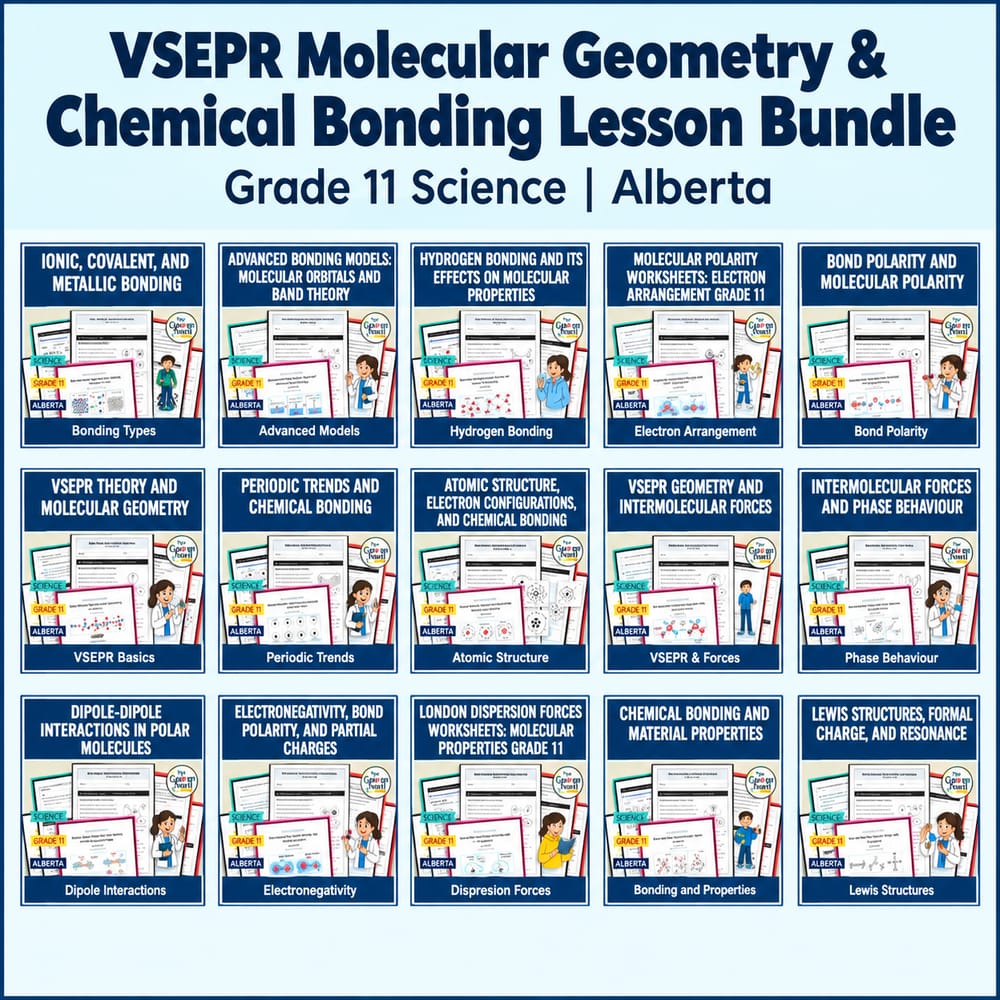
VSEPR Molecular Geometry & Chemical Bonding Lesson Bundle | Grade 11 Science | Alberta — bundle cover
VSEPR Molecular Geometry & Chemical Bonding Lesson Bundle | Grade 11 Science | Alberta — included worksheet 1
VSEPR Molecular Geometry & Chemical Bonding Lesson Bundle | Grade 11 Science | Alberta — included worksheet 2
VSEPR Molecular Geometry & Chemical Bonding Lesson Bundle | Grade 11 Science | Alberta — included worksheet 3
VSEPR Molecular Geometry & Chemical Bonding Lesson Bundle | Grade 11 Science | Alberta — included worksheet 4
VSEPR Molecular Geometry & Chemical Bonding Lesson Bundle | Grade 11 Science | Alberta — included worksheet 5
VSEPR Molecular Geometry & Chemical Bonding Lesson Bundle | Grade 11 Science | Alberta — included worksheet 6
VSEPR Molecular Geometry & Chemical Bonding Lesson Bundle | Grade 11 Science | Alberta — included worksheet 7
VSEPR Molecular Geometry & Chemical Bonding Lesson Bundle | Grade 11 Science | Alberta — included worksheet 8
VSEPR Molecular Geometry & Chemical Bonding Lesson Bundle | Grade 11 Science | Alberta — included worksheet 9
VSEPR Molecular Geometry & Chemical Bonding Lesson Bundle | Grade 11 Science | Alberta — included worksheet 10
VSEPR Molecular Geometry & Chemical Bonding Lesson Bundle | Grade 11 Science | Alberta — included worksheet 11
VSEPR Molecular Geometry & Chemical Bonding Lesson Bundle | Grade 11 Science | Alberta — included worksheet 12
VSEPR Molecular Geometry & Chemical Bonding Lesson Bundle | Grade 11 Science | Alberta — included worksheet 13
VSEPR Molecular Geometry & Chemical Bonding Lesson Bundle | Grade 11 Science | Alberta — included worksheet 14
VSEPR Molecular Geometry & Chemical Bonding Lesson Bundle | Grade 11 Science | Alberta — included worksheet 15
Grade 11 Science worksheet — VSEPR Molecular Geometry & Chemical Bonding Lesson Bundle | Grade 11 Science | Alberta

Description

Overview


VSEPR theory and molecular geometry for Grade 11 Science (Alberta) is organized into a 15-worksheet Lesson Bundle focused on chemical bonding, molecular properties, and intermolecular forces. The set moves from Lewis structures and bonding models to predicting shapes, bonding types, polarity, and how particles influence physical behavior.

What's Included


  • ✅ VSEPR Theory and Molecular Geometry Worksheets Grade 11 Science – Use VSEPR to determine molecular shape from electron-pair arrangements.
  • ✅ VSEPR Geometry and Intermolecular Forces Worksheet | Grade 11 Chemistry – Connect molecular geometry to the types of intermolecular forces present.
  • ✅ Intermolecular Forces and Phase Behaviour Worksheet Grade 11 Science – Analyze how intermolecular attractions relate to phase changes.
  • ✅ Periodic Trends and Chemical Bonding Worksheets | Grade 11 Chemistry – Apply periodic trends to predict bonding choices between elements.
  • ✅ Lewis Structures, Formal Charge and Resonance Worksheets Grade 11 – Build Lewis structures, evaluate formal charge, and interpret resonance structures.
  • ✅ Hydrogen Bonding and Molecular Properties Worksheet | Grade 11 Science – Examine how hydrogen bonding affects boiling/melting behavior and properties.
  • ✅ Electronegativity and Bond Polarity Worksheet | Grade 11 Chemistry – Use electronegativity differences to predict bond polarity.
  • ✅ Molecular Polarity Worksheets: Electron Arrangement Grade 11 Chemistry – Determine molecular polarity based on electron arrangement and shape.
  • ✅ London Dispersion Forces Worksheets: Molecular Properties Grade 11 Science – Compare London dispersion forces and link them to molecular properties.
  • ✅ Dipole-Dipole Interactions Worksheet | Grade 11 Chemistry – Predict dipole-dipole effects using polar molecules and molecular behavior.
  • ✅ Ionic, Covalent and Metallic Bonding Worksheet | Grade 11 Science – Distinguish bonding types and connect them to representative particle models.
  • ✅ Chemical Bonding and Material Properties Worksheets for Grade 11 Science – Relate bonding to material properties and observable behaviors.
  • ✅ Bond Polarity and Molecular Polarity Worksheet for Grade 11 Chemistry – Practice linking bond polarity to overall molecular polarity.
  • ✅ Atomic Structure and Chemical Bonding Worksheet | Grade 11 Science – Review atomic structure concepts that support bond formation predictions.
  • ✅ Molecular Orbital Theory and Band Theory Worksheet | Grade 11 Science – Explore molecular orbital and band theory ideas for explaining conductivity trends.

Skills & Standards


This Alberta-aligned unit emphasizes structure-to-function reasoning through chemistry models. Students use VSEPR theory to interpret electron-pair arrangements, generate molecular structures, and justify predictions with evidence from bond types, polarity, and intermolecular forces. Across the bundle, learners practice developing and testing explanations: selecting appropriate bonding models (ionic, covalent, metallic; plus MO/band ideas), predicting molecular polarity from structure, and connecting particle interactions (London dispersion, dipole-dipole, hydrogen bonding) to trends in phase behaviour and material properties. The worksheets support analytical reasoning with cause-and-effect relationships, encouraging students to communicate claims using chemical representations and model-based evidence.

Perfect For


  • Teachers seeking structured instruction
  • Sub plans
  • Homework or review
  • Intervention or centers
  • Assessment preparation

How to Use


Plan this single unit for about 1–3 weeks of classroom use, selecting worksheets in a logical sequence: start with Lewis structures and bonding foundations, then move into VSEPR geometry and polarity, and finish by comparing intermolecular forces and material/phase behaviour. Try a short warm-up daily (for example, one quick electron-pair-to-shape prompt), follow with guided practice where students justify predictions for polarity and forces, and use exit tickets to check understanding (e.g., “Given this structure, identify the intermolecular forces and predict a property trend”). For an end-of-unit review, assign a mixed set that includes bond polarity, molecular polarity, and one phase/temperature reasoning worksheet to consolidate the unit’s model connections.

Closing


With 15 ready-to-use worksheets, this Lesson Bundle supports a coherent Grade 11 Science progression from VSEPR theory to the molecular interactions that explain real material behaviour. ✅

VSEPR Molecular Geometry & Chemical Bonding Lesson Bundle | Grade 11 Science | Alberta

$48.00$60.00Save $12.00
the curious pencil
·1 followers·3 sales
SubjectScienceGradeGrade 11Pages280 PagesSubject areaChemistry, Physical Science, Basic Principles, Environment, General Science, PhysicsStandardsAligned to Alberta curriculumAnswer keyIncluded

What’s included

15 worksheets · 280 pages · Save $12.00 (20%) · prices shown inside the bundle

  1. Ionic, Covalent and Metallic Bonding Worksheet | Grade 11 Science
    Ionic, Covalent and Metallic Bonding Worksheet | Grade 11 Science

    Grade 11 · Science · 19 Pages

    • Compare electron transfer, sharing, and delocalisation in chemical bonds
    • Describe ionic lattices, covalent molecules, and metallic structures
    • Explain electrical conductivity using mobile ions and electrons
    $3.20$4.00
  2. Molecular Orbital Theory and Band Theory Worksheet Grade 11 Science
    Molecular Orbital Theory and Band Theory Worksheet Grade 11 Science

    Grade 11 · Science · 20 Pages

    • Explain how atomic orbitals combine to form molecular orbitals
    • Compare bonding and antibonding orbitals by formation and relative energy
    • Distinguish conductors, semiconductors, and insulators using band gaps
    $3.20$4.00
  3. Hydrogen Bonding and Molecular Properties Worksheet | Grade 11 Science
    Hydrogen Bonding and Molecular Properties Worksheet | Grade 11 Science

    Grade 11 · Science · 20 Pages

    • Identify suitable donor and acceptor groups involved in hydrogen bonding.
    • Explain how hydrogen bonding influences water's boiling point and ice density.
    • Relate hydrogen bonding to protein structure and polymer properties.
    $3.20$4.00
  4. Molecular Polarity Worksheets: Electron Arrangement Grade 11 Chemistry
    Molecular Polarity Worksheets: Electron Arrangement Grade 11 Chemistry

    Grade 11 · Science · 17 Pages

    • Explain how electronegativity differences affect electron distribution
    • Compare the polarity of water and carbon dioxide
    • Interpret molecular geometry and bond dipoles to predict polarity
    $3.20$4.00
  5. Bond Polarity and Molecular Polarity Worksheet for Grade 11 Chemistry
    Bond Polarity and Molecular Polarity Worksheet for Grade 11 Chemistry

    Grade 11 · Science · 18 Pages

    • Explain how electronegativity differences produce partial charges in covalent bonds.
    • Represent bond dipoles as vectors pointing toward more electronegative atoms.
    • Compare molecular polarity using molecular geometry and bond dipole cancellation.
    $3.20$4.00
  6. VSEPR Theory and Molecular Geometry Worksheets Grade 11 Science
    VSEPR Theory and Molecular Geometry Worksheets Grade 11 Science

    Grade 11 · Science · 17 Pages

    • Explain how electron-group repulsion determines molecular geometry
    • Identify five common electron-group geometries and their ideal angles
    • Distinguish bonding pairs from nonbonding electron pairs
    $3.20$4.00
  7. Periodic Trends and Chemical Bonding Worksheets | Grade 11 Chemistry
    Periodic Trends and Chemical Bonding Worksheets | Grade 11 Chemistry

    Grade 11 · Science · 20 Pages

    • Explain atomic radius trends across periods and down groups
    • Compare ionization energy with electronegativity
    • Predict cation and anion formation from periodic trends
    $3.20$4.00
  8. Atomic Structure and Chemical Bonding Worksheet | Grade 11 Science
    Atomic Structure and Chemical Bonding Worksheet | Grade 11 Science

    Grade 11 · Science · 19 Pages

    • Identify the locations, charges, and roles of subatomic particles.
    • Determine electron configurations from atomic numbers.
    • Explain how valence electrons influence ion formation and reactivity.
    $3.20$4.00
  9. VSEPR Geometry and Intermolecular Forces Worksheet | Grade 11 Chemistry
    VSEPR Geometry and Intermolecular Forces Worksheet | Grade 11 Chemistry

    Grade 11 · Science · 18 Pages

    • Use VSEPR theory to predict molecular shapes.
    • Explain how molecular geometry affects permanent molecular polarity.
    • Distinguish London dispersion, dipole-dipole, and hydrogen bonding.
    $3.20$4.00
  10. Intermolecular Forces and Phase Behaviour Worksheet Grade 11 Science
    Intermolecular Forces and Phase Behaviour Worksheet Grade 11 Science

    Grade 11 · Science · 19 Pages

    • Explain how intermolecular attractions influence vapour pressure and boiling point.
    • Compare how molecular size and polarity affect boiling behaviour.
    • Interpret phase diagrams to describe physical states under changing conditions.
    $3.20$4.00

Reviews & Feedback

Loading reviews...

Questions & Answers

Loading questions…

About this bundle

Related categories

Frequently asked questions

Who is VSEPR Molecular Geometry & Chemical Bonding Lesson Bundle | Grade 11 Science | Alberta designed for?
VSEPR Molecular Geometry & Chemical Bonding Lesson Bundle | Grade 11 Science | Alberta is designed for Grade 11 students and Science learners and can be used in classrooms, homeschool, or independent practice.
How do I download VSEPR Molecular Geometry & Chemical Bonding Lesson Bundle | Grade 11 Science | Alberta?
Add it to your cart and complete checkout. After payment, you can download immediately from your account, and you'll also receive a download link by email.