
Reading comprehension Worksheets
40,289 type resources
Grade 11 Science | Tissue Organization Worksheet | BC-Aligned
 Created byLumora Learning
Learning Objectives
- Understand how multicellular organisms organize cells into tissues, organs, and systems.
- Describe the processes of cellular differentiation and specialization in tissue formation.
- Explain models of tissue architecture and intercellular communication in maintaining organism functions.
Also included in: Grade 11 Science | Biology Custom Bundle | BC-Aligned
Instant download

Grade 11 Science | Electromagnetic Spectrum Worksheet | California Standards
Created byLumora LearningLearning Objectives
- Explain how wavelength and frequency relate across the electromagnetic spectrum and how photon energy depends on frequency
- Describe how absorption and emission produce characteristic spectra tied to atomic energy levels
- Analyze how reflection and scattering depend on wavelength relative to material structures
Instant download
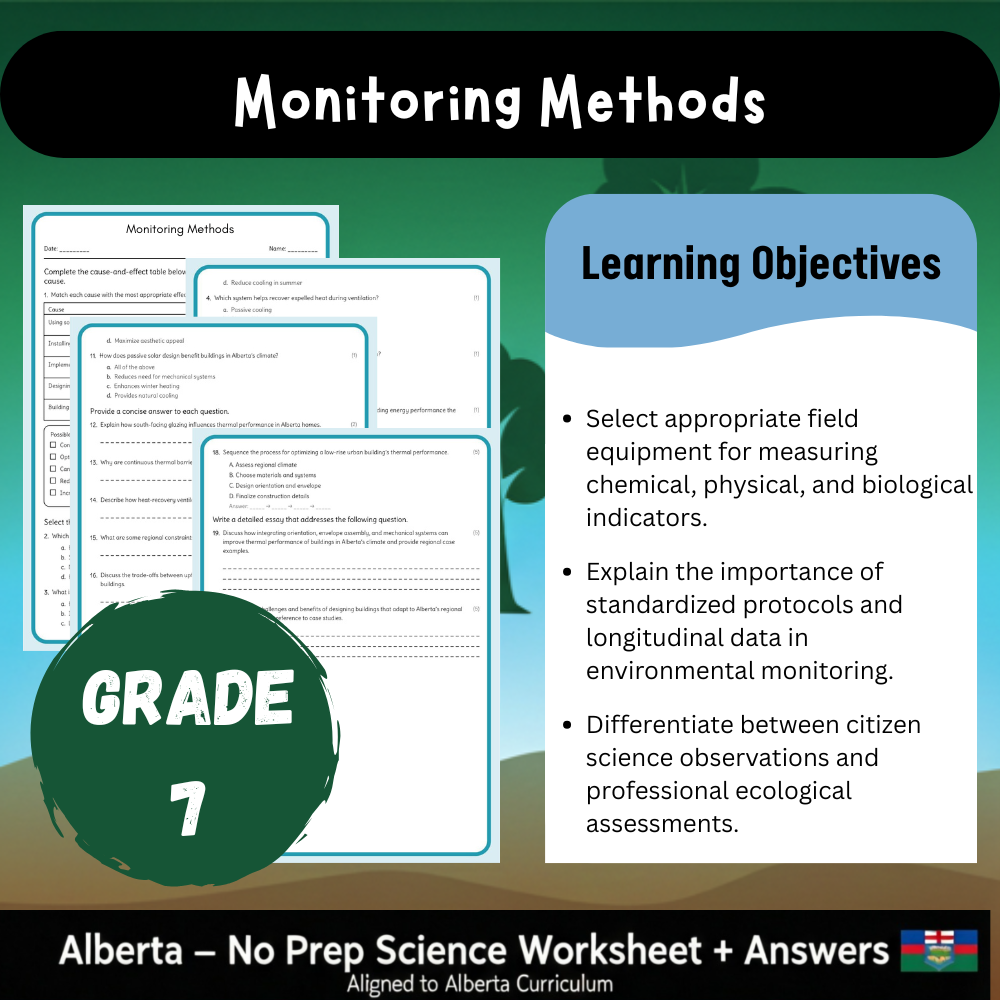
Grade 7 Science | Monitoring Methods Worksheet (PDF) – Alberta Standards
 Created byBright Mind Resources
Learning Objectives
- Understand the different data collection techniques used in ecological monitoring.
- Identify key considerations for designing effective monitoring protocols.
- Recognize how standardized sampling enables detection of ecological changes over time.
Instant download
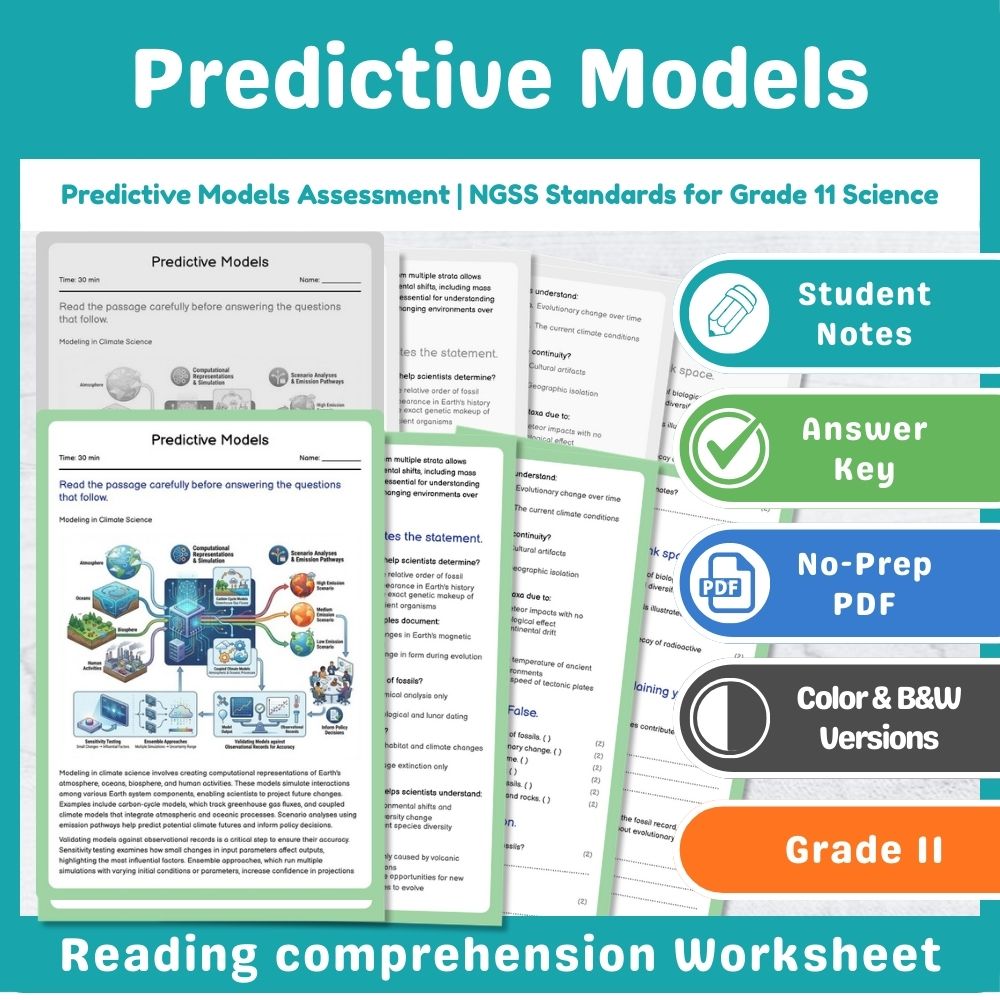
Predictive Models Assessment | NGSS Standards-Aligned Assessment for Grade 11 Science
 Created byPrism Point Learning
Learning Objectives
- Understand the role of modeling in projecting climate-related variables.
- Identify different types of climate models and their purposes.
- Evaluate the importance of model validation and sensitivity testing.
Instant download
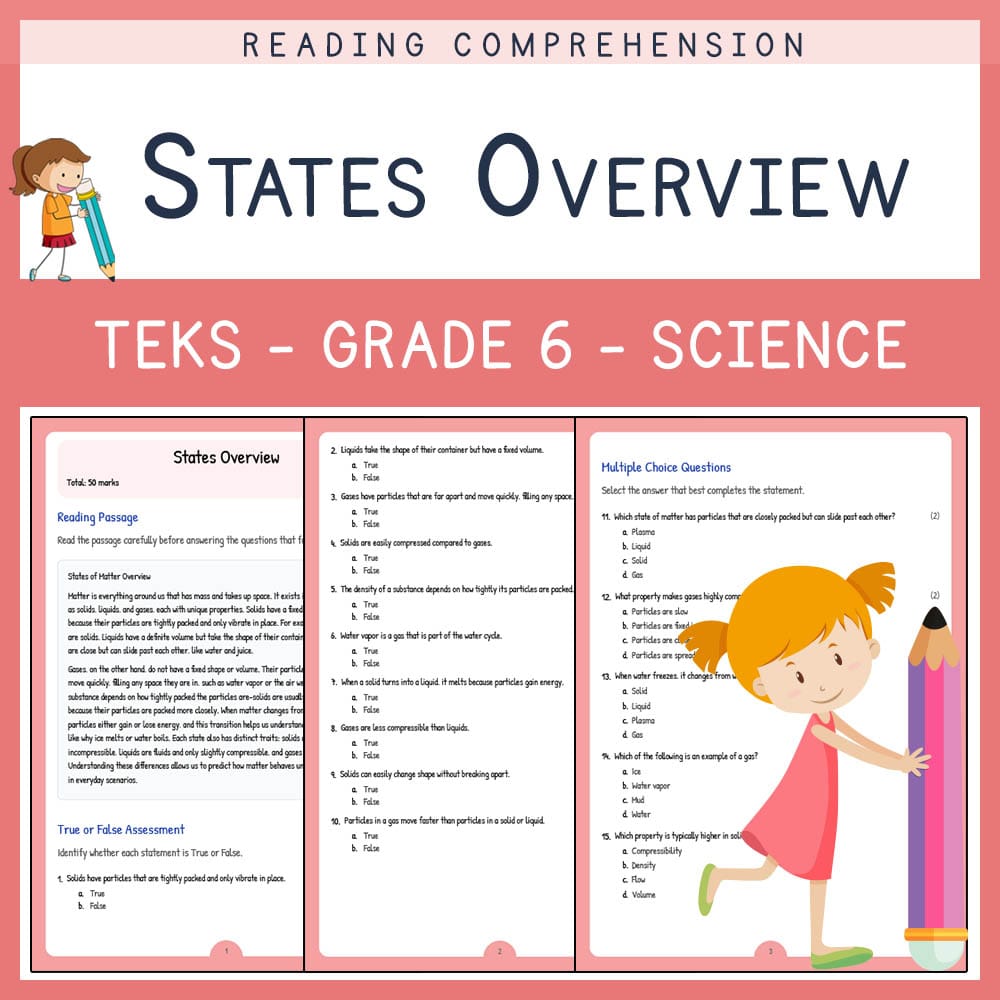
Grade 6 Science | States Overview Worksheet | TEKS-Aligned
Created byLumora LearningLearning Objectives
- Describe the three main states of matter: solid, liquid, and gas.
- Explain how particles are arranged and move in different states of matter.
- Compare properties such as shape, volume, density, and compressibility among solids, liquids, and gases.
Also included in: Grade 6 Science | Matter and Energy Lesson Bundle | TEKS Aligned
Instant download
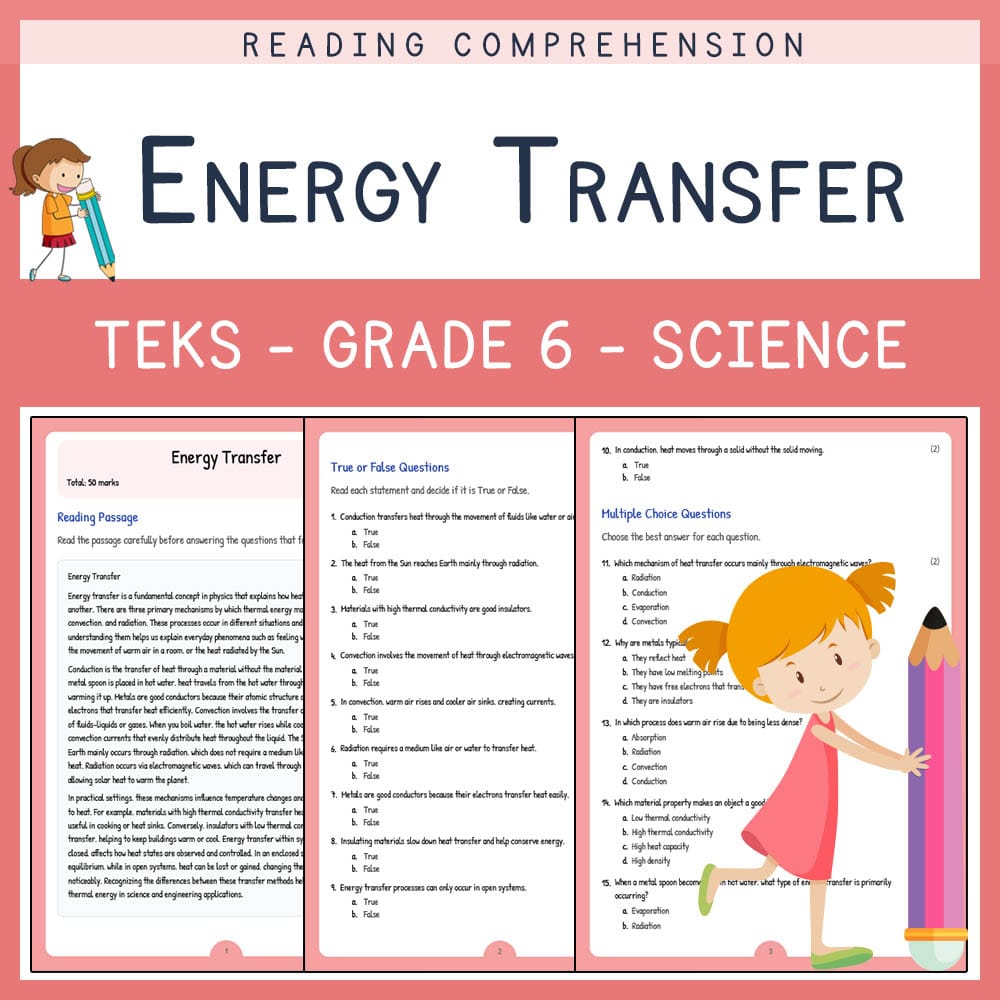
Grade 6 Science | Energy Transfer Worksheet | TEKS-Aligned
Created byLumora LearningLearning Objectives
- Explain the mechanisms of thermal energy transfer: conduction, convection, and radiation.
- Identify practical examples of each energy transfer method in real-world contexts.
- Connect energy transfer processes to observable temperature changes and material properties.
Also included in: Grade 6 Science | Matter and Energy Lesson Bundle | TEKS Aligned
Instant download
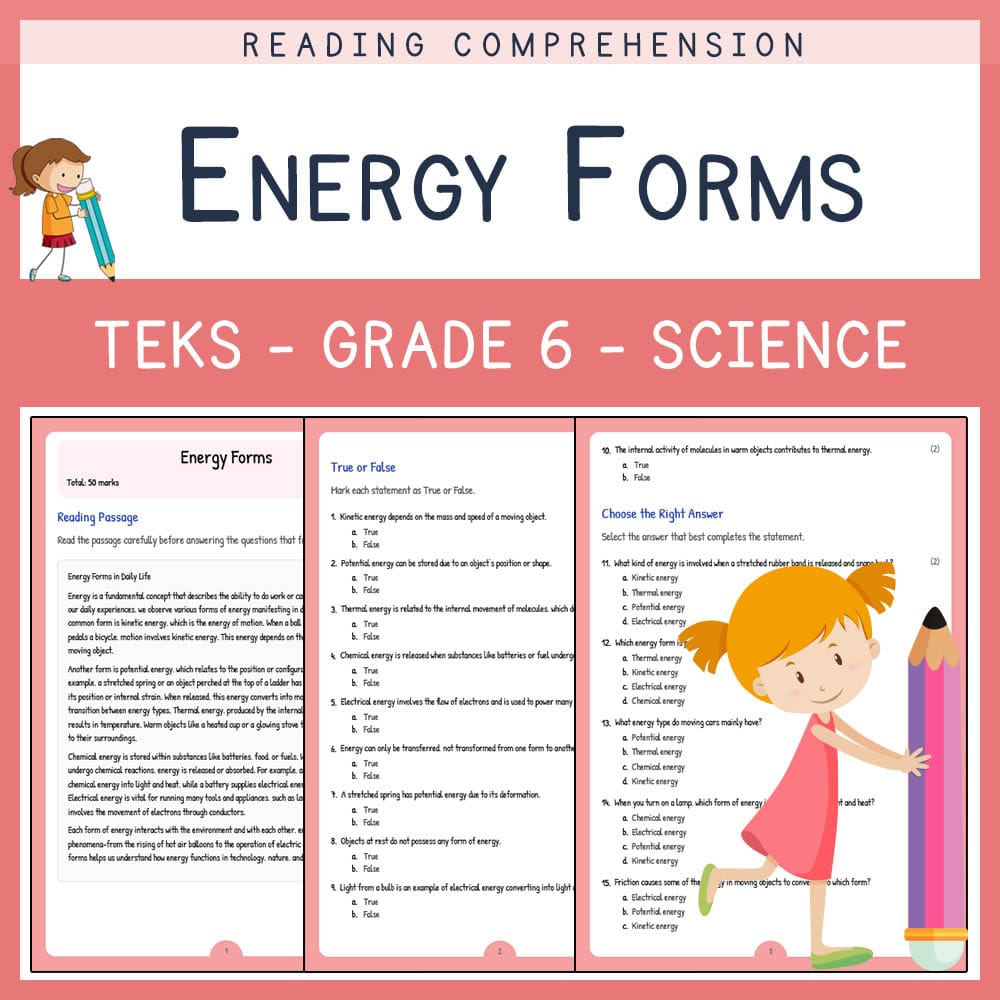
Grade 6 Science | Energy Forms Worksheet | TEKS-Aligned
Created byLumora LearningLearning Objectives
- Identify and describe common forms of energy including kinetic, potential, thermal, chemical, and electrical.
- Relate each form of energy to familiar phenomena such as moving objects, stretched springs, warm objects, and batteries.
- Understand the differences and distinctions among various energy forms based on their characteristics and associated activities.
Also included in: Grade 6 Science | Matter and Energy Lesson Bundle | TEKS Aligned
Instant download
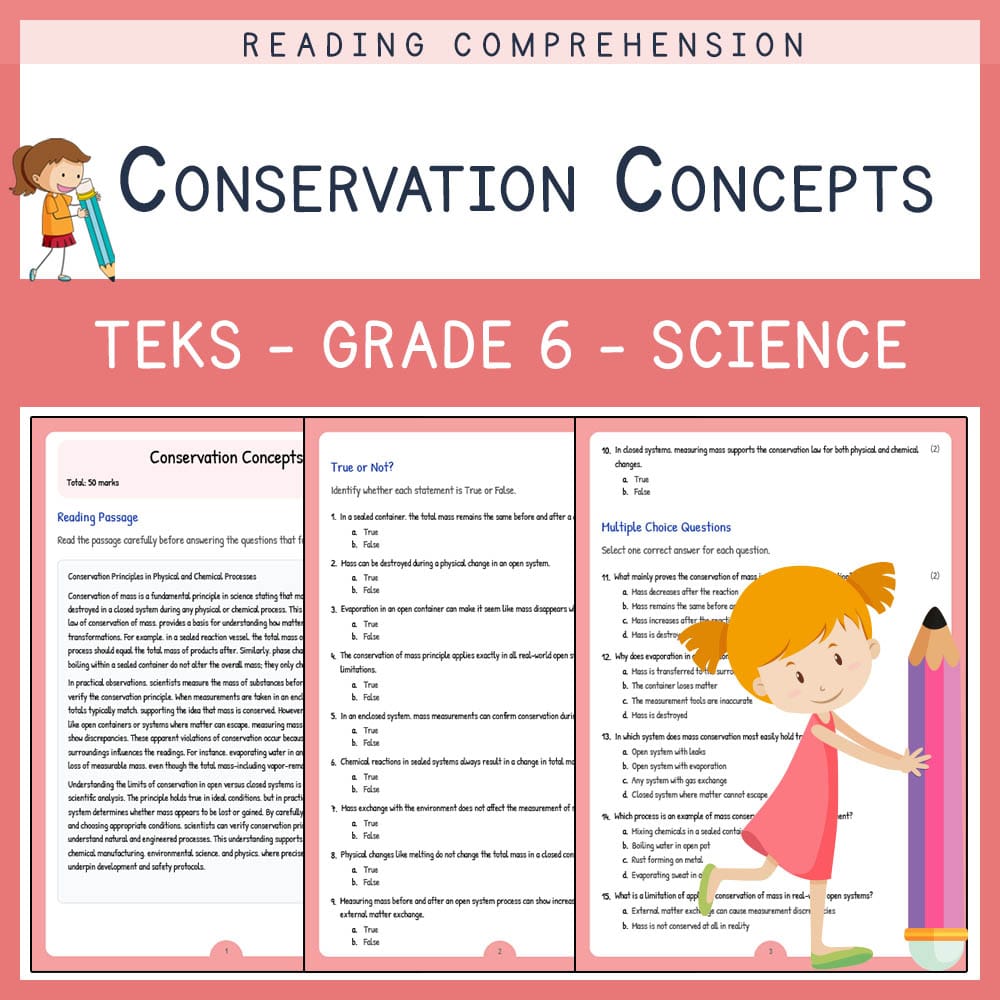
Grade 6 Science | Conservation Concepts Worksheet | TEKS Alligned
Created byLumora LearningLearning Objectives
- Understand the principle of conservation of mass in closed systems during physical and chemical changes.
- Identify real-world examples where mass conservation applies or does not apply.
- Interpret measurements before and after a process to determine if mass is conserved.
Also included in: Grade 6 Science | Matter and Energy Lesson Bundle | TEKS Aligned
Instant download
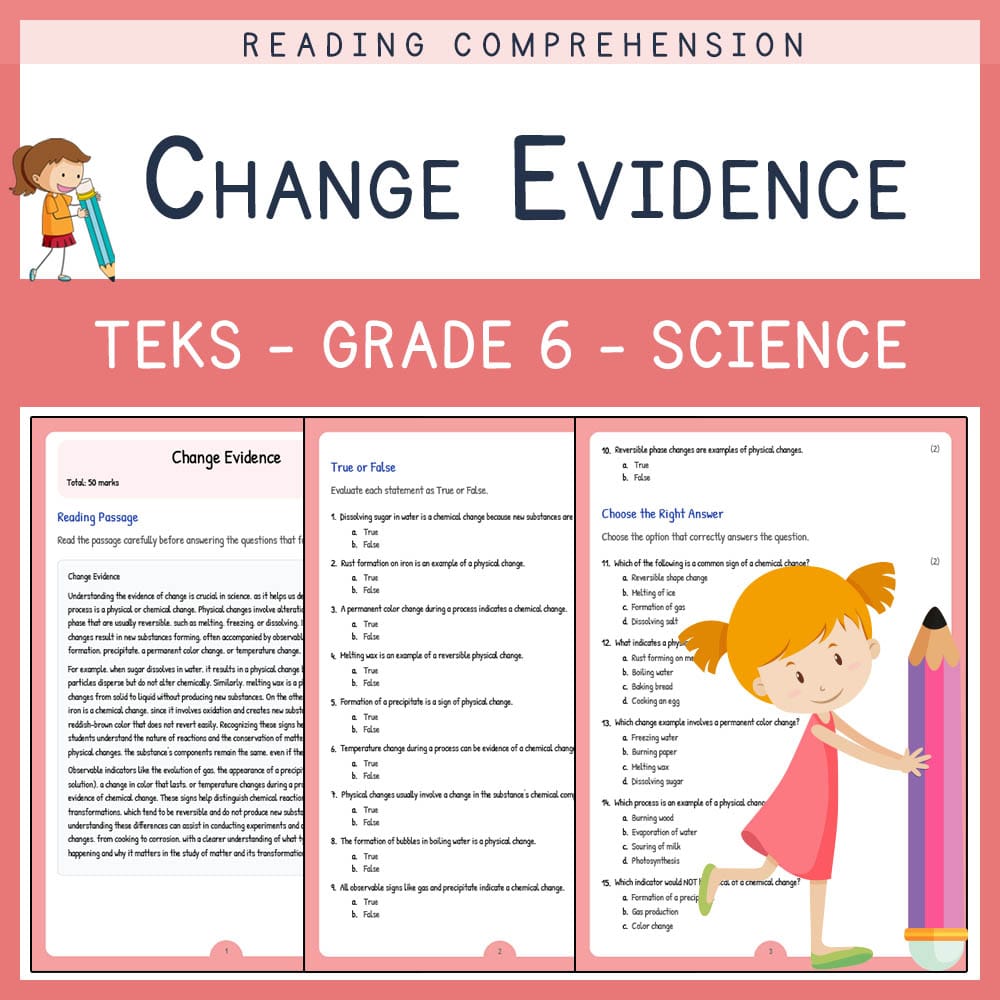
Grade 6 Science | Change Evidence Worksheet | TEKS-Aligned
Created byLumora LearningLearning Objectives
- Differentiate between physical and chemical changes based on observable indicators.
- Identify characteristic evidence of chemical changes such as gas formation, precipitate, color change, and temperature change.
- Understand that physical changes are often reversible and involve shape or phase alterations without changing substance composition.
Also included in: Grade 6 Science | Matter and Energy Lesson Bundle | TEKS Aligned
Instant download
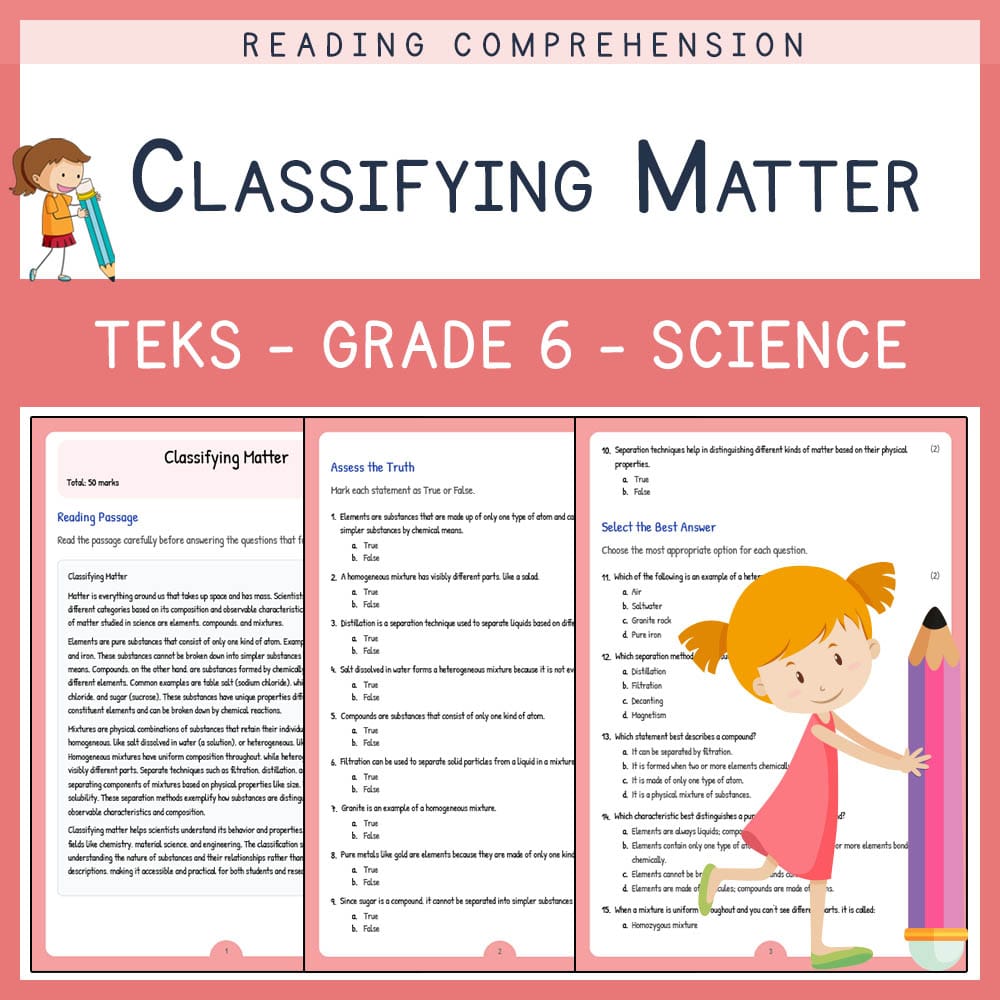
Grade 6 Science | Classifying Matter Worksheet | TEKS Alligned
Created byLumora LearningLearning Objectives
- Understand the different categories of matter: elements, compounds, and mixtures.
- Identify examples and distinguishing features of each category.
- Learn common separation techniques and how they relate to matter classification.
Also included in: Grade 6 Science | Matter and Energy Lesson Bundle | TEKS Aligned
Instant download

Grade 6 Science | Forces Basics Worksheet | TEKS Alligned
Created byLumora LearningLearning Objectives
- Understand the difference between contact and noncontact forces including gravity, friction, and normal force.
- Explain how balanced and unbalanced forces affect motion.
- Describe the concept of net force and its effects on objects in everyday situations.
Also included in: Grade 6 Science | Matter and Energy Lesson Bundle | TEKS Aligned
Instant download
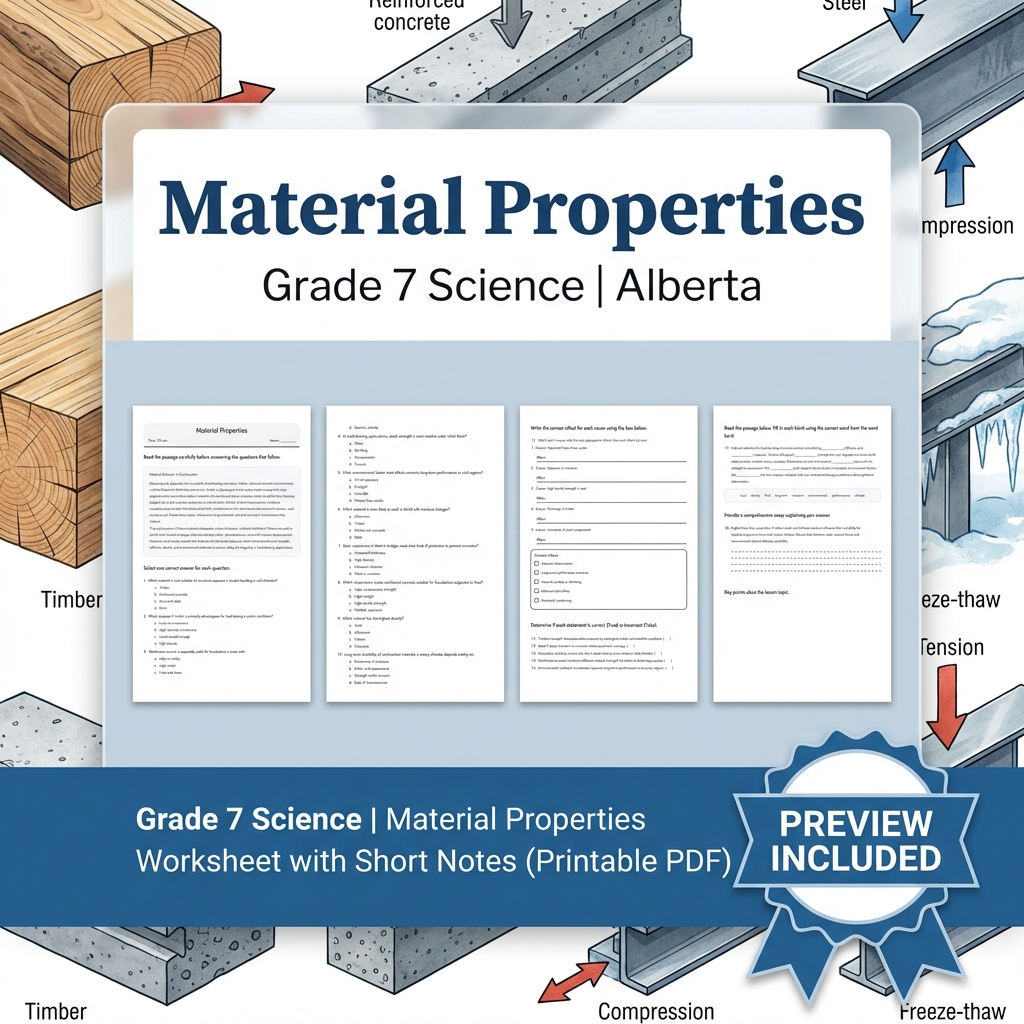
Grade 7 Science | Material Properties Worksheet with Short Notes (Printable PDF)
 Created byMeadowlark Worksheets
Learning Objectives
- Understand how different materials behave under compression, tension, and bending.
- Compare timber, steel, and concrete in load-bearing construction applications.
- Analyze the influence of environmental factors on material performance and maintenance.
Also included in: Grade 7 Science | Forces, Structures & Motion UNIT Worksheet Bundle
Instant download

Grade 11 Science – Ionic Strength Concepts Worksheet (PDF)
Created byBright Mind ResourcesLearning Objectives
- Understand the concept of ionic strength and its impact on activity coefficients.
- Explain how high ionic strength influences solubility and equilibrium in aqueous solutions.
- Apply knowledge of ionic strength to natural waters and industrial brines, with real-world examples.
Instant download
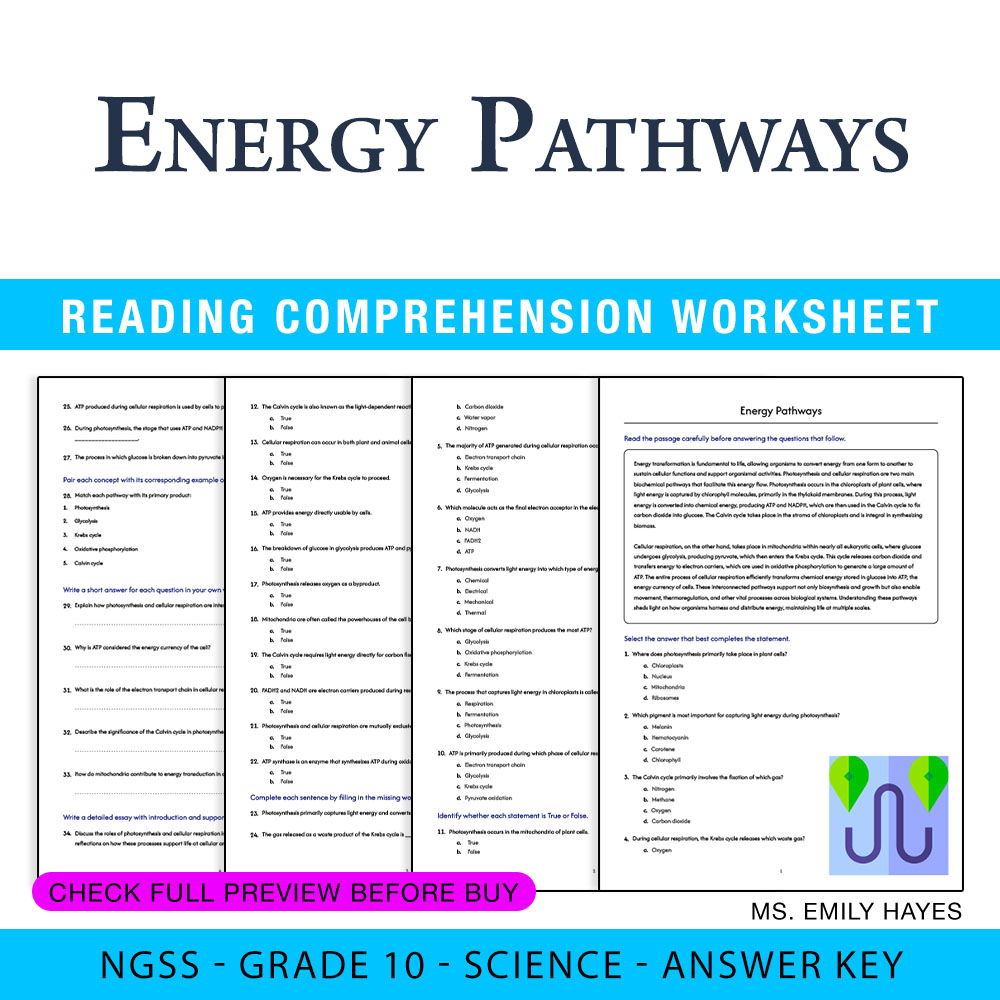
10th Grade Science | Energy Pathways Worksheet (PDF+ Answer Key)
 Created byCopper Leaf Classroom
Learning Objectives
- Explain the process of photosynthesis and its role in energy capture.
- Describe cellular respiration pathways and their relationship to ATP production.
- Illustrate how energy transduction supports life processes across cellular and organismal scales.
Instant download
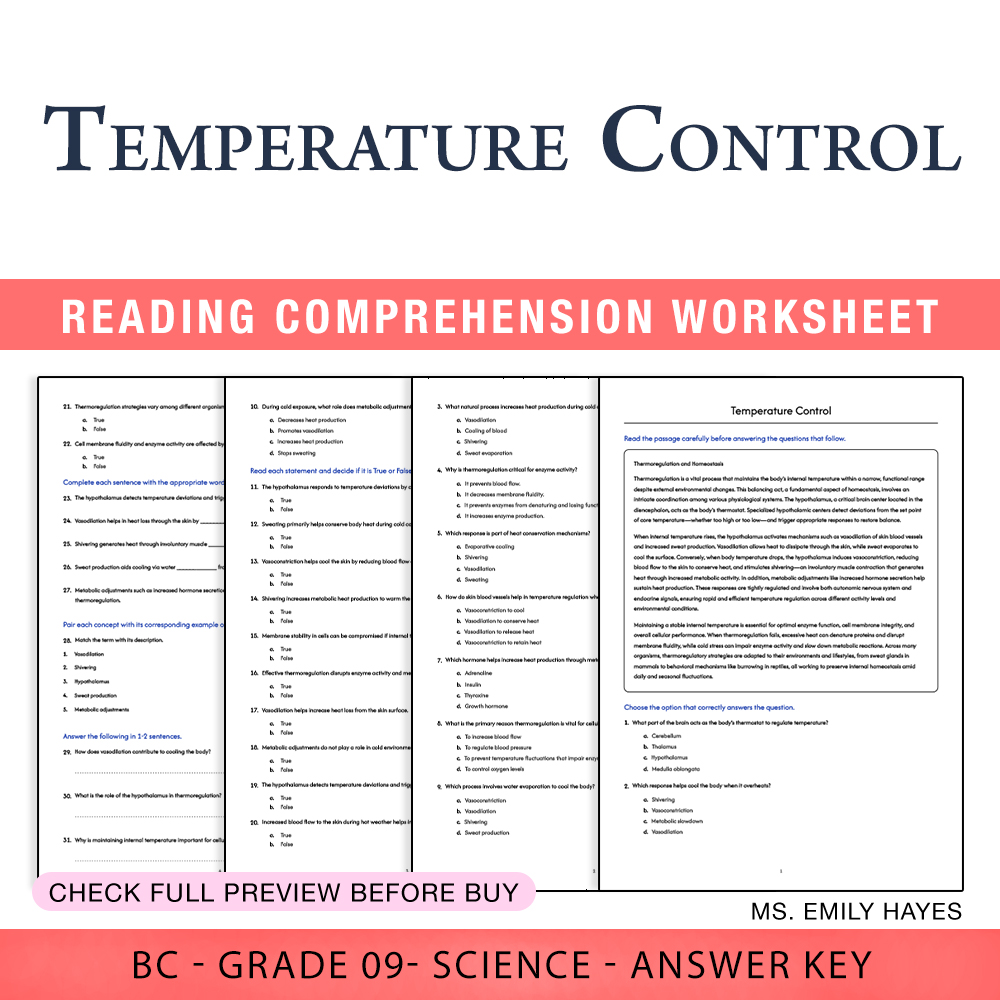
Grade 9 Science | Temperature Control Worksheet (PDF+ Answer Key)
Created byCopper Leaf ClassroomLearning Objectives
- Explain how hypothalamic centers regulate internal body temperature.
- Describe the physiological responses involved in thermoregulation.
- Identify the roles of skin blood flow, sweat production, shivering, and metabolic adjustments.
Also included in: Grade 9 Science Worksheet Pack | Biology & Cell Structures (PDF+ Answer Keys) +1 more
Instant download
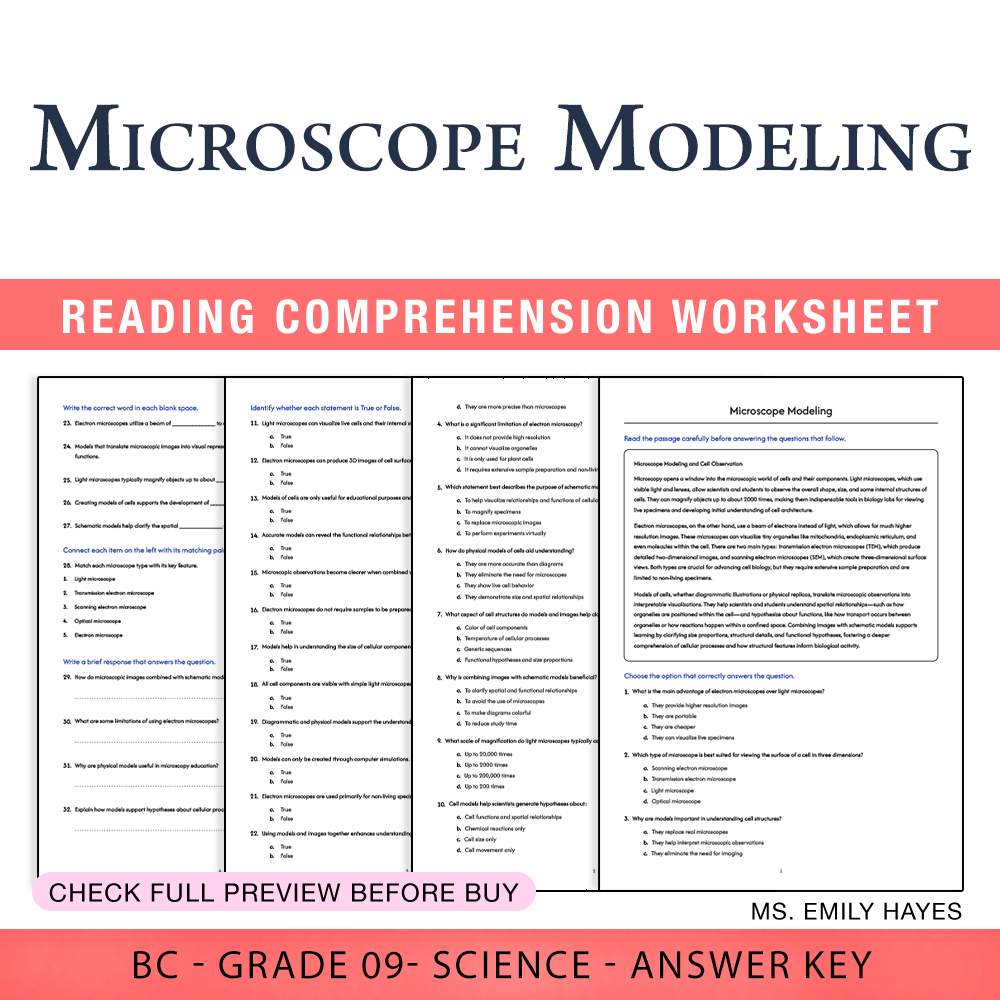
Grade 9 Science | Microscope Modeling Worksheet (PDF+ Answer Key)
Created byCopper Leaf ClassroomLearning Objectives
- Understand how microscopes reveal details of cell structures.
- Learn the differences between various types of microscopy.
- Interpret diagrammatic and physical models of cells.
Also included in: Grade 9 Science Worksheet Pack | Biology & Cell Structures (PDF+ Answer Keys) +1 more
Instant download
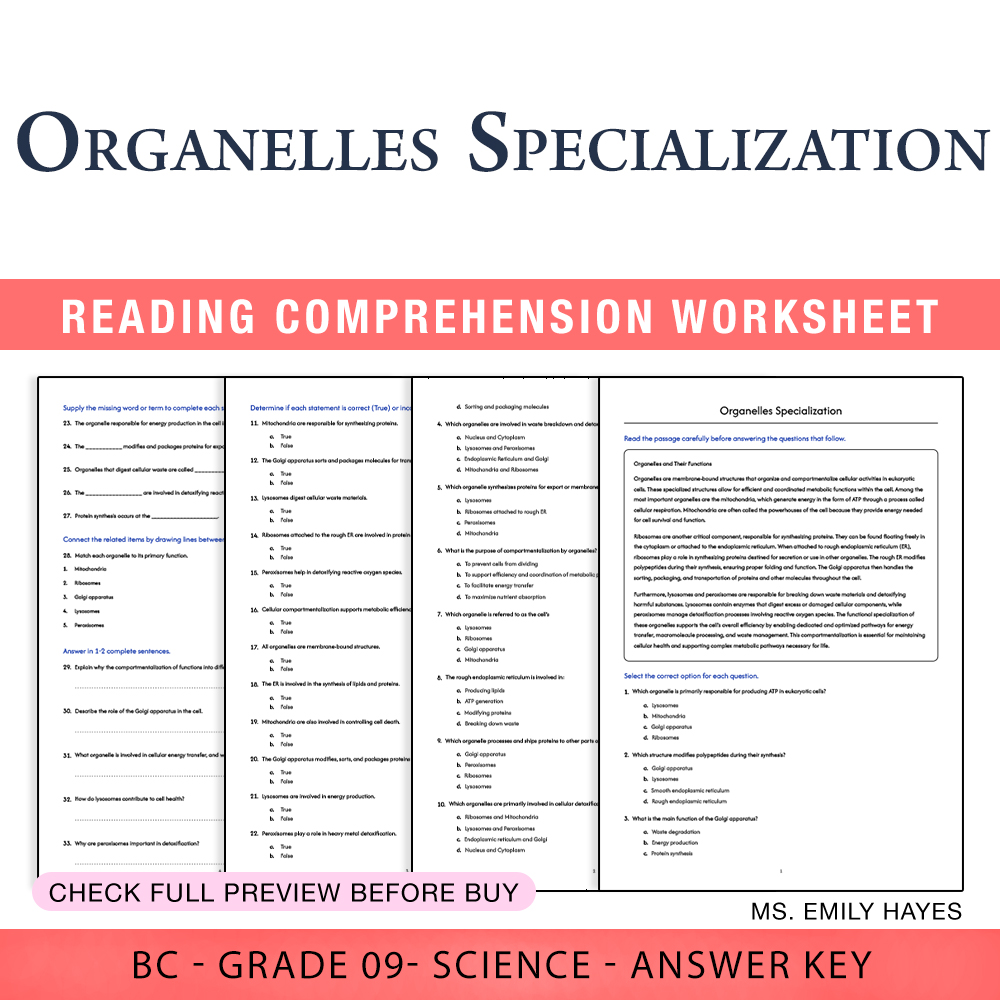
9th Grade Science | Organelles Specialization Worksheet (PDF+ Answer Key)
Created byCopper Leaf ClassroomLearning Objectives
- Describe the functions of key cellular organelles involved in specialization.
- Explain how structural differences among organelles support cellular efficiency.
- Identify the roles of mitochondria, ribosomes, rough endoplasmic reticulum, Golgi apparatus, lysosomes, and peroxisomes.
Also included in: Grade 9 Science Worksheet Pack | Biology & Cell Structures (PDF+ Answer Keys) +1 more
Instant download
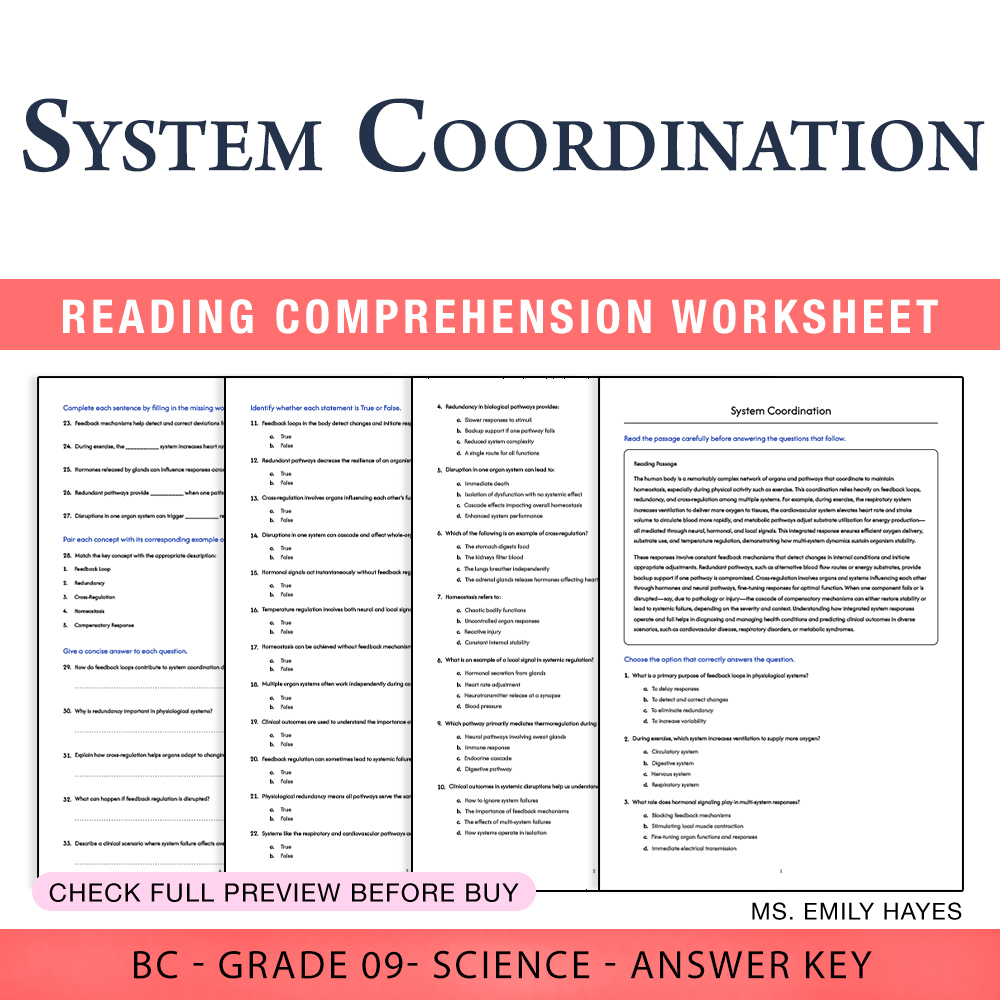
Grade 9 Science | System Coordination Worksheet (PDF+ Answer Key)
Created byCopper Leaf ClassroomLearning Objectives
- Explain how feedback loops, redundancy, and cross-regulation coordinate multiple organ systems.
- Describe how responses to exercise involve respiratory, cardiovascular, and metabolic pathways.
- Identify the mechanisms by which disruptions in one system affect overall homeostasis.
Also included in: Grade 9 Science Worksheet Pack | Biology & Cell Structures (PDF+ Answer Keys) +1 more
Instant download
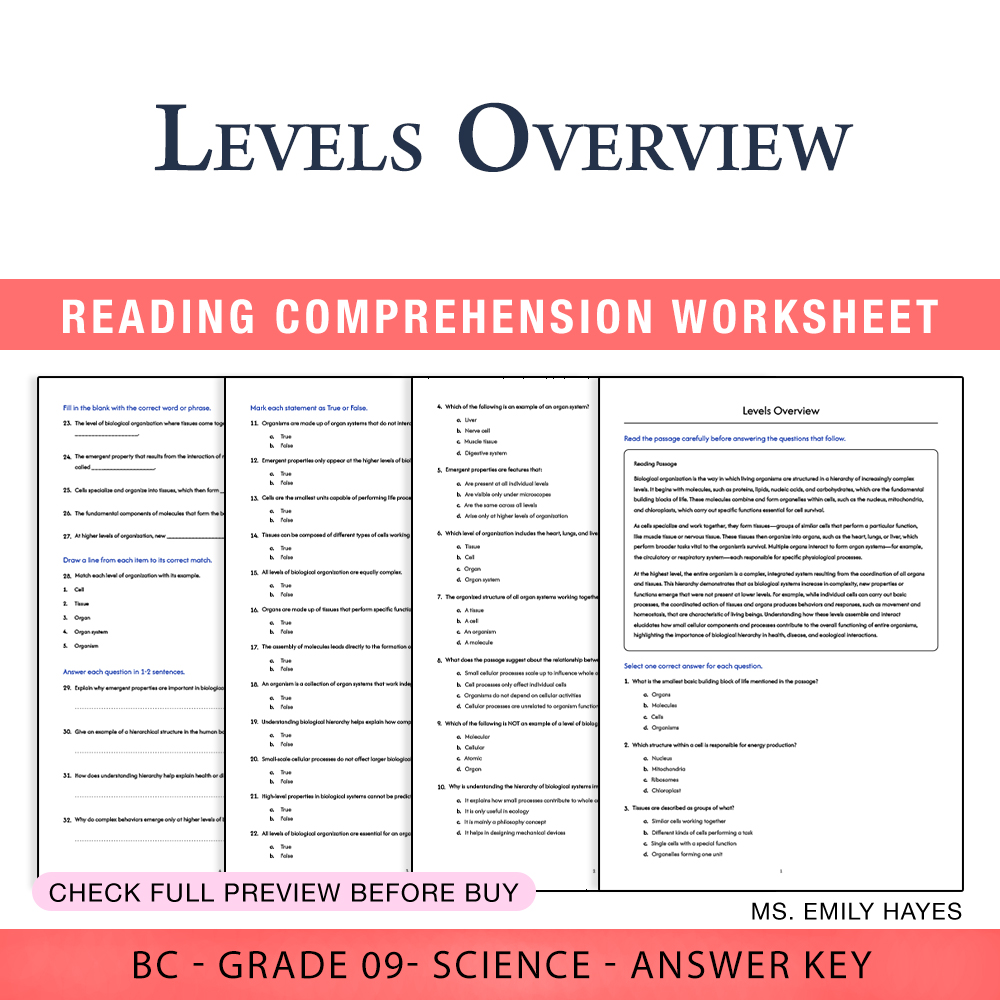
9th Grade Science | Levels of Biological Organization Worksheet(PDF+ Answer Key)
Created byCopper Leaf ClassroomLearning Objectives
- Describe the hierarchical levels of biological organization from molecules to organisms.
- Explain the concept of emergent properties at each level of biological organization.
- Understand how components assemble into complex biological systems to maintain function.
Also included in: Grade 9 Science Worksheet Pack | Biology & Cell Structures (PDF+ Answer Keys) +1 more
Instant download
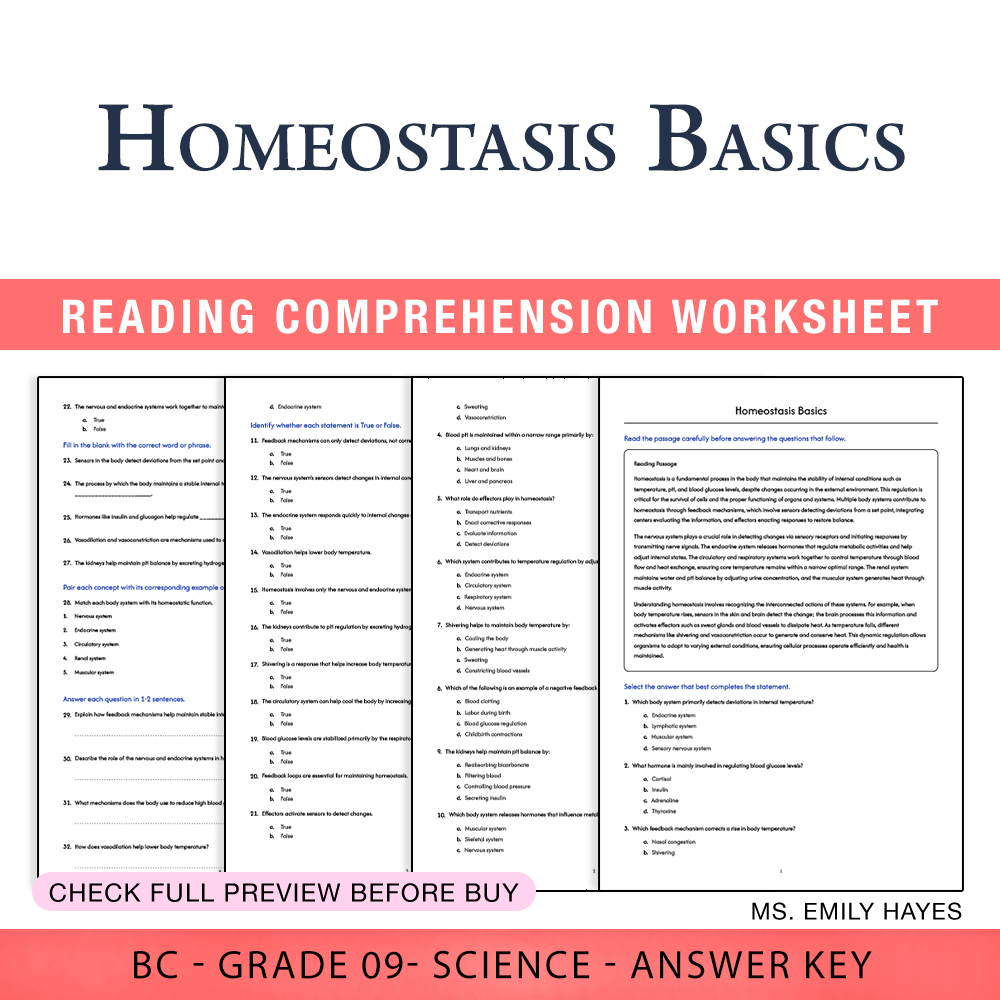
9th Grade Science | Homeostasis Basics Worksheet (PDF+ Answer Key)
Created byCopper Leaf ClassroomLearning Objectives
- Explain the concept of homeostasis and its importance in maintaining internal body conditions.
- Identify and describe the key body systems involved in homeostasis.
- Understand feedback mechanisms that regulate temperature, pH, and blood glucose levels.
Also included in: Grade 9 Science Worksheet Pack | Biology & Cell Structures (PDF+ Answer Keys) +1 more
Instant download
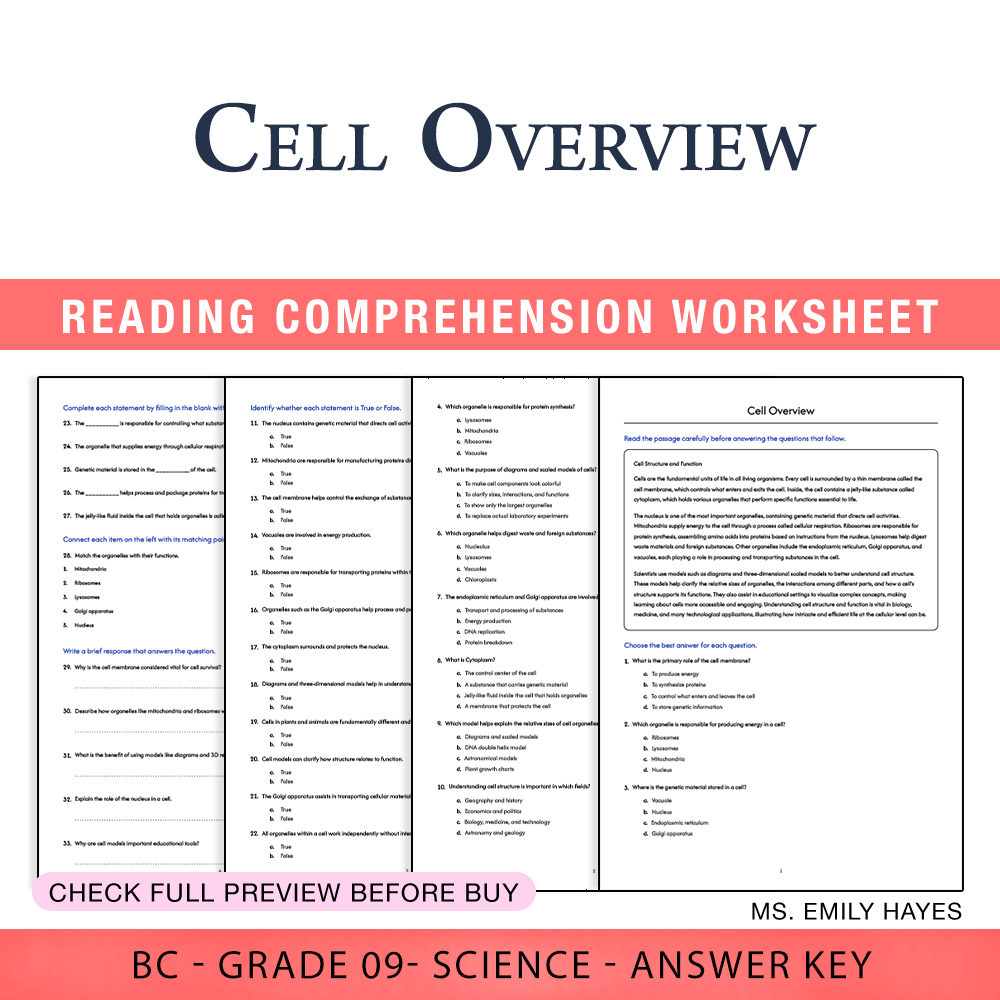
Grade 9 Science | Cell Overview Worksheet (PDF+ Answer Key)
Created byCopper Leaf ClassroomLearning Objectives
- Identify the main structures and functions of a cell and its organelles.
- Describe how cellular structures relate to their functions.
- Understand different models used to illustrate cell components and their relative sizes.
Also included in: Grade 9 Science Worksheet Pack | Biology & Cell Structures (PDF+ Answer Keys) +1 more
Instant download
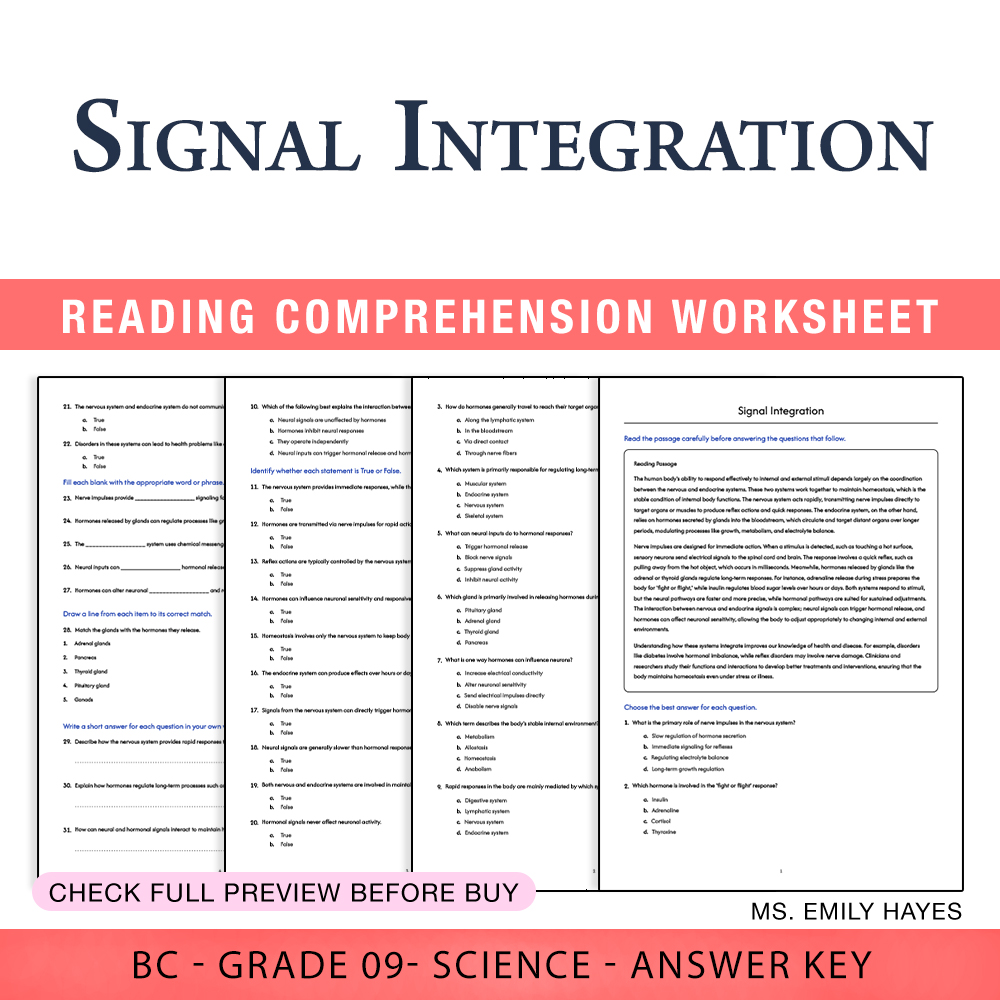
Grade 9 Science | Signal Integration Worksheet (PDF+ Answer Key)
Created byCopper Leaf ClassroomLearning Objectives
- Understand how the nervous and endocrine systems coordinate responses to stimuli.
- Identify different signals and their roles in maintaining homeostasis.
- Compare rapid nerve responses with slower hormonal responses.
Also included in: Grade 9 Science Worksheet Pack | Biology & Cell Structures (PDF+ Answer Keys) +1 more
Instant download
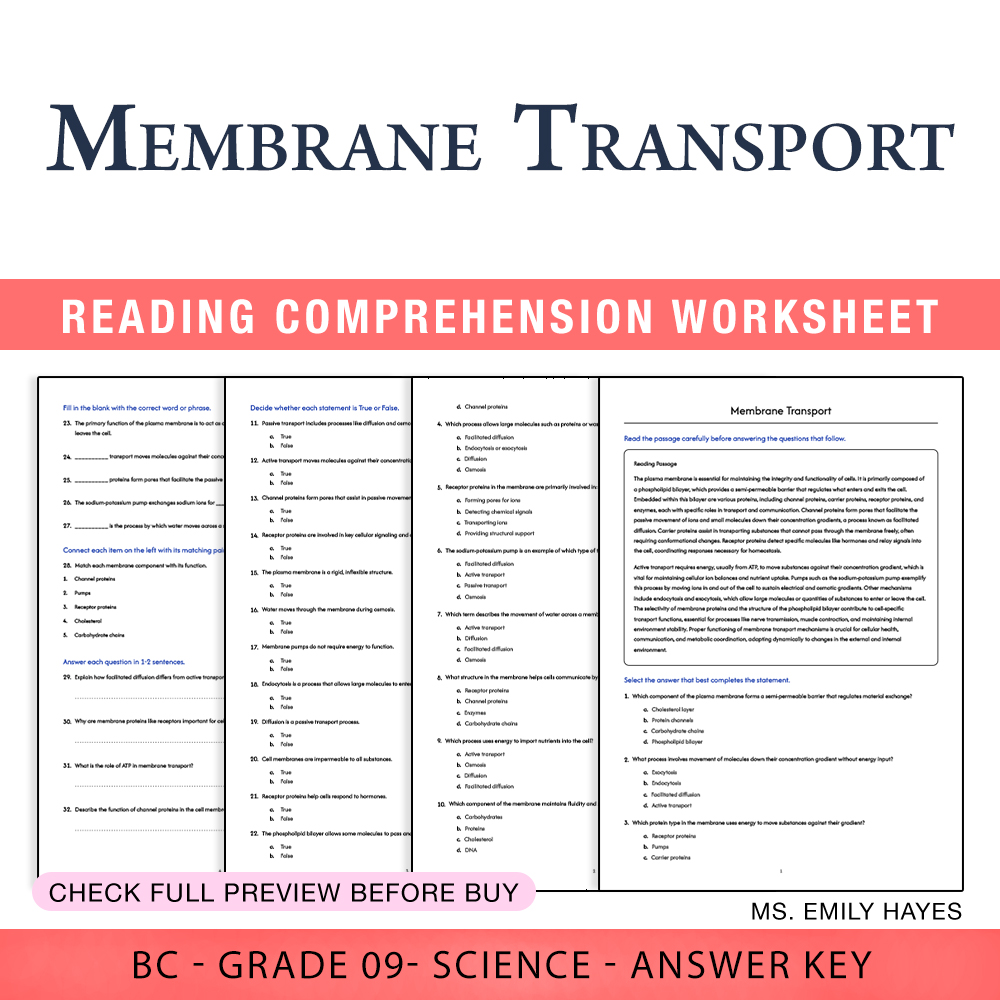
9th Grade Science | Membrane Transport Worksheet (PDF+ Answer Key)
Created byCopper Leaf ClassroomLearning Objectives
- Describe the structure of the plasma membrane and its components involved in transport.
- Differentiate between passive and active transport mechanisms.
- Explain how membrane proteins like channels, pumps, and receptors facilitate cellular functions.
Also included in: Grade 9 Science Worksheet Pack | Biology & Cell Structures (PDF+ Answer Keys) +1 more
Instant download
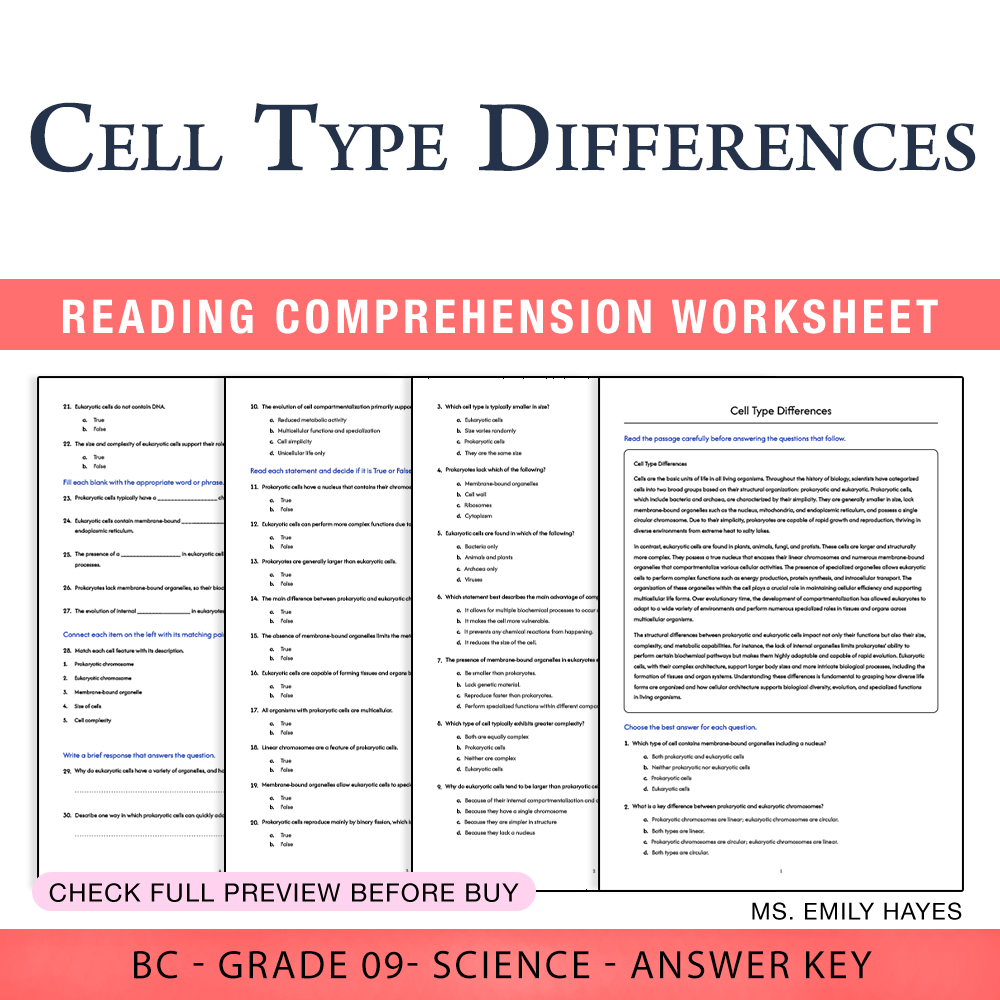
Grade 9 Science | Cell Type Differences Worksheet (PDF+ Answer Key)
Created byCopper Leaf ClassroomLearning Objectives
- Compare the structural differences between prokaryotic and eukaryotic cells.
- Identify key features of prokaryotic cells and how they differ from eukaryotic cells.
- Describe the roles of membrane-bound organelles in eukaryotic cells.
Also included in: Grade 9 Science Worksheet Pack | Biology & Cell Structures (PDF+ Answer Keys) +1 more
Instant download
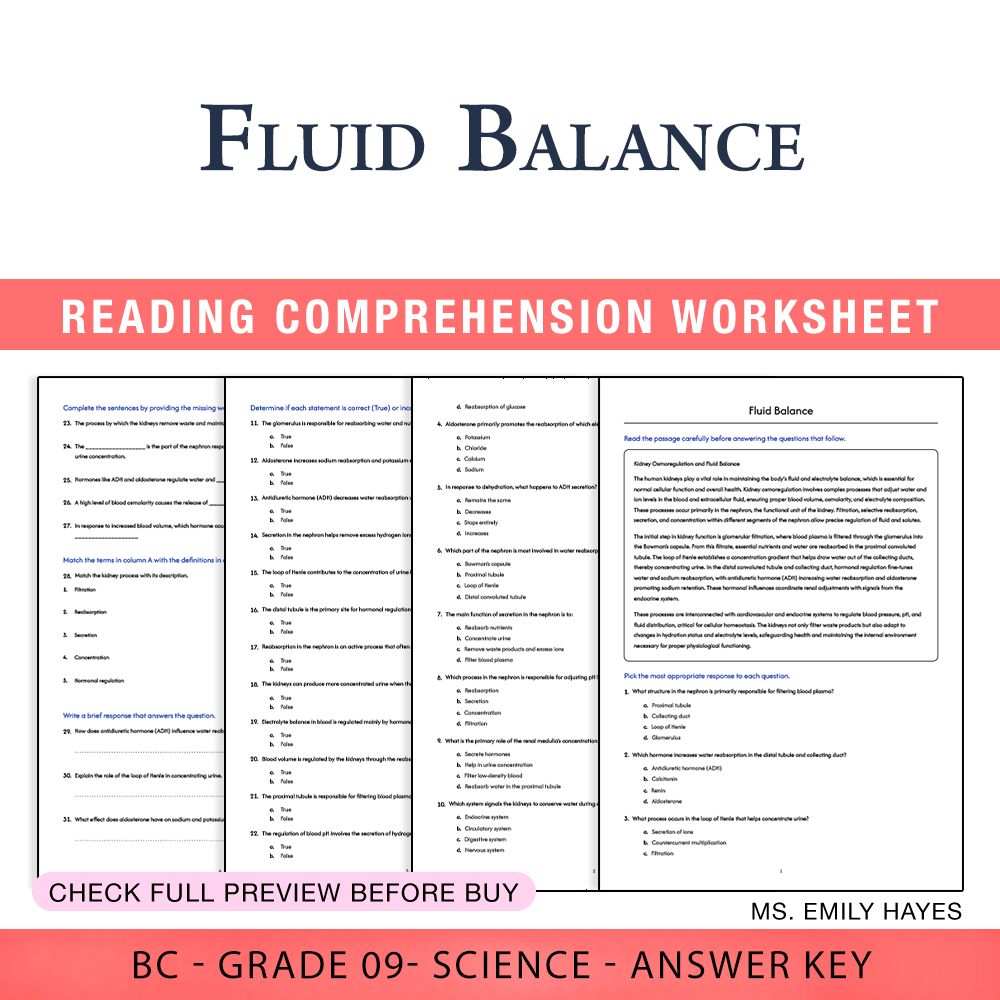
9th Grade Science | Fluid Balance Worksheet (PDF+ Answer Key)
Created byCopper Leaf ClassroomLearning Objectives
- Describe the role of kidneys in regulating water and ion balance through osmoregulation.
- Identify processes such as filtration, reabsorption, secretion, and concentration in the nephron segments.
- Explain how hormones like antidiuretic hormone and aldosterone influence kidney function.
Also included in: Grade 9 Science Worksheet Pack | Biology & Cell Structures (PDF+ Answer Keys) +1 more
Instant download
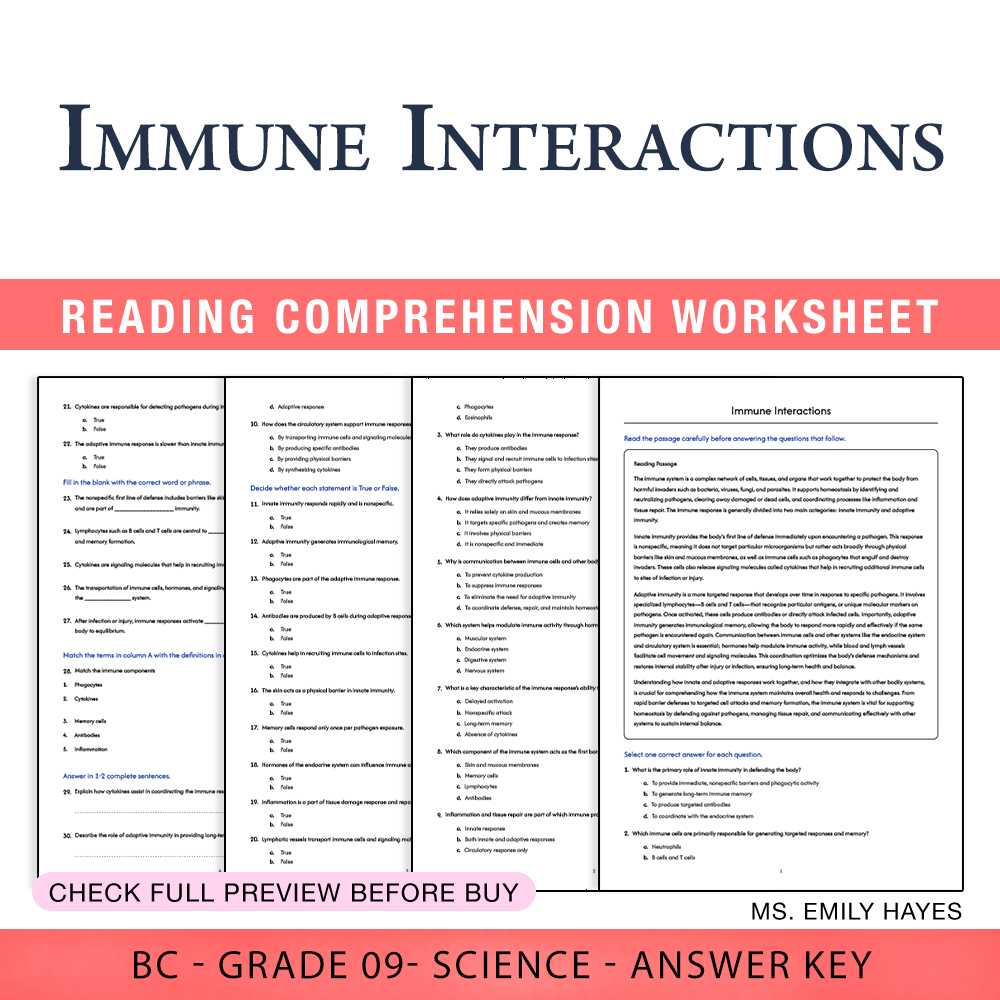
Grade 9 Science | Immune Interactions Worksheet (PDF+ Answer Key)
Created byCopper Leaf ClassroomLearning Objectives
- Describe the roles of innate and adaptive immune responses in maintaining homeostasis.
- Identify key components and functions of the immune system when defending against pathogens.
- Explain how immune communication integrates with other bodily systems, including endocrine and circulatory pathways.
Also included in: Grade 9 Science Worksheet Pack | Biology & Cell Structures (PDF+ Answer Keys) +1 more
Instant download

Grade 7 Science | Levels of Organization Worksheet | TEKS Alligned
Created byLumora LearningLearning Objectives
- Describe the hierarchical levels of biological organization from individuals to the biosphere.
- Identify roles of producers, consumers, and decomposers in ecosystems.
- Explain how energy flows through trophic levels and affects ecosystem stability.
Instant download
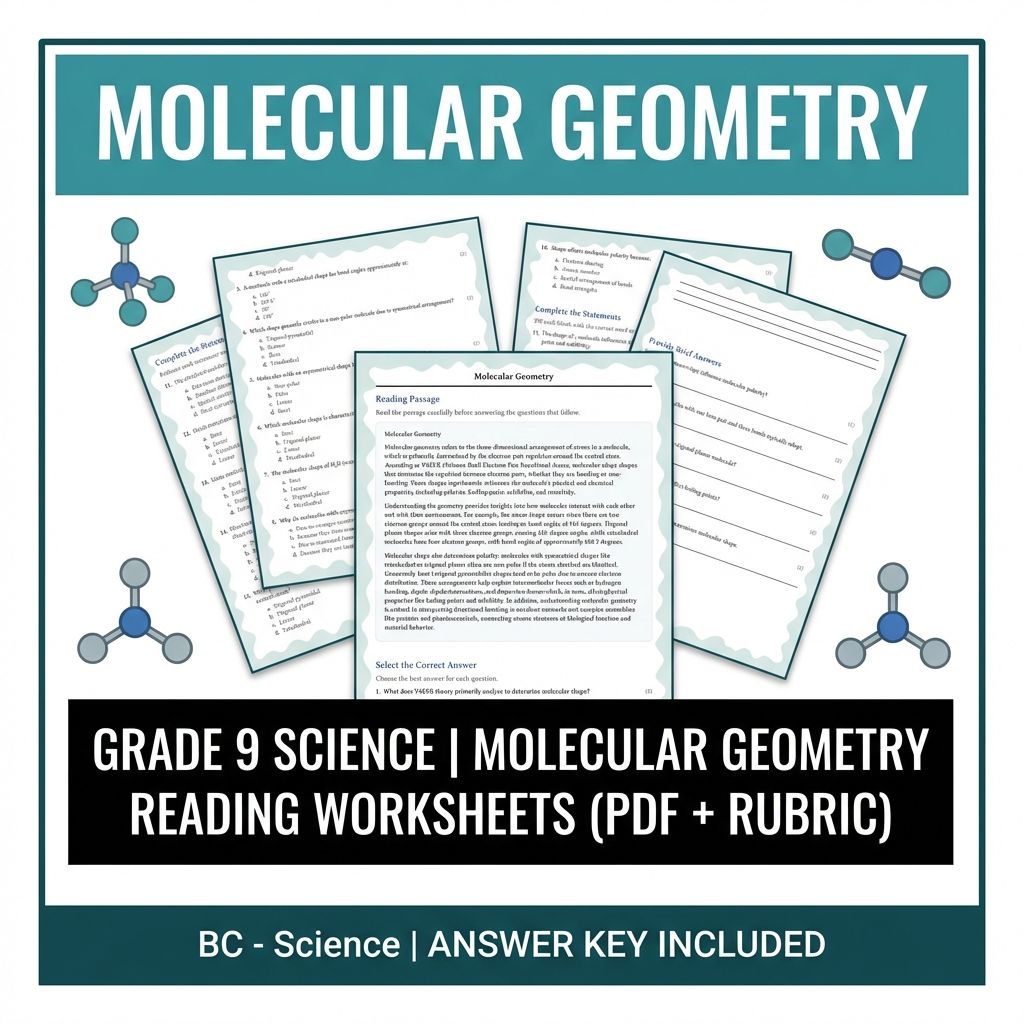
Grade 9 Science | Molecular Geometry Reading Worksheets (PDF + Rubric)
Learning Objectives
- Describe the basic principles of molecular geometry and VSEPR theory.
- Identify common molecular shapes such as linear, trigonal planar, tetrahedral, and bent.
- Explain how shape influences molecular polarity and properties like boiling point and solubility.
Instant download

Grade 5 Science | Solubility Patterns Worksheet with Short Notes (Printable PDF)
Created byMeadowlark WorksheetsLearning Objectives
- Understand the concept of solubility and how it affects various substances in solvents.
- Identify factors like temperature and agitation that influence solubility and saturation.
- Compare solubility behaviors of different pairs such as salt in water versus oil.
Also included in: Grade 5 Science Lesson Group: Ontario Curriculum Worksheets Bundle +1 more
Instant download
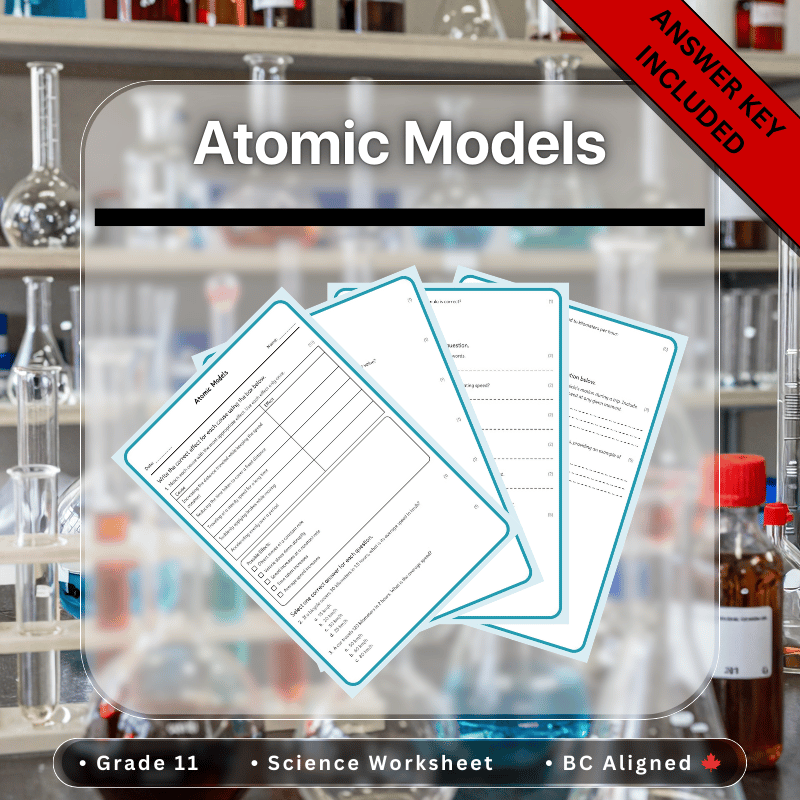
Grade 11 Science – Atomic Models Worksheet + Answer Key – BC Standards
Created byBright Mind ResourcesLearning Objectives
- Explain the evolution of atomic models from early concepts to modern quantum mechanical theories.
- Identify the structure and properties of subatomic particles: protons, neutrons, and electrons.
- Describe how quantum mechanics replaced fixed orbits with probability distributions of electrons.
Instant download

Grade 9 Science – Genetic Variation Sources & Effects | Daily Reading Worksheet
Created byBright Mind ResourcesLearning Objectives
- Identify different sources of genetic variation in populations
- Explain how mutation, recombination, gene flow, and chromosomal rearrangements contribute to diversity
- Recognize regional examples illustrating the impact of genetic variation
Also included in: Grade 9 Genetics & Inheritance Science Daily Reading Lesson Bundle | Alberta +1 more
Instant download
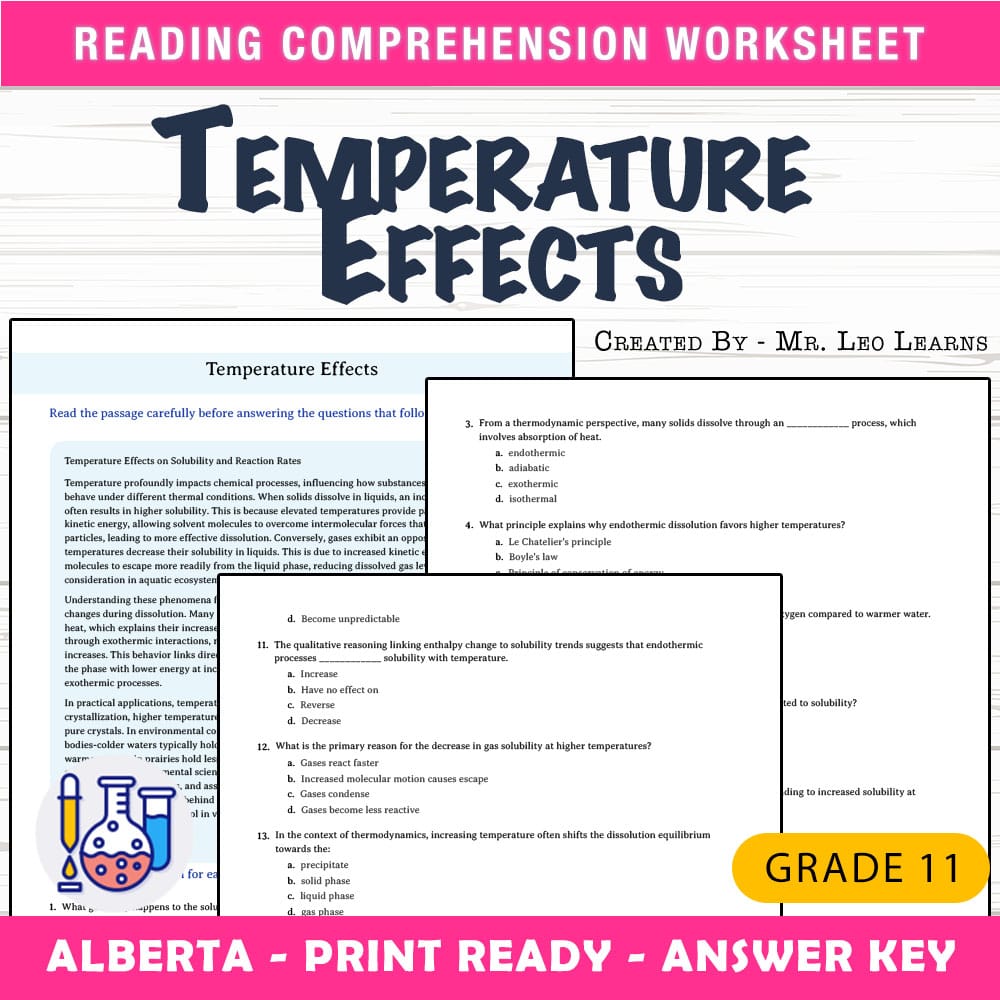
Grade 11 Science — Worksheet MCQ Paper for Mastering Temperature Effects
 Created byThe Resource Hub
Learning Objectives
- Understand how temperature influences solubility of different substances.
- Explain the relationship between temperature and reaction rates from a thermodynamic perspective.
- Describe why gases and solids respond differently to temperature changes in solubility.
Also included in: Grade 11 Science Solutions and Solubility Bundle | Alberta Framework +1 more
Instant download
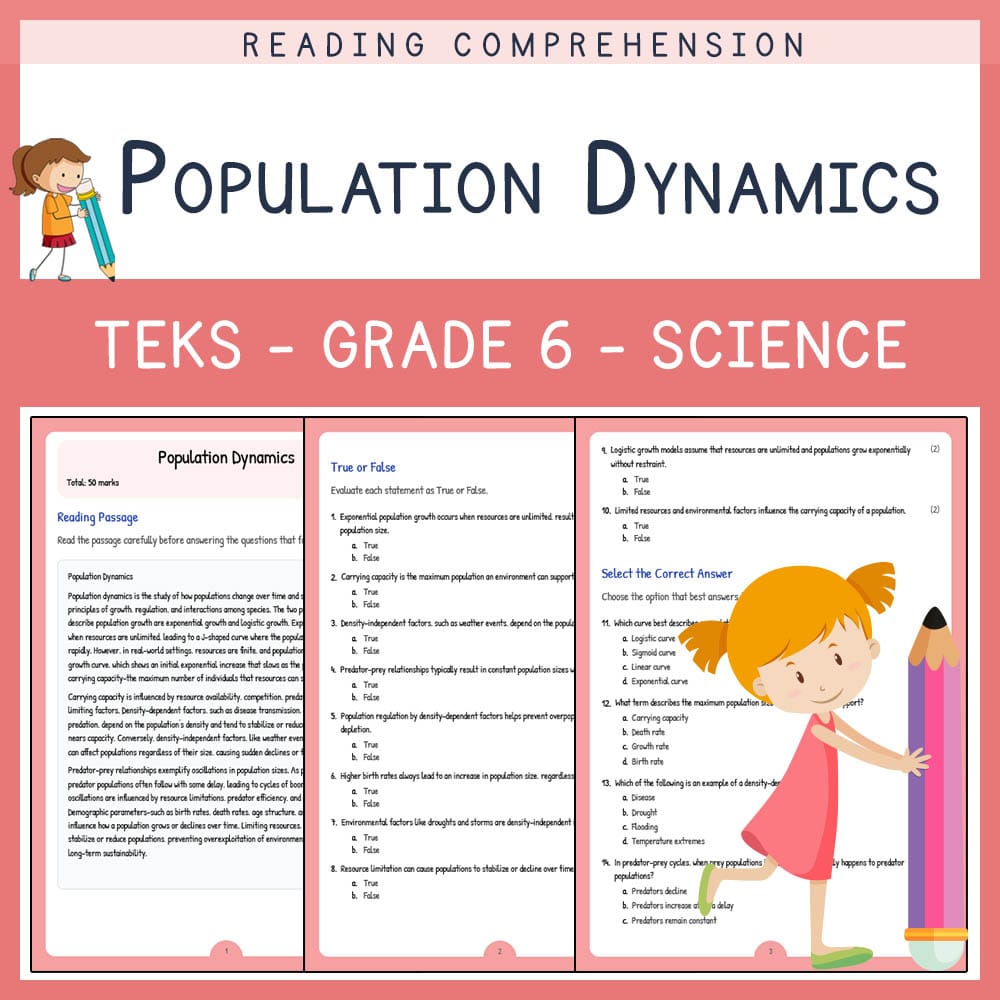
Grade 6 Science | Population Dynamics Worksheet | TEKS Aligned
Created byLumora LearningLearning Objectives
- Understand the principles of population size and how it changes over time.
- Differentiate between exponential and logistic growth curves in populations.
- Define carrying capacity and identify factors influencing population size.
Instant download
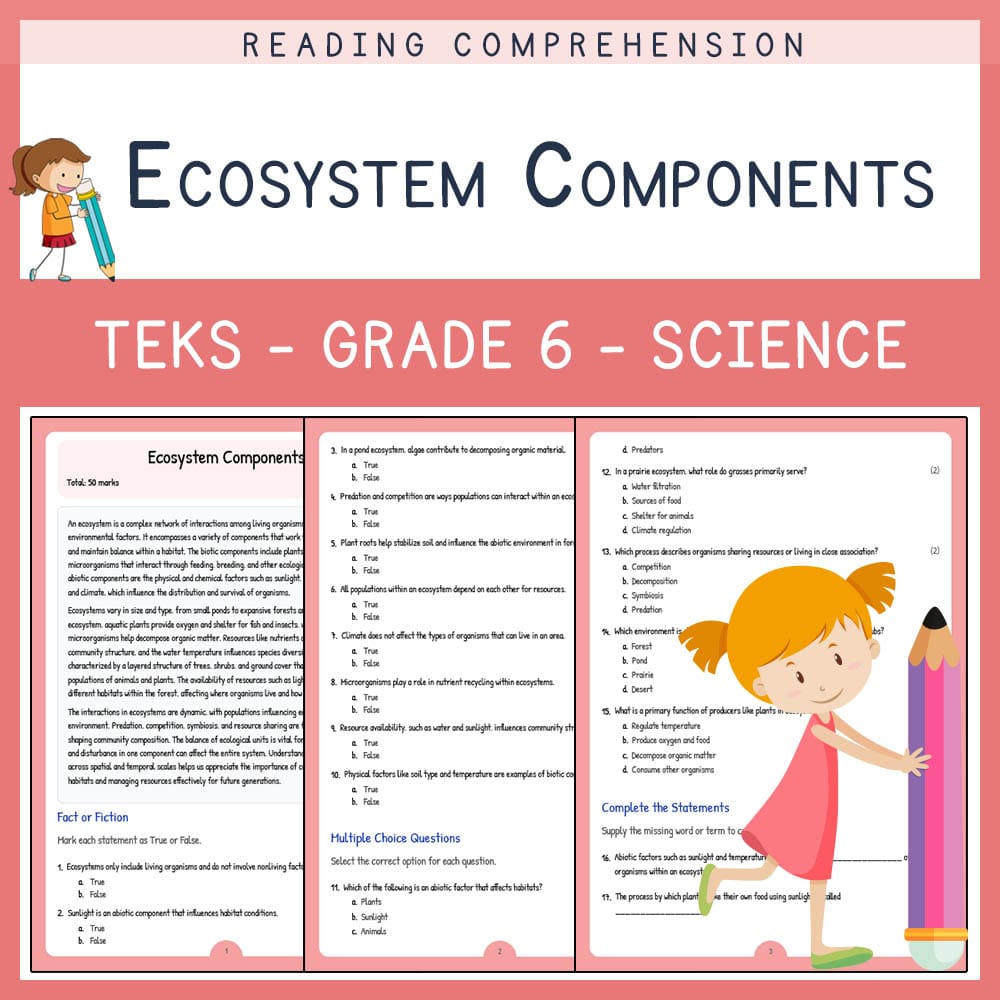
Grade 6 Science | Ecosystem Components Worksheet | TEKS-Aligned
Created byLumora LearningLearning Objectives
- Define ecosystems as interacting systems of populations, communities, and physical factors.
- Identify biotic and abiotic components and their roles in habitats.
- Describe examples such as ponds, prairies, and forests to illustrate resource distribution and community interdependence.
Instant download
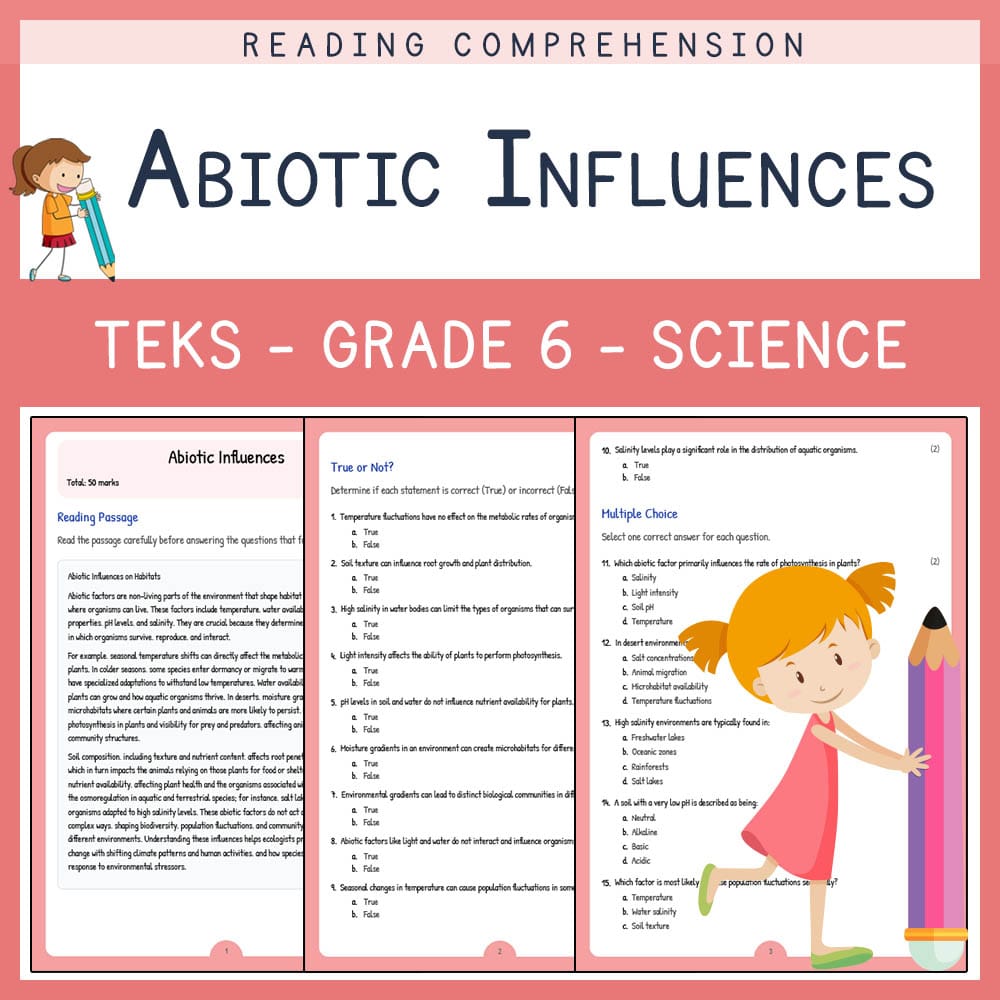
Grade 6 Science | Abiotic Influences Worksheet | TEKS Aligned
Created byLumora LearningLearning Objectives
- Understand how abiotic factors like temperature, water, light, soil, pH, and salinity influence habitats.
- Describe how environmental gradients affect organism distribution and community composition.
- Analyze examples of abiotic factors affecting biological processes and population dynamics.
Instant download
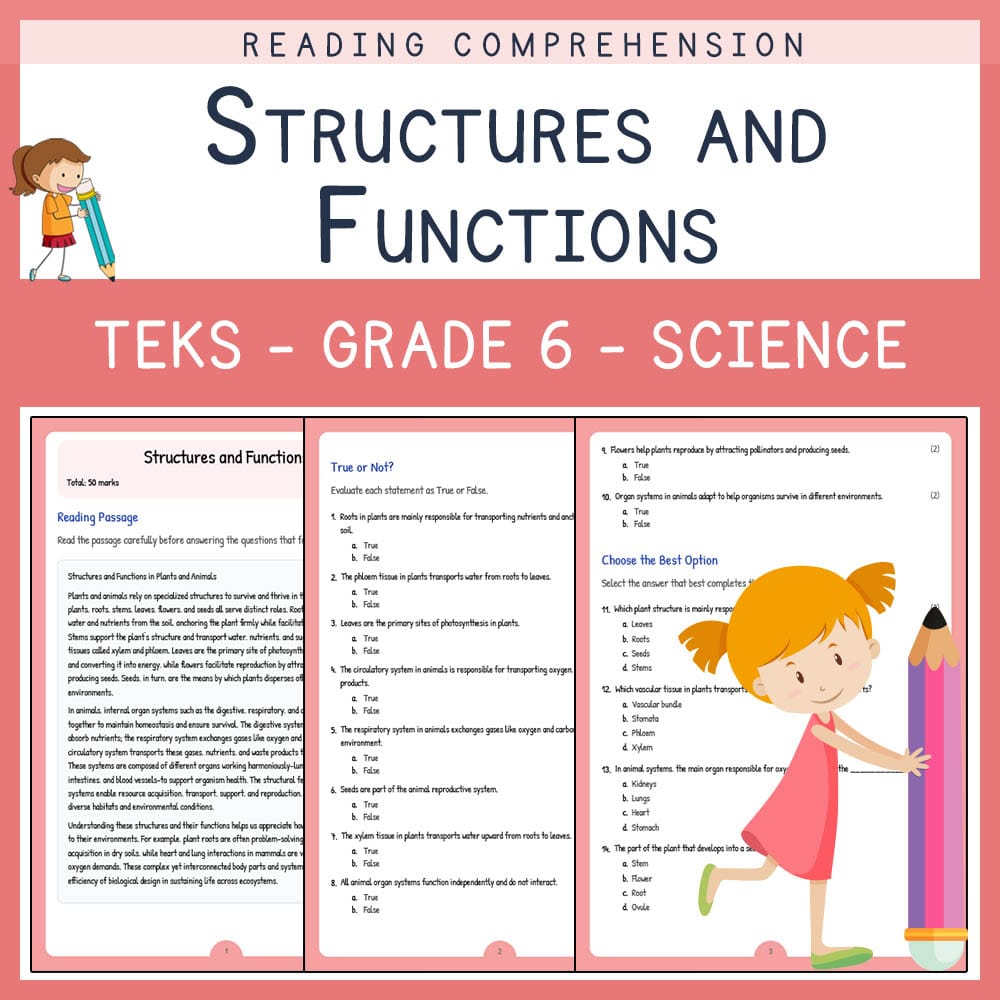
Grade 6 Science | Structures and Functions Worksheet | TEKS Standards
Created byLumora LearningLearning Objectives
- Describe major plant structures such as roots, stems, leaves, and flowers and explain their functions in resource acquisition and reproduction.
- Identify the roles of vascular tissues like xylem and phloem in transporting water and nutrients within plants.
- Explain basic animal organ systems such as digestive, respiratory, and circulatory systems and how they contribute to organism survival.
Instant download
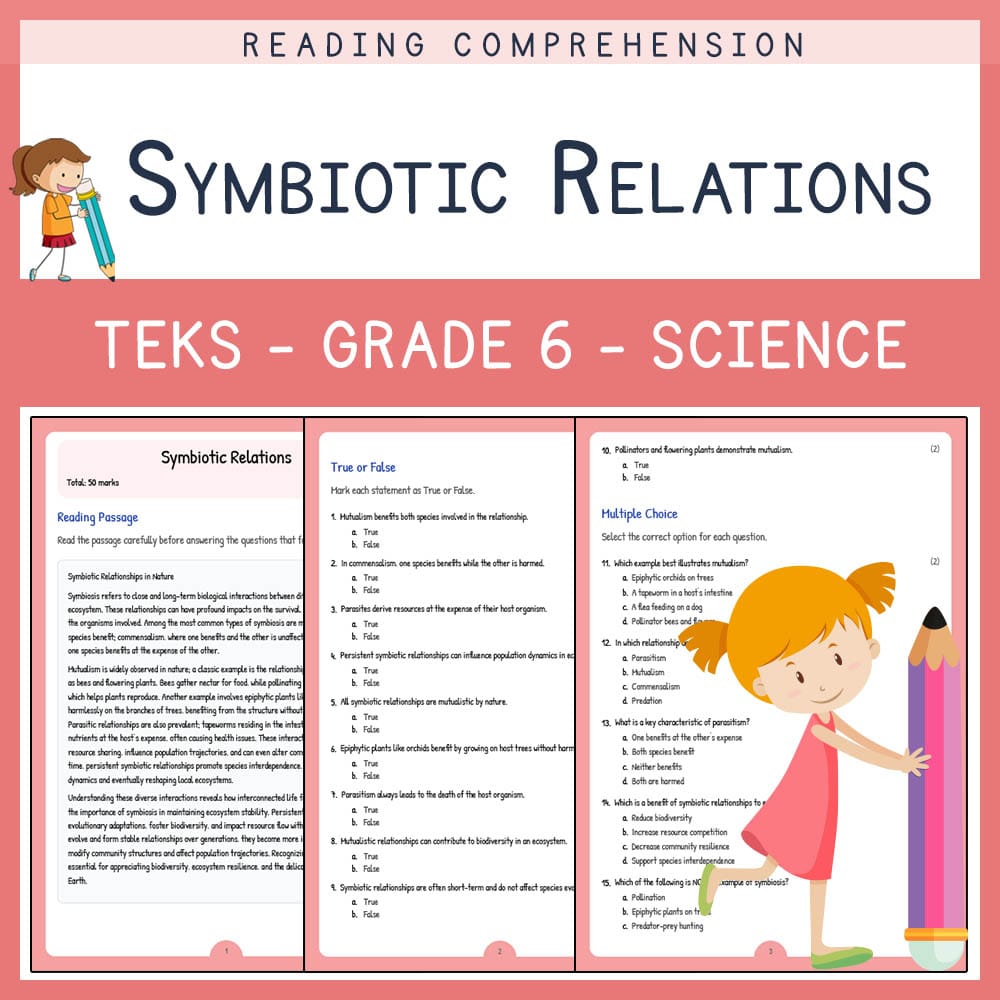
Grade 6 Science | Symbiotic Relations Worksheet | TEKS Alligned
Created byLumora LearningLearning Objectives
- Define and describe symbiotic relationships including mutualism, commensalism, and parasitism.
- Identify concrete examples of each type of symbiosis in real ecosystems.
- Analyze how symbiotic relationships influence organism fitness, resource distribution, and community structure.
Instant download
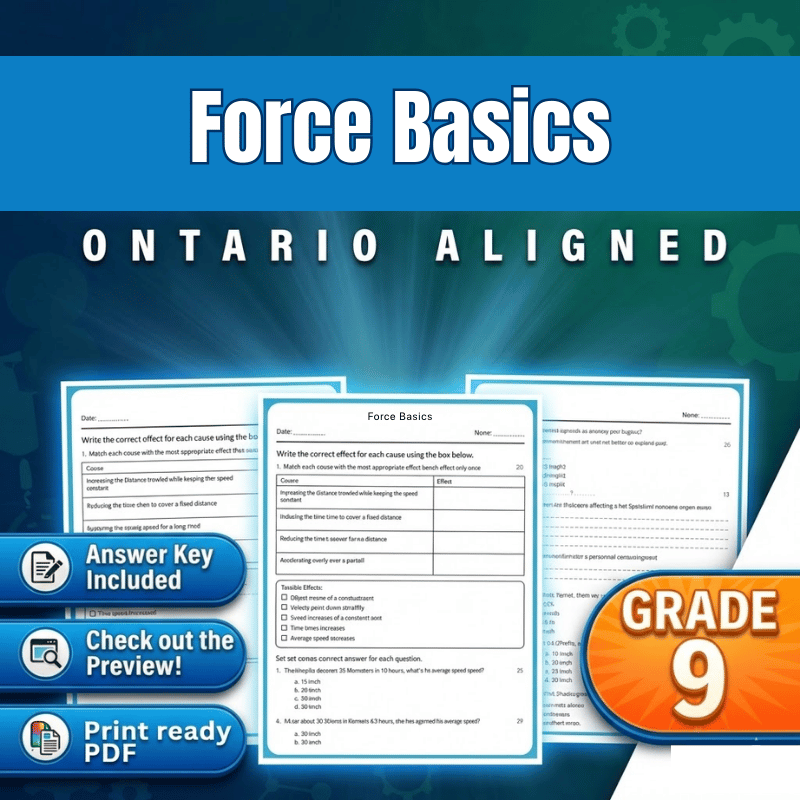
Grade 9 Science – Force Basics Worksheet (Ontario) (PDF)
Created byBright Mind ResourcesLearning Objectives
- Distinguish between contact and non-contact forces with examples and descriptions.
- Identify the direction, point of application, and relative magnitude of different forces.
- Recognize action–reaction pairs and understand their roles in interactions.
Instant download

Grade 8 Science – Model Frameworks Worksheet (PDF) | Alberta Standards
 Created byEvergreen Desk Education
Learning Objectives
- Describe how models represent matter and energy movement using diagrams, flow charts, and quantitative balances.
- Interpret model outputs for trophic levels and nutrient pools in ecosystems such as wetlands, forests, and grasslands.
- Identify common assumptions and limitations in ecological models and explain how they affect results.
Instant download
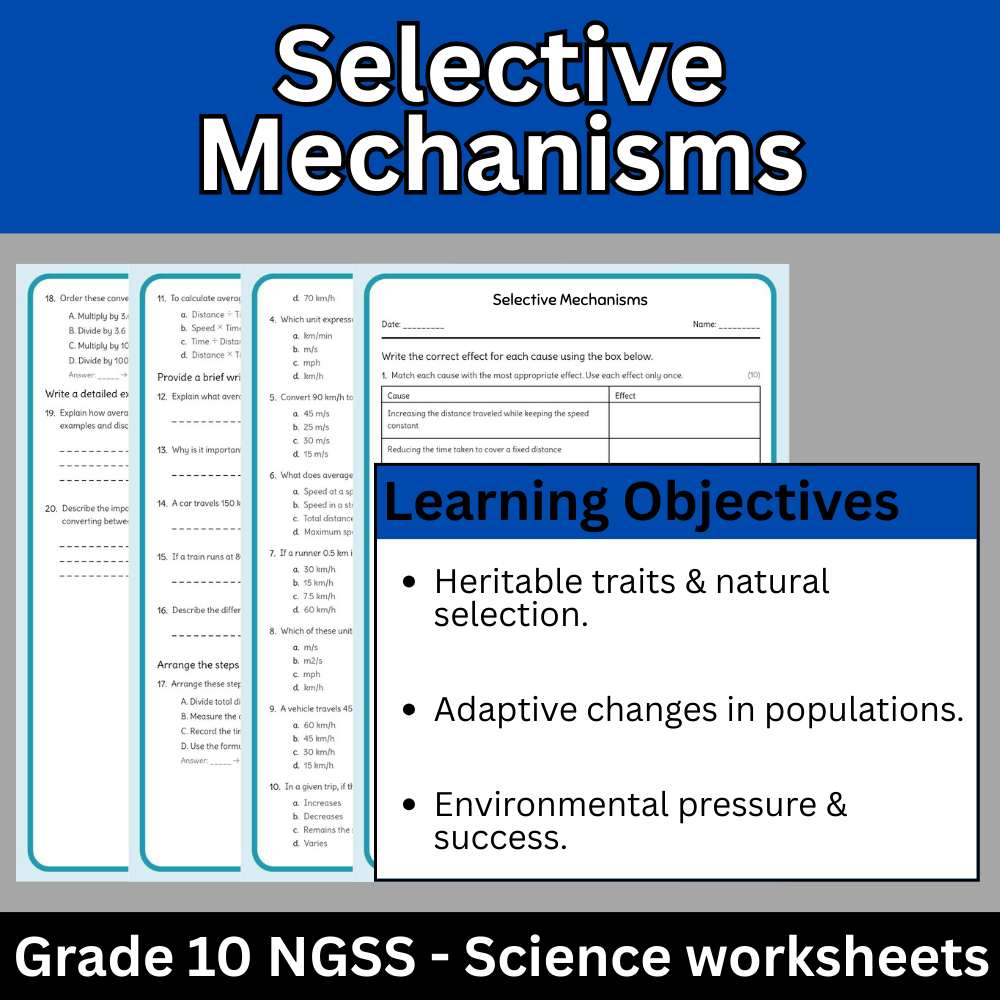
Grade 10 Science | Selective Mechanisms Worksheet (NGSS) – Science PDF
Created byBright Mind ResourcesLearning Objectives
- Understand how variation in heritable traits influences natural selection
- Identify examples illustrating adaptive changes in populations
- Analyze the role of environmental pressures and reproductive success in evolution
Instant download
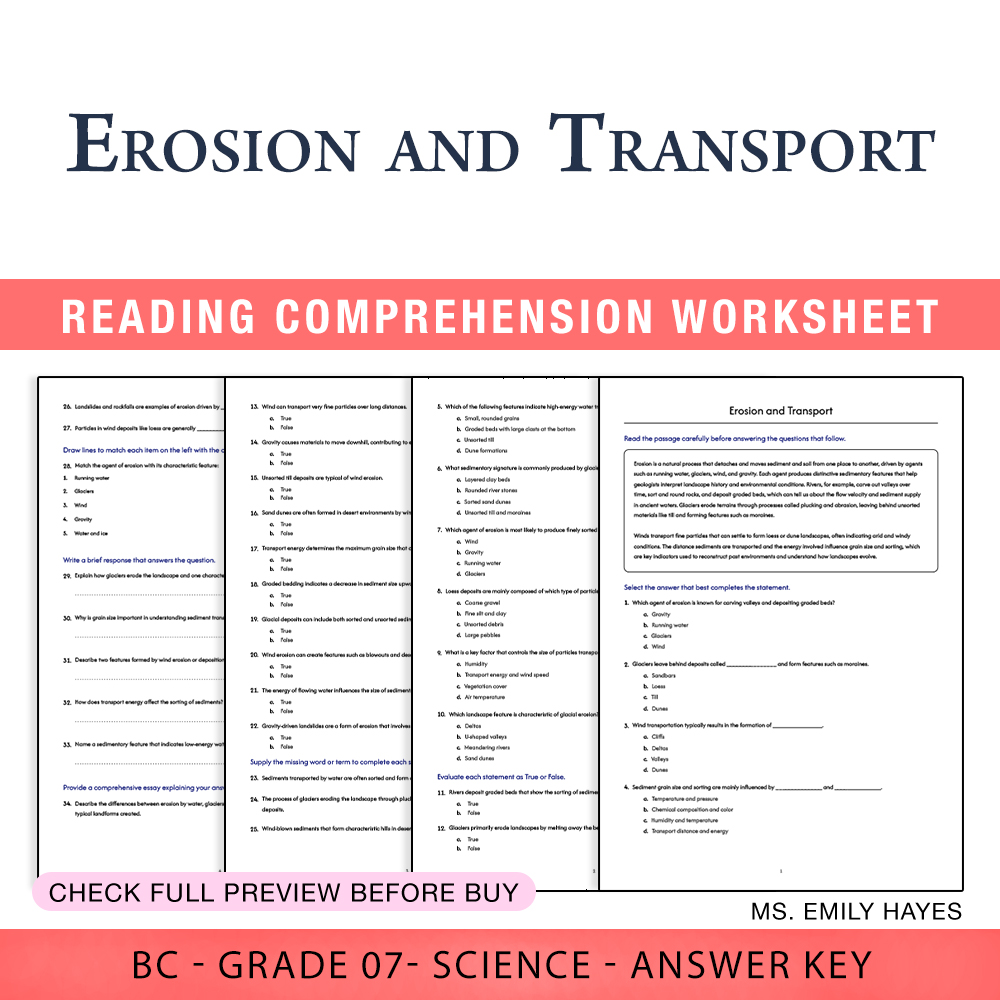
7th Grade Science | Erosion and Transport Worksheet (PDF + Answer Key)
Created byCopper Leaf ClassroomLearning Objectives
- Describe the processes of erosion by water, glaciers, wind, and gravity.
- Identify the distinctive sedimentary signatures produced by different agents of erosion.
- Explain how transport distance and energy influence grain size and sorting.
Also included in: Grade 7 Science | Earth Systems & Geology Unit (PDF+ Answer Keys) +1 more
Instant download

Grade 6 Science – Erosion Pathways Daily Reading Worksheet | Standards-Aligned
Created byBright Mind ResourcesLearning Objectives
- Understand how water causes erosion and shapes Earth's surface.
- Identify different landforms created by erosion and deposition.
- Describe factors that influence the rate of erosion.
Also included in: Earth Systems Grade 6 Science Daily Reading Worksheets Lesson Bundle | General +1 more
Instant download
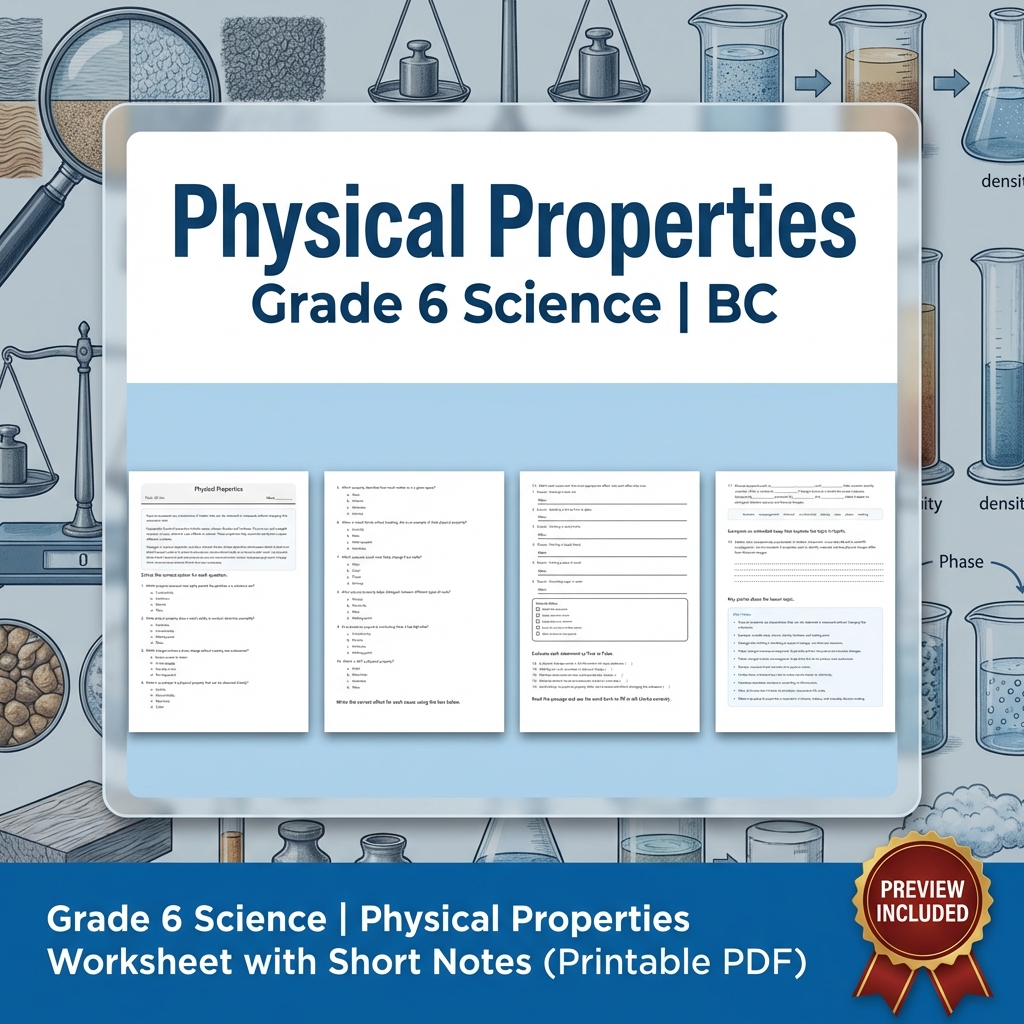
Grade 6 Science | Physical Properties Worksheet with Short Notes (Printable PDF)
Created byMeadowlark WorksheetsLearning Objectives
- Understand observable and measurable characteristics of matter such as mass, volume, density, conductivity, melting point, and hardness.
- Distinguish between physical changes and chemical changes based on properties and observations.
- Identify physical properties in real-world examples and understand their significance in scientific analysis.
Also included in: Grade 6 Science | Matter, Properties & Change UNIT Worksheet Bundle +1 more
Instant download

Grade 6 Science Change Examples Worksheet with Short Notes | PDF
Created byMeadowlark WorksheetsLearning Objectives
- Understand the difference between physical and chemical changes using concrete examples.
- Identify examples of physical changes that are reversible.
- Recognize signs of chemical changes and understand their properties.
Also included in: Grade 6 Science | Matter, Properties & Change UNIT Worksheet Bundle +1 more
Instant download
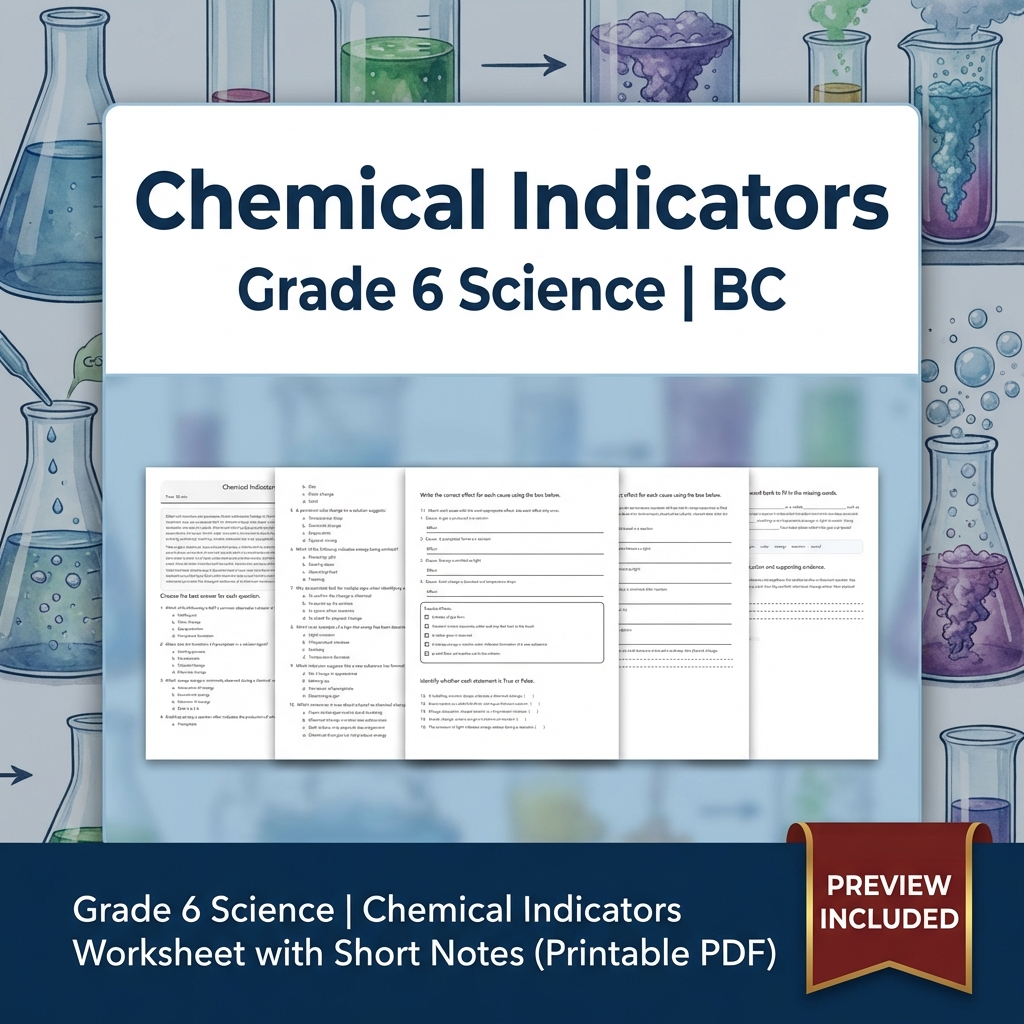
Grade 6 Science | Chemical Indicators Worksheet with Short Notes (Printable PDF)
Created byMeadowlark WorksheetsLearning Objectives
- Identify observable signs that indicate a chemical reaction has occurred.
- Understand various chemical indicators such as gas production, precipitates, and energy changes.
- Explain why multiple indicators provide stronger evidence of chemical change.
Also included in: Grade 6 Science | Matter, Properties & Change UNIT Worksheet Bundle +1 more
Instant download
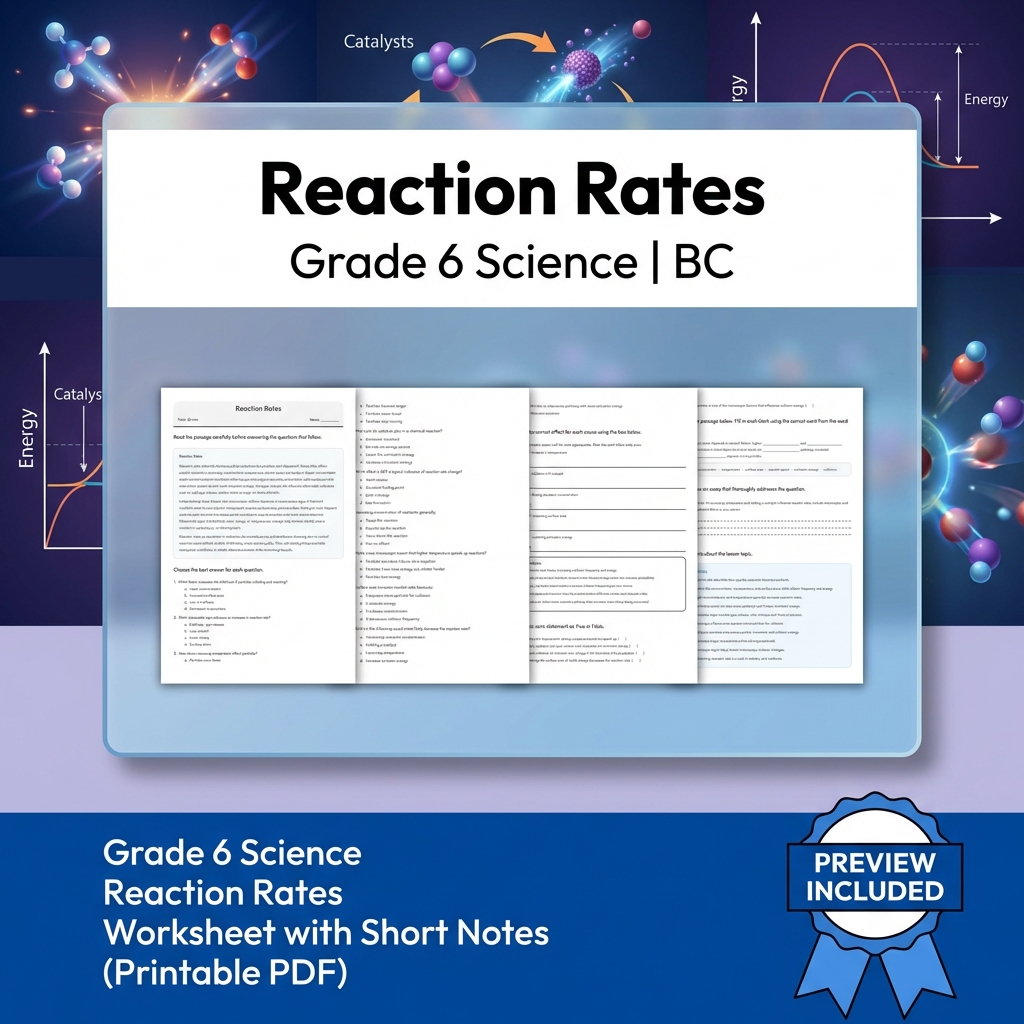
Grade 6 Science Reaction Rates Worksheet with Short Notes (Printable PDF)
Created byMeadowlark WorksheetsLearning Objectives
- Explain how factors like concentration, temperature, surface area, and catalysts influence reaction rates.
- Describe microscopic collision dynamics and relate them to observable macroscopic signs of reactions.
- Identify experimental indicators of reaction rate changes.
Also included in: Grade 6 Science | Matter, Properties & Change UNIT Worksheet Bundle +1 more
Instant download

Grade 6 Science | Diffusion Rates Worksheet with Short Notes (Printable PDF)
Created byMeadowlark WorksheetsLearning Objectives
- Understand how diffusion occurs and the factors that influence its rate.
- Connect microscopic particle motion to observable phenomena like scent spreading.
- Identify variables such as temperature, particle size, and viscosity that affect diffusion speed.
Also included in: Grade 6 Science | Matter, Properties & Change UNIT Worksheet Bundle +1 more
Instant download
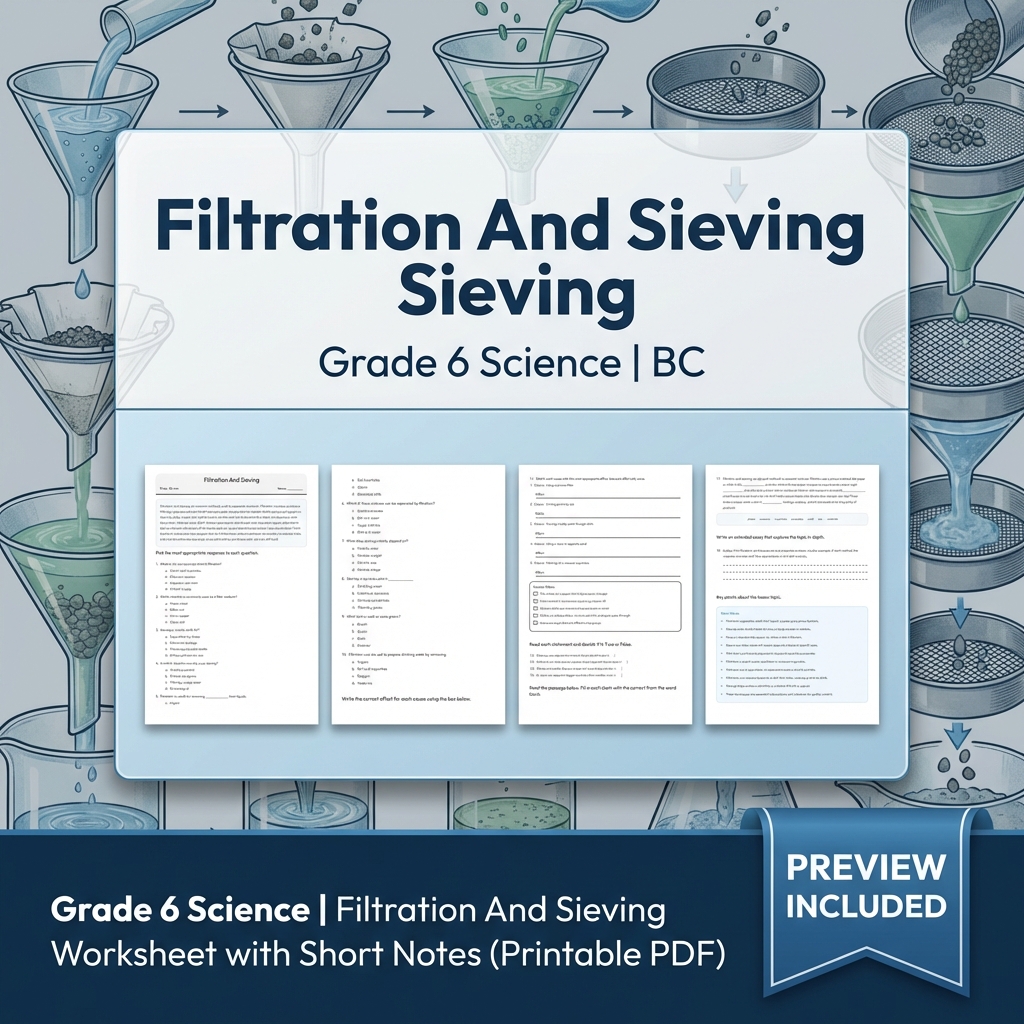
Grade 6 Science | Filtration And Sieving Worksheet with Short Notes (PDF)
Created byMeadowlark WorksheetsLearning Objectives
- Understand the processes of filtration and sieving in separating mixtures.
- Identify different methods used to separate mixtures based on particle size and phase.
- Explain how porous materials help in filtration and sieving.
Also included in: Grade 6 Science | Matter, Properties & Change UNIT Worksheet Bundle +1 more
Instant download
Browse more categories
About Reading comprehension Worksheets
Find reading comprehension worksheets for class practice, homework, or self-study. All 40,289 are instant PDF downloads.
Each resource here is built by an independent educator and reviewed for quality. Worksheets print straight from PDF and suit classroom use, homework, or extra practice; most come with answer keys, and you can preview before purchasing.