
Reading comprehension Worksheets
40,289 type resources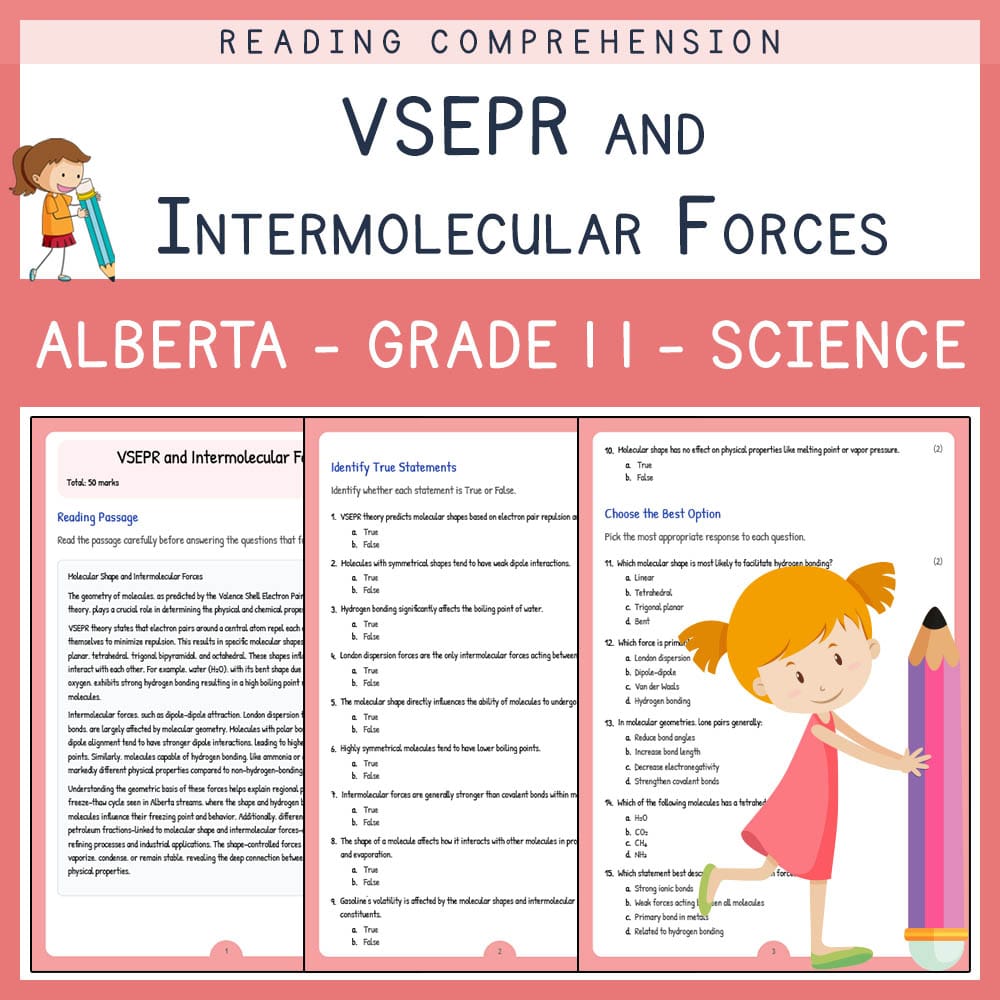
Grade 11 Science | VSEPR and Intermolecular Forces | Alberta Standards
 Created byLumora Learning
Learning Objectives
- Explain the VSEPR model and how molecular shapes influence intermolecular interactions.
- Describe how molecular geometry affects dipole moments and hydrogen bonding capabilities.
- Analyze the effects of molecular shape on boiling and melting points using real-world examples.
Also included in: Grade 11 Science | Matter and Chemical Bonding Custom Bundle | Alberta
Instant download
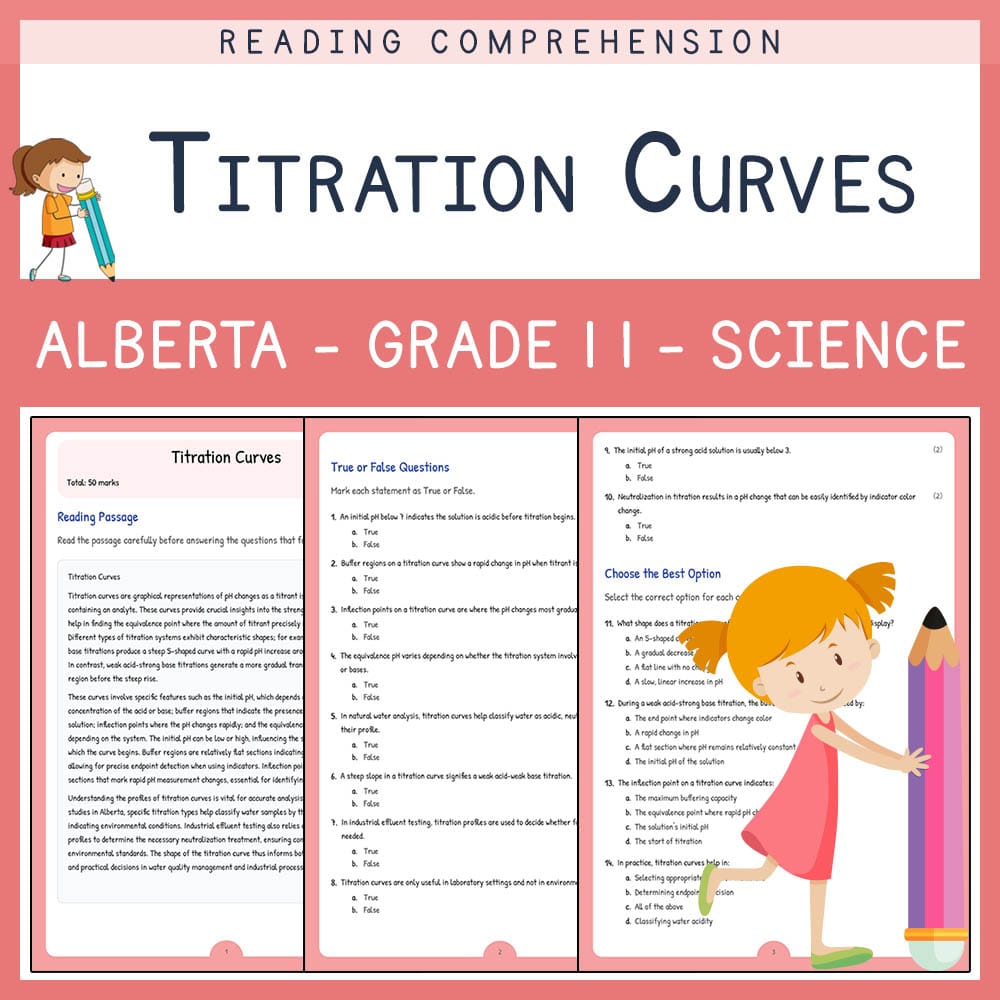
Grade 11 Science | Titration Curves Worksheet | Alberta Standards
Created byLumora LearningLearning Objectives
- Explain the shapes and features of different titration curves, including strong acid–strong base, weak acid–strong base, and weak base–strong acid systems.
- Identify key points on a titration curve such as initial pH, buffer regions, inflection points, and equivalence point pH.
- Determine the appropriate endpoint based on titration curve features for different acid–base systems.
Instant download

Grade 11 Science | Organ Systems Worksheet | TEKS Aligned
Created byLumora LearningLearning Objectives
- Identify the main functions of human organ systems.
- Describe the structures involved in each organ system.
- Explain how different organ systems interact to maintain homeostasis.
Instant download
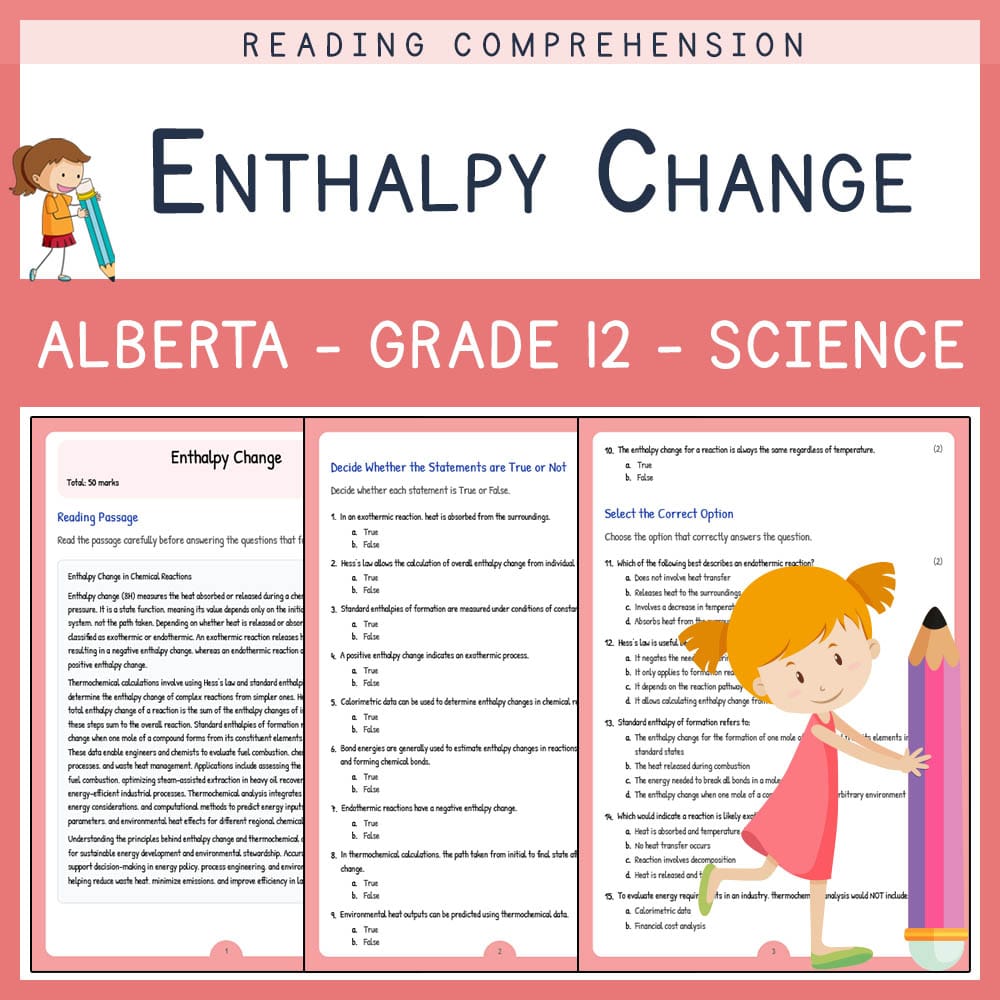
Grade 12 Science | Enthalpy Change Worksheet | Alberta Standards
Created byLumora LearningLearning Objectives
- Understand the concept of enthalpy change and its significance in chemical processes.
- Identify the signs and conventions for exothermic and endothermic reactions.
- Apply Hess’s law and standard enthalpies of formation to calculate reaction enthalpies.
Instant download
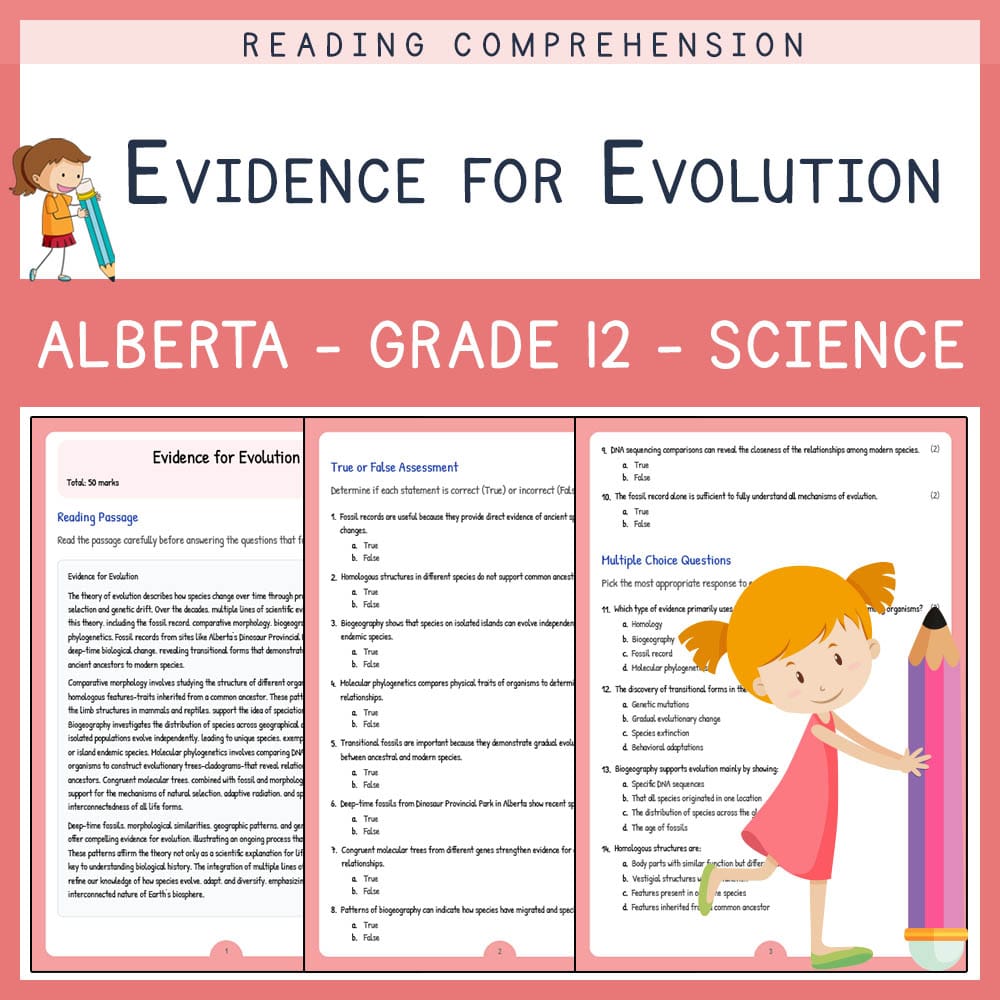
Grade 12 Science | Evidence for Evolution Worksheet | Alberta Standards
Created byLumora LearningLearning Objectives
- Understand the different types of evidence supporting the theory of evolution.
- Identify examples of fossil records, morphological similarities, and molecular data.
- Explain how biogeography and genetic analyses contribute to understanding evolutionary relationships.
Also included in: Grade 12 Science | Biology Worksheet Pack Custom Bundle | Alberta
Instant download
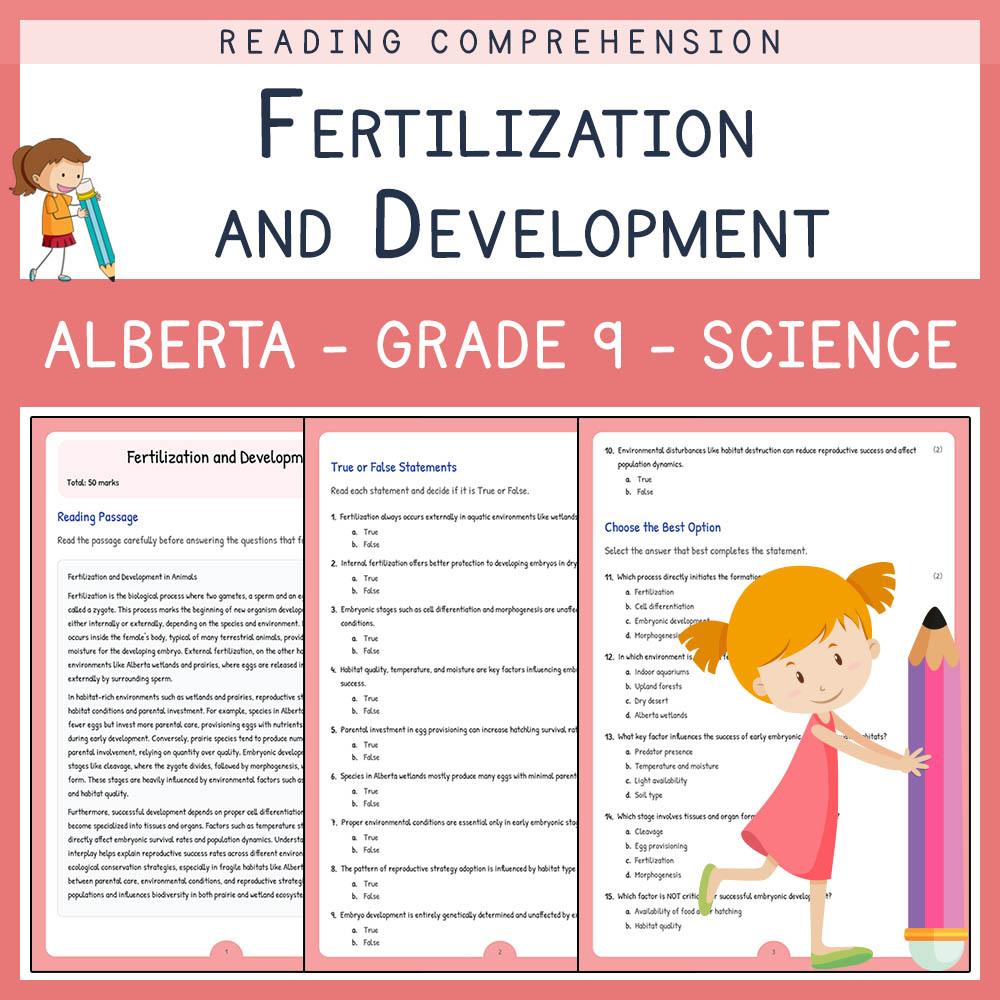
Grade 9 Science | Fertilization and Development Worksheet | Alberta Standards
Created byLumora LearningLearning Objectives
- Explain the process of fertilization and its role in forming a zygote.
- Differentiate between internal and external fertilization strategies with examples.
- Describe embryonic stages such as cell differentiation and morphogenesis.
Instant download

Grade 9 Science | Risks and Benefits Worksheet | Alberta Standards
Created byLumora LearningLearning Objectives
- Understand the ecological, economic, and health risks associated with genetic technologies.
- Evaluate potential benefits and trade-offs of adopting genetic approaches.
- Explain risk assessment, mitigation strategies, and long-term monitoring in biotechnology.
Instant download
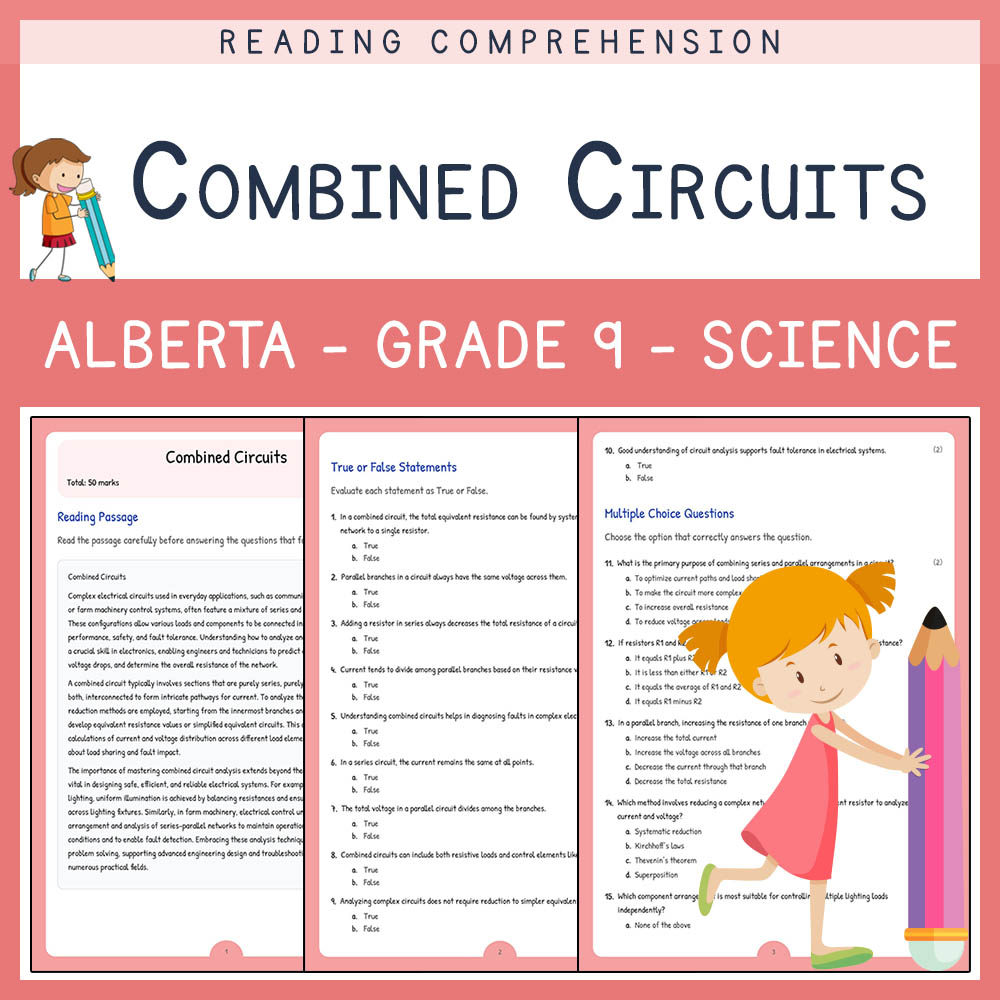
Grade 9 Science | Combined Circuits Worksheet Elena | Alberta Standards
Created byLumora LearningLearning Objectives
- Understand how series and parallel circuits combine within complex networks.
- Apply systematic methods to simplify mixed circuit arrangements.
- Identify equivalent resistances and analyze current and voltage distributions.
Instant download
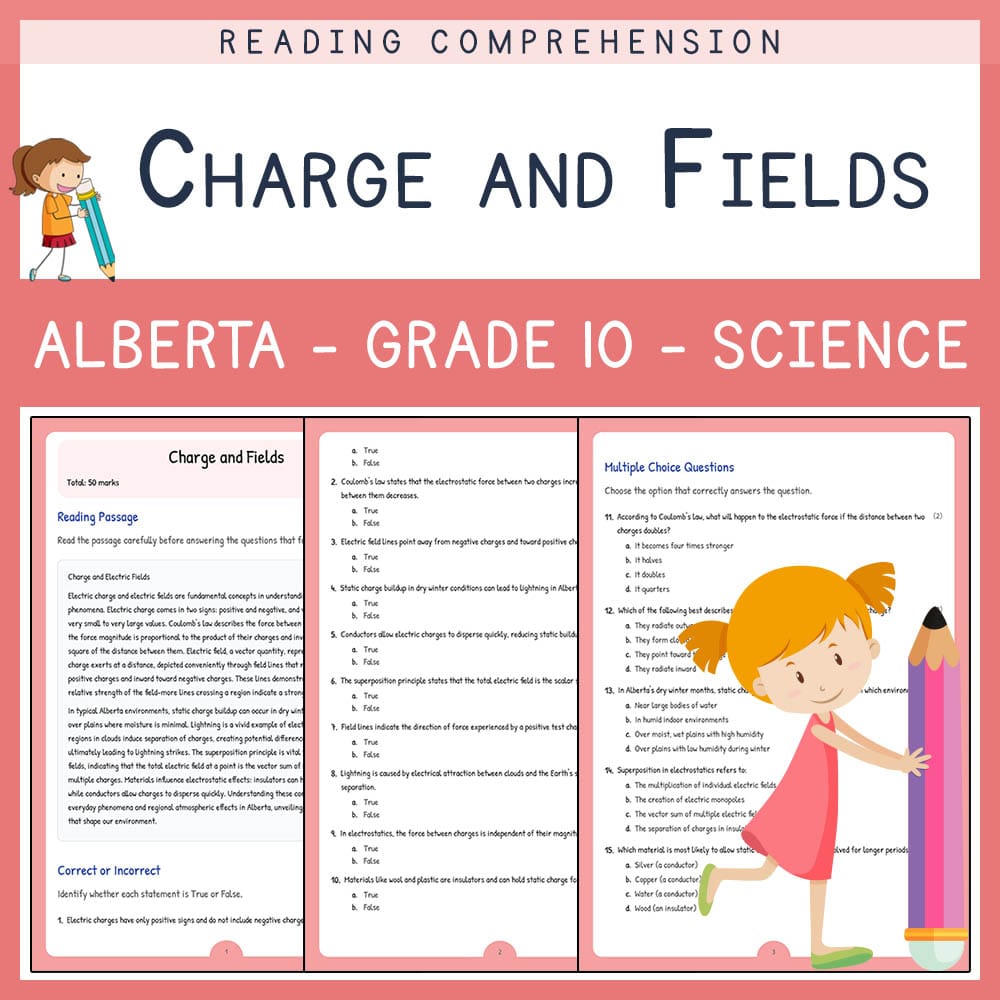
Grade 10 Science | Charge and Fields Worksheet | Alberta Standards
Created byLumora LearningLearning Objectives
- Understand the concept of electric charge, including sign and magnitude.
- Describe the electric field and how field lines represent forces at a distance.
- Explain Coulomb's law and perform force calculations between charges.
Instant download

Grade 5 Science | Weather Fronts Worksheets (PDF) | NGSS Aligned
Created byLumora LearningLearning Objectives
- Understand how cold fronts and warm fronts form and move.
- Identify features of weather maps showing fronts.
- Describe how fronts affect regional weather patterns.
Instant download

Grade 6 Science | Respiration and Digestion Worksheet | General Standard
Created byLumora LearningLearning Objectives
- Explain how the respiratory system exchanges gases through diffusion using concentration differences.
- Describe how the digestive system breaks food into smaller molecules that can enter circulation.
- Connect how oxygen intake and nutrient absorption work together to support energy release in cells.
Instant download
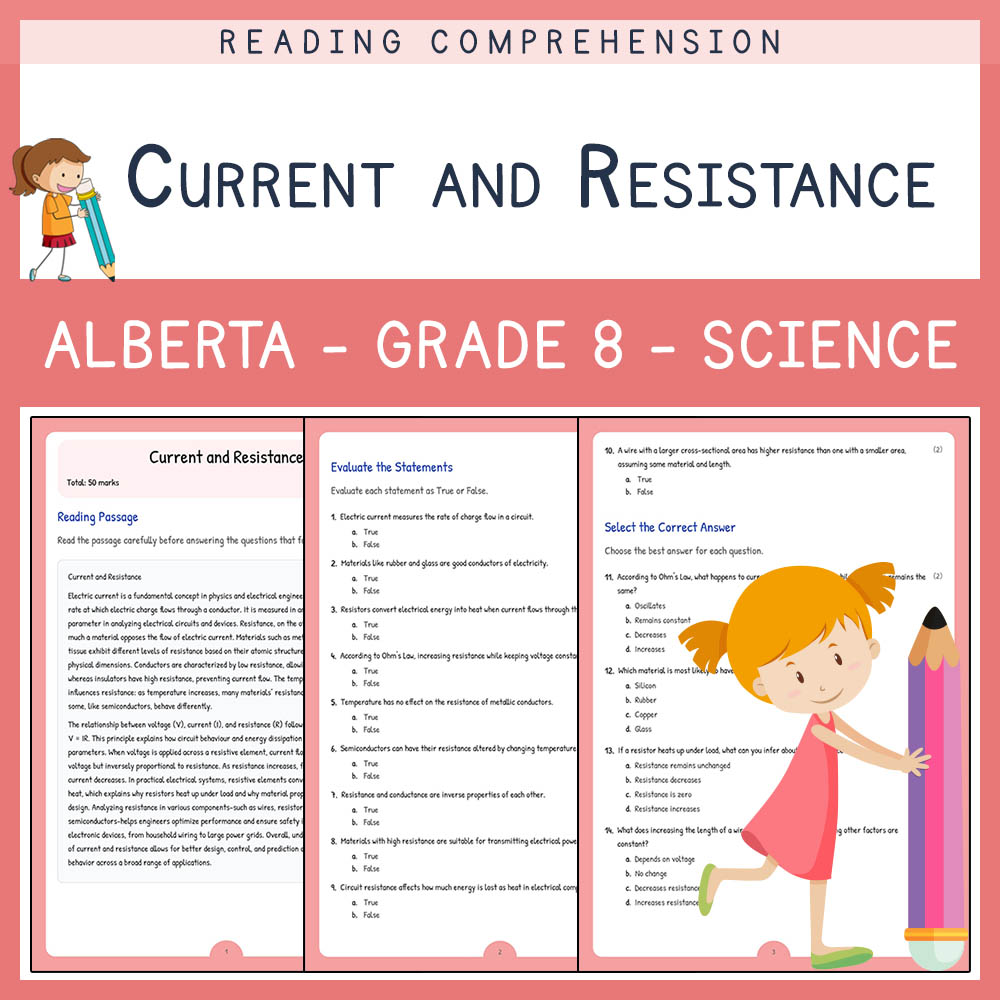
Grade 8 Science | Current and Resistance Worksheet | Alberta Standards
Created byLumora LearningLearning Objectives
- Understand the concept of electrical current and how it relates to charge flow.
- Describe resistance and factors affecting it in different materials.
- Explain the relationship between voltage, current, and resistance according to Ohm's Law.
Instant download
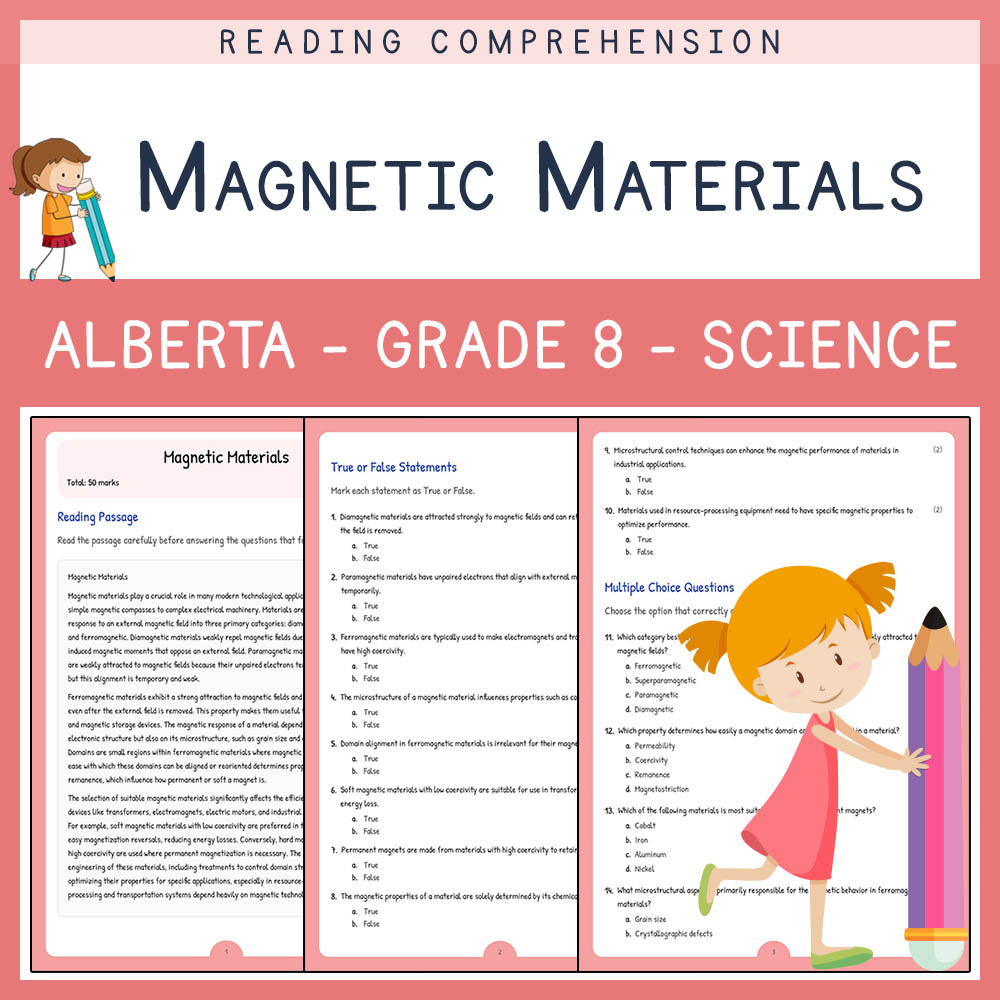
Grade 8 Science | Magnetic Materials Worksheet | Alberta Standards
Created byLumora LearningLearning Objectives
- Understand the classification of materials based on their magnetic responses: diamagnetic, paramagnetic, and ferromagnetic.
- Explain how microstructural properties influence magnetic behavior such as coercivity and remanence.
- Identify the applications of different magnetic materials in industry, including electromagnets, transformers, and separation tools.
Instant download
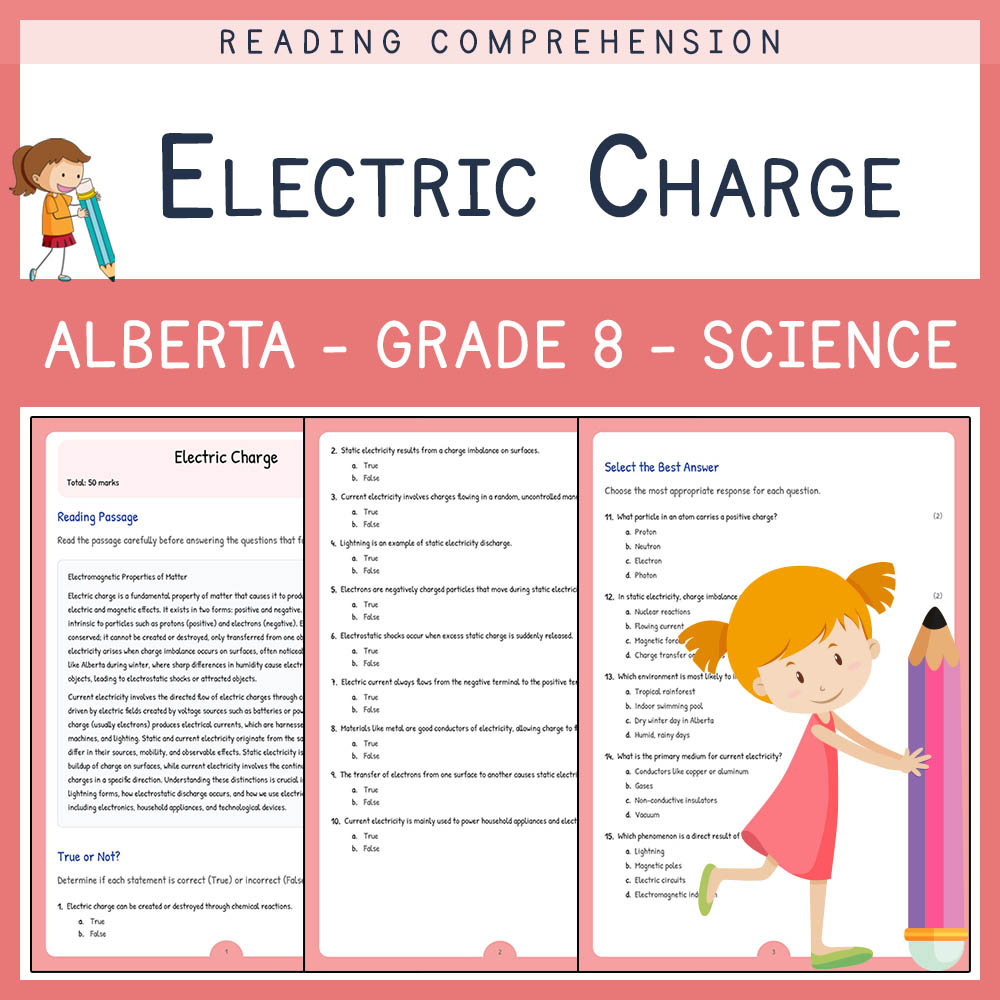
Grade 8 Science | Electric Charge Worksheet | Alberta Standards
Created byLumora LearningLearning Objectives
- Understand the concept of electric charge and its properties.
- Distinguish between static electricity and current electricity.
- Identify real-world phenomena related to electric charge.
Instant download
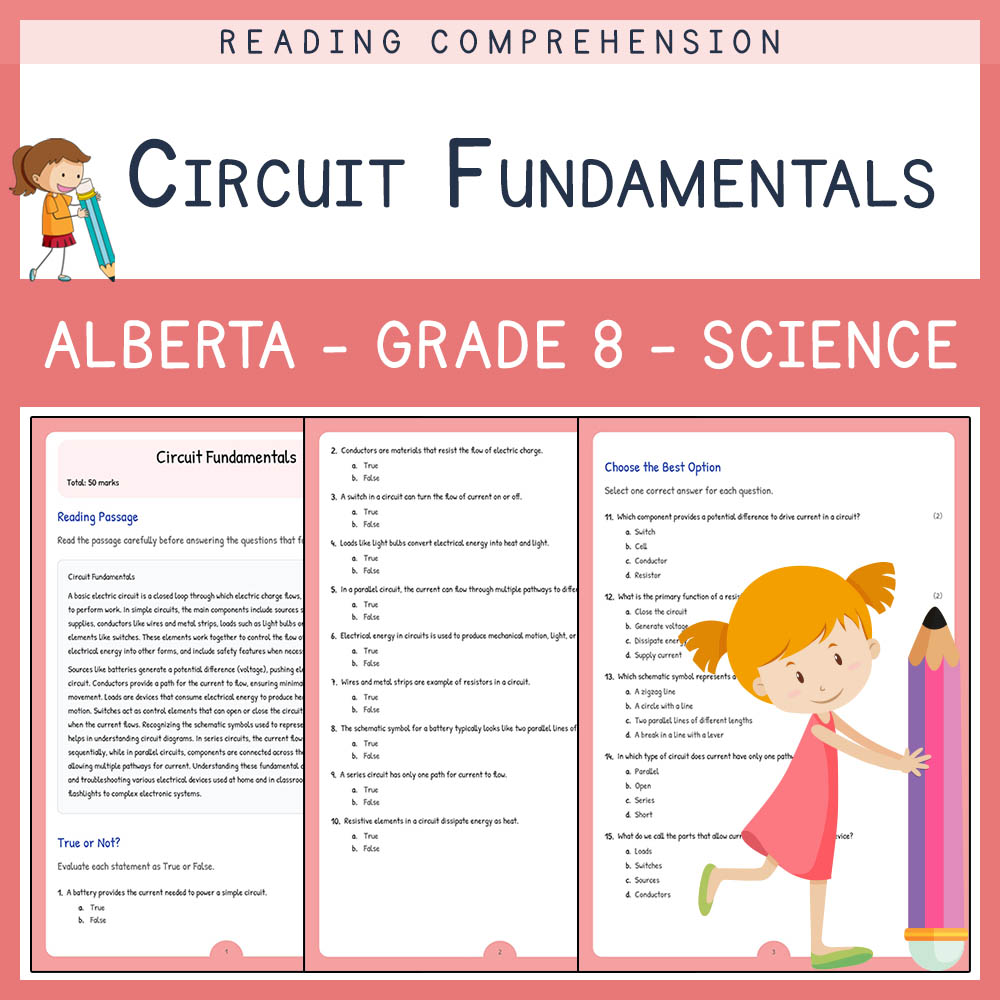
Grade 8 Science | Circuit Fundamentals Worksheet | Alberta Standard
Created byLumora LearningLearning Objectives
- Understand the basic components of a simple electric circuit and their functions.
- Identify schematic symbols for circuit elements such as sources, conductors, loads, and control devices.
- Differentiate between series and parallel circuit configurations.
Instant download
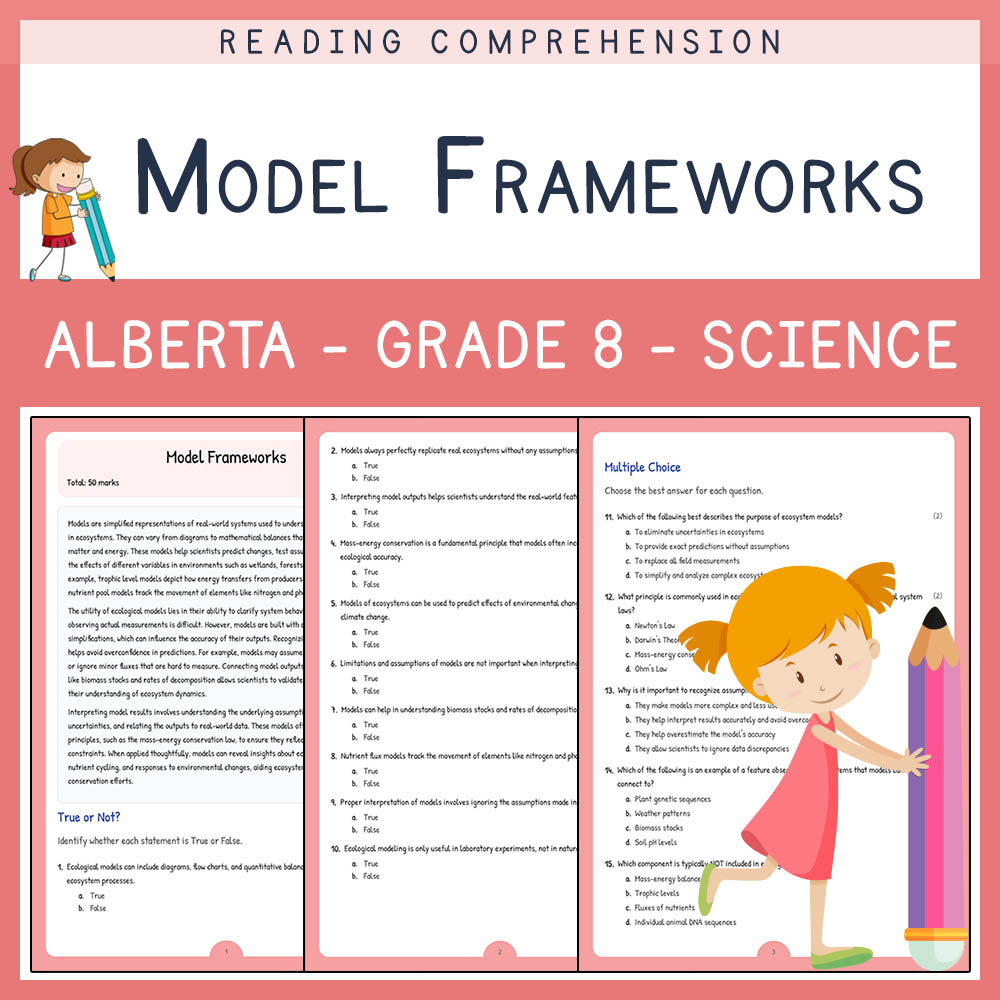
Grade 8 Science | Model Frameworks Worksheet | Alberta Standards
Created byLumora LearningLearning Objectives
- Understand the purpose and components of ecological models.
- Identify how models represent matter and energy movement in ecosystems.
- Interpret model outputs and recognize assumptions and limitations.
Instant download

Grade 12 Science | Earth System Feedbacks Worksheet | General Standards
Created byLumora LearningLearning Objectives
- Explain how atmosphere, oceans, land, and ice interact in Earth’s climate system.
- Describe positive and negative feedbacks and how they change the likelihood of extreme weather.
- Use cause-and-effect reasoning to connect feedback mechanisms to droughts, heavy precipitation, and heat waves.
Instant download
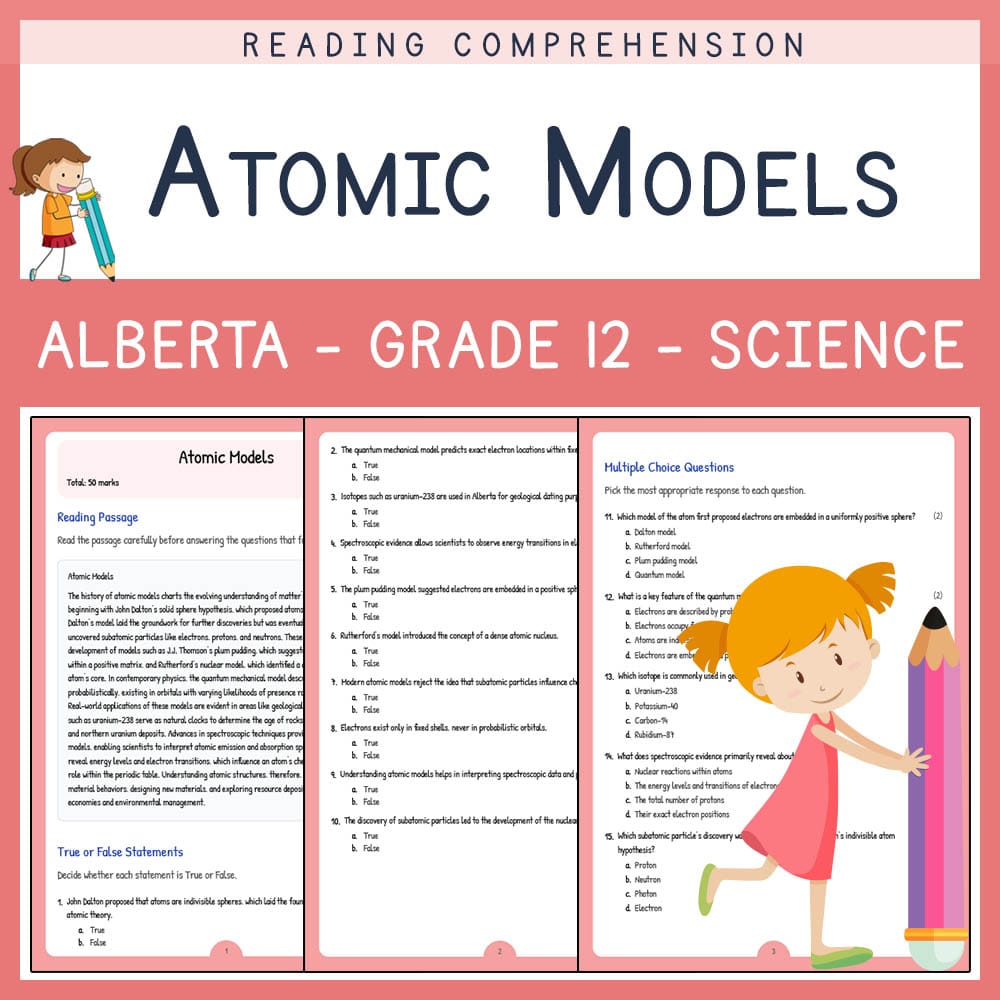
Grade 12 Science | Atomic Models Worksheet Elena | Alberta Standards
Created byLumora LearningLearning Objectives
- Describe the development of atomic models from Dalton to quantum mechanical models.
- Explain how subatomic particles influence atomic mass and behavior.
- Apply understanding of isotopes in geological and resource contexts.
Instant download

Grade 12 Science | Phase Change Heat Worksheet | General Standards
Created byLumora LearningLearning Objectives
- Explain why temperature remains constant during melting and boiling while energy continues to be absorbed or released.
- Interpret heating curves (slopes and plateaus) in terms of particle model changes and interactions.
- Connect latent heat and specific phase change energy to the amount of matter undergoing a phase change.
Instant download

Grade 10 Science – Electron Configuration Worksheet (PDF) | BC Standards
 Created byEvergreen Desk Education
Learning Objectives
- Describe how electrons fill energy levels and orbitals in an atom using quantized rules.
- Identify valence electrons from an electron configuration and explain their role in bonding and reactivity.
- Relate electron configuration patterns to groups and periods on the periodic table.
Instant download

Grade 11 Science – Integrated Cycles Worksheet (TEKS) (PDF)
Created byEvergreen Desk EducationLearning Objectives
- Explain how photosynthesis and cellular respiration are interconnected biochemical cycles involving carbon and energy transfer.
- Describe how day-night changes and tissue specialization affect sugar storage, transport, and respiration rates.
- Use a pathway model to predict how changes in light or temperature can alter net energy budgets in plants and ecosystems.
Instant download

Grade 11 Science | Integrated Systems Worksheet (TEKS) (PDF)
Created byEvergreen Desk EducationLearning Objectives
- Explain how cellular specialization and intercellular communication can produce emergent tissue, organ, and organism functions
- Compare chemical signaling, gap junction communication, and extracellular matrix organization in coordinating cell behavior
- Use systems thinking to predict how disruption of signaling or organization could affect organism-level health
Instant download

Grade 11 Science Worksheet – Cellular Respiration (PDF) | BC Standards
Created byEvergreen Desk EducationLearning Objectives
- Explain the major stages of cellular respiration and what happens to electrons and protons at each stage.
- Describe how chemiosmotic coupling and ATP synthase convert an electrochemical gradient into ATP.
- Interpret quantitative models of ATP yield per glucose and the role of oxygen as the final electron acceptor.
Instant download

Grade 9 Science | Complex Inheritance Worksheet (TEKS) Practice Set
Created byEvergreen Desk EducationLearning Objectives
- Explain how polygenic inheritance, epistasis, and pleiotropy can cause deviations from simple Mendelian ratios
- Describe how variable penetrance and expressivity affect whether and how genotypes show up as phenotypes
- Evaluate how linkage and environmental factors can change observed inheritance patterns in families and populations
Instant download

Grade 8 Science Worksheet | Phase Transitions (Alberta Standard) PDF
Created byEvergreen Desk EducationLearning Objectives
- Describe how phase transitions change particle arrangement and energy without forming new substances
- Differentiate melting, freezing, vaporization, and condensation and identify the direction of energy flow
- Explain how phase transitions influence real-world systems such as river flow, snowpack melt timing, and condensation in cities
Instant download

Grade 6 Science | Gas Pressure Worksheet (BC Standards) (PDF)
Created byEvergreen Desk EducationLearning Objectives
- Explain gas pressure using the particle model and collisions with container walls
- Describe how changing particle speed, collision frequency, and gas volume affects pressure
- Predict how temperature and pressure are related in sealed and unsealed situations
Instant download

6th Grade Science | Food Webs Worksheet (PDF) BC Standards
Created byEvergreen Desk EducationLearning Objectives
- Explain how a food web shows feeding relationships and alternative energy pathways.
- Describe how changes to one species can cause cascading effects through an ecosystem.
- Use food web ideas (connectivity, redundancy, and specialization) to predict stability after disturbances.
Instant download

Grade 6 Science | Producers and Consumers Worksheet (PDF) – BC Standards
Created byEvergreen Desk EducationLearning Objectives
- Explain how producers capture energy and how consumers obtain energy in a food web.
- Identify primary, secondary, and higher-level consumers and describe their roles.
- Describe how energy transfer limits affect ecosystem productivity and stability.
Instant download

Grade 6 Science | Distillation Principles Worksheet (PDF) with Answer Key
Created byEvergreen Desk EducationLearning Objectives
- Explain how distillation separates components based on differences in boiling point and vapor pressure
- Describe the particle-energy changes that occur during boiling and condensation
- Compare simple distillation and fractional distillation for mixtures with small vs. large boiling-point differences
Instant download

Henderson-Hasselbalch Equation Worksheet Grade 11 Chemistry Alberta
Created byEvergreen Desk EducationLearning Objectives
- Explain what the Henderson–Hasselbalch equation represents in buffer chemistry
- Use the Henderson–Hasselbalch equation to calculate pH from buffer components
- Predict how changing acid/base ratio affects buffer pH
Instant download

Grade 7 Science – Bitumen Separation Worksheet (Alberta Standards) (PDF)
Created byEvergreen Desk EducationLearning Objectives
- Classify bitumen separation steps as physical or chemical processes based on how substances change.
- Explain how density, particle size, temperature, and additives affect emulsions and dissolved organics.
- Use evidence from a process description to describe mixture behavior and expected product outcomes.
Instant download

Grade 8 Science Sheet on Cell Specialization | BC Standards (Worksheet + Answer Key)
Created byEvergreen Desk EducationLearning Objectives
- Explain how structural changes in cells support specialized functions in the body
- Compare how different cell types are specialized for tasks such as movement, absorption, and communication
- Use examples to describe how features like increased surface area, shape, and organelle abundance improve performance
Instant download

Grade 8 Science Worksheet | Exploring Genetic Diversity (PDF)
Created byEvergreen Desk EducationLearning Objectives
- Explain how genetic diversity within and among populations supports adaptation to changing conditions.
- Describe how mutation, gene flow, population size, genetic drift, and natural selection shape genetic variation.
- Predict how low genetic diversity can increase disease vulnerability, inbreeding depression, and extinction risk.
Instant download

Grade 8 Science | Speed Fundamentals Worksheet (PDF) – BC Standards
Created byEvergreen Desk EducationLearning Objectives
- Explain speed as distance divided by time and identify appropriate units
- Distinguish constant speed from average speed using distance-time reasoning
- Use proportional reasoning to predict how changes in distance, speed, or time affect the others
Instant download

Grade 9 Science Worksheet | Mountain Building Activities (BC Standards PDF)
Created byEvergreen Desk EducationLearning Objectives
- Explain how plate convergence and continental collision produce mountain building through folding, thrust faulting, and crustal shortening.
- Identify key tectonic processes (magmatic intrusion and isostatic rebound) and describe how they change rock structure and elevation.
- Use rock types, structural patterns, and timing clues to infer tectonic history and reconstruct past plate motions.
Instant download

Grade 9 Science | Nucleic Acid Structure Worksheet (TEKS) PDF
Created byEvergreen Desk EducationLearning Objectives
- Compare DNA and RNA structural features, including strand structure, sugar type, and base composition
- Explain how complementary base pairing and strand directionality relate to replication and transcription
- Describe how structural differences influence the stability and functions of DNA and RNA
Instant download

Grade 9 Science – Cardiopulmonary Interaction Worksheet (TEKS PDF)
Created byEvergreen Desk EducationLearning Objectives
- Explain how pulmonary ventilation and cardiovascular transport work together to deliver oxygen and remove carbon dioxide.
- Describe how heart rate, stroke volume, and vascular resistance can change in response to respiratory and metabolic demands.
- Use chemoreceptor feedback to predict how changes in blood gases affect ventilation and circulation.
Instant download

Grade 9 Science – Lunar Phases Worksheet (BC Standard) (PDF)
Created byEvergreen Desk EducationLearning Objectives
- Explain how the changing geometry between the Sun, Earth, and Moon causes the visible lunar phases.
- Describe the synodic month and why lunar phases repeat in a predictable sequence.
- Use illuminated fraction and viewing perspective to predict which phase comes next.
Instant download

Grade 9 Science – Cell Signaling Worksheet (TEKS) (PDF)
Created byEvergreen Desk EducationLearning Objectives
- Explain how ligands bind to receptors and initiate signal transduction inside cells
- Describe how second messengers and phosphorylation help relay and amplify signals
- Compare autocrine, paracrine, endocrine, and synaptic signaling by distance and time scale
Instant download

Grade 9 Science Worksheets | Adaptation and Selection (PDF)
Created byEvergreen Desk EducationLearning Objectives
- Explain how natural selection increases the frequency of heritable traits that improve reproductive success in a specific environment.
- Describe selective pressure, fitness, and adaptive trade-offs using examples from Alberta.
- Compare artificial selection in agriculture with natural selection and infer how adaptation can accumulate over generations.
Instant download

Grade 11 Science – Center of Mass Worksheet (BC) Practice Set (PDF)
Created byEvergreen Desk EducationLearning Objectives
- Explain the center of mass as the weighted average position of mass in a system
- Use center-of-mass ideas to analyze translational motion, explosions, and recoil with momentum conservation
- Identify how internal forces affect (and do not affect) the motion of the system’s center of mass
Instant download

Grade 11 Science – Stratigraphic Columns Worksheet (BC Standards) (PDF)
Created byEvergreen Desk EducationLearning Objectives
- Explain how stratigraphic columns use lithology, fossils, and sedimentary structures to interpret depositional history.
- Describe how correlation links equivalent rock layers across distance and how unconformities record missing time.
- Use facies concepts to infer past environments and explain how lateral changes in deposition can produce different layer patterns.
Instant download

6th Grade Science Worksheet | Growth Rings & Dendrochronology (PDF)
Created byEvergreen Desk EducationLearning Objectives
- Describe how growth rings form and how ring width and density can reflect environmental conditions.
- Explain how scientists use growth rings and dendrochronology to reconstruct past climate and disturbance events.
- Interpret growth-ring clues to make evidence-based claims about tree age, growth rates, and long-term forest health.
Instant download

Grade 12 Science Worksheet on Energy Transfers (PDF) – BC Standards
Created byEvergreen Desk EducationLearning Objectives
- Explain how energy is transferred and dissipated in oscillatory systems, including the role of damping.
- Analyze how resonance and driving frequency affect amplitude and energy flow in forced oscillations.
- Apply conservation of energy to systems with non-conservative forces such as friction and air resistance.
Instant download

Grade 12 Environmental Monitoring Worksheet | Alberta Science
Created byEvergreen Desk EducationLearning Objectives
- Explain how environmental monitoring networks are designed using representative sampling and appropriate sensor placement.
- Select indicators and justify temporal and spatial resolution for detecting long-term environmental trends.
- Apply quality assurance ideas to improve reliability and interpret results in the presence of spatial heterogeneity and human (anthropogenic) sources.
Instant download

High School Science | Natural Selection Worksheet (PDF) BC Standards
Created byEvergreen Desk EducationLearning Objectives
- Explain how environmental pressures can change allele frequencies through differential survival and reproduction.
- Differentiate directional, stabilizing, and disruptive selection and predict how each affects trait distributions.
- Use examples like antibiotic resistance to connect genetic variation to observable evolutionary change.
Instant download

Grade 10 Science Organ Systems Worksheet | Alberta Biology PDF
Created byEvergreen Desk EducationLearning Objectives
- Explain how organ structure and tissue types work together to carry out physiological functions (e.g., nutrient processing, gas exchange).
- Analyze how organ-level interfaces with the external environment support survival and reproduction across different environments in Alberta.
- Use examples from plant root systems and mammalian digestive organs to describe structure–function relationships, including vascularization and microbial interactions.
Instant download

Grade 10 Science | Chemical Equations Worksheet (PDF) BC Standards
Created byEvergreen Desk EducationLearning Objectives
- Interpret chemical equations by identifying reactants, products, and the arrow that shows the reaction direction.
- Use coefficients and state symbols to explain relative amounts and physical phases in chemical reactions.
- Apply conservation of matter to predict what must be balanced in a chemical equation.
Instant download
Browse more categories
About Reading comprehension Worksheets
Find reading comprehension worksheets for class practice, homework, or self-study. All 40,289 are instant PDF downloads.
Each resource here is built by an independent educator and reviewed for quality. Worksheets print straight from PDF and suit classroom use, homework, or extra practice; most come with answer keys, and you can preview before purchasing.