
Grade 10 Science Worksheets
7,174 worksheets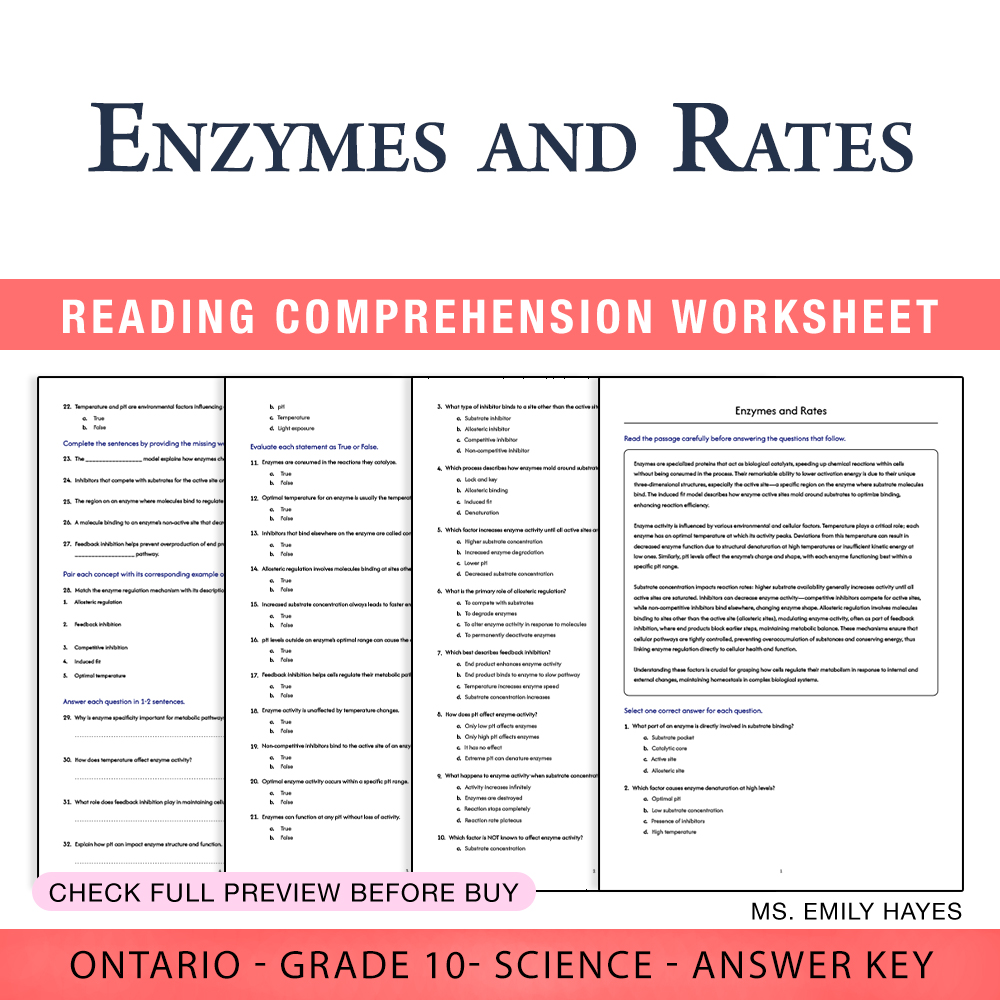
Grade 10 Science | Enzymes and Rates Worksheet (PDF + Answer Key)
 Created byCopper Leaf Classroom
Learning Objectives
- Describe the properties and functions of enzymes in biological systems.
- Explain how factors like temperature, pH, substrate concentration, and inhibitors affect enzyme activity.
- Discuss mechanisms like allosteric regulation and feedback inhibition and their roles in metabolic pathways.
Instant download
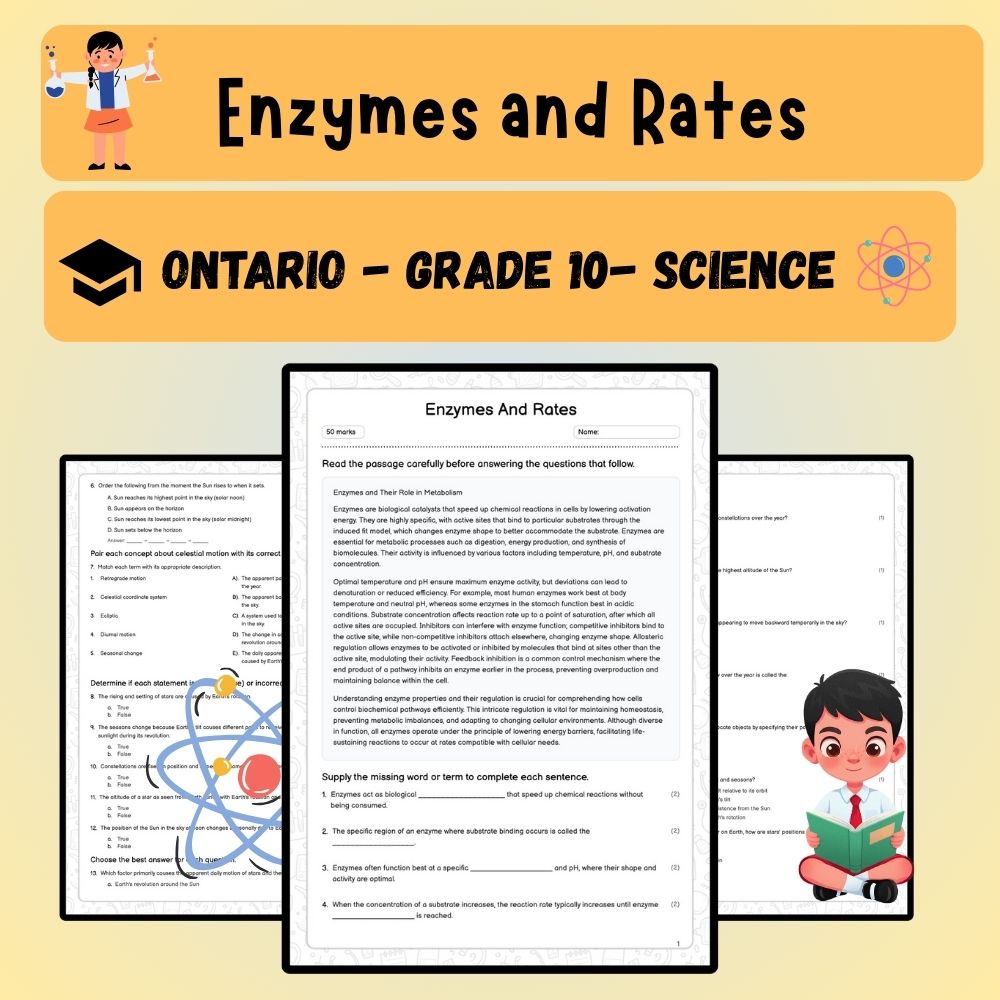
Grade 10 Science | Enzymes and Rates Worksheet (Worksheet + Answer Key) – Ontario Standards
 Created byPrism Point Learning
Learning Objectives
- Understand the properties of enzymes and their role in catalyzing metabolic reactions.
- Explain how factors like temperature, pH, substrate concentration, and inhibitors affect enzyme activity.
- Describe mechanisms of allosteric regulation and feedback inhibition in metabolic pathways.
Also included in: Grade 10 Science Unit | Cells, Photosynthesis & Microbes Worksheet Pack +1 more
Instant download

Enzymes And Rates Practice Test Prep | Grade 10 Science Worksheet
Created byPrism Point LearningLearning Objectives
- Explain how enzymes increase reaction rates by lowering activation energy and using specific active sites with induced fit.
- Describe how temperature, pH, substrate concentration, and inhibitors affect enzyme activity and reaction rate.
- Differentiate between competitive and non-competitive inhibition and predict their effects on enzyme rate.
Also included in: Grade 10 Cells & Energy Science Lesson Bundle Ontario Framework Pack
Instant download

Enzymes and Reaction Rate Worksheets | Grade 10 Science
Created byPrism Point LearningLearning Objectives
- Explain how enzymes lower activation energy using active sites
- Predict enzyme activity changes caused by temperature and pH
- Interpret substrate concentration effects on reaction rate
Also included in: Grade 10 Science Worksheets Ontario | Life Systems Cell Bundle
Instant download

Grade 10 Enzymes and Rates Worksheet | Active Sites & Factors Ontario
 Created byChalk and Compass
Learning Objectives
- Explain how enzyme active sites and induced fit lower activation energy to speed up metabolic reactions.
- Predict how temperature, pH, and substrate concentration affect enzyme activity and reaction rate.
- Describe how inhibitors (competitive and non-competitive) change enzyme activity.
Also included in: Cells, Photosynthesis, Respiration & Microbes Lesson Bundle – Grade 10 Science +1 more
Instant download
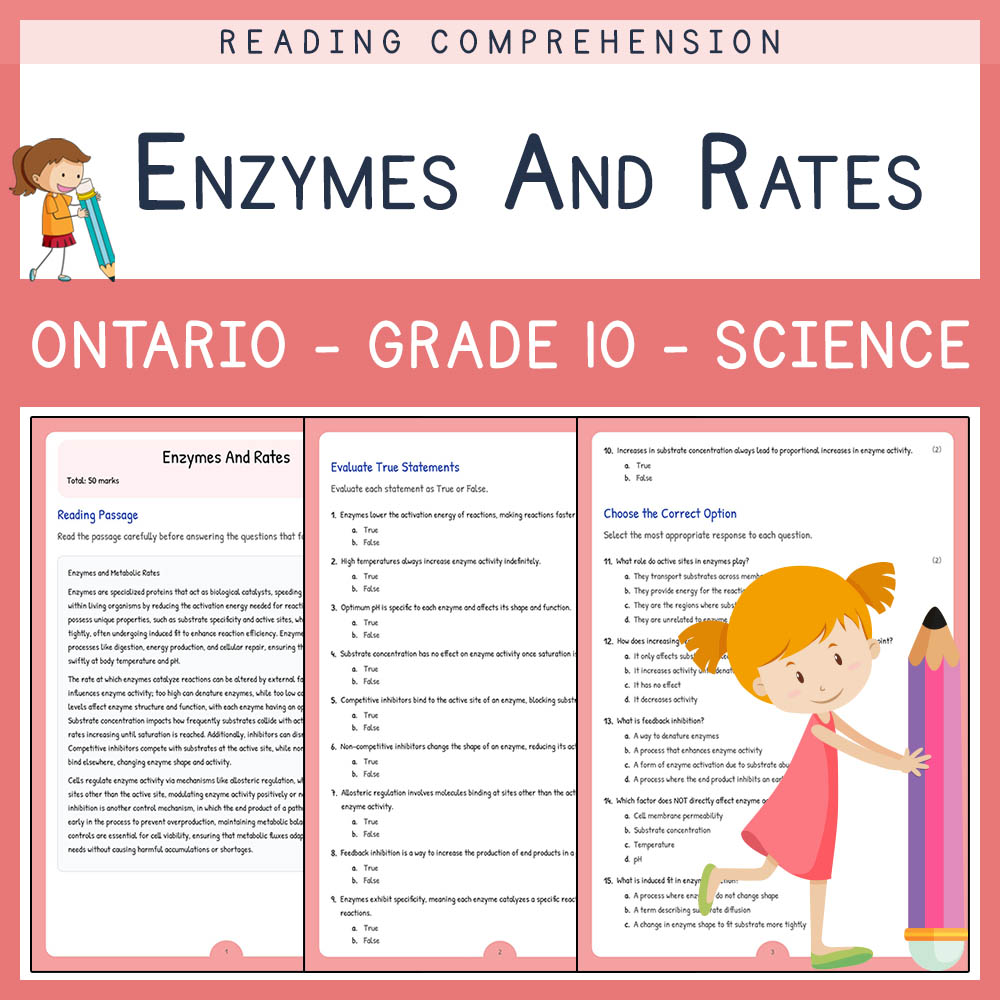
Grade 10 Science | Enzymes And Rates Worksheet | Ontario Standard
 Created byLumora Learning
Learning Objectives
- Explain the properties of enzymes and how they catalyze metabolic reactions.
- Describe the factors affecting enzyme activity, including temperature, pH, substrate concentration, and inhibitors.
- Understand concepts of allosteric regulation and feedback inhibition in metabolic pathways.
Instant download
Grade 10 Science – Enzymes And Rates Worksheet (Ontario) PDF
 Created byBright Mind Resources
Learning Objectives
- Understand the properties and functions of enzymes in cellular metabolism.
- Describe factors affecting enzyme activity such as temperature, pH, substrate concentration, and inhibitors.
- Explain the concepts of allosteric regulation and feedback inhibition as mechanisms of enzyme activity control.
Instant download

Grade 10 Science Enzymes & Rates Worksheet (Ontario) (PDF)
 Created byEvergreen Desk Education
Learning Objectives
- Explain how enzymes lower activation energy using specific active sites and induced fit to increase reaction rates.
- Predict how temperature, pH, substrate concentration, and inhibitors change enzyme activity and reaction rate.
- Describe how allosteric regulation and feedback inhibition help control pathway flux in cells.
Also included in: Grade 10 Cell Functions & Energy Science Lesson Bundle - Ontario Framework +1 more
Instant download
Grade 10 Science – Enzymes and Rates Daily Reading Worksheet + Answer Key
Learning Objectives
- Understand the properties of enzymes and how they function as biological catalysts.
- Identify factors that influence enzyme activity, including temperature, pH, substrate concentration, and inhibitors.
- Describe mechanisms of enzyme regulation such as allosteric regulation and feedback inhibition.
Also included in: Grade 10 Science Lesson Bundle | Ontario Curriculum and Daily Reading Worksheets +1 more
Instant download

Grade 10 Science – Enzymes & Rates | Daily Reading Worksheet
 Created byQuiet Forest Education
Learning Objectives
- Understand the structure and function of enzymes
- Explain how enzymes catalyze metabolic reactions
- Identify factors that affect enzyme activity such as temperature, pH, substrate concentration, and inhibitors
Also included in: Cell Biology Grade 10 Science Daily Reading Worksheets Bundle | Ontario +1 more
Instant download

Enzymes and Rates Worksheet | Grade 10 Science | Ontario Standards
Learning Objectives
- Explain how enzymes lower activation energy using active sites and induced fit
- Predict how temperature, pH, and substrate concentration affect enzyme-catalyzed reaction rates
- Distinguish competitive versus non-competitive inhibition and how they change enzyme activity
Instant download
Grade 10 Science | Enzymes And Rates Worksheet with Short Notes (Printable PDF)
 Created byMeadowlark Worksheets
Learning Objectives
- Explain the properties and functions of enzymes in biological reactions.
- Describe how temperature, pH, substrate concentration, and inhibitors affect enzyme activity.
- Understand concepts of allosteric regulation and feedback inhibition in metabolic pathways.
Also included in: Grade 10 Science Lesson Group Bundle | Ontario Curriculum +1 more
Instant download

Particle Accounting Worksheet | Grade 10 Matter Counting Practice
Created byPrism Point LearningLearning Objectives
- Explain particle accounting using atomic-level models to show what is conserved in chemical reactions.
- Use diagrams or particle representations to identify which bonds break and which bonds form during a reaction.
- Connect conservation of atoms to reaction completion and product identity.
Instant download

Particle Accounting Worksheet | California Standards Grade 10 Science Practice
Learning Objectives
- Understand that atomic-level representations show conservation of atoms during chemical reactions.
- Identify which bonds break and which form in chemical reactions using diagrams or symbolic models.
- Explain how models support claims about reaction completion and product identity.
Also included in: Grade 10 Energy, Forces, and Reactions Science Lesson Bundle +1 more
Instant download

Grade 10 Science | Particle Accounting Worksheet | California Standards
Created byLumora LearningLearning Objectives
- Use particle accounting to track conservation of atoms during chemical reactions.
- Connect atomic diagrams to conservation by comparing atom totals before and after a reaction.
- Explain which bonds break and which bonds form using particulate (atomic-level) representations.
Instant download

Grade 10 Science | Particle Accounting in Chemical Reactions - Reading Practice
 Created byCoral Reef Learning
Learning Objectives
- Explain the principle of atom conservation during chemical reactions.
- Identify atoms before and after reactions using diagrams or formulas.
- Describe how bonds break and form at the atomic level.
Instant download

Grade 10 Science – Particle Accounting & Conservation of Atoms | Worksheet
Created byBright Mind ResourcesLearning Objectives
- Understand the principle of conservation of atoms during chemical reactions.
- Identify atoms and bonds in molecular diagrams before and after reactions.
- Explain how atoms are conserved despite changes in substances' appearance or properties.
Also included in: Grade 10 Energy & Models Science Lesson Bundle | CA Standards Daily Reading +1 more
Instant download

Particle Accounting Worksheet | Grade 10 Chemistry Science CA Standards
Created byEvergreen Desk EducationLearning Objectives
- Use atomic/molecular particle accounting to justify conservation of atoms during chemical reactions
- Explain how a particle diagram shows which bonds break and which bonds form
- Interpret changes in observable properties (color, state, temperature) while maintaining consistent atom counts
Instant download

Grade 10 Science | Metabolic Pathways - Daily Reading Comprehension
Created byCoral Reef LearningLearning Objectives
- Understand the key steps of glycolysis
- Identify the main enzymes involved in glycolysis
- Recognize the energy yield from glycolysis
Also included in: Biology and Ecosystems Lesson Bundle – Grade 10 Science Advanced Placement +1 more
Instant download
Grade 10 Science | Metabolic Pathways Worksheet with Short Notes (Printable PDF)
Created byMeadowlark WorksheetsLearning Objectives
- Map and describe the core metabolic pathways including glycolysis, the TCA cycle, and oxidative phosphorylation.
- Explain how cells generate and conserve energy through these pathways.
- Identify key intermediates, enzymes, and energy carriers involved in cellular respiration.
Instant download
Grade 10 Science | Metabolic Pathways Worksheet (AP Standard) PDF
Created byBright Mind ResourcesLearning Objectives
- Map and describe the core metabolic pathways including glycolysis, the TCA cycle, and oxidative phosphorylation.
- Explain how cells conserve energy through ATP generation and electron flow in these pathways.
- Identify regulatory checkpoints and pathway branch points that maintain cellular function under different conditions.
Instant download
Grade 10 Science | Metabolic Pathways Reading Worksheet & Answer Key (PDF)
Learning Objectives
- Understand the key steps and components of glycolysis, the tricarboxylic acid cycle, and oxidative phosphorylation.
- Identify where energy is conserved and released in metabolic pathways.
- Explain how electrons flow through redox reactions during cellular respiration.
Also included in: Grade 10 Science Unit | Cell Biology, Genetics, & Ecosystems Worksheet Pack +1 more
Instant download
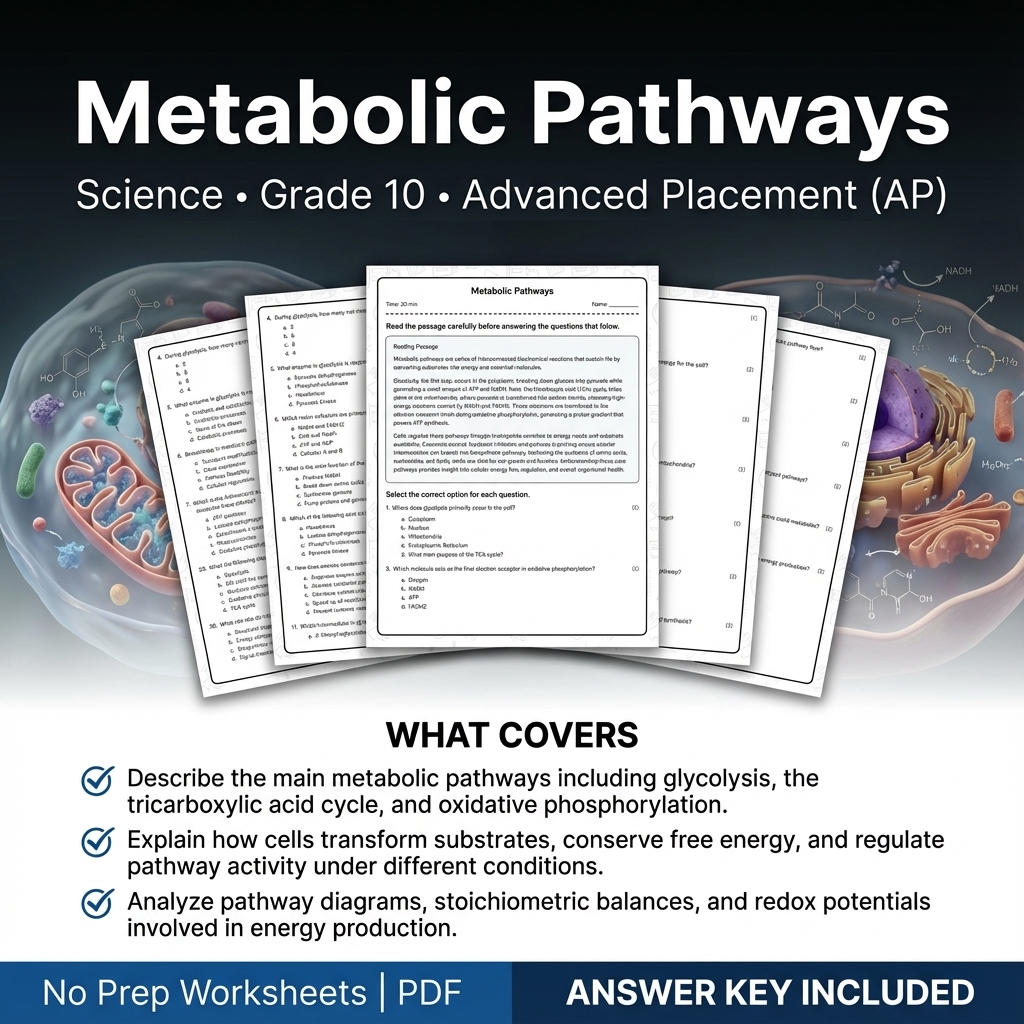
Grade 10 Science | Metabolic Pathways Worksheet (Printable PDF + Answer Key)
Created byCoral Reef LearningLearning Objectives
- Describe the main metabolic pathways including glycolysis, the tricarboxylic acid cycle, and oxidative phosphorylation.
- Explain how cells transform substrates, conserve free energy, and regulate pathway activity under different conditions.
- Analyze pathway diagrams, stoichiometric balances, and redox potentials involved in energy production.
Also included in: Grade 10 Science UNIT Worksheet Bundle – Genetics, Ecosystems & Cell Biology +1 more
Instant download

Grade 10 Science Worksheet – Metabolic Pathways (AP) (PDF)
Created byEvergreen Desk EducationLearning Objectives
- Explain how glycolysis, the citric acid (TCA) cycle, and oxidative phosphorylation work together to conserve free energy in ATP.
- Trace electron flow from NADH and FADH2 through the electron transport chain and describe how it generates an electrochemical proton gradient.
- Identify regulatory checkpoints and pathway branching that adjust flux under changing oxygen, energy, and substrate conditions.
Also included in: Grade 10 Genetics & Cell Systems Science Lesson Bundle – Advanced Placement (AP) +1 more
Instant download

Grade 10 Metabolic Pathways Worksheet | Practice & Assessment PDF
 Created byClear Sky Classroom
Learning Objectives
- Map the major stages of cellular respiration (glycolysis, the TCA cycle, and oxidative phosphorylation) and describe the flow of electrons and energy.
- Explain how cells use redox reactions and intermediate fates to conserve free energy in ATP and electrochemical gradients.
- Identify key regulatory checkpoints that control pathway branching under different energy and environmental conditions.
Also included in: Grade 10 Population, Genetics, and Cellular Processes Science Lesson Bundle AP +1 more
Instant download

Metabolic Pathways Worksheet | AP Science Grade 10 | PDF Practice
Learning Objectives
- Map and describe the core metabolic pathways: glycolysis, TCA cycle, and oxidative phosphorylation.
- Explain how cells conserve energy through ATP generation, electron flow, and intermediate fates.
- Identify regulatory checkpoints and pathway branching points that maintain cellular energy balance.
Also included in: Grade 10 Genetics & Cellular Systems Science Lesson Bundle – AP Unit
Instant download

Grade 10 Science | Metabolic Pathways Worksheet | AP Aligned
Created byLumora LearningLearning Objectives
- Describe the core metabolic pathways including glycolysis, the tricarboxylic acid cycle, and oxidative phosphorylation.
- Explain how cells transform substrates and conserve free energy in ATP and electrochemical gradients.
- Identify regulatory checkpoints and pathway branching that maintain cellular organization under varying conditions.
Also included in: Grade 10 Science | Biology and Ecosystems Custom Bundle | AP
Instant download

Grade 10 Science — Worksheet MCQ Paper for Mastering Metabolic Pathways
 Created byThe Resource Hub
Learning Objectives
- Understand the key stages of glycolysis, the tricarboxylic acid cycle, and oxidative phosphorylation.
- Identify the flow of electrons and energy transfer during cellular respiration.
- Recognize the regulation points and pathway branching that adapt to cellular needs.
Also included in: Grade 10 Biology and Ecosystems Lesson Bundle | AP Science +1 more
Instant download

Grade 10 AP Science Metabolic Pathways Worksheet | Practice Pack
Created byPrism Point LearningLearning Objectives
- Explain how glycolysis, the TCA cycle, and oxidative phosphorylation connect to transform substrates into ATP and electron carriers.
- Describe electron flow through the electron transport chain and how proton gradients enable ATP synthesis.
- Use redox concepts and regulatory checkpoints to predict how cells respond to changing oxygen and energy availability.
Also included in: Grade 10 AP Science Life Systems Lesson Bundle | Worksheet Pack
Instant download
10th Grade Science | Metabolic Pathways Worksheet (PDF+ Answer Key)
Created byCopper Leaf ClassroomLearning Objectives
- Map and explain the core metabolic pathways including glycolysis, the TCA cycle, and oxidative phosphorylation.
- Identify key energy yields, electron flows, and fates of intermediates in these pathways.
- Understand the regulation and branching points that maintain cellular homeostasis under varying conditions.
Also included in: Grade 10 Science | Key Concepts in Biology & Ecosystems (PDF+ Answer Key) +1 more
Instant download

Grade 10 Science – Selective Mechanisms & Evolution | Daily Reading Worksheet
Created byBright Mind ResourcesLearning Objectives
- Understand the concept of natural selection and how variation affects survival
- Identify examples of selective pressures such as antibiotic resistance and industrial melanism
- Explain how traits become more or less common in populations over generations
Also included in: Evolution Grade 10 Science Daily Reading Worksheets Lesson Bundle | NGSS +2 more
Instant download
10th Grade Science | Selective Mechanisms Reading Worksheet (PDF + Rubric)
Learning Objectives
- Understand the process of natural selection and how it leads to adaptation in populations.
- Identify examples of selective mechanisms such as antibiotic resistance, industrial melanism, and beak variation in finches.
- Explain how environmental pressures influence trait frequency changes across generations.
Also included in: Grade 10 Science | Evolution & Biodiversity Unit Worksheet Bundle
Instant download

Grade 10 Science – Selective Mechanisms Worksheet (NGSS10 PDF)
 Created bySilver Birch Teaching
Learning Objectives
- Understand how natural selection operates through variation, differential success, and environmental pressures.
- Identify empirical examples of natural selection such as antibiotic resistance, melanism, and beak variation.
- Explain the connection between observable phenotypic changes and allele frequency dynamics in populations.
Also included in: Grade 10 Evolution Evidence & Biodiversity Science Lesson Bundle NGSS +1 more
Instant download

Grade 10 Selective Mechanisms in Evolution Worksheet | NGSS Biology Activity
 Created byBRIGHT PATH RESOURCES
Learning Objectives
- Understand the concept of natural selection and how it influences species adaptation
- Identify real-world examples of natural selection in various organisms
- Explain the process by which traits become more or less common in populations over generations
Also included in: Genetics & Evolution Grade 10 Science Worksheets Lesson Bundle | NGSS +1 more
Instant download

10th Grade Science | Selective Mechanisms Worksheet & Answer Key (Printable PDF)
Created byCoral Reef LearningLearning Objectives
- Understand how natural selection operates through heritable trait variation.
- Identify examples of adaptive changes such as antibiotic resistance and melanism.
- Analyze the relationship between trait frequency shifts and reproductive success.
Also included in: Grade 10 Science Unit Worksheet Bundle – Genetics, Evolution & Biodiversity +1 more
Instant download

Selective Mechanisms Worksheet for Grade 10 Science | NGSS Aligned Assessment
Learning Objectives
- Understand how natural selection operates through variation, differential reproduction, and environmental pressures.
- Identify empirical examples of natural selection such as antibiotic resistance, industrial melanism, and beak variation.
- Explain the relationship between trait frequency changes and allele dynamics over generations.
Also included in: Grade 10 Evolution and Speciation Science Lesson Bundle – NGSS Framework
Instant download
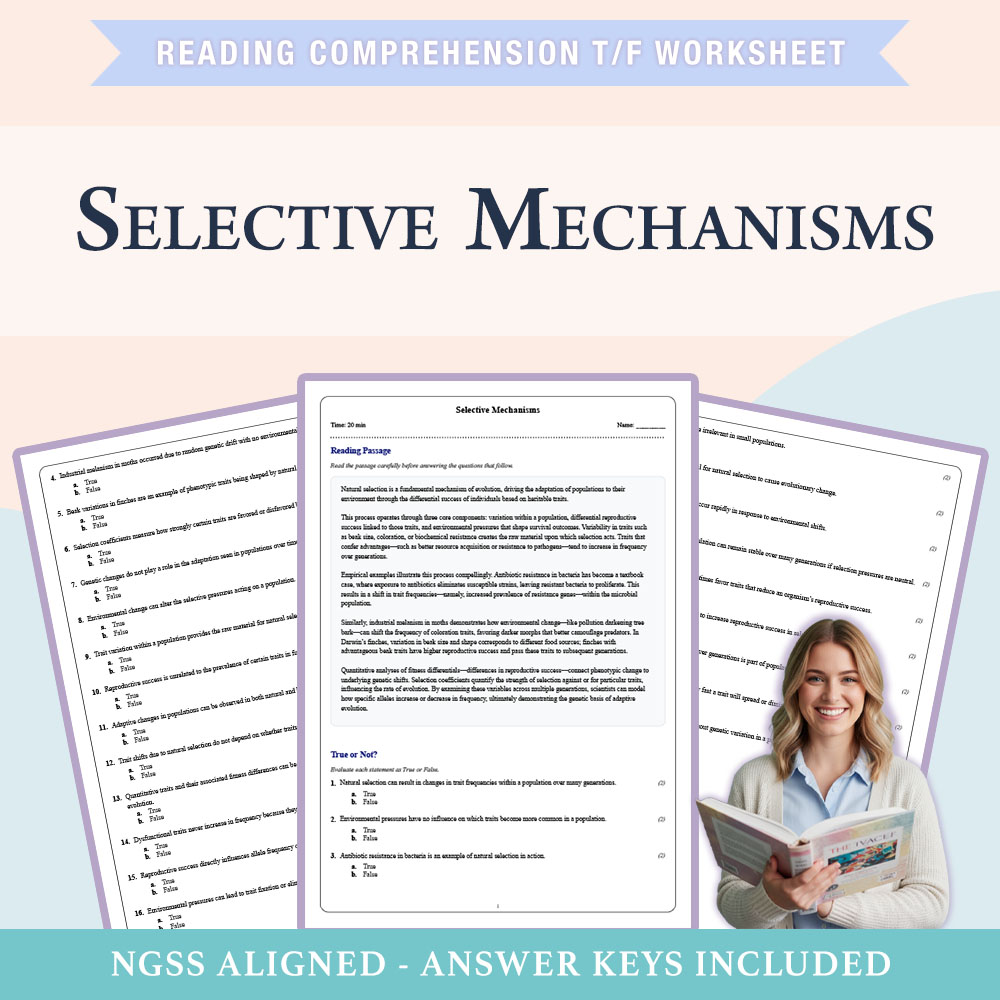
10th Grade Science | Selective Mechanisms Worksheet (PDF + Answer Key)
Created byCopper Leaf ClassroomLearning Objectives
- Understand how natural selection operates through variation, differential reproductive success, and environmental pressures.
- Identify examples of adaptive changes in populations such as antibiotic resistance, melanism, and beak variation.
- Explain the relationship between observable phenotypic changes and allele frequency dynamics within populations.
Also included in: Grade 10 Science | Evolution & Biodiversity Unit Bundle (PDF + Answer Key) +1 more
Instant download

Selective Mechanisms in Natural Selection Worksheet | Grade 10 NGSS Science
 Created byAmber Owl Education
Learning Objectives
- Explain how variation in heritable traits leads to differential survival and reproduction in natural selection
- Interpret how environmental pressures change the frequency of alleles across generations
- Use quantitative ideas such as fitness differences and selection coefficients to connect phenotype shifts to allele dynamics
Instant download
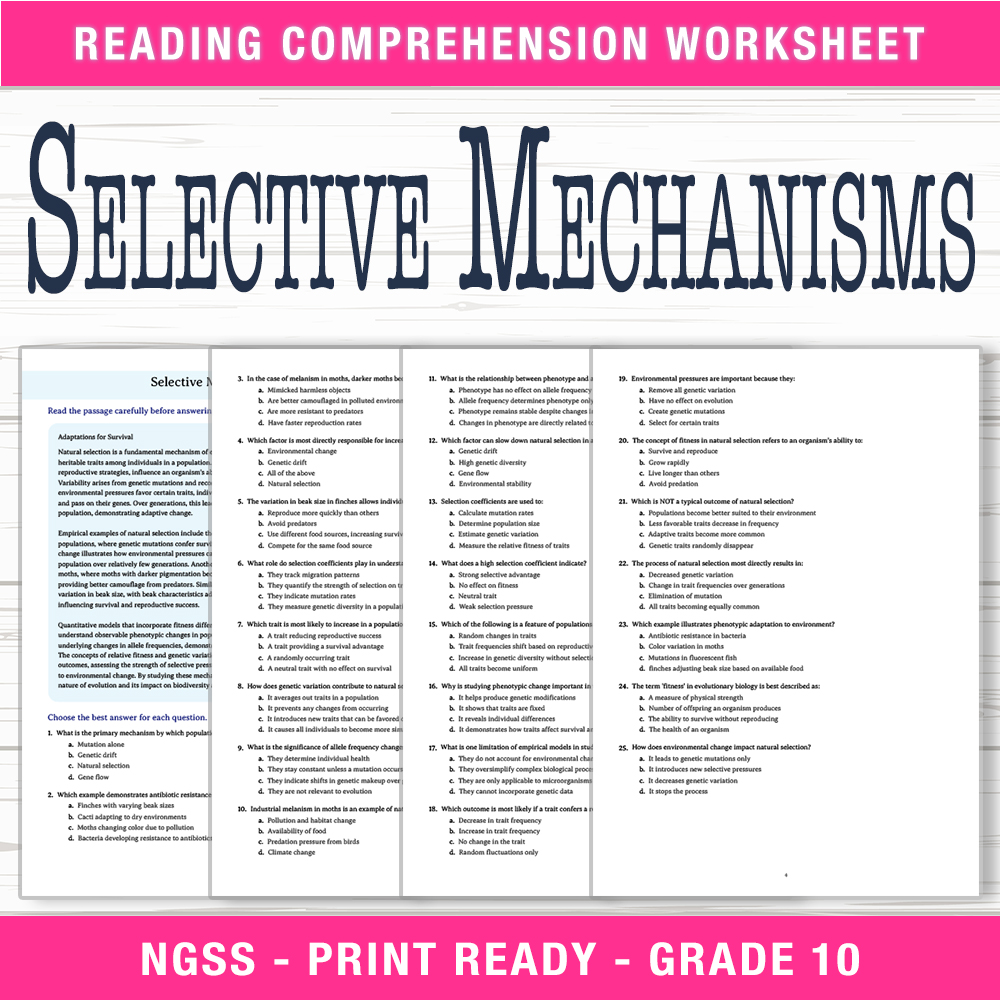
Grade 10 Science | Selective Mechanisms Worksheet (PDF + Answer Key)
 Created byRiverstone Classroom
Learning Objectives
- Understand the principles of natural selection and how it drives evolution
- Identify examples of selective mechanisms such as antibiotic resistance, industrial melanism, and beak variation
- Analyze how environmental pressures influence trait frequencies in populations
Also included in: Grade 10 Science | Evolution & Biodiversity Unit Worksheet Bundle
Instant download

Grade 10 Science Worksheet B: Selective Mechanisms Worksheet | NGSS
Created byClear Sky ClassroomLearning Objectives
- Explain how heritable variation, differential reproductive success, and environmental pressures work together in natural selection
- Use fitness concepts and allele-frequency thinking to describe how traits change in populations over generations
- Connect real-world examples (antibiotic resistance, industrial melanism, and finch beak variation) to selective mechanisms
Also included in: Grade 10 Evolution and Speciation Science Lesson Bundle | NGSS Worksheet B +1 more
Instant download
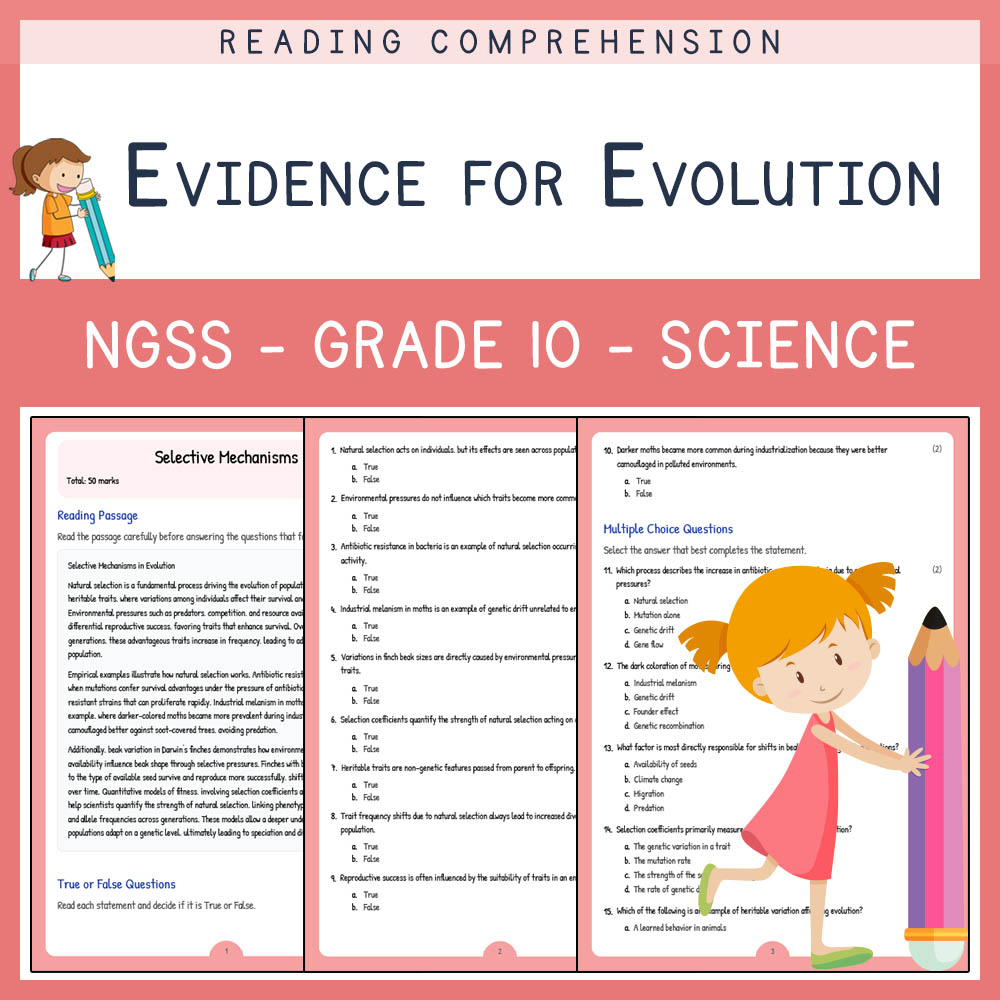
Grade 10 Science | Selective Mechanisms Worksheet (NGSS-Aligned + Answer Key)
Created byLumora LearningLearning Objectives
- Understand how natural selection causes populations to adapt through heritable trait variation.
- Identify real-world examples of natural selection such as antibiotic resistance, industrial melanism, and beak variation.
- Explain how environmental pressures influence reproductive success and trait frequency changes.
Instant download

Selective Mechanisms Worksheet | Grade 10 Science printable PDF NGSS
Learning Objectives
- Explain how heritable variation and environmental pressures drive natural selection in populations
- Interpret how differential survival and reproduction change allele frequencies over generations
- Use fitness and selection coefficient ideas to connect phenotypic change to population genetics dynamics
Instant download
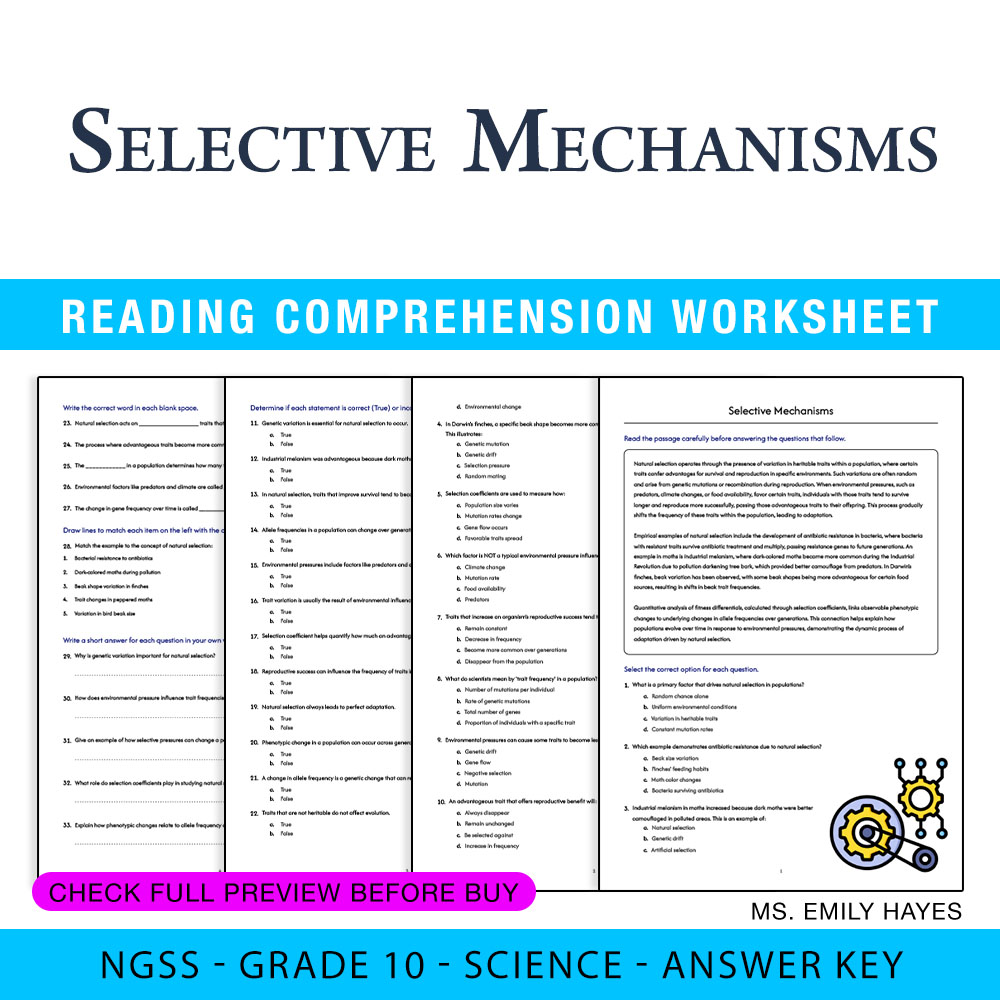
10th Grade Science | Selective Mechanisms Worksheet (PDF + Answer Key)
Created byCopper Leaf ClassroomLearning Objectives
- Explain how natural selection involves variation and environmental pressures.
- Identify real-world examples of selective mechanisms such as antibiotic resistance, industrial melanism, and beak variation.
- Analyze how traits increase or decrease in frequency due to survival and reproduction advantages.
Instant download
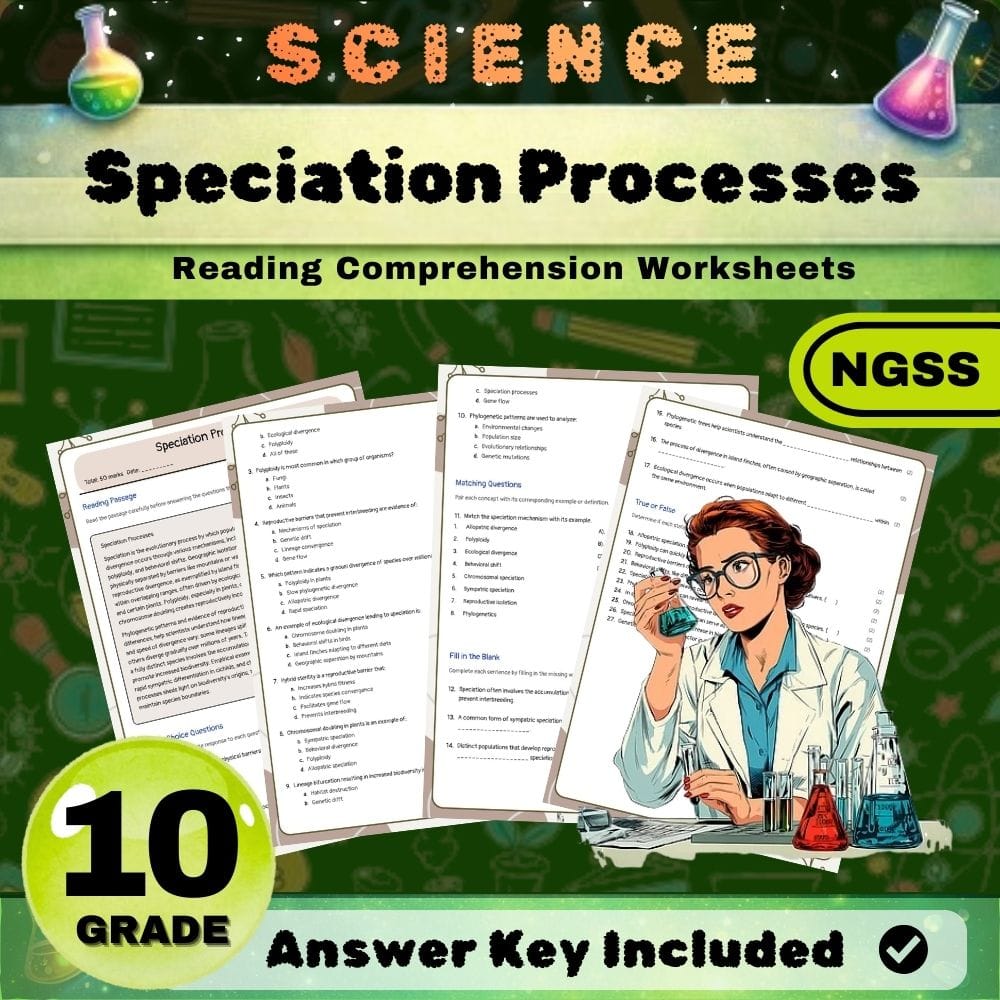
Grade 10 Science | Natural Selection Worksheet (NGSS) – PDF
 Created byMaple Path Learning
Learning Objectives
- Understand how variation in heritable traits influences natural selection.
- Explain the role of environmental pressures in shaping adaptive changes in populations.
- Identify real-world examples of evolution due to selective mechanisms, such as antibiotic resistance and industrial melanism.
Also included in: Grade 10 Science | Biological Evolution Unity and Diversity Lesson Bundle | NGSS +1 more
Instant download

Grade 10 Science | Natural Selection - Daily Reading Comprehension
Created byCoral Reef LearningLearning Objectives
- Understand the principles of natural selection
- Identify traits and environmental pressures involved in selective processes
- Recognize real-world examples of natural selection
Instant download

Natural Selection Mechanisms & Allele Frequency Change Worksheets
 Created byTeachers Club
Learning Objectives
- Explain how heritable variation supports natural selection
- Describe how environmental pressures affect reproductive success
- Interpret fitness differences among genotypes
Also included in: Grade 10 Science Evolution Worksheets | NGSS Unit Bundle +1 more
Instant download
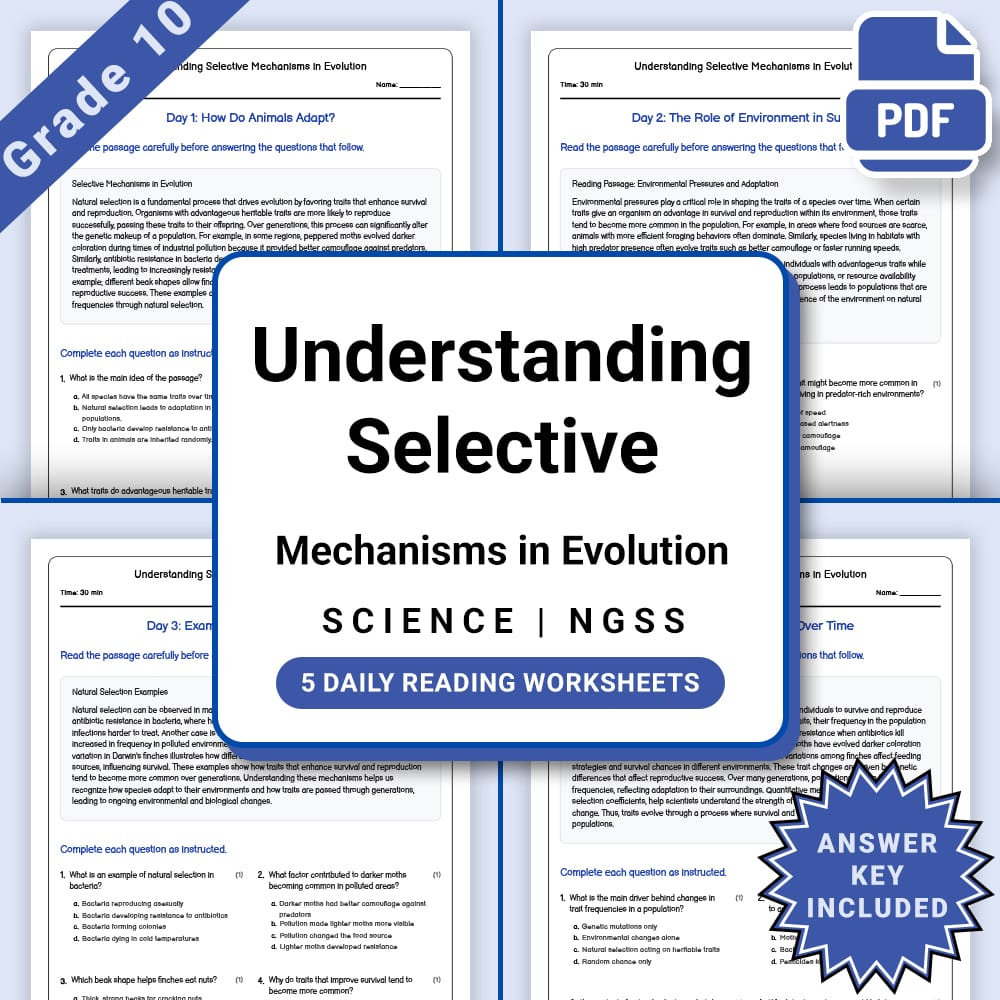
Grade 10 Science –Understanding Selective Mechanisms Worksheet (PDF +Answer Key)
Created byCopper Leaf ClassroomLearning Objectives
- Explain how natural selection favors certain traits over others.
- Identify examples of adaptive traits in different species.
- Describe how environmental pressures influence trait frequencies.
Instant download

Selective Mechanisms Worksheet Practice Test Prep | Grade 10 Science
Created byPrism Point LearningLearning Objectives
- Explain how heritable differences and environmental pressures can change allele frequencies over generations
- Use the ideas of differential survival and reproduction to describe natural selection as a quantitative process
- Connect real examples (antibiotic resistance, industrial melanism, and beak variation) to changes in trait frequency
Also included in: Grade 10 Evolution & Speciation Science Lesson Bundle (NGSS)
Instant download
About Grade 10 Science Worksheets
Find Science worksheets built for Grade 10. All 7,174 cover core skills, practice, and review, each an instant PDF download.
Every worksheet on MyTeachingSheets is created by independent teacher-authors and reviewed before publication. All resources download as printable PDFs for classroom, homework, or at-home practice, and many include answer keys. Preview any worksheet free before buying.