
Grade 11 Worksheets
9,073 grade resources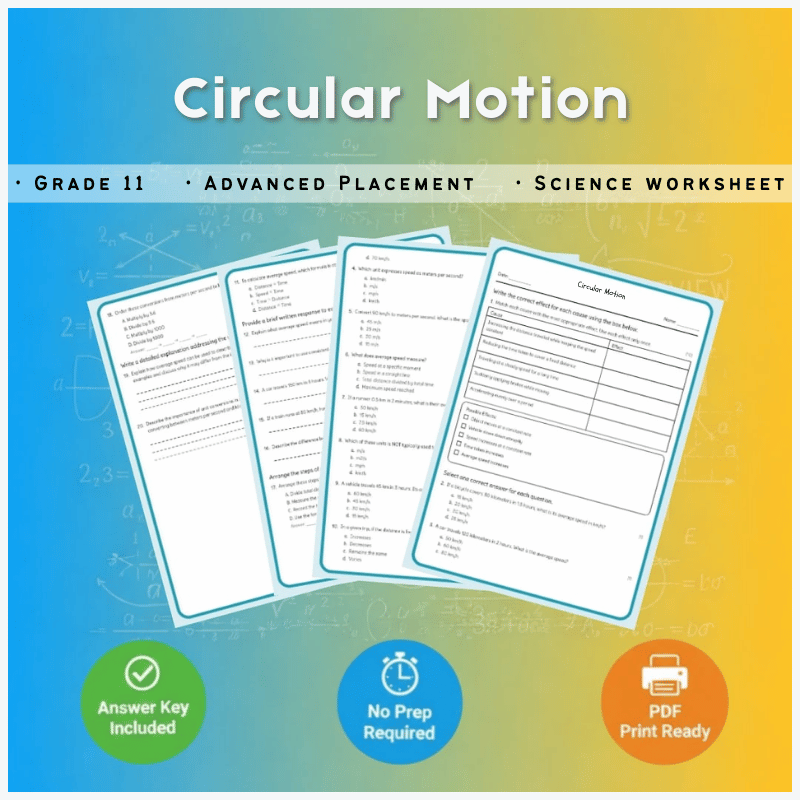
Grade 11 Science | Circular Motion Worksheet – AP Standards (PDF)
 Created byBright Mind Resources
Learning Objectives
- Explain the concepts of uniform and nonuniform circular motion, including centripetal and tangential acceleration.
- Model the net forces in circular motion using radial and tangential components.
- Describe motion in polar coordinates and understand how acceleration relates to the rate of change of velocity direction.
Instant download
Grade 11 Science | Seafloor Spreading Worksheet – BC Standards (PDF)
Created byBright Mind ResourcesLearning Objectives
- Understand the process of seafloor spreading and how it shapes ocean basins.
- Identify the evidence supporting seafloor spreading, including magnetic stripes and crust age.
- Explain how oceanic crust records Earth's magnetic field over time.
Instant download
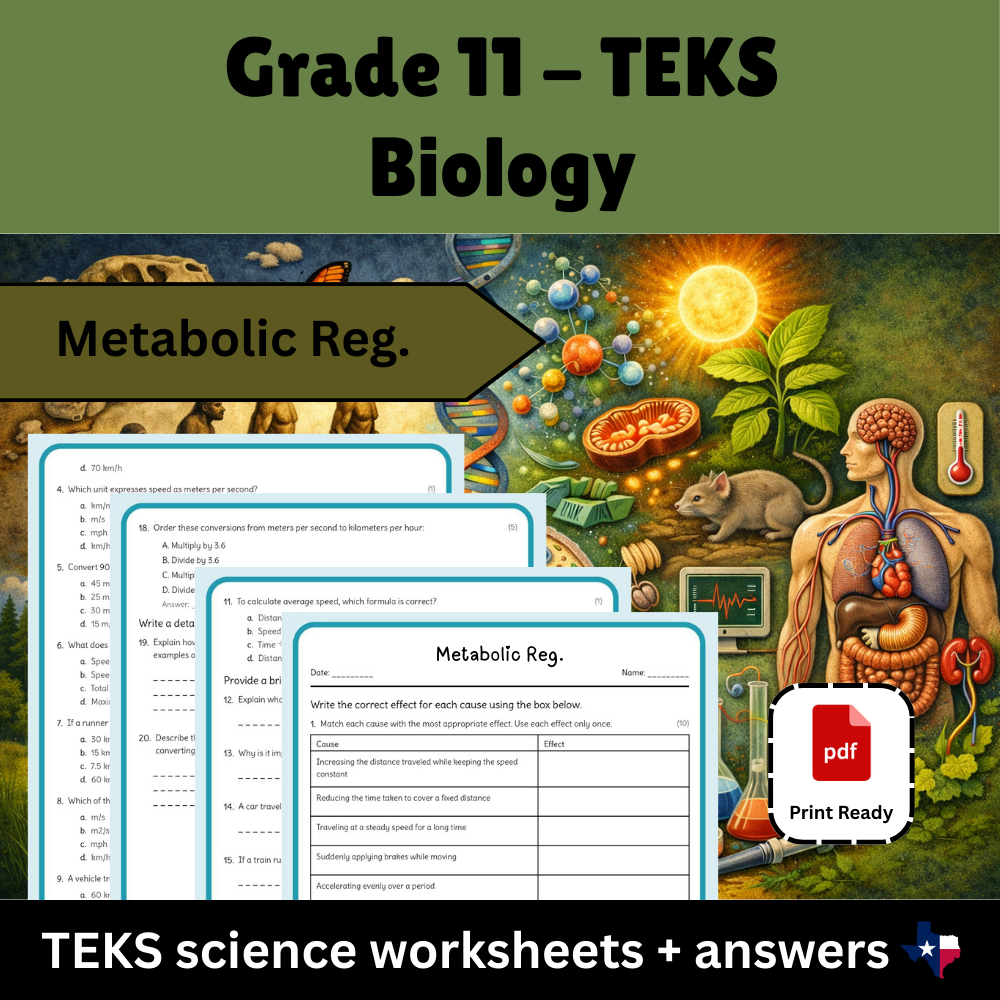
Grade 11 Science – Metabolic Regulation Worksheet (Worksheet + Answer Key) | TEKS Aligned
Created byBright Mind ResourcesLearning Objectives
- Understand enzyme regulation mechanisms that control metabolic flux.
- Identify how structural controls like allosteric modulation and phosphorylation influence pathway activity.
- Explain the roles of compartmentalization and membrane transporters in metabolic regulation.
Also included in: Grade 11 Science Unit Bundle – Cell Function, Respiration & Photosynthesis-TEKS +2 more
Instant download
Grade 11 Science | Phylogenetic Trees Worksheet (Answer Key) – BC Standards
Created byBright Mind ResourcesLearning Objectives
- Understand how phylogenetic trees illustrate hypotheses of evolutionary relationships.
- Identify different methods used to infer evolutionary histories, such as parsimony and molecular clock.
- Distinguish between homologous traits and analogous traits in evolutionary analysis.
Instant download
Grade 11 Science | Fossil Record Analysis Worksheet (Answer Key) – BC Standards
Created byBright Mind ResourcesLearning Objectives
- Understand how the fossil record documents evolutionary change over deep time.
- Identify key methods used to date fossils and establish temporal sequences.
- Explain the significance of transitional fossils in supporting descent with modification.
Instant download
Grade 11 Science | Cell Types Worksheet (TEKS) – Science 1 PDF
Created byBright Mind ResourcesLearning Objectives
- Differentiate between prokaryotic and eukaryotic cell structures.
- Identify key features of prokaryotic and eukaryotic cells.
- Explain how cell complexity affects function and ecology.
Also included in: Grade 11 Science | Cell & Systems Dynamics Unit Worksheet Bundle (TEKS-Aligned) +2 more
Instant download
Grade 11 Science – Cell Structure Worksheet (PDF) | BC Standard & Answer Key
Created byBright Mind ResourcesLearning Objectives
- Identify the key components of a cell and their functions.
- Explain differences between prokaryotic and eukaryotic cells.
- Understand how microscopy and models represent cellular structures.
Instant download
Grade 11 Science | DNA Structure Worksheet + Answer Key – BC Standards (PDF)
Created byBright Mind ResourcesLearning Objectives
- Describe the fundamental components of DNA and their functions.
- Explain the significance of complementary base pairing and the double helix structure.
- Analyze how mutations such as substitutions, insertions, and deletions affect genetic information.
Instant download
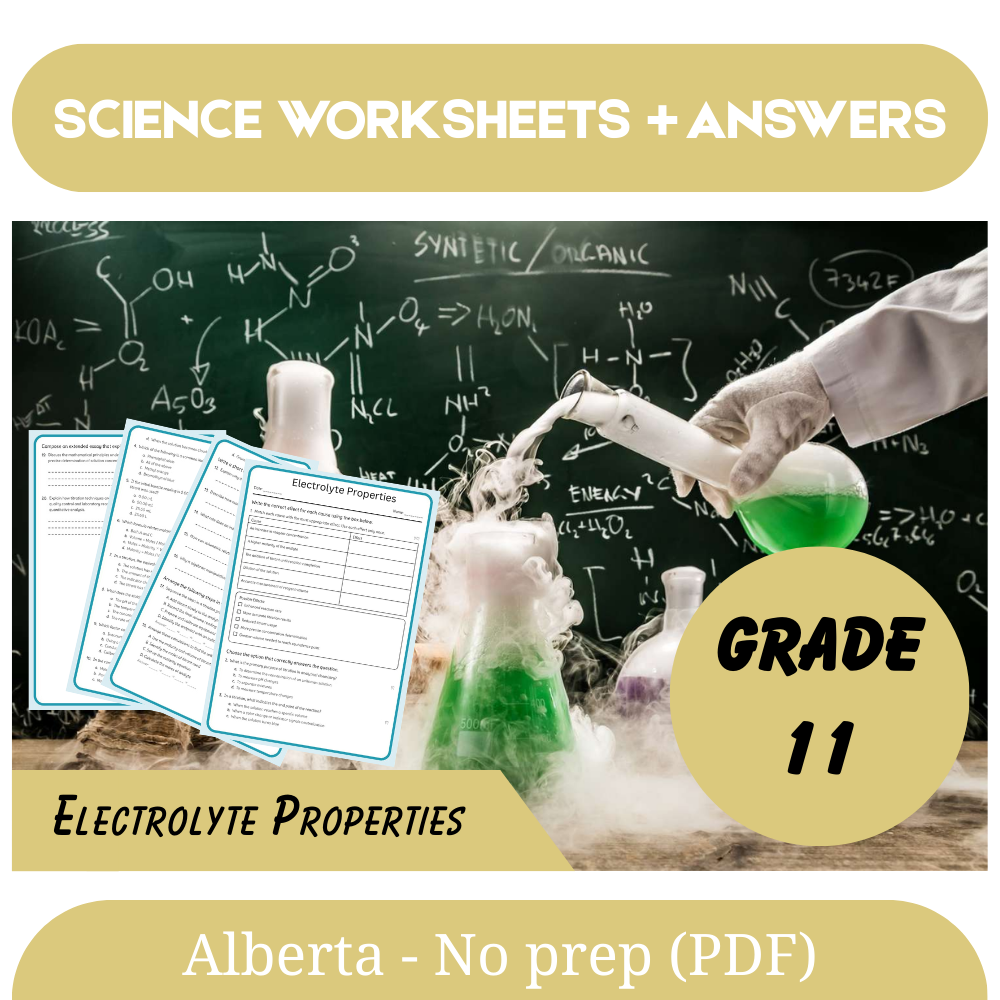
Grade 11 Science – Electrolyte Properties Worksheet (PDF)
Created byBright Mind ResourcesLearning Objectives
- Understand the difference between electrolytes and nonelectrolytes and their ability to conduct electricity.
- Analyze how electrolyte strength, ion concentration, and solute particles influence colligative properties such as freezing point depression.
Instant download
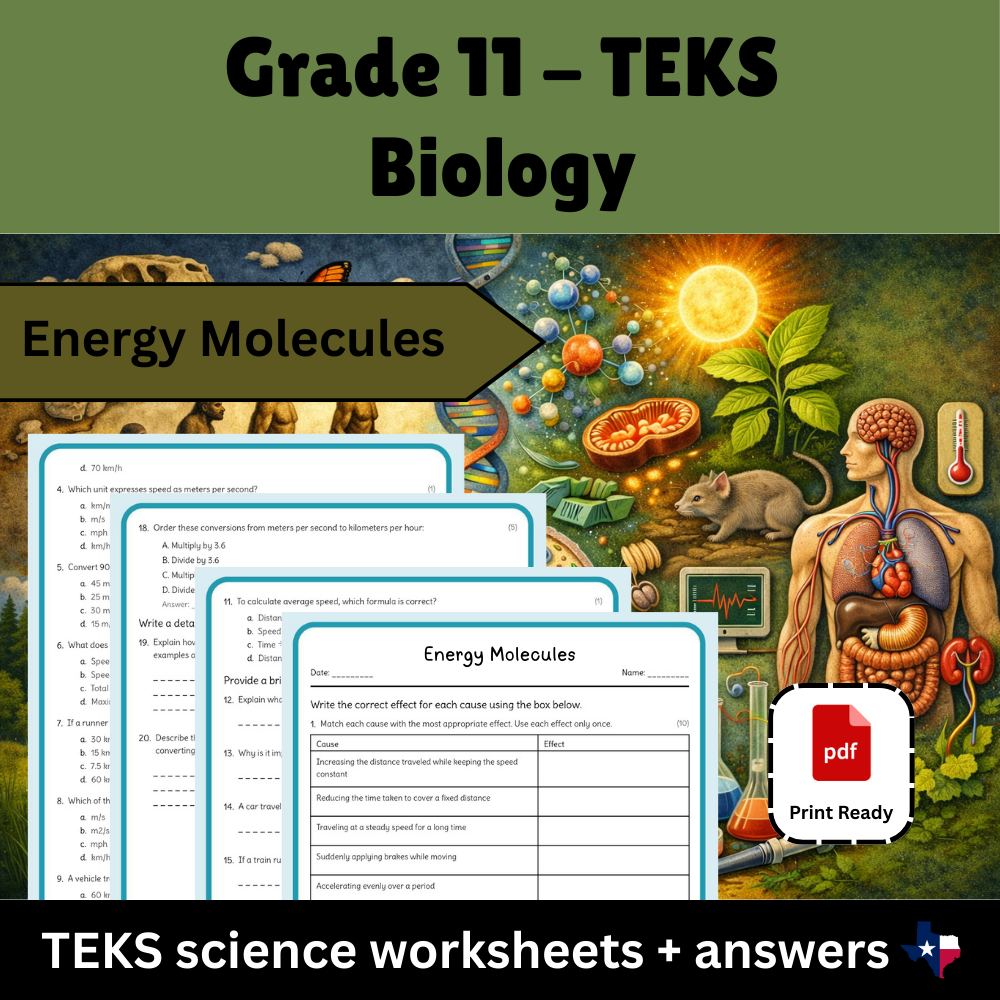
Grade 11 Science | Energy Molecules TEKS Worksheet (PDF) with Answer Key
Created byBright Mind ResourcesLearning Objectives
- Describe the function of ATP as the primary energy carrier in cells.
- Explain how cells produce ATP through different metabolic pathways.
- Identify the processes that utilize ATP energy for cellular functions.
Also included in: Grade 11 Science Unit Bundle – Cell Function, Respiration & Photosynthesis-TEKS +2 more
Instant download
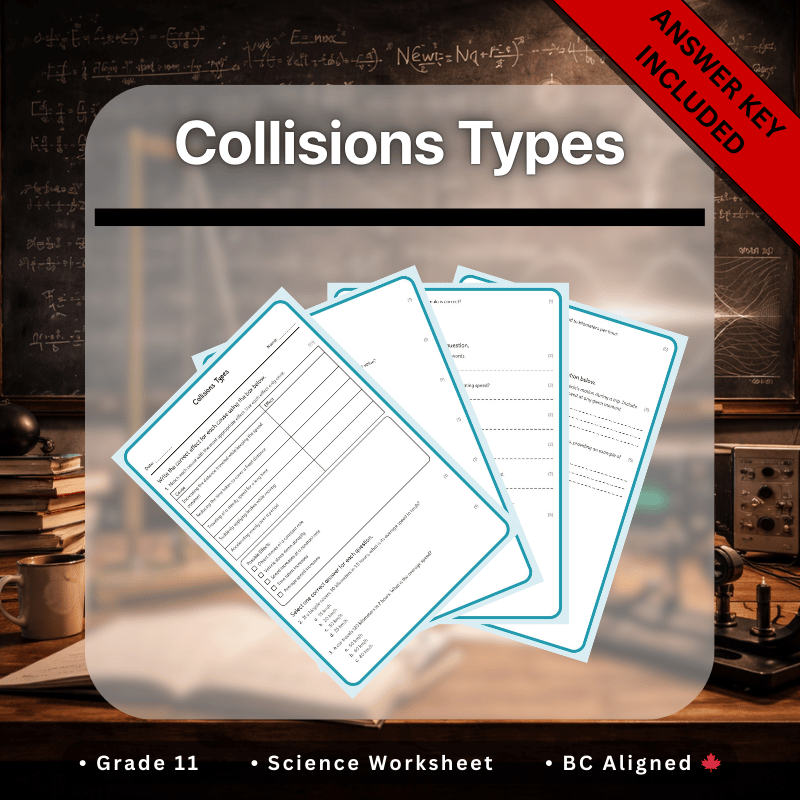
Grade 11 Science | Collisions Types Worksheet (Puzzle & Explanation) PDF
Created byBright Mind ResourcesLearning Objectives
- Understand the difference between elastic and inelastic collisions in terms of energy and momentum conservation.
- Apply conservation equations to analyze one- and two-dimensional collisions.
- Interpret physical scenarios involving collisions using center-of-mass frames and energy distribution concepts.
Instant download
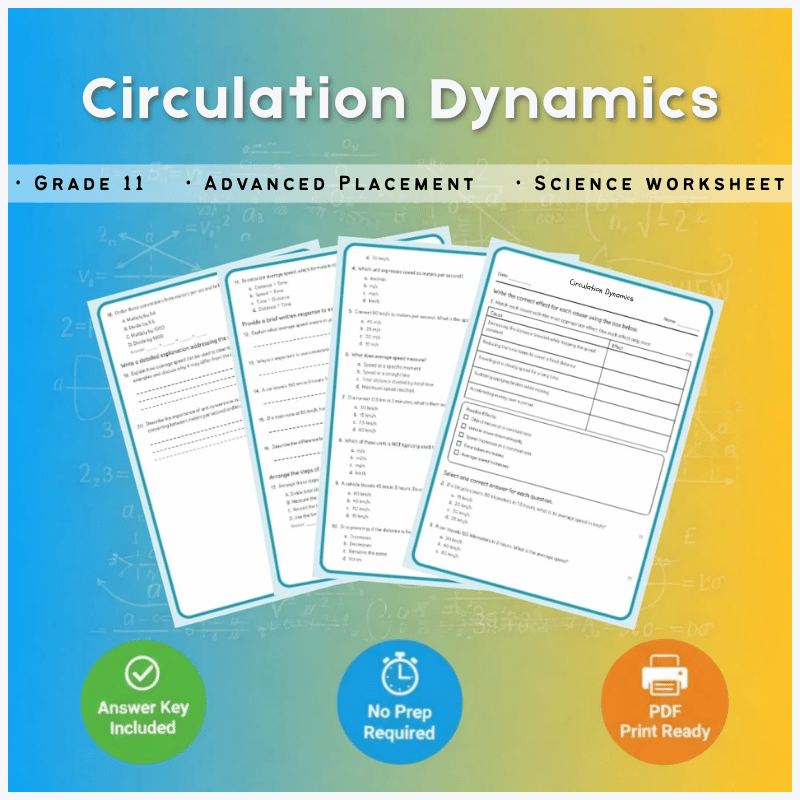
Grade 11 Science | Circulation Dynamics Worksheet (AP Standard) PDF
Created byBright Mind ResourcesLearning Objectives
- Understand the principles of atmospheric and oceanic circulation patterns.
- Interpret streamfunction plots, velocity fields, and schematic models related to circulation.
- Link jet streams, trade winds, and thermohaline circulation to climate and heat redistribution.
Instant download
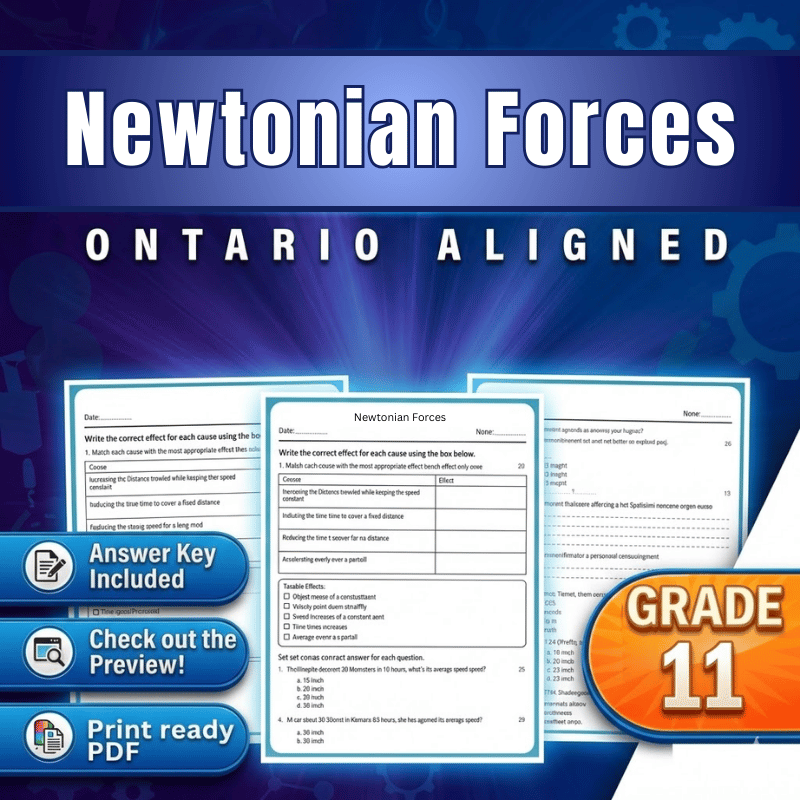
Grade 11 Science – Newtonian Forces Worksheet (Science 1) Ontario Standard (PDF)
Created byBright Mind ResourcesLearning Objectives
- Understand Newton's three laws of motion and their application to forces.
- Interpret free-body diagrams and identify contact, normal, frictional, tension, and gravitational forces.
- Explain the concepts of static and kinetic friction, including coefficients and limiting conditions.
Instant download
Grade 11 Science | Balancing Reactions Worksheet (Answer Key) – BC Standards
Created byBright Mind ResourcesLearning Objectives
- Understand the importance of balancing chemical equations to conserve mass and atoms.
- Identify the mole ratios from balanced equations for quantitative calculations.
- Apply rules for balancing ionic and redox reactions accurately.
Instant download
Grade 11 Science – Hazard Management Worksheet (Answer Key) | BC Standards
Created byBright Mind ResourcesLearning Objectives
- Understand techniques used in hazard susceptibility mapping and risk assessment.
- Identify mitigation measures for natural hazards such as earthquakes, volcanic eruptions, landslides, and tsunamis.
- Evaluate the balance between economic benefits and hazard exposure in planning and resource management.
Instant download
Grade 11 Science | Energy Balance Worksheet (AP Standards) – Science (PDF)
Created byBright Mind ResourcesLearning Objectives
- Explain the concept of Earth's energy budget and the role of radiative forcing in climate variability.
- Interpret phenomena such as seasonal cycles and polar amplification through differential heating and feedback mechanisms.
- Analyze observational data from satellites and surface records to evaluate climate models' energy transport and surface temperature responses.
Instant download
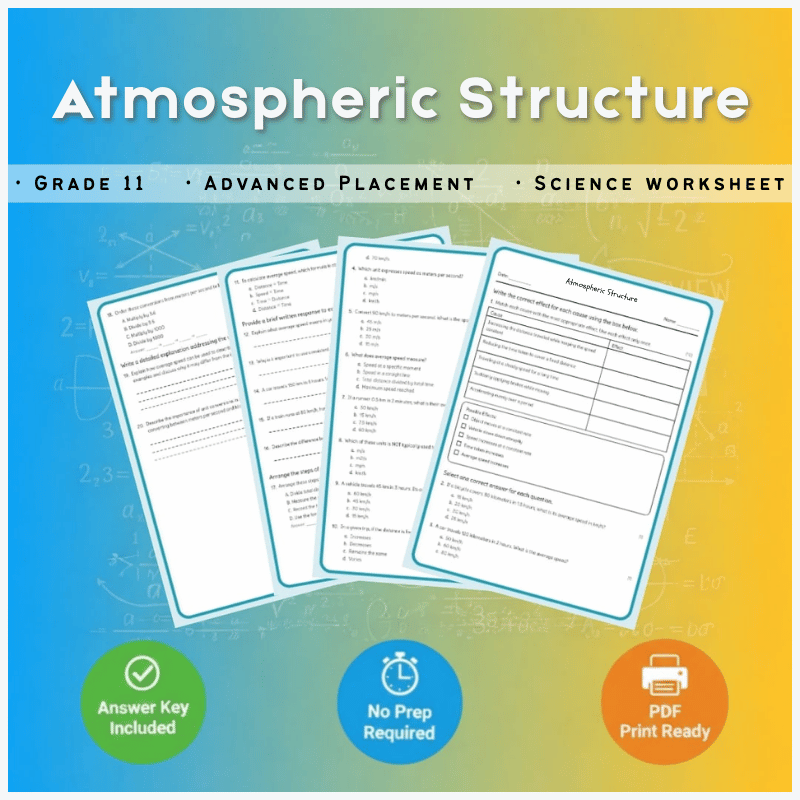
Grade 11 Science – Atmospheric Structure Worksheet (AP Standard + PDF)
Created byBright Mind ResourcesLearning Objectives
- Describe the vertical and horizontal layers of Earth's atmosphere including composition, pressure, and temperature profiles.
- Interpret sounding profiles, pressure maps, and radiative balance diagrams to understand weather and climate zones.
- Connect thermodynamic principles with phenomena like lapse rates and inversion layers to explain atmospheric responses.
Instant download
Grade 11 Science – Molecular Phylogeny Worksheet + Answer Key (TEKS Aligned)
Created byBright Mind ResourcesLearning Objectives
- Understand how DNA, RNA, and protein sequences are used to infer evolutionary relationships.
- Describe the process of sequence alignment and its importance in molecular phylogeny.
- Explain models of molecular evolution and how they account for substitution rates.
Also included in: Grade 11 Science | Evolution & Phylogenetics Worksheet Bundle (TEKS Aligned) +2 more
Instant download
Grade 11 Science | Gene Regulation Worksheet (Answer Key) – TEKS Aligned
Created byBright Mind ResourcesLearning Objectives
- Understand the mechanisms controlling gene expression, including cis-regulatory elements, chromatin modifications, and post-transcriptional processes.
- Identify the roles of promoters, enhancers, DNA methylation, and histone modifications in gene regulation.
- Explain how gene regulation influences cell differentiation, development, and response to environmental stimuli.
Also included in: Grade 11 Science DNA & Genetics Unit Worksheet Pack+ Answer Key (TEKS-Aligned) +2 more
Instant download
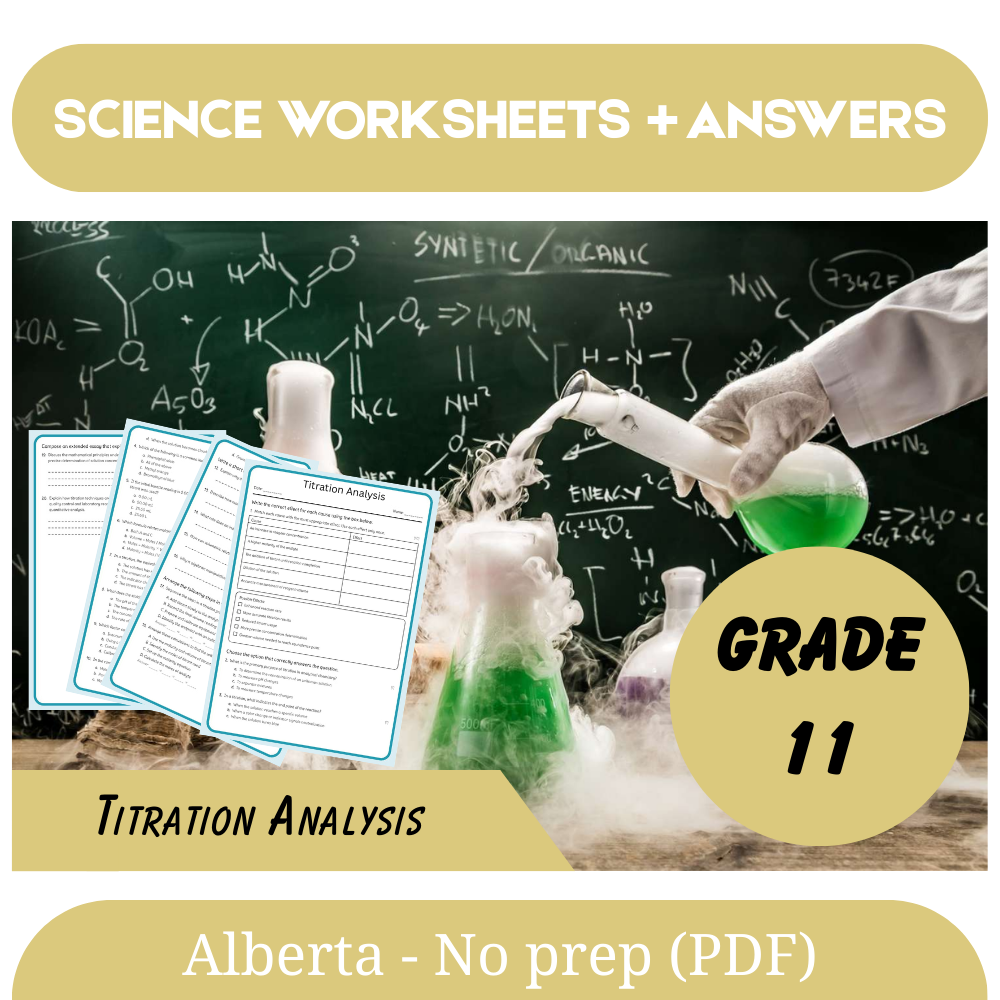
Grade 11 Science – Titration Analysis Worksheet (PDF) | Alberta Standards
Created byBright Mind ResourcesLearning Objectives
- Understand the mathematical basis of titration calculations using molarity and reaction stoichiometry.
- Apply algebraic manipulation to determine unknown concentrations in titration scenarios.
- Interpret equivalence relationships to understand the quantitative connections in titration analysis.
Instant download
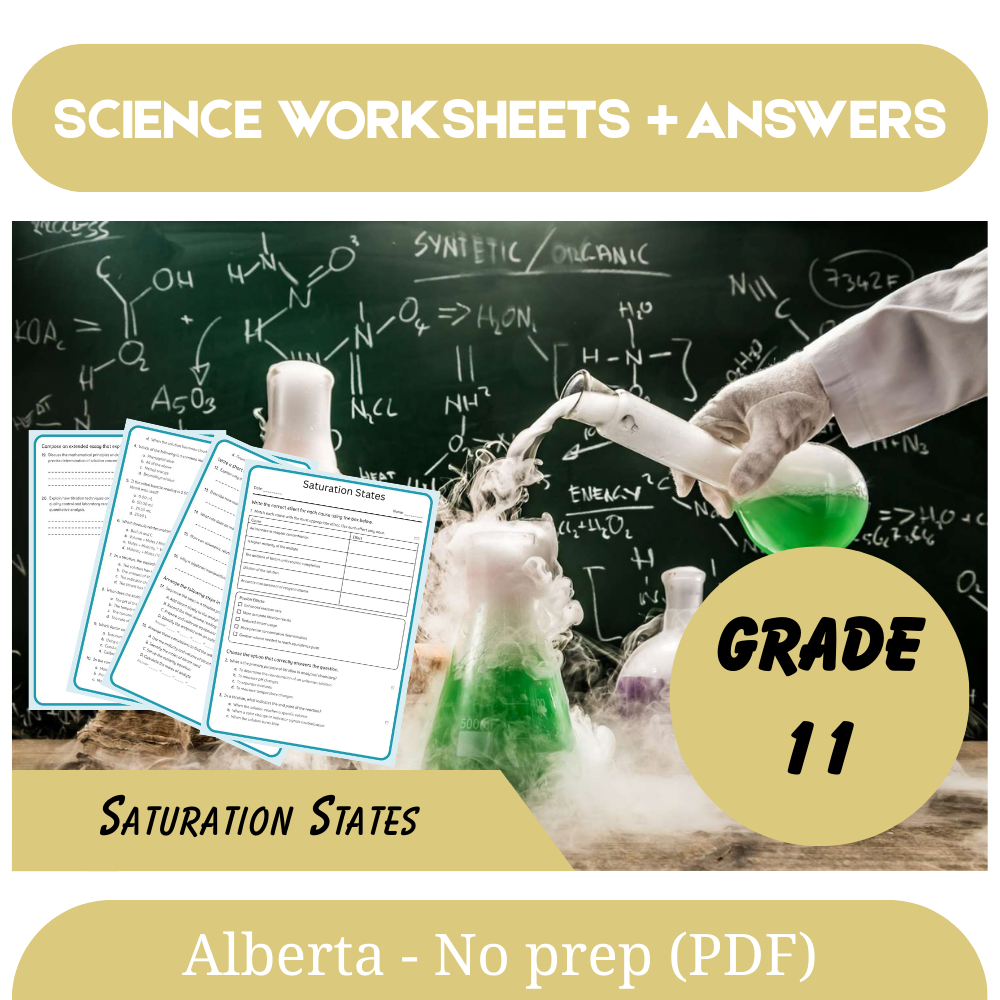
Grade 11 Science – Saturation States Worksheet (PDF) – Alberta Standard
Created byBright Mind ResourcesLearning Objectives
- Understand the concept of saturation states as unsaturated, saturated, and supersaturated solutions.
- Identify conditions leading to precipitation, dissolution, and nucleation in natural and industrial contexts.
- Describe the dynamic equilibrium between dissolved ions and solid phases.
Instant download

Grade 11 Science | Earth System Links Worksheet | General Standards
 Created byLumora Learning
Learning Objectives
- Explain how interactions among Earth’s geosphere, hydrosphere, atmosphere, and biosphere involve both matter and energy transfer
- Analyze how landform change can alter erosion, sediment transport, and waterway conditions over time
- Use systems thinking to predict cause-and-effect pathways across Earth spheres using climate and life-driven feedbacks
Instant download

Grade 11 Science | Ecology Interactions Worksheet | General Standard
Created byLumora LearningLearning Objectives
- Explain how biotic interactions (predation, competition, mutualism, and disease) affect survival and reproduction
- Describe how abiotic factors (temperature, light, water availability, and nutrients) influence species distribution and persistence
- Analyze how ecological interactions can change population sizes and community composition over time
Instant download

Hybridization Worksheet Elena | BC Science Grade 11 Assessment
Created byLumora LearningLearning Objectives
- Understand the concept of hybridization and how it explains molecular geometries.
- Identify common hybridizations such as sp, sp2, and sp3 and their associated geometries.
- Explain the role of hybrid orbitals in covalent bonding, including sigma and pi bonds.
Also included in: Grade 11 Science | Chemistry Lesson Bundle Worksheet | BC-Aligned
Instant download

Ionic Bonding Worksheet Elena | Standard BC Grade 11 Science
Created byLumora LearningLearning Objectives
- Explain the process of ionic bonding and how it results in the formation of ions.
- Describe the properties and characteristics of ionic compounds, including melting points and conductivity.
- Understand lattice energy and its influence on ionic compound stability and solubility.
Also included in: Grade 11 Science | Chemistry Lesson Bundle Worksheet | BC-Aligned
Instant download

Grade 11 Science | Center Of Mass Worksheet | BC-Aligned
Created byLumora LearningLearning Objectives
- Understand the concept of the center of mass and its significance in physics.
- Apply conservation of momentum principles relative to the center of mass.
- Analyze complex systems using the location of the center of mass to simplify calculations.
Also included in: Grade 11 Science | Physics Custom Bundle | BC-Aligned Worksheet Set
Instant download

Grade 11 Science | Physiological Regulation Worksheet | TEKS-Aligned
Created byLumora LearningLearning Objectives
- Understand the mechanisms involved in physiological regulation of internal variables.
- Identify examples of negative and positive feedback in the body.
- Explain how sensors, control centers, and effectors work together to maintain stability.
Instant download
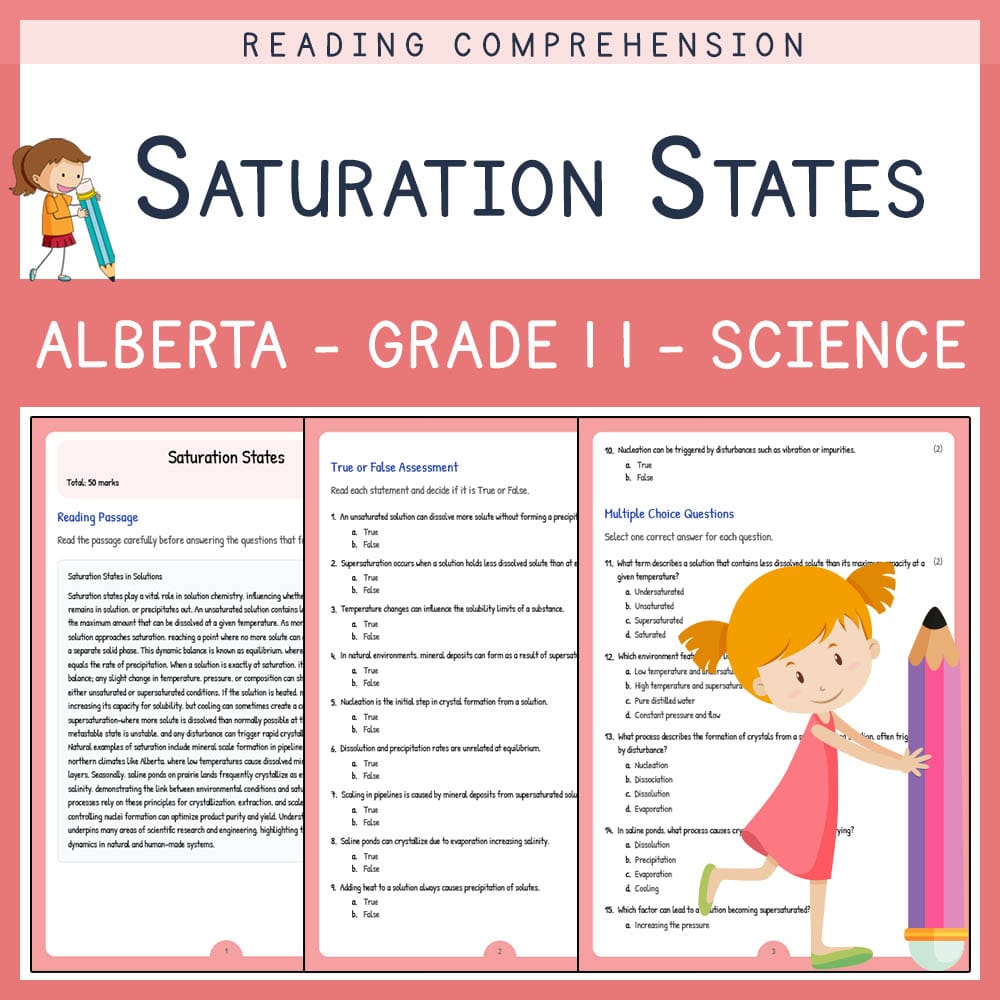
Grade 11 Science | Saturation States Worksheet | Alberta Standards
Created byLumora LearningLearning Objectives
- Understand the concepts of unsaturated, saturated, and supersaturated solutions.
- Explain how dynamic equilibrium relates to solubility and precipitation.
- Identify natural and industrial examples of saturation states and nucleation processes.
Instant download
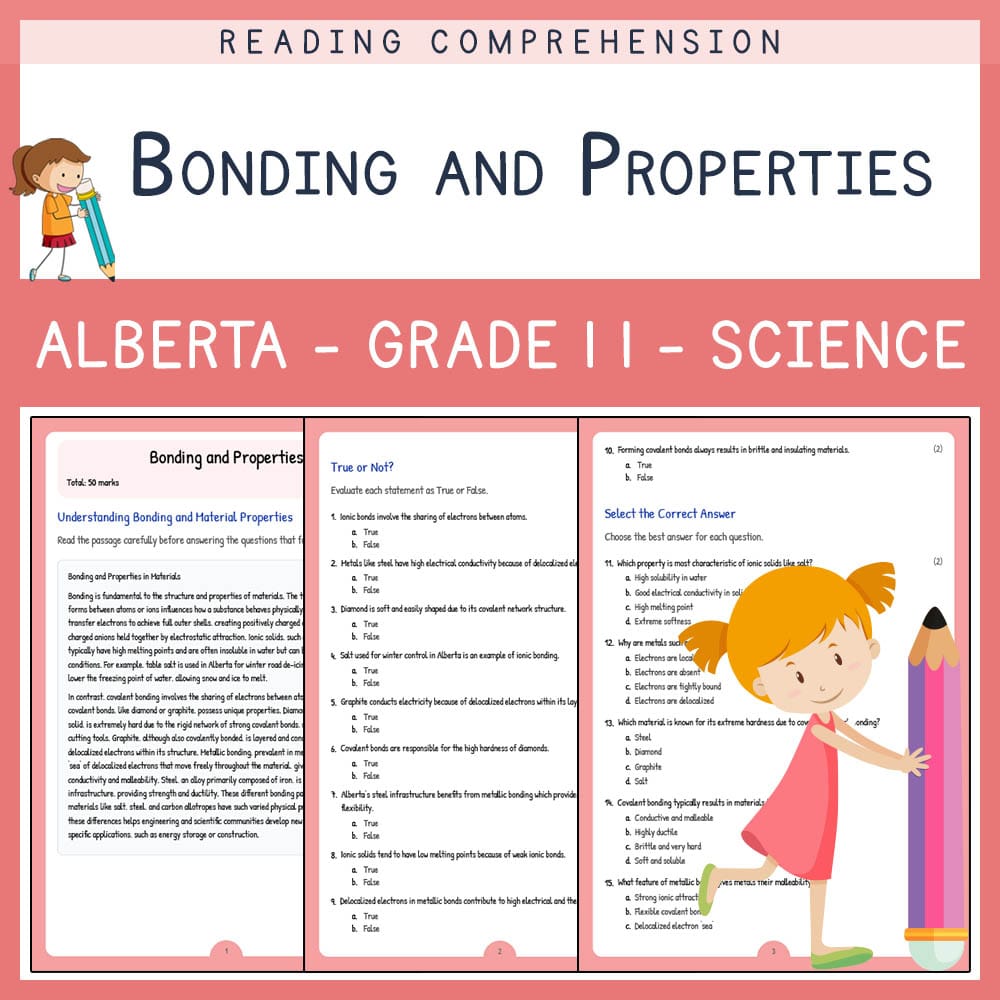
Grade 11 Science | Bonding and Properties Worksheet | Alberta Standards
Created byLumora LearningLearning Objectives
- Describe the different types of bonding—ionic, covalent, and metallic—and how they influence material properties.
- Compare the properties of ionic solids, metals, and covalent networks in terms of hardness, conductivity, melting points, and solubility.
- Analyze real-world Canadian examples such as salt for winter use, steel for infrastructure, and carbon materials in energy contexts.
Also included in: Grade 11 Science | Matter and Chemical Bonding Custom Bundle | Alberta
Instant download
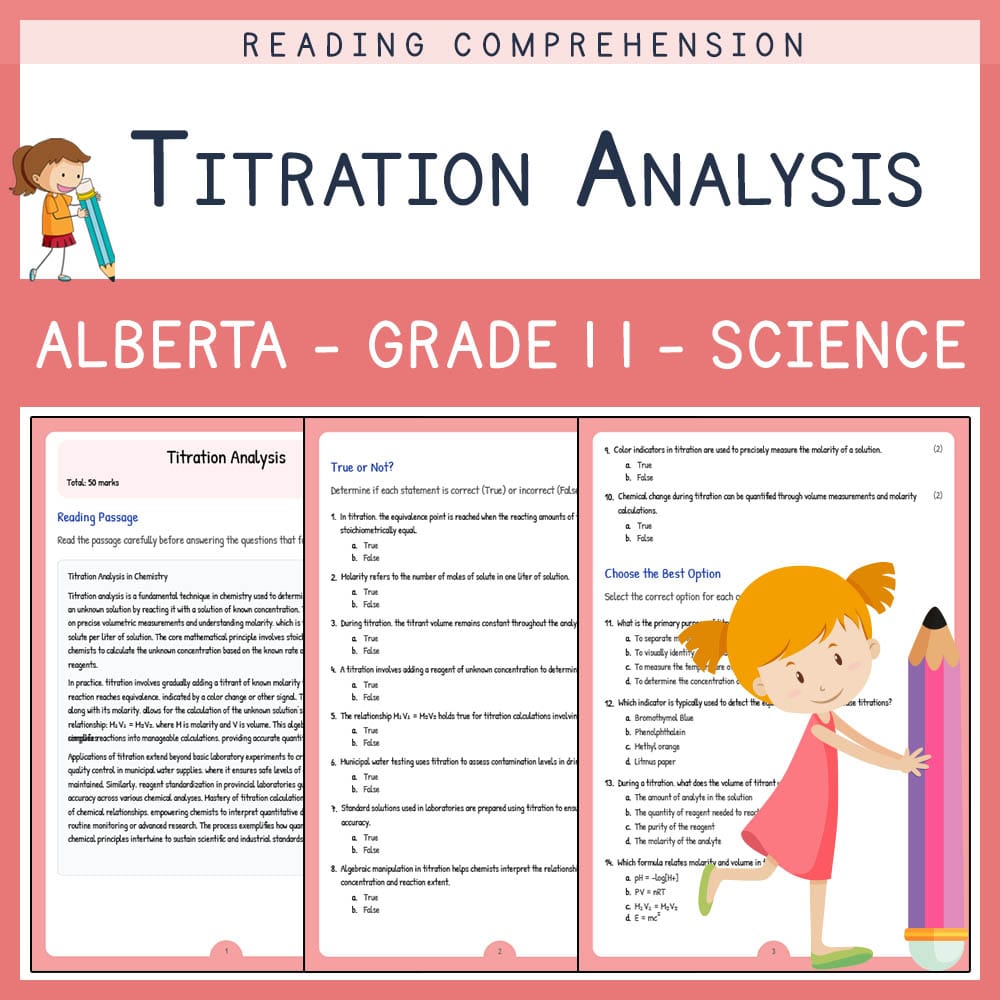
Grade 11 Science | Titration Analysis Worksheet | Alberta Standards
Created byLumora LearningLearning Objectives
- Understand the mathematical basis of titration calculations using molarity and stoichiometry.
- Apply algebraic manipulation to interpret equivalence relationships in titration.
- Explain the applications of titration in quality control for water supplies and laboratory standards.
Instant download
Grade 11 Science | Percent Concentrations Worksheet | Alberta Science
Created byLumora LearningLearning Objectives
- Understand the concept of percent concentration and its different units.
- Learn to convert between mass percent, volume percent, and parts per million.
- Interpret examples of chemical concentrations in environmental and industrial contexts.
Instant download

Grade 11 Science | Population Growth Worksheet | TEKS-Aligned
Created byLumora LearningLearning Objectives
- Understand the concepts of exponential and logistic population growth.
- Identify factors that influence population dynamics, including density-dependent and density-independent factors.
- Apply mathematical models to analyze population trends over time.
Instant download

Grade 11 Science | Newton's Laws Worksheet | BC-Aligned
Created byLumora LearningLearning Objectives
- Understand the three fundamental principles of Newton's Laws of Motion.
- Explain how forces, mass, and motion are related according to Newton's Laws.
- Apply Newton's Laws to analyze real-world situations involving pushes, pulls, and contact forces.
Also included in: Grade 11 Science | Physics Custom Bundle | BC-Aligned Worksheet Set
Instant download
Grade 11 Science | Periodic Trends Worksheet Elena | Ontario Standard
Created byLumora LearningLearning Objectives
- Understand how effective nuclear charge, shielding, and orbital penetration influence atomic radius, ionization energy, and electronegativity across periods and groups.
- Explain deviations from idealized periodic trends using representative element behaviors.
- Relate periodic properties to patterns in ion formation, lattice structures, and chemical reactivity.
Also included in: Grade 11 Science | Chemistry Lesson Bundle | Ontario Framework
Instant download
Grade 11 Science Standard | Electric Circuits Worksheet Elena | Ontario
Created byLumora LearningLearning Objectives
- Understand the fundamental principles of electric charge, current, voltage, and resistance.
- Apply Ohm's law and Kirchhoff's rules to analyze simple circuit configurations.
- Differentiate between series and parallel circuits in terms of voltage, current, and resistance.
Instant download
Grade 11 Science Assessment | Light Reactions Worksheet Elena | Ontario
Created byLumora LearningLearning Objectives
- Describe how photon energy is captured and transferred during light reactions.
- Explain the electron transport sequence involving photosystems, plastoquinone, cytochrome b6f, and plastocyanin.
- Identify the processes of proton translocation and photophosphorylation occurring during light reactions.
Instant download

Grade 11 Science | Stoichiometric Calculations Worksheet | BC-Aligned
Created byLumora LearningLearning Objectives
- Understand and perform mole-to-mole, mass-to-mass, and mass-to-mole conversions using molar masses and balanced equations.
- Identify limiting reagents and calculate the theoretical and actual yields in chemical reactions.
- Apply conservation of mass principles through stoichiometric analysis in various chemical processes.
Also included in: Grade 11 Science | Chemistry Lesson Bundle Worksheet | BC-Aligned
Instant download

Grade 11 Science | Organ Systems Worksheet | TEKS Aligned
Created byLumora LearningLearning Objectives
- Identify the main functions of human organ systems.
- Describe the structures involved in each organ system.
- Explain how different organ systems interact to maintain homeostasis.
Instant download
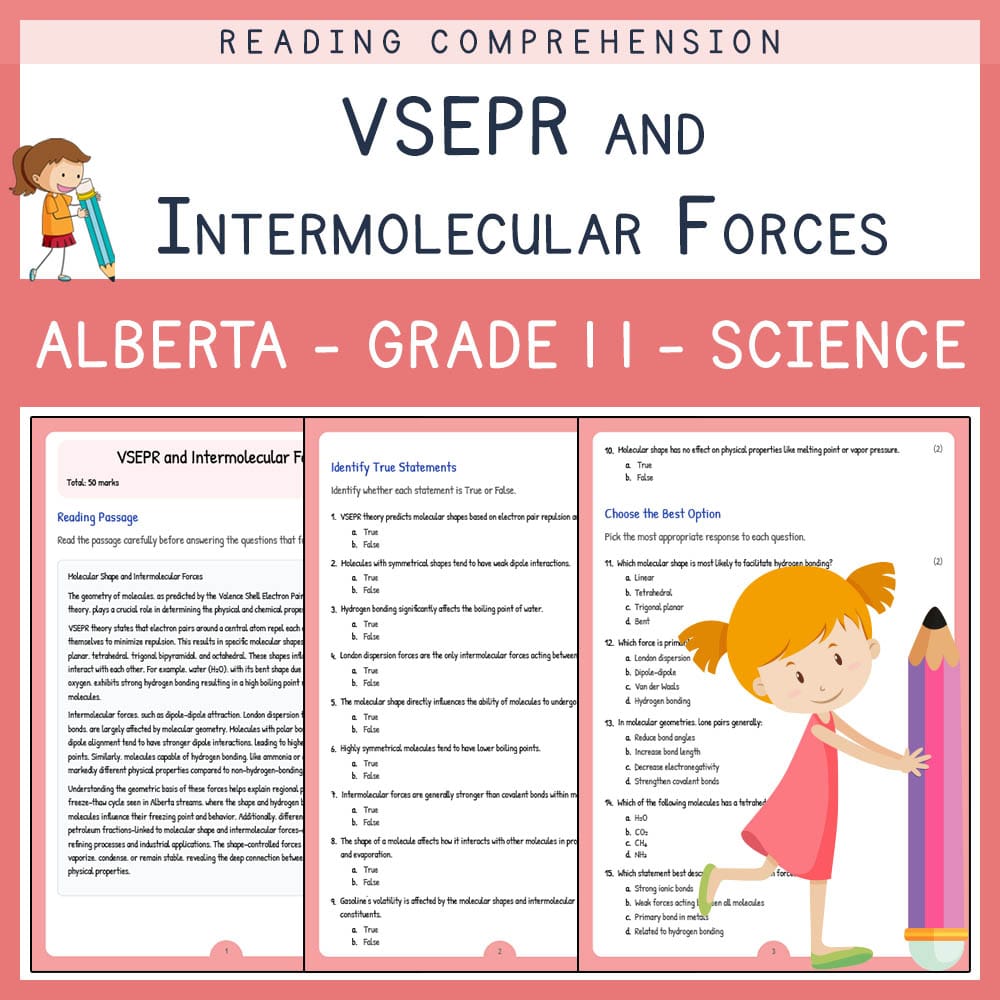
Grade 11 Science | VSEPR and Intermolecular Forces | Alberta Standards
Created byLumora LearningLearning Objectives
- Explain the VSEPR model and how molecular shapes influence intermolecular interactions.
- Describe how molecular geometry affects dipole moments and hydrogen bonding capabilities.
- Analyze the effects of molecular shape on boiling and melting points using real-world examples.
Also included in: Grade 11 Science | Matter and Chemical Bonding Custom Bundle | Alberta
Instant download
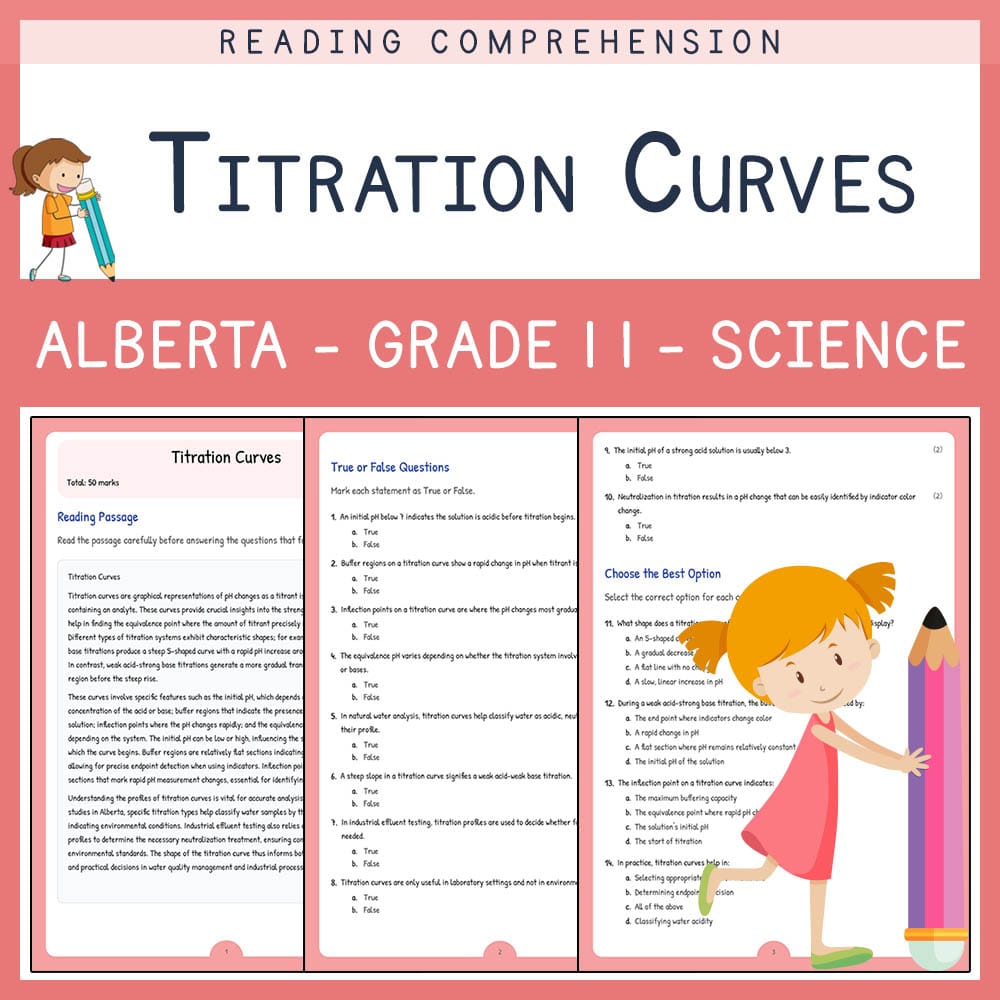
Grade 11 Science | Titration Curves Worksheet | Alberta Standards
Created byLumora LearningLearning Objectives
- Explain the shapes and features of different titration curves, including strong acid–strong base, weak acid–strong base, and weak base–strong acid systems.
- Identify key points on a titration curve such as initial pH, buffer regions, inflection points, and equivalence point pH.
- Determine the appropriate endpoint based on titration curve features for different acid–base systems.
Instant download

Grade 11 Science Worksheet – Cellular Respiration (PDF) | BC Standards
 Created byEvergreen Desk Education
Learning Objectives
- Explain the major stages of cellular respiration and what happens to electrons and protons at each stage.
- Describe how chemiosmotic coupling and ATP synthase convert an electrochemical gradient into ATP.
- Interpret quantitative models of ATP yield per glucose and the role of oxygen as the final electron acceptor.
Instant download

Grade 11 Science | Integrated Systems Worksheet (TEKS) (PDF)
Created byEvergreen Desk EducationLearning Objectives
- Explain how cellular specialization and intercellular communication can produce emergent tissue, organ, and organism functions
- Compare chemical signaling, gap junction communication, and extracellular matrix organization in coordinating cell behavior
- Use systems thinking to predict how disruption of signaling or organization could affect organism-level health
Instant download

Grade 11 Science – Integrated Cycles Worksheet (TEKS) (PDF)
Created byEvergreen Desk EducationLearning Objectives
- Explain how photosynthesis and cellular respiration are interconnected biochemical cycles involving carbon and energy transfer.
- Describe how day-night changes and tissue specialization affect sugar storage, transport, and respiration rates.
- Use a pathway model to predict how changes in light or temperature can alter net energy budgets in plants and ecosystems.
Instant download

Henderson-Hasselbalch Equation Worksheet Grade 11 Chemistry Alberta
Created byEvergreen Desk EducationLearning Objectives
- Explain what the Henderson–Hasselbalch equation represents in buffer chemistry
- Use the Henderson–Hasselbalch equation to calculate pH from buffer components
- Predict how changing acid/base ratio affects buffer pH
Instant download

Grade 11 Science – Center of Mass Worksheet (BC) Practice Set (PDF)
Created byEvergreen Desk EducationLearning Objectives
- Explain the center of mass as the weighted average position of mass in a system
- Use center-of-mass ideas to analyze translational motion, explosions, and recoil with momentum conservation
- Identify how internal forces affect (and do not affect) the motion of the system’s center of mass
Instant download

Grade 11 Science – Stratigraphic Columns Worksheet (BC Standards) (PDF)
Created byEvergreen Desk EducationLearning Objectives
- Explain how stratigraphic columns use lithology, fossils, and sedimentary structures to interpret depositional history.
- Describe how correlation links equivalent rock layers across distance and how unconformities record missing time.
- Use facies concepts to infer past environments and explain how lateral changes in deposition can produce different layer patterns.
Instant download

Grade 11 Science | Cell Components Worksheet (TEKS) (PDF)
Created byEvergreen Desk EducationLearning Objectives
- Compare the structures of eukaryotic cell organelles and relate each to its major function.
- Explain how membrane-bound and non-membrane-bound components coordinate information storage, energy conversion, and synthesis.
- Use cell structure to predict how processes like protein production and material transport occur.
Instant download

Grade 11 Science Ionic Strength Worksheet PDF | Alberta Standards
Created byEvergreen Desk EducationLearning Objectives
- Explain qualitatively how ionic strength affects ion activity coefficients in solutions.
- Describe why high ionic strength changes effective solubility and shifts equilibrium positions.
- Apply ionic-strength ideas to real contexts such as saline aquifers and industrial brines in Alberta.
Instant download
Browse more categories
About Grade 11 Worksheets
Find Grade 11 worksheets covering algebra, biology, literature, and history. All 9,073 resources download instantly as PDFs for classwork, homework, or review.
Each resource here is built by an independent educator and reviewed for quality. Worksheets print straight from PDF and suit classroom use, homework, or extra practice; most come with answer keys, and you can preview before purchasing.