
Grade 11 Science Worksheets
6,697 worksheets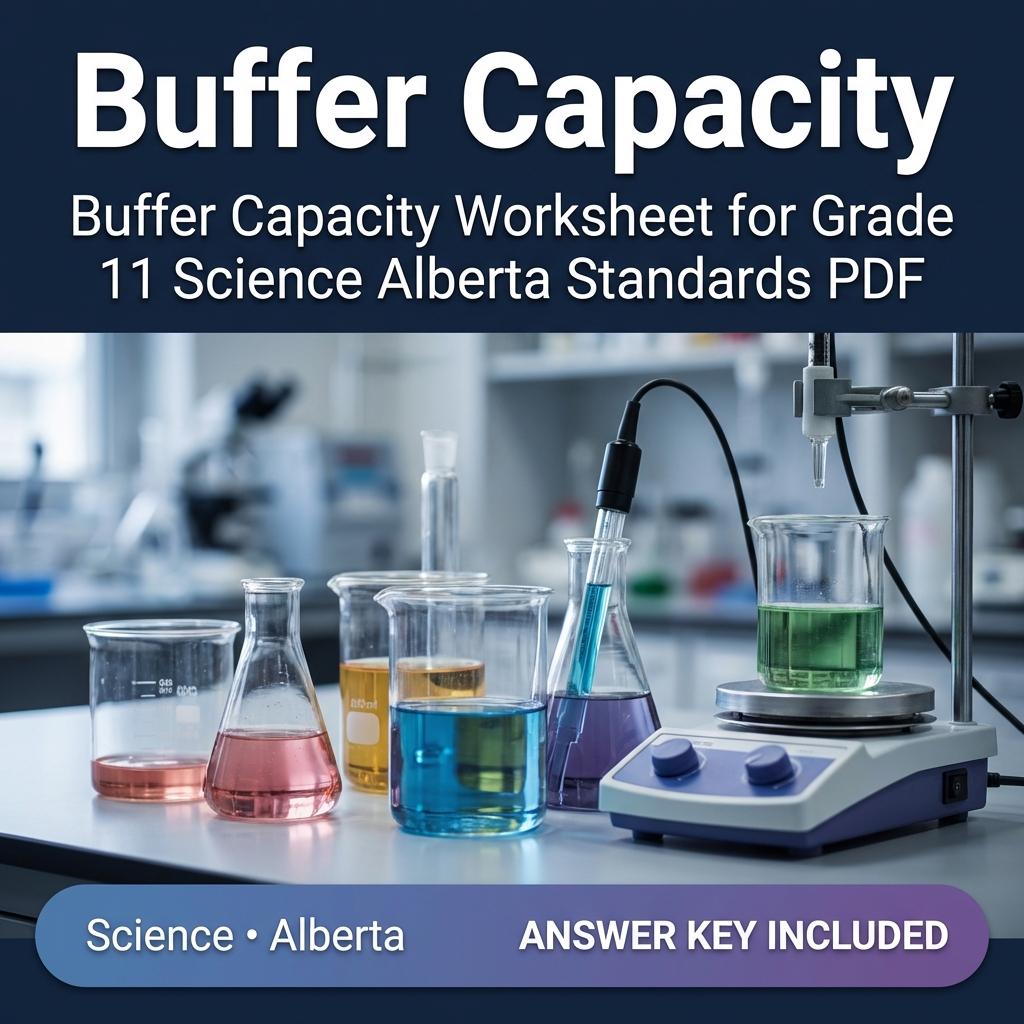
Buffer Capacity Worksheet for Grade 11 Science Alberta Standards PDF
 Created byCoral Reef Learning
Learning Objectives
- Understand the concept of buffer capacity and how it relates to environmental systems.
- Describe factors affecting buffer capacity in natural and industrial systems.
- Quantitatively assess buffer capacity using concentration and component ratios.
Instant download

Grade 11 Science – Population Growth Worksheet (TEKS) PDF
 Created byEvergreen Desk Education
Learning Objectives
- Explain how birth rate, death rate, immigration, and emigration change population size over time
- Compare exponential growth and logistic growth using the idea of carrying capacity
- Analyze how density-dependent and density-independent factors influence population trajectories
Instant download

Grade 11 Science Worksheets | Redox Processes (Ontario) – PDF
Created byEvergreen Desk EducationLearning Objectives
- Use oxidation-state conventions to determine the oxidation numbers of atoms in inorganic and organic species.
- Form and systematically balance half-reactions for redox reactions in acidic or basic conditions.
- Explain how standard reduction potentials relate to spontaneity and predict galvanic cell voltage.
Also included in: Grade 11 Chemistry Practice Science Lesson Bundle – Ontario Worksheets +1 more
Instant download

Grade 11 Science | Ethical Communication Worksheet | General Standards
 Created byLumora Learning
Learning Objectives
- Explain what ethical communication requires in scientific reporting, including full disclosure of methods and limitations.
- Evaluate how uncertainty, data quality, and representations (graphs/diagrams) affect the credibility of scientific claims.
- Use evidence-based reasoning to compare predicted and observed outcomes without selective emphasis.
Instant download

Grade 11 Science – Strong & Weak Acids & Bases | Daily Reading Worksheet
 Created byBright Mind Resources
Learning Objectives
- Describe the difference between strong and weak acids and bases.
- Explain how ionization affects pH levels in solutions.
- Identify examples of strong and weak acids and bases.
Also included in: Grade 11 Acid-Base & Titration Science Daily Reading Lesson Bundle | Alberta +1 more
Instant download
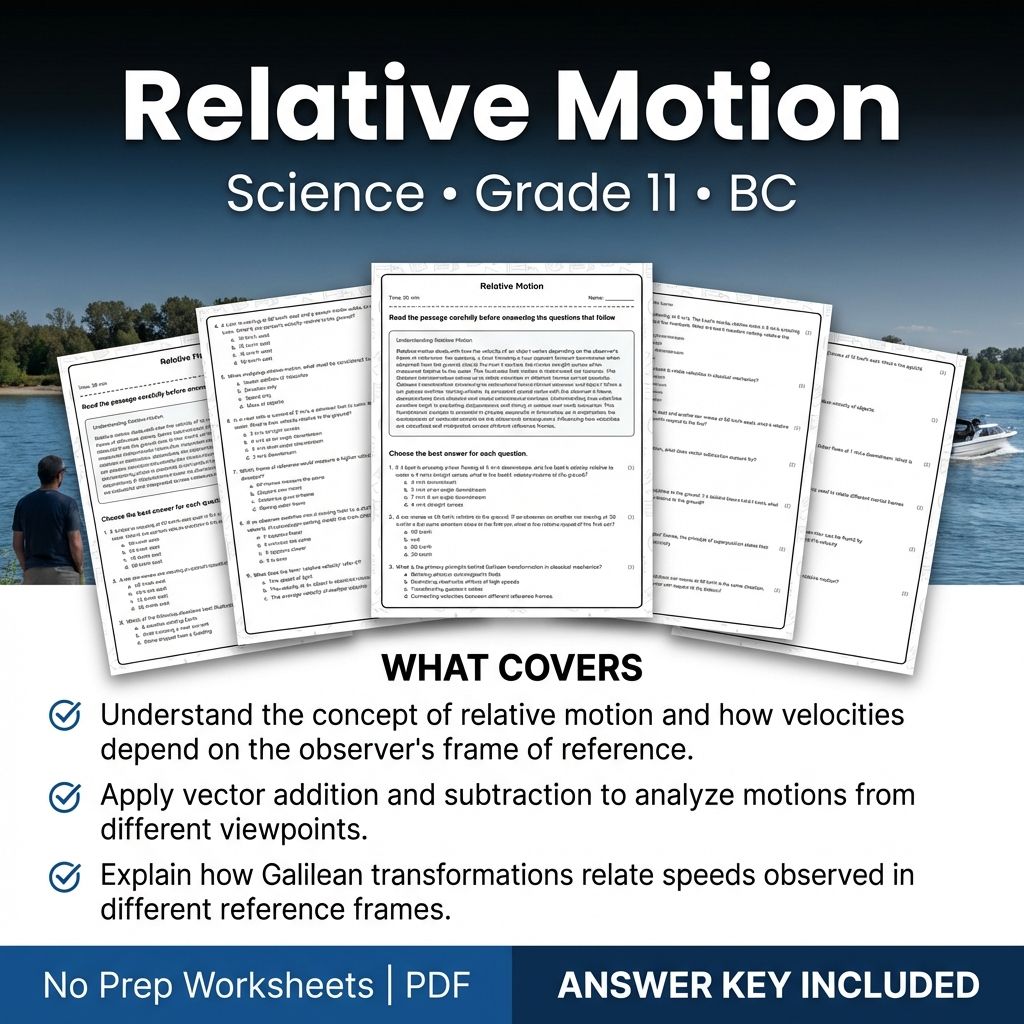
Relative Motion Worksheet for Grade 11 Science BC Standards | Classroom Practice
Created byCoral Reef LearningLearning Objectives
- Understand the concept of relative motion and how velocities depend on the observer's frame of reference.
- Apply vector addition and subtraction to analyze motions from different viewpoints.
- Explain how Galilean transformations relate speeds observed in different reference frames.
Instant download
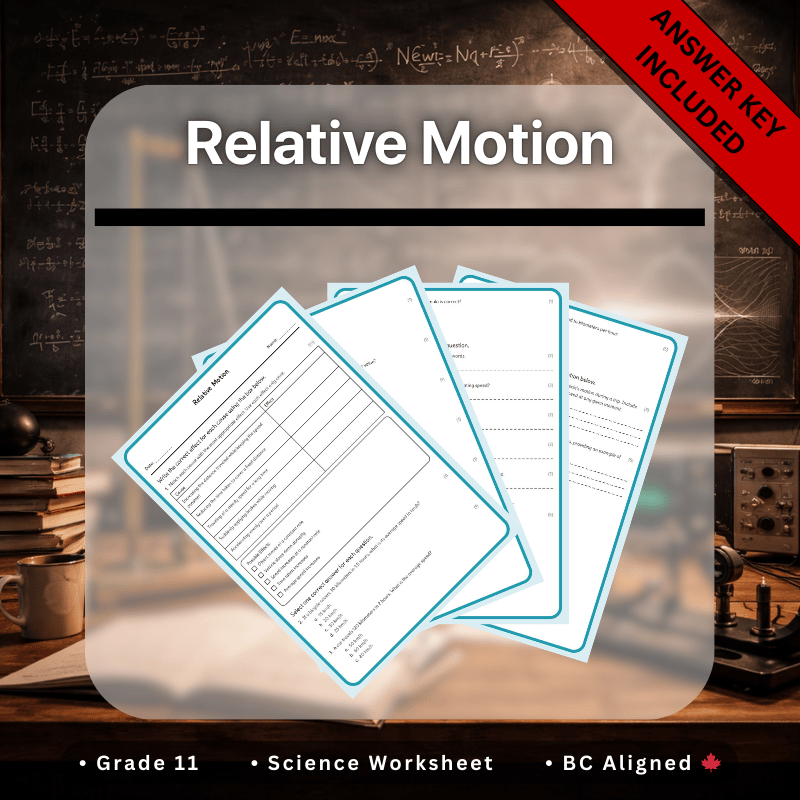
Grade 11 Science | Relative Motion Worksheet (PDF) – BC Standards
Created byBright Mind ResourcesLearning Objectives
- Understand how velocity depends on the observer's frame of reference in relative motion.
- Apply vector addition and subtraction to relate observed velocities from different reference frames.
- Use Galilean velocity addition to transform speeds between moving frames.
Instant download
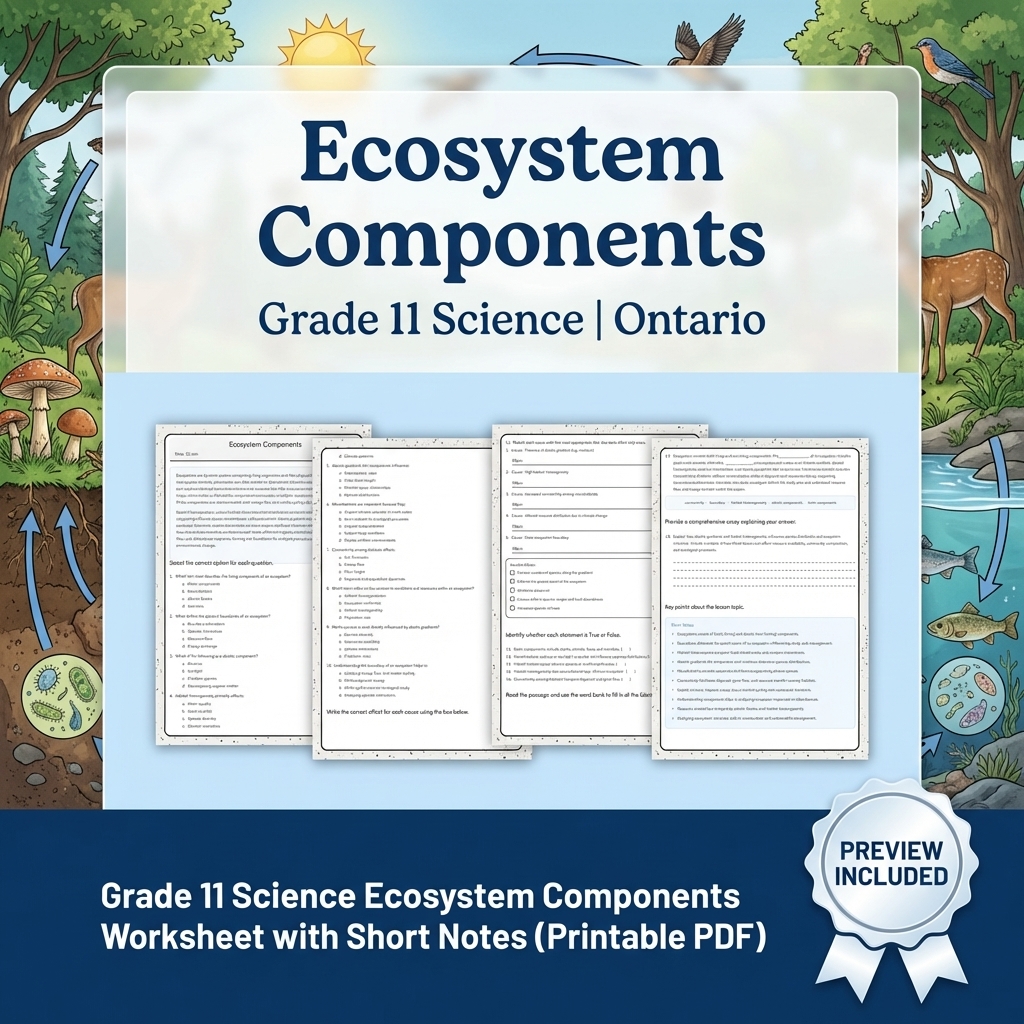
Grade 11 Science Ecosystem Components Worksheet with Short Notes (Printable PDF)
 Created byMeadowlark Worksheets
Learning Objectives
- Define biotic and abiotic components of ecosystems.
- Explain how spatial scales and boundaries influence ecosystem structure.
- Describe how abiotic gradients shape species assemblages and resource distribution.
Also included in: Grade 11 Science Lesson Group Bundle – Ontario Ecosystems & Sustainability +1 more
Instant download

Speciation Mechanisms Worksheet | TEKS Grade 11 Science Practice
Learning Objectives
- Explain how reproductive isolation leads to speciation by preventing gene flow between populations.
- Compare allopatric, sympatric, and parapatric speciation mechanisms and the geographic/ecological conditions involved.
- Distinguish prezygotic and postzygotic reproductive barriers and describe how each reduces hybrid formation or success.
Instant download

Land Use Change Worksheet for Grade 11 Science | Ontario Standards
Created byCoral Reef LearningLearning Objectives
- Understand the types of anthropogenic land-use transformations and their environmental impacts.
- Analyze the effects of habitat fragmentation, edge effects, and landscape connectivity on biodiversity.
- Evaluate approaches to landscape-scale planning that balance development with ecosystem conservation.
Instant download

Mechanisms Of Evolution Assessment | TEKS Standards-Aligned Assessment for Grade 11 Science
 Created byPrism Point Learning
Learning Objectives
- Understand the different mechanisms that drive evolutionary change in populations.
- Identify how mutation, natural selection, genetic drift, and gene flow influence genetic variation.
- Analyze the effects of these mechanisms on populations' adaptation and diversity.
Also included in: Grade 11 Evolution, Speciation & Phylogeny Science Lesson Bundle | TEKS
Instant download

Grade 11 Habitat Fragmentation and Biodiversity Loss Worksheet | TEKS
 Created byBRIGHT PATH RESOURCES
Learning Objectives
- Identify the main idea and key supporting details about habitat fragmentation and biodiversity.
- Explain how fragmentation affects species movement, genetic diversity, and ecosystem processes.
- Use evidence from a scientific passage to answer questions in multiple formats.
Instant download
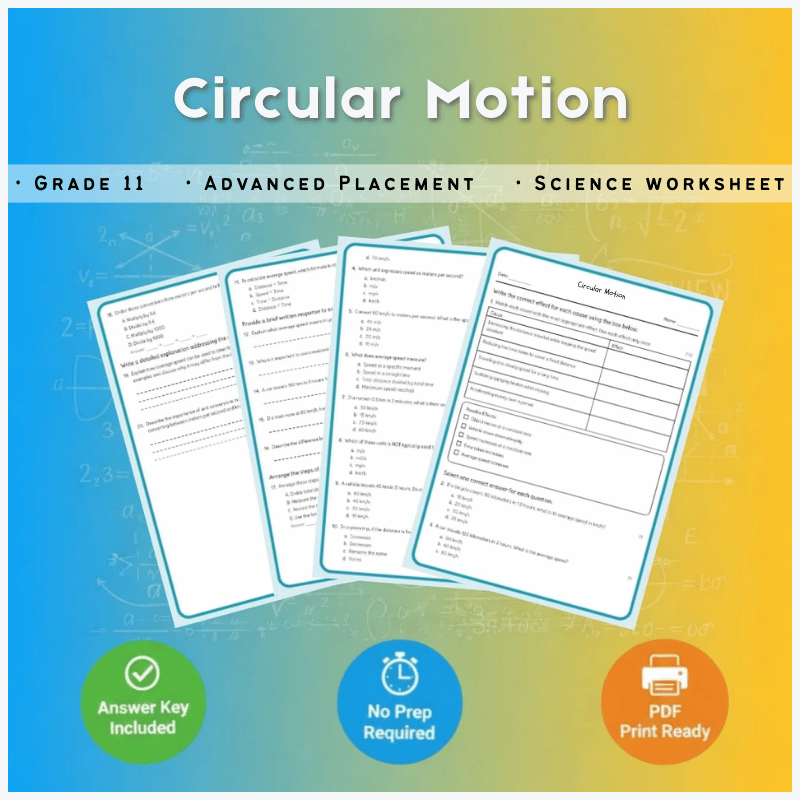
Grade 11 Science | Basic Circuits Worksheet (AP Standard + Answer Key) PDF
Created byBright Mind ResourcesLearning Objectives
- Understand the fundamental concepts of electric potential difference, current, resistance, and energy transfer in DC circuits.
- Apply Ohm’s law and Kirchhoff’s reasoning to analyze series and parallel circuit networks.
- Calculate power dissipation and energy flow in simple electrical systems using algebraic methods.
Instant download

Grade 11 Science | Light Reactions Worksheet | TEKS-Aligned
Created byLumora LearningLearning Objectives
- Describe the process of light-dependent reactions in photosynthesis.
- Identify the roles of pigments, electron transport chain, and ATP synthase in light reactions.
- Explain how light energy is converted into chemical energy (ATP and NADPH).
Instant download

Grade 11 Science | ATP Synthase Worksheet Elena | TEKS-Aligned
Created byLumora LearningLearning Objectives
- Understand the mechanism by which ATP synthase converts proton gradients into ATP.
- Describe how conformational changes in ATP synthase facilitate energy transfer.
- Explain the linkage between membrane potential, proton pumping, and ATP synthesis.
Instant download
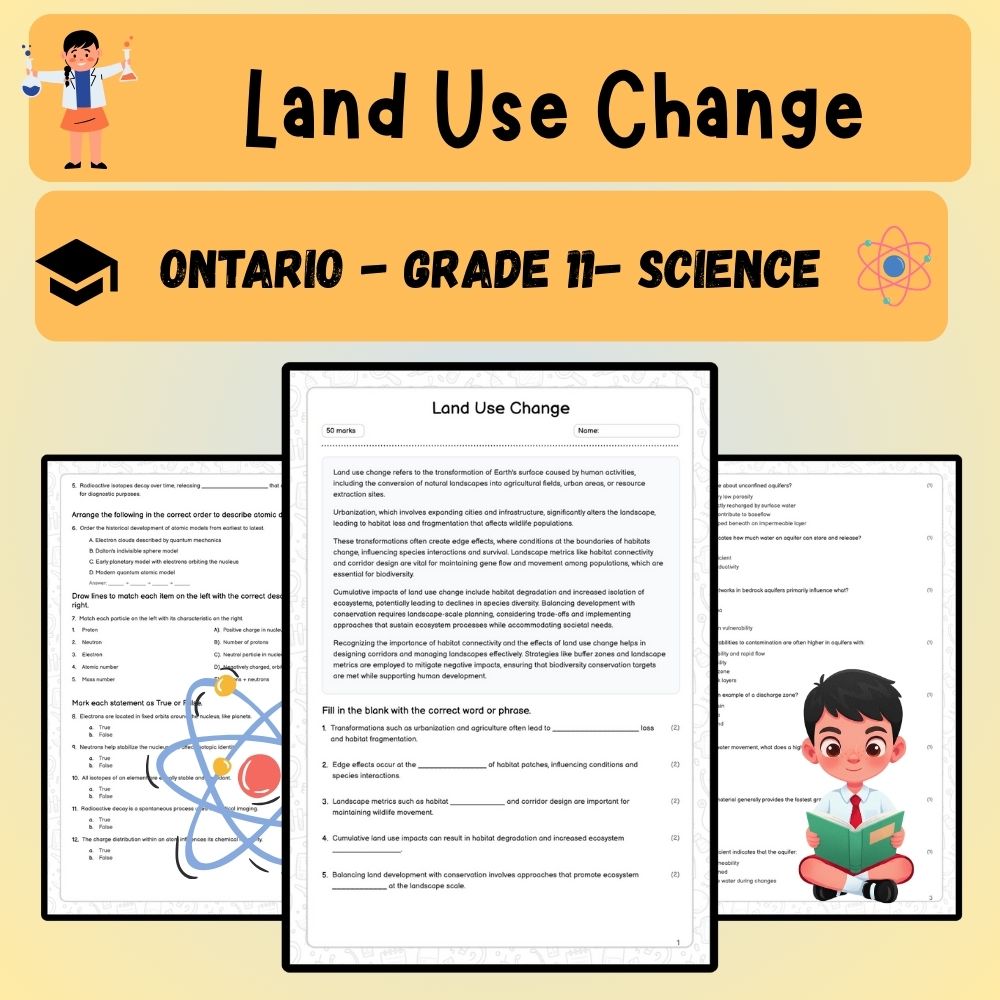
Grade 11 Science | Land Use Change Worksheet (Worksheet + Answer Key) - Ontario Standards
Created byPrism Point LearningLearning Objectives
- Describe different types of anthropogenic land-use transformations such as agriculture, urbanization, resource extraction, and infrastructure development.
- Explain the effects of land use change on habitat loss, fragmentation, and connectivity.
- Understand edge effects, corridor design, and landscape metrics that influence species movement and gene flow.
Also included in: Grade 11 Science Ecosystems & Sustainability UNIT Worksheet Pack +1 more
Instant download

Dispersion Forces Worksheet | Grade 11 Science Activities
Created byPrism Point LearningLearning Objectives
- Explain how London dispersion forces arise from instantaneous electron fluctuations in nonpolar substances
- Describe how dispersion strength depends on molar mass and molecular surface contact
- Connect dispersion forces to macroscopic properties such as melting point, viscosity, and phase behavior
Also included in: VSEPR & Chemical Bonding Lesson Bundle | Grade 11 Science | Alberta
Instant download
Grade 11 Science Worksheet on Concentration Calculations | Alberta Standards
Created byCoral Reef LearningLearning Objectives
- Interpret and convert between ionic concentrations and pH or pOH using logarithmic relationships.
- Apply procedures to determine [H+] from pH, [OH-] from pOH, and use Kw to interrelate concentrations in natural waters.
- Perform calculations with significant figures and units for accurate ionic concentration analysis, especially in environmental contexts.
Instant download

Grade 11 Science – Covalent Bonding & Structures Daily Reading Worksheet
Created byBright Mind ResourcesLearning Objectives
- Explain the concept of shared-electron bonding using Lewis structures
- Identify and interpret octet considerations and formal charge assessments in covalent molecules
- Describe the continuum between covalent (polar and non-polar) and ionic bonding based on electronegativity differences
Also included in: Grade 11 Chemistry Science Daily Reading Lesson Bundle | Ontario +1 more
Instant download

Grade 11 Science | Cell Membrane Worksheets (TEKS) Practice Set (PDF)
Created byEvergreen Desk EducationLearning Objectives
- Describe the cell membrane’s selective permeability and explain how the phospholipid bilayer and proteins work together.
- Compare passive, facilitated, and active transport by identifying energy use and movement direction relative to gradients.
- Explain how vesicular transport (endocytosis and exocytosis) supports bulk movement and cellular homeostasis.
Instant download

Titration Theory Worksheet | Grade 11 Science Activities
Created byPrism Point LearningLearning Objectives
- Explain titration stoichiometry and how the equivalence point relates to moles of reactants.
- Use concentration and volume data from a titration to calculate an unknown concentration.
- Describe how indicator choice and pH change help identify the equivalence point.
Instant download

Balancing Equations Worksheet | Grade 11 Science Activities
Created byPrism Point LearningLearning Objectives
- Explain how the conservation of atoms guides the process of balancing chemical equations
- Identify how stoichiometric coefficients act as numerical ratios in balanced equations
- Classify common reaction types (synthesis, decomposition, single- and double-displacement, combustion) using balanced examples
Instant download

Grade 11 Science | Evaluating Biological Evidence Worksheet | General Standards
Created byLumora LearningLearning Objectives
- Evaluate whether biological claims are supported by data that match model-based predictions.
- Identify confounding variables and compare alternative explanations in biological studies.
- Assess how well biomarkers and genetic data support mechanisms, considering assumptions and limitations.
Instant download

Grade 11 Science – Climate Evidence Trends Worksheet (PDF)
Created byEvergreen Desk EducationLearning Objectives
- Identify how multiple evidence sources (temperature records, ice cores, sediments, and ocean changes) support conclusions about climate change.
- Distinguish short-term weather variability from long-term climate trends and patterns.
- Evaluate whether climate shifts are gradual, abrupt, or cyclical using evidence timelines.
Also included in: Grade 11 Earth & Space Science Lesson Bundle: Science General Framework +1 more
Instant download
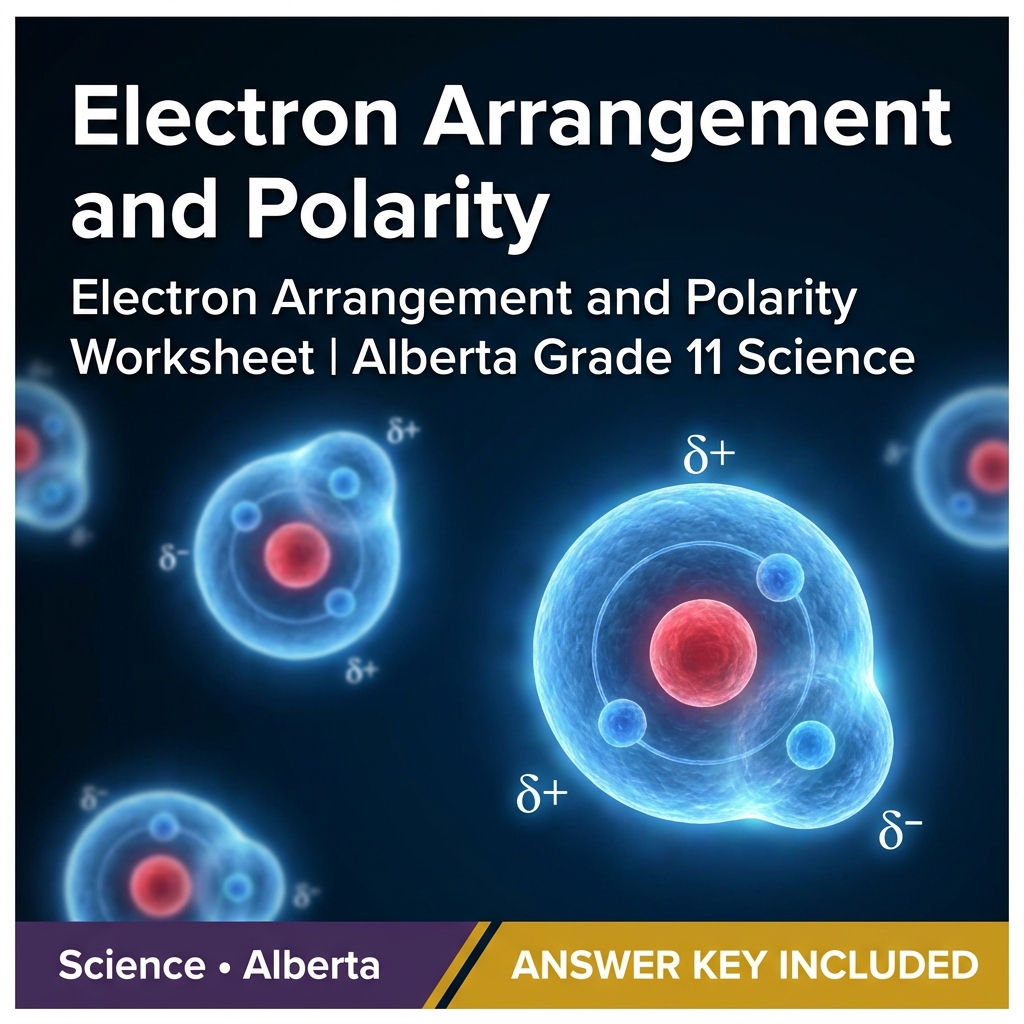
Electron Arrangement and Polarity Worksheet | Alberta Grade 11 Science
Created byCoral Reef LearningLearning Objectives
- Understand how valence electron distribution influences molecular polarity.
- Identify examples of polar and nonpolar molecules based on electron arrangement.
- Explain the significance of polarity in intermolecular interactions and industrial processes.
Instant download

Grade 11 Science – Genetic Systems Daily Reading Worksheet with Answer Key
Learning Objectives
- Understand the structural differences between prokaryotic and eukaryotic genomes
- Describe how genome organization affects gene expression and regulation
- Compare mechanisms like transcription, replication, and DNA repair in prokaryotes and eukaryotes
Also included in: Grade 11 Science Lesson Bundle | Cells, Systems, Genetics & Energy +1 more
Instant download

Reaction Rates Worksheet for Grade 11 Science | BC Standards Practice
Learning Objectives
- Explain the factors that influence reaction rates, including collision frequency, orientation, and activation energy.
- Describe how rate laws relate reactant concentrations to reaction speed.
- Interpret the Arrhenius equation and understand its significance in kinetics.
Instant download

Grade 11 Science – Forces & Net Results | Daily Reading Worksheet
Created byBright Mind ResourcesLearning Objectives
- Understand the concept of forces acting on objects
- Identify different types of forces, such as contact and frictional forces
- Explain how forces combine using vector addition to produce net force
Also included in: Grade 11 Science Concept Daily Reading Worksheets Lesson Bundle | General +1 more
Instant download

Integrated Systems: Communication & Cellular Specialization Worksheet | TEKS
Created byBRIGHT PATH RESOURCESLearning Objectives
- Identify the main idea and key details about how cells form tissues and organs through specialization and communication
- Explain how chemical signaling, gap junctions, and extracellular matrix support coordinated cell behavior
- Connect disruptions in cell communication or organization to changes in whole-system function
Instant download
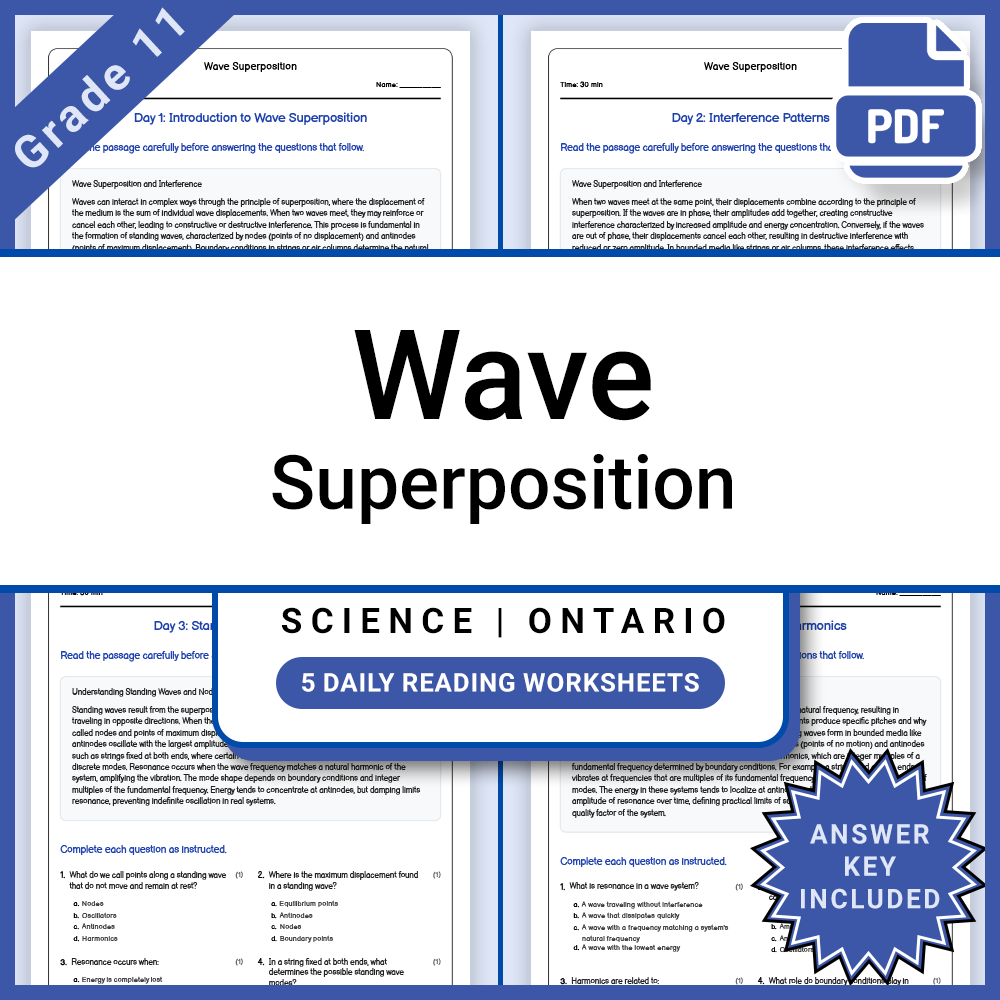
Grade 11 Science – Wave Superposition Daily Reading Worksheet + Answer Key
Learning Objectives
- Understand the principle of wave superposition and interference patterns.
- Identify nodes and antinodes in standing waves.
- Explain how resonant frequencies are determined by boundary conditions.
Also included in: Grade 11 Science Lesson Bundle for Ontario Curriculum +1 more
Instant download
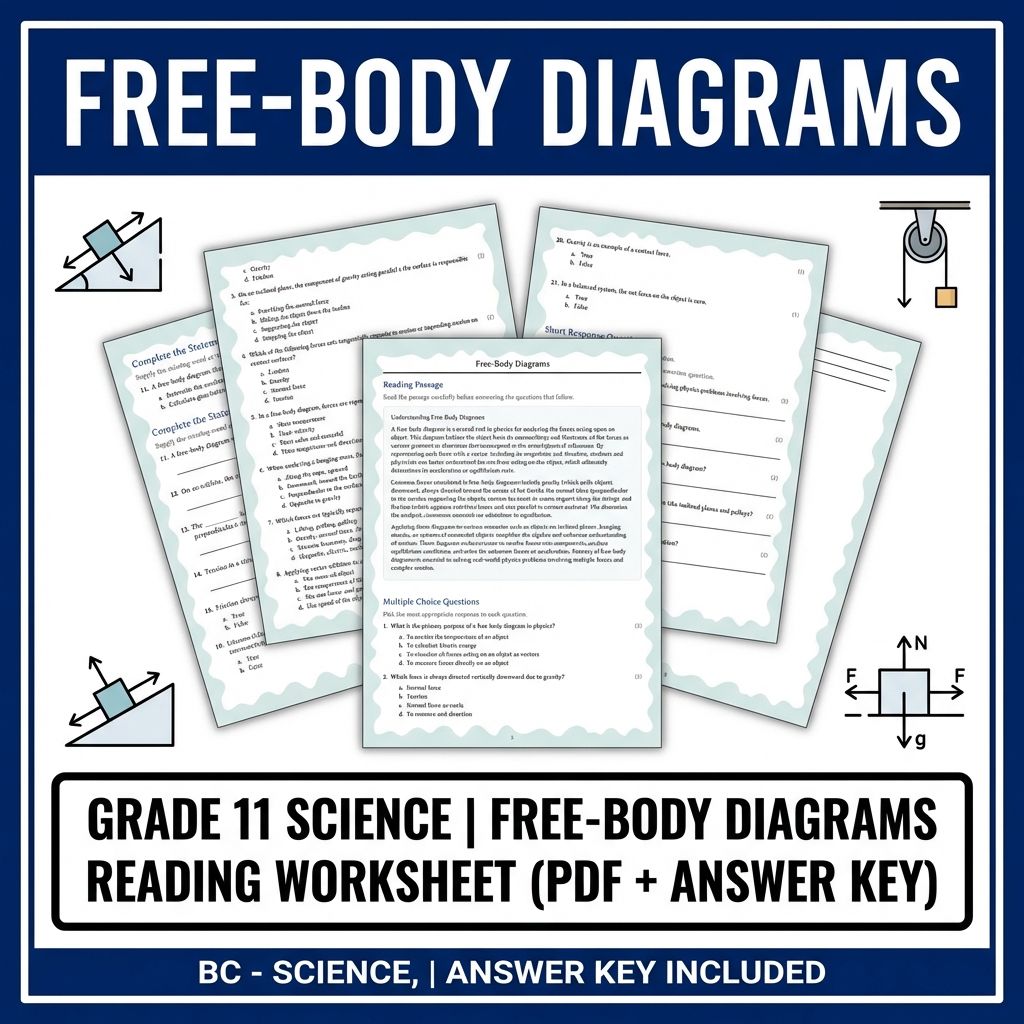
Grade 11 Science | Free-Body Diagrams Reading Worksheet (PDF + Answer Key)
Learning Objectives
- Understand how to represent forces acting on an object using free-body diagrams.
- Identify common forces such as gravity, normal force, tension, and friction in physical systems.
- Apply vector addition to analyze forces and determine net force and motion.
Instant download
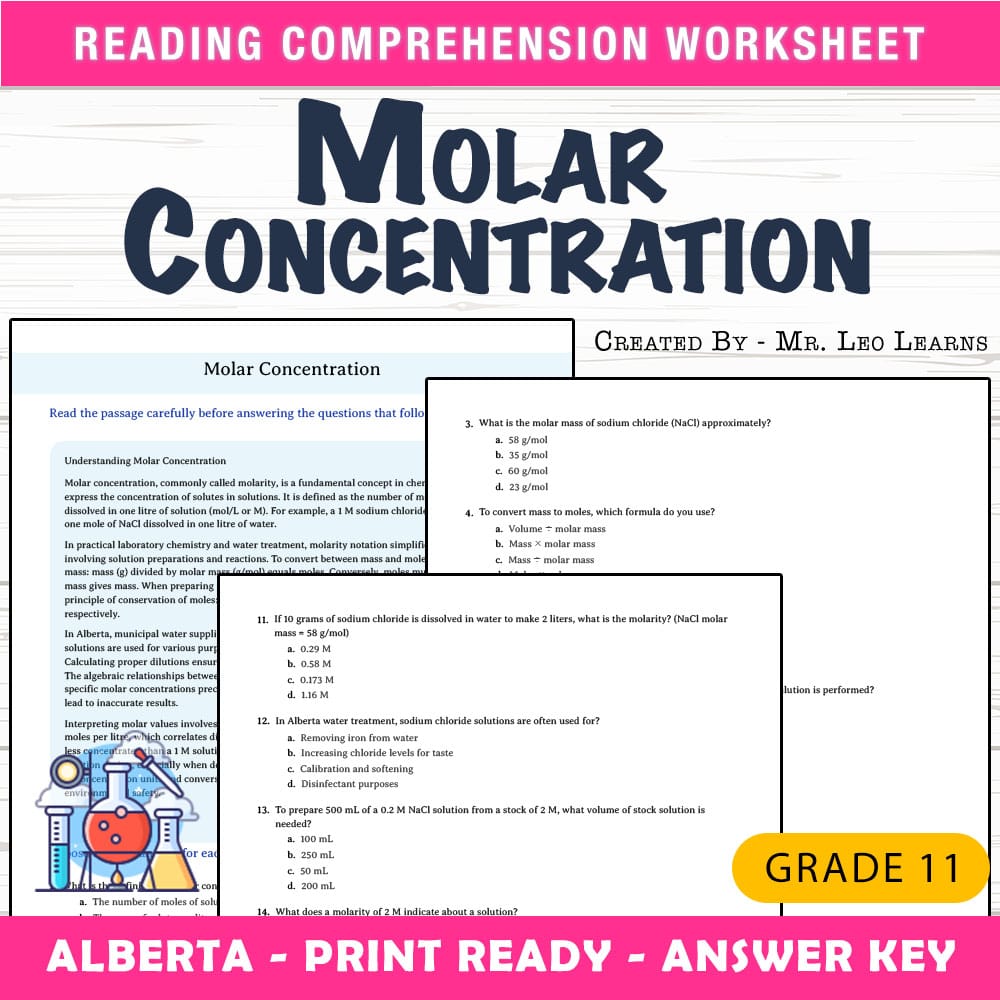
Grade 11 Science — Worksheet MCQ Paper for Mastering Molar Concentration
 Created byThe Resource Hub
Learning Objectives
- Understand the definition and notation of molar concentration (molarity).
- Convert between mass, moles, and volume in solution preparation.
- Apply dilution calculations algebraically to determine concentrations and volumes.
Also included in: Grade 11 Science Solutions and Solubility Bundle | Alberta Framework +1 more
Instant download

Grade 11 Science | Wave Phenomena Worksheet (AP Standards) (PDF)
Created byEvergreen Desk EducationLearning Objectives
- Explain how wavelength, frequency, amplitude, and wave speed are related in mechanical waves.
- Use the ideas of superposition and interference to predict when waves reinforce or cancel.
- Analyze reflection, transmission, and standing-wave formation using boundary conditions and resonance.
Also included in: Grade 11 Physics Principles Science Lesson Bundle | Advanced Placement (AP) +1 more
Instant download
Grade 11 Science | Land Use Change Worksheet (Ontario) Science (PDF)
Created byBright Mind ResourcesLearning Objectives
- Describe anthropogenic land-use transformations such as agriculture, urbanization, resource extraction, and infrastructure development.
- Explain the effects of land use change on habitat loss, fragmentation, and connectivity.
- Understand landscape metrics and design principles like edge effects and corridors that influence species movement.
Instant download

Human Alterations Worksheet | Grade 11 Science Practice
Created byPrism Point LearningLearning Objectives
- Explain how human actions such as habitat fragmentation, pollution, and resource extraction affect biodiversity and ecological processes.
- Analyze how invasive species and greenhouse gas emissions can change species interactions and ecosystem functions.
- Evaluate trade-offs between economic development, ecosystem services, and conservation to reduce ecosystem degradation.
Instant download

Grade 11 Science – Electron Configuration & Quantum Mechanics | Daily Worksheet
 Created byQuiet Forest Education
Learning Objectives
- Understand the concept of electron shells and subshells.
- Learn the rules governing electron filling order: Aufbau, Hund's rule, and Pauli exclusion principle.
- Interpret electron configurations and relate them to chemical properties.
Also included in: Chemical Reactions Grade 11 Science Daily Reading Worksheets Bundle | Ontario +1 more
Instant download

Heritable Variation Worksheets: Population Change | Grade 11 Science
Created byBRIGHT PATH RESOURCESLearning Objectives
- Explain how allele differences create heritable variation
- Describe how mutation generates new genetic combinations
- Describe how recombination creates genetic variation over generations
Also included in: Genetics, Ecology & Homeostasis Bundle | Grade 11 Science Worksheets +4 more
Instant download

Nutrient Cycling and Energy Flow Worksheets Grade 11 Science
Created byBRIGHT PATH RESOURCESLearning Objectives
- Explain energy movement through trophic levels
- Describe energy loss through metabolism and heat
- Trace carbon, nitrogen, and phosphorus through ecosystems
Also included in: Genetics, Ecology & Homeostasis Bundle | Grade 11 Science Worksheets +4 more
Instant download

Grade 11 Erosion And Sedimentation Worksheet | BC Practice PDF
 Created byClear Sky Classroom
Learning Objectives
- Explain how weathering produces sediments that can be transported by water, wind, ice, and gravity.
- Describe the processes of erosion, transport, and deposition and how they build sedimentary basins.
- Connect sediment compaction and diagenesis to the formation of sedimentary rocks and preserved environmental signals.
Instant download

Grade 11 Science | Photosynthesis Worksheet | BC-Aligned
Created byLumora LearningLearning Objectives
- Explain the processes involved in photosynthesis, including light-dependent reactions and the Calvin cycle.
- Identify the roles of chlorophyll, ATP, NADPH, and CO2 in photosynthesis.
- Describe the flow of electrons and energy transfer during light-dependent reactions.
Also included in: Grade 11 Science | Biology Custom Bundle | BC-Aligned
Instant download
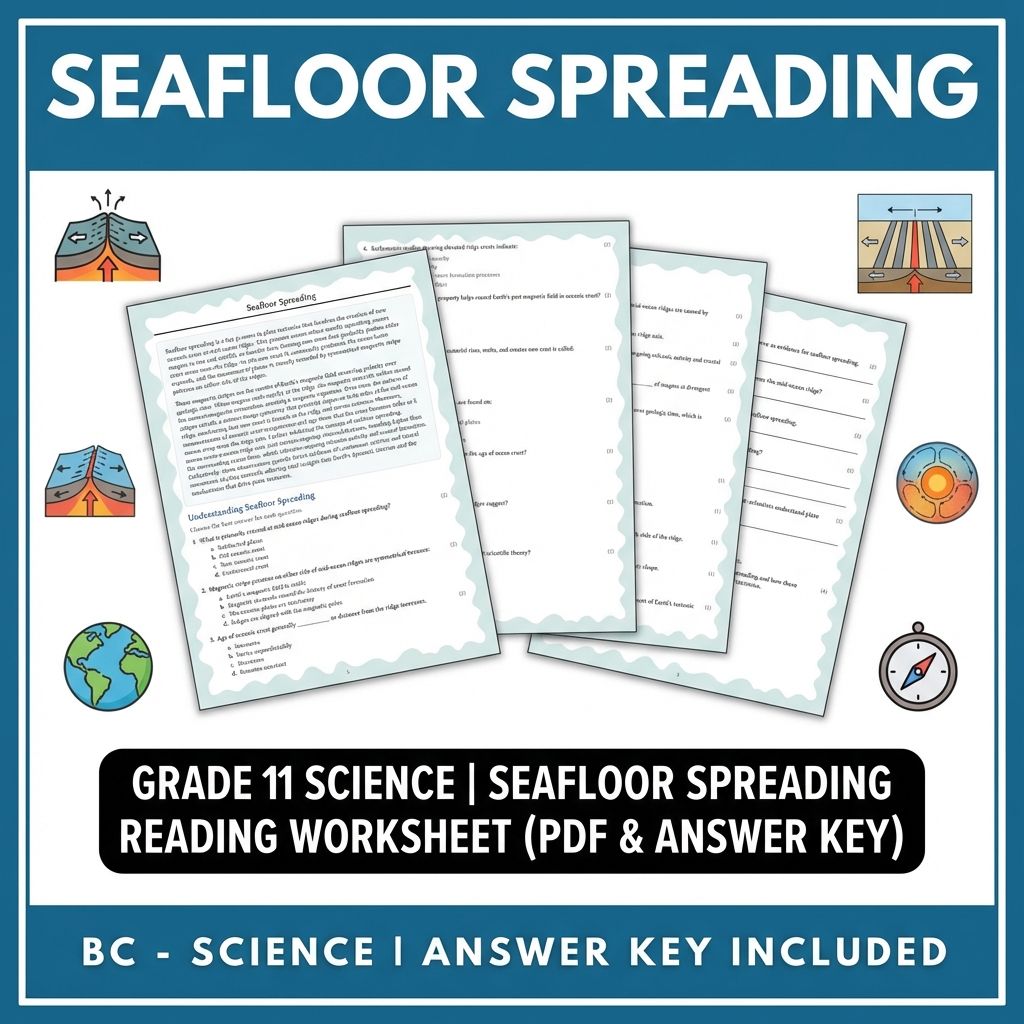
Grade 11 Science | Seafloor Spreading Reading Worksheet (PDF & Answer Key)
Learning Objectives
- Describe the process of seafloor spreading and how it shapes ocean basins.
- Explain how magnetic stripes provide evidence for seafloor spreading.
- Identify methods used to determine the age of oceanic crust.
Instant download
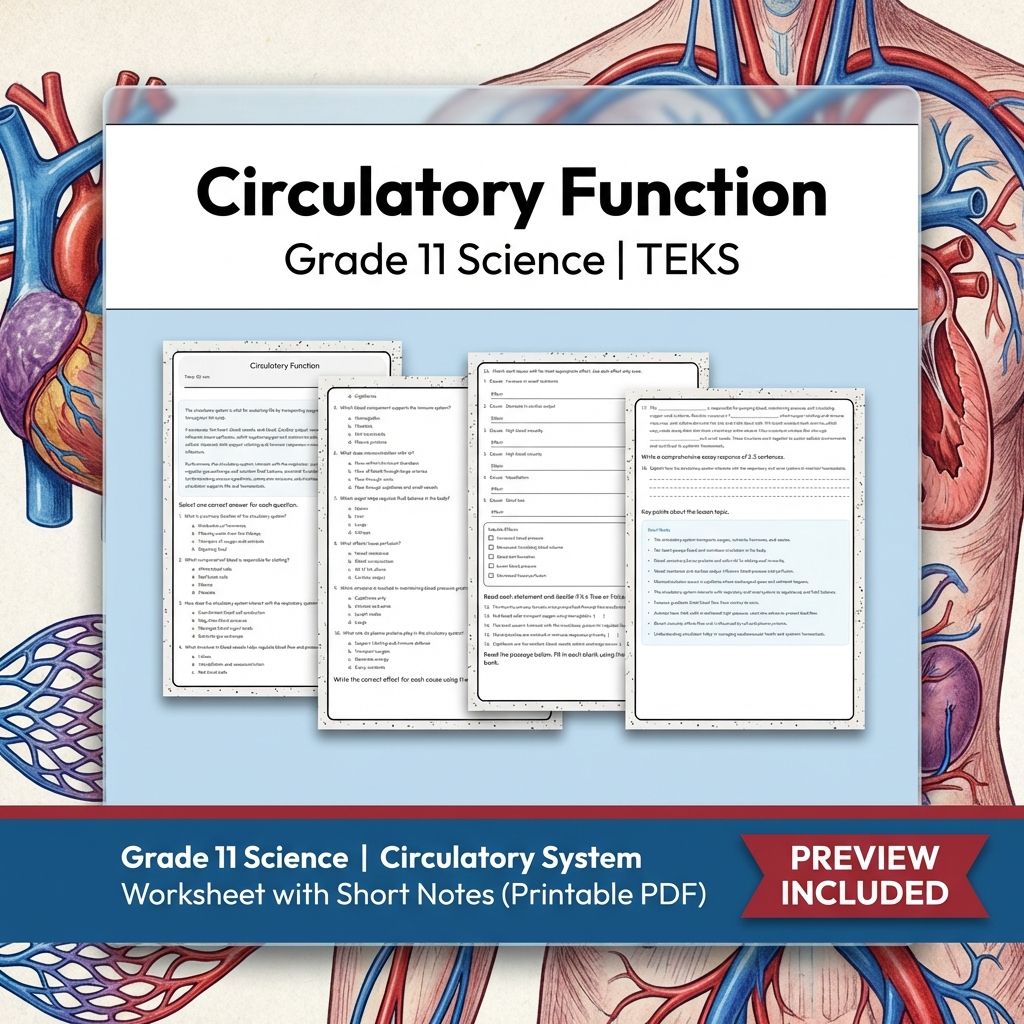
Grade 11 Science | Circulatory System Worksheet with Short Notes (Printable PDF)
Created byMeadowlark WorksheetsLearning Objectives
- Understand the primary functions of the circulatory system, including blood transport and tissue perfusion.
- Identify the components of blood and their roles in clotting and immune defense.
- Explain the interactions between the circulatory, respiratory, and renal systems in regulating gas exchange and fluid balance.
Instant download

Gene Regulation Worksheet for Grade 11 Science | Standards-Aligned Practice
Learning Objectives
- Explain how cis-regulatory elements (promoters and enhancers) and transcription factors control when genes are transcribed
- Describe how chromatin structure and epigenetic marks influence gene accessibility and gene expression levels
- Compare post-transcriptional regulation mechanisms such as alternative splicing and RNA interference
Instant download
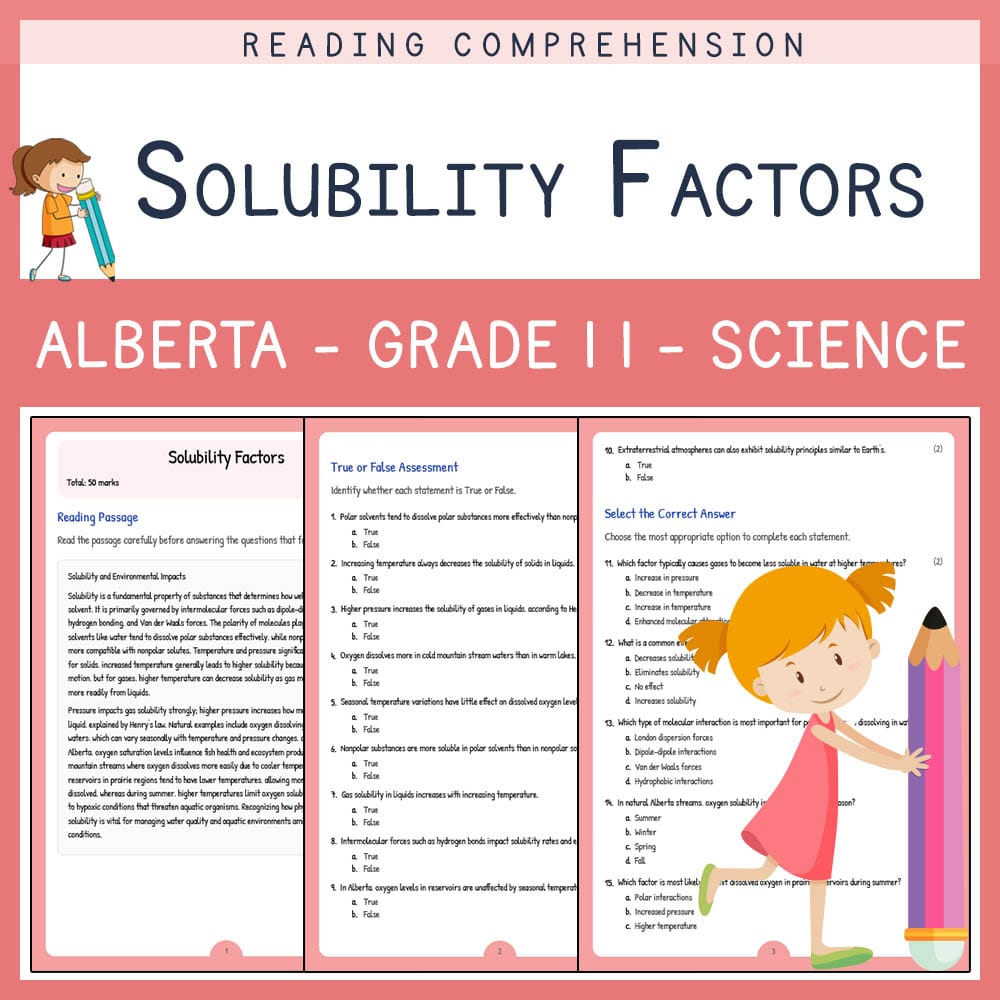
Grade 11 Science | Solubility Factors Worksheet | Alberta Standards
Created byLumora LearningLearning Objectives
- Understand how intermolecular forces influence solubility of different substances.
- Analyze the effects of temperature and pressure on the solubility of solids and gases.
- Examine real-world examples of solubility in natural and environmental contexts.
Instant download
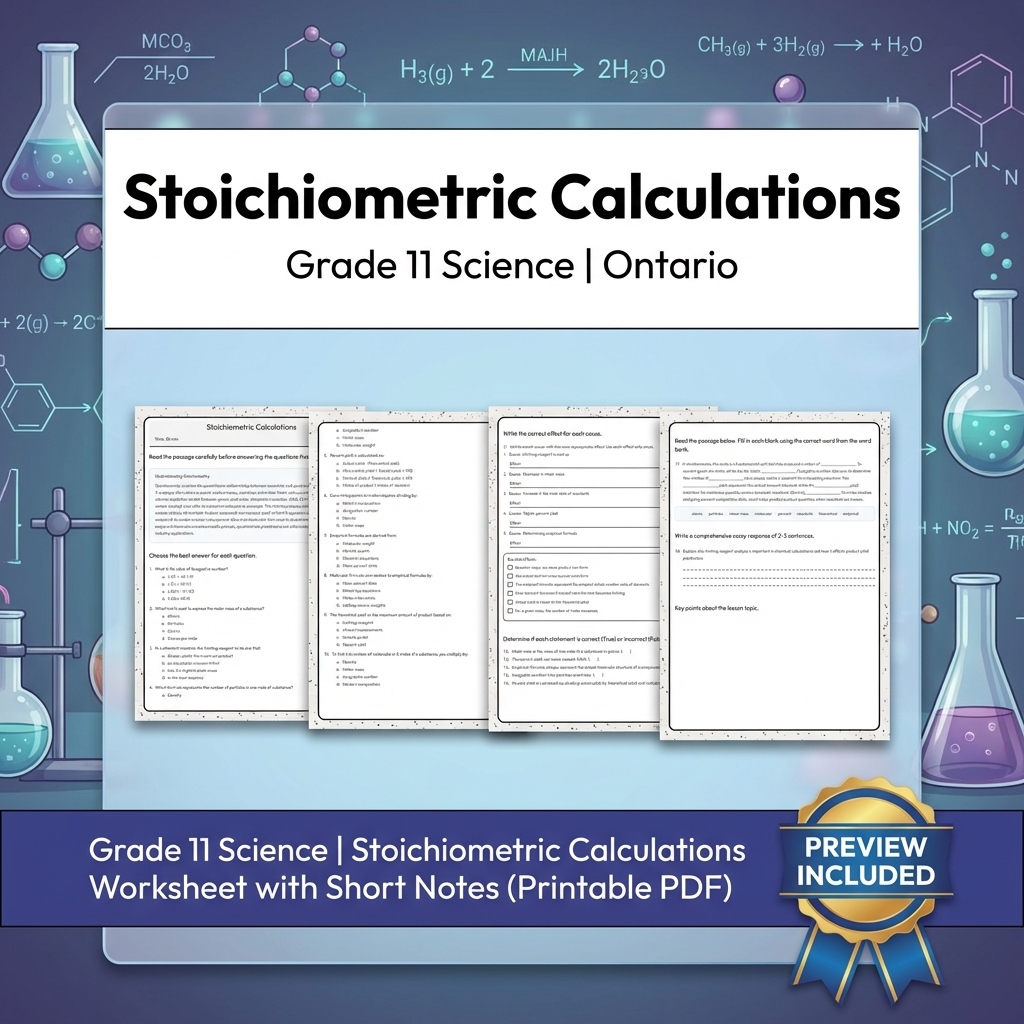
Grade 11 Science | Stoichiometric Calculations Worksheet with Short Notes
Created byMeadowlark WorksheetsLearning Objectives
- Understand how to use the mole concept to relate masses, moles, and particle counts.
- Apply molar mass conversions and Avogadro’s number in calculations involving substances.
- Perform limiting reagent, theoretical yield, and percent yield calculations.
Also included in: Grade 11 Science Lesson Bundle – Ontario Curriculum +1 more
Instant download

Grade 11 Pressure Effects Worksheet | Practice & Assessment PDF
Created byClear Sky ClassroomLearning Objectives
- Explain how pressure relates to gas solubility using Henry’s law and partial pressure.
- Predict how changing pressure affects dissolved gases such as carbon dioxide and methane in natural water systems.
- Apply pressure–gas–liquid equilibrium ideas to real Alberta contexts (reservoir management and deep groundwater).
Instant download

Limiting Reagent and Theoretical Yield Worksheets | Grade 11 Chemistry
 Created bySunny Desk Resources
Learning Objectives
- Define limiting reagents and explain their effect on product formation
- Use mole ratios to identify limiting and excess reagents
- Calculate theoretical yield using stoichiometric relationships
Also included in: Stoichiometry & Chemical Reactions Lesson Bundle — Grade 11 Science Alberta +1 more
Instant download

Grade 11 Polyprotic Systems Worksheet | Practice & PDF
Created byClear Sky ClassroomLearning Objectives
- Explain how polyprotic acids dissociate in steps and how each step affects pH
- Interpret titration curves using stepwise and cumulative acidity ideas
- Use dissociation constants (pKa values) to predict buffer regions and equivalence behavior
Instant download
About Grade 11 Science Worksheets
Browse 6,697 printable Grade 11 Science worksheets — ready-to-print PDFs with answer keys where available.
Each resource here is built by an independent educator and reviewed for quality. Worksheets print straight from PDF and suit classroom use, homework, or extra practice; most come with answer keys, and you can preview before purchasing.