
Grade 11 Science Worksheets
6,697 worksheets
Grade 11 Science | Molecular Mechanisms in Cellular Signaling - Comprehension
 Created byCoral Reef Learning
Learning Objectives
- Understand how cell surface receptors interact with ligands to initiate signaling pathways.
- Identify key biochemical mechanisms such as phosphorylation cascades and ubiquitination.
- Explain the role of second messengers in amplifying cellular signals.
Instant download

Photosynthesis Processes Test Prep Printables | Grade 11 Science
 Created byPrism Point Learning
Learning Objectives
- Explain how the light-driven reactions generate ATP and reduced electron carriers used in carbon fixation.
- Describe the electron transport chain and photophosphorylation in chloroplast thylakoid membranes.
- Model carbon fixation in the Calvin cycle using CO2, ATP, and NADPH stoichiometry.
Also included in: Cellular Processes & Energy Flows Grade 11 Science Lesson Bundle NGSS
Instant download
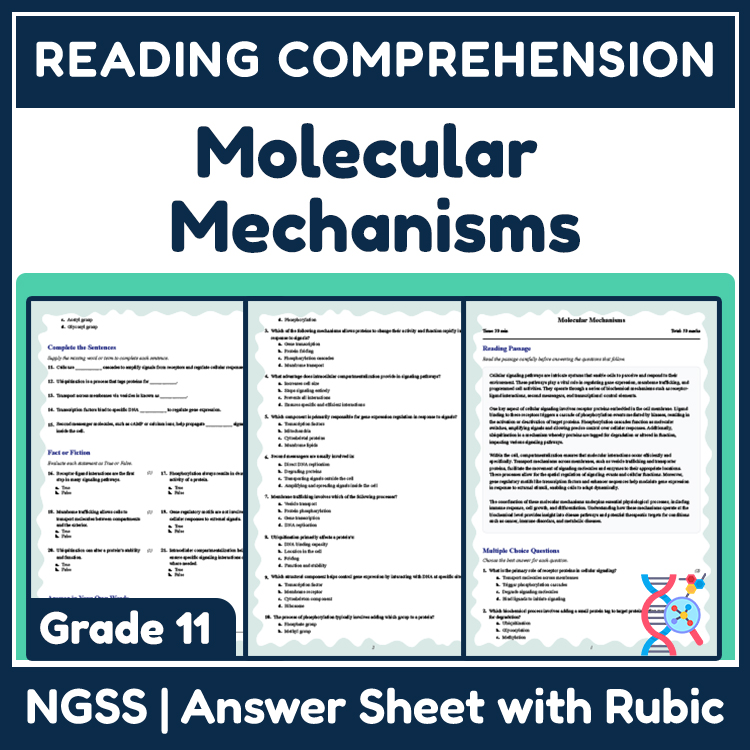
Grade 11 Science | Molecular Mechanisms Reading Worksheet (PDF + Answer Key)
Learning Objectives
- Understand cellular signaling pathways and how they regulate gene expression and cellular functions.
- Describe biochemical mechanisms such as phosphorylation cascades, ubiquitination, and gene regulatory motifs.
- Explain how intracellular compartmentalization and membrane transport influence molecular mechanisms.
Instant download
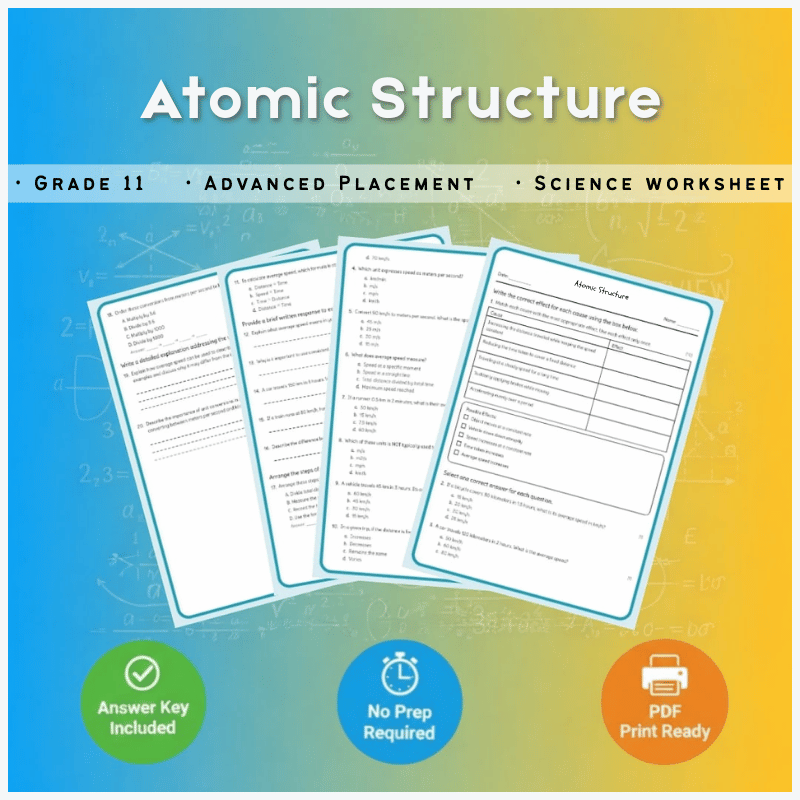
Grade 11 Science | Atomic Structure Worksheet (AP Standard PDF)
 Created byBright Mind Resources
Learning Objectives
- Identify the fundamental subatomic particles and their roles within an atom.
- Explain how evidence from emission spectra and mass spectrometry supports discrete energy levels and isotopic variation.
- Describe quantum numbers and electron orbital models as representations of electron distribution.
Instant download

Grade 11 Worksheet B: Photosynthesis Processes | NGSS
 Created byClear Sky Classroom
Learning Objectives
- Describe the light-driven reactions in chloroplasts, including electron transport, photophosphorylation, and photolysis of water.
- Explain the Calvin cycle (carbon fixation) and how ATP and NADPH produced in the light reactions are used.
- Analyze how respiration and photosynthesis together affect gas exchange (CO2 uptake and O2 release) and cellular ATP balance.
Also included in: Grade 11 Photosynthesis & Cellular Processes Science Lesson Bundle NGSS +1 more
Instant download
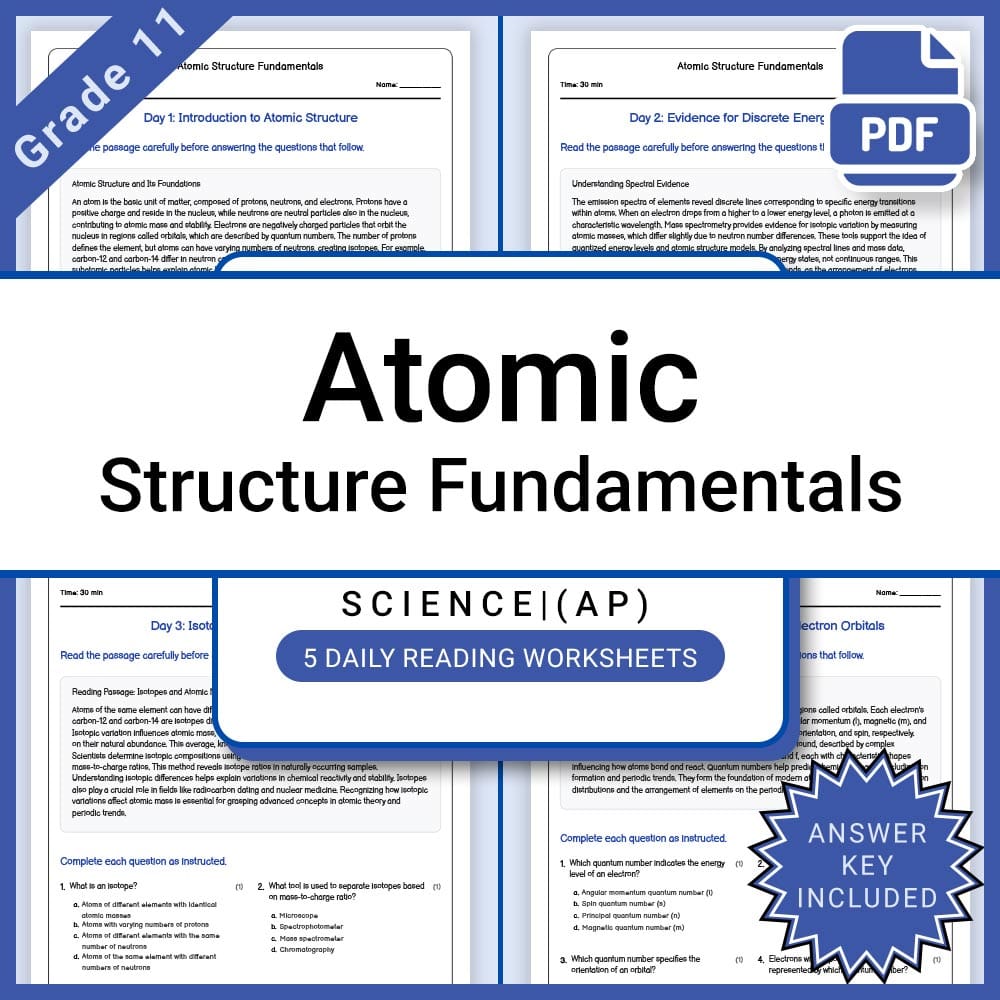
Grade 11 Science – Atomic Structure Daily Reading Worksheet with Answer Key
Learning Objectives
- Identify and describe the roles of protons, neutrons, and electrons within an atom.
- Explain the concept of isotopes and how they result in atomic variation.
- Calculate atomic mass using isotopic abundance and mass.
Also included in: AP Physics Principles Activities & Worksheets | Grade 11 Advanced Placement +1 more
Instant download
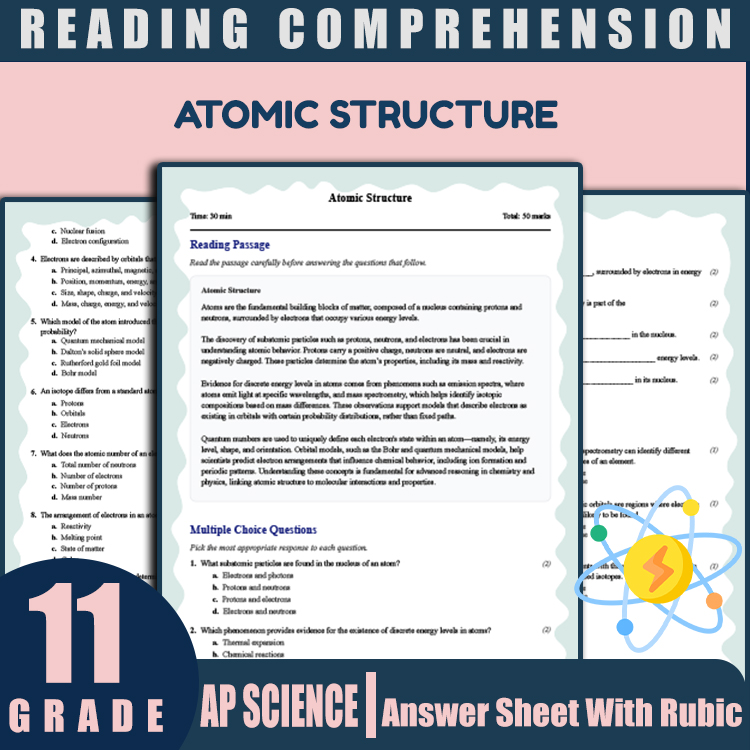
11th Grade Science | Atomic Structure Reading Worksheet (PDF + Answer Key)
Learning Objectives
- Explain the subatomic composition of atoms including protons, neutrons, and electrons.
- Describe how emission spectra and mass spectrometry support the concept of discrete energy levels.
- Analyze the roles of isotopes and atomic mass calculations in atomic theory.
Also included in: Grade 11 Science Unit Worksheet Bundle – Chemical Bonding, Kinetics & More (PDF) +1 more
Instant download

Grade 11 Molecular Mechanisms in Cellular Signal Transduction Worksheet
 Created byBRIGHT PATH RESOURCES
Learning Objectives
- Understand the basics of receptor-ligand interactions in cell signaling.
- Identify key biochemical mechanisms such as phosphorylation cascades and ubiquitination.
- Explain how molecular motifs regulate gene expression and cellular behavior.
Also included in: From Molecules to Organisms: Structures and Processes Grade 11 Science Bundle +1 more
Instant download

Atomic Structure Worksheet for Grade 11 Science | AP Standards Practice
Learning Objectives
- Describe the fundamental subatomic particles and their roles in an atom.
- Explain how emission spectra and mass spectrometry provide evidence for discrete energy levels.
- Understand isotopic variation and how atomic mass is calculated.
Instant download

Molecular Mechanisms Worksheet | NGSS Grade 11 Science MCQ Assessment
 Created byCedar Grove Learning
Learning Objectives
- Understand the biochemical processes involved in cellular signaling pathways.
- Identify key molecular mechanisms such as phosphorylation, ubiquitination, and gene regulation motifs.
- Explain how intracellular compartmentalization and membrane transport influence cellular responses.
Instant download
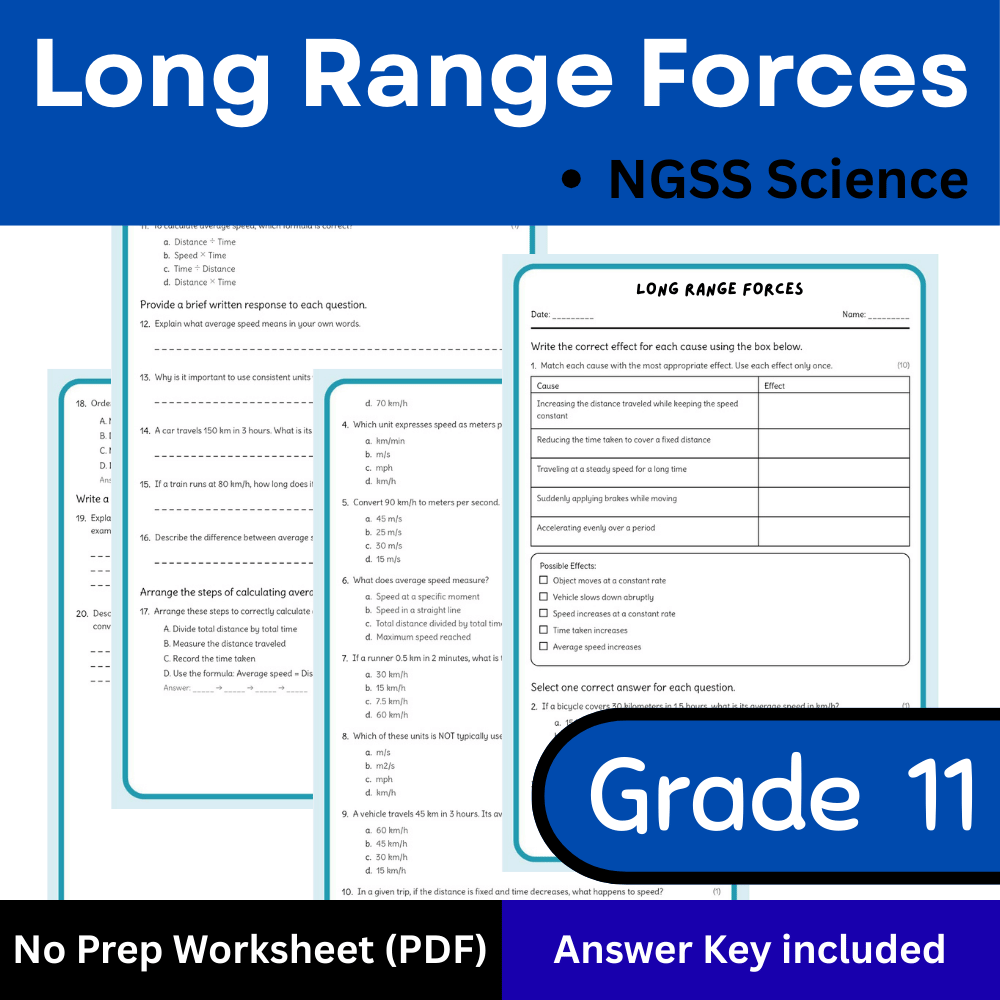
Grade 11 Science | Long Range Forces Worksheet + Answer Key (NGSS Aligned)
Created byBright Mind ResourcesLearning Objectives
- Understand and apply Newton's law of universal gravitation and Coulomb's law using inverse-square relationships.
- Use vector addition to compute net forces and predict particle motion.
- Analyze complex systems of interacting bodies, including two-body, multi-body, and point-charge arrangements.
Instant download

Grade 11 Science | Long Range Forces Worksheet (NGSS Alignment) (PDF)
 Created byMaple Path Learning
Learning Objectives
- Understand the inverse-square law expressions as they apply to gravitational and electrostatic forces.
- Apply Newton's law of universal gravitation and Coulomb's law to calculate forces between bodies.
- Use vector superposition to determine net forces and predict motion in classical mechanics.
Also included in: Grade 11 Impulse, Forces & Conservation Laws Science Lesson Bundle NGSS +1 more
Instant download

Grade 11 Science – Understanding Newton's Second Law & Daily Reading Worksheet
Created byBright Mind ResourcesLearning Objectives
- Explain the relationship between force, mass, and acceleration.
- Identify examples of Newton's second law in everyday life.
- Describe how forces affect motion and acceleration.
Also included in: Physical Science Grade 11 Science Worksheets Lesson Bundle | Florida NGSSS +1 more
Instant download

Newton Second Law Assessment Grade 11 Science NGSSS Standards
Created byPrism Point LearningLearning Objectives
- Explain Newton’s second law using the relationship between net force, mass, and acceleration
- Predict the direction and relative magnitude of acceleration based on net force and mass
- Apply Newton’s second law to situations involving identical pushes on different masses and multiple forces acting together
Also included in: Lesson Grade 11 Forces Energy & Chemistry Science Assessment Lesson Bundle | Florida (NGSSS) +1 more
Instant download

Grade 11 Photosynthesis Processes Worksheet | NGSS Biology Activity
Created byBRIGHT PATH RESOURCESLearning Objectives
- Identify the light absorption mechanisms in chloroplasts
- Describe electron transport and photophosphorylation
- Explain the steps of the Calvin cycle in carbon fixation
Also included in: From Molecules to Organisms: Structures and Processes Grade 11 Science Bundle +1 more
Instant download

Meiosis Variation Worksheet | Standards-Aligned Science Practice for Grade 11
Learning Objectives
- Understand how genetic variation arises during meiosis and fertilization.
- Identify the processes involved in homologous chromosome separation and allele assortment.
- Explain how fertilization creates new combinations of traits in offspring.
Also included in: Grade 11 Evolution & Ecosystems Science Lesson Bundle: California Standards +1 more
Instant download

Grade 11 Meiosis Variation Worksheet | Practice & PDF
Created byClear Sky ClassroomLearning Objectives
- Explain how meiosis creates genetic variation in gametes through homologous chromosome separation and allele assortment.
- Describe how fertilization combines genetically distinct gametes to produce genetically varied offspring.
- Evaluate how independent assortment, recombination, and random fertilization contribute to differences within a population.
Instant download

Grade 11 Science | Electromagnetic Detector Imaging Worksheet (NGSS PDF)
Created byMaple Path LearningLearning Objectives
- Analyze how electromagnetic radiation across UV, visible, IR, and X-ray bands is absorbed by matter using detector measurements.
- Evaluate the calibration, uncertainty, and limitations of imaging instruments such as CCDs and photodiodes.
- Assess the validity and reliability of claims related to electromagnetic absorption based on measurement data.
Also included in: Grade 11 Electromagnetic Waves & Signal Transmission Science Lesson Bundle NGSS +1 more
Instant download

Grade 11 Science – Photosynthesis & Respiration | Daily Reading Worksheet
Created byBright Mind ResourcesLearning Objectives
- Identify the main stages of photosynthesis and their roles
- Understand the electron transport chain and photophosphorylation
- Explain the Calvin cycle and carbon fixation
Also included in: Metabolism Grade 11 Science Daily Reading Worksheets Lesson Bundle|NGSS +2 more
Instant download

Reaction Stoichiometry Practice Worksheet | Grade 11 Science Review
Created byPrism Point LearningLearning Objectives
- Use balanced chemical equations and mole ratios to determine limiting reactants and theoretical yields.
- Convert among mass, moles, and gas volumes (at standard conditions) using the mole concept.
- Calculate percent composition and use empirical/molecular formulas from compositional data.
Instant download
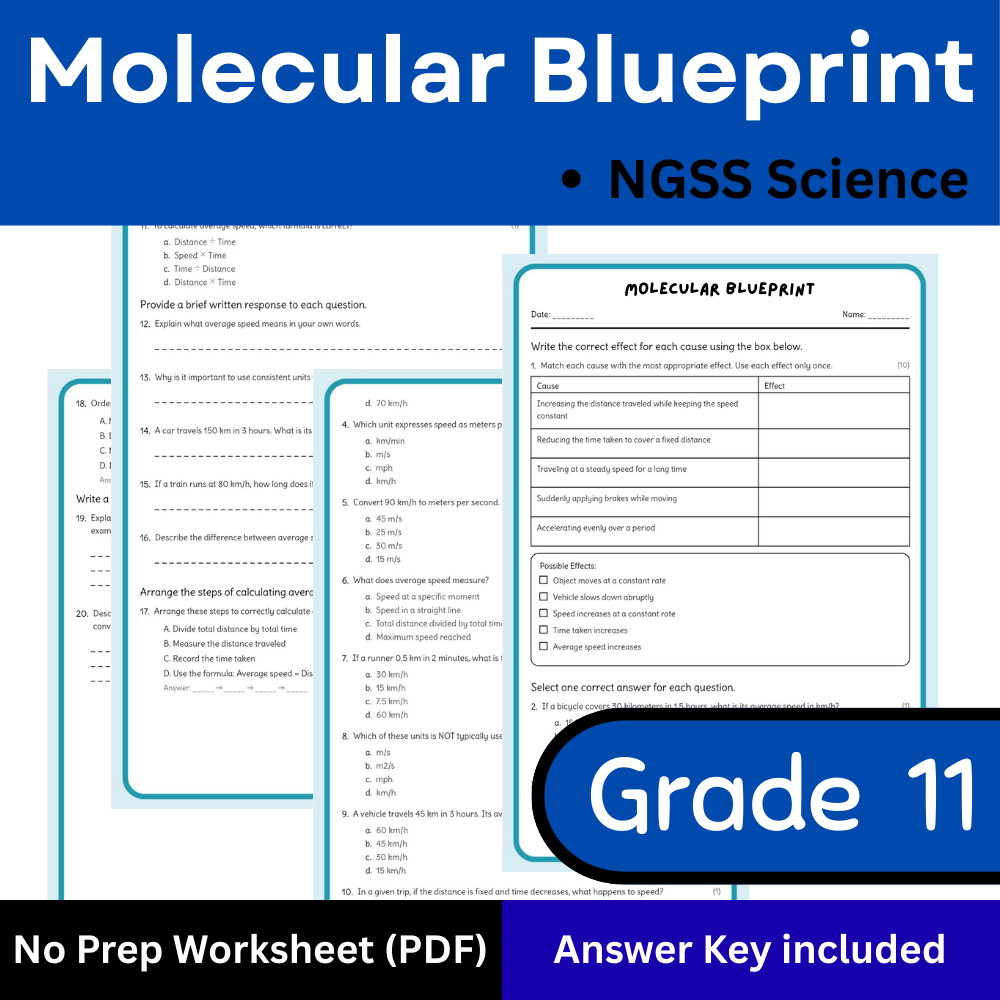
Grade 11 Science – Molecular Mechanisms Worksheet (NGSS Aligned) PDF
Created byBright Mind ResourcesLearning Objectives
- Understand the biochemical processes such as phosphorylation, ubiquitination, and gene regulatory motifs that influence cellular functions.
- Describe how receptor-ligand interactions and second messengers regulate cellular signaling pathways.
- Explain the roles of intracellular compartmentalization and membrane transport in molecular mechanisms.
Instant download

Grade 11 Worksheet B: Energy Pathways (Cellular Respiration) Practice | NGSS
Created byClear Sky ClassroomLearning Objectives
- Explain how glycolysis, pyruvate oxidation, the citric acid cycle, and oxidative phosphorylation transform energy into ATP
- Describe the electron transport chain and how the proton gradient powers ATP synthase
- Use quantitative ideas (energy yields per electron carriers/substrates) to predict changes in metabolic rate
Also included in: Grade 11 Photosynthesis & Cellular Processes Science Lesson Bundle NGSS +1 more
Instant download
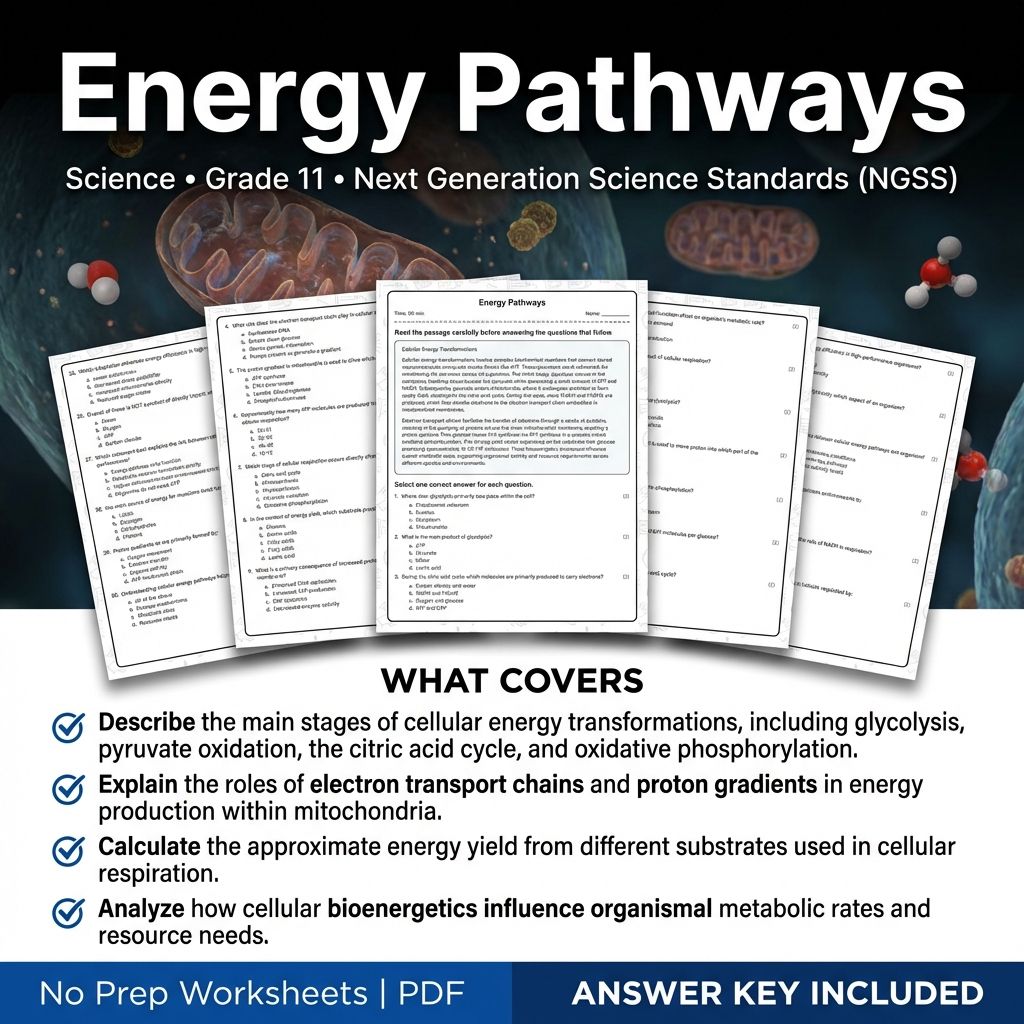
11th Grade Science | Energy Pathways Worksheet & Answer Key PDF
Created byCoral Reef LearningLearning Objectives
- Describe the main stages of cellular energy transformations, including glycolysis, pyruvate oxidation, the citric acid cycle, and oxidative phosphorylation.
- Explain the roles of electron transport chains and proton gradients in energy production within mitochondria.
- Calculate the approximate energy yield from different substrates used in cellular respiration.
Also included in: Grade 11 Science Unit Worksheet Pack | Photosynthesis & Cell Signaling NGSS +1 more
Instant download
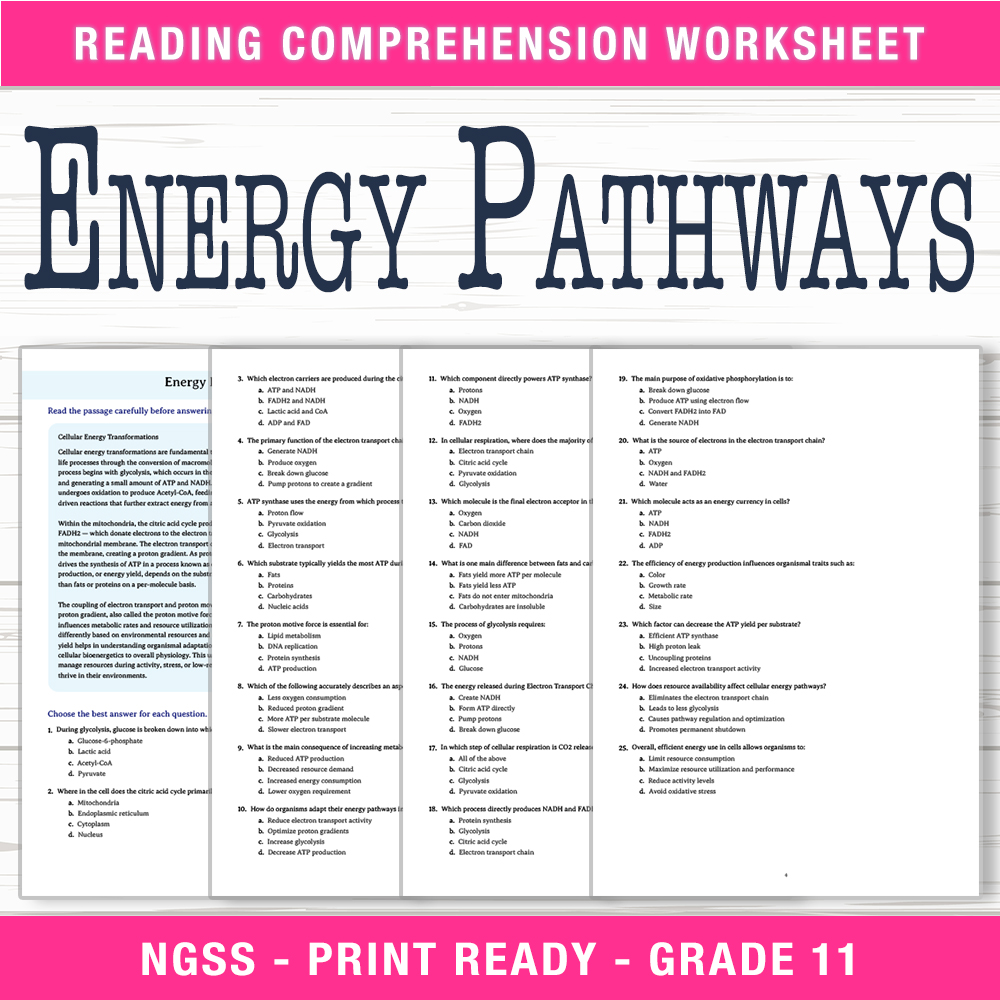
Grade 11 Science | Energy Pathways Worksheet (PDF + Answer Key)
 Created byRiverstone Classroom
Learning Objectives
- Describe the main stages of cellular energy transformation, including glycolysis, pyruvate oxidation, the citric acid cycle, and oxidative phosphorylation.
- Explain how electron transport chains and proton gradients contribute to ATP production in mitochondria.
- Calculate the energy yield of different substrates during cellular respiration and understand its implications for organismal metabolism.
Instant download

Energy Pathways Worksheet for Grade 11 Science | NGSS Aligned Practice
Learning Objectives
- Describe the main stages of cellular energy transformations, including glycolysis, pyruvate oxidation, the citric acid cycle, and oxidative phosphorylation.
- Explain the role of electron transport chains and proton gradients in ATP synthesis.
- Quantify the energy yield per substrate and analyze its impact on organismal metabolic rates.
Also included in: Grade 11 Cellular Processes and Energy Pathways Science lesson bundle: NGSS +1 more
Instant download

Cell Interactions Worksheet | Grade 11 Biology Science | California Standards
 Created byEvergreen Desk Education
Learning Objectives
- Explain how membranes create compartments that coordinate chemical reactions inside cells
- Describe how organelles and transport systems work together to maintain overall cell function
- Analyze how energy-requiring reactions depend on molecular interactions and affect cell processes
Instant download

Grade 11 Science | Cell Interactions Worksheet Elena | California Standards
 Created byLumora Learning
Learning Objectives
- Explain how organelles and molecules coordinate to maintain overall cell function
- Describe how membranes form compartments and regulate transport
- Analyze how energy-requiring reactions depend on molecular interactions and regulation
Instant download

Mitochondrial Energy Pathways & ATP Production Worksheets Grade 11
 Created byTeachers Club
Learning Objectives
- Explain how major stages of cellular respiration produce ATP
- Describe how electron transport creates a proton gradient
- Explain how ATP synthase uses proton flow to produce ATP
Instant download
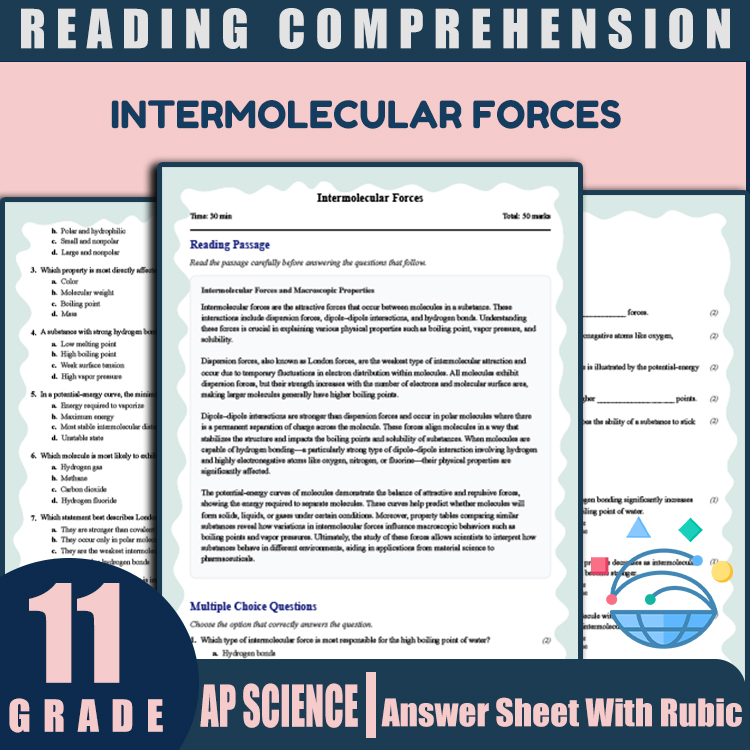
Grade 11 Science | Intermolecular Forces Reading Worksheet (PDF + Answer Key)
Learning Objectives
- Explain the types of intermolecular forces: dispersion, dipole–dipole, and hydrogen bonding.
- Describe how these forces affect boiling points, vapor pressure, and solubility.
- Relate molecular polarity and surface interactions to phase behavior and macroscopic properties.
Also included in: Grade 11 Science Unit Worksheet Bundle – Chemical Bonding, Kinetics & More (PDF) +1 more
Instant download

Intermolecular Forces Worksheet | Grade 11 AP Chemistry Activities
Created byPrism Point LearningLearning Objectives
- Characterize dispersion, dipole–dipole, and hydrogen-bonding interactions and relate them to phase behavior.
- Explain how molecular polarity and intermolecular attractions influence boiling point, vapor pressure, and solubility.
- Use potential-energy ideas and property trends to connect microscopic forces to macroscopic observations like cohesive versus adhesive behavior.
Also included in: AP Chemistry Foundations Lesson Bundle | Grade 11 Science | AP Framework
Instant download

Grade 11 Physical vs Chemical Changes Worksheet | Florida NGSSS Science
Created byEvergreen Desk EducationLearning Objectives
- Differentiate physical and chemical changes based on whether new substances form and whether composition changes.
- Interpret observable evidence (gas, color change, temperature change, precipitate) as indicators of chemical reactions.
- Explain why chemical changes are generally harder to reverse than physical changes.
Instant download

Grade 11 Science | Physical vs Chemical Worksheet | NGSSS Assessment
Created byLumora LearningLearning Objectives
- Differentiate physical changes from chemical changes by whether new substances form and composition changes.
- Identify evidence of chemical change (e.g., gas, color, temperature, precipitate) and explain why it matters.
- Predict whether a change is likely reversible based on particle/bonding behavior.
Instant download

Energy Pathways Test Prep Worksheet | Grade 11 Science NGSS
Created byPrism Point LearningLearning Objectives
- Explain how ATP production is coupled to electron transfer in mitochondria.
- Describe the main stages of cellular respiration (glycolysis, pyruvate oxidation, citric acid cycle, oxidative phosphorylation) and what each contributes.
- Use quantitative ideas (substrate-to-ATP relationships) to predict how changes in pathway efficiency can affect metabolic rate.
Also included in: Cellular Processes & Energy Flows Grade 11 Science Lesson Bundle NGSS
Instant download
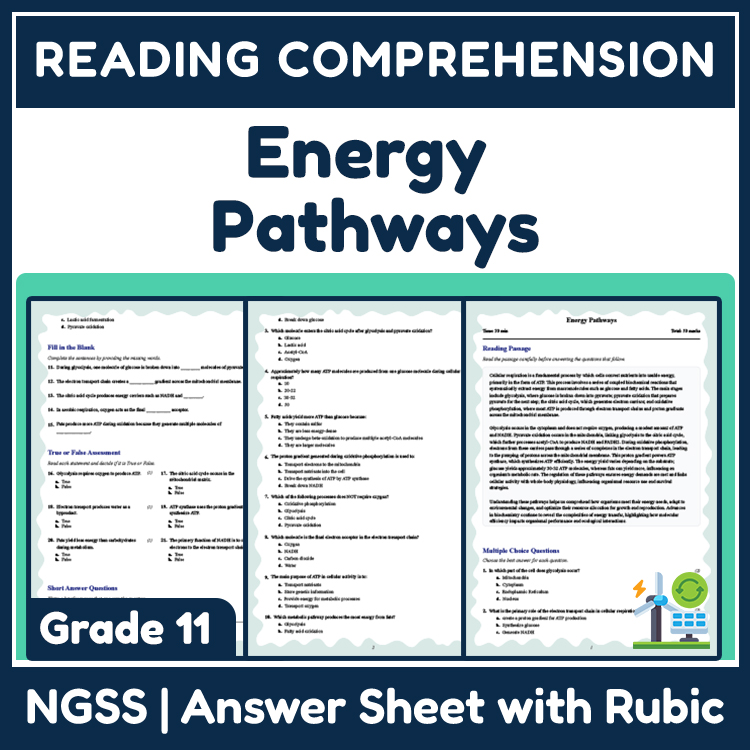
11th Grade Science | Energy Pathways Reading Worksheet & Answer Key (PDF)
Learning Objectives
- Describe the main energy transformation processes in cellular respiration, including glycolysis, pyruvate oxidation, the citric acid cycle, and oxidative phosphorylation.
- Explain how electron transport chains and proton gradients are involved in ATP production.
- Analyze the energy yield from different substrates and understand how metabolic rates affect organismal physiology.
Instant download

Grade 11 Science – Physical & Chemical Changes | Daily Reading Worksheet
Created byBright Mind ResourcesLearning Objectives
- Understand the differences between physical and chemical changes
- Identify examples of physical and chemical changes in everyday life
- Recognize observable evidence indicating chemical reactions
Also included in: Physical Science Grade 11 Science Worksheets Lesson Bundle | Florida NGSSS +1 more
Instant download
Grade 11 Science | Energy Pathways Worksheet – NGSS (PDF)
Created byMaple Path LearningLearning Objectives
- Describe the key processes involved in cellular energy transformations such as glycolysis, the citric acid cycle, and oxidative phosphorylation.
- Explain how electron transport chains and proton gradients are used to generate ATP in mitochondria.
- Quantitatively analyze energy yields from different substrates and relate these to organismal metabolic rates.
Also included in: Grade 11 Life Science Biology Lesson Bundle (NGSS) | SCIENCE NGSS +1 more
Instant download

Grade 11 Energy Pathways in Cellular Respiration Worksheet | NGSS Biology
Created byBRIGHT PATH RESOURCESLearning Objectives
- Understand the steps and products of glycolysis
- Describe the process of pyruvate oxidation
- Explain the citric acid cycle and its significance
Also included in: From Molecules to Organisms: Structures and Processes Grade 11 Science Bundle +1 more
Instant download

Human Cycle Alteration Worksheet | Grade 11 Environmental Science Resource
Created byPrism Point LearningLearning Objectives
- Explain how land-use change, extraction, and waste management can alter Earth’s material cycles.
- Describe how changes in the geosphere, hydrosphere, atmosphere, and biosphere connect and affect water quality and air quality.
- Use evidence-based reasoning to predict measurable near-surface and surface chemistry changes caused by human activity.
Instant download

Grade 11 Science | Cell Interactions - Daily Reading Comprehension
Created byCoral Reef LearningLearning Objectives
- Understand key concepts related to Science
- Apply knowledge through practice questions
- Demonstrate comprehension of the material
Instant download

Grade 11 Science– Intermolecular Forces & Surface Properties | Reading Worksheet
Created byBright Mind ResourcesLearning Objectives
- Identify and describe different types of intermolecular forces: dispersion, dipole–dipole, and hydrogen bonding.
- Understand how intermolecular forces influence boiling point, vapor pressure, and solubility.
- Relate molecular polarity and surface interactions to phase behavior and macroscopic properties.
Also included in: Grade 11 Chemistry Concepts Science Daily Reading Worksheets Lesson Bundle | AP +2 more
Instant download

Physical vs Chemical Assessment | Florida NGSSS Grade 11 Science
Created byPrism Point LearningLearning Objectives
- Differentiate physical changes from chemical changes based on whether chemical identity changes.
- Use evidence such as gas production, temperature change, color change, and precipitate formation to infer chemical reactions.
- Predict whether a process is reversible by considering whether the chemical composition remains the same.
Also included in: Lesson Grade 11 Forces Energy & Chemistry Science Assessment Lesson Bundle | Florida (NGSSS) +1 more
Instant download

Grade 11 Science | Physical & Chemical Changes - Daily Reading Comprehension
Created byCoral Reef LearningLearning Objectives
- Understand the difference between physical and chemical changes.
- Identify observable evidence of chemical reactions.
- Differentiate reversible physical changes from irreversible chemical changes.
Instant download

Grade 11 Science — Worksheet MCQ Paper for Mastering Intermolecular Forces
 Created byThe Resource Hub
Learning Objectives
- Describe dispersion, dipole–dipole, and hydrogen bonding interactions.
- Explain how these forces influence boiling point, vapor pressure, and solubility.
- Relate molecular polarity to phase behavior and surface interactions.
Also included in: Grade 11 Science AP Worksheet Bundle: Mastering Key Concepts +1 more
Instant download
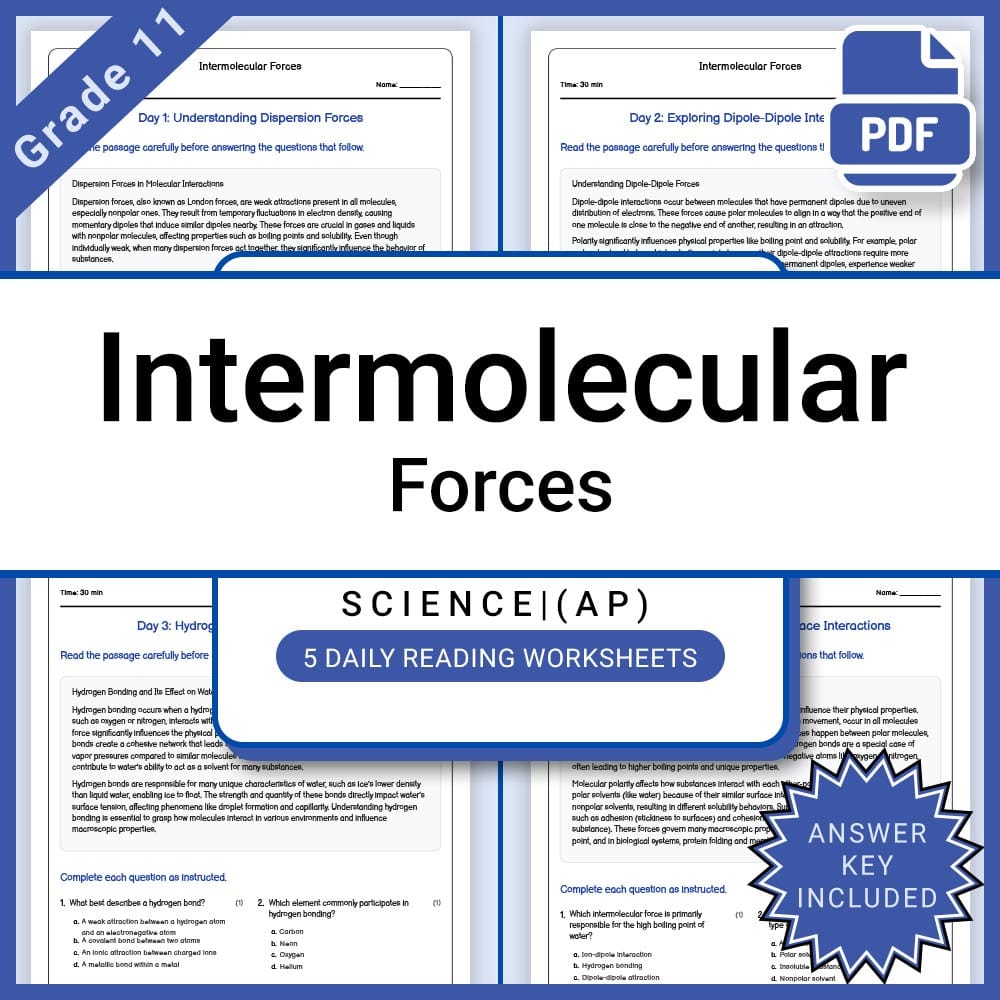
Grade 11 Science – Intermolecular Forces Daily Reading Worksheet + Answer Key
Learning Objectives
- Understand dispersion forces and their role in molecular interactions.
- Identify different types of intermolecular forces including dipole–dipole and hydrogen bonding.
- Explain how intermolecular forces influence physical properties like boiling points and vapor pressure.
Also included in: AP Physics Principles Activities & Worksheets | Grade 11 Advanced Placement +1 more
Instant download

Energy Pathways MCQ Worksheet | NGSS Grade 11 Science Practice
Created byCedar Grove LearningLearning Objectives
- Understand the sequence of cellular energy transformations including glycolysis, pyruvate oxidation, the citric acid cycle, and oxidative phosphorylation.
- Identify the role of electron transport chains and proton gradients in ATP production.
- Quantify energy yield from different substrates and relate it to organismal metabolic rates.
Instant download

Cell Interactions Worksheet | Standards-Aligned Practice for Grade 11 Science
Learning Objectives
- Understand how organelles and structures within a cell interact physically and chemically.
- Describe the roles of membranes and compartments in maintaining cell processes.
- Explain how energy-requiring reactions depend on molecular interactions to sustain cell functions.
Also included in: Grade 11 Evolution & Ecosystems Science Lesson Bundle: California Standards +1 more
Instant download

Grade 11 Science | Energy Pathways in Cellular Biology - Reading Comprehension
Created byCoral Reef LearningLearning Objectives
- Understand the basic processes involved in cellular energy transformation.
- Identify the main stages of cellular respiration: glycolysis, pyruvate oxidation, citric acid cycle, and oxidative phosphorylation.
- Explain how electron transport chains and proton gradients generate ATP.
Instant download

Grade 11 Intermolecular Forces Worksheet | Practice & Assessment PDF
Created byClear Sky ClassroomLearning Objectives
- Characterize dispersion, dipole–dipole, and hydrogen bonding interactions and explain how they affect boiling point, vapor pressure, and solubility.
- Use molecular polarity and intermolecular (surface) interactions to predict phase behavior and macroscopic trends.
- Interpret potential-energy curves and comparative property tables to justify how intermolecular forces influence cohesive versus adhesive tendencies.
Also included in: Grade 11 AP Chemistry Science Lesson Bundle: Foundations & Models +1 more
Instant download
About Grade 11 Science Worksheets
Browse 6,697 printable Grade 11 Science worksheets — ready-to-print PDFs with answer keys where available.
Each resource here is built by an independent educator and reviewed for quality. Worksheets print straight from PDF and suit classroom use, homework, or extra practice; most come with answer keys, and you can preview before purchasing.