Grade 7 Worksheets
8,664 grade resources
Genotype and Phenotype Worksheet | Grade 7 Genetics Science Activity
 Created byPrism Point Learning
Learning Objectives
- Explain the difference between genotype and phenotype in terms of genes and observable traits
- Describe how dominant and recessive alleles affect which phenotype an organism shows
- Use the genotype–phenotype relationship to predict traits and explain why relatives may look different
Also included in: Grade 7 Evolution, Genetics & Ecosystems Lesson Bundle | Florida NGSSS
Instant download
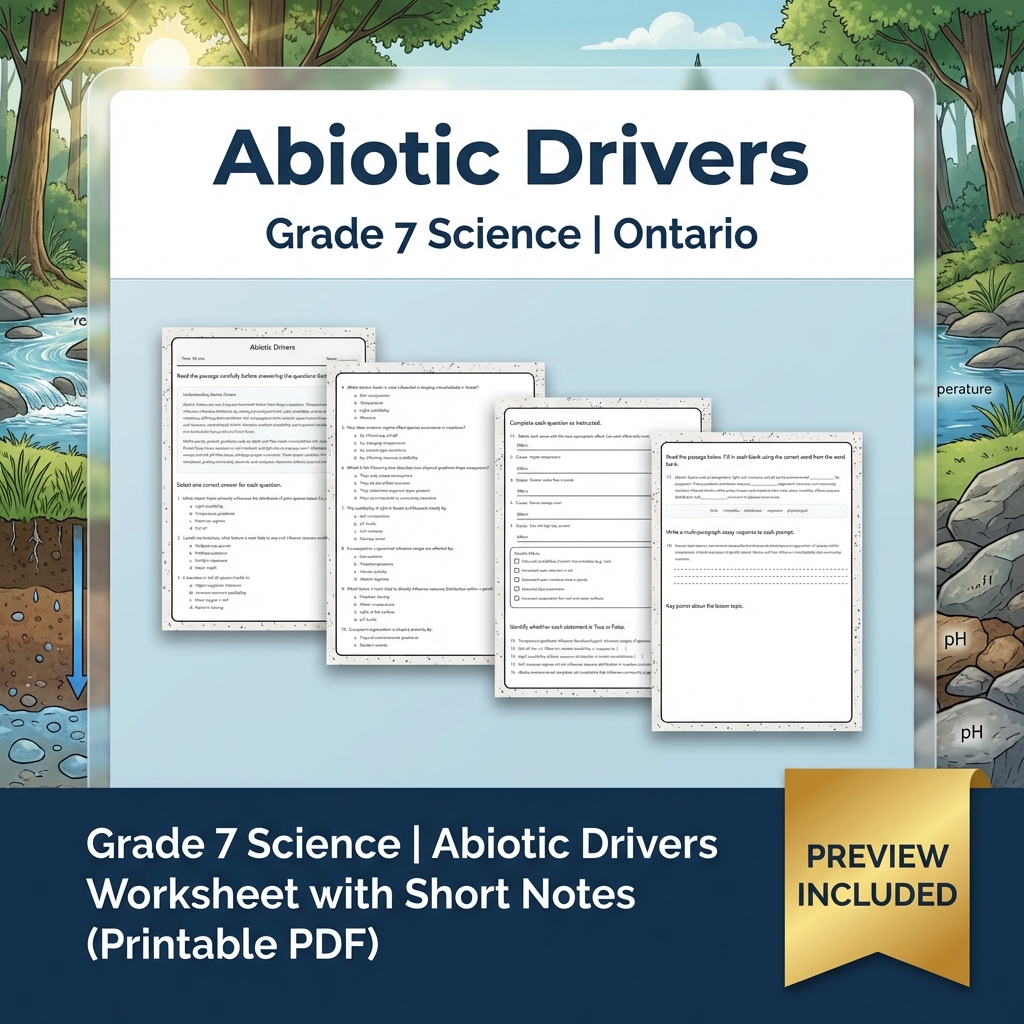
Grade 7 Science | Abiotic Drivers Worksheet with Short Notes (Printable PDF)
 Created byMeadowlark Worksheets
Learning Objectives
- Describe abiotic drivers such as temperature, light, soil, moisture, and pH and their roles in ecosystems.
- Explain how abiotic factors influence resource distribution and organismal tolerance.
- Identify microhabitats and their abiotic characteristics in pond, forest, and meadow environments.
Also included in: Grade 7 Science Lesson Bundle with Ontario Framework | Ecosystems & Biodiversity +1 more
Instant download
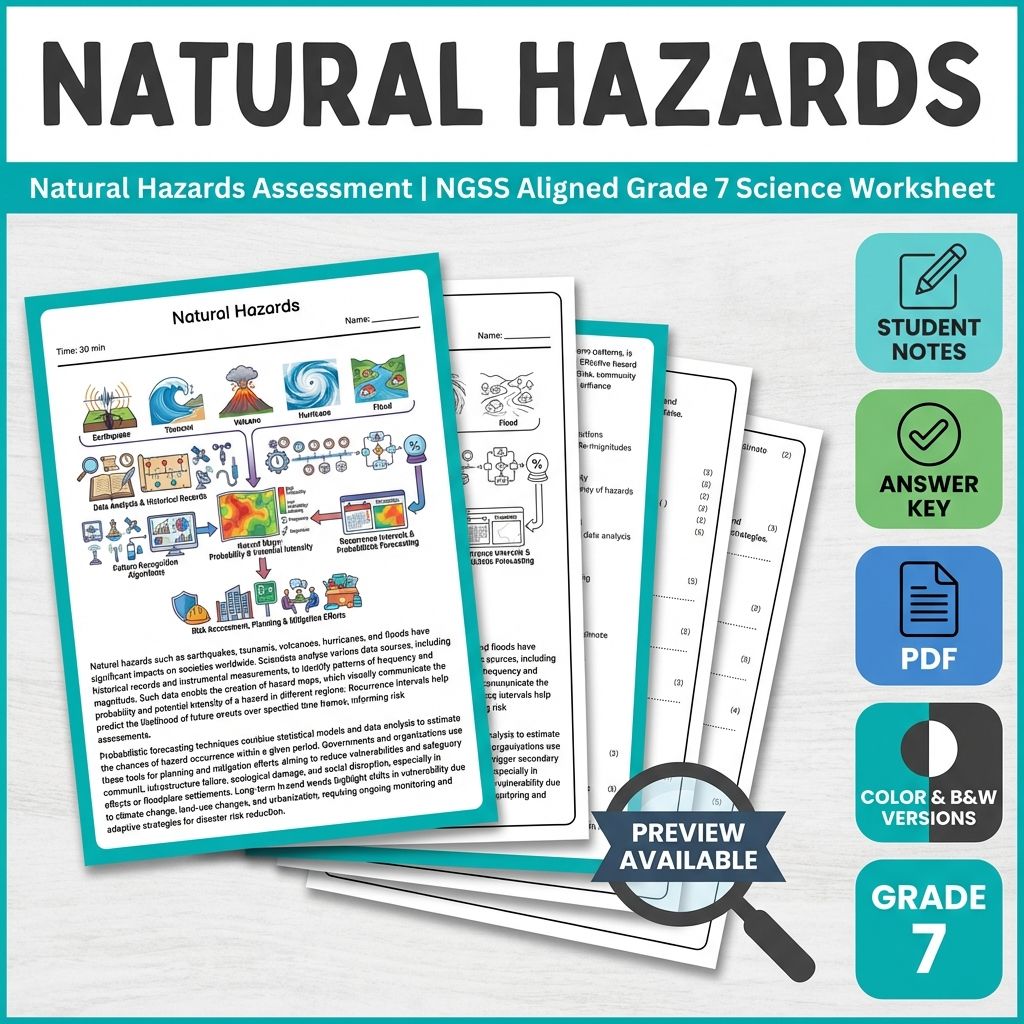
Natural Hazards Assessment | NGSS Aligned Grade 7 Science Worksheet
Created byPrism Point LearningLearning Objectives
- Understand key concepts related to Science
- Apply knowledge through practice questions
- Demonstrate comprehension of the material
Also included in: Grade 7 Science Mini Bundle | Earth and Human Activity NGSS Not specified +1 more
Instant download

Grade 7 Optimization Strategies Worksheet | Ontario Science Practice PDF
 Created byClear Sky Classroom
Learning Objectives
- Explain how topology and form optimization can reduce material use while meeting structural performance requirements.
- Use performance-based criteria (strength, stiffness, and durability) to compare multiple design options quantitatively.
- Describe how life-cycle assessment and constructability constraints affect feasible optimized designs.
Instant download

Grade 7 Science – Photosynthesis & Photosynthesis Capture | Reading Worksheet
 Created byBright Mind Resources
Learning Objectives
- Understand the process of photosynthesis and its significance
- Identify the key components involved in photosynthesis
- Recognize the importance of light and water for plant growth
Also included in: Grade 7 Energy Transfer Science Daily Reading: Lesson Bundle | California Std. +1 more
Instant download

Figurative Language Worksheet for Grade 7 | Reading & Literary Analysis CCSS
Learning Objectives
- Explain the difference between literal and figurative language and how connotation shapes meaning.
- Identify common figures of speech (such as similes and metaphors) and describe how they affect tone.
- Analyze how word choice and imagery strengthen an author’s message about emotions, themes, or conflicts.
Instant download
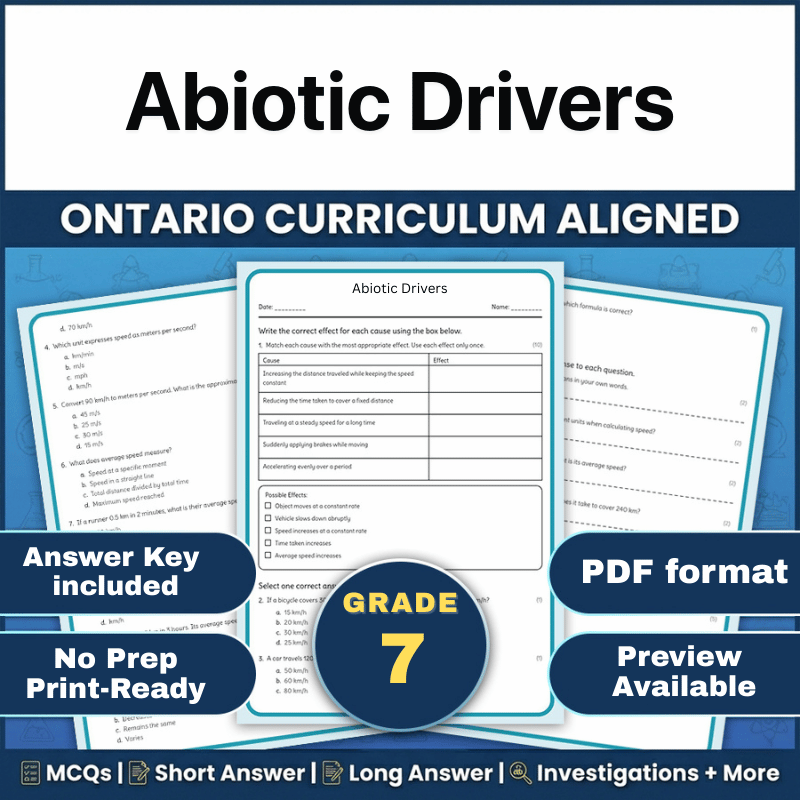
Grade 7 Science | Abiotic Drivers Worksheet (Ontario) (PDF)
Created byBright Mind ResourcesLearning Objectives
- Describe key abiotic factors such as temperature, light, soil, moisture, and pH that influence ecosystems.
- Explain how abiotic conditions create environmental templates for communities and affect resource distribution.
- Identify microhabitats within different ecosystems where abiotic variability impacts organisms.
Instant download
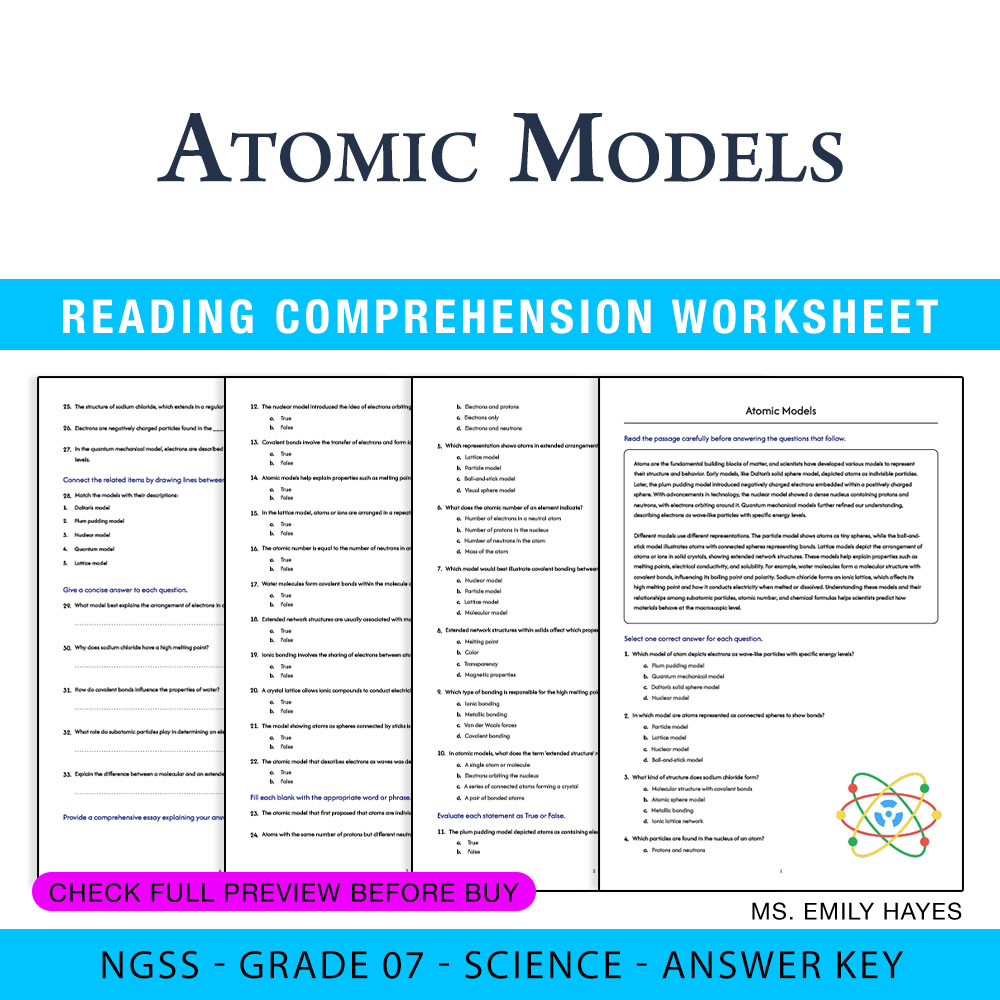
Grade 7 Science | Atomic Models Worksheet (PDF +Answer Key)
 Created byCopper Leaf Classroom
Learning Objectives
- Understand different models of atoms and their representations.
- Identify the relationships among subatomic particles, atomic number, and chemical formulas.
- Differentiate between molecular structures and extended network structures in materials.
Instant download

Evaluating Speaker Claims Worksheet | CCSS Grade 7 ELA Assessment
Learning Objectives
- Identify a speaker’s main claim and any sub-claims within an argument.
- Evaluate whether evidence and reasoning logically connect to the speaker’s conclusion.
- Recognize when emotional language or unsupported attacks replace evidence.
Instant download

Evaluating Speaker Claims Worksheet | Grade 7 ELA Practice
 Created bySunny Desk Resources
Learning Objectives
- Identify a speaker’s main claim and supporting details in a text or speech
- Evaluate whether the evidence and reasoning logically support (or fail to support) the claim
- Respond to claims by addressing misunderstandings and using respectful, evidence-based language
Also included in: Grade 7 Speaking & Listening: Presenting, Claims & Collaboration Lesson Bundle | CCSS ELA +1 more
Instant download

Grade 7 Atomic Models Worksheet | NGSS Practice PDF
Created byClear Sky ClassroomLearning Objectives
- Understand different representations of atomic structures such as particle, ball-and-stick, and lattice models.
- Identify how atomic models illustrate molecular and extended structures like water molecules and salt crystals.
- Connect subatomic particle relationships to atomic number and chemical formulas.
Also included in: Grade 7 Matter and Its Interactions Science Lesson Bundle NGSS Worksheets +1 more
Instant download
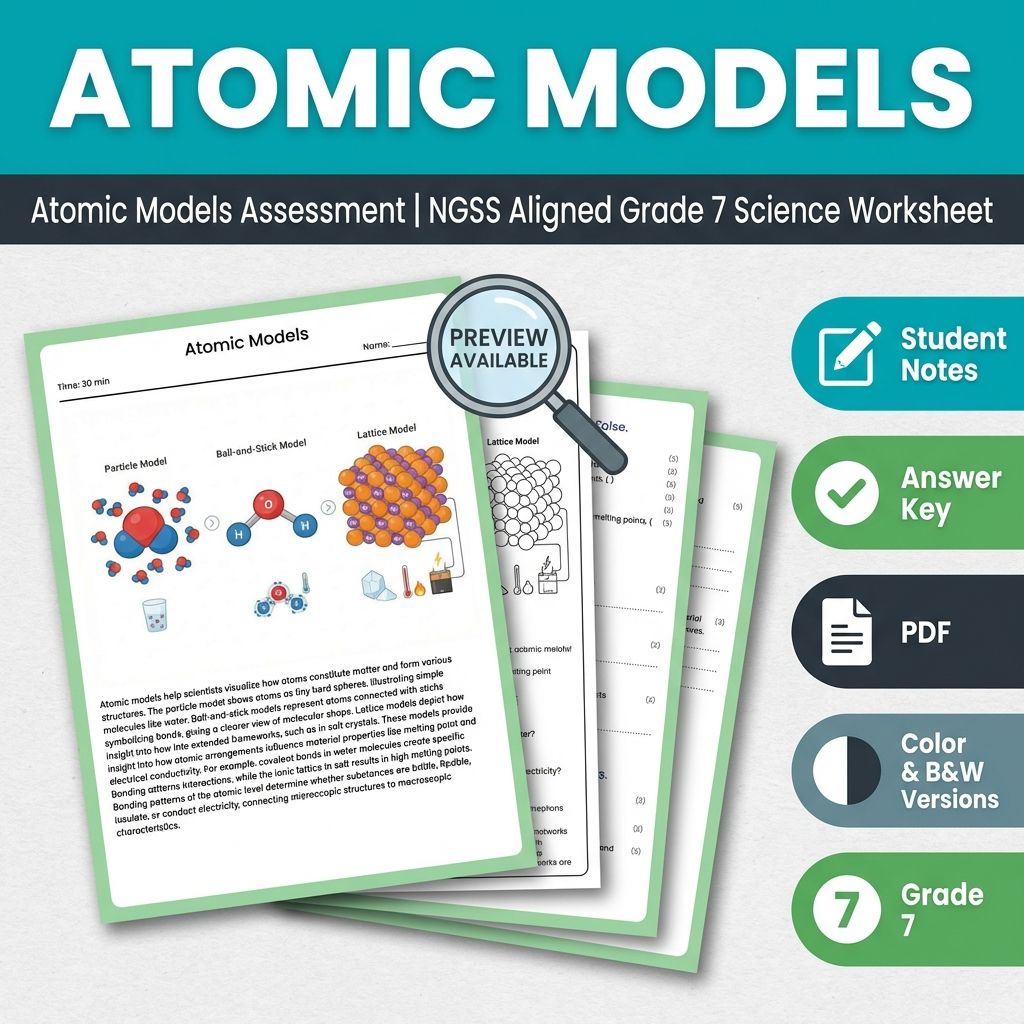
Atomic Models Assessment | NGSS Aligned Grade 7 Science Worksheet
Created byPrism Point LearningLearning Objectives
- Understand different atomic model representations such as particle, ball-and-stick, and lattice models.
- Identify how atoms form molecules and extended structures through bonding patterns.
- Explain the relationship between subatomic particles, atomic number, and material properties.
Also included in: Grade 7 Science Lesson | Matter and Its Interactions Standards +1 more
Instant download

Population Change Worksheet | TEKS Grade 7 Science Assessment PDF
Learning Objectives
- Explain how birth, death, immigration, and emigration influence population size and distribution
- Differentiate exponential growth from logistic growth using carrying capacity and limiting factors
- Describe how predators and prey can influence each other through oscillating population patterns
Instant download

Grade 7 Science – Quantitative Heat Concepts Worksheet | Ontario Standards
Created byBright Mind ResourcesLearning Objectives
- Understand the difference between heat and temperature.
- Learn about specific heat capacity and heat transfer.
- Practice basic heat calculations using Q=mcΔT.
Also included in: Heat Transfer Grade 7 Science Daily Reading Worksheets Lesson Bundle | Ontario +1 more
Instant download

Grade 7 Choosing Best Solution Worksheet | NGSS Practice PDF
Created byClear Sky ClassroomLearning Objectives
- Compare design alternatives using clear criteria and constraints to select the best solution.
- Explain how iterative refinement changes a design when test results do not meet constraints.
- Justify a final choice by linking criteria to observed outcomes and describing managed tradeoffs.
Instant download

Grade 7 Atomic Models Worksheet | NGSS Physical Science Activity
 Created byBRIGHT PATH RESOURCES
Learning Objectives
- Understand key concepts related to Science
- Apply knowledge through practice questions
- Demonstrate comprehension of the material
Also included in: Chemical Reactions Grade 7 Science Daily Reading Worksheets Lesson Bundle | NGSS +2 more
Instant download

Grade 7 Science – Conservation of Mass Worksheet for Mastery
 Created byThe Resource Hub
Learning Objectives
- Explain the principle of the conservation of mass in closed systems during physical and chemical processes.
- Apply mass accounting techniques to reactions and dissolution processes to relate reactant and product masses.
- Balance simple chemical formulas and use sealed-system measurements to reconcile observed mass distributions with stoichiometric calculations.
Also included in: Grade 7 Science Unit Bundle – States, Reactions & Atomic Structure Worksheets +1 more
Instant download

Grade 7 Atomic Models Worksheet NGSS Matter Structure Activity Answer Key
 Created byNorthstar Worksheets
Learning Objectives
- Explain how atomic number relates to the number of protons and electrons in common cases.
- Compare particle, ball-and-stick, and lattice representations of atoms in molecules and extended structures.
- Use chemical formula notation to describe how bonding patterns affect properties such as melting point and conductivity.
Also included in: Grade 7 Physical Science: Matter & Chemical Reactions Lesson Bundle | NGSS +1 more
Instant download
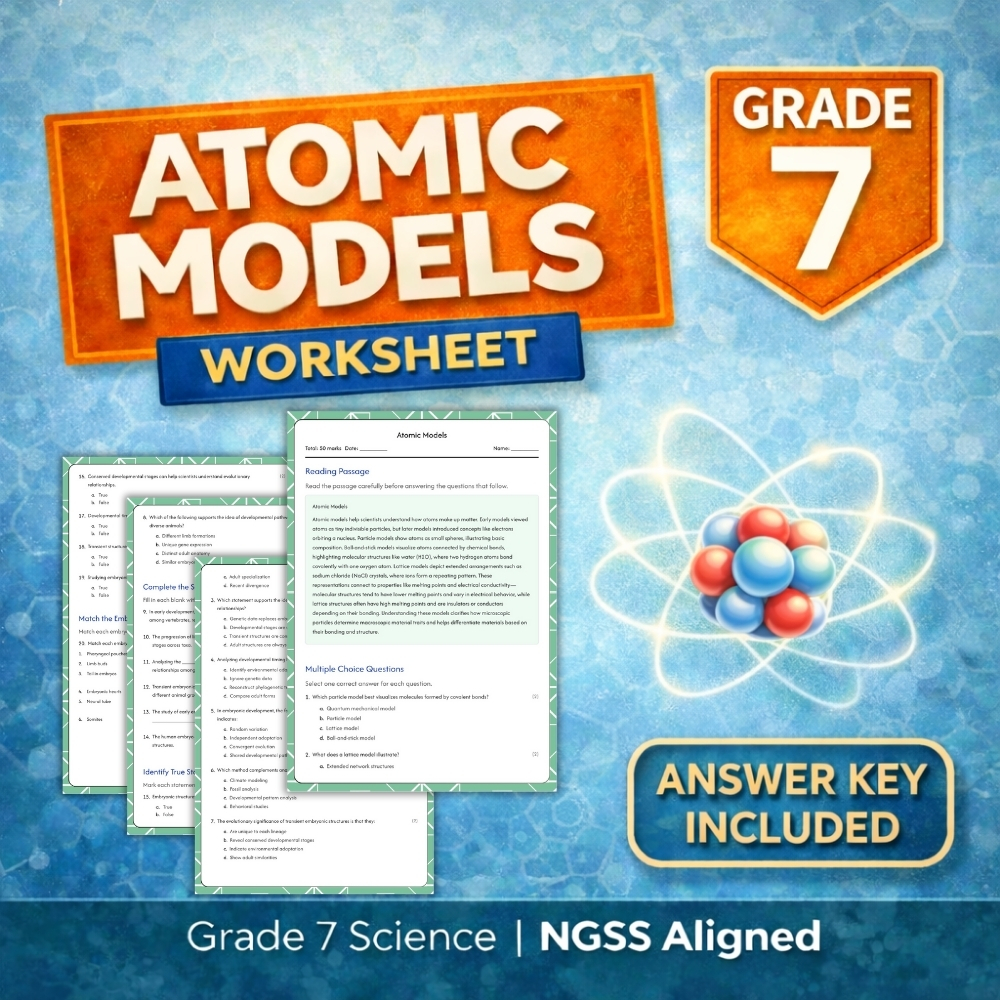
Grade 7 Science – Atomic Models (Worksheet + Answer Key) NGSS Aligned
 Created byCedar Grove Learning
Learning Objectives
- Describe different representations of atoms, including particle, ball-and-stick, and lattice models.
- Explain how atoms form molecules via covalent and ionic bonding.
- Connect subatomic particles, atomic number, and chemical formulas to the properties of materials.
Instant download

Fossil Patterns Practice Worksheet | Grade 7 Science NGSS Review
Created byPrism Point LearningLearning Objectives
- Analyze patterns in the fossil record to make inferences about ancestry and macroevolution over geologic time.
- Explain how stratigraphic sequences, index fossils, and transitional forms provide evidence for evolutionary change.
- Describe how mass extinctions and radiations can be recognized in fossil assemblages and sedimentary layers.
Also included in: Grade 7 Evolution, Natural Selection Science Lesson Bundle for NGSS
Instant download

Quantitative Heat Assessment Worksheet | Grade 7 Science Ontario
Created byPrism Point LearningLearning Objectives
- Use Q = mcΔT to estimate thermal energy needed to change temperature of a substance.
- Identify common heat and power units (joules and watts) and relate power to energy over time.
- Explain how surface area, temperature gradient, and time affect heat-transfer rate.
Instant download

Grade 7 Science – Conservation of Mass Daily Reading Worksheet | TEKS Aligned
Created byBright Mind ResourcesLearning Objectives
- Understand the law of conservation of mass as a principle in physical and chemical changes.
- Identify that mass remains constant in a closed system during transformations.
- Apply concepts of mass conservation to various laboratory scenarios.
Also included in: 7th Grade States of Matter Science Daily Reading Lesson Bundle | TEKS +2 more
Instant download
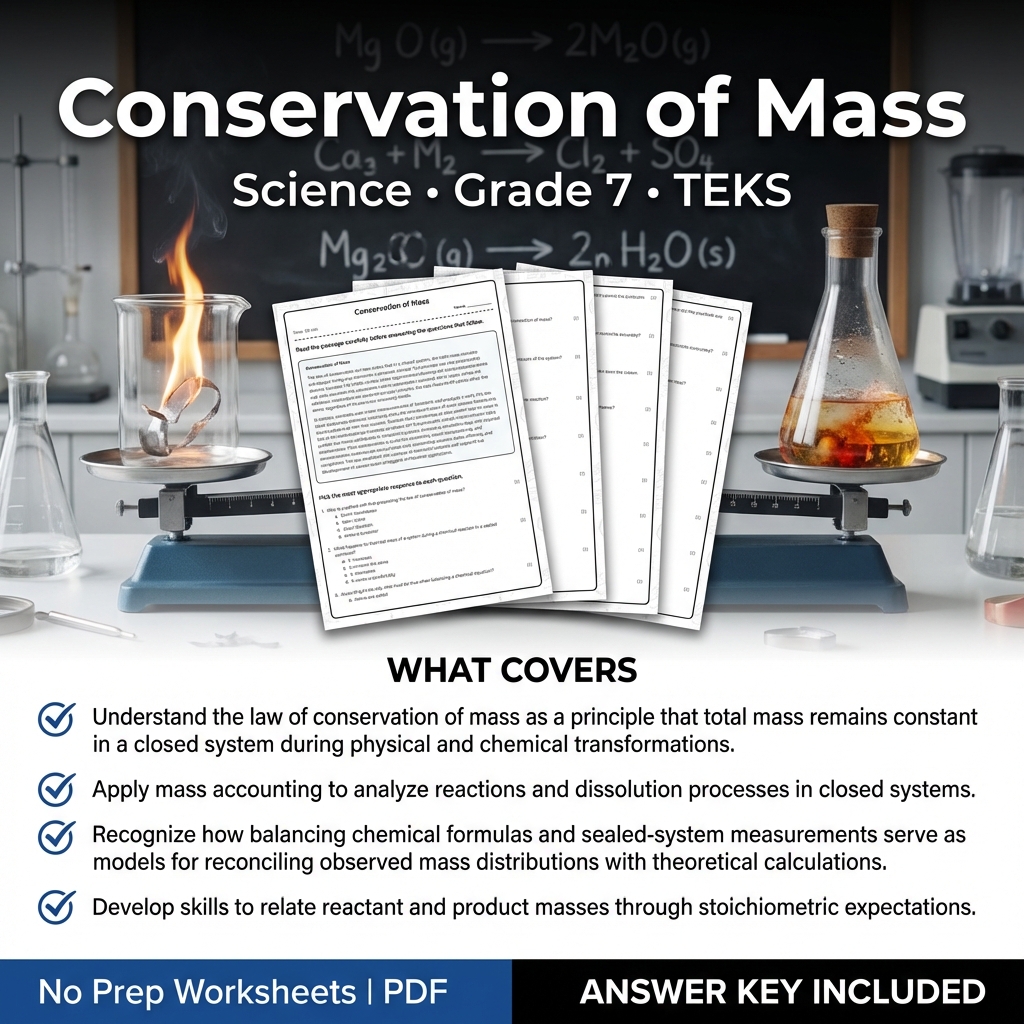
Grade 7 Science Worksheet on Conservation of Mass | TEKS Aligned
 Created byCoral Reef Learning
Learning Objectives
- Understand the law of conservation of mass as a principle that total mass remains constant in a closed system during physical and chemical transformations.
- Apply mass accounting to analyze reactions and dissolution processes in closed systems.
- Recognize how balancing chemical formulas and sealed-system measurements serve as models for reconciling observed mass distributions with theoretical calculations.
Instant download

Atomic Models Worksheet | NGSS-Aligned Grade 7 Science Practice PDF
Learning Objectives
- Understand different types of atomic models and their representations.
- Identify the relationship between subatomic particles, atomic number, and chemical formulas.
- Distinguish between molecular structures and extended network structures based on bonding patterns.
Also included in: Grade 7 Structure and Properties of Matter Science Lesson Bundle: NGSS +1 more
Instant download

Grade 7 Science Worksheet | Conservation of Mass TEKS (PDF)
 Created byEvergreen Desk Education
Learning Objectives
- State the law of conservation of mass for a closed system during physical and chemical changes.
- Use mass accounting to relate reactant mass and product mass in sealed reactions and dissolution processes.
- Balance simple formulas or mass expectations to reconcile observed mass distributions with stoichiometric relationships.
Instant download
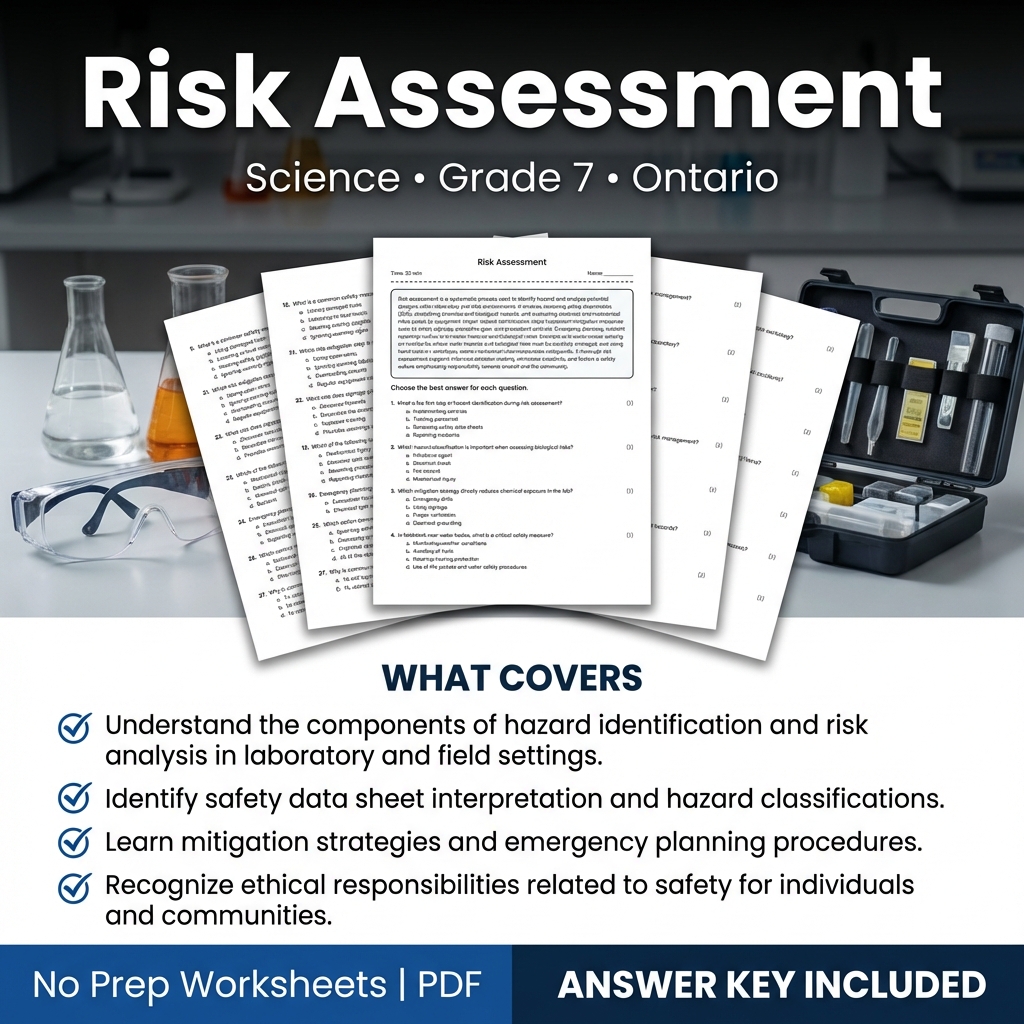
Risk Assessment Worksheet for Grade 7 Science | Ontario Standards
Created byCoral Reef LearningLearning Objectives
- Understand the components of hazard identification and risk analysis in laboratory and field settings.
- Identify safety data sheet interpretation and hazard classifications.
- Learn mitigation strategies and emergency planning procedures.
Instant download

Grade 7 Science | Photosynthesis Capture Worksheet | California Standards
 Created byLumora Learning
Learning Objectives
- Explain how producers convert light energy into chemical energy during photosynthesis
- Describe how carbon dioxide and water are used to build sugars and store energy in biomass
- Connect photosynthesis to the flow of matter and the availability of energy through food chains
Instant download

Grade 7 Population Change Science Daily Reading Worksheet | TEKS Activity
Created byBRIGHT PATH RESOURCESLearning Objectives
- Identify main ideas about why populations change over time.
- Use key vocabulary: birth rate, death rate, immigration, emigration, carrying capacity, and limiting factors.
- Explain how birth and death and movement into and out of a habitat affect population size.
Also included in: Grade 7 Ecosystems Science Daily Reading Worksheets Bundle | TEKS +1 more
Instant download

Grade 7 Science | Population Change Worksheet (TEKS) PDF
Created byEvergreen Desk EducationLearning Objectives
- Explain how births, deaths, immigration, and emigration change population size and distribution
- Describe carrying capacity and limiting factors and how they affect population growth
- Compare exponential and logistic growth patterns using real population examples
Instant download

Grade 7 Science – Matter Cycling & Ecosystems | Daily Reading Worksheet
Created byBright Mind ResourcesLearning Objectives
- Understand how matter such as carbon and nitrogen move through ecosystems
- Identify pathways like photosynthesis, respiration, decomposition, and nutrient transport
- Explain the role of decomposers in nutrient recycling
Also included in: Grade 7 Energy Transfer Science Daily Reading: Lesson Bundle | California Std. +1 more
Instant download

Population Change Worksheet | Grade 7 Science Activities
Created byPrism Point LearningLearning Objectives
- Explain how birth and death rates and migration affect population size and distribution
- Compare exponential and logistic growth patterns using carrying capacity and limiting factors
- Describe how resources, disease, and competition influence population dynamics and species interactions
Also included in: Ecosystems & Adaptations Grade 7 Science Lesson Bundle TEKS Worksheets
Instant download

Matter Cycling Assessment for Grade 7 Science | California Standards
Created byPrism Point LearningLearning Objectives
- Explain how matter (atoms of elements like carbon and nitrogen) cycles through ecosystems between living and nonliving components.
- Describe major pathways for matter cycling, including photosynthesis, respiration, feeding, decomposition, and transport in soil and water.
- Differentiate energy flow from matter cycling by recognizing that energy moves mainly one direction from the Sun.
Also included in: Grade 7 Energy Flow and Matter Cycling Science lesson bundle – California Standards +1 more
Instant download

Grade 7 Science | Matter Cycling Worksheet | California Standards
Created byLumora LearningLearning Objectives
- Explain how atoms move through an ecosystem via processes like photosynthesis, feeding, respiration, and decomposition.
- Describe how decomposers return nutrients to soil and water and how this supports new plant growth.
- Distinguish matter cycling from energy flow in ecosystems, emphasizing that energy moves one direction from the Sun.
Instant download

Population Change Assessment for Grade 7 Science | TEKS Standards
Created byPrism Point LearningLearning Objectives
- Understand the factors that influence population size and distribution.
- Explain the concepts of exponential and logistic growth patterns.
- Analyze how predator-prey interactions affect population dynamics.
Instant download
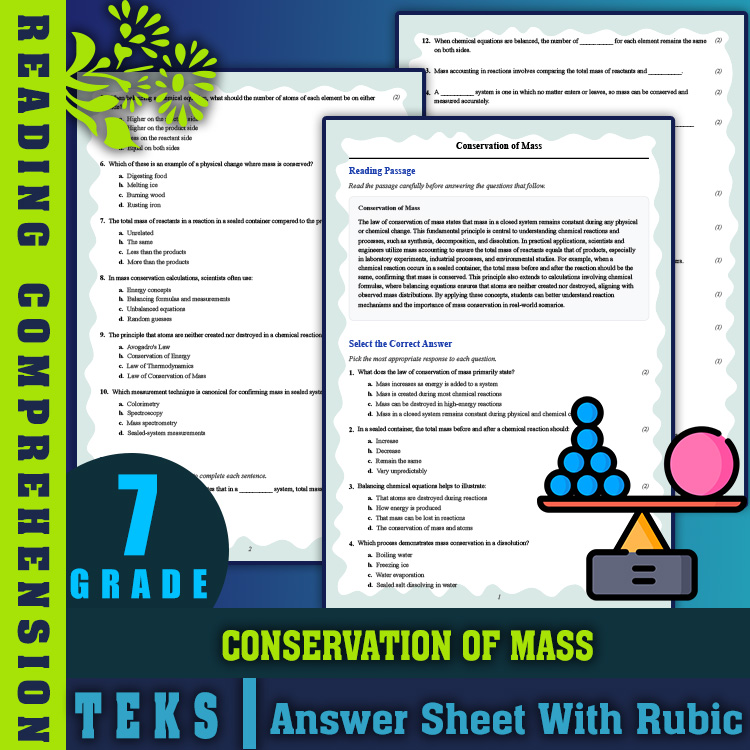
7th Grade Science | Conservation of Mass Reading Worksheet & Answer Key (PDF)
Learning Objectives
- Understand the law of conservation of mass and its fundamental principles.
- Apply mass accounting to chemical and physical processes in closed systems.
- Recognize how balancing chemical equations relates to mass conservation.
Instant download

Matter Cycling Worksheet Grade 7 Science Activities | Ecosystems & Matter
Created byPrism Point LearningLearning Objectives
- Explain how atoms move through an ecosystem during matter cycling processes such as photosynthesis, respiration, feeding, and decomposition.
- Describe how decomposers return nutrients to soil and water so that new plants can grow.
- Distinguish matter cycling (reused atoms) from energy flow (one-way transfer with heat loss).
Also included in: Life Science - Grade 7 Bundle
Instant download
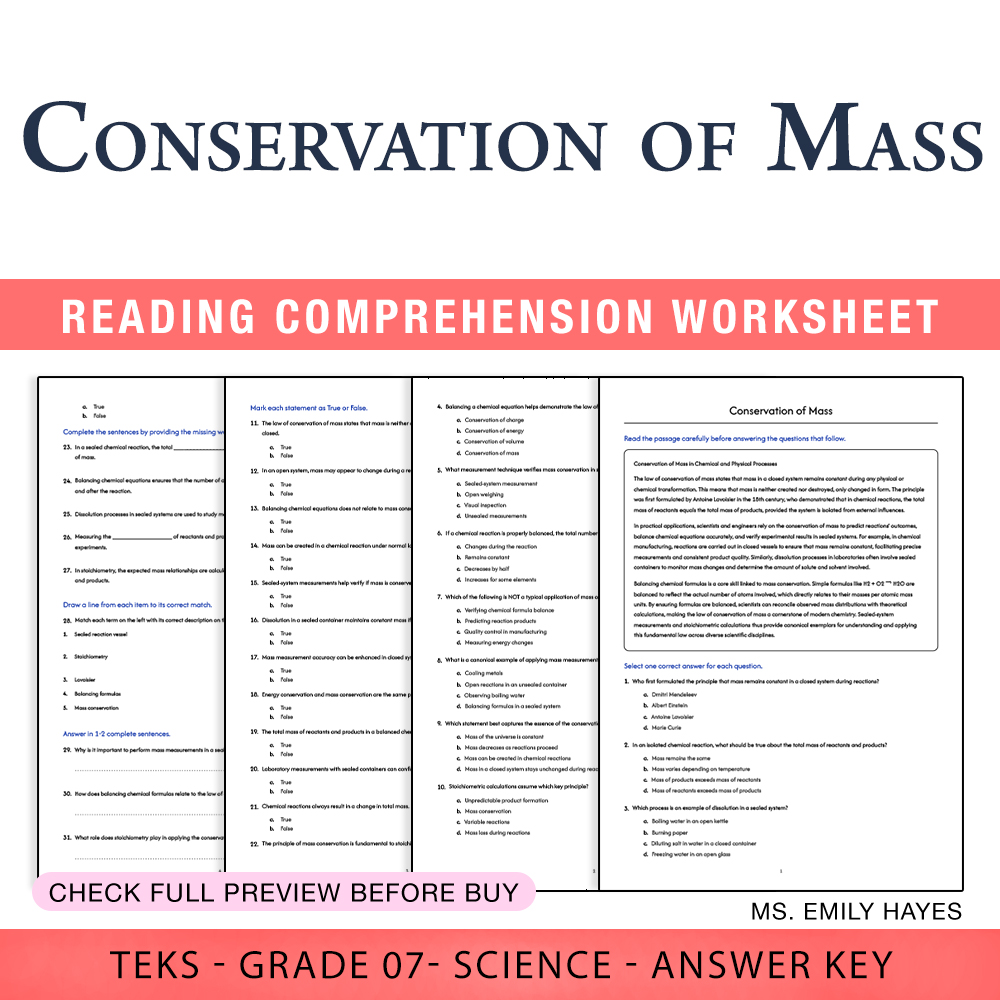
7th Grade Science | Conservation of Mass Worksheet (PDF + Answer Key)
Created byCopper Leaf ClassroomLearning Objectives
- Understand the law of conservation of mass as a fundamental principle in physical and chemical changes.
- Apply mass accounting techniques to closed reactions and dissolution processes.
- Balance simple chemical formulas to relate reactant and product mass.
Instant download

Grade 7 Science | Matter Cycling - Daily Reading Comprehension
Created byCoral Reef LearningLearning Objectives
- Understand the stages of the water cycle
- Explain how water moves within the environment
- Identify the processes involved in water cycling such as evaporation, condensation, precipitation, and collection
Instant download

Natural Hazards Test Prep Worksheets | Grade 7 Science NGSS
Created byPrism Point LearningLearning Objectives
- Analyze and interpret hazard maps, recurrence intervals, and probabilistic forecasts to assess risk.
- Compare short-term event behavior with long-term trends in natural hazard occurrence and vulnerability.
- Explain how natural hazards can cause cascading impacts to infrastructure and ecosystems.
Also included in: Grade 7 Human Impacts & Climate Earth Science Lesson Bundle | NGSS
Instant download

Grade 7 Science | Optimization Strategies Worksheet (Ontario PDF)
Created byEvergreen Desk EducationLearning Objectives
- Explain how iterative refinement and quantitative comparison are used to improve engineering designs.
- Describe how topology and form optimization can reduce weight and cost while maintaining required strength, stiffness, and durability.
- Use performance-based criteria and safety margins to evaluate whether an optimized design meets code requirements.
Also included in: Grade 7 Engineering Design & Materials Science Lesson Bundle Ontario +1 more
Instant download

Grade 7 Fossil Patterns Worksheet NGSS Evolution Activity Answer Key
Created byNorthstar WorksheetsLearning Objectives
- Analyze patterns in the fossil record, including diversity, extinction events, and morphological change over geologic time
- Explain how stratigraphy and index fossils support correlation and inferences about ancestry
- Describe how transitional fossils provide evidence for evolutionary continuity
Also included in: Grade 7 Evolution Evidence & Patterns Lesson Bundle | NGSS Science +1 more
Instant download

Grade 7 Abiotic Drivers Worksheet | Ontario Science Practice PDF
Created byClear Sky ClassroomLearning Objectives
- Identify abiotic drivers (temperature gradients, light availability, soil composition, moisture regimes, and pH) and explain how they influence where organisms can survive.
- Describe how physical gradients create environmental templates that shape community structure.
- Explain how microhabitats within ponds, forests, and meadows differ because of abiotic variability and resources.
Instant download

Grade 7 Science – Population Change Worksheet (Answer Key) | TEKS Aligned
Created byBright Mind ResourcesLearning Objectives
- Identify factors that influence population size and distribution
- Explain patterns of exponential and logistic growth in populations
- Describe how limiting factors affect population dynamics
Also included in: Grade 7 Science Unit Bundle – Ecosystems, Adaptation & Environmental Impact +2 more
Instant download
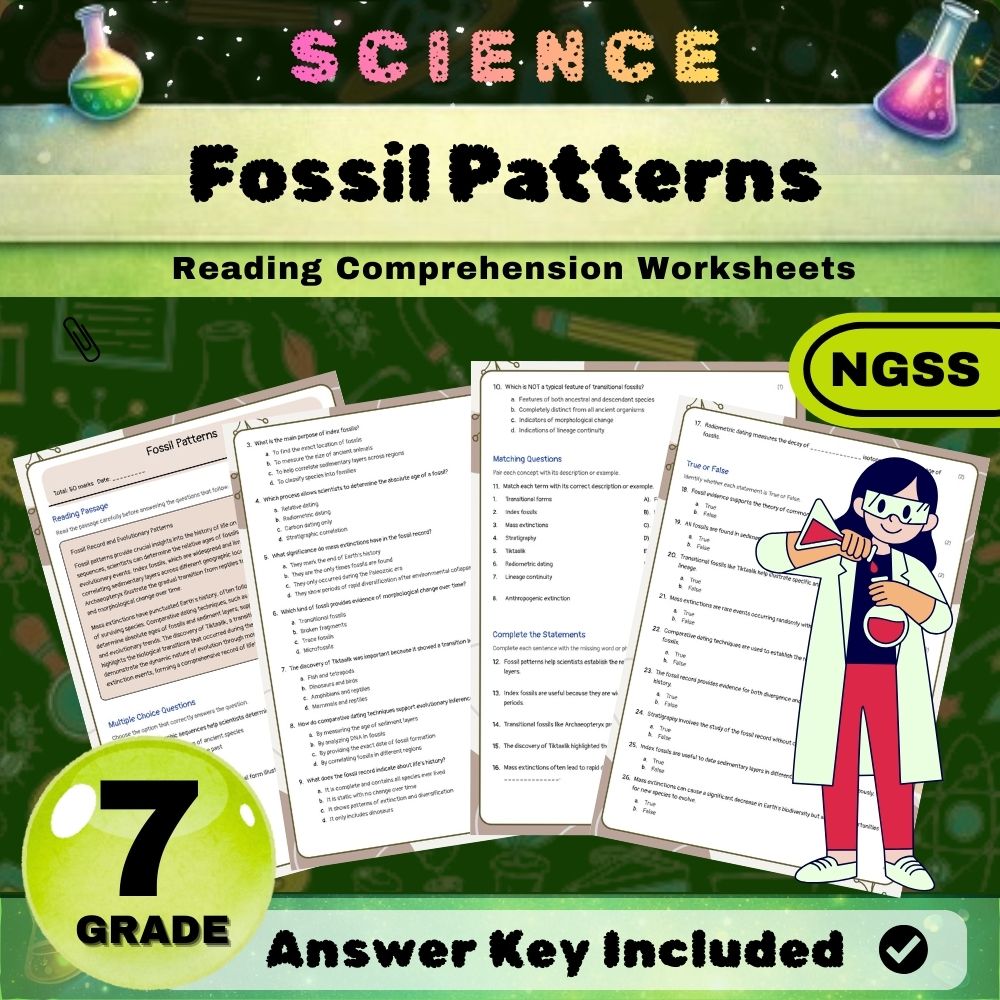
Grade 7 Science | Fossil Patterns NGSS Worksheet (PDF)
 Created byMaple Path Learning
Learning Objectives
- Understand the significance of fossil patterns in revealing evolutionary history.
- Identify key concepts such as stratigraphy, index fossils, transitional forms, and macroevolutionary trends.
- Analyze fossil evidence to infer common ancestry and extinction events.
Also included in: Grade 7 Science | Evolution & Adaptation NGSS Worksheet Bundle +1 more
Instant download

Grade 7 Science | Genotype and Phenotype Worksheet | Florida NGSSS Aligned
Created byLumora LearningLearning Objectives
- Explain the difference between genotype and phenotype in terms of genes and observable traits
- Use dominant and recessive allele ideas to predict how genotype can affect phenotype
- Describe how environmental factors can influence phenotype even when genotype is known
Instant download

Grade 7 Science Matter Cycling Worksheet | California Standards PDF
Created byEvergreen Desk EducationLearning Objectives
- Explain how matter (atoms) cycles through an ecosystem using processes such as photosynthesis, respiration, feeding, decomposition, and soil/water transport
- Distinguish matter cycling (reused atoms) from energy flow (one-direction from the Sun with heat dispersing)
- Trace how carbon and nitrogen move among plants, animals, decomposers, and the environment
Instant download

Grade 7 Photosynthesis Capture Worksheet | California Standards Practice PDF
Created byClear Sky ClassroomLearning Objectives
- Explain how producers use light, carbon dioxide, and water to make sugars through photosynthesis.
- Describe how photosynthesis transfers matter (atoms) and energy through trophic levels.
- Interpret statements about photosynthesis using accurate scientific terminology.
Instant download

Grade 7 Science Risk Assessment Worksheet | Ontario Curriculum
 Created byChalk and Compass
Learning Objectives
- Explain the difference between a hazard and a risk during laboratory or field activities.
- Describe how to use an SDS to identify hazards and select appropriate controls.
- Evaluate potential hazards by considering likelihood and severity and choosing mitigation strategies.
Also included in: Grade 7 Science Scientific Inquiry & Data Analysis Lesson Bundle | Ontario +1 more
Instant download
Browse more categories
About Grade 7 Worksheets
Find Grade 7 worksheets covering math, ELA, science, and social studies. All 8,664 resources download instantly as PDFs for classwork, homework, or review.
MyTeachingSheets worksheets are made by real teacher-authors and checked before they go live. Download any as a print-ready PDF for lessons, homework, or independent practice — most include answer keys, and previews are always free.