
Grade 7 Worksheets
8,664 grade resources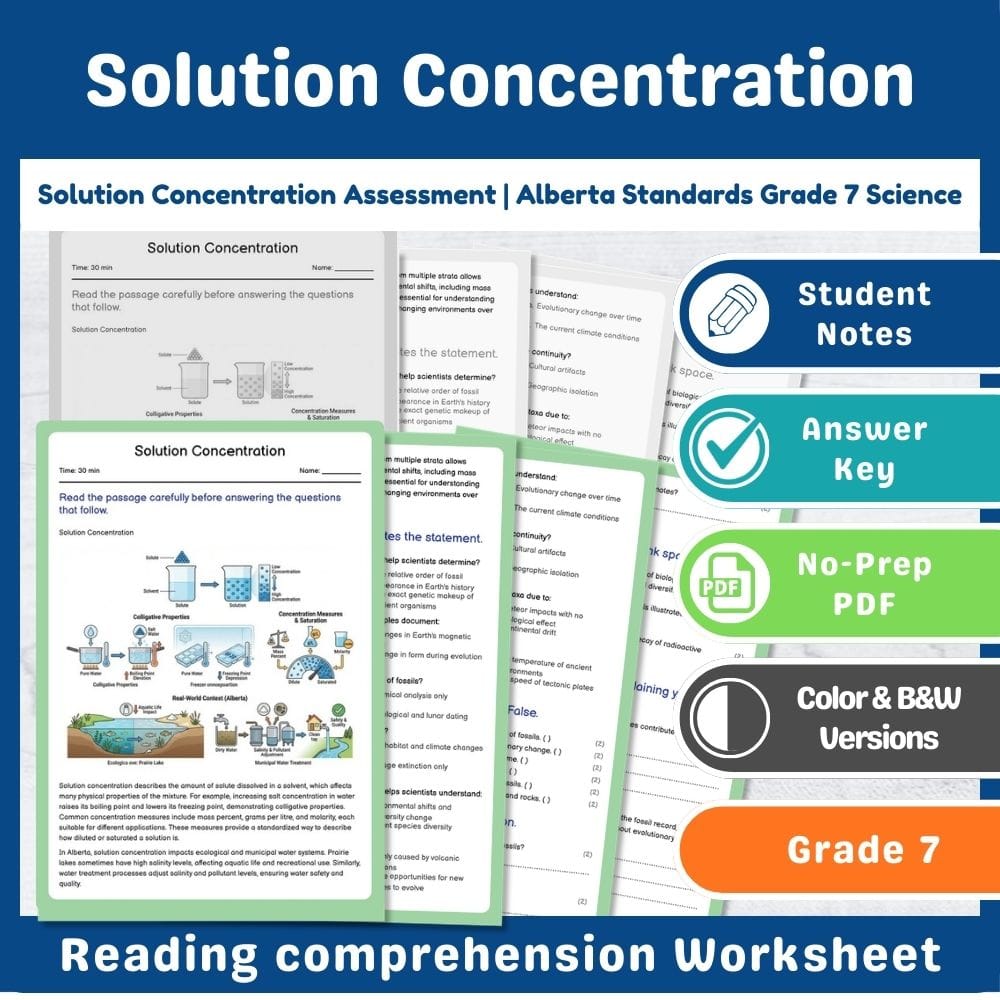
Solution Concentration Assessment | Alberta Standards Grade 7 Science
 Created byPrism Point Learning
Learning Objectives
- Understand how solution concentration quantifies the amount of solute relative to solvent.
- Recognize common measures of concentration such as mass percent and grams per litre.
- Explain the effects of concentration on physical properties like boiling point and freezing point.
Also included in: Lesson Grade 7 Science Mini Bundle | Matter and Chemical Change +1 more
Instant download
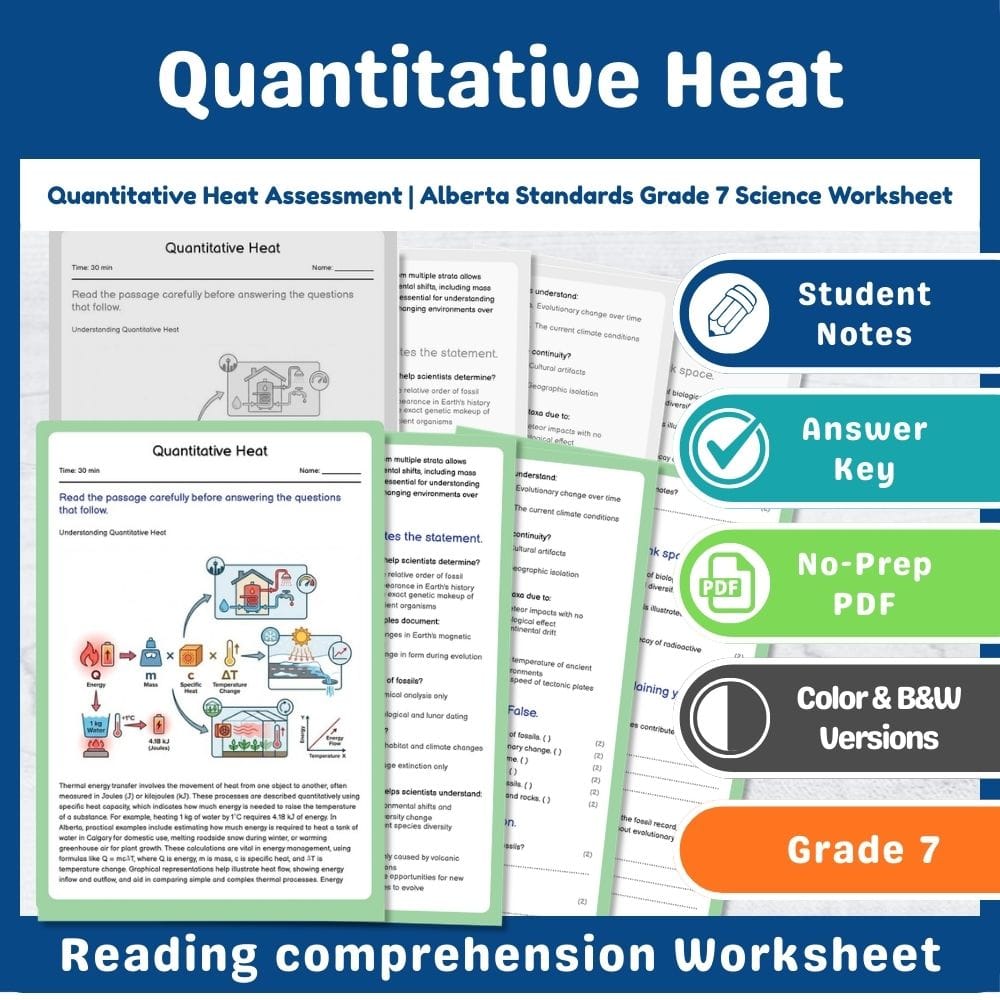
Quantitative Heat Assessment | Alberta Standards Grade 7 Science Worksheet
Created byPrism Point LearningLearning Objectives
- Understand how to quantify energy transfer in thermal processes using numerical representations.
- Apply calculations involving specific heat, mass, and temperature change to solve energy transfer problems.
- Interpret practical examples of heat transfer in real-world contexts such as heating water, melting snow, and warming air.
Also included in: Lesson Grade 7 Science Mini Bundle | Energy, Heat & Thermal Processes +1 more
Instant download
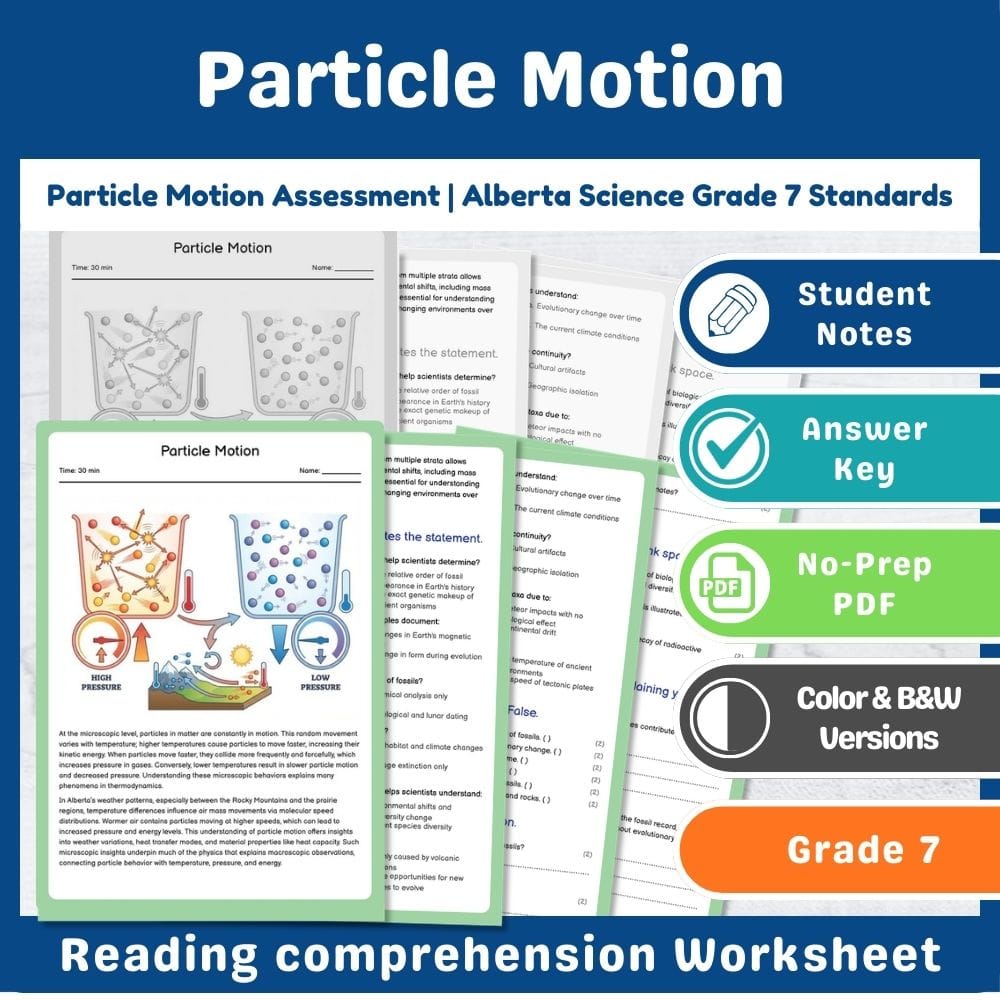
Particle Motion Assessment | Alberta Science Grade 7 Standards
Created byPrism Point LearningLearning Objectives
- Understand how microscopic particle motion relates to temperature, thermal energy, and pressure.
- Explain how molecular speed distributions vary with temperature and phase.
- Apply kinetic theory concepts to interpret temperature differences in different environments.
Also included in: Lesson Grade 7 Science Mini Bundle | Energy, Heat & Thermal Processes +1 more
Instant download
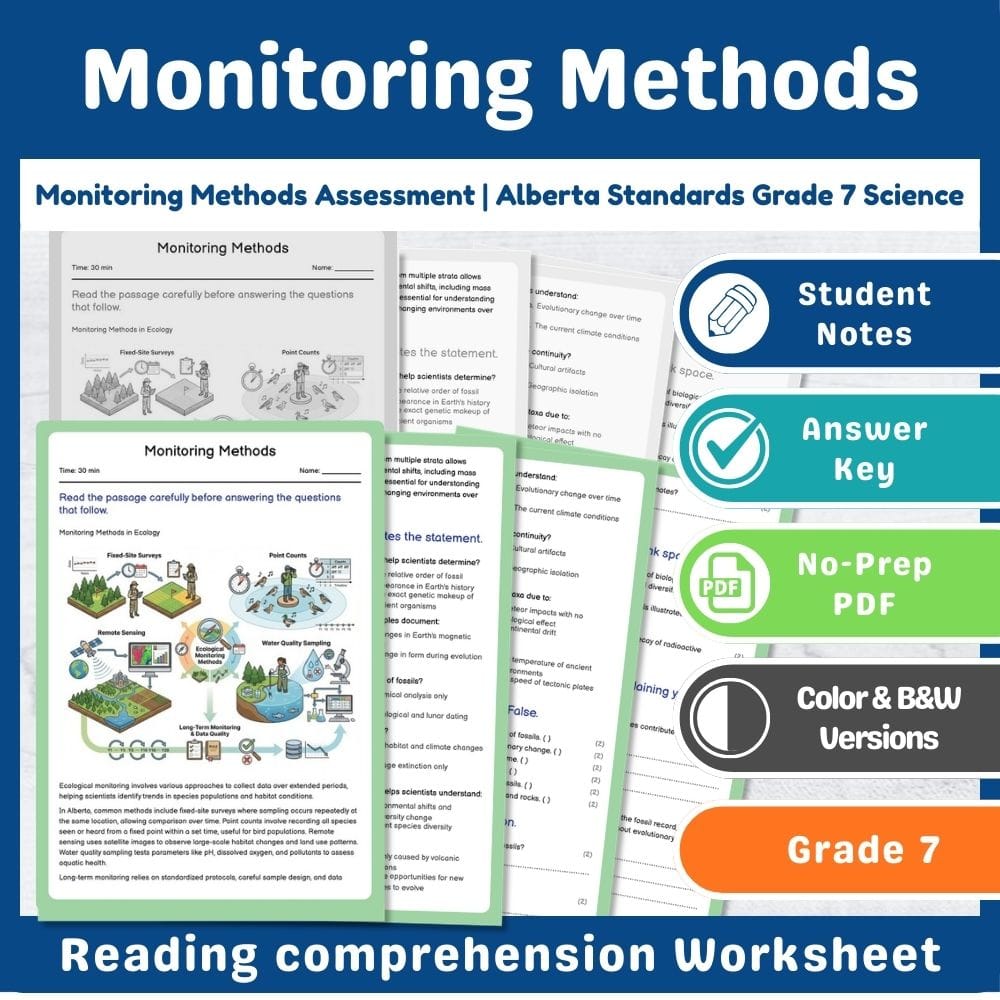
Monitoring Methods Assessment | Alberta Standards Grade 7 Science
Created byPrism Point LearningLearning Objectives
- Understand different methods used in ecological monitoring.
- Identify the importance of data consistency and data quality in long-term studies.
- Describe various sampling techniques such as fixed-site surveys, point counts, remote sensing, and water quality sampling.
Also included in: Lesson Bundle Grade 7 Science - Interactions and Ecosystems +1 more
Instant download
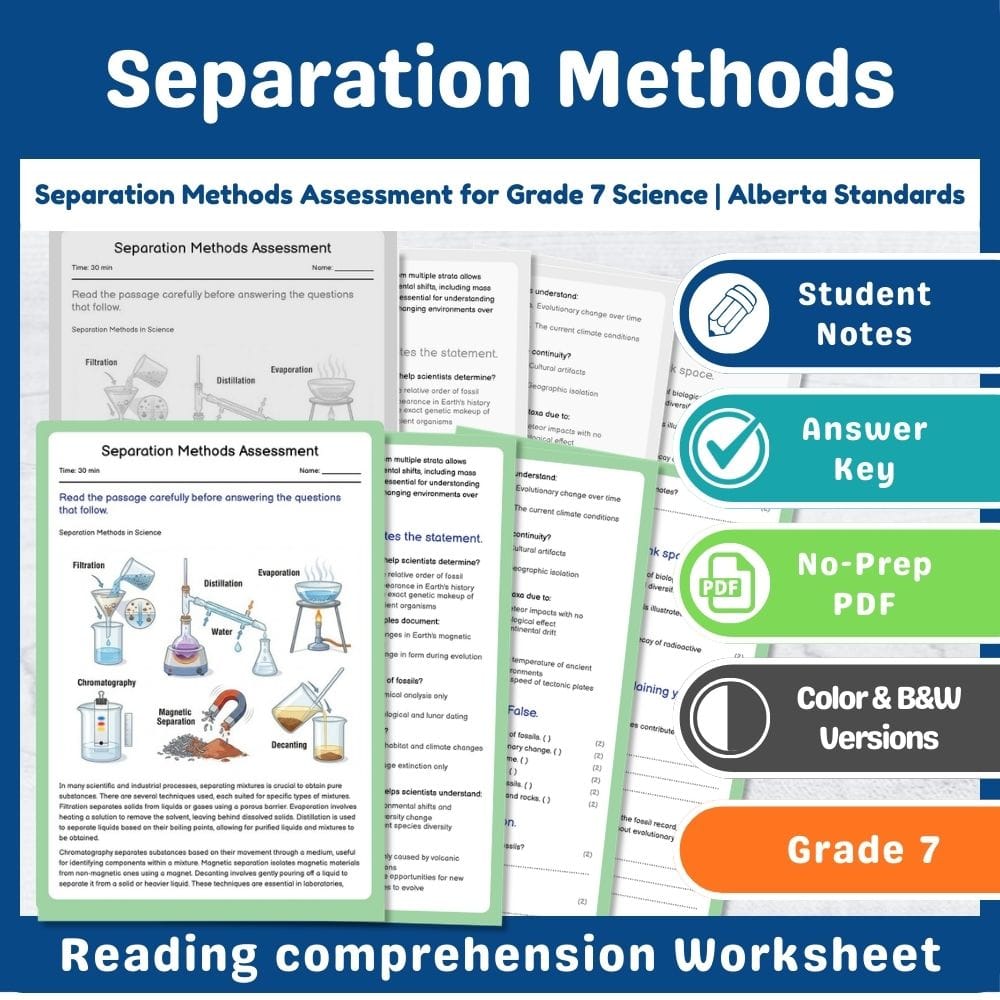
Separation Methods Assessment for Grade 7 Science | Alberta Standards
Created byPrism Point LearningLearning Objectives
- Understand the various separation techniques used in science.
- Identify the appropriate separation method for different mixtures.
- Explain the steps involved in processes such as filtration, evaporation, and distillation.
Also included in: Lesson Grade 7 Science Mini Bundle | Matter and Chemical Change +1 more
Instant download
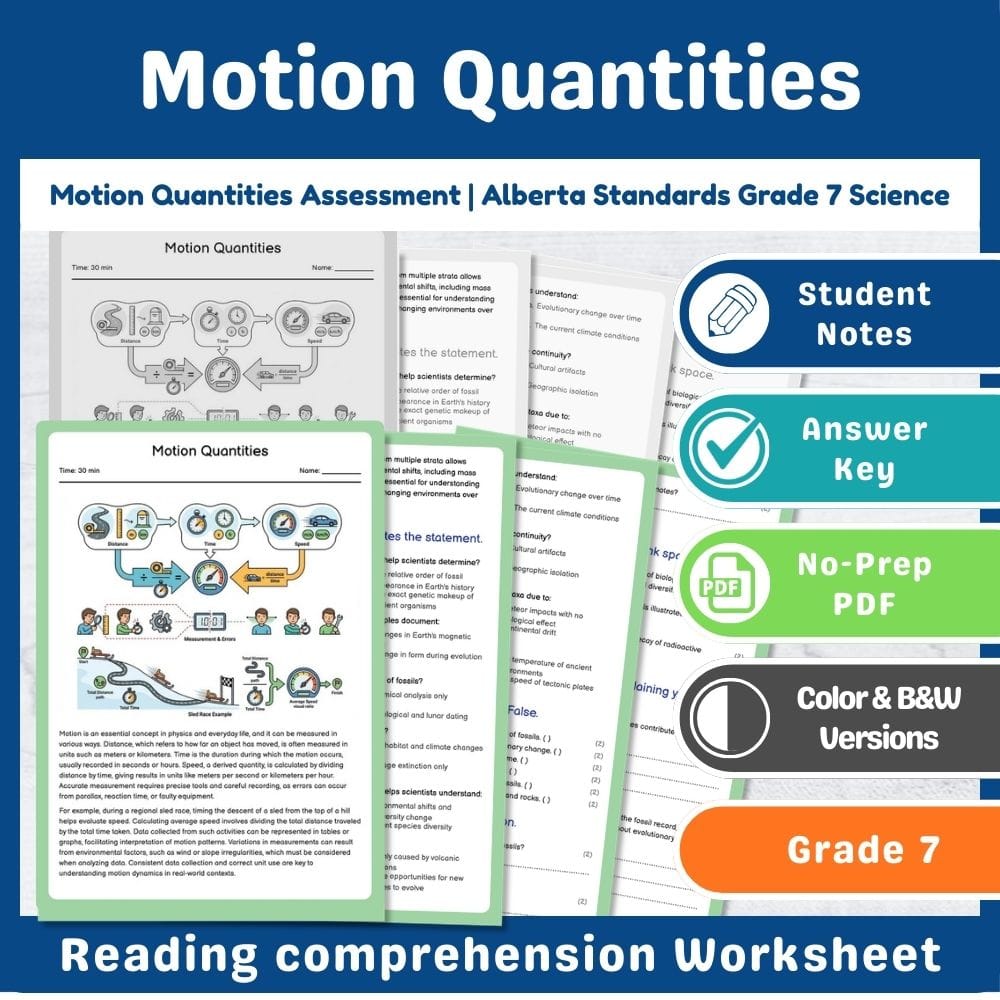
Motion Quantities Assessment | Alberta Standards Grade 7 Science
Created byPrism Point LearningLearning Objectives
- Understand the key concepts of distance, time, and speed in motion measurement.
- Calculate average speed using distance and time data accurately.
- Identify common sources of measurement error in motion data.
Also included in: Lesson Bundle Grade 7 Science Forces Structures and Motion | Alberta Standards +1 more
Instant download
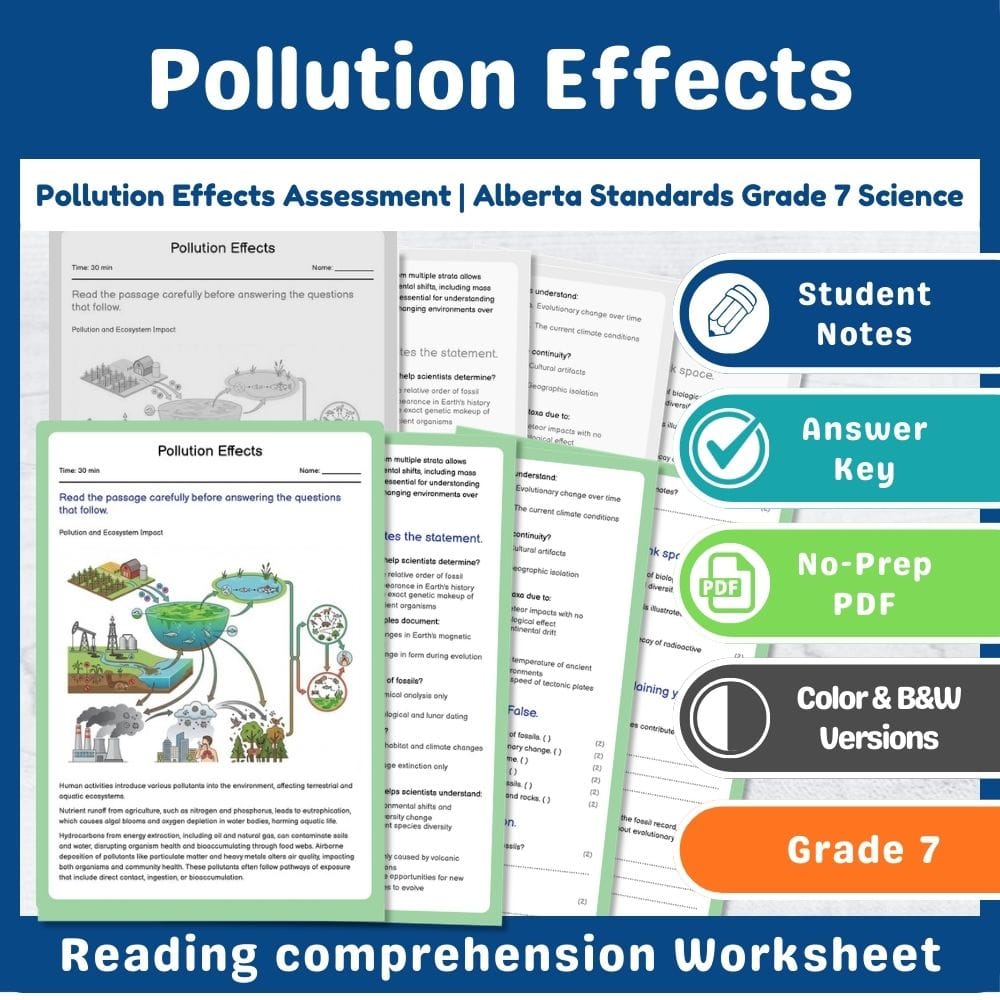
Pollution Effects Assessment | Alberta Standards Grade 7 Science
Created byPrism Point LearningLearning Objectives
- Describe basic types of pollutants affecting terrestrial and aquatic ecosystems.
- Explain how pollutants travel pathways lead to bioaccumulation and community impacts.
- Identify measurable ecological effects caused by different pollutants.
Also included in: Lesson Bundle Grade 7 Science - Interactions and Ecosystems +1 more
Instant download
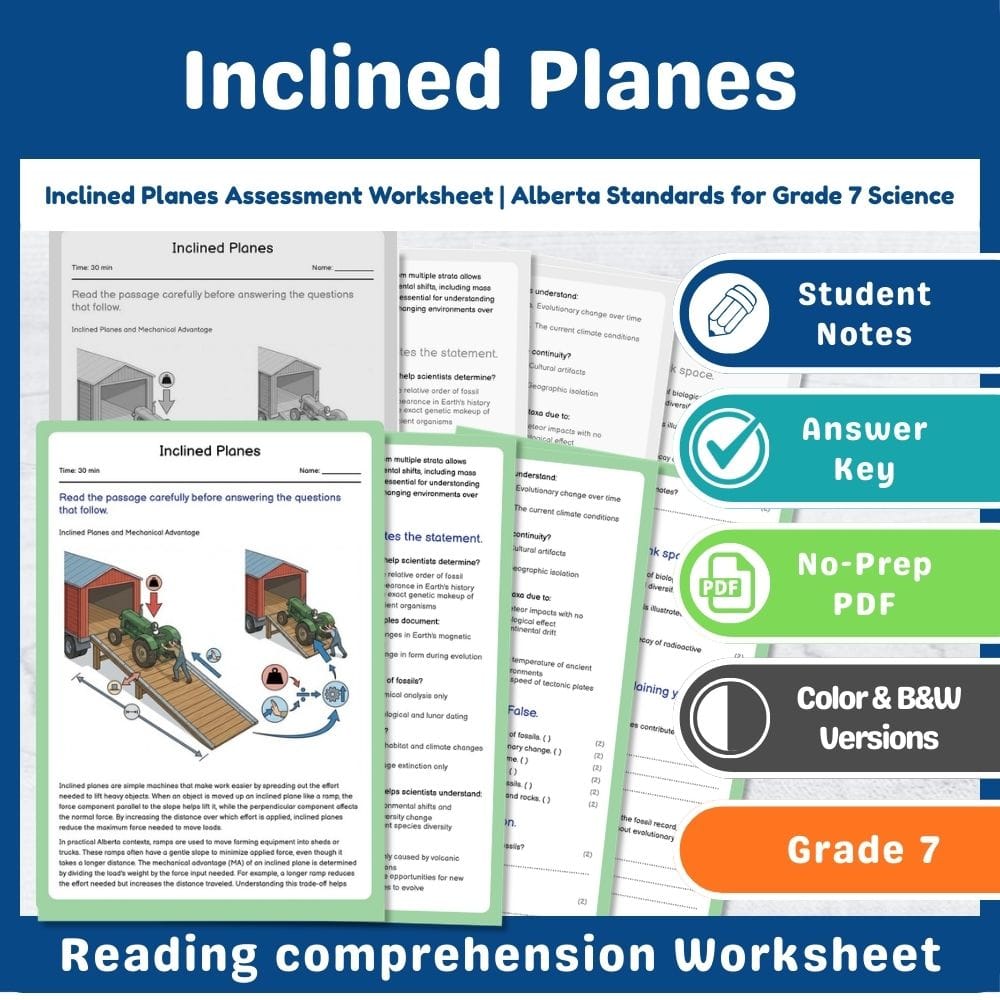
Inclined Planes Assessment Worksheet | Alberta Standards for Grade 7 Science
Created byPrism Point LearningLearning Objectives
- Understand how inclined planes reduce the force needed to move loads.
- Identify components of force parallel and perpendicular to an inclined plane.
- Calculate mechanical advantage of inclined planes based on input force and load.
Also included in: Lesson Bundle Grade 7 Science Forces Structures and Motion | Alberta Standards +1 more
Instant download
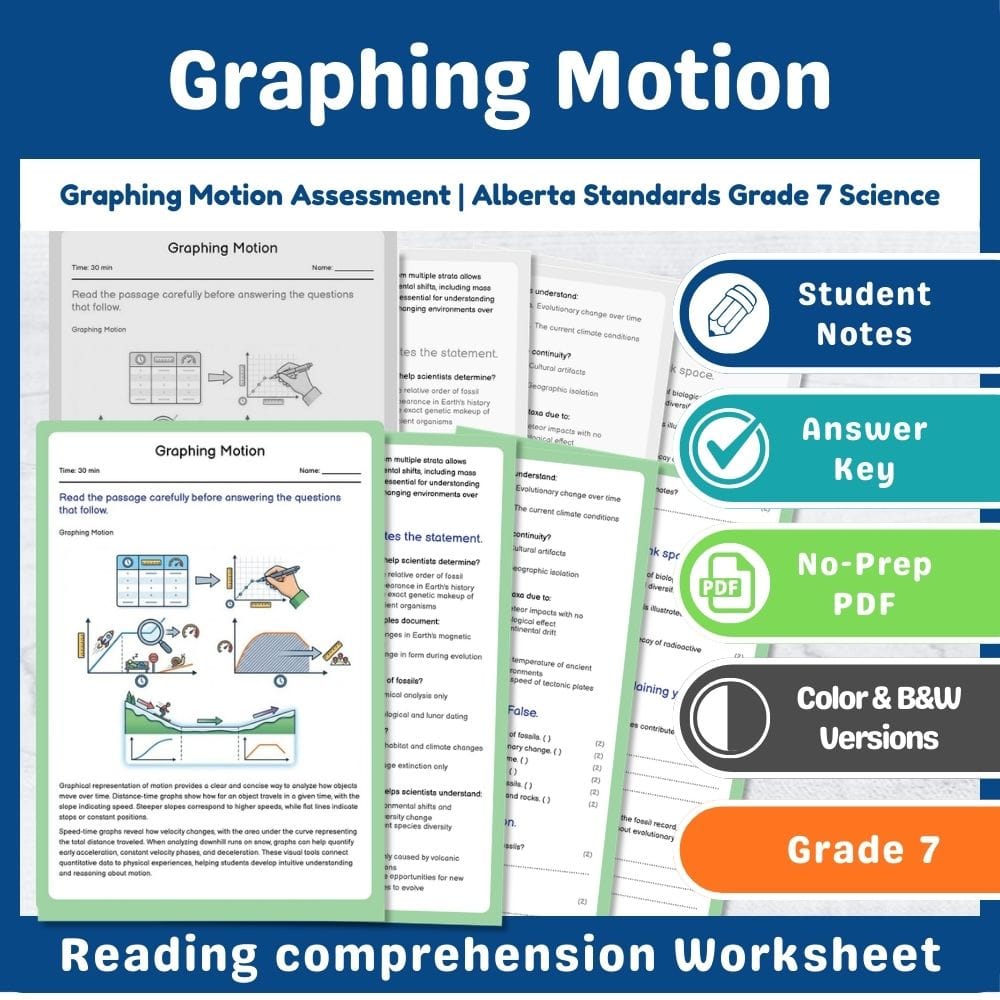
Graphing Motion Assessment | Alberta Standards Grade 7 Science
Created byPrism Point LearningLearning Objectives
- Understand how to interpret distance–time and speed–time graphs.
- Explain the significance of slope, area under curves, and rate calculations in motion graphs.
- Translate tabulated numerical data into accurate graphical representations.
Also included in: Lesson Bundle Grade 7 Science Forces Structures and Motion | Alberta Standards +1 more
Instant download
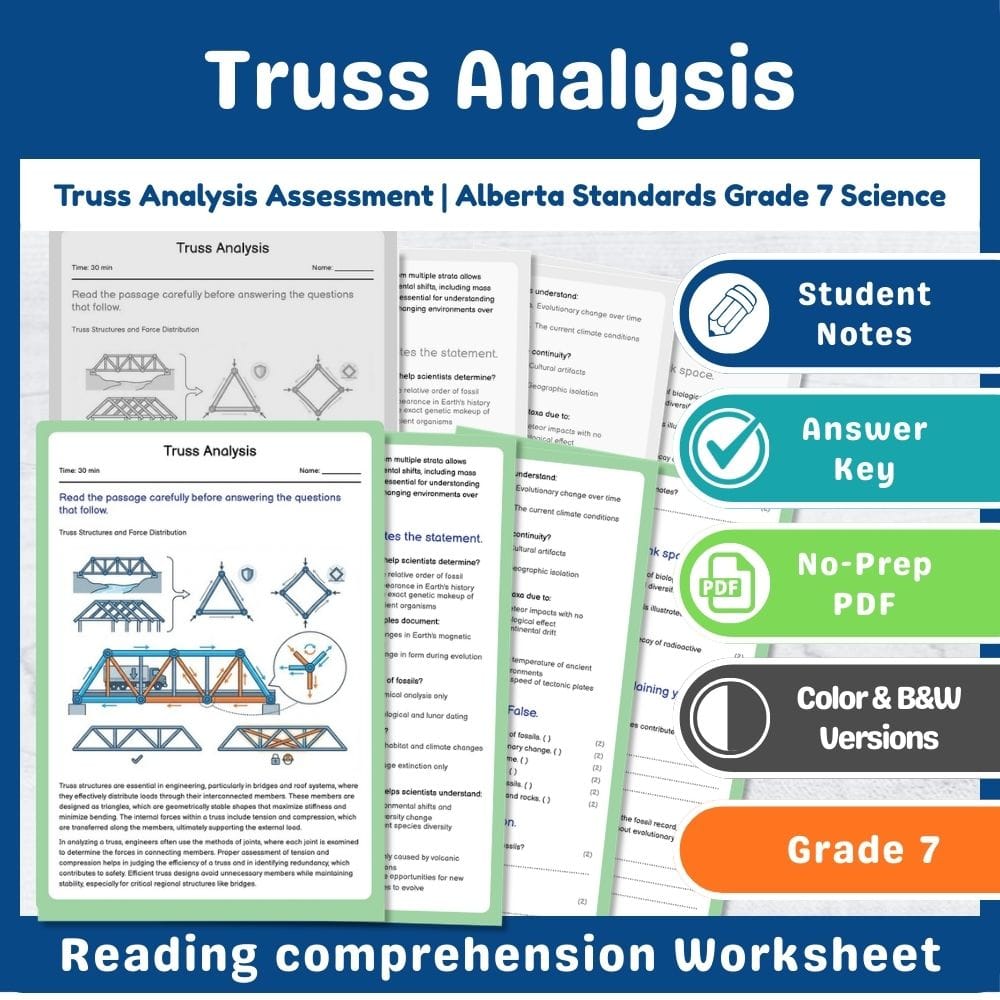
Truss Analysis Assessment | Alberta Standards Grade 7 Science
Created byPrism Point LearningLearning Objectives
- Understand the internal force distribution in truss structures.
- Analyze methods of joints to determine member tension and compression.
- Evaluate the efficiency and redundancy of various truss designs used in regional applications.
Also included in: Lesson Bundle Grade 7 Science Forces Structures and Motion | Alberta Standards +1 more
Instant download
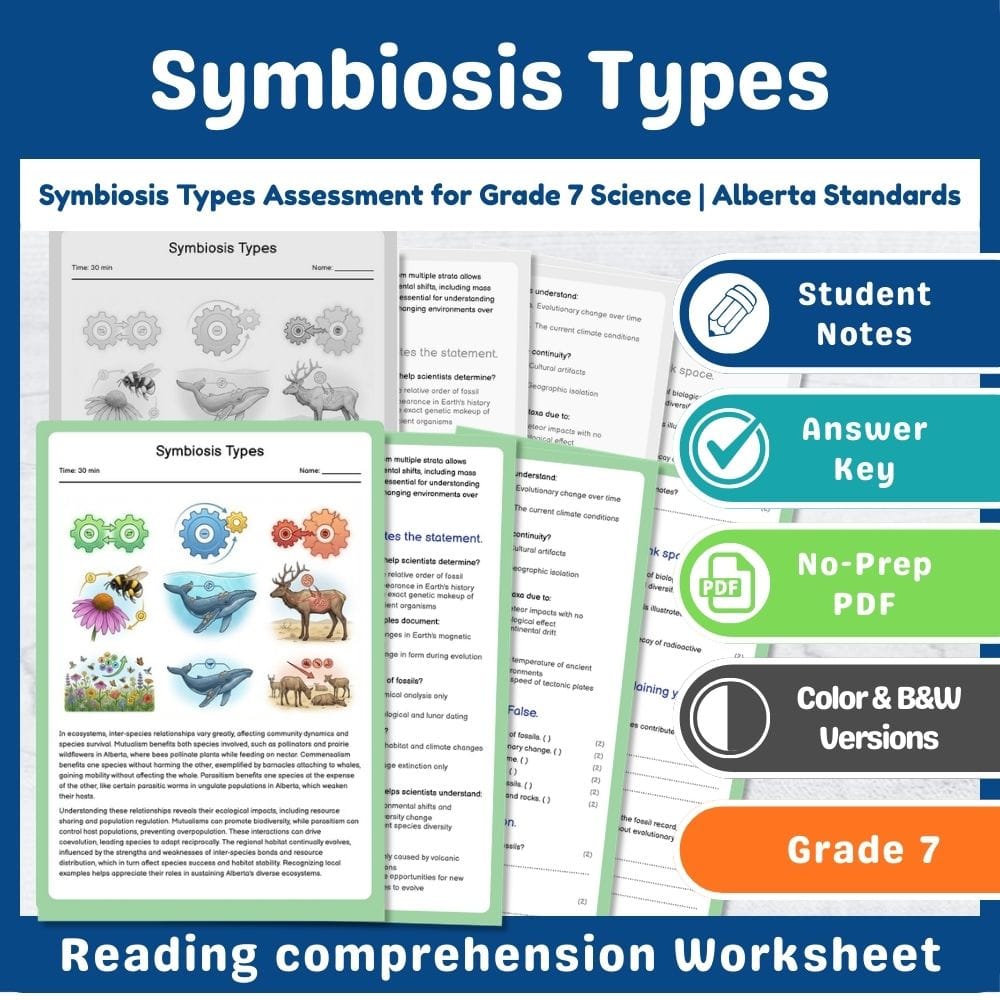
Symbiosis Types Assessment for Grade 7 Science | Alberta Standards
Created byPrism Point LearningLearning Objectives
- Define and differentiate among mutualism, commensalism, and parasitism.
- Identify Alberta-relevant examples of inter-species relationships.
- Explain ecological consequences of different symbiosis types on populations and habitats.
Also included in: Lesson Bundle Grade 7 Science - Interactions and Ecosystems +1 more
Instant download
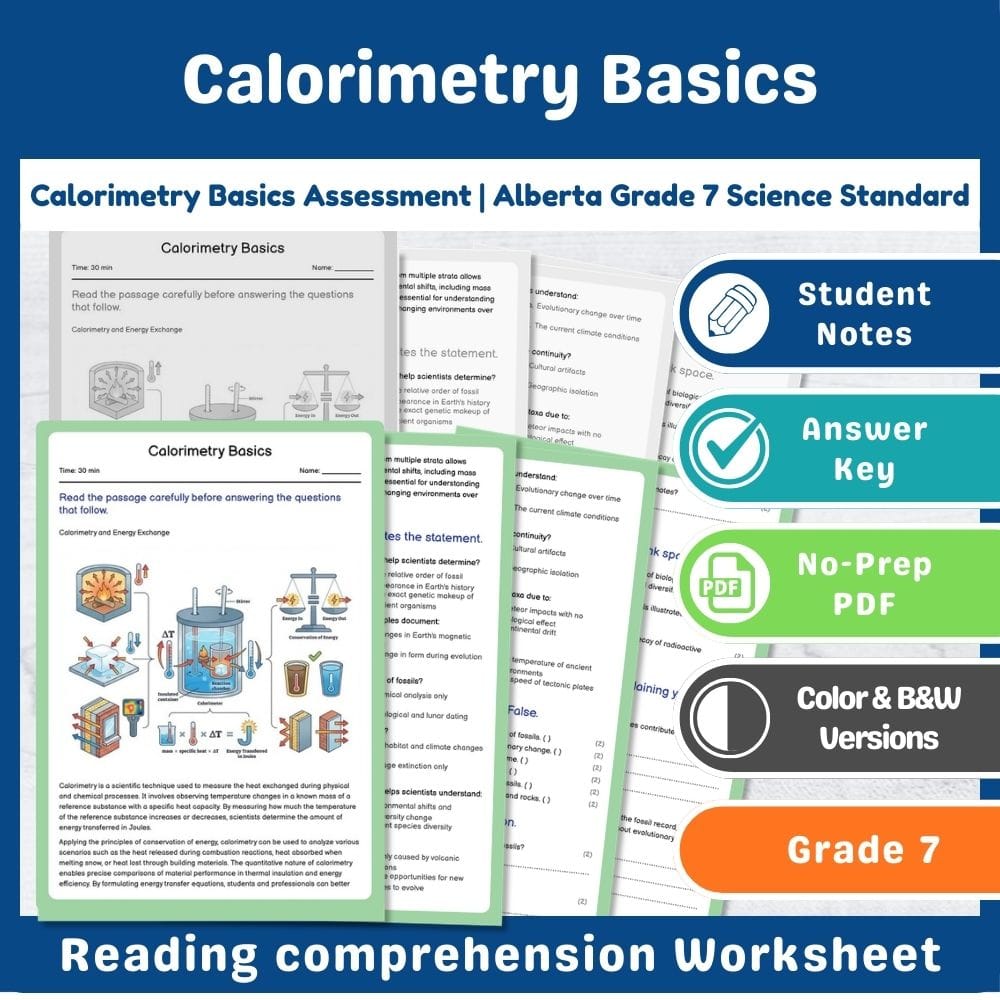
Calorimetry Basics Assessment | Alberta Grade 7 Science Standard
Created byPrism Point LearningLearning Objectives
- Explain the principles of calorimetry and how temperature changes relate to energy exchange.
- Apply energy conservation equations to quantitative heat transfer calculations.
- Describe real-world scenarios involving calorimetric reasoning in thermal performance of materials.
Also included in: Lesson Grade 7 Science Mini Bundle | Energy, Heat & Thermal Processes +1 more
Instant download
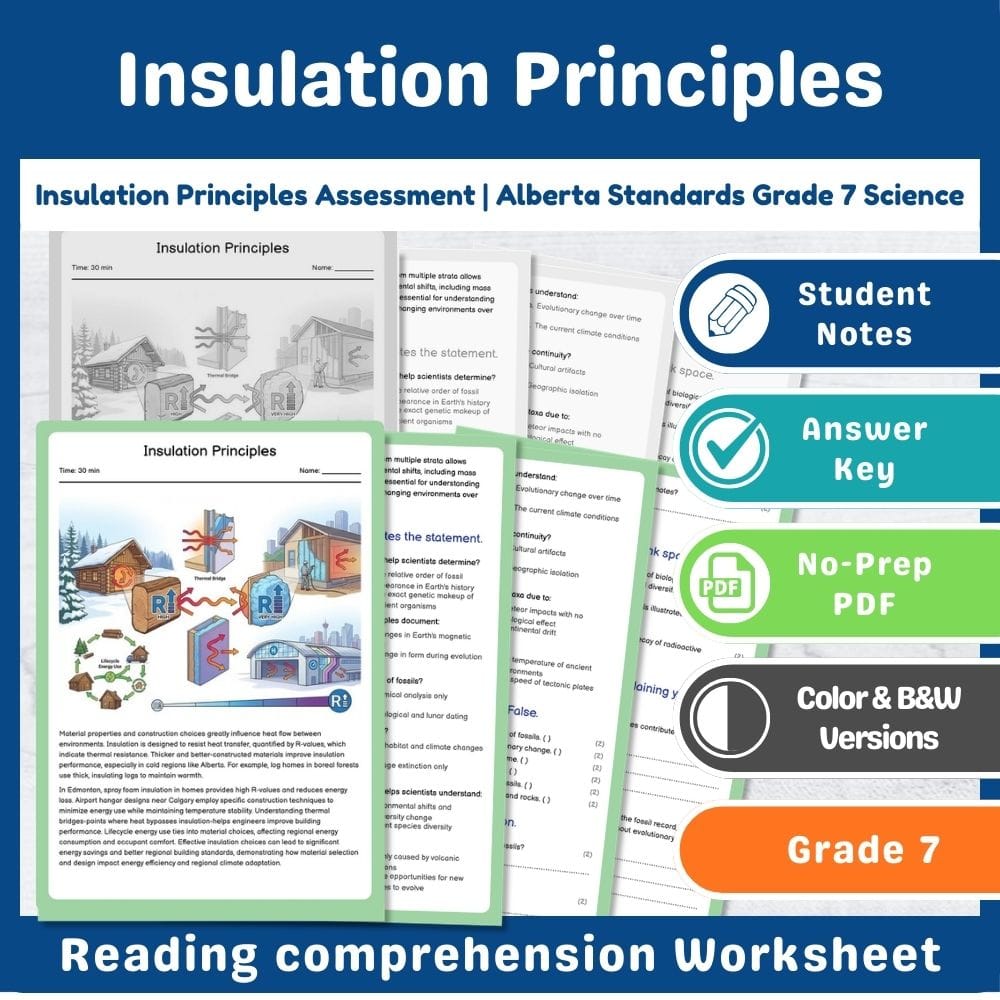
Insulation Principles Assessment | Alberta Standards Grade 7 Science
Created byPrism Point LearningLearning Objectives
- Understand how material properties influence heat flow.
- Identify regional examples of insulation techniques in Alberta.
- Determine the significance of R-values and thermal bridges in building design.
Also included in: Lesson Grade 7 Science Mini Bundle | Energy, Heat & Thermal Processes +1 more
Instant download
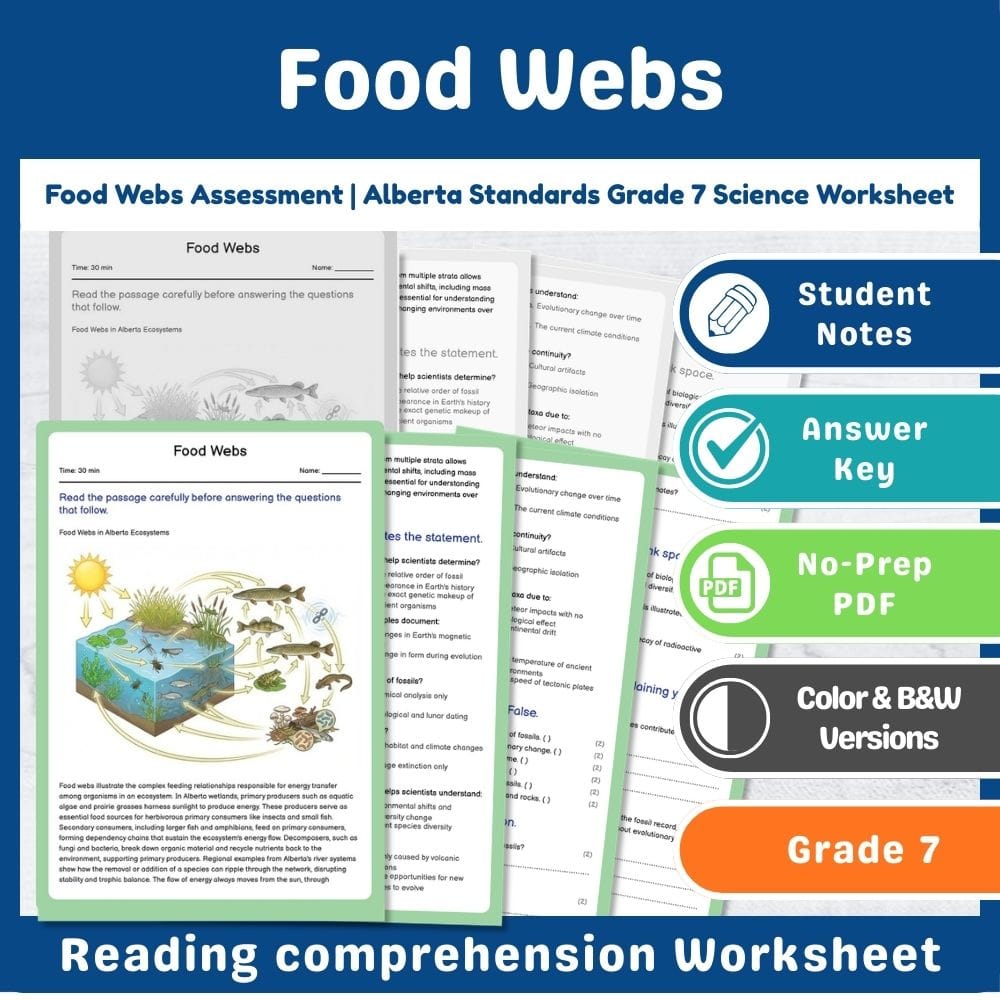
Food Webs Assessment | Alberta Standards Grade 7 Science Worksheet
Created byPrism Point LearningLearning Objectives
- Understand the concept of food webs and how energy transfers through ecosystems.
- Identify roles of producers, consumers, and decomposers within a regional ecological context.
- Analyze how changes in species populations can affect the stability of food webs.
Also included in: Lesson Bundle Grade 7 Science - Interactions and Ecosystems +1 more
Instant download
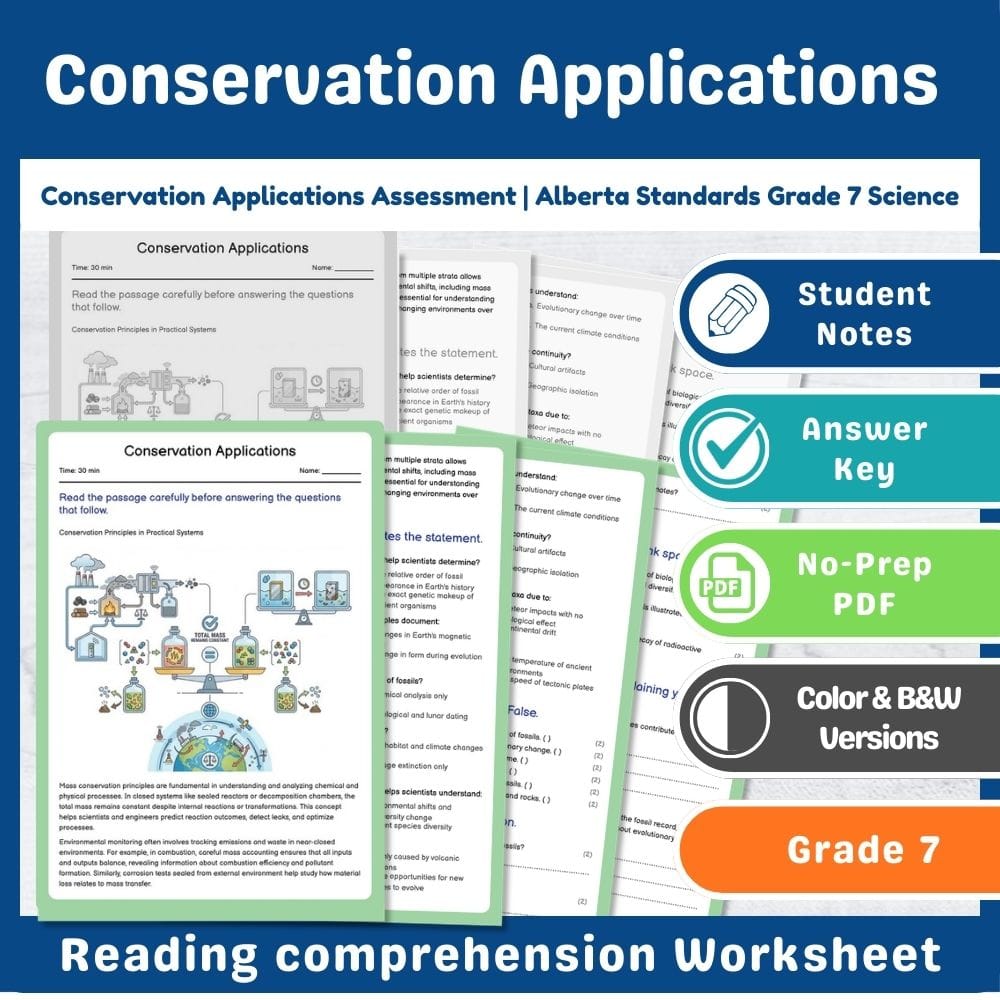
Conservation Applications Assessment | Alberta Standards Grade 7 Science
Created byPrism Point LearningLearning Objectives
- Understand the principle of mass conservation in chemical and physical systems.
- Apply mass conservation concepts to reaction stoichiometry, waste tracking, and environmental mass balances.
- Analyze real-world examples of closed systems to predict and reconcile measured versus expected masses.
Also included in: Lesson Grade 7 Science Mini Bundle | Matter and Chemical Change +1 more
Instant download
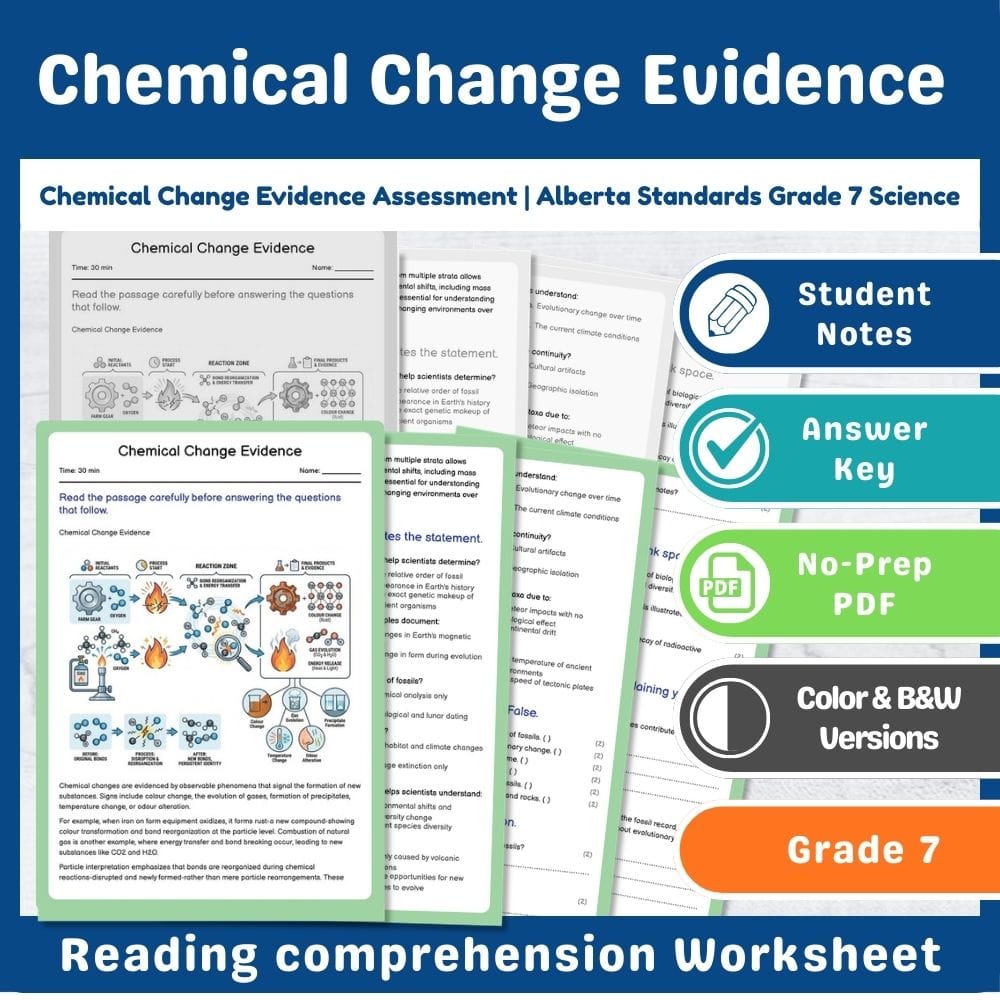
Chemical Change Evidence Assessment | Alberta Standards Grade 7 Science
Created byPrism Point LearningLearning Objectives
- Identify observable signs of chemical changes such as colour change, gas production, and precipitate formation.
- Understand the particle-level interpretation involving bond reorganization during chemical reactions.
- Differentiate between physical and chemical changes based on evidence of chemical alteration.
Also included in: Lesson Grade 7 Science Mini Bundle | Matter and Chemical Change +1 more
Instant download
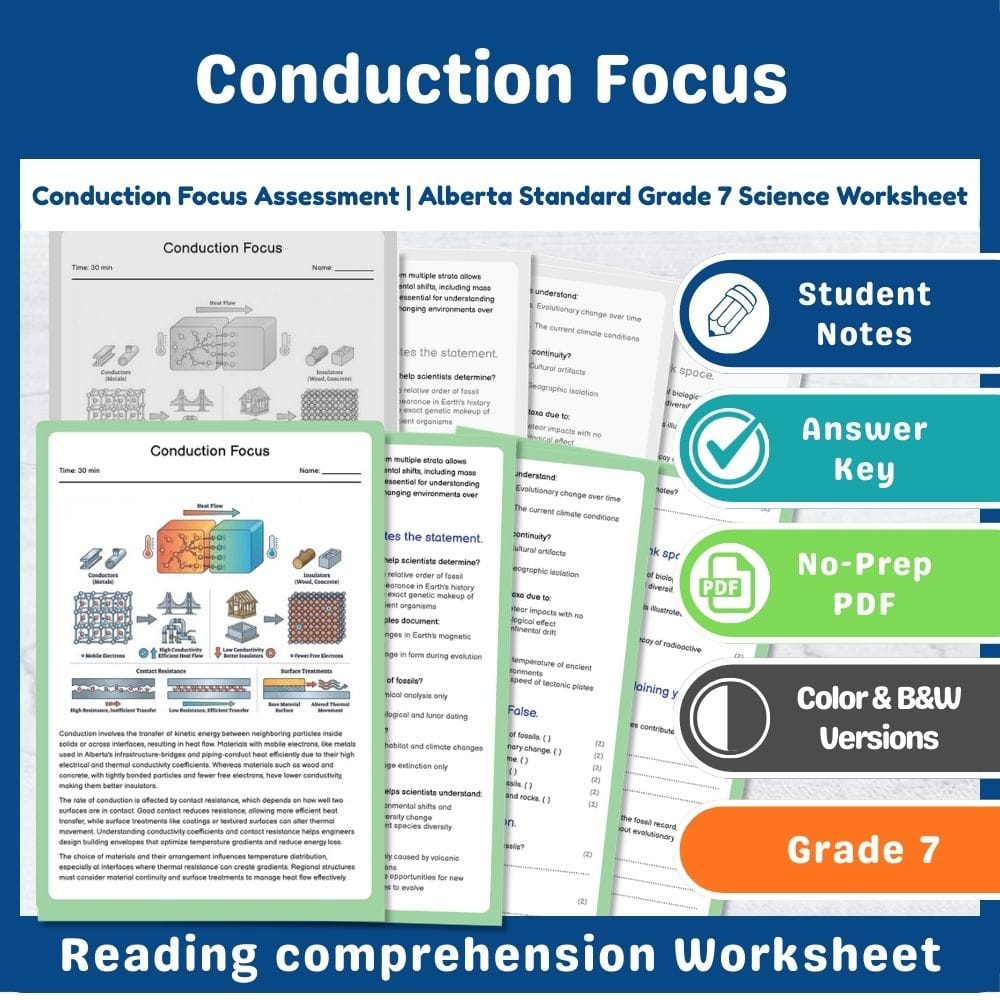
Conduction Focus Assessment | Alberta Standard Grade 7 Science Worksheet
Created byPrism Point LearningLearning Objectives
- Explain how energy is transferred through conduction in solids.
- Identify materials with high and low thermal conductivity and their applications.
- Describe the effects of contact resistance and surface treatments on heat flow in structures.
Also included in: Lesson Grade 7 Science Mini Bundle | Energy, Heat & Thermal Processes +1 more
Instant download
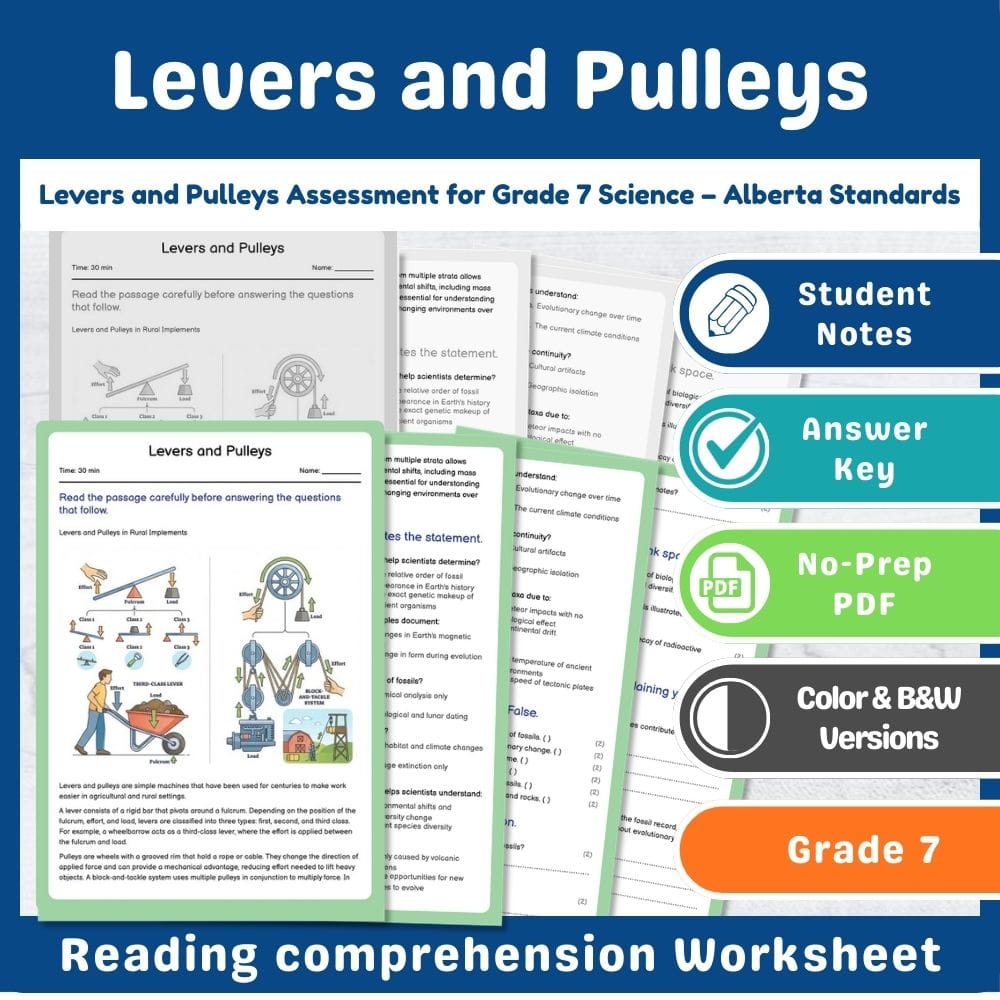
Levers and Pulleys Assessment for Grade 7 Science – Alberta Standards
Created byPrism Point LearningLearning Objectives
- Understand the principles of levers and pulleys and how they modify effort and direction.
- Explain torque, fulcrum placement, and mechanical advantage calculations.
- Identify examples of lever classes and pulley systems used in rural settings.
Also included in: Lesson Bundle Grade 7 Science Forces Structures and Motion | Alberta Standards +1 more
Instant download
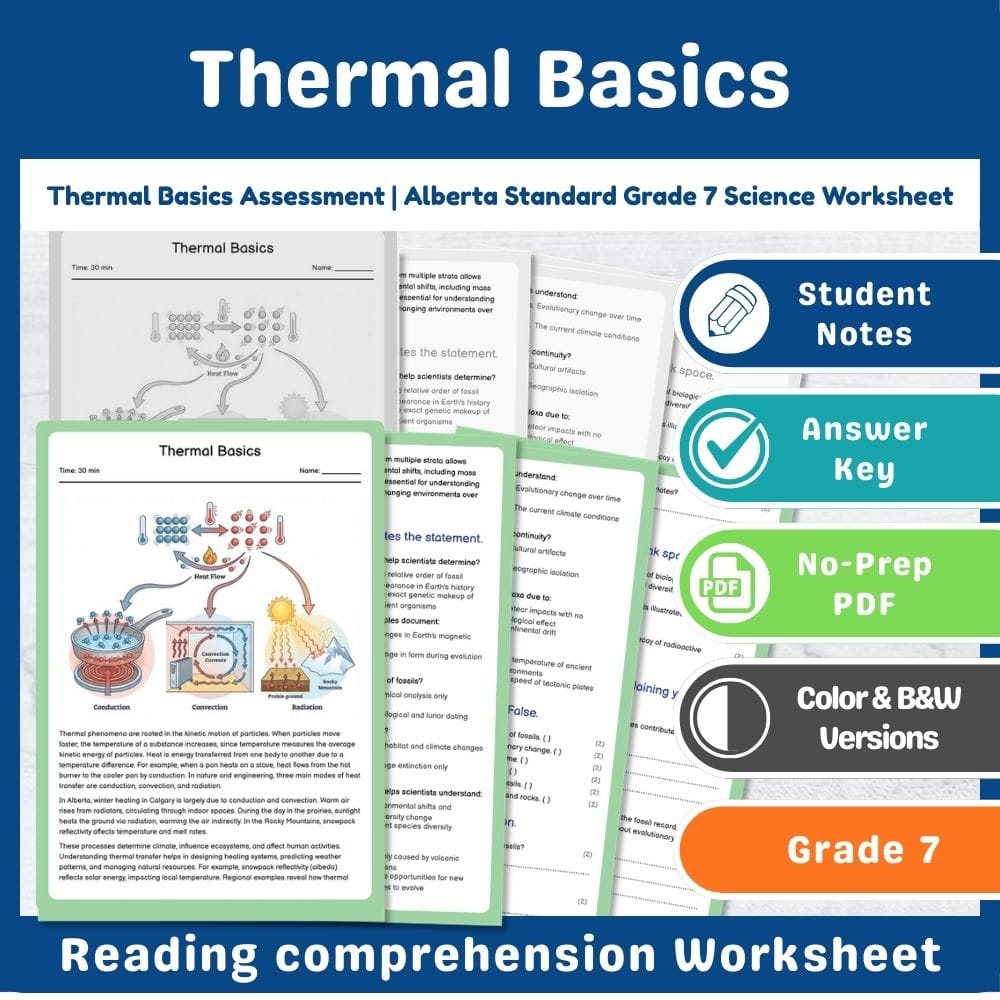
Thermal Basics Assessment | Alberta Standard Grade 7 Science Worksheet
Created byPrism Point LearningLearning Objectives
- Understand how the kinetic motion of particles relates to thermal phenomena.
- Differentiate between heat and temperature as forms of energy transfer.
- Identify conduction, convection, and radiation as methods of thermal transfer.
Also included in: Lesson Grade 7 Science Mini Bundle | Energy, Heat & Thermal Processes +1 more
Instant download
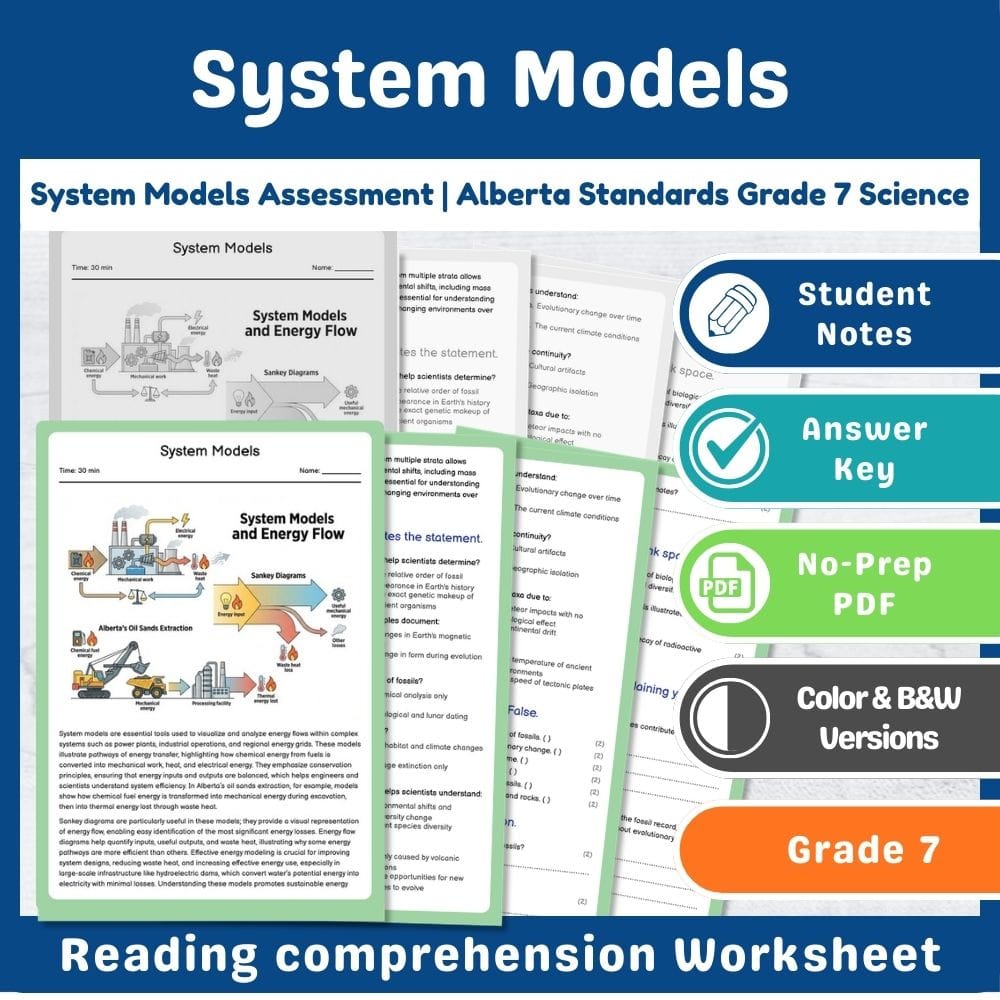
System Models Assessment | Alberta Standards Grade 7 Science
Created byPrism Point LearningLearning Objectives
- Understand how energy pathways are traced and represented in system models.
- Analyze energy transformations and identify loss mechanisms in regional energy systems.
- Utilize diagrams such as Sankey diagrams and energy flow charts to interpret energy data.
Also included in: Lesson Grade 7 Science Mini Bundle | Energy, Heat & Thermal Processes +1 more
Instant download
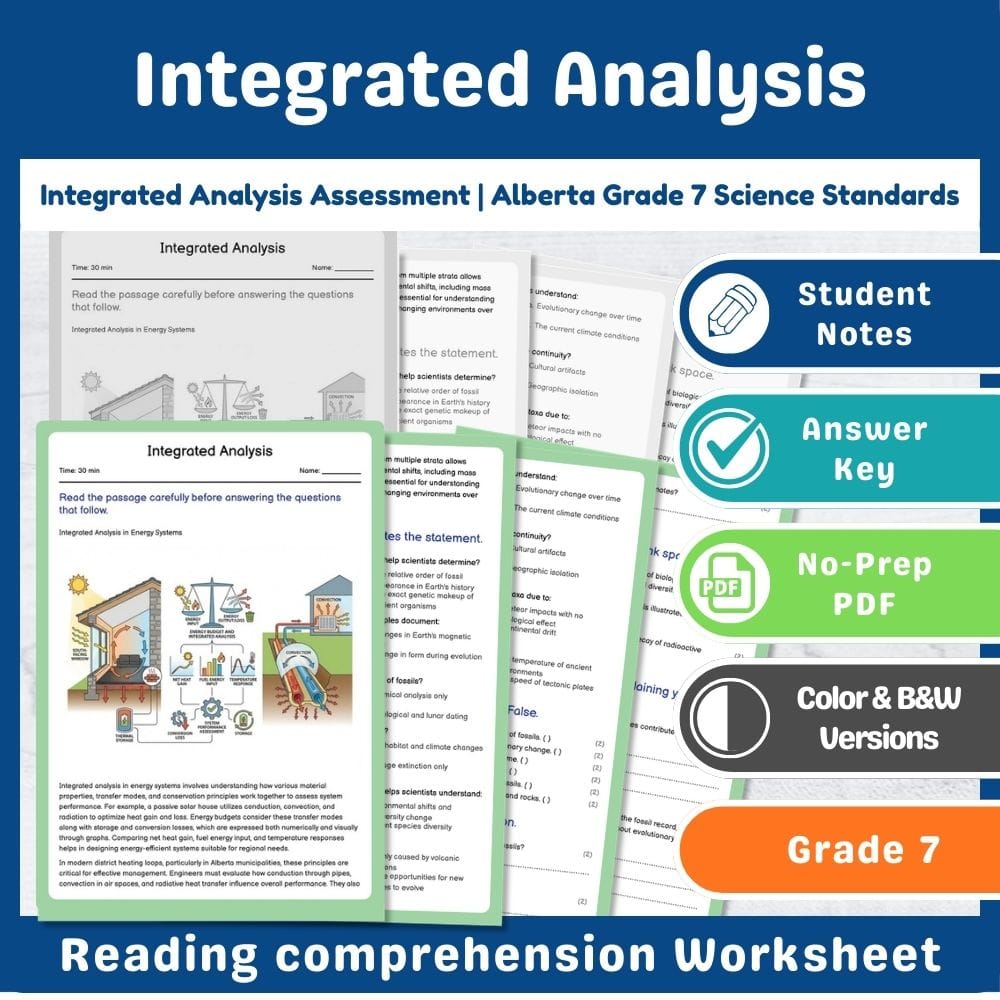
Integrated Analysis Assessment | Alberta Grade 7 Science Standards
Created byPrism Point LearningLearning Objectives
- Understand principles of energy transfer modes and conservation in system analysis.
- Apply properties and mechanisms of conduction, convection, and radiation to real-world systems.
- Interpret energy budgets through numerical data and graphical representations.
Also included in: Lesson Grade 7 Science Mini Bundle | Energy, Heat & Thermal Processes +1 more
Instant download
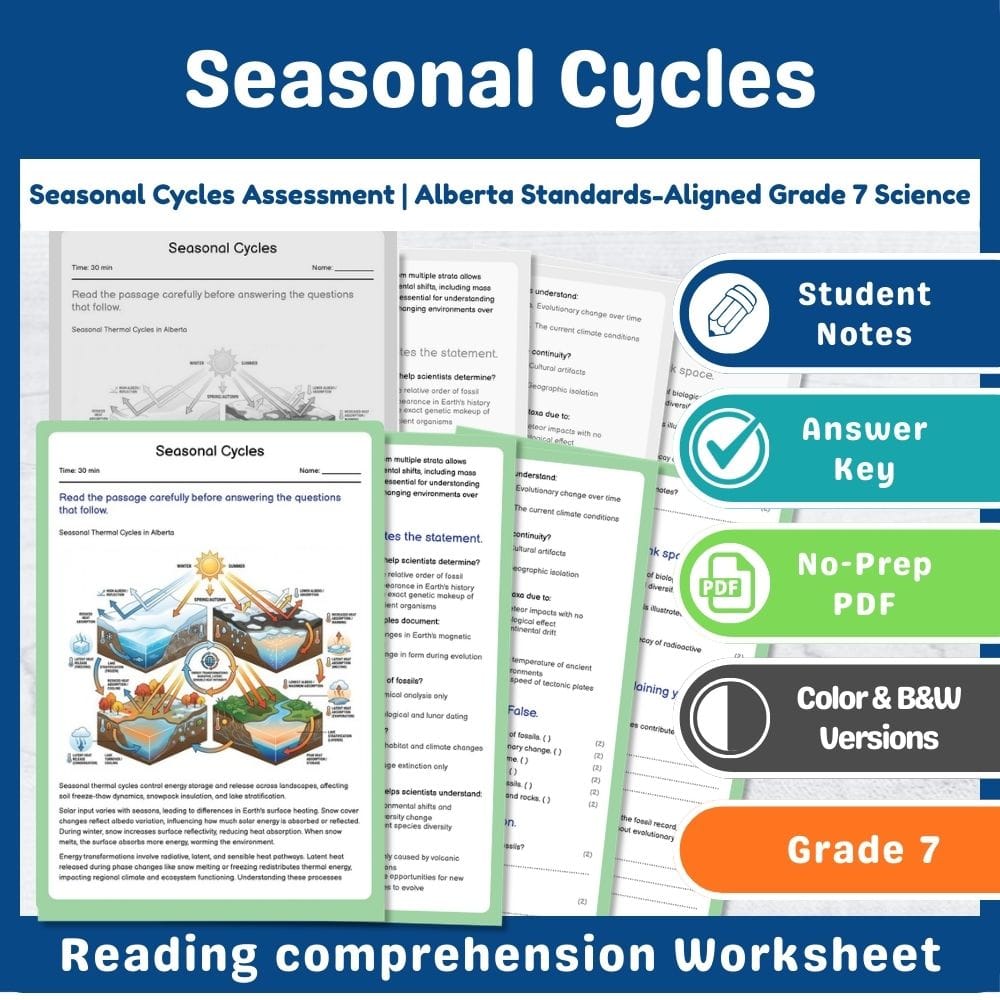
Seasonal Cycles Assessment | Alberta Standards-Aligned Grade 7 Science
Created byPrism Point LearningLearning Objectives
- Understand how seasonal thermal cycles influence energy storage and release in landscapes.
- Identify the main factors driving seasonal energy fluxes, including solar input and albedo changes.
- Describe the pathways of energy transformation such as radiative, latent, and sensible heat processes.
Also included in: Lesson Grade 7 Science Mini Bundle | Energy, Heat & Thermal Processes +1 more
Instant download
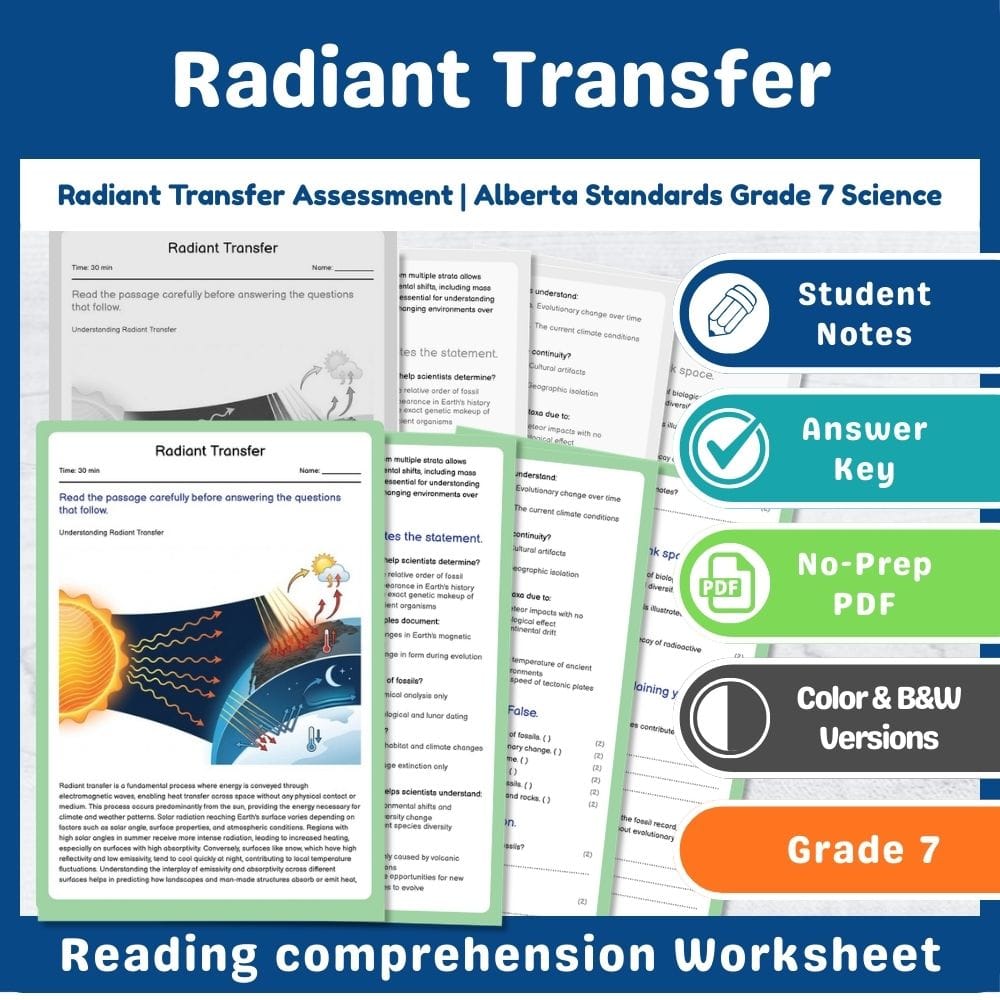
Radiant Transfer Assessment | Alberta Standards Grade 7 Science
Created byPrism Point LearningLearning Objectives
- Explain the concept of radiant transfer and how energy moves through electromagnetic waves without needing a medium.
- Identify factors such as solar radiation intensity, surface absorptivity, and emissivity that influence radiative heating.
- Describe how seasonal variations and surface types affect radiative balances and microclimates.
Also included in: Lesson Grade 7 Science Mini Bundle | Energy, Heat & Thermal Processes +1 more
Instant download
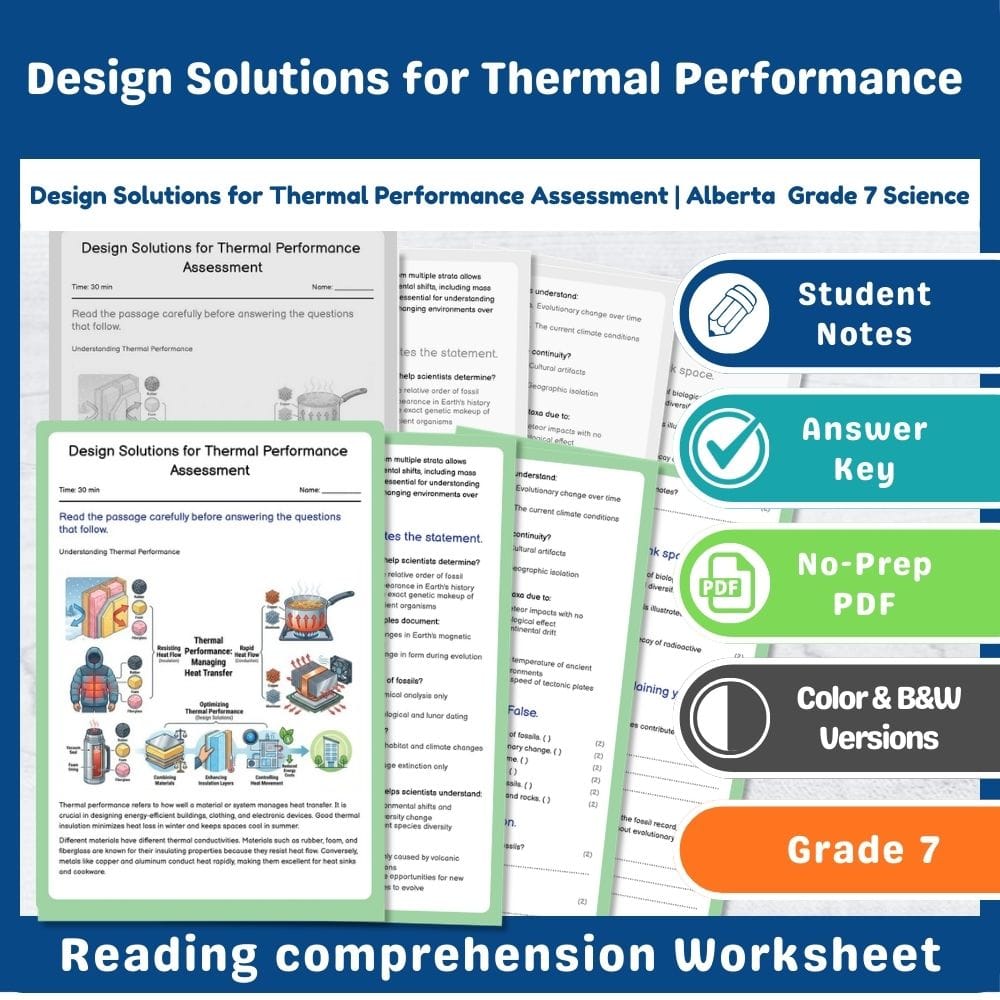
Design Solutions for Thermal Performance Assessment | Alberta Assessment Grade 7 Science
Created byPrism Point LearningLearning Objectives
- Understand key factors affecting thermal performance of materials.
- Analyze different design solutions to optimize thermal performance.
- Evaluate the effectiveness of various insulation and cooling techniques.
Also included in: Lesson Grade 7 Science Mini Bundle | Energy, Heat & Thermal Processes +1 more
Instant download
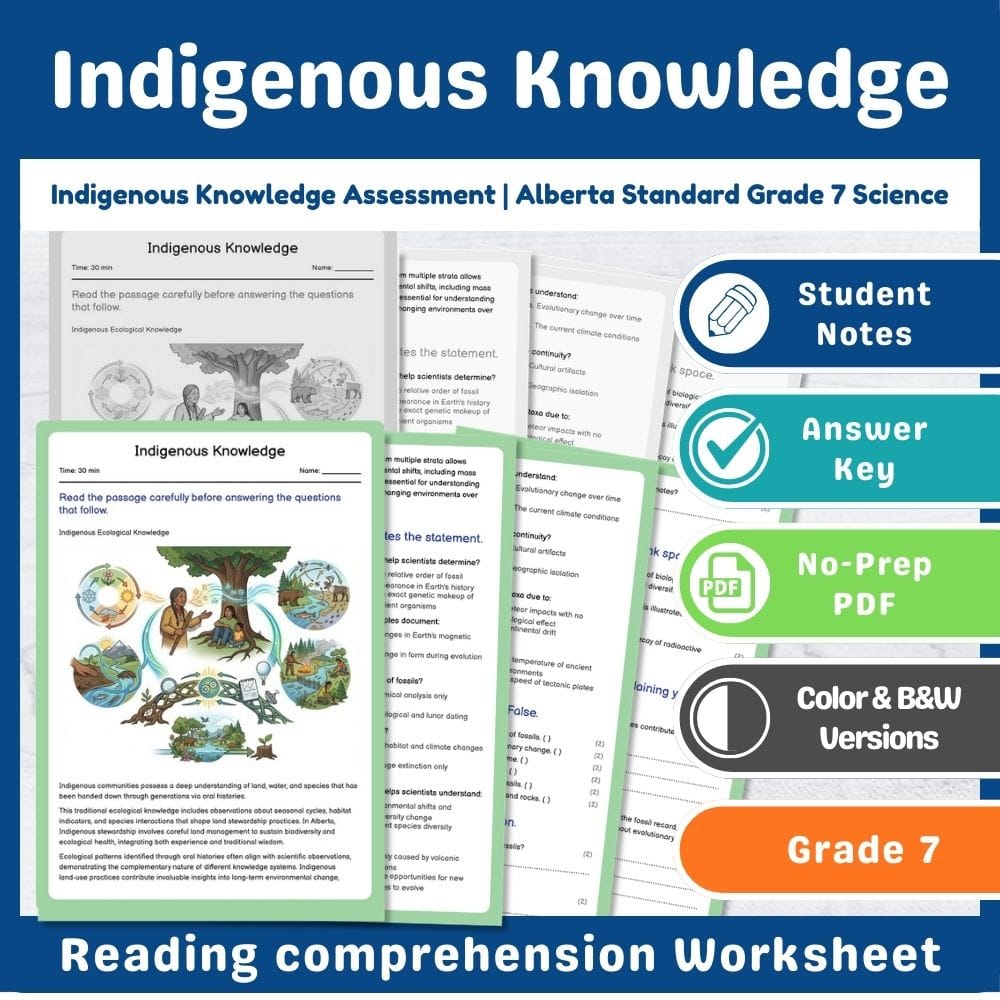
Indigenous Knowledge Assessment | Alberta Standard Grade 7 Science
Created byPrism Point LearningLearning Objectives
- Understand the role of oral histories and land-use practices in traditional ecological knowledge.
- Identify examples of species interactions and habitat indicators used by Indigenous communities.
- Recognize the importance of integrating different knowledge systems to interpret environmental patterns.
Also included in: Lesson Bundle Grade 7 Science - Interactions and Ecosystems +1 more
Instant download
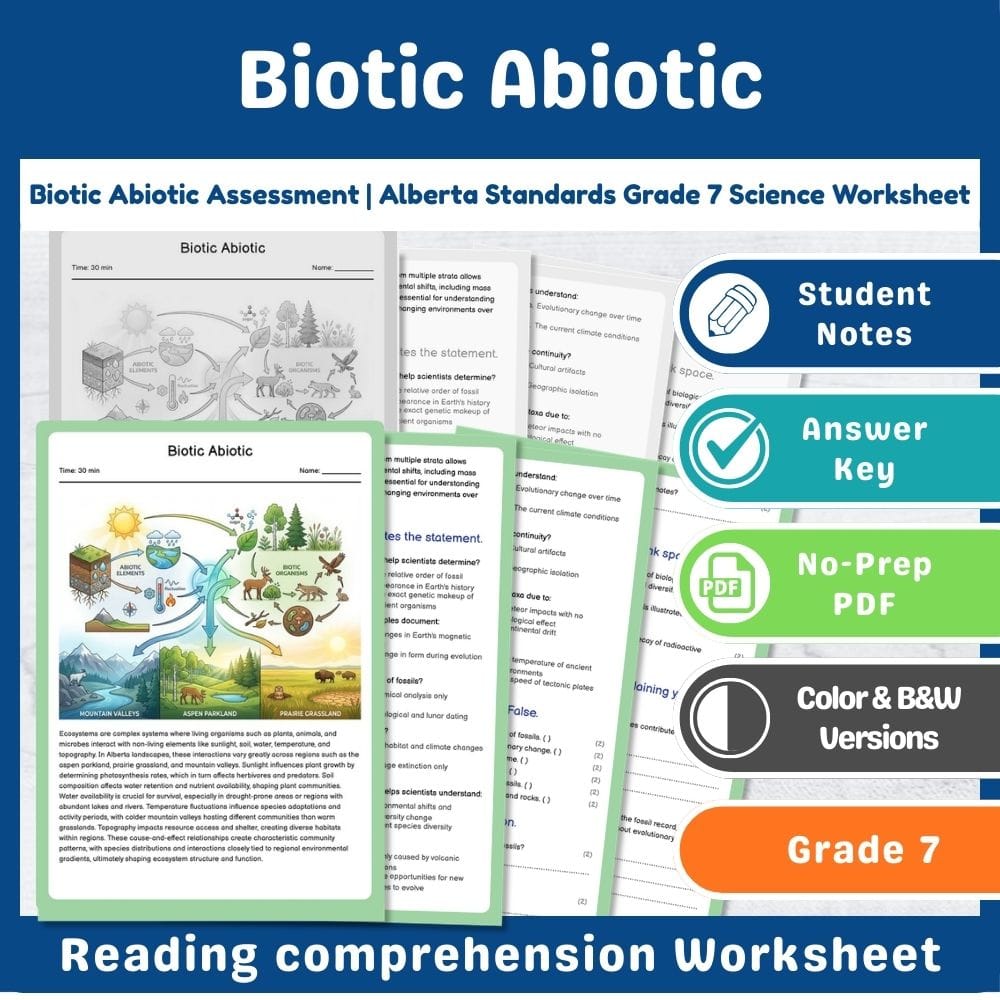
Biotic Abiotic Assessment | Alberta Standards Grade 7 Science Worksheet
Created byPrism Point LearningLearning Objectives
- Understand how sunlight, soil, water, temperature, and topography influence ecosystems.
- Identify the relationships between living organisms and non-living environmental factors.
- Explain how cause-and-effect links shape community patterns in Alberta landscapes.
Also included in: Lesson Bundle Grade 7 Science - Interactions and Ecosystems +1 more
Instant download
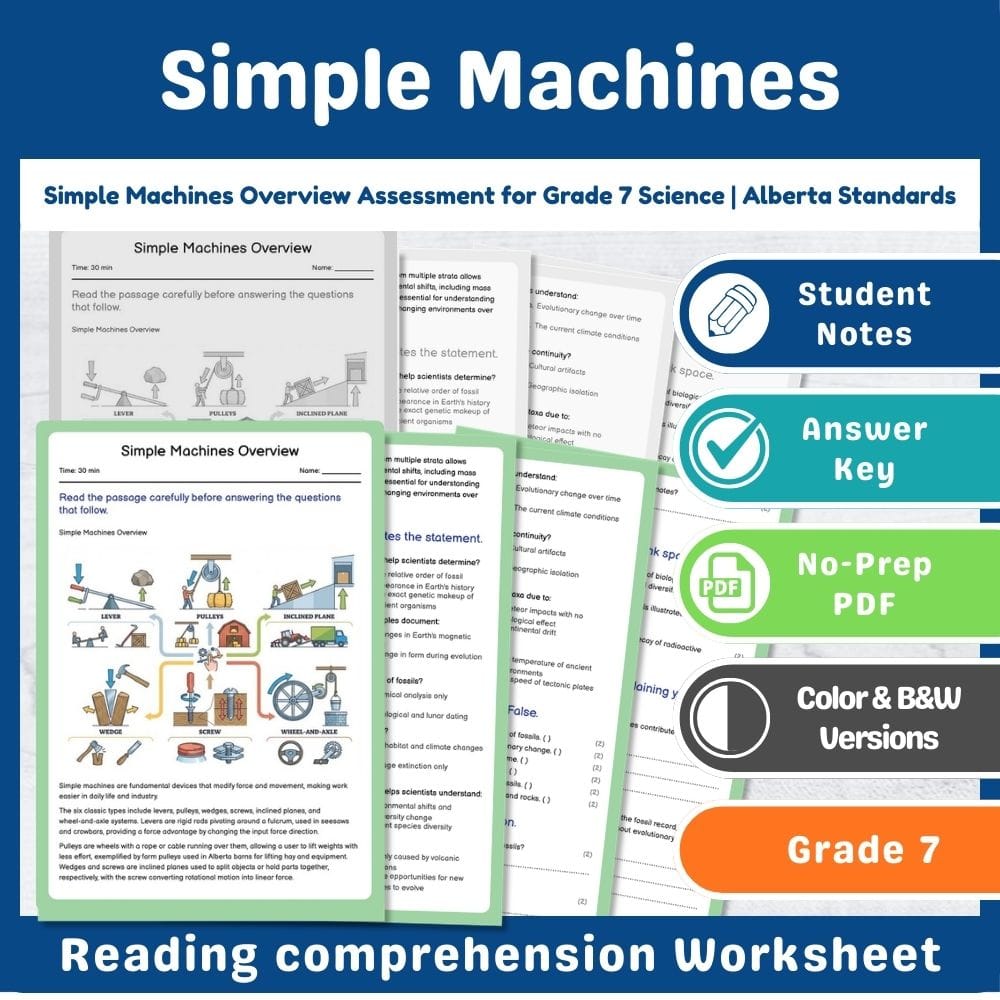
Simple Machines Overview Assessment for Grade 7 Science | Alberta Standards
Created byPrism Point LearningLearning Objectives
- Describe the six types of simple machines and their functions.
- Explain how mechanical advantage is calculated and its significance.
- Identify examples of simple machines in Alberta's agricultural and everyday contexts.
Also included in: Lesson Bundle Grade 7 Science Forces Structures and Motion | Alberta Standards +1 more
Instant download
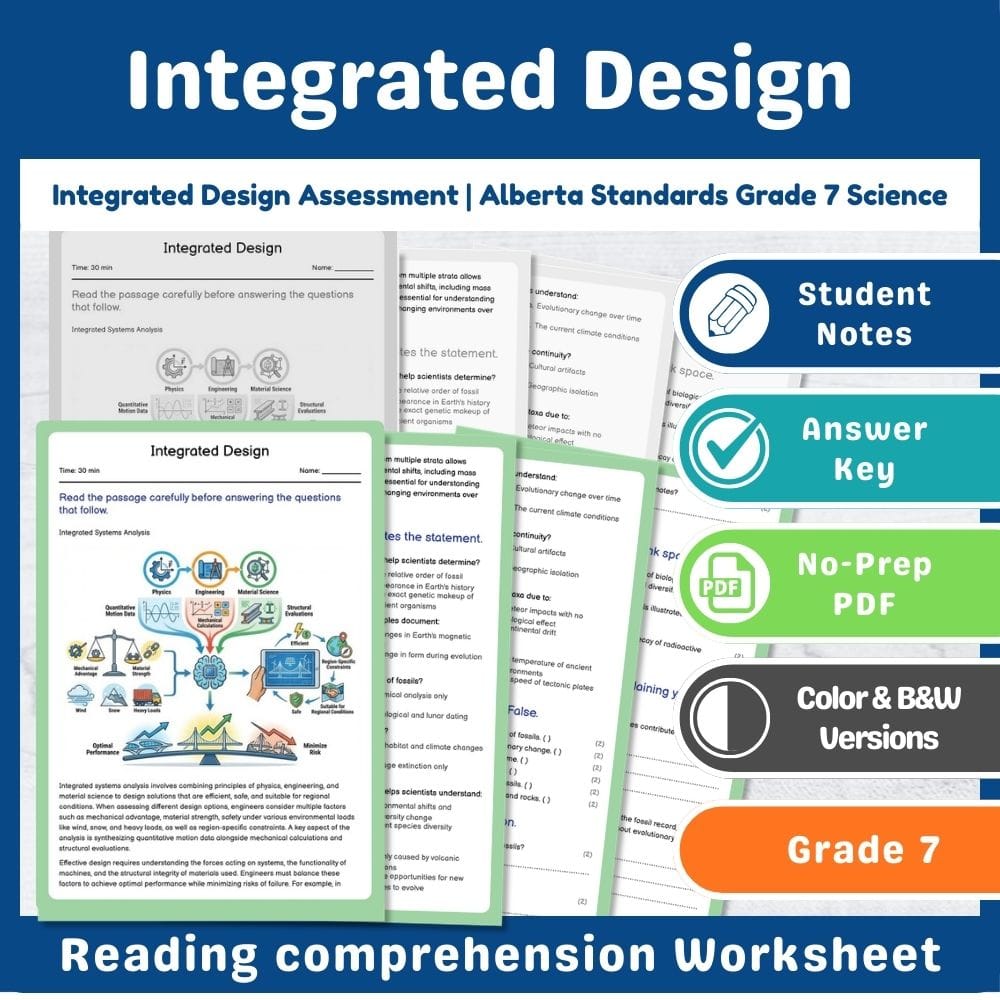
Integrated Design Assessment | Alberta Standards Grade 7 Science
Created byPrism Point LearningLearning Objectives
- Analyze how force understanding impacts mechanical system design.
- Evaluate structural stability and safety considerations for regional applications.
- Compare alternative design solutions based on multiple criteria including material choice and mechanical advantage.
Also included in: Lesson Bundle Grade 7 Science Forces Structures and Motion | Alberta Standards +1 more
Instant download
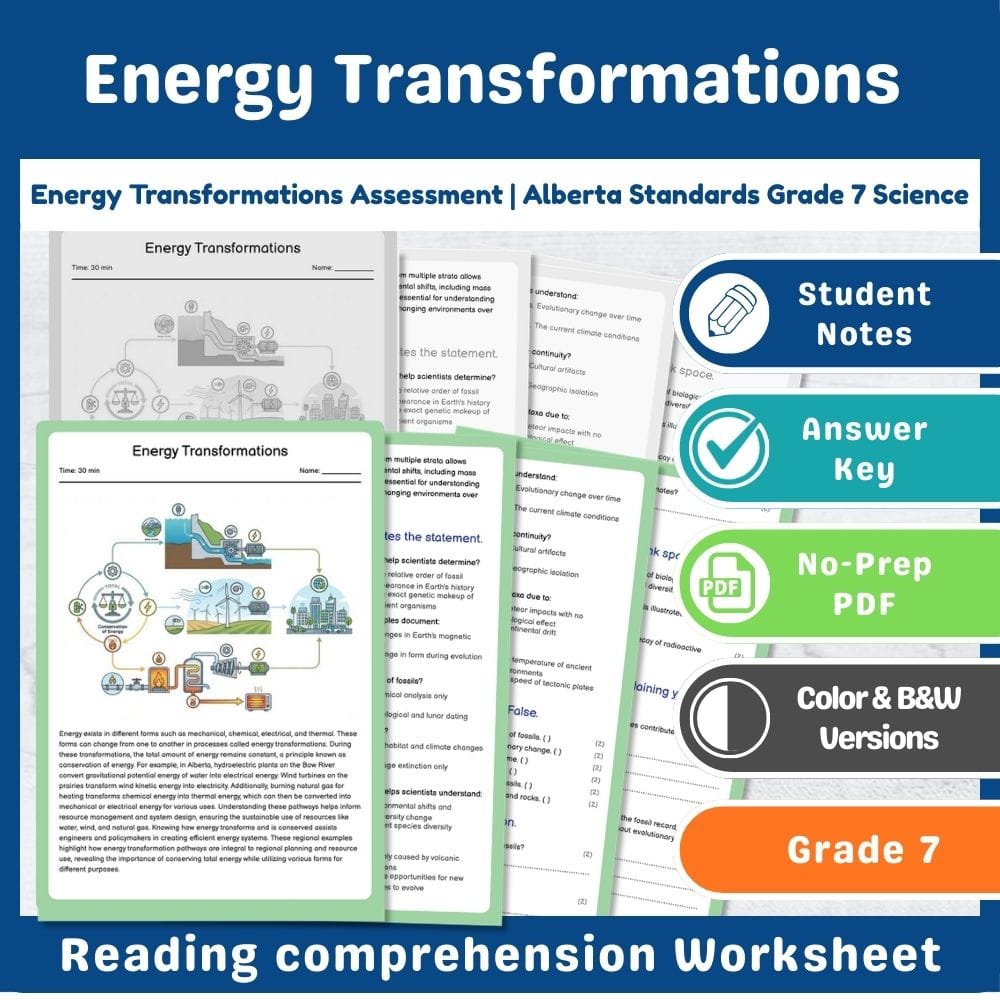
Energy Transformations Assessment | Alberta Standards Grade 7 Science
Created byPrism Point LearningLearning Objectives
- Understand the various forms of energy and how they interconvert during processes.
- Recognize examples of energy transformation in Alberta's regional resources.
- Explain the principle of energy conservation during transformations.
Also included in: Lesson Grade 7 Science Mini Bundle | Energy, Heat & Thermal Processes +1 more
Instant download
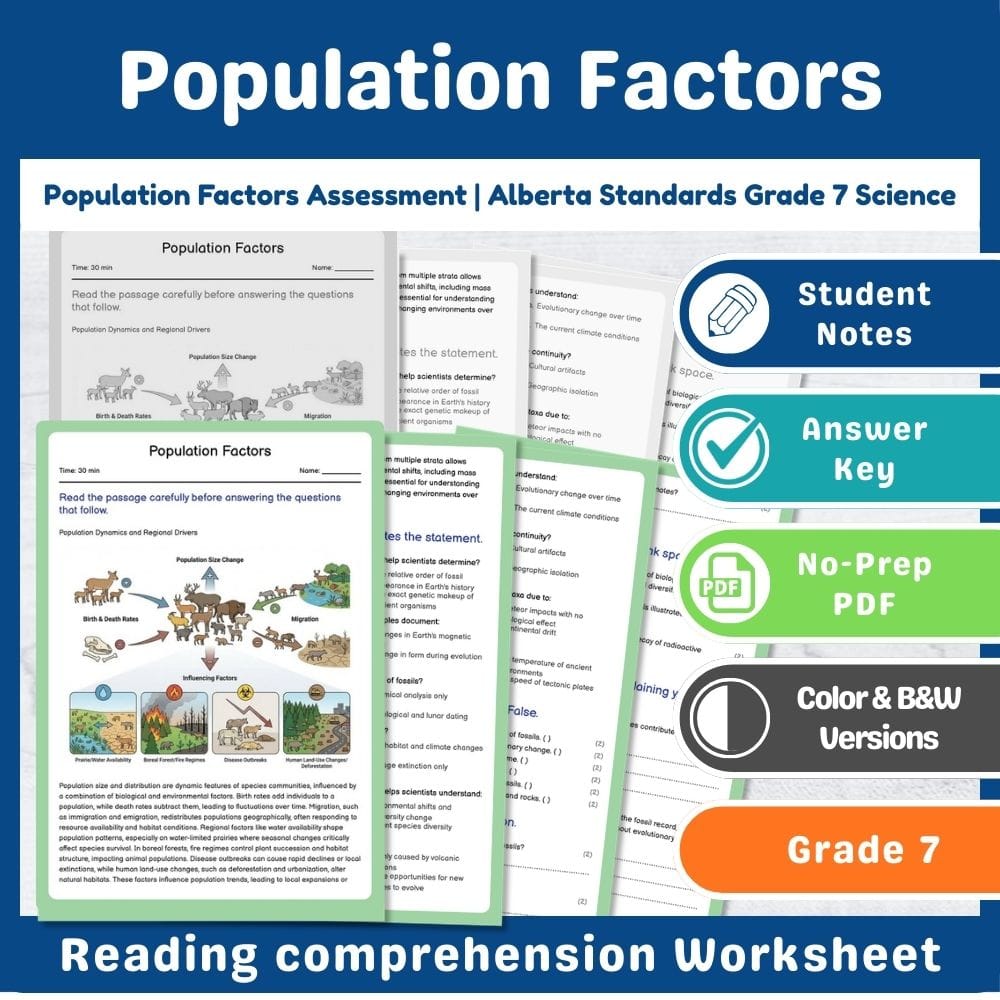
Population Factors Assessment | Alberta Standards Grade 7 Science
Created byPrism Point LearningLearning Objectives
- Understand how birth and death rates influence population size.
- Explore how immigration and emigration impact population distribution.
- Identify regional drivers affecting population fluctuations and biodiversity.
Also included in: Lesson Bundle Grade 7 Science - Interactions and Ecosystems +1 more
Instant download
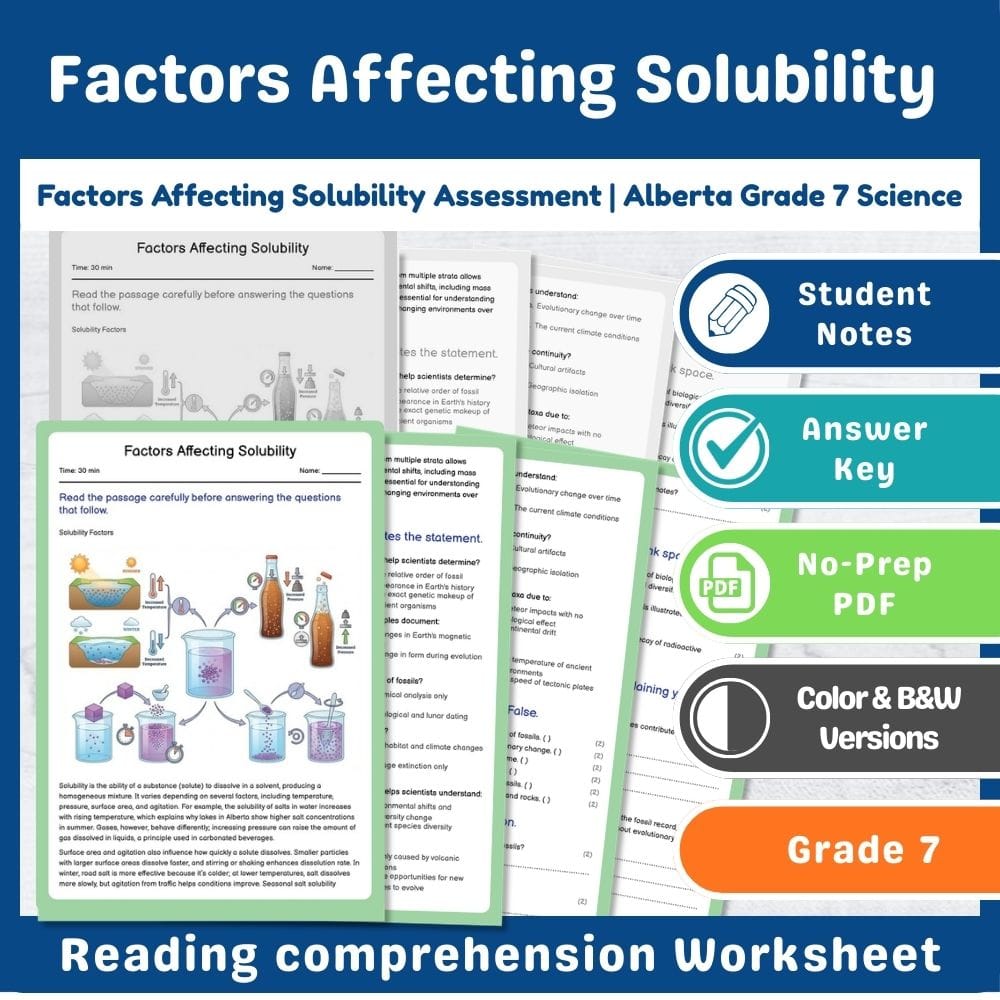
Factors Affecting Solubility Assessment | Alberta Grade 7 Science
Created byPrism Point LearningLearning Objectives
- Understand how temperature influences the solubility of solids and gases in liquids.
- Identify the effects of surface area and agitation on the rate of dissolution.
- Explore how pressure impacts the solubility of gases in liquids under different conditions.
Also included in: Lesson Grade 7 Science Mini Bundle | Matter and Chemical Change +1 more
Instant download
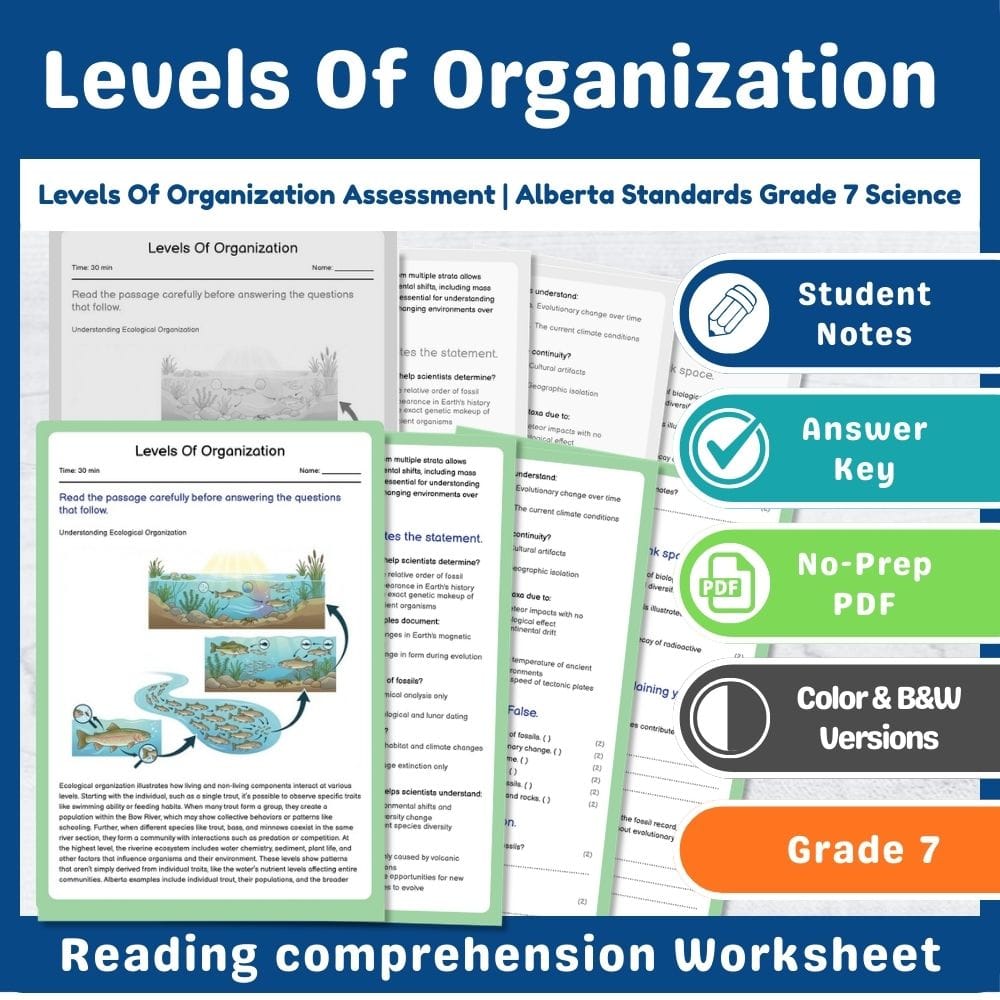
Levels Of Organization Assessment | Alberta Standards Grade 7 Science
Created byPrism Point LearningLearning Objectives
- Describe the different levels of ecological organization from individual organisms to ecosystems.
- Explain how properties and processes emerge at higher levels that are not evident at individual levels.
- Use Alberta examples to differentiate among levels such as individual trout, trout populations, communities, and ecosystems.
Also included in: Lesson Bundle Grade 7 Science - Interactions and Ecosystems +1 more
Instant download
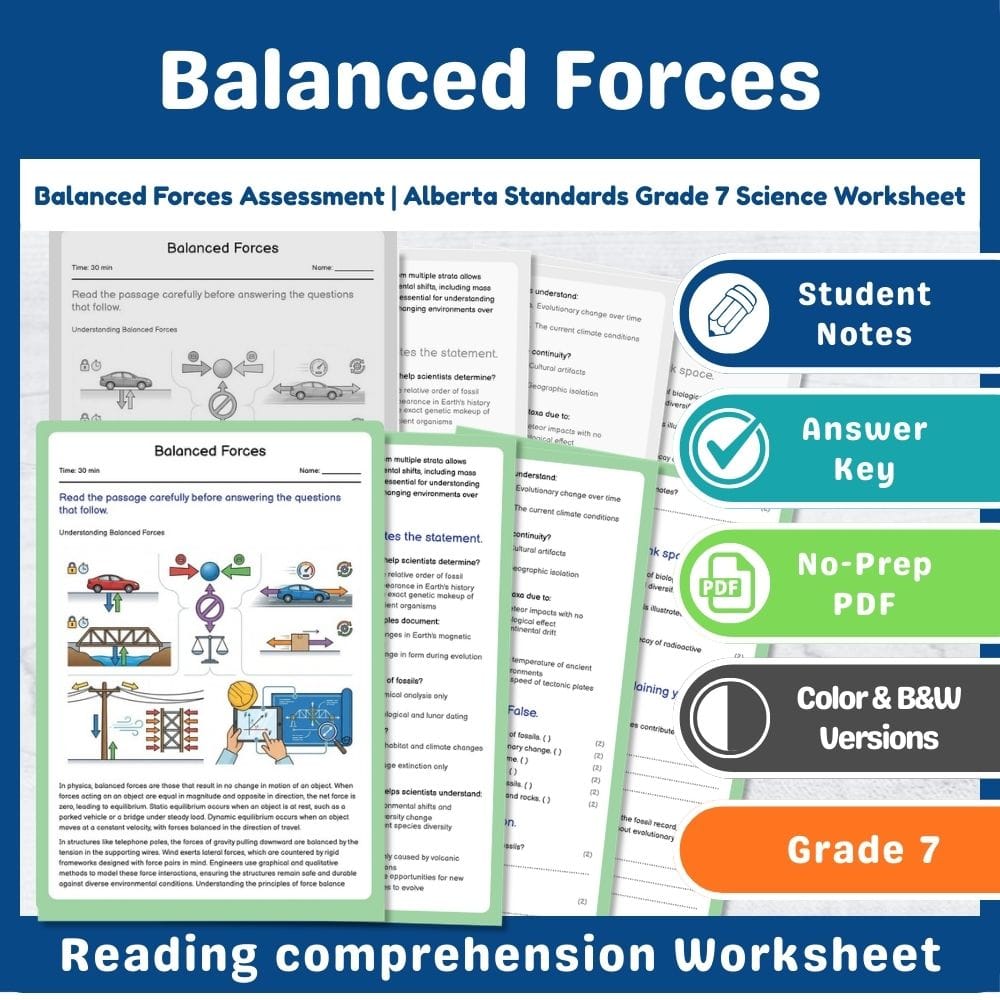
Balanced Forces Assessment | Alberta Standards Grade 7 Science Worksheet
Created byPrism Point LearningLearning Objectives
- Understand the concept of equilibrium and static balance in structures.
- Identify and describe examples of static and dynamic equilibrium.
- Graphically represent force pairs and analyze their effects on objects.
Also included in: Lesson Bundle Grade 7 Science Forces Structures and Motion | Alberta Standards +1 more
Instant download
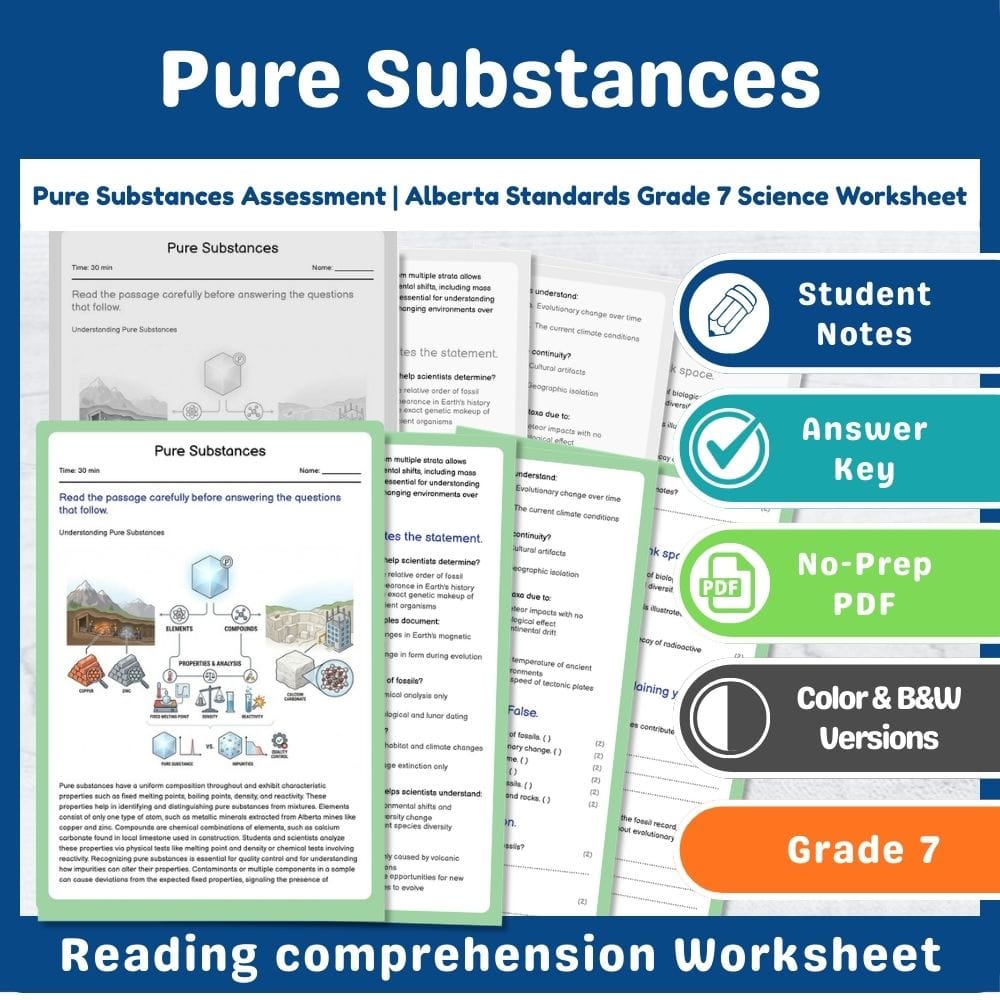
Pure Substances Assessment | Alberta Standards Grade 7 Science Worksheet
Created byPrism Point LearningLearning Objectives
- Understand the defining properties of pure substances such as fixed melting points, density, and reactivity.
- Differentiate between elements and compounds through physical and chemical tests.
- Identify real-world examples of pure substances from local sources and common compounds.
Also included in: Lesson Grade 7 Science Mini Bundle | Matter and Chemical Change +1 more
Instant download
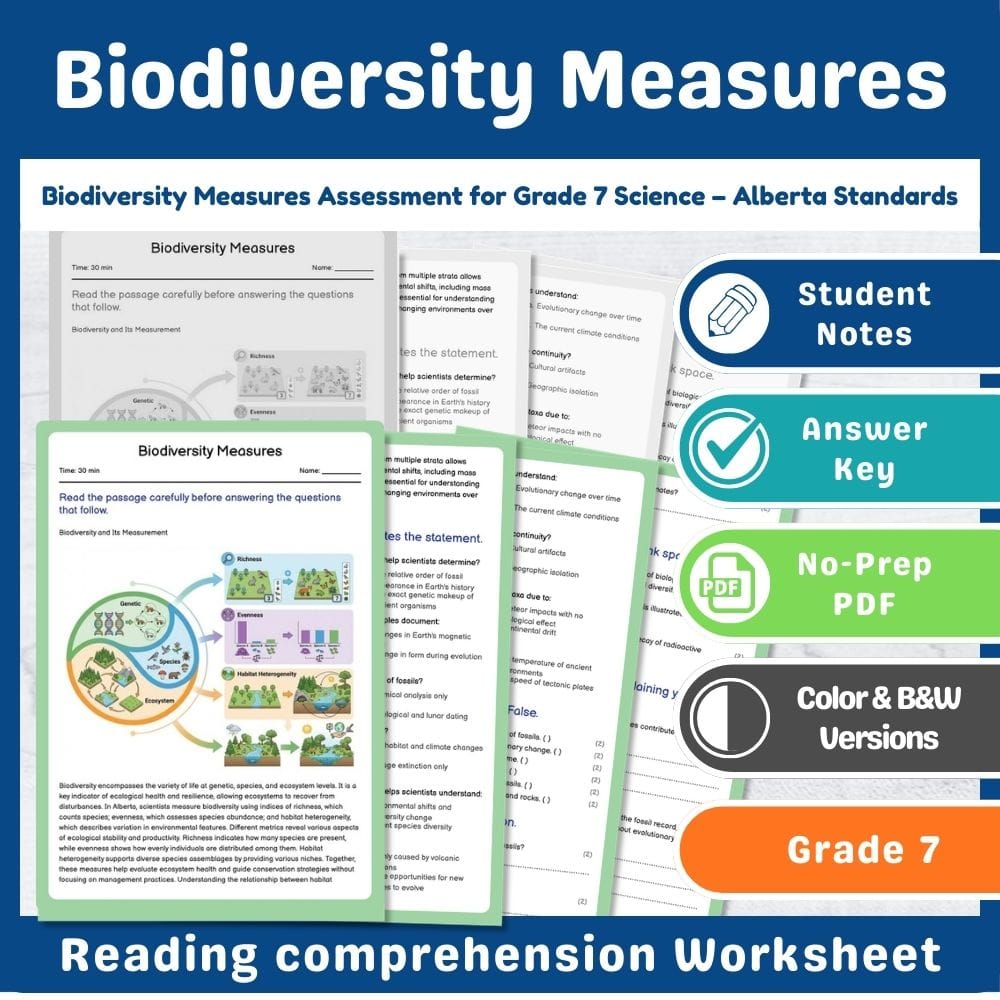
Biodiversity Measures Assessment for Grade 7 Science – Alberta Standards
Created byPrism Point LearningLearning Objectives
- Understand key concepts related to Science
- Apply knowledge through practice questions
- Demonstrate comprehension of the material
Also included in: Lesson Bundle Grade 7 Science - Interactions and Ecosystems +1 more
Instant download
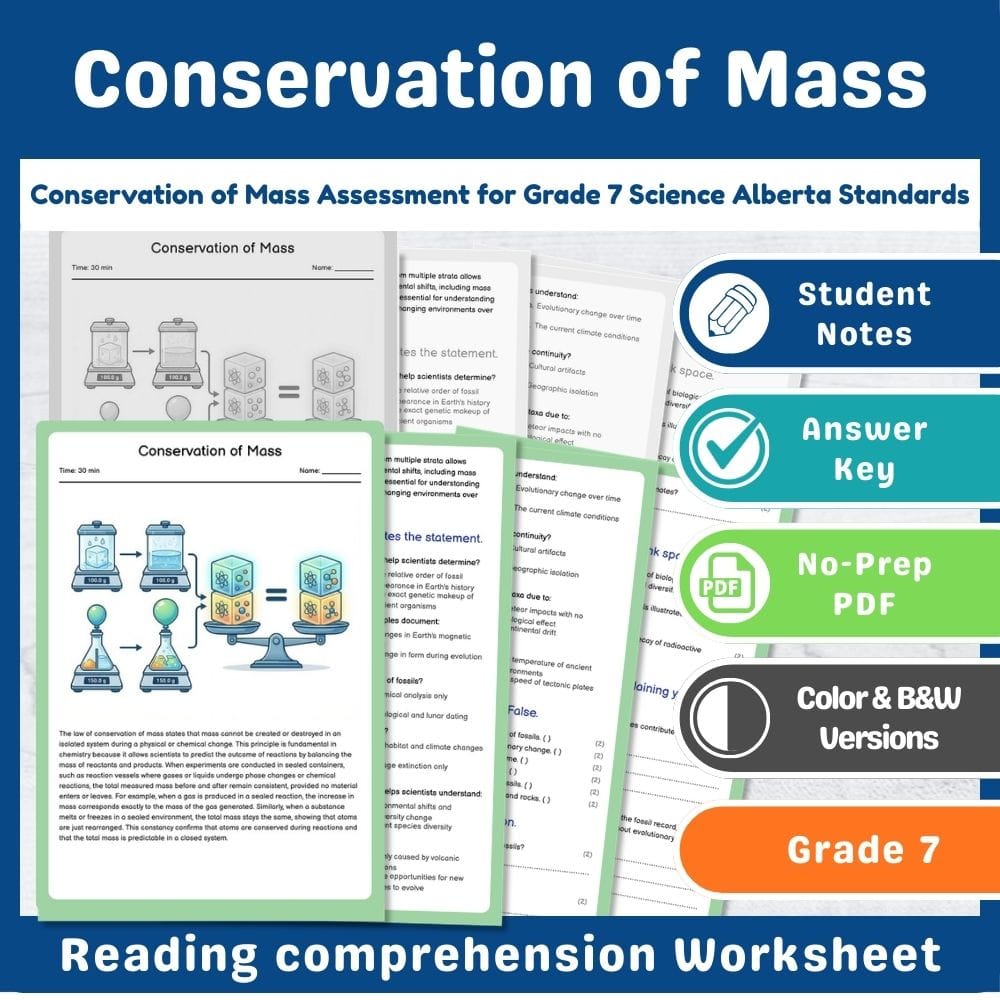
Conservation of Mass Assessment for Grade 7 Science Alberta Standards
Created byPrism Point LearningLearning Objectives
- Understand the principle of conservation of mass in physical and chemical changes.
- Describe how mass remains constant in a sealed system during reactions.
- Explain observations of sealed-container reactions that demonstrate mass conservation.
Also included in: Lesson Grade 7 Science Mini Bundle | Matter and Chemical Change +1 more
Instant download
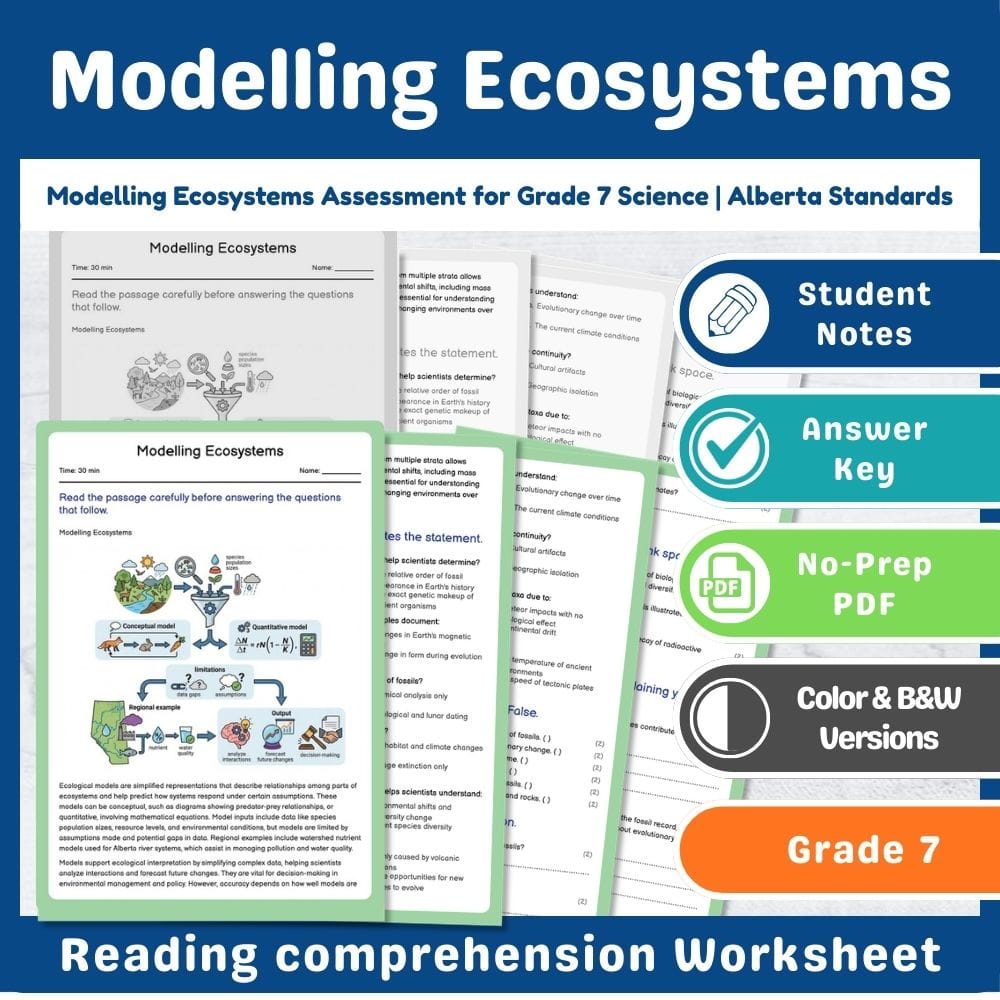
Modelling Ecosystems Assessment for Grade 7 Science | Alberta Standards
Created byPrism Point LearningLearning Objectives
- Understand the concept and importance of ecological models in environmental science.
- Identify different types of modelling approaches and their applications.
- Recognize regional examples of ecological models and their significance.
Also included in: Lesson Bundle Grade 7 Science - Interactions and Ecosystems +1 more
Instant download
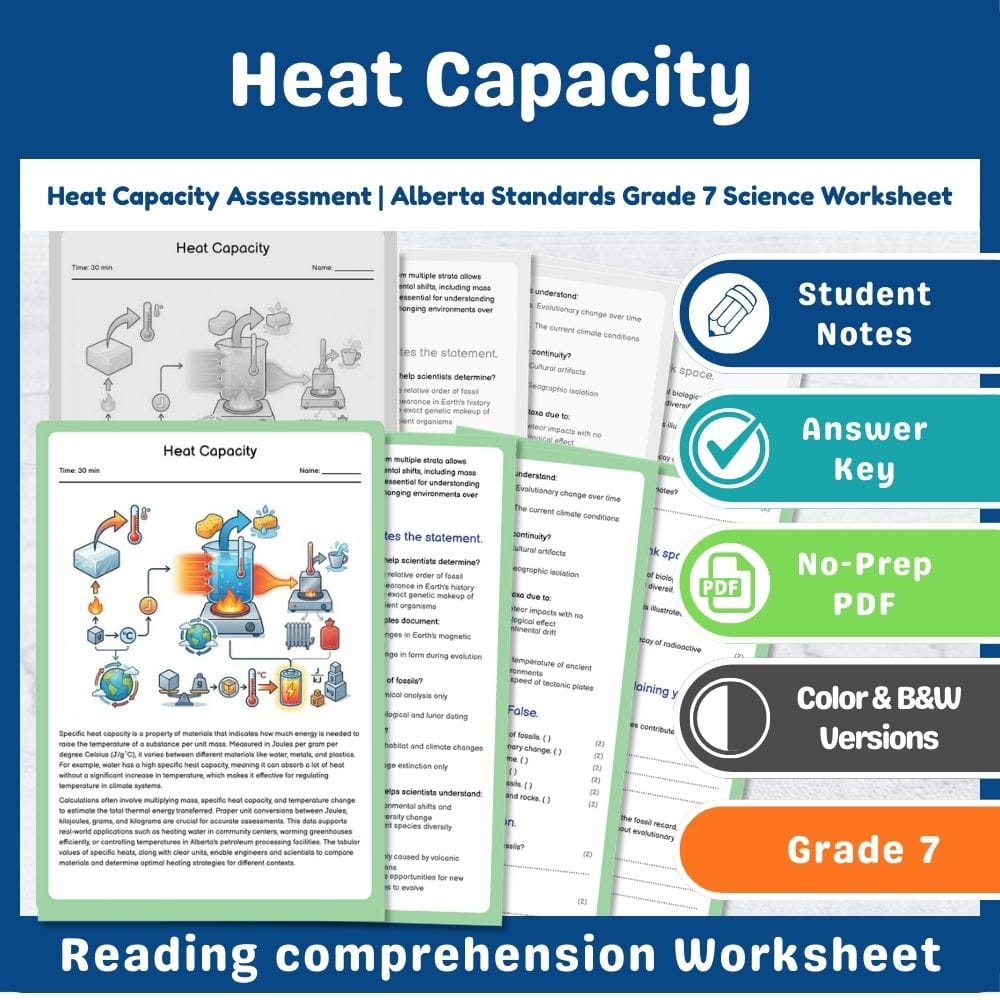
Heat Capacity Assessment | Alberta Standards Grade 7 Science Worksheet
Created byPrism Point LearningLearning Objectives
- Understand the concept of specific heat capacity and its units.
- Perform calculations involving mass, specific heat, and temperature change to find energy in Joules or kilojoules.
- Interpret tabular data of thermal properties for different materials.
Also included in: Lesson Grade 7 Science Mini Bundle | Energy, Heat & Thermal Processes +1 more
Instant download
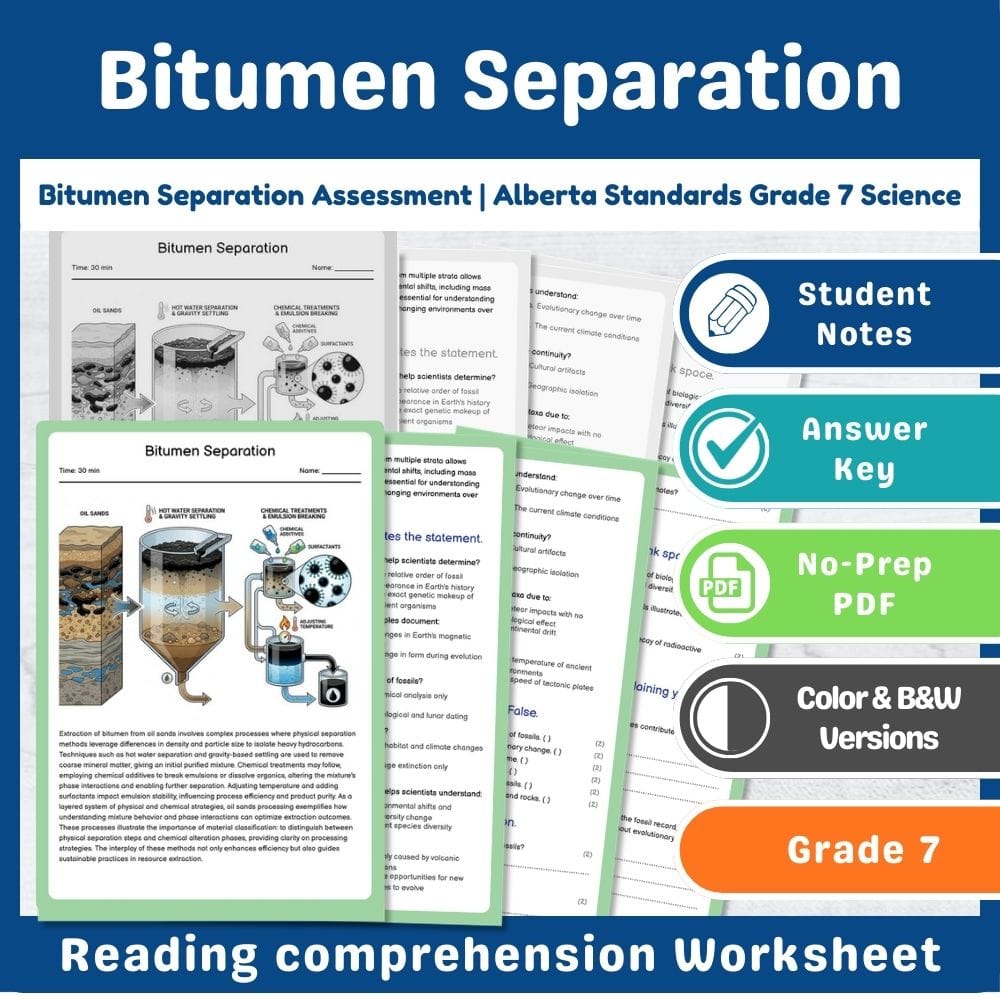
Bitumen Separation Assessment | Alberta Standards Grade 7 Science
Created byPrism Point LearningLearning Objectives
- Understand the physical and chemical processes involved in separating bitumen from oil sands.
- Identify differentiating features of physical separation versus chemical treatment in mixture processing.
- Explain how density, particle size, and additives influence separation methods.
Also included in: Lesson Grade 7 Science Mini Bundle | Matter and Chemical Change +1 more
Instant download
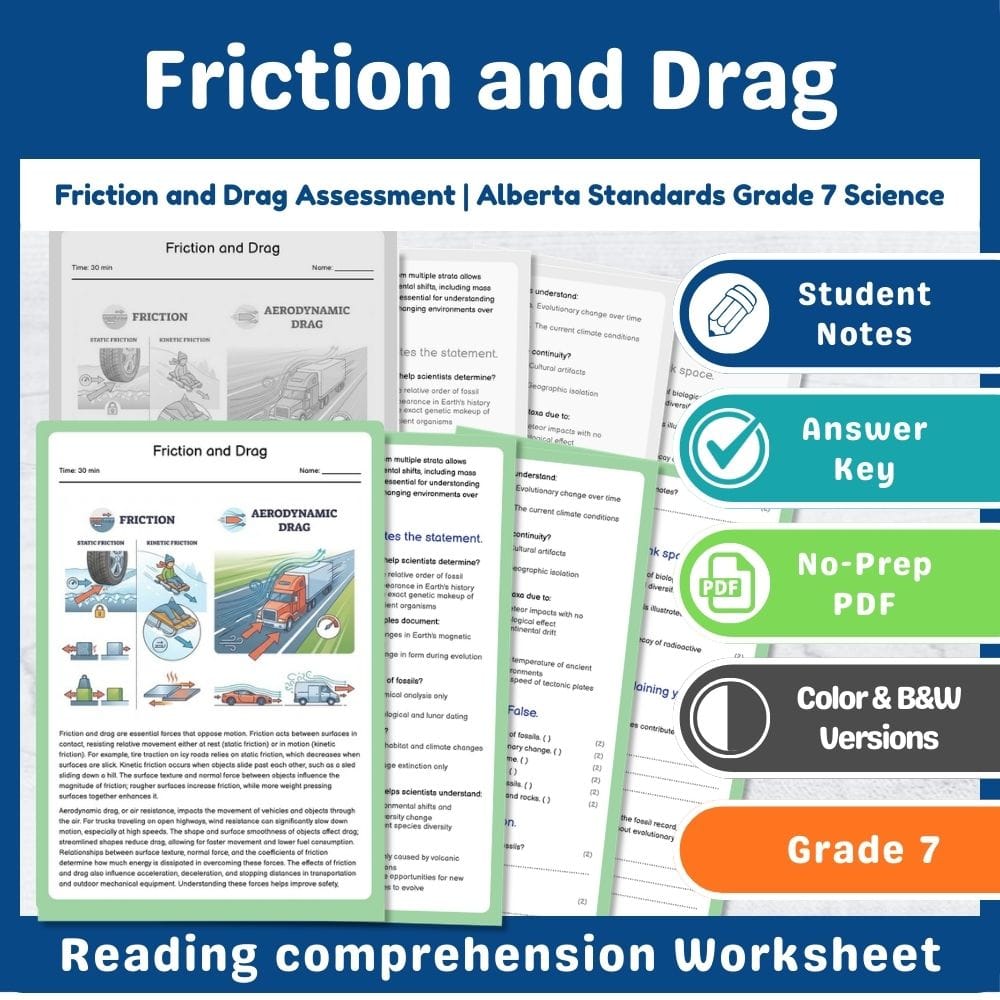
Friction and Drag Assessment | Alberta Standards Grade 7 Science
Created byPrism Point LearningLearning Objectives
- Explain the concepts of static and kinetic friction with examples.
- Describe how surface texture and normal force affect friction.
- Analyze how aerodynamic drag influences motion in real-world scenarios.
Also included in: Lesson Bundle Grade 7 Science Forces Structures and Motion | Alberta Standards +1 more
Instant download
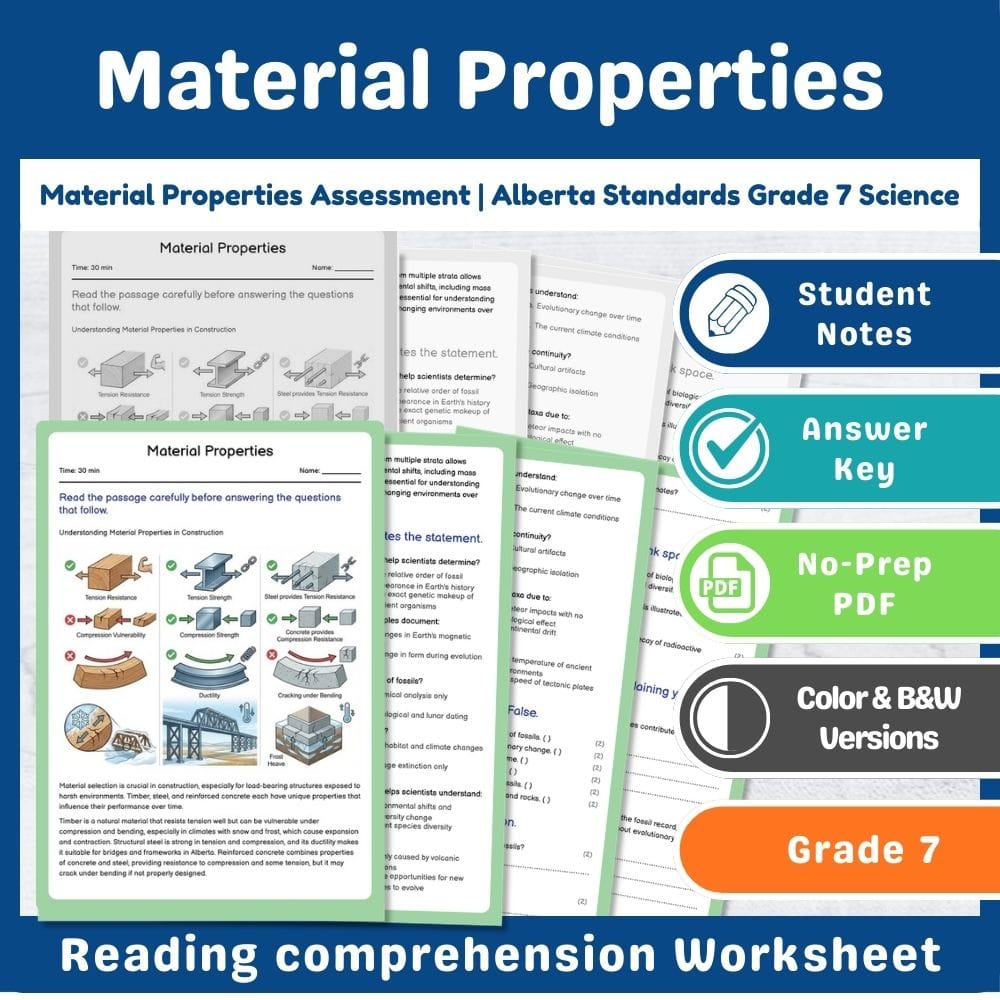
Material Properties Assessment | Alberta Standards Grade 7 Science
Created byPrism Point LearningLearning Objectives
- Understand how different materials perform under compression, tension, and bending.
- Compare timber, structural steel, and reinforced concrete in load-bearing applications.
- Analyze environmental effects on material durability in cold climates such as Alberta.
Also included in: Lesson Bundle Grade 7 Science Forces Structures and Motion | Alberta Standards +1 more
Instant download
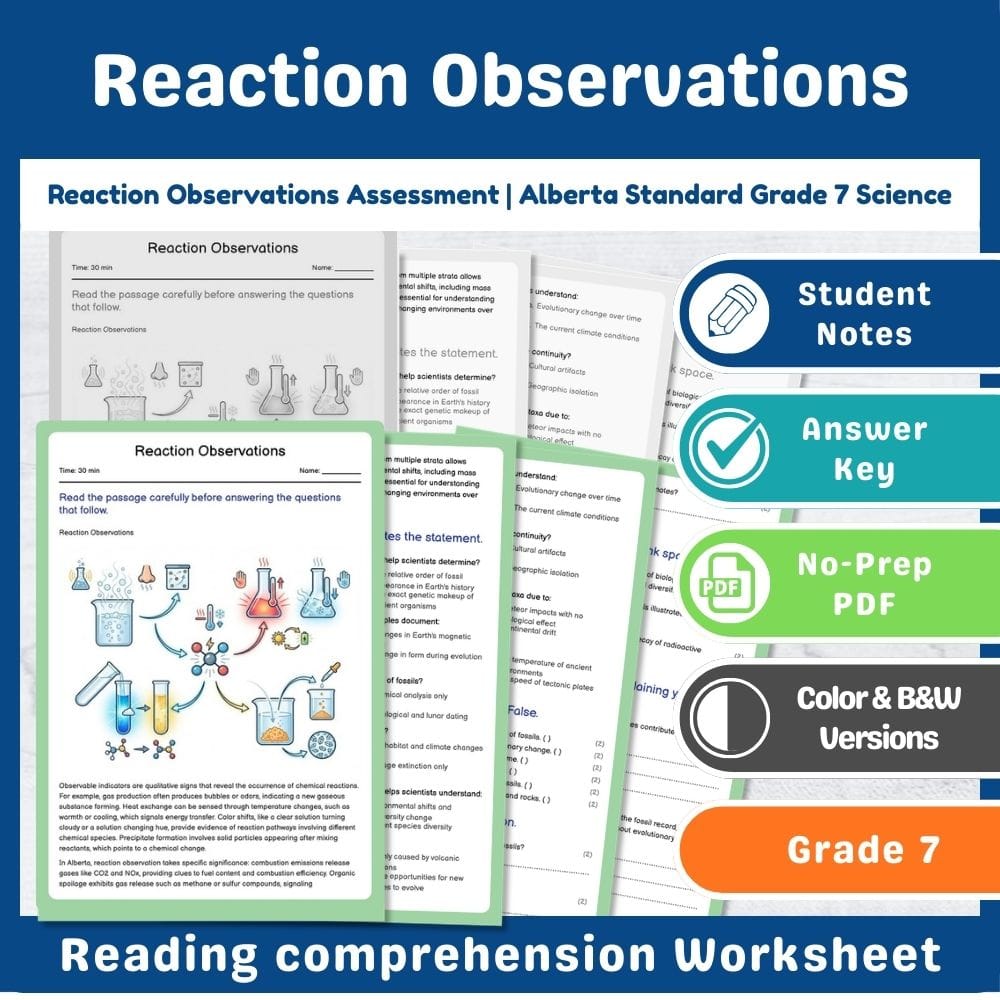
Reaction Observations Assessment | Alberta Standard Grade 7 Science
Created byPrism Point LearningLearning Objectives
- Identify different observable indicators of chemical reactions, such as gas production, color change, heat exchange, and precipitate formation.
- Describe how reaction types and extents can be contextualized through qualitative observations.
- Connect reaction observations to underlying particle interactions and mass changes.
Also included in: Lesson Grade 7 Science Mini Bundle | Matter and Chemical Change +1 more
Instant download
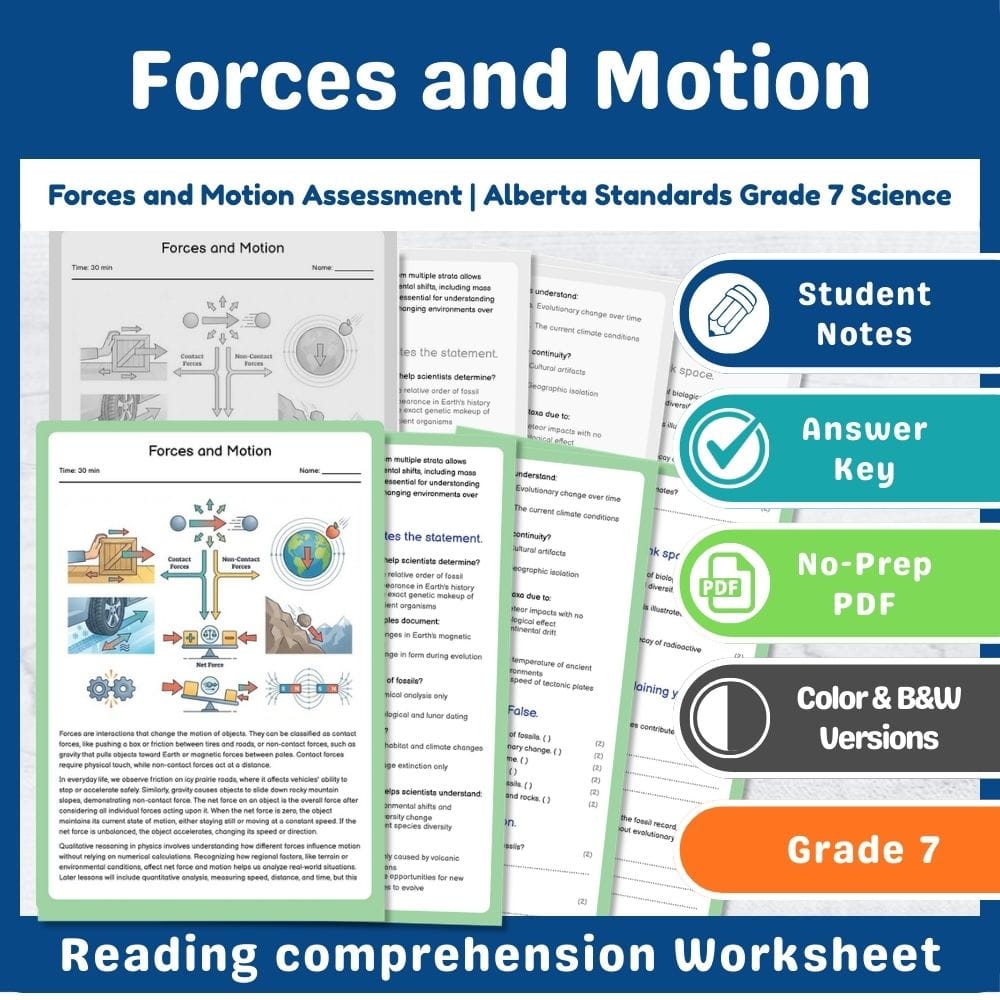
Forces and Motion Assessment | Alberta Standards Grade 7 Science
Created byPrism Point LearningLearning Objectives
- Understand the difference between contact and non-contact forces.
- Explain how net force affects the motion of an object.
- Identify examples of forces in regional contexts such as friction and gravity.
Also included in: Lesson Bundle Grade 7 Science Forces Structures and Motion | Alberta Standards +1 more
Instant download
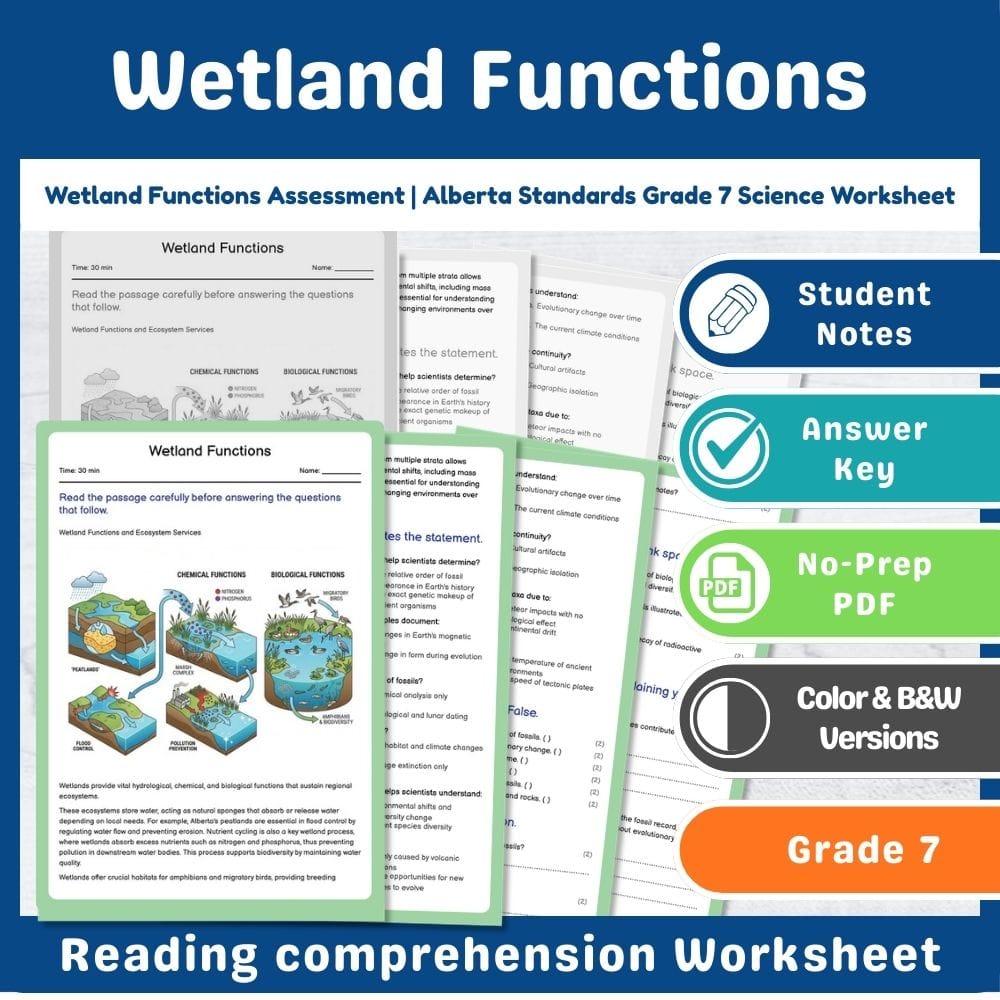
Wetland Functions Assessment | Alberta Standards Grade 7 Science Worksheet
Created byPrism Point LearningLearning Objectives
- Describe the hydrological, chemical, and biological functions of wetlands.
- Identify examples of how wetlands support biodiversity and ecosystem services.
- Explain the functional differences among wetland types such as peatlands and marshes.
Also included in: Lesson Bundle Grade 7 Science - Interactions and Ecosystems +1 more
Instant download
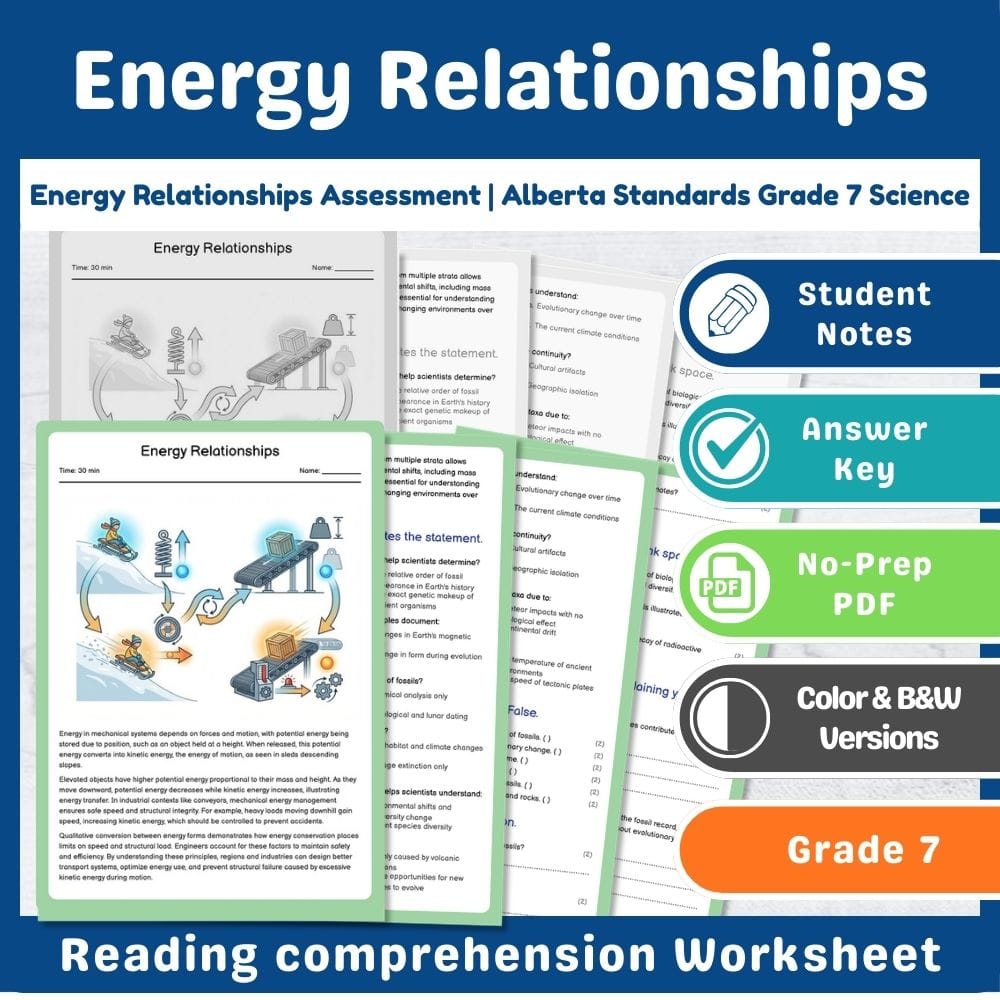
Energy Relationships Assessment | Alberta Standards Grade 7 Science
Created byPrism Point LearningLearning Objectives
- Describe how potential and kinetic energy are linked through energy transfer in mechanical systems.
- Explain how elevation, mass, and speed influence mechanical energy in real-world contexts.
- Interpret qualitative conversions between potential and kinetic energy during motion.
Also included in: Lesson Bundle Grade 7 Science Forces Structures and Motion | Alberta Standards +1 more
Instant download
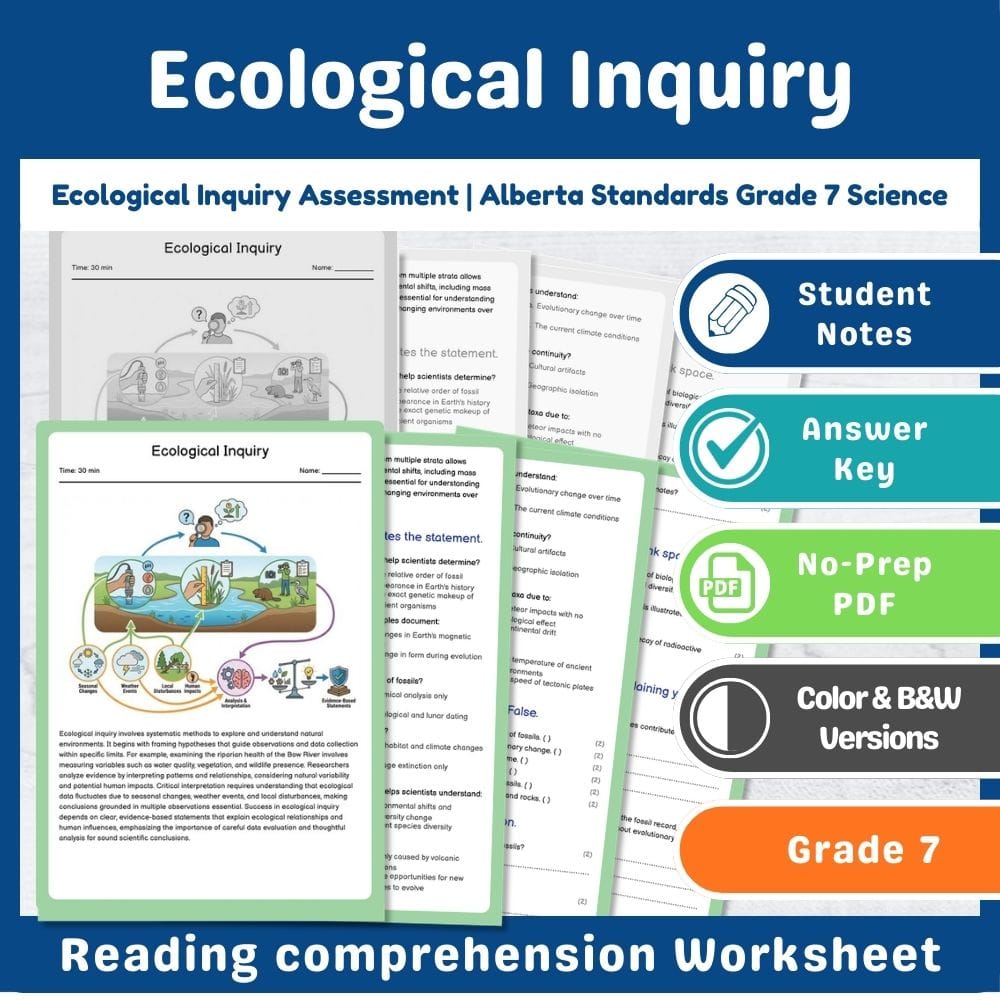
Ecological Inquiry Assessment | Alberta Standards Grade 7 Science
Created byPrism Point LearningLearning Objectives
- Understand the systematic approaches used in ecological inquiry, including posing questions and collecting observations.
- Interpret ecological data within natural variability and evaluate evidence to draw conclusions.
- Recognize local examples such as riparian health assessments and their role in ecological relationships.
Also included in: Lesson Bundle Grade 7 Science - Interactions and Ecosystems +1 more
Instant download
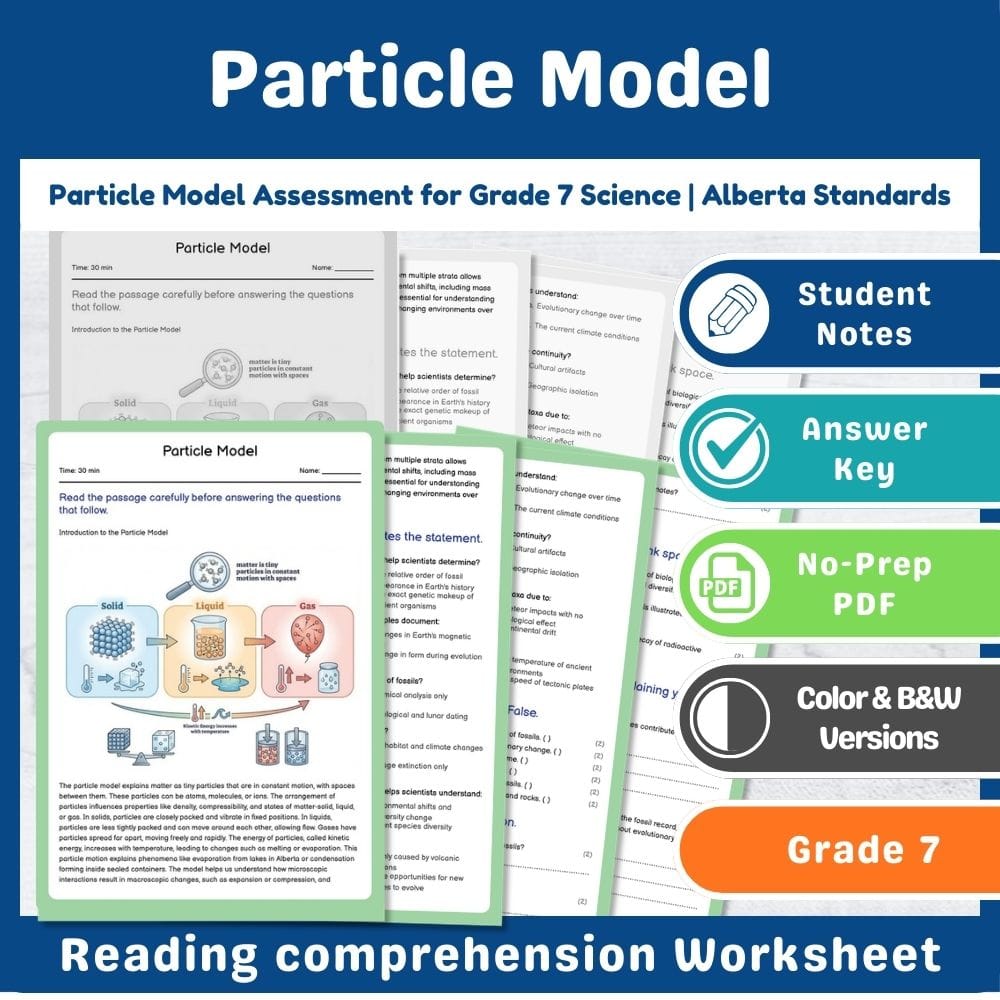
Particle Model Assessment for Grade 7 Science | Alberta Standards
Created byPrism Point LearningLearning Objectives
- Describe the particle model as a representation of matter with particles in constant motion.
- Explain how particle arrangement and kinetic energy determine states of matter, diffusion, and density.
- Relate microscopic particle motion to observable phenomena such as evaporation and condensation.
Also included in: Lesson Grade 7 Science Mini Bundle | Matter and Chemical Change +1 more
Instant download
Grade 7 Science – Signs of Physical Change Daily Reading Worksheet + Answer Key
Learning Objectives
- Identify different signs that indicate a physical change has occurred
- Describe examples of physical changes from real-life scenarios
- Differentiate between physical and chemical changes based on observable signs
Also included in: Grade 7 Science Lesson Bundle | Alberta Framework for Classroom Use +1 more
Instant download
Browse more categories
About Grade 7 Worksheets
Find Grade 7 worksheets covering math, ELA, science, and social studies. All 8,664 resources download instantly as PDFs for classwork, homework, or review.
MyTeachingSheets worksheets are made by real teacher-authors and checked before they go live. Download any as a print-ready PDF for lessons, homework, or independent practice — most include answer keys, and previews are always free.