
Grade 7 Science Worksheets
6,126 worksheets
Science Grade 7: Material Properties Worksheet | NGSS Alignment Grade 7 Science
 Created bySkylark Worksheets
Learning Objectives
- Distinguish physical properties from chemical properties using qualitative and quantitative descriptors.
- Use measurable property data (density, melting point, solubility, conductivity) to compare and identify materials.
- Explain how reactivity and flammability indicate chemical change risk during temperature or contact.
Also included in: Grade 7 Matter, Reactions & Atomic Models Science Lesson Bundle (NGSS) +1 more
Instant download
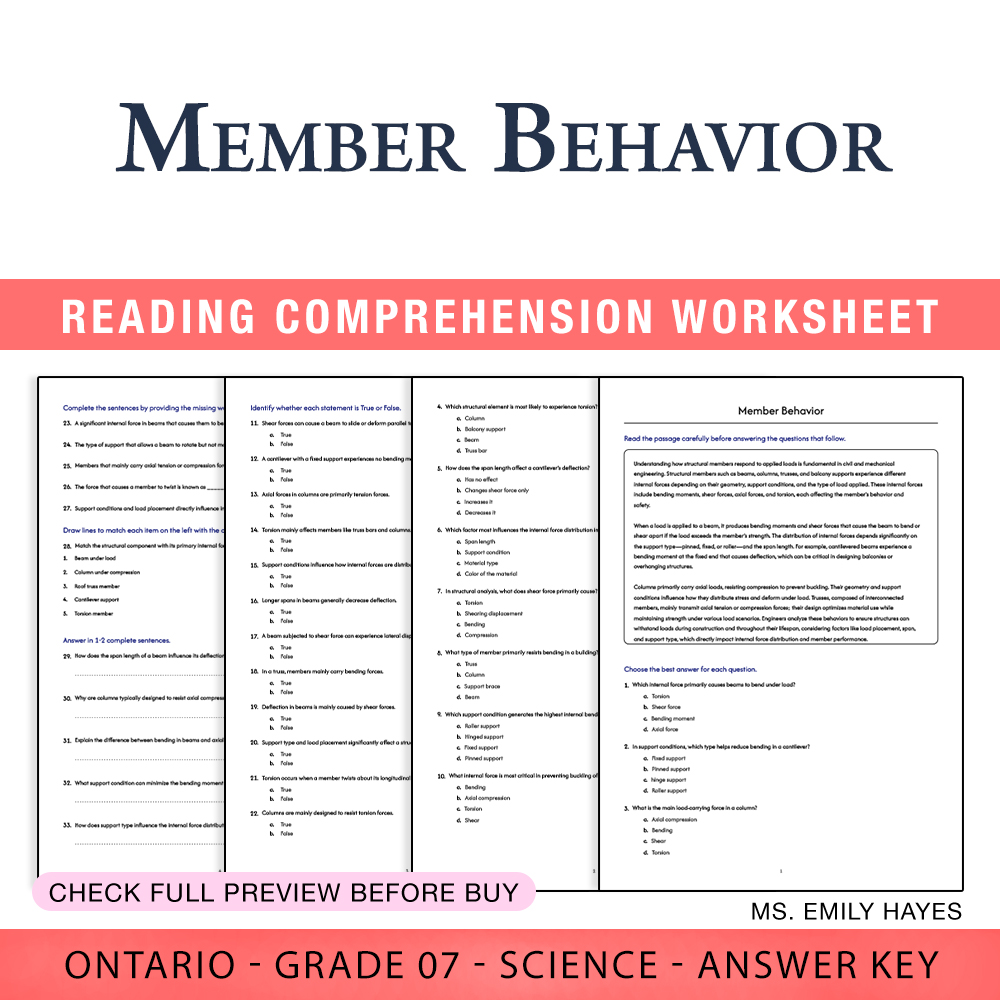
Grade 7 Science | Member Behavior Worksheet (PDF+ Answer Key)
 Created byCopper Leaf Classroom
Learning Objectives
- Describe how structural members respond to loads through bending, shear, axial force, and torsion.
- Relate geometry and support conditions to internal force distribution in beams and columns.
- Explain the effects of bending moment and shear force on deflection and serviceability in beams and cantilevers.
Instant download

Relative Geologic Time Assessment | Florida NGSSS Grade 7 Science
 Created byPrism Point Learning
Learning Objectives
- Explain how the law of superposition and cross-cutting relationships help determine the relative order of geologic events.
- Identify which rock layers or features are older or younger based on observable evidence.
- Use relative dating reasoning to construct a simple geologic history when numerical ages are not available.
Also included in: Grade 7 Earth and Climate Systems Science Lesson Bundle: Florida NGSSS
Instant download

Grade 7 Science | Member Behaviour Worksheet (Ontario) PDF
 Created byEvergreen Desk Education
Learning Objectives
- Explain how bending, shear, axial force, and torsion affect structural members.
- Relate support conditions and load placement to internal force distribution in beams and cantilevers.
- Describe how bending moment and shear force influence deflection and serviceability.
Also included in: Grade 7 Engineering Design & Materials Science Lesson Bundle Ontario +1 more
Instant download
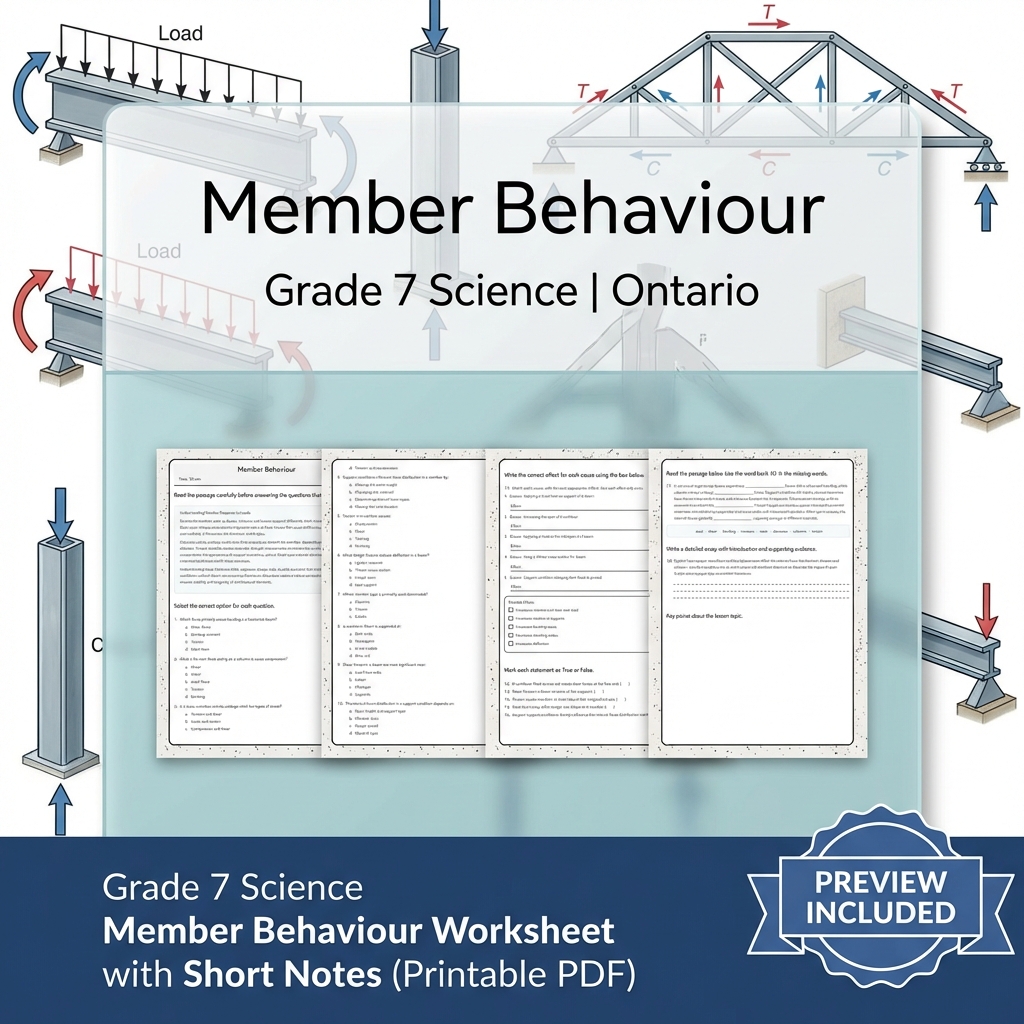
Grade 7 Science Member Behaviour Worksheet with Short Notes (Printable PDF)
 Created byMeadowlark Worksheets
Learning Objectives
- Describe how structural members respond to applied loads through different types of forces.
- Relate geometry and support conditions to internal force distribution in beams and columns.
- Explain the effects of bending, shear, axial forces, and torsion on member deflection and serviceability.
Also included in: Grade 7 Science Lesson Group | Ontario Curriculum Worksheets Bundle +1 more
Instant download

Grade 7 Member Behaviour Worksheet | Forces, Loads & Structural Response
 Created byChalk and Compass
Learning Objectives
- Describe how structural members respond to applied loads through bending, shear, axial force, and torsion
- Connect bending moment and shear force to deflection and serviceability in beams and cantilevers
- Contrast bending-dominated members with axial-dominated members such as columns and truss bars
Also included in: Grade 7 Science Structural Engineering Design & Materials Lesson Bundle |Ontario +1 more
Instant download

Grade 7 Member Behaviour Worksheet | Ontario Science Activity PDF
 Created byClear Sky Classroom
Learning Objectives
- Describe how beams and cantilevers respond to loads through bending, shear, and deflection
- Relate support conditions and load placement to internal force distribution (bending moment and shear force)
- Contrast bending-dominated members with axial-dominated members such as columns and truss bars
Instant download

Science Worksheet Member Behaviour Beams Cantilevers Axial Members Grade 7
Learning Objectives
- Explain how applied loads create internal forces (bending moment, shear force, axial force, and torsion) in structural members.
- Describe how beam and cantilever support conditions affect deflection and serviceability.
- Compare bending- and shear-dominated members with axial-dominated members such as columns and truss bars.
Instant download
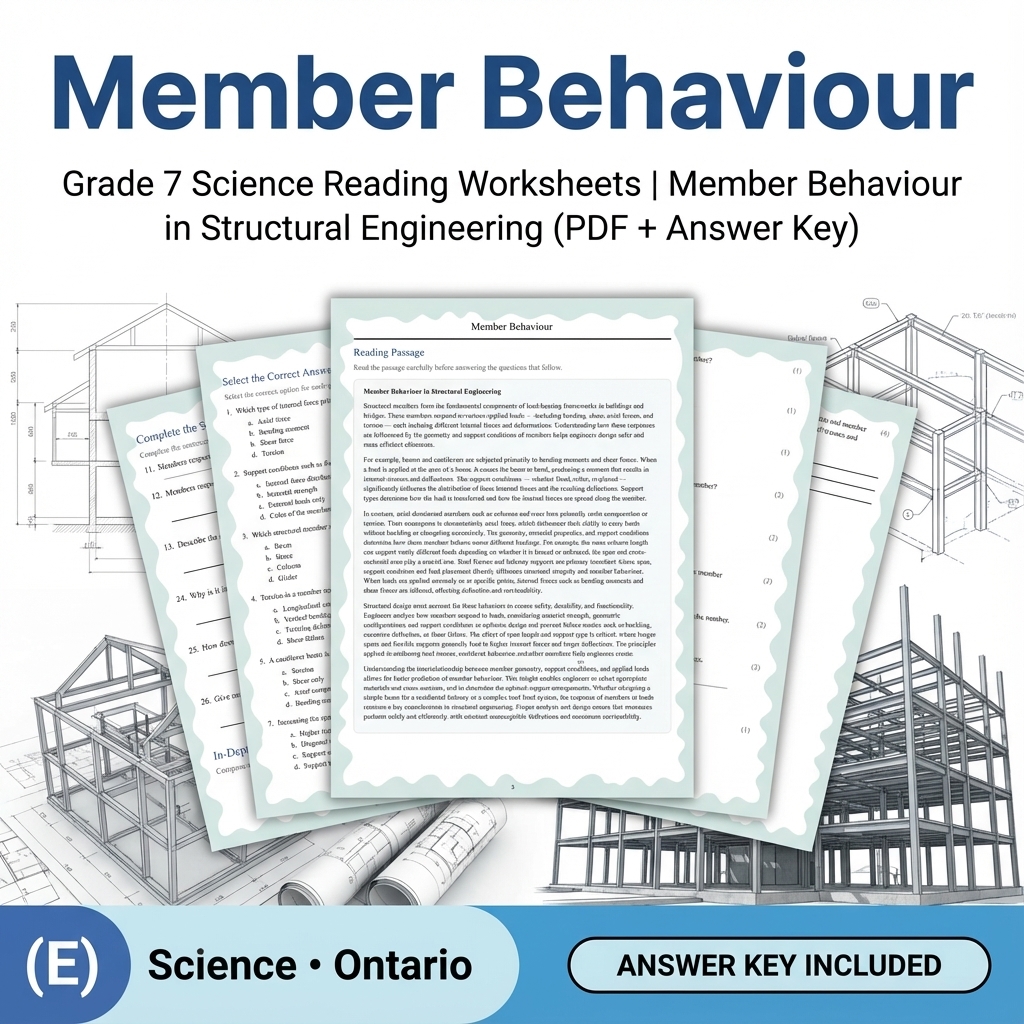
Grade 7 Science | Member Behaviour in Structural Engineering (PDF + Answer Key)
Learning Objectives
- Understand how structural members respond to different types of loads such as bending, shear, axial force, and torsion.
- Relate the geometry and support conditions of members to internal force distribution in structural elements.
- Describe how bending moments and shear forces affect deflection and serviceability in beams and cantilevers.
Also included in: Grade 7 Science Unit Bundle – Structural Engineering & Material Testing +1 more
Instant download

Grade 7 Science Worksheet | Technical Communication & TEKS Standards (PDF)
Created byEvergreen Desk EducationLearning Objectives
- Explain how standardized symbols, labels, and units improve clarity in technical communication.
- Identify key differences between orthographic, isometric, and schematic representations.
- Use conventions for dimensions and tolerances to make a drawing or specification easier to evaluate and replicate.
Instant download
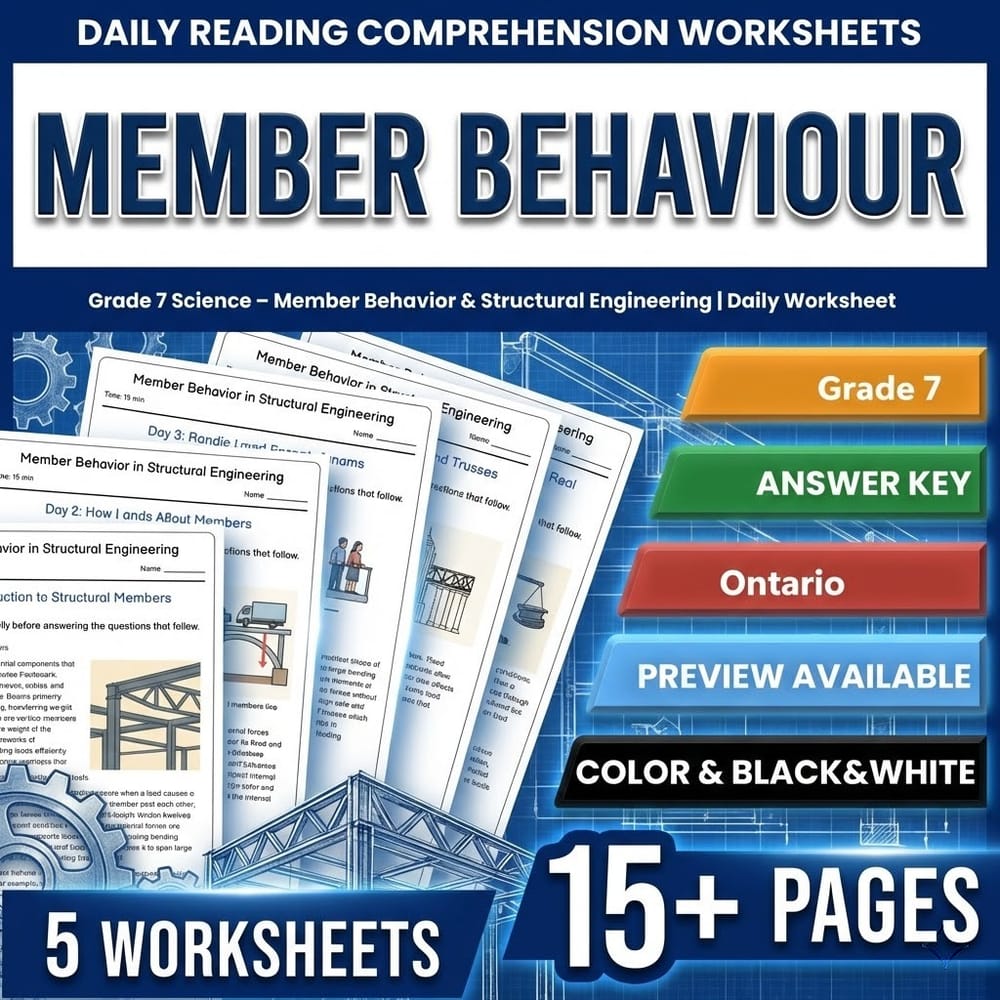
Grade 7 Science – Member Behavior & Structural Engineering | Daily Worksheet
 Created byQuiet Forest Education
Learning Objectives
- Identify different types of structural members such as beams, columns, trusses, and cantilevers.
- Understand how structural members respond to loads through bending, shear, axial force, and torsion.
- Relate geometry and support conditions to internal force distribution in structures.
Also included in: Structural Engineering Grade 7 Science Daily Reading Worksheets Bundle | Ontario +1 more
Instant download
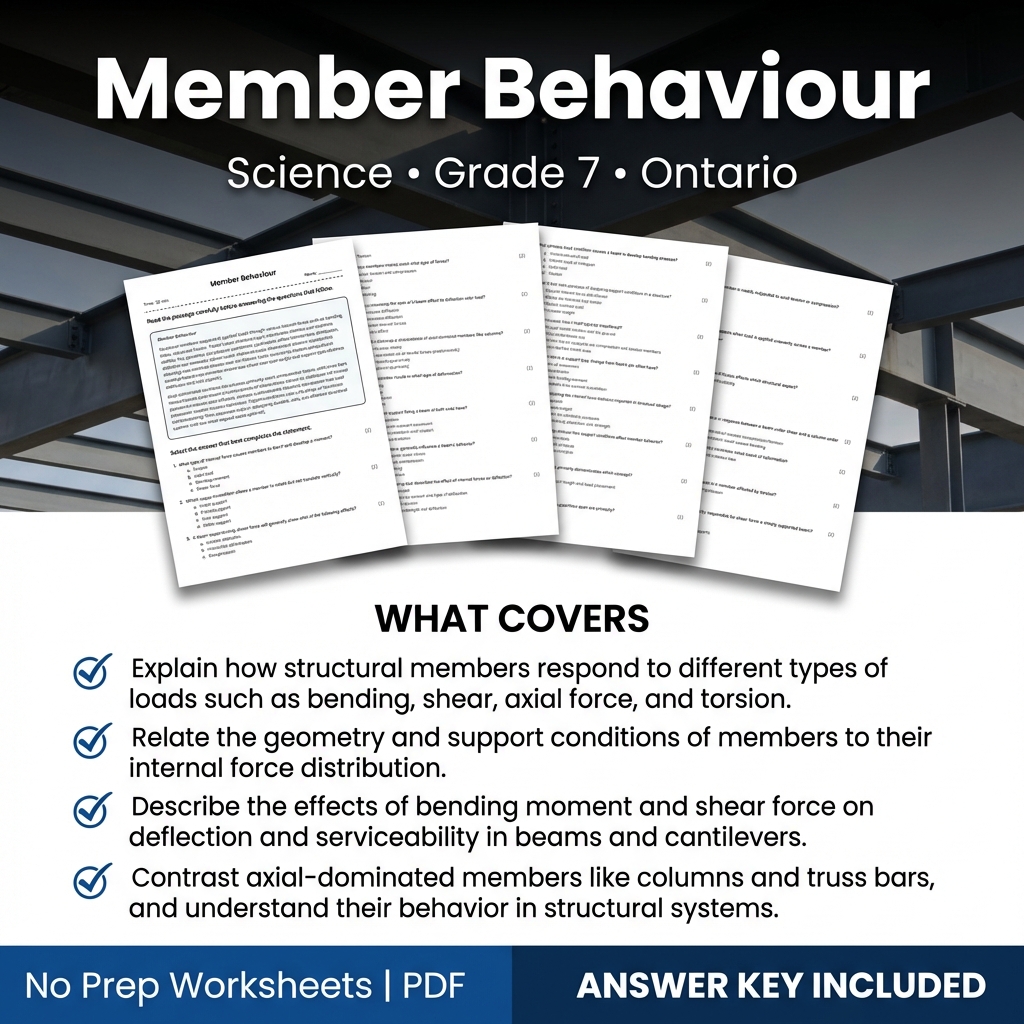
Member Behaviour Grade 7 Science Worksheet | Ontario Standards PDF
 Created byCoral Reef Learning
Learning Objectives
- Explain how structural members respond to different types of loads such as bending, shear, axial force, and torsion.
- Relate the geometry and support conditions of members to their internal force distribution.
- Describe the effects of bending moment and shear force on deflection and serviceability in beams and cantilevers.
Instant download
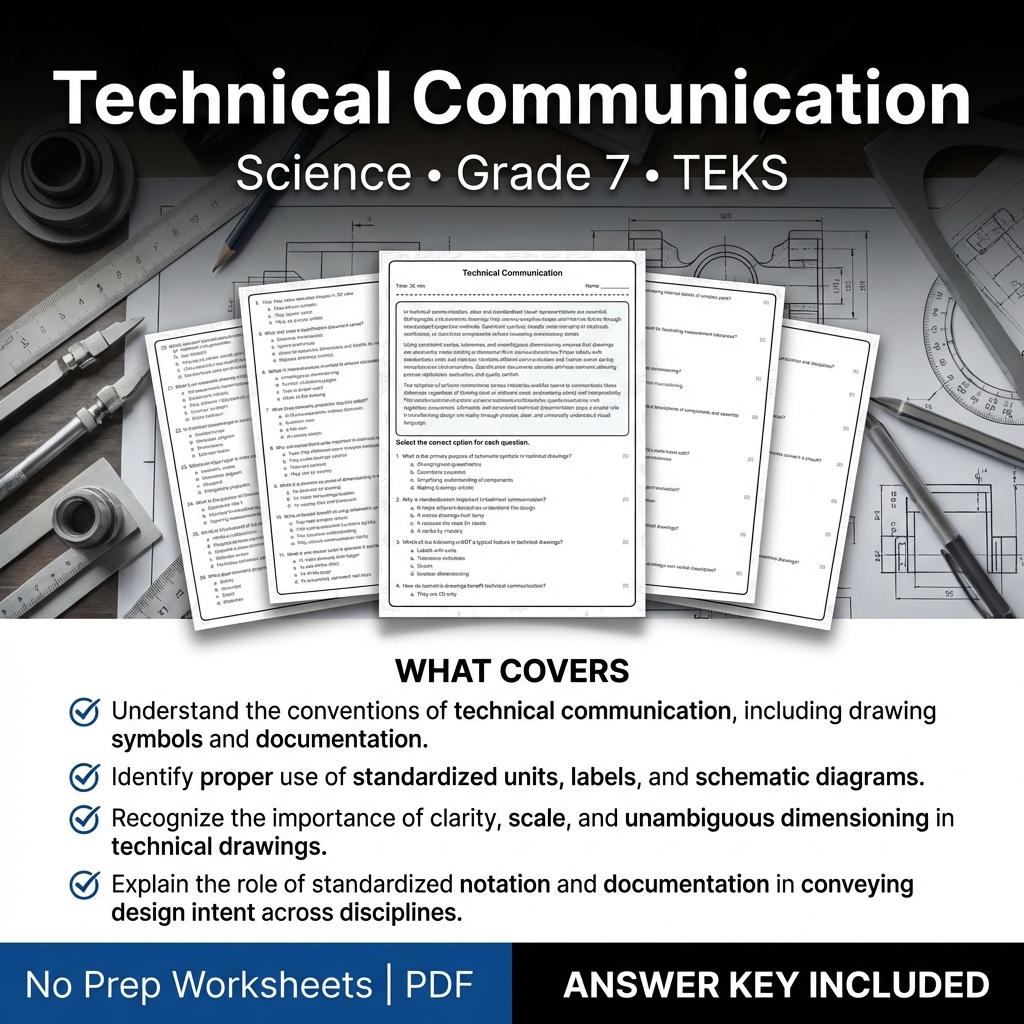
Grade 7 Science Worksheet on Technical Communication TEKS aligned
Created byCoral Reef LearningLearning Objectives
- Understand the conventions of technical communication, including drawing symbols and documentation.
- Identify proper use of standardized units, labels, and schematic diagrams.
- Recognize the importance of clarity, scale, and unambiguous dimensioning in technical drawings.
Instant download

Beam and Column Internal Forces Worksheets: Grade 7 Science
Created byPrism Point LearningLearning Objectives
- Describe how beams respond to bending, shear, axial force, and torsion
- Relate support type and load placement to internal forces
- Explain how bending moment and shear affect beam deflection
Also included in: Grade 7 Structural Performance Lesson Bundle | Ontario Science +1 more
Instant download
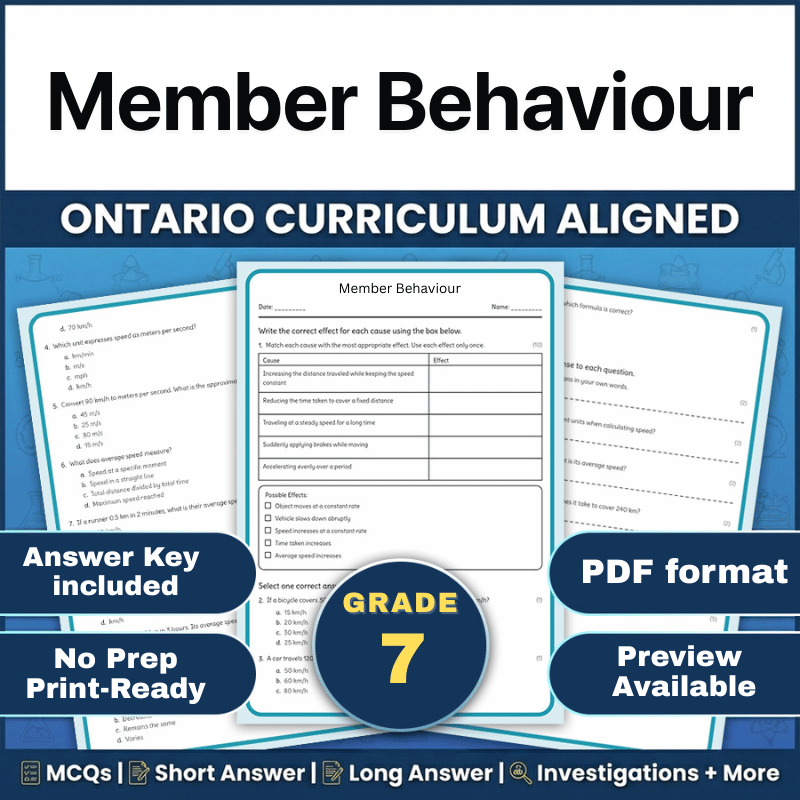
Grade 7 Science – Member Behaviour Worksheet (Ontario) (PDF)
 Created byBright Mind Resources
Learning Objectives
- Understand how structural members respond to loads through bending, shear, axial force, and torsion.
- Relate geometry and support conditions to internal force distribution in beams and columns.
- Describe the effects of bending moment and shear force on deflection and serviceability.
Instant download

Grade 7 Science – Empirical Knowledge & Scientific Processes | Reading Worksheet
Created byBright Mind ResourcesLearning Objectives
- Define empirical knowledge and explain its role in scientific investigations.
- Identify evidence through observation and measurement.
- Understand how scientific explanations are supported or revised based on evidence.
Also included in: Grade 7 Variables Science lesson-bundle daily reading worksheets | Florida NGSSS +1 more
Instant download
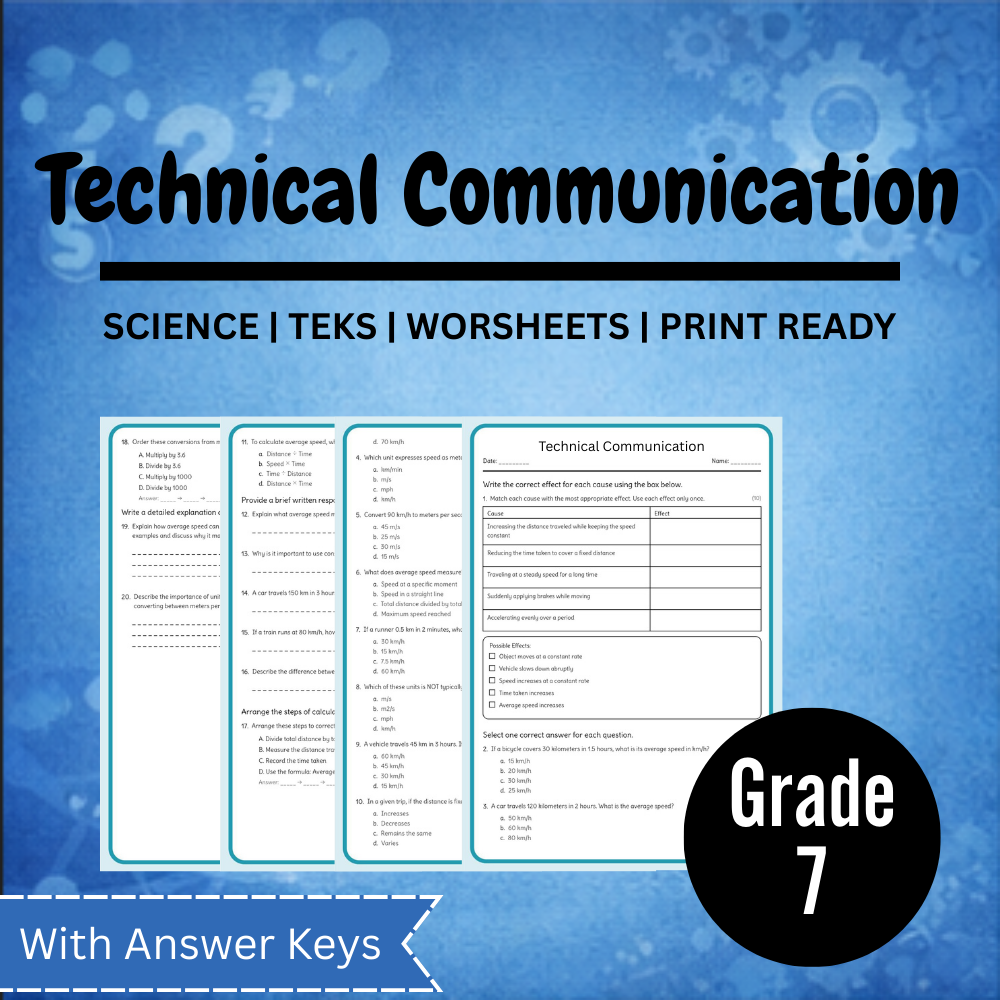
Grade 7 Science | Technical Communication Worksheet (Worksheet + Answer Key) – TEKS Aligned
Created byBright Mind ResourcesLearning Objectives
- Identify and understand the conventions used in technical drawings and diagrams.
- Recognize standardized symbols, units, and labels used in engineering documentation.
- Explain the importance of clarity and unambiguity in technical communication.
Also included in: Grade 7 Science Unit Bundle | Standards, Safety, Innovation & Systems Aligned TEKS +2 more
Instant download

Science Worksheet: Empirical Knowledge Practice | NGSSS Grade 7 Science
Learning Objectives
- Explain what empirical knowledge means and why evidence from observations and measurements matters.
- Describe how uncertainty and transparency support scientific reasoning.
- Use evidence to evaluate an explanation and consider alternative interpretations.
Also included in: Grade 7 Scientific Variables, Data, and Models Science Lesson Bundle +1 more
Instant download

Science Worksheet Inheritance Probability | NGSS Grade 7 Science Assessment
Created bySkylark WorksheetsLearning Objectives
- Use probability to predict expected genotype and phenotype ratios from monohybrid crosses.
- Connect Punnett square outcomes to inheritance probabilities.
- Explain how larger populations better match predicted ratios due to random chance.
Also included in: Grade 7 Genetics: Traits Inheritance Science Lesson Bundle for NGSS +1 more
Instant download
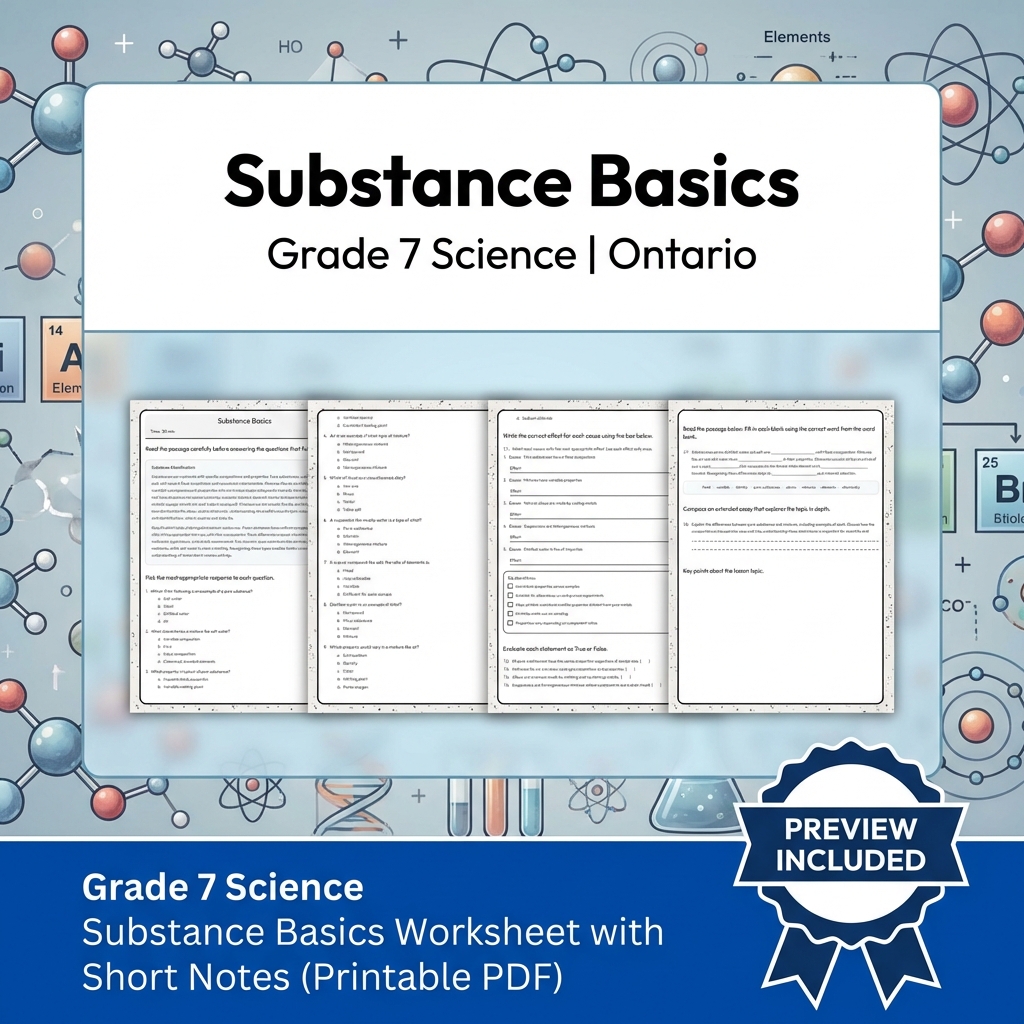
Grade 7 Science Substance Basics Worksheet with Short Notes (Printable PDF)
Created byMeadowlark WorksheetsLearning Objectives
- Understand the classification of pure substances and mixtures based on composition and uniformity.
- Identify examples of elements, compounds, and mixtures in everyday contexts.
- Differentiate between pure substances and mixtures using properties and characteristics.
Also included in: Grade 7 Science Lesson Group Bundle – Ontario Curriculum Worksheets +1 more
Instant download
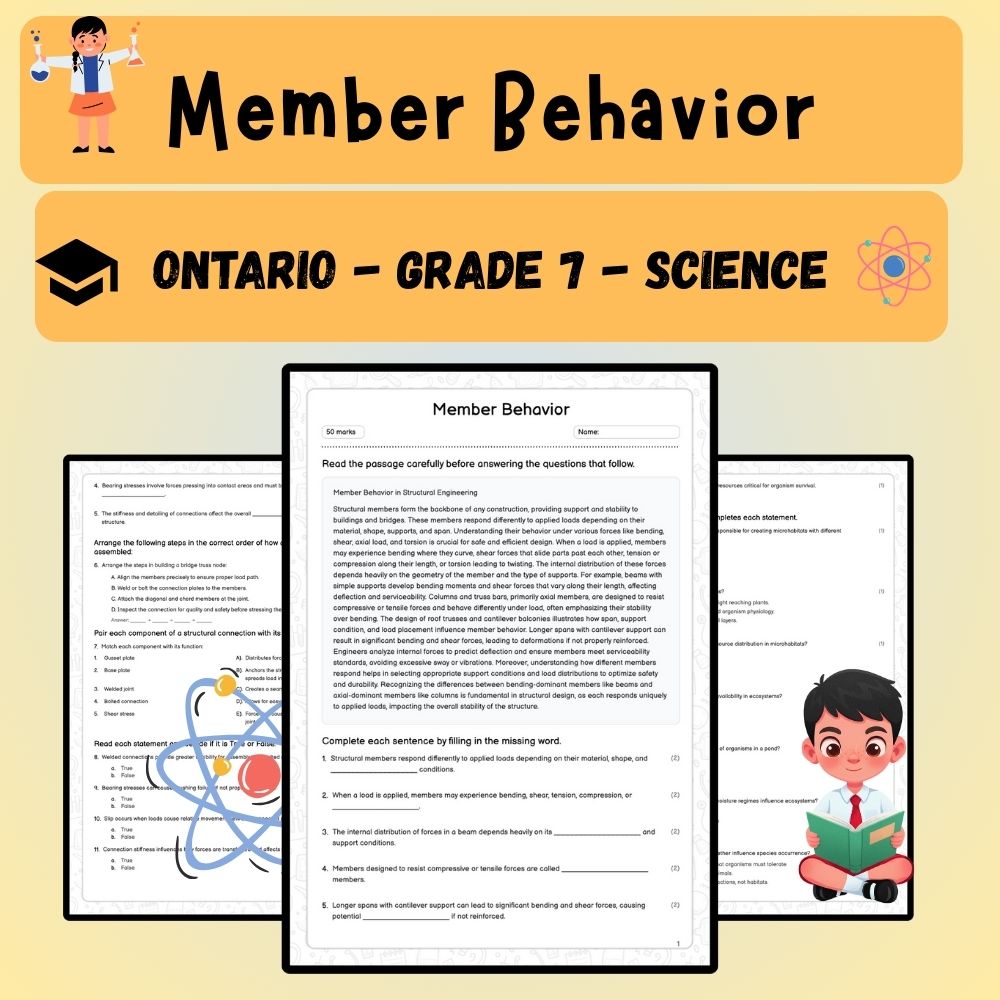
Grade 7 Science – Structural Members & Load Analysis Worksheet (PDF )
Created byPrism Point LearningLearning Objectives
- Explain how structural members respond to loads through bending, shear, axial force, and torsion.
- Relate geometry and support conditions to internal force distribution in beams and columns.
- Describe the effects of bending moment and shear force on deflection and serviceability.
Also included in: Grade 7 Science Unit | Structural Engineering & Material Testing Worksheets Bundle +1 more
Instant download
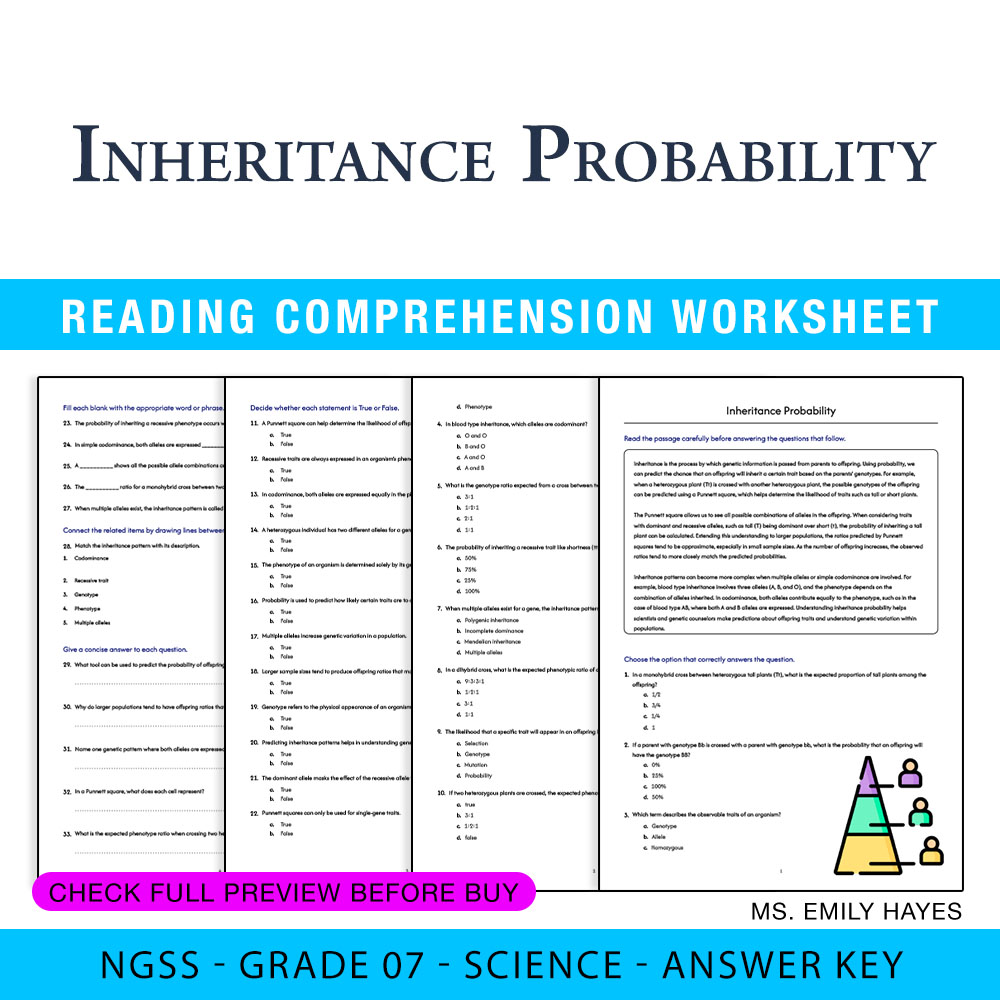
7th Grade Science | Inheritance Probability Worksheet (PDF+ Answer Key)
Created byCopper Leaf ClassroomLearning Objectives
- Understand how probability concepts apply to genetic inheritance and predict offspring traits using Punnett squares.
- Calculate expected genotype and phenotype ratios for monohybrid crosses involving dominant and recessive alleles.
- Connect outcomes of Punnett squares to the probability of inheritance and extend predictions to larger populations.
Instant download

Technical Communication Worksheet Pack | Grade 7 Science Activities
Created byPrism Point LearningLearning Objectives
- Identify key conventions in technical communication, including labels, units, and unambiguous dimensioning
- Use standardized notation to interpret and create clear diagrams and schematic information
- Explain how specification documents support replication, evaluation, and cross-discipline collaboration
Also included in: Grade 7 Technology & Engineering Design in Science: Lesson Bundle TEKS
Instant download

Grade 7 Science | Member Behaviour in Structural Engineering - Comprehension
Created byCoral Reef LearningLearning Objectives
- Understand how structural members respond to various loads through bending, shear, axial force, and torsion.
- Relate the geometry and support conditions of beams and columns to internal force distribution.
- Describe the effects of bending moment and shear force on beam deflection and serviceability.
Instant download

Grade 7 Science | Understanding Stoichiometry - Daily Reading Comprehension
Created byCoral Reef LearningLearning Objectives
- Identify chemical formulas and distinguish between reactants and products in a chemical equation.
- Understand the mole concept and its application in quantifying substances.
- Use balanced symbolic equations to determine ratios of substances involved in chemical reactions.
Instant download
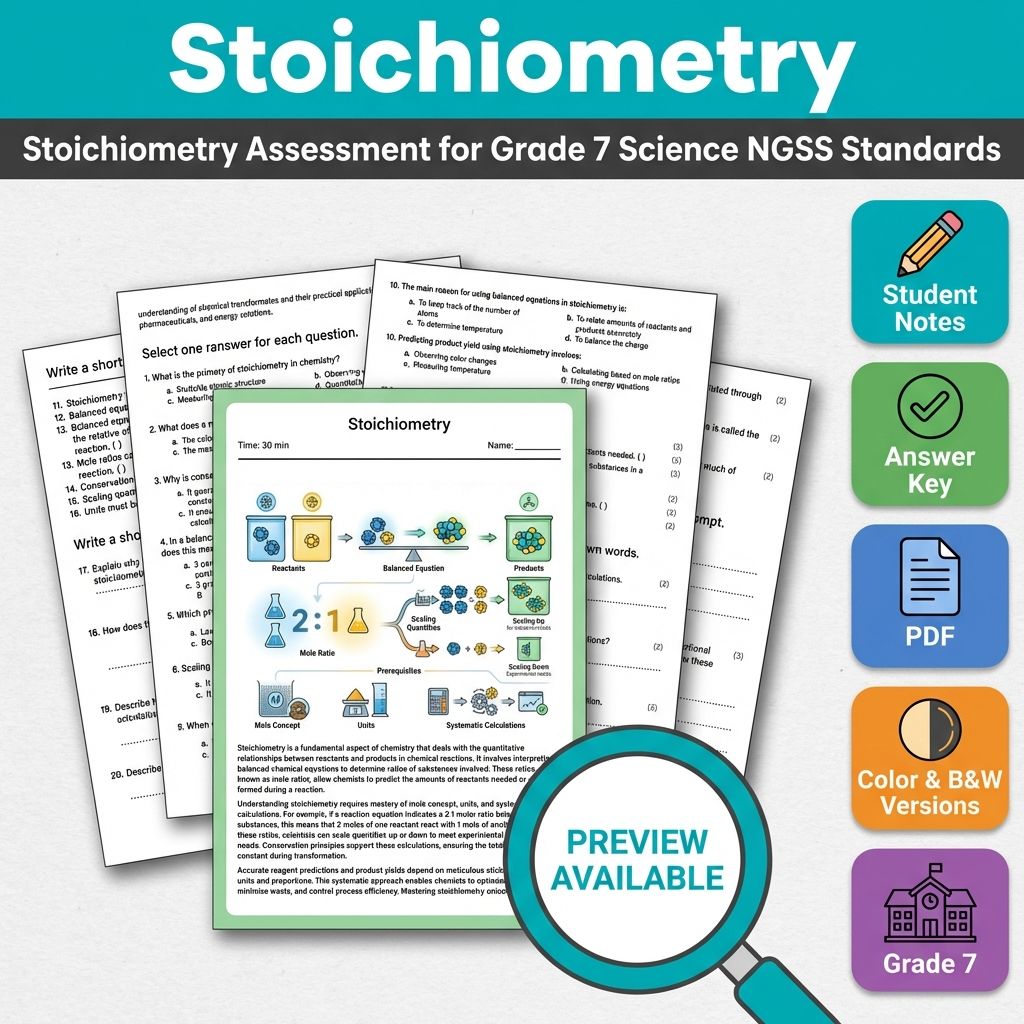
Stoichiometry Assessment for Grade 7 Science NGSS Standards
Created byPrism Point LearningLearning Objectives
- Describe how balanced chemical equations depict the quantitative relationships between reactants and products.
- Understand and apply mole ratios to calculate amounts of substances involved in chemical reactions.
- Use conservation of mass principles to predict reagent requirements and product yields in chemical transformations.
Also included in: Grade 7 Science Lesson | Matter and Its Interactions Standards +1 more
Instant download
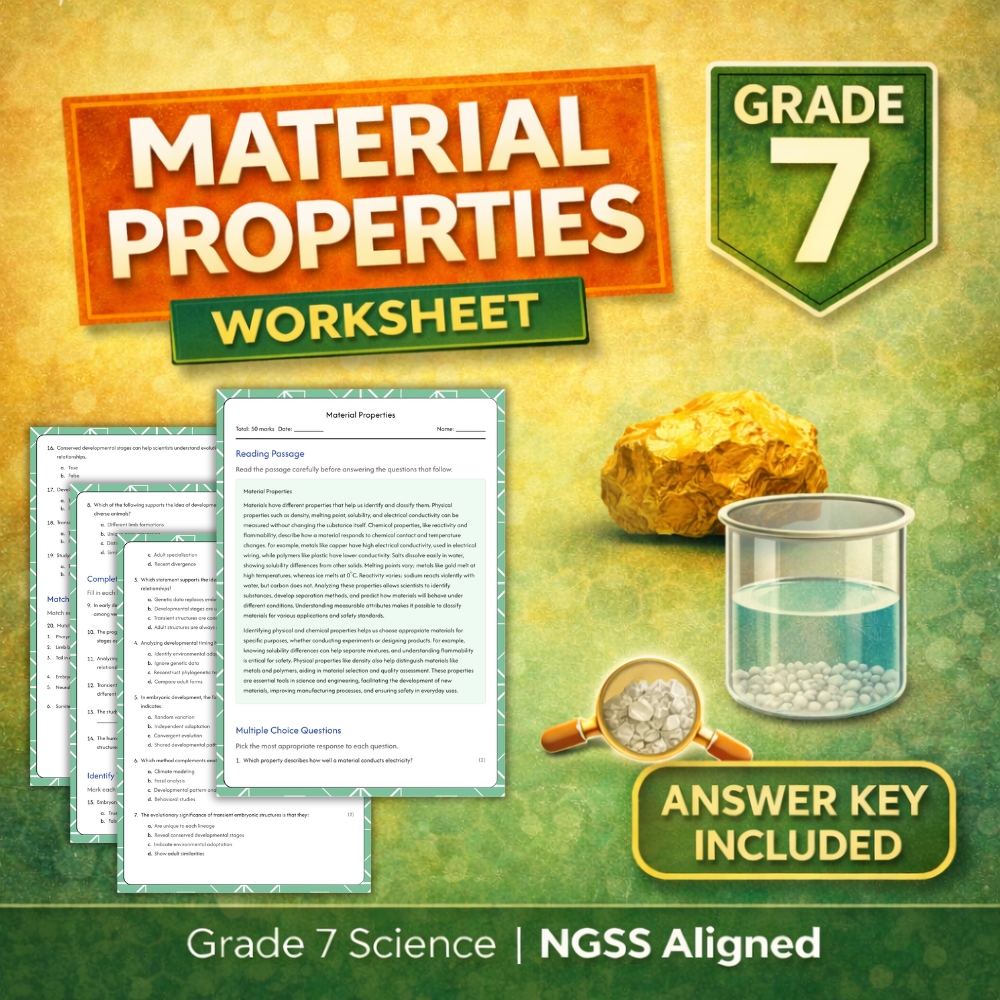
7th Grade Science | Material Properties Worksheet (NGSS & Answer Key)
 Created byCedar Grove Learning
Learning Objectives
- Distinguish between physical and chemical properties of materials.
- Identify measurable descriptors such as density, melting point, solubility, conductivity, reactivity, and flammability.
- Analyze property data to support material identification and separation strategies.
Instant download

Grade 7 Science | Energy Transfer Overview Worksheet | Florida NGSSS Aligned
 Created byLumora Learning
Learning Objectives
- Explain how energy transfers from higher-energy systems to lower-energy systems.
- Identify ways energy can transform (such as thermal, kinetic, and light energy) during everyday events.
- Connect energy transfer to observable effects like temperature change, motion, and light emission.
Instant download

Material Properties Worksheets: Physical & Chemical Properties Grade 7
 Created bythe curious pencil
Learning Objectives
- Distinguish physical properties from chemical properties
- Describe how density and melting point identify materials
- Explain how solubility and conductivity characterize materials
Also included in: Matter and Its Interactions Worksheets | Grade 7 Science NGSS +2 more
Instant download
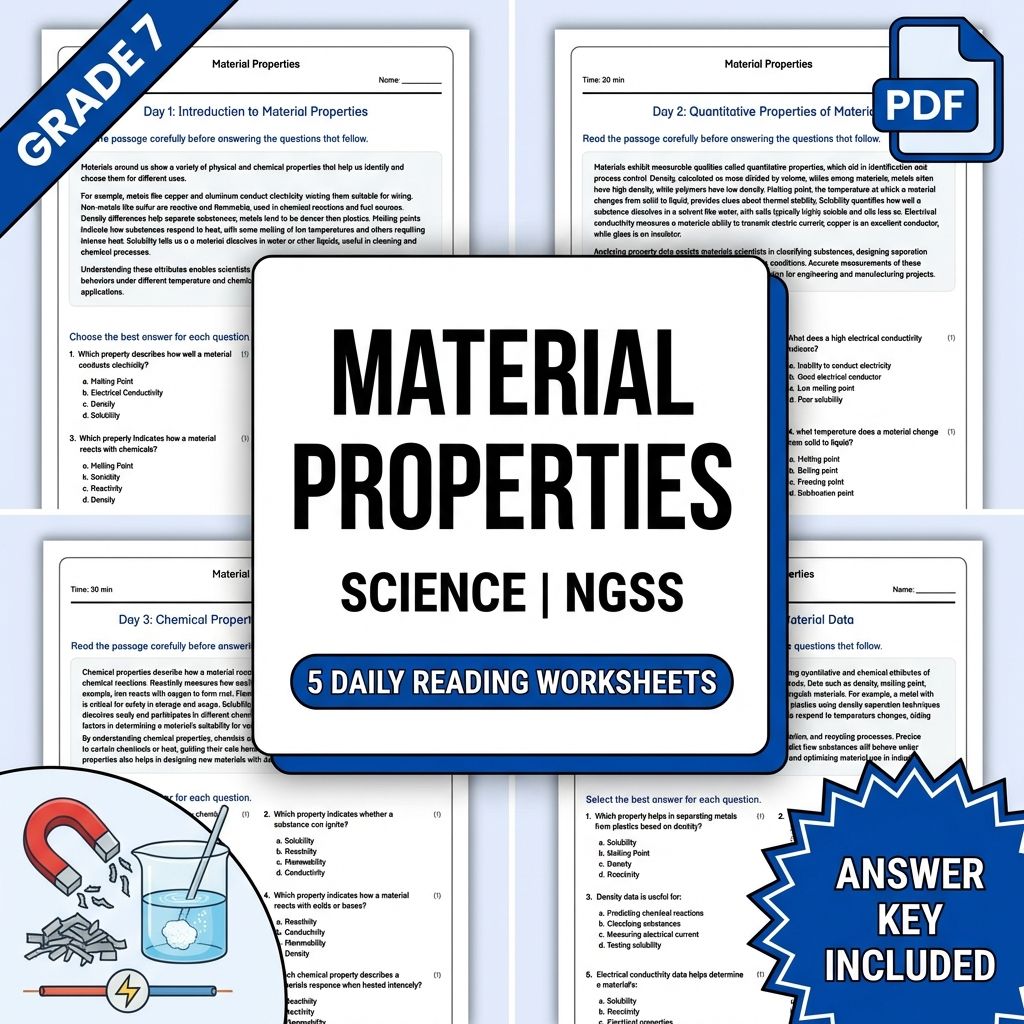
7th Grade Science | Material Properties Worksheet(PDF + Answer Key)
Created byCopper Leaf ClassroomLearning Objectives
- Distinguish physical and chemical properties of materials with descriptive attributes.
- Identify measurable properties such as density, melting point, solubility, electrical conductivity, reactivity, and flammability.
- Analyze property data to aid in material identification and separation strategies.
Instant download
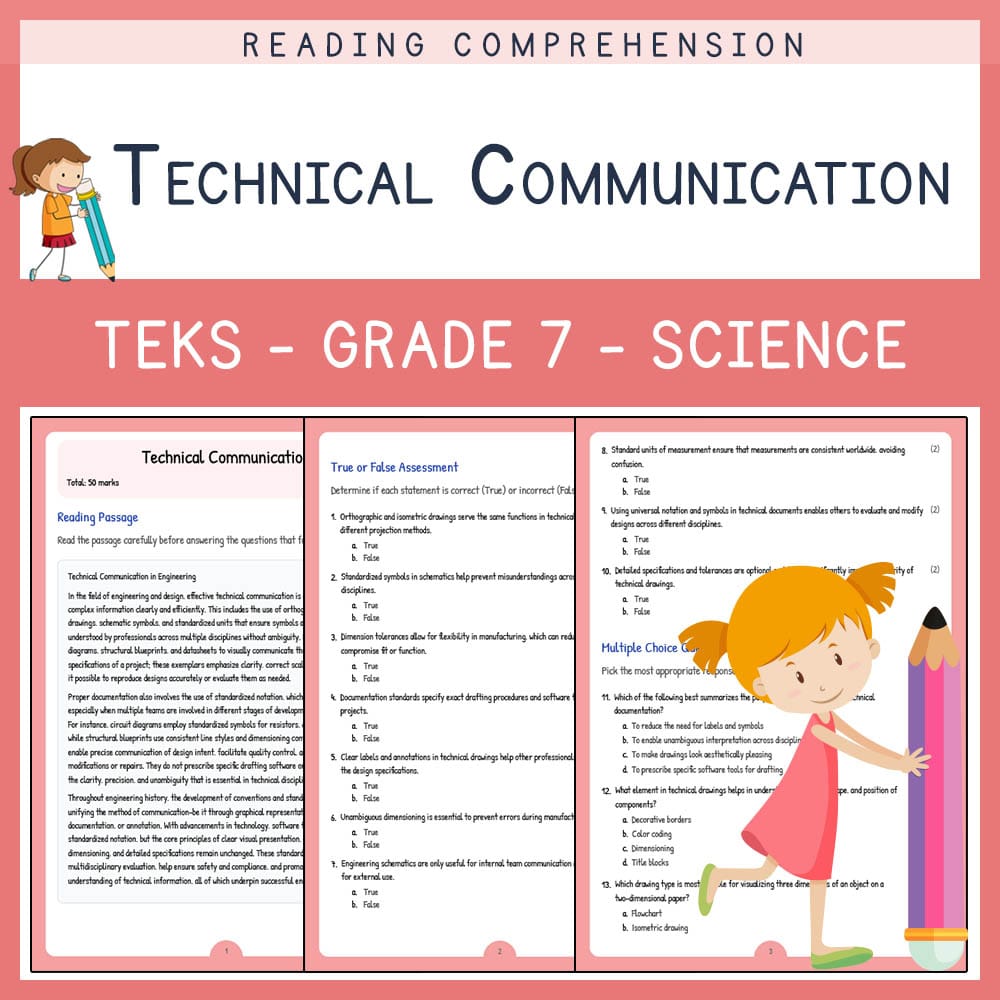
Grade 7 Science | Technical Communication Worksheet | TEKS Aligned
Created byLumora LearningLearning Objectives
- Understand the conventions of technical communication including drawings, schematics, and documentation.
- Identify and interpret standardized symbols, units, and labels used in engineering diagrams.
- Explain the importance of clarity, scale, and unambiguous dimensioning in technical drawings.
Instant download

Grade 7 Friction And Resistance Worksheet | NGSS Practice PDF
Created byClear Sky ClassroomLearning Objectives
- Explain how friction and other resistive forces oppose motion.
- Compare how surface texture and air resistance affect how quickly objects slow down.
- Use direction of net force to describe realistic (not ideal) motion.
Instant download

Friction and Air Resistance Worksheet for Grade 7 Science Activities
Created byPrism Point LearningLearning Objectives
- Explain how friction and air resistance oppose motion and reduce an object's speed.
- Describe how surface texture and contact between surfaces affect the strength of resistive forces.
- Use the idea of resistive forces acting opposite motion to predict how quickly objects slow down.
Also included in: Physical Science Lesson Bundle | Grade 7 Science | Florida NGSSS
Instant download

Grade 7 Science – Energy Transfer & Heat Movement | Daily Reading Worksheet
Created byBright Mind ResourcesLearning Objectives
- Understand the basic concepts of energy transfer and transformation
- Identify examples of energy transfer in daily life
- Explain how energy moves from objects with higher energy to those with lower energy
Also included in: Grade 7 Daily Reading Science Worksheets Lesson Bundle | Florida NGSSS +1 more
Instant download

Grade 7 Technical Communication Science Daily Reading Worksheet | TEKS
 Created byBRIGHT PATH RESOURCES
Learning Objectives
- Identify the purpose of a technical text.
- Determine the main idea using evidence from the passage.
Also included in: Engineering Design Grade 7 Science Daily Reading Worksheets Lesson Bundle | TEKS +1 more
Instant download
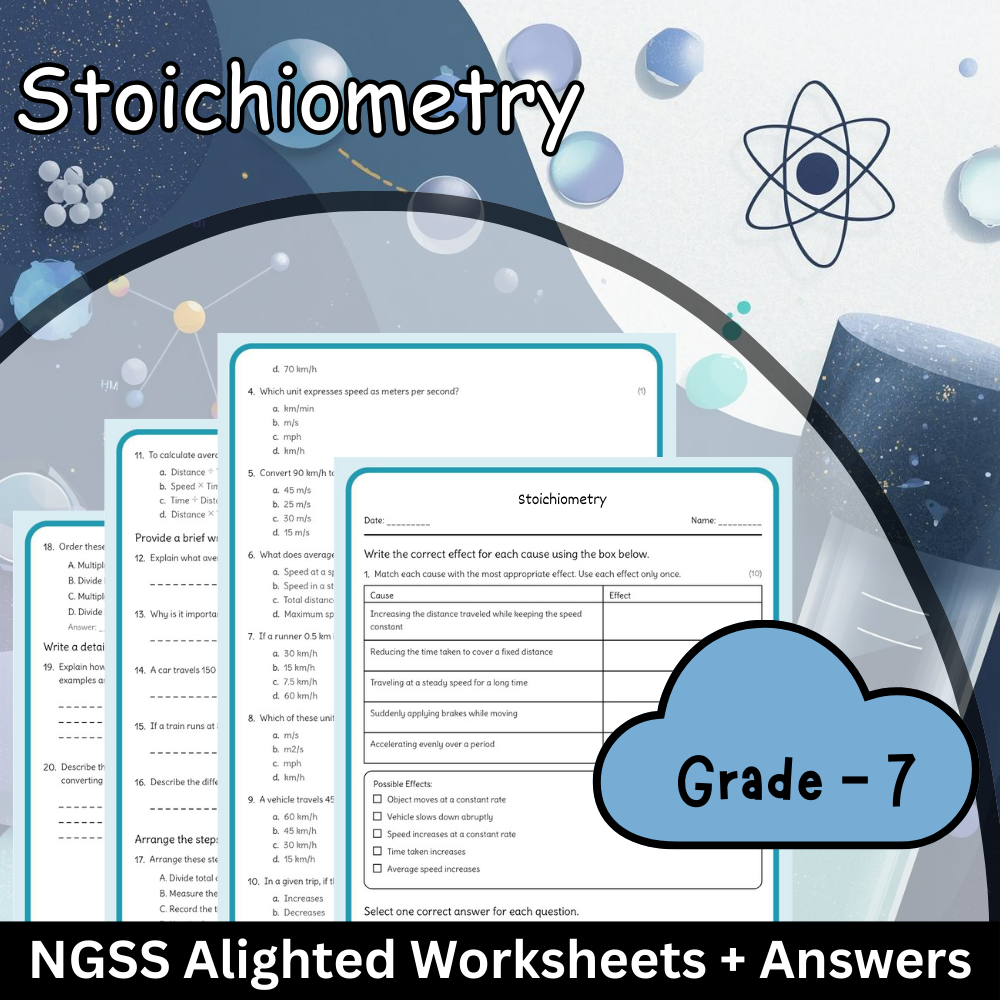
Grade 7 Science – Stoichiometry Worksheet (Answer Key) | NGSS Aligned
Created byBright Mind ResourcesLearning Objectives
- Understand how to interpret and use balanced symbolic equations in stoichiometry.
- Calculate molar and mass ratios of reactants and products in chemical reactions.
- Apply conservation principles to predict reagent needs and product yields.
Instant download

Grade 7 Inheritance Probability Worksheet | Punnett Squares | NGSS Genetics
 Created byAmber Owl Education
Learning Objectives
- Use probability to predict expected genotype and phenotype ratios from a monohybrid cross
- Connect Punnett square outcomes to the likelihood of offspring inheriting specific alleles
- Explain how larger populations tend to better match expected genetic ratios
Also included in: Grade 7 Science NGSS Genetics Lesson Bundle | Punnett Squares & DNA (NGSS) +1 more
Instant download

Grade 7 Stoichiometry Worksheet | Mole Ratios, NGSS Science Activity Pack
Created byAmber Owl EducationLearning Objectives
- Use balanced chemical equations to relate the mole amounts of reactants and products.
- Solve simple mole-ratio problems to predict relative mass or amount changes in reactions.
- Apply the conservation of atoms to check whether calculated quantities are consistent with a balanced equation.
Also included in: Grade 7 Science Stoichiometry, Mixtures & Material Properties Lesson Bundle | NGSS +1 more
Instant download
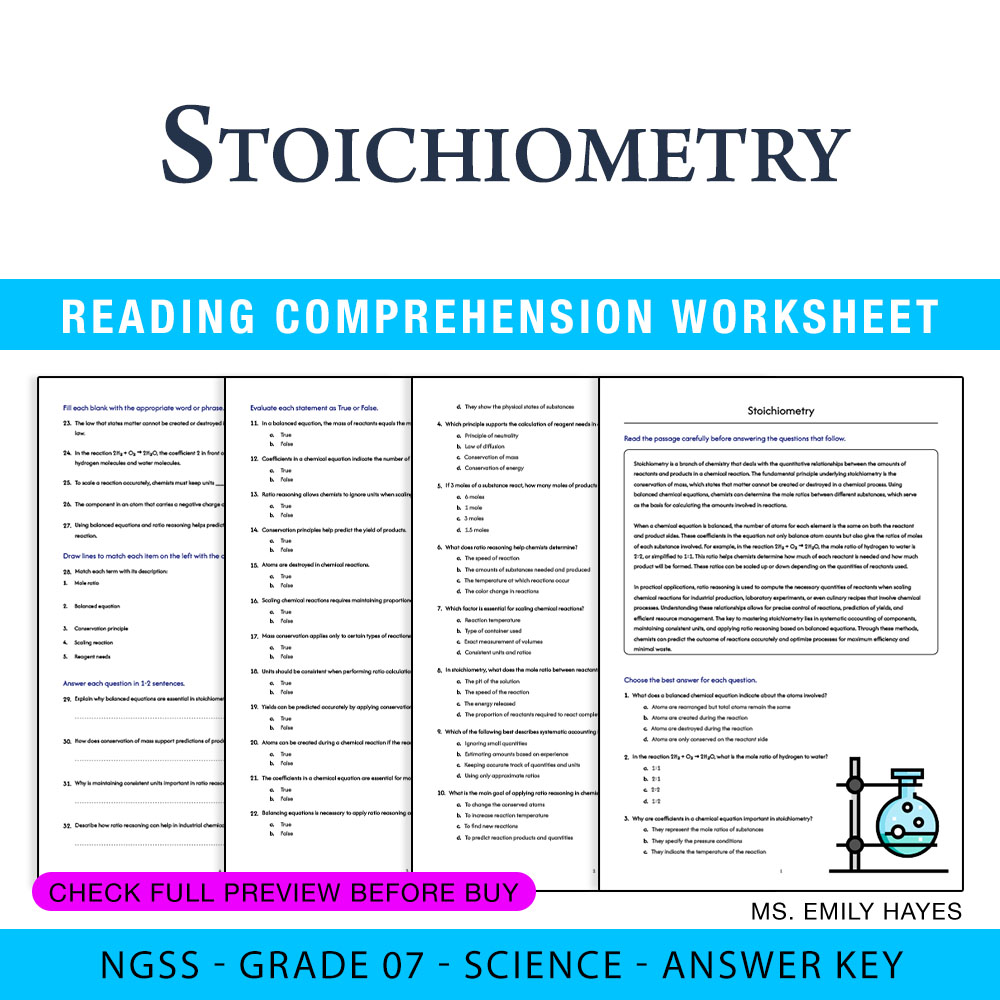
7th Grade Science | Mastering Stoichiometry Worksheet (PDF +Answer Key)
Created byCopper Leaf ClassroomLearning Objectives
- Understand the concept of mole ratios and their use in chemical equations.
- Apply balanced symbolic equations to determine the relationships between reactants and products.
- Use ratio reasoning to calculate amounts of substances involved in chemical reactions.
Instant download

Grade 7 Stoichiometry Worksheet | Practice & NGSS PDF
Created byClear Sky ClassroomLearning Objectives
- Understand the concept of mole ratios and how they relate to balanced chemical equations.
- Apply ratio reasoning to calculate amounts of reactants and products in chemical reactions.
- Use conservation principles to predict reagent needs and product yields.
Also included in: Grade 7 Matter and Its Interactions Science Lesson Bundle NGSS Worksheets +1 more
Instant download

Stoichiometry and Mole Ratios Worksheets Grade 7 Science
Created bythe curious pencilLearning Objectives
- Explain quantitative relationships shown by balanced chemical equations
- Identify mole ratios from coefficients in balanced equations
- Calculate related quantities using proportional reasoning
Also included in: Matter and Its Interactions Worksheets | Grade 7 Science NGSS +2 more
Instant download
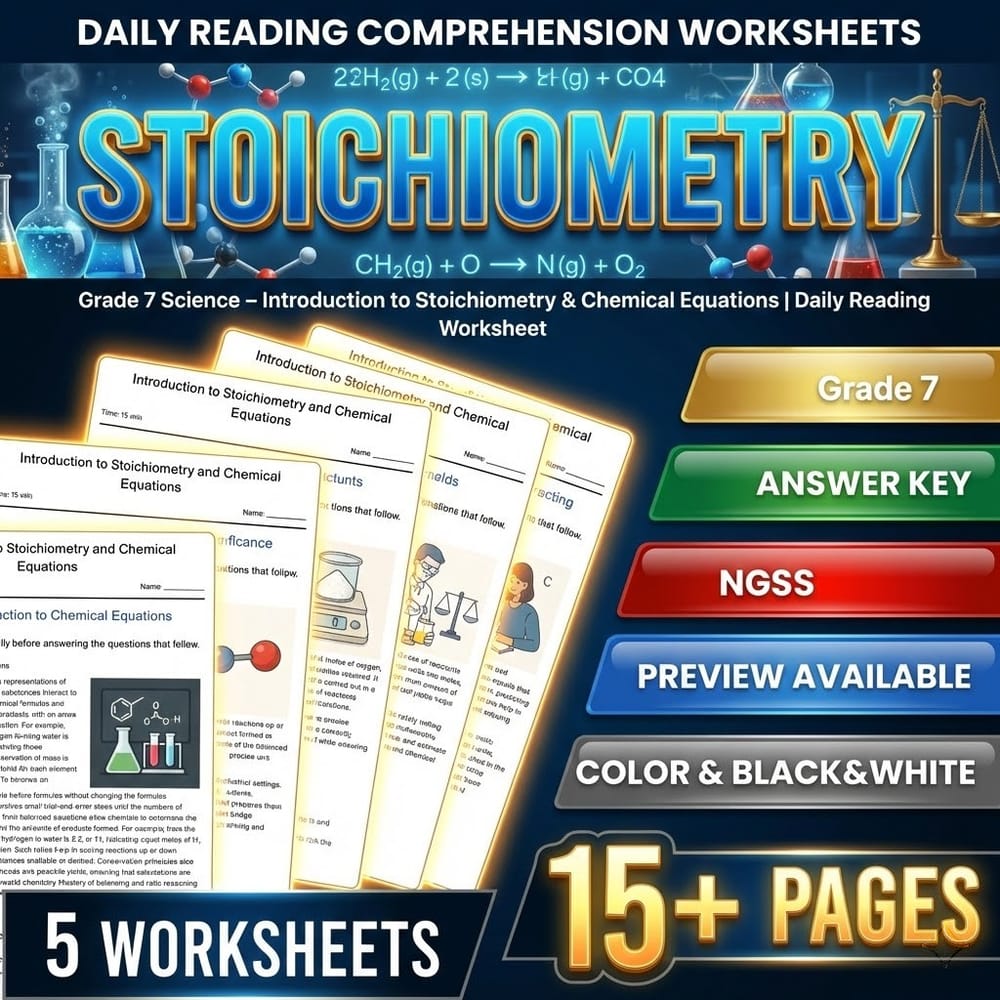
Grade 7 Science – Stoichiometry & Chemical Equations | Daily Reading Worksheet
 Created byElena Brooks
Learning Objectives
- Understand the concept of chemical equations and their importance.
- Learn how to balance chemical equations correctly.
- Explore the basic principles of mole ratios and how they relate to quantities of reactants and products.
Also included in: Materials and Chemical Reactions Grade 7 Science Worksheets Bundle | NGSS +1 more
Instant download

Grade 7 Science | Stoichiometry Worksheet (Answer Key) for NGSS Alignment
Created byLumora LearningLearning Objectives
- Explain the concept of mole ratios in chemical equations and how they relate amounts of reactants and products.
- Perform mole-mole and mass-mass calculations based on balanced chemical equations.
- Apply conservation of mass principles to predict reagent requirements and yields in chemical reactions.
Instant download

Grade 7 Substance Basics Worksheet | Ontario Science with Answer Key
Created byClear Sky ClassroomLearning Objectives
- Classify pure substances and mixtures based on composition and uniformity.
- Differentiate elements, compounds, and mixtures using examples and particle-level reasoning.
- Use evidence from properties (such as fixed vs. variable composition) to identify materials in everyday contexts.
Instant download

Grade 7 Science Worksheet on Stoichiometry | NGSS-Aligned Practice
Learning Objectives
- Understand how to interpret and balance chemical equations to reflect quantitative relationships.
- Apply mole ratios from balanced equations to calculate amounts of reactants and products.
- Use conservation principles to predict reagent needs and product yields in chemical reactions.
Also included in: Grade 7 Structure and Properties of Matter Science Lesson Bundle: NGSS +1 more
Instant download

Grade 7 Energy Transfer Overview Worksheet | NGSS Practice PDF
Created byClear Sky ClassroomLearning Objectives
- Explain how energy transfers from higher-energy objects or systems to lower-energy ones
- Describe how energy can change form during a transfer (energy transformation)
- Connect energy transfers to observable effects such as temperature change, motion, or light emission
Instant download

Grade 7 Stoichiometry Worksheet | NGSS Chemical Equations & Mole Ratios
 Created byNorthstar Worksheets
Learning Objectives
- Interpret balanced chemical equations to determine the mole-to-mole relationships between reactants and products.
- Use ratio reasoning and unit consistency to convert between amounts of substances during chemical transformations.
- Scale reactant and product quantities proportionally and predict outcomes using conservation of matter.
Also included in: Grade 7 Physical Science: Matter & Chemical Reactions Lesson Bundle | NGSS +1 more
Instant download

Grade 7 Understanding Chemical Equations Worksheet | NGSS Physical Science
Created byBRIGHT PATH RESOURCESLearning Objectives
- Understand key concepts related to Science
- Apply knowledge through practice questions
- Demonstrate comprehension of the material
Also included in: Chemical Reactions Grade 7 Science Daily Reading Worksheets Lesson Bundle | NGSS +2 more
Instant download
About Grade 7 Science Worksheets
Browse 6,126 printable Grade 7 Science worksheets — ready-to-print PDFs with answer keys where available.
Every worksheet on MyTeachingSheets is created by independent teacher-authors and reviewed before publication. All resources download as printable PDFs for classroom, homework, or at-home practice, and many include answer keys. Preview any worksheet free before buying.