
Grade 7 Science Worksheets
6,126 worksheets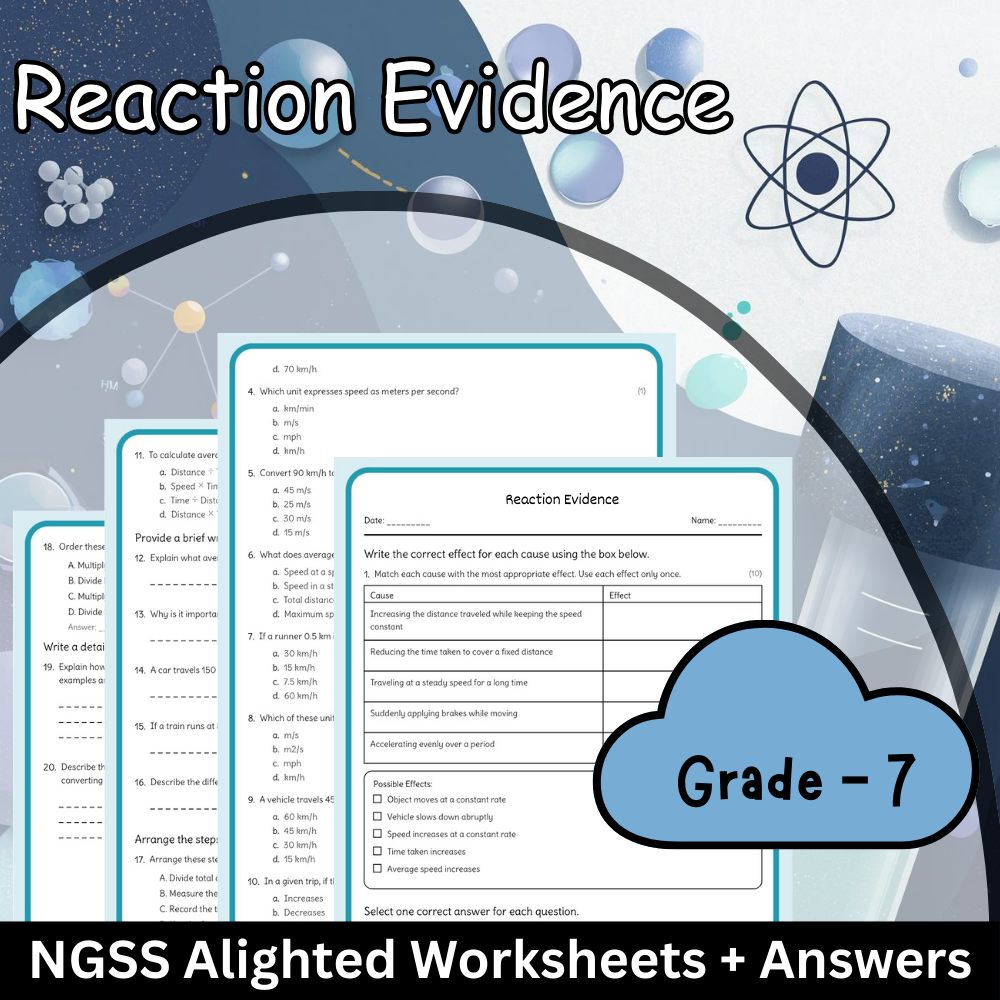
Grade 7 Science – Reaction Evidence Worksheet (PDF) | NGSS Standards
 Created byBright Mind Resources
Learning Objectives
- Identify different indicators that suggest a chemical reaction has taken place.
- Explain examples of chemical reactions based on observable signs like gas production, precipitate formation, color change, temperature change, and irreversibility.
- Understand how mass measurements in sealed systems relate to the conservation of mass principle in chemical reactions.
Instant download

Grade 7 Science | Gravity On Objects - Daily Reading Comprehension
 Created byCoral Reef Learning
Learning Objectives
- Understand what gravity is and how it pulls objects downward.
- Recognize how mass affects gravitational force.
- Learn why different objects accelerate at the same rate near Earth.
Instant download

Grade 7 Science | Physical Chemical Changes Worksheet | NGSSS Aligned
 Created byLumora Learning
Learning Objectives
- Distinguish physical changes from chemical changes based on whether a new substance forms
- Identify common indicators of chemical change (color change, gas production, precipitate formation, temperature change)
- Classify everyday examples of matter changes as physical or chemical using evidence
Instant download

Natural Selection Worksheet for Grade 7 Science | NGSS Aligned Practice
Learning Objectives
- Explain how heritable variation and environmental pressures influence natural selection.
- Identify examples of adaptation and how selection pressures affect populations.
- Describe sources of genetic variation and their role in evolution.
Also included in: Grade 7 Evolution Evidence and Speciation Processes Science Lesson Bundle – NGSS +1 more
Instant download
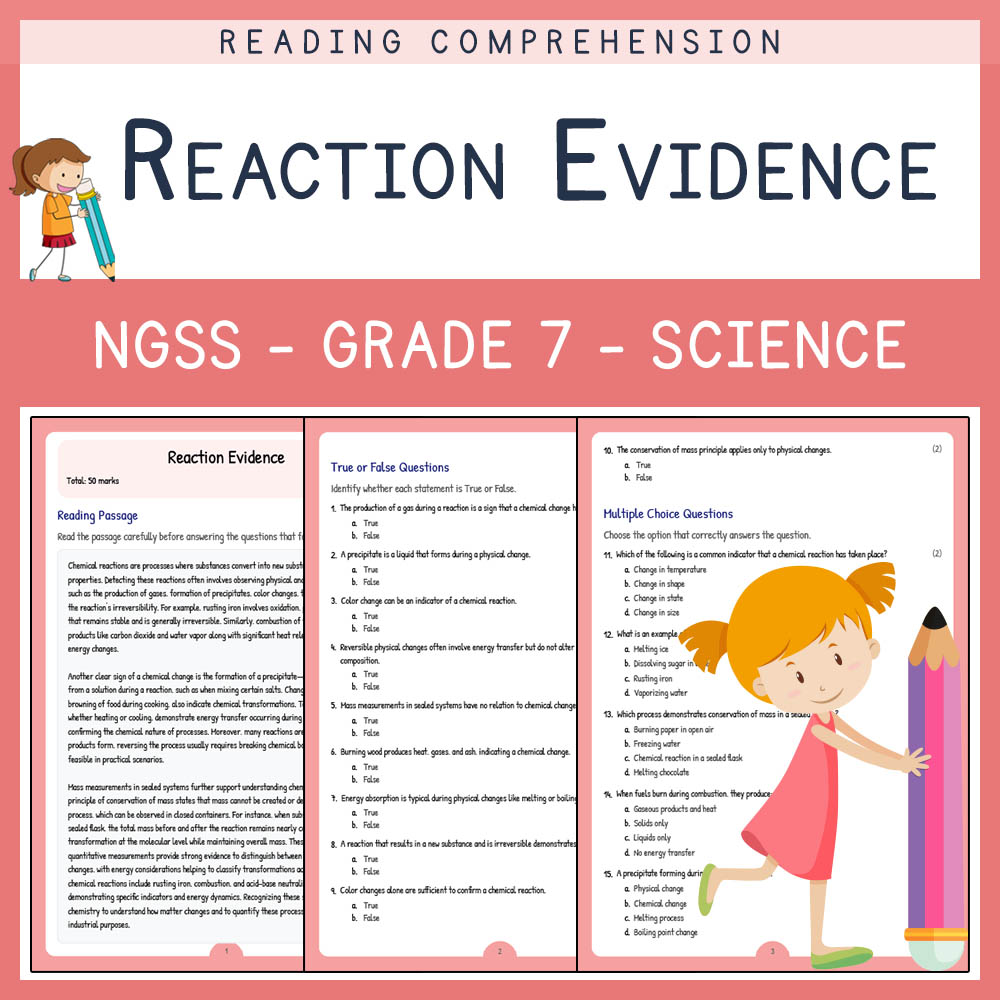
Grade 7 Science | Reaction Evidence Worksheet & Answer Key (NGSS Aligned)
Created byLumora LearningLearning Objectives
- Identify observable indicators that a chemical reaction has occurred, such as gas production, precipitate formation, color change, and temperature change.
- Explain irreversibility in chemical reactions and relate it to composition changes.
- Describe examples of chemical reactions, including rusting, combustion, and neutralization, and discuss how mass measurements in sealed systems demonstrate conservation principles.
Instant download

Grade 7 Indicators of Chemical Reactions Worksheet | NGSS Physical Science
 Created byBRIGHT PATH RESOURCES
Learning Objectives
- Identify the signs indicating a chemical reaction has occurred
- Understand examples of chemical indicators such as gas production and precipitate formation
- Explain how energy changes and mass measurements relate to chemical reactions
Also included in: Chemical Reactions Grade 7 Science Daily Reading Worksheets Lesson Bundle | NGSS +2 more
Instant download

Biodiversity Stability Assessment | Florida NGSSS Grade 7 Science
 Created byPrism Point Learning
Learning Objectives
- Explain how biodiversity supports ecosystem stability through overlapping ecological functions.
- Describe how disturbances such as habitat loss and invasive species can reduce biodiversity and weaken ecosystem processes.
- Use evidence from a passage to answer questions about nutrient cycling and ecosystem resilience.
Instant download

Climate Drivers Worksheet | Grade 7 Earth Science Climate Systems
 Created byEvergreen Desk Education
Learning Objectives
- Explain how the Sun’s energy, atmospheric circulation, and water distribution contribute to Earth’s climate.
- Describe how ocean processes can modify regional climate by changing how heat is stored and released.
- Use cause-and-effect reasoning to predict how changes in climate drivers can shift patterns like drought or wet seasons.
Instant download

Grade 7 States of Matter Science Daily Reading Worksheet | TEKS Activity
Created byBRIGHT PATH RESOURCESLearning Objectives
- Define states of matter using particle behavior and energy
- Identify the six phase changes named in the passage
- Explain, in basic terms, how temperature and pressure relate to phase changes
Also included in: Matter-Energy Grade 7 Science Daily Reading Worksheets Lesson Bundle | TEKS +1 more
Instant download

Chemical Reaction Evidence Worksheets | Grade 7 Science
 Created bythe curious pencil
Learning Objectives
- Identify observations that provide evidence of chemical reactions
- Explain how new substances form during chemical reactions
- Describe conservation of matter using sealed-system mass measurements
Also included in: Matter and Its Interactions Worksheets | Grade 7 Science NGSS +2 more
Instant download

States Of Matter Assessment | TEKS Grade 7 Science Classroom-Ready Materials
Created byPrism Point LearningLearning Objectives
- Define the different states of matter based on particle arrangements and energy levels.
- Describe phase changes such as melting, freezing, vaporization, condensation, and sublimation.
- Explain how temperature and pressure influence phase transition points and measurable properties like density and viscosity.
Also included in: Grade 7 Matter and Energy Science Lesson Bundle: TEKS assessments
Instant download
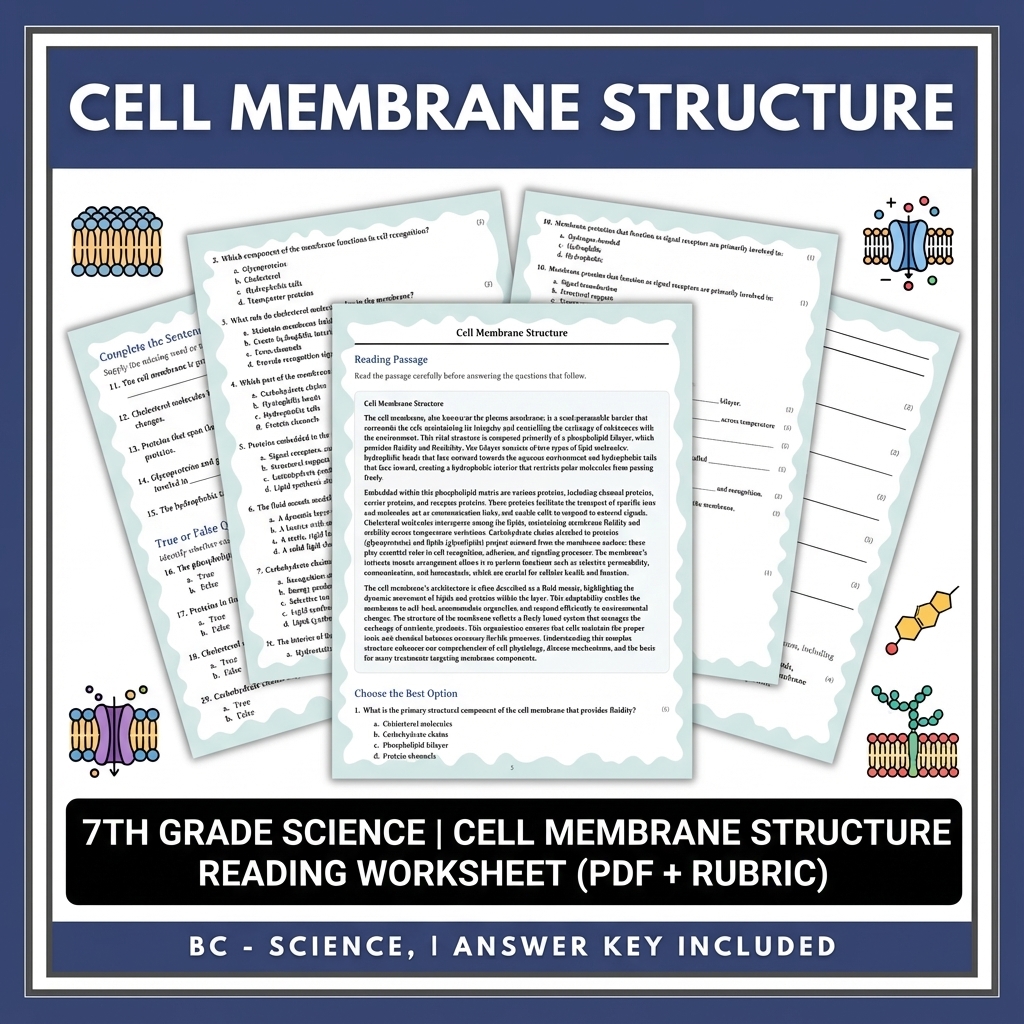
7th Grade Science | Cell Membrane Structure Reading Worksheet (PDF + Rubric)
Learning Objectives
- Describe the organization and components of the cell membrane.
- Explain the functions of lipids, proteins, and carbohydrates in the membrane.
- Understand how the membrane maintains selective permeability.
Instant download

Grade 7 Reaction Evidence Worksheet | NGSS Chemical Reactions Activity
 Created byNorthstar Worksheets
Learning Objectives
- Identify observable indicators that a chemical reaction has occurred.
- Explain how gas production, precipitate formation, color change, and temperature change serve as evidence of new substances.
- Distinguish chemical changes from reversible physical changes using conservation of mass in sealed systems.
Also included in: Grade 7 Physical Science: Matter & Chemical Reactions Lesson Bundle | NGSS +1 more
Instant download
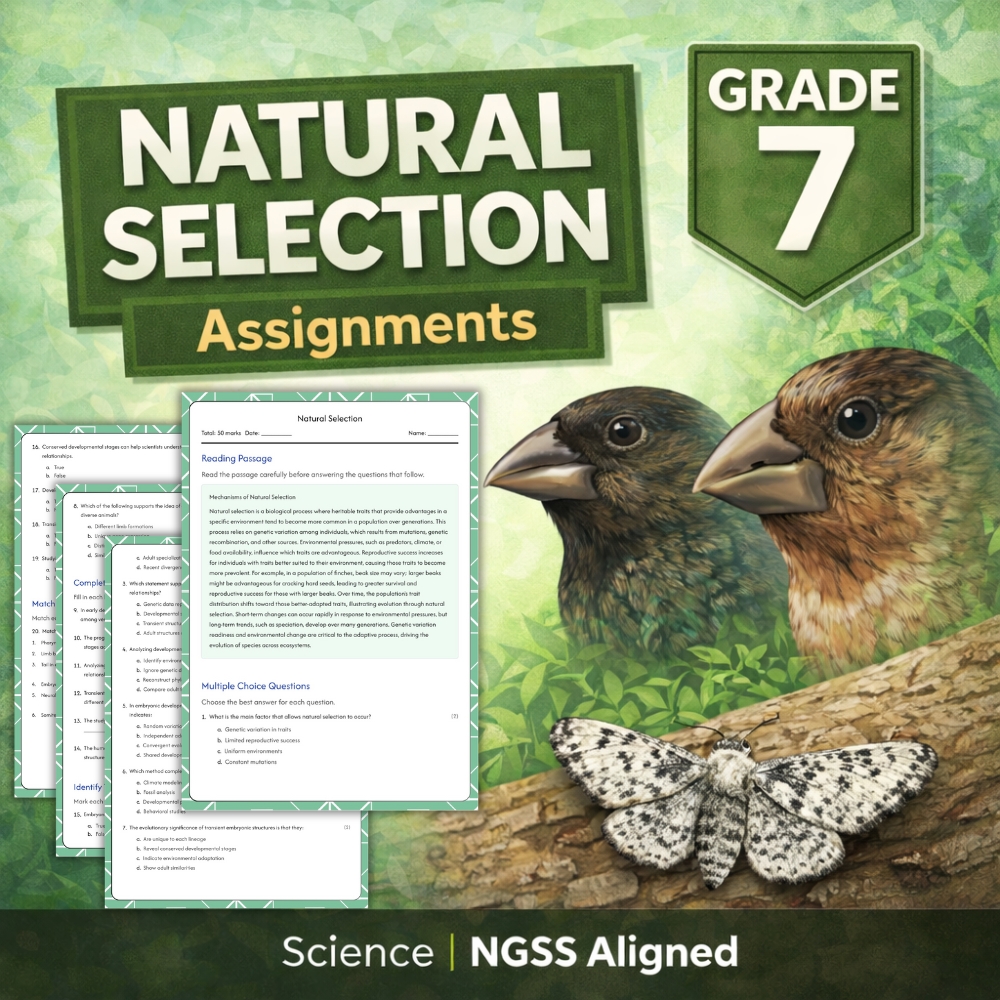
Grade 7 Science | Natural Selection (Worksheet + Answer Key) NGSS Aligned
 Created byCedar Grove Learning
Learning Objectives
- Describe how heritable variation and environmental pressures influence natural selection.
- Explain how differential survival and reproduction lead to adaptation over generations.
- Identify examples of natural selection, such as antibiotic resistance and beak size variation.
Instant download
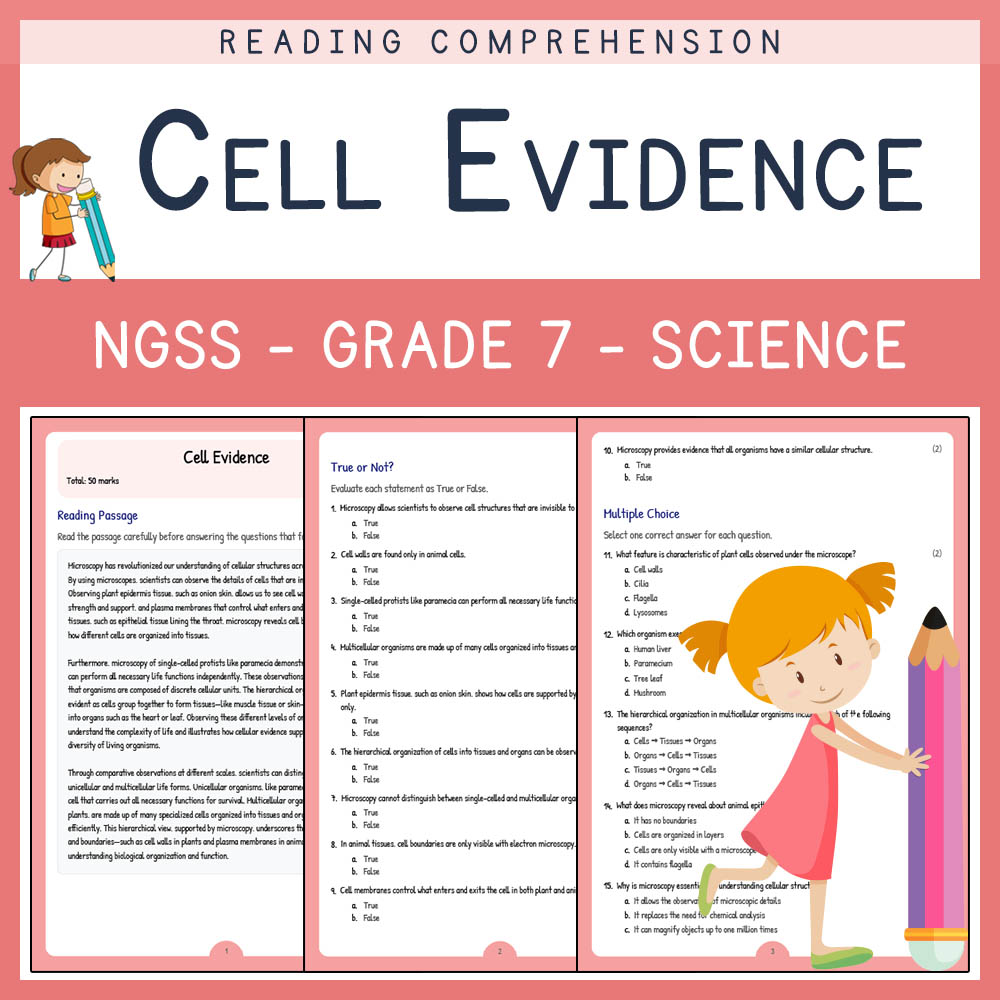
Grade 7 Science | Cell Evidence Worksheet & Answer Key NGSS Aligned (PDF)
Created byLumora LearningLearning Objectives
- Describe the role of microscopy in analyzing cellular structures.
- Differentiate between unicellular and multicellular organisms.
- Identify key features of plant and animal cells based on microscopy observations.
Instant download

Grade 7 Cell Evidence Worksheet | NGSS Practice & PDF
 Created byClear Sky Classroom
Learning Objectives
- Observe plant epidermis and protists using microscopy to identify cellular structures.
- Differentiate between unicellular and multicellular organisms based on microscopic observations.
- Understand the hierarchical organization from cells to tissues and organs.
Also included in: Grade 7 Cell Systems Science Lesson Bundle: NGSS Worksheet B +1 more
Instant download

Grade 7 Science – States Of Matter Daily Reading Worksheet | TEKS Aligned
Created byBright Mind ResourcesLearning Objectives
- Identify and describe the three main states of matter: solid, liquid, and gas.
- Understand phase changes such as melting, freezing, vaporization, condensation, and sublimation.
- Relate temperature and pressure influences to phase transition points and measurable properties.
Also included in: 7th Grade States of Matter Science Daily Reading Lesson Bundle | TEKS +2 more
Instant download
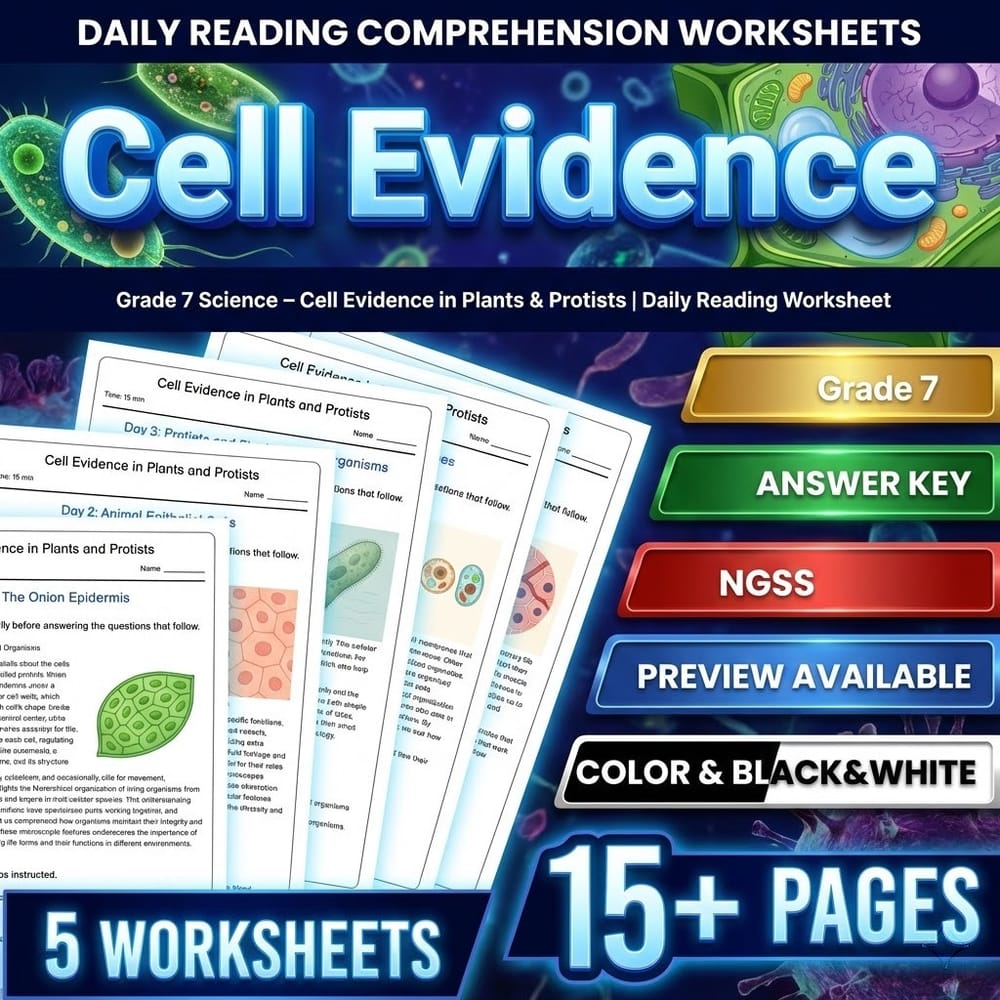
Grade 7 Science – Cell Evidence in Plants & Protists | Daily Reading Worksheet
 Created byElena Brooks
Learning Objectives
- Observe plant epidermis cells under a microscope.
- Identify cell boundaries such as plasma membranes and cell walls.
- Differentiate between unicellular and multicellular organisms.
Also included in: Cell Structures & Functions Grade 7 Science Worksheets Bundle | NGSS +1 more
Instant download
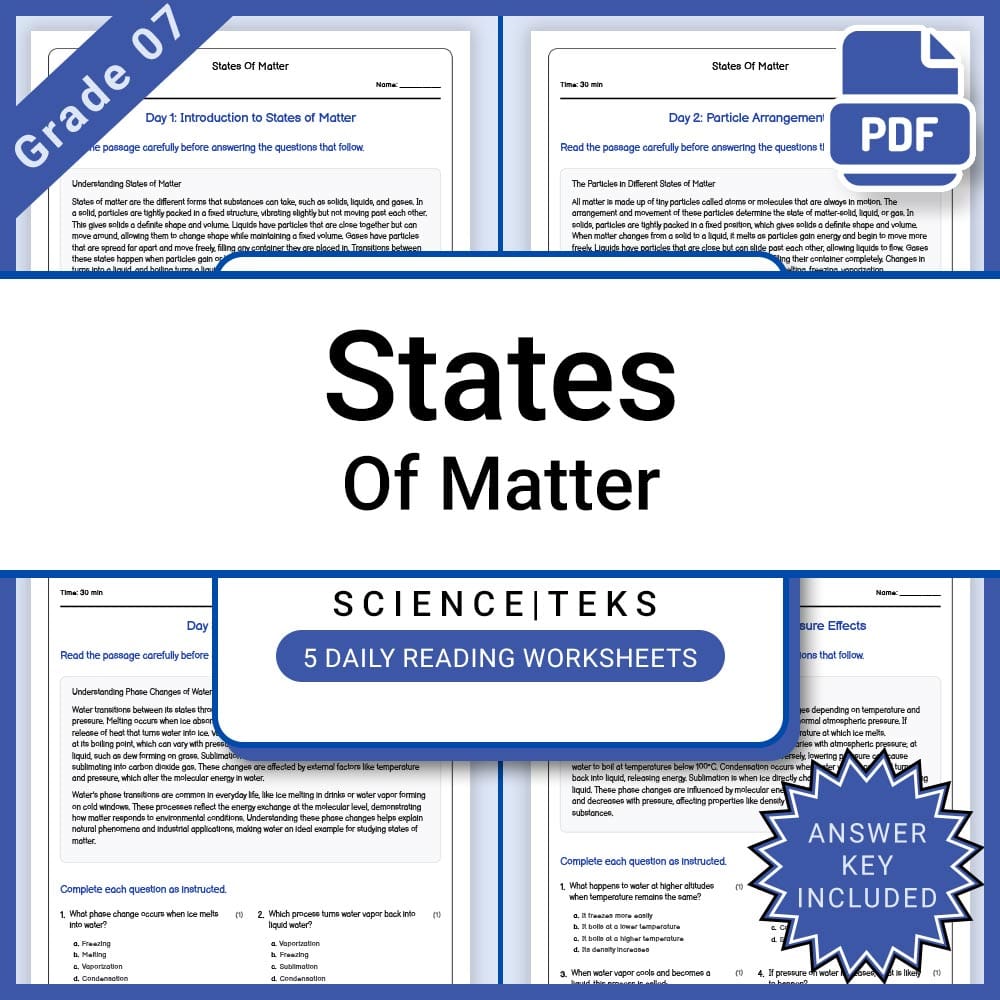
Grade 7 Science – States of Matter Daily Reading Worksheet with Answer Key
Learning Objectives
- Recognize and describe the three main states of matter: solid, liquid, and gas.
- Understand the particle arrangements and energy regimes in each state.
- Identify phase changes and conditions that cause state transitions.
Also included in: Grade 7 Science Lesson Group: TEKS-Aligned Daily Reading Worksheets +1 more
Instant download

Natural Selection and Adaptation Worksheets | Grade 7 Science
Created bythe curious pencilLearning Objectives
- Explain how heritable variation affects populations over generations
- Describe how environmental pressures influence trait frequencies
- Identify how survival and reproduction contribute to natural selection
Also included in: Biological Evolution Worksheets Bundle | Grade 7 Science NGSS +2 more
Instant download
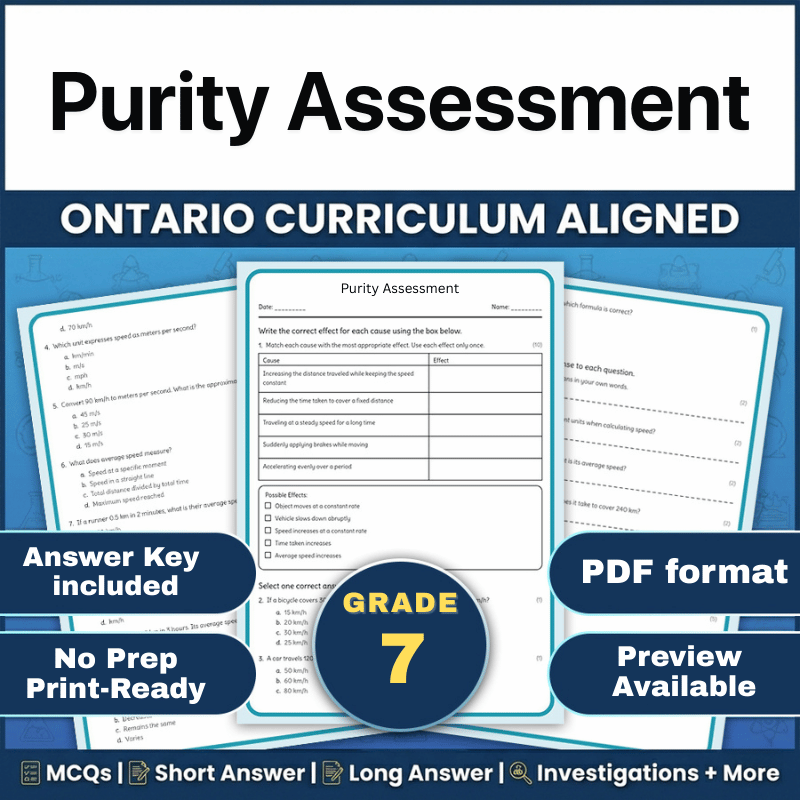
Grade 7 Science | Purity Assessment Worksheet (Ontario Standard) (PDF)
Created byBright Mind ResourcesLearning Objectives
- Understand various analytical indicators used to assess material purity.
- Identify methods to detect contamination in substances.
- Evaluate advantages and limitations of different purity assessment techniques.
Instant download

Grade 7 Science | States Of Matter Worksheet | TEKS-Aligned
Created byLumora LearningLearning Objectives
- Define the different states of matter and their particle arrangements.
- Describe phase changes such as melting, freezing, vaporization, condensation, and sublimation.
- Understand the influence of temperature and pressure on phase transitions.
Also included in: Grade 7 Science | Matter and Energy Lesson Bundle | TEKS Aligned
Instant download

Grade 7 Science Natural Selection and Adaptation Worksheet |NGSS Grade 7 Science
 Created bySkylark Worksheets
Learning Objectives
- Explain how heritable variation and environmental pressures drive natural selection.
- Describe how differential survival and reproduction can shift trait distributions over generations.
- Use real-world examples (antibiotic resistance and island finches) to identify selective pressures and adaptations.
Also included in: Grade 7 Speciation and Evolution Evidence Science Lesson Bundle NGSS +1 more
Instant download

Grade 7 Science | Solubility Principles Worksheet with Short Notes (PDF)
 Created byMeadowlark Worksheets
Learning Objectives
- Explain factors affecting solubility such as temperature, pressure, and solvent polarity.
- Interpret solubility curves and understand saturation and supersaturation concepts.
- Predict outcomes of recrystallization and separation processes based on solubility principles.
Also included in: Grade 7 Science Lesson Group Bundle – Ontario Curriculum Worksheets +1 more
Instant download

Physical & Chemical Changes Worksheet Grade 7 Science Practice Activity
Created byPrism Point LearningLearning Objectives
- Differentiate between physical and chemical changes based on whether new substances form
- Identify evidence of chemical changes such as gas production, precipitate formation, color change, and temperature change
- Classify common everyday examples as physical or chemical changes
Also included in: Physical Science Lesson Bundle | Grade 7 Science | Florida NGSSS
Instant download

Cell Evidence and Cellular Organization Worksheets Grade 7 Science
Created bythe curious pencilLearning Objectives
- Identify evidence that organisms are composed of cells
- Distinguish unicellular from multicellular organization
- Compare cell boundaries in plant and animal cells
Also included in: Grade 7 Science Cells & Organisms Worksheets Bundle | NGSS +2 more
Instant download

Reaction Evidence Assessment | NGSSS Standard Grade 7 Science
Created byPrism Point LearningLearning Objectives
- Identify macroscopic evidence that indicates a chemical reaction is occurring.
- Differentiate chemical changes from physical changes using observable and irreversible signs.
- Explain how particle rearrangement connects to observations such as gas production, color change, and precipitate formation.
Also included in: Grade 7 Matter, Forces & Energy Science Lesson Bundle | Florida NGSSS
Instant download
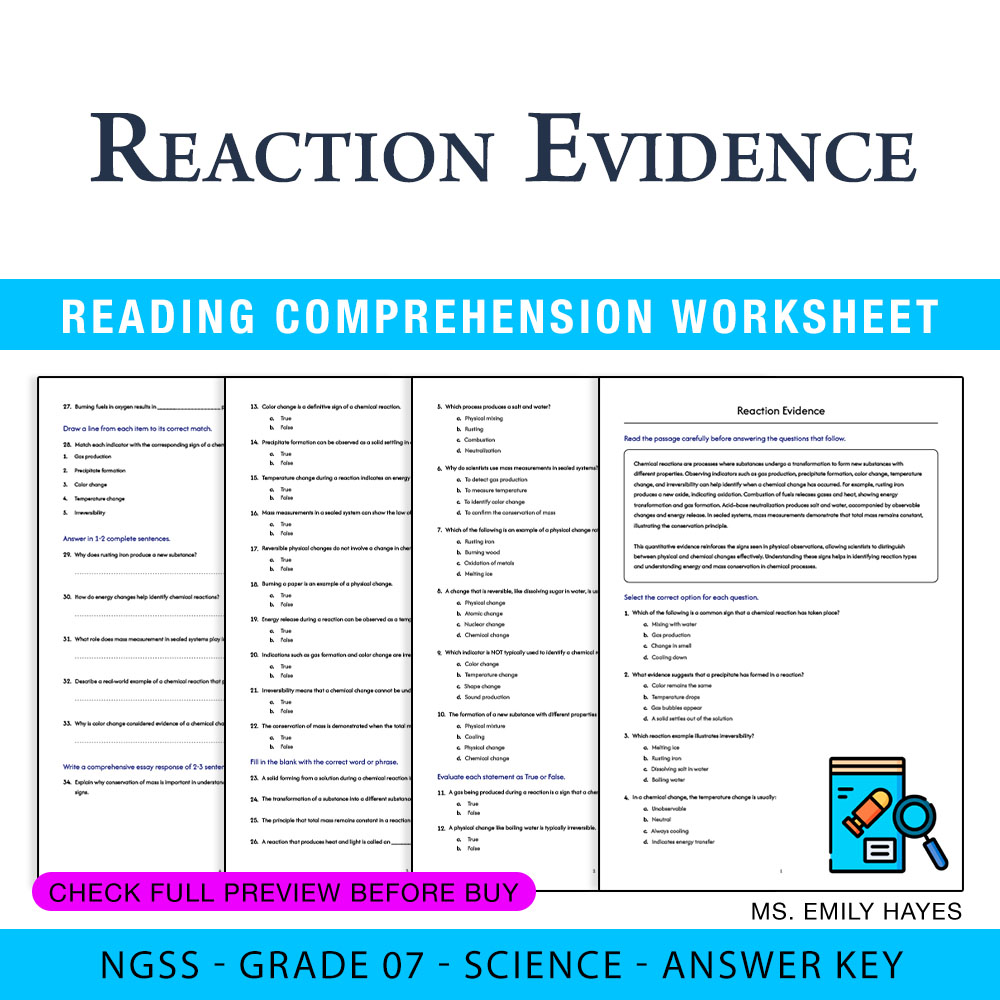
7th Grade Science | Reaction Evidence Worksheet (PDF +Answer Key)
 Created byCopper Leaf Classroom
Learning Objectives
- Identify observable signs indicating a chemical reaction has occurred, such as gas production, precipitate formation, color change, temperature change, and irreversibility.
- Explain the concept of irreversibility in chemical changes and how mass measurements in sealed systems support the conservation of mass principle.
- Describe real-world examples of chemical reactions including rusting, combustion, and acid–base neutralization, highlighting their signs and outcomes.
Instant download

Grade 7 Science | Gravity on Objects Worksheet | California Standards
Created byLumora LearningLearning Objectives
- Explain how gravity produces weight and affects the motion of objects near Earth
- Relate gravitational force and acceleration using the role of mass and inertia
- Describe how support forces (normal forces) balance weight when objects are at rest
Instant download

Scientific Variables Worksheet Grade 7 Science Activities | NGSSS
Created byPrism Point LearningLearning Objectives
- Identify independent, dependent, and controlled variables in an investigation
- Explain how controlled variables support fair comparisons
- Interpret how changes in the dependent variable relate to the independent variable using data from tables or graphs
Instant download

Grade 7 Climate Drivers Science Worksheet | Florida NGSSS with Answer Key
Created byEvergreen Desk EducationLearning Objectives
- Explain how latitude affects the angle of incoming sunlight and changes temperature patterns.
- Describe how elevation and distance from water influence temperature and precipitation.
- Use ocean currents and climate examples to connect multiple climate drivers to regional weather differences.
Instant download

Science Worksheet Physical vs Chemical Changes Grade 7 NGSSS
Learning Objectives
- Differentiate physical changes from chemical changes by analyzing what happens to matter.
- Identify indicators of chemical changes, such as gas production, precipitate formation, and temperature/color changes.
- Classify common examples as physical or chemical changes and justify the classification.
Also included in: Grade 7 Matter, Energy & Forces Science Lesson Bundle – Florida NGSSS +1 more
Instant download

Grade 7 Science – Human Impacts on Ecosystems | Daily Reading Worksheet
Created byBright Mind ResourcesLearning Objectives
- Understand the causes and effects of deforestation and habitat loss
- Identify human activities that lead to habitat fragmentation
- Explain how habitat destruction impacts biodiversity and ecosystem functions
Also included in: Grade 7 Ecosystems & Adaptations Science Daily Reading Lesson Bundle | TEKS +2 more
Instant download

Reaction Evidence Test Prep Printable | Grade 7 Science
Created byPrism Point LearningLearning Objectives
- Identify observable indicators that show a chemical reaction has occurred, such as gas production, precipitate formation, color change, and temperature change.
- Explain why mass measurements in sealed systems support the conservation of mass during chemical reactions.
- Distinguish chemical changes from physical changes by linking evidence to changes in composition and reversibility.
Also included in: Grade 7 Matter & Atomic Models Science Lesson Bundle Review | NGSS
Instant download

Matter Energy Flow Assessment Grade 7 Science California Standards
Created byPrism Point LearningLearning Objectives
- Explain how producers, consumers, and decomposers transfer matter and energy in ecosystems
- Describe how energy flows through food chains and food webs and why energy decreases at higher trophic levels
- Use key vocabulary (producer, consumer, decomposer, trophic level, metabolism, heat) to support scientific explanations
Also included in: Grade 7 Energy Flow and Matter Cycling Science lesson bundle – California Standards +1 more
Instant download

Cell Evidence Worksheet | NGSS Grade 7 Science Assessment Practice
Learning Objectives
- Understand how microscopy reveals cellular structures in plant and animal tissues.
- Identify differences between unicellular and multicellular organisms based on microscopic evidence.
- Compare cellular features such as cell boundaries, plasma membranes, and cell walls in different organisms.
Also included in: Grade 7 Cellular and Organ Systems Science Lesson Bundle: NGSS Practice +1 more
Instant download

Grade 7 Cell Membrane Structure Worksheet | BC Practice PDF
Created byClear Sky ClassroomLearning Objectives
- Describe the structure of the cell membrane as a phospholipid bilayer with embedded components
- Explain how proteins, cholesterol, and carbohydrates contribute to selective permeability and communication
- Use evidence from membrane structure to predict how substances move in and out of cells
Instant download

Grade 7 Science | Purity Assessment Reading Worksheet & Answer Key (PDF)
Learning Objectives
- Understand the analytical indicators used to assess material purity.
- Identify methods to detect contamination in chemical samples.
- Compare different techniques such as melting points, conductivity, and gravimetric analysis.
Also included in: Grade 7 Science Unit Bundle | Properties of Matter & Separation Techniques (Worksheet Pack) +1 more
Instant download

Grade 7 Matter Energy Flow Worksheet | Practice & Assessment PDF
Created byClear Sky ClassroomLearning Objectives
- Explain how matter and energy move through ecosystems using producers, consumers, and decomposers
- Describe how energy transfers through food chains and food webs and why less energy reaches higher trophic levels
- Connect the roles of metabolism and heat loss to patterns of energy flow in ecosystems
Instant download

Cell Membrane Structure Worksheet | Grade 7 Science Standard BC Practice
Learning Objectives
- Describe the organization and components of the cell membrane as a fluid mosaic model.
- Explain the functions of phospholipids, proteins, cholesterol, and carbohydrates in the membrane.
- Understand how the membrane's structure contributes to its selective permeability and cellular communication.
Instant download
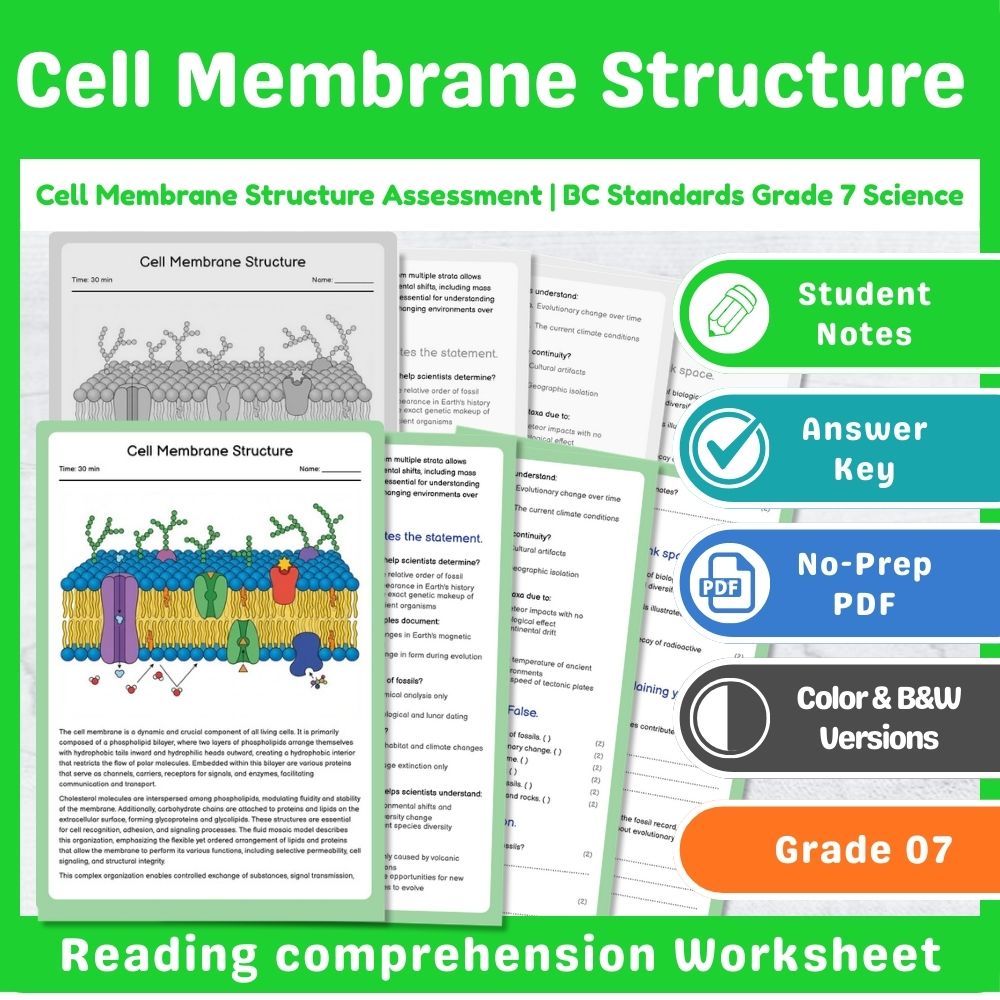
Cell Membrane Structure Assessment | BC Standards Grade 7 Science
Created byPrism Point LearningLearning Objectives
- Describe the composition of the cell membrane as a phospholipid bilayer with embedded proteins, cholesterol, and carbohydrates.
- Explain the fluid mosaic model of cell membrane organization.
- Identify the functions of membrane proteins, cholesterol, and carbohydrate chains.
Instant download

Science Worksheet: Reaction Evidence Grade 7 | NGSS | Worksheet
Created bySkylark WorksheetsLearning Objectives
- Identify observable indicators that a chemical reaction has occurred, including gas production, precipitate formation, color change, and temperature change.
- Explain irreversibility and how it differs from reversible physical changes.
- Use mass measurements from sealed systems to connect reaction evidence to the conservation of matter.
Also included in: Grade 7 Matter, Reactions & Atomic Models Science Lesson Bundle (NGSS) +1 more
Instant download

Grade 7 Science | Understanding the Cell Membrane - Daily Reading Comprehension
Created byCoral Reef LearningLearning Objectives
- Describe the structure of the cell membrane as a phospholipid bilayer.
- Identify the roles of embedded proteins, cholesterol, and carbohydrates in the cell membrane.
- Explain how the fluid mosaic model contributes to the membrane's functions.
Instant download

Climate Drivers Worksheet | Standards-Aligned Practice for Grade 7 Science
Learning Objectives
- Understand the key factors that influence Earth's climate patterns.
- Differentiate between weather and climate and their long-term significance.
- Identify how ocean processes and atmospheric circulation affect regional climate.
Also included in: Grade 7 Engineering Tradeoffs & Optimization Science Lesson Bundle +1 more
Instant download

Grade 7 Science Worksheet | Understanding Solubility Principles (PDF)
Created byEvergreen Desk EducationLearning Objectives
- Explain how temperature and solvent polarity affect how much solute dissolves in a solvent.
- Use solubility curves and saturation concepts to predict whether a solution will be unsaturated, saturated, or supersaturated.
- Describe how gas solubility changes with pressure and how that relates to everyday situations.
Also included in: Grade 7 Substances and Mixtures Science Lesson Bundle Worksheet (Ontario) +1 more
Instant download

Grade 7 Science – Cell Membrane Structure & Function | Daily Reading Worksheet
Created byBright Mind ResourcesLearning Objectives
- Identify the components of the cell membrane.
- Understand the functions of phospholipids, proteins, cholesterol, and carbohydrates in the membrane.
- Explain how the fluid mosaic model maintains cellular homeostasis.
Also included in: Cell Function & Transport Grade 7 Science Daily Reading Worksheets Bundle | BC +1 more
Instant download

States Of Matter Worksheet | Grade 7 Science Activities
Created byPrism Point LearningLearning Objectives
- Explain states of matter using a particle model and describe phase changes between states.
- Relate temperature and pressure to when phase changes occur and to measurable properties such as density and viscosity.
- Use water as an example to connect molecular energy to observable behavior, including how boiling point changes with atmospheric pressure.
Also included in: Grade 7 Matter, States, and Reactions in Science Lesson Bundle TEKS
Instant download

Grade 7 Science – Purity Assessment & Scientific Methods | Reading Worksheet
Created byBright Mind ResourcesLearning Objectives
- Understand how melting point compares indicate purity
- Identify how conductivity changes are related to purity
- Recognize various methods used to assess material contamination
Also included in: Grade 7 Matter Science Daily Reading Worksheets Lesson Bundle | Ontario +1 more
Instant download
About Grade 7 Science Worksheets
Browse 6,126 printable Grade 7 Science worksheets — ready-to-print PDFs with answer keys where available.
Every worksheet on MyTeachingSheets is created by independent teacher-authors and reviewed before publication. All resources download as printable PDFs for classroom, homework, or at-home practice, and many include answer keys. Preview any worksheet free before buying.