
Grade 7 Science Worksheets
6,126 worksheets
Grade 7 Science | Photosynthesis Capture - Daily Reading Comprehension
 Created byCoral Reef Learning
Learning Objectives
- Understand the process of photosynthesis and how plants convert sunlight into chemical energy.
- Identify the key components involved in photosynthesis such as light, carbon dioxide, water, and sugars.
- Recognize the importance of photosynthesis in supporting ecosystems and energy transfer among organisms.
Instant download

Grade 7 Integration And Homeostasis Worksheet | BC Practice & PDF
 Created byClear Sky Classroom
Learning Objectives
- Explain how transport across cell membranes and between organ systems supports homeostasis.
- Identify roles of transport proteins, membrane pumps, and hormone signaling in regulating nutrients, ions, and water.
- Describe how disruptions at the cellular or tissue level can affect whole-organism stability.
Instant download
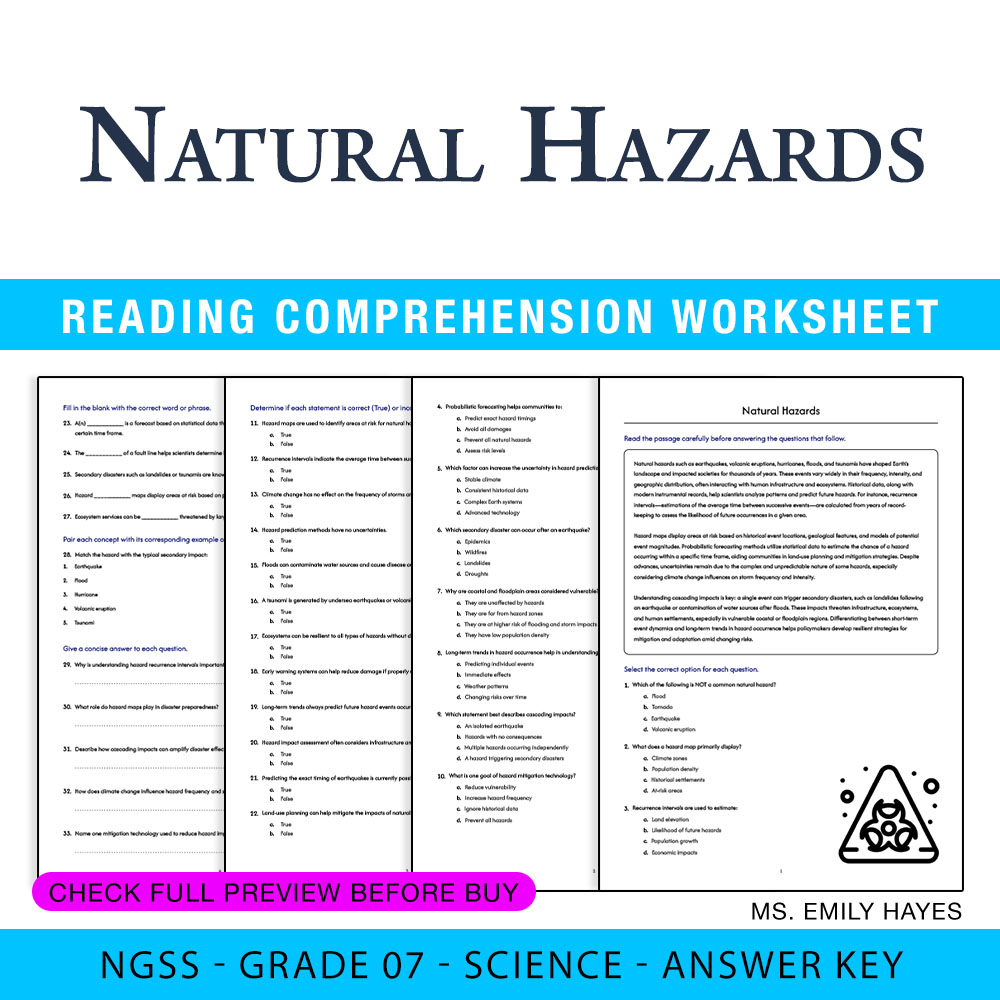
7th Grade Science | Natural Hazards Worksheet (PDF+ Answer Key)
 Created byCopper Leaf Classroom
Learning Objectives
- Analyze patterns of frequency and magnitude for different natural hazards.
- Interpret hazard maps, recurrence intervals, and probabilistic data to assess risk.
- Understand the cascading impacts of hazards on infrastructure, ecosystems, and communities.
Instant download

Fossil Patterns and Evidence of Evolution Worksheets Grade 7 Science
 Created byTeachers Club
Learning Objectives
- Use stratigraphic order to reconstruct timelines from sedimentary layers
- Identify how index fossils correlate rock layers across regions
- Explain how transitional fossils support common ancestry
Also included in: Biological Evolution Grade 7 Science NGSS Unit Bundle +2 more
Instant download

Grade 7 Science Worksheet | Conservation of Mass TEKS (PDF)
 Created byEvergreen Desk Education
Learning Objectives
- State the law of conservation of mass for a closed system during physical and chemical changes.
- Use mass accounting to relate reactant mass and product mass in sealed reactions and dissolution processes.
- Balance simple formulas or mass expectations to reconcile observed mass distributions with stoichiometric relationships.
Instant download

Fossil Patterns & Common Ancestry Worksheets | Grade 7 Science
 Created bythe curious pencil
Learning Objectives
- Identify patterns in fossil records and sedimentary rock layers
- Explain how index fossils help compare rock-layer ages
- Describe how fossil assemblages help correlate rock layers
Also included in: Biological Evolution Worksheets Bundle | Grade 7 Science NGSS +2 more
Instant download
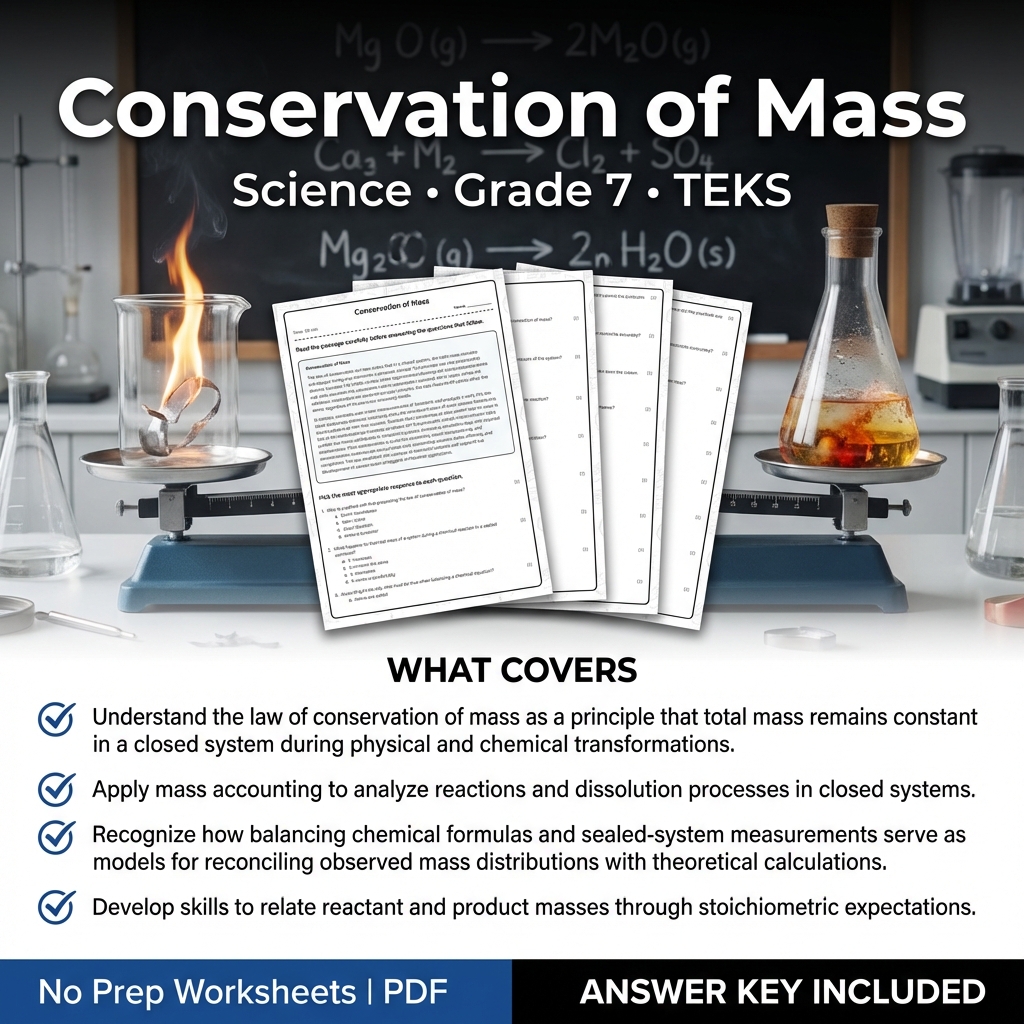
Grade 7 Science Worksheet on Conservation of Mass | TEKS Aligned
Created byCoral Reef LearningLearning Objectives
- Understand the law of conservation of mass as a principle that total mass remains constant in a closed system during physical and chemical transformations.
- Apply mass accounting to analyze reactions and dissolution processes in closed systems.
- Recognize how balancing chemical formulas and sealed-system measurements serve as models for reconciling observed mass distributions with theoretical calculations.
Instant download

Conservation of Mass Assessment | TEKS Standards Grade 7 Science
 Created byPrism Point Learning
Learning Objectives
- Understand the law of conservation of mass as a fundamental principle in physical and chemical transformations.
- Apply mass accounting techniques to analyze closed reactions and dissolution processes.
- Balance simple chemical formulas and relate reactant and product mass relationships in sealed systems.
Also included in: Grade 7 Matter and Energy Science Lesson Bundle: TEKS assessments
Instant download

Grade 7 Science – Conservation of Mass Daily Reading Worksheet | TEKS Aligned
 Created byBright Mind Resources
Learning Objectives
- Understand the law of conservation of mass as a principle in physical and chemical changes.
- Identify that mass remains constant in a closed system during transformations.
- Apply concepts of mass conservation to various laboratory scenarios.
Also included in: 7th Grade States of Matter Science Daily Reading Lesson Bundle | TEKS +2 more
Instant download

Grade 7 Science | Atomic Models - Daily Reading Comprehension
Created byCoral Reef LearningLearning Objectives
- Understand the basic components of an atom: protons, neutrons, and electrons.
- Learn how atomic structure influences the properties of elements and molecules.
- Differentiate between simple molecular models and extended lattice structures.
Instant download

Population Change Worksheet | Grade 7 Science Activities
Created byPrism Point LearningLearning Objectives
- Explain how birth and death rates and migration affect population size and distribution
- Compare exponential and logistic growth patterns using carrying capacity and limiting factors
- Describe how resources, disease, and competition influence population dynamics and species interactions
Also included in: Ecosystems & Adaptations Grade 7 Science Lesson Bundle TEKS Worksheets
Instant download
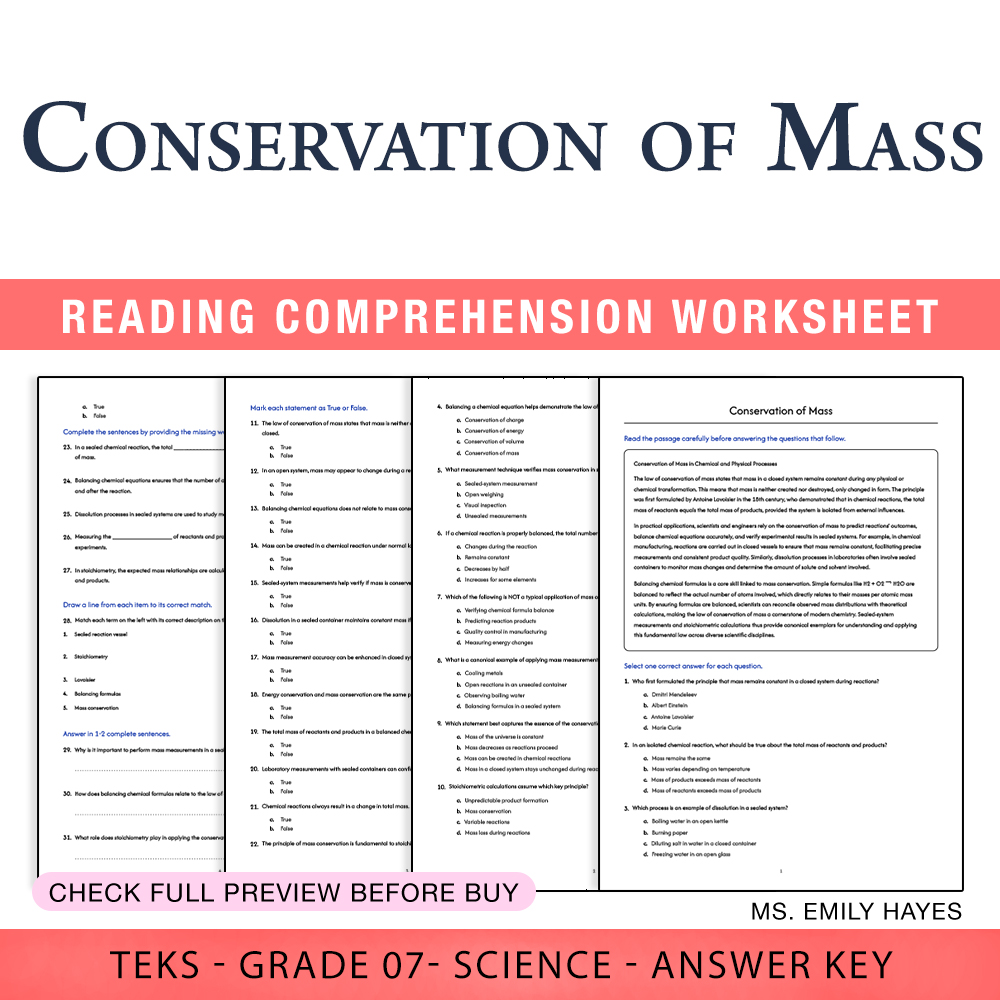
7th Grade Science | Conservation of Mass Worksheet (PDF + Answer Key)
Created byCopper Leaf ClassroomLearning Objectives
- Understand the law of conservation of mass as a fundamental principle in physical and chemical changes.
- Apply mass accounting techniques to closed reactions and dissolution processes.
- Balance simple chemical formulas to relate reactant and product mass.
Instant download
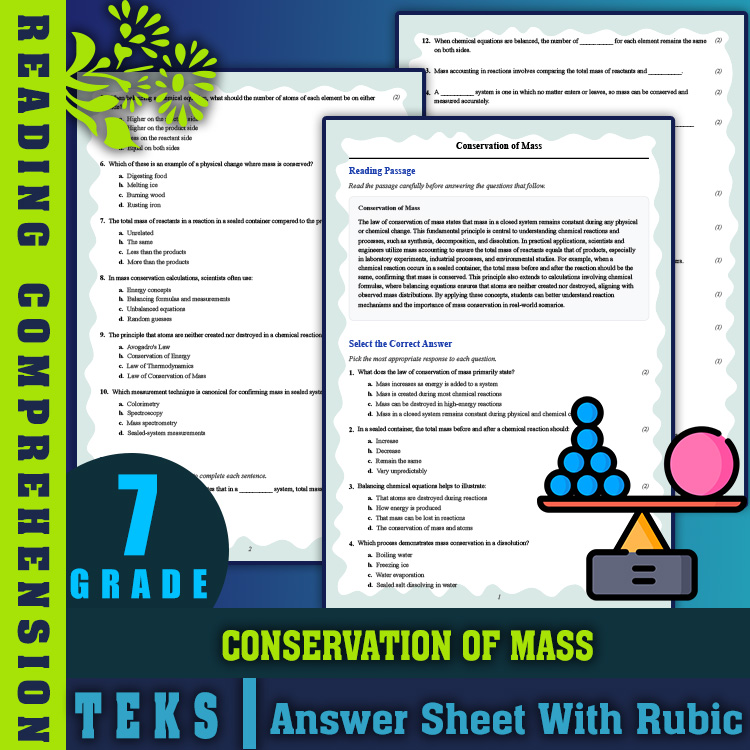
7th Grade Science | Conservation of Mass Reading Worksheet & Answer Key (PDF)
Learning Objectives
- Understand the law of conservation of mass and its fundamental principles.
- Apply mass accounting to chemical and physical processes in closed systems.
- Recognize how balancing chemical equations relates to mass conservation.
Instant download

Atomic Models Worksheet | NGSS-Aligned Grade 7 Science Practice PDF
Learning Objectives
- Understand different types of atomic models and their representations.
- Identify the relationship between subatomic particles, atomic number, and chemical formulas.
- Distinguish between molecular structures and extended network structures based on bonding patterns.
Also included in: Grade 7 Structure and Properties of Matter Science Lesson Bundle: NGSS +1 more
Instant download

Grade 7 Science – Genotype & Phenotype | Daily Reading Worksheet
Created byBright Mind ResourcesLearning Objectives
- Understand the difference between genotype and phenotype.
- Identify how genetic information influences observable traits.
- Explain how environment interacts with genetics to shape traits.
Also included in: Populations & Traits Grade 7 Science Daily Reading Lesson Bundle | Florida NGSSS +1 more
Instant download

Grade 7 Population Change Science Daily Reading Worksheet | TEKS Activity
 Created byBRIGHT PATH RESOURCES
Learning Objectives
- Identify main ideas about why populations change over time.
- Use key vocabulary: birth rate, death rate, immigration, emigration, carrying capacity, and limiting factors.
- Explain how birth and death and movement into and out of a habitat affect population size.
Also included in: Grade 7 Ecosystems Science Daily Reading Worksheets Bundle | TEKS +1 more
Instant download

Population Change Assessment for Grade 7 Science | TEKS Standards
Created byPrism Point LearningLearning Objectives
- Understand the factors that influence population size and distribution.
- Explain the concepts of exponential and logistic growth patterns.
- Analyze how predator-prey interactions affect population dynamics.
Instant download

Grade 7 Conservation of Mass Science Daily Reading Worksheet | TEKS
Created byBRIGHT PATH RESOURCESLearning Objectives
- Summarize the law of conservation of mass for closed systems.
- Explain how mass is tracked during physical and chemical changes.
- Use simple mass accounting ideas to relate reactants and products.
Also included in: Matter-Energy Grade 7 Science Daily Reading Worksheets Lesson Bundle | TEKS +1 more
Instant download

Grade 7 Science | Population Change Worksheet (TEKS) PDF
Created byEvergreen Desk EducationLearning Objectives
- Explain how births, deaths, immigration, and emigration change population size and distribution
- Describe carrying capacity and limiting factors and how they affect population growth
- Compare exponential and logistic growth patterns using real population examples
Instant download

Grade 7 Science | Integration & Homeostasis - Daily Reading Comprehension
Created byCoral Reef LearningLearning Objectives
- Understand cellular transport mechanisms such as diffusion, osmosis, and active transport.
- Explain how transport proteins, membrane pumps, and hormones regulate homeostasis.
- Describe the process of nutrient and ion transport across cell membranes.
Instant download

Matter Cycling Worksheet Grade 7 Science Activities | Ecosystems & Matter
Created byPrism Point LearningLearning Objectives
- Explain how atoms move through an ecosystem during matter cycling processes such as photosynthesis, respiration, feeding, and decomposition.
- Describe how decomposers return nutrients to soil and water so that new plants can grow.
- Distinguish matter cycling (reused atoms) from energy flow (one-way transfer with heat loss).
Also included in: Life Science - Grade 7 Bundle
Instant download

Grade 7 Science | Matter Cycling - Daily Reading Comprehension
Created byCoral Reef LearningLearning Objectives
- Understand the stages of the water cycle
- Explain how water moves within the environment
- Identify the processes involved in water cycling such as evaporation, condensation, precipitation, and collection
Instant download
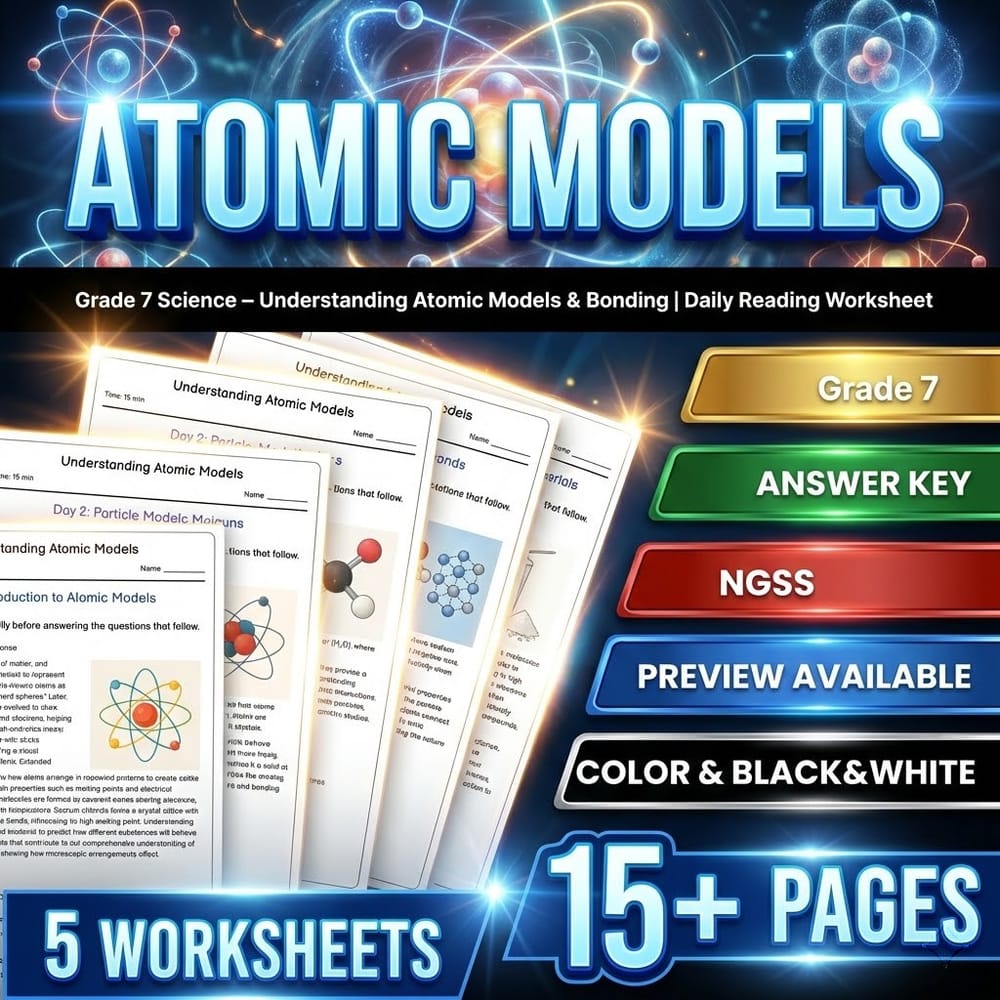
Grade 7 Science – Atomic Models & Bonding | Daily Reading Worksheet
 Created byElena Brooks
Learning Objectives
- Identify different atomic models such as particle, ball-and-stick, and lattice representations
- Understand how atoms form molecules and extended structures
- Recognize examples like water molecules and sodium chloride crystals
Also included in: Materials and Chemical Reactions Grade 7 Science Worksheets Bundle | NGSS +1 more
Instant download

Matter Cycling Assessment for Grade 7 Science | California Standards
Created byPrism Point LearningLearning Objectives
- Explain how matter (atoms of elements like carbon and nitrogen) cycles through ecosystems between living and nonliving components.
- Describe major pathways for matter cycling, including photosynthesis, respiration, feeding, decomposition, and transport in soil and water.
- Differentiate energy flow from matter cycling by recognizing that energy moves mainly one direction from the Sun.
Also included in: Grade 7 Energy Flow and Matter Cycling Science lesson bundle – California Standards +1 more
Instant download

Model Limits Worksheet Grade 7 Science Activities | NGSSS Resource
Created byPrism Point LearningLearning Objectives
- Explain how models use assumptions and simplifications that can limit what they predict accurately
- Identify how discrepancies between observations and predictions can guide revisions to a model
- Distinguish reliable model predictions from approximate representations of complex systems
Instant download
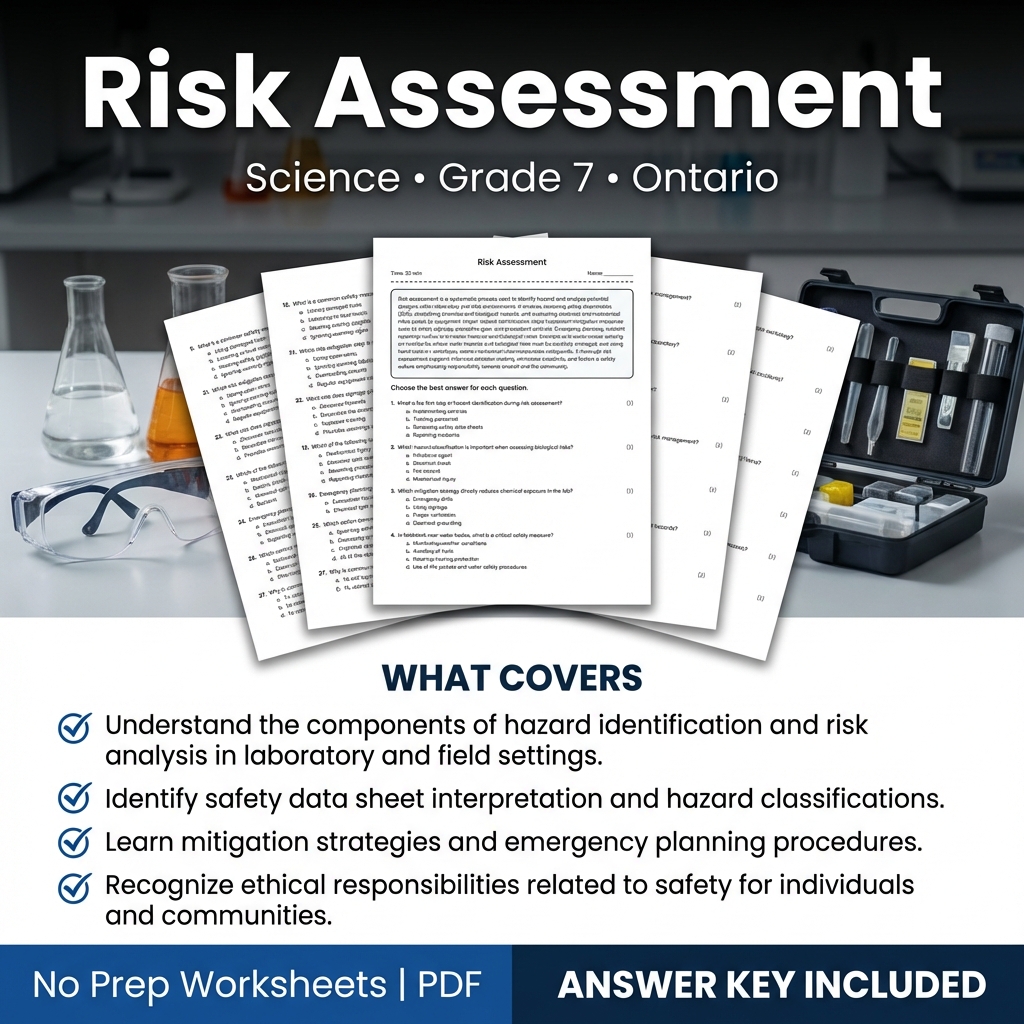
Risk Assessment Worksheet for Grade 7 Science | Ontario Standards
Created byCoral Reef LearningLearning Objectives
- Understand the components of hazard identification and risk analysis in laboratory and field settings.
- Identify safety data sheet interpretation and hazard classifications.
- Learn mitigation strategies and emergency planning procedures.
Instant download

Grade 7 Science – Conservation of Mass Worksheet for Mastery
 Created byThe Resource Hub
Learning Objectives
- Explain the principle of the conservation of mass in closed systems during physical and chemical processes.
- Apply mass accounting techniques to reactions and dissolution processes to relate reactant and product masses.
- Balance simple chemical formulas and use sealed-system measurements to reconcile observed mass distributions with stoichiometric calculations.
Also included in: Grade 7 Science Unit Bundle – States, Reactions & Atomic Structure Worksheets +1 more
Instant download

Grade 7 Genotype and Phenotype Worksheet | NGSS Practice PDF
Created byClear Sky ClassroomLearning Objectives
- Explain the difference between genotype and phenotype.
- Use dominant and recessive alleles to predict possible phenotypes.
- Describe how environmental factors can affect how a genotype becomes a phenotype.
Instant download

Grade 7 Science | Matter Cycling Worksheet | California Standards
 Created byLumora Learning
Learning Objectives
- Explain how atoms move through an ecosystem via processes like photosynthesis, feeding, respiration, and decomposition.
- Describe how decomposers return nutrients to soil and water and how this supports new plant growth.
- Distinguish matter cycling from energy flow in ecosystems, emphasizing that energy moves one direction from the Sun.
Instant download

Hazard Patterns and Risk Assessment Worksheets for Grade 7 Science
Created byTeachers ClubLearning Objectives
- Describe how hazard magnitude influences risk
- Compare hazard frequency and geographic distribution across areas
- Interpret hazard maps to compare patterns of risk
Also included in: Grade 7 Earth & Human Activity Science Worksheets | NGSS Bundle +2 more
Instant download

Risk Assessment and Safety Controls Science Worksheets Grade 7
Created byPrism Point LearningLearning Objectives
- Identify hazards and categorize risks in science activities
- Interpret safety data sheet information for safer choices
- Select engineering controls that reduce exposure to hazards
Also included in: Scientific Inquiry & Data Practices Lesson Bundle | Grade 7 Science | Ontario +1 more
Instant download

Grade 7 Natural Hazards Worksheet | NGSS Practice PDF
Created byClear Sky ClassroomLearning Objectives
- Identify different types of natural hazards and their characteristics.
- Interpret historical and instrumental data to analyze hazard patterns.
- Understand the concepts of recurrence intervals and hazard maps.
Also included in: Grade 7 Ecosystems & Human Impacts Science Lesson Bundle Worksheet B (NGSS) +1 more
Instant download

Fossil Patterns Worksheet | Fossil Record Evidence Activity Grade 7
 Created byAmber Owl Education
Learning Objectives
- Identify how stratigraphic layers and index fossils help scientists interpret the fossil record over geologic time.
- Explain how transitional fossils provide evidence for anatomical change and lineage continuity.
- Compare evidence for macroevolutionary patterns such as radiation events and mass extinctions.
Also included in: Grade 7 Science Evolution & Biodiversity Lesson Bundle – NGSS +1 more
Instant download

Energy Flow in Ecosystems Worksheets | Grade 7 Science Review
Created byTeachers ClubLearning Objectives
- Explain how energy moves through producers, consumers, and decomposers
- Describe photosynthesis and cellular respiration as energy mechanisms
- Model an energy budget across trophic levels
Also included in: Grade 7 Science Ecosystems Worksheets | NGSS Unit Bundle +2 more
Instant download
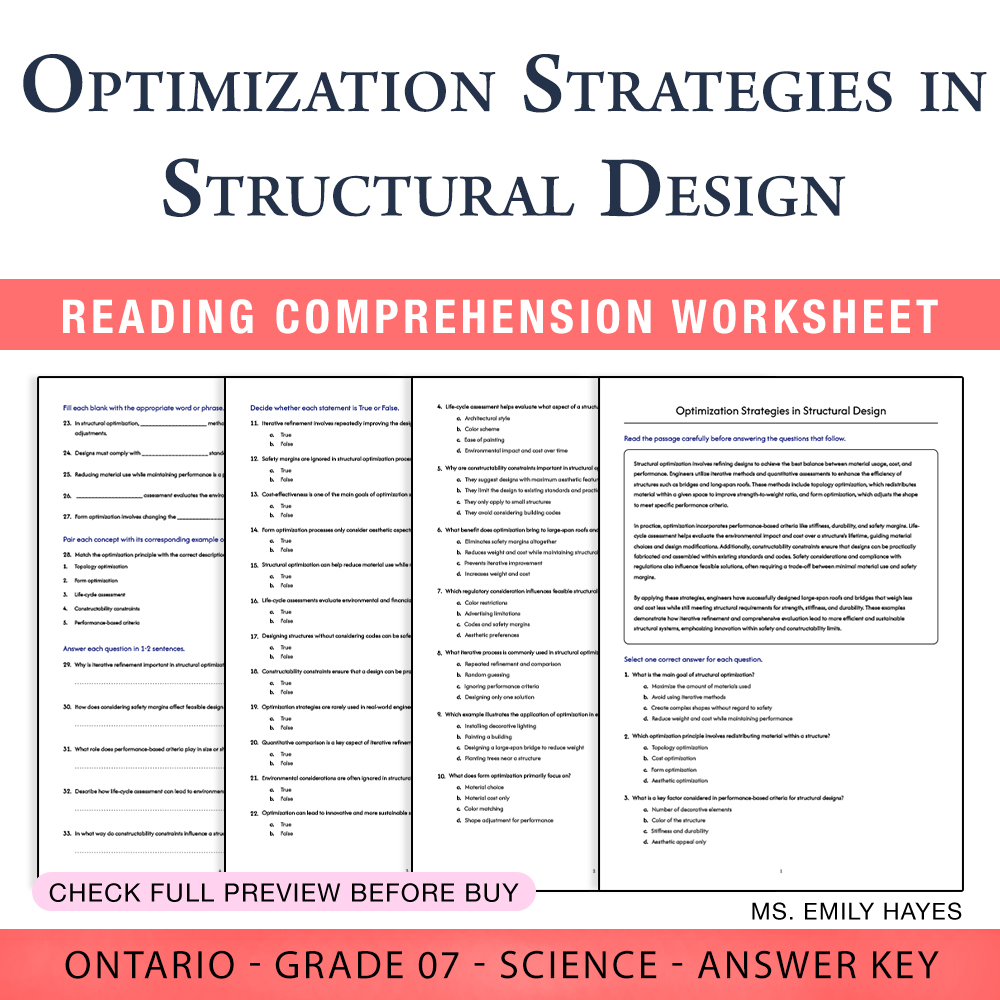
7th Grade Science | Optimization Strategies Worksheet (PDF+ Answer Key)
Created byCopper Leaf ClassroomLearning Objectives
- Understand the principles of structural optimization, including topology and form optimization.
- Learn how performance-based criteria, life-cycle assessments, and constructability constraints influence design choices.
- Analyze real-world examples of optimization in large-span roofs and bridges to reduce weight and cost while maintaining strength.
Instant download

Grade 7 Science | Fossil Patterns - Daily Reading Comprehension
Created byCoral Reef LearningLearning Objectives
- Understand different types of fossils and how they are formed.
- Learn about stratigraphic sequences and their significance.
- Identify key fossil examples that demonstrate transitional forms.
Instant download

Grade 7 Fossil Patterns Worksheet | NGSS Practice & PDF
Created byClear Sky ClassroomLearning Objectives
- Analyze patterns in the fossil record to understand evolutionary relationships.
- Identify key concepts such as stratigraphy, index fossils, and transitional forms.
- Interpret data from fossil assemblages and understand their significance in macroevolution.
Also included in: Grade 7 Natural Selection & Adaptation Science Lesson Bundle for NGSS +1 more
Instant download

Science Grade 7 Worksheet: Fossil Patterns | NGSS Aligned Science
 Created bySkylark Worksheets
Learning Objectives
- Explain how fossil patterns in stratigraphic layers provide evidence for common ancestry and evolutionary change over geologic time.
- Use index fossils and correlations between sedimentary layers to infer relative ages and interpret changes in fossil assemblages.
- Analyze how transitional fossils and morphological trends support ideas about lineage continuity, radiations, and mass extinctions.
Also included in: Grade 7 Speciation and Evolution Evidence Science Lesson Bundle NGSS +1 more
Instant download

Quantitative Heat Worksheet Grade 7 Science | Heat Energy & Specific Heat
 Created byChalk and Compass
Learning Objectives
- Use the relationship Q = mcΔT to estimate the thermal energy needed to change a substance’s temperature.
- Explain how specific heat capacity links material identity to temperature change for a given mass and added heat.
- Describe how heat-transfer rate depends on area, temperature gradient, and time.
Also included in: Grade 7 Science Heat Transfer and Thermal Energy Lesson Bundle | Ontario +1 more
Instant download
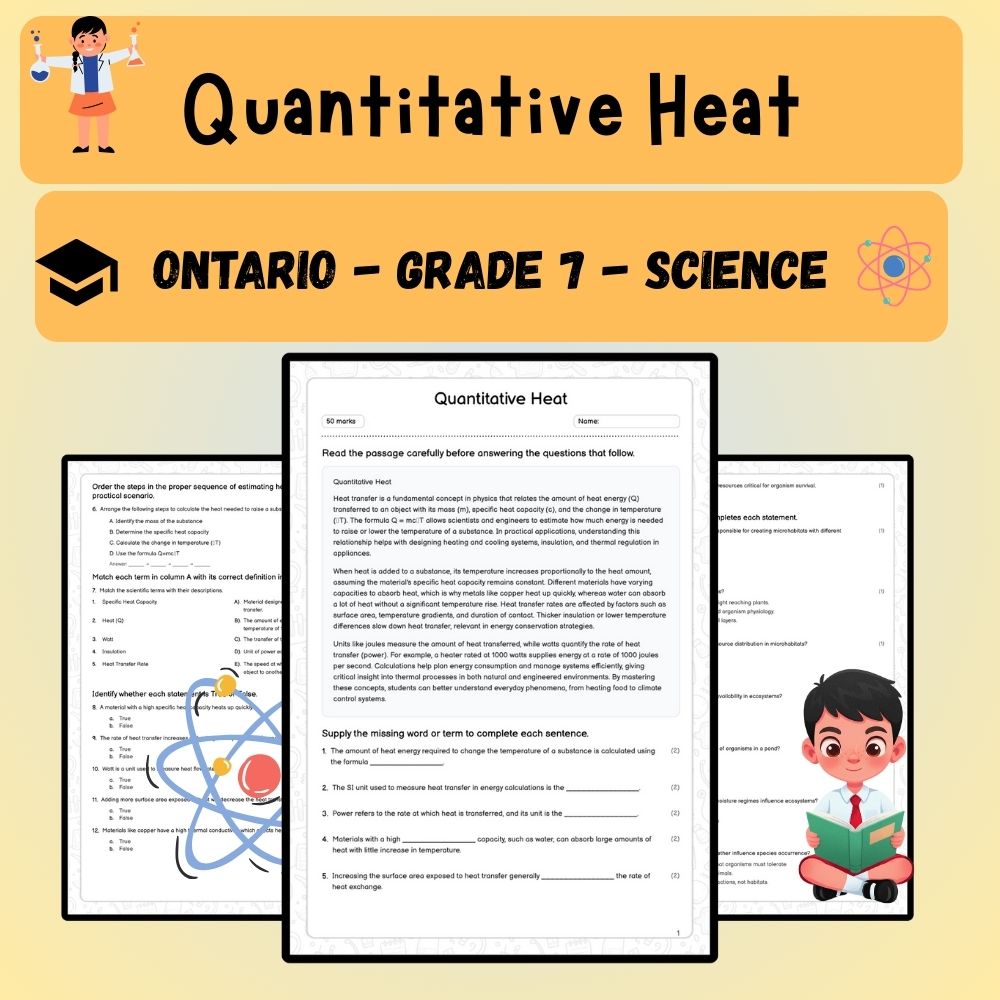
Grade 7 Science | Quantitative Heat Worksheet (PDF ) – Ontario Standards
Created byPrism Point LearningLearning Objectives
- Understand the relationship between heat, mass, and temperature change using the formula Q = mcΔT.
- Recognize units such as joules and watts used to measure heat and power.
- Apply the specific heat capacity concept to estimate energy required for heating substances.
Also included in: Grade 7 Science – Heat Transfer & Insulation Unit Worksheet Bundle +1 more
Instant download
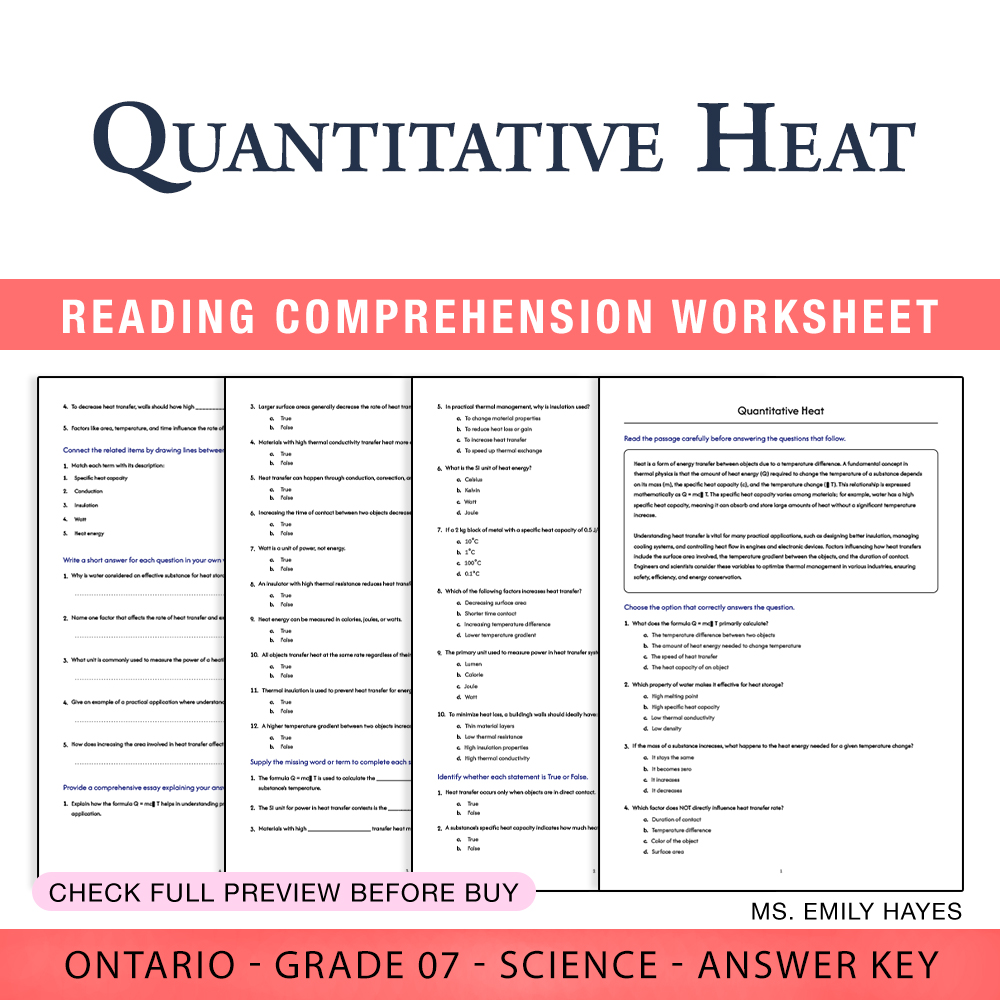
Grade 7 Science | Quantitative Heat Worksheet (PDF+ Answer Key)
Created byCopper Leaf ClassroomLearning Objectives
- Understand the relationship between heat, mass, and temperature change using the equation Q = mcΔT.
- Calculate the amount of heat energy required to change the temperature of various substances.
- Explain factors affecting heat transfer such as area, temperature gradient, and time.
Instant download

Fossil Patterns Worksheet | Assessment & Student Practice | NGSS Grade 7 Science
Learning Objectives
- Understand how fossil records reveal patterns of succession, diversity, and extinction events.
- Identify key fossil types such as index fossils and transitional forms like Archaeopteryx and Tiktaalik.
- Analyze stratigraphic sequences to infer evolutionary relationships and timing of macroevolutionary trends.
Also included in: Grade 7 Science Lesson Bundle | Biological Evolution: Unity and Diversity +1 more
Instant download

Grade 7 Science | Understanding Scientific Models - Daily Reading Comprehension
Created byCoral Reef LearningLearning Objectives
- Define what a scientific model is
- Identify the purpose of scientific models
- Explain the limitations and assumptions within models
Instant download

Grade 7 Science – Understanding Model Limits | Daily Reading Worksheet
Created byBright Mind ResourcesLearning Objectives
- Identify the assumptions made in scientific models.
- Recognize the boundaries and limitations of various models.
- Understand how discrepancies between observations and models signal the need for revision.
Also included in: Grade 7 Variables Science lesson-bundle daily reading worksheets | Florida NGSSS +1 more
Instant download
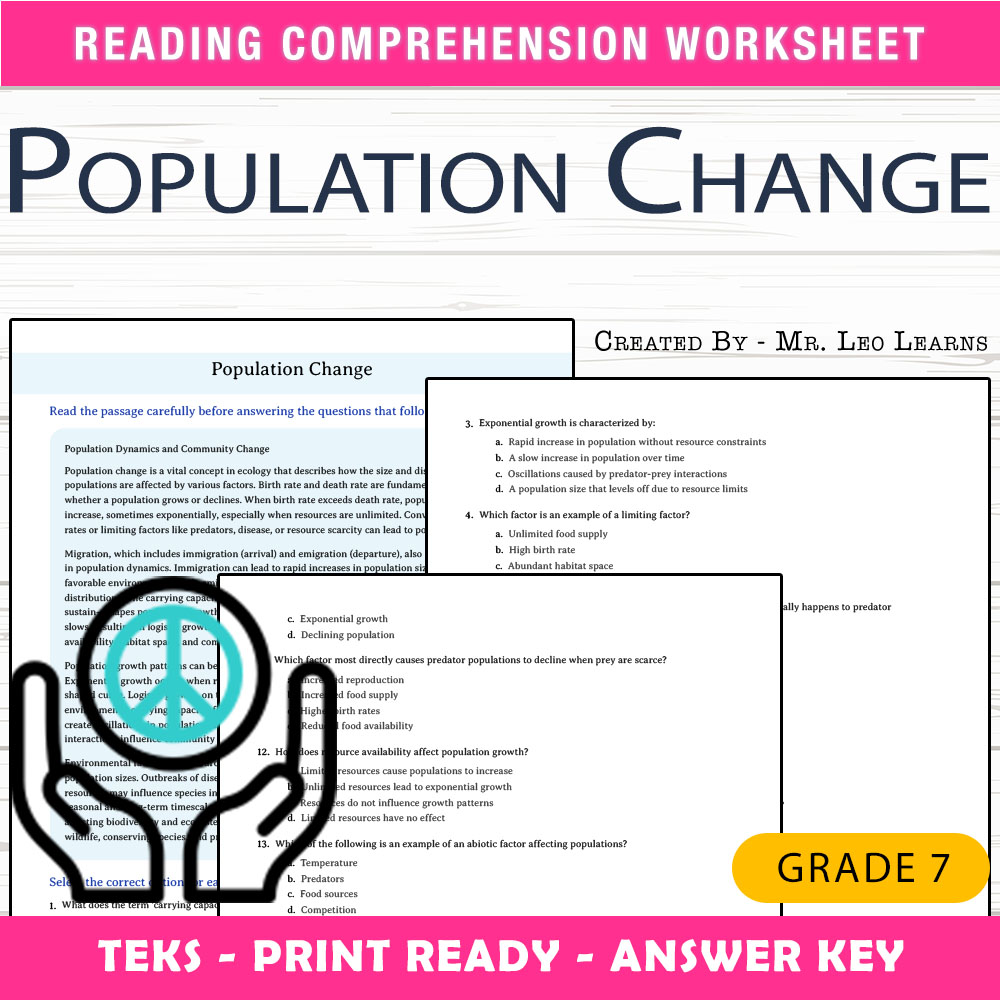
Grade 7 Science — Population Change Worksheet for Mastery
Created byThe Resource HubLearning Objectives
- Understand factors that influence population size and distribution.
- Explain patterns of exponential and logistic growth in populations.
- Analyze how predator-prey relationships and limiting factors affect community dynamics.
Also included in: Grade 7 Science Unit Bundle – Ecosystems, Cells & Adaptations Worksheet Pack +1 more
Instant download
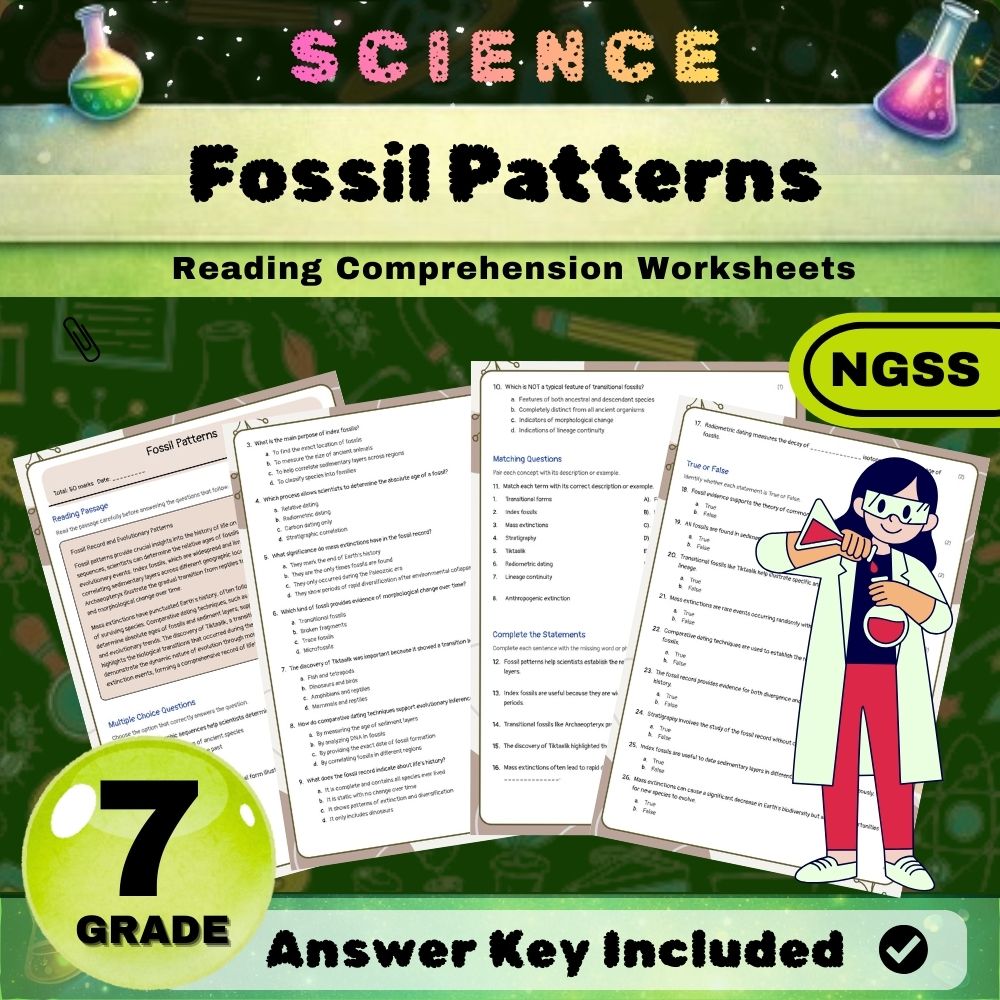
Grade 7 Science | Fossil Patterns NGSS Worksheet (PDF)
 Created byMaple Path Learning
Learning Objectives
- Understand the significance of fossil patterns in revealing evolutionary history.
- Identify key concepts such as stratigraphy, index fossils, transitional forms, and macroevolutionary trends.
- Analyze fossil evidence to infer common ancestry and extinction events.
Also included in: Grade 7 Science | Evolution & Adaptation NGSS Worksheet Bundle +1 more
Instant download
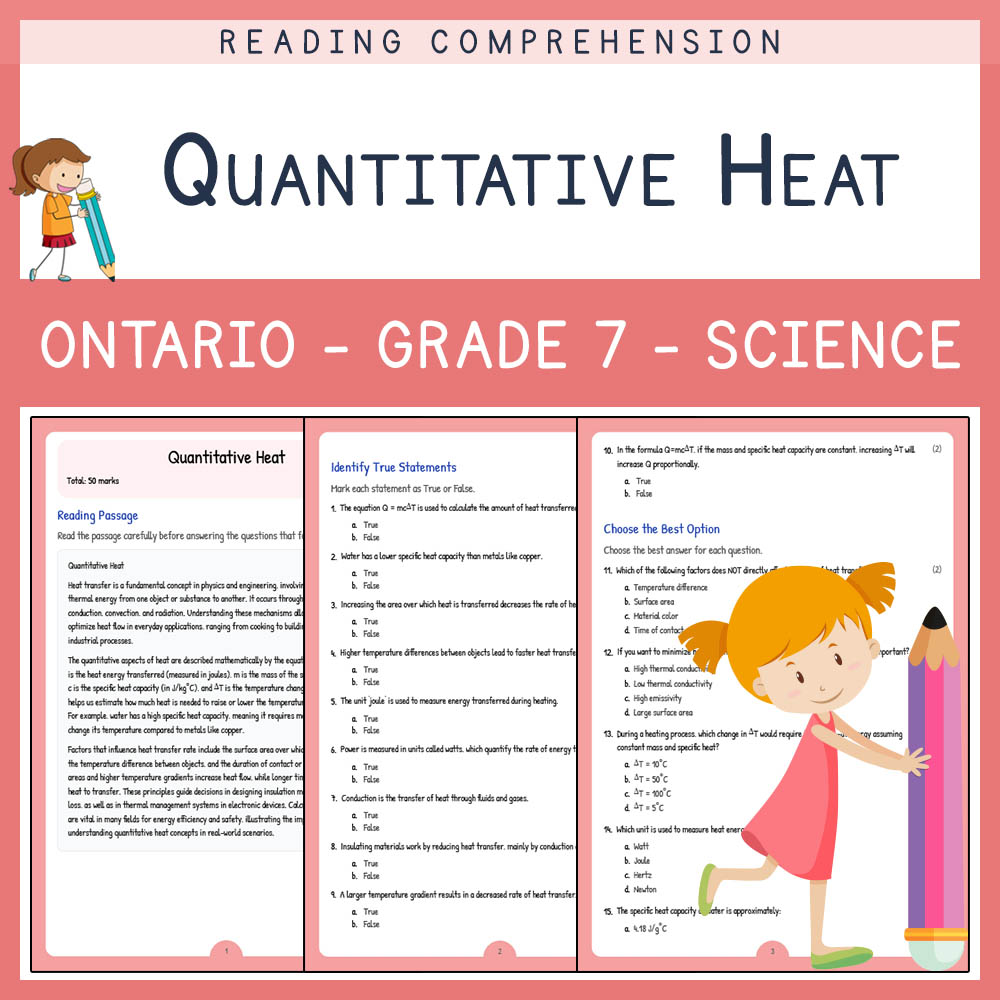
Grade 7 Science Assessment | Quantitative Heat Worksheet Elena | Ontario
Created byLumora LearningLearning Objectives
- Understand how heat transfer depends on mass, temperature change, and specific heat capacity.
- Apply the equation Q = mcΔT to calculate thermal energy changes in common substances.
- Identify units of energy and power such as joules and watts.
Instant download

Grade 7 Science | Quantitative Heat Worksheet with Short Notes (Printable PDF)
 Created byMeadowlark Worksheets
Learning Objectives
- Understand the relationship between heat, mass, and temperature change using the equation Q = mcΔT.
- Identify units such as joules and watts used for measuring heat energy.
- Apply heat calculation formulas to practical problems involving different substances.
Also included in: Grade 7 Science Lesson Group | Thermal Effects and Heat Transfer Worksheets +1 more
Instant download
About Grade 7 Science Worksheets
Browse 6,126 printable Grade 7 Science worksheets — ready-to-print PDFs with answer keys where available.
Every worksheet on MyTeachingSheets is created by independent teacher-authors and reviewed before publication. All resources download as printable PDFs for classroom, homework, or at-home practice, and many include answer keys. Preview any worksheet free before buying.