
Grade 7 Science Worksheets
6,126 worksheets
Grade 7 Science | Restoration Strategies Worksheet (Ontario) (PDF)
 Created byBright Mind Resources
Learning Objectives
- Understand key principles of ecological restoration, including reference conditions and active vs passive approaches.
- Identify factors influencing species selection, habitat connectivity, and corridor design in restoration projects.
- Analyze the trade-offs between short-term recovery and long-term ecosystem resilience.
Instant download
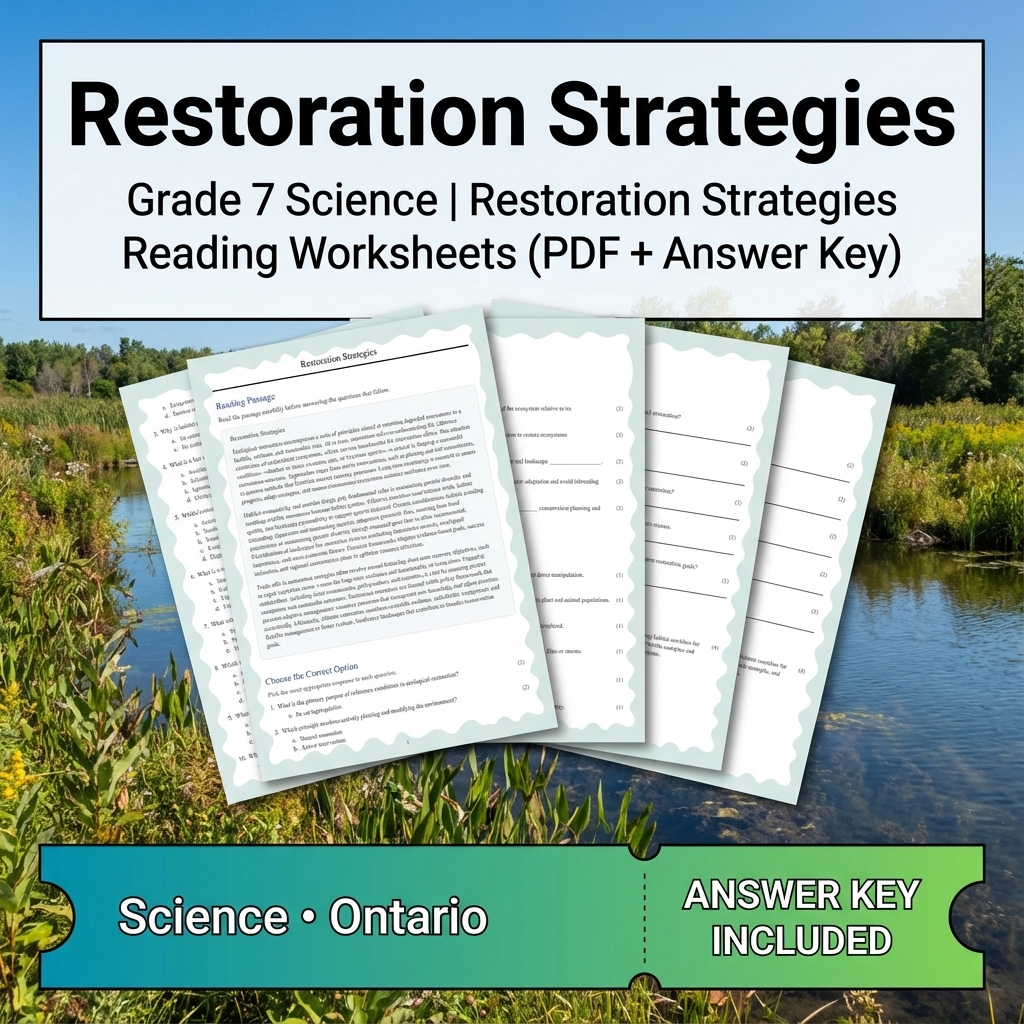
Grade 7 Science | Restoration Strategies Reading Worksheets (PDF + Answer Key)
Learning Objectives
- Understand the key principles of ecological restoration, including reference conditions and species selection.
- Analyze different approaches to restoration, such as active versus passive strategies, and their implications.
- Evaluate long-term monitoring, habitat connectivity, and prioritization criteria in restoration projects.
Also included in: Grade 7 Science | Ecosystems, Biodiversity & Environmental Stewardship +1 more
Instant download

Grade 7 Science – Ecosystem Restoration Strategies Worksheet (PDF)
 Created byEvergreen Desk Education
Learning Objectives
- Explain ecological restoration principles, including reference conditions, active vs. passive approaches, and evidence-based goals
- Describe how species selection, genetic considerations, and habitat connectivity influence restoration planning
- Identify trade-offs between short-term recovery and long-term resilience, and connect restoration to monitoring and adaptive management
Also included in: Grade 7 Ecosystem Dynamics Science Lesson Bundle (Ontario) Worksheets +1 more
Instant download

Grade 7 Science | Ecological Restoration Principles - Reading Comprehension
 Created byCoral Reef Learning
Learning Objectives
- Understand the key principles of ecological restoration
- Identify different restoration approaches and their applications
- Recognize factors influencing successful habitat connectivity and species selection
Instant download

Grade 7 Science | Evolutionary Change Worksheet | Florida NGSSS Aligned
 Created byLumora Learning
Learning Objectives
- Explain how evolutionary change involves shifts in heritable traits across generations rather than individual lifetime changes
- Use the ideas of variation, heredity, and differential survival/reproduction to describe population-level evolution
- Distinguish between adaptation within a lifetime and evolutionary change over long time scales
Instant download

Science Worksheet Conservation Of Matter Grade 7 | Standards-Aligned Practice
Learning Objectives
- Explain the law of conservation of matter in terms of total mass before and after chemical reactions
- Connect conservation of matter to atoms being rearranged rather than created or destroyed
- Interpret real-world examples (sealed container vs. open container) using conservation of mass
Also included in: Grade 7 Matter, Energy & Forces Science Lesson Bundle – Florida NGSSS +1 more
Instant download

Conservation of Matter Worksheet Grade 7 Science NGSSS Practice
Created byEvergreen Desk EducationLearning Objectives
- Explain the law of conservation of matter using the idea that mass is not created or destroyed in chemical reactions.
- Use balanced-mass reasoning to predict whether the total mass of reactants equals the total mass of products.
- Identify everyday examples (such as sealed containers) that support conservation of matter.
Instant download

Conservation of Matter Worksheet | Grade 7 Science Practice Activity
 Created byPrism Point Learning
Learning Objectives
- Explain the conservation of matter during chemical reactions using evidence such as equal total mass of substances before and after.
- Describe how atoms are rearranged in chemical reactions while the total number of atoms remains the same.
- Apply conservation of matter to everyday observations, like mass measurements in sealed containers.
Also included in: Physical Science Lesson Bundle | Grade 7 Science | Florida NGSSS
Instant download

Grade 7 Conservation Of Matter Worksheet | NGSS Practice PDF
 Created byClear Sky Classroom
Learning Objectives
- Explain the conservation of matter principle in terms of atoms being rearranged during chemical reactions.
- Use the idea of a closed system to predict when total mass should stay the same before and after a reaction.
- Apply conservation of mass to interpret evidence from sealed-container experiments.
Instant download

Grade 7 Science | Conservation Of Matter - Daily Reading Comprehension
Created byCoral Reef LearningLearning Objectives
- Understand the principle of conservation of matter in chemical reactions
- Identify real-world examples of conservation of mass
- Explain how atoms are rearranged during chemical changes without gaining or losing mass
Instant download

Grade 7 Science – Conservation of Matter & Chemical Changes | Reading Worksheet
Created byBright Mind ResourcesLearning Objectives
- Describe the principle of conservation of matter during chemical reactions.
- Explain how atoms are rearranged but not destroyed in reactions.
- Identify examples of conservation of mass in everyday observations.
Also included in: Grade 7 Daily Reading Science Worksheets Lesson Bundle | Florida NGSSS +1 more
Instant download

Grade 7 Science | Material Properties in Structural Materials - Comprehension
Created byCoral Reef LearningLearning Objectives
- Understand the concepts of density and tensile strength.
- Compare different construction materials based on their density and tensile strength.
- Recognize how these properties influence material selection in construction.
Instant download
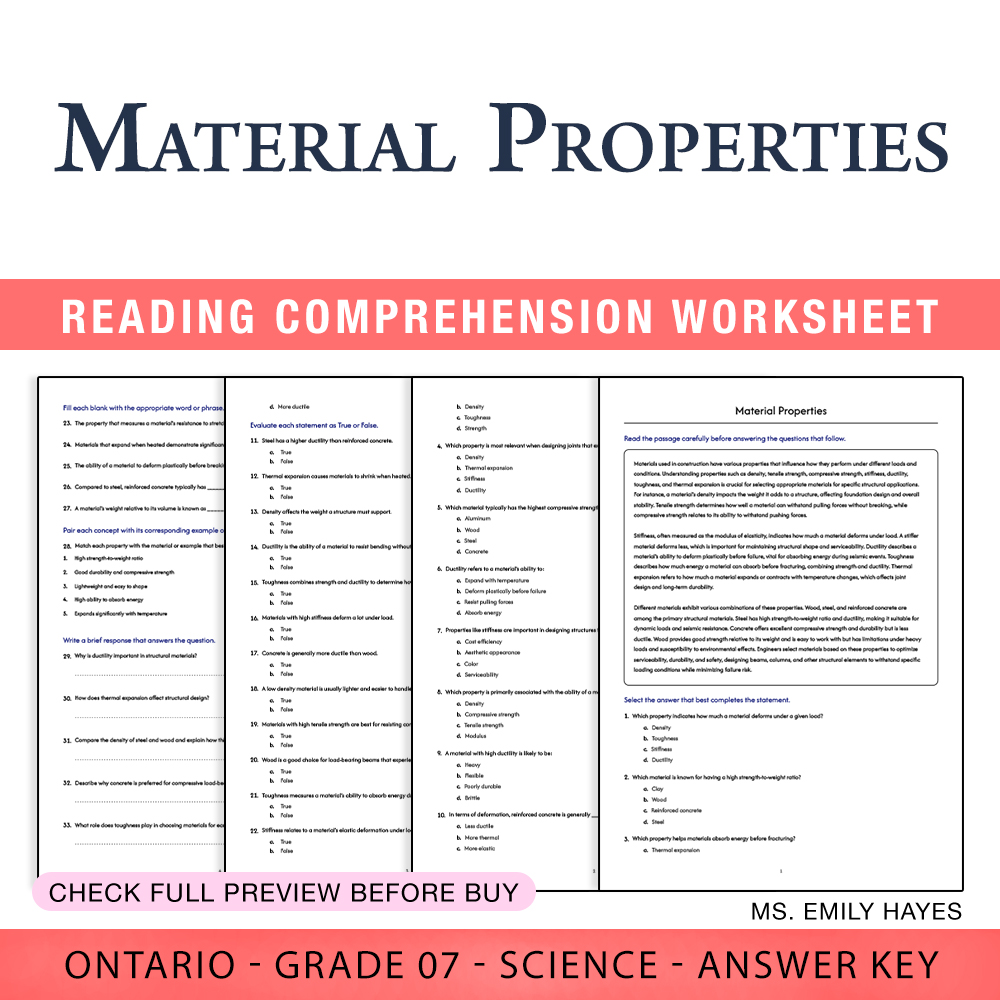
7th Grade Science | Material Properties Worksheet (PDF+ Answer Key)
 Created byCopper Leaf Classroom
Learning Objectives
- Define and explain key material properties such as density, tensile and compressive strength, stiffness, ductility, toughness, and thermal expansion.
- Compare common construction materials—wood, steel, and reinforced concrete—in terms of their strength-to-weight ratio, deformation under load, and failure modes.
- Relate material properties to structural performance, serviceability, durability, and loading conditions.
Instant download

Grade 7 Science – Material Properties & Structural Materials | Reading Worksheet
Created byBright Mind ResourcesLearning Objectives
- Define and explain the concepts of density and tensile strength in materials.
- Identify differences in material properties among wood, steel, and reinforced concrete.
- Analyze how density and tensile strength influence structural performance and failure modes.
Also included in: Structural Eng. Grade 7 Science Daily Reading Worksheets Lesson Bundle | Ontario +1 more
Instant download
Grade 7 Science | Material Properties Worksheet (Ontario, PDF)
Created byBright Mind ResourcesLearning Objectives
- Define key material properties such as density, tensile and compressive strength, stiffness, ductility, toughness, and thermal expansion.
- Explain how these properties influence structural performance and failure modes.
- Contrast common construction materials—wood, steel, and reinforced concrete—in terms of strength-to-weight ratio, deformation, and failure.
Instant download

Material Properties Worksheets: Structural Performance Grade 7 Science
Created byPrism Point LearningLearning Objectives
- Define density, strength, stiffness, ductility, toughness, and thermal expansion
- Distinguish tensile strength from compressive strength in structural materials
- Compare wood, steel, and reinforced concrete properties
Also included in: Grade 7 Structural Performance Lesson Bundle | Ontario Science +1 more
Instant download
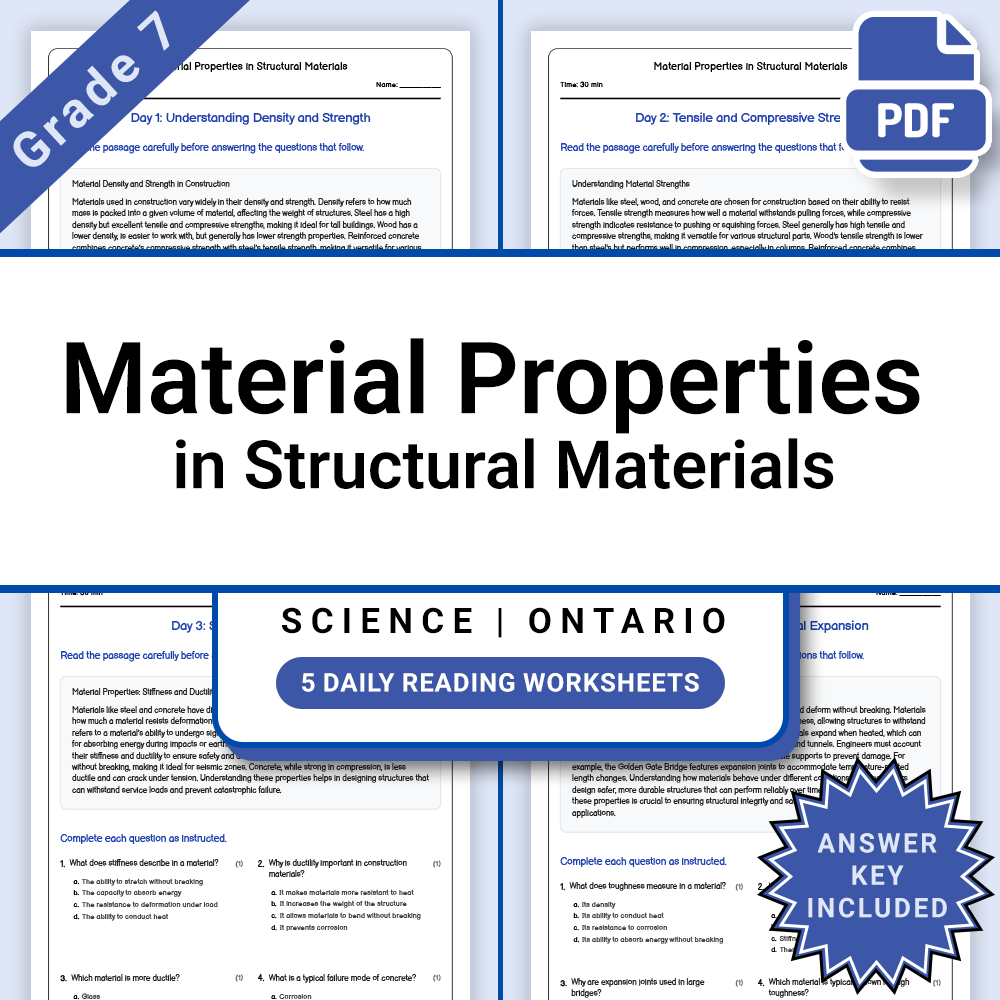
Grade 7 – Material Properties in Structural Materials Worksheet + Answer Key
Learning Objectives
- Understand the key material properties such as density, tensile strength, compressive strength, stiffness, ductility, toughness, and thermal expansion.
- Learn how these properties affect structural performance, durability, and failure modes.
- Compare common construction materials—wood, steel, and reinforced concrete—in terms of strength-to-weight ratio, deformation, and failure.
Also included in: Grade 7 Science Lesson Bundle: Engineering & Structural Materials Ontario +1 more
Instant download

Grade 7 Science Worksheet – Material Properties with Ontario Standards (PDF)
Created byEvergreen Desk EducationLearning Objectives
- Define and compare key material properties: density, tensile strength, compressive strength, stiffness (modulus), ductility, toughness, and thermal expansion.
- Explain how material properties influence structural performance and design choices for beams and columns.
- Contrast wood, steel, and reinforced concrete by strength-to-weight ratio, deformation under load, and typical failure modes.
Also included in: Grade 7 Engineering Design & Materials Science Lesson Bundle Ontario +1 more
Instant download

Grade 7 Material Properties Worksheet | Ontario Science Practice PDF
Created byClear Sky ClassroomLearning Objectives
- Explain how density, strength (tensile and compressive), stiffness (modulus), ductility, toughness, and thermal expansion affect how materials behave under load and temperature changes.
- Use material-property reasoning to compare wood, steel, and reinforced concrete in terms of strength-to-weight, deformation, and typical failure modes.
- Connect beam and column performance to property selection for serviceability, durability, and anticipated loading conditions.
Instant download

Grade 7 Science Worksheet Material Properties in Structures
Learning Objectives
- Define key material properties (density, tensile/compressive strength, stiffness, ductility, toughness, thermal expansion) and describe what each property influences in structures.
- Compare wood, steel, and reinforced concrete in terms of strength-to-weight ratio, deformation under load, and typical failure modes.
- Apply material property reasoning to beam and column examples for serviceability, durability, and anticipated loading conditions.
Instant download

Grade 7 Material Properties Worksheet | Ontario Science Activity
 Created byChalk and Compass
Learning Objectives
- Define and compare key material properties (density, tensile/compressive strength, stiffness, ductility, toughness, and thermal expansion).
- Explain how material properties affect structural behavior such as deformation, cracking, and failure modes.
- Relate property selection to loading conditions and structural performance using wood, steel, and reinforced concrete examples.
Also included in: Grade 7 Science Structural Engineering Design & Materials Lesson Bundle |Ontario +1 more
Instant download

Grade 7 Science | Food Building Blocks - Daily Reading Comprehension
Created byCoral Reef LearningLearning Objectives
- Identify the main nutrients found in food
- Understand the role of carbohydrates, proteins, fats, vitamins, and minerals
- Learn how nutrients contribute to growth, repair, and energy production
Instant download

Food Building Blocks Worksheet for Grade 7 Science | Standards-Aligned Practice
Learning Objectives
- Understand the molecules in food and their roles as building materials and energy sources.
- Describe how food molecules are broken down and used for growth, repair, and energy.
- Explain the process of how food provides energy for body functions over time.
Also included in: Grade 7 Ecosystem Energy & Matter Cycles Science Lesson Bundle +1 more
Instant download

Food Building Blocks Assessment | California Standards Grade 7 Science
Created byPrism Point LearningLearning Objectives
- Explain how food molecules can be used for building body structures and for providing usable energy
- Describe how digestion and cellular processes transform food molecules into forms the body can use
- Connect eating habits to changes in growth, repair, and body condition over time
Also included in: Grade 7 Energy Flow and Matter Cycling Science lesson bundle – California Standards +1 more
Instant download

Grade 7 Science | Food Building Blocks Worksheet | California Standards
Created byLumora LearningLearning Objectives
- Explain how food molecules are broken down and rearranged into molecules needed for growth and repair.
- Describe how chemical energy in food becomes usable energy for life processes.
- Use scientific vocabulary (molecules, energy, chemical energy, growth, repair) to answer questions about digestion and body changes over time.
Instant download

Grade 7 Food Building Blocks Worksheet | NGSS Practice PDF
Created byClear Sky ClassroomLearning Objectives
- Explain how food molecules are broken down and rearranged in the body for growth, repair, and maintenance.
- Describe how chemical energy in food becomes usable energy for life processes.
- Use evidence from food and digestion to connect eating habits with changes in body condition over time.
Instant download

Grade 7 Science Worksheet | Food Building Blocks & Energy Use
Created byEvergreen Desk EducationLearning Objectives
- Explain how food molecules are broken down and rearranged into new molecules needed for growth and repair.
- Describe how chemical energy in food becomes usable energy for life processes.
- Connect nutrition choices to changes in body condition over time.
Instant download
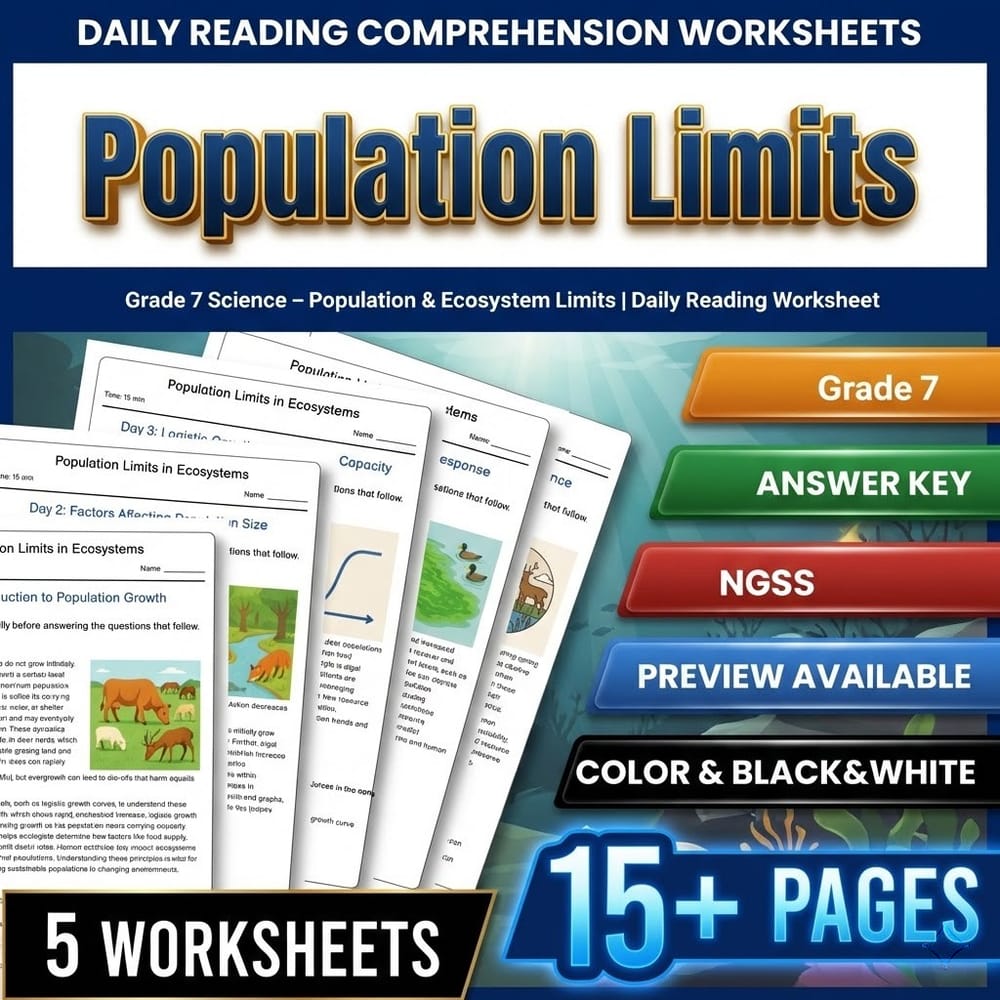
Grade 7 Science – Population & Ecosystem Limits | Daily Reading Worksheet
 Created byElena Brooks
Learning Objectives
- Understand the concept of carrying capacity and how resources influence population growth.
- Interpret data graphs showing population changes over time.
- Identify the effects of limited food, water, and shelter on animal populations.
Also included in: Ecosystems Grade 7 Science Daily Reading Worksheets Bundle | NGSS +1 more
Instant download
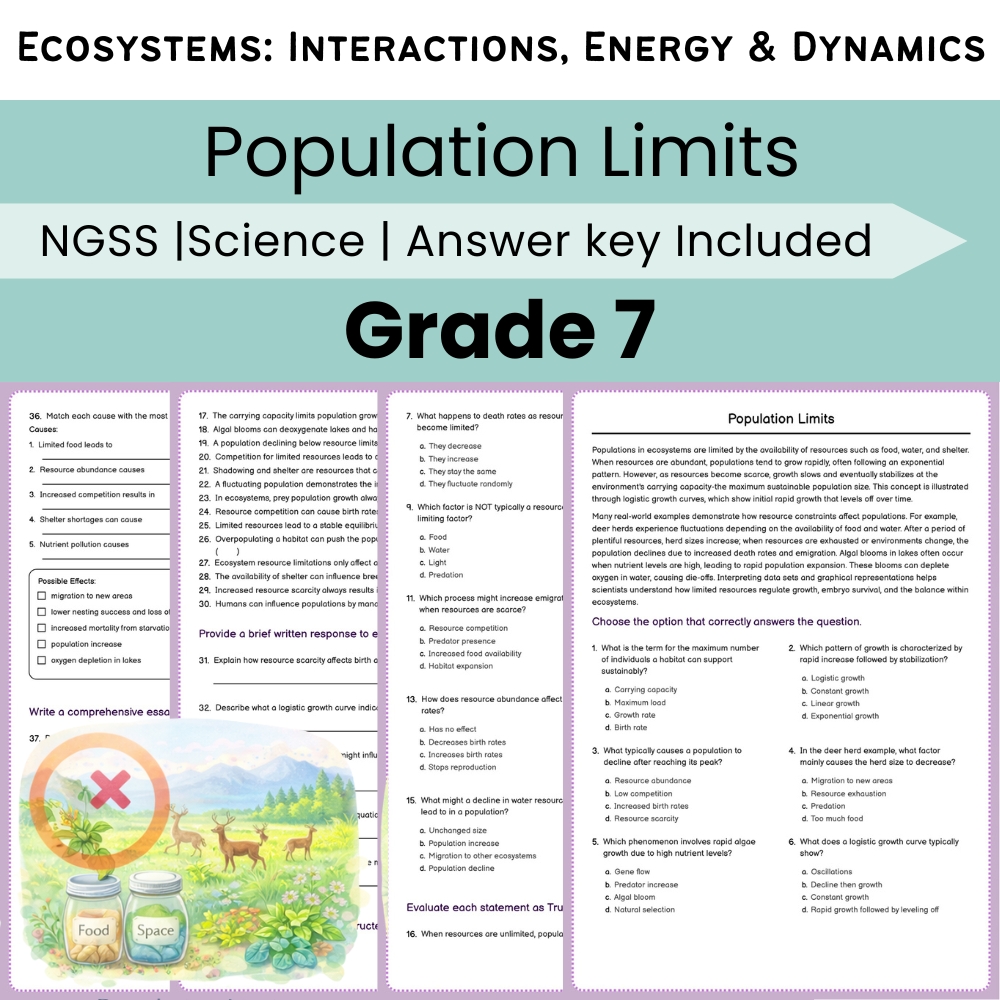
Population Limits Worksheet | Grade 7 Science Printable PDF Assessment
Learning Objectives
- Analyze how resource availability influences population size and growth rates.
- Interpret data sets and graphs related to ecosystem resource constraints.
- Understand the concepts of carrying capacity, logistic growth, and their effects on populations.
Also included in: Grade 7 Science Ecosystems Lesson Bundle | NGSS Interactions & Energy +1 more
Instant download

Science Grade 7:Population Limits and Carrying Capacity Worksheet
 Created bySkylark Worksheets
Learning Objectives
- Explain how resource availability and competition affect population growth rates
- Interpret logistic growth curves and identify the carrying capacity concept
- Relate birth, death, immigration, and emigration to population change within an ecosystem
Also included in: Grade 7 Ecosystem Dynamics Science Lesson Bundle (NGSS) Worksheets +1 more
Instant download
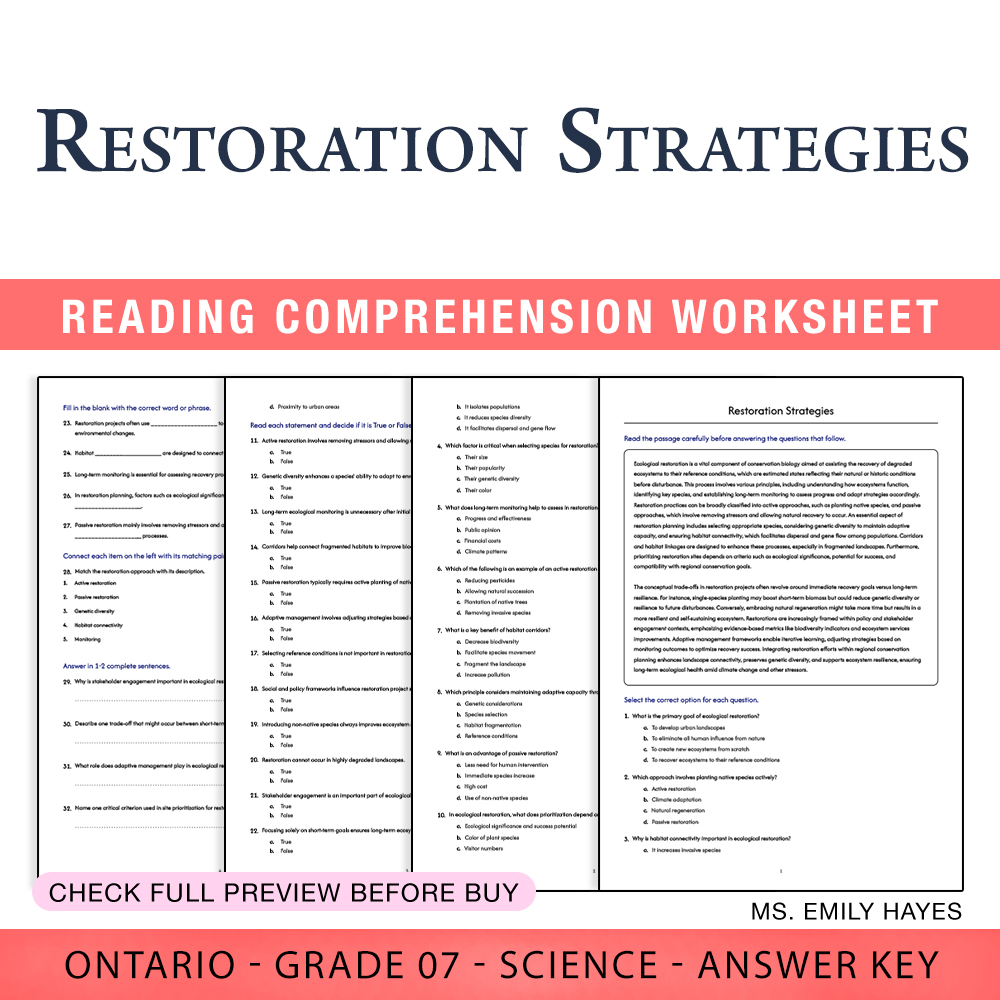
7th Grade Science | Restoration Strategies Worksheet (PDF+ Answer Key)
Created byCopper Leaf ClassroomLearning Objectives
- Explain the principles of ecological restoration, including reference conditions and long-term monitoring.
- Identify and differentiate active versus passive restoration approaches and their applications.
- Analyze factors such as habitat connectivity, species selection, and genetic considerations in restoration planning.
Instant download

Population Limits and Carrying Capacity Worksheets | Grade 7
 Created bythe curious pencil
Learning Objectives
- Explain how limited resources affect population growth rates
- Interpret logistic growth curves and identify carrying capacity
- Describe how births and deaths change population size
Also included in: Ecosystems Worksheets Grade 7 Science | NGSS Unit Bundle +2 more
Instant download

Population Limits Worksheet | Grade 7 NGSS Ecosystems Activity Pack
 Created byAmber Owl Education
Learning Objectives
- Explain how resource availability and competition influence population growth rates
- Interpret logistic growth curves and the concept of carrying capacity
- Relate birth, death, immigration, and emigration to changes in population size
Also included in: Grade 7 Science Ecosystems and Food Webs Lesson Bundle | NGSS +1 more
Instant download

Population Limits Worksheet for Grade 7 Science | NGSS Standards Practice
Learning Objectives
- Understand how resource availability influences population growth and decline.
- Interpret data from graphs and quantitative datasets related to ecosystems.
- Analyze the effects of competition, food, water, and shelter on population dynamics.
Also included in: Grade 7 Ecosystem Dynamics Science Lesson Bundle Worksheets – NGSS +1 more
Instant download
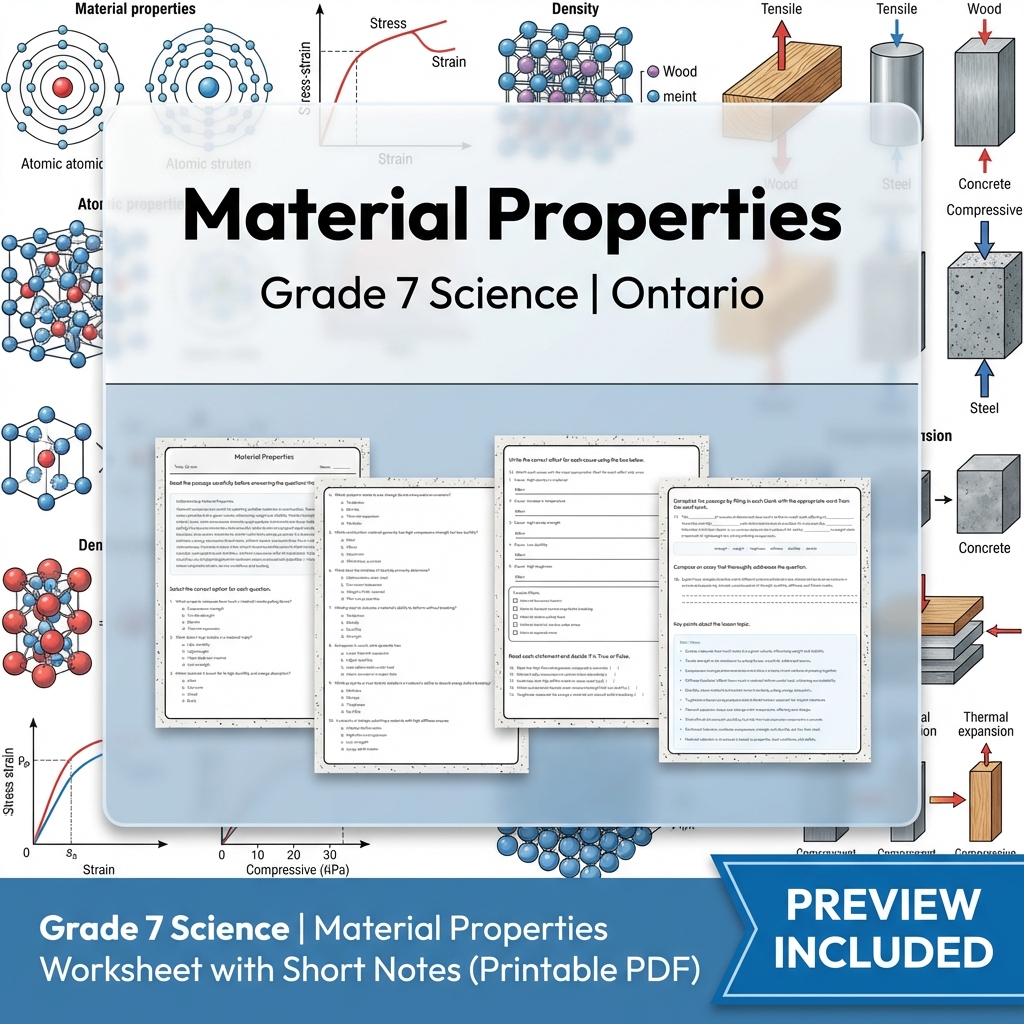
Grade 7 Science | Material Properties Worksheet with Short Notes (Printable PDF)
 Created byMeadowlark Worksheets
Learning Objectives
- Define key material properties such as density, tensile and compressive strength, stiffness, ductility, toughness, and thermal expansion.
- Explain how these properties influence structural performance and failure modes.
- Contrast materials like wood, steel, and reinforced concrete in terms of strength-to-weight ratio and deformation behaviors.
Also included in: Grade 7 Science Lesson Group | Ontario Curriculum Worksheets Bundle +1 more
Instant download
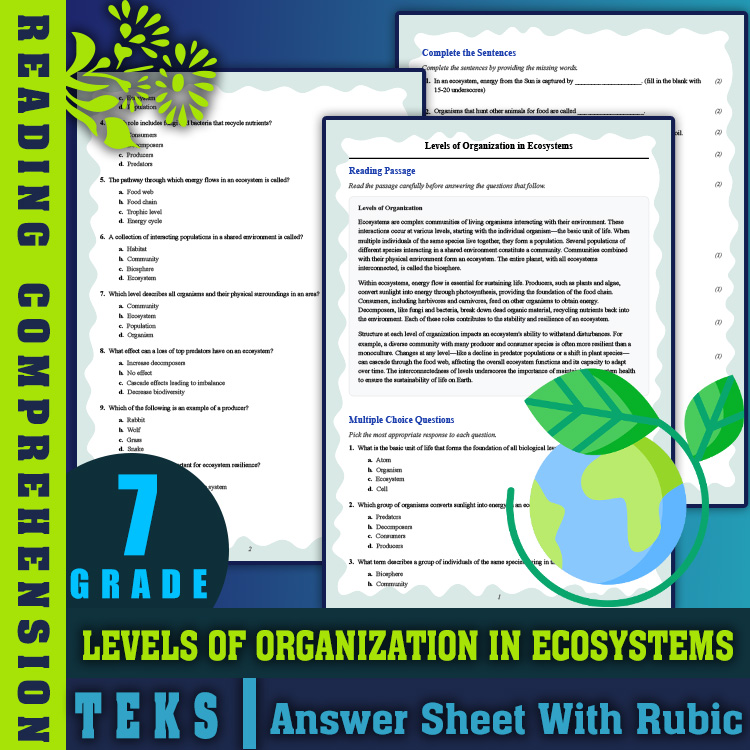
7th Grade Science | Levels of Ecosystem Organization Reading Worksheet
Learning Objectives
- Understand the hierarchical levels of biological organization from individuals to the biosphere.
- Identify roles of producers, consumers, and decomposers within food webs.
- Explain how energy flows through trophic levels and impacts ecosystem stability.
Instant download

Evolutionary Change Assessment for Grade 7 Science | NGSSS Standards
Created byPrism Point LearningLearning Objectives
- Explain how evolutionary change occurs at the population level through changes in allele frequency over generations
- Connect inherited variation and differential survival/reproduction to long-term shifts in traits
- Differentiate evolution from individual organisms changing within their lifetimes
Instant download
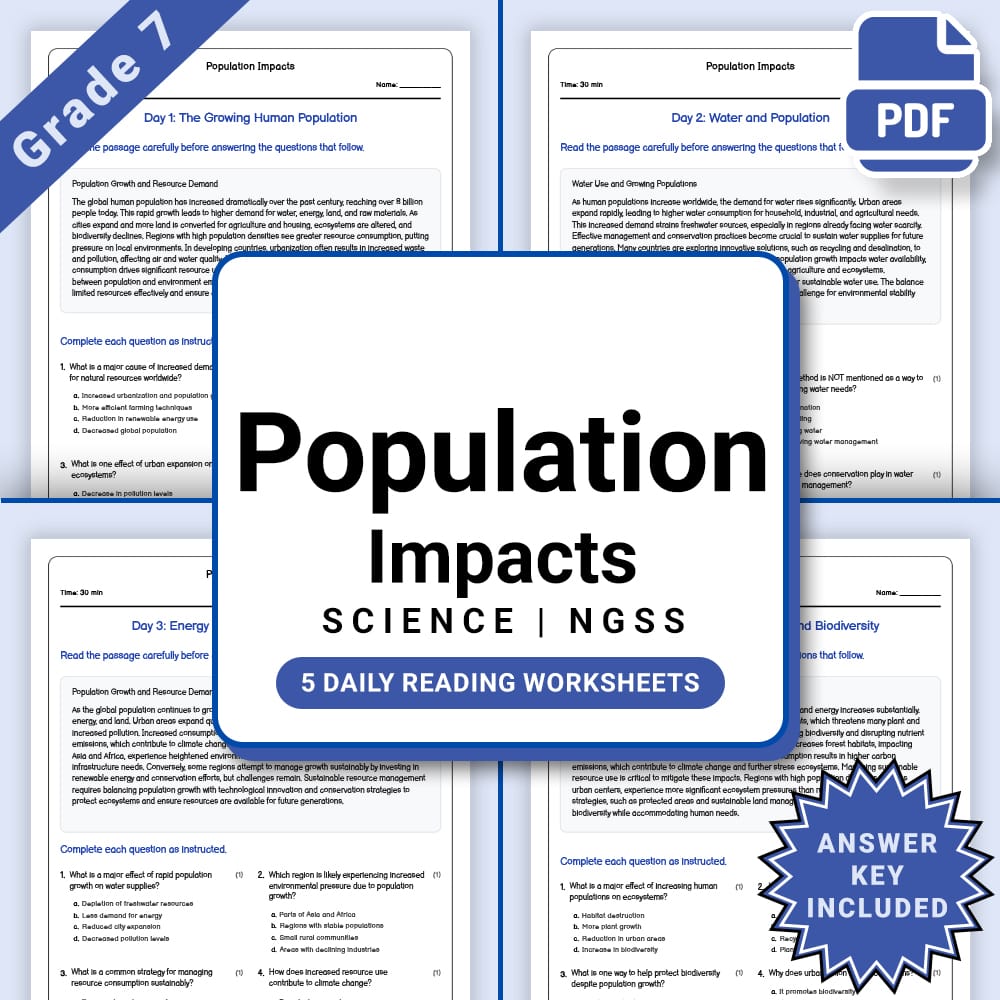
Grade 7 Science – Population Impacts Daily Reading Worksheet(PDF + Answer Key)
Created byCopper Leaf ClassroomLearning Objectives
- Understand how human population growth influences demand for natural resources
- Identify regional examples of environmental pressures caused by population changes
- Analyze the effects of increased resource consumption on ecosystems and biodiversity
Instant download
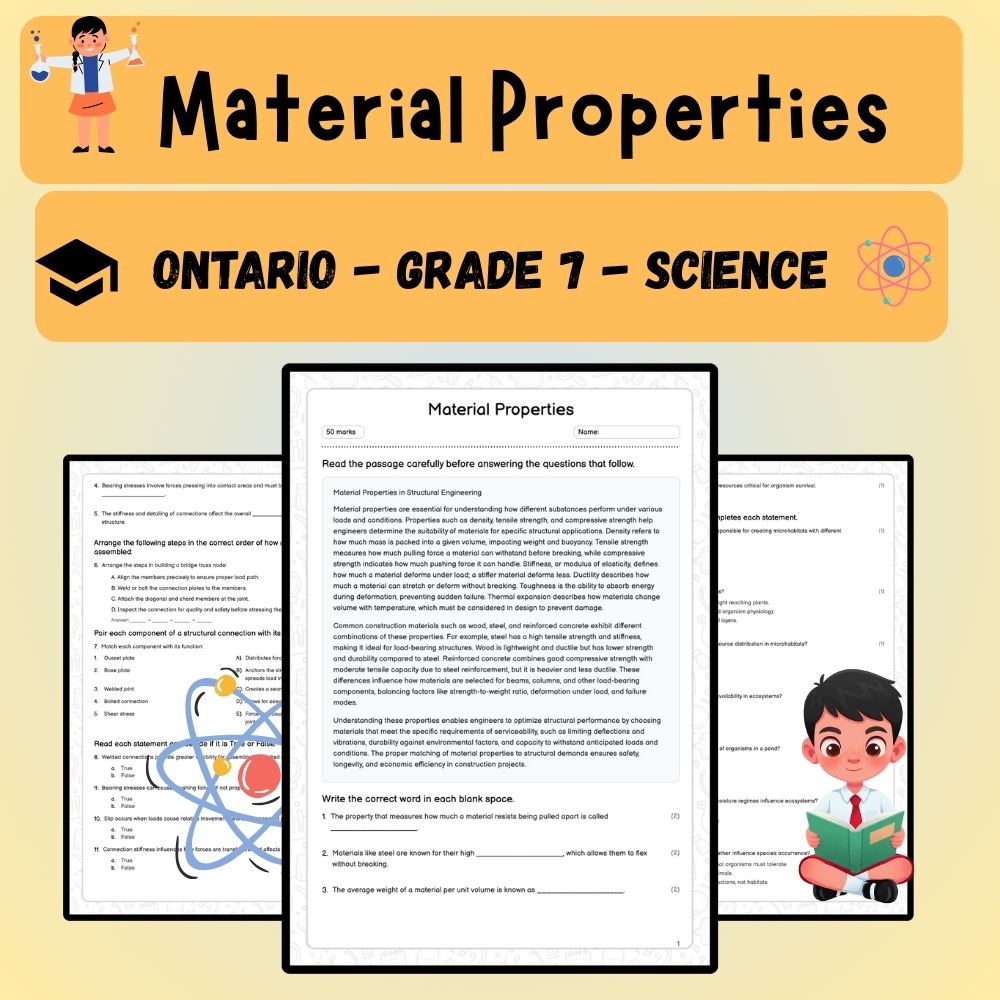
Grade 7 Science – Understanding Material Properties Worksheet (PDF )
Created byPrism Point LearningLearning Objectives
- Define key material properties such as density, tensile strength, compressive strength, stiffness (modulus), ductility, toughness, and thermal expansion.
- Explain how these properties influence the structural performance of materials.
- Compare construction materials like wood, steel, and reinforced concrete in terms of strength-to-weight ratio, deformation, and failure modes.
Also included in: Grade 7 Science Unit | Structural Engineering & Material Testing Worksheets Bundle +1 more
Instant download

Grade 7 Levels of Organization Science Daily Reading Worksheet | TEKS
 Created byBRIGHT PATH RESOURCES
Learning Objectives
- Identify main ideas about hierarchical organization in living systems.
- Use key vocabulary: organism, population, community, ecosystem, biosphere.
- Explain how structure at one level can support how life functions at the next level.
Also included in: Grade 7 Ecosystems Science Daily Reading Worksheets Bundle | TEKS +1 more
Instant download

Grade 7 Science – Food Building Blocks Reading Worksheet | Standards-Aligned
Created byBright Mind ResourcesLearning Objectives
- Identify different types of food molecules: carbohydrates, proteins, fats, vitamins, and minerals.
- Understand the roles of food molecules in providing energy and building materials for the body.
- Recognize how food molecules are broken down and used in body processes.
Also included in: Grade 7 Energy Transfer Science Daily Reading: Lesson Bundle | California Std. +1 more
Instant download

Grade 7 Environment and Traits Worksheet | NGSS Genetics Activity Pack
Created byAmber Owl EducationLearning Objectives
- Explain how phenotype can be influenced by both genes and environmental factors.
- Identify examples of environmental effects on traits, such as nutrition, ultraviolet light, and temperature.
- Distinguish inherited genetic contributions from environmental modulation using evidence-based reasoning.
Also included in: Grade 7 Science NGSS Genetics Lesson Bundle | Punnett Squares & DNA (NGSS) +1 more
Instant download

Material Properties Test Prep Worksheet | Grade 7 Science Ontario
Created byPrism Point LearningLearning Objectives
- Define and explain key material properties: density, tensile strength, compressive strength, stiffness (modulus), ductility, toughness, and thermal expansion.
- Describe how material properties affect structural performance, including deformation and likely failure modes.
- Compare wood, steel, and reinforced concrete in terms of strength-to-weight, stiffness, and typical behavior under load.
Instant download

Grade 7 Population Impacts Worksheet | NGSS Environmental Science Activity
 Created byNorthstar Worksheets
Learning Objectives
- Explain how population growth and per-capita consumption increase demand for water, energy, land, and raw materials
- Analyze how increased demand affects ecosystems, biodiversity, and resource cycles
- Use cause-and-effect reasoning to connect urbanization, waste production, and environmental impacts
Also included in: Earth & Environmental Systems: Grade 7 Science Lesson Bundle | NGSS +1 more
Instant download
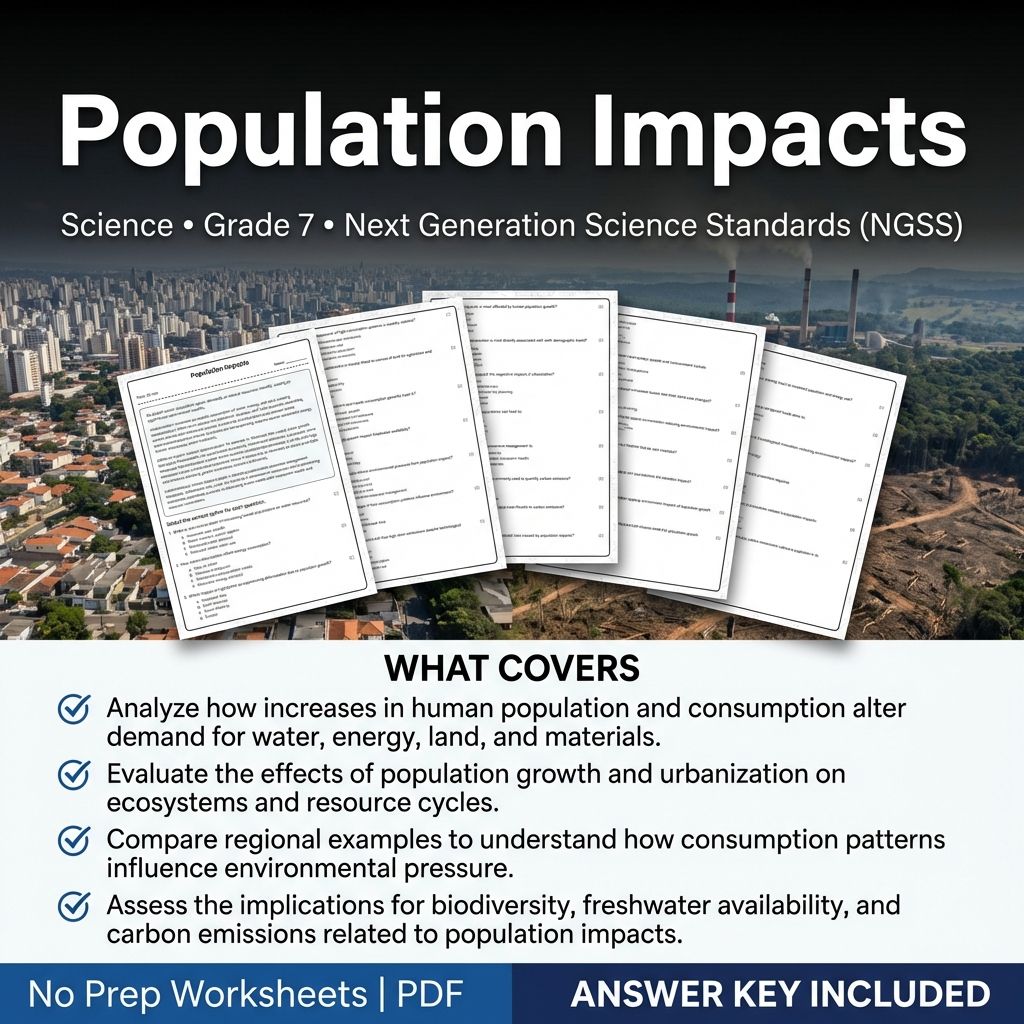
7th Grade Science Worksheet | Population Impacts & Environment (PDF & Answers)
Created byCoral Reef LearningLearning Objectives
- Analyze how increases in human population and consumption alter demand for water, energy, land, and materials.
- Evaluate the effects of population growth and urbanization on ecosystems and resource cycles.
- Compare regional examples to understand how consumption patterns influence environmental pressure.
Instant download
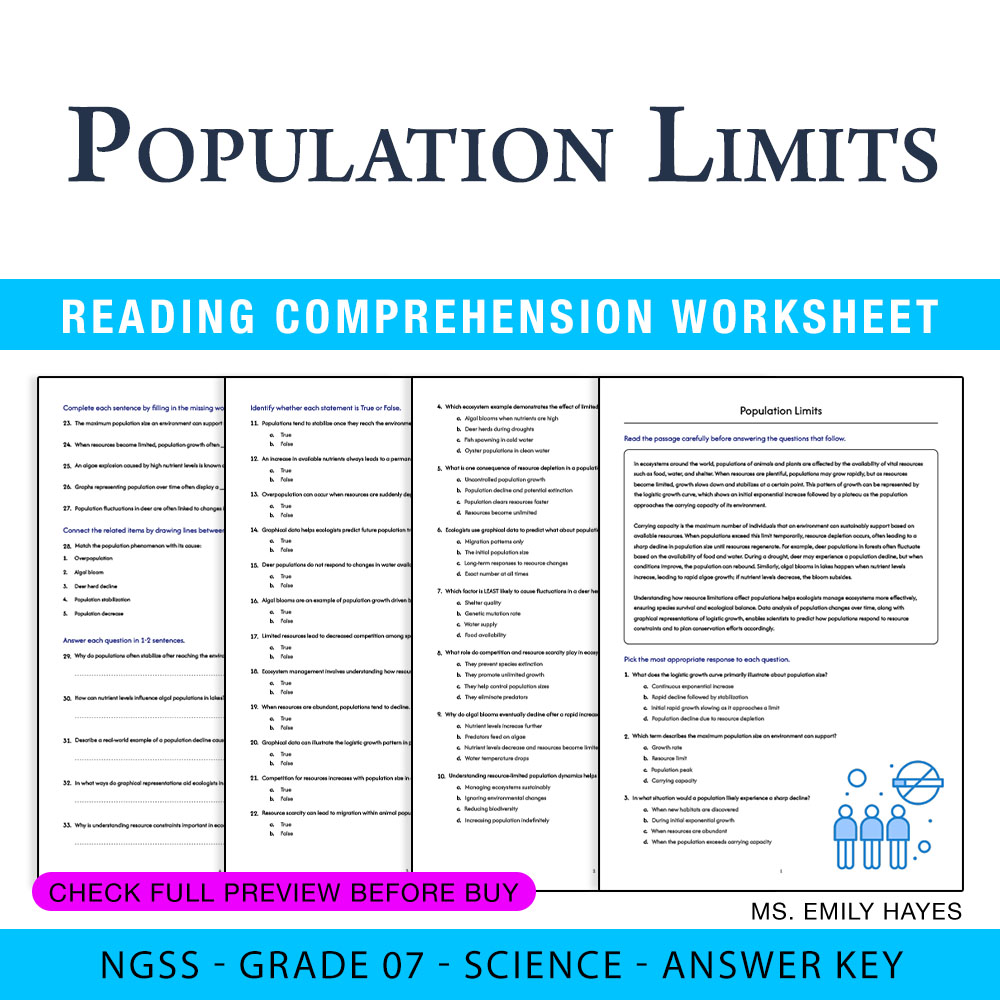
7th Grade Science | Population Limits Worksheet (PDF +Answer Key)
Created byCopper Leaf ClassroomLearning Objectives
- Understand how resource availability influences population growth and stability.
- Analyze graphical data representing population responses to environmental constraints.
- Interpret quantitative data sets related to ecosystem resource limits.
Instant download

Science Worksheet: Population Impacts Assessment | NGSS Grade 7 Science
Created bySkylark WorksheetsLearning Objectives
- Explain how population growth and consumption increase demand for water, energy, land, and raw materials.
- Describe how increased waste and intensified agriculture or energy systems can disrupt ecosystems and resource cycles.
- Use quantitative reasoning to compare how different regions experience biodiversity loss, freshwater stress, and carbon emissions.
Also included in: Grade 7 Ecosystems & Climate Interactions Science Lesson Bundle: NGSS +1 more
Instant download

Grade 7 Science Worksheet | Environment and Traits (Phenotype) NGSS
Created bySkylark WorksheetsLearning Objectives
- Explain how phenotype can result from interactions between genotype and environmental factors.
- Identify real-world examples of environmental influences on traits (nutrition, UV exposure, temperature).
- Distinguish inherited genetic contributions from environmental modulation using evidence-based claims.
Also included in: Grade 7 Genetics: Traits Inheritance Science Lesson Bundle for NGSS +1 more
Instant download
About Grade 7 Science Worksheets
Browse 6,126 printable Grade 7 Science worksheets — ready-to-print PDFs with answer keys where available.
Every worksheet on MyTeachingSheets is created by independent teacher-authors and reviewed before publication. All resources download as printable PDFs for classroom, homework, or at-home practice, and many include answer keys. Preview any worksheet free before buying.