
Grade 7 Science Worksheets
6,126 worksheets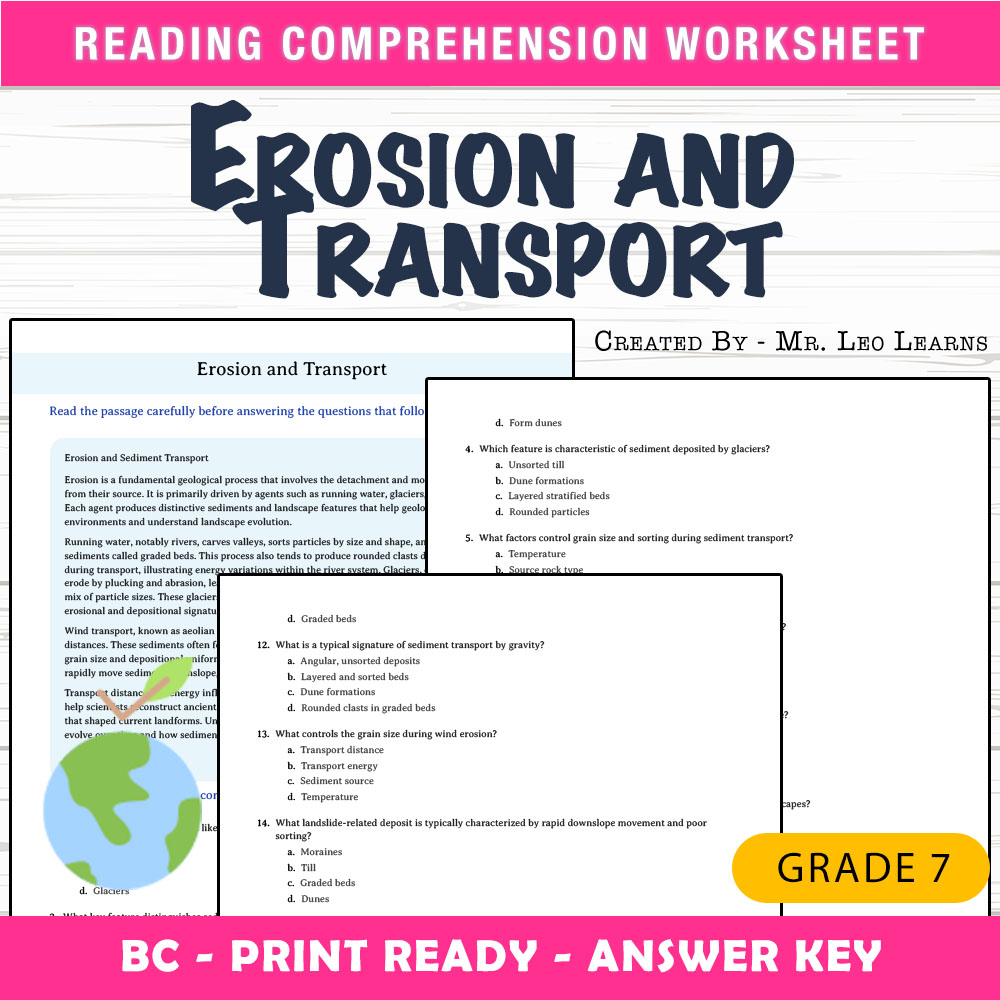
Grade 7 Science — Erosion and Transport Worksheet MCQ Paper
 Created byThe Resource Hub
Learning Objectives
- Understand the agents responsible for erosion and transportation of sediments.
- Identify distinctive signatures of sediment transported by water, glaciers, wind, and gravity.
- Explain how sediment sorting and grain size relate to landscape evolution and paleoenvironments.
Also included in: Grade 7 Science | Earth's Systems & Processes Worksheet Bundle – BC Framework +1 more
Instant download
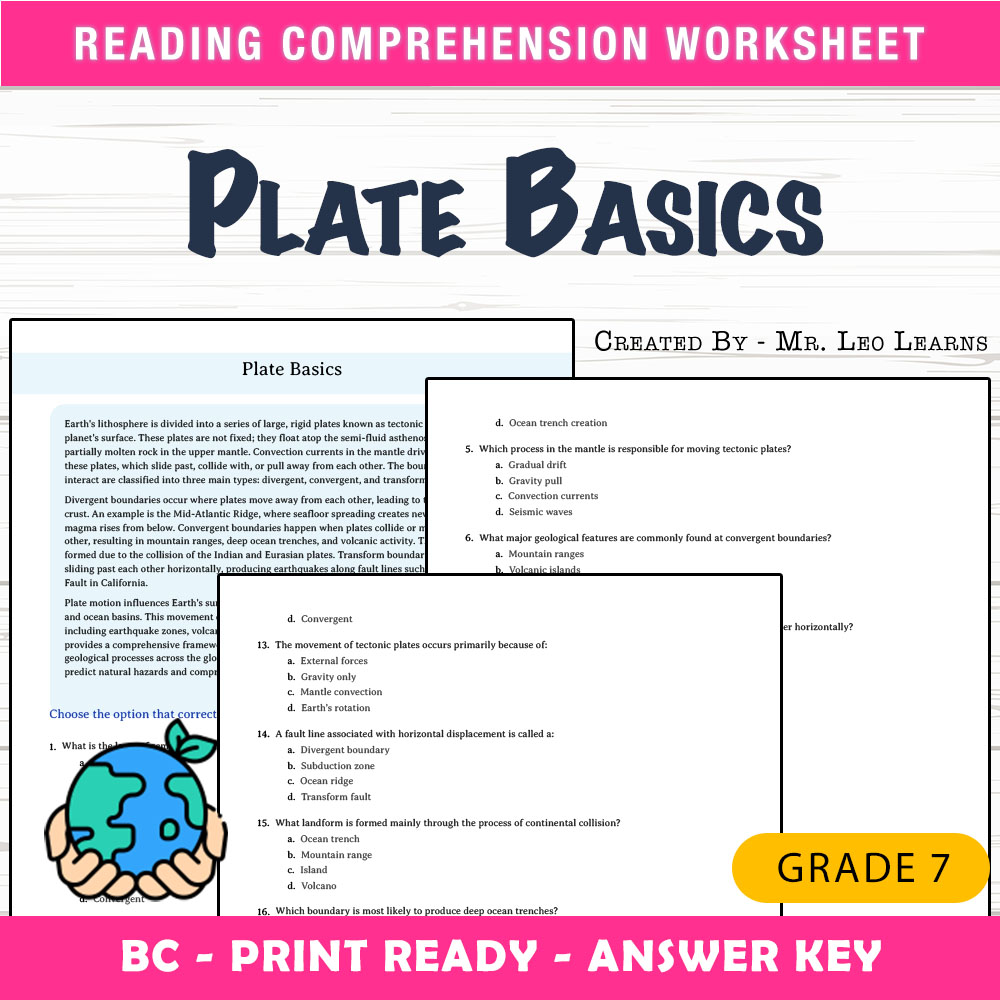
Grade 7 Science — Plate Basics Worksheet for Mastery
Created byThe Resource HubLearning Objectives
- Understand the structure and function of Earth's tectonic plates.
- Identify the three main types of plate boundaries and their effects.
- Explain how plate movements influence geological activity such as earthquakes and mountain formation.
Also included in: Grade 7 Science | Earth's Systems & Processes Worksheet Bundle – BC Framework +1 more
Instant download
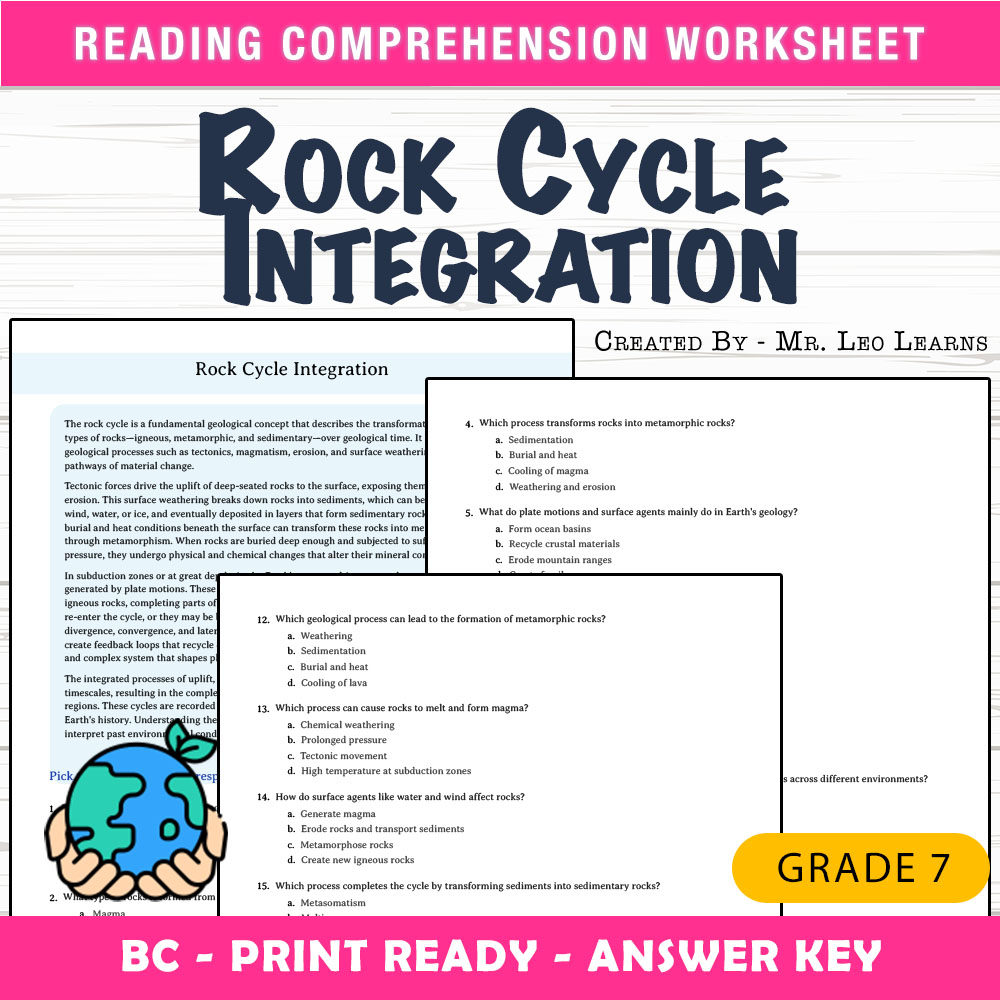
Grade 7 Science — Rock Cycle MCQ Practice Worksheet PDF + Answer Key
Created byThe Resource HubLearning Objectives
- Understand the processes involved in the rock cycle and how they connect tectonics, magmatism, and surface processes.
- Identify the roles of uplift, erosion, burial, and heat in transforming rocks.
- Explain how plate motions and surface agents contribute to crustal recycling.
Also included in: Grade 7 Science | Earth's Systems & Processes Worksheet Bundle – BC Framework +1 more
Instant download
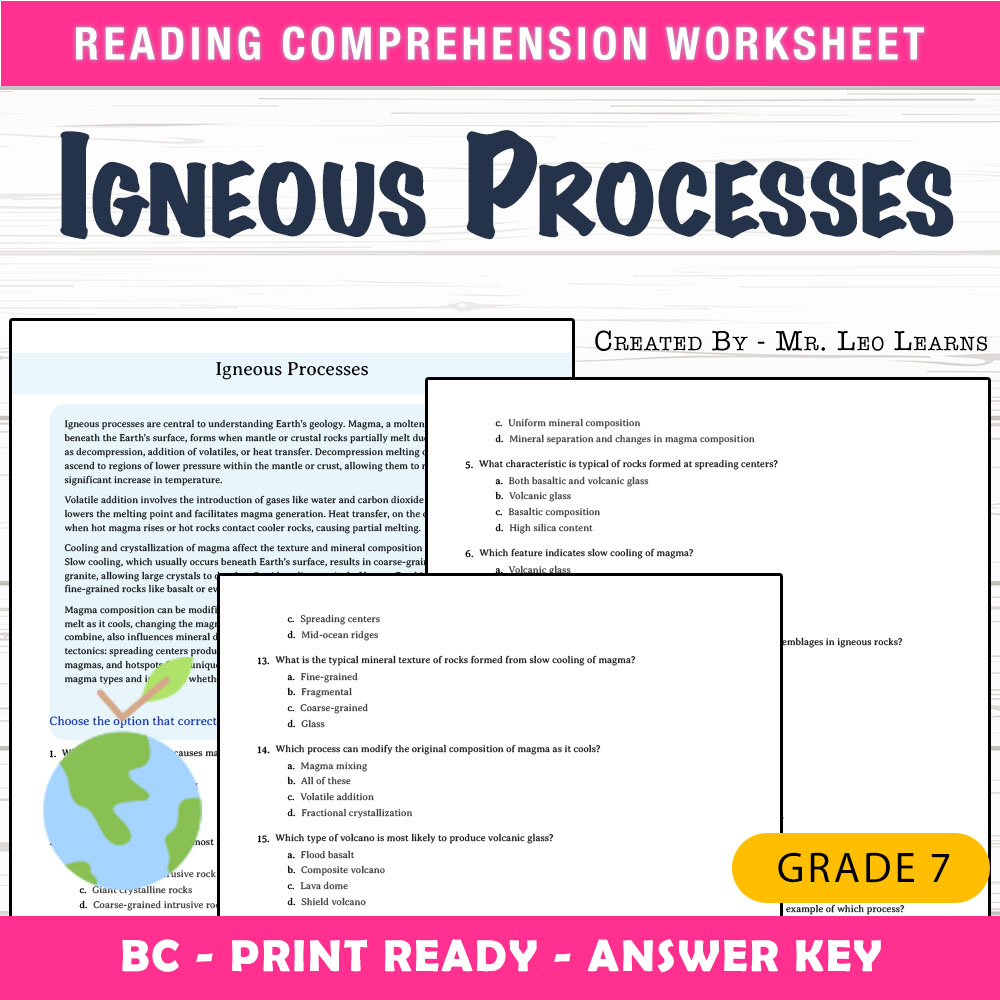
Grade 7 Science — Igneous Processes Worksheet MCQ Paper
Created byThe Resource HubLearning Objectives
- Understand how magma forms through different geological processes.
- Identify the characteristics of intrusive and extrusive igneous rocks.
- Explain how cooling rates affect mineral texture in igneous rocks.
Also included in: Grade 7 Science | Earth's Systems & Processes Worksheet Bundle – BC Framework +1 more
Instant download
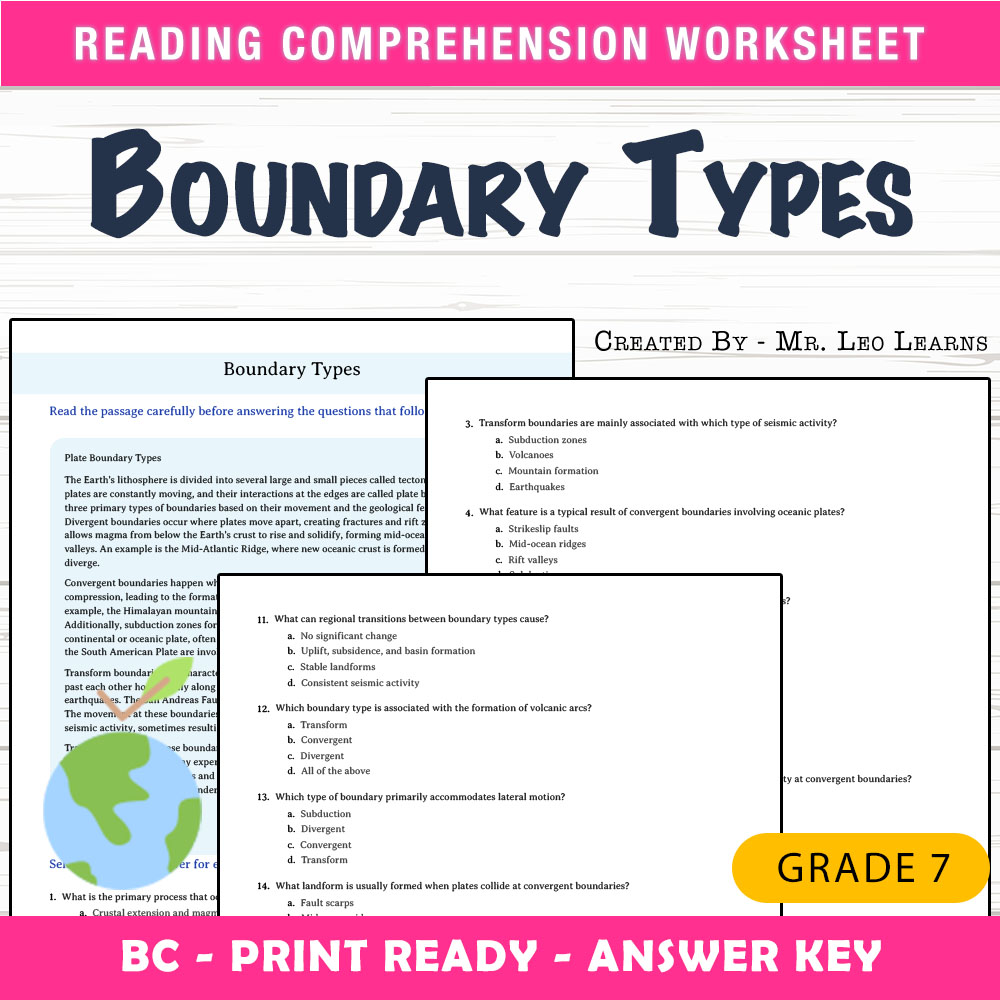
Grade 7 Science — Boundary Types Worksheet MCQ Paper for Mastery
Created byThe Resource HubLearning Objectives
- Identify and describe the three main types of plate boundaries.
- Understand the landforms and processes associated with divergent, convergent, and transform boundaries.
- Explain how boundary interactions influence Earth's surface features and seismic activity.
Also included in: Grade 7 Science | Earth's Systems & Processes Worksheet Bundle – BC Framework +1 more
Instant download
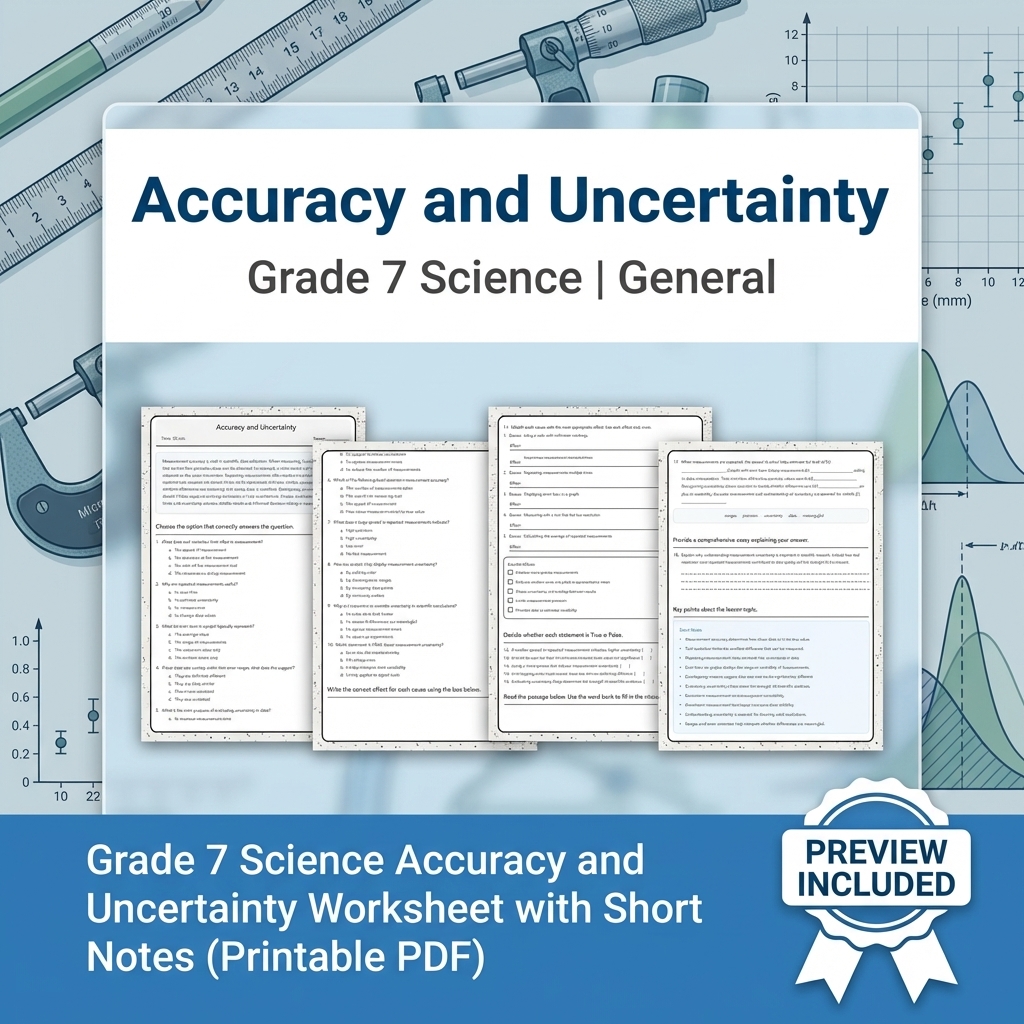
Grade 7 Science Accuracy and Uncertainty Worksheet with Short Notes
 Created byMeadowlark Worksheets
Learning Objectives
- Understand how measurement accuracy affects data quality and conclusions.
- Explain tool resolution limits and how repeated measurements estimate uncertainty.
- Interpret graphs and tables that incorporate ranges or error estimates.
Also included in: Grade 7 Science Scientific Modeling & Evidence Lesson Bundle: General Framework +1 more
Instant download

Grade 7 Science – Gears & Mechanisms | Daily Reading Worksheet
 Created byBright Mind Resources
Learning Objectives
- Understand the basic function and purpose of gears in mechanical systems.
- Identify different types of gear mechanisms and their uses.
- Explain how gear ratios affect speed and torque in devices.
Also included in: Design & Tech Grade 7 Science Daily Reading Worksheets Lesson Bundle | General +1 more
Instant download
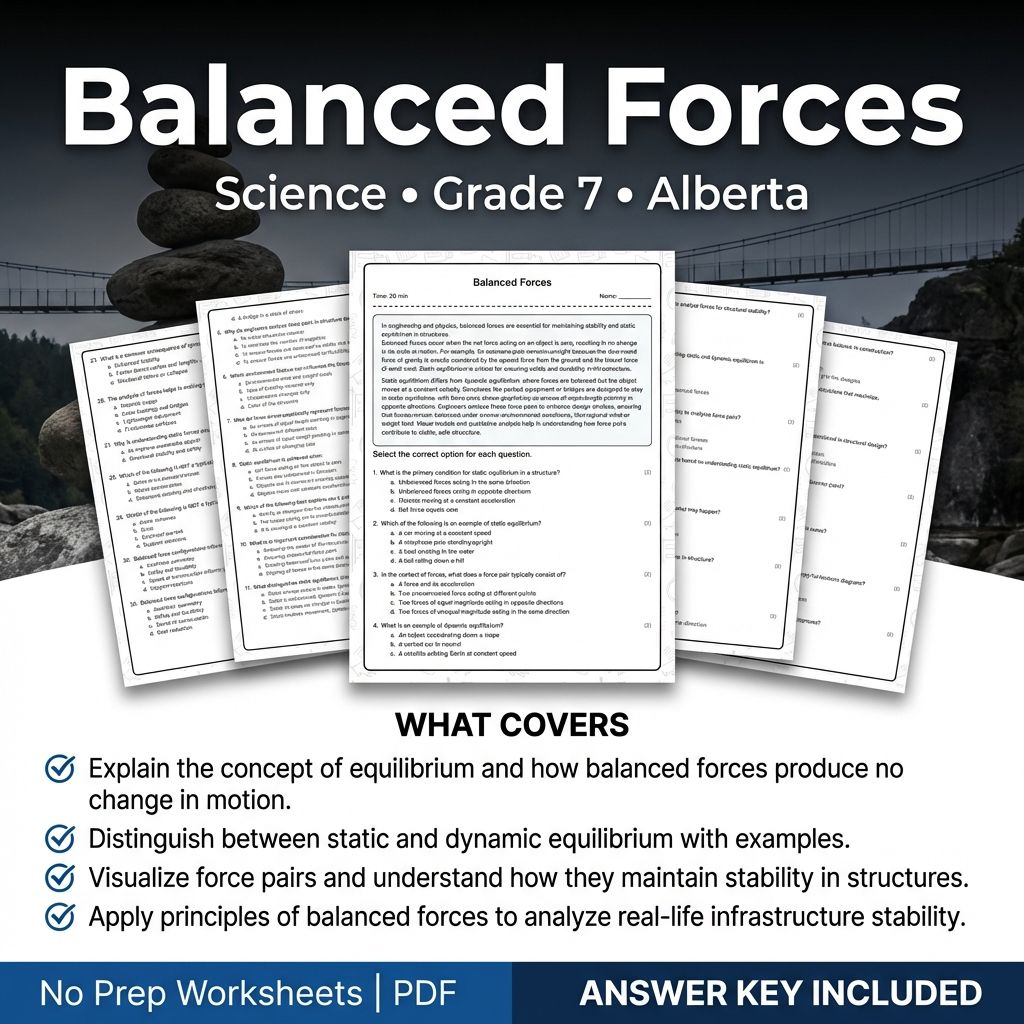
Balanced Forces Worksheet - 7th Grade Science Practice & Assessment
 Created byCoral Reef Learning
Learning Objectives
- Explain the concept of equilibrium and how balanced forces produce no change in motion.
- Distinguish between static and dynamic equilibrium with examples.
- Visualize force pairs and understand how they maintain stability in structures.
Instant download
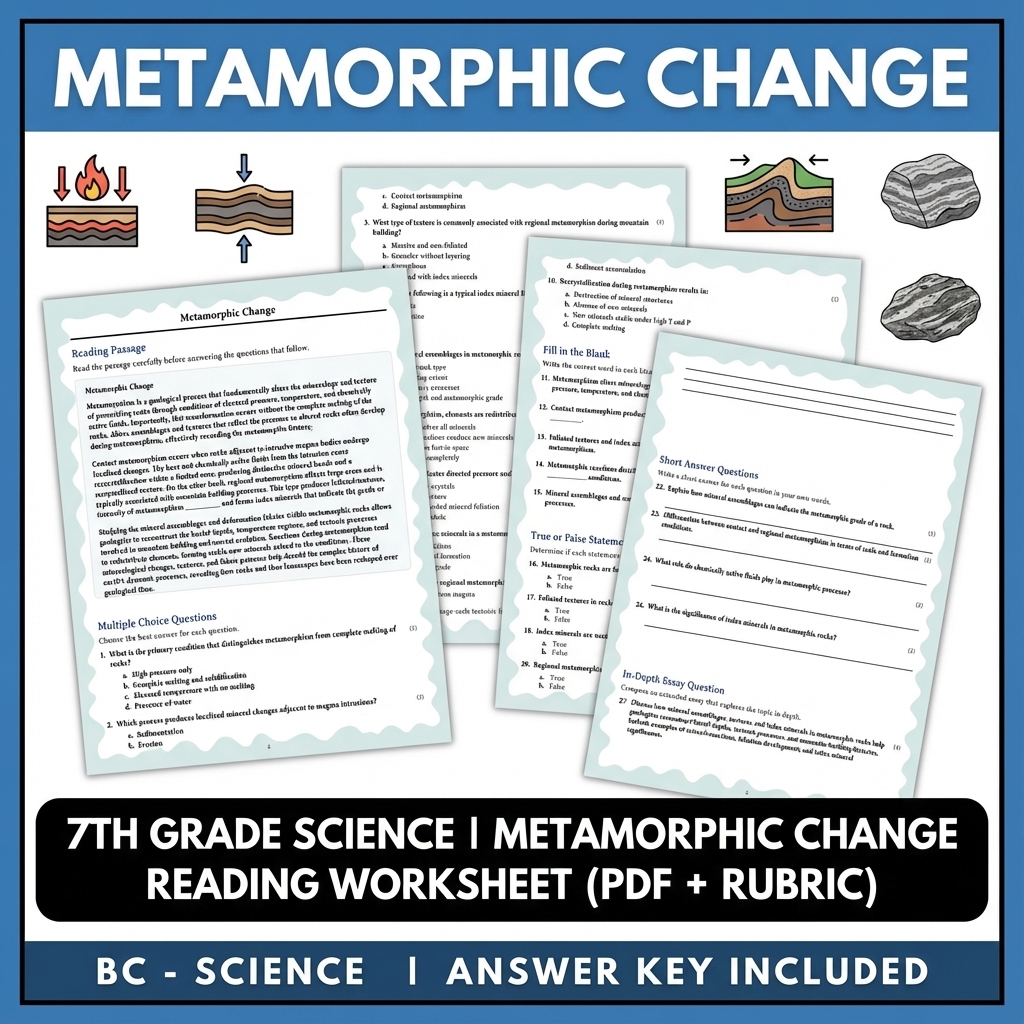
7th Grade Science | Metamorphic Change Reading Worksheet (PDF + Rubric)
Learning Objectives
- Describe the processes and conditions involved in metamorphism of rocks.
- Differentiate between contact and regional metamorphism.
- Identify mineral clues that indicate metamorphic grade and history.
Instant download

Grade 7 Science | Integrated Design Worksheet (Alberta Standards PDF)
 Created bySilver Birch Teaching
Learning Objectives
- Explain how integrated systems analysis connects forces, motion, and structural safety when comparing design options.
- Use mechanical advantage and simple reasoning about motion to predict how design changes affect performance.
- Evaluate structural factors such as deflection and safe stress levels under wind, snow, and load conditions.
Also included in: Grade 7 Simple Machines and Forces Science Lesson Bundle: Alberta +1 more
Instant download

7th Grade Science | Population Models Reading Worksheet with Answer Key (PDF)
Learning Objectives
- Understand the differences between exponential and logistic population growth models.
- Identify factors that influence population dynamics, including density-dependent and density-independent factors.
- Describe how population models help interpret patterns observed in ecosystems.
Instant download

Population Basics Practice Worksheet | Grade 7 Science Review Assessment
 Created byPrism Point Learning
Learning Objectives
- Define population and explain how it changes over time using births, deaths, immigration, and emigration.
- Describe how population density and distribution patterns can affect interactions within a species.
- Explain how reproductive capacity and survival influence population growth rates.
Also included in: Ecosystems & Interactions Lesson Bundle – Grade 7 Science BC Framework +1 more
Instant download

Grade 7 Science | Environmental Change Impacts Worksheet | General Standards
 Created byLumora Learning
Learning Objectives
- Explain how changes in climate and habitat conditions can affect ecosystem survival and reproduction
- Describe how changes in water quality and pollution can alter growth, mortality, and population size
- Analyze how shifts in key species can change predation, competition, and symbiosis within an ecosystem
Instant download
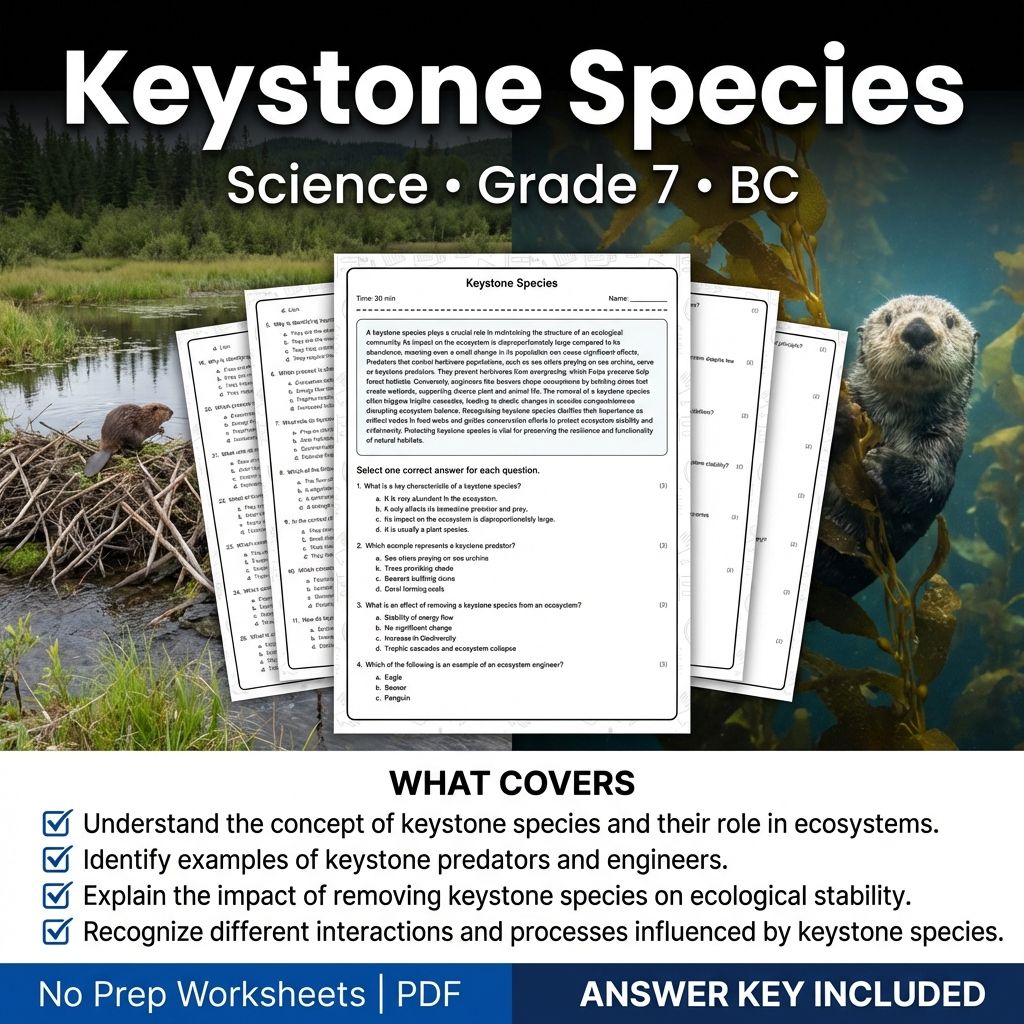
7th Grade Science | Keystone Species Worksheet & Answer Key (Printable PDF)
Created byCoral Reef LearningLearning Objectives
- Understand the concept of keystone species and their role in ecosystems.
- Identify examples of keystone predators and engineers.
- Explain the impact of removing keystone species on ecological stability.
Instant download

Grade 7 Science | Biotic and Abiotic Factors Worksheet (Alberta Standards) (PDF)
Created bySilver Birch TeachingLearning Objectives
- Explain how abiotic factors (sunlight, water, temperature, soil, and topography) influence where organisms can survive
- Describe how biotic interactions (plants, animals, and microbes) respond to changing abiotic conditions
- Use cause-and-effect reasoning to predict how ecosystem patterns differ across regional environmental gradients
Also included in: Grade 7 Ecosystems & Biodiversity Science Lesson Bundle for Alberta Framework +1 more
Instant download

Grade 7 Science | Migration Patterns Worksheet (Alberta Standards) PDF
Created bySilver Birch TeachingLearning Objectives
- Explain how food availability and breeding needs drive seasonal and annual migration patterns.
- Describe how timing cues and energetic demands influence when organisms move between habitats.
- Interpret how migratory connectivity links ecosystems and supports biodiversity across regions.
Also included in: Grade 7 Ecosystems & Biodiversity Science Lesson Bundle for Alberta Framework +1 more
Instant download

Grade 7 Science | Food Webs Worksheet – Alberta Standards (PDF)
Created bySilver Birch TeachingLearning Objectives
- Explain how energy flows through producers, consumers, and decomposers in a food web
- Describe how organisms are connected through feeding relationships and dependency chains
- Analyze how removing or adding a species can change trophic connections and affect ecosystem stability
Also included in: Grade 7 Ecosystems & Biodiversity Science Lesson Bundle for Alberta Framework +1 more
Instant download

Grade 7 Science | Wetland Functions Worksheet (Alberta Standards) (PDF)
Created bySilver Birch TeachingLearning Objectives
- Describe how wetlands regulate water at the landscape scale through storage, slow release, and flood buffering.
- Explain how wetlands support ecosystem services through nutrient cycling and filtration.
- Identify how wetland type (e.g., peatlands vs. marshes) relates to different habitats and biological functions.
Also included in: Grade 7 Ecosystems & Biodiversity Science Lesson Bundle for Alberta Framework +1 more
Instant download

Grade 7 Science – Symbiosis Types Worksheet (Alberta) | PDF & Answer Key
Created bySilver Birch TeachingLearning Objectives
- Identify and distinguish mutualism, commensalism, and parasitism using key features
- Explain how symbiosis relationships affect population size, resource use, and survival
- Use examples from Alberta habitats to describe real-world ecological consequences
Also included in: Grade 7 Ecosystems & Biodiversity Science Lesson Bundle for Alberta Framework +1 more
Instant download

Grade 7 Science Worksheet – Biodiversity Measures (PDF) | Alberta Standards
Created bySilver Birch TeachingLearning Objectives
- Explain how biodiversity can be described using richness, evenness, and habitat heterogeneity.
- Interpret what different biodiversity metrics may indicate about ecosystem resilience and ecological function.
- Connect habitat complexity to changes in species assemblages in Alberta-like environments.
Also included in: Grade 7 Ecosystems & Biodiversity Science Lesson Bundle for Alberta Framework +1 more
Instant download
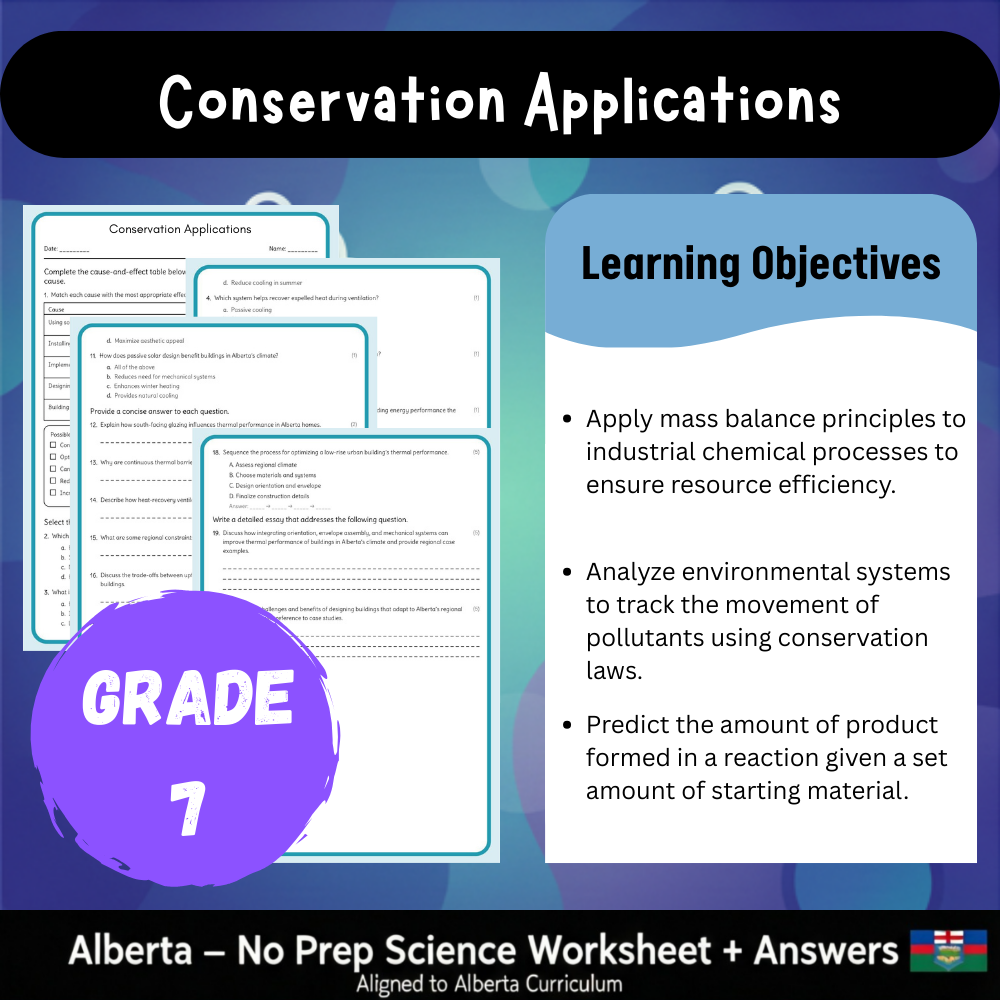
Grade 7 Science | Conservation Applications Worksheet (PDF) – Alberta Standards
Created byBright Mind ResourcesLearning Objectives
- Understand how mass conservation principles apply to chemical and environmental systems.
- Identify practical examples of mass balancing in real-world applications.
- Analyze scenarios involving mass accounting in closed or sealed systems.
Instant download

Modelling Ecosystems Worksheet | Grade 7 Science Practice
Created byPrism Point LearningLearning Objectives
- Explain how ecological models use assumptions to simplify complex ecosystem relationships.
- Identify common model inputs and how models are tested using real-world observations.
- Compare conceptual and quantitative modelling approaches and describe their strengths and limits.
Also included in: Grade 7 Ecosystems & Biodiversity Science Lesson Bundle | Alberta
Instant download

Conservation Status Worksheet | Grade 7 Science Activities
Created byPrism Point LearningLearning Objectives
- Explain how conservation status is assessed using population trends, threat severity, and recovery potential
- Describe how land use, genetic diversity, and habitat connectivity affect a species’ vulnerability
- Interpret conservation evidence to understand regional species persistence
Also included in: Grade 7 Ecosystems & Biodiversity Science Lesson Bundle | Alberta
Instant download
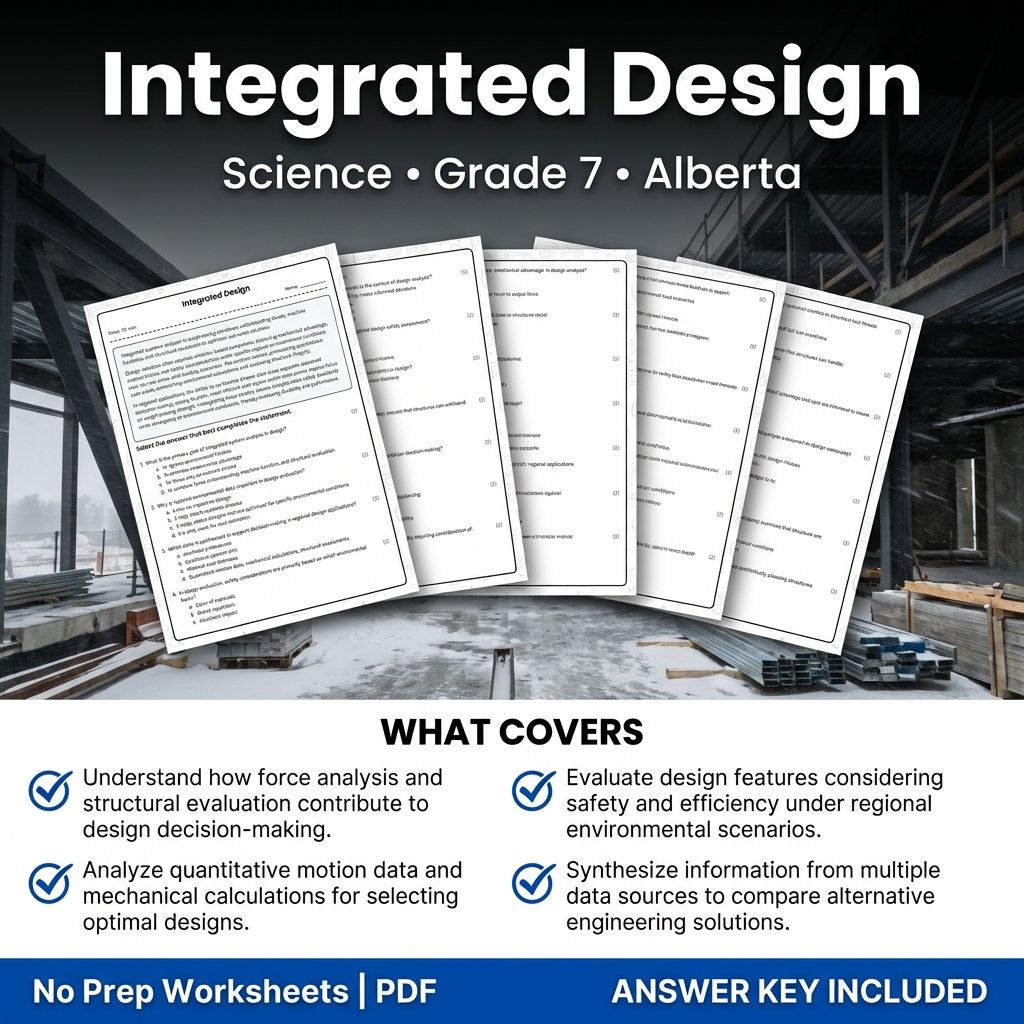
Grade 7 Science Worksheet on Integrated Design | Alberta Standards
Created byCoral Reef LearningLearning Objectives
- Understand how force analysis and structural evaluation contribute to design decision-making.
- Analyze quantitative motion data and mechanical calculations for selecting optimal designs.
- Evaluate design features considering safety and efficiency under regional environmental scenarios.
Instant download

Grade 7 Monitoring Methods Worksheet | Practice & Assessment PDF
 Created byClear Sky Classroom
Learning Objectives
- Explain how long-term ecological monitoring uses standardized sampling to detect ecological trends.
- Compare common monitoring methods such as fixed-site surveys, point counts, remote sensing, and water quality sampling.
- Describe how sampling design and temporal replication improve data quality and interpretation over time.
Instant download
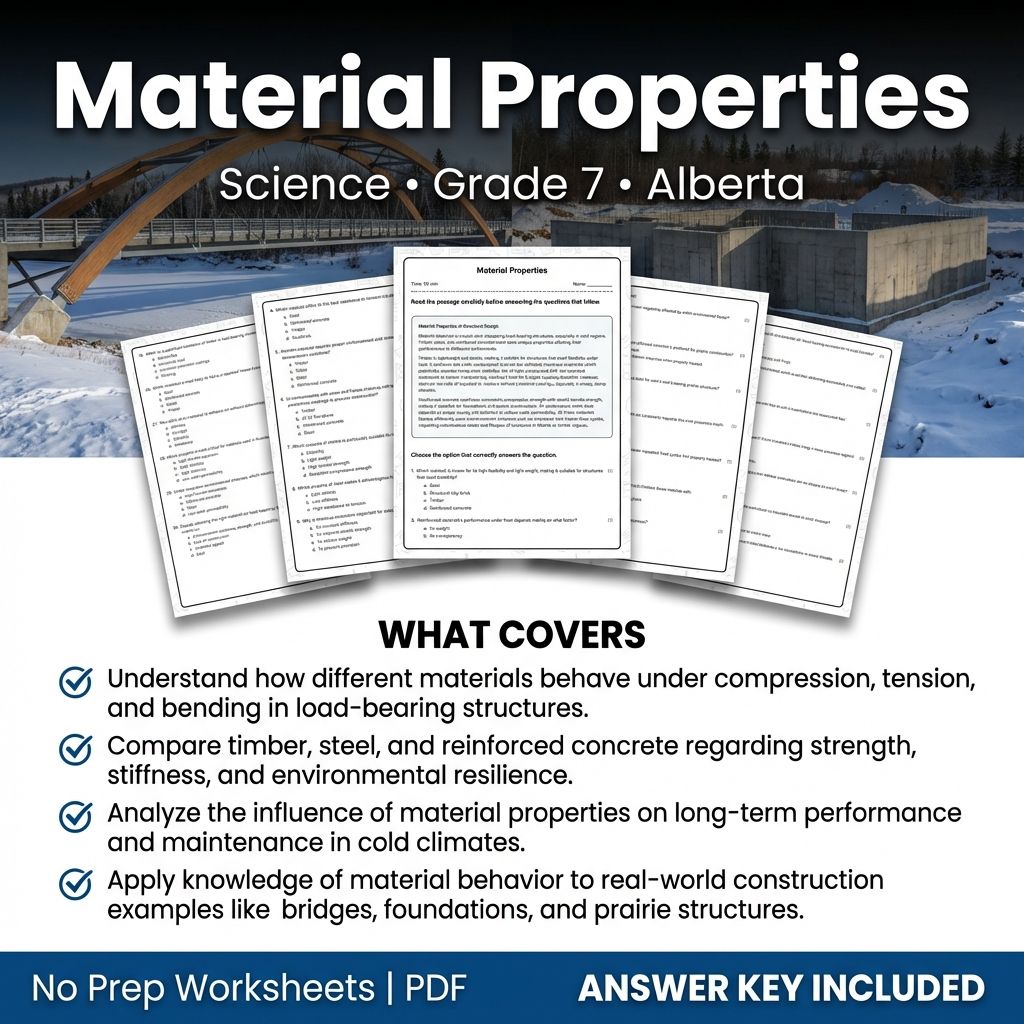
Material Properties Worksheet | Grade 7 Science | Alberta Standards
Created byCoral Reef LearningLearning Objectives
- Understand how different materials behave under compression, tension, and bending in load-bearing structures.
- Compare timber, steel, and reinforced concrete regarding strength, stiffness, and environmental resilience.
- Analyze the influence of material properties on long-term performance and maintenance in cold climates.
Instant download

Grade 7 Seasonal Energy Storage & Change Science Worksheet Alberta
 Created byBRIGHT PATH RESOURCES
Learning Objectives
- Explain how solar energy drives seasonal change.
- Use vocabulary such as albedo, sensible heat, and latent heat in context.
- Describe how phase changes and snow cover affect energy budgets.
Also included in: Grade 7 Alberta Science Energy Heat and Thermal Processes Worksheet Bundle +1 more
Instant download
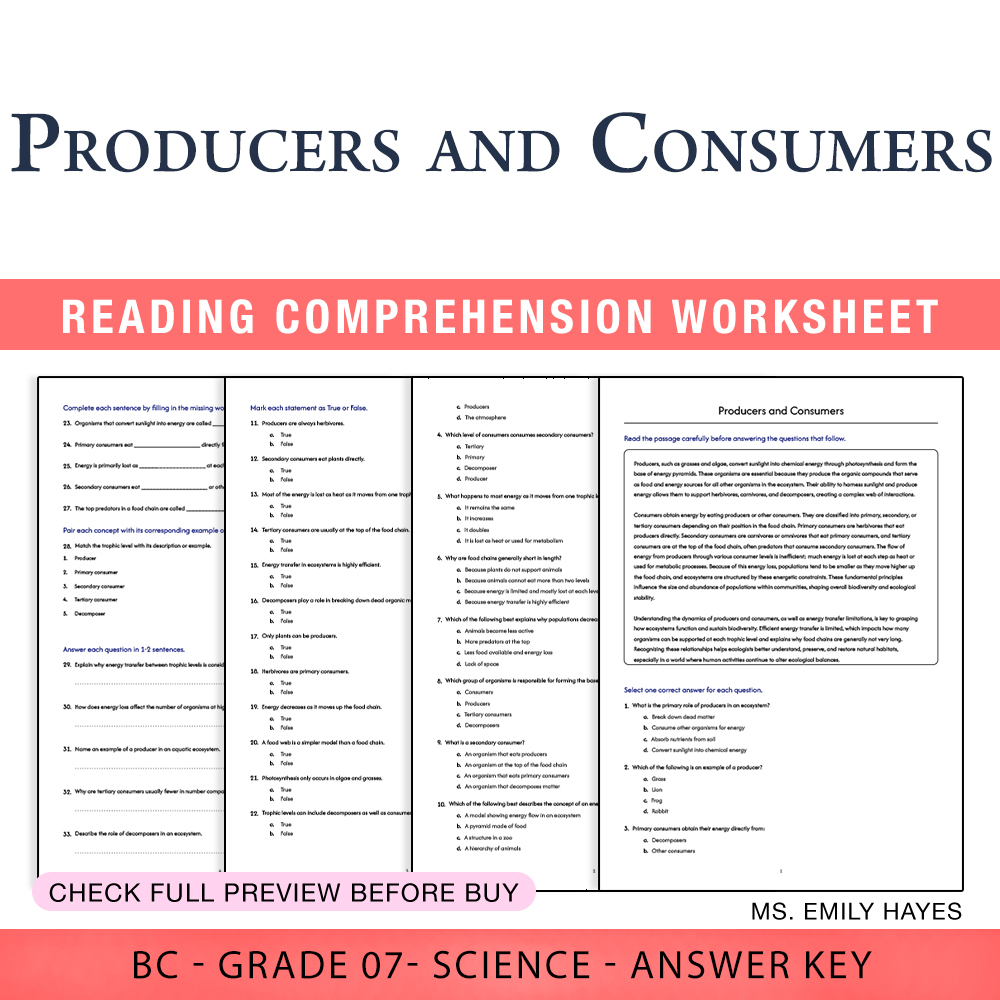
7th Grade Science | Producers and Consumers Worksheet (PDF+ Answer Key)
 Created byCopper Leaf Classroom
Learning Objectives
- Understand the roles of producers and consumers in an ecosystem
- Explain how energy is transferred between trophic levels and why it is inefficient
- Describe how these energy dynamics influence population sizes and community structure
Also included in: Grade 7 Science Bundle | Ecosystem Dynamics & Population (PDF+ Answer Key) +1 more
Instant download
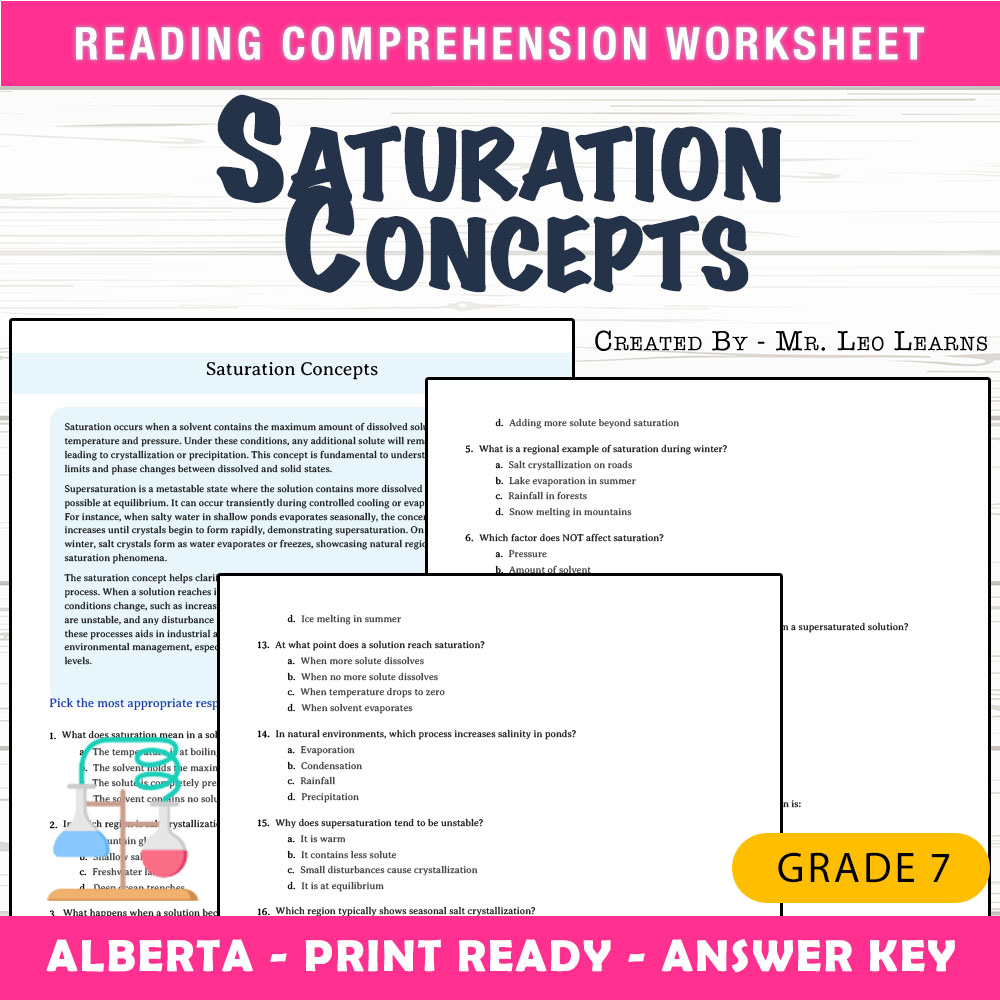
Grade 7 Science — Saturation Concepts Worksheet for Mastery
Created byThe Resource HubLearning Objectives
- Understand the definition of saturation and supersaturation in solutions.
- Identify conditions leading to saturation and crystallization.
- Recognize regional examples of saturation phenomena.
Also included in: Grade 7 Science Alberta Matter and Chemical Change Worksheet Collection +1 more
Instant download
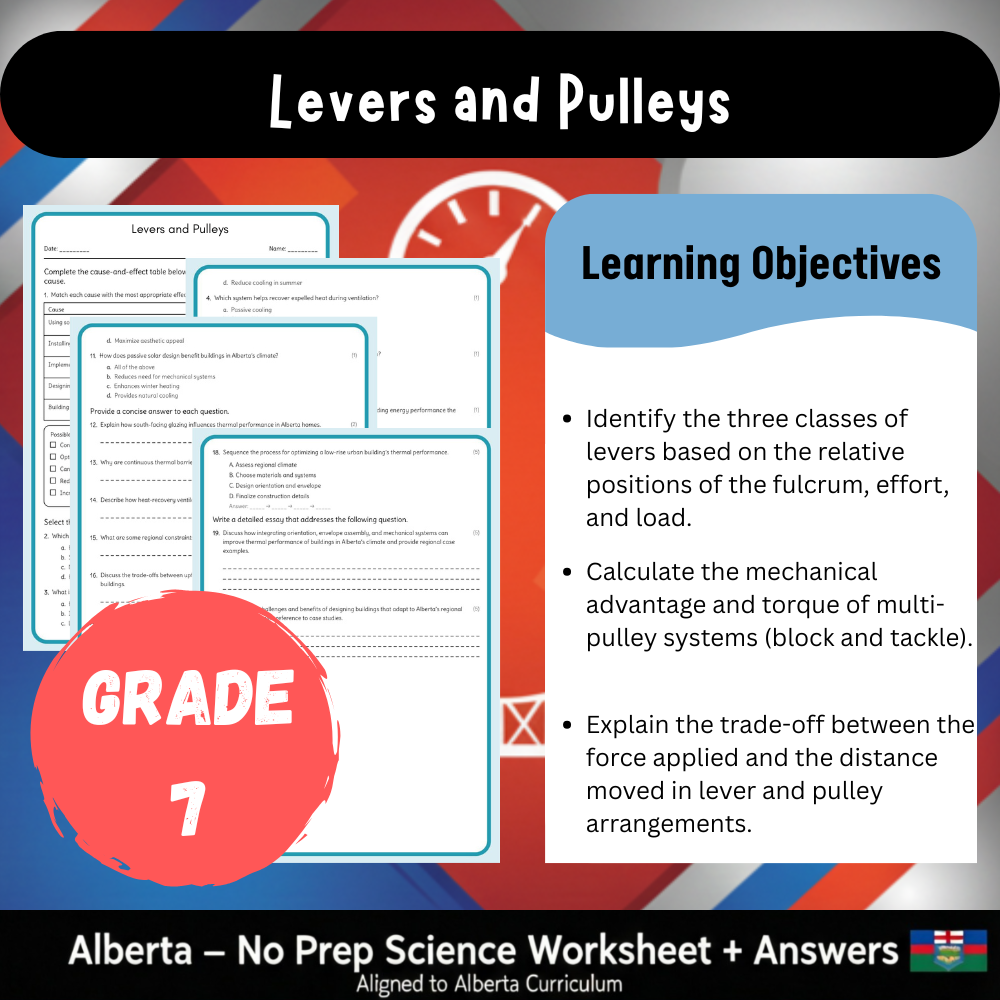
Grade 7 Science | Levers and Pulleys Worksheet (PDF) – Alberta Standard
Created byBright Mind ResourcesLearning Objectives
- Understand the basic principles of levers and pulley systems and how they modify effort and direction.
- Calculate torque and mechanical advantage in lever and pulley arrangements.
- Relate geometry and physics concepts to force multiplication in real-world examples.
Instant download
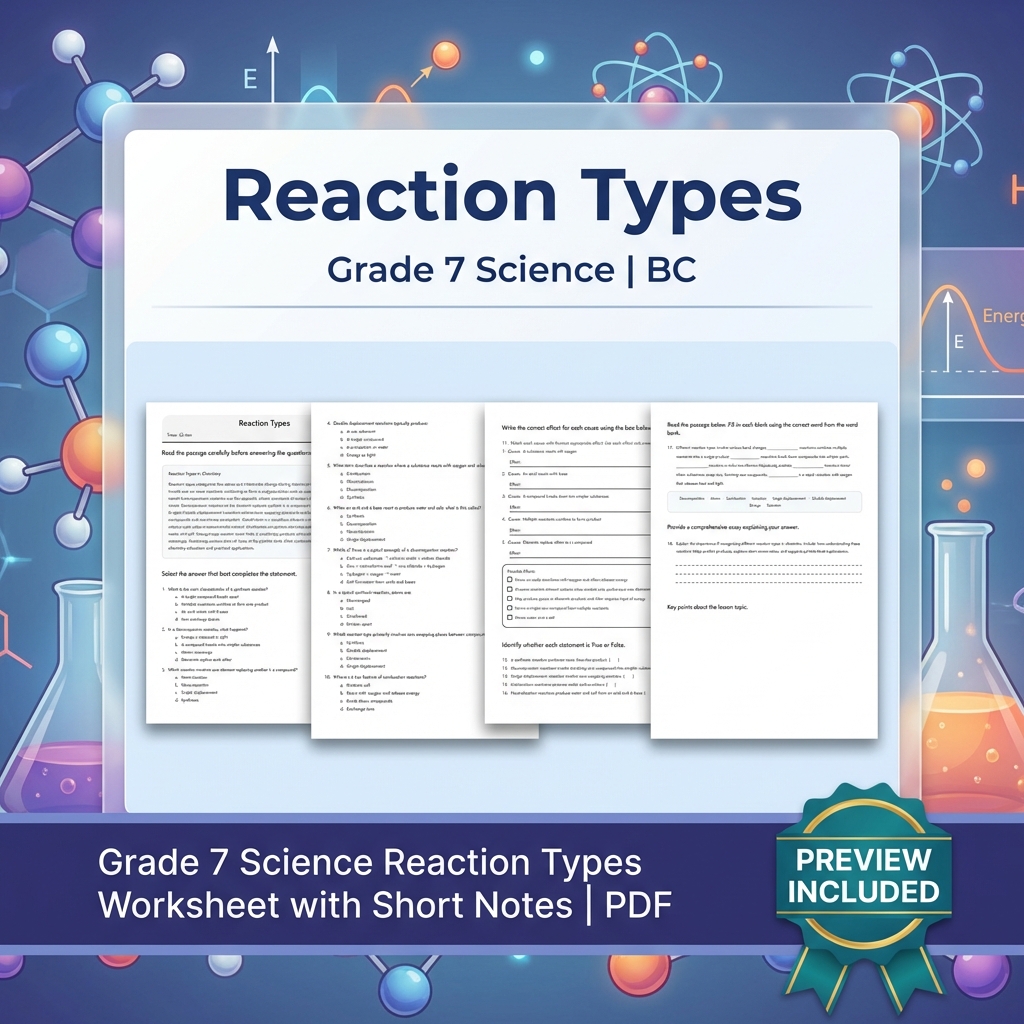
Grade 7 Science Reaction Types Worksheet with Short Notes | PDF
Created byMeadowlark WorksheetsLearning Objectives
- Understand the different categories of chemical reactions, including synthesis, decomposition, single and double displacement, acid–base neutralization, and combustion.
- Identify and classify reaction types based on given chemical equations and descriptions.
- Explain particle-level processes involved in various reaction types and how atoms rearrange during reactions.
Also included in: Grade 7 Science Lesson Bundle | BC Framework on Matter & Reactions Worksheets +1 more
Instant download

Grade 7 Science - Conservation Status Worksheet (Alberta Standard) (PDF)
 Created byEvergreen Desk Education
Learning Objectives
- Explain how conservation status assessments use population trends, threat severity, and recovery potential.
- Interpret evidence from examples (such as swift fox and at-risk plants) to identify why a species is vulnerable.
- Describe how land use, genetic diversity, and habitat connectivity affect species persistence.
Instant download

Population Models Test Prep Printables | Grade 7 Science
Created byPrism Point LearningLearning Objectives
- Explain how exponential and logistic population models describe population growth over time.
- Distinguish density-dependent and density-independent factors using real examples.
- Use population model ideas to interpret patterns in how populations change in ecosystems.
Also included in: Ecosystems & Interactions Lesson Bundle – Grade 7 Science BC Framework +1 more
Instant download
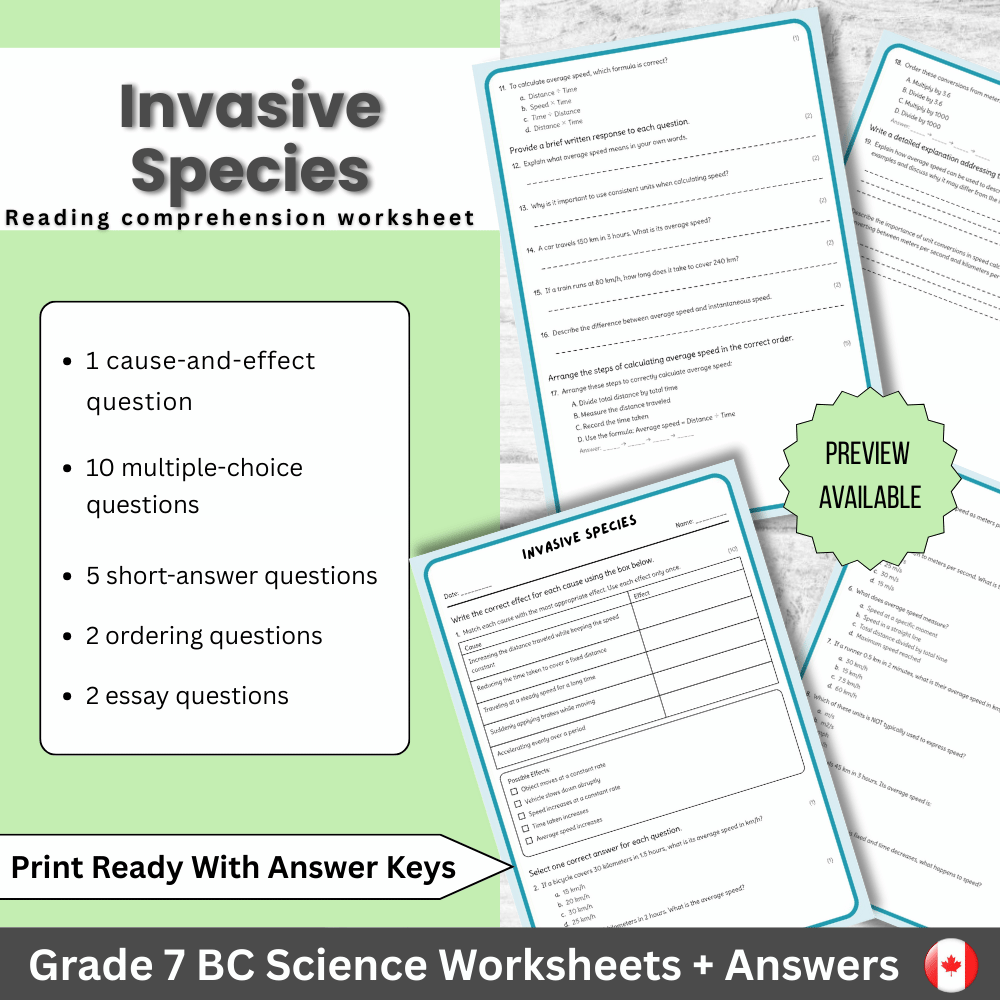
Grade 7 Science | Invasive Species Worksheet + Answer Key | BC Standards
Created byBright Mind ResourcesLearning Objectives
- Understand how invasive species spread and establish in new environments.
- Identify ecological impacts caused by invasive species.
- Explain the mechanisms behind invasion and their effect on native ecosystems.
Instant download
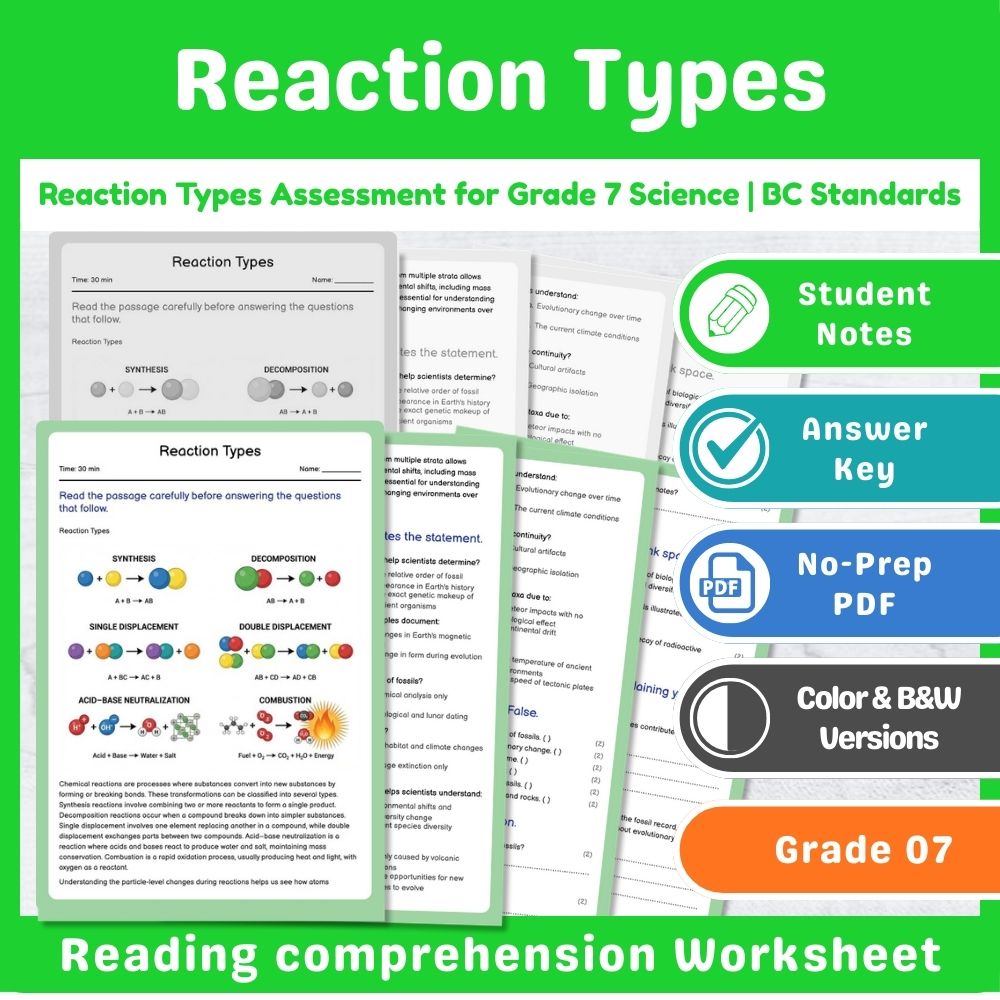
Reaction Types Assessment for Grade 7 Science | BC Standards
Created byPrism Point LearningLearning Objectives
- Identify and describe different types of chemical reactions including synthesis, decomposition, single and double displacement, acid-base neutralization, and combustion.
- Recognize patterns in reactant and product changes to classify reaction types.
- Explain particle-level processes such as bond breaking and forming during reactions.
Instant download
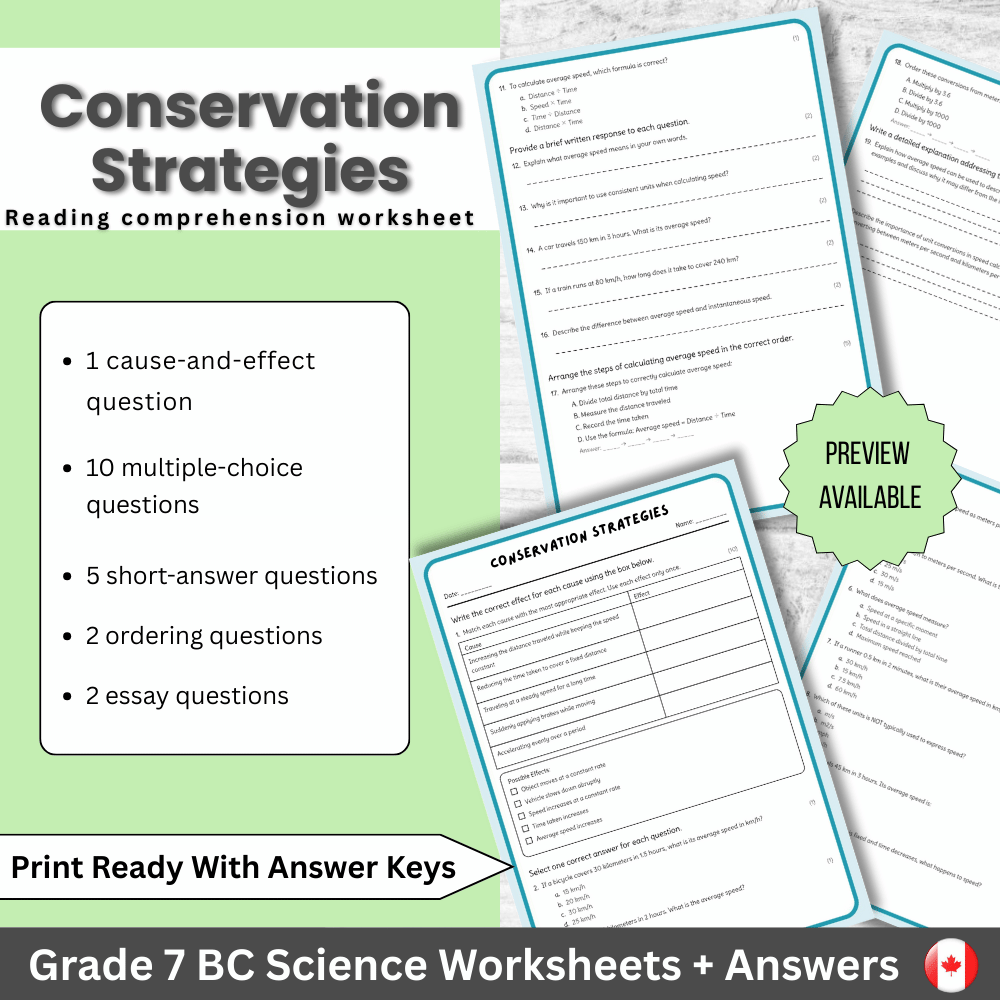
Grade 7 Science | Conservation Strategies Worksheet Aligned with BC Standards
Created byBright Mind ResourcesLearning Objectives
- Understand various conservation strategies including habitat protection, restoration, and species management.
- Identify methods used to reduce human impacts on ecosystems.
- Explain how ecological concepts like food webs and population dynamics inform conservation efforts.
Instant download
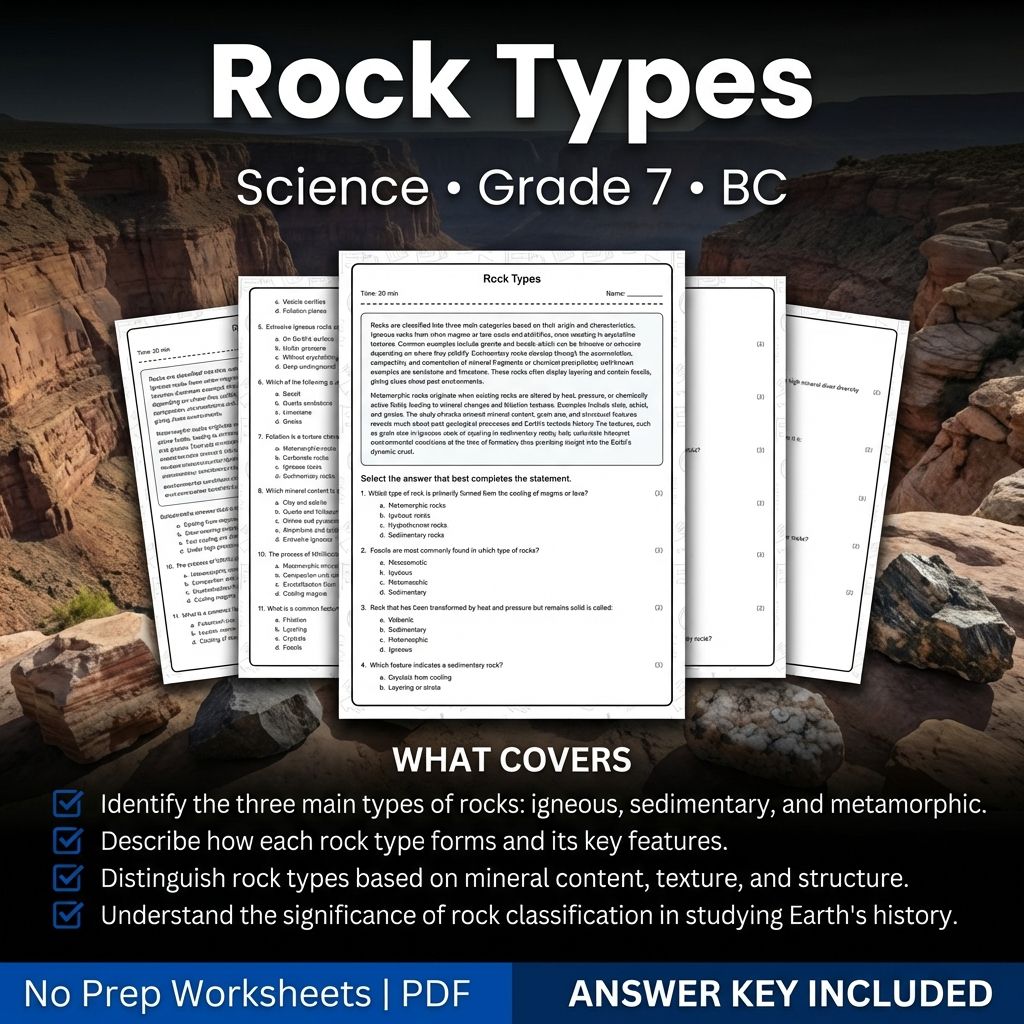
7th Grade Science | Rock Types Worksheet & Answer Key (Printable PDF)
Created byCoral Reef LearningLearning Objectives
- Identify the three main types of rocks: igneous, sedimentary, and metamorphic.
- Describe how each rock type forms and its key features.
- Distinguish rock types based on mineral content, texture, and structure.
Instant download

Grade 7 Design Solutions Worksheet | Practice & Alberta Standards PDF
Created byClear Sky ClassroomLearning Objectives
- Explain how building orientation and south-facing glazing can support passive solar heating in Alberta’s climates.
- Describe how thermal barriers and reduced thermal bridging improve a building envelope’s thermal performance.
- Compare how heat-recovery ventilation can conserve energy while maintaining indoor air quality.
Instant download

Grade 7 Science: Energy and Matter in Living Systems Worksheet | BC Practice PDF
Created byClear Sky ClassroomLearning Objectives
- Explain the roles of photosynthesis and cellular respiration in transferring energy in plants
- Use vocabulary correctly to describe gas exchange and energy conversion
- Identify the main idea of scientific paragraphs and choose supporting concepts
Instant download

Grade 7 Science Worksheet | Reaction Observations (PDF) Aligned to Alberta
Created byEvergreen Desk EducationLearning Objectives
- Describe common observable indicators of chemical reactions, such as gas production, heat change, colour shifts, and precipitate formation.
- Connect specific observations to likely reaction pathways and what they may suggest about particles and mass changes.
- Use precise scientific language to record observations and distinguish between qualitative evidence and explanations.
Instant download

Grade 7 Science – Weather Data & Patterns | Daily Reading Worksheet
Created byBright Mind ResourcesLearning Objectives
- Understand how to read and interpret weather data tables and graphs
- Identify key weather variables such as temperature, wind, humidity, and pressure
- Explain how daily weather data can reveal patterns and trends over time
Also included in: Weather, Earth Systems & Human Feedbacks Grade 7 Science Lesson Bundle | General +1 more
Instant download

Grade 7 Science | Integrated Analysis - Daily Reading Comprehension
Created byCoral Reef LearningLearning Objectives
- Understand different modes of heat transfer: conduction, convection, radiation.
- Analyze how each transfer mode affects energy efficiency in systems.
- Apply principles of energy transfer to real-world systems like passive solar houses.
Also included in: Energy, Heat and Thermal Processes Lesson Bundle: Grade 7 Science Alberta +1 more
Instant download

Grade 7 Science – Bitumen Separation & Mixtures Daily Reading Worksheet
Created byBright Mind ResourcesLearning Objectives
- Understand the basic concepts of mixtures and their separation methods.
- Identify physical and chemical separation techniques used in extracting bitumen.
- Differentiate between physical and chemical processes in mixture treatment.
Also included in: Grade 7 Solutions Science Daily Reading Worksheets Lesson Bundle | Alberta +2 more
Instant download
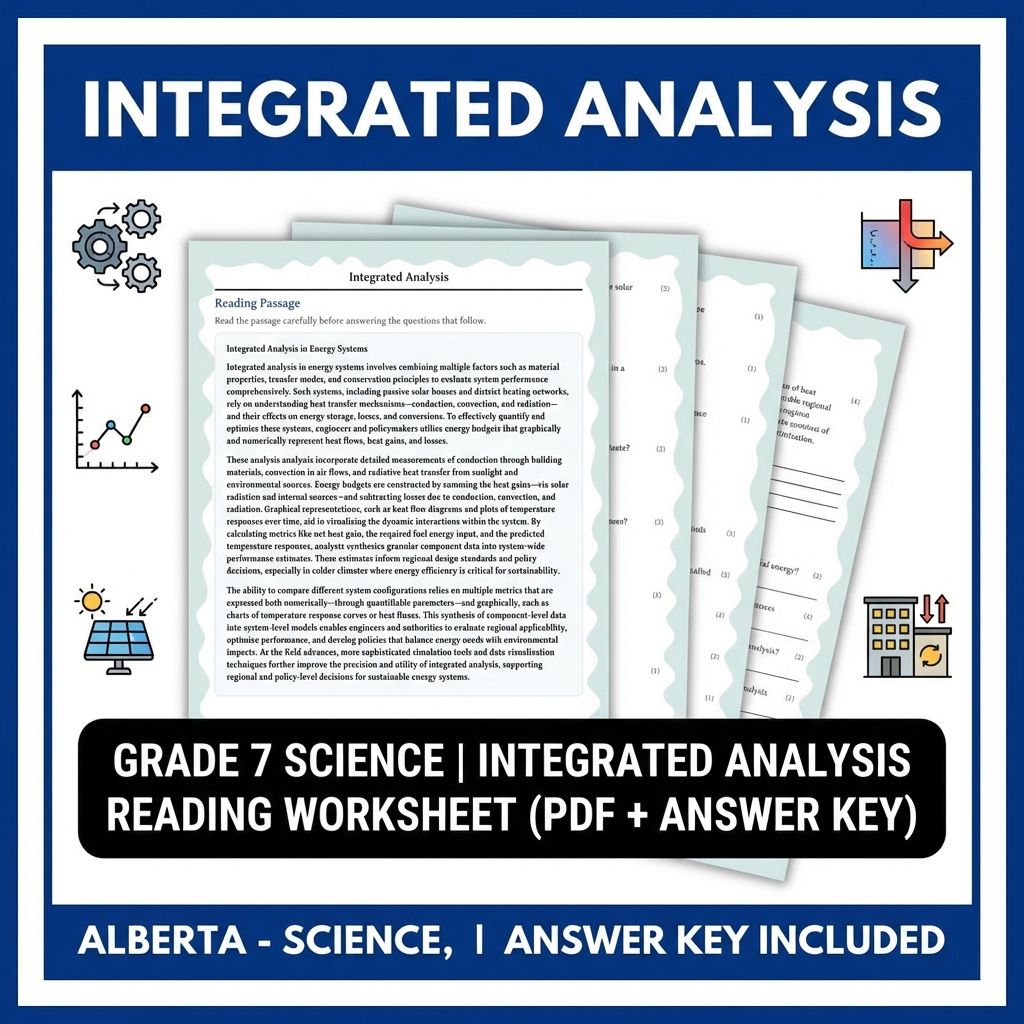
Grade 7 Science | Integrated Analysis Reading Worksheet (PDF + Answer Key)
Learning Objectives
- Understand the principles of energy transfer modes, such as conduction, convection, and radiation.
- Analyze how energy budgets are constructed and interpreted in systems like passive solar houses and district heating loops.
- Compare system performance metrics including net heat gain, fuel energy requirements, and temperature responses.
Also included in: Grade 7 Science UNIT Bundle | Heat Transfer, Convection & Energy Worksheets +1 more
Instant download
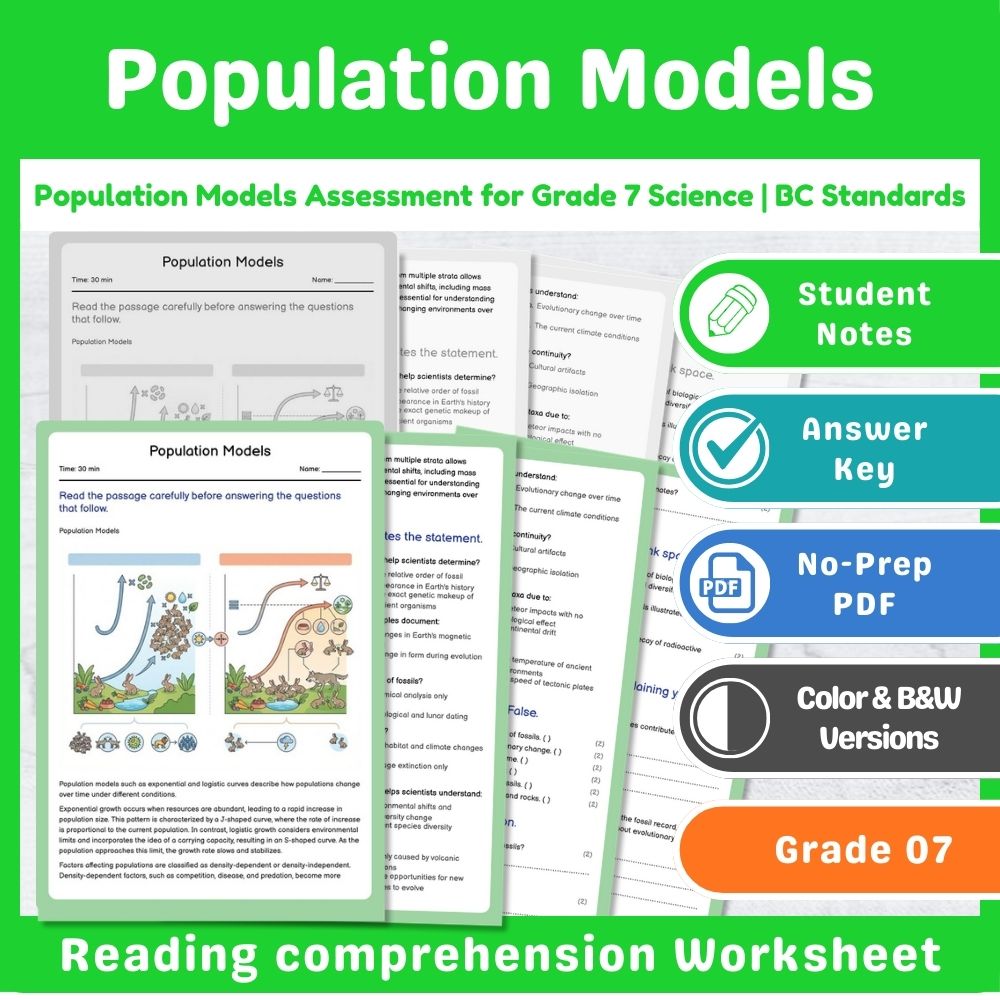
Population Models Assessment for Grade 7 Science | BC Standards
Created byPrism Point LearningLearning Objectives
- Understand the differences between exponential and logistic population growth models.
- Explain factors influencing population change, including density-dependent and density-independent factors.
- Interpret patterns in real-world population dynamics using simple models.
Instant download

Change Indicators Test Prep Printable | Grade 7 Science BC Standards
Created byPrism Point LearningLearning Objectives
- Identify observable indicators of chemical change, such as gas formation, persistent color change, temperature change, and precipitate formation
- Explain why multiple indicators together provide stronger evidence for chemical change than a single sign
- Use simple measurements alongside observations to support claims about whether a chemical change occurred
Also included in: Matter & Chemical Change Lesson Bundle — Grade 7 Science British Columbia +1 more
Instant download

Energy And Change Worksheet Practice | Grade 7 Science
Created byPrism Point LearningLearning Objectives
- Explain how energy changes during exothermic and endothermic chemical reactions using temperature evidence
- Relate energy input and release to bond breaking and bond formation
- Use energy-change evidence, along with other signs, to distinguish chemical from physical changes
Also included in: Matter & Chemical Change Lesson Bundle — Grade 7 Science British Columbia +1 more
Instant download

Heat Transfer Models Worksheet | Grade 7 Science Practice
Created byPrism Point LearningLearning Objectives
- Explain how temperature differences drive heat transfer in conduction, convection, and radiation.
- Use a simple heat-transfer model to describe the direction of energy flow during everyday processes.
- Connect observable temperature changes to changes in thermal energy and possible heat-transfer mechanisms.
Instant download
About Grade 7 Science Worksheets
Browse 6,126 printable Grade 7 Science worksheets — ready-to-print PDFs with answer keys where available.
Every worksheet on MyTeachingSheets is created by independent teacher-authors and reviewed before publication. All resources download as printable PDFs for classroom, homework, or at-home practice, and many include answer keys. Preview any worksheet free before buying.