
Grade 8 Worksheets
8,421 grade resources
Grade 8 Science — Motion Fundamentals Worksheet for Mastery
 Created byThe Resource Hub
Learning Objectives
- Understand the basic concepts of motion such as position, distance, speed, velocity, and acceleration.
- Differentiate between scalar and vector quantities related to motion.
- Interpret distance-time and velocity-time graphs with real-world examples.
Also included in: Grade 8 Science Unit Bundle | Motion, Forces & Energy Mastery Worksheets +1 more
Instant download

Grade 8 Science – Motion & Graphs Daily Reading Worksheet | TEKS
 Created byBright Mind Resources
Learning Objectives
- Understand the concepts of position and distance.
- Differentiate between scalar and vector quantities.
- Interpret simple distance–time and velocity–time graphs.
Also included in: Grade 8 Energy & Motion Science Daily Reading Worksheets Lesson Bundle | TEKS +2 more
Instant download

Motion Basics Worksheet for Grade 8 Science | Standards-Aligned Practice
Learning Objectives
- Explain the difference between position, distance, speed, velocity, and acceleration
- Classify quantities as scalars or vectors and justify why velocity is a vector
- Interpret distance–time and velocity–time graphs using basic features like slope and straight-line behavior
Instant download
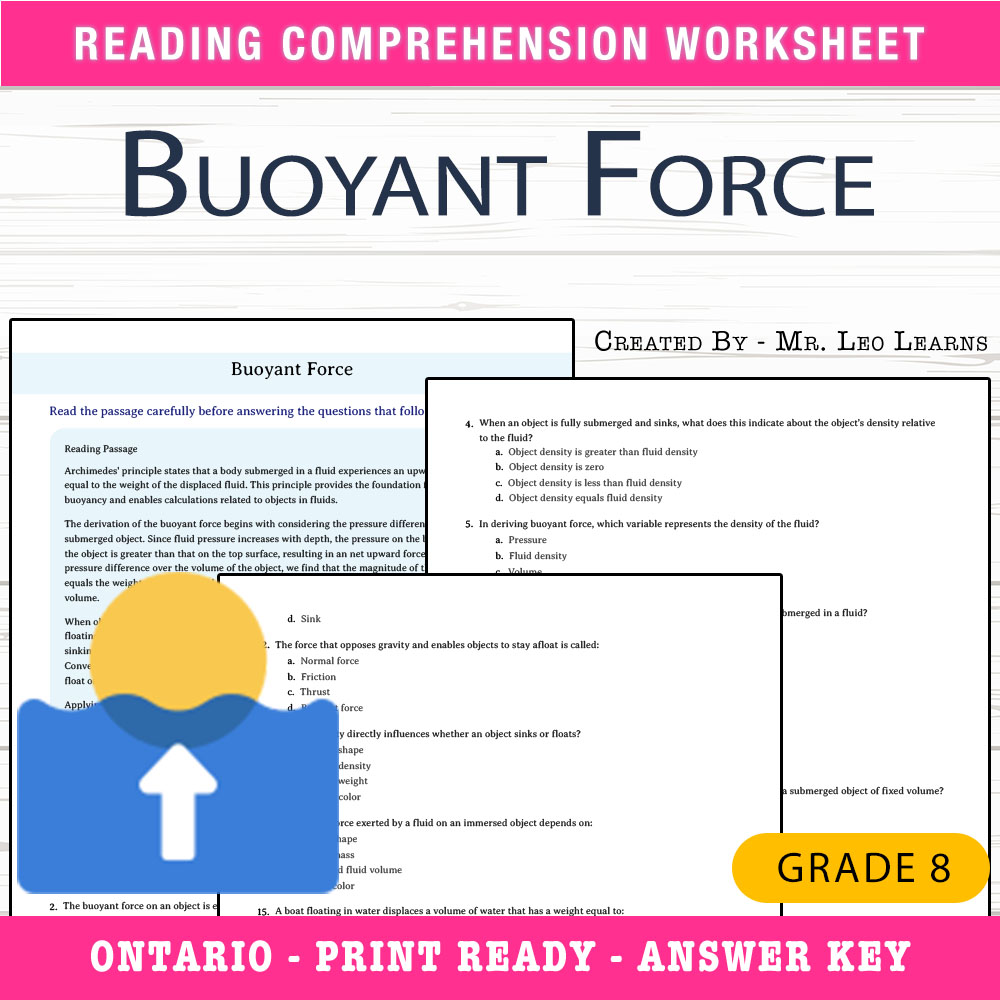
8th Grade Science – Buoyant Force Worksheet for Mastery
Created byThe Resource HubLearning Objectives
- Explain Archimedes' principle and derive the buoyant force expression.
- Differentiate between apparent weight in air and when submerged in a fluid.
- Apply density relationships to analyze floating, sinking, and neutral buoyancy scenarios.
Also included in: Grade 8 Science – Fluids & Buoyancy Mastery Unit Bundle (Worksheet Pack) +1 more
Instant download

Grade 8 Biogeochemical Cycling Worksheet | Carbon Water Nitrogen Cycles
 Created byPrism Point Learning
Learning Objectives
- Explain how matter (water, carbon, and nitrogen) moves through living and nonliving parts of ecosystems
- Describe the role of decomposition in returning nutrients to soil and water
- Model how cycles keep ecosystems functioning over time
Instant download

Orbital Cycles Worksheet | NGSS-Aligned Grade 8 Science Practice
Learning Objectives
- Explain the relative positions and motions of the Earth, Moon, and Sun that produce lunar phases, eclipses, and seasonal changes.
- Describe the concepts of axial tilt, orbital geometry, and timing of cycles such as the synodic month and seasons.
- Use observational phenomena like moon phases, eclipse alignments, and insolation patterns to understand celestial relationships.
Also included in: Grade 8 Gravity, Orbital Cycles & Patterns Science Lesson Bundle | NGSS +1 more
Instant download

Grade 8 Biogeochemical Cycling Worksheet | Water, Carbon & Nitrogen Cycles
 Created byEvergreen Desk Education
Learning Objectives
- Explain how matter cycles within and between ecosystems through living organisms and the physical environment.
- Describe the roles of evaporation, condensation, and precipitation in the water cycle.
- Trace how carbon and nitrogen move through air, water, soil, and living things.
Instant download

Biogeochemical Cycling Worksheet | Standards-Aligned Grade 8 Science Practice
Learning Objectives
- Understand the key processes involved in biogeochemical cycles within ecosystems.
- Identify how water, carbon, and nitrogen move through different parts of the environment.
- Explain the roles of producers, decomposers, and physical processes in nutrient recycling.
Also included in: Grade 8 Adaptation and Ecosystem Change Science Lesson Bundle +1 more
Instant download

Grade 8 Biogeochemical Cycling Worksheet | California Standards Practice PDF
 Created byClear Sky Classroom
Learning Objectives
- Explain how matter cycles through ecosystems rather than being used up once
- Describe key pathways in the water, carbon, and nitrogen cycles
- Connect decomposition to the return of nutrients that producers need
Instant download

Grade 8 Science | Biogeochemical Cycling Worksheet | California Standards
 Created byLumora Learning
Learning Objectives
- Explain how matter cycles within and between ecosystems through living organisms and the physical environment.
- Describe the water cycle processes of evaporation, condensation, and precipitation and how they connect to nutrient movement.
- Trace how carbon and nitrogen move through air, soil, organisms, and water using decomposition and producer uptake.
Instant download
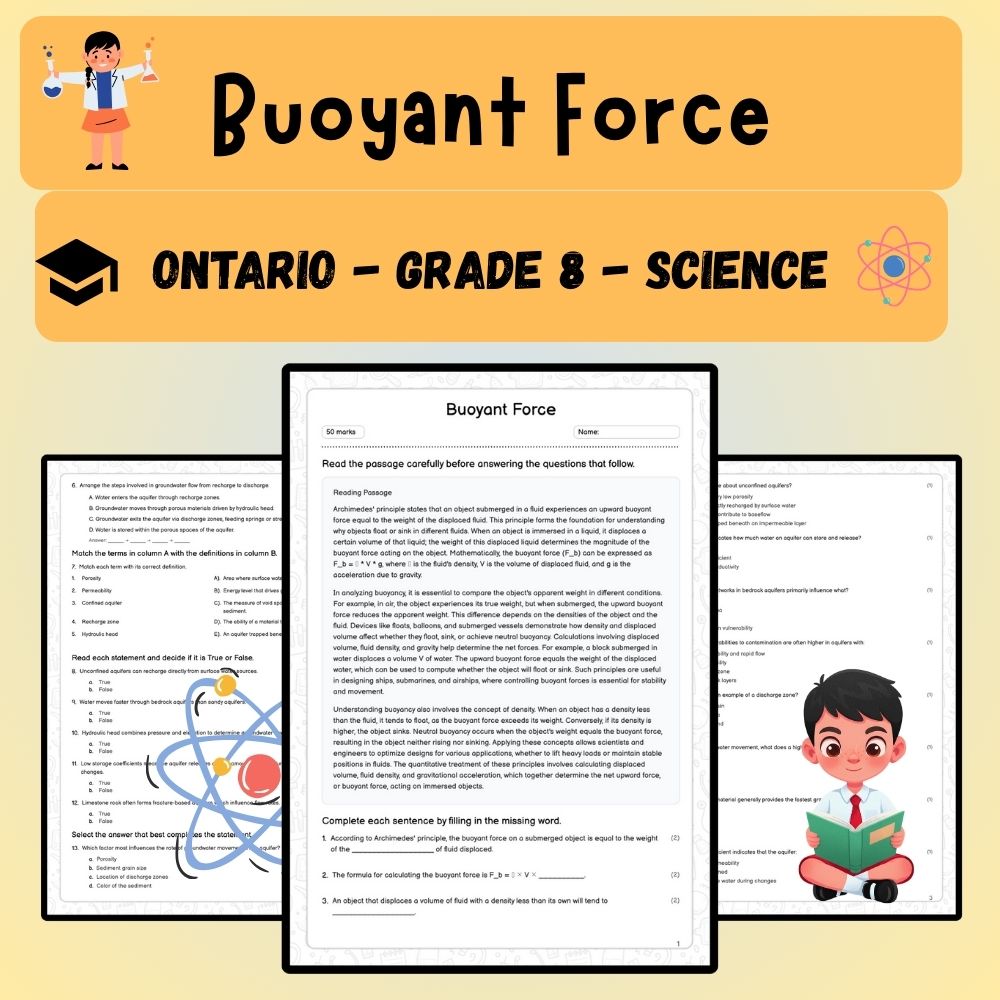
Grade 8 Science | Buoyant Force Worksheet (PDF ) – Ontario Standards
Created byPrism Point LearningLearning Objectives
- Understand Archimedes' principle and its relation to buoyant force.
- Explain the difference between apparent weight in air and submerged conditions.
- Apply density relationships to analyze floating, sinking, and neutral buoyancy scenarios.
Also included in: Grade 8 Science | Fluid Mechanics & Pressure Unit Worksheet Bundle +1 more
Instant download

Grade 8 Science – Biogeochemical Cycling & Water Cycle | Daily Reading Worksheet
Created byBright Mind ResourcesLearning Objectives
- Understand the stages of the water cycle and their roles
- Explain how water moves through evaporation and condensation
- Describe the importance of water cycling in maintaining ecosystems
Also included in: Grade 8 Science Daily Reading Worksheets Lesson Bundle | California Standards +1 more
Instant download

Grade 8 Science – Exploring the Solar System Daily Worksheet with Answer Key
Learning Objectives
- Identify the main components of the solar system.
- Describe the characteristics of the Sun, planets, and other celestial bodies.
- Understand the relative scale and composition of different planets.
Also included in: Grade 8 Science Lesson Bundle | TEKS Standards Worksheets for Earth & Space +1 more
Instant download

Buoyant Force Worksheet for Grade 8 Science | Ontario Standards
 Created byCoral Reef Learning
Learning Objectives
- Understand Archimedes' principle and how buoyant force relates to displaced fluid weight.
- Describe the difference between apparent weight in air and submerged conditions.
- Apply density relationships to analyze floating, sinking, and neutral buoyancy scenarios.
Instant download
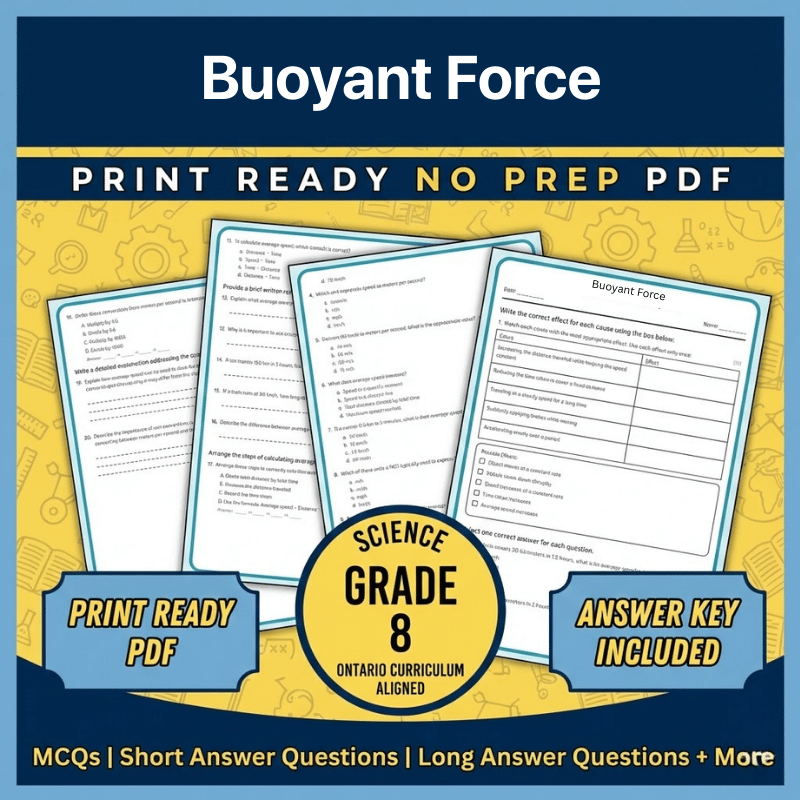
Grade 8 Science Worksheet – Buoyant Force & Archimedes' Principle (Ontario)(PDF)
Created byBright Mind ResourcesLearning Objectives
- Understand Archimedes' principle and how buoyant force relates to displaced fluid weight.
- Explain the difference between apparent weight in air and when submerged.
- Apply density relationships to determine whether objects will float, sink, or attain neutral buoyancy.
Instant download

Kinetic and Potential Energy Worksheet Pack | Grade 8 Science Activities
Created byPrism Point LearningLearning Objectives
- Differentiate kinetic energy and gravitational potential energy using evidence from motion and position
- Explain how energy can change forms while the total energy stays the same
- Use examples (like a roller coaster) to describe energy transfer between kinetic and potential energy
Instant download

Grade 8 Science | Understanding Buoyancy - Daily Reading Comprehension
Created byCoral Reef LearningLearning Objectives
- Explain the concept of buoyant force and its relation to fluid displacement.
- Derive the mathematical expression for buoyant force using Archimedes' principle.
- Describe how buoyant force affects objects submerged in fluids.
Instant download

Grade 8 Science – Buoyant Force & Displacement | Daily Reading Worksheet
 Created byQuiet Forest Education
Learning Objectives
- Explain Archimedes' principle and its relation to buoyant force.
- Identify how displaced fluid volume affects buoyancy.
- Differentiate between apparent weight in air and when submerged.
Also included in: Fluid Dynamics Grade 8 Science Daily Reading Worksheets Bundle | Ontario +1 more
Instant download

Grade 8 Science | Buoyant Force Worksheet (Ontario Standards) (PDF)
Created byEvergreen Desk EducationLearning Objectives
- Explain Archimedes principle and how buoyant force depends on displaced fluid.
- Compare apparent weight in air versus apparent weight when an object is submerged.
- Use density relationships to predict whether objects float, sink, or remain neutrally buoyant.
Also included in: Grade 8 Fluid Pressure & Forces Science Lesson Bundle: Ontario Worksheet Set +1 more
Instant download
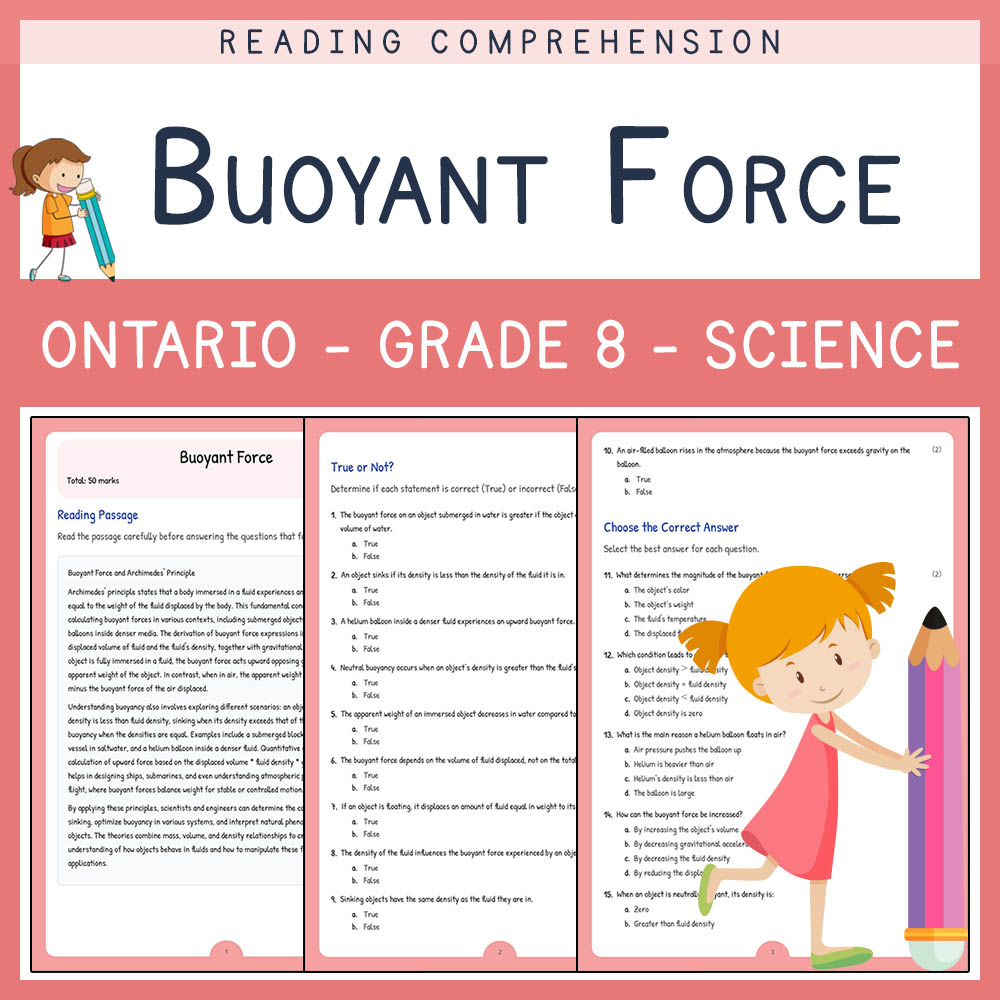
Grade 8 Science Assessment | Buoyant Force Worksheet Elena | Ontario
Created byLumora LearningLearning Objectives
- Understand Archimedes' principle and how buoyant force relates to displaced fluid weight.
- Differentiate between apparent weight in air and when submerged.
- Apply density and volume relationships to analyze floating, sinking, and neutral buoyancy scenarios.
Also included in: Grade 8 Science | Fluids Lesson Bundle | Ontario Framework
Instant download
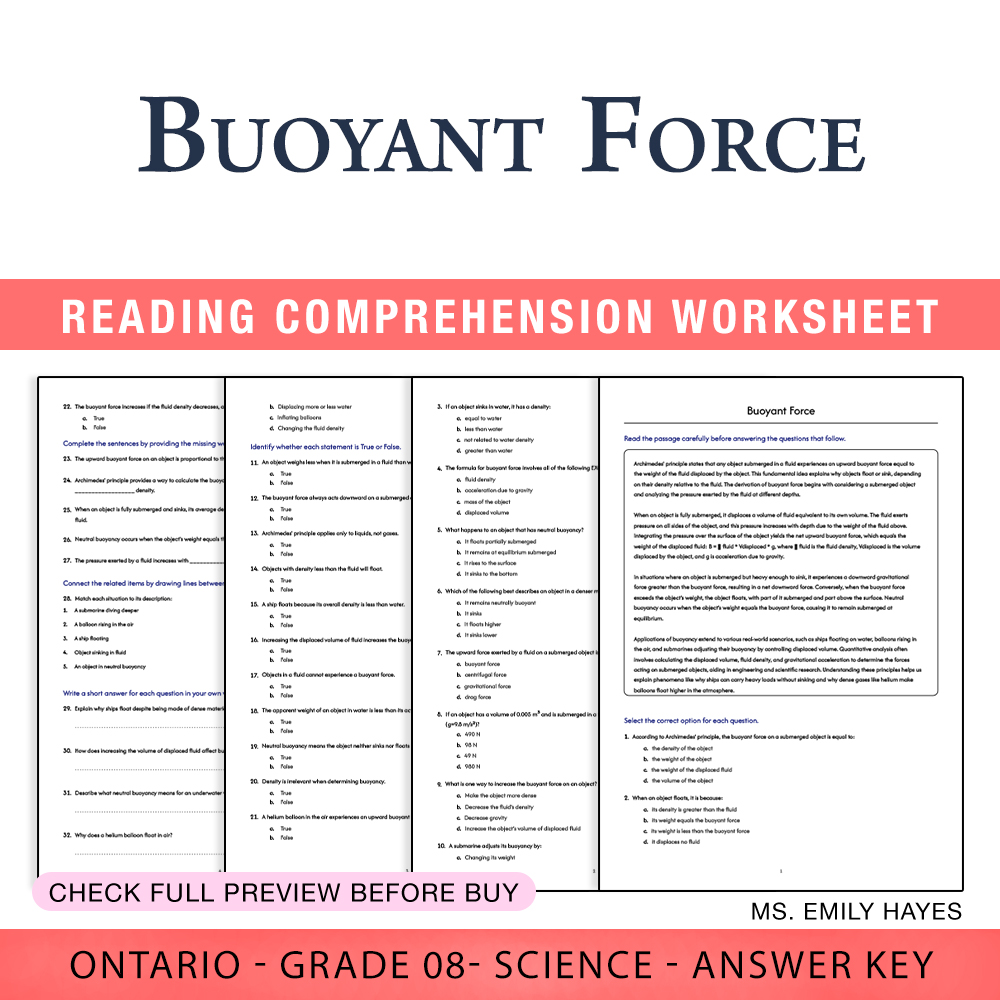
8th Grade Science | Buoyant Force Worksheet (PDF+ Answer Key)
 Created byCopper Leaf Classroom
Learning Objectives
- Understand Archimedes' principle and how buoyant force relates to displaced fluid weight.
- Calculate buoyant force using fluid density, volume displaced, and gravitational acceleration.
- Explain the concepts of apparent weight, neutral buoyancy, and how objects behave in different fluids.
Instant download
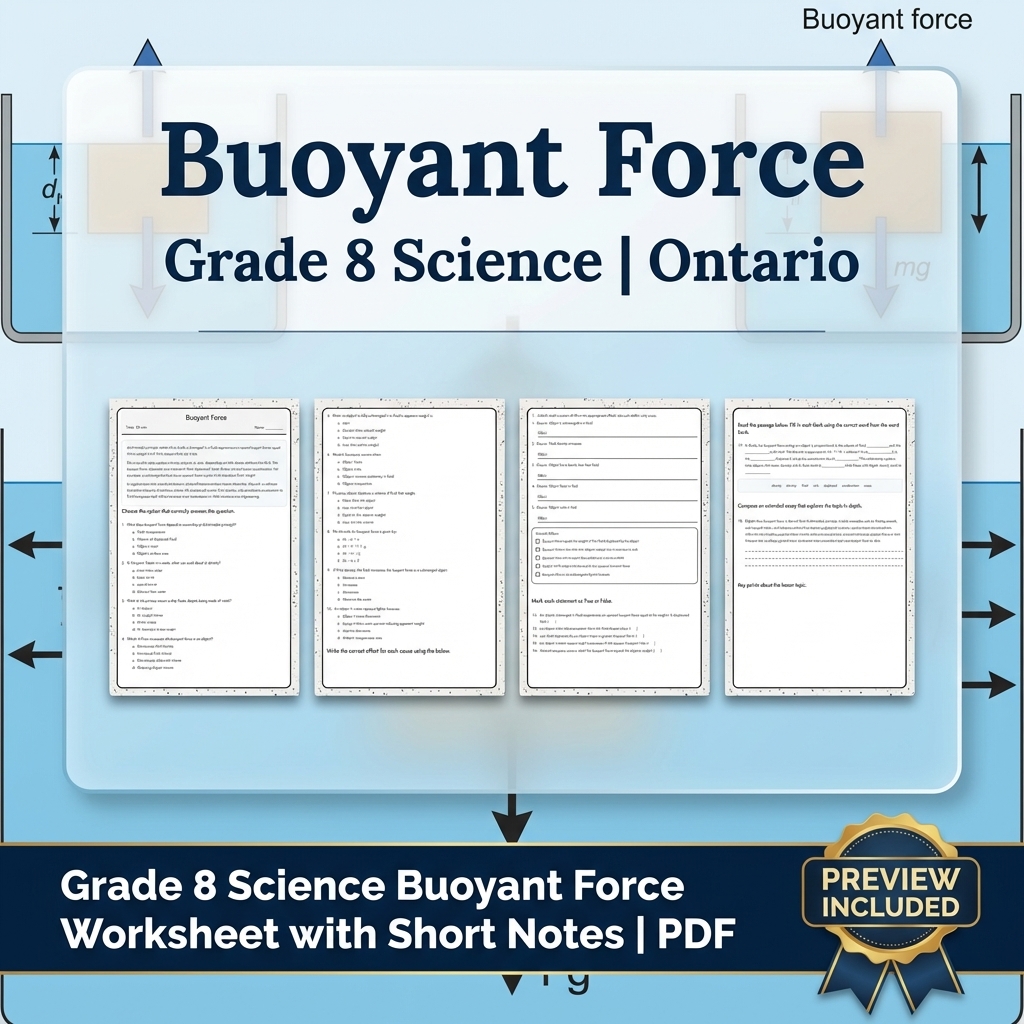
Grade 8 Science Buoyant Force Worksheet with Short Notes | PDF
 Created byMeadowlark Worksheets
Learning Objectives
- Understand Archimedes' principle and how buoyant force relates to displaced fluid weight.
- Calculate buoyant force using fluid density, displaced volume, and gravitational acceleration.
- Explain the differences in apparent weight when objects are in air versus submerged in fluid.
Also included in: Grade 8 Science Lesson Group Bundle | Hydrostatics & Fluid Mechanics +1 more
Instant download
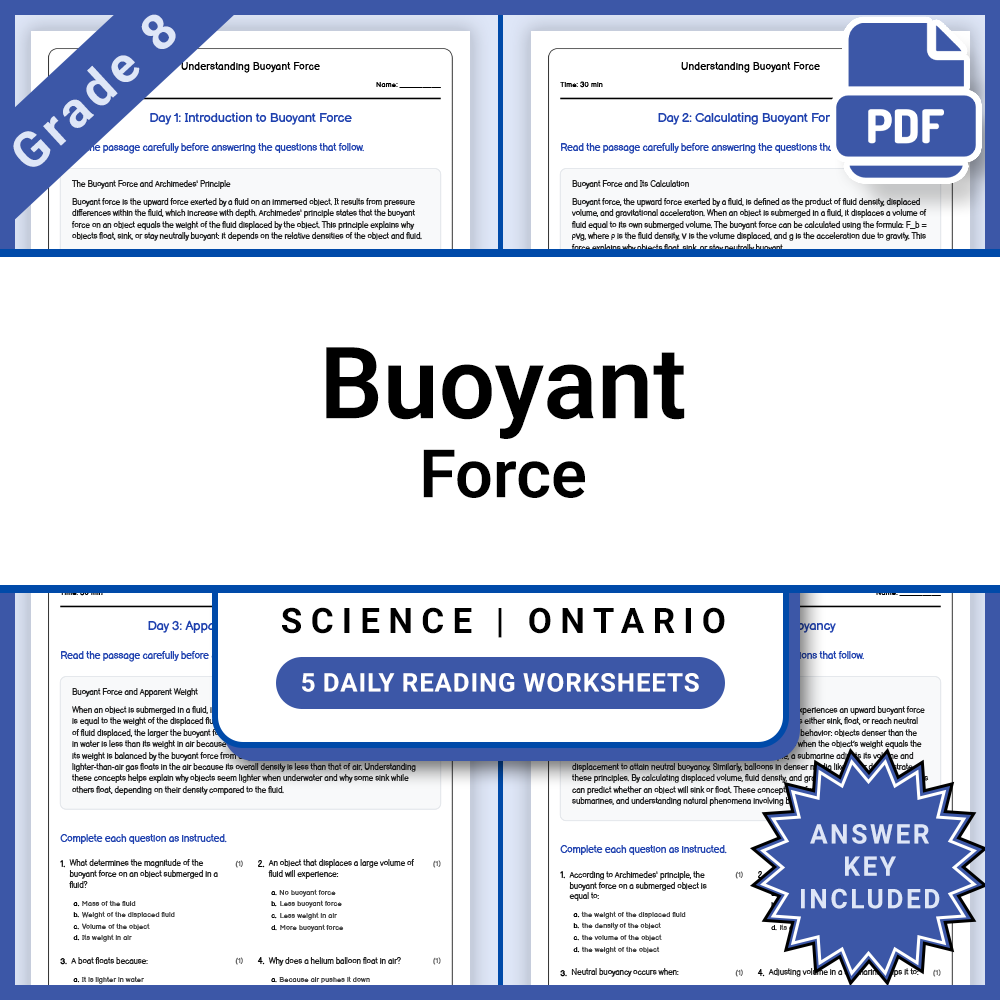
Grade 8 Science – Buoyant Force Daily Reading Worksheet + Answer Key
Learning Objectives
- Explain the concept of buoyant force and how it relates to fluid displacement.
- Understand Archimedes' principle and its application to floating and sinking objects.
- Apply density and volume relationships to calculate buoyant forces in various scenarios.
Also included in: Grade 8 Science Lesson Bundle: Fluids, Pressure, and Density Topics +1 more
Instant download

Grade 8 Buoyant Force Worksheet | Ontario Science with Doodle Notes
 Created byChalk and Compass
Learning Objectives
- Explain Archimedes’ principle and relate buoyant force to the weight of displaced fluid
- Compare apparent weight in air versus when an object is submerged
- Use density relationships to predict floating, sinking, and neutral buoyancy
Also included in: Fluids, Pressure & Flow Lesson Bundle — Grade 8 Science Ontario +1 more
Instant download
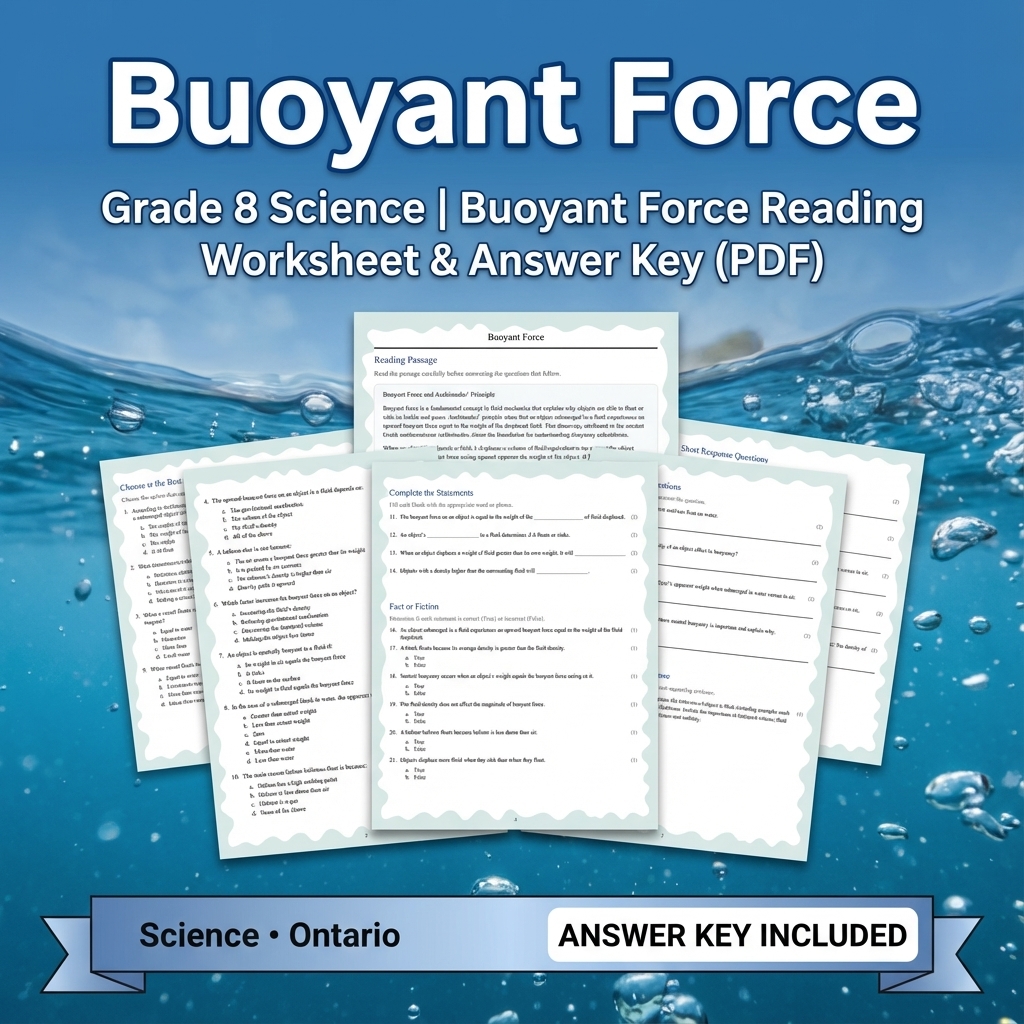
Grade 8 Science | Buoyant Force Reading Worksheet & Answer Key (PDF)
Learning Objectives
- Understand Archimedes' principle and how buoyant force relates to displaced fluid.
- Explain the differences between apparent weight in air and when submerged in a fluid.
- Apply density relationships to analyze objects floating, sinking, or in neutral buoyancy.
Also included in: Grade 8 Science Unit Bundle – Density, Pressure & Fluid Mechanics Worksheets +1 more
Instant download

Grade 8 Buoyant Force Worksheet | Ontario Science Activity & Answer Key
Created byClear Sky ClassroomLearning Objectives
- Explain Archimedes’ principle and relate buoyant force to the weight of displaced fluid.
- Use density and displaced volume relationships to compare buoyant force in different fluids.
- Predict whether an object floats, sinks, or is neutrally buoyant by comparing forces.
Instant download

Grade 8 Science | Orbital Cycles Worksheet with Short Notes (Printable PDF)
Created byMeadowlark WorksheetsLearning Objectives
- Articulate a coherent model of the Earth–Sun–Moon system explaining cyclic phenomena.
- Describe the relative positions and motions that produce lunar phases, eclipses, and seasonal changes.
- Explain how orbital geometry and axial tilt influence observable sky patterns and calendar cycles.
Also included in: Grade 8 Science | Earth's Place in the Universe Unit Bundle (NGSS-Aligned) +1 more
Instant download

Orbital Cycles Worksheet | NGSS Grade 8 Science Assessment
 Created byCedar Grove Learning
Learning Objectives
- Explain the relative positions and motions of the Earth, Sun, and Moon that cause observable cyclic phenomena.
- Describe how axial tilt and orbital geometry lead to seasonal changes and eclipses.
- Model lunar phases and understand their regular sequence based on the Earth's and Moon's movements.
Instant download

Orbital Cycles Worksheet | NGSS Grade 8 Science Printable PDF Assessment
Learning Objectives
- Explain the relative positions and motions of the Earth, Moon, and Sun that cause lunar phases, eclipses, and seasonal changes.
- Describe how Earth's axial tilt and orbital geometry influence observable sky patterns and calendar cycles.
- Understand the timing and sequence of lunar phases, eclipses, and seasons based on celestial motions.
Also included in: Grade 8 Science Earth's Place in the Universe Lesson Bundle NGSS +1 more
Instant download

Earth Sun Moon Orbital Cycles Science Worksheets Grade 8
 Created bythe curious pencil
Learning Objectives
- Explain how Earth, Sun, and Moon motions create observable cycles
- Describe how changing positions produce lunar phases
- Identify the alignments required for solar and lunar eclipses
Also included in: Earth's Place in the Universe NGSS Science Unit Bundle +2 more
Instant download

Grade 8 Science – Earth's Orbital Cycles & Phases | Daily Reading Worksheet
Created byBright Mind ResourcesLearning Objectives
- Describe the Earth's position and movement around the Sun
- Explain how lunar phases are related to the Earth–Moon–Sun system
- Identify key events like eclipses and seasonal changes based on Earth's orbit
Also included in: Grade 8 Space Systems Science Daily Reading Worksheets Lesson Bundle | NGSS +1 more
Instant download

Orbital Cycles Practice Worksheet | Grade 8 Science NGSS Review
Created byPrism Point LearningLearning Objectives
- Model the relative motions and positions of Earth, the Sun, and the Moon to explain lunar phases and eclipses.
- Explain how Earth’s axial tilt and orbital geometry drive seasonal changes in solar energy.
- Use cycle timing terms such as the synodic month to connect sky patterns with calendar observations.
Also included in: Grade 8 Gravity and Motion Science lesson bundle NGSS worksheet practice
Instant download
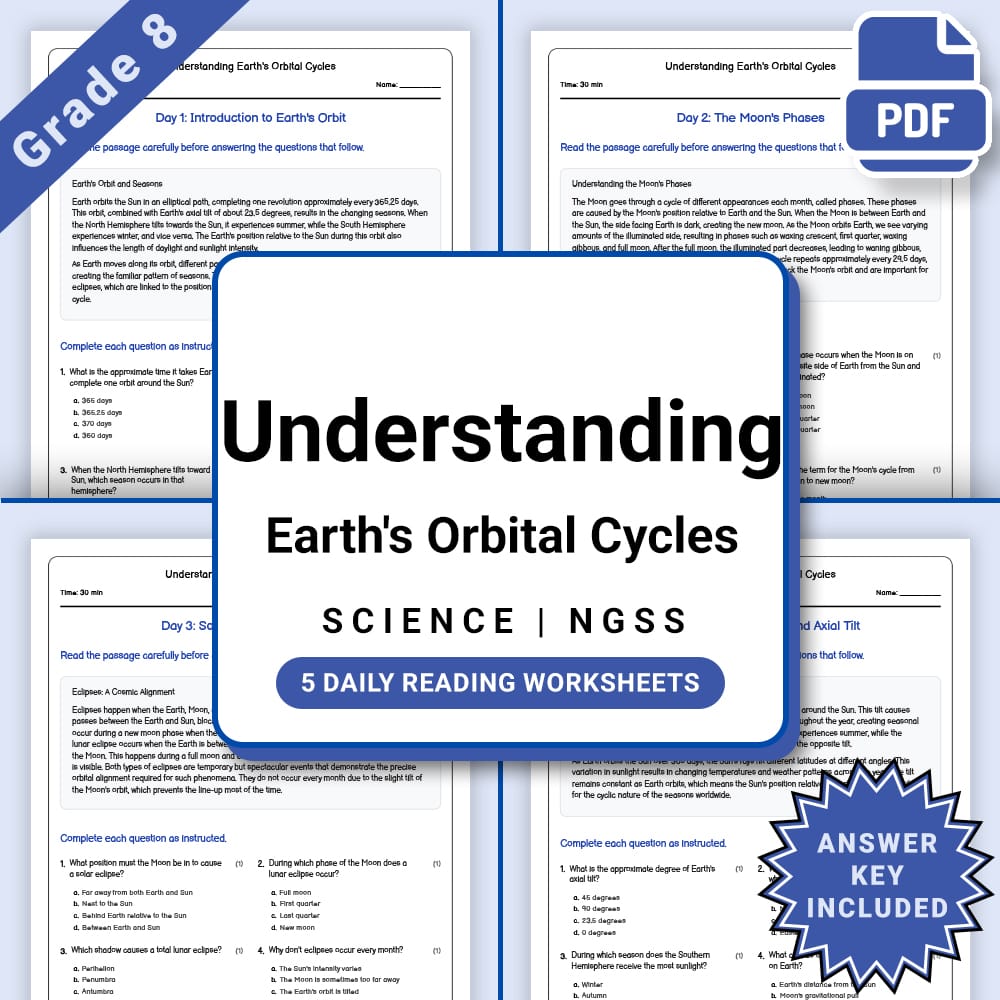
Grade 8 Science – Understanding Earth's Orbital Cycles Worksheet(PDF + Answers)
Created byCopper Leaf ClassroomLearning Objectives
- Explain the motion of Earth around the Sun and how it influences seasons.
- Identify and describe key lunar phases and related phenomena such as eclipses.
- Understand the significance of axial tilt and orbital geometry in cyclic phenomena.
Instant download
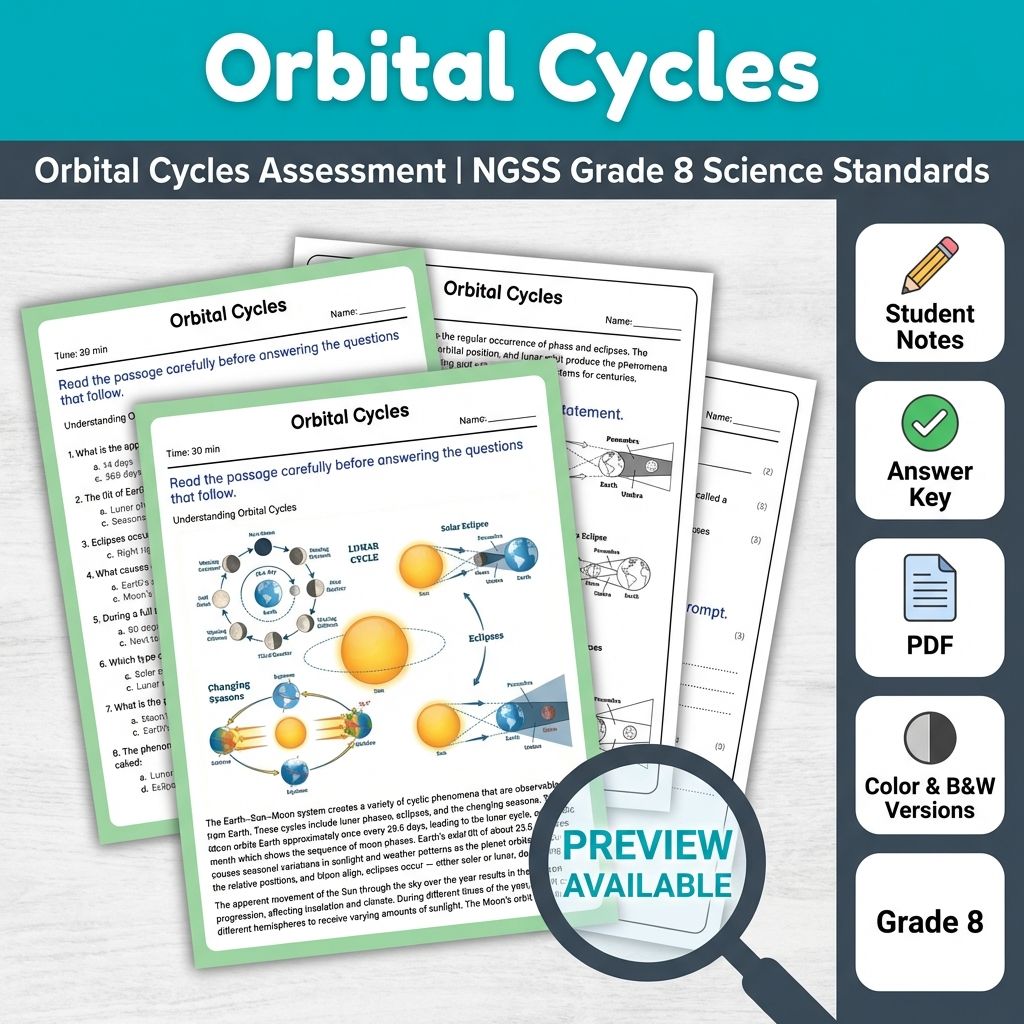
Orbital Cycles Assessment | NGSS Grade 8 Science Standards
Created byPrism Point LearningLearning Objectives
- Describe the relative positions and motions of the Earth, Moon, and Sun that produce lunar phases, eclipses, and seasonal changes.
- Explain how orbital geometry and axial tilt influence observable sky phenomena and calendar cycles.
- Analyze the relationship between Earth's orbit, the lunar cycle, and seasonal insolation differences.
Also included in: Grade 8 Science Mini Bundle | Earth's Place in the Universe – NGSS +1 more
Instant download
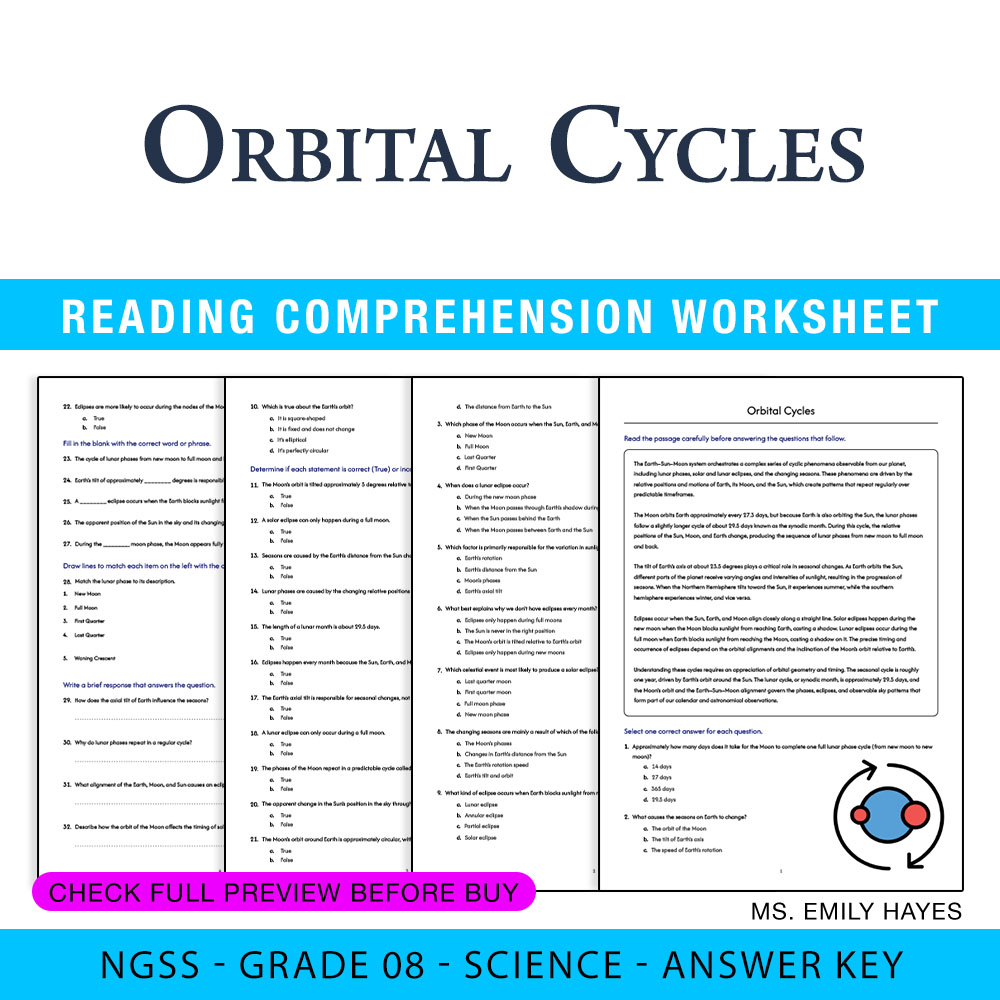
Grade 8 Science | Orbital Cycles Worksheet (PDF+ Answer Key)
Created byCopper Leaf ClassroomLearning Objectives
- Explain the relative positions and motions of the Earth, Moon, and Sun during lunar phases, eclipses, and seasonal changes.
- Describe how axial tilt and orbital geometry influence observable sky patterns and calendar cycles.
- Identify and link phenomena such as moon phases, eclipses, and seasons to the Earth's and Moon's motions.
Instant download
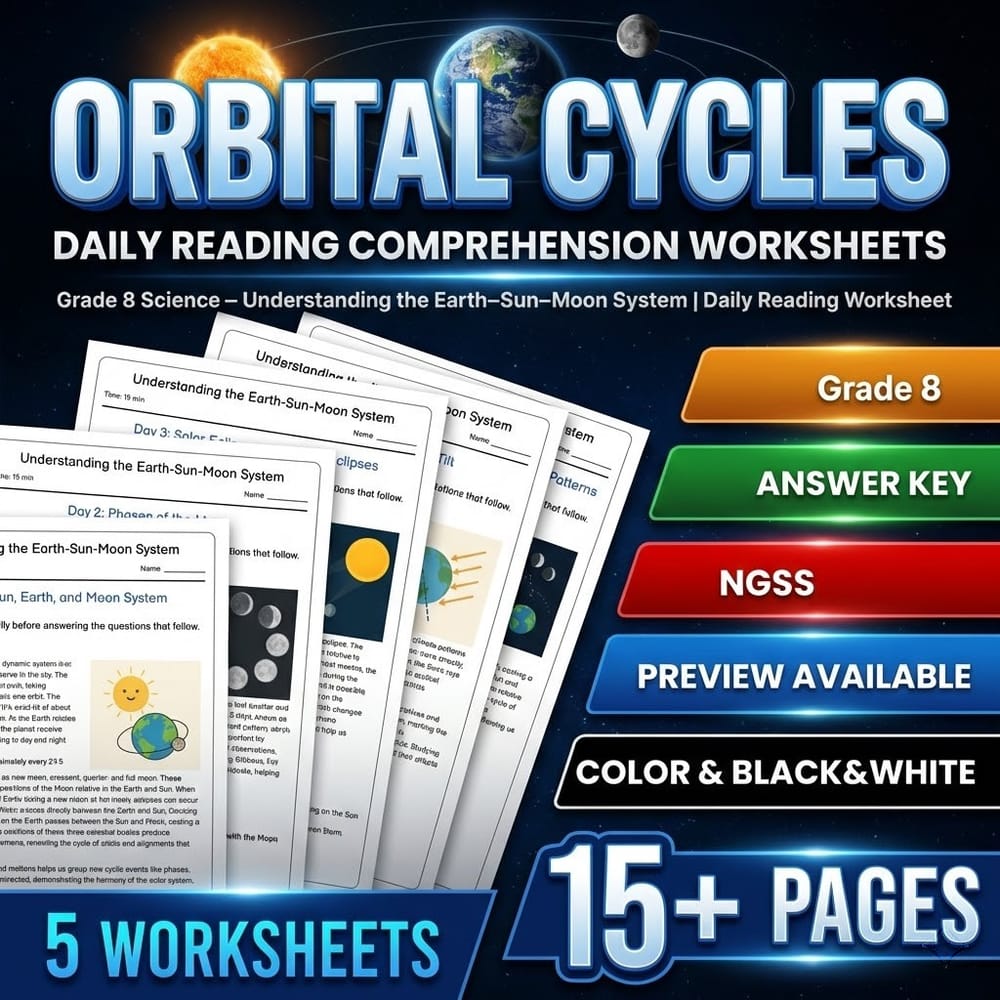
Grade 8 Science – Earth–Sun–Moon System | Daily Reading Worksheet
 Created byElena Brooks
Learning Objectives
- Describe the relative positions of the Earth, Sun, and Moon during different phases.
- Explain how axial tilt and orbital motion cause seasonal changes.
- Identify the causes of lunar phases, solar eclipses, and lunar eclipses.
Instant download

Grade 8 Science | Orbital Cycles Worksheet (PDF + Answer Key)
 Created byRiverstone Classroom
Learning Objectives
- Explain how the relative positions and motions of the Earth, Moon, and Sun produce lunar phases, eclipses, and seasonal changes.
- Describe the key cycles such as the lunar synodic month and seasonal progression and how they relate to observable sky patterns.
- Identify how orbital geometry and axial tilt influence phenomena like moon phases, eclipses, and insolation differences.
Instant download

Grade 8 Science Data Modeling Worksheet (NGSS) – PDF
 Created byMaple Path Learning
Learning Objectives
- Describe how physical and computational models can generate quantitative data.
- Identify limitations and sources of measurement uncertainty in modeling.
- Explain the importance of consistent input conditions, repeatability, and accurate data recording.
Also included in: Grade 8 Science | Engineering Design Unit Bundle – NGSS Practice & Worksheets +1 more
Instant download

Solar System Worksheet | Grade 8 Science Activities
Created byPrism Point LearningLearning Objectives
- Explain the major parts of the solar system, including the Sun, planets, dwarf planets, moons, asteroids, and comets.
- Describe how gravity and solar energy influence orbits, planetary environments, and atmospheric conditions.
- Use evidence from telescopes and spacecraft to support basic claims about the solar system.
Also included in: Grade 8 Earth and Space Science Lesson Bundle for TEKS Worksheets +1 more
Instant download

Grade 8 Modeling Data in Science Worksheet | NGSS Data Analysis Activity
 Created byBRIGHT PATH RESOURCES
Learning Objectives
- Understand what physical models are and how they are used in science
- Learn about the different types of models such as scale models, force sensors, and simulations
- Recognize the limitations and sources of measurement uncertainty in models
Also included in: Design Tradeoffs Grade 8 Science Daily Reading Worksheets Lesson Bundle | NGSS +2 more
Instant download

Earth–Sun–Moon Cycles and Seasonal Changes Worksheets Grade 8 Science
 Created byTeachers Club
Learning Objectives
- Explain why lunar phases follow a repeating sequence
- Describe alignments that produce solar and lunar eclipses
- Explain how axial tilt contributes to seasonal changes
Also included in: Earth's Place in the Universe Grade 8 Science NGSS Worksheets +2 more
Instant download
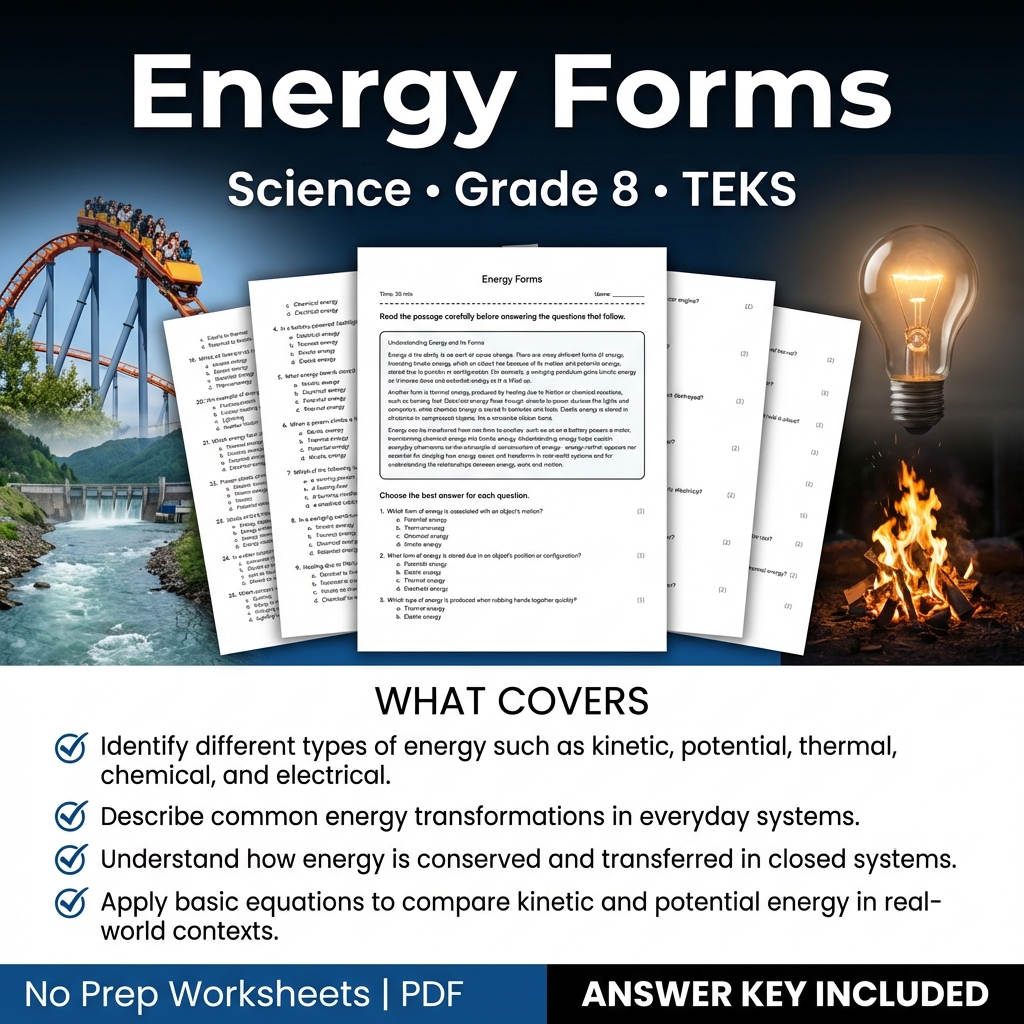
Grade 8 Science Energy Forms Worksheet | TEKS-Aligned Practice & Answer Key
Created byCoral Reef LearningLearning Objectives
- Identify different types of energy such as kinetic, potential, thermal, chemical, and electrical.
- Describe common energy transformations in everyday systems.
- Understand how energy is conserved and transferred in closed systems.
Instant download

Grade 8 Orbital Cycles Worksheet | NGSS Moon Phases Eclipses Seasons
 Created byAmber Owl Education
Learning Objectives
- Explain how the Earth–Sun–Moon system creates cyclic phenomena such as lunar phases, eclipses, and seasons
- Use relative positions and motions to predict when phases and eclipses occur
- Describe how axial tilt and orbital geometry affect the timing and intensity of seasonal sunlight
Also included in: Grade 8 Science NGSS Full-Year Worksheet Bundle | NGSS Aligned
Instant download

Grade 8 Homeostatic Control Worksheet | Body Systems & Balance PDF
Created byEvergreen Desk EducationLearning Objectives
- Explain how homeostasis helps maintain stable internal conditions for cell function
- Describe how negative feedback systems respond to changes using a set range
- Connect homeostatic control to regulation of body temperature, blood chemistry, water balance, and oxygen levels
Instant download

Grade 8 Science | Energy Forms (Worksheet + Answer Key) – TEKS Aligned
Created byBright Mind ResourcesLearning Objectives
- Identify and describe different types of energy including kinetic, potential, elastic, thermal, chemical, and electrical.
- Understand how energy transforms from one form to another in everyday systems.
- Apply basic equations to compare kinetic and potential energy quantitatively.
Also included in: Grade 8 Science Unit | Motion, Forces & Energy Worksheets Bundle (TEKS Aligned) +1 more
Instant download

Grade 8 Science – Homeostasis & Regulatory Systems | Daily Reading Worksheet
Created byBright Mind ResourcesLearning Objectives
- Define homeostasis and explain its significance in maintaining internal stability.
- Describe how negative feedback mechanisms regulate body temperature and other internal conditions.
- Identify examples of homeostatic processes in the human body.
Also included in: Grade 8 Science Daily Reading Worksheets Lesson Bundle | California Standards +1 more
Instant download

Grade 8 Science – Energy Forms & Transfer | Daily Reading Worksheet
Created byBright Mind ResourcesLearning Objectives
- Identify and describe different forms of energy including kinetic and gravitational potential energy.
- Recognize everyday examples of energy transformations.
- Understand basic principles of energy conservation in simple systems.
Also included in: Grade 8 Energy & Motion Science Daily Reading Worksheets Lesson Bundle | TEKS +2 more
Instant download

Grade 8 Science | Introduction to Ecosystems - Daily Reading Comprehension
Created byCoral Reef LearningLearning Objectives
- Understand the basic components of ecosystems, including biotic and abiotic factors.
- Identify different biomes such as grassland, desert, and temperate forest and their climatic influences.
- Learn about trophic roles: producers, consumers, and decomposers.
Instant download
Browse more categories
About Grade 8 Worksheets
Explore Grade 8 worksheets in math, ELA, science, and social studies. Our 8,421 Grade 8 printables print straight from PDF, answer keys included.
Each resource here is built by an independent educator and reviewed for quality. Worksheets print straight from PDF and suit classroom use, homework, or extra practice; most come with answer keys, and you can preview before purchasing.