
Grade 8 Science Worksheets
6,034 worksheets
Orbital Cycles Worksheet | NGSS Grade 8 Science Printable PDF Assessment
Learning Objectives
- Explain the relative positions and motions of the Earth, Moon, and Sun that cause lunar phases, eclipses, and seasonal changes.
- Describe how Earth's axial tilt and orbital geometry influence observable sky patterns and calendar cycles.
- Understand the timing and sequence of lunar phases, eclipses, and seasons based on celestial motions.
Also included in: Grade 8 Science Earth's Place in the Universe Lesson Bundle NGSS +1 more
Instant download

Grade 8 Science – Earth's Orbital Cycles & Phases | Daily Reading Worksheet
 Created byBright Mind Resources
Learning Objectives
- Describe the Earth's position and movement around the Sun
- Explain how lunar phases are related to the Earth–Moon–Sun system
- Identify key events like eclipses and seasonal changes based on Earth's orbit
Also included in: Grade 8 Space Systems Science Daily Reading Worksheets Lesson Bundle | NGSS +1 more
Instant download
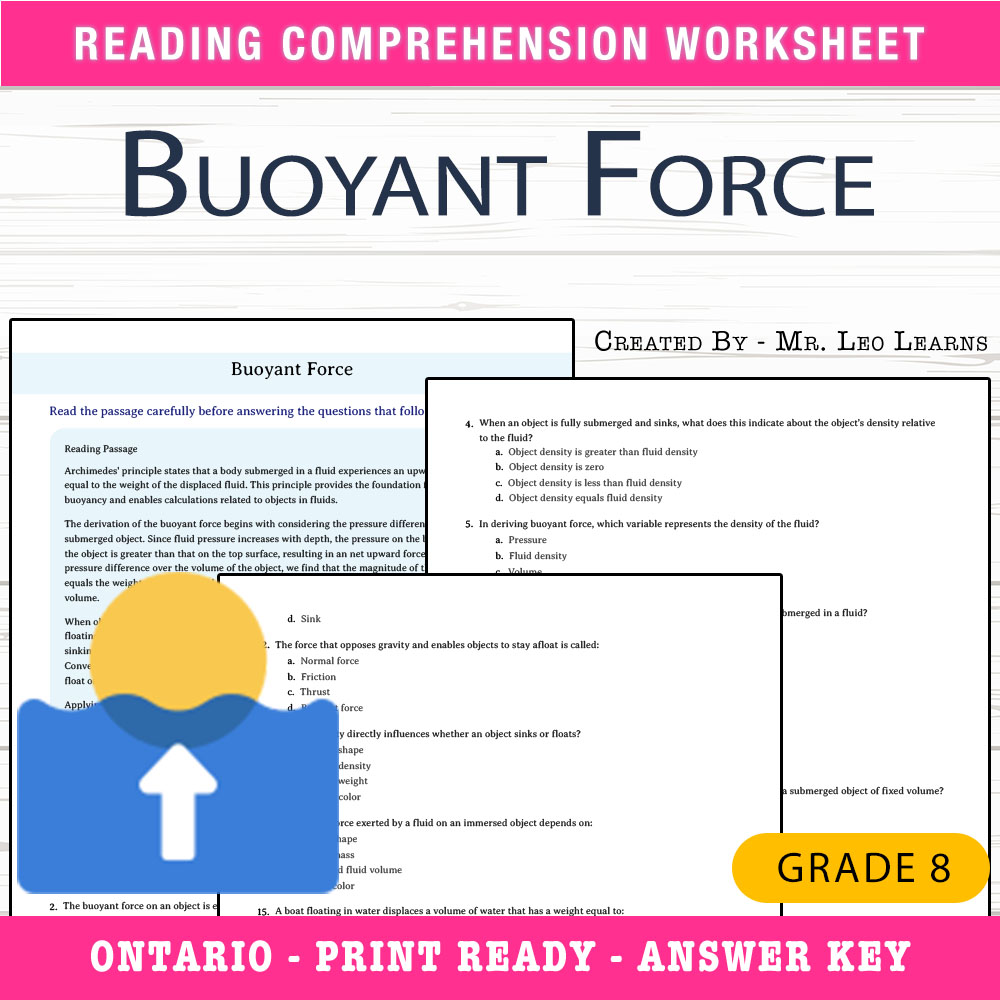
8th Grade Science – Buoyant Force Worksheet for Mastery
 Created byThe Resource Hub
Learning Objectives
- Explain Archimedes' principle and derive the buoyant force expression.
- Differentiate between apparent weight in air and when submerged in a fluid.
- Apply density relationships to analyze floating, sinking, and neutral buoyancy scenarios.
Also included in: Grade 8 Science – Fluids & Buoyancy Mastery Unit Bundle (Worksheet Pack) +1 more
Instant download

Earth Sun Moon Orbital Cycles Science Worksheets Grade 8
 Created bythe curious pencil
Learning Objectives
- Explain how Earth, Sun, and Moon motions create observable cycles
- Describe how changing positions produce lunar phases
- Identify the alignments required for solar and lunar eclipses
Also included in: Earth's Place in the Universe NGSS Science Unit Bundle +2 more
Instant download

Orbital Cycles Practice Worksheet | Grade 8 Science NGSS Review
 Created byPrism Point Learning
Learning Objectives
- Model the relative motions and positions of Earth, the Sun, and the Moon to explain lunar phases and eclipses.
- Explain how Earth’s axial tilt and orbital geometry drive seasonal changes in solar energy.
- Use cycle timing terms such as the synodic month to connect sky patterns with calendar observations.
Also included in: Grade 8 Gravity and Motion Science lesson bundle NGSS worksheet practice
Instant download
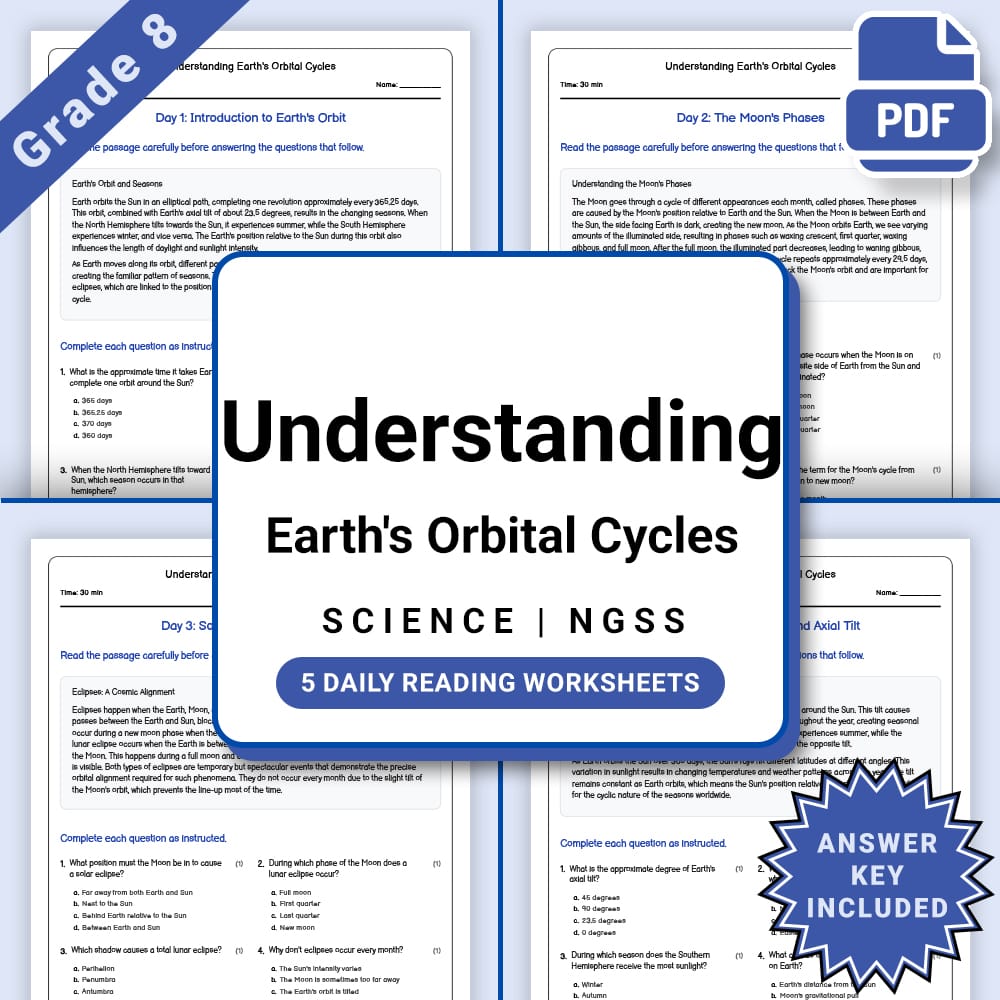
Grade 8 Science – Understanding Earth's Orbital Cycles Worksheet(PDF + Answers)
 Created byCopper Leaf Classroom
Learning Objectives
- Explain the motion of Earth around the Sun and how it influences seasons.
- Identify and describe key lunar phases and related phenomena such as eclipses.
- Understand the significance of axial tilt and orbital geometry in cyclic phenomena.
Instant download

Grade 8 Science | Motion Basics Worksheet | TEKS-Aligned
 Created byLumora Learning
Learning Objectives
- Understand fundamental concepts of motion including position, distance, speed, velocity, and acceleration.
- Differentiate between scalar and vector quantities related to motion.
- Interpret distance–time and velocity–time graphs through examples such as rolling balls and toy vehicles.
Also included in: Grade 8 Science | Force, Motion, and Energy Lesson Bundle | TEKS-Aligned
Instant download
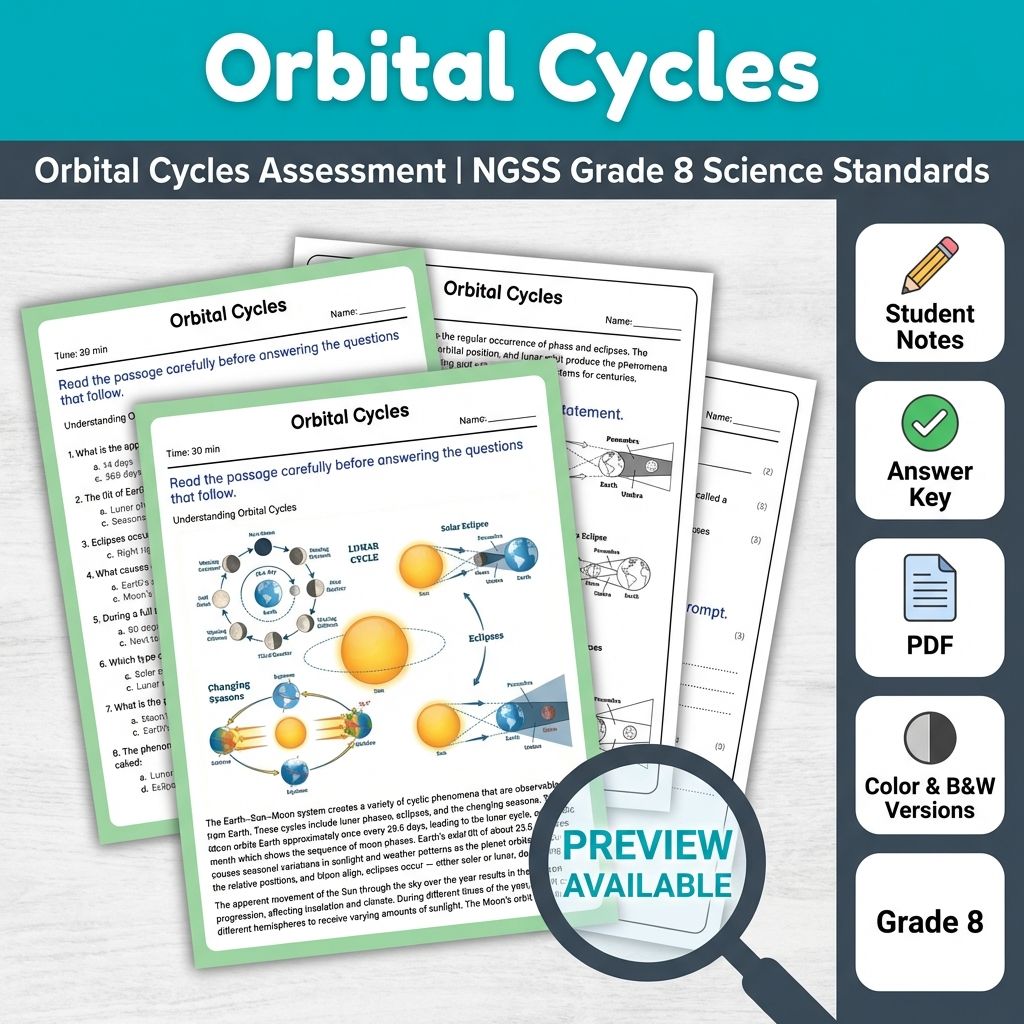
Orbital Cycles Assessment | NGSS Grade 8 Science Standards
Created byPrism Point LearningLearning Objectives
- Describe the relative positions and motions of the Earth, Moon, and Sun that produce lunar phases, eclipses, and seasonal changes.
- Explain how orbital geometry and axial tilt influence observable sky phenomena and calendar cycles.
- Analyze the relationship between Earth's orbit, the lunar cycle, and seasonal insolation differences.
Also included in: Grade 8 Science Mini Bundle | Earth's Place in the Universe – NGSS +1 more
Instant download

Grade 8 Science | Homeostatic Control Worksheet | California Standards
Created byLumora LearningLearning Objectives
- Explain how homeostasis helps maintain stable internal conditions for cell function.
- Describe how negative feedback responds to changes by counteracting them.
- Identify examples of homeostatic regulation involving temperature, water balance, blood chemistry, and oxygen levels.
Instant download
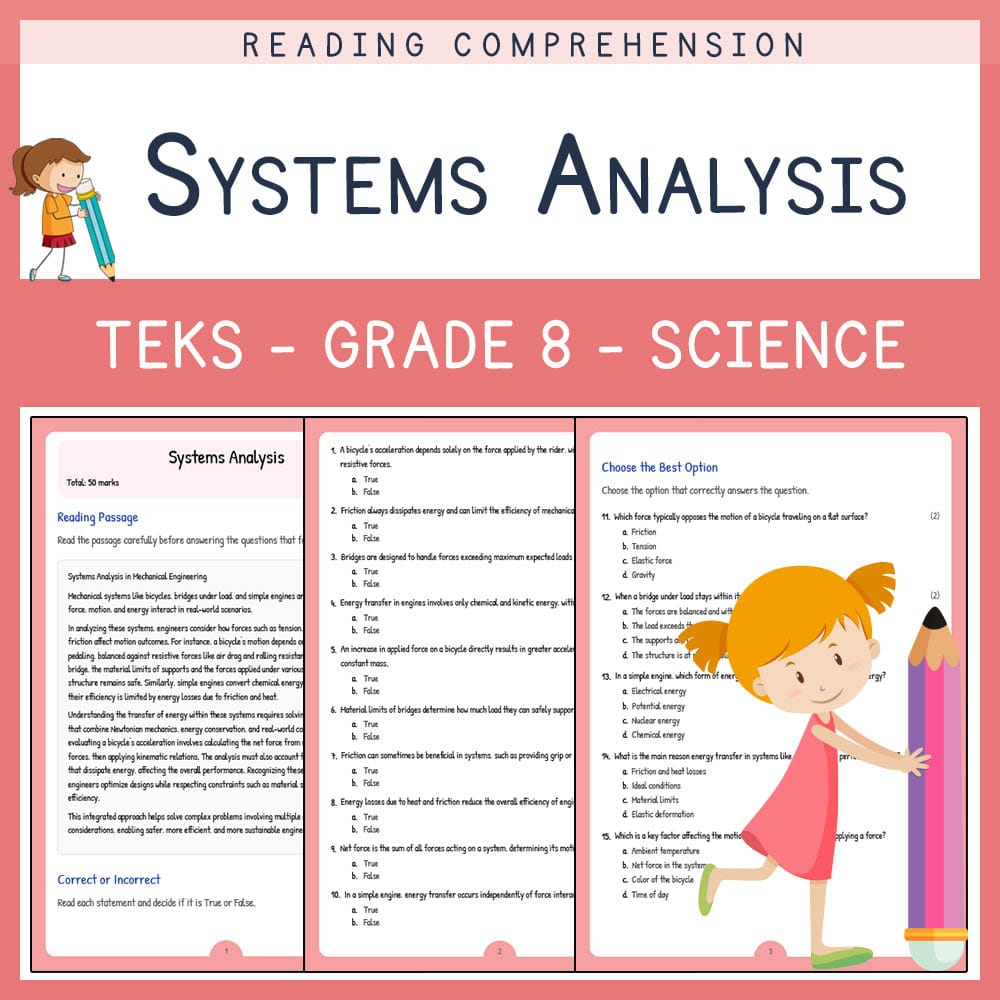
Grade 8 Science | Systems Analysis Worksheet | TEKS Aligned
Created byLumora LearningLearning Objectives
- Understand the principles of force, motion, and energy in mechanical systems.
- Apply combined concepts of net force, energy transfer, and motion to analyze real-world systems.
- Solve multi-step problems involving kinematic relations, force summations, and energy comparisons.
Also included in: Grade 8 Science | Force, Motion, and Energy Lesson Bundle | TEKS-Aligned
Instant download

Grade 8 Science | Biogeochemical Cycling & Water Cycle - Reading Comprehension
 Created byCoral Reef Learning
Learning Objectives
- Understand the processes of evaporation, condensation, and precipitation
- Explain how water moves through different parts of the environment
- Recognize the importance of water cycling for ecosystems
Instant download
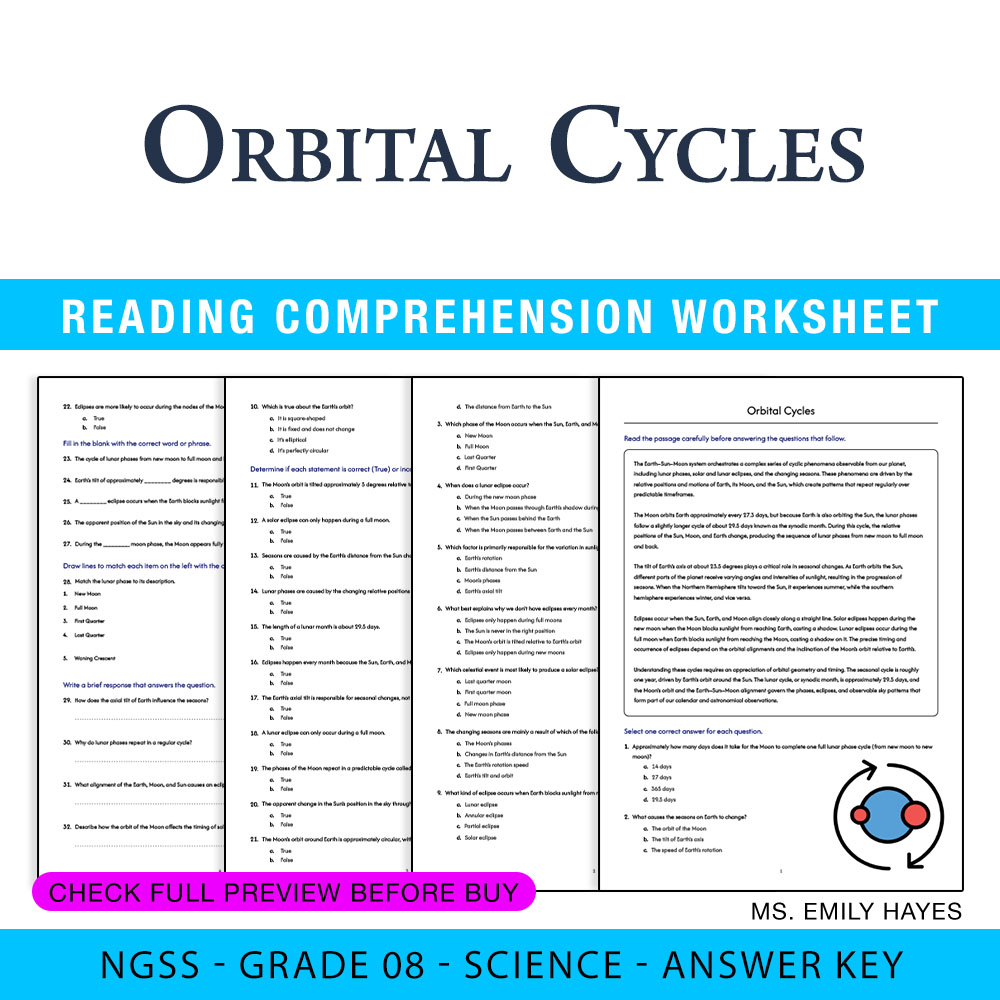
Grade 8 Science | Orbital Cycles Worksheet (PDF+ Answer Key)
Created byCopper Leaf ClassroomLearning Objectives
- Explain the relative positions and motions of the Earth, Moon, and Sun during lunar phases, eclipses, and seasonal changes.
- Describe how axial tilt and orbital geometry influence observable sky patterns and calendar cycles.
- Identify and link phenomena such as moon phases, eclipses, and seasons to the Earth's and Moon's motions.
Instant download

Grade 8 TEKS Ecosystem Basics & Biome Clues Science Reading Worksheet
 Created byBRIGHT PATH RESOURCES
Learning Objectives
- Identify abiotic and biotic ecosystem components from a scientific passage.
- Explain how biomes relate to climate and how producers, consumers, and decomposers fit into ecosystem structure.
- Use evidence from a passage to answer questions about ecosystem interactions.
Also included in: Grade 8 Organisms & Environments Science Reading Worksheets Bundle | TEKS +1 more
Instant download
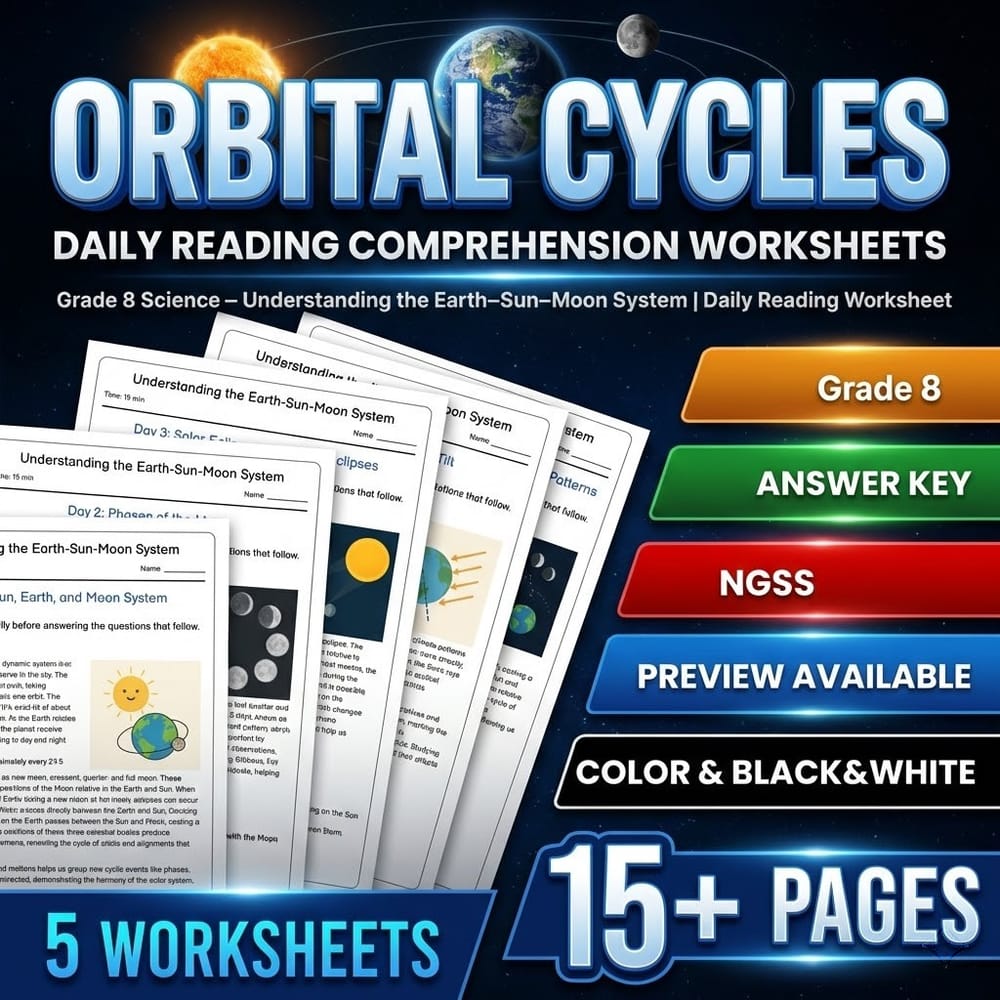
Grade 8 Science – Earth–Sun–Moon System | Daily Reading Worksheet
 Created byElena Brooks
Learning Objectives
- Describe the relative positions of the Earth, Sun, and Moon during different phases.
- Explain how axial tilt and orbital motion cause seasonal changes.
- Identify the causes of lunar phases, solar eclipses, and lunar eclipses.
Instant download

Grade 8 Science | Orbital Cycles Worksheet (PDF + Answer Key)
 Created byRiverstone Classroom
Learning Objectives
- Explain how the relative positions and motions of the Earth, Moon, and Sun produce lunar phases, eclipses, and seasonal changes.
- Describe the key cycles such as the lunar synodic month and seasonal progression and how they relate to observable sky patterns.
- Identify how orbital geometry and axial tilt influence phenomena like moon phases, eclipses, and insolation differences.
Instant download

Grade 8 Science – Ecosystem Structure Worksheet (PDF) | TEKS Aligned & Engaging
Created byBright Mind ResourcesLearning Objectives
- Describe the components and biomes of ecosystems and their abiotic factors.
- Explain the roles of producers, consumers, and decomposers in energy flow and nutrient cycling.
- Identify different biomes such as grassland, desert, and temperate forest based on climate and community composition.
Also included in: Grade 8 Science Unit Bundle | Ecosystems,Evolution & Cell Processes TEKS Aligned +1 more
Instant download

Grade 8 Science | Systems Analysis (Worksheet + Answer Key) TEKS-Aligned
Created byBright Mind ResourcesLearning Objectives
- Understand the relationship between net force, motion, and energy transfer in mechanical systems.
- Analyze multi-step problem setups involving forces, kinematics, and energy comparisons.
- Evaluate real-world constraints like friction, material limits, and efficiency in system performance.
Also included in: Grade 8 Science Unit | Motion, Forces & Energy Worksheets Bundle (TEKS Aligned) +1 more
Instant download

Grade 8 Science | Energy Forms in Science - Daily Reading Comprehension
Created byCoral Reef LearningLearning Objectives
- Identify different types of energy including kinetic, potential, elastic, thermal, chemical, and electrical.
- Understand basic concepts of energy transfer, transformation, and conservation.
- Recognize everyday examples of various energy types and their transformations.
Instant download

Modeling Data Worksheet ngss g8 | Grade 8 Science Assessment
 Created byCedar Grove Learning
Learning Objectives
- Describe how physical and computational models generate quantitative data for testing solutions.
- Identify limitations and sources of measurement uncertainty in data models.
- Understand the importance of consistent input conditions and repeatability in data collection.
Instant download

Grade 8 Kinetic and Potential Worksheet | NGSS Practice PDF
 Created byClear Sky Classroom
Learning Objectives
- Distinguish kinetic energy from potential energy and identify which one changes with motion or position.
- Explain how gravitational potential energy and kinetic energy shift during roller-coaster-like motion.
- Apply the idea of energy conservation (or near conservation) to predict what happens to total mechanical energy.
Instant download

Grade 8 Homeostatic Control Worksheet | Body Systems & Balance PDF
 Created byEvergreen Desk Education
Learning Objectives
- Explain how homeostasis helps maintain stable internal conditions for cell function
- Describe how negative feedback systems respond to changes using a set range
- Connect homeostatic control to regulation of body temperature, blood chemistry, water balance, and oxygen levels
Instant download

Grade 8 Science – Homeostasis & Regulatory Systems | Daily Reading Worksheet
Created byBright Mind ResourcesLearning Objectives
- Define homeostasis and explain its significance in maintaining internal stability.
- Describe how negative feedback mechanisms regulate body temperature and other internal conditions.
- Identify examples of homeostatic processes in the human body.
Also included in: Grade 8 Science Daily Reading Worksheets Lesson Bundle | California Standards +1 more
Instant download
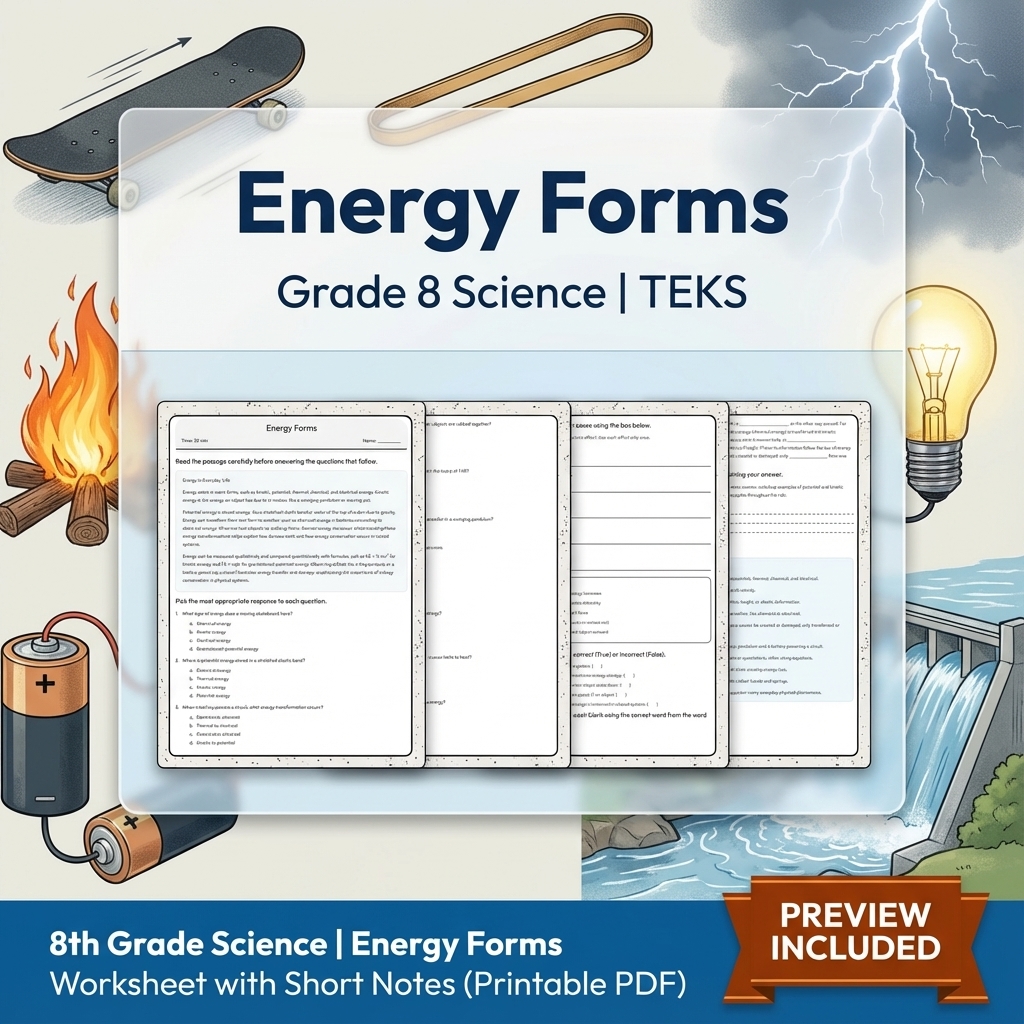
8th Grade Science | Energy Forms Worksheet with Short Notes (Printable PDF)
 Created byMeadowlark Worksheets
Learning Objectives
- Identify and describe different types of energy, including kinetic, gravitational potential, elastic, thermal, chemical, and electrical energy.
- Explain examples of energy transfer and transformation in everyday systems.
- Use basic equations to compare kinetic and potential energy in real-world contexts.
Instant download
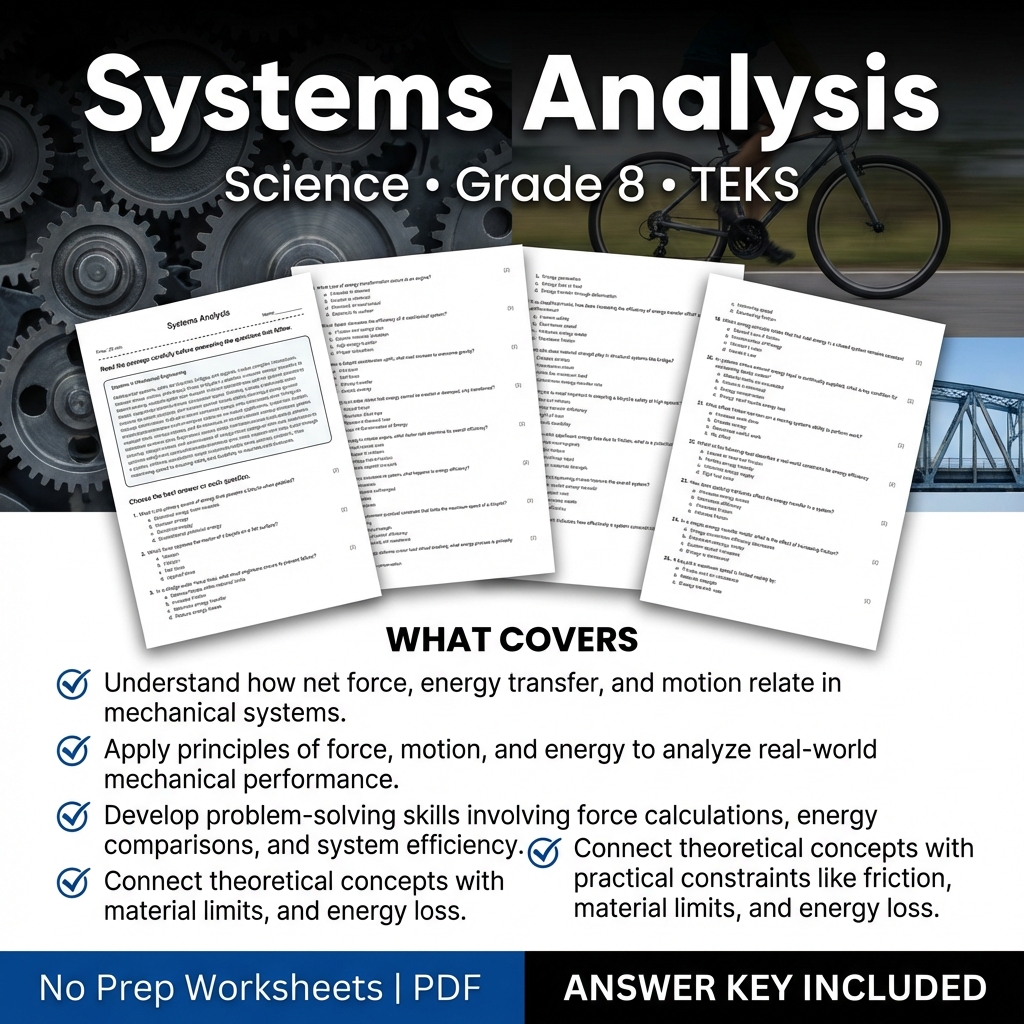
Systems Analysis Worksheet Grade 8 Science TEKS Practice PDF
Created byCoral Reef LearningLearning Objectives
- Understand how net force, energy transfer, and motion relate in mechanical systems.
- Apply principles of force, motion, and energy to analyze real-world mechanical performance.
- Develop problem-solving skills involving force calculations, energy comparisons, and system efficiency.
Instant download
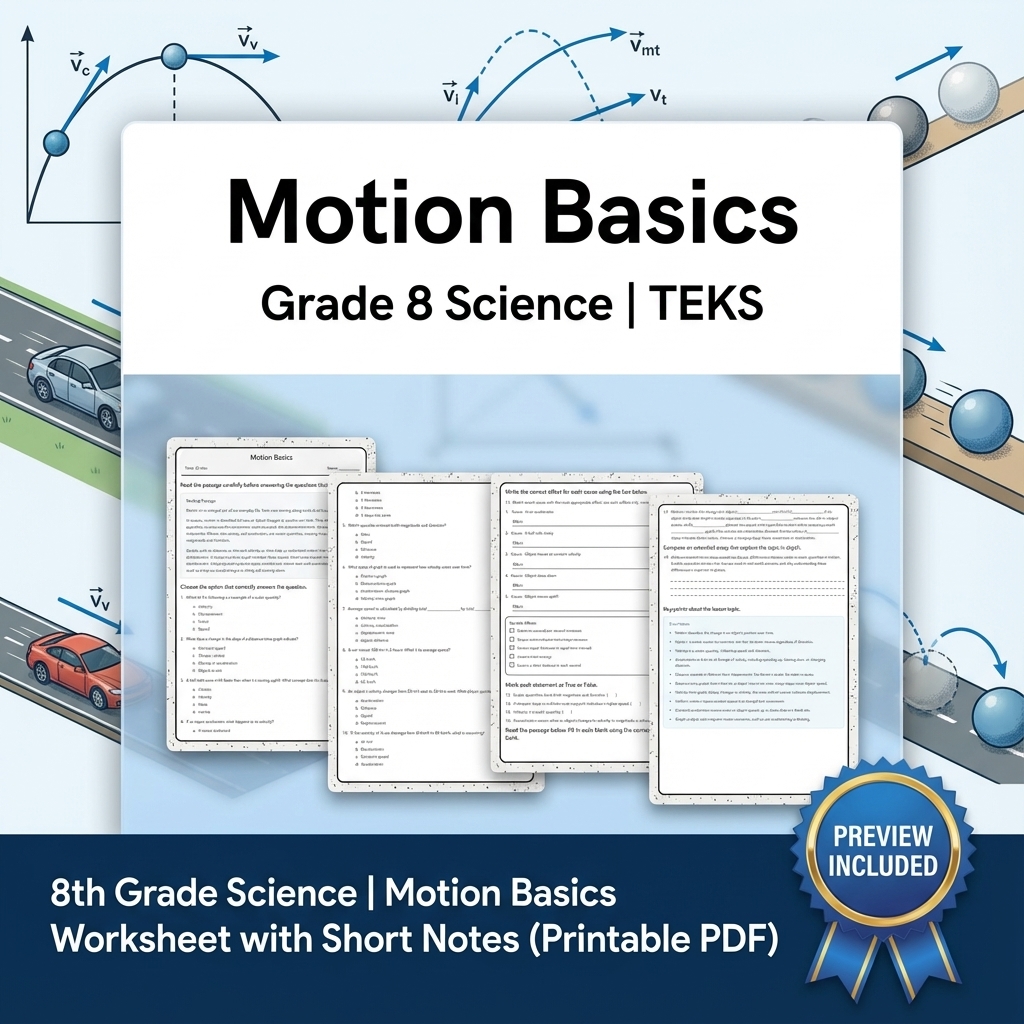
8th Grade Science | Motion Basics Worksheet with Short Notes (Printable PDF)
Created byMeadowlark WorksheetsLearning Objectives
- Understand the fundamental concepts of motion, including position, distance, speed, velocity, and acceleration.
- Differentiate between scalar and vector quantities related to motion.
- Interpret and analyze distance-time and velocity-time graphs.
Instant download

Kinetic and Potential Energy Worksheet Pack | Grade 8 Science Activities
Created byPrism Point LearningLearning Objectives
- Differentiate kinetic energy and gravitational potential energy using evidence from motion and position
- Explain how energy can change forms while the total energy stays the same
- Use examples (like a roller coaster) to describe energy transfer between kinetic and potential energy
Instant download

Grade 8 Buoyant Force Worksheet | Ontario Science Activity & Answer Key
Created byClear Sky ClassroomLearning Objectives
- Explain Archimedes’ principle and relate buoyant force to the weight of displaced fluid.
- Use density and displaced volume relationships to compare buoyant force in different fluids.
- Predict whether an object floats, sinks, or is neutrally buoyant by comparing forces.
Instant download

Grade 8 Modeling Data in Science Worksheet | NGSS Data Analysis Activity
Created byBRIGHT PATH RESOURCESLearning Objectives
- Understand what physical models are and how they are used in science
- Learn about the different types of models such as scale models, force sensors, and simulations
- Recognize the limitations and sources of measurement uncertainty in models
Also included in: Design Tradeoffs Grade 8 Science Daily Reading Worksheets Lesson Bundle | NGSS +2 more
Instant download
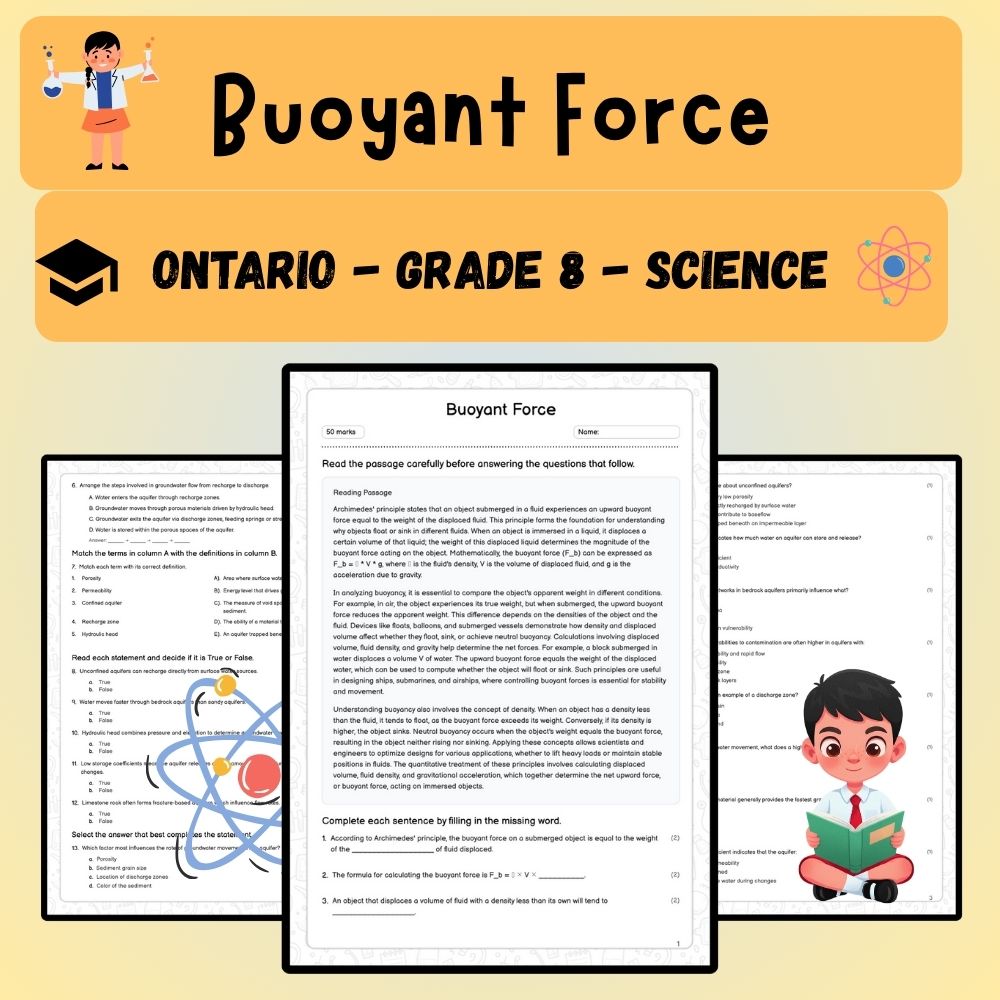
Grade 8 Science | Buoyant Force Worksheet (PDF ) – Ontario Standards
Created byPrism Point LearningLearning Objectives
- Understand Archimedes' principle and its relation to buoyant force.
- Explain the difference between apparent weight in air and submerged conditions.
- Apply density relationships to analyze floating, sinking, and neutral buoyancy scenarios.
Also included in: Grade 8 Science | Fluid Mechanics & Pressure Unit Worksheet Bundle +1 more
Instant download

Energy Forms Worksheet | Standards-Aligned Practice for Grade 8 Science
Learning Objectives
- Identify major forms of energy (kinetic, gravitational potential, elastic, thermal, chemical, and electrical) and describe how they store or transfer.
- Explain energy transformations using everyday examples such as swinging pendulums, batteries powering circuits, and heating due to friction.
- Use qualitative energy accounting and basic quantitative ideas to compare kinetic and potential energy in grade-appropriate ways.
Instant download

Grade 8 Science – Energy Forms and Transformations Worksheet + Answer Key
Learning Objectives
- Understand different forms of energy including kinetic, potential, elastic, thermal, chemical, and electrical.
- Recognize common transformations among energy types in everyday situations.
- Apply basic equations to compare kinetic and potential energy qualitatively.
Also included in: Grade 8 Science Lesson Group – TEKS-Aligned Daily Reading Worksheets Bundle +1 more
Instant download

Grade 8 Energy Forms Science Daily Reading Worksheet | TEKS Activity
Created byBRIGHT PATH RESOURCESLearning Objectives
- Identify kinetic energy in situations described by motion
- Explain how motion can transfer energy within a system
- Use energy accounting language to connect observed effects to energy changes
Also included in: Grade 8 Force Motion and Energy Science Reading Worksheets Bundle | TEKS +1 more
Instant download
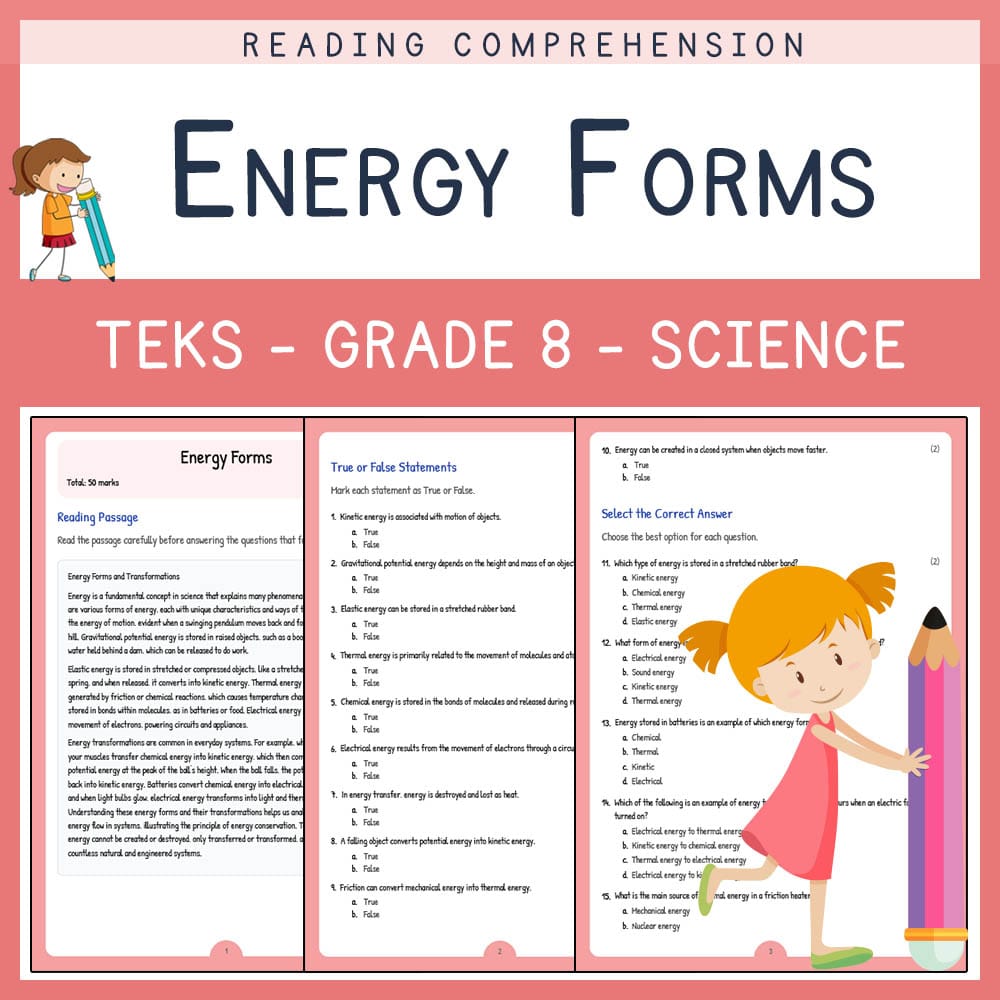
Grade 8 Science | Energy Forms Worksheet | TEKS-Aligned
Created byLumora LearningLearning Objectives
- Identify and describe different types of energy, including kinetic, gravitational potential, elastic, thermal, chemical, and electrical energy.
- Understand and explain energy transfer and transformation in various systems and scenarios.
- Apply qualitative and basic quantitative concepts of energy conservation in everyday contexts.
Also included in: Grade 8 Science | Force, Motion, and Energy Lesson Bundle | TEKS-Aligned
Instant download

Grade 8 Biogeochemical Cycling Worksheet | Water, Carbon & Nitrogen Cycles
Created byEvergreen Desk EducationLearning Objectives
- Explain how matter cycles within and between ecosystems through living organisms and the physical environment.
- Describe the roles of evaporation, condensation, and precipitation in the water cycle.
- Trace how carbon and nitrogen move through air, water, soil, and living things.
Instant download

Modeling Data Worksheets: Measurements, Variables & Uncertainty | Grade 8
Created bythe curious pencilLearning Objectives
- Explain how physical and computational models generate quantitative data.
- Identify variables and conditions that should remain controlled during testing.
- Describe how uncertainty and repeatability affect measurement quality.
Also included in: Engineering Design - Grade 8 Bundle +2 more
Instant download
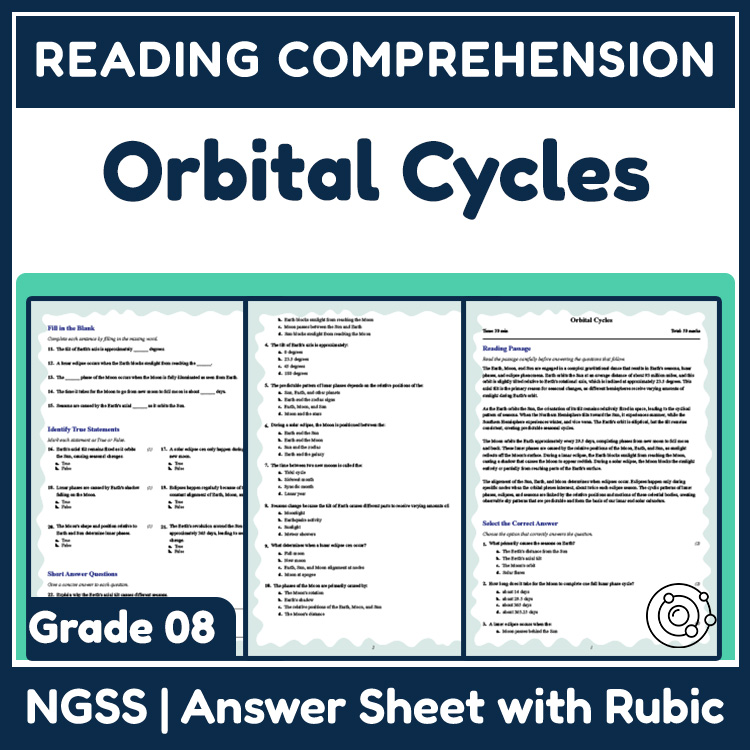
Grade 8 Science Reading Worksheets | Orbital Cycles (Worksheet + Answer Key)
Learning Objectives
- Describe the Earth's axial tilt and its effect on seasons.
- Explain how the relative positions of the Earth, Moon, and Sun cause lunar phases.
- Understand the mechanics behind solar and lunar eclipses.
Instant download

8th Grade Science | Motion Basics Worksheet (PDF+ Answer Key)
Created byCopper Leaf ClassroomLearning Objectives
- Understand the fundamental concepts of position, distance, speed, velocity, and acceleration.
- Differentiate between scalar and vector quantities related to motion.
- Interpret distance–time and velocity–time graphs with real-world examples.
Instant download

Grade 8 Science Worksheet on Buoyant Force and Archimedes’ Principle
Learning Objectives
- Explain buoyant force using Archimedes’ principle and the idea of displaced fluid
- Compare apparent weight in air versus in a fluid using density and buoyant force relationships
- Determine whether objects float, sink, or remain neutrally buoyant using density comparisons
Instant download

8th Grade Science | Modeling Data in Science Worksheet (PDF + Answer Key)
Created byCopper Leaf ClassroomLearning Objectives
- Understand the purpose and construction of physical and computational models.
- Identify sources of measurement uncertainty and model limitations.
- Apply best practices for data collection, repeatability, and analysis in modeling.
Also included in: Grade 8 Science Unit | Engineering Problem-Solving Worksheets (PDF + Answer Key) +1 more
Instant download

Grade 8 Orbital Cycles Worksheet | NGSS Moon Phases Eclipses Seasons
 Created byAmber Owl Education
Learning Objectives
- Explain how the Earth–Sun–Moon system creates cyclic phenomena such as lunar phases, eclipses, and seasons
- Use relative positions and motions to predict when phases and eclipses occur
- Describe how axial tilt and orbital geometry affect the timing and intensity of seasonal sunlight
Also included in: Grade 8 Science NGSS Full-Year Worksheet Bundle | NGSS Aligned
Instant download

Systems Analysis Worksheet for Grade 8 Science | TEKS Standards Practice
Learning Objectives
- Use net force to predict how the motion of a mechanical system changes (acceleration).
- Connect energy transfer (work, kinetic energy, losses) to observed motion outcomes.
- Analyze real systems by including friction, efficiency, and material limits in quantitative reasoning.
Instant download

Grade 8 Science – Systems Analysis Daily Reading Worksheet + Answer Key
Learning Objectives
- Identify key components of mechanical systems such as bicycles, bridges, and engines.
- Explain how forces, motion, and energy transfer work together in these systems.
- Analyze simple problems involving net force, kinematics, and energy comparisons.
Also included in: Grade 8 Science Lesson Group – TEKS-Aligned Daily Reading Worksheets Bundle +1 more
Instant download

Grade 8 Science – Systems Analysis & Mechanical Systems | Reading Worksheet
Created byBright Mind ResourcesLearning Objectives
- Understand how force, motion, and energy interact in mechanical systems.
- Analyze the movement and efficiency of bicycles under various forces.
- Evaluate the effect of friction, material limits, and energy transfer on system performance.
Also included in: Grade 8 Energy & Motion Science Daily Reading Worksheets Lesson Bundle | TEKS +2 more
Instant download

Grade 8 Science | Systems Analysis in Mechanical Systems - Reading Comprehension
Created byCoral Reef LearningLearning Objectives
- Understand the components of different mechanical systems such as bicycles, bridges, and engines.
- Describe how forces, motion, and energy interact within these systems.
- Identify the relationship between net force and motion outcomes.
Instant download

Grade 8 Systems Analysis Science Daily Reading Worksheet | TEKS
Created byBRIGHT PATH RESOURCESLearning Objectives
- Identify how net force changes an object’s motion using evidence from a scenario.
- Explain the relationship between net force and changes in speed for a simple push.
- Use given values to reason about balanced vs. unbalanced forces.
Also included in: Grade 8 Force Motion and Energy Science Reading Worksheets Bundle | TEKS +1 more
Instant download

Grade 8 Science – Motion Basics | Daily Reading Worksheet with Answer Key
Learning Objectives
- Understand the fundamental concepts of position, distance, and speed
- Differentiate between scalar and vector quantities
- Interpret distance–time and velocity–time graphs
Also included in: Grade 8 Science Lesson Group – TEKS-Aligned Daily Reading Worksheets Bundle +1 more
Instant download

Grade 8 Science | Orbiting Phenomena: Earth–Sun–Moon System - Comprehension
Created byCoral Reef LearningLearning Objectives
- Identify the relative positions and motions of Earth, Sun, and Moon.
- Understand the cyclic phenomena such as lunar phases, eclipses, and seasons.
- Explain the significance of axial tilt and orbital geometry in observable sky patterns.
Instant download

Homeostatic Control Worksheet for Grade 8 Science | Standards-Aligned Practice
Learning Objectives
- Understand the concept of homeostasis and its importance in maintaining internal stability.
- Identify how negative feedback mechanisms regulate body temperature, blood chemistry, water balance, and oxygen levels.
- Describe the system interactions involved in homeostatic regulation and their role in supporting cell function, growth, and reproduction.
Also included in: Grade 8 Adaptation and Ecosystem Change Science Lesson Bundle +1 more
Instant download
About Grade 8 Science Worksheets
Explore Grade 8 Science worksheets for classwork, homework, or review. Our 6,034 printables download instantly as PDFs.
Each resource here is built by an independent educator and reviewed for quality. Worksheets print straight from PDF and suit classroom use, homework, or extra practice; most come with answer keys, and you can preview before purchasing.