
Grade 8 Science Worksheets
6,034 worksheets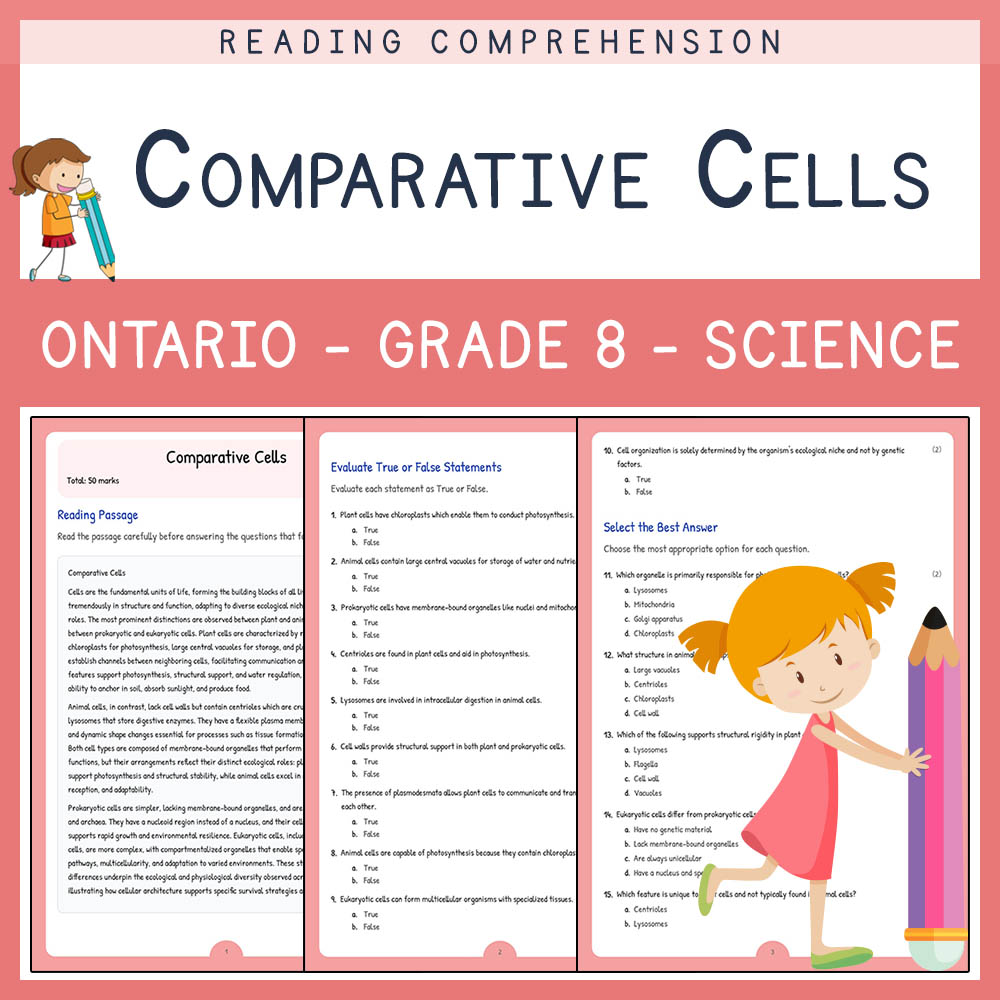
Grade 8 Science | Comparative Cells Worksheet Elena | Ontario Standards
 Created byLumora Learning
Learning Objectives
- Identify the structural differences between plant and animal cells and their functional implications.
- Compare prokaryotic and eukaryotic cells in terms of organization and roles in ecosystems.
- Explain how cellular structures like cell walls, chloroplasts, and lysosomes support specific physiological functions.
Instant download

Natural Hazards Science Worksheet Grade 8 | NGSS Earth Science Activity
 Created byAmber Owl Education
Learning Objectives
- Explain how scientists use natural hazard records to estimate recurrence intervals and compare short-term events with long-term geologic change.
- Interpret relationships between earthquake, faulting, volcanic activity, and tsunami risk using basic statistical and spatial reasoning.
- Describe how monitoring and modeling support hazard forecasts and early-warning decision-making.
Also included in: Grade 8 Science Earth Systems & Weather Patterns Lesson Bundle: NGSS +1 more
Instant download
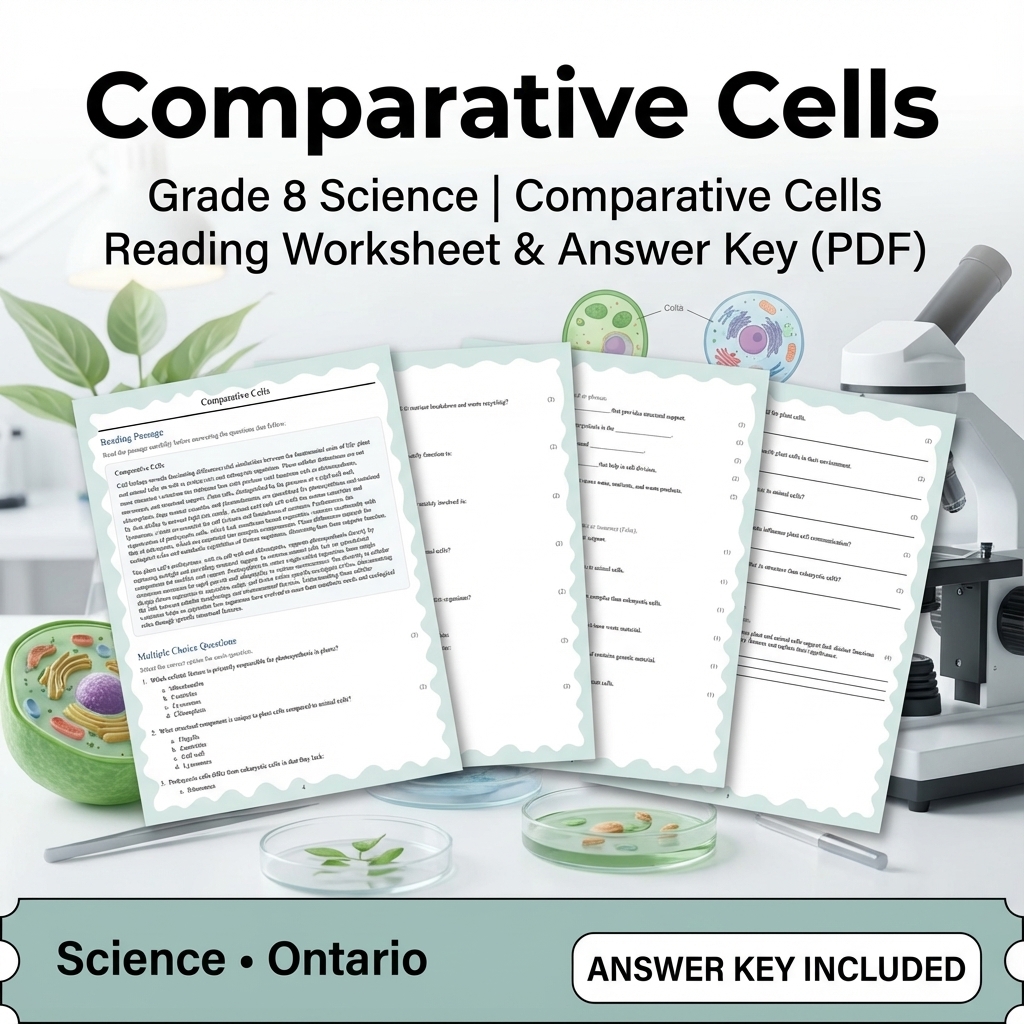
Grade 8 Science | Comparative Cells Reading Worksheet & Answer Key (PDF)
Learning Objectives
- Identify key structural differences between plant and animal cells.
- Understand how cellular features relate to specific physiological functions.
- Compare the organization of prokaryotic and eukaryotic cells and their ecological roles.
Also included in: Grade 8 Science Unit Bundle – Cell Structure & Function (Answer Keys Included) +1 more
Instant download

Moon Interactions Assessment | TEKS Grade 8 Science Standards-Aligned
 Created byPrism Point Learning
Learning Objectives
- Identify the phases of the Moon and explain their causes.
- Describe different types of lunar and solar eclipses based on orbital alignment.
- Explain tidal phenomena, including spring and neap tides, in relation to the Moon's gravitational pull.
Also included in: Grade 8 Weather and Earth-Space Science Assessment Lesson Bundle TEKS
Instant download

Grade 8 Science – Understanding Thermal Transfer Modes | Daily Reading Worksheet
 Created byBright Mind Resources
Learning Objectives
- Define conduction as a mode of heat transfer in solids
- Identify real-world examples of conduction
- Explain the mechanism behind conduction at the particle level
Also included in: Grade 8 Energy, Forces & Matter Lesson Bundle - Daily Reading | Calif. Std. +1 more
Instant download
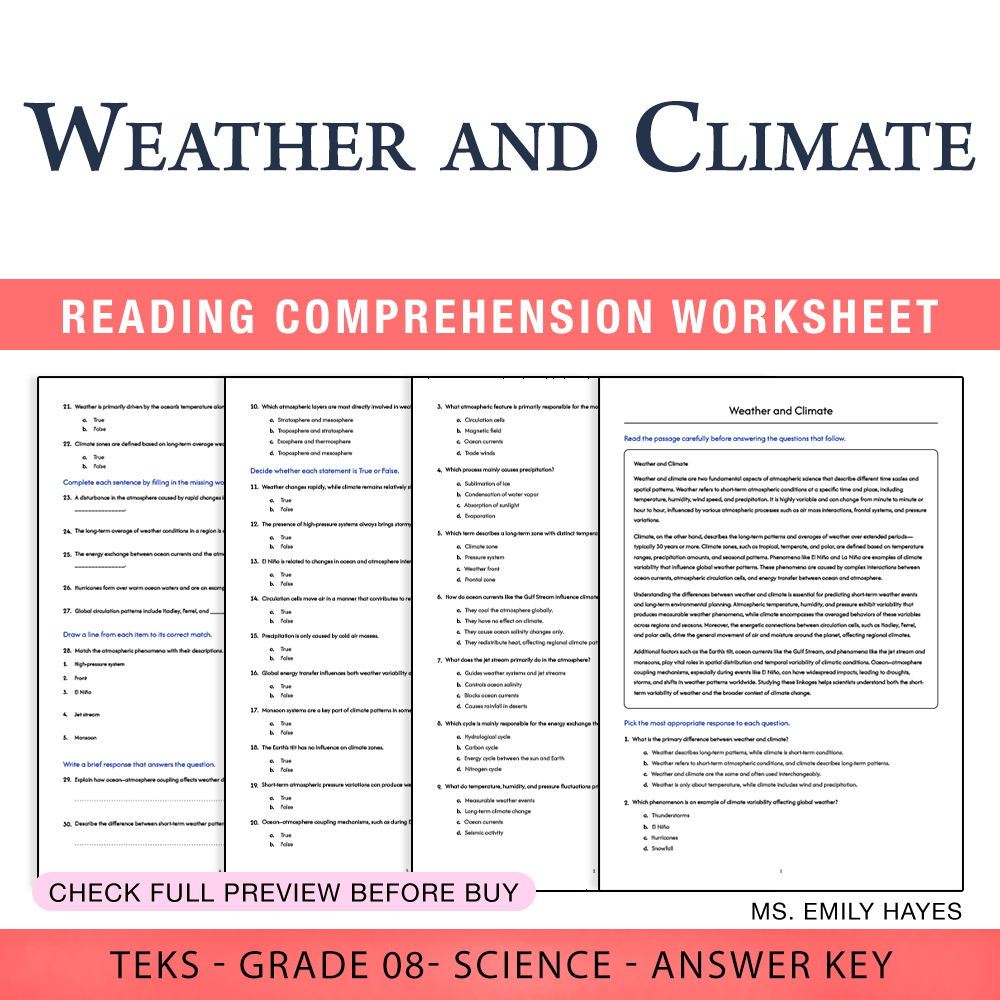
8th Grade Science | Weather and Climate Worksheet (PDF+ Answer Key)
 Created byCopper Leaf Classroom
Learning Objectives
- Explain the differences between weather and climate and their respective patterns.
- Identify key atmospheric processes such as air mass interactions, fronts, and pressure systems.
- Describe the processes of precipitation and how they influence local weather conditions.
Instant download

Energy Forms Worksheet | Standards-Aligned Practice for Grade 8 Science
Learning Objectives
- Identify the different forms of energy related to motion and position.
- Explain how kinetic energy varies with speed and mass.
- Describe how gravitational potential energy depends on height.
Also included in: Grade 8 Forces, Energy & Matter Science Lesson Bundle | California Standards +1 more
Instant download

Grade 8 Science Weather and Climate Daily Reading Worksheet with Answer Key
Learning Objectives
- Identify different weather conditions.
- Recognize key atmospheric variables such as temperature, humidity, and pressure.
- Understand the difference between weather and climate.
Also included in: Grade 8 Science Lesson Bundle | TEKS Standards Worksheets for Earth & Space +1 more
Instant download

Grade 8 Thermal Transfer Modes Worksheet | California Standards Practice PDF
 Created byClear Sky Classroom
Learning Objectives
- Describe and distinguish conduction, convection, and radiation as three modes of thermal energy transfer.
- Use evidence from everyday situations to explain how heat moves from warmer to cooler regions.
- Connect particle motion and fluid motion to conduction and convection, and connect electromagnetic waves to radiation.
Instant download
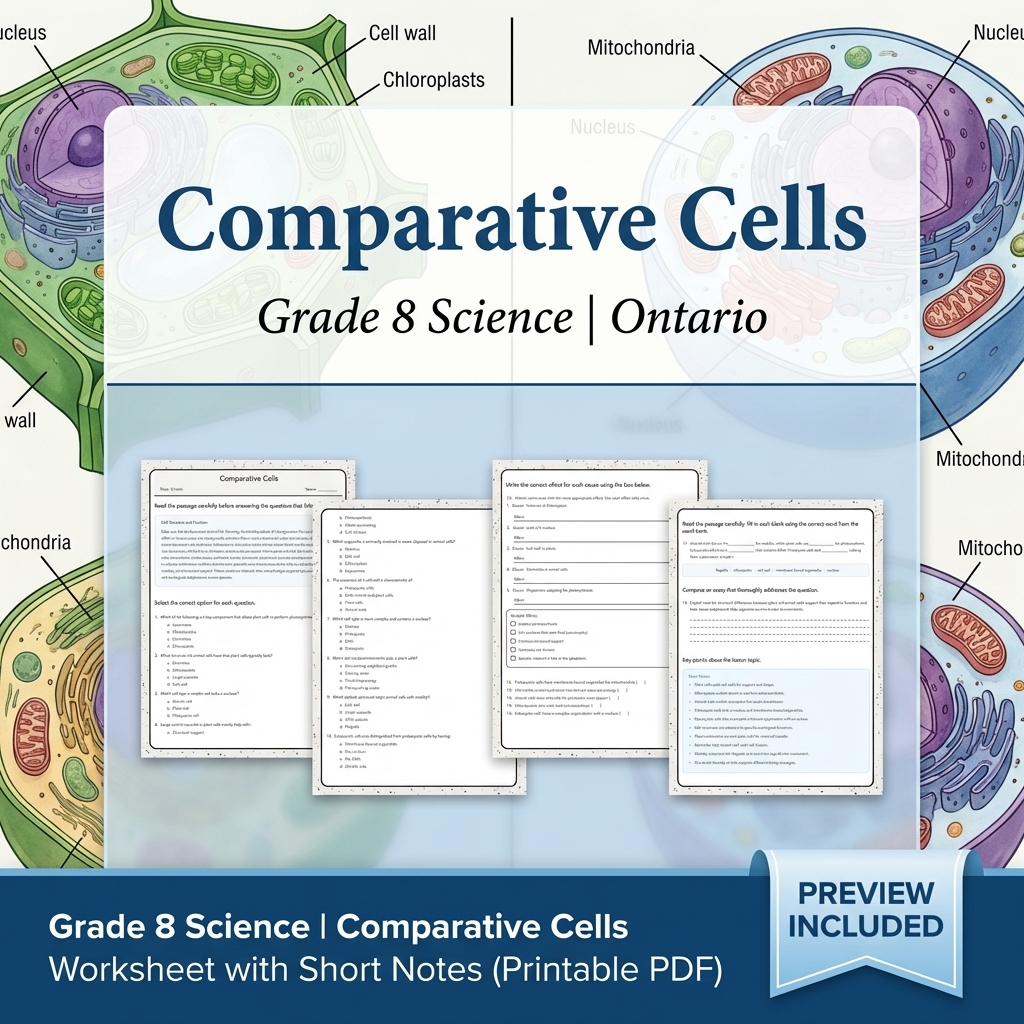
Grade 8 Science | Comparative Cells Worksheet with Short Notes (Printable PDF)
 Created byMeadowlark Worksheets
Learning Objectives
- Describe the key differences between plant and animal cells.
- Identify the functions of cellular components like cell walls, chloroplasts, and lysosomes.
- Compare prokaryotic and eukaryotic cells in terms of organization.
Also included in: Grade 8 Science Lesson Group Bundle | Ontario Curriculum Worksheets +1 more
Instant download

Natural Hazards Quiz & Assessment | NGSS Grade 8 Science Worksheet
 Created byCedar Grove Learning
Learning Objectives
- Analyze datasets related to earthquakes, volcanoes, tsunamis, and faults to understand recurrence intervals and spatial distribution.
- Interpret seismic, paleoseismic, geodetic, and tsunami data to evaluate hazard likelihood and potential impacts.
- Assess the role of monitoring technologies and modeling methods in forecasting natural hazards and guiding mitigation efforts.
Instant download

Grade 8 Natural Hazards & Earthquake Data Analysis NGSS Science Worksheet
 Created byBRIGHT PATH RESOURCES
Learning Objectives
- Interpret seismic catalogs to understand earthquake patterns
- Calculate and analyze earthquake recurrence intervals
- Identify spatial distribution of earthquakes using fault maps
Also included in: Earth Science Grade 8 Science Daily Reading Worksheets Lesson Bundle | NGSS +2 more
Instant download

Cell Structure Worksheet | NGSS Grade 8 Science Assessment
Created byCedar Grove LearningLearning Objectives
- Describe the key organelles of prokaryotic and eukaryotic cells and their functions.
- Compare single-celled and multicellular organisms in terms of cellular organization and specialization.
- Explain how microscopy and imaging techniques help to identify cell features and link structures to functions.
Instant download

Grade 8 Science Cell Structure Worksheet | NGSS Aligned Assessments
Learning Objectives
- Describe the key features and functions of cellular organelles such as nucleus, mitochondria, chloroplasts, ribosomes, cell membrane, and cell wall.
- Compare and contrast prokaryotic and eukaryotic cells, and single-celled versus multicellular organisms.
- Explain how microscopy and cell imaging techniques help in understanding cell structure and function.
Also included in: Grade 8 Cell Modeling and Organ Systems Science Lesson Bundle – NGSS +1 more
Instant download

Grade 8 Science | Quality Indicators in Water Testing - Reading Comprehension
 Created byCoral Reef Learning
Learning Objectives
- Understand how temperature affects water quality
- Interpret temperature data to assess aquatic health
- Identify optimal temperature ranges for different water uses
Instant download
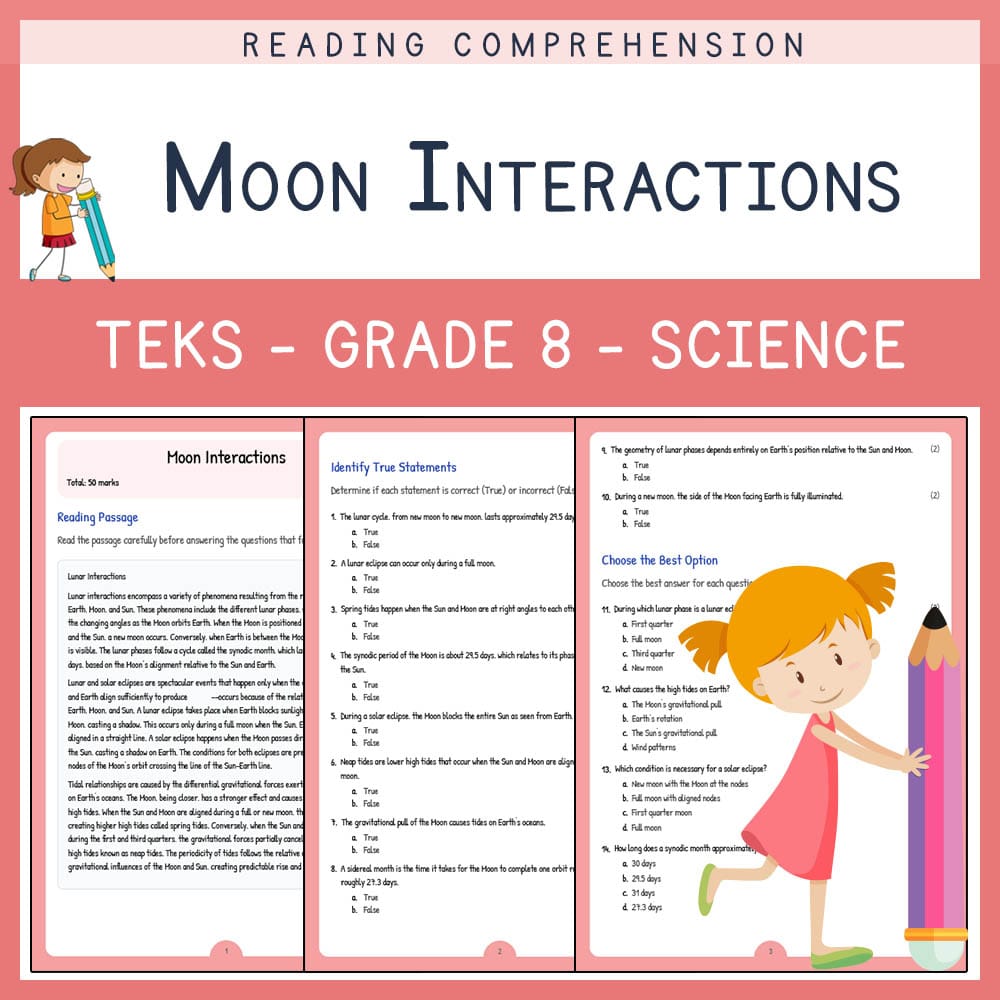
Grade 8 Science | Moon Interactions Worksheet | TEKS Aligned
Created byLumora LearningLearning Objectives
- Explain the phases of the Moon and how relative positions affect these phases.
- Describe the causes and conditions of lunar and solar eclipses based on orbital alignment.
- Understand the gravitational forces exerted by the Moon and Sun and how they influence Earth's tides.
Also included in: Grade 8 Science | Earth and Space Systems Lesson Bundle | TEKS Aligned
Instant download

Prokaryotic vs. Eukaryotic Cells Worksheet | Grade 8 NGSS
 Created byNorthstar Worksheets
Learning Objectives
- Describe the major parts of cells and explain what each part does.
- Compare prokaryotic and eukaryotic cells based on their internal structures.
- Relate organelles to functions such as energy transformation and information storage.
Instant download

Grade 8 Science – Energy Forms & Energy Transfer Daily Reading Worksheet
Created byBright Mind ResourcesLearning Objectives
- Understand the concept of kinetic energy and how it relates to an object's speed and mass.
- Identify the different forms of energy and their characteristics.
- Interpret data and graphs showing the relationship between motion, position, and energy.
Also included in: Grade 8 Energy, Forces & Matter Lesson Bundle - Daily Reading | Calif. Std. +1 more
Instant download
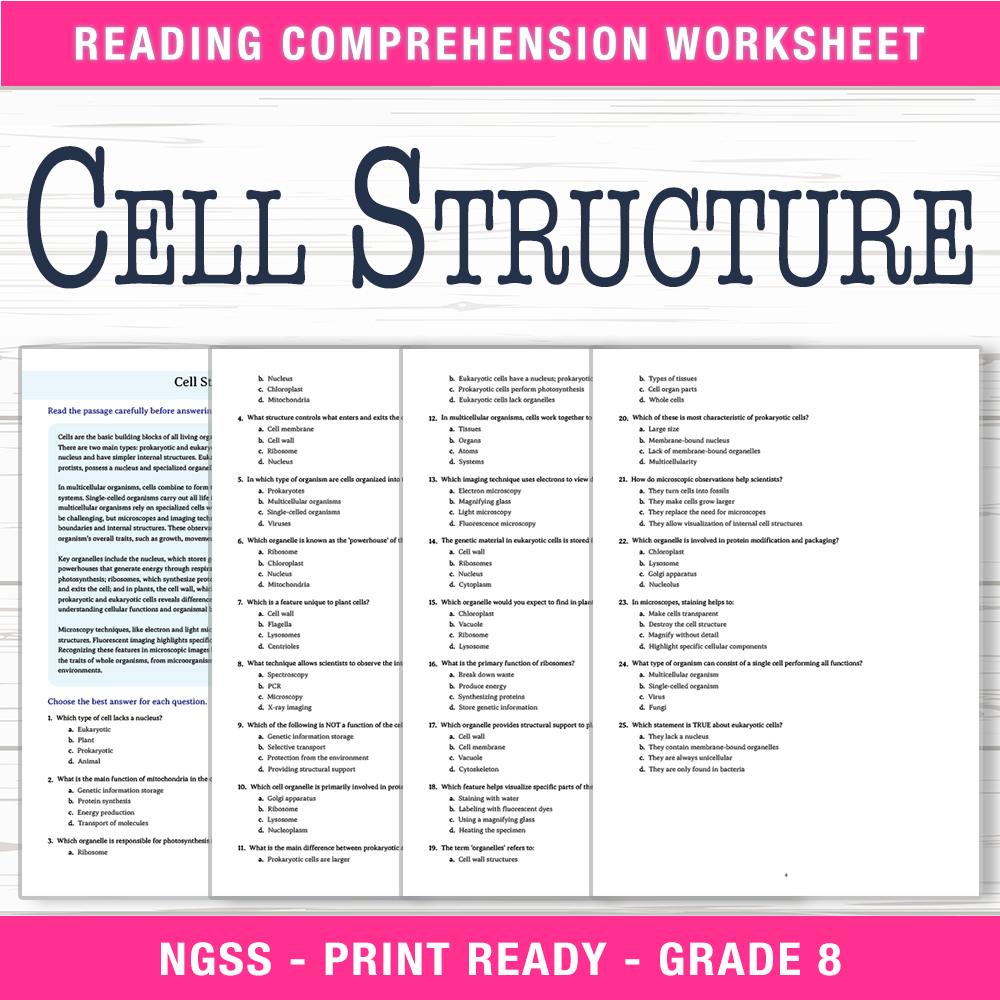
Grade 8 Science | Cell Structure Worksheet (PDF + Answer Key)
 Created byRiverstone Classroom
Learning Objectives
- Identify and describe the main organelles of cells and their functions.
- Compare the features of prokaryotic and eukaryotic cells.
- Differentiate between single-celled and multicellular organisms based on cellular organization.
Instant download
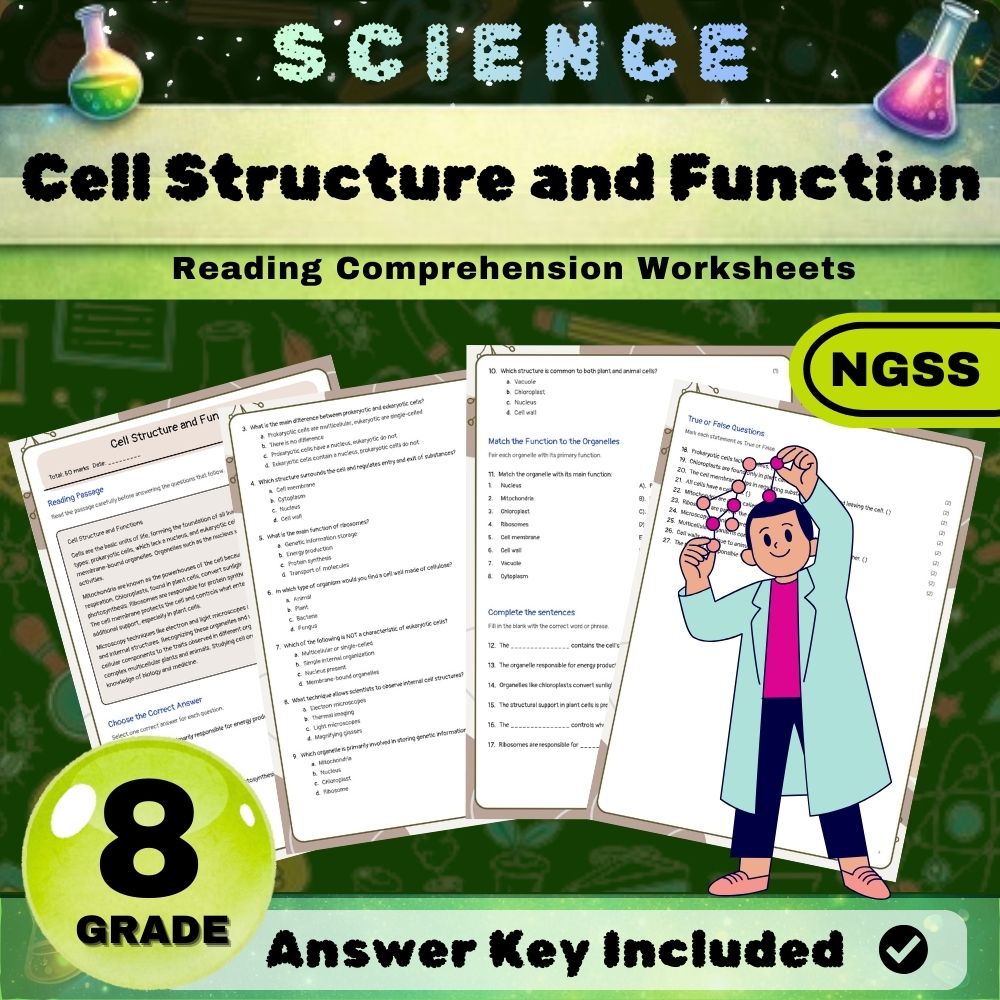
Grade 8 Science | Cell Structure and Function Worksheet (NGSS) PDF
 Created byMaple Path Learning
Learning Objectives
- Describe the key features and functions of cell organelles such as the nucleus, mitochondria, chloroplasts, ribosomes, cell membrane, and cell wall.
- Compare and contrast prokaryotic and eukaryotic cells, as well as single-celled and multicellular organisms.
- Understand how microscopy and cell imaging help recognize cellular structures and relate them to organism traits.
Also included in: Grade 8 Science | From Molecules to Organisms Unit Bundle NGSS-Aligned +1 more
Instant download
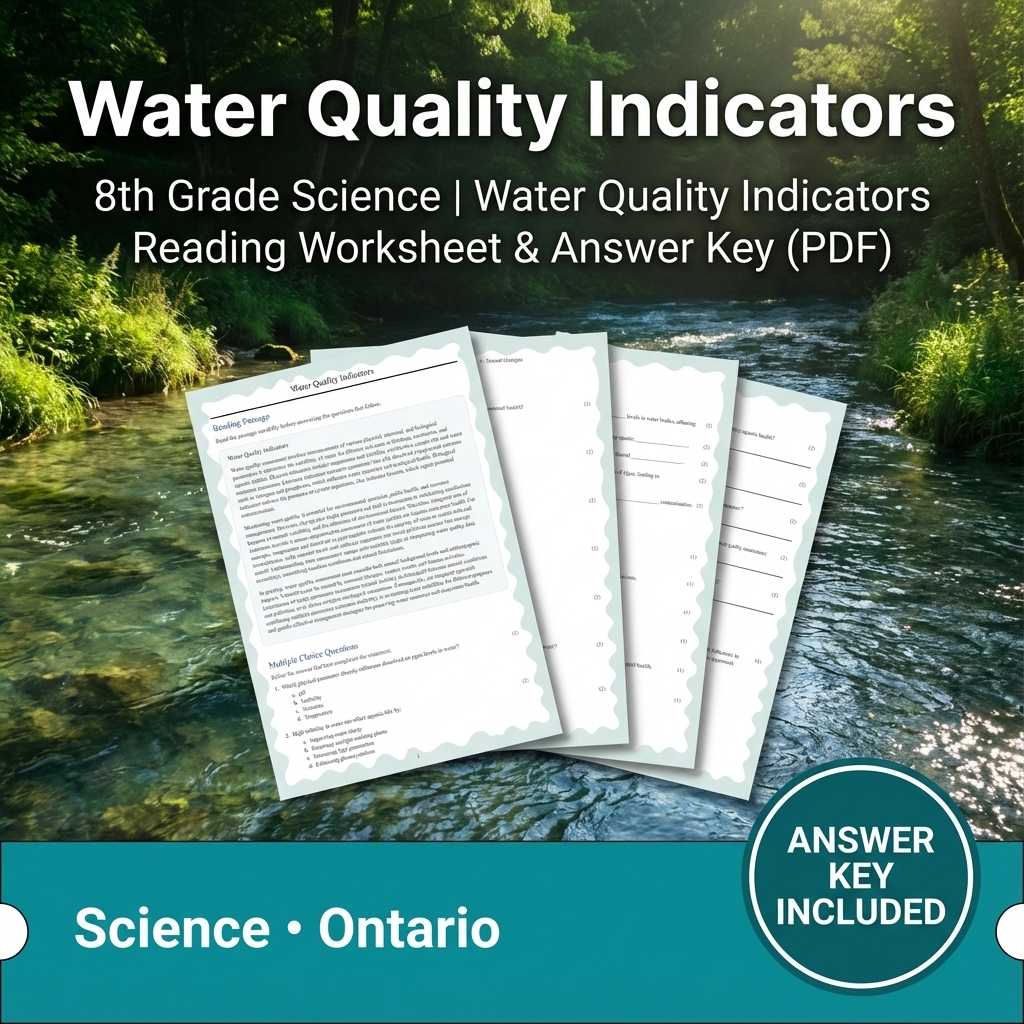
8th Grade Science | Water Quality Indicators Reading Worksheet & Answer Key
Learning Objectives
- Identify physical, chemical, and biological water quality indicators.
- Interpret ranges of indicator parameters for aquatic health and water uses.
- Understand sources of variability and the importance of integrated assessments.
Also included in: Grade 8 Science Bundle | Water Systems Hydrology Concepts (Answer Key Included) +1 more
Instant download

Cell Structure Test Prep Printable | Grade 8 Science NGSS Review
Created byPrism Point LearningLearning Objectives
- Compare prokaryotic and eukaryotic cells by identifying key structural differences
- Describe how major organelles support cell functions such as energy transformation and information storage
- Connect cell structures to observable features using microscopy and imaging evidence
Also included in: Grade 8 Cell Structure and Organ Systems Science Lesson Bundle NGSS
Instant download

Cell Structure and Cellular Organization Worksheets Grade 8 Science
 Created bythe curious pencil
Learning Objectives
- Identify major cell structures and describe their functions.
- Compare prokaryotic and eukaryotic cell structures.
- Explain differences between single-celled and multicellular organization.
Also included in: From Molecules to Organisms Grade 8 Science NGSS Worksheets Bundle +2 more
Instant download

Grade 8 Science | Indicator Properties in Chemistry - Reading Comprehension
Created byCoral Reef LearningLearning Objectives
- Understand what pH and chemical indicators are
- Identify how chemical reactions can change properties like pH, conductivity, density, and refractive index
- Distinguish between physical changes and chemical reactions based on property shifts
Instant download

Grade 8 Science | Cell Structure - Daily Reading Comprehension
Created byCoral Reef LearningLearning Objectives
- Identify the main parts of a cell and explain their functions.
- Differentiate between prokaryotic and eukaryotic cells.
- Compare single-celled and multicellular organisms.
Instant download

Speciation & Change Worksheet | Grade 8 Science NGSSS Evolution + Key
 Created byEvergreen Desk Education
Learning Objectives
- Explain how reproductive isolation leads to speciation over time.
- Describe how geographic barriers, habitat changes, and behavioral differences can reduce interbreeding.
- Use natural selection and genetic variation to predict how traits may persist in separated populations.
Instant download

Grade 8 Forms of Energy Worksheet | NGSS Practice PDF
Created byClear Sky ClassroomLearning Objectives
- Identify and describe different forms of energy, including kinetic, potential, thermal, light, and electrical energy
- Use evidence from everyday situations to explain how energy is transferred and transformed
- Distinguish between statements that correctly and incorrectly describe energy changes
Instant download

Forms of Energy Worksheet Pack Grade 8 Science Activities & Review
Created byPrism Point LearningLearning Objectives
- Identify major forms of energy: kinetic, potential, thermal, and energy carried by light and electricity
- Explain how energy can transfer and change form in everyday situations while conserving total energy
- Use correct science vocabulary to describe the relationship between temperature, motion, and stored position energy
Instant download

Grade 8 Science | Understanding Energy Types - Daily Reading Comprehension
Created byCoral Reef LearningLearning Objectives
- Identify different forms of energy
- Describe how energy is transferred and transformed
- Recognize examples of energy in daily life
Instant download

Science Worksheet Speciation and Change Grade 8 | NGSSS Aligned
Learning Objectives
- Explain how reproductive isolation can lead to speciation
- Describe how variation and natural selection can cause populations to diverge over time
- Identify examples of barriers that reduce gene flow and increase differences between populations
Also included in: Grade 8 Evolution and Ecosystems Science Lesson Bundle | Florida NGSSS +1 more
Instant download

Grade 8 Quality Indicators Worksheet | Ontario Science Activity & Answer Key
Created byClear Sky ClassroomLearning Objectives
- Identify physical, chemical, and biological indicators used to assess water quality.
- Interpret indicator values by connecting them to aquatic health and water-use needs.
- Explain how natural variability and baseline conditions affect indicator readings.
Instant download

Grade 8 Rotational Forces Worksheet | Ontario Science Torque & Motion
Created byClear Sky ClassroomLearning Objectives
- Explain torque using force and lever arm and identify the axis of rotation
- Determine conditions for rotational equilibrium using net torque
- Connect net torque to angular acceleration using rotational inertia
Instant download
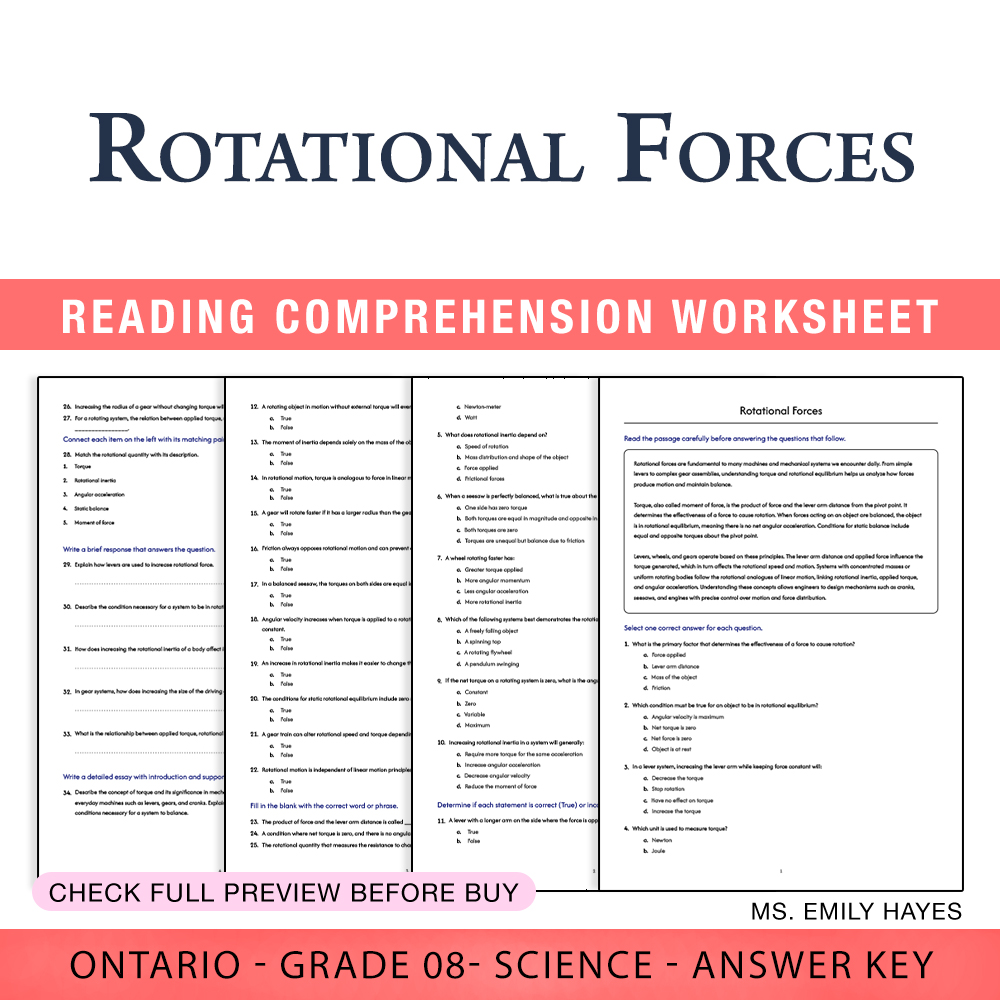
Grade 8 Science | Rotational Forces Worksheet (PDF + Answer Key)
Created byCopper Leaf ClassroomLearning Objectives
- Explain the concept of torque and how it relates to rotational forces.
- Describe the conditions for rotational equilibrium and static balance in levers and assemblies.
- Calculate the moment of force for various systems involving gears, wheels, and levers.
Instant download

Rotational Forces Worksheet | Grade 8 Science – Ontario
Created byCedar Grove LearningLearning Objectives
- Explain torque using lever arm and moment of force, and determine when rotational equilibrium occurs
- Use the relationship between net torque, rotational inertia, and angular acceleration to predict rotational changes
- Apply rotational analogies of linear motion to gears, wheels, and levers in real situations
Instant download

Torque, Equilibrium, and Rotational Motion Worksheets Grade 8 Science
Created byPrism Point LearningLearning Objectives
- Explain how force and lever arm determine torque
- Calculate simple relationships involving torque and rotational inertia
- Identify conditions required for static rotational equilibrium
Also included in: Systems in Action Lesson Bundle | Grade 8 Science | Ontario Framework +1 more
Instant download

Grade 8 Thermal Transfer Modes Worksheet | Conduction Convection Radiation
Created byEvergreen Desk EducationLearning Objectives
- Explain how conduction, convection, and radiation transfer thermal energy
- Use evidence from everyday situations to identify which thermal transfer mode is happening
- Compare how different environments affect heating patterns using the three modes
Instant download

8th Grade Science | Weather and Climate Reading Worksheets (PDF + Answer Key)
Learning Objectives
- Understand the differences between weather and climate patterns.
- Describe how atmospheric variables like temperature, humidity, and pressure influence weather events.
- Explain the role of air mass interactions, fronts, and circulation cells in weather formation.
Instant download

Grade 8 Comparative Cells Worksheet | Ontario Science Cell Structure Activity
 Created byChalk and Compass
Learning Objectives
- Compare plant and animal cell structures and explain how those structures affect cell functions.
- Contrast prokaryotic and eukaryotic cellular organization and relate differences to metabolic capabilities.
- Use cellular features (e.g., chloroplasts, vacuoles, centrioles, lysosomes, cell walls) to describe adaptation to roles such as photosynthesis and motility.
Also included in: Grade 8 Science Cell Organization, Transport & Homeostasis Lesson Bundle – Ontario +1 more
Instant download

Grade 8 Science | Weather & Climate - Daily Reading Comprehension
Created byCoral Reef LearningLearning Objectives
- Differentiate between weather and climate
- Identify key concepts related to atmospheric conditions
- Understand the factors that influence weather patterns
Instant download
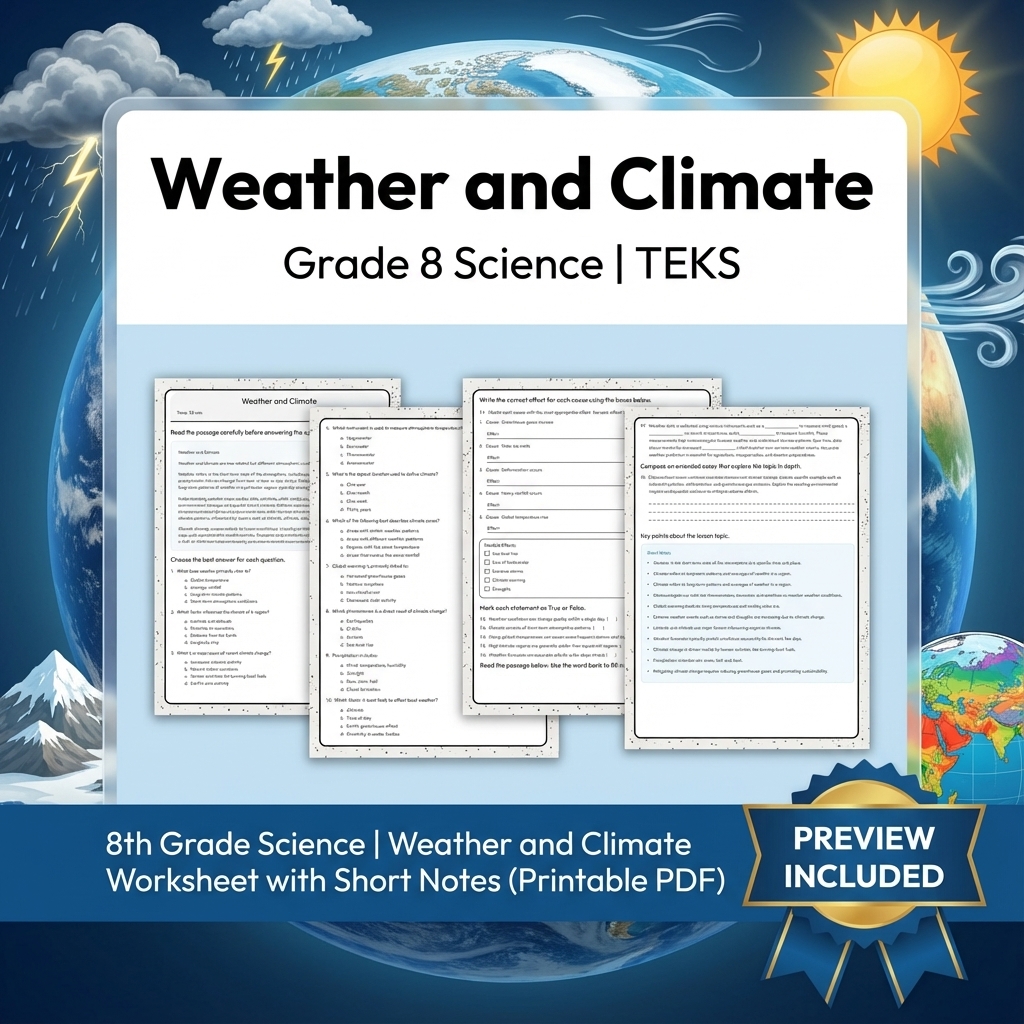
8th Grade Science Weather and Climate Worksheet with Short Notes (Printable PDF)
Created byMeadowlark WorksheetsLearning Objectives
- Understand the key concepts of weather and climate.
- Identify different weather patterns and climate zones.
- Explain how weather is measured and recorded.
Instant download

Natural Hazards Review & Practice Worksheets | Grade 8 Science
Created byPrism Point LearningLearning Objectives
- Interpret natural hazard data using earthquake catalogs, fault maps, and eruption histories to understand patterns over time and space.
- Explain how paleoseismology, satellite geodesy, and tsunami records help estimate recurrence intervals and hazard likelihood.
- Use statistical and geospatial reasoning to describe potential impacts and evaluate engineering, land-use, and early-warning choices.
Instant download

Grade 8 Science – Moon's Phases Daily Reading Worksheet + Answer Key
Learning Objectives
- Describe the different phases of the Moon
- Explain how the relative positions of the Earth, Moon, and Sun create lunar phases
- Identify the characteristics of each lunar phase
Also included in: Grade 8 Science Lesson Bundle | TEKS Standards Worksheets for Earth & Space +1 more
Instant download

Grade 8 Science – Water Treatment & Purification | Daily Reading Worksheet
Created byBright Mind ResourcesLearning Objectives
- Understand key concepts related to Science
- Apply knowledge through practice questions
- Demonstrate comprehension of the material
Also included in: Grade 8 Water Systems Science Daily Reading Worksheets Lesson Bundle | Ontario +1 more
Instant download

Grade 8 Weather and Climate Science Daily Reading Worksheet | TEKS
Created byBRIGHT PATH RESOURCESLearning Objectives
- Explain how weather differs from climate using key details.
- Identify how air pressure, temperature, and humidity help create short-term weather changes.
- Use vocabulary from the passage to answer questions about fronts and precipitation.
Also included in: Grade 8 Earth and Space Science Daily Reading Worksheets Bundle | TEKS +1 more
Instant download

Grade 8 Science – Weather & Climate | Daily Reading Worksheet
Created byBright Mind ResourcesLearning Objectives
- Understand the difference between weather and climate.
- Identify various atmospheric conditions that influence weather patterns.
- Interpret weather maps and data related to air masses, fronts, and pressure systems.
Also included in: Grade 8 Earth & Space Science Daily Reading Worksheets Lesson Bundle | TEKS +2 more
Instant download

Grade 8 Science | Natural Hazards & Seismic Data Interpretation - Practice
Created byCoral Reef LearningLearning Objectives
- Understand how earthquake catalogs and fault maps are used to assess earthquake risks.
- Interpret data from seismic monitoring systems and fault maps.
- Examine the relationship between fault lines and earthquake occurrence.
Instant download

Weather And Climate Worksheet | Grade 8 Science Practice
Created byPrism Point LearningLearning Objectives
- Differentiate weather and climate using short-term vs long-term atmospheric patterns
- Explain how air masses, fronts, and pressure systems influence precipitation and storm development
- Describe how temperature, humidity, and atmospheric pressure changes can produce measurable weather events
Also included in: Grade 8 Earth and Space Science Lesson Bundle for TEKS Worksheets +1 more
Instant download

Natural Hazards Worksheet | NGSS Grade 8 Science Assessment PDF
 Created bySkylark Worksheets
Learning Objectives
- Explain how natural hazards (weather, geological, and other Earth processes) can pose risks to people and ecosystems
- Use NGSS-aligned reasoning to connect hazard characteristics and exposure to potential impacts
- Describe science-based strategies for preparing for, responding to, and mitigating natural hazards
Also included in: Grade 8 Earth's Systems Science Lesson Bundle with NGSS Worksheets +1 more
Instant download
About Grade 8 Science Worksheets
Explore Grade 8 Science worksheets for classwork, homework, or review. Our 6,034 printables download instantly as PDFs.
Each resource here is built by an independent educator and reviewed for quality. Worksheets print straight from PDF and suit classroom use, homework, or extra practice; most come with answer keys, and you can preview before purchasing.