
Reading comprehension Worksheets
40,289 type resources
Transport and Sediment Assessment | General Standards Grade 6 Science
 Created byPrism Point Learning
Learning Objectives
- Understand how streams and wind transfer particles of different sizes based on energy and strength.
- Explain the process of sorting of sediments during transportation and deposition.
- Identify natural structures formed by sediment sorting, such as sandbars and deltas.
Also included in: Grade 6 Life Science Science Lesson Bundle – General Framework Unit
Instant download

System Thinking In Solutions Assessment | General Grade 6 Science
Created byPrism Point LearningLearning Objectives
- Understand the concept of systems thinking and how components interact within a system.
- Identify cause-and-effect relationships in system design and performance.
- Analyze how changes to one part of a system can influence overall behavior.
Instant download

Trade-off Decisions Assessment for Grade 6 Science | Standards-Aligned
Created byPrism Point LearningLearning Objectives
- Understand how design choices involve trade-offs affecting properties like strength, flexibility, and insulation.
- Identify the impact of material choices on weight, cost, and usability in shelter design.
- Analyze how trade-offs relate to user needs and environmental constraints.
Instant download
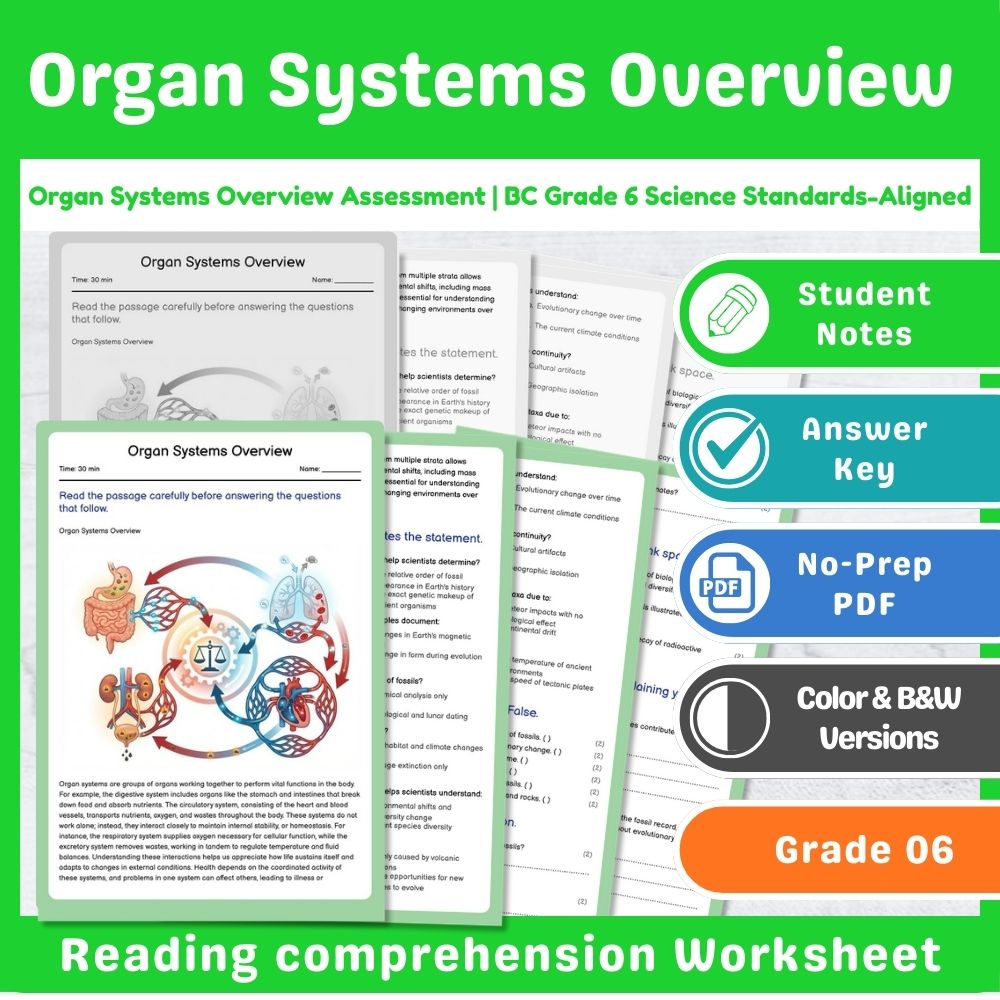
Organ Systems Overview Assessment | BC Grade 6 Science Standards-Aligned
Created byPrism Point LearningLearning Objectives
- Describe the main functions of different organ systems.
- Explain how organ systems interact to maintain homeostasis.
- Identify principal organs involved in various systems.
Instant download

Circuit Diagrams Assessment for Grade 6 | BC Standards-Aligned Science
Created byPrism Point LearningLearning Objectives
- Understand the standard symbols used in circuit diagrams for sources, conductors, and loads.
- Identify components such as batteries, resistors, switches, and meters in circuit diagrams.
- Translate physical electrical systems into simplified schematic diagrams.
Instant download

Safety and Reporting Assessment for Grade 6 Science | Standards-Aligned
Created byPrism Point LearningLearning Objectives
- Understand the importance of safety practices in scientific experiments.
- Identify proper reporting methods for data and safety concerns.
- Recognize ethical standards in scientific communication.
Also included in: Grade 6 Data & Evidence Science Lesson Bundle | General Framework
Instant download

Producers And Consumers Assessment | BC Standards Grade 6 Science
Created byPrism Point LearningLearning Objectives
- Understand the roles of producers and consumers in food webs and ecosystems.
- Identify different types of consumers and their feeding habits.
- Explain energy transfer efficiency between trophic levels and its ecological impact.
Instant download
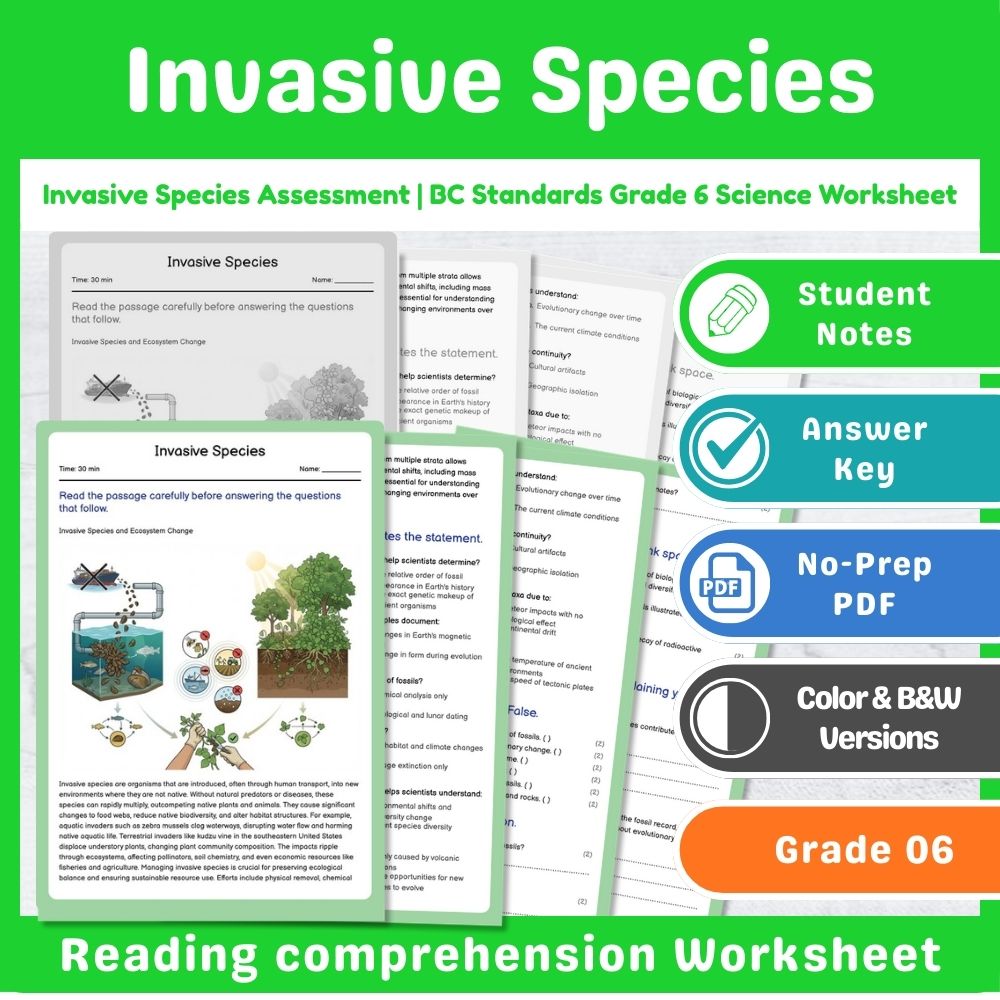
Invasive Species Assessment | BC Standards Grade 6 Science Worksheet
Created byPrism Point LearningLearning Objectives
- Understand the definition and characteristics of invasive species.
- Identify examples and impacts of invasive species on ecosystems.
- Analyze how invasive species outcompete native organisms and alter habitats.
Instant download

Light Properties Assessment | BC Standards Grade 6 Science
Created byPrism Point LearningLearning Objectives
- Describe the wave and particle nature of light and their properties such as wavelength, frequency, and energy.
- Explain how visible, ultraviolet, and infrared light differ in wavelength and energy.
- Understand how different materials transmit, absorb, or reflect specific colours based on light properties.
Instant download
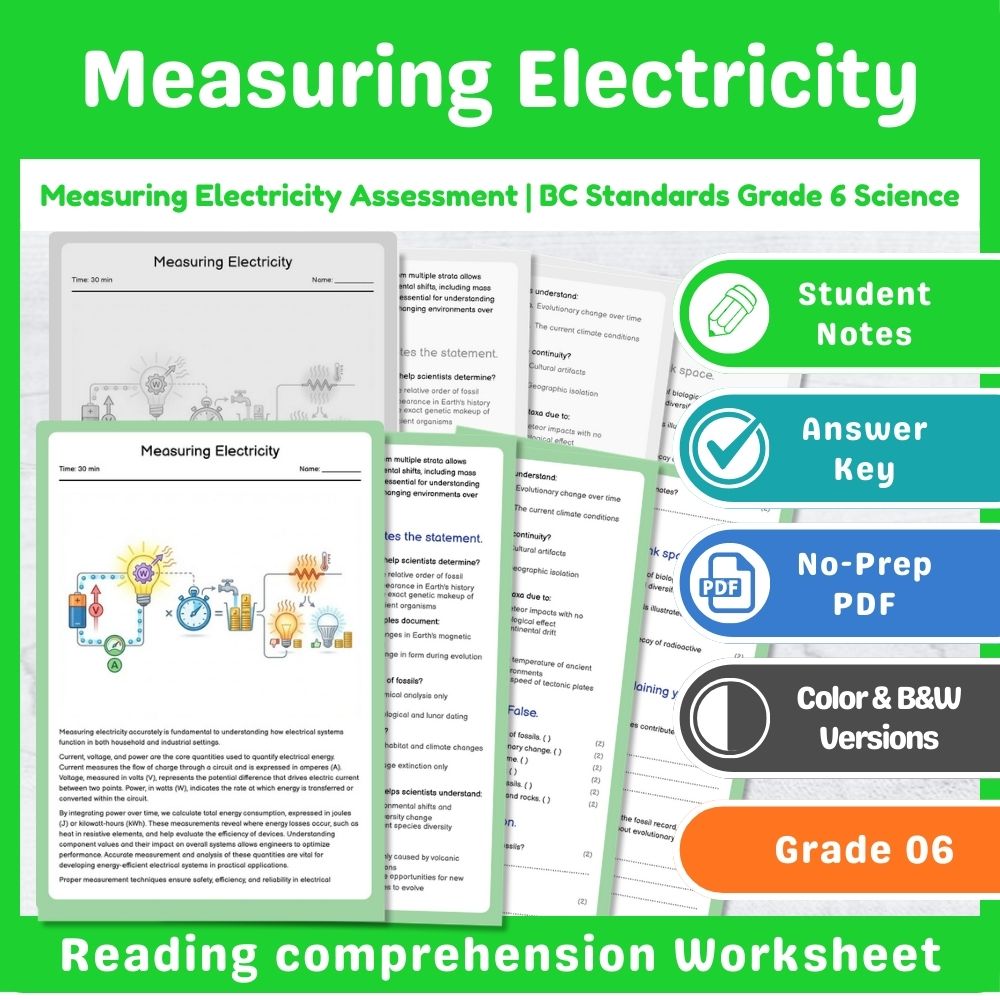
Measuring Electricity Assessment | BC Standards Grade 6 Science
Created byPrism Point LearningLearning Objectives
- Understand key electrical quantities such as current, voltage, and power.
- Identify how measurements of electricity determine energy transfer and system efficiency.
- Learn the relationship between instantaneous electrical quantities and cumulative energy consumption.
Instant download

Density Evidence Assessment | General Grade 6 Science Standards
Created byPrism Point LearningLearning Objectives
- Understand how density relates mass to volume and its role in classifying substances.
- Identify how objects with different densities behave in water, such as floating or sinking.
- Explain that density depends on how tightly matter is packed and does not change the substance's identity.
Also included in: Grade 6 Physical Science Science Lesson Bundle: General Framework
Instant download

Waves and Technology Assessment for Grade 6 Science | BC Standards
Created byPrism Point LearningLearning Objectives
- Explain how sound and light waves transfer energy in technological devices.
- Describe the conversion processes in speakers and microphones.
- Understand how cameras utilize wave properties to produce images.
Instant download
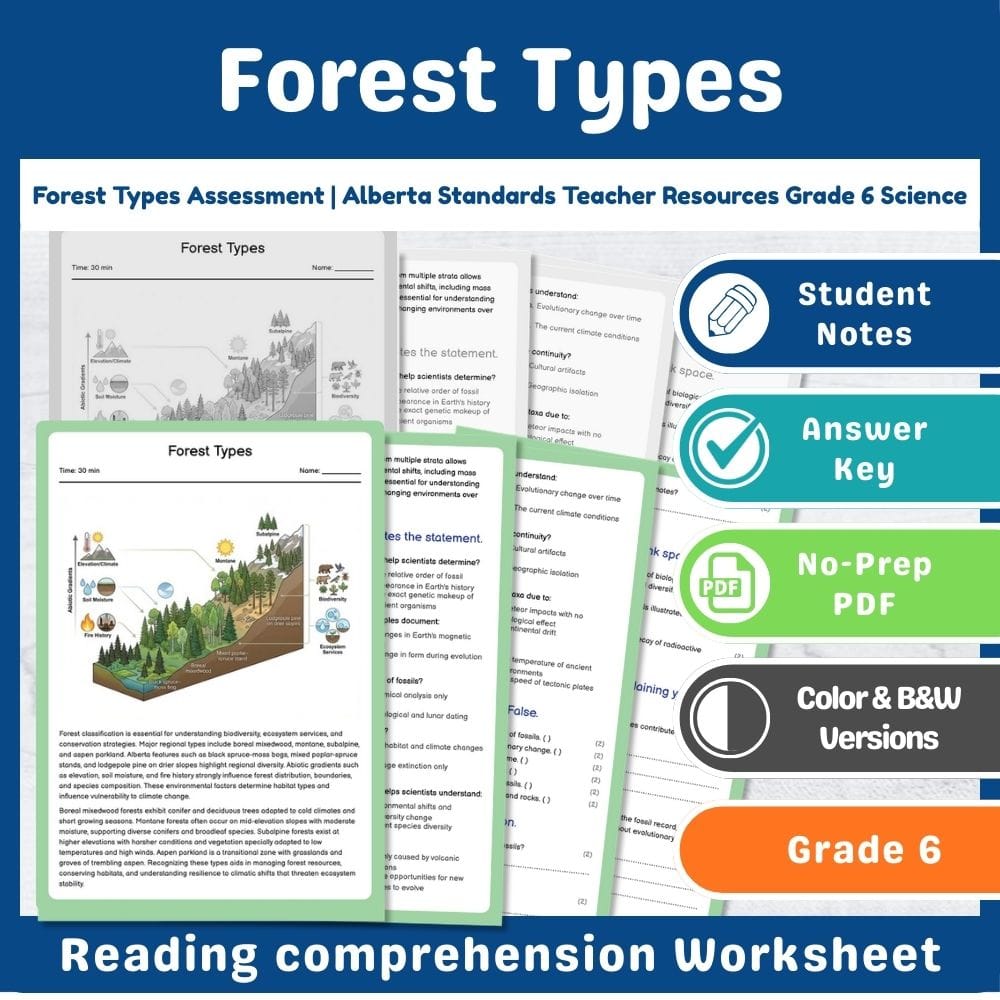
Forest Types Assessment | Alberta Standards Teacher Resources Grade 6 Science
Created byPrism Point LearningLearning Objectives
- Identify major regional forest types and their characteristic species
- Understand environmental factors shaping forest distribution
- Recognize different forest ecosystems and their ecological importance
Also included in: Lesson Grade 6 Science Mini Bundle Trees and Forests Alberta Standards
Instant download

Leaf Functions Assessment | Alberta Grade 6 Science Standards
Created byPrism Point LearningLearning Objectives
- Understand key concepts related to Science
- Apply knowledge through practice questions
- Demonstrate comprehension of the material
Also included in: Lesson Grade 6 Science Mini Bundle Trees and Forests Alberta Standards
Instant download

Forces and Motion Assessment Grade 6 | Science Standards-Aligned Test
Created byPrism Point LearningLearning Objectives
- Understand how forces influence the motion of objects.
- Identify examples of balanced and unbalanced forces in everyday situations.
- Explain how different types of forces affect speed and direction.
Also included in: Grade 6 Physical Science Science Lesson Bundle: General Framework
Instant download

Magnetic Separation Assessment for Grade 6 Science – Standards Aligned
Created byPrism Point LearningLearning Objectives
- Understand the principle of magnetic separation and its applications.
- Identify materials that respond to magnetic forces versus those that do not.
- Describe how magnetic separation can be used in everyday technology and recycling.
Also included in: Grade 6 Physical Science Science Lesson Bundle: General Framework
Instant download

Habitats and Niches Assessment | BC Standard Grade 6 Science Worksheet
Created byPrism Point LearningLearning Objectives
- Understand the difference between habitats and niches in ecosystems.
- Identify how species interact within shared habitats and niches.
- Explain how resource partitioning reduces competition among species.
Instant download

Species Classification Assessment | Alberta Standard Grade 6 Science
Created byPrism Point LearningLearning Objectives
- Understand how to classify organisms into producers, consumers, and decomposers.
- Distinguish between native species and invasive or pest species within ecosystems.
- Recognize Alberta-relevant examples of species and their roles in ecosystems.
Also included in: Lesson Grade 6 Science Mini Bundle Trees and Forests Alberta Standards
Instant download

Ecosystem Components Assessment | BC Standards Grade 6 Science
Created byPrism Point LearningLearning Objectives
- Identify the key components of an ecosystem, including biotic and abiotic factors.
- Explain how living organisms interact with nonliving elements in their habitat.
- Describe the roles of sunlight, water, soil, and temperature in supporting ecosystems.
Instant download

Decomposers And Nutrients Assessment | BC Standards Grade 6 Science
Created byPrism Point LearningLearning Objectives
- Understand the role of decomposers in nutrient cycling and ecosystem health.
- Identify different types of decomposers including fungi, bacteria, and detritivores.
- Explain how environmental factors affect decomposer efficiency.
Instant download

Adaptation Overview Assessment – BC Standard Grade 6 Science Worksheet
Created byPrism Point LearningLearning Objectives
- Understand the concept of adaptation and its importance for survival.
- Identify different types of adaptations in animals and plants.
- Analyze real-world examples of adaptations and their functions.
Instant download

Crystal Structures Assessment | BC Grade 6 Science Standards-Aligned
Created byPrism Point LearningLearning Objectives
- Understand the differences between crystalline and amorphous solids based on particle arrangement.
- Identify observable behaviors associated with crystalline and amorphous structures.
- Explain how particle bonding strength influences solid properties.
Instant download
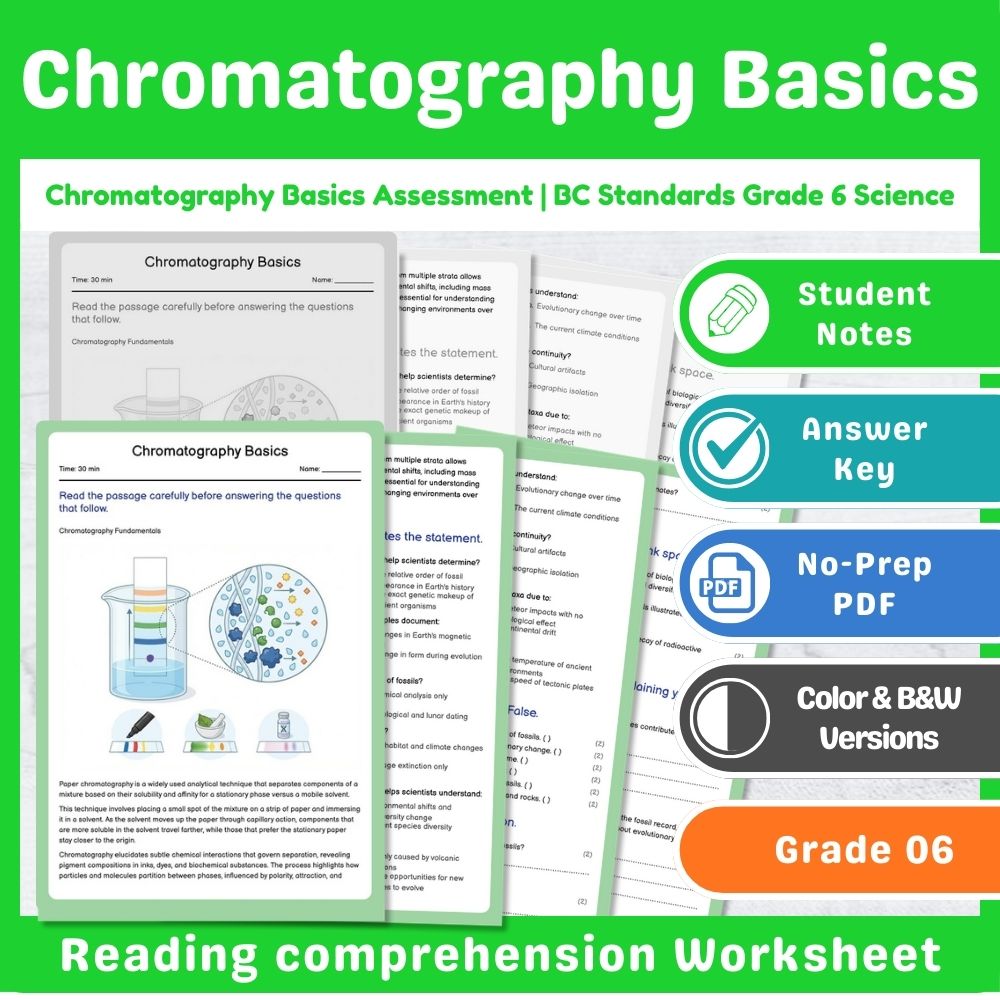
Chromatography Basics Assessment | BC Standards Grade 6 Science
Created byPrism Point LearningLearning Objectives
- Understand the fundamental principles of paper chromatography and how it separates mixture components.
- Identify factors influencing the mobility and separation of substances in chromatography.
- Describe practical applications of chromatography in analyzing complex mixtures such as ink pigments.
Instant download

Reaction Rates Assessment for Grade 6 Science BC Standards-Aligned
Created byPrism Point LearningLearning Objectives
- Understand the factors that influence the speed of chemical reactions.
- Identify how concentration, temperature, surface area, and catalysts affect reaction rates.
- Connect microscopic particle collisions to observable signs of chemical change.
Instant download

Physical Properties Assessment | BC Standards Grade 6 Science Worksheet
Created byPrism Point LearningLearning Objectives
- Define and identify various physical properties of matter.
- Differentiate between physical and chemical changes based on properties.
- Observe and measure properties like mass, volume, density, conductivity, melting point, and hardness.
Instant download

Reaction Classification Assessment | BC Standards Grade 10 Science
Created byPrism Point LearningLearning Objectives
- Identify and classify different types of chemical reactions based on reactant and product characteristics.
- Understand the characteristic features and observable evidence of various reaction types.
- Relate reaction classes to the periodic properties of reactants to predict products and energy changes.
Instant download
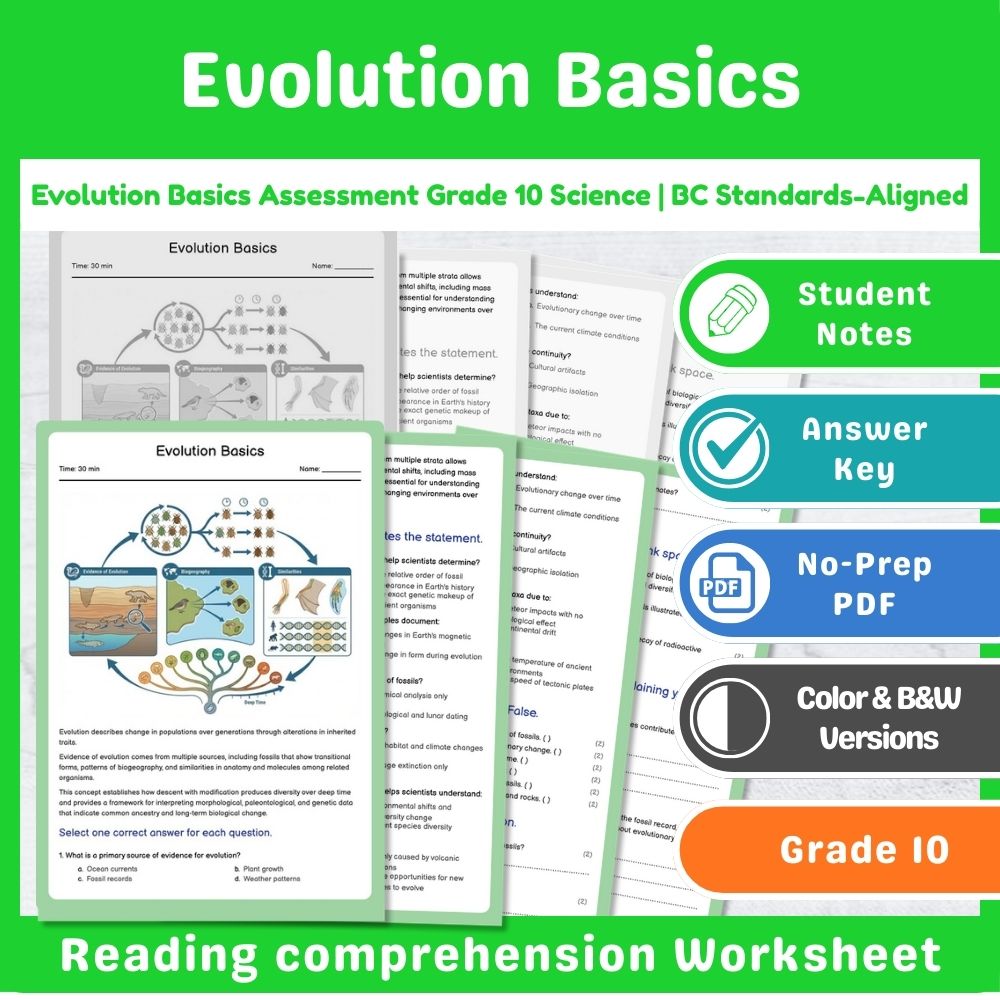
Evolution Basics Assessment Grade 10 Science | BC Standards-Aligned
Created byPrism Point LearningLearning Objectives
- Describe the concept of evolution and its importance in biological history.
- Identify sources of evidence that support the theory of evolution.
- Explain how morphological, paleontological, and genetic data demonstrate common ancestry.
Instant download

Carbon Balance Assessment for Grade 10 Science | Alberta Standards
Created byPrism Point LearningLearning Objectives
- Explain the major carbon pools, flux pathways, and their roles in regional and global climate.
- Identify natural and anthropogenic drivers affecting carbon transfer among atmosphere, vegetation, soil, and ocean.
- Analyze regional examples like boreal forest succession, peatland accumulation, and soil disturbance impacts.
Also included in: Grade 10 Earth and Space Systems Science Lesson Bundle for Alberta +1 more
Instant download

Dynamic Equilibrium Assessment for Grade 10 Science – Alberta Standards
Created byPrism Point LearningLearning Objectives
- Understand the concept of dynamic equilibrium and the factors influencing it.
- Interpret equilibrium constant expressions and predict system shifts due to external changes.
- Apply principles of chemical equilibrium to industrial and environmental contexts.
Also included in: Grade 10 Matter and Chemical Change Science Lesson Bundle: Alberta +1 more
Instant download

Hydrologic Cycle Assessment for Grade 10 Science | Alberta Standards
Created byPrism Point LearningLearning Objectives
- Explain the processes involved in the hydrologic cycle including evaporation, transpiration, condensation, and runoff.
- Describe water movement from mountain snowpack to regional aquifers and rivers.
- Analyze how climate variability and watershed characteristics affect regional water resources.
Also included in: Grade 10 Earth and Space Systems Science Lesson Bundle for Alberta +1 more
Instant download
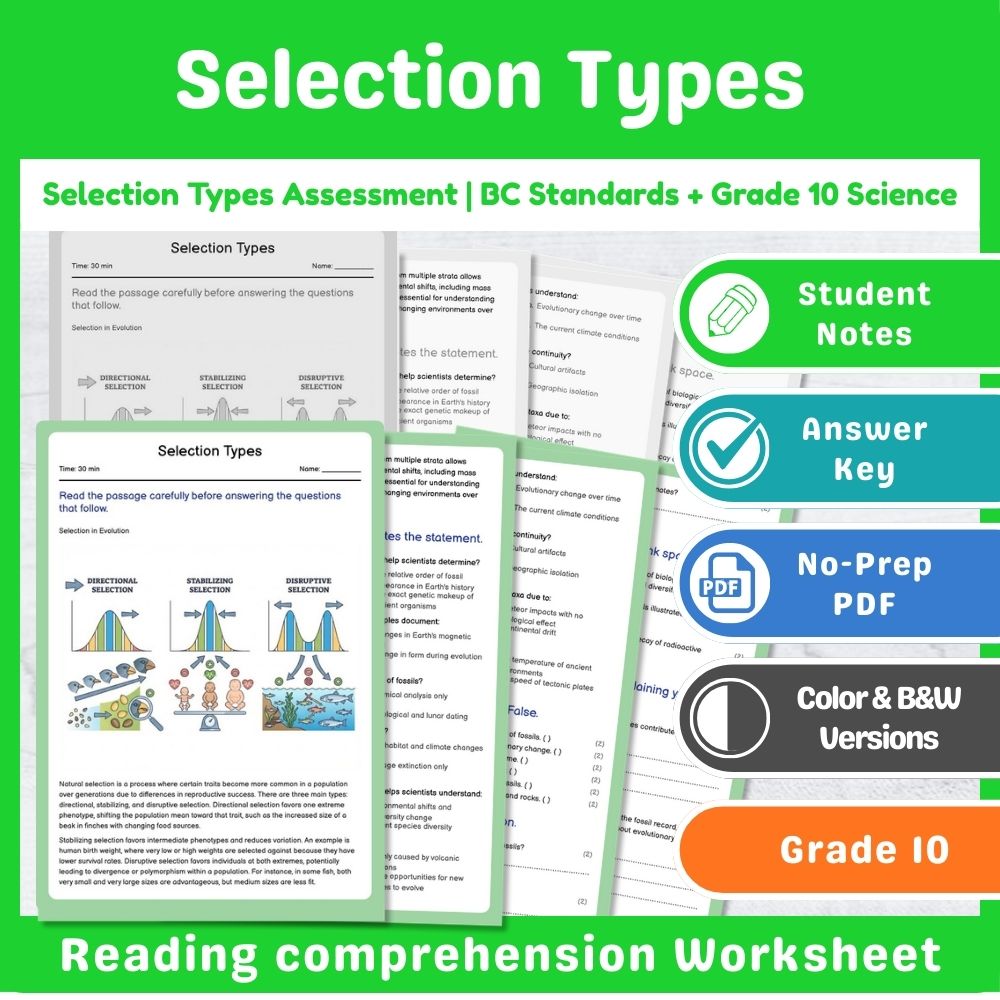
Selection Types Assessment | BC Standards + Grade 10 Science
Created byPrism Point LearningLearning Objectives
- Identify the different modes of natural selection and understand their effects on populations.
- Interpret how directional, stabilizing, and disruptive selection modify trait distributions over time.
- Explain the roles of frequency-dependent and sexual selection in evolution.
Instant download

Evidence Supporting Evolution Assessment | General Grade 10 Science
Created byPrism Point LearningLearning Objectives
- Understand the different types of evidence used to support claims about biological change over time.
- Identify how fossil records, comparative anatomy, molecular data, and biogeography contribute to evolutionary understanding.
- Analyze how multiple lines of evidence reinforce conclusions about evolution despite limitations in individual datasets.
Also included in: Grade 10 Evolution and Genetics Science Lesson Bundle: General Unit
Instant download

Atomic Particles Assessment | BC Standards Grade 10 Science
Created byPrism Point LearningLearning Objectives
- Describe the structure of an atom, including protons, neutrons, and electrons.
- Explain how the number of protons determines an element and contributes to atomic mass.
- Identify the arrangement of electrons in shells and how it influences chemical behavior.
Instant download
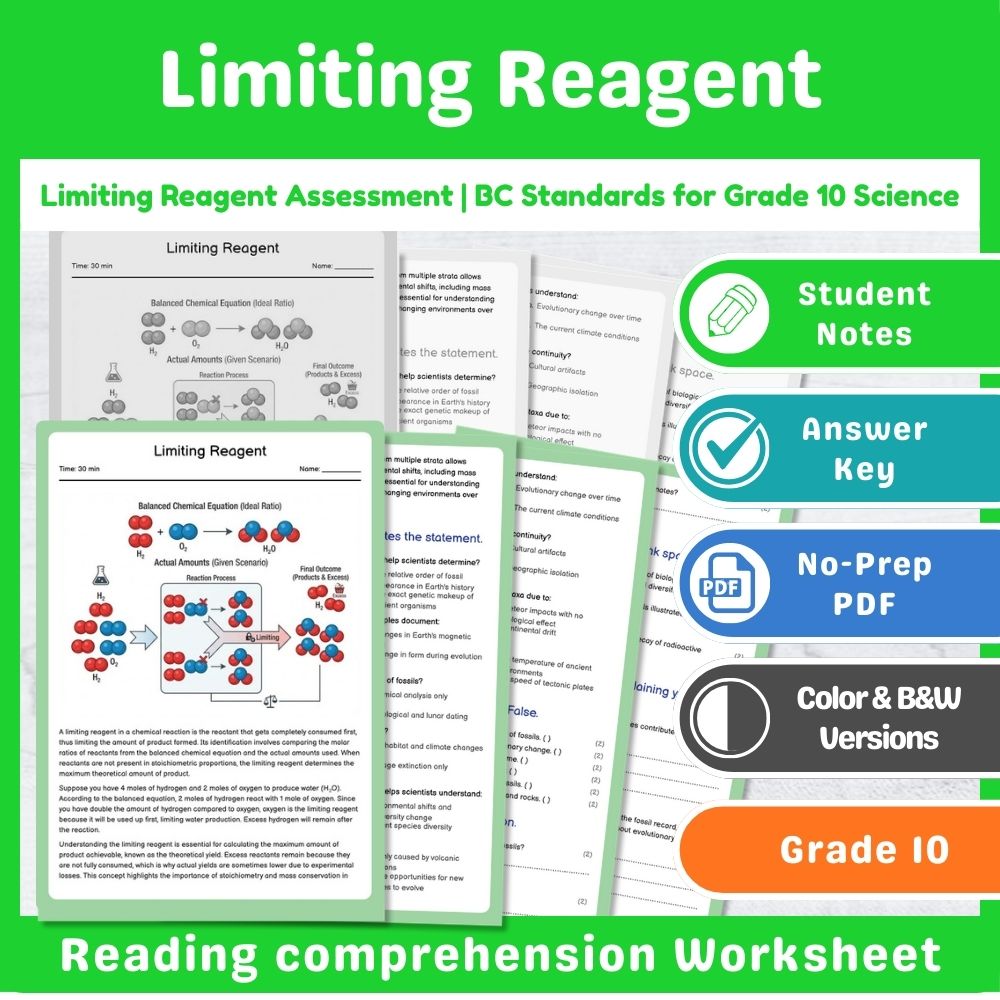
Limiting Reagent Assessment | BC Standards for Grade 10 Science
Created byPrism Point LearningLearning Objectives
- Understand the concept of a limiting reagent in a chemical reaction.
- Learn how to compare stoichiometric ratios to identify the limiting reactant.
- Calculate the theoretical yield based on limiting reagent analysis.
Instant download

Electron Configuration Assessment | BC Standards Grade 10 Science
Created byPrism Point LearningLearning Objectives
- Describe how electrons occupy energy levels and orbitals around an atomic nucleus.
- Explain the significance of valence electrons in bonding and chemical reactivity.
- Apply principles of quantized energy levels to determine electron distribution in elements.
Instant download

Reaction Energetics Assessment | BC Standards Grade 10 Science
Created byPrism Point LearningLearning Objectives
- Understand the principles of energy changes during chemical reactions.
- Identify differences between exothermic and endothermic reactions.
- Relate bond energies to reaction thermodynamics and feasibility.
Instant download

Adaptation Types Assessment | BC Standards Grade 10 Science
Created byPrism Point LearningLearning Objectives
- Define different types of adaptations and explain their roles in survival and reproduction.
- Identify morphological, physiological, and behavioral adaptations with examples.
- Analyze how adaptations involve trade-offs and are influenced by environmental pressures.
Instant download

Trophic Modeling Assessment for Grade 8 Science – Alberta Standards
Created byPrism Point LearningLearning Objectives
- Understand the principles of trophic modeling in ecological systems.
- Identify different types of models used to represent energy and matter fluxes.
- Explain how models estimate production, respiration, and decomposition rates.
Also included in: Grade 8 Science Mini Bundle | Interactions and Ecosystems Curriculum
Instant download

Particles Meet Energy Assessment | General Grade 8 Science
Created byPrism Point LearningLearning Objectives
- Explain how particle interactions relate to energy changes during reactions.
- Identify observable changes indicating particle rearrangements and energy shifts.
- Connect temperature changes to energy transfer in chemical reactions.
Also included in: Grade 8 Physical Science Science Lesson Bundle – General Framework
Instant download

Ecosystem Matter Cycling Assessment | Standards-Aligned Grade 8 Science
Created byPrism Point LearningLearning Objectives
- Understand how matter cycles through ecosystems involving living and nonliving components.
- Identify processes such as decomposition, gas exchange, and nutrient transformation that return elements to the environment.
- Explain how producers and consumers transfer matter within ecosystems over time.
Also included in: Grade 8 Life Science Science Lesson Bundle – General Framework Resources
Instant download

Thermochemistry Assessment for Grade 11 Science Standards-Aligned
Created byPrism Point LearningLearning Objectives
- Understand the concept of enthalpy and its role in chemical reactions.
- Identify differences between endothermic and exothermic processes.
- Calculate reaction enthalpies using bond energies and standard enthalpies of formation.
Also included in: Grade 11 Science | Thermochemistry Assessment Bundle – Standards-Aligned
Instant download

Lewis Structures Assessment | Alberta Standard Assessment Grade 11 Science
Created byPrism Point LearningLearning Objectives
- Understand the concept of Lewis electron-dot structures for molecules.
- Identify how to represent shared electrons and bonds.
- Interpret Lewis structures to predict molecular shapes and properties.
Also included in: Grade 11 Matter and Chemical Bonding Science Lesson Bundle for Alberta +1 more
Instant download

Population Growth Assessment for Grade 11 Science TEKS standards
Created byPrism Point LearningLearning Objectives
- Understand the key factors influencing population dynamics, including birth rates, death rates, immigration, and emigration.
- Differentiate between exponential and logistic growth models and their real-world applications.
- Analyze the impact of density-dependent and density-independent factors on population trajectories.
Instant download

Chemical Equilibrium Assessment for Grade 11 Science | BC Standards
Created byPrism Point LearningLearning Objectives
- Understand the concept of chemical equilibrium and the factors that affect it.
- Learn how to write and interpret equilibrium constant expressions.
- Apply Le Chatelier’s principle to predict shifts in equilibrium in response to concentration, temperature, and pressure changes.
Also included in: Grade 11 Science | Thermochemistry Assessment Bundle – Standards-Aligned
Instant download

The Mole Concept Assessment | BC Standards Grade 11 Science
Created byPrism Point LearningLearning Objectives
- Explain the fundamental principles of the mole concept and its relation to Avogadro's number.
- Convert between mass, number of particles, and volume using molar mass and molar relationships.
- Perform calculations involving moles, gases, and mass for quantitative analysis in chemistry.
Also included in: Grade 11 Science | Thermochemistry Assessment Bundle – Standards-Aligned
Instant download

Physiological Regulation Assessment for Grade 11 Science TEKS
Created byPrism Point LearningLearning Objectives
- Describe the mechanisms involved in maintaining internal stability in the human body.
- Explain the roles of sensors, control centers, and effectors in physiological regulation.
- Identify examples of negative and positive feedback mechanisms in human physiology.
Also included in: Grade 11 Homeostasis & Human Body Systems Science: Lesson Bundle TEKS
Instant download

Renal Regulation Assessment | TEKS Grade 11 Science Standards
Created byPrism Point LearningLearning Objectives
- Understand how the kidneys regulate fluid, electrolyte, and acid-base balance.
- Identify the hormonal controls involved in renal function, such as aldosterone and antidiuretic hormone.
- Describe the processes of filtration, reabsorption, secretion, and excretion in nephrons.
Also included in: Grade 11 Homeostasis & Human Body Systems Science: Lesson Bundle TEKS
Instant download

Phase Behaviour Assessment | Alberta Standard Grade 11 Science
Created byPrism Point LearningLearning Objectives
- Understand the concept of phase behaviour and phase diagrams.
- Identify the different phases of matter and their transitions under varying conditions.
- Interpret phase diagrams to determine phase changes at specific temperature and pressure points.
Also included in: Grade 11 Matter and Chemical Bonding Science Lesson Bundle for Alberta +1 more
Instant download
Browse more categories
About Reading comprehension Worksheets
Find reading comprehension worksheets for class practice, homework, or self-study. All 40,289 are instant PDF downloads.
Each resource here is built by an independent educator and reviewed for quality. Worksheets print straight from PDF and suit classroom use, homework, or extra practice; most come with answer keys, and you can preview before purchasing.