
Reading comprehension Worksheets
40,289 type resources
Inheritance Patterns Assessment for Grade 11 Science | Standards-Aligned
 Created byPrism Point Learning
Learning Objectives
- Explain how observable traits are connected to genetic inheritance patterns across generations.
- Describe the role of Punnett squares in predicting offspring genotypes and phenotypes.
- Differentiate between autosomal and sex-linked inheritance, including dominance and recessiveness.
Also included in: Grade 11 Biological Evidence Science Lesson Bundle | General Framework
Instant download

Biogeochemical Cycles Assessment for Grade 11 Science TEKS
Created byPrism Point LearningLearning Objectives
- Understand the key processes involved in the carbon, nitrogen, and phosphorus cycles.
- Identify the roles of different biogeochemical cycles in ecosystems.
- Explain how human activities perturb natural nutrient cycles and their effects.
Instant download

Collisions Types Assessment | BC Standards Grade 11 Science
Created byPrism Point LearningLearning Objectives
- Explain the difference between elastic and inelastic collisions in terms of energy and momentum conservation.
- Apply conservation laws to analyze one- and two-dimensional collision scenarios.
- Use center-of-mass frames to determine final velocities after collisions in various situations.
Also included in: Grade 11 Science Assessment Bundle | Classical Mechanics & Motion Topics
Instant download

Stratigraphic Columns Assessment for Grade 11 Science | BC Standards
Created byPrism Point LearningLearning Objectives
- Understand the components and significance of stratigraphic columns in geology.
- Identify how lithology, fossils, and sedimentary structures help interpret past environments.
- Explain the concepts of correlation, unconformities, and facies changes within stratigraphy.
Also included in: Grade 11 Science Assessment | Plate Tectonics BC Standards Mini Bundle
Instant download

Protein Synthesis Assessment for Grade 11 Science TEKS Standards
Created byPrism Point LearningLearning Objectives
- Explain the process of transcription and translation in protein synthesis.
- Identify the roles of RNA polymerase, mRNA, tRNA, ribosomes, and amino acids.
- Describe the significance of codon redundancy and wobble in genetic decoding.
Also included in: Grade 11 Molecular Genetics Science Lesson Bundle: TEKS Assessments
Instant download
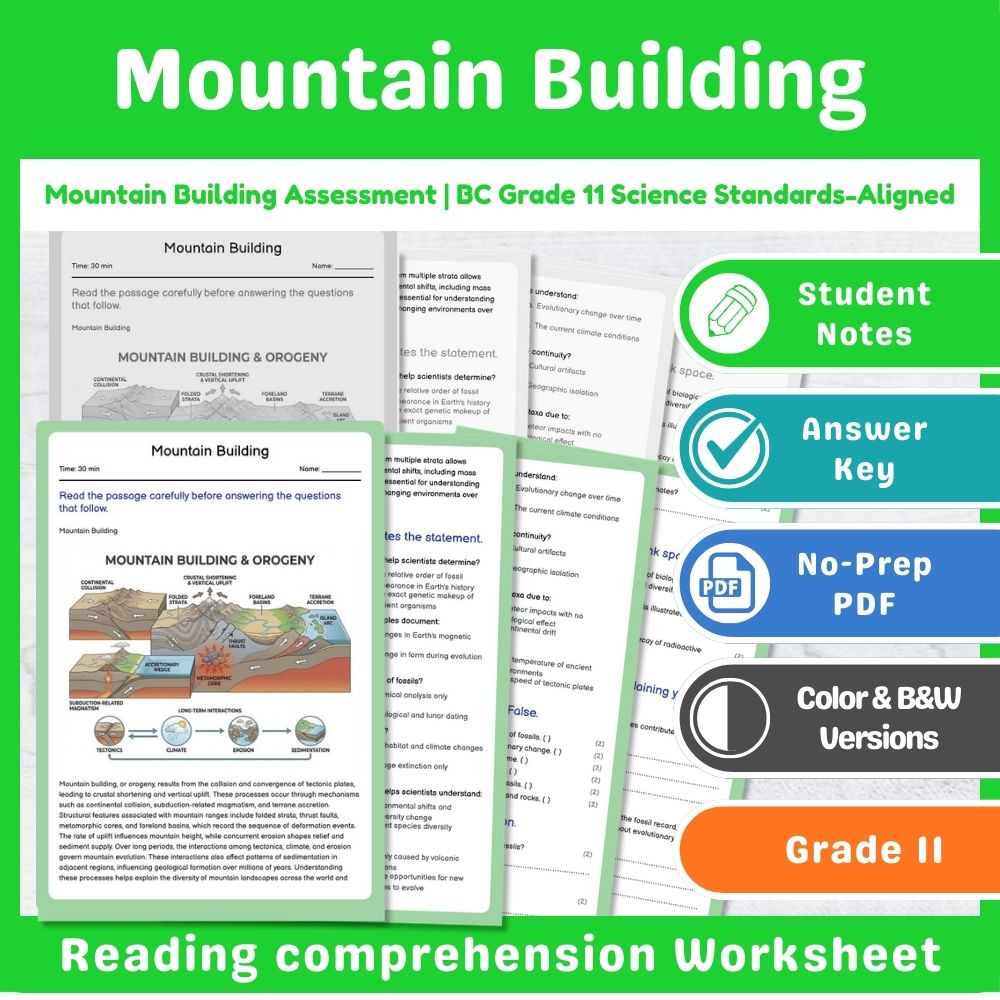
Mountain Building Assessment | BC Grade 11 Science Standards-Aligned
Created byPrism Point LearningLearning Objectives
- Explain the geological processes involved in mountain formation, including tectonic convergence, crustal shortening, and uplift.
- Identify structural features such as folded strata, thrust faults, metamorphic cores, and foreland basins associated with mountain ranges.
- Describe how rates of uplift and erosion influence mountain evolution and sediment distribution.
Also included in: Grade 11 Science Assessment | Plate Tectonics BC Standards Mini Bundle
Instant download

Carbon Pathways Assessment | AP Standards for Grade 11 Science
Created byPrism Point LearningLearning Objectives
- Explain how carbon is stored and transferred among air, ocean, terrestrial biosphere, and sediments.
- Utilize flux diagrams and isotopic tracers to distinguish natural from anthropogenic carbon sources.
- Analyze the impact of ocean uptake, soil carbon, and fossil fuel emissions on atmospheric CO2 levels.
Also included in: Lesson Grade 11 Science Assessment Bundle | Earth Systems & Climate
Instant download
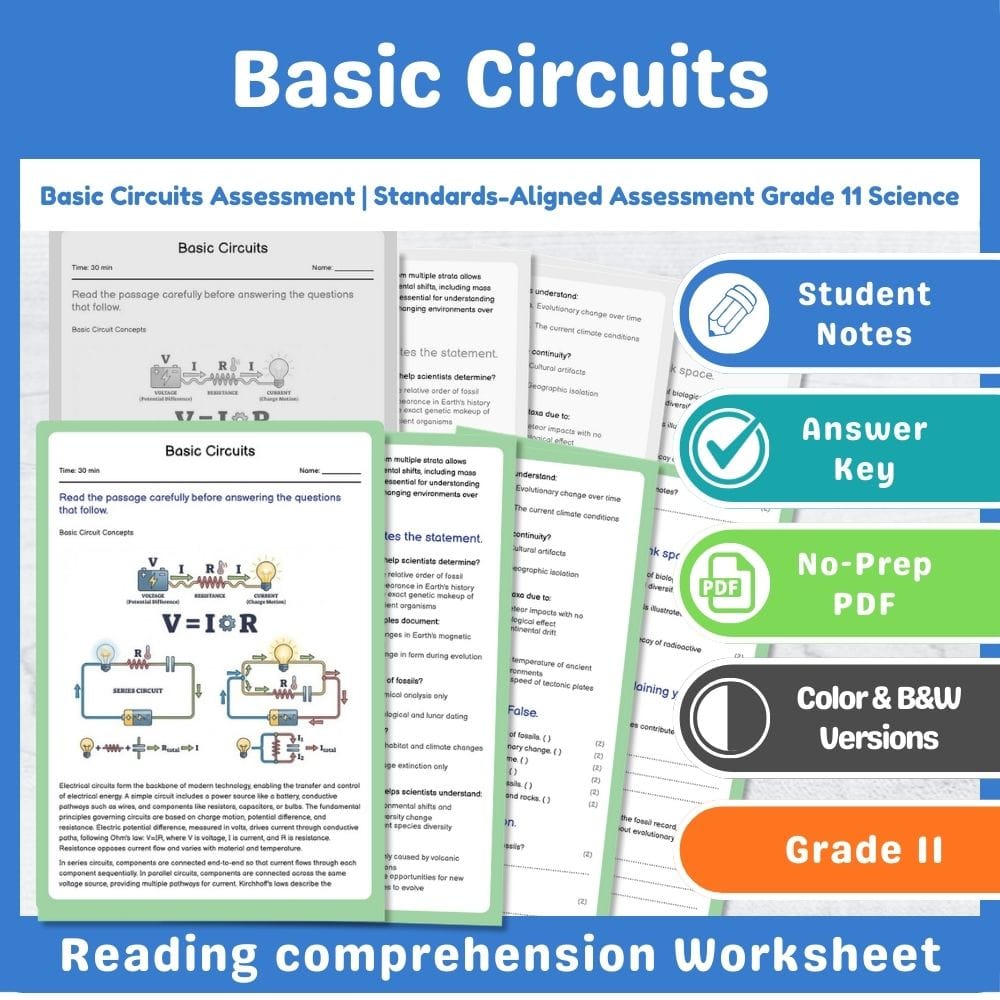
Basic Circuits Assessment | Standards-Aligned Assessment Grade 11 Science
Created byPrism Point LearningLearning Objectives
- Explain the concepts of electric potential difference, current, resistance, and energy transfer in DC circuits.
- Apply Ohm's law and Kirchhoff's laws to analyze series and parallel circuits.
- Calculate power dissipation and energy in simple electrical systems using algebraic methods.
Instant download
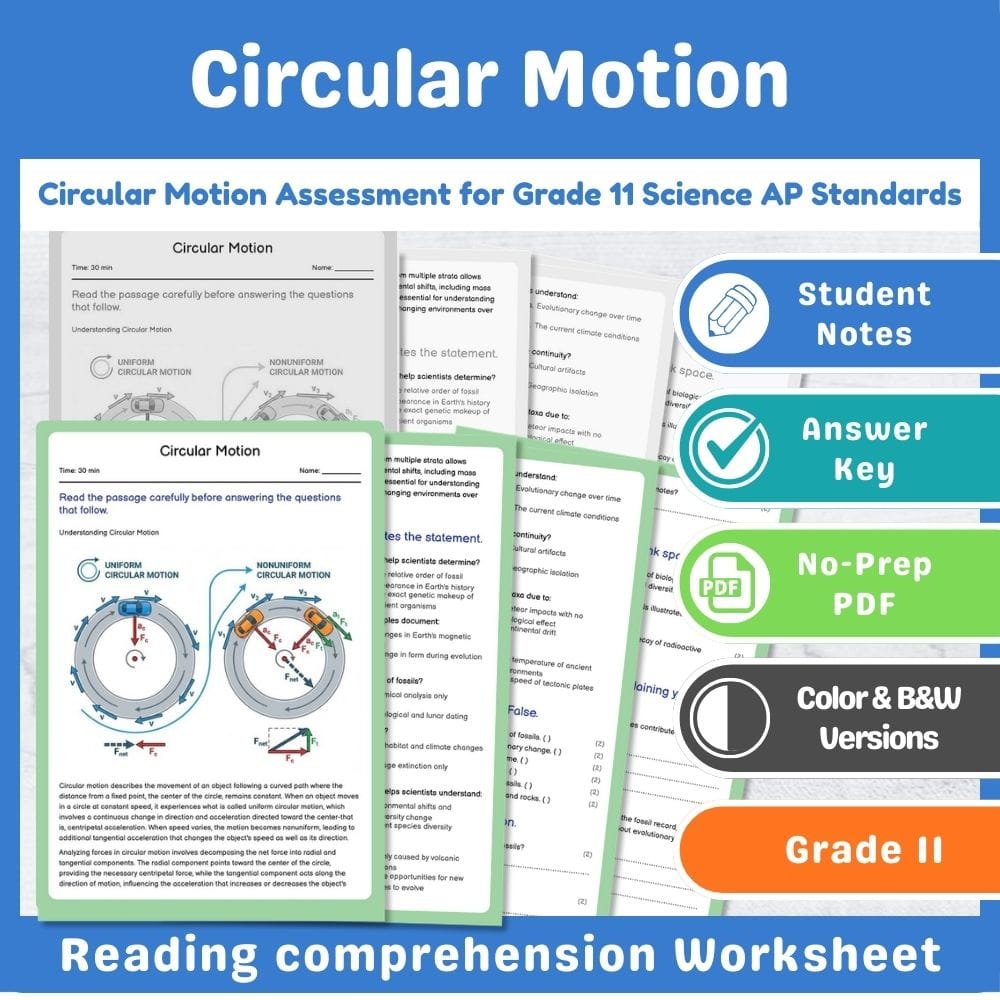
Circular Motion Assessment for Grade 11 Science AP Standards
Created byPrism Point LearningLearning Objectives
- Describe uniform and nonuniform circular motion with emphasis on centripetal and tangential accelerations.
- Model net forces in circular motion by analyzing radial and tangential components.
- Express acceleration vectors in polar coordinates and relate them to the change in velocity direction.
Instant download

Mantle Convection Assessment for Grade 11 Science – Standards-Aligned
Created byPrism Point LearningLearning Objectives
- Understand the process of mantle convection and how it drives plate tectonics.
- Identify geophysical techniques used to observe mantle flow and dynamics.
- Explain the roles of slab pull, ridge push, and mantle plumes in Earth's geological activity.
Also included in: Grade 11 Science Assessment | Plate Tectonics BC Standards Mini Bundle
Instant download

Groundwater Systems Assessment for Grade 11 Science | BC Standards
Created byPrism Point LearningLearning Objectives
- Understand the concepts of aquifers, porosity, and permeability in groundwater systems.
- Differentiate between confined and unconfined aquifers and their responses to recharge and pumping.
- Identify factors affecting groundwater flow, quality, and sustainability.
Also included in: Grade 11 Science Assessment | Plate Tectonics BC Standards Mini Bundle
Instant download

Atomic Structure Assessment for Grade 11 Science | Alberta Standards
Created byPrism Point LearningLearning Objectives
- Describe the organization of protons, neutrons, and electrons within atoms.
- Explain how electron arrangements, including shells and valence electrons, influence reactivity and bonding.
- Identify atomic features of Alberta elements used in industry and their macroscopic chemical behaviors.
Also included in: Grade 11 Matter and Chemical Bonding Science Lesson Bundle for Alberta +1 more
Instant download
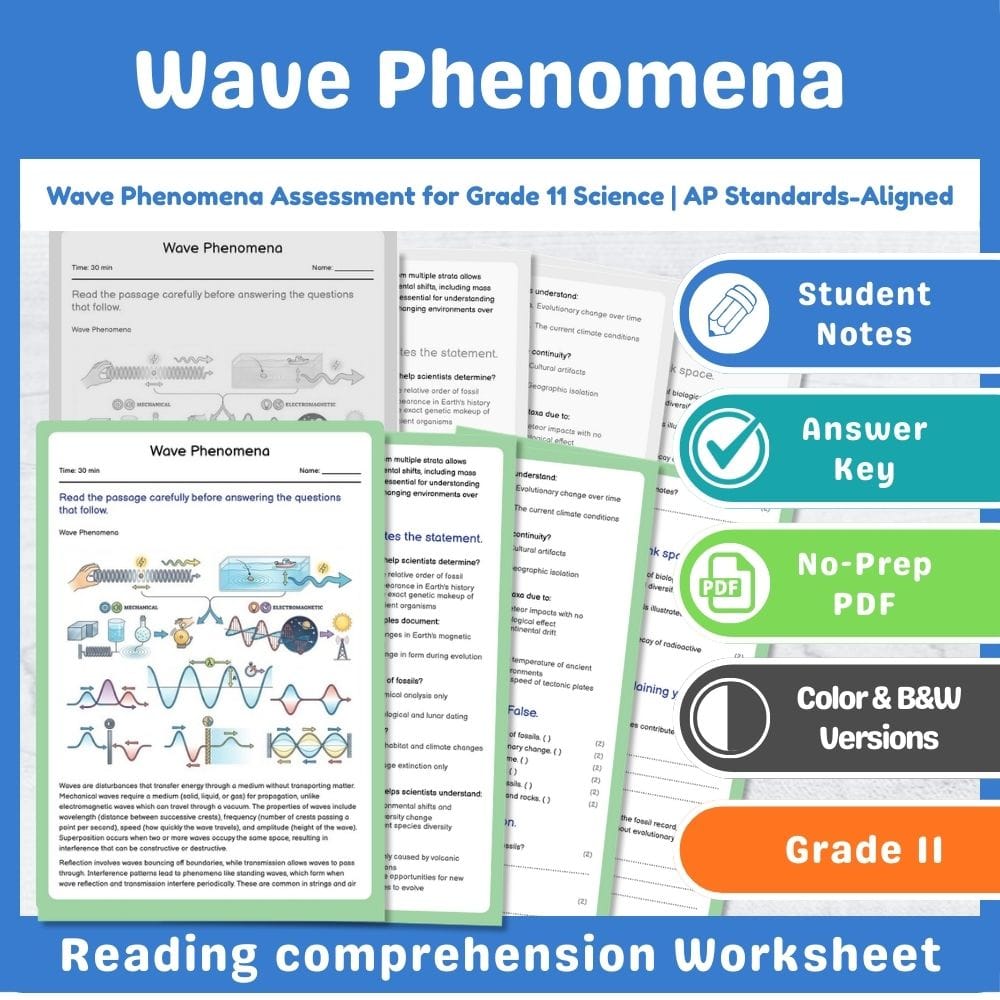
Wave Phenomena Assessment for Grade 11 Science | AP Standards-Aligned
Created byPrism Point LearningLearning Objectives
- Understand the properties of mechanical waves including wavelength, frequency, speed, and amplitude.
- Analyze wave behaviors such as reflection, transmission, interference, and standing waves.
- Relate sinusoidal and graphical models to energy transport and modal patterns in waves.
Instant download

Ionic Strength Assessment | Alberta Standards Grade 11 Science
Created byPrism Point LearningLearning Objectives
- Understand the concept of ionic strength and how it relates to ion concentration and charge.
- Explain how ionic strength affects activity coefficients and solubility in solutions.
- Analyze real-world examples of ionic strength effects in natural waters and industrial processes.
Also included in: Grade 11 Solutions and Solubility Science Lesson Bundle | Alberta Framework +1 more
Instant download

Solution Stoichiometry Assessment | Alberta Standards Grade 11 Science
Created byPrism Point LearningLearning Objectives
- Understand how to use concentration measures like molarity to determine quantities of reactants and products in aqueous reactions.
- Apply mole relationships and equivalence principles to solve solution-based stoichiometry problems.
- Use mass conservation and volume-mole conversions to predict outcomes of chemical reactions in solution.
Also included in: Grade 11 Chemical Reactions & Stoichiometry Science Lesson Bundle – Alberta +1 more
Instant download

Dipole Interactions Assessment for Grade 11 Science | Alberta Standards
Created byPrism Point LearningLearning Objectives
- Explain the concept of molecular polarity and its influence on intermolecular forces.
- Analyze how dipole-dipole interactions affect physical properties like boiling point and solubility.
- Describe real-world applications of dipole interactions in refinery processes and atmospheric chemistry.
Also included in: Grade 11 Matter and Chemical Bonding Science Lesson Bundle for Alberta +1 more
Instant download

VSEPR and Forces Assessment | Alberta Standards Grade 11 Science
Created byPrism Point LearningLearning Objectives
- Describe the VSEPR model and predict molecular geometries based on electron pair arrangements.
- Explain how molecular shapes influence intermolecular forces such as dipole interactions and hydrogen bonding.
- Relate molecular shape to physical properties like boiling and melting points, with real-world examples.
Also included in: Grade 11 Matter and Chemical Bonding Science Lesson Bundle for Alberta +1 more
Instant download

Advanced Models Assessment | Alberta Standards Grade 11 Science
Created byPrism Point LearningLearning Objectives
- Explain how molecular orbital theory accounts for delocalization, metallic conduction, and semiconductor behavior.
- Describe how band structure and molecular symmetry influence the spectroscopic features and reactivity of transition metal complexes.
- Assess the electronic properties of materials used in energy technologies through advanced bonding models.
Also included in: Grade 11 Matter and Chemical Bonding Science Lesson Bundle for Alberta +1 more
Instant download
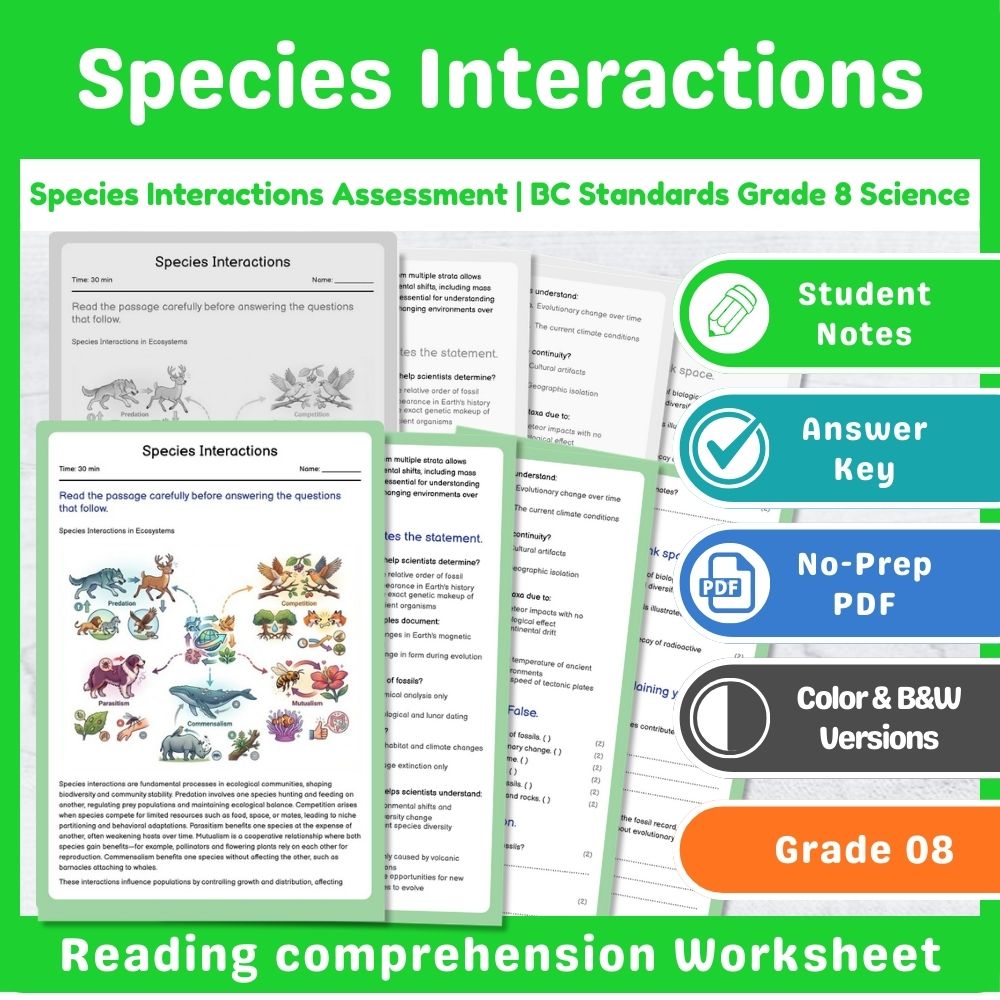
Species Interactions Assessment | BC Standards Grade 8 Science
Created byPrism Point LearningLearning Objectives
- Describe different types of species interactions such as predation, competition, parasitism, mutualism, and commensalism.
- Explain how species interactions influence population dynamics and community structure.
- Analyze the role of predation and mutualism in ecosystem regulation and species survival.
Instant download
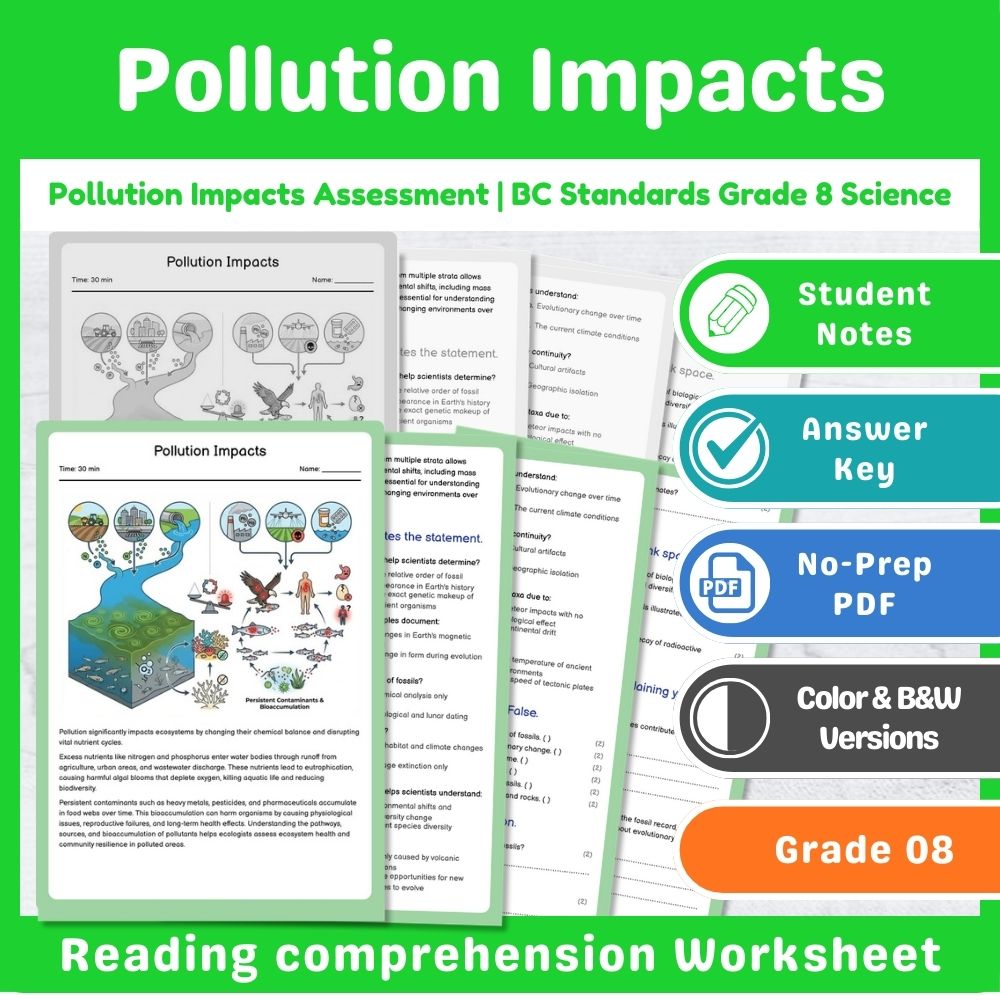
Pollution Impacts Assessment | BC Standards Grade 8 Science
Created byPrism Point LearningLearning Objectives
- Understand how pollution alters ecosystem chemistry and nutrient cycles.
- Identify the effects of excess nutrients and persistent contaminants on water, soil, and organisms.
- Explain the processes of eutrophication, bioaccumulation, and ecological resilience in polluted environments.
Instant download
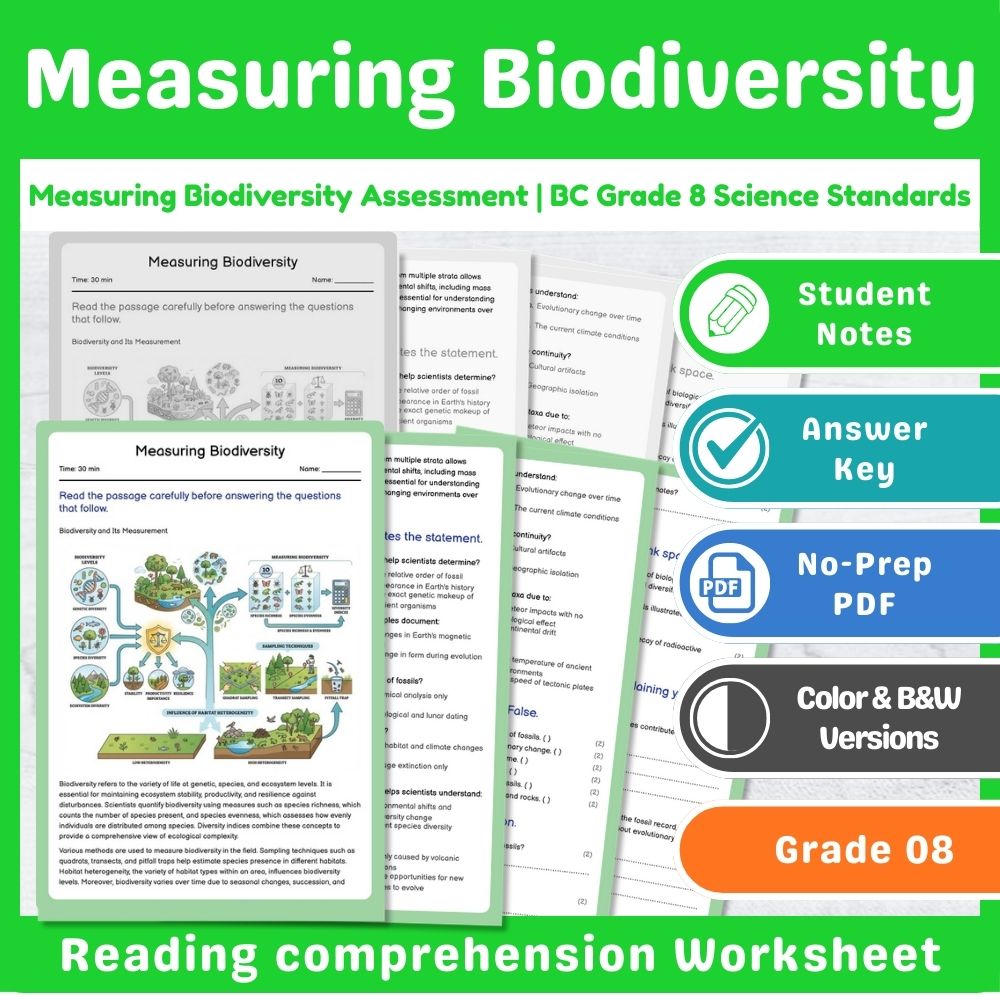
Measuring Biodiversity Assessment | BC Grade 8 Science Standards
Created byPrism Point LearningLearning Objectives
- Understand the concepts of biodiversity, species richness, evenness, and diversity indices.
- Identify methods used to measure biodiversity in different ecosystems.
- Analyze how sampling techniques, habitat heterogeneity, and temporal variation influence biodiversity measurements.
Instant download

Gene Expression Pathway Assessment for Grade 12 Science | Standards-Aligned
Created byPrism Point LearningLearning Objectives
- Explain how transcription and translation enable cells to express genetic information as proteins.
- Describe how regulation at multiple steps can create different phenotypes from the same genome.
- Analyze how timing and cell-type specific control of gene expression influence traits.
Instant download
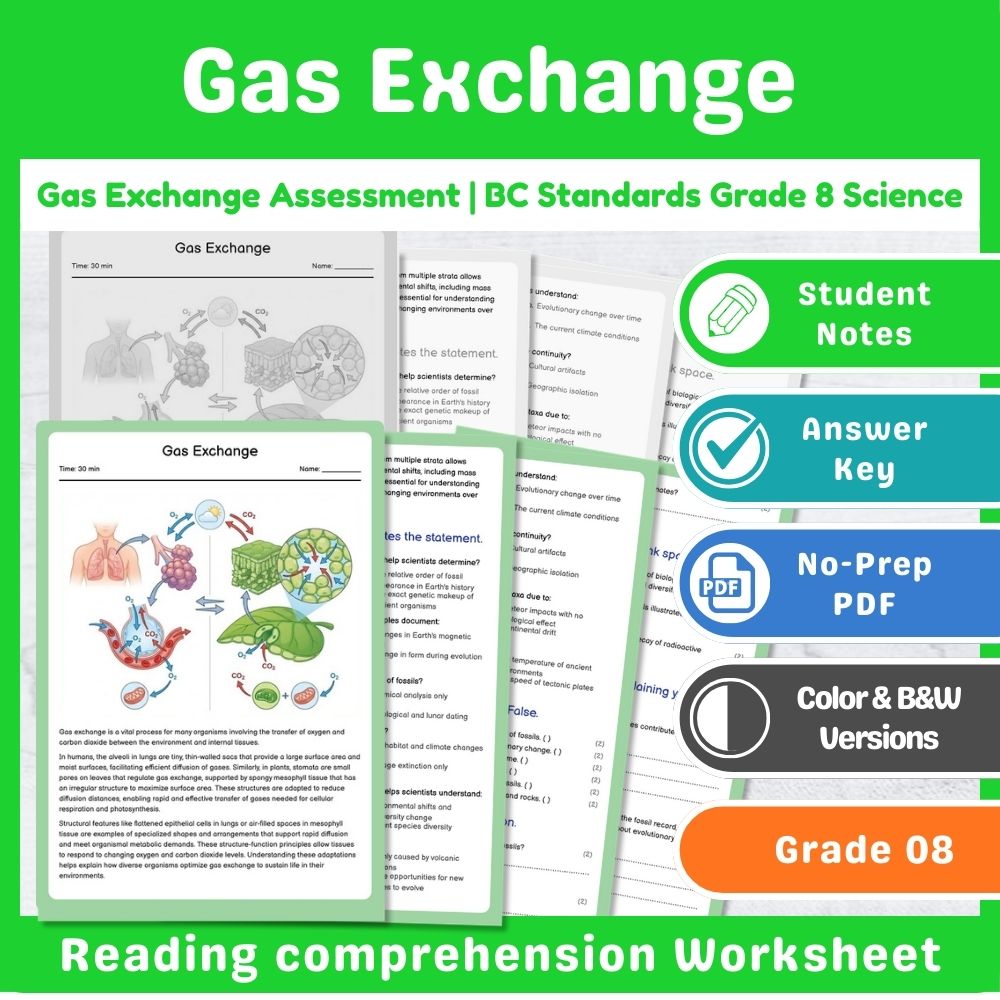
Gas Exchange Assessment | BC Standards Grade 8 Science
Created byPrism Point LearningLearning Objectives
- Understand how thin, moist surfaces facilitate gas exchange in organisms.
- Identify different structures involved in gas exchange, such as alveoli and stomata.
- Explain structural adaptations that support efficient diffusion of gases.
Instant download

Energy System Efficiency Assessment | General Standards Grade 12 Science
Created byPrism Point LearningLearning Objectives
- Explain energy system efficiency and identify common loss pathways in real systems
- Evaluate how design choices (insulation, surface area, and control systems) affect useful energy output
- Apply the efficiency concept to a solar-thermal collector by linking absorber and surface properties to stored thermal energy
Instant download

Energy Basics Assessment | BC Standards Grade 8 Science
Created byPrism Point LearningLearning Objectives
- Understand the forms of mechanical energy, including kinetic and potential energy.
- Explain how energy transfers occur through work and force interactions.
- Describe how friction and air resistance transform mechanical energy into thermal energy.
Instant download

Societal Engineering Outcomes Assessment | General Grade 12 Science
Created byPrism Point LearningLearning Objectives
- Explain how engineered safety standards relate known failure modes to public risk outcomes.
- Analyze how reliability and maintenance planning affect long-term costs, trust, and community resilience.
- Evaluate how sustainability decisions influence lifecycle resource use, emissions, and end-of-life outcomes.
Instant download

Orbital Mechanics Assessment | TEKS Standards Grade 12 Science
Created byPrism Point LearningLearning Objectives
- Understand the principles of gravitational dynamics and Keplerian motion.
- Apply conservation laws to analyze orbital trajectories and resonances.
- Relate orbital parameters such as eccentricity, inclination, and semimajor axis to celestial phenomena.
Instant download
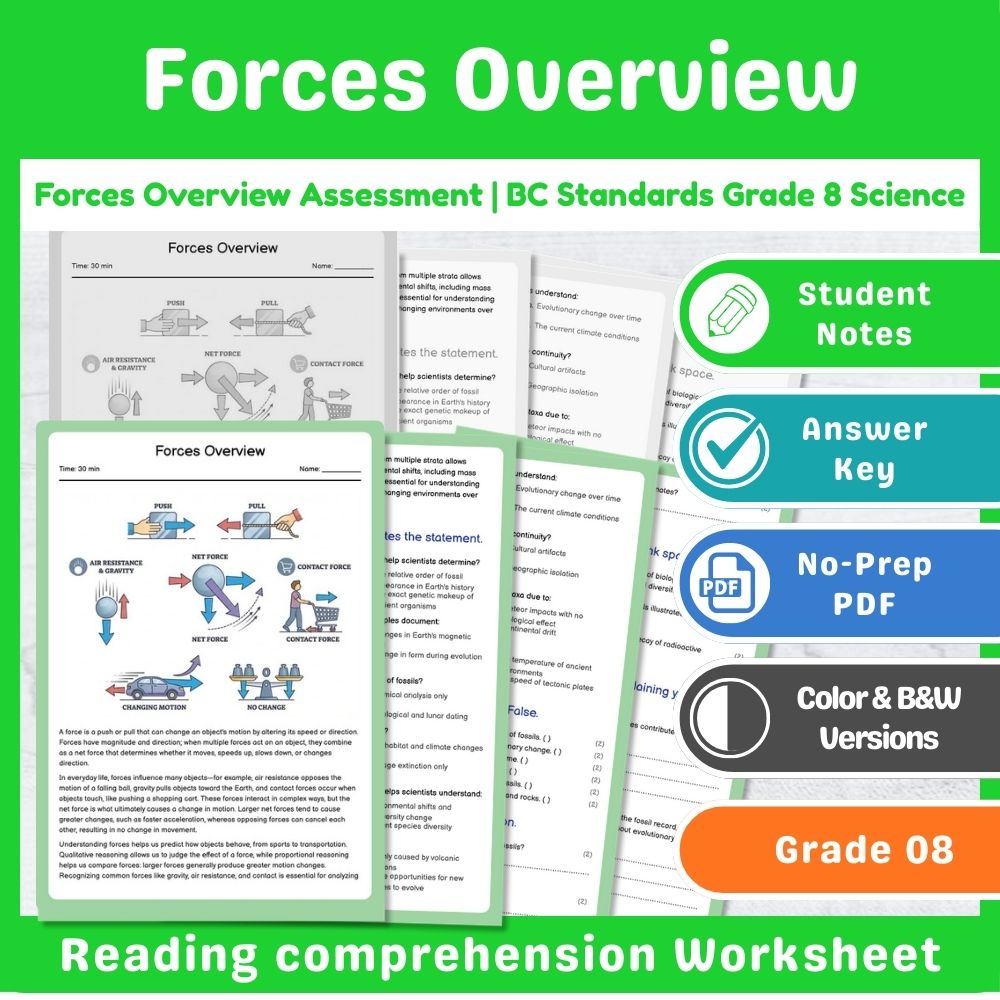
Forces Overview Assessment | BC Standards Grade 8 Science
Created byPrism Point LearningLearning Objectives
- Define what a force is and identify different types of forces
- Explain how net force affects an object's motion
- Describe everyday forces like gravity and air resistance
Instant download
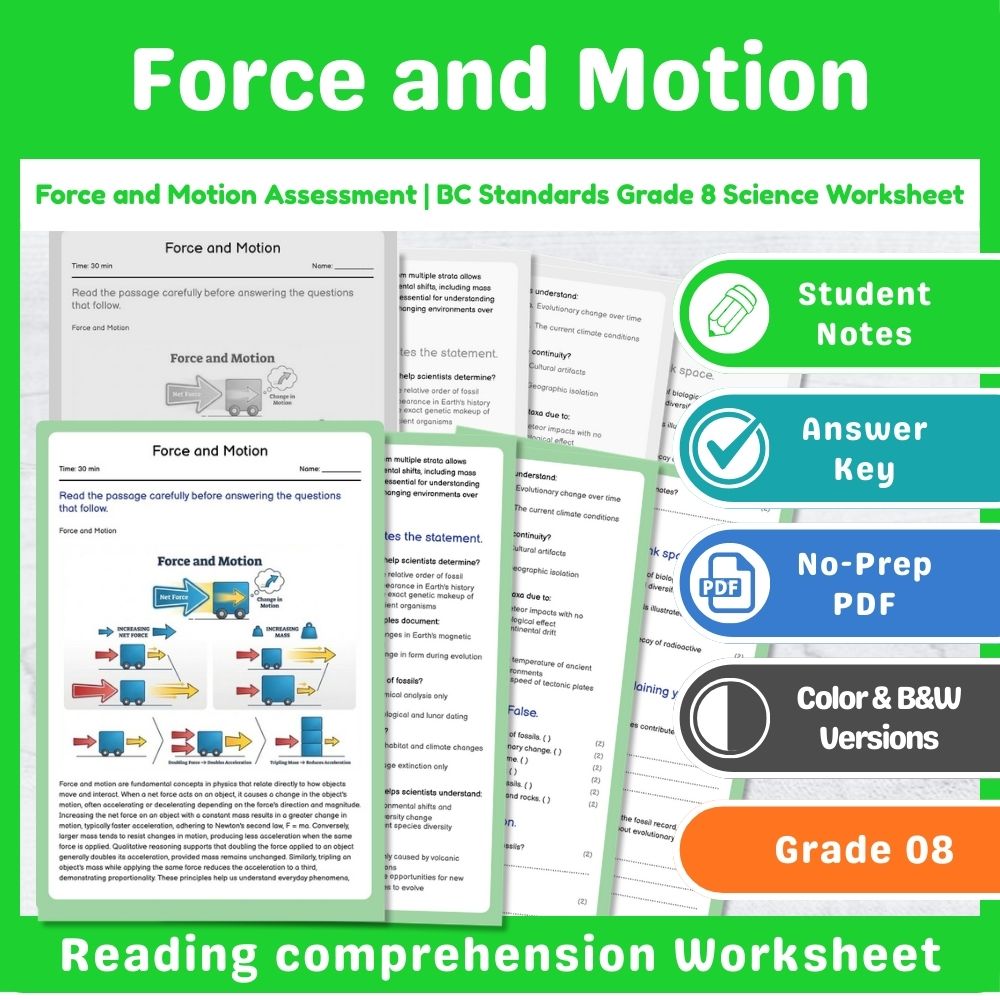
Force and Motion Assessment | BC Standards Grade 8 Science Worksheet
Created byPrism Point LearningLearning Objectives
- Understand the relationship between net force, mass, and acceleration.
- Explain qualitatively how increasing net force affects motion.
- Describe the effect of increased mass on acceleration under the same force.
Instant download

Pendulum Energy Assessment | BC Standards Grade 8 Science
Created byPrism Point LearningLearning Objectives
- Explain how a pendulum demonstrates energy transformation between potential and kinetic energy.
- Identify factors that influence the period of a pendulum.
- Describe how energy dissipation occurs due to air resistance and friction.
Instant download
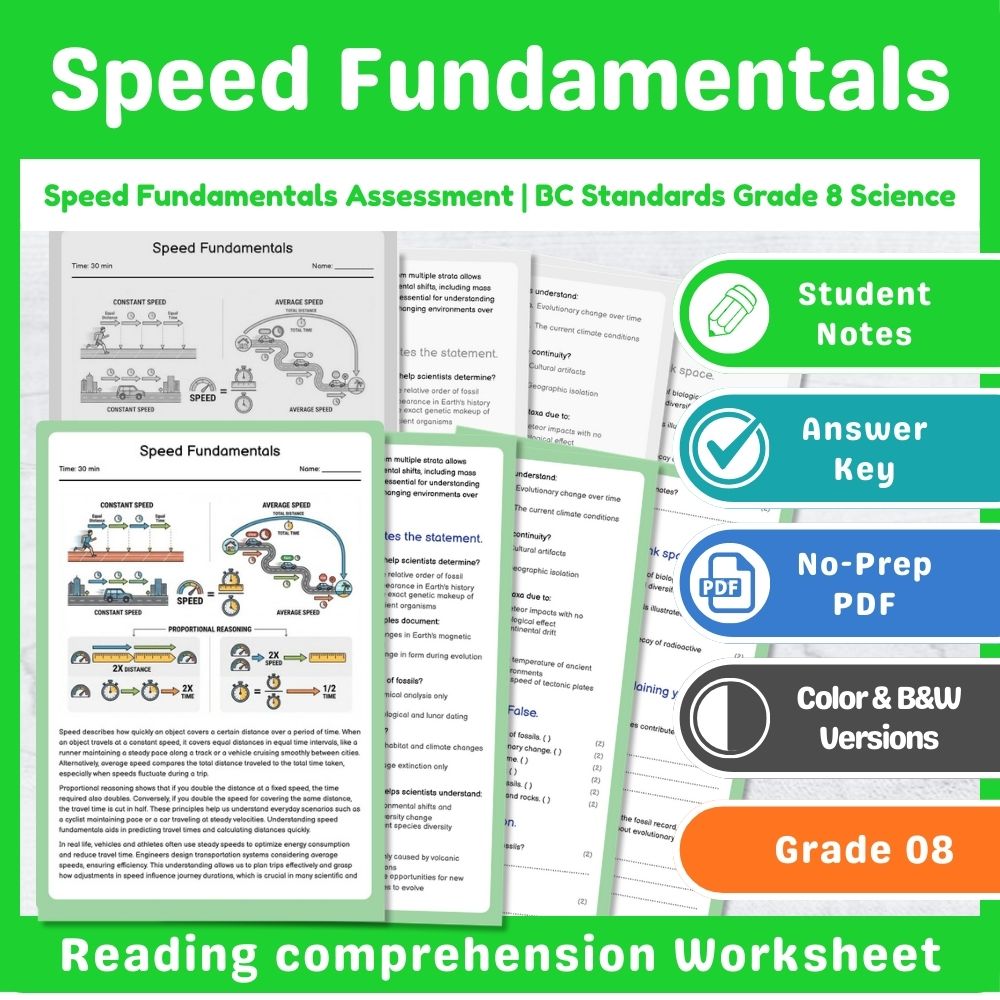
Speed Fundamentals Assessment | BC Standards Grade 8 Science
Created byPrism Point LearningLearning Objectives
- Define speed as the ratio of distance over time.
- Differentiate between constant and average speed.
- Apply proportional reasoning to solve speed, distance, and time problems.
Instant download

Measurement Concepts Assessment | Alberta Standards Grade 12 Science
Created byPrism Point LearningLearning Objectives
- Understand the significance of SI units and calibration in measurement.
- Differentiate between accuracy, precision, systematic and random errors.
- Learn how instrument response and traceability affect data quality in Alberta field contexts.
Also included in: Grade 12 Science 30 Lesson Bundle: Alberta Science Assessment Pack +1 more
Instant download
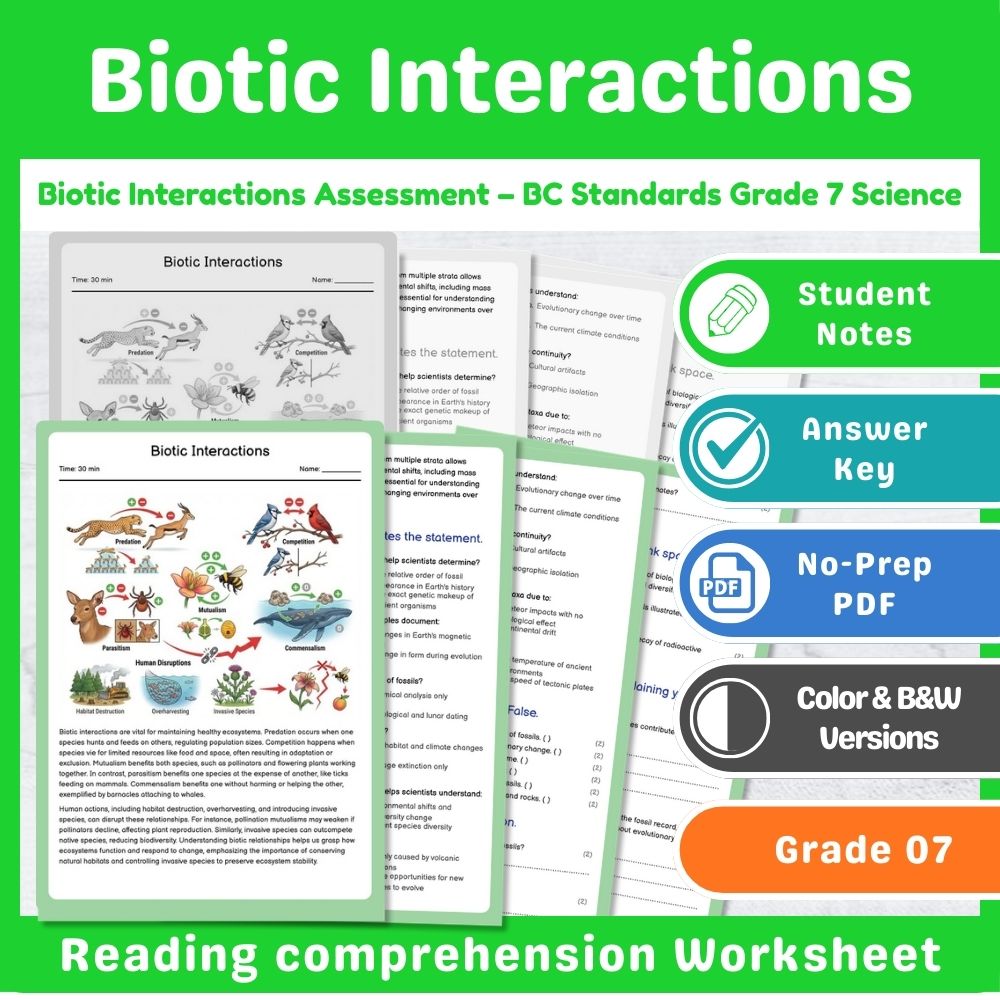
Biotic Interactions Assessment – BC Standards Grade 7 Science
Created byPrism Point LearningLearning Objectives
- Understand the different types of biotic interactions such as predation, competition, mutualism, commensalism, and parasitism.
- Explain how human activities can disrupt biotic relationships and affect ecosystems.
- Describe how changes in one species can influence community structure and biodiversity.
Instant download
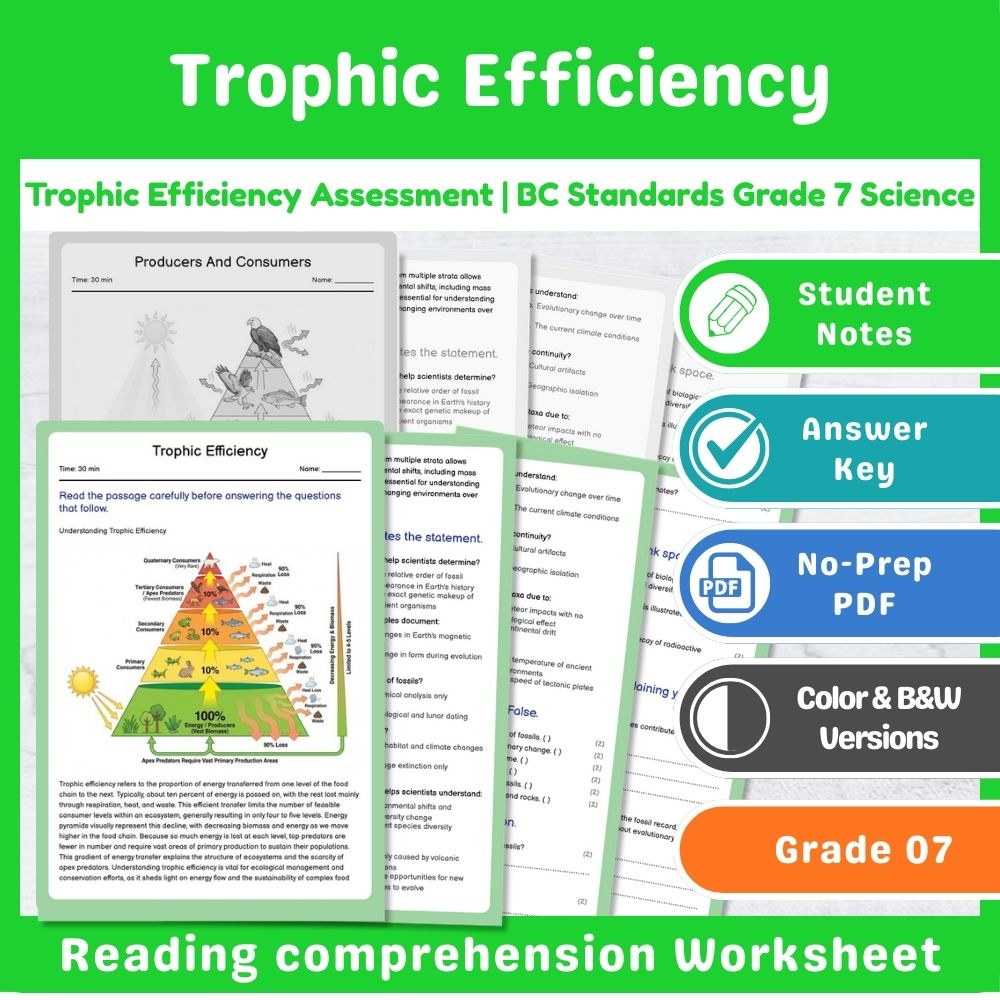
Trophic Efficiency Assessment | BC Standards Grade 7 Science
Created byPrism Point LearningLearning Objectives
- Explain the concept of trophic efficiency and its role in energy transfer within ecosystems.
- Describe how energy pyramids illustrate energy loss at each trophic level.
- Understand the factors limiting the number of trophic levels in ecological communities.
Instant download
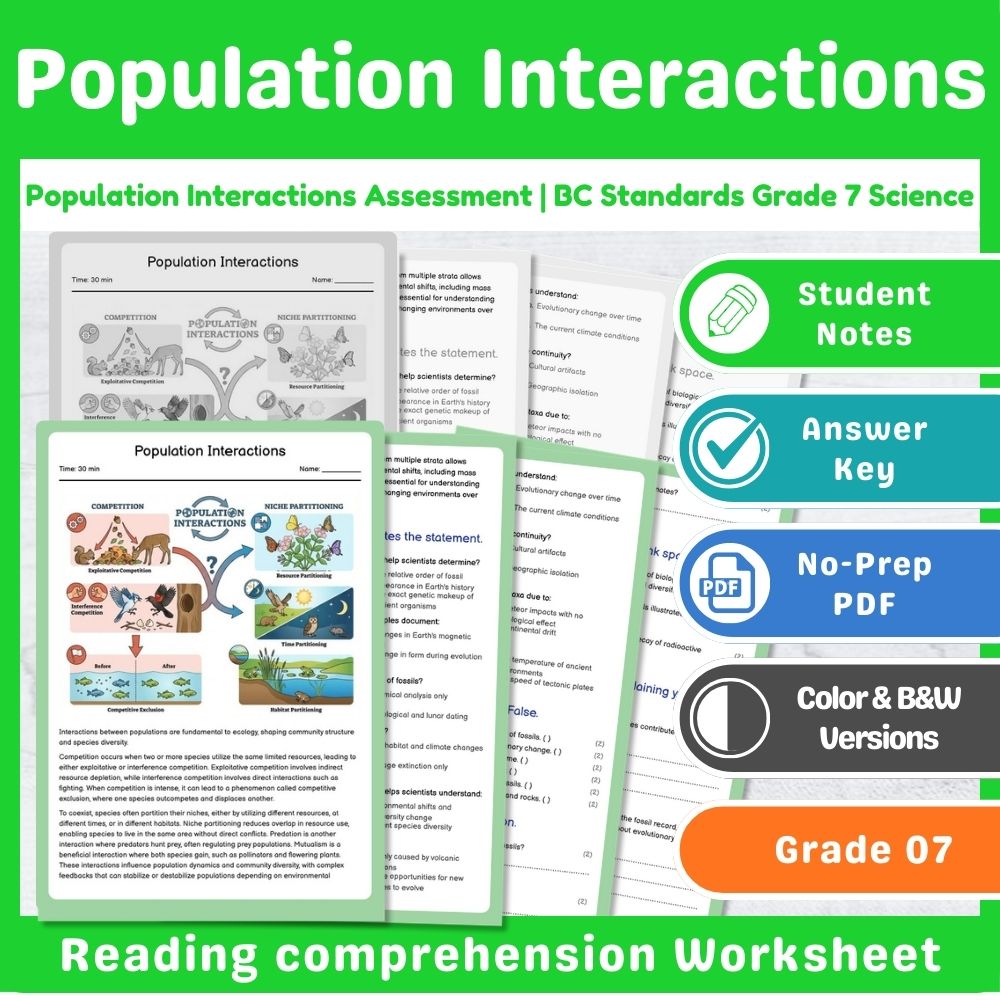
Population Interactions Assessment | BC Standards Grade 7 Science
Created byPrism Point LearningLearning Objectives
- Understand different types of population interactions including competition, predation, and mutualism.
- Identify mechanisms that allow species to coexist despite competition.
- Explain how interactions influence community composition and diversity.
Instant download
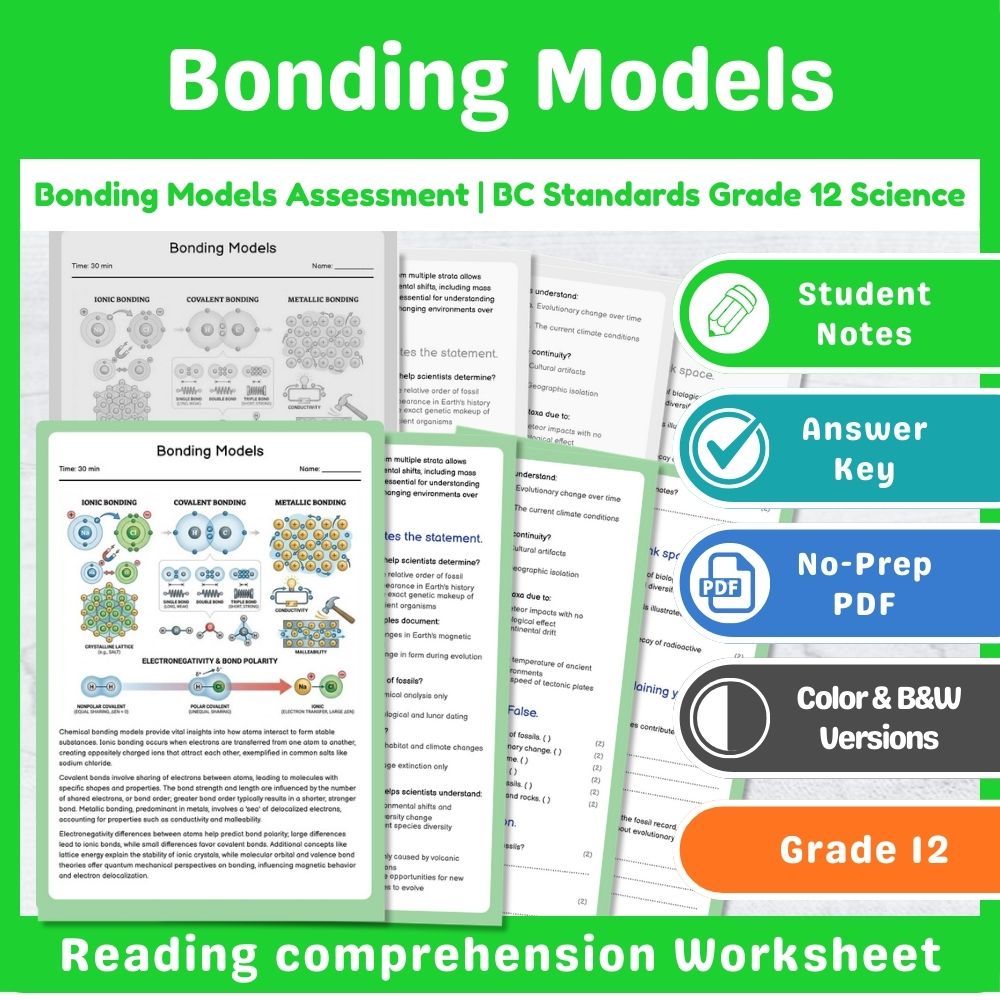
Bonding Models Assessment | BC Standards Grade 12 Science
Created byPrism Point LearningLearning Objectives
- Understand different models of chemical bonding and how they explain the behavior of atoms in molecules.
- Identify the principles behind ionic, covalent, and metallic bonding, including how electrons are shared or transferred.
- Explain how electronegativity differences predict bond polarity and how bond order and energy relate to bond length and strength.
Also included in: Grade 12 Science Mini Bundle – Thermochemistry & Equilibrium Assessment
Instant download
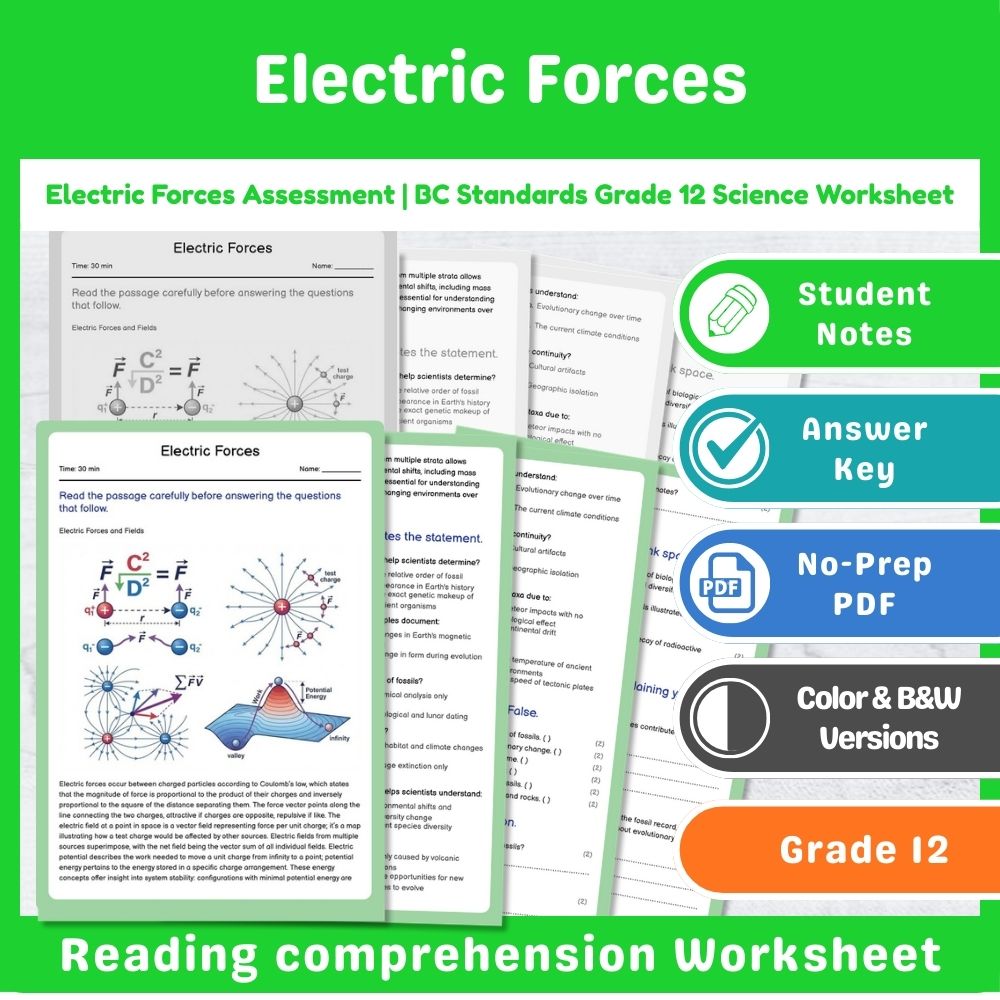
Electric Forces Assessment | BC Standards Grade 12 Science Worksheet
Created byPrism Point LearningLearning Objectives
- Explain Coulomb’s law and how it determines the magnitude and direction of electric forces between point charges.
- Describe the concept of electric field as a spatial force distribution and understand superposition of fields.
- Define electric potential and potential energy, and analyze energy configurations of charged systems.
Also included in: Grade 12 Science Wave & Quantum Assessment Mini Bundle – BC Standards
Instant download

Climate Drivers Over Time Assessment | General Grade 7 Science
Created byPrism Point LearningLearning Objectives
- Understand how natural records and measurements are used to assess past and present climate conditions.
- Identify key climate drivers that influence long-term climate change.
- Explain how factors like greenhouse gases, ocean currents, and volcanic activity affect Earth's energy balance.
Also included in: Grade 7 Earth & Space Science Lesson Bundle: General Science Framework
Instant download

Inheritance Patterns Assessment for Grade 12 Science | BC Standards
Created byPrism Point LearningLearning Objectives
- Explain various inheritance models such as Mendelian segregation, linkage, Sex linkage, incomplete dominance, and polygenic traits.
- Describe how recombination frequency reveals chromosomal distances and influences trait distribution.
- Interpret pedigrees to infer inheritance modes and estimate carrier status.
Also included in: Grade 12 Science Mini Bundle – Genetics & Evolution Assessment Pack
Instant download

Mountain Building Assessment | BC Standards Grade 12 Science
Created byPrism Point LearningLearning Objectives
- Understand the geological processes involved in mountain formation and orogeny.
- Identify the different tectonic settings that lead to mountain building, such as subduction zones and continent-continent collisions.
- Describe the geological features and records preserved in mountain ranges that inform us about past tectonic regimes.
Also included in: Grade 12 Science Mini Bundle – Plate Tectonics & Geoscience Assessment
Instant download

Resource Assessment Assessment | BC Standards Grade 12 Science
Created byPrism Point LearningLearning Objectives
- Understand the methods used for resource evaluation including geological, geophysical, and geochemical techniques.
- Identify environmental considerations such as waste, water, and greenhouse gas emissions in resource extraction.
- Evaluate the balance between resource development benefits and ecological impacts.
Also included in: Grade 12 Science Mini Bundle – Plate Tectonics & Geoscience Assessment
Instant download
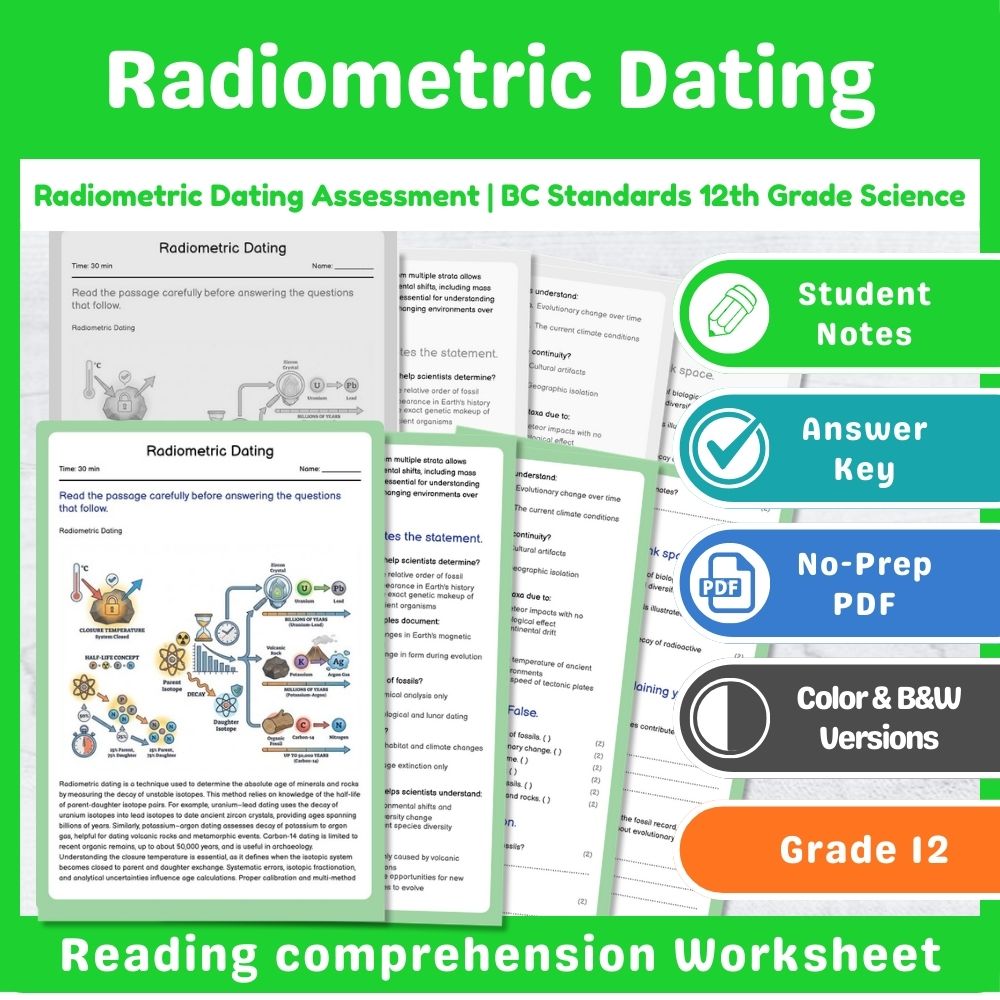
Radiometric Dating Assessment | BC Standards 12th Grade Science
Created byPrism Point LearningLearning Objectives
- Understand the principles of radiometric dating and isotopic decay.
- Identify different radiometric dating methods and their applications.
- Analyze factors affecting the accuracy of radiometric age determinations.
Also included in: Grade 12 Science Mini Bundle – Plate Tectonics & Geoscience Assessment
Instant download
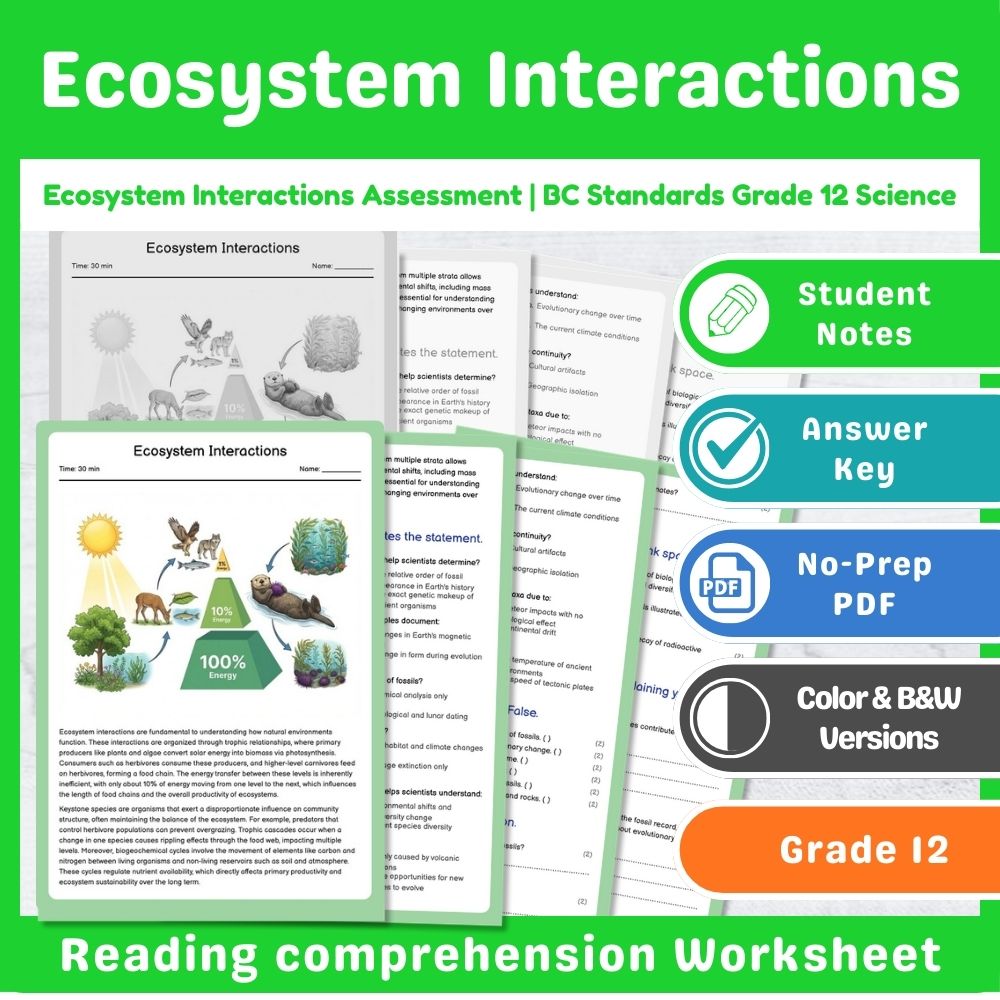
Ecosystem Interactions Assessment | BC Standards Grade 12 Science
Created byPrism Point LearningLearning Objectives
- Explain the flow of energy through trophic levels and its impact on ecosystem productivity.
- Identify key species and their roles within ecological communities, including keystone species.
- Describe trophic cascades and how changes at one level affect others.
Also included in: Grade 12 Science Mini Bundle – Genetics & Evolution Assessment Pack
Instant download

Genetic Variation Assessment for Grade 12 Science BC Standards
Created byPrism Point LearningLearning Objectives
- Understand the mechanisms that generate genetic variation, including mutations and recombination.
- Explain how genetic variation influences phenotypes and evolution.
- Compare Mendelian inheritance with polygenic inheritance and gene interactions.
Also included in: Grade 12 Science Mini Bundle – Genetics & Evolution Assessment Pack
Instant download

Quantum Photons Assessment | BC Standards Grade 12 Science
Created byPrism Point LearningLearning Objectives
- Describe the concept of photon energy and its relation to frequency through the equation E = hf.
- Explain the photoelectric effect as evidence of light's particle-like behavior.
- Define work function and threshold frequency in the context of electron emission.
Also included in: Grade 12 Science Wave & Quantum Assessment Mini Bundle – BC Standards
Instant download

Field Energy Assessment | BC Standards Grade 12 Science Worksheet
Created byPrism Point LearningLearning Objectives
- Define energy density for electrostatic and magnetic fields.
- Explain how capacitors and inductors store and release energy in circuits.
- Describe the concept of field energy as distributed in space and how work is involved in charge configuration.
Also included in: Grade 12 Science Wave & Quantum Assessment Mini Bundle – BC Standards
Instant download

Surface Process Evidence Assessment | General Grade 7 Science
Created byPrism Point LearningLearning Objectives
- Understand how Earth's surface is shaped by internal and external processes.
- Identify evidence of surface processes in landform patterns and rock formations.
- Explain how landforms such as deltas and floodplains are formed through external processes.
Also included in: Grade 7 Earth & Space Science Lesson Bundle: General Science Framework
Instant download
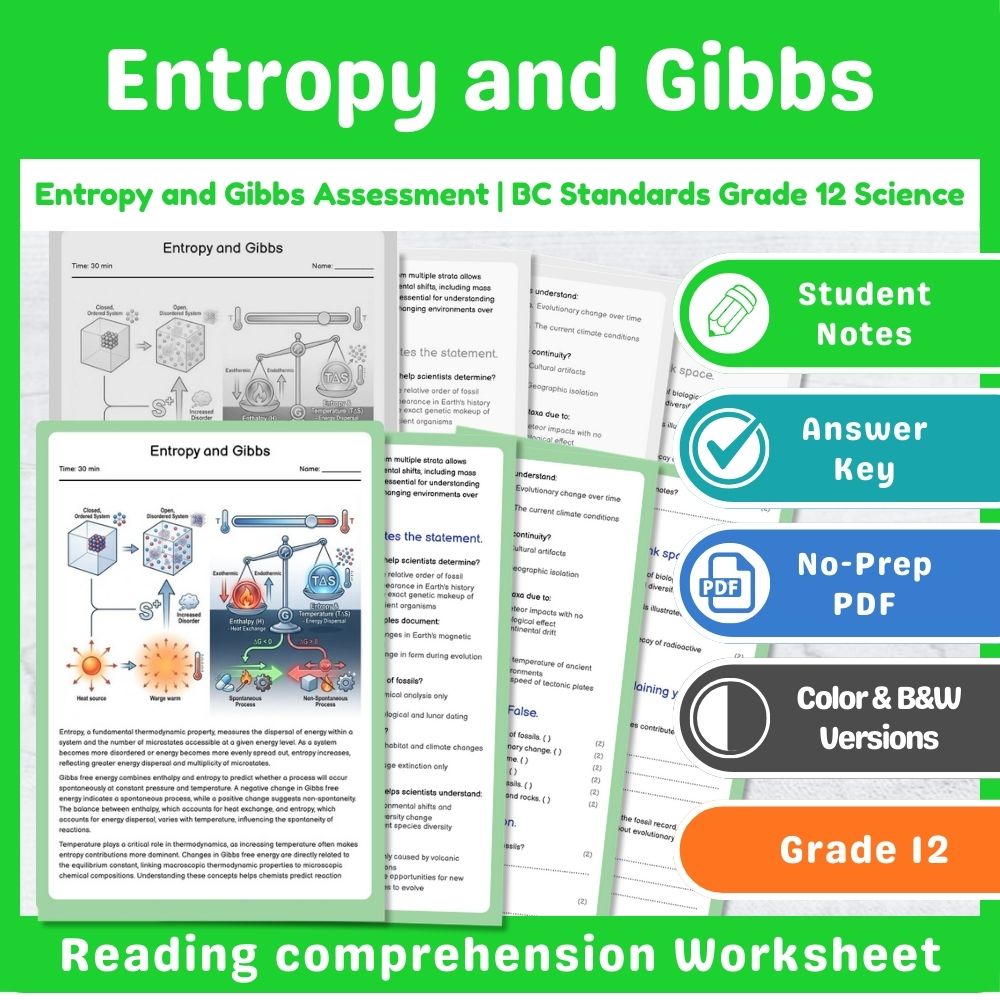
Entropy and Gibbs Assessment | BC Standards Grade 12 Science
Created byPrism Point LearningLearning Objectives
- Explain the concept of entropy and how it relates to energy dispersal and microstates.
- Describe Gibbs free energy and its role in predicting the spontaneity of chemical reactions.
- Analyze how enthalpy and entropy contributions influence temperature-dependent spontaneity.
Also included in: Grade 12 Science Mini Bundle – Thermochemistry & Equilibrium Assessment
Instant download
Browse more categories
About Reading comprehension Worksheets
Find reading comprehension worksheets for class practice, homework, or self-study. All 40,289 are instant PDF downloads.
Each resource here is built by an independent educator and reviewed for quality. Worksheets print straight from PDF and suit classroom use, homework, or extra practice; most come with answer keys, and you can preview before purchasing.