
Grade 12 Science Worksheets
4,404 worksheets
Grade 12 Frequency Wavelength Speed Worksheet | California Science Standards
 Created byEvergreen Desk Education
Learning Objectives
- Explain how wave speed, frequency, and wavelength are related using v = fλ.
- Predict how wavelength changes when frequency changes, assuming wave speed is constant.
- Apply frequency–wavelength reasoning to compare electromagnetic waves such as radio and visible light.
Instant download

Grade 12 Science | Wave Speed & Frequency - Daily Reading Comprehension
 Created byCoral Reef Learning
Learning Objectives
- Define wave speed and explain its importance in wave behavior
- Understand the relationship between frequency, wavelength, and wave speed
- Calculate wave speed using frequency and wavelength
Instant download

Grade 12 Science | Frequency Wavelength Speed Worksheet | California Standards
 Created byLumora Learning
Learning Objectives
- Understand the relationship between wave frequency, wavelength, and wave speed.
- Describe how changes in frequency affect wavelength in wave phenomena.
- Compare wave behavior across different regions of the electromagnetic spectrum.
Instant download

Frequency Wavelength Speed Worksheet | Grade 12 Wave Physics Activity
 Created byPrism Point Learning
Learning Objectives
- Use the wave equation v = fλ to relate frequency, wavelength, and wave speed.
- Explain how changes in frequency affect wavelength when wave speed stays constant.
- Apply wave relationships to interpret electromagnetic spectrum examples.
Instant download

Wave Relationships Worksheet | Standard-Aligned Science Practice for Grade 12
Learning Objectives
- Understand the relationship between wave frequency, wavelength, and speed.
- Explain how changes in frequency affect wavelength in wave phenomena.
- Apply wave concepts to compare different regions of the electromagnetic spectrum.
Also included in: Grade 12 Energy, Forces, and Waves Science Lesson Bundle | California Standards +1 more
Instant download

Grade 12 Science – Wave Properties & Speed | Daily Reading Worksheet
 Created byBright Mind Resources
Learning Objectives
- Understand the fundamental concepts of wave frequency, wavelength, and wave speed.
- Learn how these properties relate to each other mathematically.
- Explore the differences between types of electromagnetic waves based on their frequency and wavelength.
Also included in: Energy Grade 12 Science Daily Reading Worksheets Lesson Bundle | CA Standards +1 more
Instant download

Grade 12 Science – Scientific Models & NGSSS | Daily Reading Worksheet
Created byBright Mind ResourcesLearning Objectives
- Understand the purpose and importance of models in science
- Identify different types of scientific models
- Recognize the limitations and assumptions of models
Also included in: Scientific Inquiry , Models & Claims Grade 12 Science Bundle | Florida NGSSS +1 more
Instant download

Scientific Models Practice Worksheet | Standard-Aligned Grade 12 Science
Learning Objectives
- Explain how scientific models represent phenomena and connect variables to predictions.
- Identify assumptions and limitations in models and describe how evidence can drive model revision.
- Use models to reason about outcomes under new conditions in scientific contexts.
Also included in: Grade 12 Science Claims, Evidence, and Models Lesson Bundle – Florida NGSSS +1 more
Instant download

Grade 12 Science | Scientific Models - Daily Reading Comprehension
Created byCoral Reef LearningLearning Objectives
- Understand what scientific models are and their purpose
- Identify different types of scientific models used in various fields
- Explain how models help scientists make predictions and explanations
Instant download

Scientific Models Worksheet Grade 12 NGSSS Science Activity + Answer Key
Created byEvergreen Desk EducationLearning Objectives
- Explain how scientific models represent systems and relate variables to observed patterns
- Differentiate between diagram, mathematical, and simulation models and describe what each is best used for
- Evaluate a model’s assumptions and limitations and justify how evidence can revise it
Instant download

Scientific Models Worksheet Grade 12 Science NGSSS Practice Pack
Created byPrism Point LearningLearning Objectives
- Explain how scientific models represent systems and link observations to explanations
- Identify assumptions and limitations in a model and describe when models should be revised
- Use models to make and evaluate predictions under new conditions
Instant download

Grade 12 Science | Scientific Models Worksheet | NGSSS Aligned
Created byLumora LearningLearning Objectives
- Explain how scientific models represent patterns in natural phenomena and support predictions.
- Identify common types of models (diagrams, mathematical relationships, and simulations) and the variables they connect.
- Evaluate how assumptions and limitations affect a model’s accuracy and how evidence can lead to revision.
Instant download

Scientific Models Grade 12 Science Assessment | NGSSS Standards
Created byPrism Point LearningLearning Objectives
- Explain how scientific models represent real-world systems to support explanation and prediction
- Identify common types of models (diagram, mathematical, simulation) and link them to relevant variables
- Evaluate a model by stating assumptions, limitations, and how evidence could revise it
Also included in: Grade 12 Science Claims & Evidence Lesson Bundle Assessment | Florida NGSSS +1 more
Instant download

Grade 12 Stoichiometric Concepts Worksheet | Practice & PDF
 Created byClear Sky Classroom
Learning Objectives
- Use the mole concept to convert between mass, moles, and particle counts.
- Apply molar mass and balanced chemical equations to relate reactant and product quantities.
- Determine the limiting reactant and calculate theoretical yield from stoichiometric ratios.
Also included in: Grade 12 Chemistry Stoichiometry & Atomic Models Science Lesson Bundle AP +1 more
Instant download

Grade 12 Science | Stoichiometric Concepts - Daily Reading Comprehension
Created byCoral Reef LearningLearning Objectives
- Understand how to interpret mole ratios from balanced chemical equations
- Calculate limiting reactants in chemical reactions
- Determine theoretical yields based on molar relationships
Also included in: Chemistry Foundations Lesson Bundle | Grade 12 Science AP +1 more
Instant download

Stoichiometric Concepts Worksheet | AP Chemistry Practice for Grade 12
Learning Objectives
- Understand the quantitative relationships in chemical reactions using the mole concept, molar mass, and balanced equations.
- Calculate limiting reactant, theoretical yield, and percent yield from mass and mole data.
- Employ symbolic and arithmetic representations to connect mass, particle count, and molar relationships.
Instant download

Stoichiometric Concepts Worksheet | AP Chemistry Grade 12 Practice
Created byPrism Point LearningLearning Objectives
- Use balanced chemical equations to relate moles of reactants to moles of products.
- Convert between mass, moles, and particle counts using molar mass and the mole concept.
- Calculate limiting reactant, theoretical yield, and percent yield from mass or mole data.
Instant download

Grade 12 Science Worksheet | Stoichiometric Concepts AP Standard (PDF)
Created byEvergreen Desk EducationLearning Objectives
- Use mole concepts and molar mass to convert between mass, moles, and particle counts.
- Apply balanced chemical equations to determine mole ratios and predict product amounts.
- Determine the limiting reactant, theoretical yield, and percent yield from given data.
Also included in: Grade 12 Chemistry Foundations Science Lesson Bundle for Advanced Placement (AP) +1 more
Instant download

Grade 12 Science – Mole & Molar Mass Daily Reading Worksheet | AP Standards
Created byBright Mind ResourcesLearning Objectives
- Explain the concept of a mole in chemistry.
- Calculate molar mass of chemical compounds.
- Determine the number of particles in a sample using molar relationships.
Also included in: Grade 12 Chemistry Daily Reading Science Lesson Bundle | AP Standards +2 more
Instant download
Grade 12 Science | Stoichiometric Concepts Worksheet (AP Standards) (PDF)
Created byBright Mind ResourcesLearning Objectives
- Understand and apply the mole concept and molar mass to relate quantities of reactants and products.
- Interpret balanced chemical equations to determine molar relationships.
- Calculate limiting reactant, theoretical yield, and percent yield from mass and mole data.
Instant download
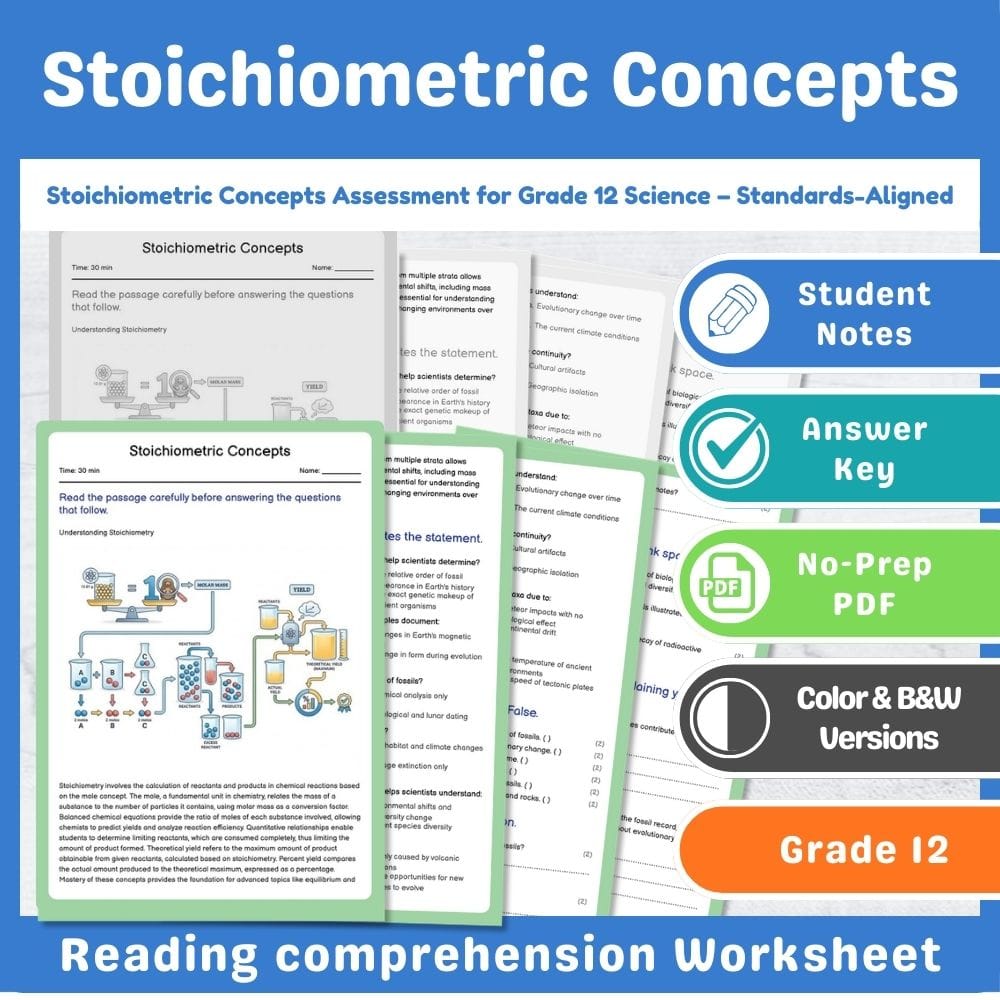
Stoichiometric Concepts Assessment for Grade 12 Science – Standards-Aligned
Created byPrism Point LearningLearning Objectives
- Define and understand the mole concept, molar mass, and balanced chemical equations.
- Calculate limiting reactants, theoretical yield, and percent yield from experimental data.
- Relate mass, particle counts, and molar relationships using symbolic and arithmetic methods.
Instant download

Grade 12 Science — Worksheet MCQ Paper for Mastering Stoichiometry
 Created byThe Resource Hub
Learning Objectives
- Understand the mole concept and its applications in quantitative chemical analysis.
- Apply balanced equations to determine molar relationships between reactants and products.
- Calculate limiting reactants, theoretical yields, and percent yields from mass and mole data.
Also included in: Grade 12 Science AP Practice Worksheets Bundle for Mastering Core Concepts +2 more
Instant download
Grade 12 Science – Stoichiometry Daily Reading Worksheet with Answer Key
Learning Objectives
- Define the mole and explain its importance in chemistry.
- Calculate molar mass of different chemical compounds.
- Interpret balanced chemical equations to determine relationships between reactants and products.
Also included in: Grade 12 Chemistry Foundations Lesson Bundle – AP Science Activities +1 more
Instant download
12th Grade Science | Stoichiometric Concepts Worksheet (PDF+ Answer Key)
 Created byCopper Leaf Classroom
Learning Objectives
- Define and interpret quantitative relationships in chemical reactions using the mole concept and molar mass.
- Apply balanced chemical equations to relate amounts of reactants and products.
- Calculate limiting reactants, theoretical yield, and percent yield from mass and mole data.
Also included in: Grade 12 Science | Chemical Bonding & Reaction Concepts (PDF+ Answer Key) +1 more
Instant download

Grade 12 Science | Stoichiometric Concepts Worksheet | AP Aligned
Created byLumora LearningLearning Objectives
- Understand and apply the mole concept to quantify reactants and products in chemical reactions.
- Calculate limiting reactants, theoretical yields, and percent yields from given mass and mole data.
- Use balanced chemical equations to relate quantities of substances involved in reactions.
Instant download

Equilibrium Foundations Worksheet | AP Science Practice for Grade 12
Learning Objectives
- Explain the concept of chemical equilibrium as a dynamic balance between forward and reverse reactions.
- Describe the equilibrium constant as a quantitative measure of reaction position.
- Relate concentration- and pressure-based expressions to reaction directionality and response to perturbations.
Instant download
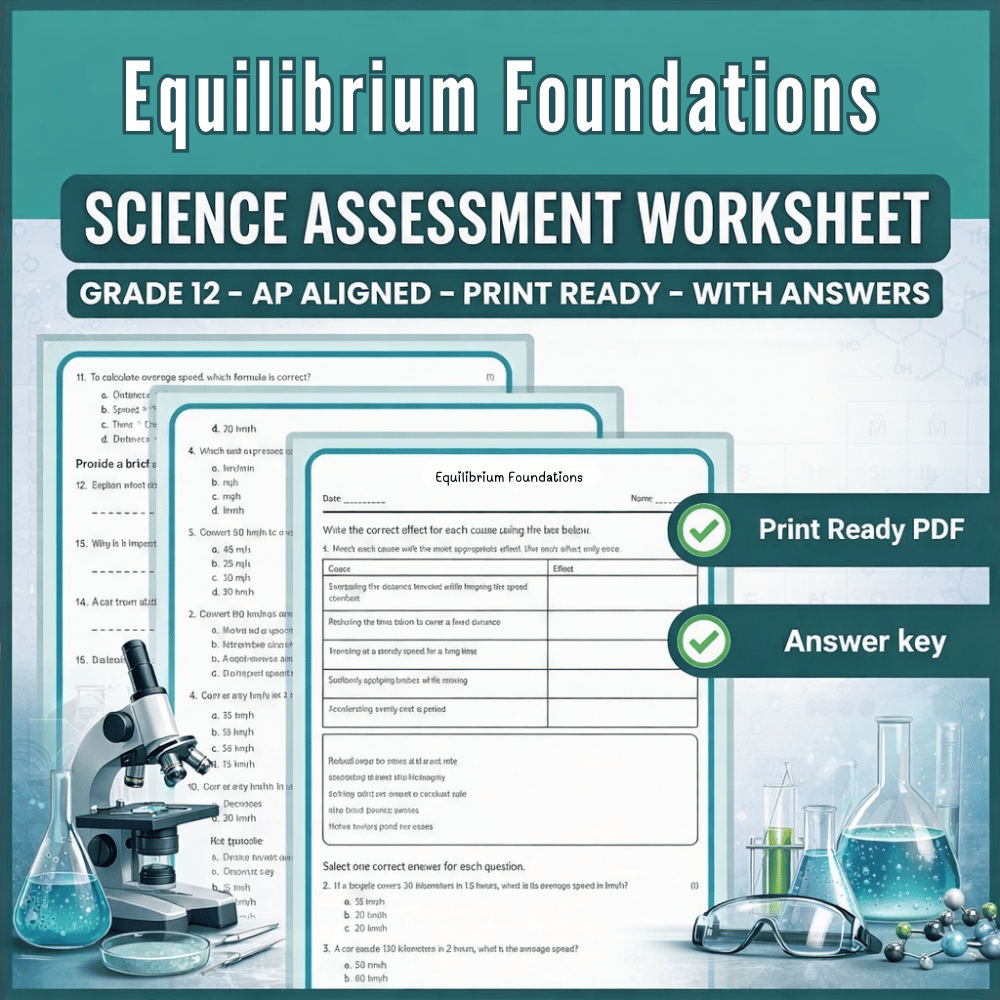
Grade 12 Science | Equilibrium Foundations Worksheet (AP) (PDF)
Created byBright Mind ResourcesLearning Objectives
- Explain the concept of chemical equilibrium as a dynamic balance between forward and reverse reactions.
- Describe the equilibrium constant as a quantitative measure of the position of equilibrium.
- Analyze how changes in concentration and pressure affect the direction of a chemical reaction.
Instant download
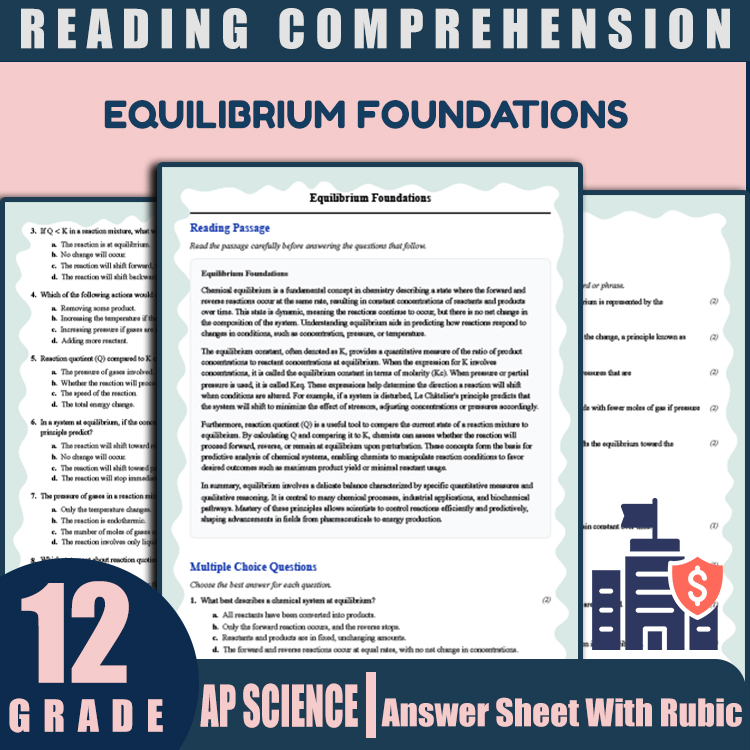
12th Grade Science | Equilibrium Foundations Reading Worksheet (PDF + Rubric)
Learning Objectives
- Explain the concept of chemical equilibrium as a dynamic balance between forward and reverse reactions.
- Describe how the equilibrium constant characterizes the relative concentrations of reactants and products at equilibrium.
- Relate concentration and pressure expressions to reaction directionality and shifts due to stressors.
Also included in: Grade 12 Science Unit Bundle | Atomic Structure & Chemical Reactions Worksheets +1 more
Instant download

Grade 12 Science | Equilibrium Foundations Worksheet Elena | AP Aligned
Created byLumora LearningLearning Objectives
- Explain the concept of chemical equilibrium as a dynamic balance between forward and reverse reactions.
- Define and interpret the equilibrium constant as a quantitative measure of reaction position.
- Relate concentration- and pressure-based expressions to reaction directionality and response to perturbations.
Instant download

Grade 12 Science | Understanding Chemical Equilibrium - Reading Comprehension
Created byCoral Reef LearningLearning Objectives
- Define chemical equilibrium and recognize it in real-world examples.
- Describe the dynamic nature of equilibrium involving forward and reverse reactions.
- Explain the role of the equilibrium constant as a quantitative measure.
Also included in: Chemistry Foundations Lesson Bundle | Grade 12 Science AP +1 more
Instant download

Grade 12 Science — Equilibrium Foundations Worksheet MCQ Paper
Created byThe Resource HubLearning Objectives
- Understand the concept of chemical equilibrium as a dynamic balance between forward and reverse reactions.
- Interpret the equilibrium constant as a measure of reaction position and extent.
- Relate concentration- and pressure-based expressions to reaction direction and shifts.
Also included in: Grade 12 Science AP Practice Worksheets Bundle for Mastering Core Concepts +2 more
Instant download

Grade 12 Science | Equilibrium Foundations Worksheet (AP Standards) (PDF)
Created byEvergreen Desk EducationLearning Objectives
- Explain chemical equilibrium as a dynamic balance between forward and reverse reaction rates
- Interpret the meaning of equilibrium constants (Kc and Kp) and their dependence on temperature
- Use reaction quotient (Q) compared with K to predict the shift in reaction composition after a perturbation
Also included in: Grade 12 Chemistry Foundations Science Lesson Bundle for Advanced Placement (AP) +1 more
Instant download

Grade 12 Science – Wave Behavior & Properties | Daily Reading Worksheet
Created byBright Mind ResourcesLearning Objectives
- Identify different types of waves and their basic properties
- Understand the concept of wave displacement, wavelength, frequency, and amplitude
- Describe wave superposition, interference, and standing waves
Also included in: AP Science Grade 12 Daily Reading Worksheets Lesson Bundle | AP +2 more
Instant download
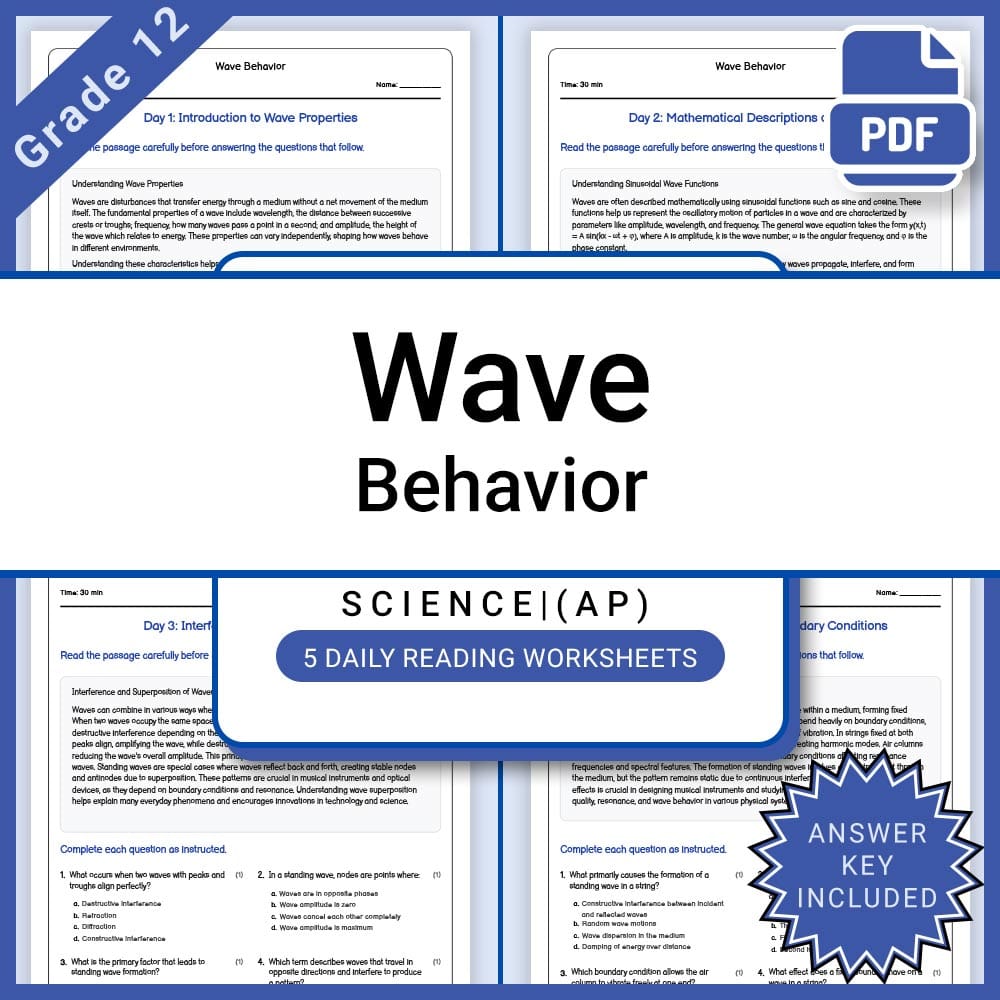
Grade 12 Science – Wave Behavior Daily Reading Worksheet + Answer Key
Learning Objectives
- Identify basic wave characteristics such as wavelength, frequency, and amplitude
- Understand the principles of superposition, interference, and standing waves
- Represent sinusoidal waves mathematically and conceptually
Also included in: Grade 12 Physics Principles Lesson Bundle – AP Science Curriculum +1 more
Instant download

Grade 12 Wave Behavior Worksheet | Practice & NGSS PDF
Created byClear Sky ClassroomLearning Objectives
- Characterize sinusoidal wave behavior using wavelength, frequency, amplitude, and phase.
- Apply superposition and interference principles to predict resulting displacement patterns.
- Use boundary conditions to determine standing-wave modes in strings and air columns.
Also included in: Grade 12 Physics Science Lesson Bundle: Motion, Energy (Advanced Placement (AP)) +1 more
Instant download
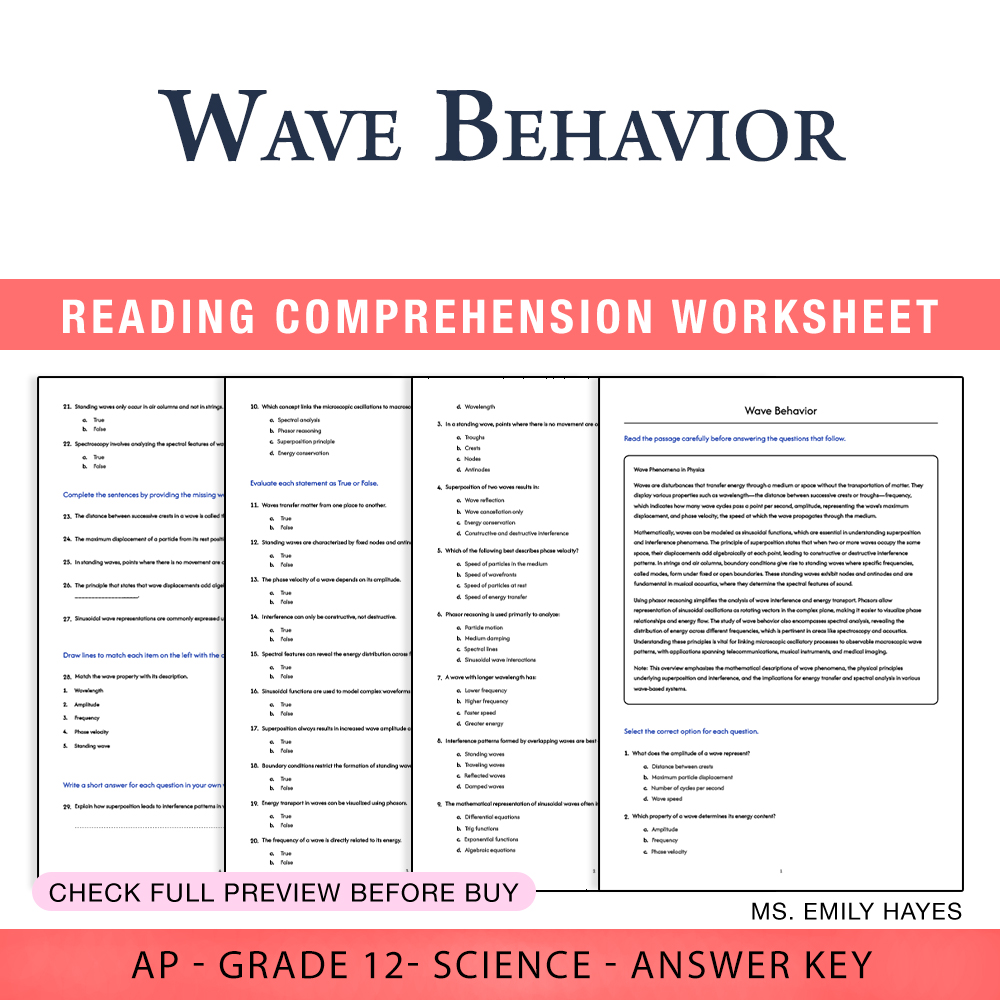
Grade 12 Science | Wave Behavior Worksheet (PDF+ Answer Key)
Created byCopper Leaf ClassroomLearning Objectives
- Understand the fundamental properties of waves, including wavelength, frequency, phase velocity, and amplitude.
- Explain the principles of superposition and interference in wave phenomena.
- Analyze standing wave formation, boundary conditions, and mode structures in strings and air columns.
Also included in: Grade 12 Science AP – Energy, Motion & Electricity Mastery(PDF+ Answer Key) +1 more
Instant download
Grade 12 Science | Wave Behavior Worksheet (AP Standard) (PDF)
Created byBright Mind ResourcesLearning Objectives
- Understand and describe the key properties of waves such as wavelength, frequency, amplitude, and phase velocity.
- Apply principles of superposition and interference to wave phenomena.
- Analyze standing wave formation and boundary conditions in strings and air columns.
Instant download

Wave Behavior Worksheet AP Science Practice and Mastery
Learning Objectives
- Describe the fundamental properties of waves including wavelength, frequency, amplitude, and phase velocity.
- Explain the principles of superposition, interference, and standing waves in different media.
- Apply mathematical representations and concepts such as sinusoidal functions and phasor reasoning to analyze wave phenomena.
Instant download

Wave Behavior Practice Worksheet Pack AP Physics Grade 12 Waves
Created byPrism Point LearningLearning Objectives
- Describe periodic wave motion using amplitude, wavelength, frequency, and phase relationships.
- Use the superposition principle to predict interference patterns for waves on strings and in air.
- Explain standing-wave formation with boundary conditions and relate mode structure to resonance frequencies.
Also included in: AP Physics Grade 12 Science Mechanics & Electricity Lesson Bundle | AP
Instant download

Grade 12 Science | Wave Behavior Worksheet | AP Aligned
Created byLumora LearningLearning Objectives
- Describe wave phenomena using mathematical descriptions such as wavelength, frequency, phase velocity, and amplitude.
- Explain the principles of superposition, interference, and standing waves in strings and air columns.
- Apply sinusoidal representations, phasor reasoning, and energy transport concepts to analyze wave patterns.
Instant download

Grade 12 Science | Wave Behavior - Daily Reading Comprehension
Created byCoral Reef LearningLearning Objectives
- Identify basic wave characteristics such as wavelength, frequency, amplitude, and phase velocity.
- Understand the principles of superposition, interference, and standing waves.
- Apply sinusoidal models and phasor reasoning to wave phenomena.
Also included in: Daily Reading Comprehension Skills Lesson Bundle | Grade 12 Science AP +1 more
Instant download

Grade 12 Science – Criteria & Constraints in Engineering | Reading Worksheet
Created byBright Mind ResourcesLearning Objectives
- Define what constraints are in engineering design.
- Identify various types of engineering constraints in real-world problems.
- Explain the importance of criteria in guiding engineering solutions.
Also included in: Grade 12 Systems & Eng. Science Daily Rd Lesson Bundle | California Standards +1 more
Instant download

Grade 12 Science Worksheet Bundle | California Standards Biology Practice & Critical Thinking
Created byEvergreen Desk EducationLearning Objectives
- Explain how societal needs become engineering criteria and how constraints limit solutions.
- Identify qualitative and quantitative criteria used to evaluate an engineering design.
- Use measurable targets and limits to justify design decisions and trade-offs.
Instant download

Criteria Constraints Worksheet | Standards-Aligned Science Practice for Grade 12
Learning Objectives
- Understand how societal needs are translated into measurable criteria and constraints for engineering solutions.
- Identify key qualitative and quantitative criteria such as cost, safety, energy use, and environmental boundaries.
- Analyze examples of criteria application in real-world engineering challenges like water access during droughts.
Also included in: Grade 12 Systems Thinking Trade-Offs Science Lesson Bundle +1 more
Instant download

Grade 12 Science | Criteria & Constraints in Engineering Design - Daily Reading
Created byCoral Reef LearningLearning Objectives
- Understand the concept of criteria and constraints in engineering
- Identify societal needs and how they influence engineering solutions
- Recognize measurable limits such as cost, safety, and environmental boundaries
Instant download

Grade 12 Science | Criteria Constraints Worksheet Elena | California Standards
Created byLumora LearningLearning Objectives
- Understand how societal needs are translated into measurable criteria and constraints in engineering solutions.
- Identify key qualitative and quantitative criteria used in designing solutions for global challenges.
- Analyze the importance of balancing societal needs with environmental, safety, and cost constraints.
Instant download

Grade 12 Science Criteria and Constraints Worksheet CA Standards
Created byPrism Point LearningLearning Objectives
- Translate a real-world engineering challenge into clear qualitative and quantitative criteria and measurable constraints.
- Connect societal needs and wants to specific limits such as cost, reliability, safety, energy use, and environmental impact.
- Evaluate design trade-offs by interpreting criteria, constraints, and regulatory or resource boundaries.
Instant download
Grade 12 Science | Climate Drivers Worksheet (AP Standards) (PDF)
Created byBright Mind ResourcesLearning Objectives
- Identify the main forcings that influence climate variability and change.
- Understand the concepts of radiative forcing and feedback loops such as ice-albedo and water vapor responses.
- Compare the roles of different climate drivers across various timescales using simple models.
Instant download
About Grade 12 Science Worksheets
Explore Grade 12 Science worksheets for classwork, homework, or review. Our 4,404 printables download instantly as PDFs.
MyTeachingSheets worksheets are made by real teacher-authors and checked before they go live. Download any as a print-ready PDF for lessons, homework, or independent practice — most include answer keys, and previews are always free.