
Grade 12 Science Worksheets
4,404 worksheets
Grade 12 Science | Climate Drivers Worksheet | AP Aligned
 Created byLumora Learning
Learning Objectives
- Identify the key forcings that influence climate variability and change.
- Explain feedback mechanisms such as ice-albedo and water vapor feedback.
- Understand how radiative forcing metrics quantify climate drivers.
Also included in: Grade 12 Science | Earth Systems Science Custom Bundle | AP Aligned
Instant download

Grade 12 Science — Worksheet MCQ Paper for Climate Drivers
 Created byThe Resource Hub
Learning Objectives
- Understand the key forcings that influence climate variability and change.
- Analyze the roles of greenhouse gases, volcanic aerosols, solar irradiance, and land surface changes in climate forcing.
- Evaluate feedback mechanisms such as ice-albedo and water vapor feedbacks.
Also included in: Grade 12 Science AP Custom Bundle: Earth Systems, Climate, and Tectonics +1 more
Instant download

Grade 12 Climate Drivers Worksheet | Practice & Assessment PDF
 Created byClear Sky Classroom
Learning Objectives
- Explain how greenhouse gas concentrations, volcanic aerosols, and solar irradiance changes affect radiative forcing and climate variability.
- Use radiative forcing and simple energy-balance ideas to compare the relative importance of different climate drivers across timescales.
- Describe key feedbacks (ice-albedo and water vapor) and how ocean heat uptake influences observed warming and uncertainty.
Also included in: Grade 12 Earth Systems and Climate Science Bundle – Advanced Placement (AP) +1 more
Instant download
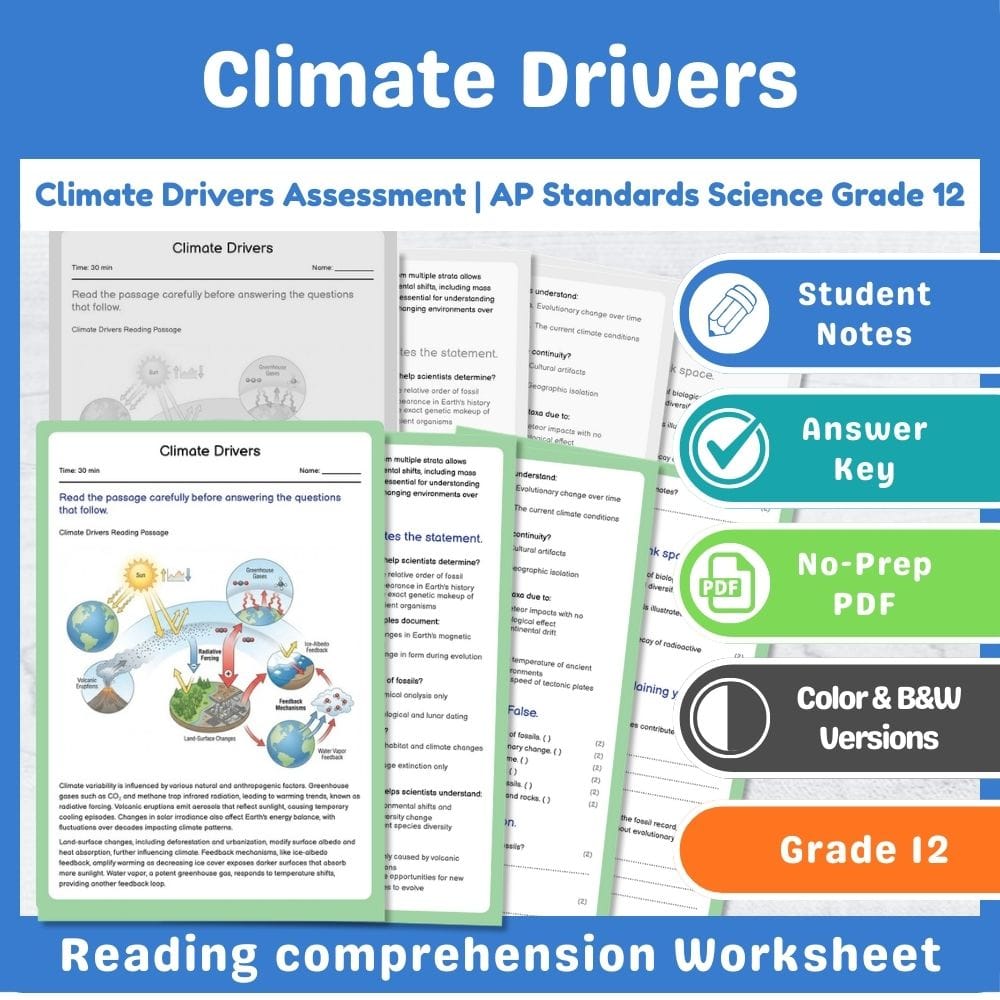
Climate Drivers Assessment | AP Standards Science Grade 12
 Created byPrism Point Learning
Learning Objectives
- Identify the main forcings that drive climate variability and change.
- Understand radiative forcing metrics and feedback mechanisms.
- Analyze the role of ocean heat uptake and land-surface alterations in climate dynamics.
Instant download
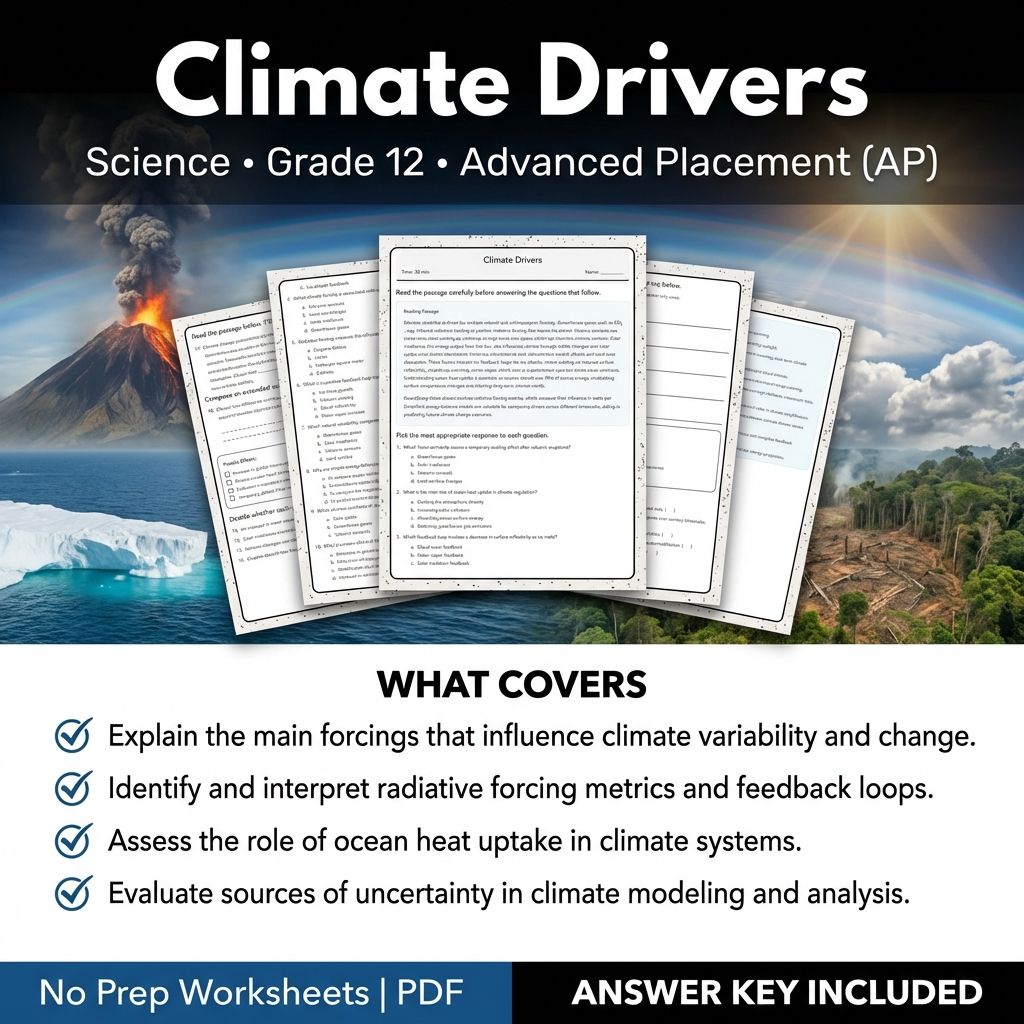
12th Grade Science | Climate Drivers Worksheet & Answer Key (Printable PDF)
 Created byCoral Reef Learning
Learning Objectives
- Explain the main forcings that influence climate variability and change.
- Identify and interpret radiative forcing metrics and feedback loops.
- Assess the role of ocean heat uptake in climate systems.
Also included in: Grade 12 Science Unit Worksheets Pack | Earth's Systems & Surface Processes +1 more
Instant download

Grade 12 Science – Climate Drivers Greenhouse Gases Daily Worksheet + Answer Key
Learning Objectives
- Understand key concepts related to Science
- Apply knowledge through practice questions
- Demonstrate comprehension of the material
Also included in: Grade 12 Earth and Space Sciences Lesson Bundle for AP Curriculum +1 more
Instant download

Climate Drivers Worksheet | Grade 12 AP Science Climate Change Activity
Created byPrism Point LearningLearning Objectives
- Explain how greenhouse gas, volcanic, solar, and land-surface changes affect climate through radiative forcing.
- Use basic energy-balance ideas to compare the relative magnitude and timing of different climate drivers.
- Describe key feedbacks (ice-albedo and water vapor) and how uncertainty is quantified in climate projections.
Instant download

Grade 12 Science | Climate Change Forcing Worksheet (AP Standards)(PDF)
 Created byEvergreen Desk Education
Learning Objectives
- Explain how greenhouse gas concentrations, volcanic aerosols, solar irradiance, and land-surface change contribute to climate variability and long-term change.
- Use radiative forcing concepts to compare the relative influence of different climate drivers and identify key feedback mechanisms.
- Interpret simple conceptual and energy-balance models to reason about ocean heat uptake and uncertainty in climate projections.
Also included in: Grade 12 Earth and Space Sciences Science Lesson Bundle | Advanced Placement (AP) +1 more
Instant download
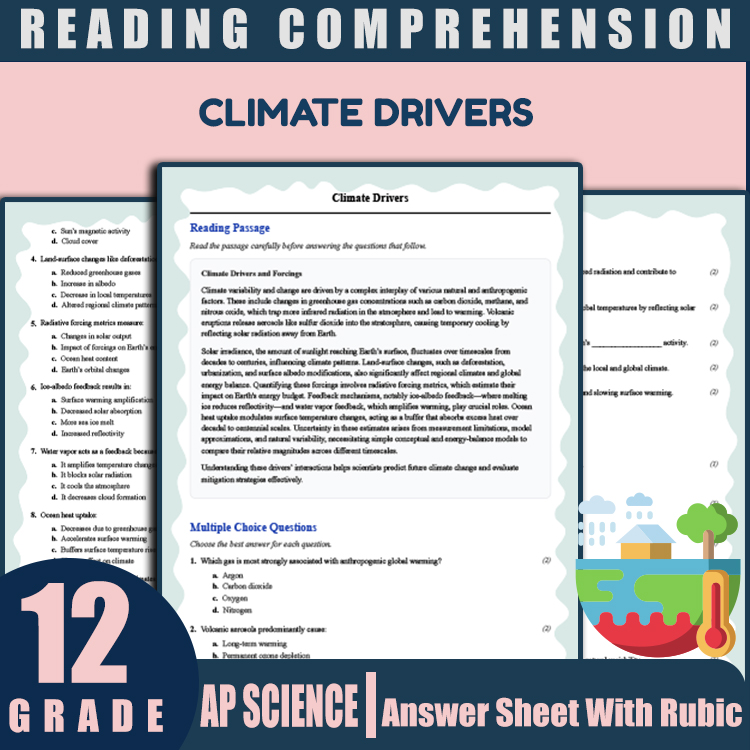
12th Grade Science | Climate Drivers Reading Worksheet (PDF + Answer Key)
Learning Objectives
- Understand the main forcings that influence climate variability and change.
- Analyze the roles of greenhouse gases, volcanic aerosols, solar irradiance, and land-surface alterations in climate forcing.
- Interpret radiative forcing metrics and feedback mechanisms such as ice-albedo and water vapor effects.
Also included in: Grade 12 Science Unit | Earth Systems & Climate Change Worksheet Bundle (PDF) +1 more
Instant download

Climate Drivers Worksheet for Grade 12 Science | AP Standards Practice
Learning Objectives
- Identify key factors that influence climate variability and change.
- Explain the concepts of radiative forcing and feedback loops in climate science.
- Analyze the roles of greenhouse gases, volcanic aerosols, solar irradiance, and land-surface changes.
Instant download

Atomic Models Worksheet | Grade 12 Science Practice
Created byPrism Point LearningLearning Objectives
- Explain how experimental evidence led to changes in atomic models from Dalton to Rutherford to Bohr.
- Relate cathode ray observations and gold foil scattering to the existence and location of subatomic particles.
- Connect discrete spectral lines to quantized energy levels and infer implications for electron structure.
Instant download
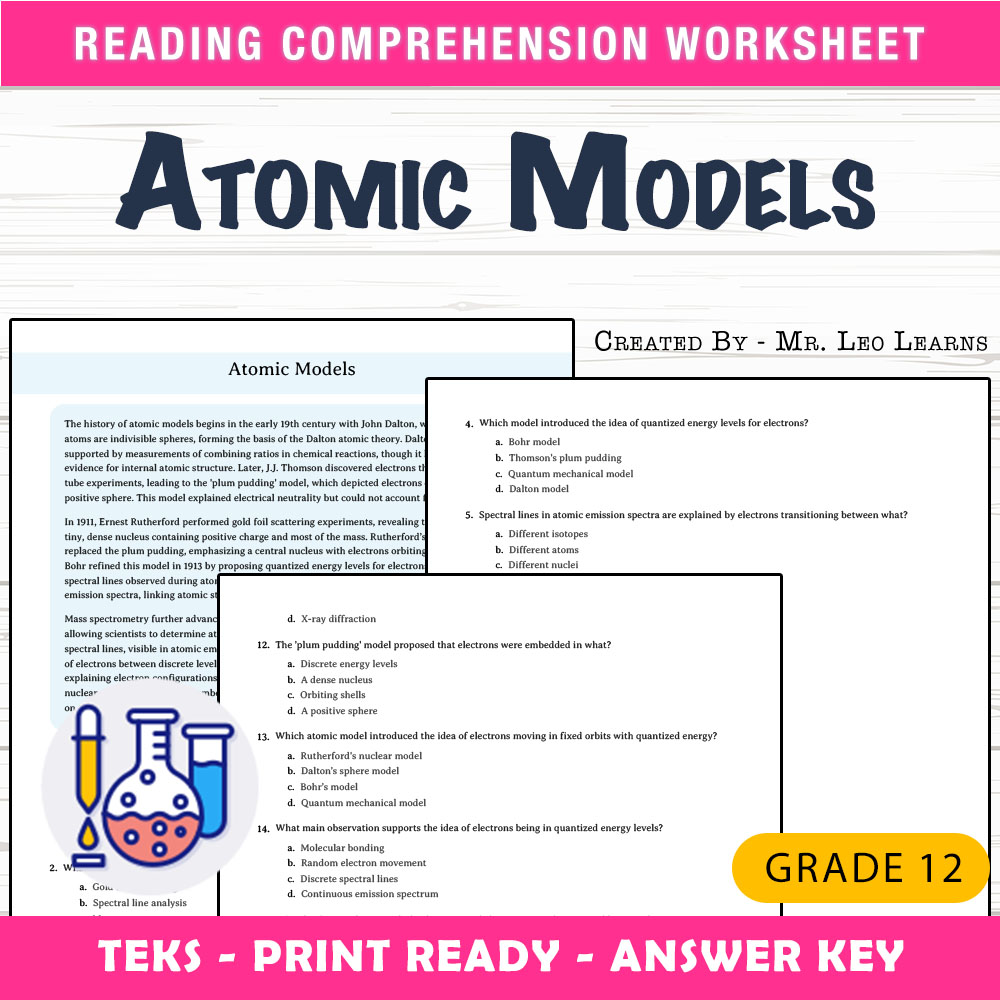
Grade 12 Science | Atomic Models Worksheet for Mastery
Created byThe Resource HubLearning Objectives
- Understand the development and evolution of atomic models from Dalton to Rutherford and Bohr.
- Identify the empirical evidence supporting each atomic model, such as cathode ray experiments and gold foil scattering.
- Explain the concepts of nuclear charge, mass number, and isotopic abundance using mass spectrometry as an example.
Also included in: Grade 12 Science Worksheet Bundle | Chemistry & Chemical Reactions Mastery +1 more
Instant download

Grade 12 Science | Atomic Models Worksheet (PDF) TEKS-Aligned
Created byEvergreen Desk EducationLearning Objectives
- Describe how Dalton, Thomson, Rutherford, and Bohr proposed atomic models and what evidence supported each model.
- Connect atomic number, mass number, isotopic abundance, and nuclear charge to measurable properties of atoms.
- Explain how cathode rays, gold foil scattering, and emission spectra provide empirical support for atomic structure.
Instant download

Grade 12 Science | Atomic Models Worksheet | TEKS Aligned
Created byLumora LearningLearning Objectives
- Trace the development of atomic models from Dalton to Rutherford and Bohr.
- Describe empirical evidence supporting atomic theory, such as cathode ray experiments and gold foil scattering.
- Explain concepts of nuclear charge, mass number, and isotopic abundance.
Also included in: Grade 12 Science | Matter and Energy Lesson Bundle | TEKS Aligned
Instant download

Atomic Models Worksheet | Standards-Aligned Practice for Grade 12 Science
Learning Objectives
- Explain how historical atomic models changed as new experimental evidence became available.
- Use cathode ray observations, Rutherford scattering, and Bohr’s spectral evidence to justify modern ideas about charge and electrons.
- Differentiate isotopes, nuclear charge, and mass number, and connect these ideas to mass spectrometry results.
Instant download

Atomic Models Worksheet for Grade 12 Science | TEKS Aligned Practice
Created byCoral Reef LearningLearning Objectives
- Understand the historical development of atomic models from Dalton to Bohr.
- Identify empirical evidence supporting atomic theories, such as cathode ray experiments and gold foil scattering.
- Explain concepts of nuclear charge, mass number, and isotopic abundance using spectrometry data.
Instant download

Grade 12 Science | Atomic Models - Daily Reading Comprehension
Created byCoral Reef LearningLearning Objectives
- Understand the development of atomic models from Dalton to Bohr.
- Recognize empirical evidence such as cathode rays and gold foil scattering.
- Explain concepts like nuclear charge, mass number, and isotopic abundance.
Also included in: Grade 12 Science Daily Reading Worksheets Full-Year Bundle | TEKS
Instant download
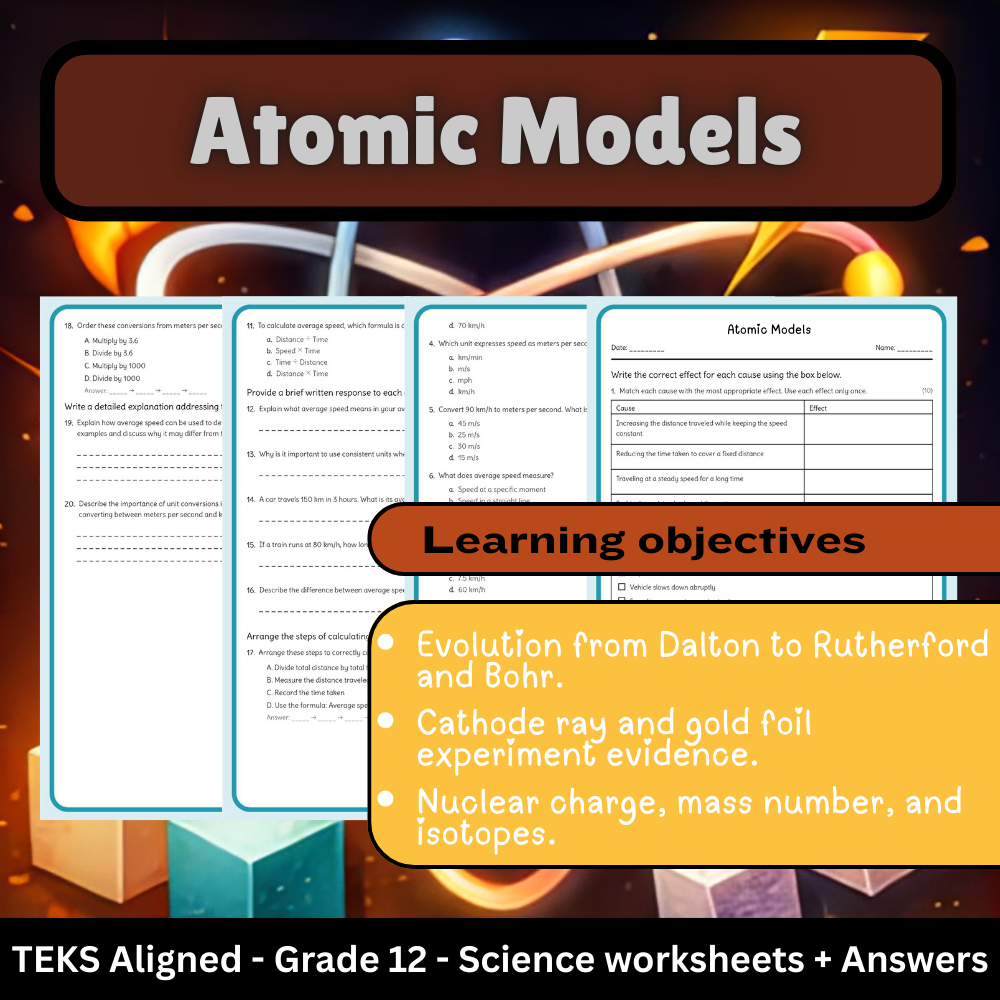
Grade 12 Science – Atomic Models Worksheet (PDF) | Teachable Atomic Theory
 Created byBright Mind Resources
Learning Objectives
- Describe the development of atomic models from Dalton to Rutherford and Bohr.
- Explain empirical evidence such as cathode ray experiments and gold foil scattering.
- Understand concepts of nuclear charge, mass number, and isotopic abundance.
Instant download

Grade 12 Science – Atomic Models Daily Reading Worksheet + Answer Key
Learning Objectives
- Identify key historical figures in atomic theory.
- Describe the development of atomic models from Dalton to Bohr.
- Understand empirical evidence supporting atomic theories.
Also included in: Grade 12 Science Lesson Group Bundle | TEKS Standards +1 more
Instant download

Grade 12 Science – Atomic Models & Theories | Daily Reading Worksheet
Created byBright Mind ResourcesLearning Objectives
- Understand the development of atomic models from Dalton to Bohr.
- Identify key experiments that supported different atomic theories.
- Explain concepts such as nuclear charge, mass number, and isotopes.
Also included in: Grade 12 Chemistry Science Lesson Bundle, Daily Reading Worksheets | TEKS +2 more
Instant download

Grade 12 Science | Phylogenetics Worksheet | TEKS-Aligned
Created byLumora LearningLearning Objectives
- Understand the methods used to reconstruct evolutionary relationships, including character matrix analysis and molecular sequence alignment.
- Interpret cladograms and phylograms to infer speciation events and characterize taxa.
- Assess homology and model substitution rates for phylogenetic analysis.
Also included in: Grade 12 Science | Biological Concepts Lesson Bundle | TEKS Aligned
Instant download

Grade 12 Science | Phylogenetics Worksheet (TEKS) with Answer Key (PDF)
Created byEvergreen Desk EducationLearning Objectives
- Explain how character matrices, molecular sequence alignment, and substitution-rate models help reconstruct evolutionary relationships.
- Interpret cladograms and phylograms, including what monophyly, paraphyly, and polyphyly mean for classification.
- Use homology assessment and fossil calibration to support molecular phylogenetic inference and taxonomic revision.
Instant download

Phylogenetics Worksheet | Grade 12 Science Activities
Created byPrism Point LearningLearning Objectives
- Explain how molecular data and morphological characters can be combined to infer evolutionary relationships
- Describe how sequence alignment, cladogram/phylogram inference, and substitution model selection are used in phylogenetic analysis
- Interpret monophyly, paraphyly, and polyphyly and connect them to taxonomic revision
Also included in: Population Genetics & Evolution Lesson Bundle: Grade 12 Science TEKS
Instant download
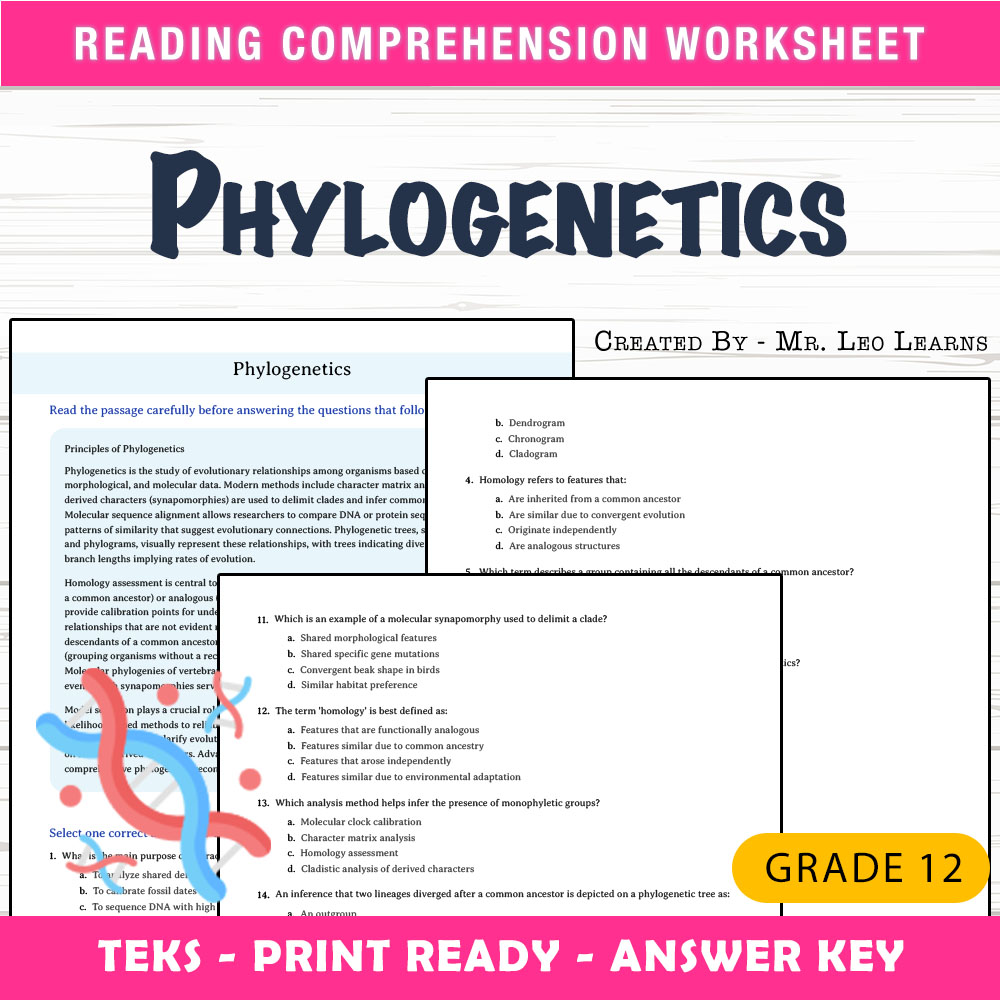
Grade 12 Science – Phylogenetics Worksheet for Mastering Evolutionary Relationships
Created byThe Resource HubLearning Objectives
- Understand the methods used for reconstructing evolutionary relationships, including character matrix analysis and molecular sequence alignment.
- Describe the concepts of homology, monophyly, paraphyly, and polyphyly in phylogenetic classification.
- Interpret phylogenetic trees such as cladograms and phylograms, and comprehend their significance in taxonomy.
Also included in: Grade 12 Science Worksheet Bundle – Genetics, Evolution & Biodiversity Mastery +1 more
Instant download

Phylogenetics Assessment for Grade 12 Science – Standards-Aligned Worksheet
Created byPrism Point LearningLearning Objectives
- Understand methods used to reconstruct evolutionary relationships, including character matrix analysis and molecular sequence alignment.
- Identify and interpret different types of phylogenetic trees such as cladograms and phylograms.
- Evaluate homology, monophyly, paraphyly, and polyphyly in the context of taxonomy and evolutionary analysis.
Also included in: Grade 12 Genetics and Evolution Science Lesson Bundle Unit | TEKS
Instant download

Phylogenetics Worksheet | Standard-Aligned PDF for Grade 12 Science
Learning Objectives
- Explain how homology assessment supports character selection in phylogenetics.
- Compare character matrix analysis, molecular sequence alignment, and tree inference (cladograms vs. phylograms).
- Use model selection and molecular clock calibration to interpret evolutionary relationships.
Instant download

Grade 12 Science – Phylogenetics Daily Reading Worksheet + Answer Key
Learning Objectives
- Define phylogenetics and explain its importance in evolutionary biology.
- Identify different methods used to reconstruct evolutionary relationships.
- Describe how molecular and morphological data contribute to phylogenetic analysis.
Also included in: Grade 12 Science Lesson Group Bundle – TEKS Standards-Based Worksheets +1 more
Instant download
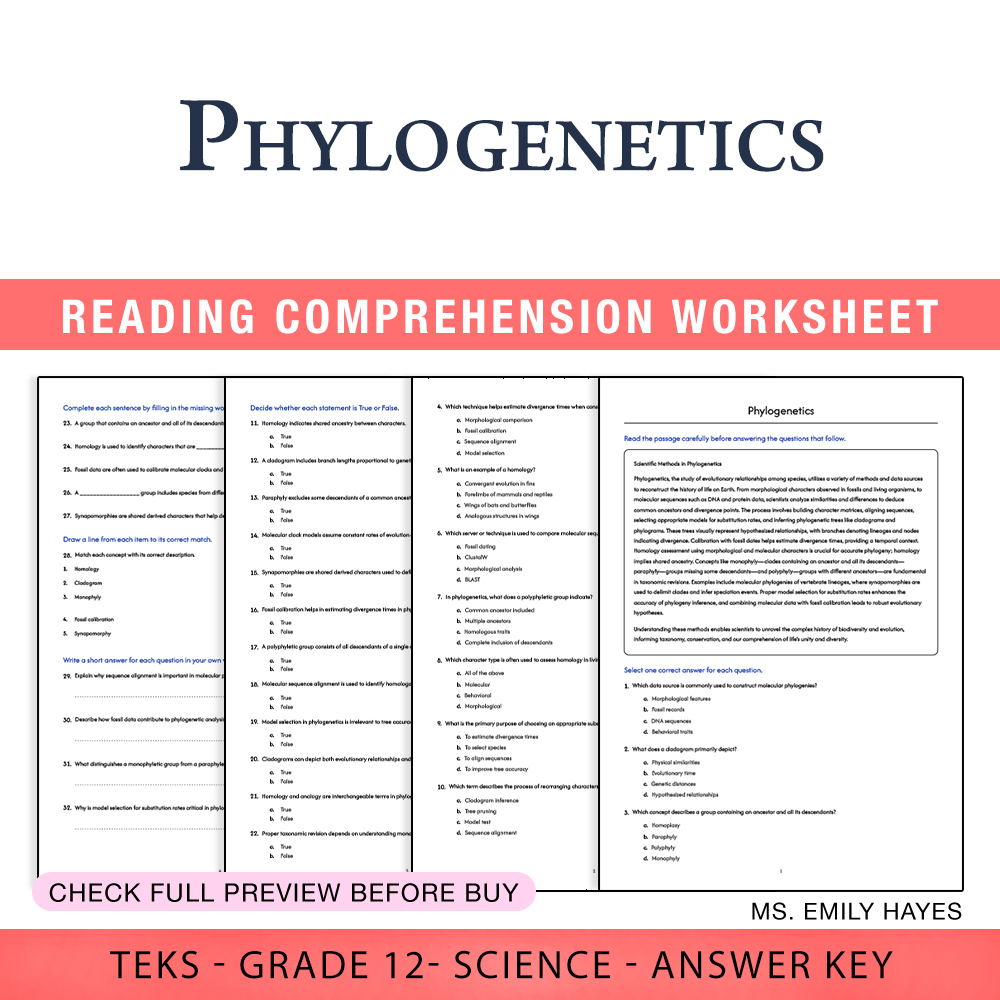
12th Grade Science | Phylogenetics Worksheet (PDF+ Answer Key)
 Created byCopper Leaf Classroom
Learning Objectives
- Understand methods used for reconstructing evolutionary relationships, including character matrix analysis and molecular sequence alignment.
- Explain how cladograms and phylograms are inferred and interpreted, including the role of model selection for substitution rates.
- Assess homology using morphological and molecular characters, and understand the concepts of monophyly, paraphyly, and polyphyly.
Instant download

Grade 12 Science – Phylogenetics & Evolutionary Relationships | Worksheet
Created byBright Mind ResourcesLearning Objectives
- Identify homologous characters in different species.
- Understand methods for reconstructing evolutionary trees.
- Differentiate between types of phylogenetic groups: monophyly, paraphyly, polyphyly.
Also included in: Biological Concepts Grade 12 Science Daily Reading Lesson Bundle | TEKS +2 more
Instant download

Grade 12 Science | Evolutionary Relationships - Daily Reading Comprehension
Created byCoral Reef LearningLearning Objectives
- Define phylogenetics and explain its importance in understanding evolution.
- Identify key methods used in reconstructing evolutionary relationships.
- Interpret phylogenetic trees, including concepts of monophyly, paraphyly, and polyphyly.
Also included in: Grade 12 Science Daily Reading Worksheets Full-Year Bundle | TEKS
Instant download

Grade 12 Science | Phylogenetics Worksheet with Short Notes (Printable PDF)
 Created byMeadowlark Worksheets
Learning Objectives
- Understand the methods used for reconstructing evolutionary relationships.
- Explain the significance of character matrix analysis, molecular sequence alignment, and model selection.
- Assess homology using morphological and molecular characters.
Also included in: Grade 12 Science Unit Bundle | Genetics, Evolution & Cell Biology Worksheets +2 more
Instant download

Grade 12 Science | Adaptation Over Time - Daily Reading Comprehension
Created byCoral Reef LearningLearning Objectives
- Understand the concept of adaptation in evolution
- Identify how natural selection drives changes in populations
- Recognize different types of adaptation patterns
Instant download

Grade 12 Science | Adaptation Over Time Worksheet | NGSSS Aligned
Created byLumora LearningLearning Objectives
- Explain how natural selection changes allele frequencies across generations in a population.
- Describe how heritable traits that increase fitness become more common in particular environments.
- Distinguish between directional adaptation and habitat-specific (variable) adaptation.
Instant download

Adaptation Over Time Assessment – NGSSS Standards-Aligned for Grade 12 Science
Created byPrism Point LearningLearning Objectives
- Explain how heritable variation and differential fitness lead to changes in allele frequencies over generations
- Distinguish directional selection from habitat-dependent variation in adaptation
- Analyze how ecological context influences which traits become more common in a population
Also included in: Lesson Bundle Grade 12 Genetics and Evolution Science: Florida NGSSS +1 more
Instant download

Adaptation Over Time Worksheet | Grade 12 Science Activities
Created byPrism Point LearningLearning Objectives
- Explain how natural selection changes allele frequencies over generations
- Describe how heritable traits affect fitness in specific environments
- Compare directional adaptation with adaptation that varies across habitats
Also included in: Grade 12 Genetics and Evolution Lesson Bundle | Florida NGSSS Science
Instant download

Adaptation Over Time Worksheet Grade 12 NGSSS Evolution Biology Natural Selection
Created byEvergreen Desk EducationLearning Objectives
- Explain how heritable traits change in frequency due to natural selection
- Describe how allele frequency shifts across generations during adaptation
- Connect environmental conditions and ecological context to which traits become more common
Instant download

Science Grade 12 Adaptation Over Time Worksheet | NGSSS Standards Activity
Learning Objectives
- Explain how heritable variation and fitness lead to changes in allele frequencies over generations
- Differentiate directional selection from selection that varies across habitats
- Analyze how ecological context influences the specific traits favored by natural selection
Also included in: Grade 12 Genetics, Evolution & Ecosystems Science Lesson Bundle | Florida NGSSS +1 more
Instant download

Evolution Evidence Worksheet Grade 12 Biology Activity NGSSS Review
Created byPrism Point LearningLearning Objectives
- Explain how multiple lines of evidence support common descent and evolutionary change
- Describe how fossil records, comparative anatomy, biogeographical patterns, and genetic data inform evolutionary relationships
- Use evidence-based reasoning to connect patterns in data to the process of evolution
Also included in: Grade 12 Genetics and Evolution Lesson Bundle | Florida NGSSS Science
Instant download

Science Grade 12 Evolution Evidence Worksheet | Standards-Aligned Practice
Learning Objectives
- Explain how fossil records, comparative anatomy, biogeography, and genetics provide evidence for evolution.
- Describe how patterns of similarity and difference among organisms support common descent.
- Use multiple lines of evidence to justify the conclusion that evolution continues to shape biodiversity.
Also included in: Grade 12 Genetics, Evolution & Ecosystems Science Lesson Bundle | Florida NGSSS +1 more
Instant download

Grade 12 Science – Evolution Evidence & Fossil Records | Daily Reading Worksheet
Created byBright Mind ResourcesLearning Objectives
- Understand how fossils provide evidence for evolution over time
- Identify key features of fossil records and what they reveal about past life
- Learn how fossil patterns support the theory of evolution
Also included in: Life Science Grade 12 Daily Reading Worksheets Lesson Bundle | Florida NGSSS +1 more
Instant download

Evolution Evidence Assessment for Grade 12 Science | NGSSS Standards
Created byPrism Point LearningLearning Objectives
- Explain how fossils, comparative anatomy, biogeography, and genetics provide evidence for evolution and common descent
- Distinguish homologous structures from analogous structures and interpret what each implies
- Use multiple evidence sources to justify why species change over time
Also included in: Lesson Bundle Grade 12 Genetics and Evolution Science: Florida NGSSS +1 more
Instant download

Grade 12 Science | Evolution Evidence Worksheet | NGSSS Assessment
Created byLumora LearningLearning Objectives
- Explain how multiple lines of evidence (fossils, comparative anatomy, biogeography, and genetics) support common descent and evolutionary change
- Differentiate homologous and analogous structures and relate them to shared ancestry or convergent evolution
- Interpret how species distributions and genetic relatedness can reflect historical migration, isolation, and divergence
Instant download

Grade 12 Digitized Electromagnetic Signals Worksheet | NGSS Practice PDF
Created byClear Sky ClassroomLearning Objectives
- Explain how information can be encoded into digitized electromagnetic signals using controlled changes in signal properties.
- Use evidence-based reasoning to relate measurable wave behaviors (frequency content, modulation, propagation effects) to transmitted digital information.
- Compare how different modulation approaches affect how a receiver reconstructs bits from an electromagnetic wave.
Instant download

Digitized Electromagnetic Signals Worksheet | Grade 12 Physics Activity
Created byPrism Point LearningLearning Objectives
- Explain how digitization encodes information into electromagnetic signals using controlled signal variations
- Describe how electromagnetic waves carry energy through space while the data can be recovered from measurable signal properties
- Use evidence-based reasoning to connect frequency content and signal propagation to communication performance
Instant download

Grade 12 Science – Electromagnetic Signals & Communication | Reading Worksheet
Created byBright Mind ResourcesLearning Objectives
- Understand the basic concepts of electromagnetic radiation and signals
- Identify how signals are encoded and transmitted via electromagnetic waves
- Recognize properties of electromagnetic signals relevant to communication technology
Also included in: Energy Grade 12 Science Daily Reading Worksheets Lesson Bundle | CA Standards +1 more
Instant download

Grade 12 Science | Electromagnetic Signals Worksheet | California Standards
Created byLumora LearningLearning Objectives
- Understand how electromagnetic radiation transmits information through digitized signals.
- Identify the properties of signals that encode information, such as frequency and amplitude.
- Explain how electromagnetic waves carry energy and facilitate communication across distances.
Instant download

Digitized Electromagnetic Signals Worksheet | Grade 12 Physics Science
Created byEvergreen Desk EducationLearning Objectives
- Explain how digitization encodes information into discrete signal changes represented as bits.
- Describe how electromagnetic waves carry energy and how receivers reconstruct encoded data.
- Use evidence-based reasoning to connect frequency content and propagation effects to received signals.
Instant download

Digitized Electromagnetic Signals Worksheet Grade 12 Science
Learning Objectives
- Understand how electromagnetic radiation transmits information through digitized signals.
- Identify the properties of signals that encode information, such as frequency and variation.
- Explain the physics principles that allow electromagnetic waves to carry information across distances.
Also included in: Grade 12 Energy, Forces, and Waves Science Lesson Bundle | California Standards +1 more
Instant download
About Grade 12 Science Worksheets
Explore Grade 12 Science worksheets for classwork, homework, or review. Our 4,404 printables download instantly as PDFs.
MyTeachingSheets worksheets are made by real teacher-authors and checked before they go live. Download any as a print-ready PDF for lessons, homework, or independent practice — most include answer keys, and previews are always free.