
Grade 8 Science Worksheets
6,034 worksheets
Grade 8 Energy Relationships Worksheet | NGSS Kinetic & Potential Energy
 Created byAmber Owl Education
Learning Objectives
- Explain how kinetic energy depends on mass and speed and how potential energy depends on position.
- Interpret graphs that show relationships between kinetic energy and mass or kinetic energy and the square of speed.
- Apply conservation of mechanical energy to analyze energy transfer between kinetic and potential forms, including the effects of friction.
Also included in: Grade 8 Science Thermal Transfer & Energy Conservation Lesson Bundle | NGSS +1 more
Instant download

Experimental Design Worksheet | TEKS Grade 8 Science Practice PDF
Learning Objectives
- Write a testable hypothesis and connect it to an independent and dependent variable.
- Use operational definitions to make variables measurable and repeatable.
- Identify appropriate controls, replication, and measurement criteria in experimental procedures.
Instant download

Grade 8 Science | Experimental Design Worksheet (PDF) aligned to TEKS
 Created byEvergreen Desk Education
Learning Objectives
- Formulate a testable hypothesis and identify independent and dependent variables in an experiment.
- Write operational definitions and choose measurable criteria for collecting reliable data.
- Design controls, replication, and measurement methods to reduce confounding factors and improve reproducibility.
Instant download
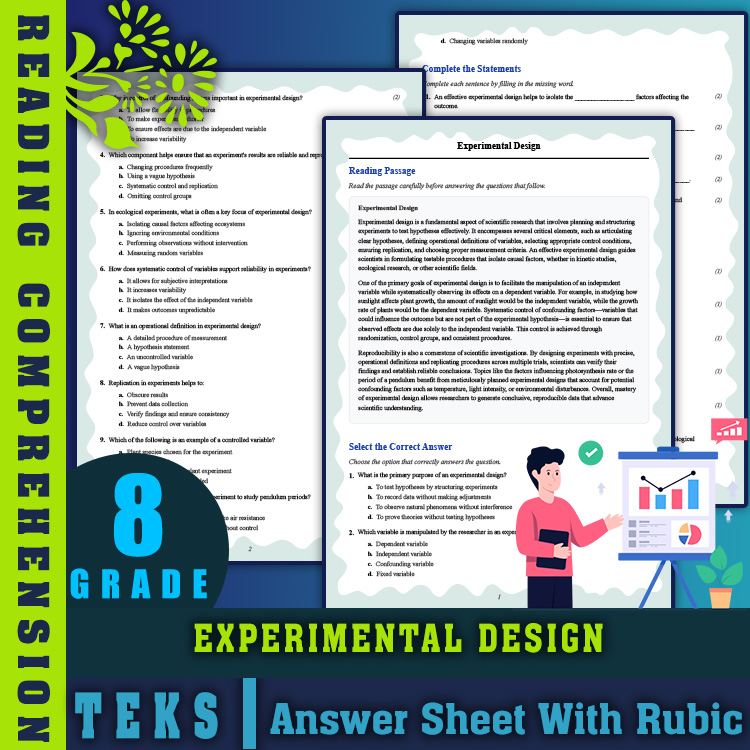
8th Grade Science | Experimental Design Reading Worksheet & Answer Key (PDF)
Learning Objectives
- Understand the key components of experimental design, including hypothesis formulation, control conditions, and variable manipulation.
- Learn how to identify independent and dependent variables within experimental procedures.
- Recognize the importance of systematic control and replication to ensure reliable and reproducible results.
Instant download
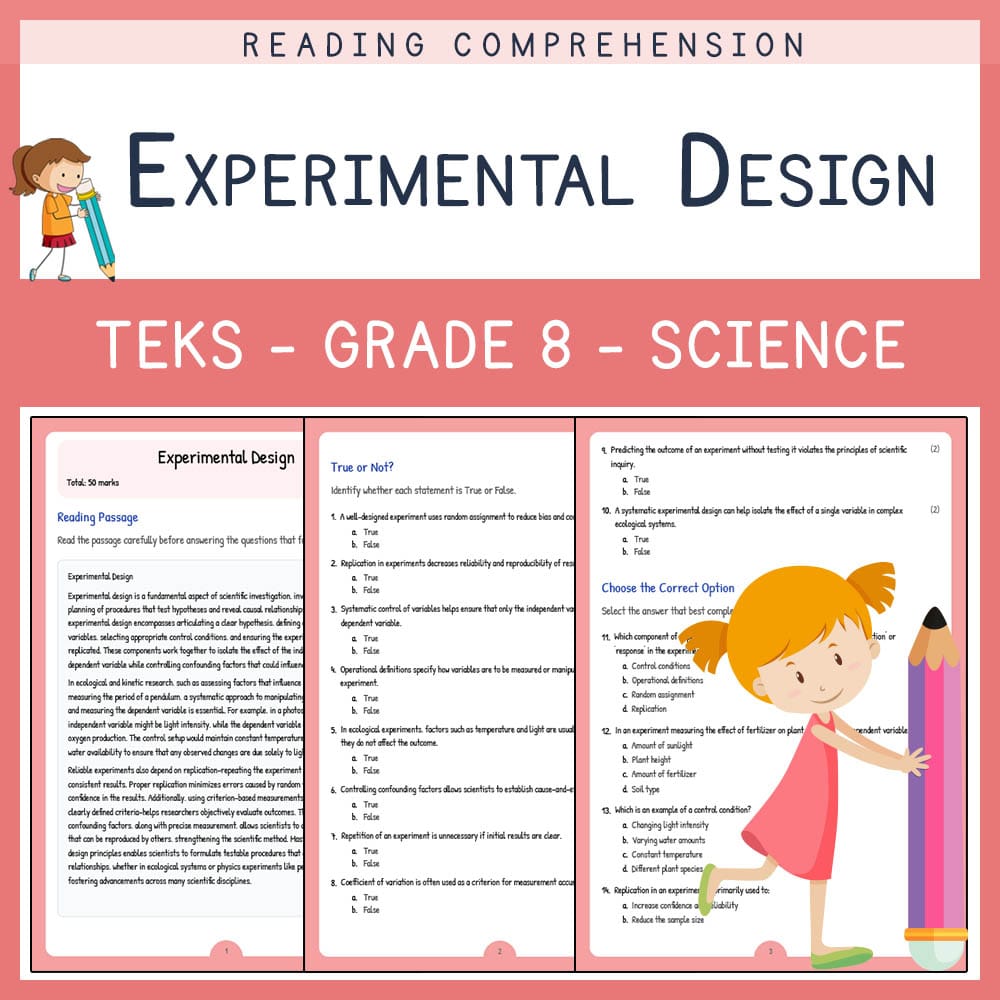
Grade 8 Science | Experimental Design Worksheet | TEKS Aligned
 Created byLumora Learning
Learning Objectives
- Understand the key components of experimental design, including hypotheses, control conditions, and operations.
- Identify variables and how to manipulate or measure them in experiments.
- Explain the importance of replication and systematic control in reliable experiments.
Also included in: Grade 8 Science | Science Concepts/Skills Lesson Bundle | TEKS Aligned
Instant download

Grade 8 Science – Experimental Design Daily Reading Worksheet + Answer Key
Learning Objectives
- Define key components of experimental design.
- Identify variables involved in experiments.
- Understand the importance of controls and replication.
Also included in: Grade 8 Science Lesson Group Bundle | TEKS Standards-Aligned Worksheets +1 more
Instant download

Experimental Design Worksheet | Grade 8 Science Practice
 Created byPrism Point Learning
Learning Objectives
- Write a testable hypothesis and identify the independent and dependent variables in an experiment.
- Use operational definitions and choose reliable control conditions and replication to reduce bias.
- Select appropriate measurement criteria and recognize confounding factors in real-world investigations.
Also included in: Grade 8 Scientific Inquiry and Data Analysis Science Lesson Bundle – TEKS +1 more
Instant download

Grade 8 Science | Experimental Design - Daily Reading Comprehension
 Created byCoral Reef Learning
Learning Objectives
- Define a hypothesis and explain its role in scientific experiments.
- Identify components that make a hypothesis testable and specific.
- Recognize the importance of operational definitions in experiments.
Instant download

Grade 8 Experimental Design Science Daily Reading Worksheet | TEKS
 Created byBRIGHT PATH RESOURCES
Learning Objectives
- Distinguish a hypothesis from a prediction.
- Identify the independent variable and dependent variable in a proposed investigation.
- Recognize how clear variable definitions support testable science.
Also included in: Grade 8 Science Skills Daily Reading Worksheets Bundle | TEKS +1 more
Instant download
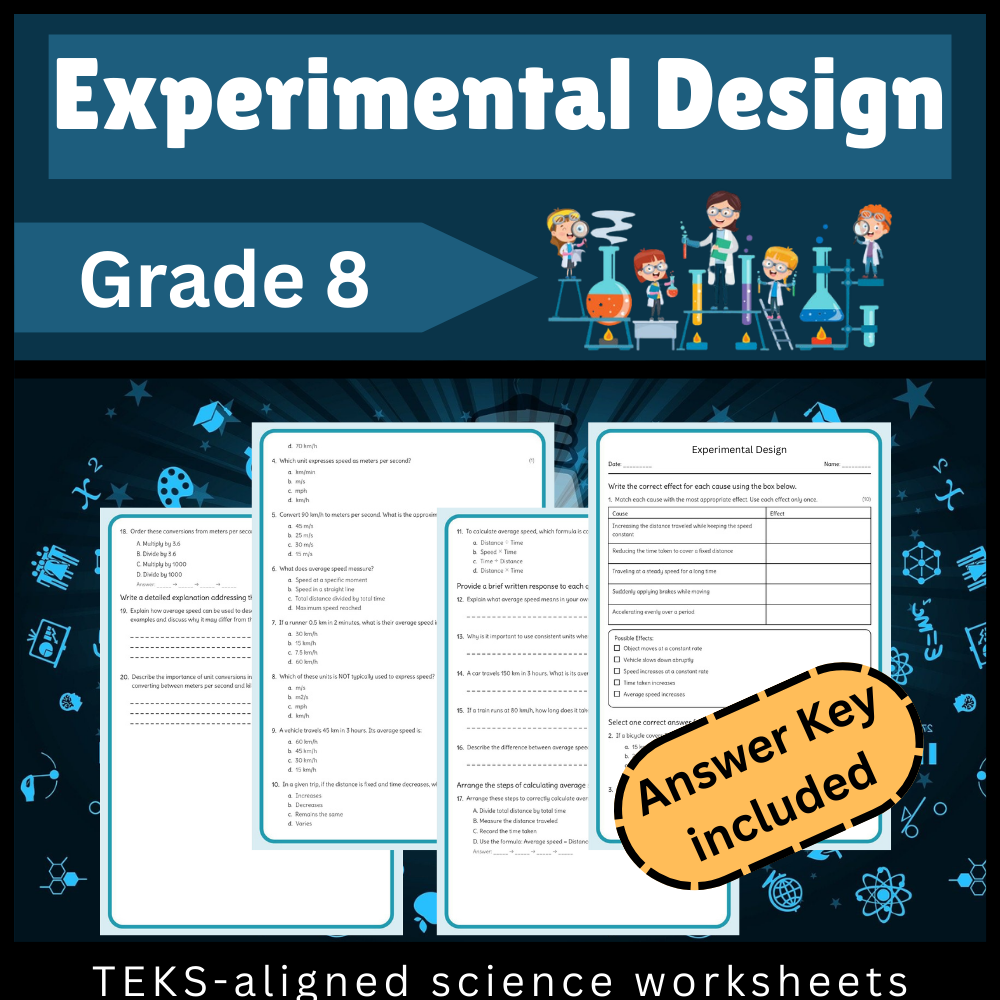
Grade 8 Science | Experimental Design Worksheet with Answer Key (PDF)
 Created byBright Mind Resources
Learning Objectives
- Understand the key components of experimental design including hypothesis formulation and operational definitions.
- Identify control conditions, replication, and measurement criteria in experiments.
- Apply systematic methods to manipulate variables and measure outcomes reliably.
Also included in: Grade 8 Science Unit Bundle | Scientific Inquiry, Data & Measurement Skills +1 more
Instant download
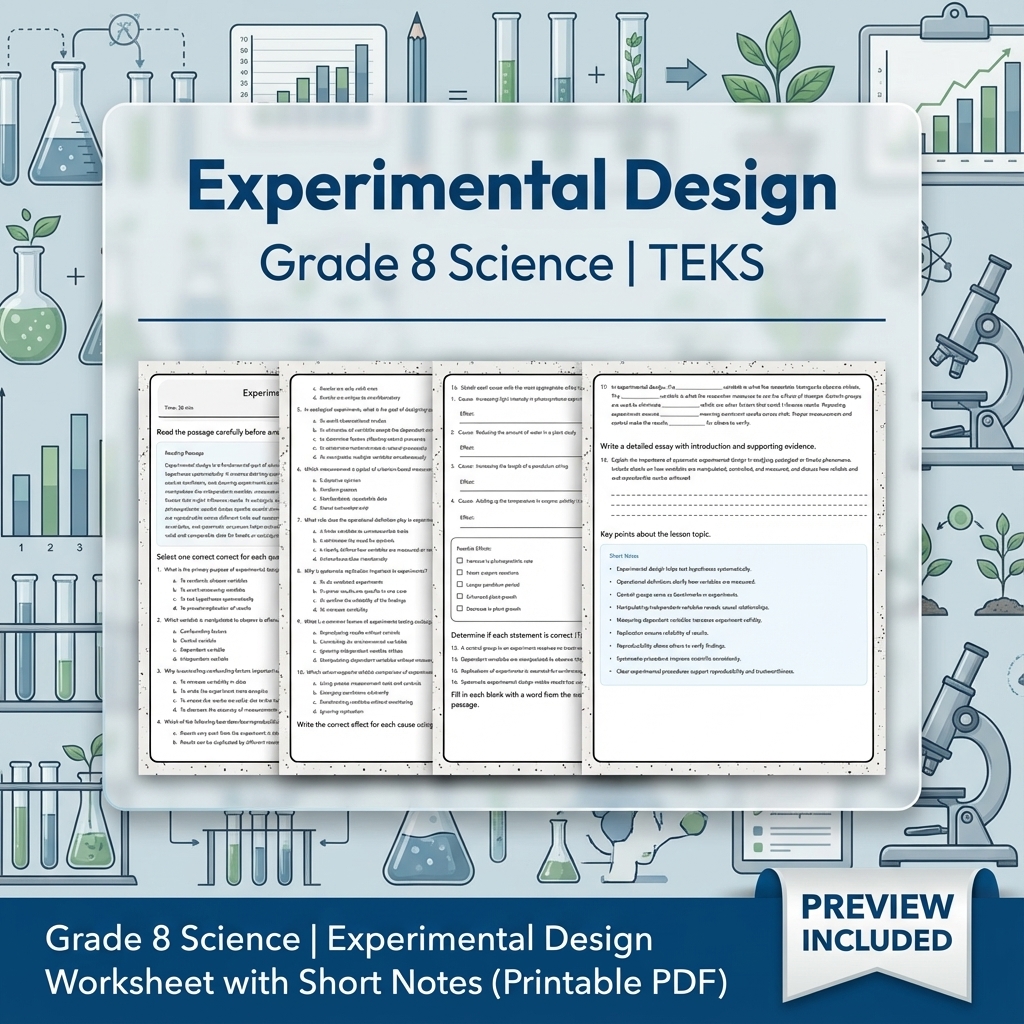
Grade 8 Science | Experimental Design Worksheet with Short Notes (Printable PDF)
 Created byMeadowlark Worksheets
Learning Objectives
- Understand the key components of designing a scientific experiment.
- Identify the roles of variables and controls in experimental procedures.
- Apply principles of systematic design to hypothetical experiments.
Instant download
8th Grade Science | Experimental Design Worksheet (PDF+ Answer Key)
 Created byCopper Leaf Classroom
Learning Objectives
- Understand the key components of experimental design, including hypothesis formulation and operational definitions.
- Identify control conditions, replication, and measurement criteria used in experiments.
- Analyze the manipulation of independent variables and measurement of dependent variables in scientific studies.
Instant download

Experimental Design Assessment for Grade 8 Science | TEKS Standards
Created byPrism Point LearningLearning Objectives
- Identify key components of an experimental design, including hypotheses, variables, and controls.
- Evaluate systematic procedures to ensure reproducibility and reliability of experimental results.
- Differentiate between independent, dependent, and controlled variables in experiments.
Also included in: Grade 8 Scientific Inquiry & Data Analysis Science Lesson Bundle TEKS
Instant download
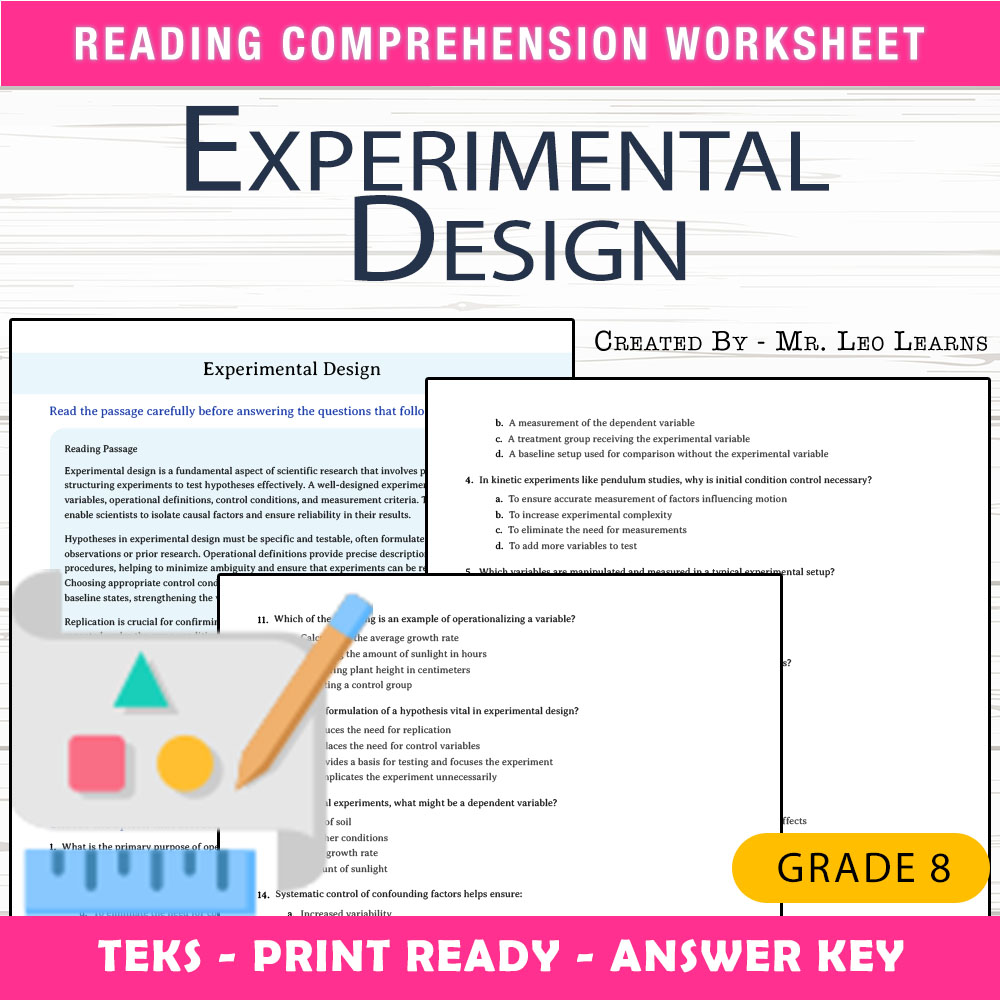
8th Grade Science — Experimental Design Worksheet for Mastery
 Created byThe Resource Hub
Learning Objectives
- Understand the key components and procedures of experimental design.
- Identify variables and controls in scientific experiments.
- Explain the importance of replication and systematic measurement.
Also included in: Grade 8 Science Unit Bundle | Scientific Inquiry & Data Skills Worksheet Pack +1 more
Instant download
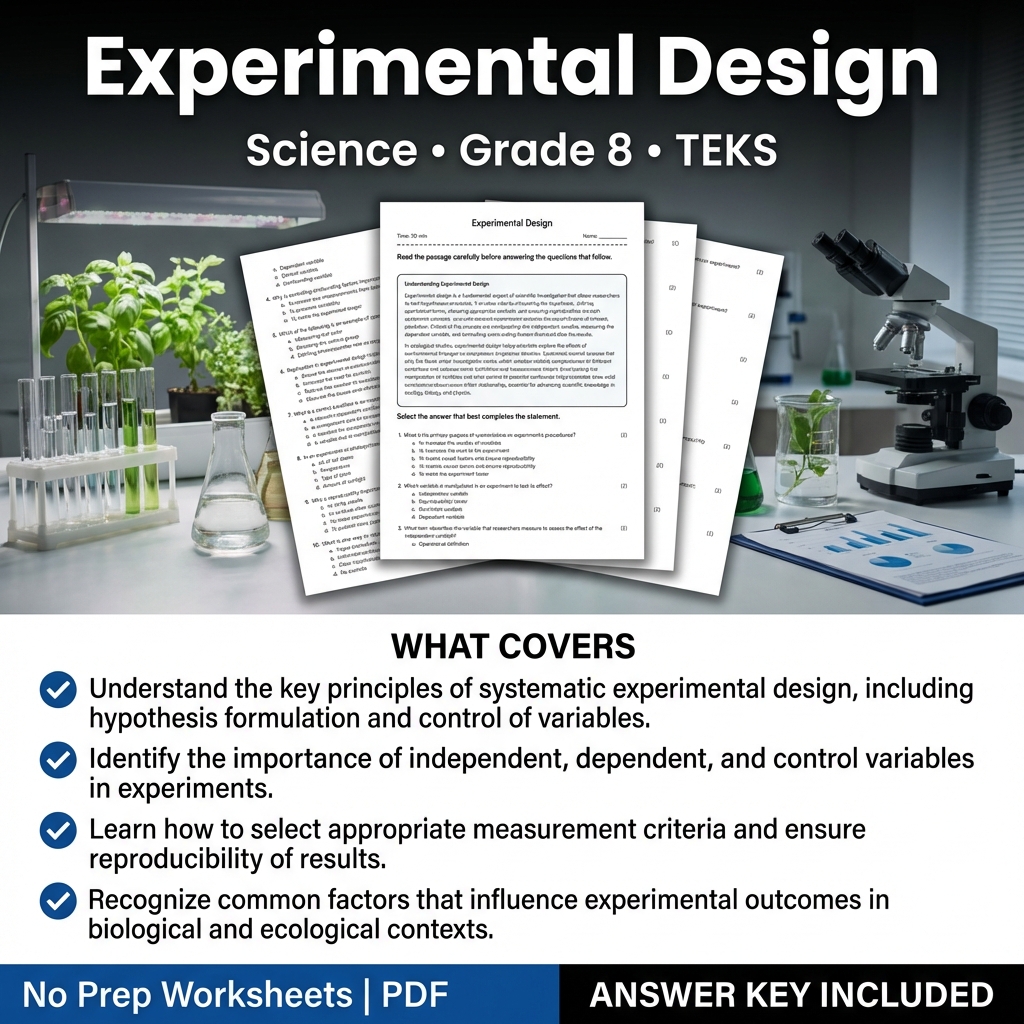
Experimental Design Worksheet Grade 8 Science TEKS Practice PDF
Created byCoral Reef LearningLearning Objectives
- Understand the key principles of systematic experimental design, including hypothesis formulation and control of variables.
- Identify the importance of independent, dependent, and control variables in experiments.
- Learn how to select appropriate measurement criteria and ensure reproducibility of results.
Instant download

Grade 8 Science – Experimental Design Daily Reading Worksheet | TEKS Aligned
Created byBright Mind ResourcesLearning Objectives
- Understand the purpose of hypotheses in experiments
- Learn how to formulate testable hypotheses
- Identify components of an experimental hypothesis
Also included in: Experiments Grade 8 Science Daily Reading Worksheets Lesson Bundle | TEKS +2 more
Instant download
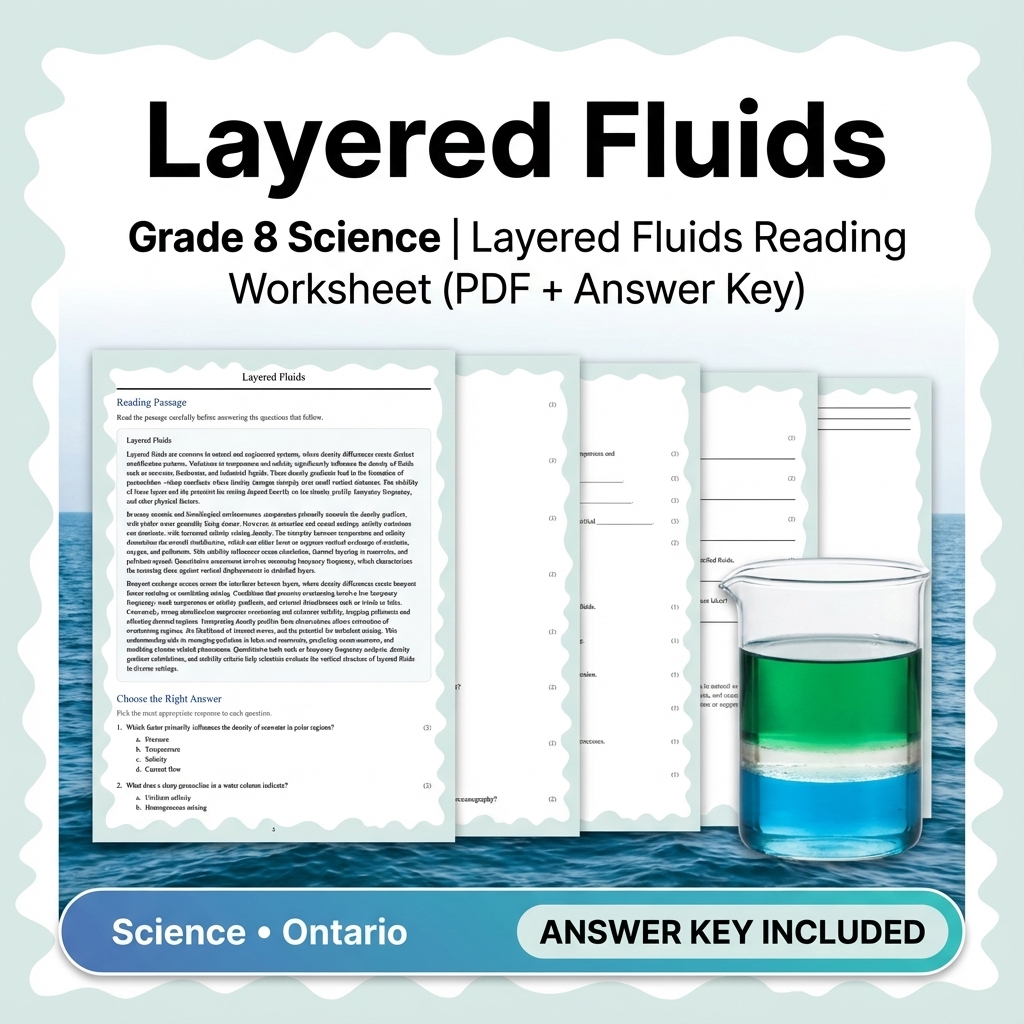
Grade 8 Science | Layered Fluids Reading Worksheet (PDF + Answer Key)
Learning Objectives
- Understand how temperature and salinity influence fluid density and stratification
- Explain the concept of buoyant exchange across fluid interfaces
- Analyze the consequences of density gradients for pollutant dispersion and ocean circulation
Also included in: Grade 8 Science Unit Bundle – Density, Pressure & Fluid Mechanics Worksheets +1 more
Instant download

Grade 8 Science – Layered Fluids & Stratification | Daily Reading Worksheet
 Created byQuiet Forest Education
Learning Objectives
- Understand the concept of fluid stratification
- Identify how temperature and salinity influence fluid density
- Explain the stability regimes of layered fluids
Also included in: Fluid Dynamics Grade 8 Science Daily Reading Worksheets Bundle | Ontario +1 more
Instant download

Layered Fluids Worksheet Practice | Grade 8 Science Assessment
Created byPrism Point LearningLearning Objectives
- Explain how temperature and salinity affect fluid density and create stratified layers.
- Describe buoyant exchange across interfaces and why mixing can be suppressed in pycnoclines.
- Interpret how density profiles relate to stability and pollutant or thermal dispersion.
Instant download

Layered Fluids Worksheet Grade 8 Science Ontario | Density & Buoyancy
 Created byClear Sky Classroom
Learning Objectives
- Explain how density differences create layered (stratified) fluids and pycnoclines
- Interpret how temperature and salinity affect density gradients in natural and engineered systems
- Describe buoyancy and vertical mixing across fluid interfaces and predict when overturning is likely
Instant download

Grade 8 Layered Fluids Worksheet | Density, Buoyancy & Stratification Ontario
 Created byChalk and Compass
Learning Objectives
- Explain how density differences from temperature and salinity create stratified layers (pycnoclines) in fluids.
- Use buoyancy and density-gradient ideas to predict when vertical mixing is promoted or suppressed.
- Describe how layered-fluid structure affects mixing across interfaces and the dispersion of pollutants or heat.
Also included in: Fluids, Pressure & Flow Lesson Bundle — Grade 8 Science Ontario +1 more
Instant download

Grade 8 Science | Layered Fluids Worksheet (PDF+ Answer Key)
Created byCopper Leaf ClassroomLearning Objectives
- Explain how temperature and salinity influence fluid density gradients and stratification.
- Analyze the impact of density differences on buoyant exchange and stability regimes in layered fluids.
- Interpret buoyancy frequency and density profiles to assess mixing and overturning conditions.
Instant download

Grade 8 Science – Layered Fluids Worksheet (Ontario) (PDF)
Created byEvergreen Desk EducationLearning Objectives
- Explain how temperature and salinity differences change fluid density and create layered (stratified) systems.
- Describe how buoyancy and density gradients limit vertical mixing and can form a pycnocline.
- Predict how conditions that promote or suppress overturning affect pollutant or heat dispersion.
Also included in: Grade 8 Fluid Pressure & Forces Science Lesson Bundle: Ontario Worksheet Set +1 more
Instant download
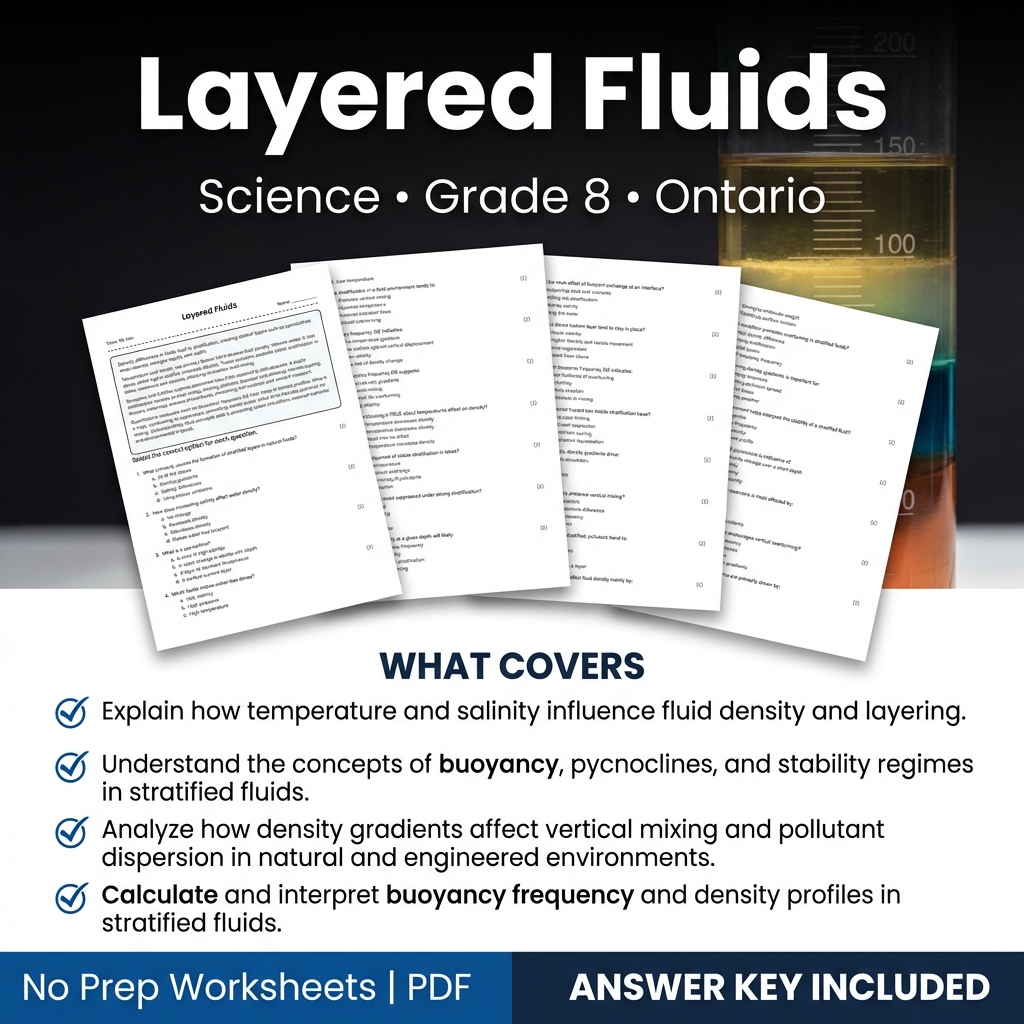
Layered Fluids Worksheet Grade 8 Science | Ontario Standards
Created byCoral Reef LearningLearning Objectives
- Explain how temperature and salinity influence fluid density and layering.
- Understand the concepts of buoyancy, pycnoclines, and stability regimes in stratified fluids.
- Analyze how density gradients affect vertical mixing and pollutant dispersion in natural and engineered environments.
Instant download
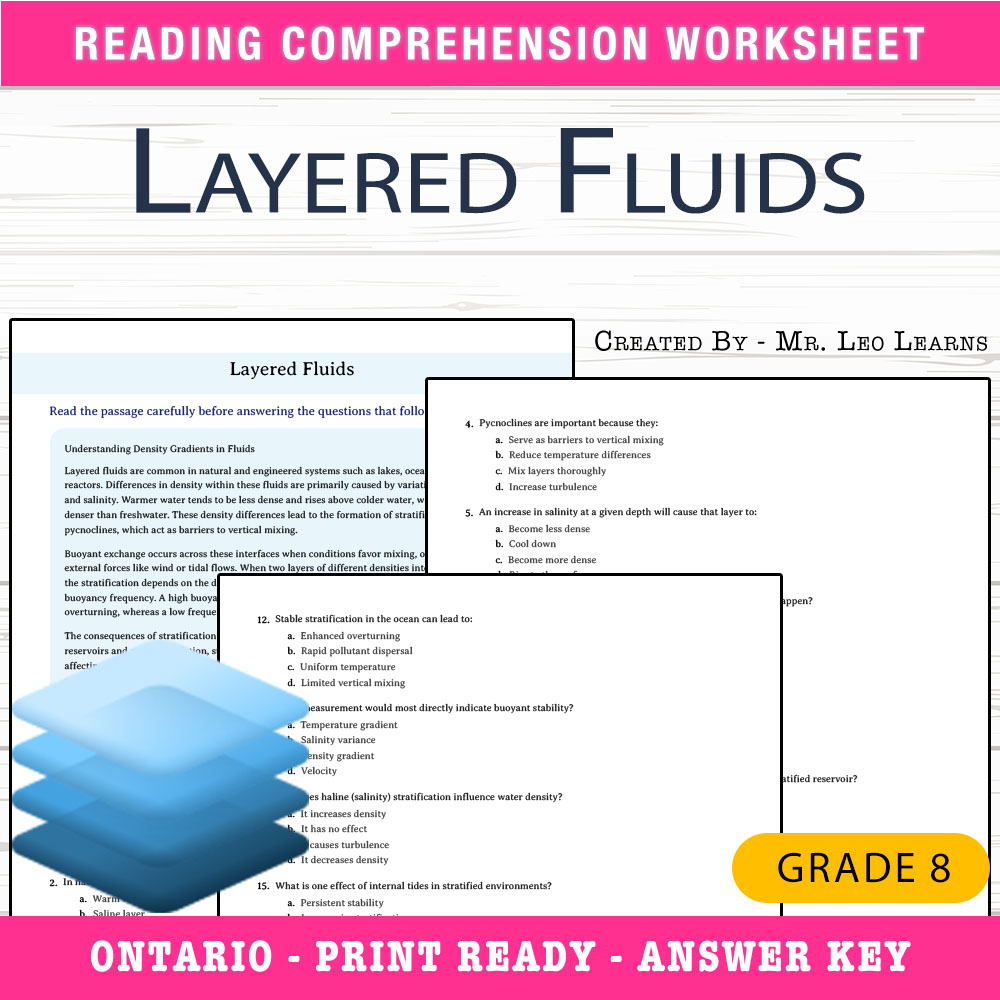
Grade 8 Science — Layered Fluids Worksheet for Mastering Fluid Stratification
Created byThe Resource HubLearning Objectives
- Understand how temperature and salinity influence fluid density and create stratification in natural and engineered environments.
- Analyze the stability regimes resulting from density differences and their effects on vertical mixing and pollutant dispersion.
- Interpret density profiles and buoyancy frequency to evaluate conditions promoting or suppressing overturning in stratified fluids.
Also included in: Grade 8 Science – Fluids & Buoyancy Mastery Unit Bundle (Worksheet Pack) +1 more
Instant download

Hydrostatic Pressure and Depth Worksheets Grade 8 Science
Created byPrism Point LearningLearning Objectives
- Calculate hydrostatic pressure using fluid density, gravity, and depth
- Explain how hydrostatic pressure changes with vertical depth
- Compare pressure in fluids with different densities
Also included in: Fluids, Pressure & Buoyancy Lesson Bundle | Grade 8 Science | Ontario +1 more
Instant download

Grade 8 Science – Layered Fluids Density & Stability | Daily Reading Worksheet
Created byBright Mind ResourcesLearning Objectives
- Understand how temperature and salinity affect fluid density
- Identify different fluid layers based on their density differences
- Explain the concepts of buoyancy, pycnoclines, and stability regimes in fluids
Also included in: Grade 8 Fluid Mechanics & Pressure Science Lesson Bundle | Ontario +1 more
Instant download
Grade 8 Science | Layered Fluids Worksheets (Ontario) (PDF)
Created byBright Mind ResourcesLearning Objectives
- Understand how density differences create stratified layers in fluids.
- Explain the effects of temperature and salinity on fluid density and stability.
- Interpret buoyancy frequency and density profiles in natural bodies of water.
Instant download

Layered Fluids Density Stratification and Mixing Worksheet | Ontario Grade 8
Learning Objectives
- Explain how density differences from temperature and salinity create layered (stratified) fluids and pycnoclines
- Describe how buoyancy acts to resist vertical displacement and what buoyancy frequency tells us about stability
- Predict how mixing limitations affect pollutant dispersion and thermal layering in natural waters and reservoirs
Instant download

Grade 8 Science | Layered Fluids - Daily Reading Comprehension
Created byCoral Reef LearningLearning Objectives
- Understand how temperature and salinity influence fluid density
- Identify different fluid layers based on density differences
- Explain buoyant exchange and stability in stratified fluids
Instant download

Grade 8 Science | Layered Fluids Worksheet with Short Notes (Printable PDF)
Created byMeadowlark WorksheetsLearning Objectives
- Understand how temperature and salinity influence fluid density and stratification.
- Interpret density profiles and identify pycnoclines in natural and engineered systems.
- Explain buoyant exchange across fluid interfaces and its effects on mixing and pollutant dispersion.
Also included in: Grade 8 Science Lesson Group Bundle | Hydrostatics & Fluid Mechanics +1 more
Instant download
Grade 8 Science | Biodiversity Conservation Worksheet (Answer Key) – TEKS Aligned
Created byBright Mind ResourcesLearning Objectives
- Understand the importance of species diversity, ecosystem function, and conservation strategies.
- Identify measurement methods of biodiversity and analyze ecosystem services.
- Evaluate various conservation and restoration strategies and their trade-offs.
Also included in: Grade 8 Science Unit Bundle | Ecosystems,Evolution & Cell Processes TEKS Aligned +1 more
Instant download
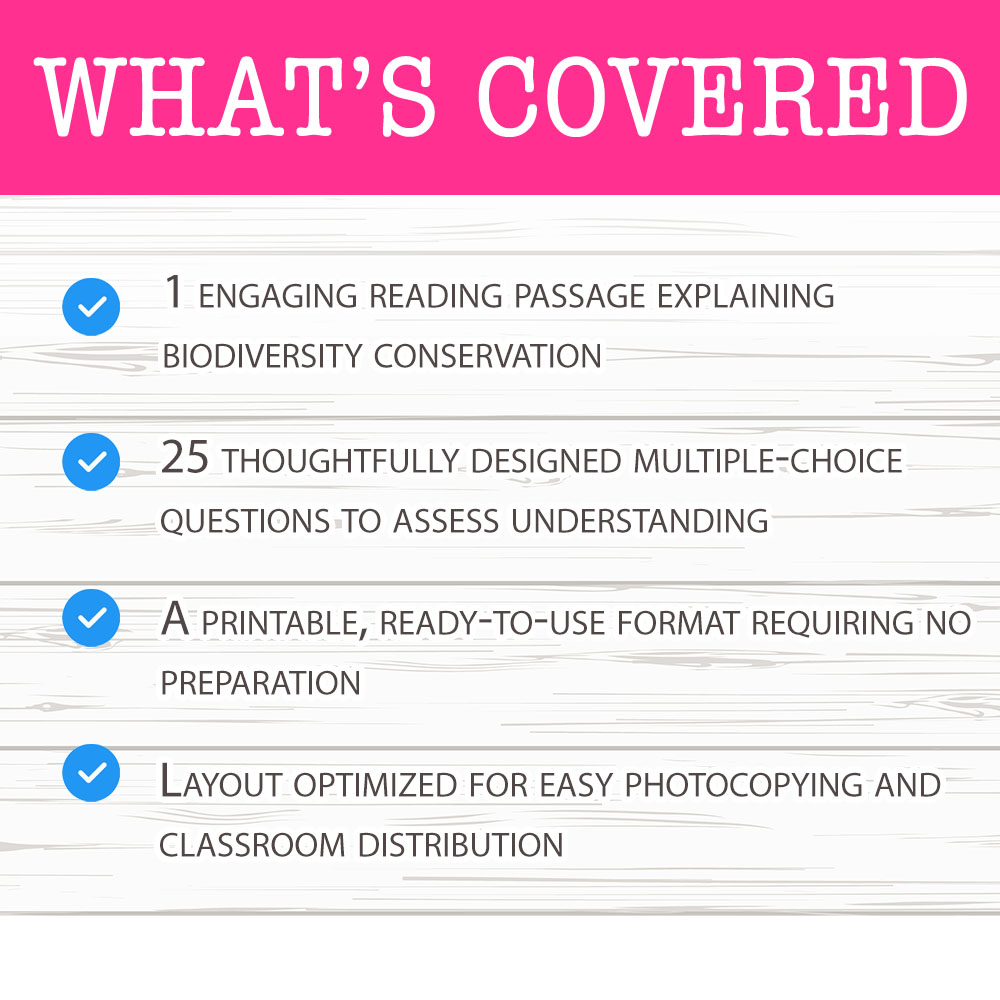
8th Grade Science – Biodiversity Conservation Worksheet for Mastery | PDF + Answer Key
Created byThe Resource HubLearning Objectives
- Understand the different levels and measurement of biodiversity in ecosystems.
- Identify key strategies used in conserving species, genetic, and ecosystem diversity.
- Evaluate the role of protected areas, habitat connectivity, and policy in biodiversity conservation.
Also included in: Grade 8 Science Unit | Ecosystems, Evolution & Cell Processes Worksheet Pack +1 more
Instant download

Grade 8 Science – Biodiversity & Conservation | Daily Reading Worksheet
Created byBright Mind ResourcesLearning Objectives
- Understand the concept of biodiversity and its importance in ecosystems.
- Identify different levels of biodiversity: genetic, species, and ecosystem.
- Recognize basic conservation strategies and challenges.
Also included in: Grade 8 Ecosystems & Cells Science Daily Reading Lesson Bundle | TEKS +2 more
Instant download

8th Grade Science | Biodiversity Conservation Worksheet (PDF+ Answer Key)
Created byCopper Leaf ClassroomLearning Objectives
- Understand the key concepts of species diversity, ecosystem function, and conservation strategies.
- Learn how to measure biodiversity and assess ecosystem services.
- Explore principles of habitat connectivity, protected areas, and policy influences on conservation.
Instant download

Biodiversity Conservation Assessment for Grade 8 Science TEKS
Created byPrism Point LearningLearning Objectives
- Understand the components of biodiversity at genetic, species, and ecosystem levels.
- Evaluate restoration strategies and their trade-offs in conservation.
- Analyze ecosystem services and factors influencing conservation outcomes.
Instant download

Grade 8 TEKS Biodiversity Conservation Science Reading Worksheet
Created byBRIGHT PATH RESOURCESLearning Objectives
- Identify the main idea of a passage about biodiversity conservation and explain supporting details.
- Describe how biodiversity helps ecosystems function.
- Distinguish between genetic, species, and ecosystem diversity using evidence from a text.
Also included in: Grade 8 Organisms & Environments Science Reading Worksheets Bundle | TEKS +1 more
Instant download

Biodiversity Conservation Worksheet | Grade 8 Science TEKS-Aligned
Created byPrism Point LearningLearning Objectives
- Explain how genetic, species, and ecosystem diversity support ecosystem functions and services.
- Describe conservation strategies such as habitat connectivity, protected areas, and restoration and how they affect biodiversity outcomes.
- Evaluate trade-offs and adaptive management decisions using real-world examples.
Also included in: Grade 8 Ecosystems & Cellular Processes Science Lesson Bundle TEKS +1 more
Instant download

Grade 8 Science | Biodiversity Conservation - Daily Reading Comprehension
Created byCoral Reef LearningLearning Objectives
- Identify different types of biodiversity—genetic, species, and ecosystem-level.
- Explain why biodiversity is vital for ecosystem health and human well-being.
- Recognize conservation strategies and their roles in protecting biodiversity.
Instant download

Grade 8 Science Worksheet on Biodiversity Conservation
Learning Objectives
- Explain biodiversity at genetic, species, and ecosystem levels and how each level contributes to ecosystem function.
- Describe how scientists measure biodiversity and use biodiversity to evaluate ecosystem services.
- Apply conservation strategies (protected areas, habitat connectivity, and restoration) to real-world scenarios.
Instant download

Solution Comparison Worksheet for Grade 8 Science | NGSS Assessment PDF
Learning Objectives
- Understand how to compare different design solutions using evaluation criteria.
- Learn to develop and interpret trade-off matrices for solution selection.
- Differentiate qualitative assessments from quantitative performance indicators.
Also included in: Grade 8 Science Engineering Design Lesson Bundle | NGSS +1 more
Instant download

Solution Comparison Worksheet | Grade 8 NGSS Science Engineering Design
Created byAmber Owl EducationLearning Objectives
- Use solution-comparison criteria, constraints, and measurable performance indicators to evaluate design alternatives.
- Create and interpret trade-off matrices that compare multiple concepts using both qualitative and quantitative information.
- Explain how evidence from tests supports a final selection and identifies limitations for each candidate solution.
Also included in: Grade 8 Science Engineering Design Lesson Bundle | NGSS +1 more
Instant download

Solution Comparison Worksheet | NGSS Aligned Grade 8 Science Practice
Learning Objectives
- Understand the development and evaluation of multiple design concepts based on criteria and constraints.
- Differentiate solutions using sketches, trade-off matrices, and qualitative versus quantitative assessments.
- Analyze how functional requirements align with feasible materials and document benefits and limitations.
Also included in: Grade 8 Design Optimization and Tradeoff Analysis Science Lesson Bundle – NGSS +1 more
Instant download

Solution Comparison Test Prep Worksheet | Grade 8 Science NGSS Review
Created byPrism Point LearningLearning Objectives
- Compare multiple design concepts using clear selection criteria and constraints.
- Use measurable performance indicators and evidence to support decisions between competing solutions.
- Explain trade-offs between qualitative and quantitative information when evaluating designs.
Also included in: Grade 8 NGSS Science Practice Lesson Bundle: Modeling & Tradeoff Review
Instant download

Grade 8 Solution Comparison NGSS Science Engineering Design Worksheet
Created byBRIGHT PATH RESOURCESLearning Objectives
- Understand key concepts related to Science
- Apply knowledge through practice questions
- Demonstrate comprehension of the material
Also included in: Design Tradeoffs Grade 8 Science Daily Reading Worksheets Lesson Bundle | NGSS +2 more
Instant download

Engineering Design Solutions: Comparing Criteria & Indicators Worksheets
 Created byTeachers Club
Learning Objectives
- Explain how criteria guide comparisons between competing design concepts
- Distinguish qualitative from quantitative evidence in design evaluation
- Describe benefits and limitations using trade-off reasoning
Also included in: Grade 8 Science Engineering Design Worksheets | NGSS Bundle +2 more
Instant download
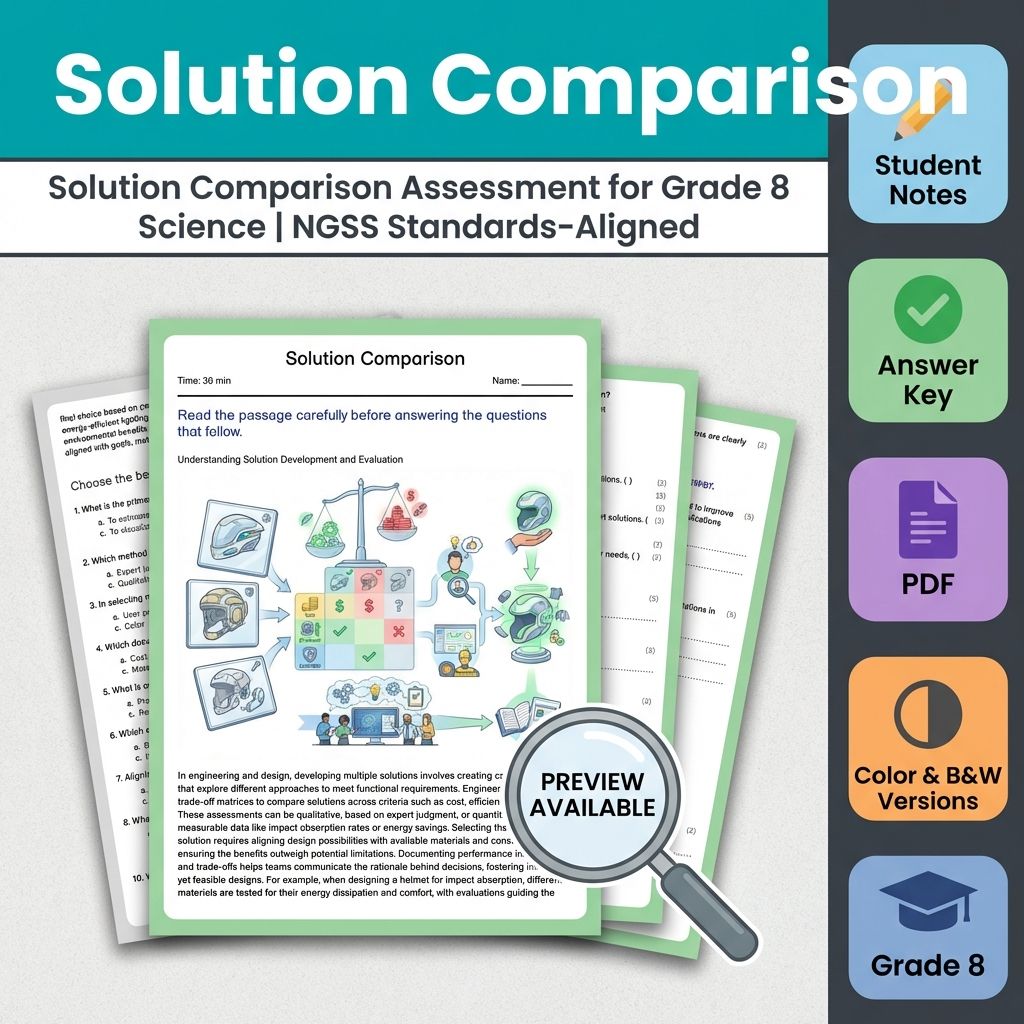
Solution Comparison Assessment for Grade 8 Science | NGSS Standards-Aligned
Created byPrism Point LearningLearning Objectives
- Understand the principles of designing and evaluating multiple solutions based on criteria and constraints.
- Learn to develop concept sketches, trade-off matrices, and compare solutions qualitatively and quantitatively.
- Identify key performance indicators and document benefits and limitations of design concepts.
Also included in: Grade 8 Science Mini Bundle – Engineering Design Unit & Assessments +1 more
Instant download

Grade 8 Science | Solution Comparison Worksheet (NGSS) PDF
 Created byMaple Path Learning
Learning Objectives
- Understand criteria for developing and evaluating multiple solution concepts.
- Differentiate solutions based on measurable performance indicators.
- Apply trade-off matrices and qualitative versus quantitative assessment methods.
Also included in: Grade 8 Science | Engineering Design Unit Bundle – NGSS Practice & Worksheets +1 more
Instant download
About Grade 8 Science Worksheets
Explore Grade 8 Science worksheets for classwork, homework, or review. Our 6,034 printables download instantly as PDFs.
Each resource here is built by an independent educator and reviewed for quality. Worksheets print straight from PDF and suit classroom use, homework, or extra practice; most come with answer keys, and you can preview before purchasing.