
Grade 8 Science Worksheets
6,034 worksheets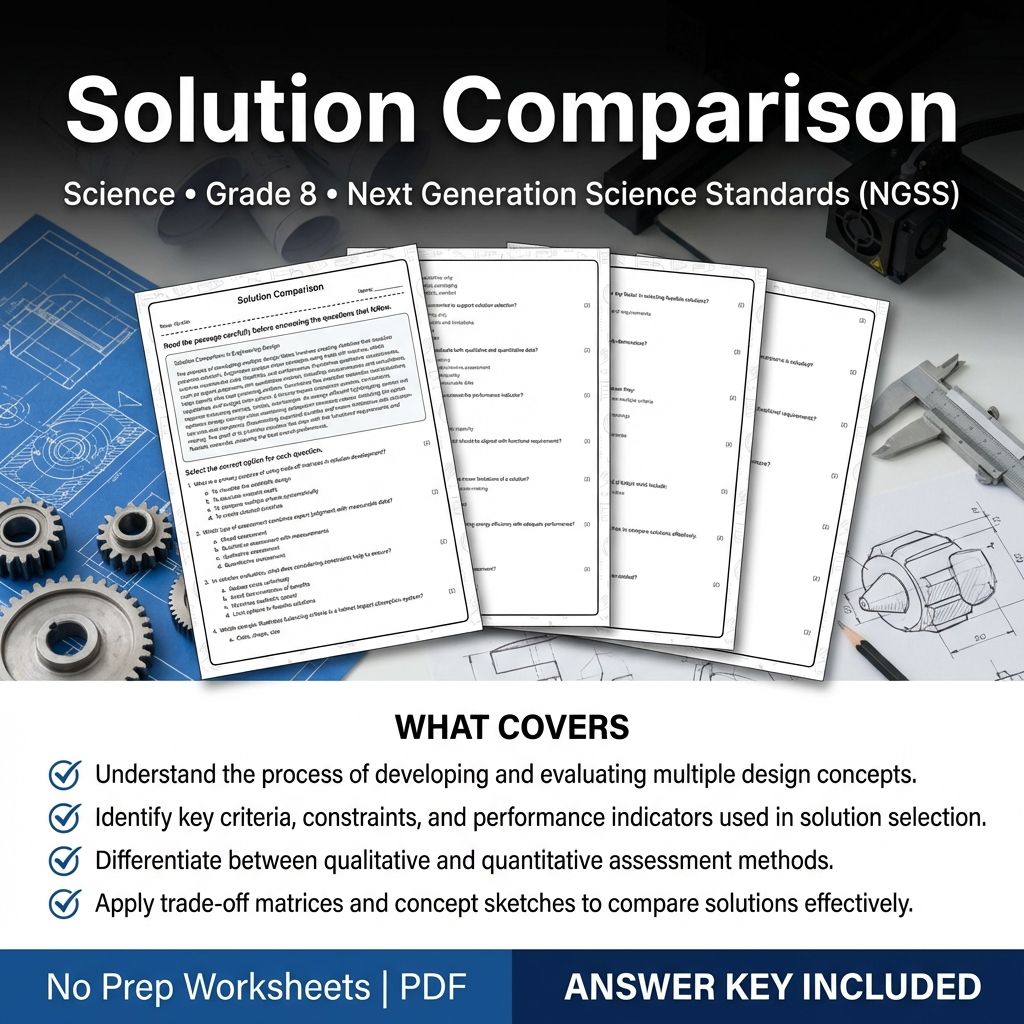
Grade 8 Science Worksheet | Solution Comparison Practice with Answer Key
 Created byCoral Reef Learning
Learning Objectives
- Understand the process of developing and evaluating multiple design concepts.
- Identify key criteria, constraints, and performance indicators used in solution selection.
- Differentiate between qualitative and quantitative assessment methods.
Instant download
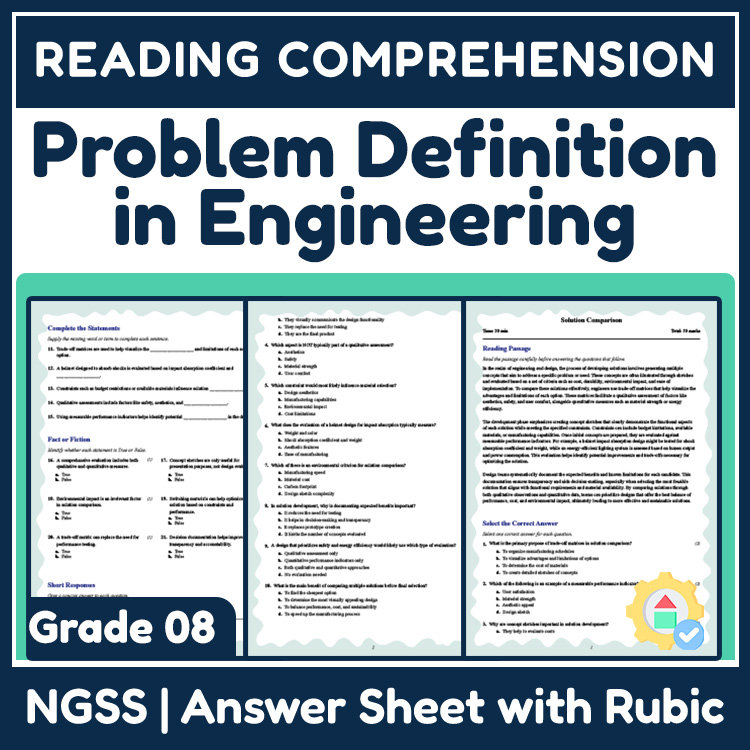
Grade 8 Science | Solution Comparison Reading Worksheet (PDF + Rubric)
Learning Objectives
- Understand the process of developing and comparing multiple design concepts.
- Recognize criteria, constraints, and performance indicators in solution evaluation.
- Differentiate qualitative and quantitative assessment methods.
Instant download
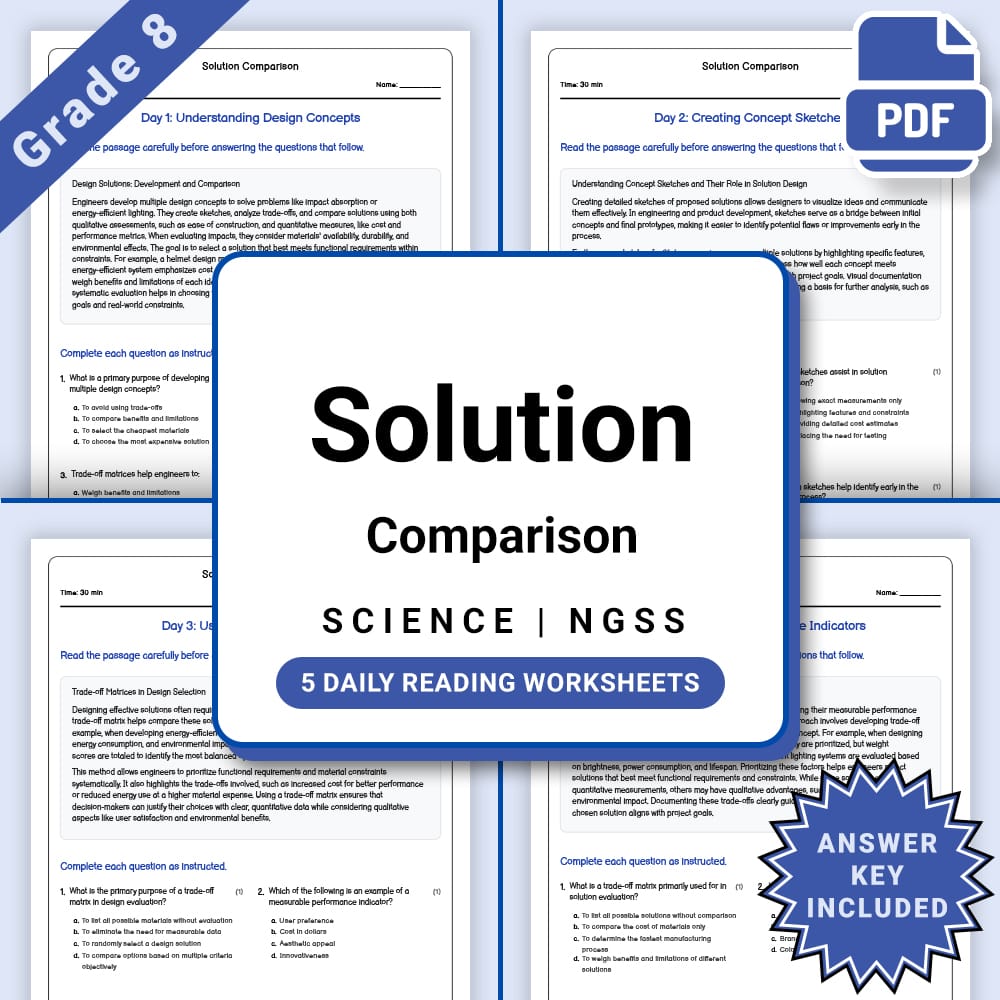
Grade 8 Science – Solution Comparison Worksheet(PDF + Answer Key)
 Created byCopper Leaf Classroom
Learning Objectives
- Understand the key features of different design concepts for solutions such as impact absorption and energy efficiency.
- Evaluate design solutions using criteria like benefits, limitations, materials, and performance indicators.
- Differentiate between qualitative and quantitative assessments in solution evaluation.
Instant download

Grade 8 Science – Solution Comparison Daily Reading Worksheet | NGSS
 Created byBright Mind Resources
Learning Objectives
- Understand the different design concepts for solutions such as helmets and lighting systems.
- Learn to evaluate and compare solutions using measurable performance indicators.
- Develop skills to create concept sketches, trade-off matrices, and assess solutions qualitatively and quantitatively.
Also included in: Grade 8 Tradeoff Analysis Science Daily Reading Worksheets Lesson Bundle | NGSS +1 more
Instant download
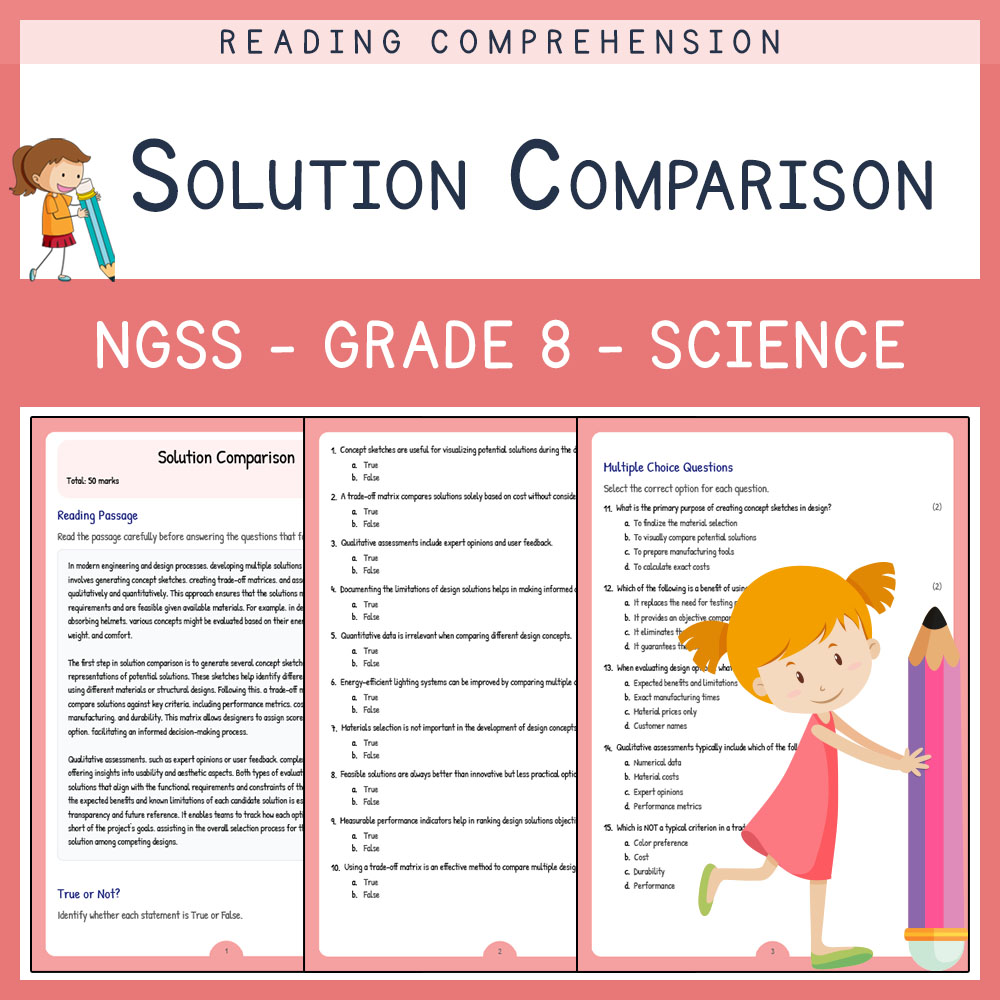
Grade 8 Science | Solution Comparison Worksheet for NGSS Standards (PDF + Answer Key)
 Created byLumora Learning
Learning Objectives
- Understand how to develop multiple solution concepts for design challenges.
- Evaluate and compare different design solutions based on criteria such as performance, feasibility, and benefits.
- Apply trade-off matrices and qualitative assessments to select optimal solutions.
Instant download

Solution Comparison Worksheet | NGSS Grade 8 Science Assessment
 Created byCedar Grove Learning
Learning Objectives
- Understand the development and evaluation of multiple design concepts using selection criteria.
- Differentiate solutions based on measurable performance indicators and trade-off analysis.
- Apply qualitative and quantitative assessment methods to compare design options.
Instant download

Solution Comparison Worksheet | NGSS Grade 8 Science Assessment PDF
 Created bySkylark Worksheets
Learning Objectives
- Identify criteria, constraints, and measurable performance indicators used to compare multiple engineering design concepts.
- Use a trade-off matrix to compare solutions and describe key benefits and limitations of each concept.
- Differentiate qualitative evidence from quantitative data when justifying a design choice.
Also included in: Grade 8 Engineering Design Science Lesson Bundle for NGSS Assessment +1 more
Instant download

Grade 8 Science Solution Comparison Worksheet with Short Notes (Printable PDF)
 Created byMeadowlark Worksheets
Learning Objectives
- Understand development and evaluation criteria for different solution concepts.
- Compare designs using trade-off matrices and performance indicators.
- Differentiate qualitative and quantitative assessment methods.
Also included in: Grade 8 Science Engineering Design Unit Bundle (NGSS Worksheets Collection) +1 more
Instant download

8th Grade Science | Solution Comparison Worksheet (PDF + Answer Key)
Created byCopper Leaf ClassroomAlso included in: Grade 8 Science Unit | Engineering Problem-Solving Worksheets (PDF + Answer Key) +1 more
Instant download

Engineering Design Solutions: Grade 8 Science Comparison Worksheets
 Created bythe curious pencil
Learning Objectives
- Explain how selection criteria support engineering design comparisons
- Distinguish qualitative and quantitative evidence in design evaluation
- Identify trade-offs among competing engineering design solutions
Also included in: Engineering Design - Grade 8 Bundle +2 more
Instant download

Grade 8 Solution Comparison Worksheet | NGSS Practice PDF
 Created byClear Sky Classroom
Learning Objectives
- Understand the development and evaluation of multiple design concepts using selection criteria.
- Differentiate solutions based on measurable performance indicators and constraints.
- Apply qualitative and quantitative assessment methods to compare competing solutions.
Also included in: Grade 8 Engineering Design Tradeoff Analysis Science Lesson Bundle NGSS +1 more
Instant download

Grade 8 Science | Sustainable Solutions Managing Water Resources - Daily Reading
Created byCoral Reef LearningLearning Objectives
- Understand various methods of water conservation
- Recognize the importance of sustainable water use practices
- Identify ways to reduce water pollution
Instant download

Grade 8 Rock Cycle Worksheet | California Science Standards PDF Activity
 Created byEvergreen Desk Education
Learning Objectives
- Explain how resource efficiency, waste reduction, and pollution treatment can reduce harm to Earth’s air and water systems
- Identify how restoring landscapes and conserving habitats support ecosystem stability
- Use data-based comparisons to evaluate which sustainable solutions better meet human needs while lowering environmental impacts
Instant download

Sustainable Solutions Worksheet Grade 8 Science Practice Activities
 Created byPrism Point Learning
Learning Objectives
- Explain how energy and water efficiency, waste reduction, and pollution treatment can reduce harm to Earth systems.
- Describe how ecosystem restoration and habitat conservation support long-term environmental stability.
- Use data-based comparisons to justify which sustainable solutions meet human needs while lowering negative impacts.
Instant download

Grade 8 Science – Water Conservation & Recycling | Daily Reading Worksheet
Created byBright Mind ResourcesLearning Objectives
- Understand the importance of water conservation.
- Identify ways to reduce water pollution.
- Recognize individual actions that contribute to sustainable water use.
Also included in: Earth Grade 8 Science Daily Reading Worksheets Bundle | California Standards +1 more
Instant download

Grade 8 Sustainable Solutions Worksheet | NGSS Practice & PDF
Created byClear Sky ClassroomLearning Objectives
- Explain how sustainable practices reduce impacts on Earth’s air, water, land, and ecosystems
- Identify key strategies for improving resource efficiency, reducing waste, and treating pollutants
- Use data-based reasoning to compare solutions that meet human needs while lowering harm
Instant download

Grade 8 Science | Sustainable Solutions Worksheet | California Standards
Created byLumora LearningLearning Objectives
- Explain how energy and water efficiency, waste reduction, recycling, and pollutant treatment help reduce harm to Earth systems.
- Describe how restoring landscapes and conserving habitats support ecosystem stability.
- Use data-based comparisons to justify which sustainable solutions better meet human needs while reducing environmental impacts.
Instant download

Grade 8 Science | Scale and Patterns Worksheet with Short Notes (Printable PDF)
Created byMeadowlark WorksheetsLearning Objectives
- Interpret scale relationships among solar system objects using quantitative data.
- Compare diameters, masses, and distances of planets and other celestial bodies.
- Understand and apply astronomical units and relative scaling to analyze spatial and temporal patterns.
Also included in: Grade 8 Science | Earth's Place in the Universe Unit Bundle (NGSS-Aligned) +1 more
Instant download
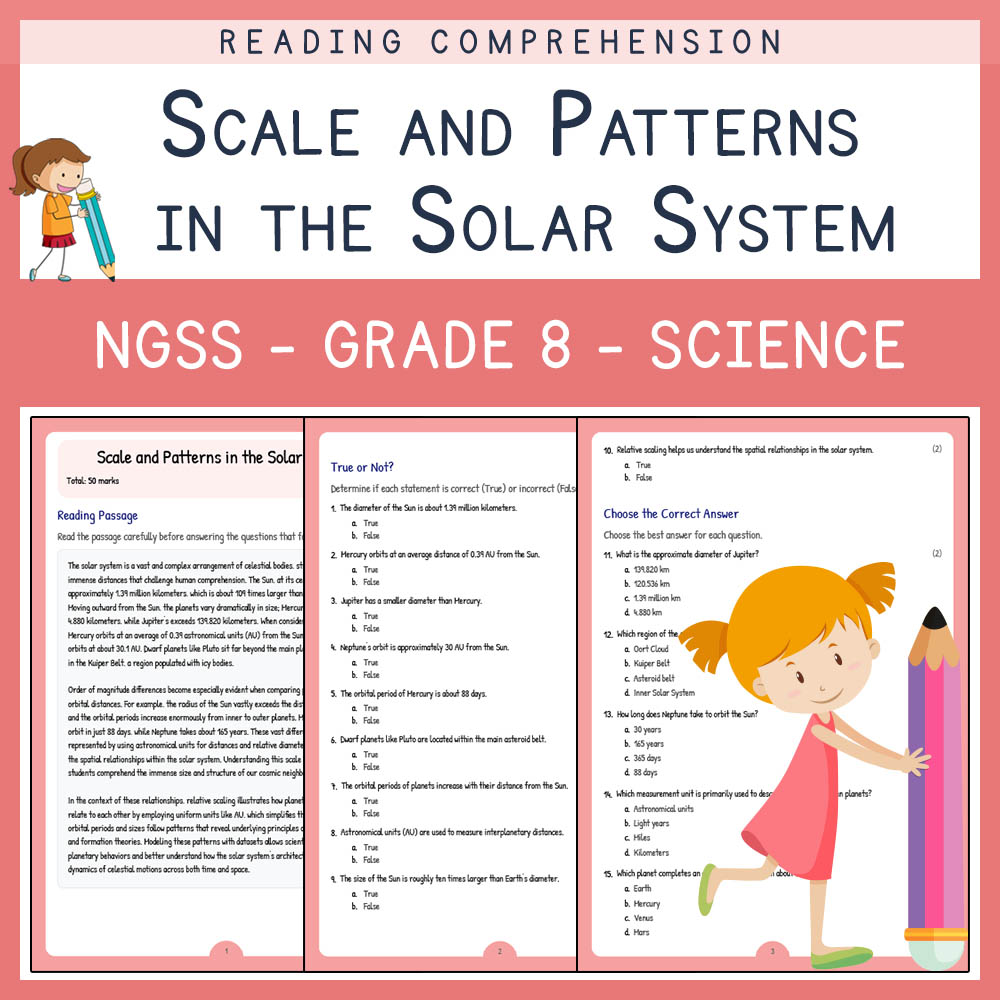
Grade 8 Science | Scale and Patterns in the Solar System Worksheets (PDF)
Created byLumora LearningLearning Objectives
- Understand and interpret scale relationships among solar system objects using quantitative data.
- Compare diameters, distances, and orbital periods of planets, dwarf planets, and moons.
- Use astronomical units and relative scaling to analyze spatial and temporal patterns.
Instant download
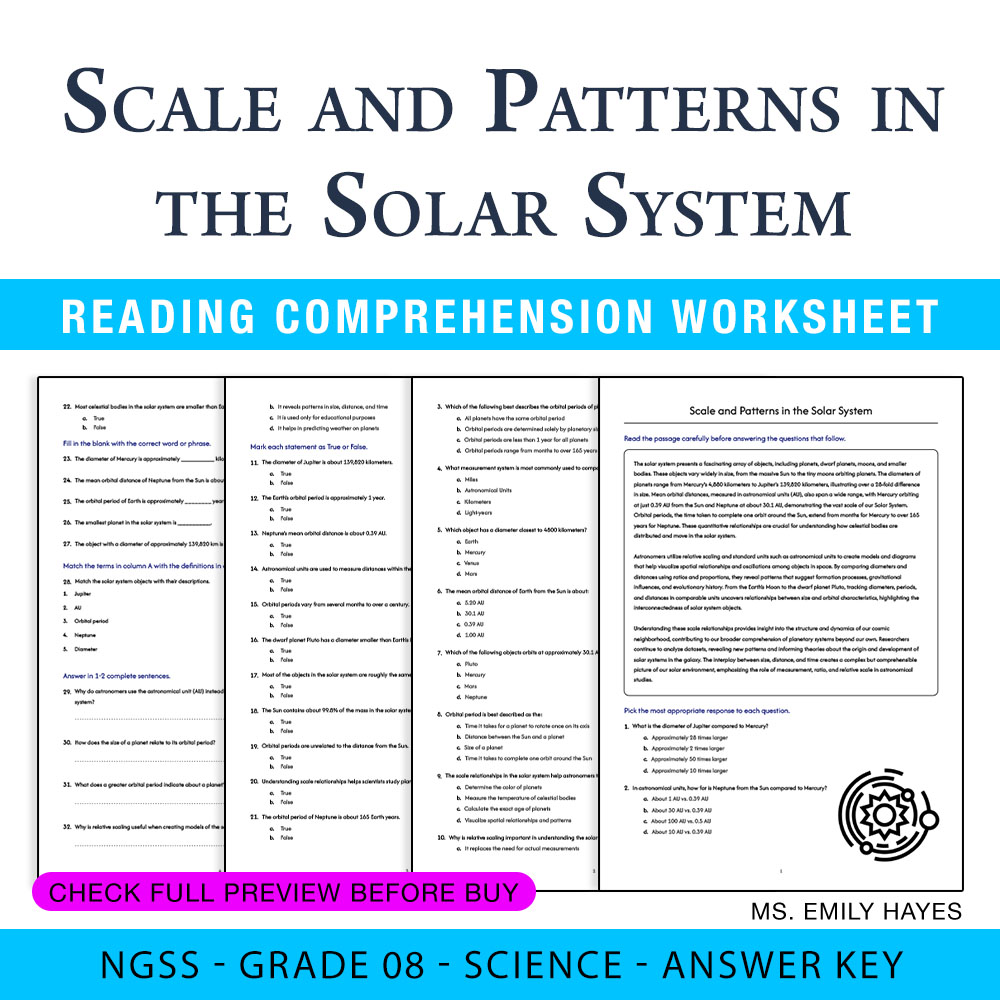
Grade 8 Science | Scale & Patterns in the Solar System Worksheet (PDF+ Answers)
Created byCopper Leaf ClassroomLearning Objectives
- Understand and interpret scale relationships among celestial objects in the solar system.
- Compare the sizes, distances, and orbital periods of planets, dwarf planets, and major moons using quantitative data.
- Apply concepts of astronomical units and relative scaling to analyze spatial and temporal patterns.
Instant download
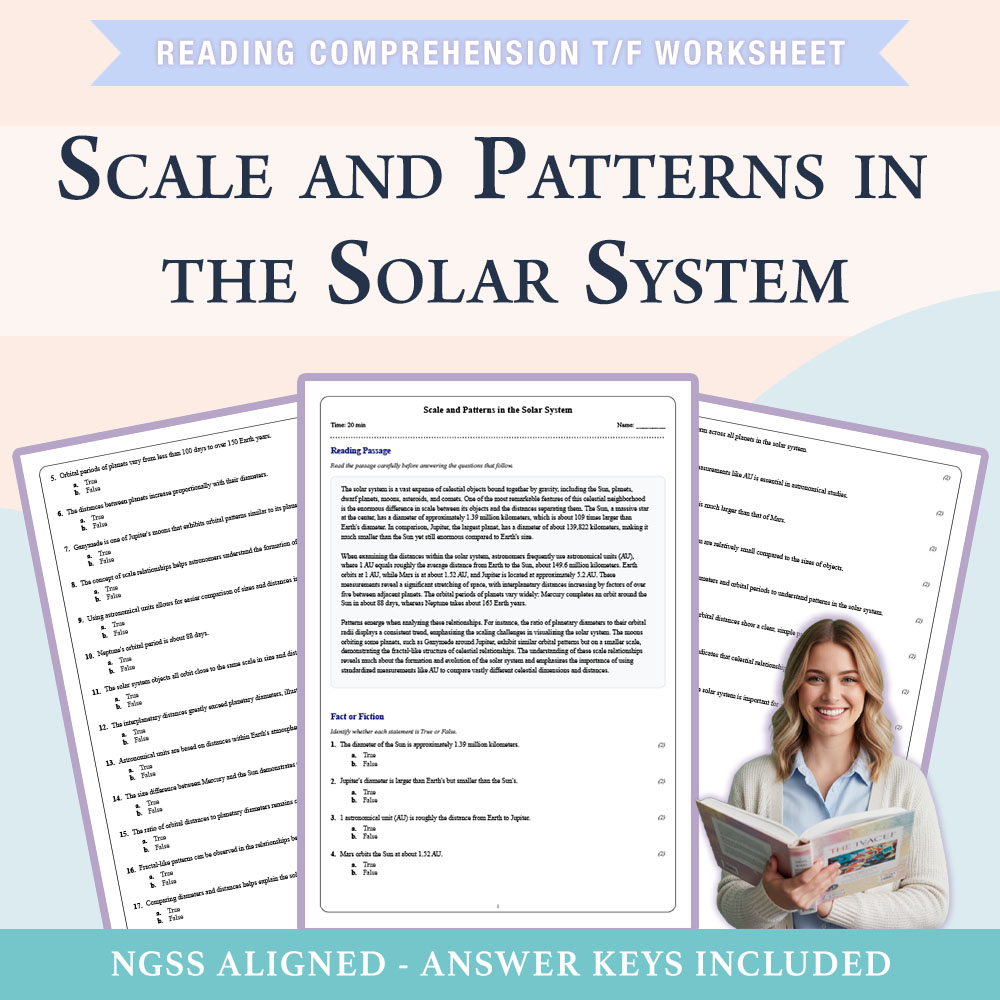
8th Grade Science | Scale and Patterns in the Solar System (PDF + Answer Key)
Created byCopper Leaf ClassroomLearning Objectives
- Understand the relative sizes and distances of objects in the solar system
- Interpret astronomical data concerning diameters, distances, and orbital periods
- Identify patterns and relationships among solar system objects
Also included in: Grade 8 Science | Solar System Patterns, Orbital Cycles & Gravity (PDF +Answers) +1 more
Instant download

Scale and Patterns Worksheet | NGSS Grade 8 Science Assessment
Created bySkylark WorksheetsLearning Objectives
- Analyze how distances in the solar system can be represented using scale factors and astronomical units (AU).
- Compare solar system objects by interpreting quantitative data (diameter, mass, distance, orbital period).
- Identify patterns and orders of magnitude when relating planetary size, spacing, and orbital timing.
Also included in: Grade 8 Earth’s Place in the Universe Science Lesson Bundle (NGSS) +1 more
Instant download

Grade 8 Science Scale and Patterns in the Solar System Worksheet | NGSS
 Created byBRIGHT PATH RESOURCES
Learning Objectives
- Understand and interpret scale relationships among solar system objects.
- Compare sizes and distances using astronomical units and relative scaling.
- Analyze data related to planetary diameters, orbital distances, and periods.
Also included in: Solar System Scale Patterns Grade 8 Science Daily Reading Worksheets Bundle|NGSS +2 more
Instant download
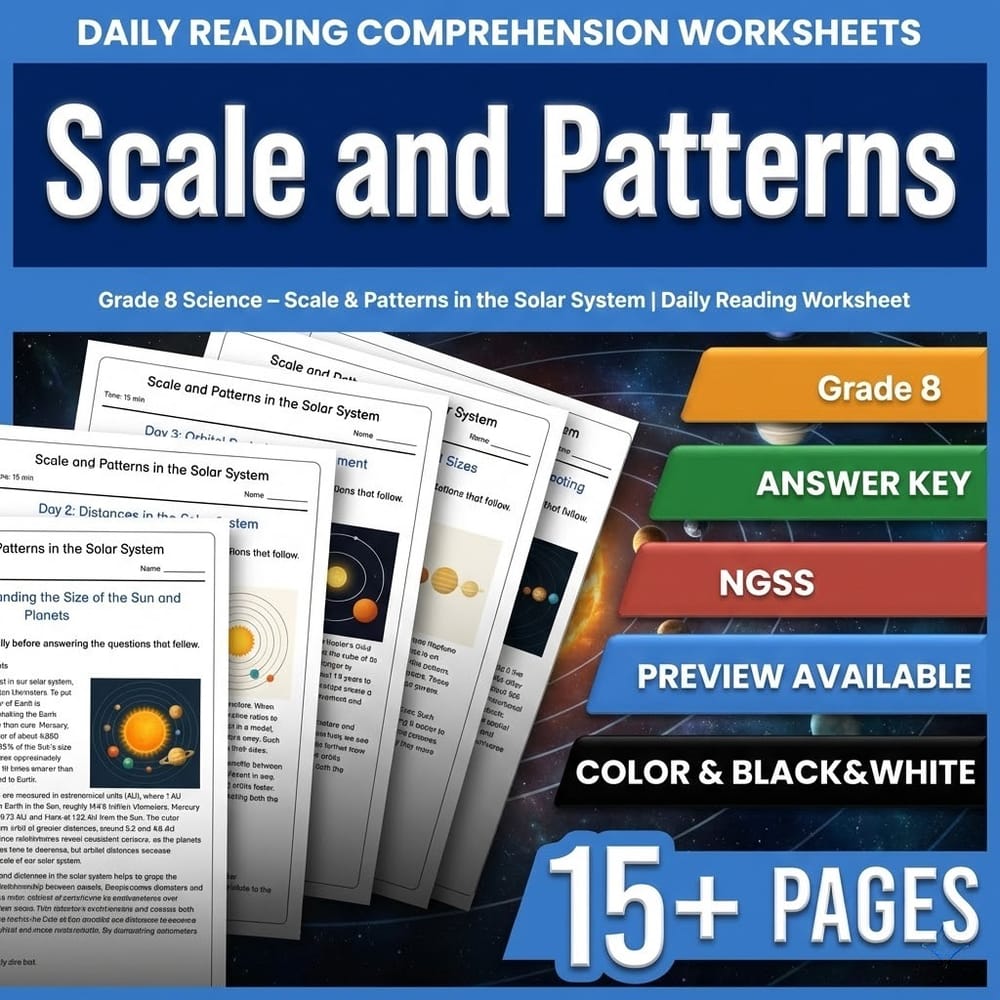
Grade 8 Science – Scale & Patterns in the Solar System | Daily Reading Worksheet
 Created byElena Brooks
Learning Objectives
- Interpret planetary diameters and compare their sizes relative to the Sun
- Understand the use of astronomical units in measuring distances
- Identify patterns and relationships among solar system objects based on data
Instant download

Solar System Scale and Patterns Worksheets | Grade 8 Science
 Created byTeachers Club
Learning Objectives
- Interpret scale relationships using solar system measurement data
- Compare planetary sizes and distances using astronomical units
- Explain orders of magnitude in scaled solar system diagrams
Also included in: Earth's Place in the Universe Grade 8 Science NGSS Worksheets +2 more
Instant download
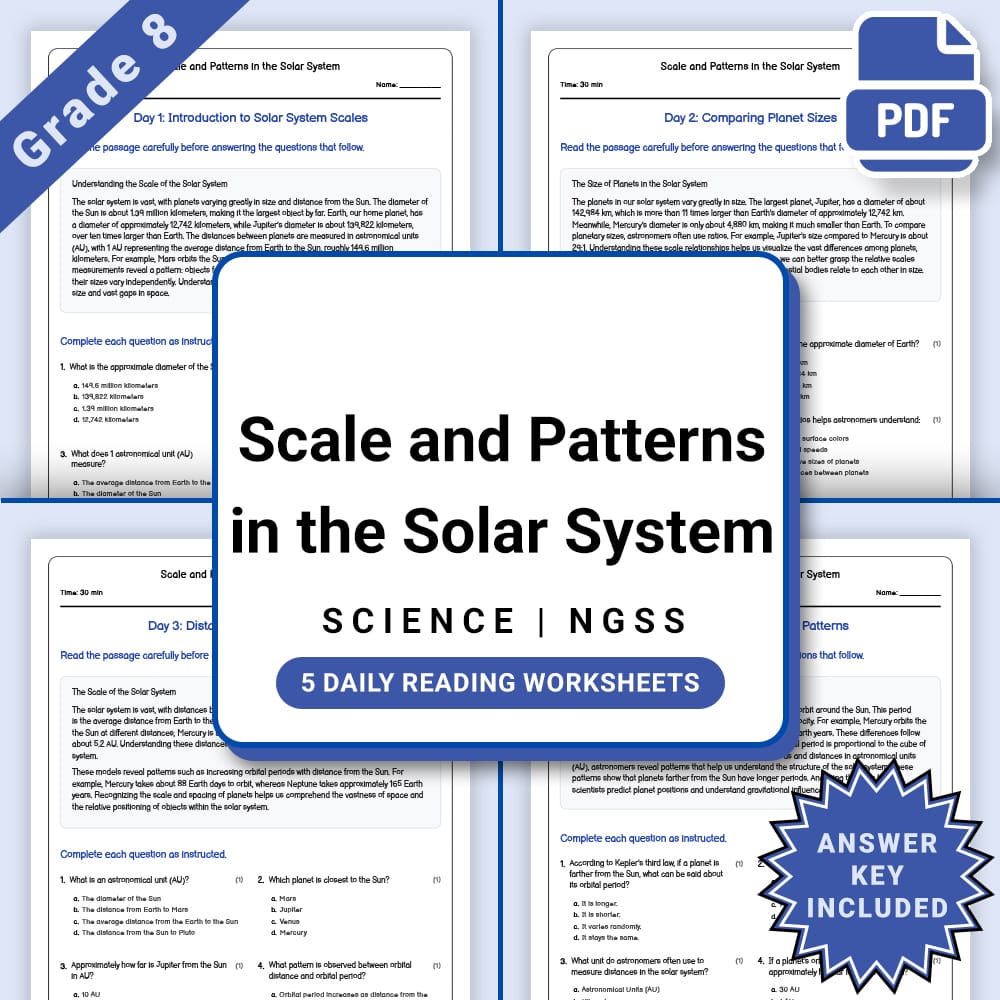
Grade 8 Science –Scale and Patterns in the Solar System Worksheet(PDF + Answers)
Created byCopper Leaf ClassroomLearning Objectives
- Understand the concept of scale in astronomical contexts.
- Interpret quantitative data about solar system objects.
- Recognize patterns and relationships among planets, the Sun, and moons.
Instant download

Grade 8 Science Scale and Patterns Worksheet | NGSS Solar System Activity
 Created byAmber Owl Education
Learning Objectives
- Interpret solar system scale relationships using quantitative data such as diameters, distances, and orbital periods.
- Use astronomical units (AU) and relative scaling to compare the Sun, planets, dwarf planets, and major moons.
- Explain patterns across the solar system by identifying orders of magnitude in sizes and interplanetary distances.
Also included in: Grade 8 Science Solar System Orbits & Gravity Lesson Bundle | NGSS +1 more
Instant download

Scale and Patterns in the Solar System Worksheet for Grade 8 Science NGSS
Created byCedar Grove LearningLearning Objectives
- Interpret quantitative data on planetary diameters, orbital distances, and periods.
- Compare relative scales of celestial objects using astronomical units and ratios.
- Identify patterns and relationships in the spatial and temporal organization of the solar system.
Instant download

Scale and Patterns Worksheet for Grade 8 Science | NGSS-Aligned Assessment
Learning Objectives
- Interpret scale relationships among solar system objects using quantitative data.
- Compare sizes, distances, and periods of planets, dwarf planets, and moons.
- Analyze patterns and relationships in astronomical data across the solar system.
Also included in: Grade 8 Gravity, Orbital Cycles & Patterns Science Lesson Bundle | NGSS +1 more
Instant download

Solar System Scale and Patterns Worksheet | Grade 8 Science Practice
Created bythe curious pencilLearning Objectives
- Compare solar system objects using diameter, mass, distance, and orbital period data
- Interpret astronomical units when comparing large solar system distances
- Identify patterns in object size, orbital distance, and orbital period
Also included in: Earth's Place in the Universe NGSS Science Unit Bundle +2 more
Instant download

Grade 8 Science | Scale & Patterns in the Solar System - Reading Comprehension
Created byCoral Reef LearningLearning Objectives
- Understand the relative sizes of planets based on their diameters
- Interpret quantitative data related to planetary scales
- Compare distances of planets from the Sun using astronomical units
Instant download
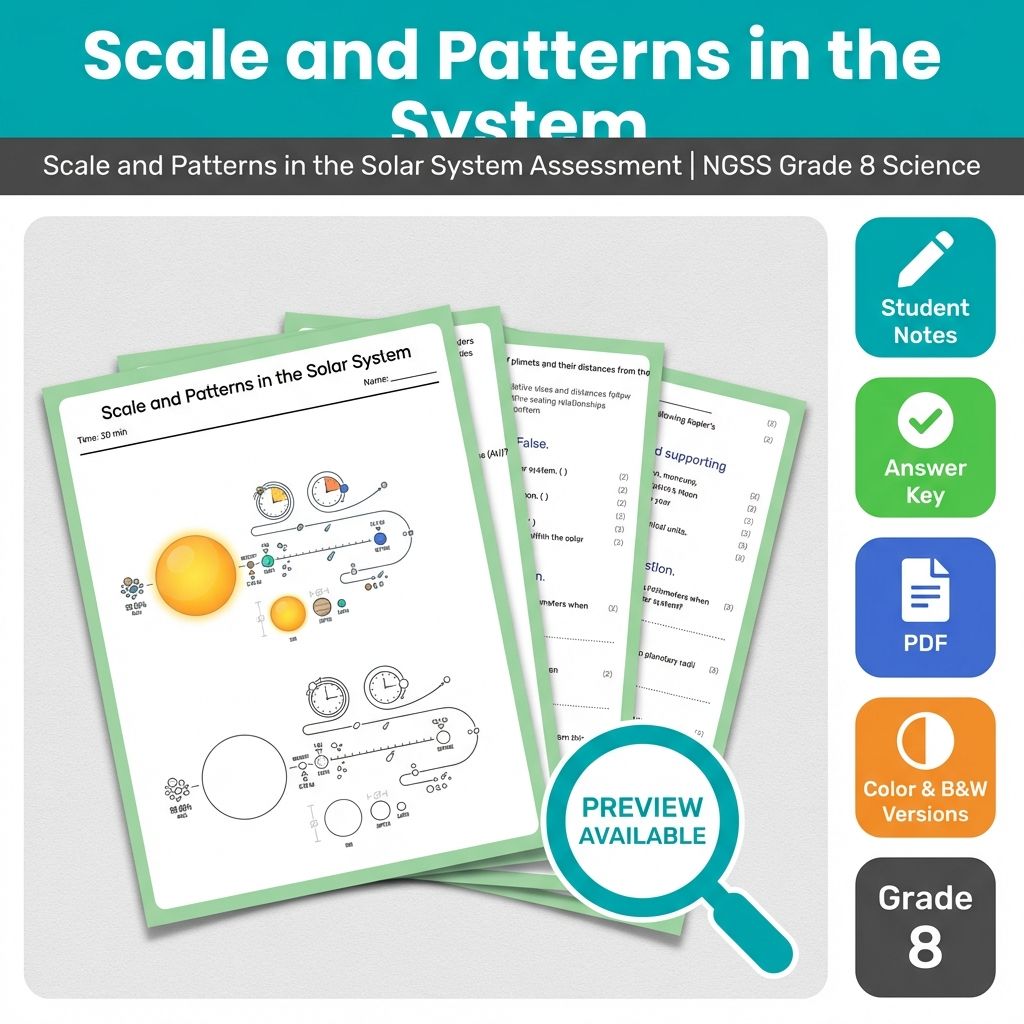
Scale and Patterns in the Solar System Assessment | NGSS Grade 8 Science
Created byPrism Point LearningLearning Objectives
- Interpret quantitative data related to solar system objects such as diameters, distances, and orbital periods.
- Compare and analyze patterns and relationships among planets, dwarf planets, moons, and the Sun using scaled data and astronomical units.
- Identify orders of magnitude differences in planetary radii and interplanetary distances.
Also included in: Grade 8 Science Mini Bundle | Earth's Place in the Universe – NGSS +1 more
Instant download

Scale and Patterns Worksheet | Grade 8 Science printable PDF NGSS assessment
Learning Objectives
- Analyze scale relationships among solar system objects using size and distance data.
- Interpret quantitative data including diameters, masses, and orbital periods.
- Use astronomical units and relative scaling to compare planets, dwarf planets, and moons.
Also included in: Grade 8 Science Earth's Place in the Universe Lesson Bundle NGSS +1 more
Instant download

Grade 8 Scale and Patterns in the Solar System Worksheet | NGSS Practice PDF
Created byClear Sky ClassroomLearning Objectives
- Interpret scale relationships among solar system objects using quantitative data.
- Compare sizes, distances, and orbital periods of planets, dwarf planets, and moons.
- Understand the use of astronomical units and relative scaling in astronomy.
Also included in: Grade 8 Solar System Scale, Orbits & Gravity Science Lesson Bundle (NGSS) +1 more
Instant download

Scale and Patterns Practice Test Printable | Grade 8 Science NGSS
Created byPrism Point LearningLearning Objectives
- Use scale factors to compare solar system sizes and explain what changes when objects are scaled up or down.
- Interpret patterns in mean orbital distance (in astronomical units) and orbital period (in Earth days/years).
- Describe how orders of magnitude differ between planetary radii and interplanetary distances.
Also included in: Grade 8 Gravity and Motion Science lesson bundle NGSS worksheet practice
Instant download
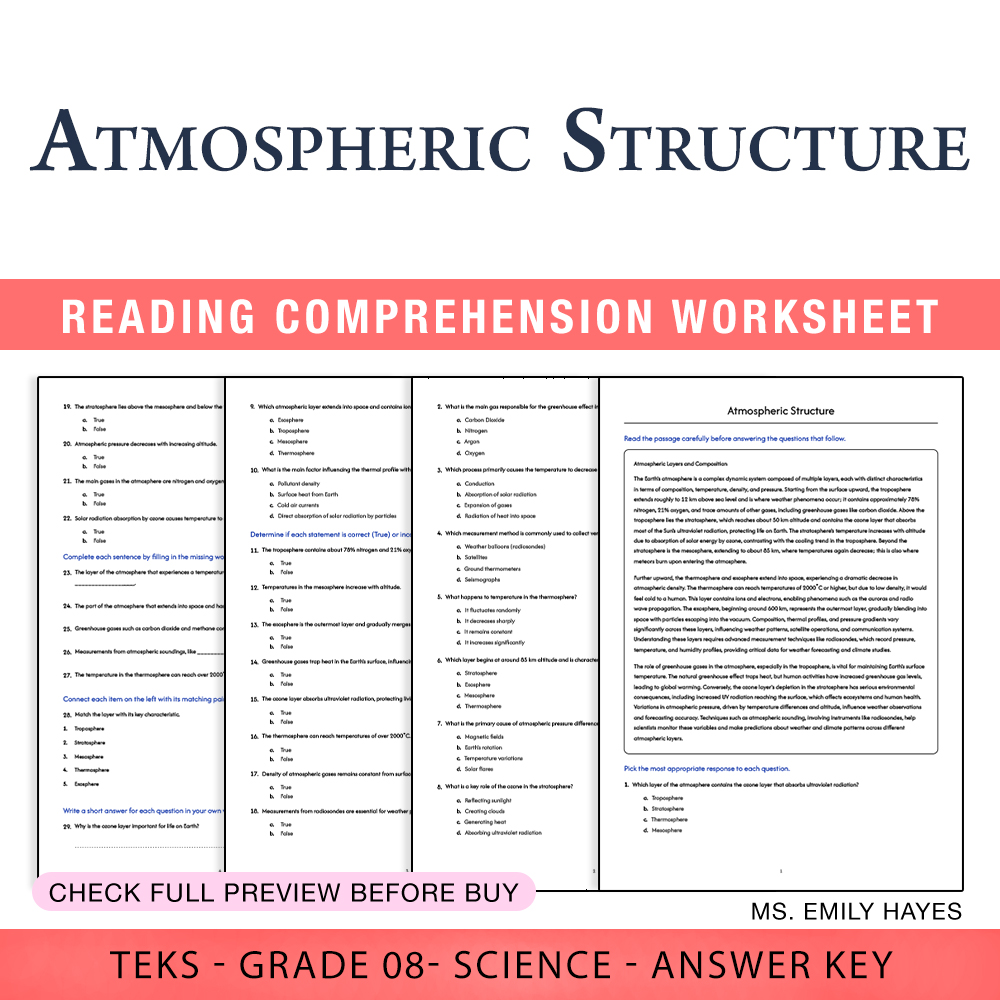
8th Grade Science | Atmospheric Structure Worksheet (PDF+ Answer Key)
Created byCopper Leaf ClassroomLearning Objectives
- Understand the different compositional layers of the atmosphere and their characteristics.
- Identify the role of ozone, greenhouse gases, and pressure gradients in atmospheric processes.
- Explain measurement methods such as radiosonde profiles and atmospheric soundings.
Instant download

Grade 8 Science | Atmospheric Structure - Daily Reading Comprehension
Created byCoral Reef LearningLearning Objectives
- Identify and describe the layers of the Earth's atmosphere.
- Understand the characteristics and functions of each atmospheric layer.
- Explain the role of ozone, greenhouse gases, and atmospheric pressure in weather and climate.
Instant download

Atmospheric Structure Worksheet | Standards-Aligned Grade 8 Science Practice
Learning Objectives
- Identify the main atmospheric layers and describe how temperature and density change with altitude.
- Explain how pressure decreases with height and how this affects weather observations.
- Describe the role of ozone in the stratosphere and greenhouse gases in Earth’s energy balance.
Instant download

Grade 8 Atmospheric Structure Daily Science Reading Worksheet | TEKS
Created byBRIGHT PATH RESOURCESLearning Objectives
- Identify the main idea and key details about atmospheric layers.
- Describe how pressure and temperature change with altitude.
- Explain why ozone and greenhouse gases matter in different layers.
Also included in: Grade 8 Earth and Space Science Daily Reading Worksheets Bundle | TEKS +1 more
Instant download

Grade 8 Science | Atmospheric Structure Worksheet (TEKS) PDF
Created byEvergreen Desk EducationLearning Objectives
- Describe the main atmospheric layers (troposphere to exosphere) and how temperature changes with height.
- Explain how ozone and greenhouse gases affect energy balance in the atmosphere.
- Interpret how atmospheric pressure influences weather observations and measurements.
Instant download

Atmospheric Structure Assessment | TEKS Grade 8 Science Standards
Created byPrism Point LearningLearning Objectives
- Understand key concepts related to Science
- Apply knowledge through practice questions
- Demonstrate comprehension of the material
Also included in: Grade 8 Weather and Earth-Space Science Assessment Lesson Bundle TEKS
Instant download

Grade 8 Science – Atmospheric Structure Daily Reading Worksheet with Answer Key
Learning Objectives
- Identify and describe the major layers of Earth's atmosphere.
- Understand the composition and thermal profiles of atmospheric layers.
- Recognize the roles of ozone and greenhouse gases in climate regulation.
Also included in: Grade 8 Science Lesson Bundle | TEKS Standards Worksheets for Earth & Space +1 more
Instant download

Atmospheric Structure Assessment Grade 8 Science TEKS Printable
Created byPrism Point LearningLearning Objectives
- Describe the compositional layers of Earth's atmosphere and their features.
- Explain the roles of ozone and greenhouse gases in atmospheric processes.
- Interpret pressure gradients and thermal profiles throughout atmospheric layers.
Instant download
Grade 8 Science | Atmospheric Structure Worksheet | TEKS Aligned
Created byLumora LearningLearning Objectives
- Describe the main layers of Earth's atmosphere and their characteristics.
- Explain the roles of ozone and greenhouse gases in Earth's atmosphere.
- Understand how pressure, temperature, and density change with altitude.
Also included in: Grade 8 Science | Earth and Space Systems Lesson Bundle | TEKS Aligned
Instant download
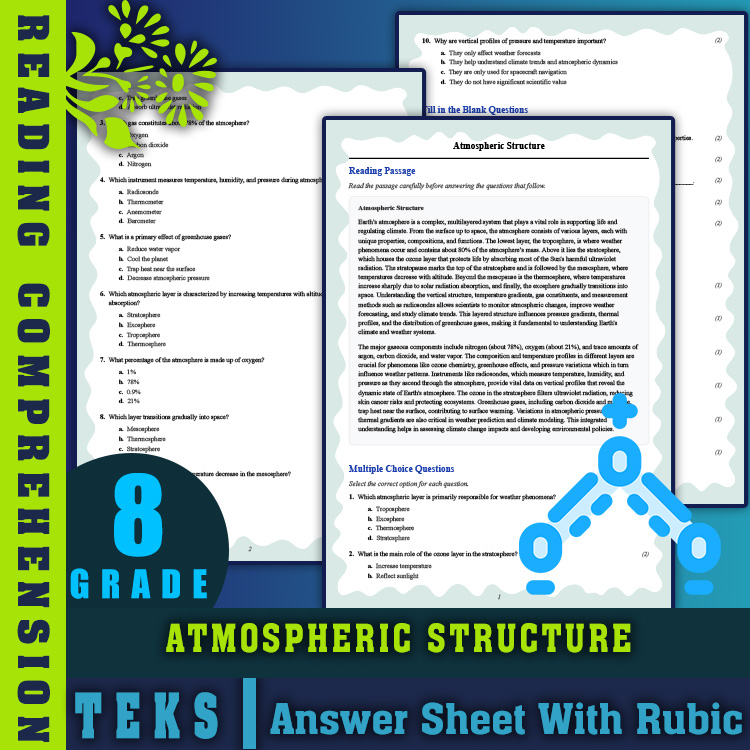
Grade 8 Science | Atmospheric Structure Reading Worksheet (PDF + Answer Key)
Learning Objectives
- Identify and describe the major layers of Earth's atmosphere.
- Understand the roles of ozone and greenhouse gases in atmospheric processes.
- Interpret pressure and thermal profiles within different atmospheric layers.
Instant download

Atmospheric Structure Worksheet | Grade 8 Science Practice
Created byPrism Point LearningLearning Objectives
- Describe the major compositional layers of Earth’s atmosphere from the troposphere to the exosphere.
- Explain how temperature and density change with altitude and how that affects atmospheric behavior.
- Relate ozone in the stratosphere and greenhouse gases near Earth’s surface to energy balance.
Also included in: Grade 8 Earth and Space Science Lesson Bundle for TEKS Worksheets +1 more
Instant download
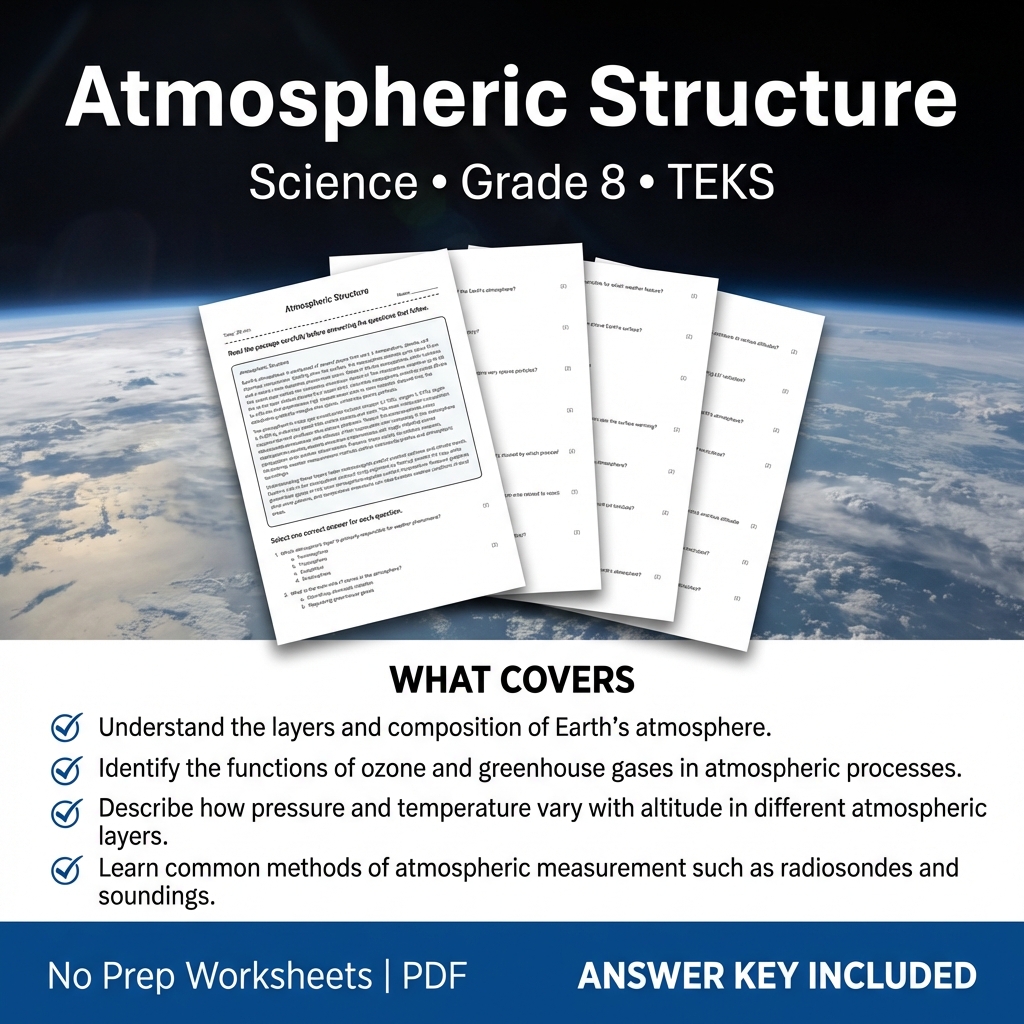
Atmospheric Structure Grade 8 Science Worksheet | TEKS Practice
Created byCoral Reef LearningLearning Objectives
- Understand the layers and composition of Earth's atmosphere.
- Identify the functions of ozone and greenhouse gases in atmospheric processes.
- Describe how pressure and temperature vary with altitude in different atmospheric layers.
Instant download

Grade 8 Science – Atmospheric Structure Worksheet (Answer Key) | TEKS Aligned
Created byBright Mind ResourcesLearning Objectives
- Describe the layers of the atmosphere and their characteristics.
- Explain the roles of gases such as ozone and greenhouse gases in Earth's atmosphere.
- Understand how pressure gradients and thermal profiles affect weather and climate.
Also included in: Grade 8 Science UNIT Bundle | Weather, Solar System & Earth - TEKS Aligned +1 more
Instant download
About Grade 8 Science Worksheets
Explore Grade 8 Science worksheets for classwork, homework, or review. Our 6,034 printables download instantly as PDFs.
Each resource here is built by an independent educator and reviewed for quality. Worksheets print straight from PDF and suit classroom use, homework, or extra practice; most come with answer keys, and you can preview before purchasing.