
Grade 8 Science Worksheets
6,034 worksheets
Science Worksheet Flotation Stability Grade 8 | Standards-Aligned Practice
Learning Objectives
- Explain how the centre of gravity and centre of buoyancy affect whether a floating body returns upright or tips over
- Describe how metacentric height (GM) relates to righting stability and capsizing thresholds
- Use loading and hull-shape ideas to predict changes in stability and safe trim
Instant download

Grade 8 Science | Flotation Stability - Daily Reading Comprehension
 Created byCoral Reef Learning
Learning Objectives
- Understand the principles of buoyancy and stability in floating bodies
- Identify the roles of center of gravity and center of buoyancy
- Learn how hull shape and loading affect a vessel's stability
Instant download
Grade 8 Science – Flotation Stability Worksheet (Ontario) (PDF)
 Created byBright Mind Resources
Learning Objectives
- Explain how relative positions of the centre of gravity and centre of buoyancy affect stability of floating bodies.
- Identify factors such as weight distribution, hull shape, and loading that influence righting moments and tipping safety.
- Calculate stability margins and buoyancy shifts during loading changes.
Instant download
Grade 8 Science | Flotation Stability Worksheet with Short Notes (Printable PDF)
 Created byMeadowlark Worksheets
Learning Objectives
- Understand how the positions of the centre of gravity and buoyancy affect stability of floating bodies.
- Describe how hull shape and loading influence tipping moments and capsizing thresholds.
- Calculate stability margins and analyze buoyancy shifts during loading.
Also included in: Grade 8 Science Lesson Group Bundle | Hydrostatics & Fluid Mechanics +1 more
Instant download

Grade 8 Science – Flotation Stability Worksheet (PDF) – Ontario Standards
 Created byEvergreen Desk Education
Learning Objectives
- Explain how centre of gravity (CG) and centre of buoyancy (CB) relate to upright equilibrium of a floating body
- Describe how metacentric height (GM) influences stability and the risk of capsizing
- Apply stability ideas to real loading and hull-shape situations using righting and tipping moments
Also included in: Grade 8 Fluid Pressure & Forces Science Lesson Bundle: Ontario Worksheet Set +1 more
Instant download

Rock Cycle Reading Comprehension Worksheet | Grade 8 Science PDF
Created byEvergreen Desk EducationLearning Objectives
- Describe how igneous, sedimentary, and metamorphic rocks change through the rock cycle.
- Explain how weathering, erosion, and deposition rebuild sediment layers over time.
- Connect lithospheric recycling and plate tectonics to rock formation and transformation.
Instant download

Rock Cycle Earth Materials in Motion Worksheet | NGSSS Grade 8 Science
Learning Objectives
- Explain how igneous, sedimentary, and metamorphic rocks connect through the rock cycle.
- Describe how weathering, erosion, deposition, heat, and pressure change Earth materials.
- Connect rock-cycle processes to tectonic plate movement and long time scales.
Also included in: Grade 8 Earth Systems and Climate Science Lesson Bundle – Florida NGSSS +1 more
Instant download

Grade 8 Rock Cycle Worksheet | NGSS Practice PDF
 Created byClear Sky Classroom
Learning Objectives
- Describe how igneous, sedimentary, and metamorphic rocks change through the rock cycle.
- Explain how weathering, erosion, and deposition rebuild sediment layers over time.
- Connect the rock cycle to plate tectonics and the long-term recycling of Earth materials.
Instant download

Rock Cycle Worksheet Grade 8 Science Activities | Earth Science NGSSS
 Created byPrism Point Learning
Learning Objectives
- Explain how the rock cycle connects igneous, sedimentary, and metamorphic rocks
- Describe how weathering, erosion, deposition, heat, and pressure transform rocks over time
- Relate lithospheric recycling to tectonic plate motion and Earth’s energy transfer
Also included in: Earth Systems & Climate Lesson Bundle | Grade 8 Science | Florida NGSSS
Instant download

Grade 8 Science – Rock Cycle & Formation Worksheets | Daily Reading
Created byBright Mind ResourcesLearning Objectives
- Identify different types of rocks: igneous, sedimentary, and metamorphic.
- Understand the basic processes involved in the rock cycle, including formation and transformation.
- Recognize how Earth's processes like weathering, erosion, and tectonic activity contribute to the rock cycle.
Also included in: Grade 8 Earth Science Daily Reading Worksheets Lesson Bundle | Florida NGSSS +1 more
Instant download

Rock Cycle Assessment | Florida NGSSS Grade 8 Science Standards
Created byPrism Point LearningLearning Objectives
- Describe how igneous, sedimentary, and metamorphic rocks transform through the rock cycle
- Explain how weathering, erosion, and deposition rebuild sediment layers over time
- Connect lithospheric recycling and tectonic plate movement to energy transfer in Earth systems
Also included in: Grade 8 Earth Systems Science Lesson Bundle: Florida NGSSS Assessment
Instant download

Grade 8 Molecular Structure Worksheet | NGSS Atoms & Molecules Activity
 Created byBRIGHT PATH RESOURCES
Learning Objectives
- Identify and describe atoms in simple molecules using particle models and symbolic formulas.
- Understand how molecules like water (H2O) and carbon dioxide (CO2) are represented diagrammatically.
- Differentiate between discrete molecules and extended structures like ionic lattices.
Also included in: Reactions & Matter Grade 8 Science Daily Reading Worksheets Lesson Bundle | NGSS +2 more
Instant download

Grade 8 Science | Molecular Structure Worksheet with Short Notes (PDF)
Created byMeadowlark WorksheetsLearning Objectives
- Understand the atomic composition of simple molecules using particle models and formulas.
- Interpret structural diagrams and symbolic formulas of molecules like H2O, CO2, and NaCl.
- Distinguish between molecular units and extended solids based on microscopic arrangements.
Also included in: Grade 8 Science | Matter and Its Interactions NGSS Unit Bundle – Worksheets +1 more
Instant download
Grade 8 Science | Molecular Structure Worksheet (PDF + Answer Key)
 Created byCopper Leaf Classroom
Learning Objectives
- Understand the atomic composition of simple molecules and extended structures.
- Interpret particle models and symbolic formulas of molecules.
- Distinguish between molecular units and extended solids based on microscopic arrangements.
Also included in: Grade 8 Science Bundle| Critical Concepts & Applications Unit (PDF + Answer Key) +1 more
Instant download
Grade 8 Science – Molecular Structure Daily Reading Worksheet(PDF + Answer Key)
Created byCopper Leaf ClassroomLearning Objectives
- Understand basic atomic composition of simple molecules
- Identify element symbols and how atoms combine
- Learn to interpret particle models and symbolic formulas
Instant download

Molecular Structure Worksheet | NGSS Grade 8 Science Assessment
 Created byCedar Grove Learning
Learning Objectives
- Describe how atoms combine to form molecules using particle models and symbolic formulas.
- Identify the types and numbers of atoms in common molecules such as H2O and CO2.
- Interpret molecular diagrams and structural models to understand bonding arrangements.
Instant download
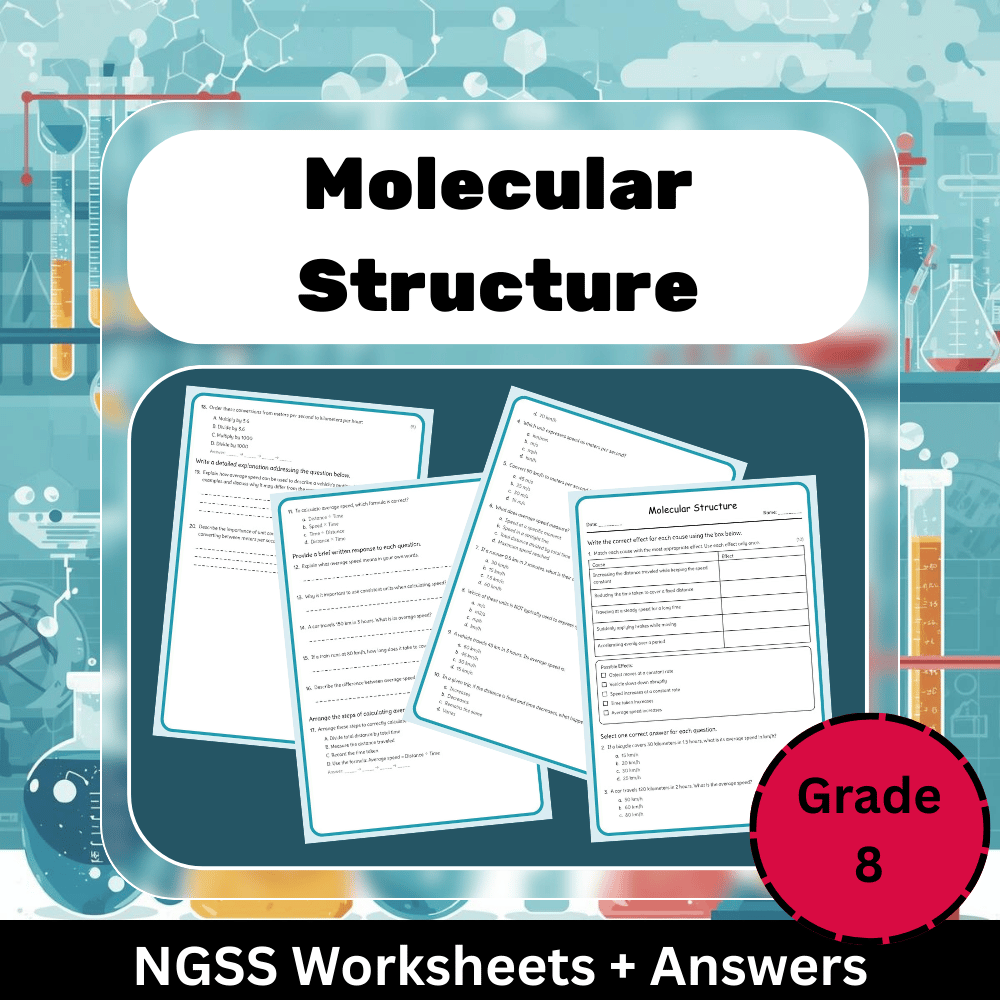
Grade 8 Science | Molecular Structure Worksheet (NGSS-Aligned) PDF
Created byBright Mind ResourcesLearning Objectives
- Understand the atomic composition of simple molecules and extended structures.
- Interpret particle models and symbolic formulas of molecules.
- Identify different types of bonds and arrangements in molecules like water, carbon dioxide, and salts.
Also included in: Grade 8 Science | Molecular Structures & Energy Effects Unit Worksheet Pack-NGSS +2 more
Instant download

Molecular Structure and Particle Models Worksheet | Grade 8 Science
 Created bythe curious pencil
Learning Objectives
- Identify atoms and elements represented in simple molecular formulas
- Interpret subscripts and formulas using particle models
- Distinguish discrete molecules from extended ionic lattice structures
Also included in: Matter and Its Interactions Grade 8 Science Worksheets NGSS Bundle +2 more
Instant download

Molecular Structure Worksheets: Molecules & Ionic Lattices Grade 8
 Created byTeachers Club
Learning Objectives
- Represent simple molecules using element symbols and molecular formulas.
- Interpret subscripts to determine atom counts within molecular units.
- Compare discrete molecular units with extended ionic lattices.
Also included in: Grade 8 Science Worksheets | NGSS Matter & Interactions Bundle +2 more
Instant download

Molecular Structure Worksheet | NGSS Grade 8 Science Assessment
 Created bySkylark Worksheets
Learning Objectives
- Use particle models and symbolic formulas to represent the types and numbers of atoms in simple molecules (e.g., H2O, CO2).
- Differentiate discrete molecular units from extended ionic solids using particle model ideas and element/ion symbols (e.g., NaCl).
- Explain how bonding arrangements affect observable properties such as melting point and behavior of substances.
Also included in: Matter and Its Interactions Lesson Bundle | Grade 8 Science | NGSS +1 more
Instant download

Grade 8 Molecular Structure Worksheet | NGSS Molecules & Particle Models
 Created byAmber Owl Education
Learning Objectives
- Use particle models and chemical formulas to represent the relative numbers and types of atoms in simple molecules (e.g., H2O, CO2).
- Differentiate discrete molecular units from continuous extended solids using structural models (including ionic lattices).
- Relate observable properties (such as conductivity for ionic substances) to microscopic bonding arrangements and structure.
Also included in: Grade 8 Science Thermal Effects & Chemical Reactions Lesson Bundle | NGSS +1 more
Instant download

Grade 8 Science | Molecular Structures - Daily Reading Comprehension
Created byCoral Reef LearningLearning Objectives
- Identify different atoms in simple molecules.
- Understand how atoms bond to form molecules such as water and carbon dioxide.
- Represent molecules using particle models and symbolic formulas.
Instant download

Molecular Structure Worksheet | Standards-Aligned Grade 8 Science Practice
Learning Objectives
- Understand how atoms combine to form simple molecules using particle models and symbolic formulas.
- Identify the types and numbers of atoms in common molecules like H2O and CO2.
- Distinguish between discrete molecular units and extended solid structures such as ionic lattices.
Also included in: Grade 8 Chemical Reactions Science Lesson Bundle NGSS: Worksheet Set +1 more
Instant download

Grade 8 Molecular Structure Worksheet | NGSS Practice PDF
Created byClear Sky ClassroomLearning Objectives
- Describe the atomic composition and bonding arrangements in simple molecules like water and carbon dioxide.
- Explain how particle models and symbolic formulas represent molecular structures.
- Distinguish between discrete molecules and extended solids such as ionic lattices.
Also included in: Grade 8 Conservation of Matter Science Lesson Bundle | NGSS +1 more
Instant download
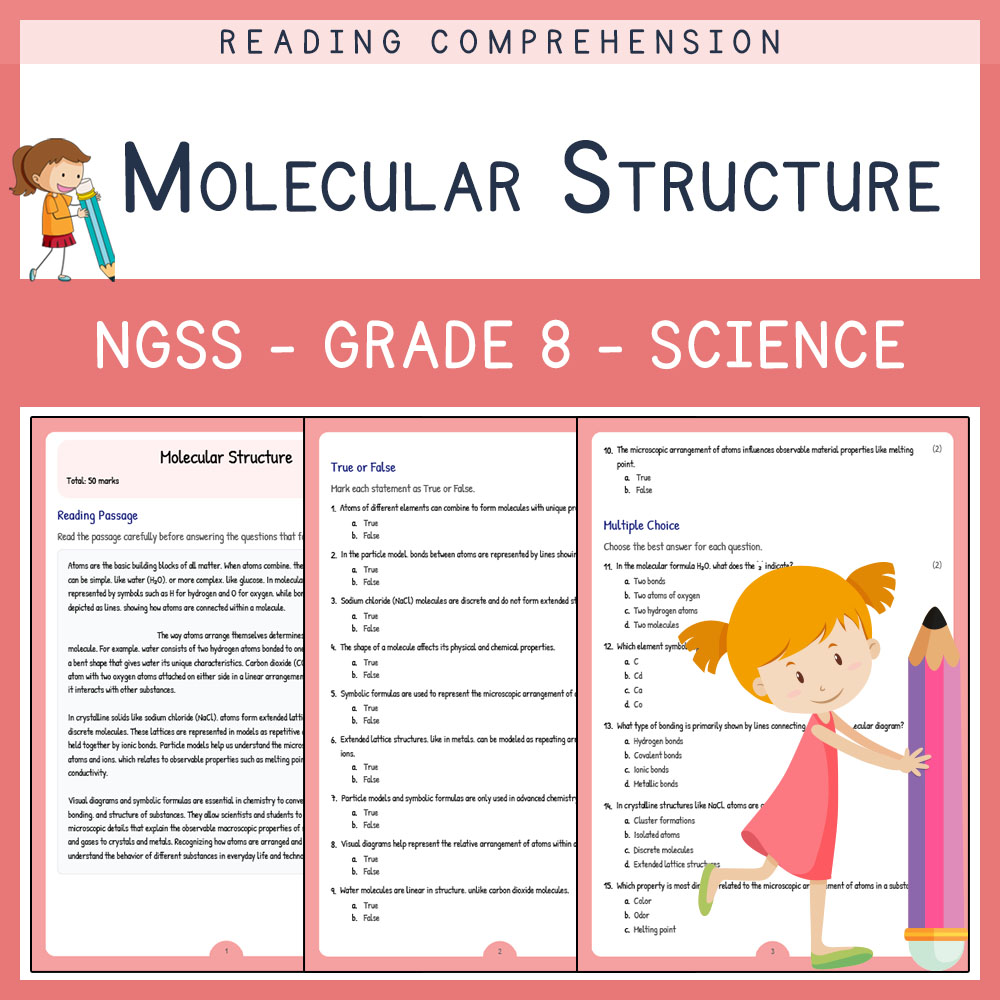
Grade 8 Science | Molecular Structure Worksheet (Answer Key) – NGSS Aligned
 Created byLumora Learning
Learning Objectives
- Describe the atomic composition of simple molecules using particle models and symbolic formulas.
- Interpret molecular diagrams and structural models to identify atom types and bonds.
- Differentiate between discrete molecular units and extended solids based on microscopic arrangements.
Instant download

Molecular Structure Worksheet | Assessment for Grade 8 Science Printable PDF
Learning Objectives
- Describe the atomic composition of simple molecules using particle models and formulas.
- Represent atoms, element symbols, and bonding arrangements in common molecules.
- Distinguish between discrete molecules and extended solids through structural models.
Also included in: Grade 8 Science Lesson Bundle on Matter and Its Interactions NGSS +1 more
Instant download
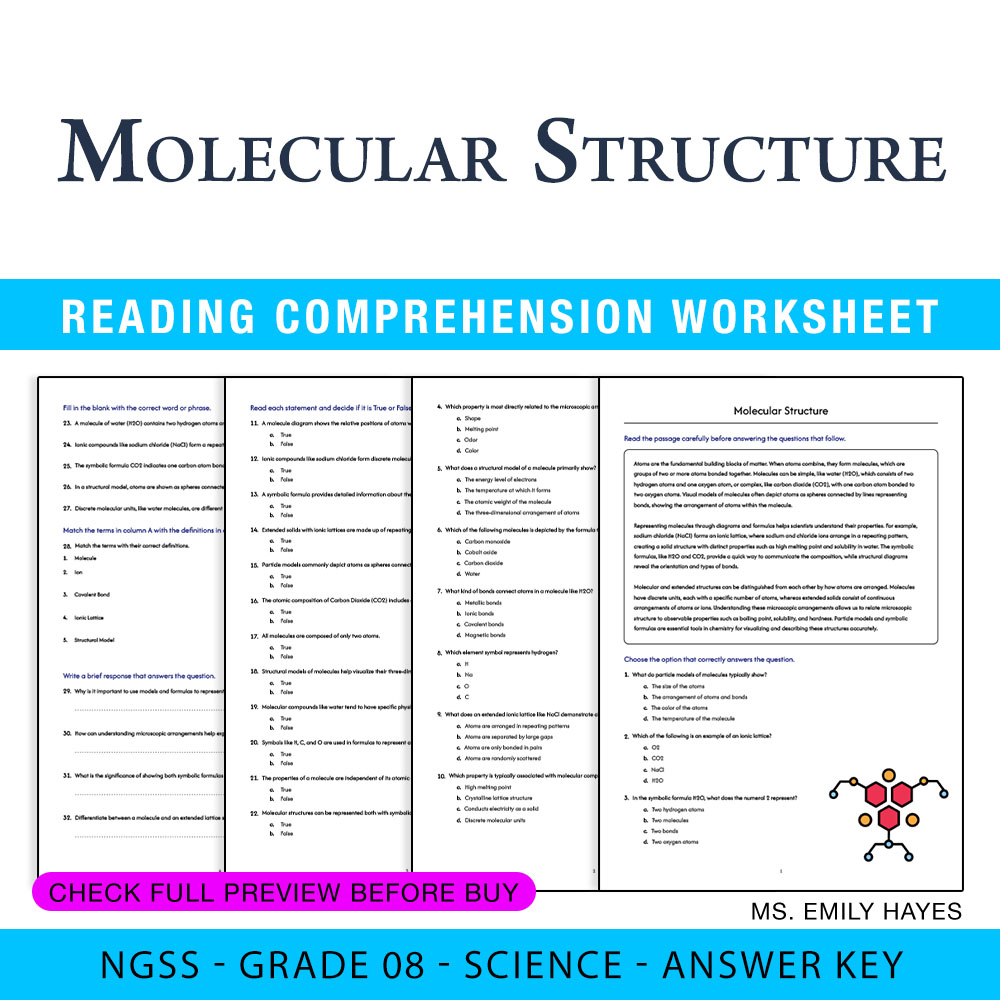
8th Grade Science | Molecular Structure Worksheet (PDF+ Answer Key)
Created byCopper Leaf ClassroomLearning Objectives
- Describe the atomic composition of simple molecules and extended structures using particle models and symbolic formulas.
- Understand how to represent atoms, element symbols, and bonding arrangements in common examples such as water (H2O), carbon dioxide (CO2), and ionic lattices like sodium chloride.
- Explain how molecule diagrams and structural models convey the relative atom types and numbers.
Instant download

Grade 8 Science – Molecular Structure & Composition | Daily Reading Worksheet
Created byBright Mind ResourcesLearning Objectives
- Identify atoms and molecules using symbolic formulas.
- Understand the atomic composition of simple molecules like water and carbon dioxide.
- Recognize extended structures such as ionic lattices like sodium chloride.
Also included in: Particle Motion Grade 8 Science Daily Reading Worksheets Lesson Bundle | NGSS +1 more
Instant download

Molecular Structure Test Prep Worksheet | Grade 8 Science NGSS
Created byPrism Point LearningLearning Objectives
- Use particle models and symbolic formulas to represent atoms in simple molecules and in ionic solids.
- Identify how molecule diagrams show relative atom types and numbers for compounds like H2O and CO2.
- Distinguish discrete molecular units from extended ionic lattices and relate structure to observable properties.
Also included in: Grade 8 Matter & Chemical Reactions Science Lesson Bundle (NGSS)
Instant download

Force Relationships Worksheet for Grade 8 Science | NGSS G8 Assessment
Created byCedar Grove LearningLearning Objectives
- Analyze how net force, mass, and acceleration are related using mathematical models.
- Interpret graphical representations connecting force and motion.
- Predict changes in acceleration based on variations in force and mass.
Instant download
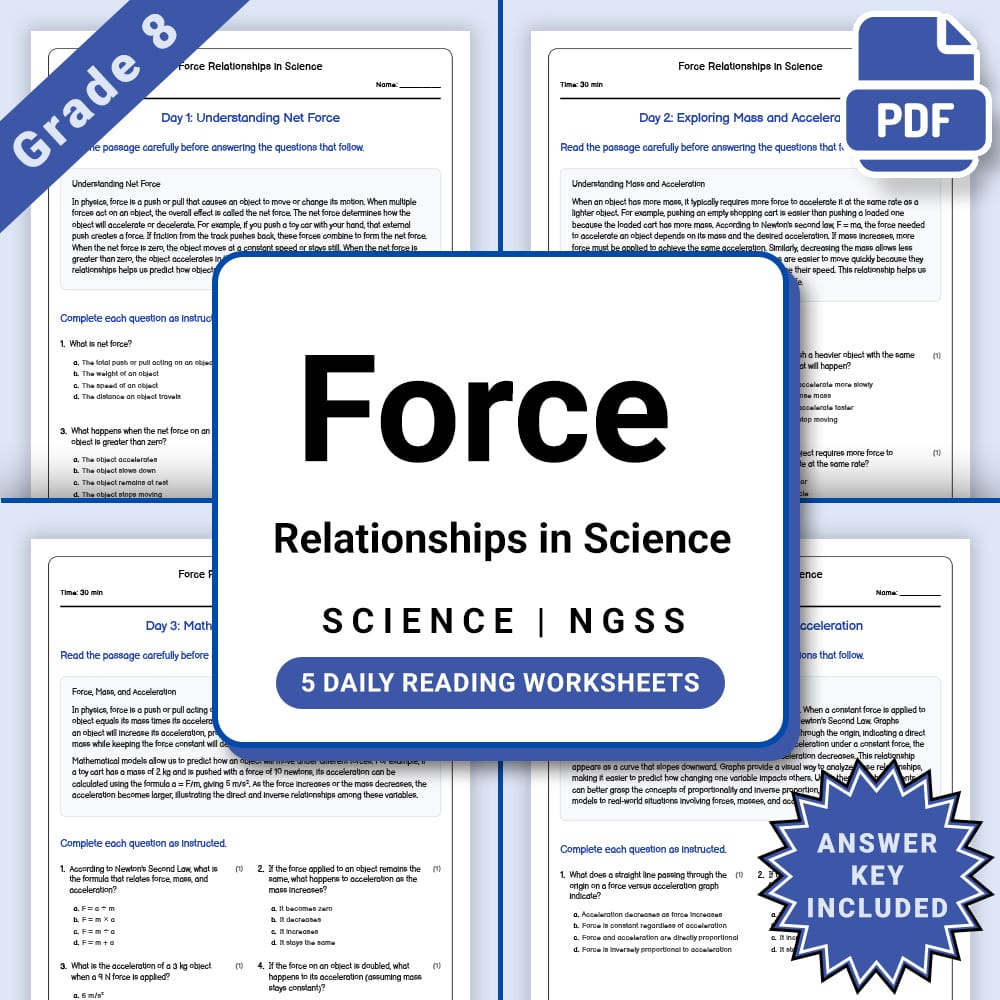
Grade 8 Science – Force Relationships Worksheet(PDF + Answer Key)
Created byCopper Leaf ClassroomLearning Objectives
- Understand key concepts related to Science
- Apply knowledge through practice questions
- Demonstrate comprehension of the material
Instant download

Force Relationships Worksheet | NGSS Grade 8 Science Assessment
Created bySkylark WorksheetsLearning Objectives
- Explain how net force, mass, and acceleration are related using proportional reasoning.
- Use equations and numerical substitution to predict acceleration from given force and mass values.
- Interpret how friction changes net force and affects acceleration in real situations.
Also included in: Grade 8 Motion and Stability Forces Interactions Science Lesson Bundle (NGSS) +1 more
Instant download

Force Relationships Worksheet | NGSS-Aligned Grade 8 Science Practice
Learning Objectives
- Understand how net force, mass, and acceleration are related through mathematical models.
- Analyze real-world examples involving forces and motion.
- Interpret graphical representations of force and acceleration data.
Also included in: Grade 8 Forces and Electromagnetism Science Lesson Bundle NGSS Worksheets +1 more
Instant download
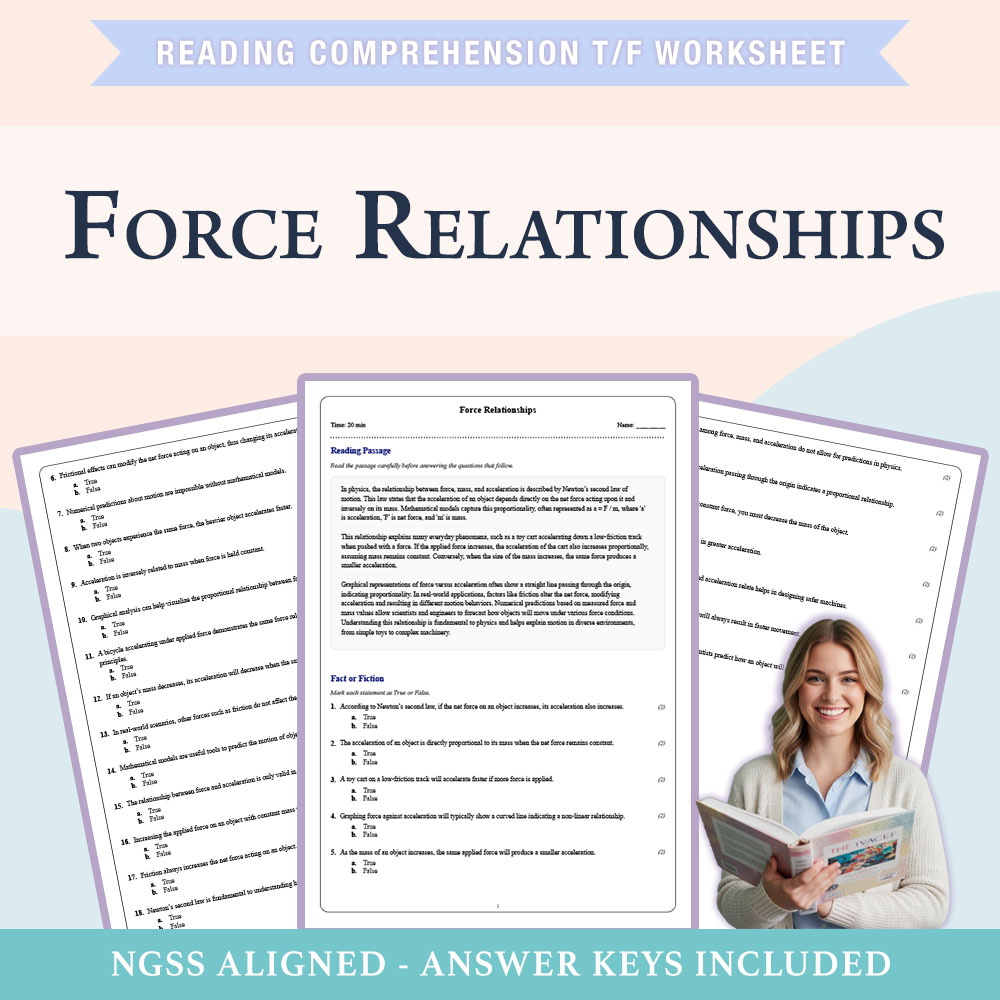
8th Grade Science | Force Relationships Worksheet (PDF + Answer Key)
Created byCopper Leaf ClassroomLearning Objectives
- Understand the proportional relationship between acceleration and net force
- Recognize the inverse relationship between acceleration and mass
- Analyze graphs and numerical data to predict motion changes
Also included in: Grade 8 Science | Motion, Forces & Magnetism Unit Worksheets (PDF + Answer Keys) +1 more
Instant download

Grade 8 Force Relationships and Motion Worksheet | NGSS Science Activity
Created byBRIGHT PATH RESOURCESLearning Objectives
- Understand the basic concepts of force and motion
- Analyze how net force affects acceleration
- Recognize the relationship between mass, force, and acceleration using simple examples
Also included in: Forces & Electromagnetism Grade 8 Science Daily Reading Lesson Bundle | NGSS +2 more
Instant download

Force Relationships Worksheet for Grade 8 Science | NGSS Assessment PDF
Learning Objectives
- Understand the proportional relationship between net force, mass, and acceleration.
- Analyze numerical examples to predict how changes in force or mass affect acceleration.
- Interpret graphical representations of force and mass in motion.
Also included in: Grade 8 Science Motion and Stability: Forces and Interactions Lesson Bundle +1 more
Instant download

Force Relationships Worksheet | Grade 8 Science | Review Assessment
Created byPrism Point LearningLearning Objectives
- Explain how net force affects acceleration in a quantitative way for objects moving with less friction.
- Use mathematical models to relate acceleration, net force, and mass, including inverse relationships with mass.
- Interpret simple motion predictions using proportional reasoning and units.
Instant download
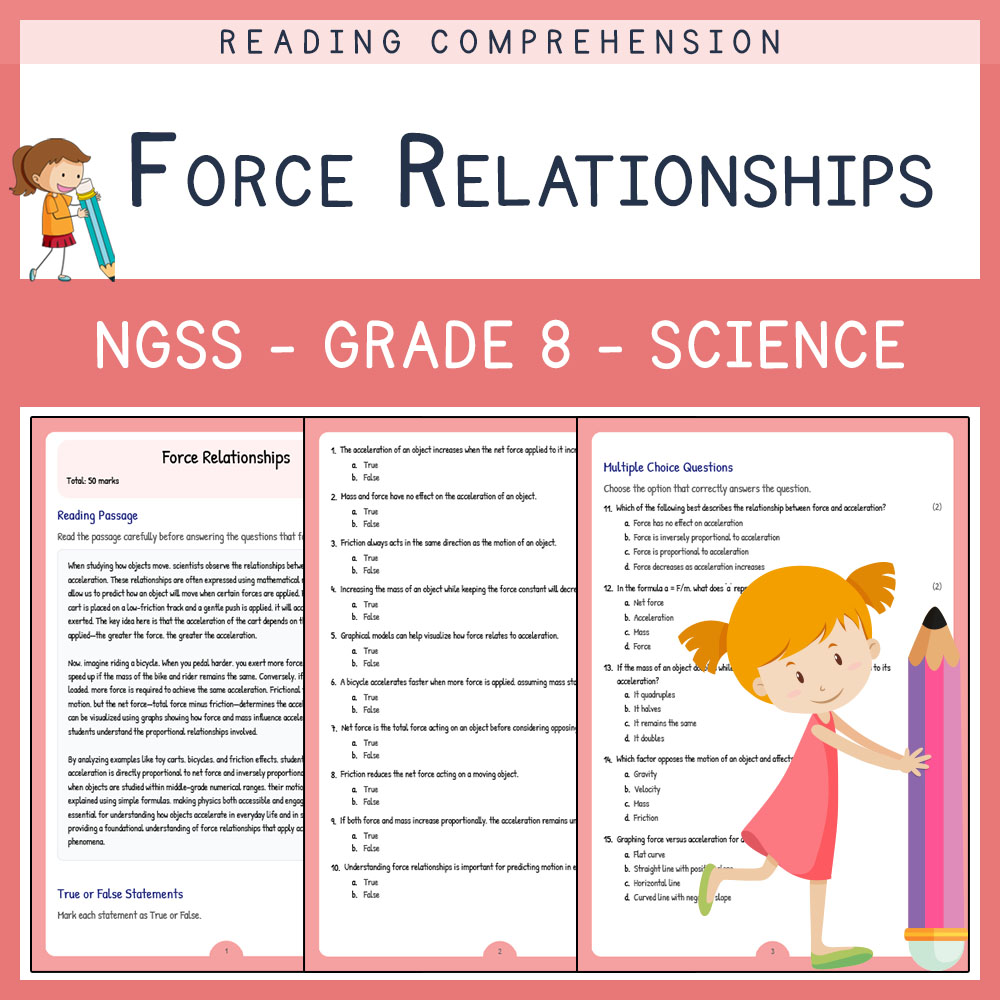
Grade 8 Science | Force Relationships Worksheet (PDF & Answer Key) NGSS-Aligned
Created byLumora LearningLearning Objectives
- Understand how net force influences acceleration of objects.
- Apply mathematical models to calculate acceleration from force and mass.
- Analyze real-world examples of forces acting on objects.
Instant download
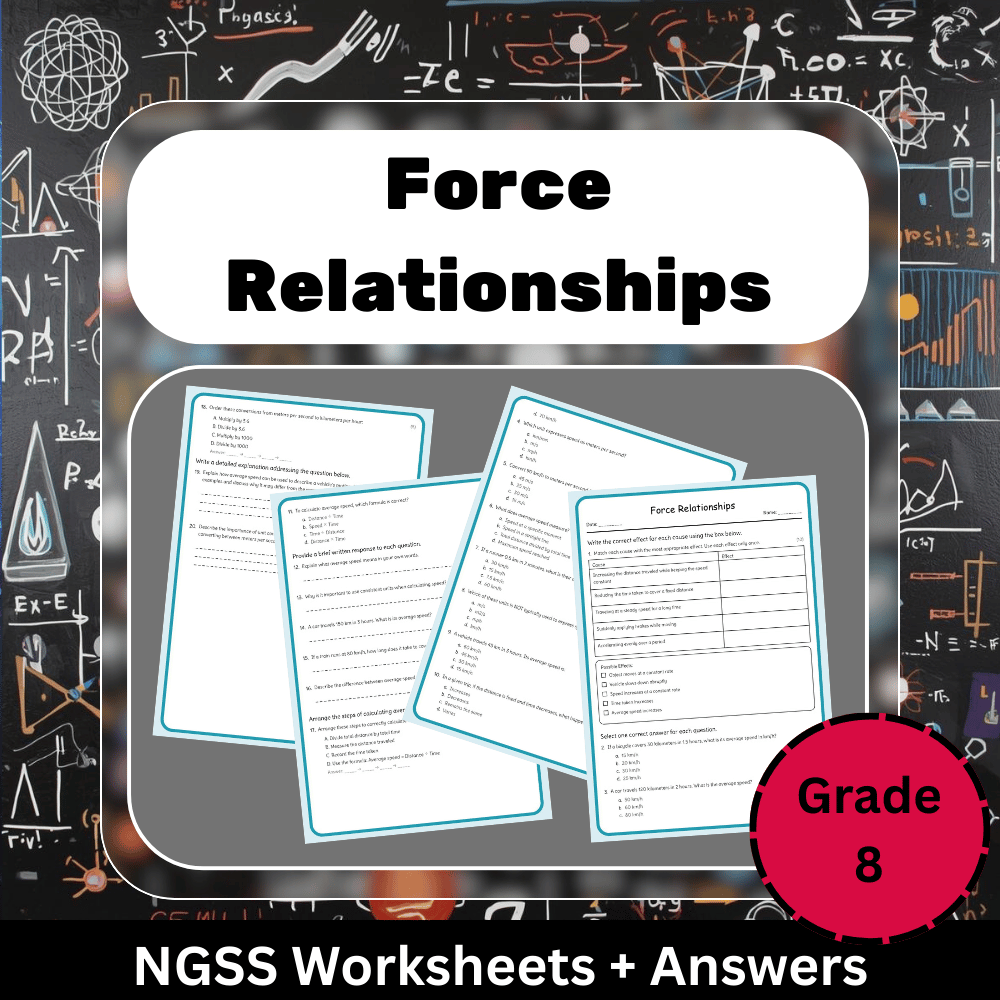
Grade 8 Science | Force Relationships Worksheet (PDF) Aligned with NGSS
Created byBright Mind ResourcesLearning Objectives
- Analyze the relationship between net force, mass, and acceleration using mathematical models.
- Interpret graphical representations and perform proportional calculations related to force and motion.
- Predict change in motion when force or mass varies within middle-grade numerical ranges.
Also included in: Grade 8 Science Unit Bundle- Forces, Magnetism & Accelerations Worksheets - NGSS +2 more
Instant download
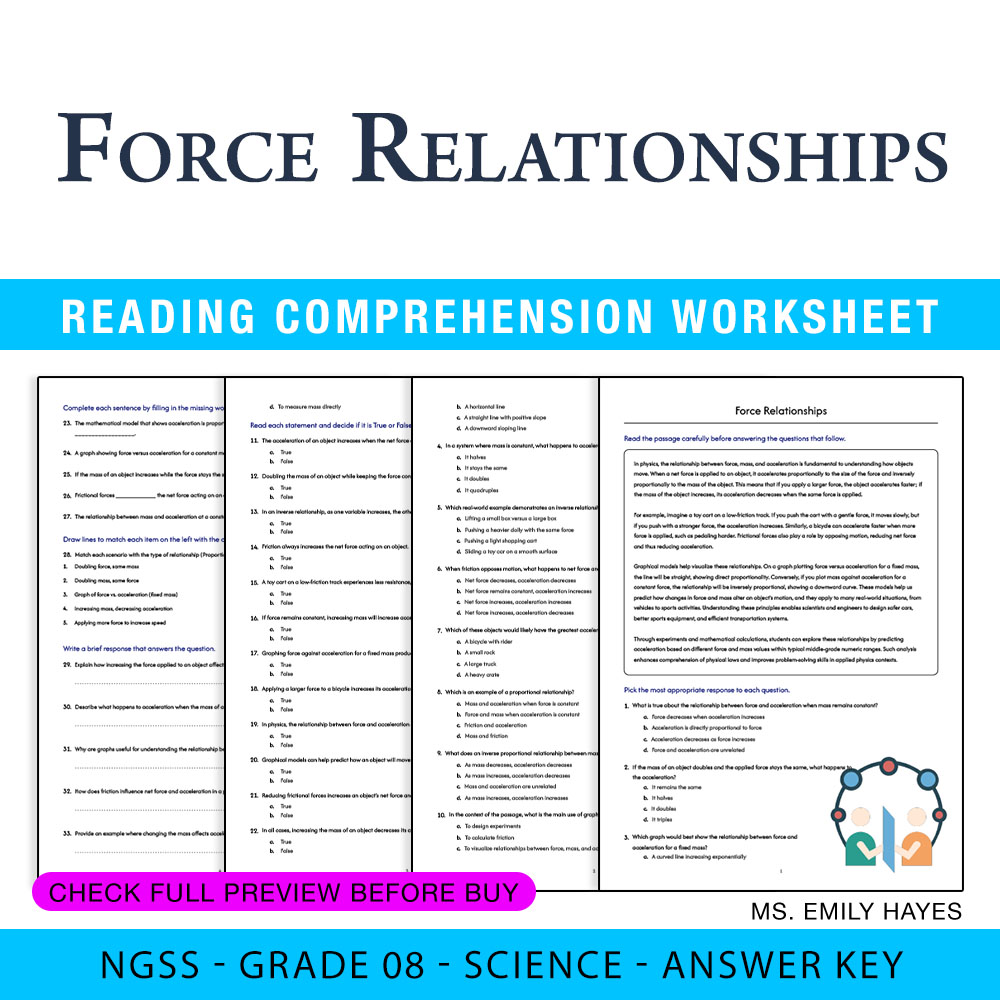
Grade 8 Science | Force Relationships Worksheet (PDF+ Answer Key)
Created byCopper Leaf ClassroomLearning Objectives
- Explain how net force, mass, and acceleration are mathematically related.
- Analyze how changes in force and mass affect an object's acceleration using models and graphs.
- Apply proportional and inverse relationships to predict motion in real-world scenarios.
Instant download

Force Relationships and Acceleration Worksheets | Grade 8 Science
Created byTeachers ClubLearning Objectives
- Explain how net force, mass, and acceleration relate proportionally.
- Predict acceleration changes from changes in net force.
- Predict acceleration changes from changes in mass.
Also included in: Grade 8 Science Worksheets | NGSS Motion & Stability Bundle +2 more
Instant download
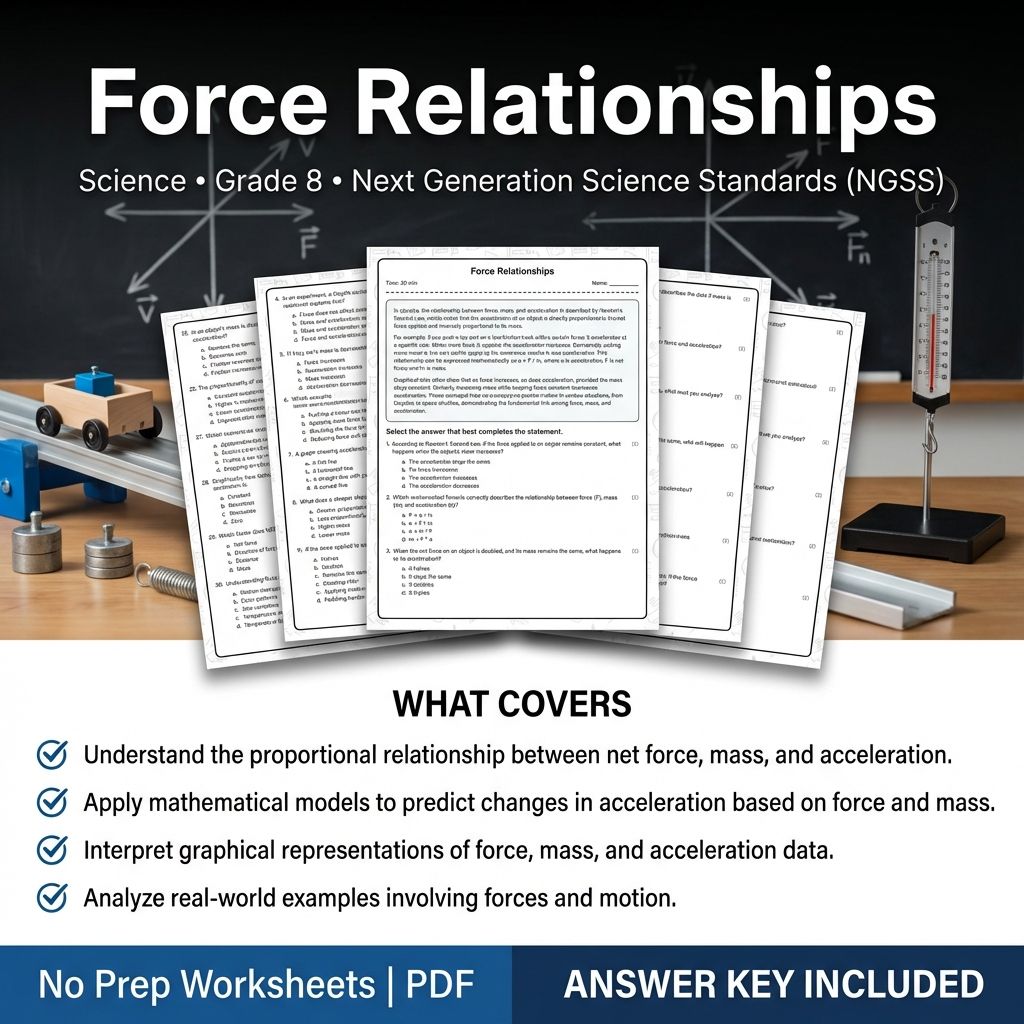
Grade 8 Science | Force Relationships Worksheet & Answer Key (Printable PDF)
Created byCoral Reef LearningLearning Objectives
- Understand the proportional relationship between net force, mass, and acceleration.
- Apply mathematical models to predict changes in acceleration based on force and mass.
- Interpret graphical representations of force, mass, and acceleration data.
Instant download
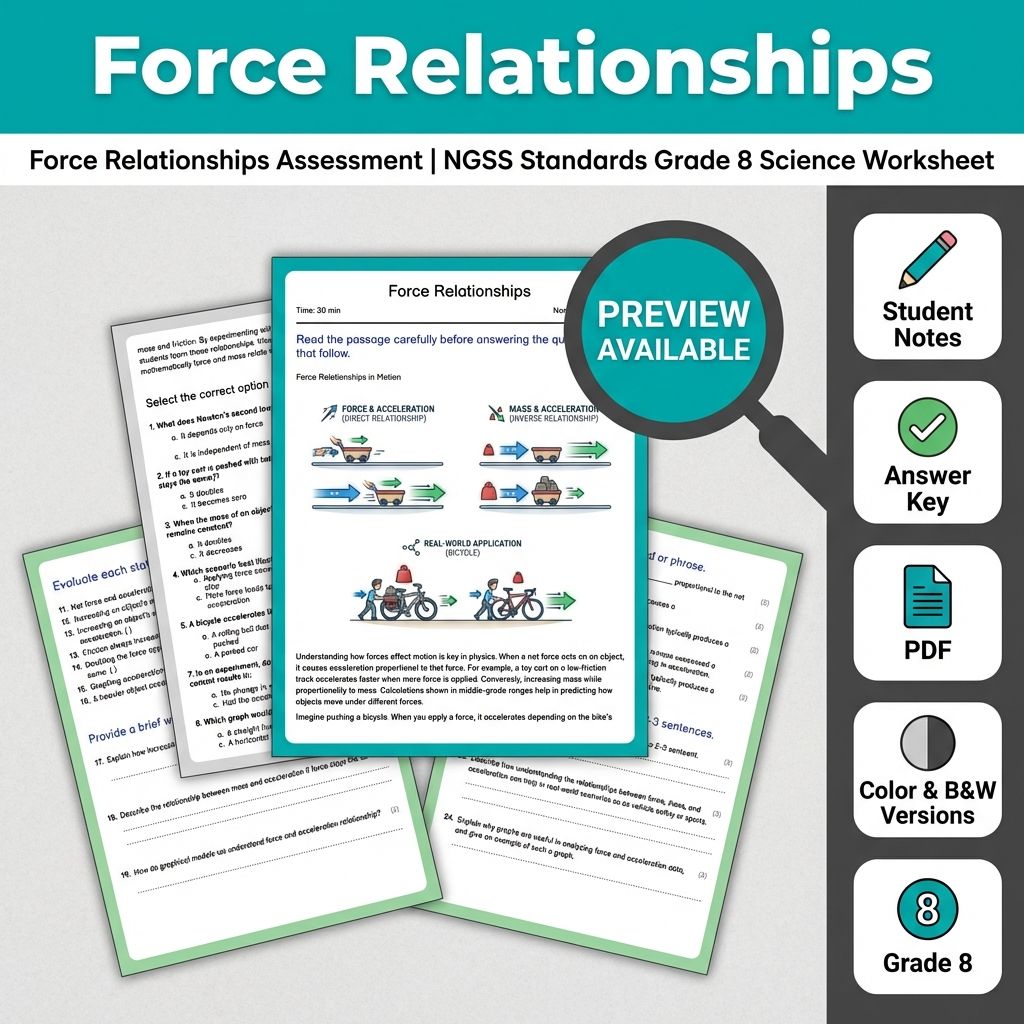
Force Relationships Assessment | NGSS Standards Grade 8 Science Worksheet
Created byPrism Point LearningLearning Objectives
- Analyze and interpret the mathematical relationships among net force, mass, and acceleration.
- Apply proportional calculations to predict changes in motion based on force and mass values.
- Use graphical and numerical models to understand the effects of different forces on objects.
Also included in: Grade 8 Science Mini Bundle | Forces and Interactions NGSS-Aligned Unit +1 more
Instant download

Net Force, Mass and Acceleration Worksheets | Grade 8 Science
Created bythe curious pencilLearning Objectives
- Calculate acceleration using net force and mass.
- Explain how net force affects acceleration when mass stays constant.
- Compare acceleration for objects with different masses.
Also included in: Motion and Stability Forces Grade 8 Science NGSS Worksheets Bundle +2 more
Instant download

Force Relationships Worksheet Grade 8 NGSS | Net Force & Acceleration
Created byAmber Owl EducationLearning Objectives
- Explain how net force relates to acceleration and how mass affects acceleration using proportional reasoning
- Use a simple model to predict acceleration from given net force and mass values
- Interpret how friction changes the net force and therefore the acceleration
Also included in: Grade 8 Science Forces and Fields Physics Lesson Bundle | NGSS +1 more
Instant download
8th Grade Science | Force Relationships Reading Worksheet (Answer Key)
Learning Objectives
- Understand the relationship between net force, mass, and acceleration.
- Analyze how different forces affect motion using mathematical models.
- Interpret graphical representations of force and mass data.
Instant download

Grade 8 Science | Force Relationships - Daily Reading Comprehension
Created byCoral Reef LearningLearning Objectives
- Understand key concepts related to Science
- Apply knowledge through practice questions
- Demonstrate comprehension of the material
Instant download

Grade 8 Science – Force & Motion | Daily Reading Worksheet
Created byBright Mind ResourcesLearning Objectives
- Understand how net force influences the acceleration of objects
- Interpret the relationship between mass, force, and acceleration using mathematical models
- Apply concepts to real-world examples like toys, bicycles, and friction effects
Also included in: Physical Science Grade 8 Science Daily Reading Worksheets Lesson Bundle | NGSS +1 more
Instant download
About Grade 8 Science Worksheets
Explore Grade 8 Science worksheets for classwork, homework, or review. Our 6,034 printables download instantly as PDFs.
Each resource here is built by an independent educator and reviewed for quality. Worksheets print straight from PDF and suit classroom use, homework, or extra practice; most come with answer keys, and you can preview before purchasing.