
Science Worksheets
45,429 subject resources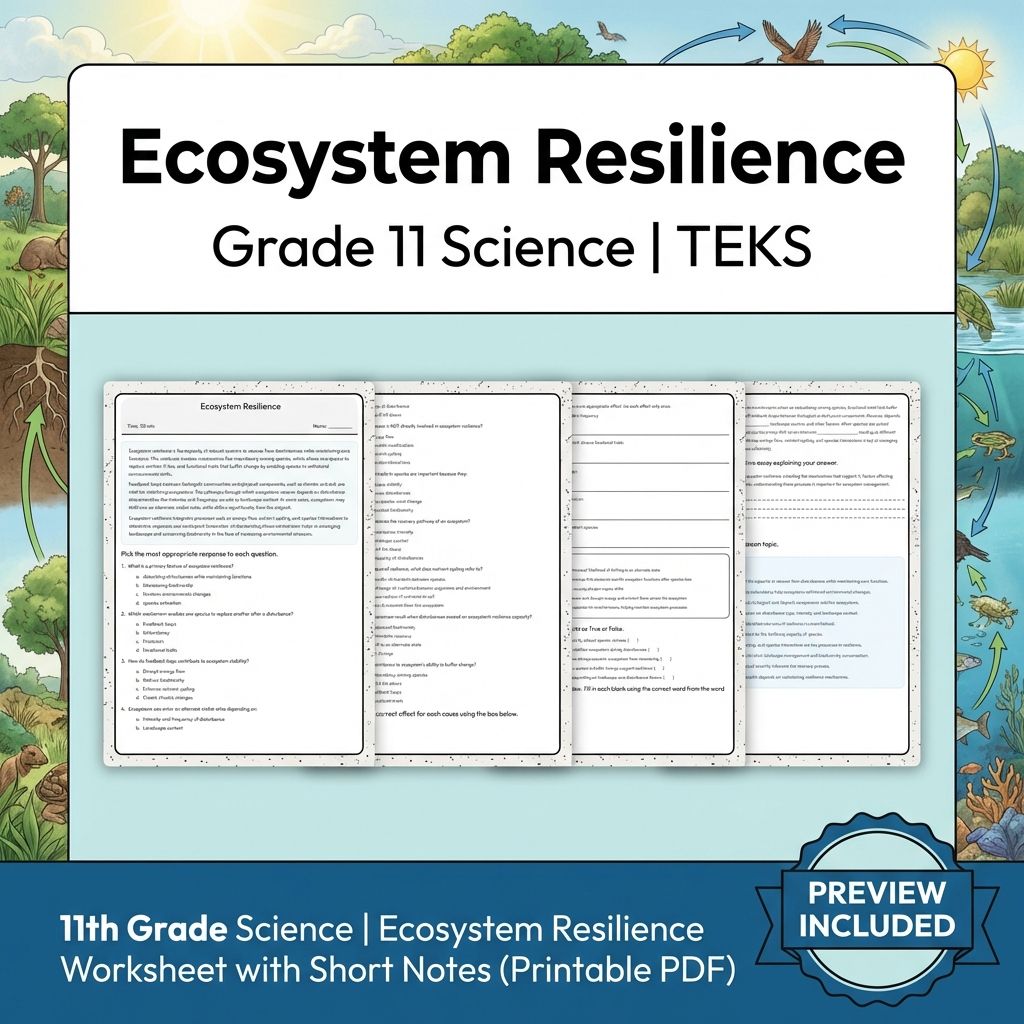
11th Grade Science | Ecosystem Resilience Worksheet with Short Notes (PDF)
 Created byMeadowlark Worksheets
Learning Objectives
- Define ecosystem resilience and identify its key mechanisms.
- Explain how ecosystems recover from disturbances and the factors influencing their stability.
- Describe the role of feedback loops, redundancy, and functional traits in resilience.
Instant download
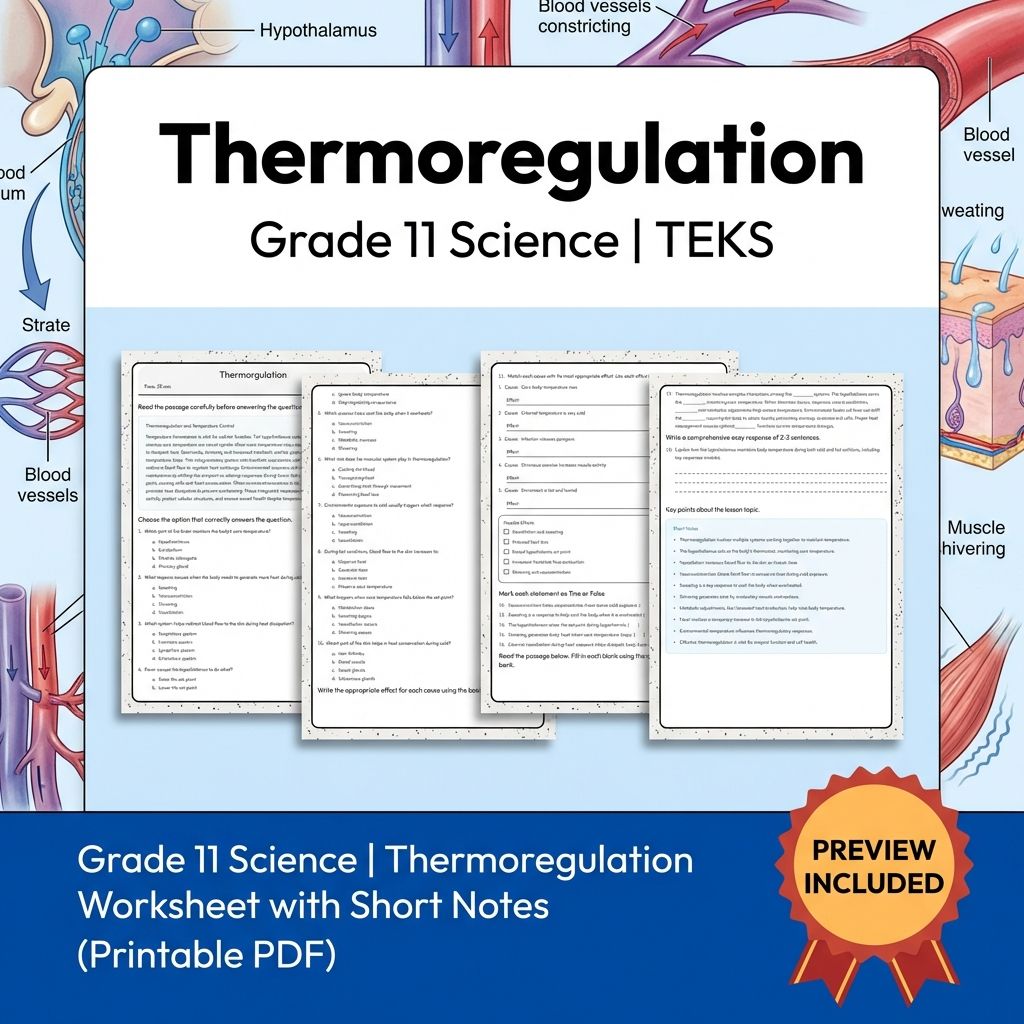
Grade 11 Science | Thermoregulation Worksheet with Short Notes (Printable PDF)
Created byMeadowlark WorksheetsLearning Objectives
- Understand the physiological mechanisms involved in temperature homeostasis.
- Identify the roles of the nervous, circulatory, and muscular systems in thermoregulation.
- Describe how environmental factors and fever influence thermoregulatory responses.
Instant download
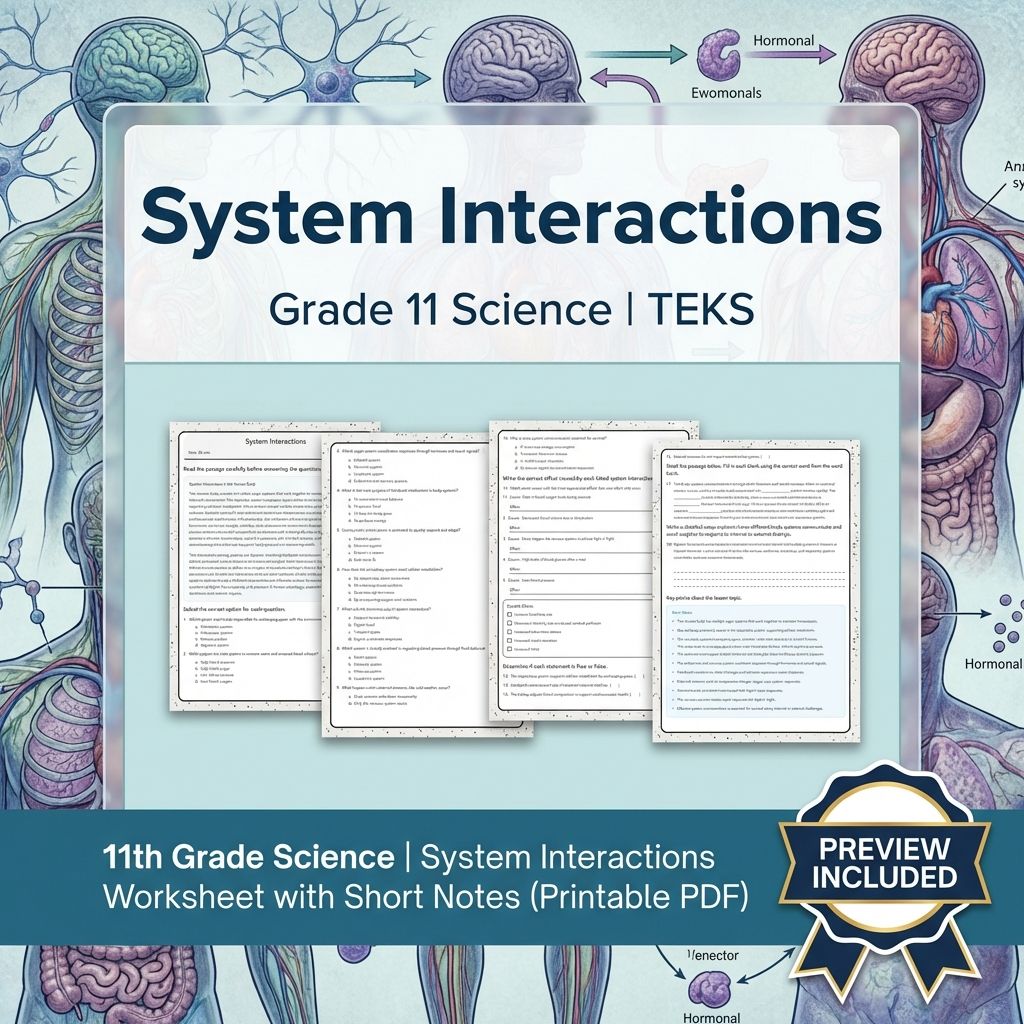
11th Grade Science | System Interactions Worksheet with Short Notes (PDF)
Created byMeadowlark WorksheetsLearning Objectives
- Understand how human body systems coordinate to maintain internal stability.
- Identify examples of cross-system communication and response mechanisms.
- Explain the roles of different organ systems in homeostasis.
Instant download
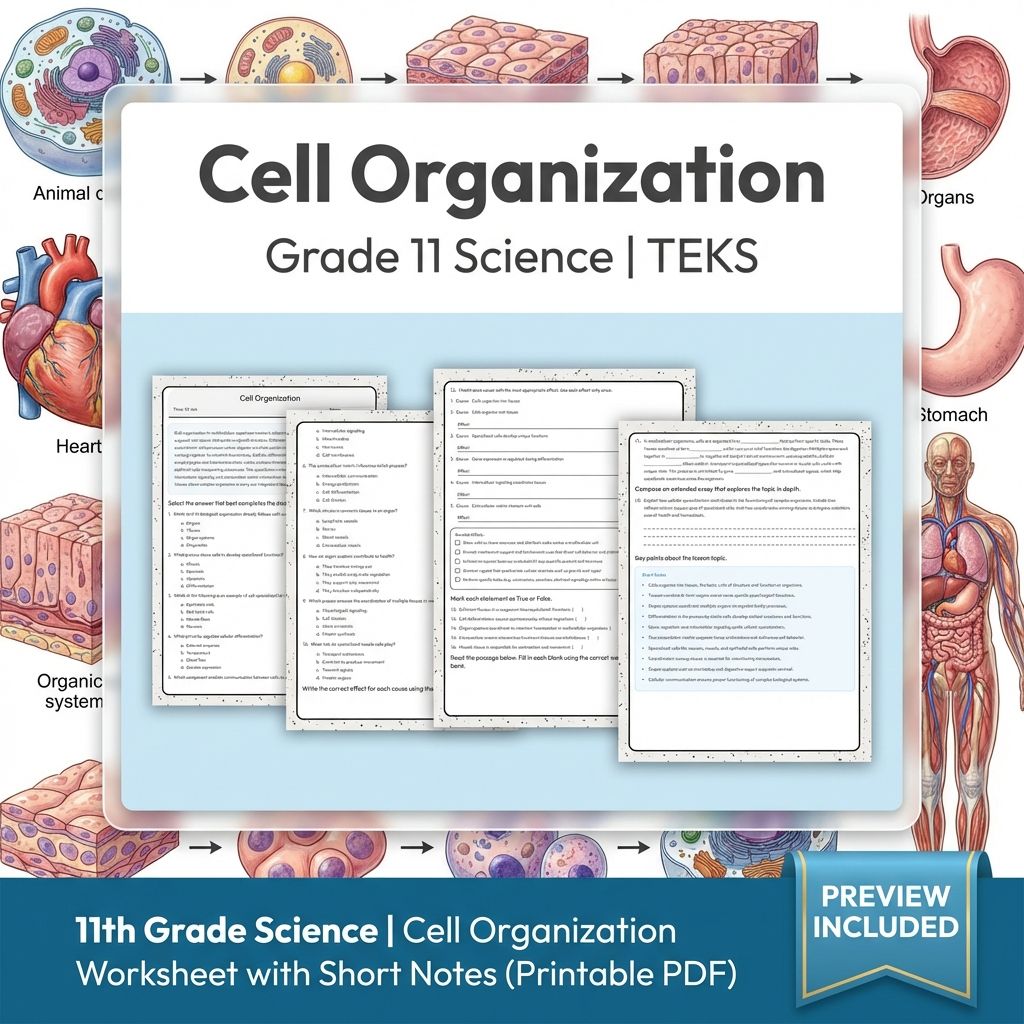
11th Grade Science | Cell Organization Worksheet with Short Notes (PDF)
Created byMeadowlark WorksheetsLearning Objectives
- Describe the hierarchical levels of organization from cells to organ systems.
- Explain how specialized cells perform distinct functions in multicellular organisms.
- Understand the processes of differentiation and cellular specialization.
Instant download
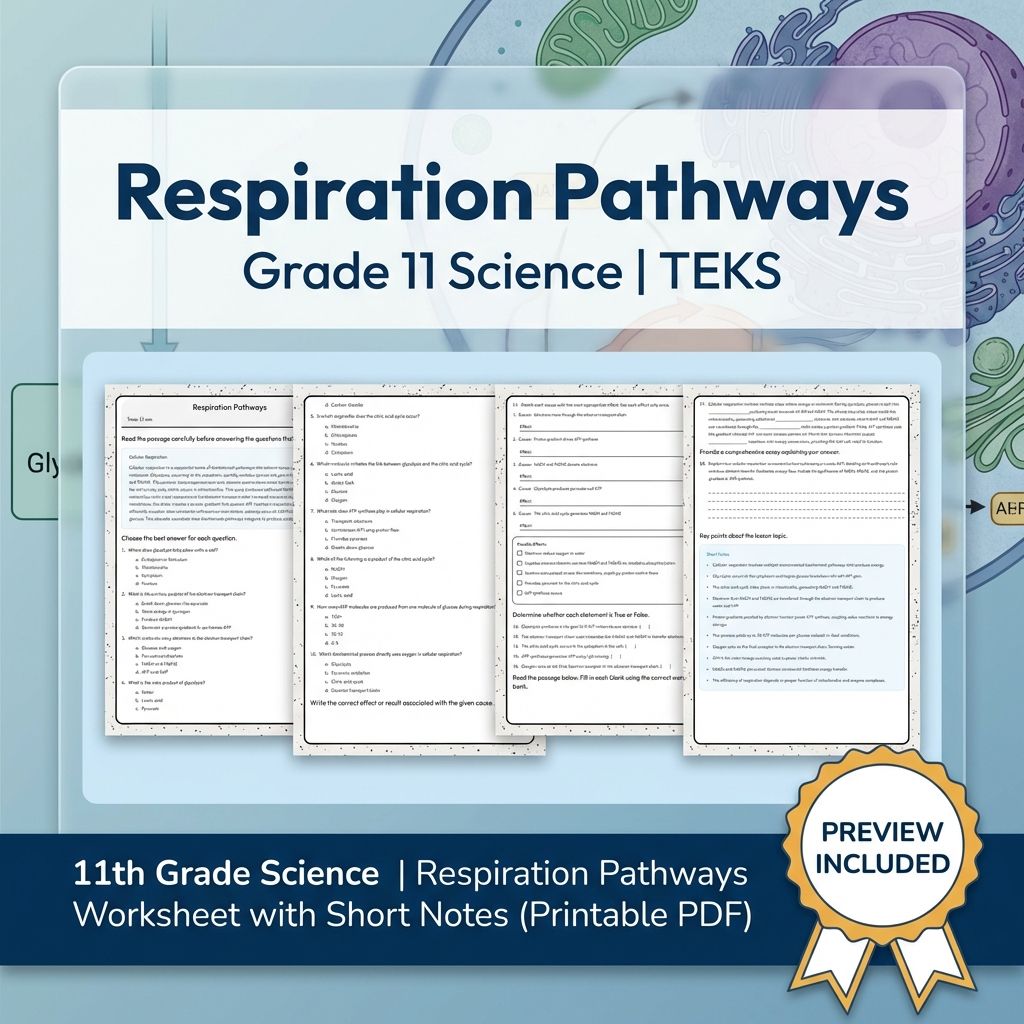
11th Grade Science | Respiration Pathways Worksheet with Short Notes (PDF)
Created byMeadowlark WorksheetsLearning Objectives
- Describe the main stages of cellular respiration, including glycolysis, the citric acid cycle, and electron transport.
- Explain how electrons transfer energy through electron carriers to produce ATP.
- Identify the biochemical pathways and their sequence involved in energy flow during respiration.
Instant download
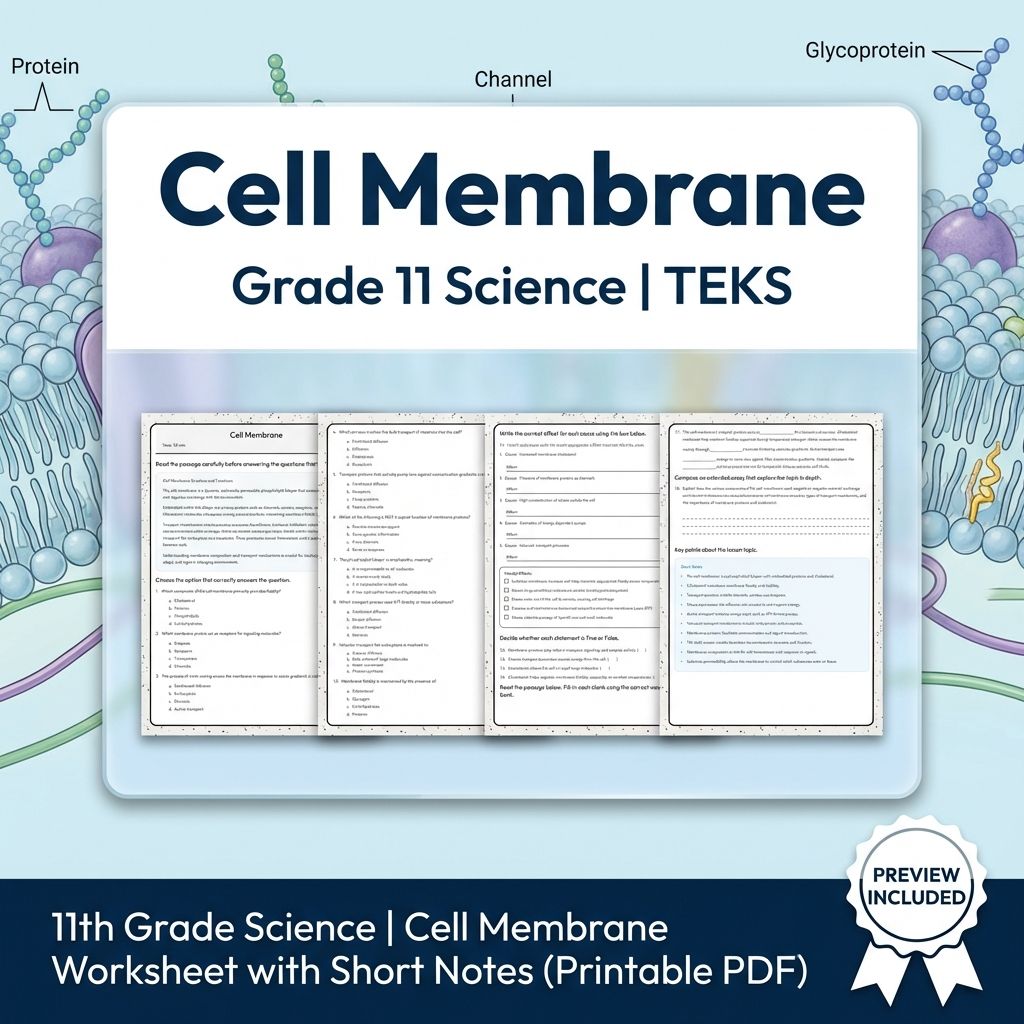
11th Grade Science | Cell Membrane Worksheet with Short Notes (Printable PDF)
Created byMeadowlark WorksheetsLearning Objectives
- Describe the structure of the cell membrane and its components.
- Explain how membrane proteins facilitate transport and communication.
- Identify different mechanisms of material exchange across the membrane.
Instant download

Grade 11 Science | Fermentation Pathways Worksheet with Short Notes (PDF)
Created byMeadowlark WorksheetsLearning Objectives
- Explain the process of anaerobic fermentation pathways and their importance in energy production when oxygen is scarce.
- Differentiate between lactic acid and alcoholic fermentation and identify their end products.
- Describe how fermentation helps regenerate NAD+ to sustain glycolysis.
Instant download
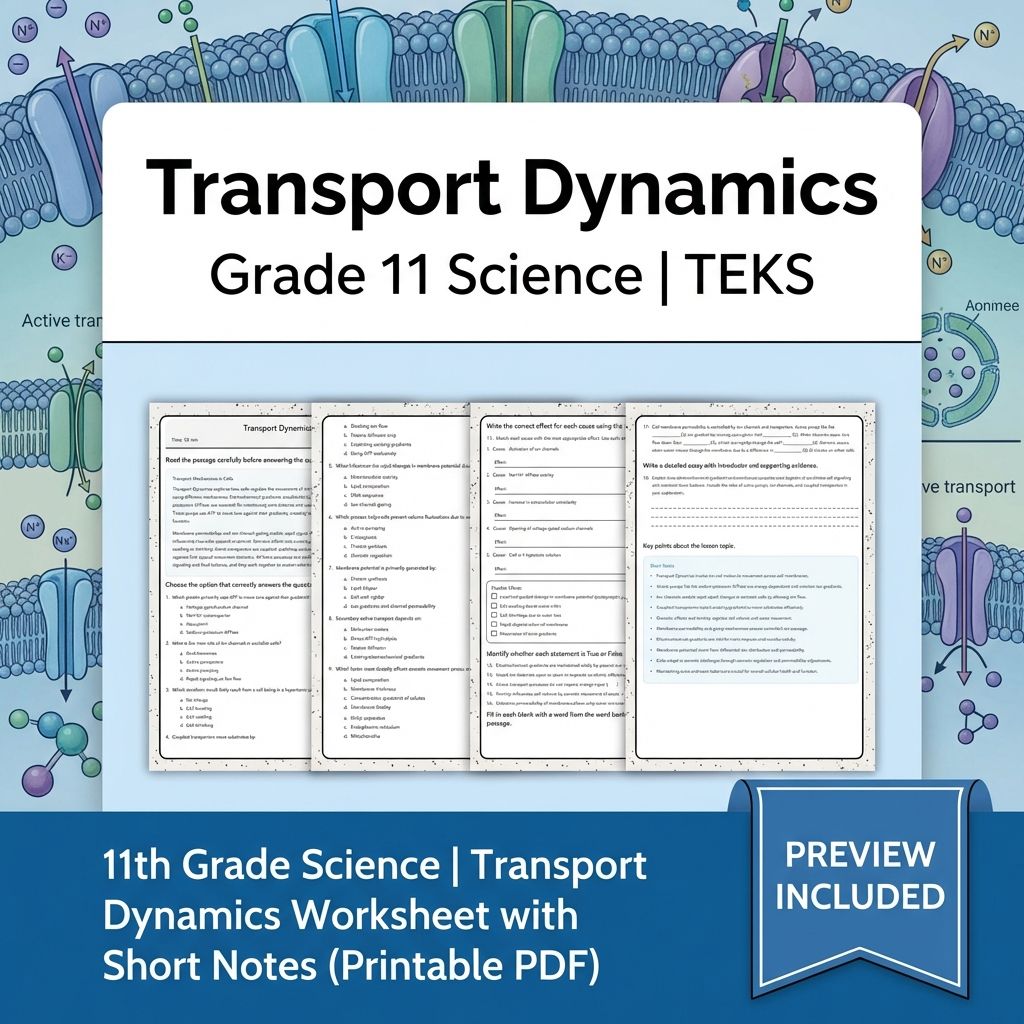
11th Grade Science | Transport Dynamics Worksheet with Short Notes ( PDF)
Created byMeadowlark WorksheetsLearning Objectives
- Understand how electrochemical gradients and membrane properties influence ion and molecule movement
- Explain the role of active pumps like the sodium-potassium ATPase in maintaining cellular ionic balance
- Describe how coupled transporters utilize existing gradients for substrate movement against their own gradients
Instant download

11th Grade Science | Structure and Function Worksheet with Short Notes (PDF)
Created byMeadowlark WorksheetsLearning Objectives
- Understand how organelle architecture influences metabolic efficiency.
- Identify the roles of thylakoid membranes and mitochondrial cristae in cellular processes.
- Describe how enzyme structure facilitates substrate binding and energy transfer.
Instant download

Grade 6 Science – Reflection & Refraction | Daily Reading Worksheet
 Created byBright Mind Resources
Learning Objectives
- Understand the concepts of light reflection and refraction
- Identify how light changes direction when meeting different surfaces
- Explain how lenses focus and disperse light
Also included in: Grade 6 Daily Reading Science Worksheets | Lesson Bundle | BC Framework +1 more
Instant download

Grade 8 Science | Biomedical Flow Worksheet (PDF+ Answer Key)
 Created byCopper Leaf Classroom
Learning Objectives
- Explain how blood flow is affected by viscosity, vessel diameter, and pressure gradients.
- Describe the role of non-Newtonian properties in perfusion and how stenosis impacts flow and pressure.
- Apply simplified pipe-flow relations to estimate volumetric flow in biomedical contexts.
Instant download
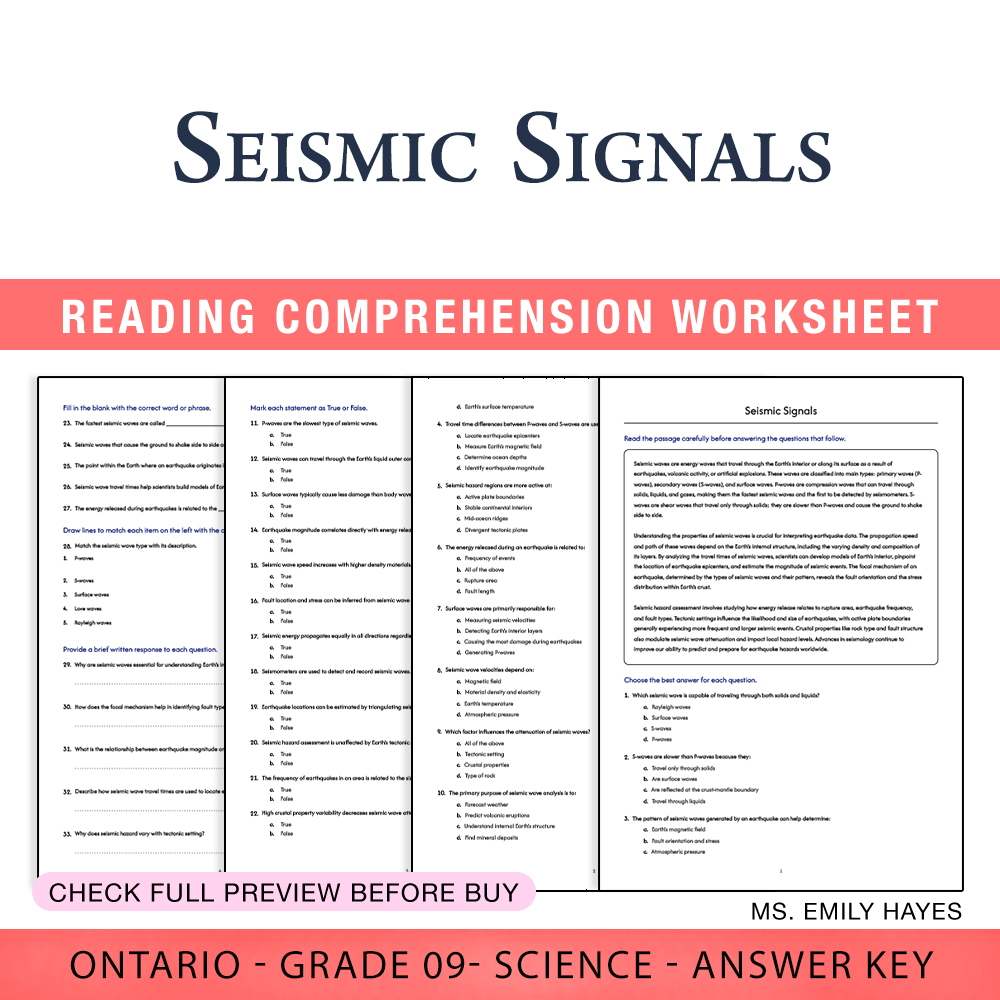
9th Grade Science | Seismic Signals Worksheet (PDF + Answer Key)
Created byCopper Leaf ClassroomLearning Objectives
- Describe different types of seismic waves and their propagation characteristics
- Explain how earthquake focal mechanisms reveal fault types and stress orientations
- Relate seismic wave travel times to Earth’s interior models and methods for locating epicentres
Instant download

Grade 11 Science – Community Interactions & Ecosystems | Daily Reading Worksheet
Created byBright Mind ResourcesLearning Objectives
- Understand mutualism as a type of interspecific interaction.
- Identify examples of mutualistic relationships in ecosystems.
- Analyze the benefits mutualism provides to both species involved.
Also included in: Grade 11 Cell Organelle Science Daily Reading Worksheets Lesson Bundle | AP +2 more
Instant download
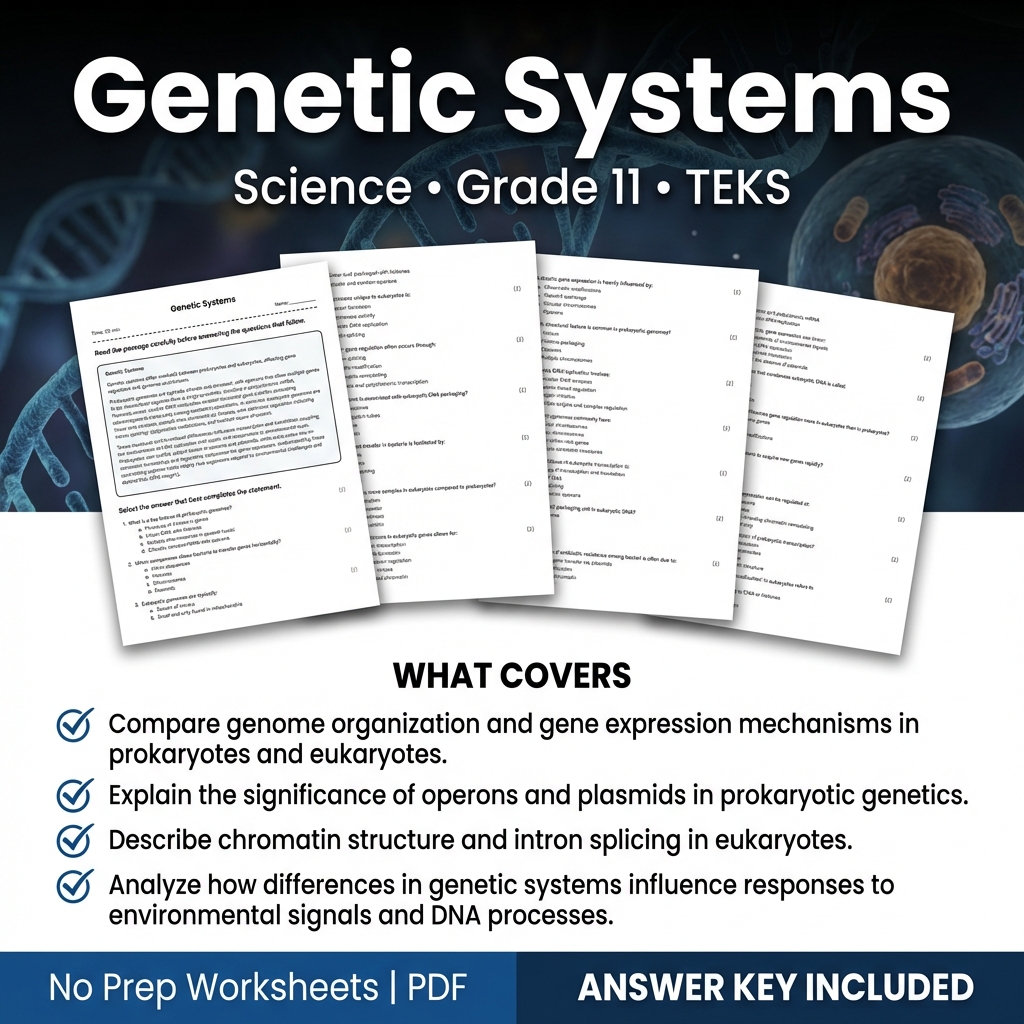
Genetic Systems Worksheet for Grade 11 Science | TEKS aligned practice
 Created byCoral Reef Learning
Learning Objectives
- Compare genome organization and gene expression mechanisms in prokaryotes and eukaryotes.
- Explain the significance of operons and plasmids in prokaryotic genetics.
- Describe chromatin structure and intron splicing in eukaryotes.
Instant download
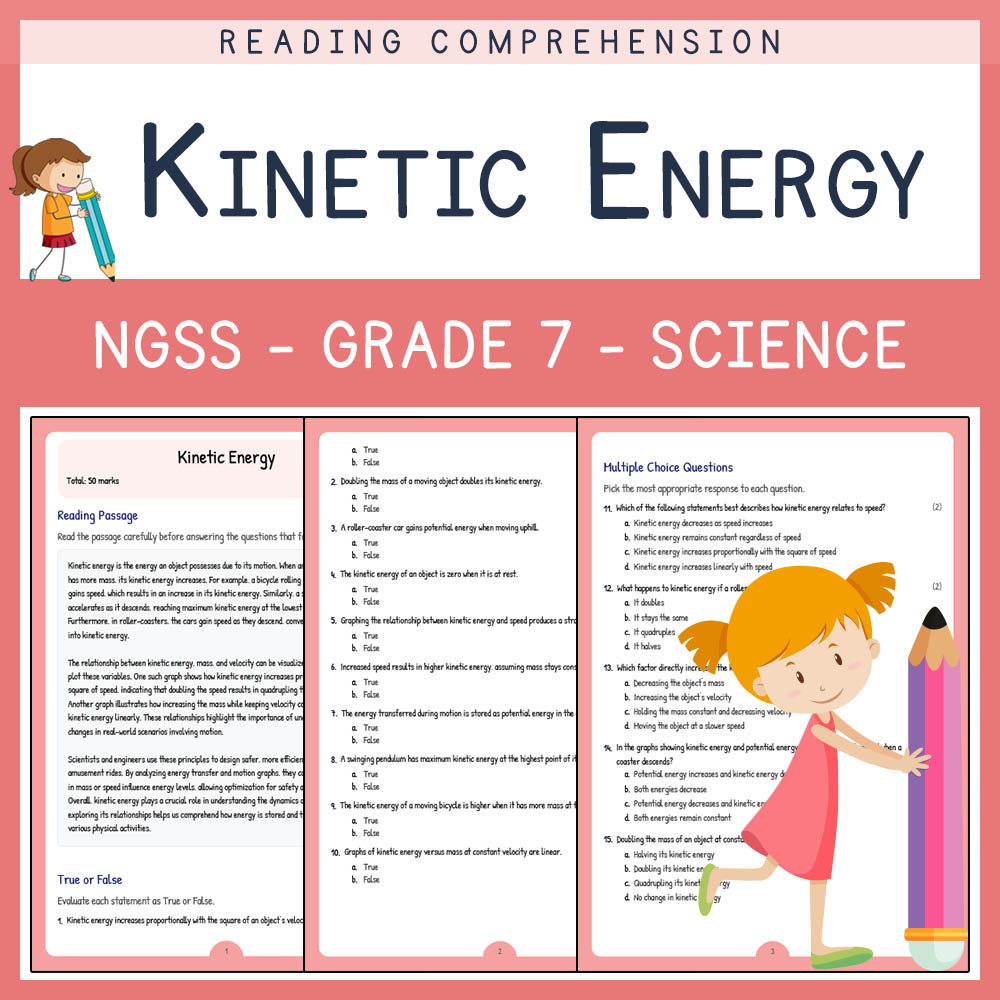
Grade 7 Science | Kinetic Energy Worksheet & Answer Key (NGSS-Aligned)
 Created byLumora Learning
Learning Objectives
- Construct and interpret graphical relationships between kinetic energy, potential energy, mass, and speed.
- Analyze how doubling the mass or speed of an object affects its kinetic energy through quantitative comparisons and graphs.
- Apply energy calculation formulas to real-world motion scenarios such as rolling bicycles, swinging pendulums, and roller-coaster cars.
Instant download
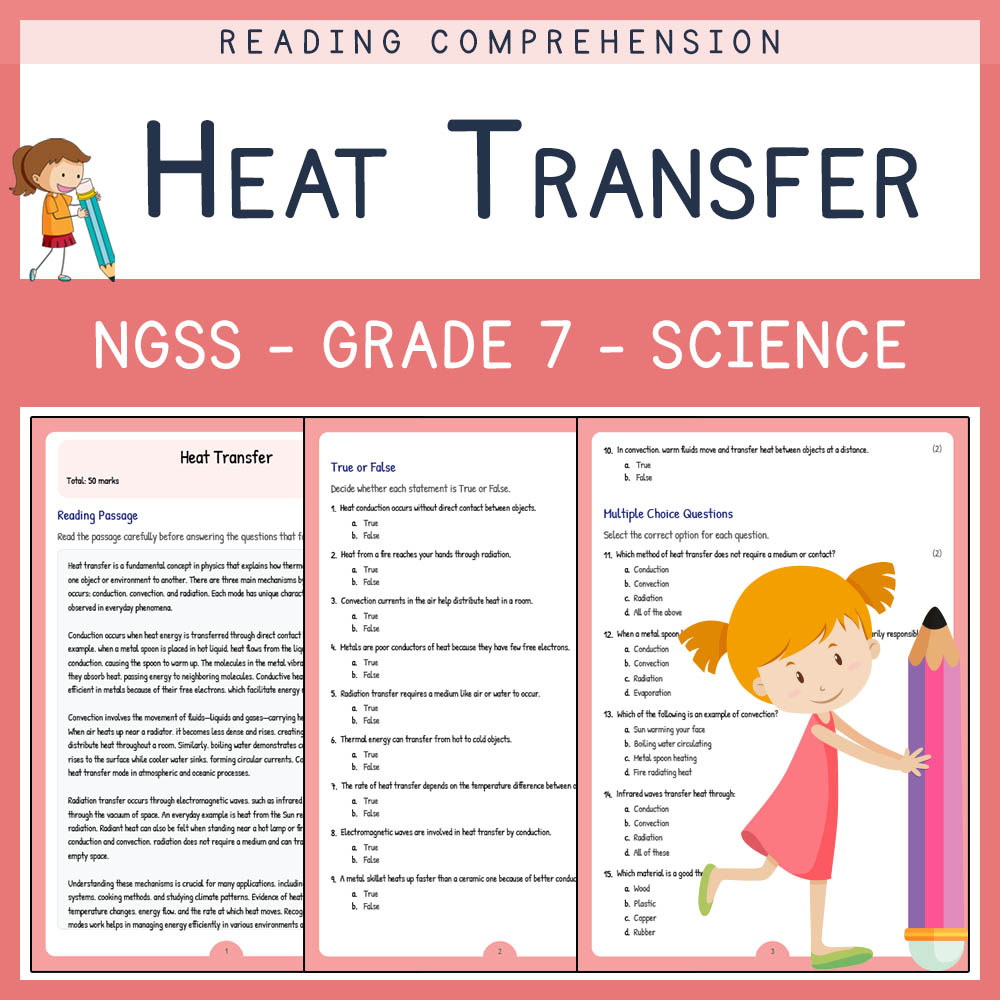
Grade 7 Science | Heat Transfer Worksheet & Answer Key for NGSS Standards
Created byLumora LearningLearning Objectives
- Describe the different mechanisms of heat transfer: conduction, convection, and radiation.
- Identify examples of heat transfer in everyday life.
- Explain how heat transfer affects temperature changes and energy flow in objects and environments.
Instant download
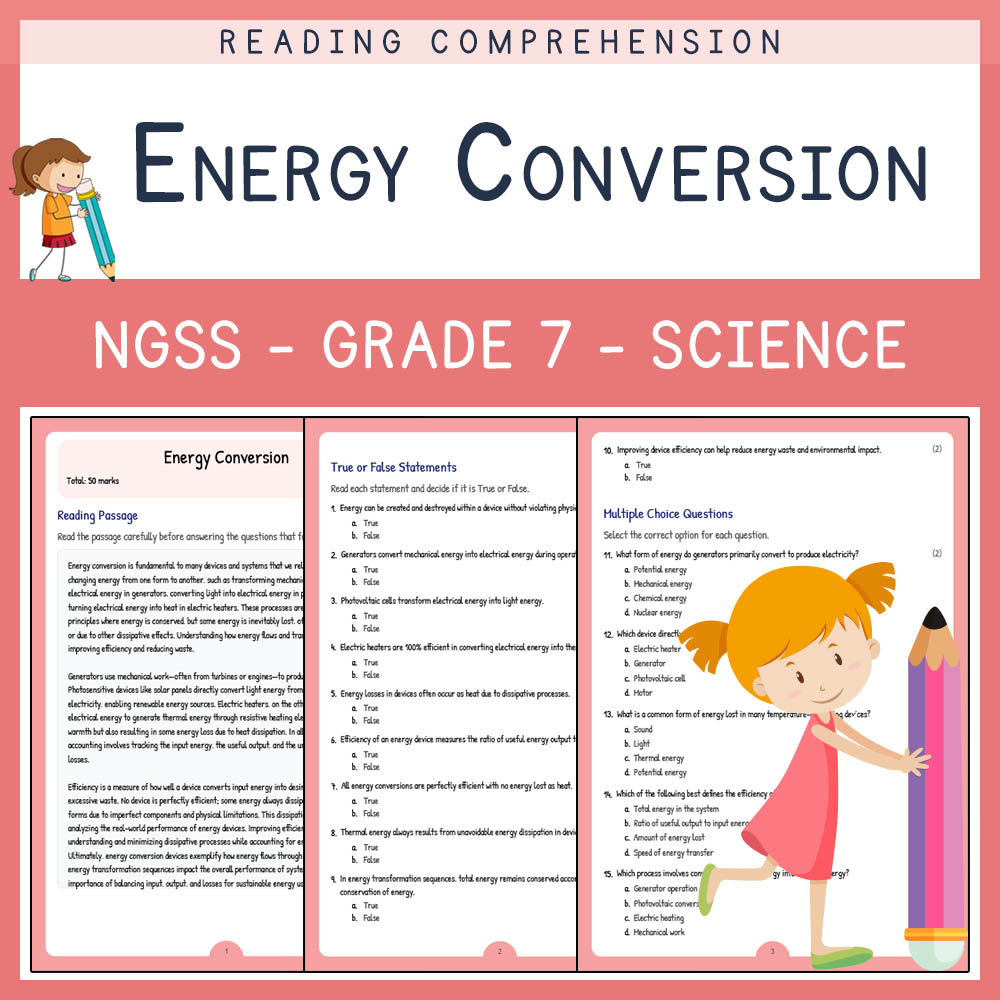
Grade 7 Science | Energy Conversion Worksheet PDF with Answer Key (NGSS Aligned)
Created byLumora LearningLearning Objectives
- Understand the principles of energy transfer and conservation during device operation.
- Identify examples of energy conversion in real-world devices such as generators, photovoltaic cells, and heaters.
- Describe the concept of efficiency and energy losses in energy transformation processes.
Instant download
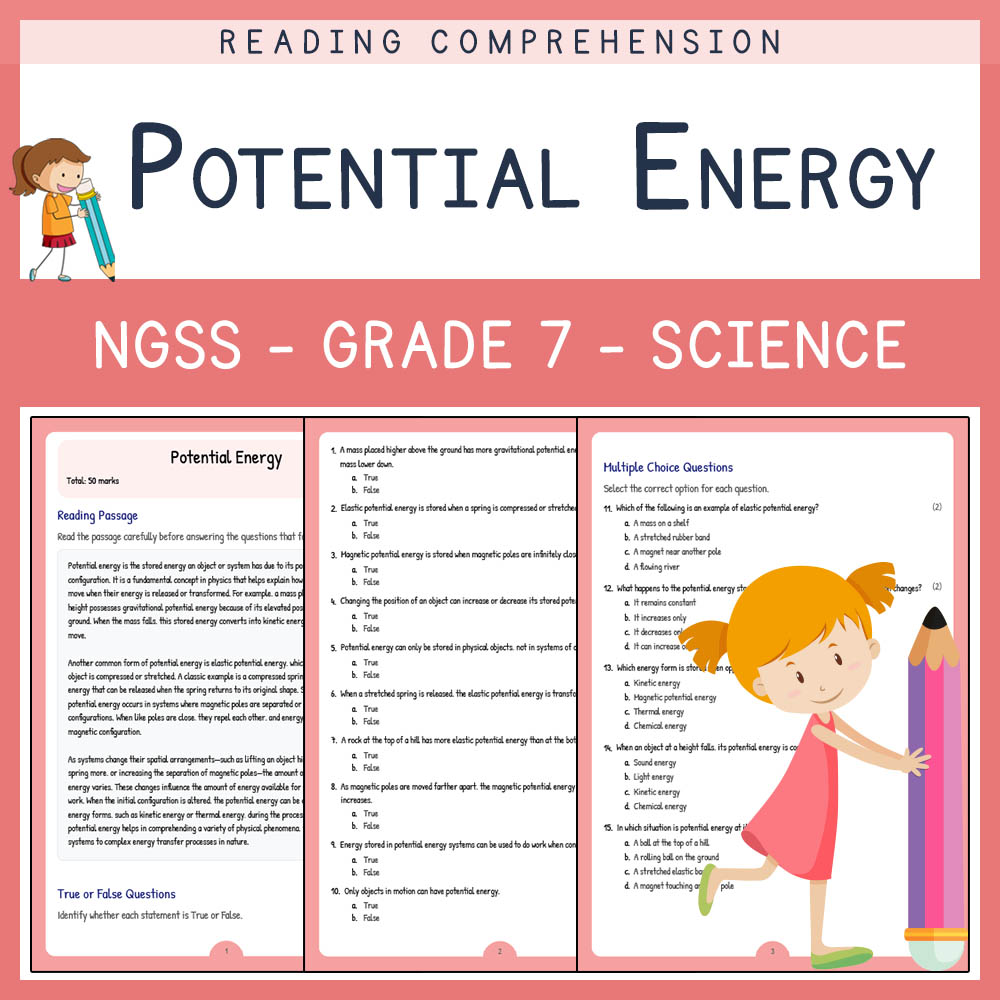
Grade 7 Science | Potential Energy Worksheet & Answer Key for NGSS Standards
Created byLumora LearningLearning Objectives
- Explain different types of potential energy and how they are stored in systems.
- Describe how changes in object arrangement and interactions can alter stored potential energy.
- Identify examples of gravitational, elastic, and magnetic potential energy in real-world situations.
Instant download
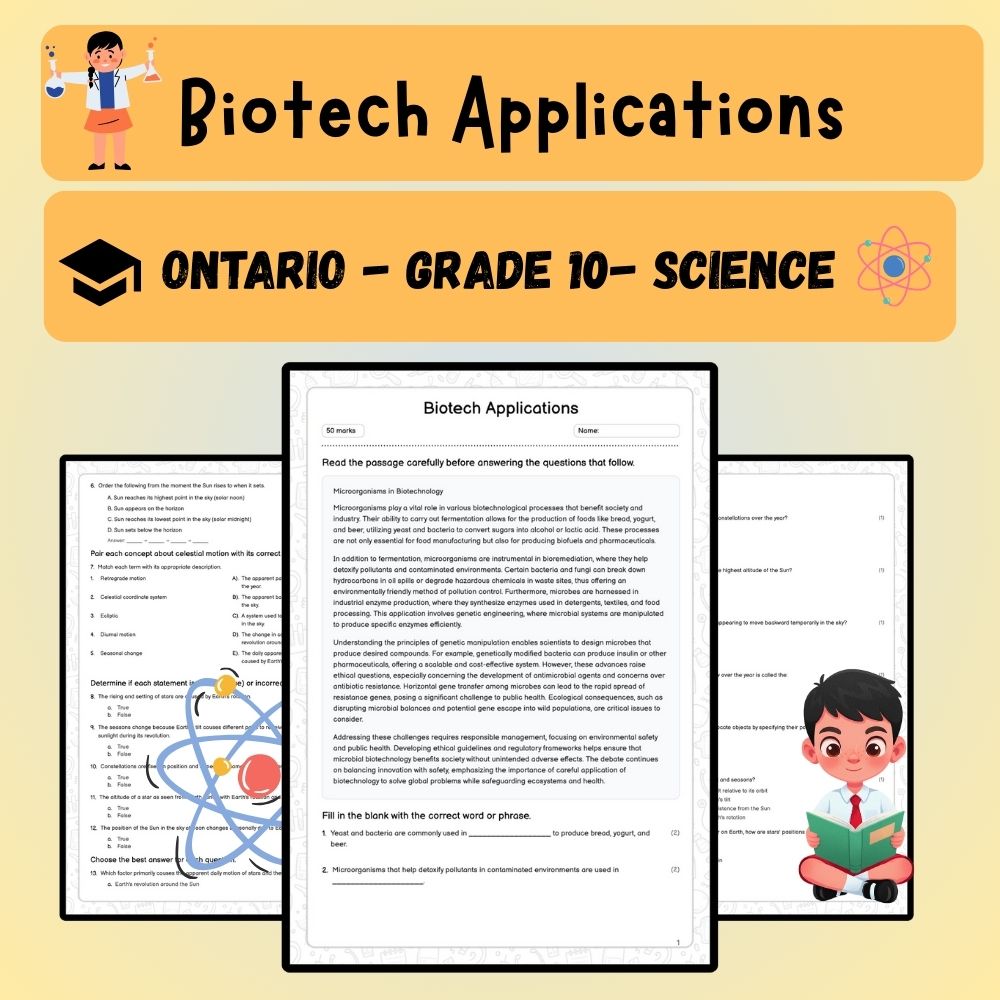
Grade 10 Science | Biotech Applications Worksheet (PDF) - Ontario Standards
 Created byPrism Point Learning
Learning Objectives
- Describe key biotechnological applications of microorganisms, including fermentation and bioremediation.
- Explain principles of genetic manipulation in microbial systems for product synthesis.
- Analyze the ecological and health implications of antibiotic resistance and horizontal gene transfer.
Also included in: Grade 10 Science Unit | Cells, Photosynthesis & Microbes Worksheet Pack +1 more
Instant download
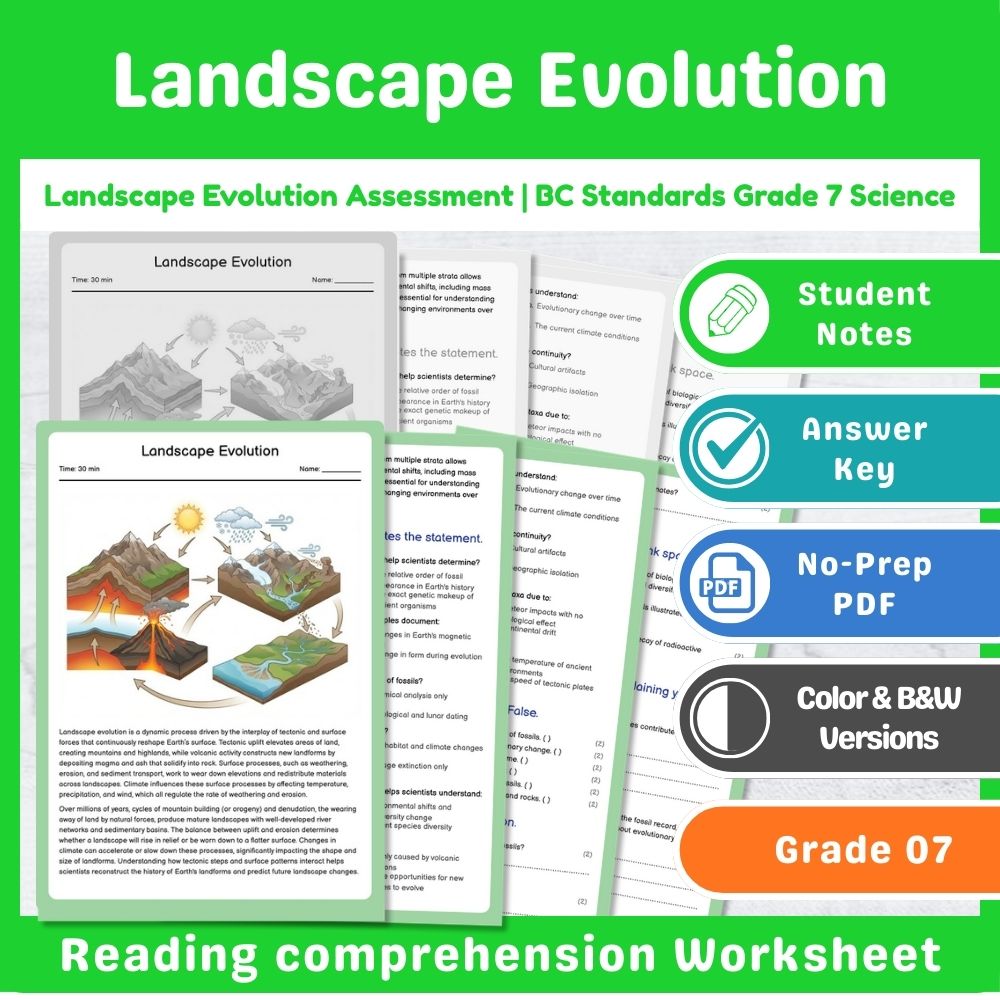
Landscape Evolution Assessment | BC Standards Grade 7 Science
Created byPrism Point LearningLearning Objectives
- Explain how tectonic uplift, volcanic construction, and surface processes influence landscape change.
- Analyze the balance between uplift and erosion in shaping landforms over time.
- Describe how climate variations affect weathering and material transport in landscapes.
Also included in: Grade 7 Science Lesson – Earth Processes Assessment & Landforms Bundle
Instant download
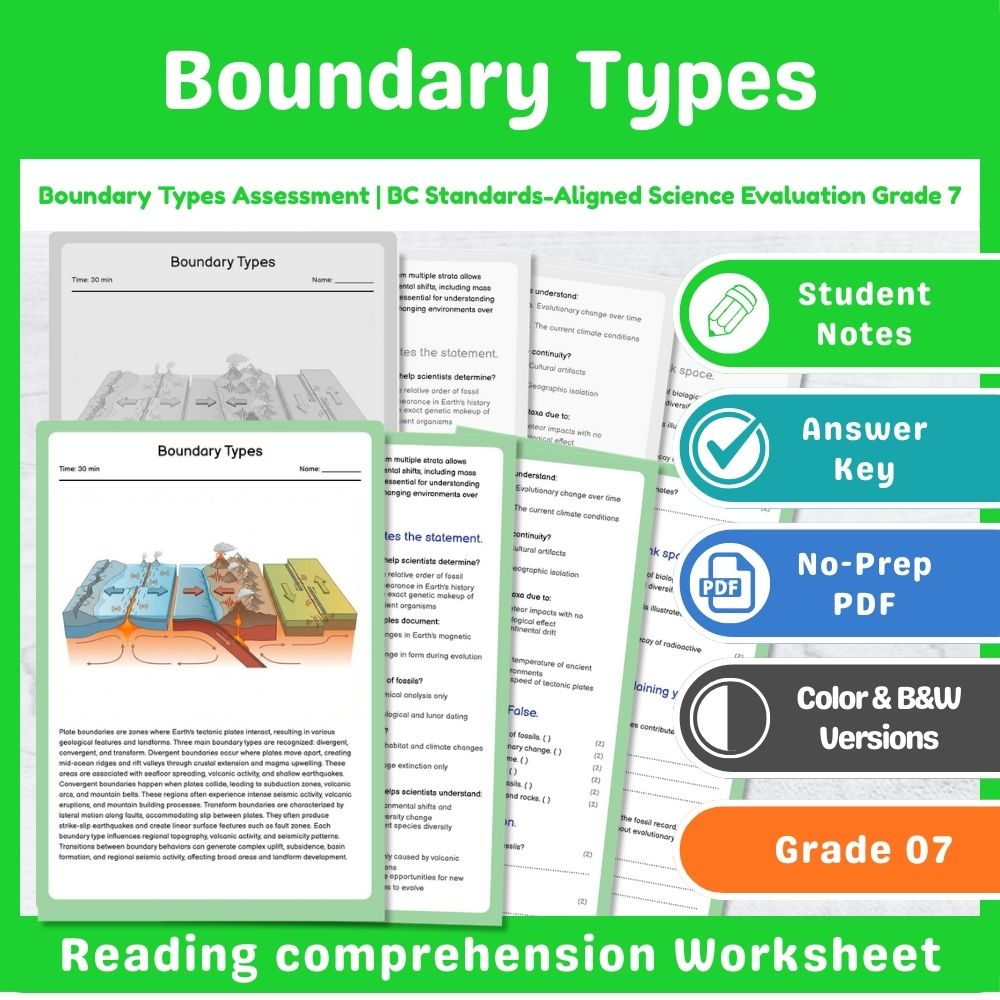
Boundary Types Assessment | BC Standards-Aligned Science Evaluation Grade 7
Created byPrism Point LearningLearning Objectives
- Understand the three principal boundary types and their characteristic landforms.
- Identify the processes and landforms associated with divergent, convergent, and transform boundaries.
- Explain how boundary transitions can produce complex regional geological patterns.
Also included in: Grade 7 Science Lesson – Earth Processes Assessment & Landforms Bundle
Instant download
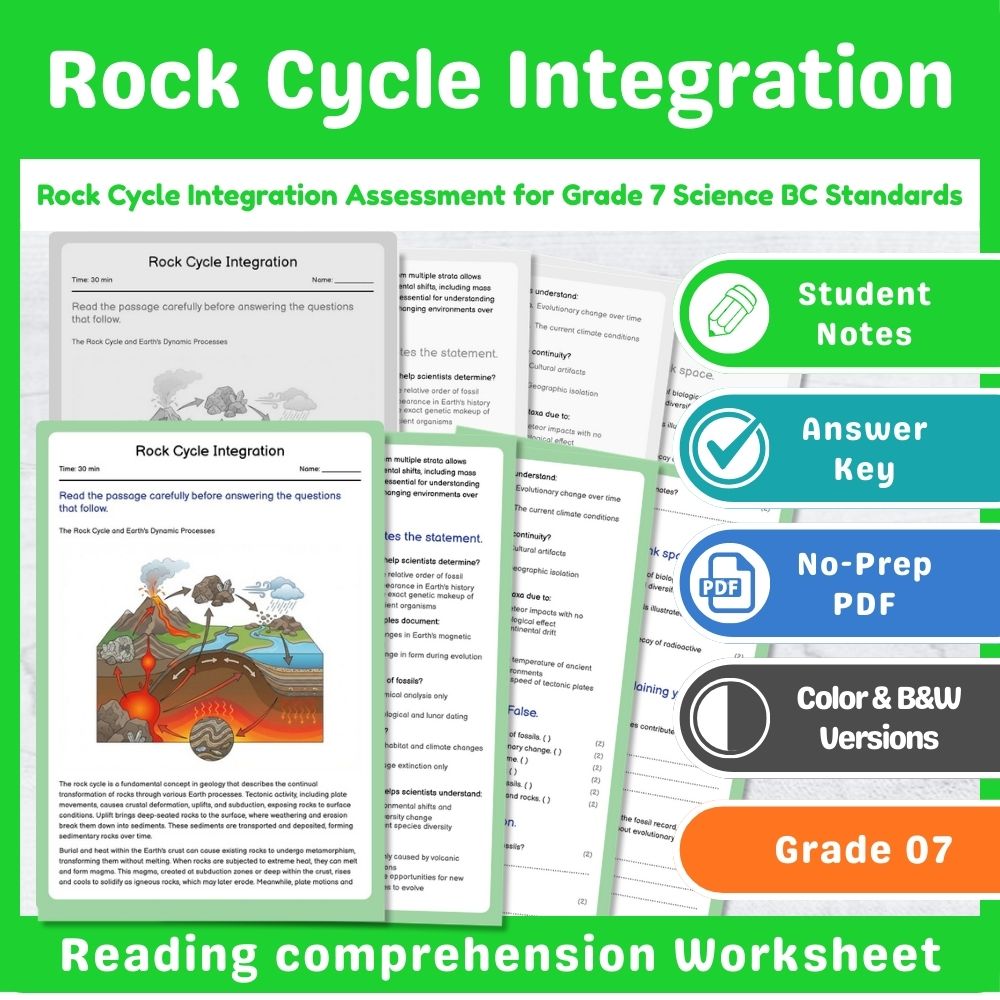
Rock Cycle Integration Assessment for Grade 7 Science BC Standards
Created byPrism Point LearningLearning Objectives
- Understand how the rock cycle links tectonics, magmatism, and surface processes.
- Identify the pathways of material transformation in the rock cycle.
- Explain how uplift, erosion, burial, and heat contribute to different rock types.
Also included in: Grade 7 Science Lesson – Earth Processes Assessment & Landforms Bundle
Instant download
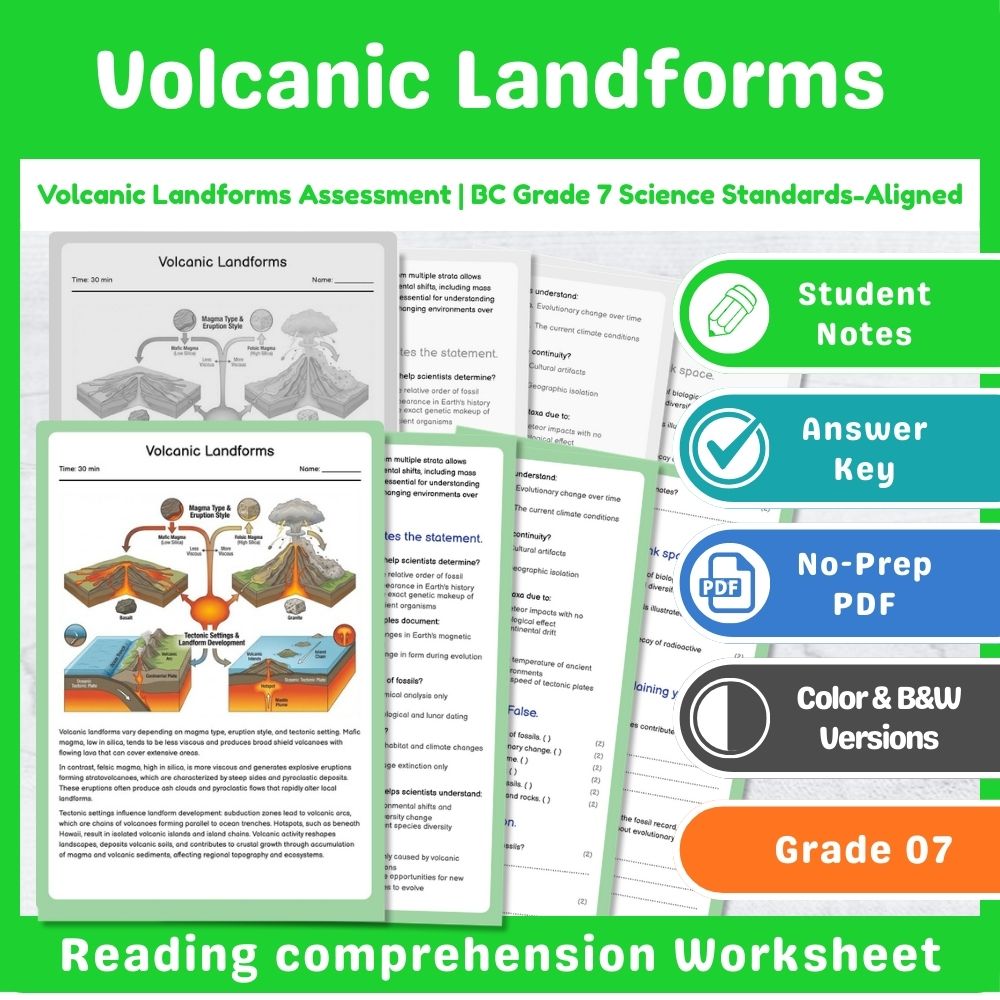
Volcanic Landforms Assessment | BC Grade 7 Science Standards-Aligned
Created byPrism Point LearningLearning Objectives
- Describe different types of volcanic landforms based on magma composition and eruption style.
- Identify the tectonic settings associated with various volcanic features such as arcs and hotspots.
- Explain how volcanic activity influences local topography and crustal growth.
Also included in: Grade 7 Science Lesson – Earth Processes Assessment & Landforms Bundle
Instant download
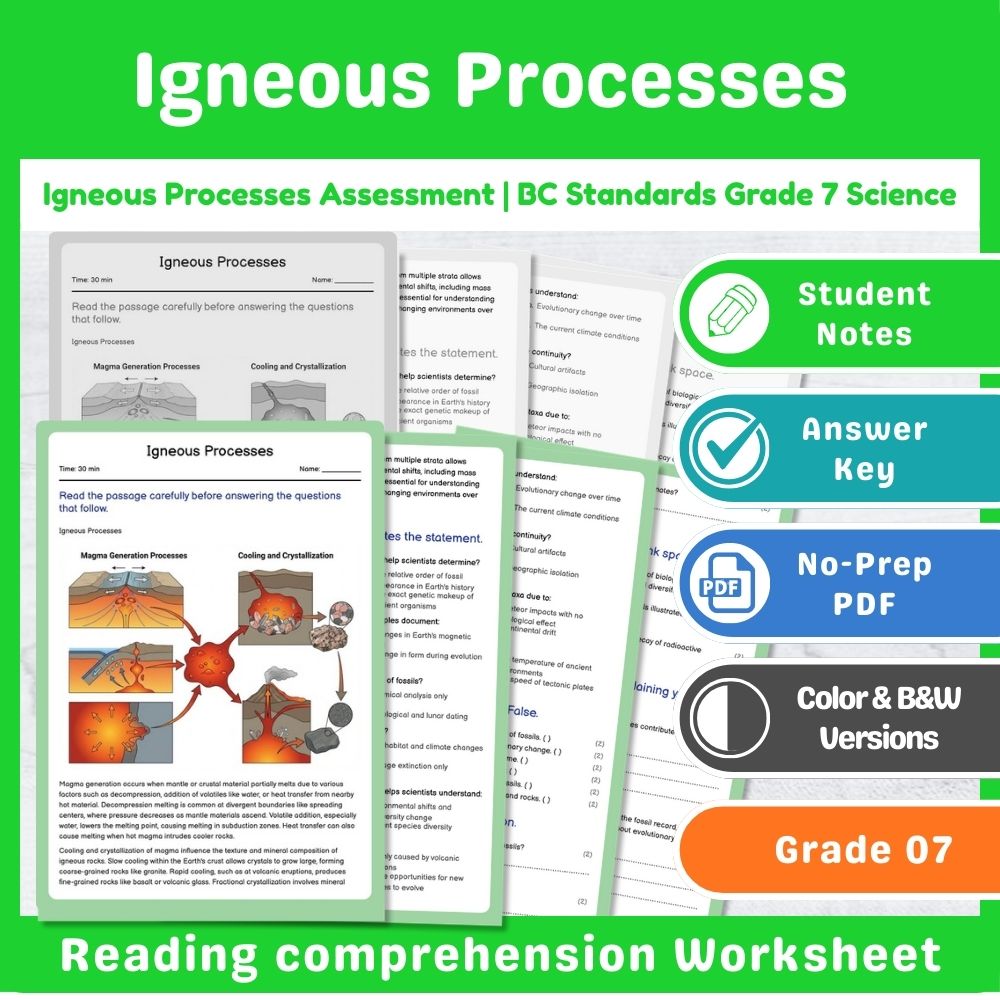
Igneous Processes Assessment | BC Standards Grade 7 Science
Created byPrism Point LearningLearning Objectives
- Describe how magma forms through partial melting due to decompression, volatiles, or heat transfer.
- Explain the processes of cooling and crystallization that determine rock textures and mineral assemblages.
- Identify the roles of fractional crystallization and magma mixing in producing diverse igneous rocks.
Also included in: Grade 7 Science Lesson – Earth Processes Assessment & Landforms Bundle
Instant download
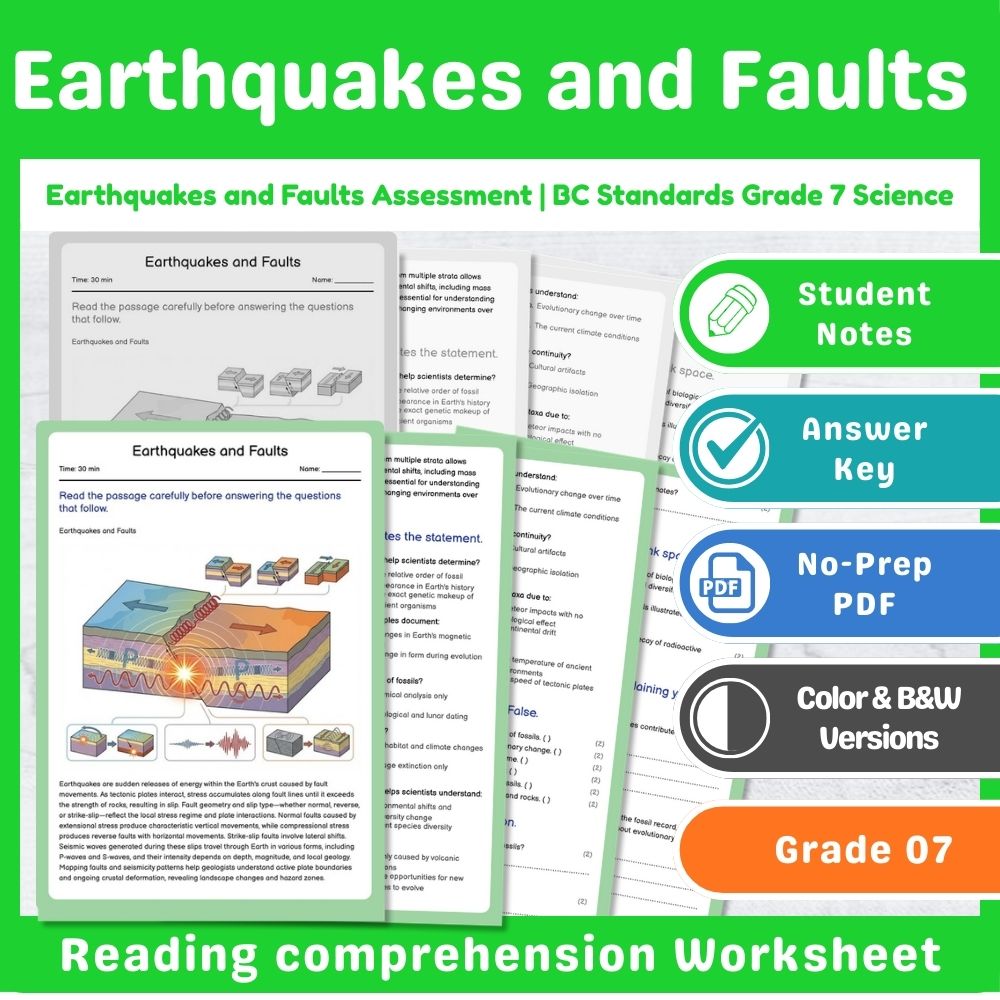
Earthquakes and Faults Assessment | BC Standards Grade 7 Science
Created byPrism Point LearningLearning Objectives
- Understand the causes and effects of earthquakes related to fault movements.
- Identify different fault types and their seismic signatures.
- Explain how seismic waves are generated and how they travel through the Earth.
Also included in: Grade 7 Science Lesson – Earth Processes Assessment & Landforms Bundle
Instant download
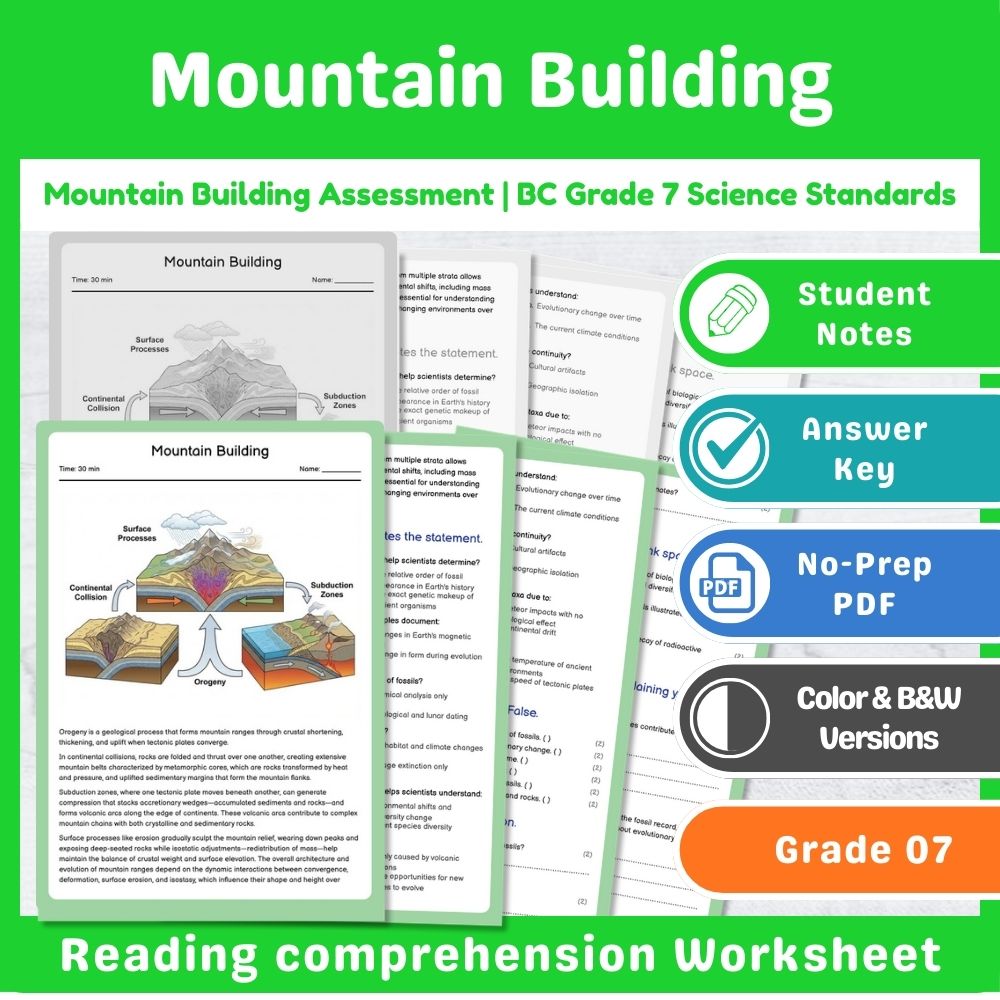
Mountain Building Assessment | BC Grade 7 Science Standards
Created byPrism Point LearningLearning Objectives
- Understand the processes involved in orogeny and mountain formation.
- Identify key geological features associated with mountain belts and subduction zones.
- Explain how surface processes shape mountain regions over time.
Also included in: Grade 7 Science Lesson – Earth Processes Assessment & Landforms Bundle
Instant download
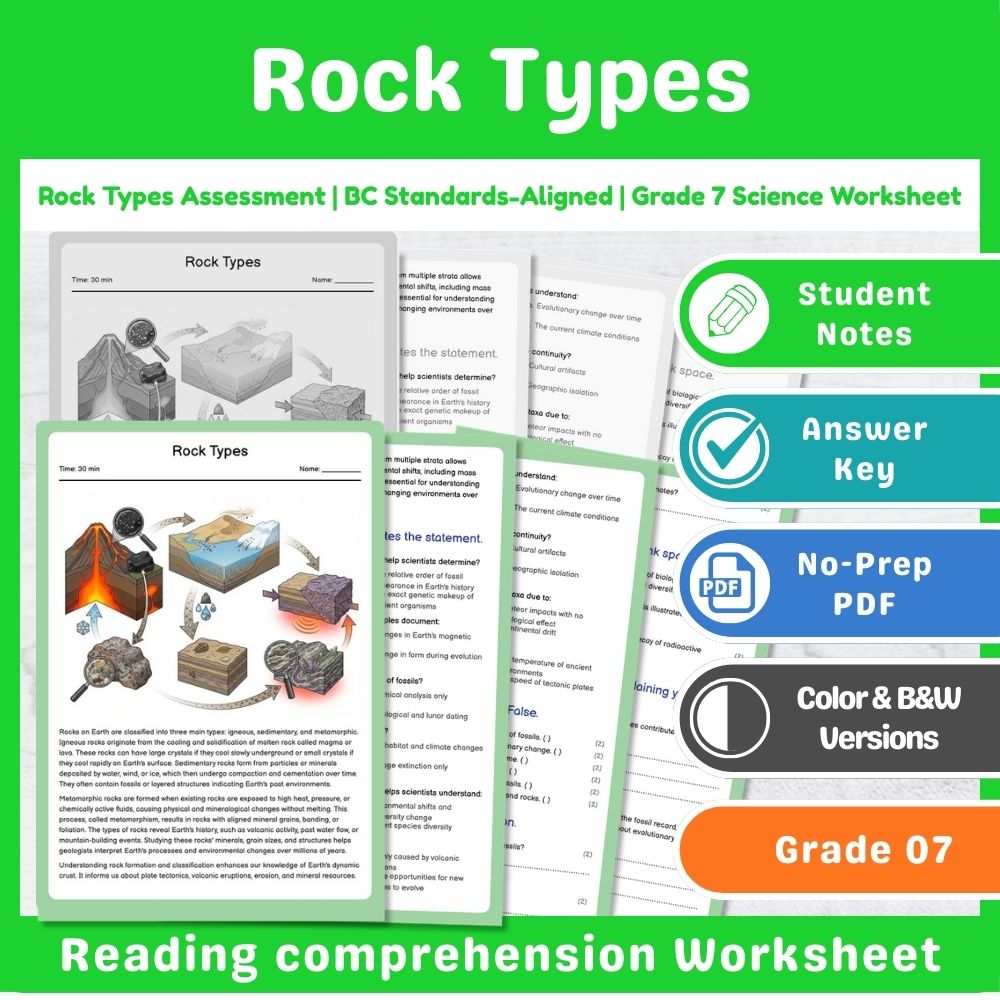
Rock Types Assessment | BC Standards-Aligned | Grade 7 Science Worksheet
Created byPrism Point LearningLearning Objectives
- Describe the three main types of rocks: igneous, sedimentary, and metamorphic.
- Explain the processes by which each type of rock forms.
- Identify distinguishing features of each rock type based on texture and mineral content.
Also included in: Grade 7 Science Lesson – Earth Processes Assessment & Landforms Bundle
Instant download
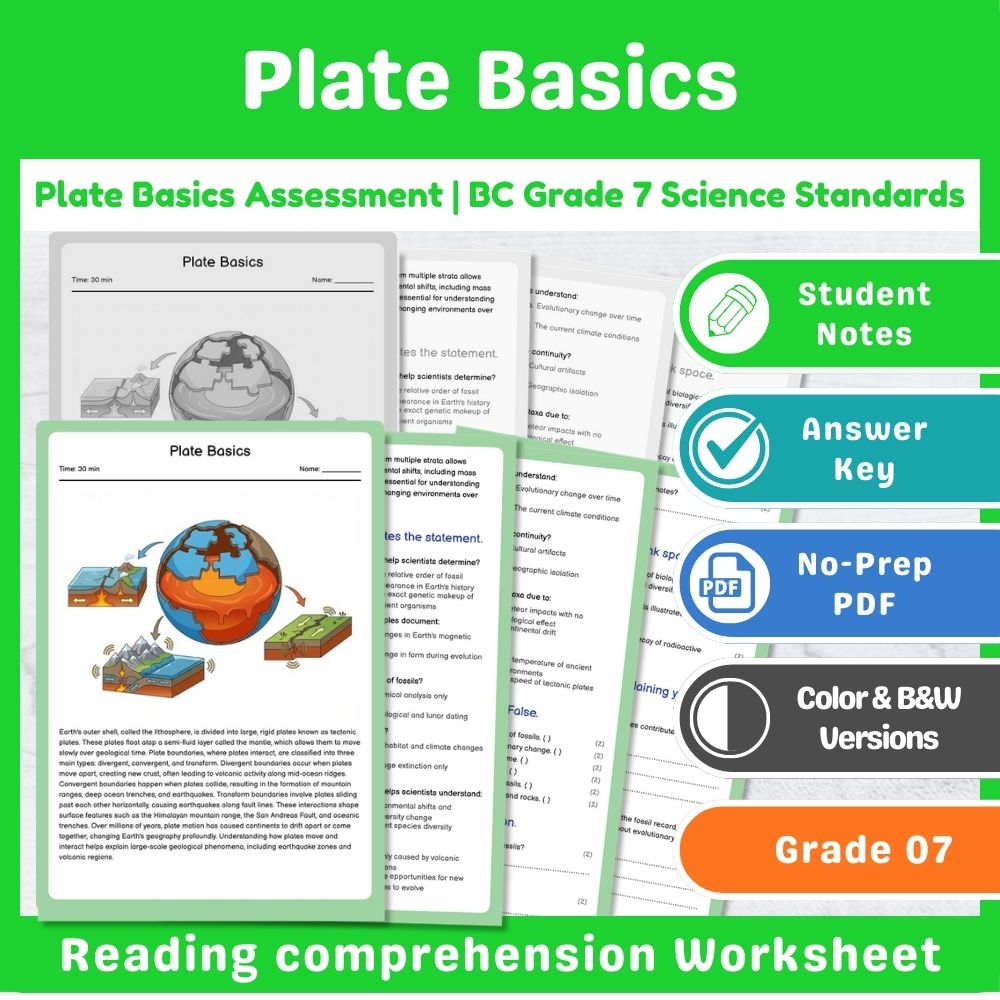
Plate Basics Assessment | BC Grade 7 Science Standards
Created byPrism Point LearningLearning Objectives
- Understand the structure and movement of Earth's lithospheric plates.
- Identify different types of plate boundaries and their effects on surface features.
- Explain how plate interactions influence geological activity such as earthquakes and volcanoes.
Also included in: Grade 7 Science Lesson – Earth Processes Assessment & Landforms Bundle
Instant download
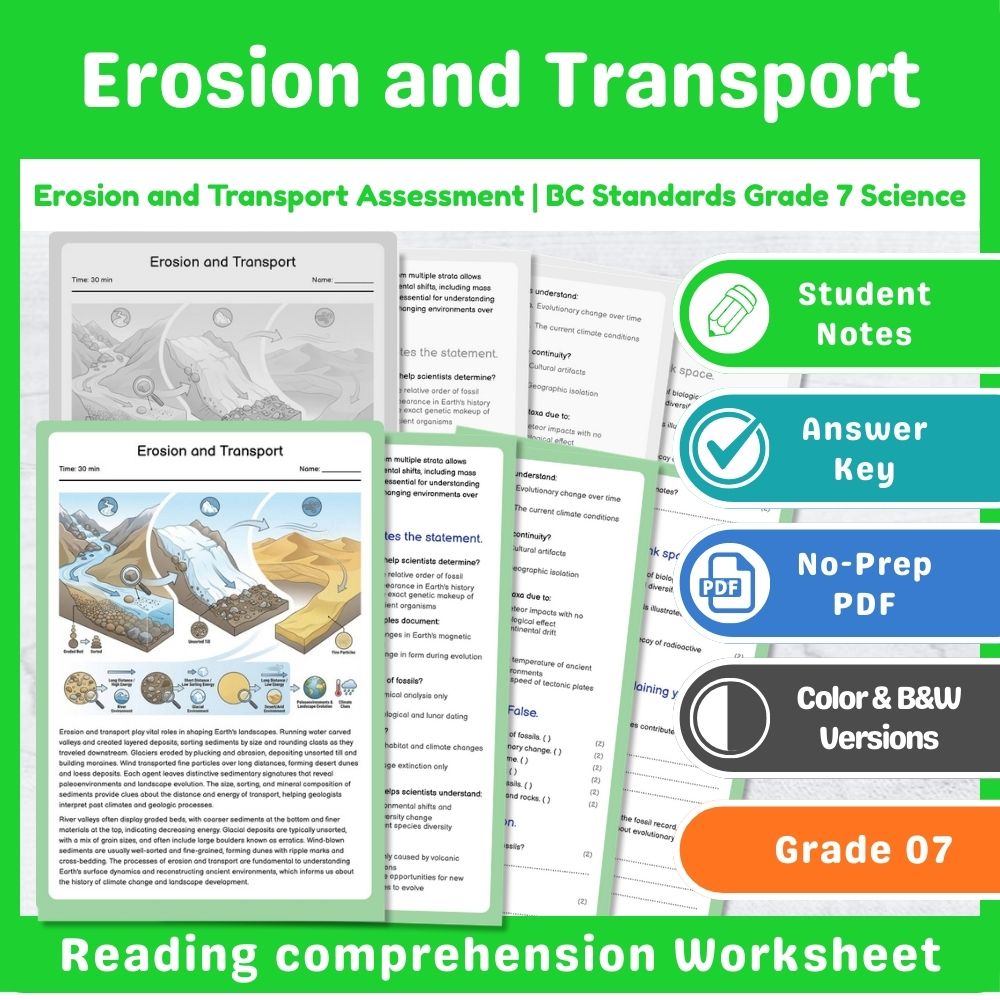
Erosion and Transport Assessment | BC Standards Grade 7 Science
Created byPrism Point LearningLearning Objectives
- Understand how agents like water, glaciers, wind, and gravity cause erosion and transport Sediment.
- Describe distinctive sedimentary signatures produced by different erosion agents.
- Interpret landscape features to deduce past environments and erosion history.
Also included in: Grade 7 Science Lesson – Earth Processes Assessment & Landforms Bundle
Instant download
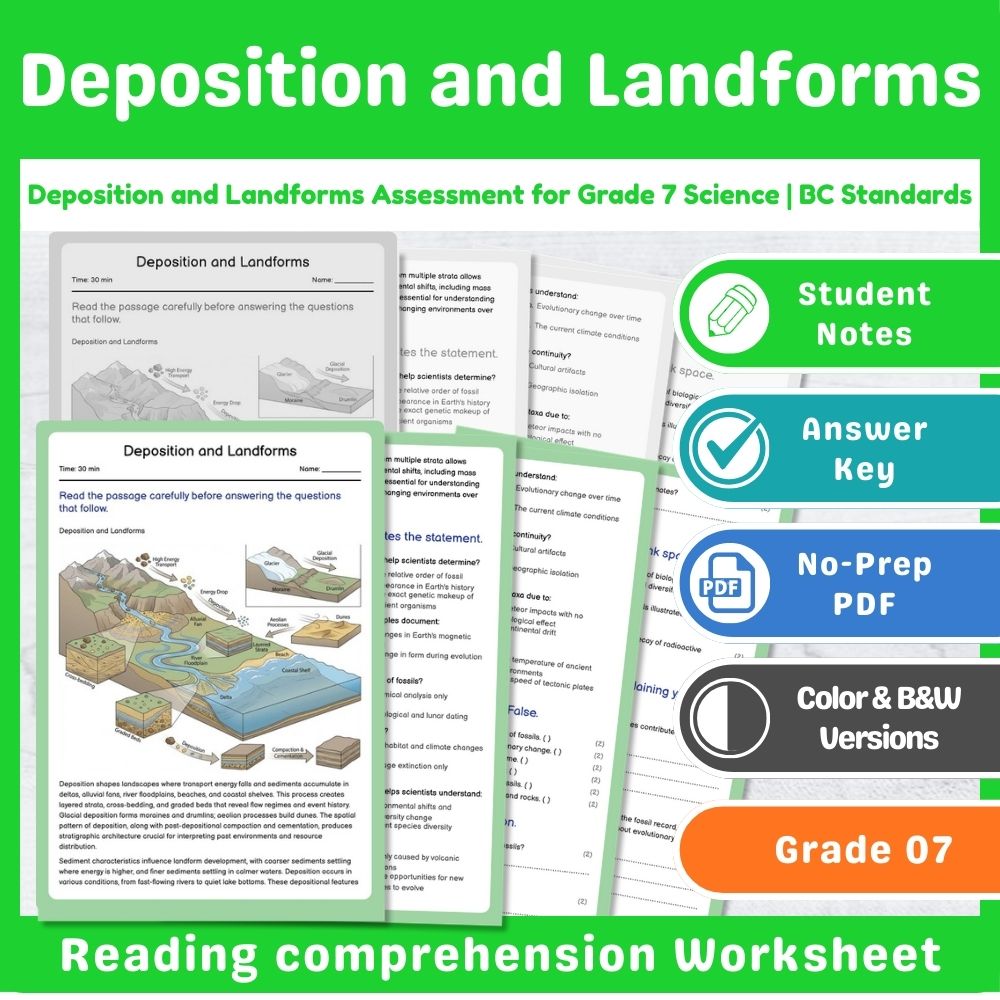
Deposition and Landforms Assessment for Grade 7 Science | BC Standards
Created byPrism Point LearningLearning Objectives
- Understand the processes of deposition and how they shape landforms.
- Identify different types of depositional features such as deltas, beaches, and moraines.
- Describe the characteristics of sediments involved in depositional environments.
Also included in: Grade 7 Science Lesson – Earth Processes Assessment & Landforms Bundle
Instant download
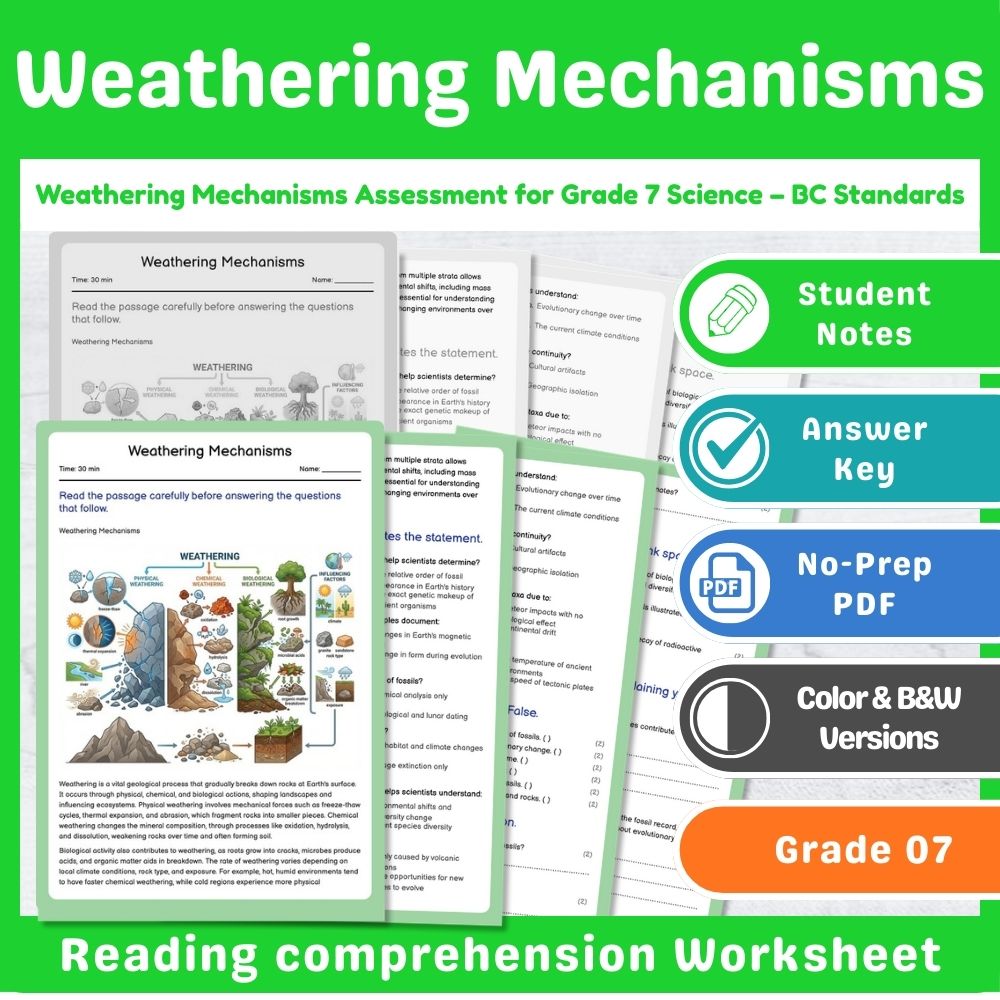
Weathering Mechanisms Assessment for Grade 7 Science – BC Standards
Created byPrism Point LearningLearning Objectives
- Understand the different types of weathering processes and how they affect rocks and landscapes.
- Identify examples of physical, chemical, and biological weathering mechanisms.
- Explain how weathering influences soil formation and landform development.
Also included in: Grade 7 Science Lesson – Earth Processes Assessment & Landforms Bundle
Instant download
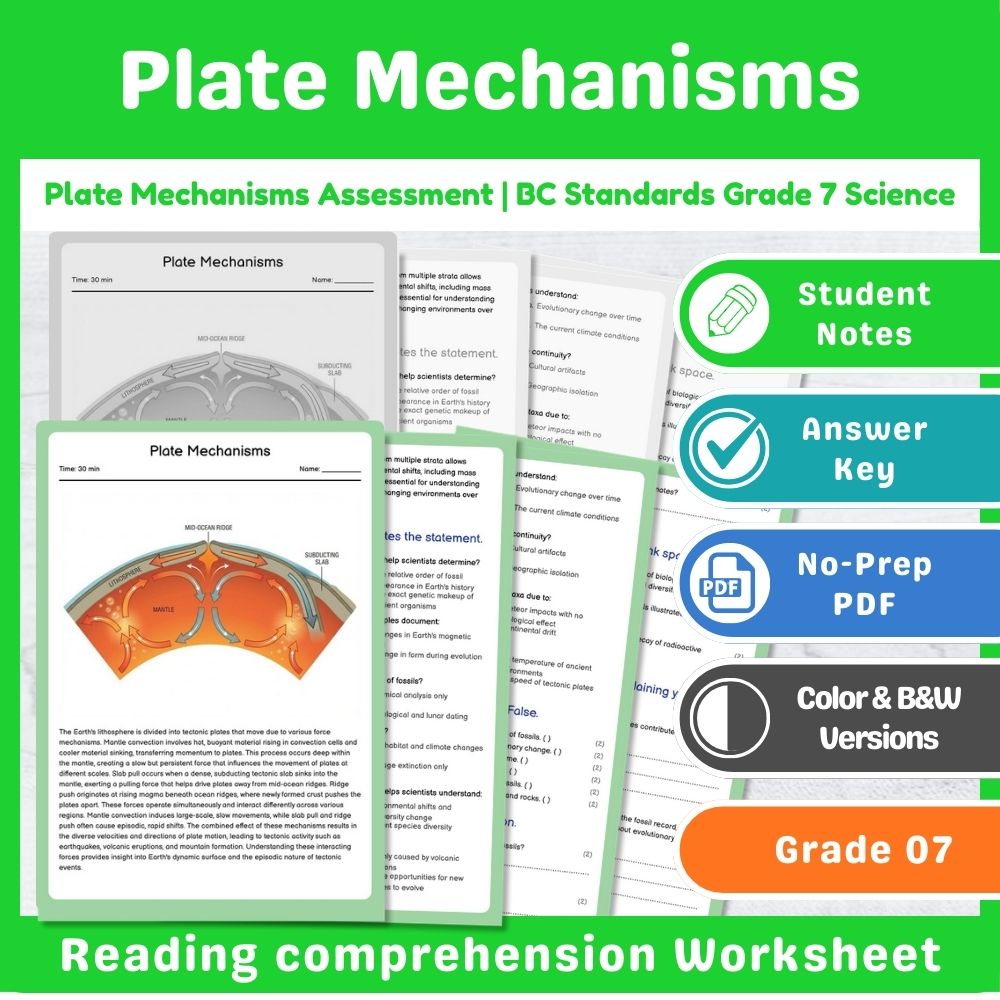
Plate Mechanisms Assessment | BC Standards Grade 7 Science
Created byPrism Point LearningLearning Objectives
- Describe the key force systems within the Earth's crust that drive plate motion.
- Explain how mantle convection, slab pull, and ridge push influence tectonic activity.
- Analyze the interaction of different plate force mechanisms and their impact on Earth's surface.
Also included in: Grade 7 Science Lesson – Earth Processes Assessment & Landforms Bundle
Instant download
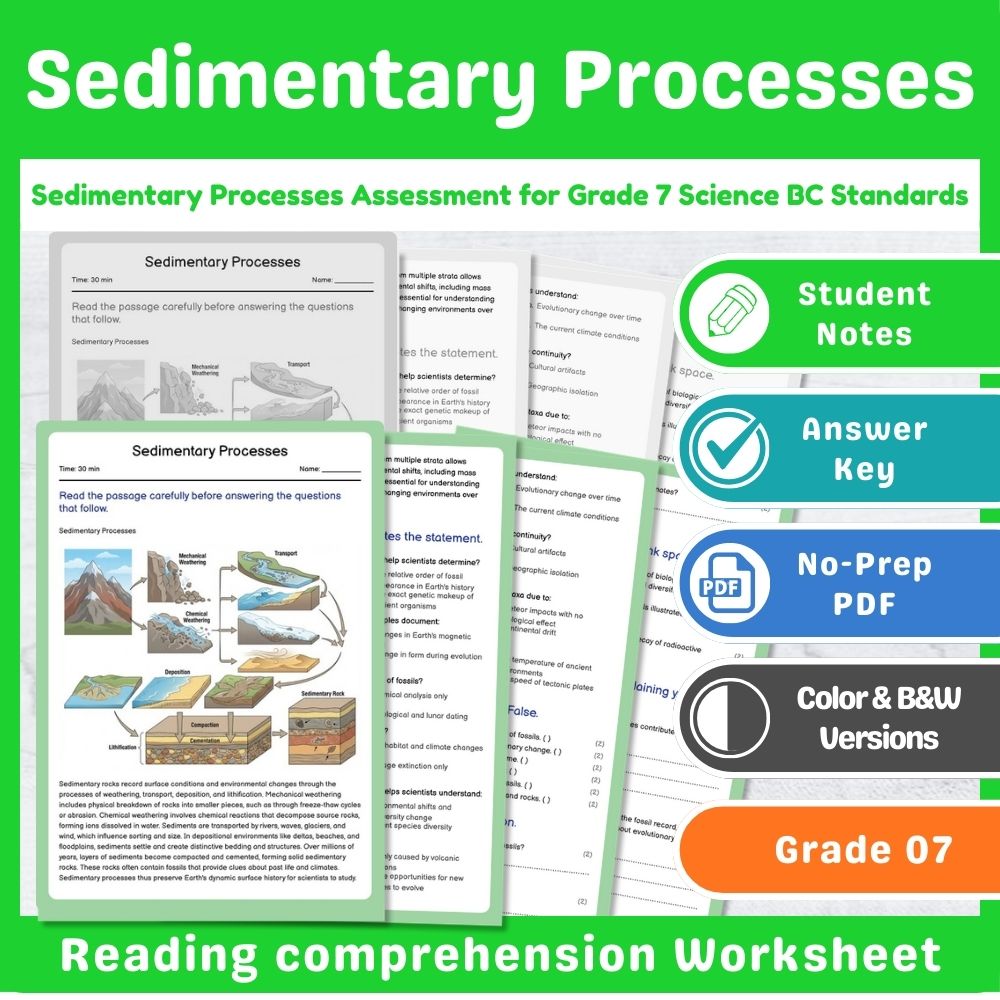
Sedimentary Processes Assessment for Grade 7 Science BC Standards
Created byPrism Point LearningLearning Objectives
- Describe the processes involved in the formation of sedimentary rocks.
- Identify different types of weathering and how they contribute to sediment formation.
- Explain how sediments are transported and deposited in various environments.
Also included in: Grade 7 Science Lesson – Earth Processes Assessment & Landforms Bundle
Instant download
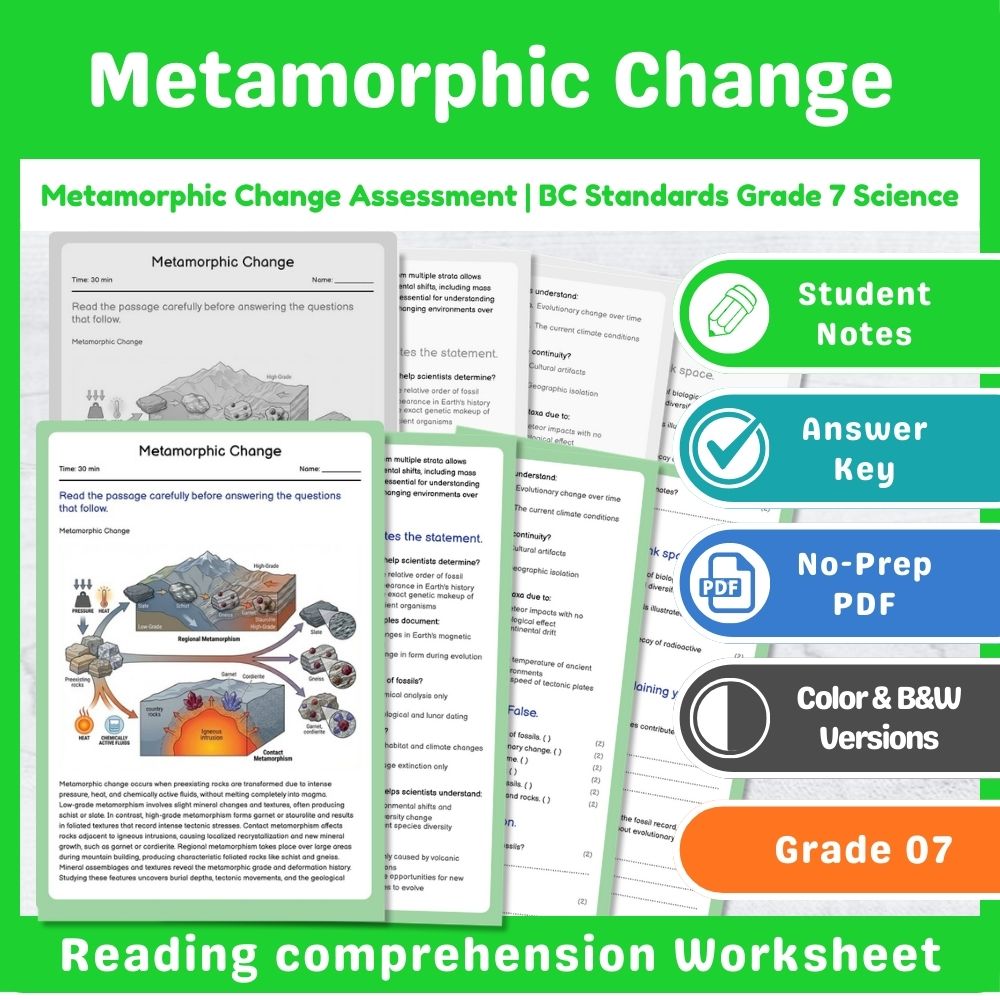
Metamorphic Change Assessment | BC Standards Grade 7 Science
Created byPrism Point LearningLearning Objectives
- Describe the processes involved in metamorphism and how rocks change mineralogically and texturally.
- Differentiate between contact and regional metamorphism and their effects on rocks.
- Identify mineral assemblages and textures that indicate metamorphic grade and history.
Also included in: Grade 7 Science Lesson – Earth Processes Assessment & Landforms Bundle
Instant download
Grade 12 Science | Modeling and Prediction Worksheet | Alberta Standards
Created byLumora LearningLearning Objectives
- Understand key concepts of mathematical and computational modeling in environmental science.
- Describe the processes of model construction, calibration, and validation.
- Explain the role of sensitivity analysis and boundary conditions in modeling.
Also included in: Grade 12 Science | Science Custom Bundle | Alberta Standards Worksheets
Instant download
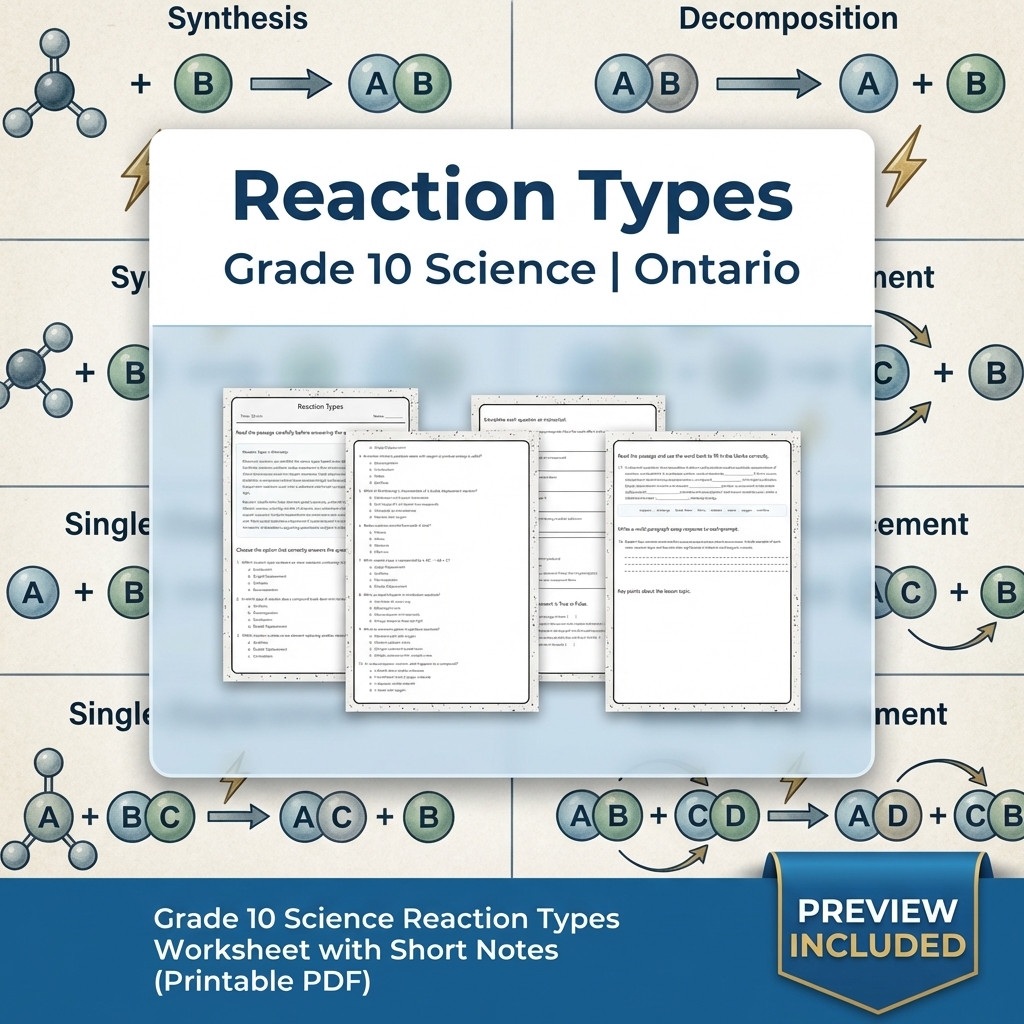
Grade 10 Science Reaction Types Worksheet with Short Notes (Printable PDF)
Created byMeadowlark WorksheetsLearning Objectives
- Classify chemical reactions into synthesis, decomposition, single displacement, double displacement, and combustion categories.
- Identify characteristic reactant-product patterns in various reaction types.
- Understand redox considerations and predict potential products based on reaction patterns.
Also included in: Grade 10 Science Lesson Group Bundle with Ontario Framework +1 more
Instant download
Grade 6 Science | Resource Distribution Worksheet | NGSS-Aligned
Created byLumora LearningLearning Objectives
- Understand the geological processes that influence the distribution of mineral, energy, and groundwater resources.
- Analyze spatial patterns in resource deposits and their relation to Earth's geological history.
- Evaluate societal and technological factors affecting resource extraction and long-term availability.
Instant download

Grade 11 Science – Genetic Systems & Genome Organization | Reading Worksheet
Created byBright Mind ResourcesLearning Objectives
- Identify key features of prokaryotic and eukaryotic genomes
- Understand the structural differences between circular and linear genomes
- Describe the processes of gene transcription and regulation in different organisms
Also included in: Grade 11 Cell Systems Life Science Daily Reading Lesson Bundle | TEKS +2 more
Instant download
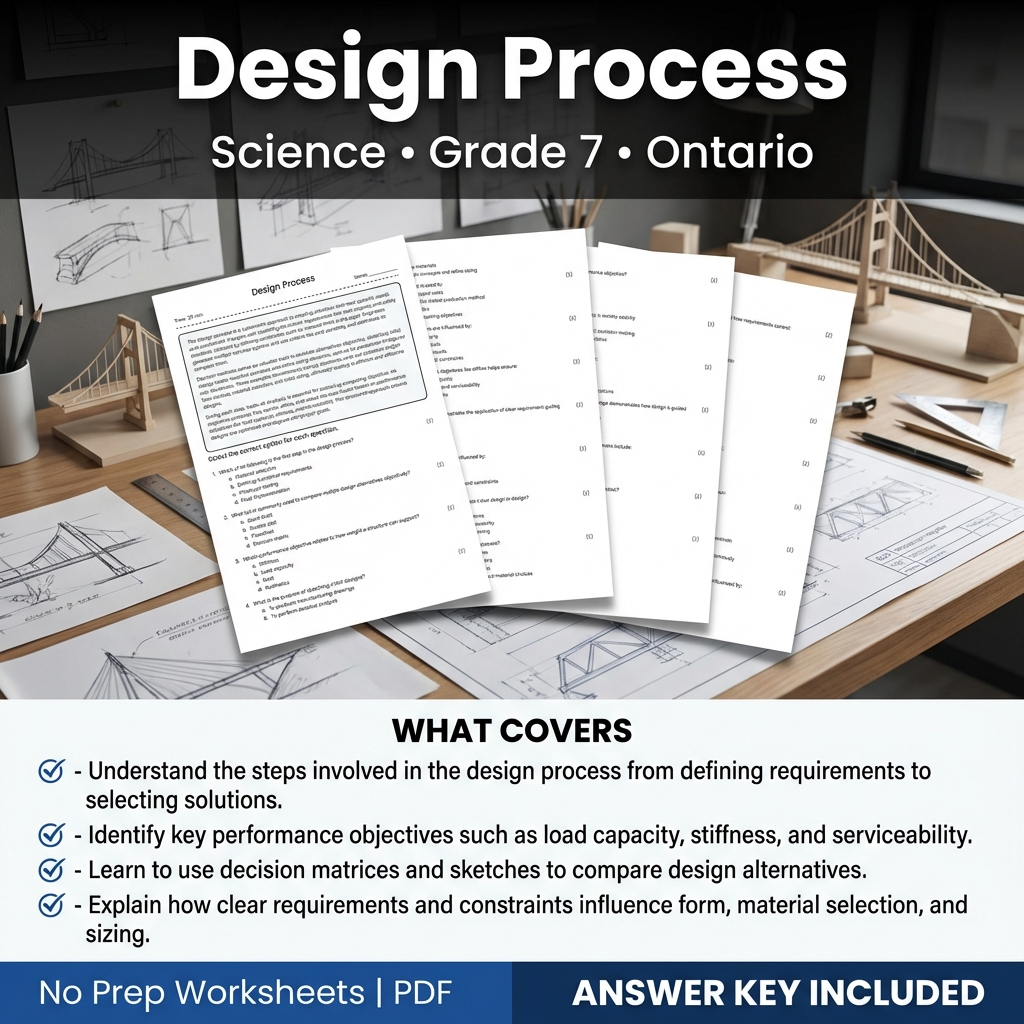
Grade 7 Science Worksheet on Design Process | Ontario Standards
Created byCoral Reef LearningLearning Objectives
- Understand the steps involved in the design process from defining requirements to selecting solutions.
- Identify key performance objectives such as load capacity, stiffness, and serviceability.
- Learn to use decision matrices and sketches to compare design alternatives.
Instant download
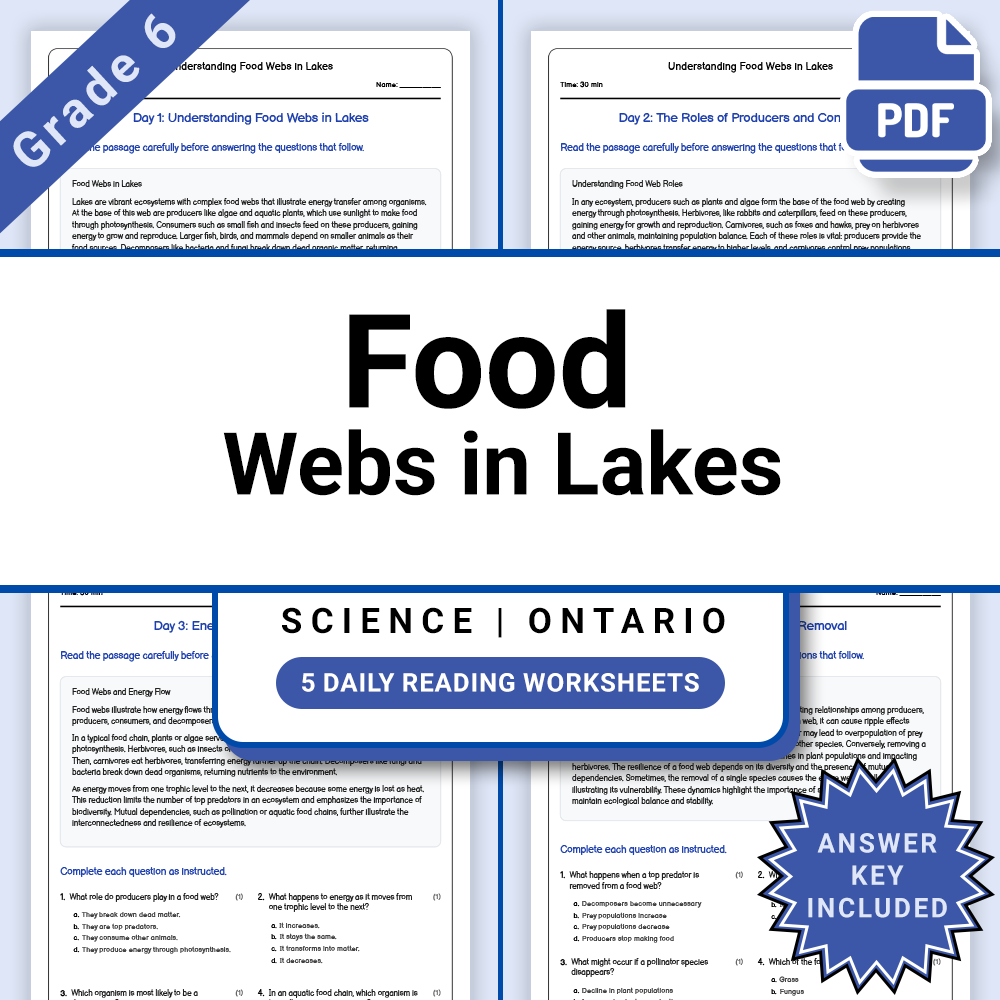
Grade 6 Science – Understanding Food Webs in Lakes Daily Worksheet + Answer Key
Learning Objectives
- Identify producers, consumers, and decomposers in aquatic environments
- Understand how energy flows through food webs
- Recognize the roles of different organisms in lakes
Also included in: Grade 6 Science Biodiversity Lesson Bundle – Ecosystems and Conservation +1 more
Instant download
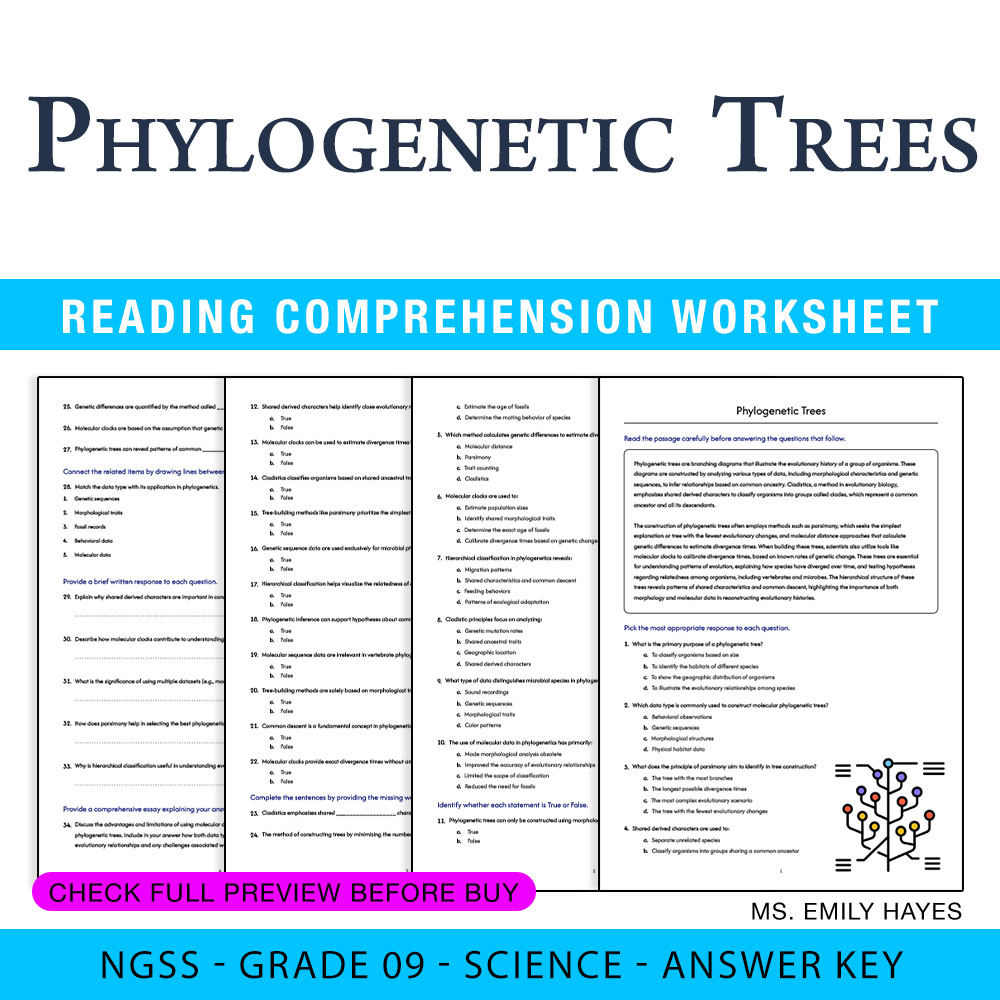
Grade 9 Science | Phylogenetic Trees Worksheet (PDF+ Answer Key)
Created byCopper Leaf ClassroomLearning Objectives
- Understand how to construct phylogenetic trees based on morphological and molecular data.
- Interpret branching diagrams to identify evolutionary relationships and common ancestors.
- Apply cladistic principles such as shared derived characters to classify organisms.
Instant download
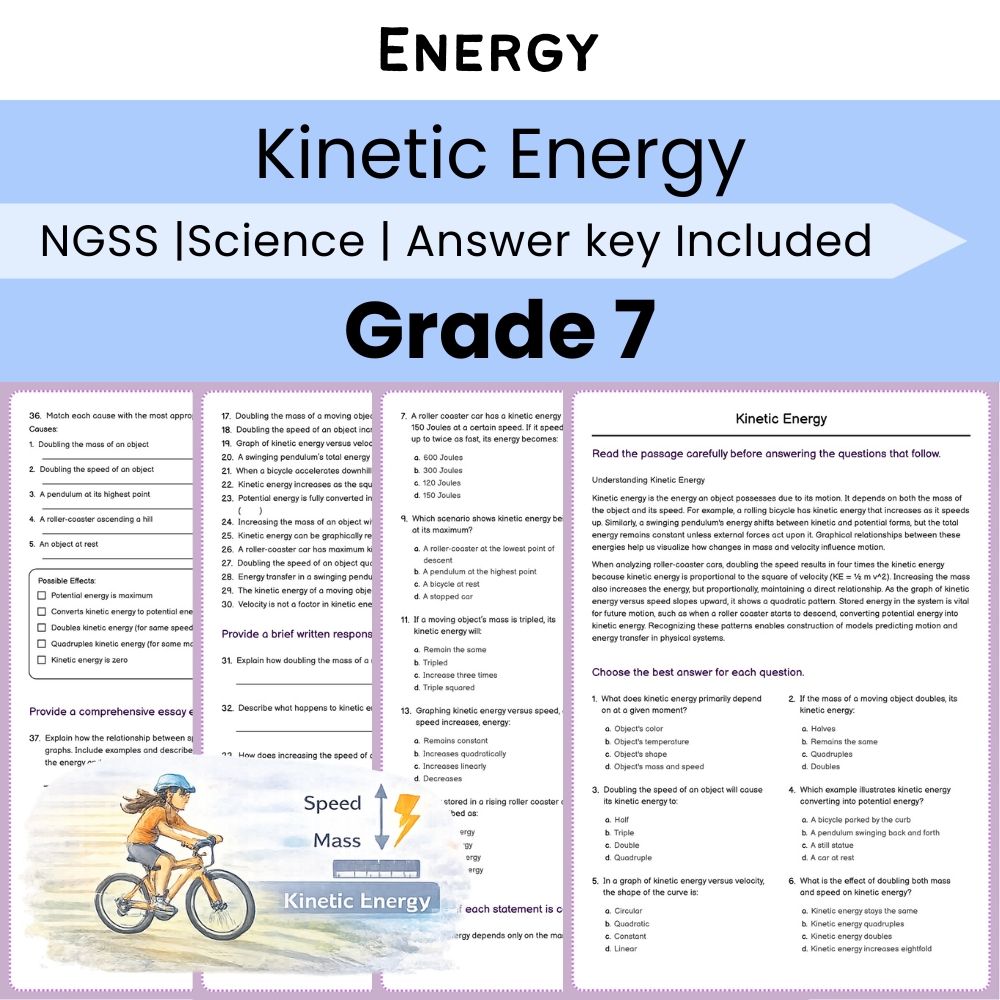
Kinetic Energy Worksheet | Grade 7 Science Printable PDF Assessment
Learning Objectives
- Construct and interpret graphical relationships between kinetic energy, potential energy, mass, and speed.
- Understand how doubling mass or speed affects kinetic energy through quantitative analysis.
- Analyze energy calculations and correlate motion graphs with energy changes.
Also included in: Grade 7 Science NSGS Energy Lesson Bundle | Worksheets & Assessments +1 more
Instant download

Grade 9 Science – Membrane Transport & Cell Movement | Daily Reading Worksheet
Created byBright Mind ResourcesLearning Objectives
- Understand the different types of passive and active membrane transport processes.
- Explain how molecules move across cell membranes through diffusion, osmosis, and active transport.
- Identify the differences between diffusion, facilitated diffusion, and osmosis.
Also included in: Grade 9 Homeostasis & Body Systems Science Lesson Bundle Daily Reading | TEKS +2 more
Instant download
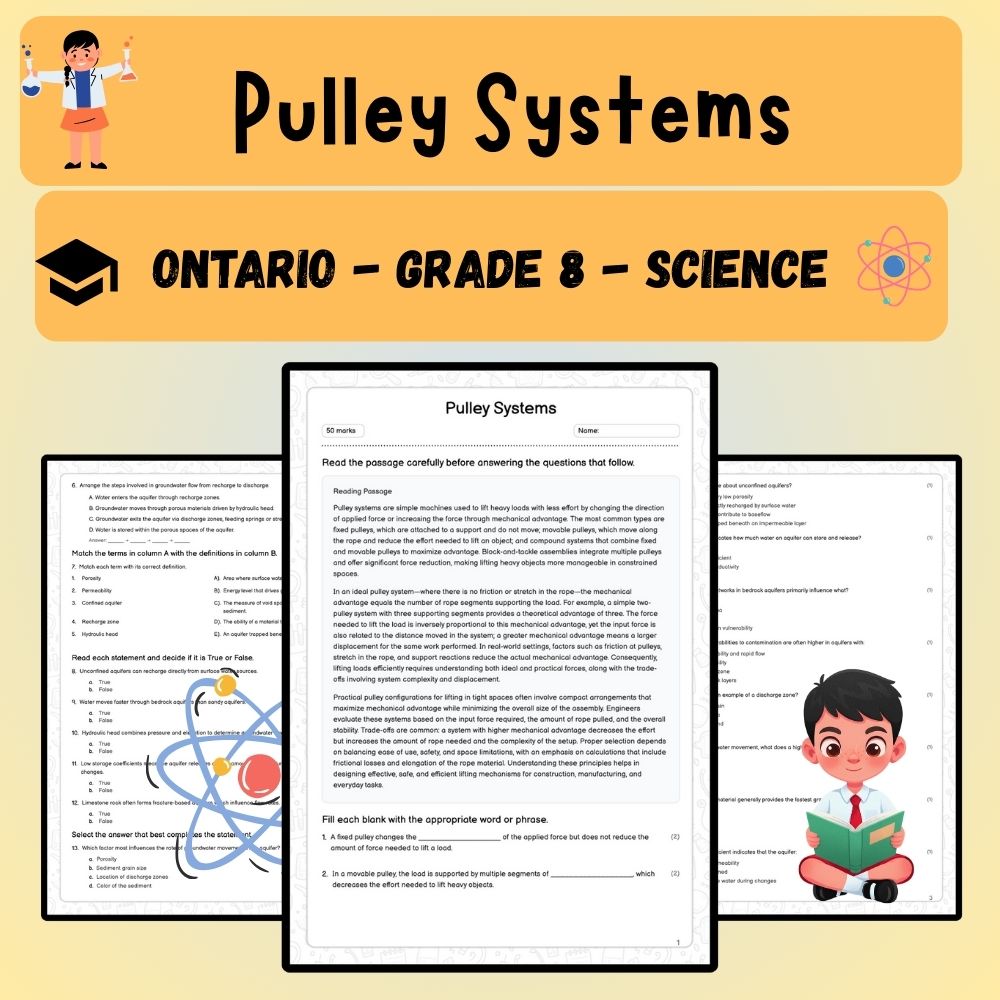
Grade 8 Science | Pulley Systems Worksheet (PDF) – Ontario Standards
Created byPrism Point LearningLearning Objectives
- Understand the difference between fixed, movable, and compound pulley arrangements.
- Explain how mechanical advantage is achieved and calculated in pulley systems.
- Analyze real-world factors such as friction and rope stretch that affect pulley performance.
Also included in: Grade 8 Science Unit Bundle | Forces, Energy & Motion Worksheets +1 more
Instant download
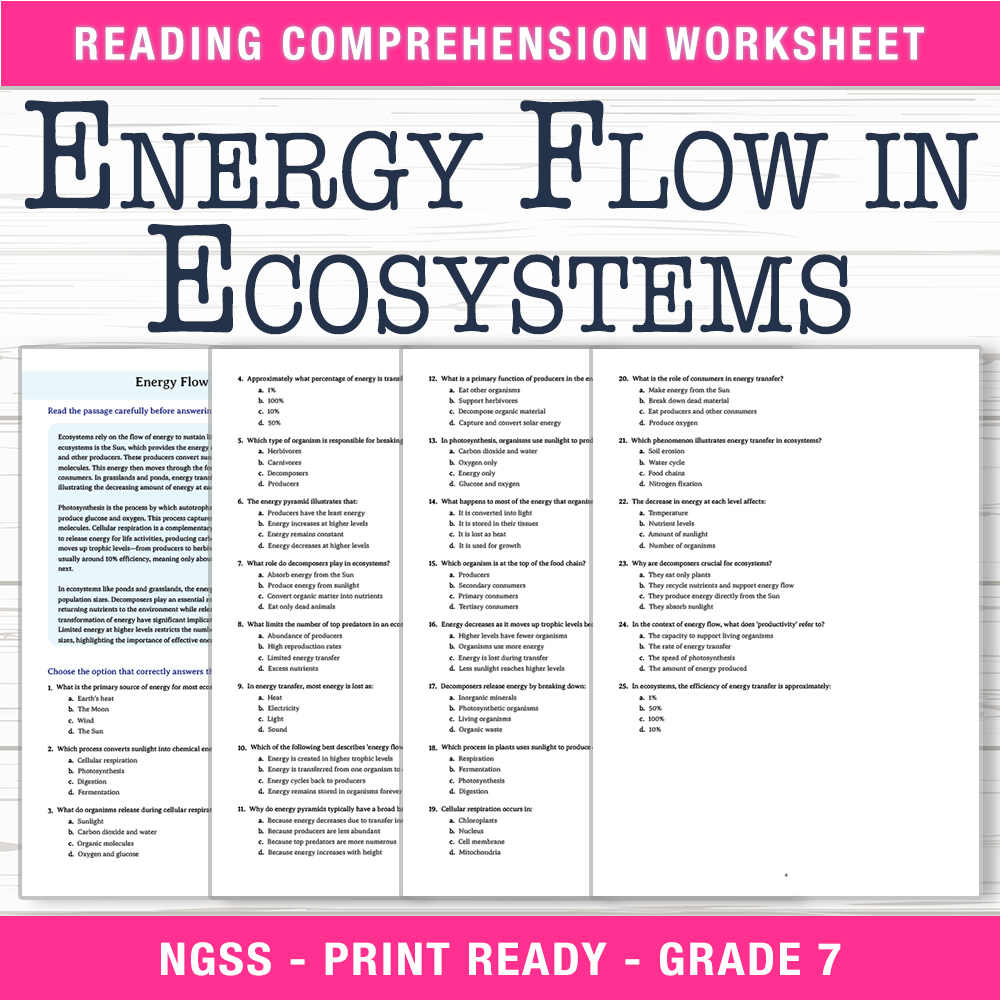
Grade 7 Science | Energy Flow in Ecosystems Worksheet (PDF + Answer Key)
 Created byRiverstone Classroom
Learning Objectives
- Describe how energy is transferred through trophic levels in food webs and energy pyramids.
- Explain the roles of producers, consumers, and decomposers in ecosystem energy flow.
- Understand the mechanisms of photosynthesis and cellular respiration in energy capture and release.
Also included in: Grade 7 Science | Ecosystems & Biodiversity Unit Worksheet Pack
Instant download
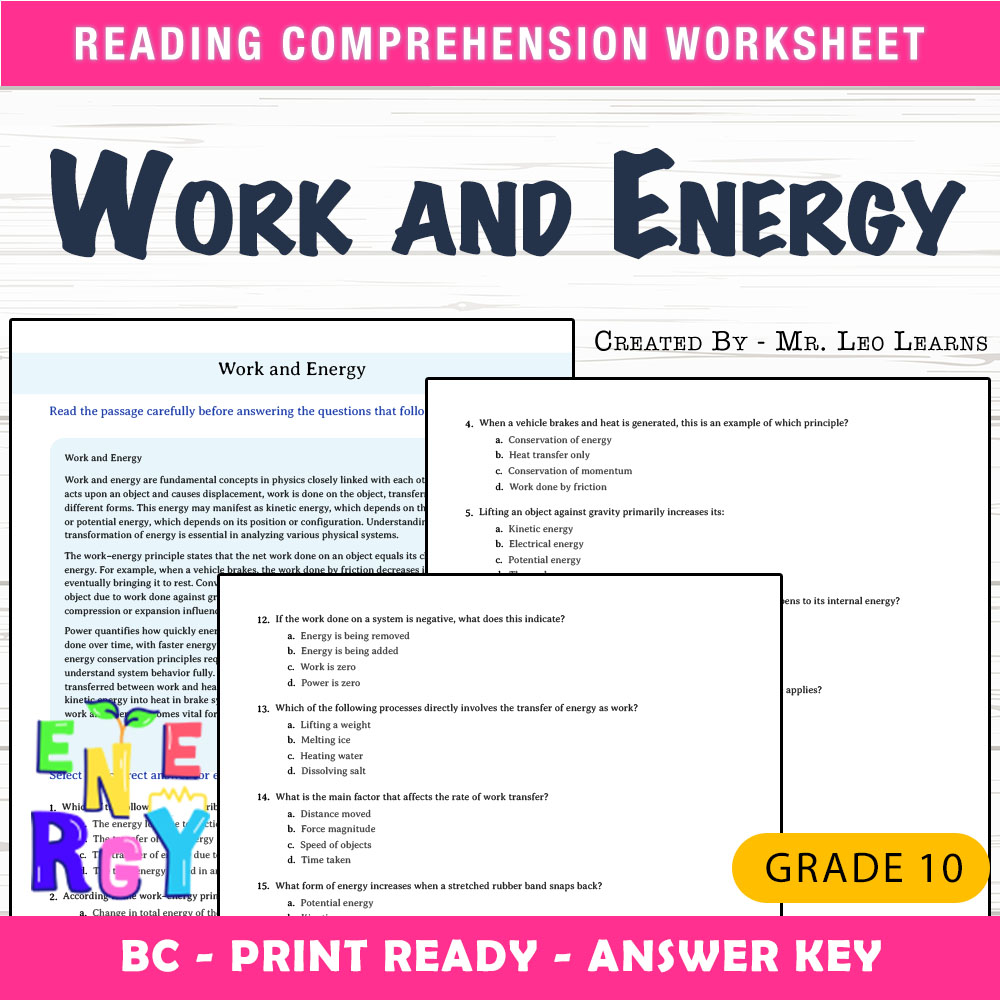
Grade 10 Science — Work and Energy Worksheet for Mastery
 Created byThe Resource Hub
Learning Objectives
- Understand the relationship between work done by forces and energy transfer.
- Explain the work–energy principle and its role in mechanical systems.
- Describe how power measures the rate of energy transfer.
Also included in: Grade 10 Science | Energy Transfer & Conservation UNIT Worksheet Bundle +1 more
Instant download
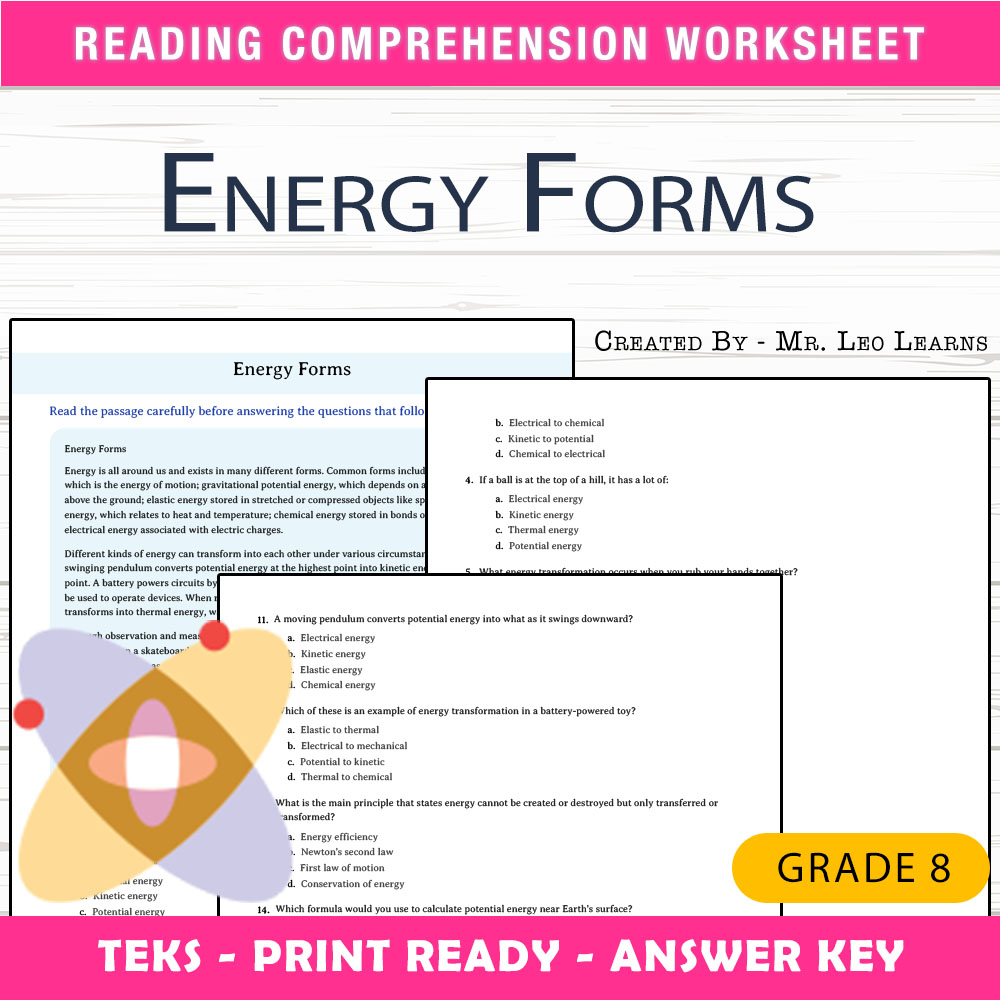
Grade 8 Science – Energy Forms Worksheet for Mastering Energy Types
Created byThe Resource HubLearning Objectives
- Identify and describe different forms of energy including kinetic, gravitational potential, elastic, thermal, chemical, and electrical.
- Explain common transformations among energy types using real-world examples such as swinging pendulums, batteries, and heating.
- Understand the concept of energy conservation in everyday systems and relate observable effects to energy transfer and storage.
Also included in: Grade 8 Science Unit Bundle | Motion, Forces & Energy Mastery Worksheets +1 more
Instant download
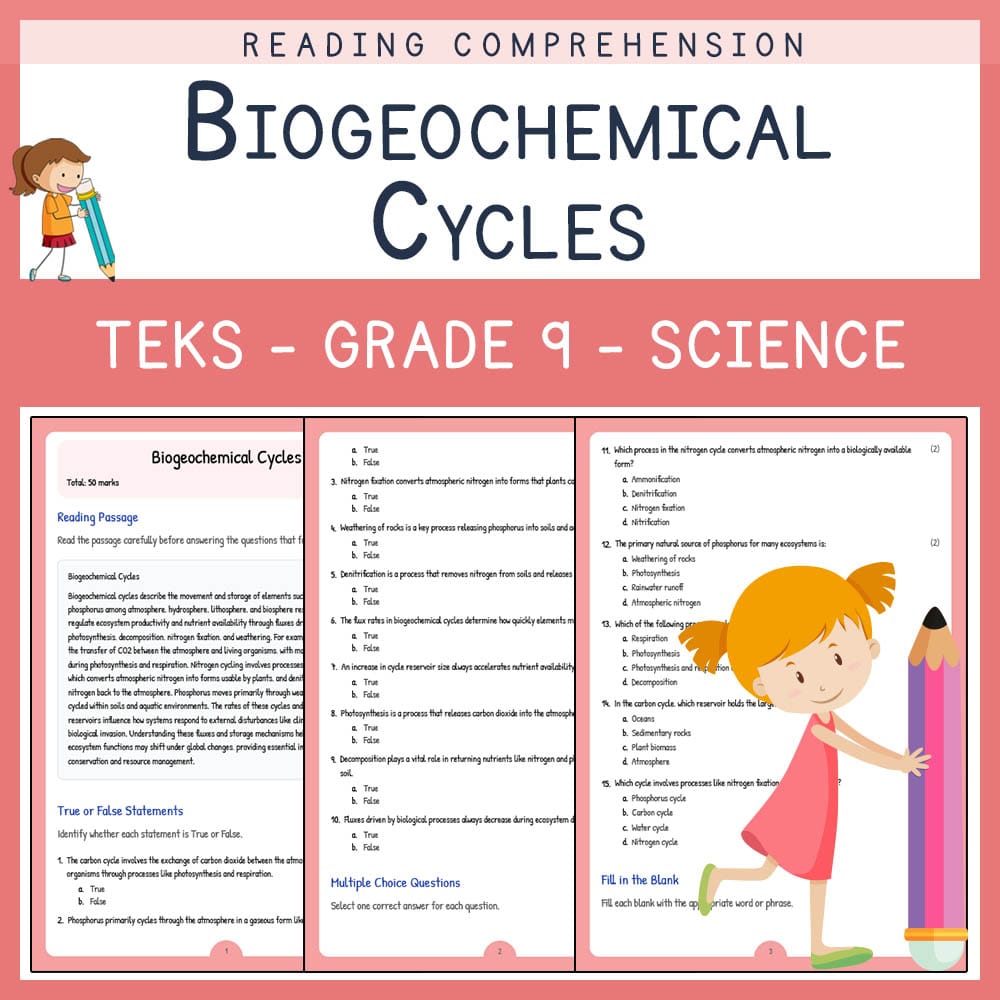
Grade 9 Science | Biogeochemical Cycles Worksheet | TEKS Aligned
Created byLumora LearningLearning Objectives
- Describe the major biogeochemical cycles and their role in ecosystems.
- Identify the key processes driving movement of elements like carbon, nitrogen, and phosphorus.
- Explain the impact of fluxes and reservoir sizes on ecosystem responses and climate change.
Instant download
Browse more categories
About Science Worksheets
Find Science worksheets spanning core skills, practice, and review. All 45,429 resources are instant PDF downloads for the classroom or home.
Every worksheet on MyTeachingSheets is created by independent teacher-authors and reviewed before publication. All resources download as printable PDFs for classroom, homework, or at-home practice, and many include answer keys. Preview any worksheet free before buying.