
Science Worksheets
45,429 subject resources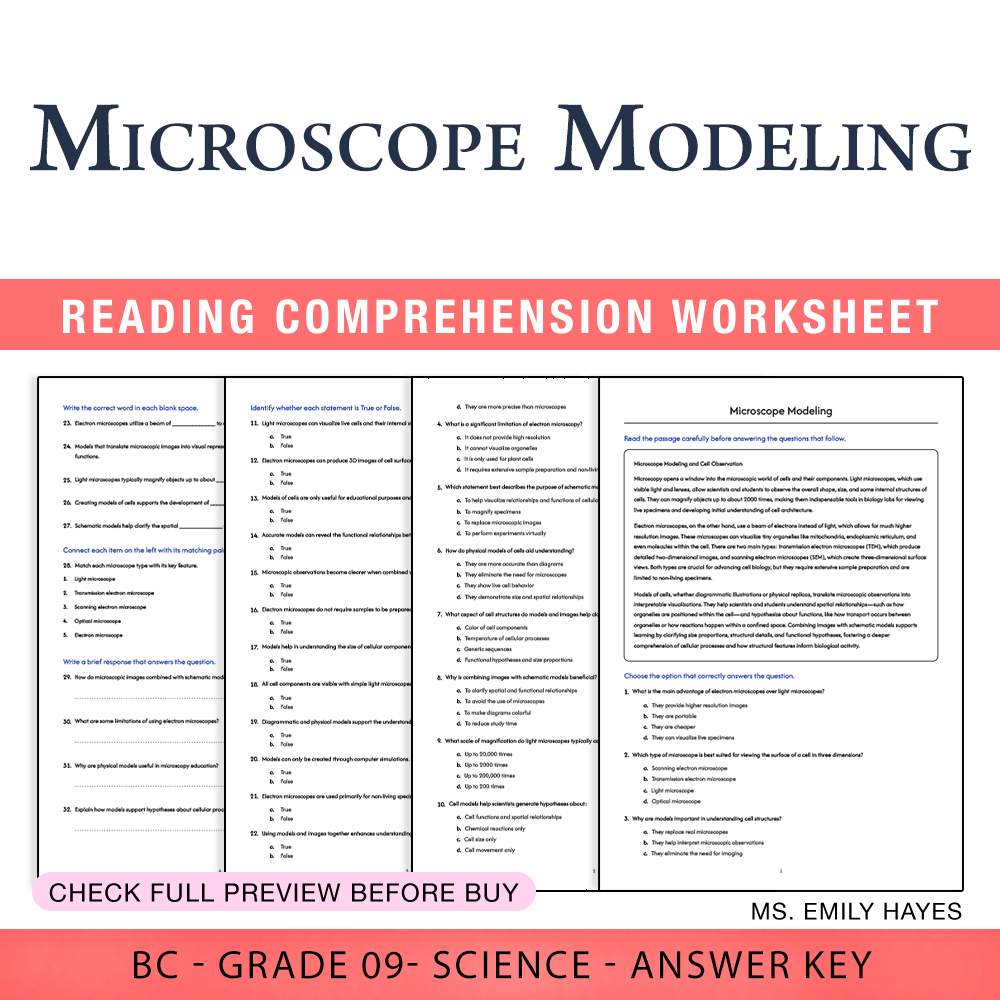
Grade 9 Science | Microscope Modeling Worksheet (PDF+ Answer Key)
 Created byCopper Leaf Classroom
Learning Objectives
- Understand how microscopes reveal details of cell structures.
- Learn the differences between various types of microscopy.
- Interpret diagrammatic and physical models of cells.
Also included in: Grade 9 Science Worksheet Pack | Biology & Cell Structures (PDF+ Answer Keys) +1 more
Instant download
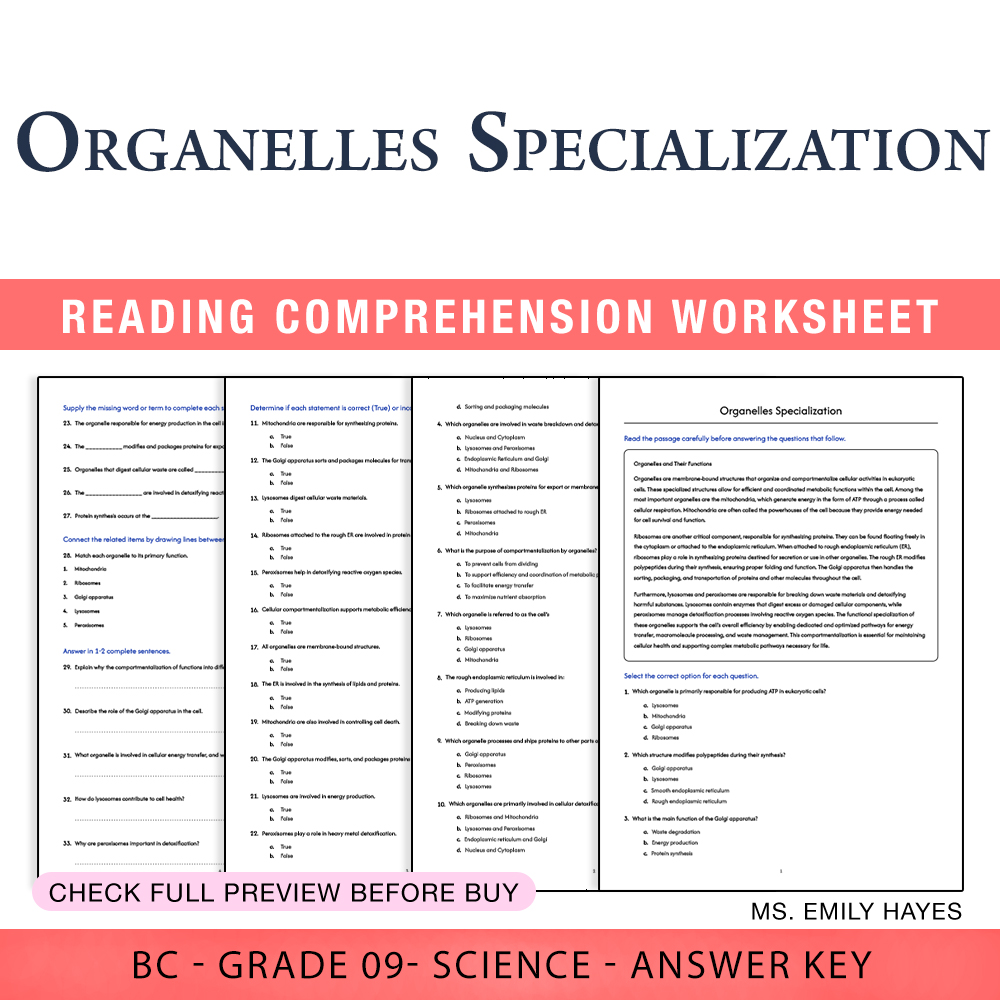
9th Grade Science | Organelles Specialization Worksheet (PDF+ Answer Key)
Created byCopper Leaf ClassroomLearning Objectives
- Describe the functions of key cellular organelles involved in specialization.
- Explain how structural differences among organelles support cellular efficiency.
- Identify the roles of mitochondria, ribosomes, rough endoplasmic reticulum, Golgi apparatus, lysosomes, and peroxisomes.
Also included in: Grade 9 Science Worksheet Pack | Biology & Cell Structures (PDF+ Answer Keys) +1 more
Instant download
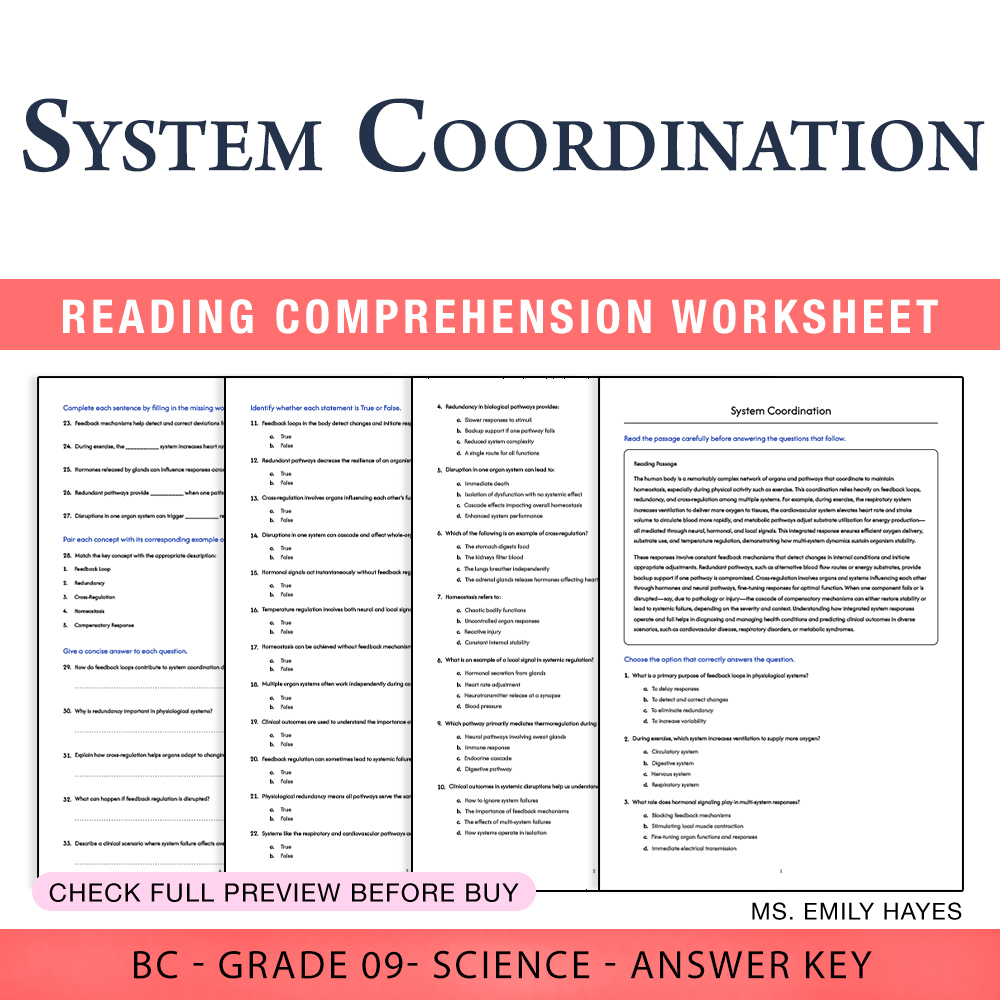
Grade 9 Science | System Coordination Worksheet (PDF+ Answer Key)
Created byCopper Leaf ClassroomLearning Objectives
- Explain how feedback loops, redundancy, and cross-regulation coordinate multiple organ systems.
- Describe how responses to exercise involve respiratory, cardiovascular, and metabolic pathways.
- Identify the mechanisms by which disruptions in one system affect overall homeostasis.
Also included in: Grade 9 Science Worksheet Pack | Biology & Cell Structures (PDF+ Answer Keys) +1 more
Instant download
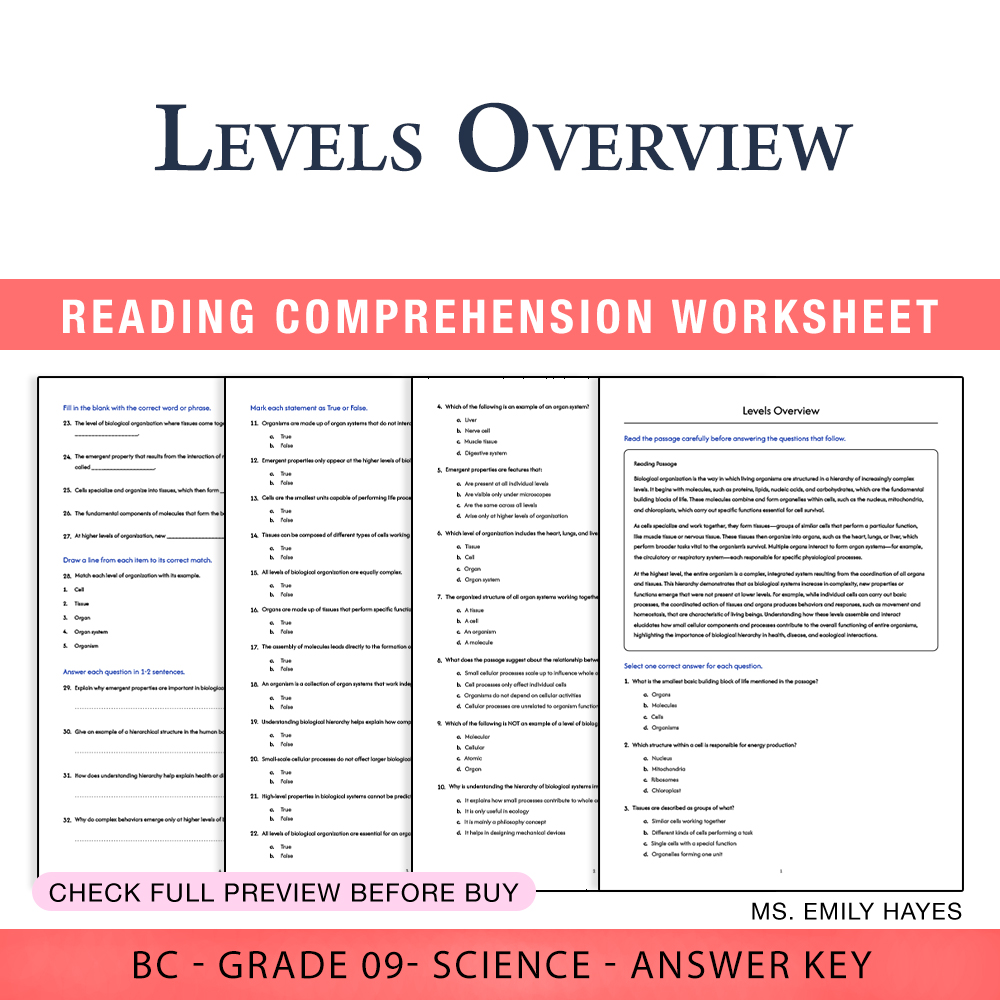
9th Grade Science | Levels of Biological Organization Worksheet(PDF+ Answer Key)
Created byCopper Leaf ClassroomLearning Objectives
- Describe the hierarchical levels of biological organization from molecules to organisms.
- Explain the concept of emergent properties at each level of biological organization.
- Understand how components assemble into complex biological systems to maintain function.
Also included in: Grade 9 Science Worksheet Pack | Biology & Cell Structures (PDF+ Answer Keys) +1 more
Instant download
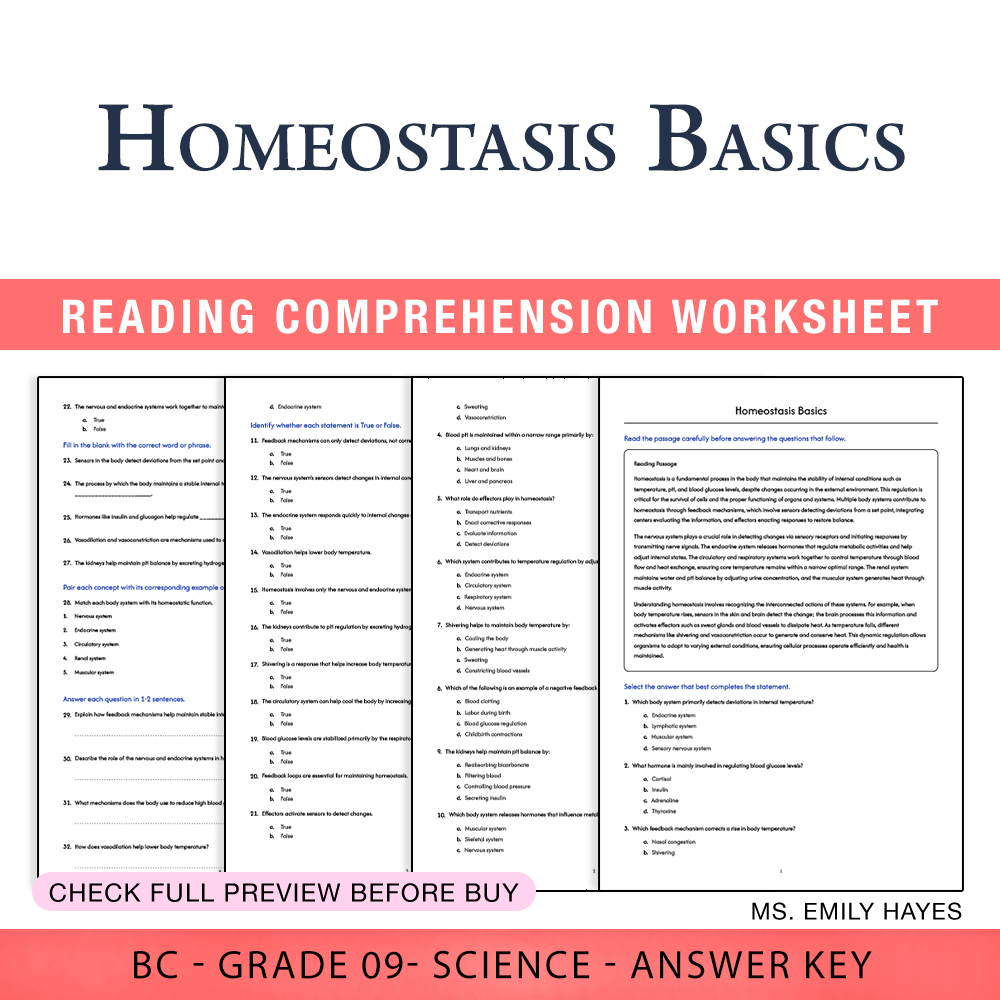
9th Grade Science | Homeostasis Basics Worksheet (PDF+ Answer Key)
Created byCopper Leaf ClassroomLearning Objectives
- Explain the concept of homeostasis and its importance in maintaining internal body conditions.
- Identify and describe the key body systems involved in homeostasis.
- Understand feedback mechanisms that regulate temperature, pH, and blood glucose levels.
Also included in: Grade 9 Science Worksheet Pack | Biology & Cell Structures (PDF+ Answer Keys) +1 more
Instant download
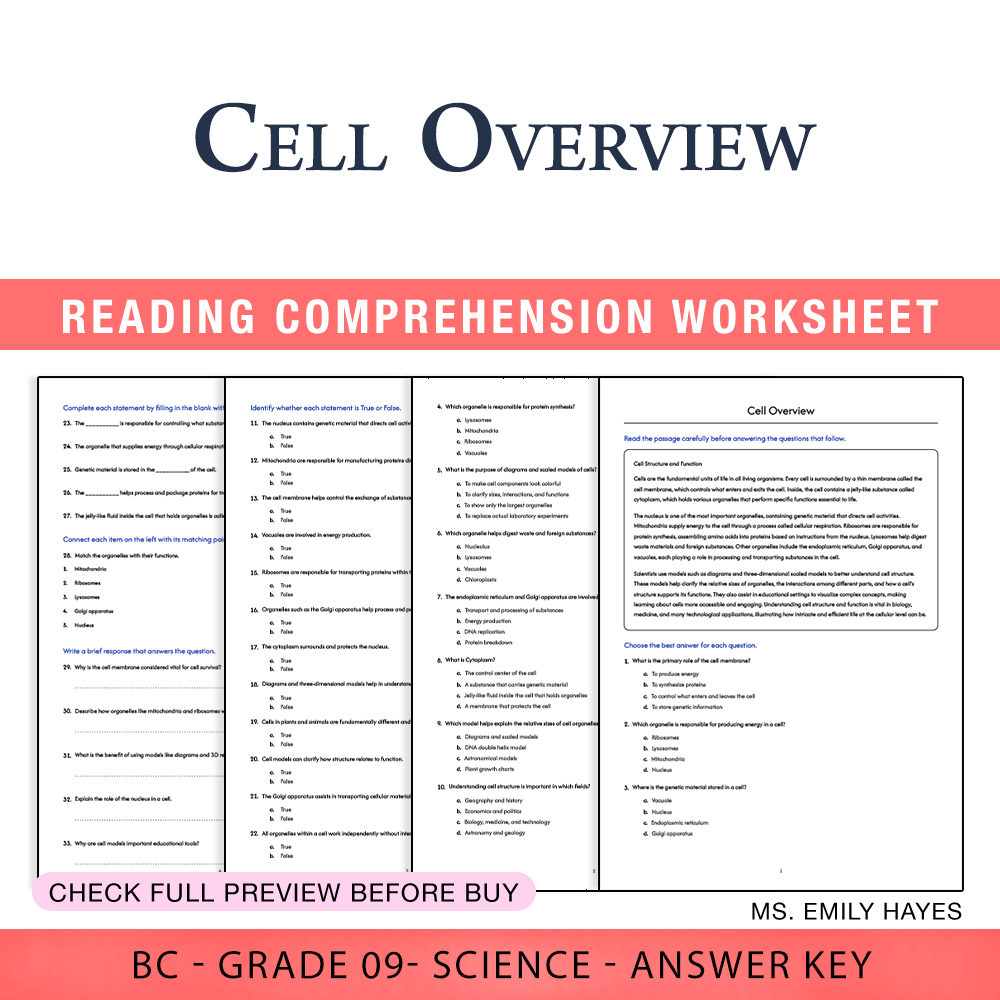
Grade 9 Science | Cell Overview Worksheet (PDF+ Answer Key)
Created byCopper Leaf ClassroomLearning Objectives
- Identify the main structures and functions of a cell and its organelles.
- Describe how cellular structures relate to their functions.
- Understand different models used to illustrate cell components and their relative sizes.
Also included in: Grade 9 Science Worksheet Pack | Biology & Cell Structures (PDF+ Answer Keys) +1 more
Instant download
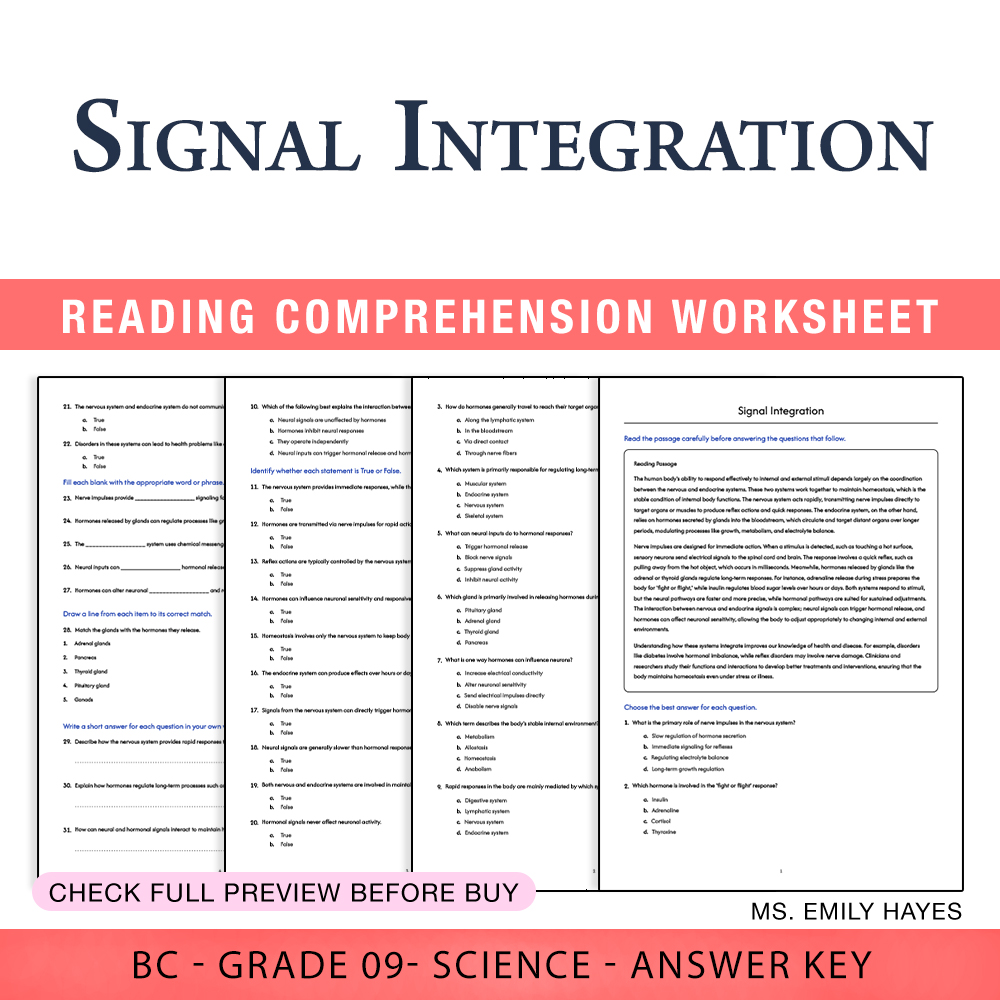
Grade 9 Science | Signal Integration Worksheet (PDF+ Answer Key)
Created byCopper Leaf ClassroomLearning Objectives
- Understand how the nervous and endocrine systems coordinate responses to stimuli.
- Identify different signals and their roles in maintaining homeostasis.
- Compare rapid nerve responses with slower hormonal responses.
Also included in: Grade 9 Science Worksheet Pack | Biology & Cell Structures (PDF+ Answer Keys) +1 more
Instant download
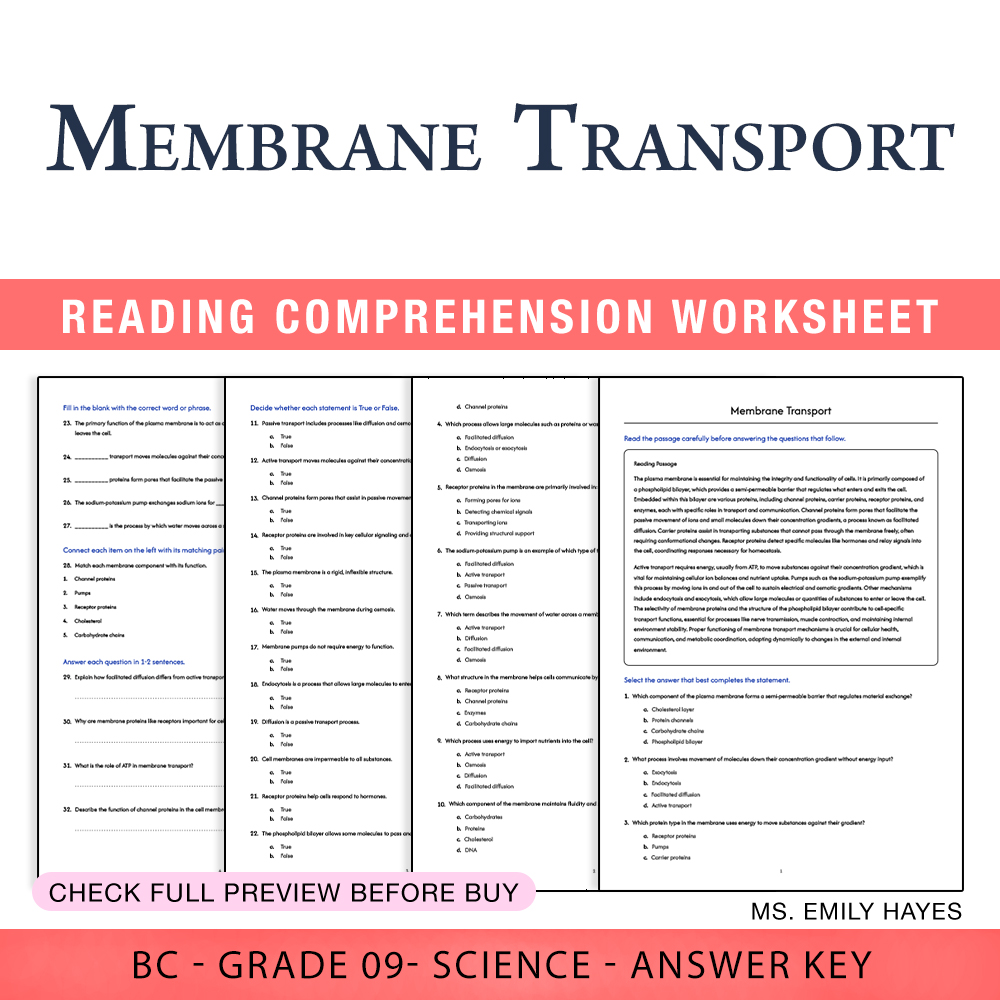
9th Grade Science | Membrane Transport Worksheet (PDF+ Answer Key)
Created byCopper Leaf ClassroomLearning Objectives
- Describe the structure of the plasma membrane and its components involved in transport.
- Differentiate between passive and active transport mechanisms.
- Explain how membrane proteins like channels, pumps, and receptors facilitate cellular functions.
Also included in: Grade 9 Science Worksheet Pack | Biology & Cell Structures (PDF+ Answer Keys) +1 more
Instant download
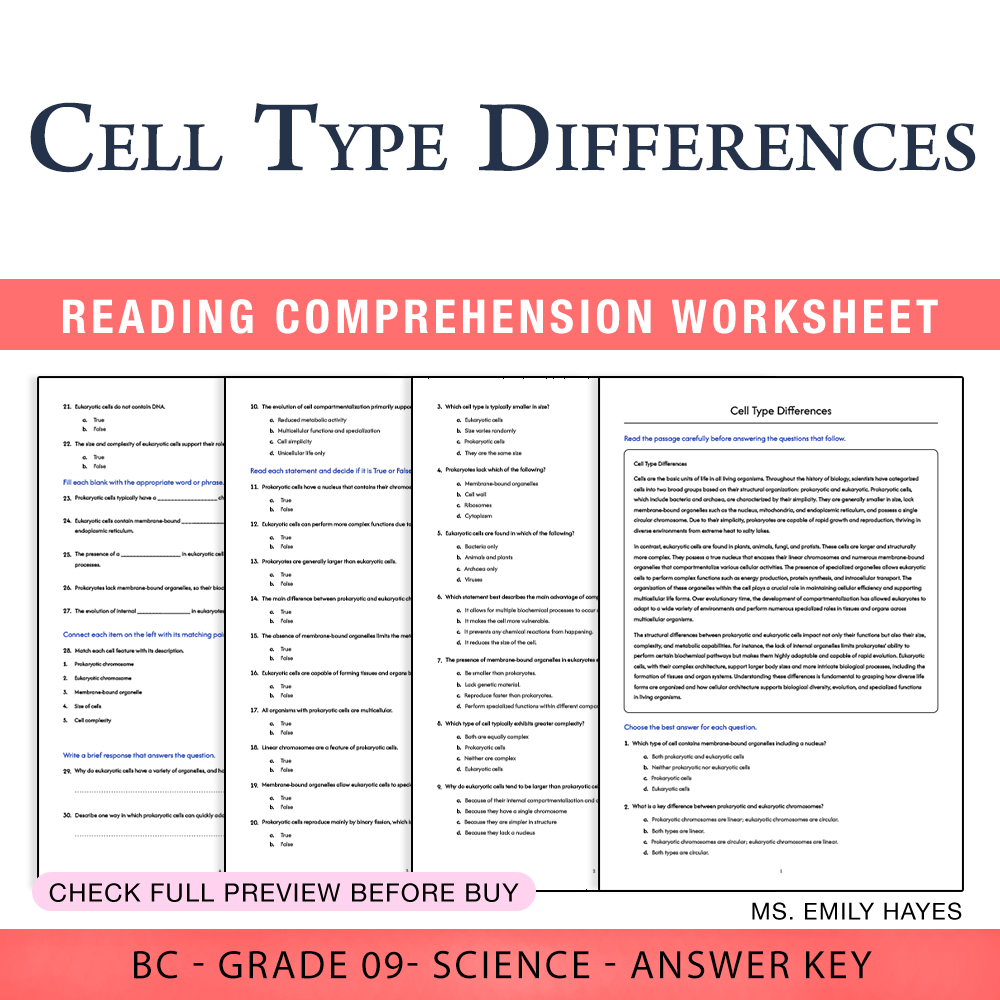
Grade 9 Science | Cell Type Differences Worksheet (PDF+ Answer Key)
Created byCopper Leaf ClassroomLearning Objectives
- Compare the structural differences between prokaryotic and eukaryotic cells.
- Identify key features of prokaryotic cells and how they differ from eukaryotic cells.
- Describe the roles of membrane-bound organelles in eukaryotic cells.
Also included in: Grade 9 Science Worksheet Pack | Biology & Cell Structures (PDF+ Answer Keys) +1 more
Instant download
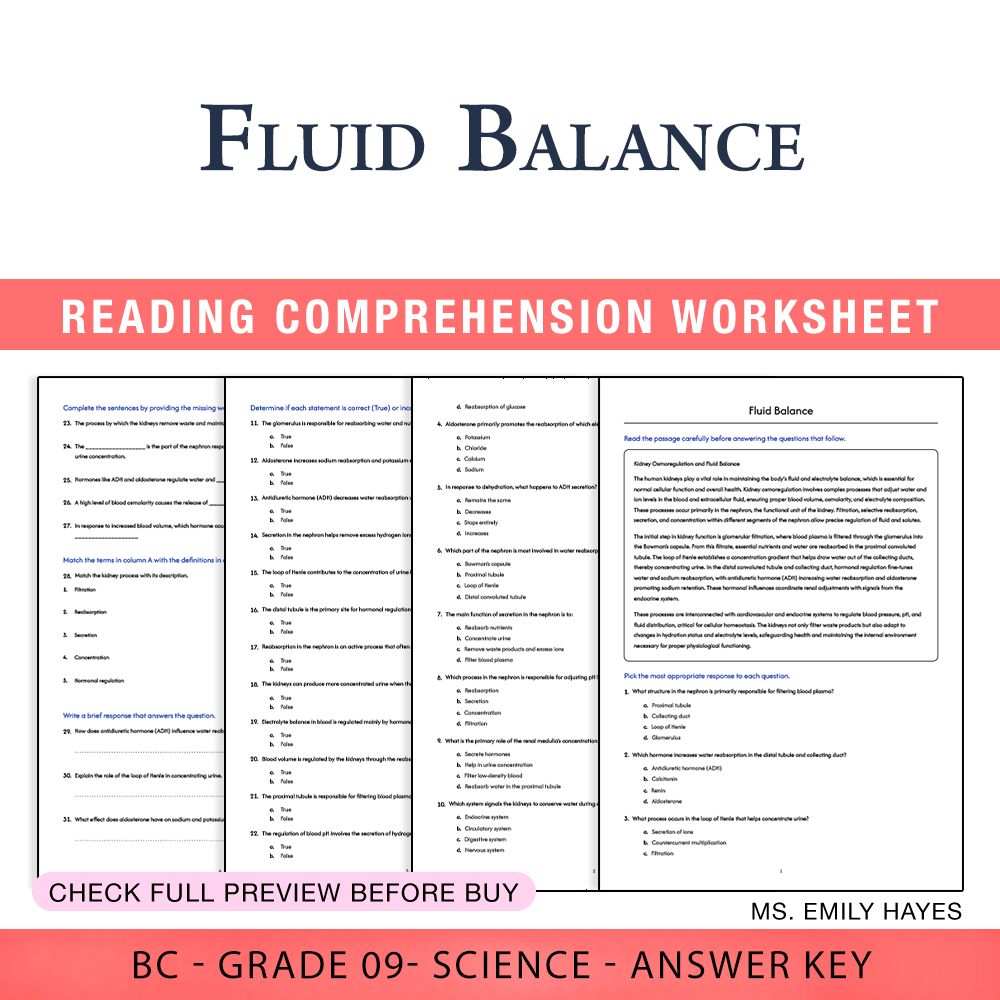
9th Grade Science | Fluid Balance Worksheet (PDF+ Answer Key)
Created byCopper Leaf ClassroomLearning Objectives
- Describe the role of kidneys in regulating water and ion balance through osmoregulation.
- Identify processes such as filtration, reabsorption, secretion, and concentration in the nephron segments.
- Explain how hormones like antidiuretic hormone and aldosterone influence kidney function.
Also included in: Grade 9 Science Worksheet Pack | Biology & Cell Structures (PDF+ Answer Keys) +1 more
Instant download
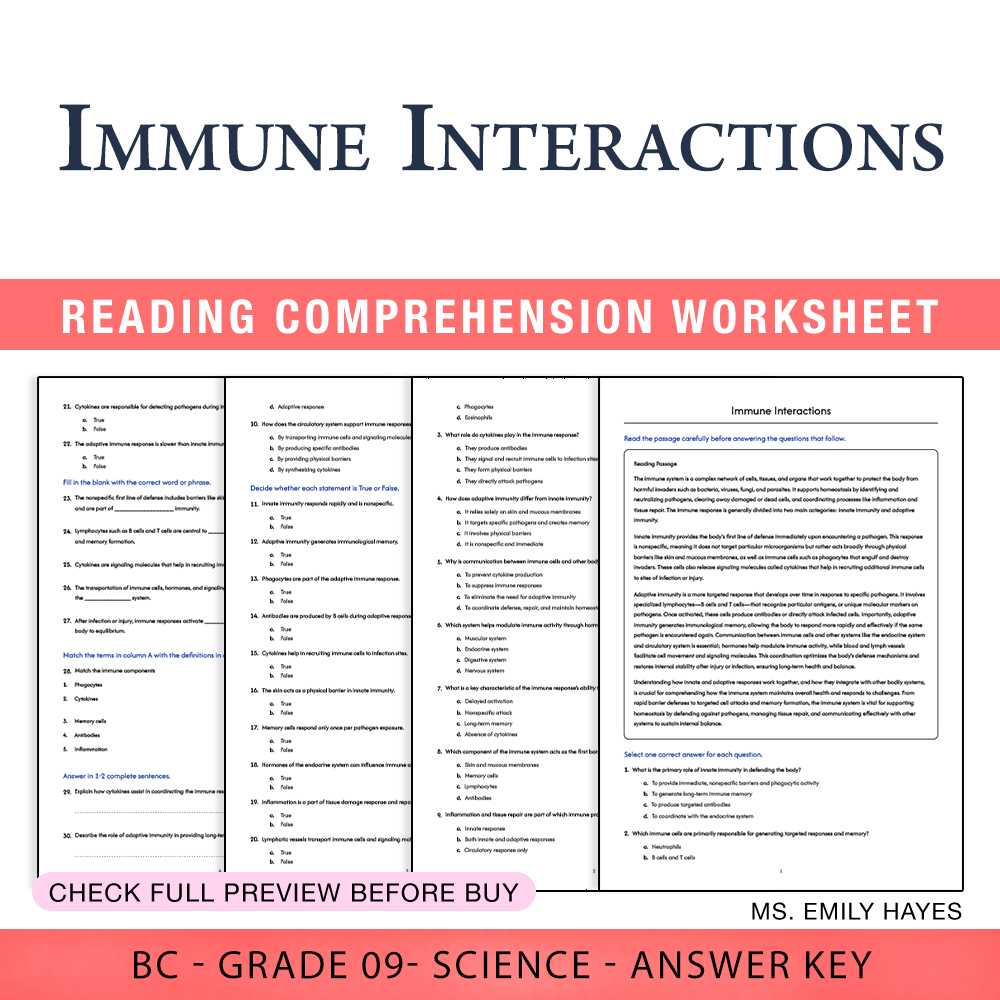
Grade 9 Science | Immune Interactions Worksheet (PDF+ Answer Key)
Created byCopper Leaf ClassroomLearning Objectives
- Describe the roles of innate and adaptive immune responses in maintaining homeostasis.
- Identify key components and functions of the immune system when defending against pathogens.
- Explain how immune communication integrates with other bodily systems, including endocrine and circulatory pathways.
Also included in: Grade 9 Science Worksheet Pack | Biology & Cell Structures (PDF+ Answer Keys) +1 more
Instant download
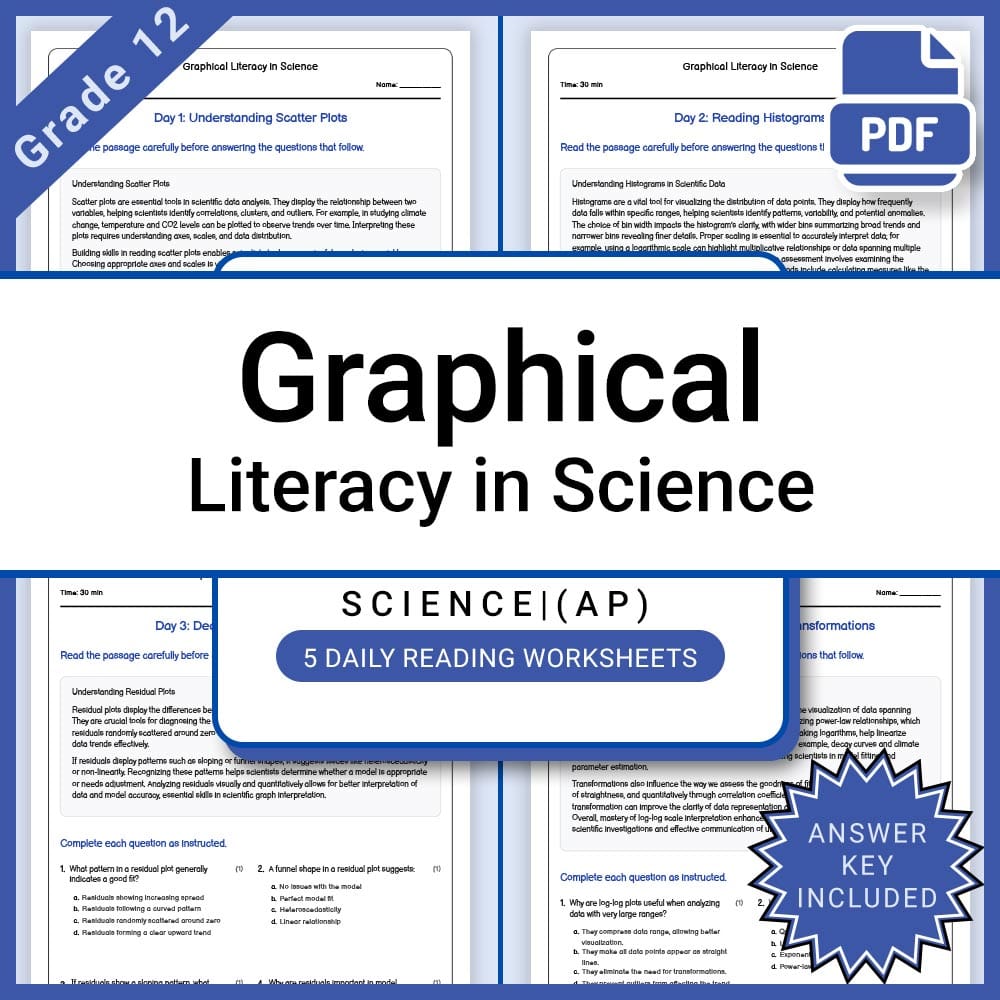
Grade 12 Science – Graphical Literacy Daily Reading Worksheet with Answer Key
Learning Objectives
- Understand the conventions of scatter plots and residual plots
- Interpret patterns and trends in various graphical representations
- Apply strategies to analyze decay curves and climate data
Also included in: Grade 12 Science Practices Lesson Bundle | AP Framework and Skills +1 more
Instant download

Grade 7 Science | Levels of Organization Worksheet | TEKS Alligned
 Created byLumora Learning
Learning Objectives
- Describe the hierarchical levels of biological organization from individuals to the biosphere.
- Identify roles of producers, consumers, and decomposers in ecosystems.
- Explain how energy flows through trophic levels and affects ecosystem stability.
Instant download
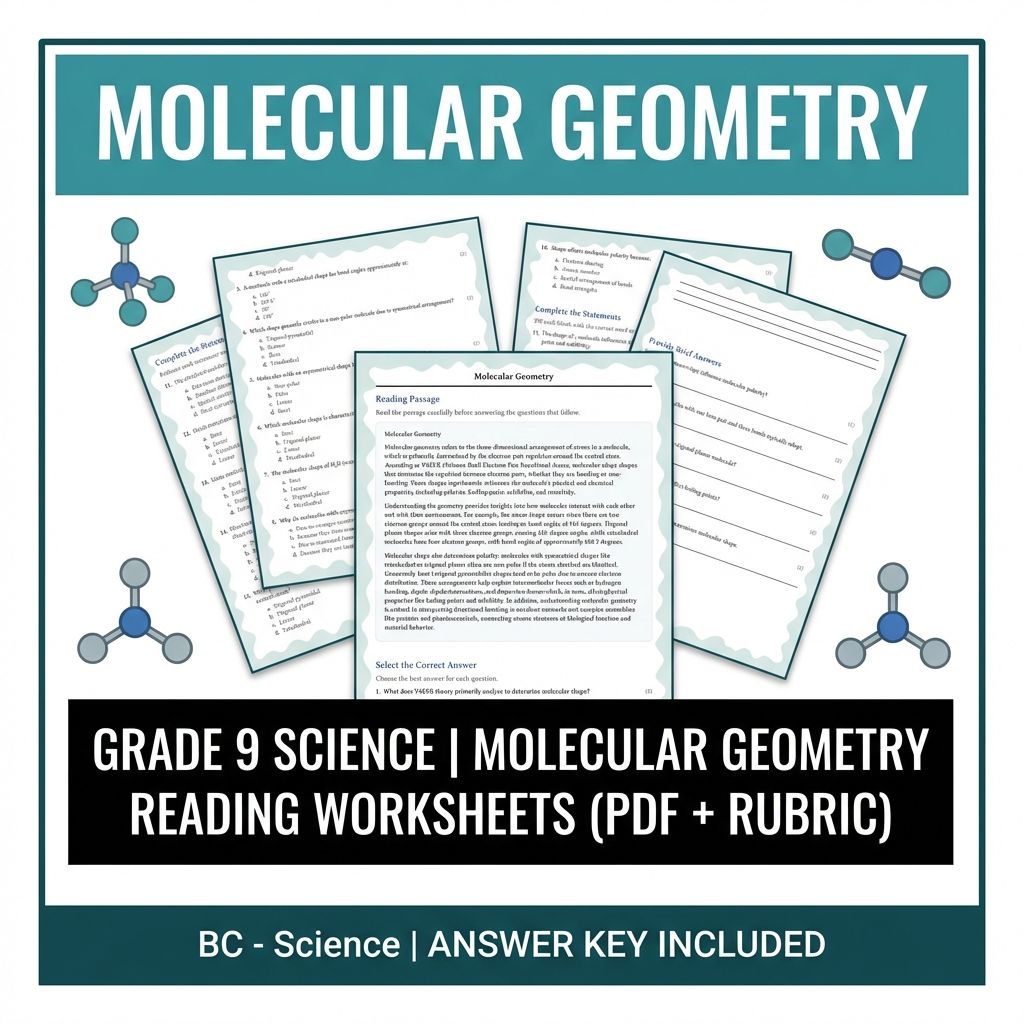
Grade 9 Science | Molecular Geometry Reading Worksheets (PDF + Rubric)
Learning Objectives
- Describe the basic principles of molecular geometry and VSEPR theory.
- Identify common molecular shapes such as linear, trigonal planar, tetrahedral, and bent.
- Explain how shape influences molecular polarity and properties like boiling point and solubility.
Instant download

Grade 5 Science | Solubility Patterns Worksheet with Short Notes (Printable PDF)
 Created byMeadowlark Worksheets
Learning Objectives
- Understand the concept of solubility and how it affects various substances in solvents.
- Identify factors like temperature and agitation that influence solubility and saturation.
- Compare solubility behaviors of different pairs such as salt in water versus oil.
Also included in: Grade 5 Science Lesson Group: Ontario Curriculum Worksheets Bundle +1 more
Instant download

Transport Mechanisms Worksheet | TEKS Aligned Grade 9 Science Practice
Learning Objectives
- Explain how diffusion, facilitated diffusion, and osmosis move substances across membranes based on concentration gradients.
- Describe how active transport uses ATP and membrane proteins to move materials against gradients.
- Compare vesicular transport (endocytosis and exocytosis) with membrane-based transport mechanisms.
Instant download
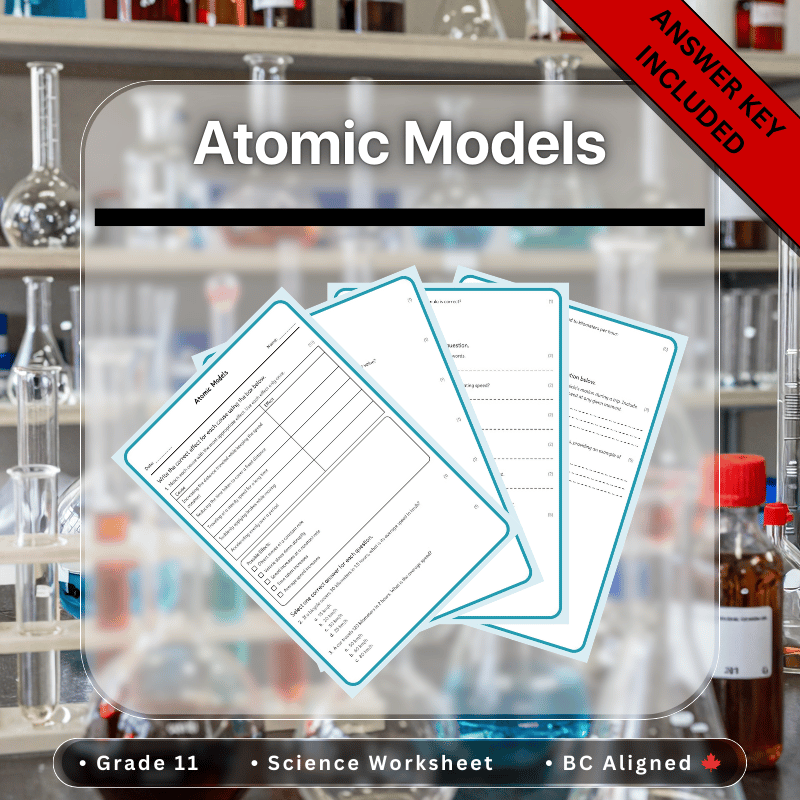
Grade 11 Science – Atomic Models Worksheet + Answer Key – BC Standards
 Created byBright Mind Resources
Learning Objectives
- Explain the evolution of atomic models from early concepts to modern quantum mechanical theories.
- Identify the structure and properties of subatomic particles: protons, neutrons, and electrons.
- Describe how quantum mechanics replaced fixed orbits with probability distributions of electrons.
Instant download

Grade 9 Science – Genetic Variation Sources & Effects | Daily Reading Worksheet
Created byBright Mind ResourcesLearning Objectives
- Identify different sources of genetic variation in populations
- Explain how mutation, recombination, gene flow, and chromosomal rearrangements contribute to diversity
- Recognize regional examples illustrating the impact of genetic variation
Also included in: Grade 9 Genetics & Inheritance Science Daily Reading Lesson Bundle | Alberta +1 more
Instant download
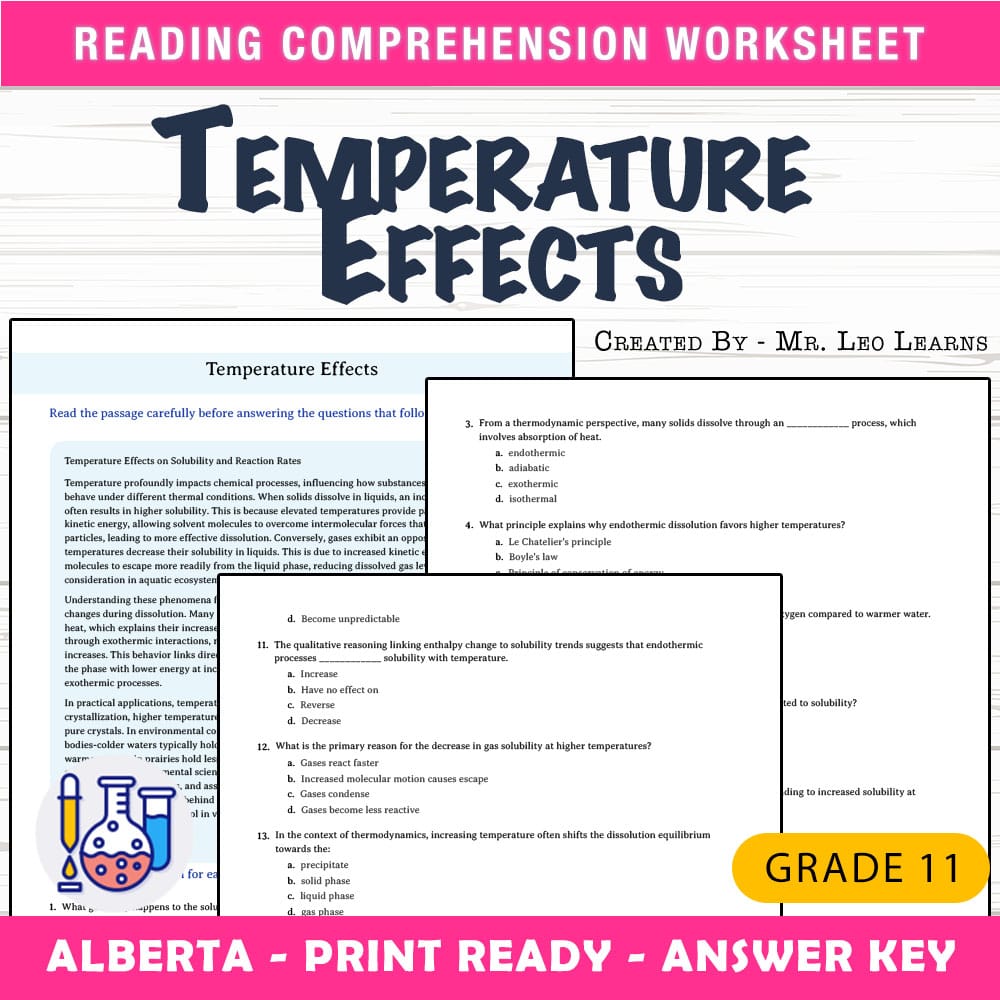
Grade 11 Science — Worksheet MCQ Paper for Mastering Temperature Effects
 Created byThe Resource Hub
Learning Objectives
- Understand how temperature influences solubility of different substances.
- Explain the relationship between temperature and reaction rates from a thermodynamic perspective.
- Describe why gases and solids respond differently to temperature changes in solubility.
Also included in: Grade 11 Science Solutions and Solubility Bundle | Alberta Framework +1 more
Instant download
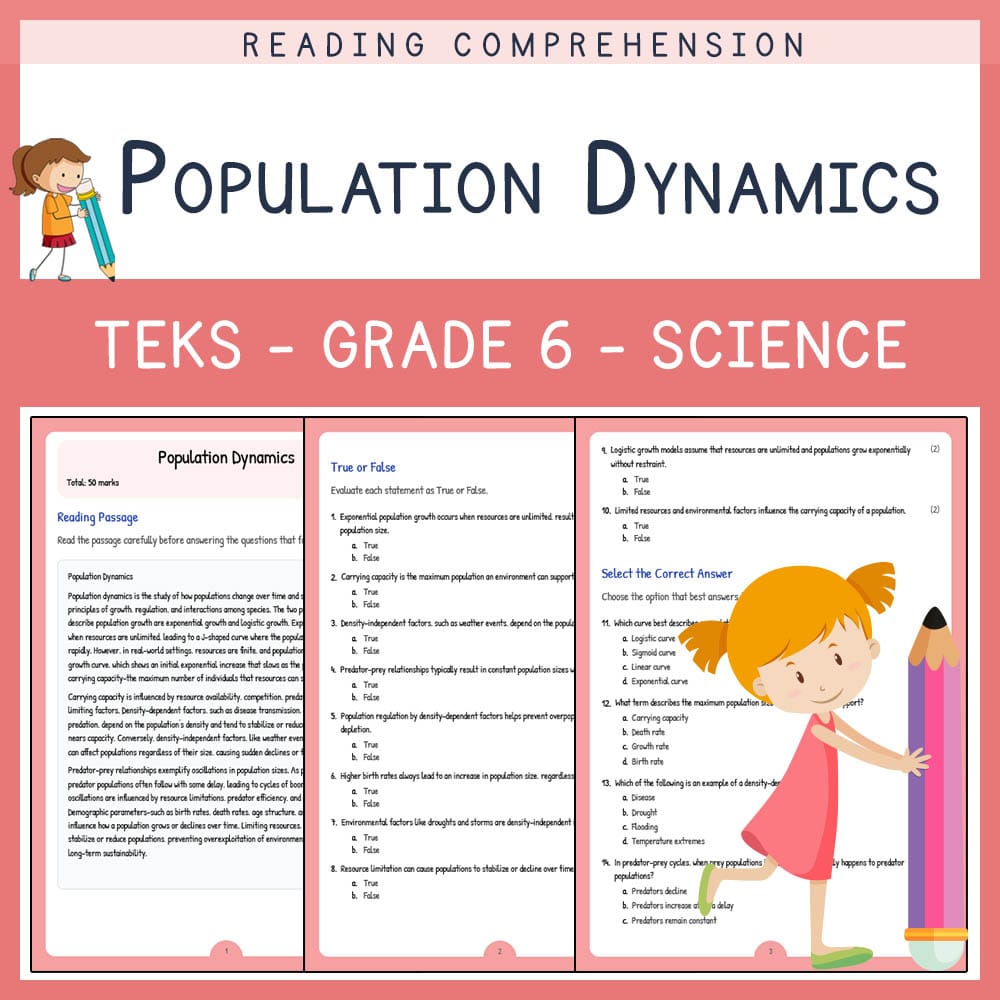
Grade 6 Science | Population Dynamics Worksheet | TEKS Aligned
Created byLumora LearningLearning Objectives
- Understand the principles of population size and how it changes over time.
- Differentiate between exponential and logistic growth curves in populations.
- Define carrying capacity and identify factors influencing population size.
Instant download
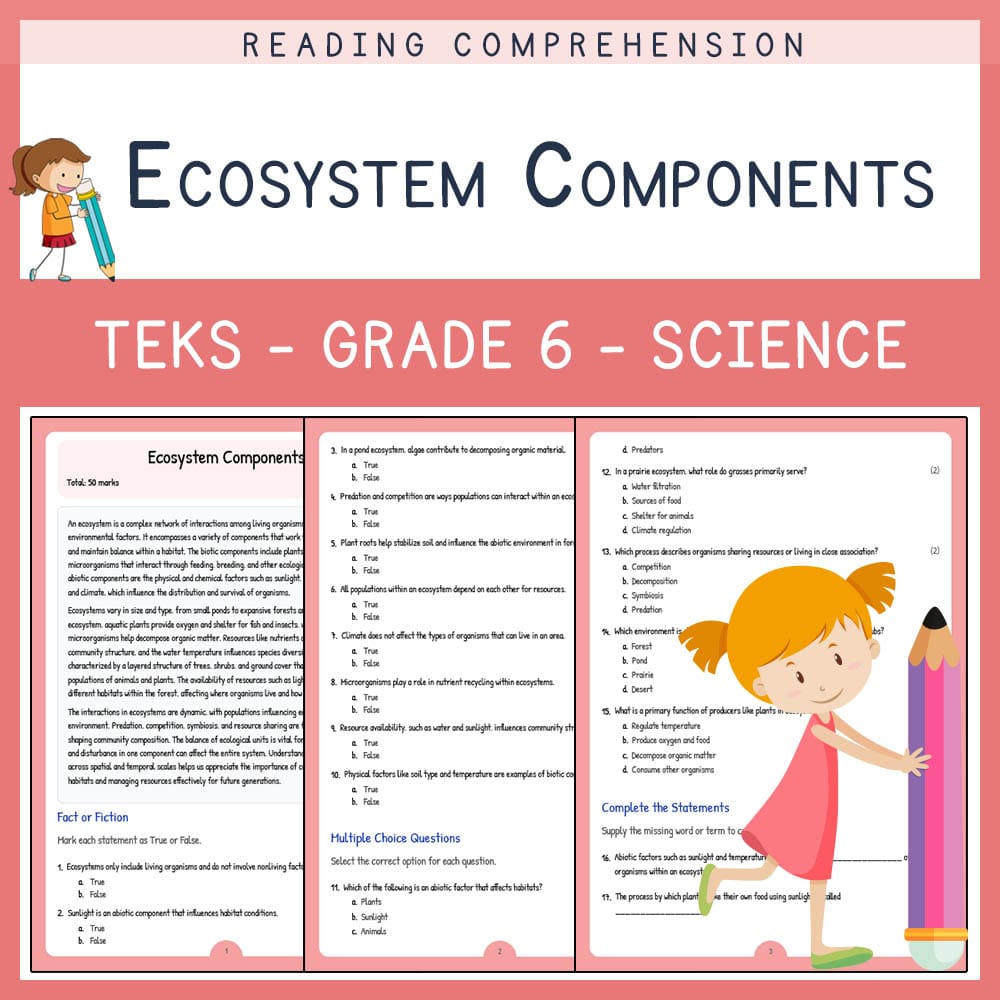
Grade 6 Science | Ecosystem Components Worksheet | TEKS-Aligned
Created byLumora LearningLearning Objectives
- Define ecosystems as interacting systems of populations, communities, and physical factors.
- Identify biotic and abiotic components and their roles in habitats.
- Describe examples such as ponds, prairies, and forests to illustrate resource distribution and community interdependence.
Instant download
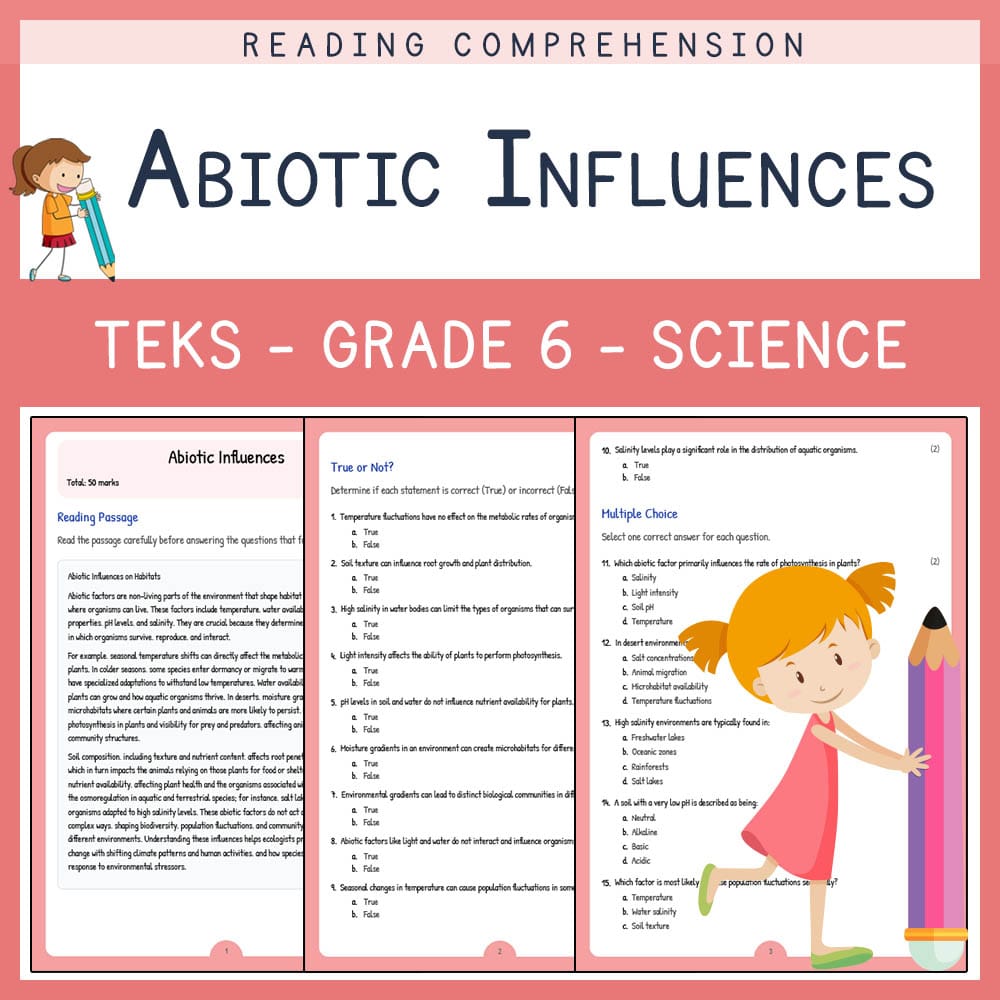
Grade 6 Science | Abiotic Influences Worksheet | TEKS Aligned
Created byLumora LearningLearning Objectives
- Understand how abiotic factors like temperature, water, light, soil, pH, and salinity influence habitats.
- Describe how environmental gradients affect organism distribution and community composition.
- Analyze examples of abiotic factors affecting biological processes and population dynamics.
Instant download
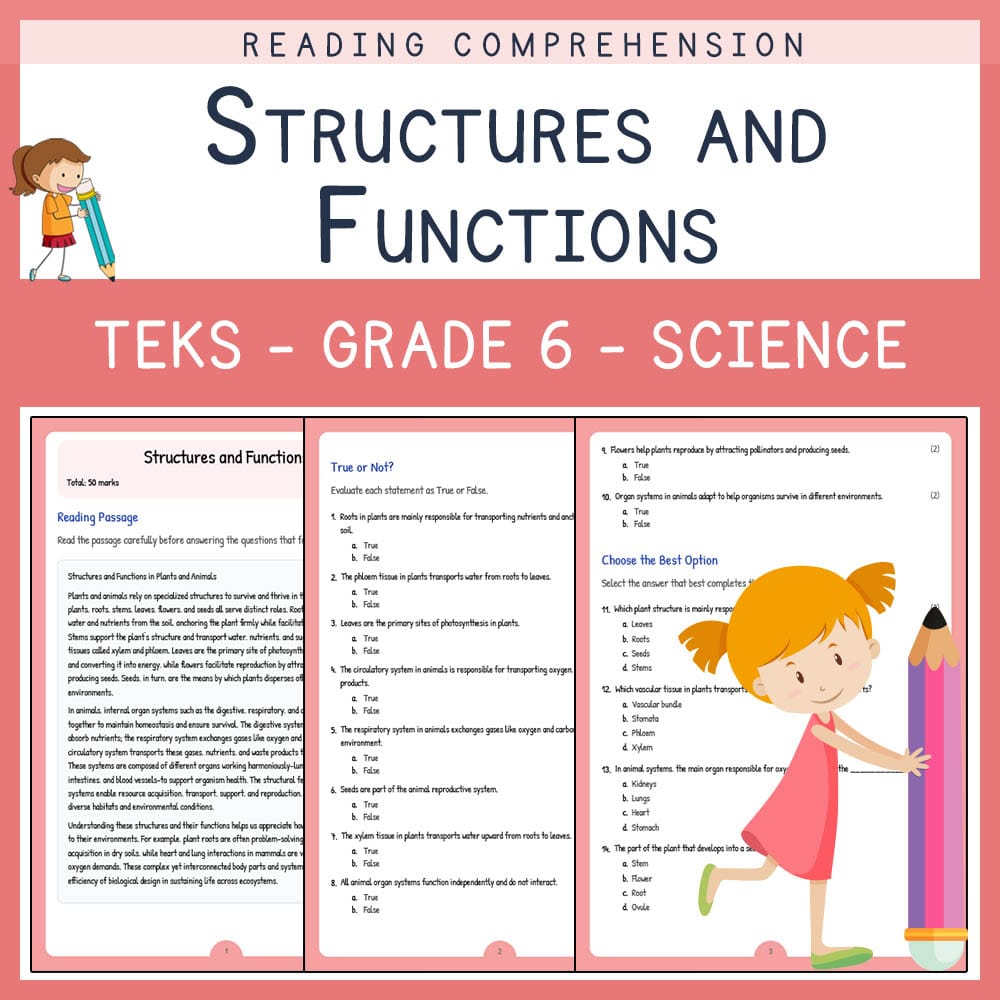
Grade 6 Science | Structures and Functions Worksheet | TEKS Standards
Created byLumora LearningLearning Objectives
- Describe major plant structures such as roots, stems, leaves, and flowers and explain their functions in resource acquisition and reproduction.
- Identify the roles of vascular tissues like xylem and phloem in transporting water and nutrients within plants.
- Explain basic animal organ systems such as digestive, respiratory, and circulatory systems and how they contribute to organism survival.
Instant download
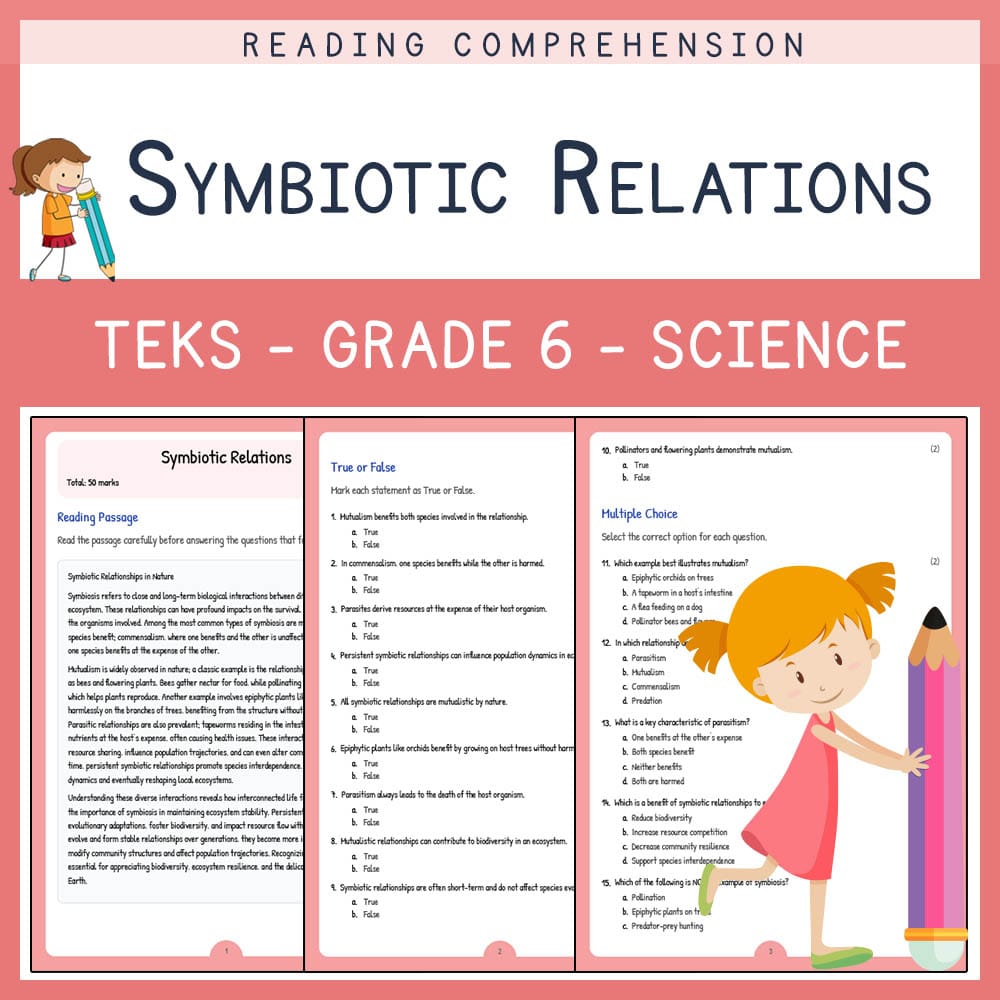
Grade 6 Science | Symbiotic Relations Worksheet | TEKS Alligned
Created byLumora LearningLearning Objectives
- Define and describe symbiotic relationships including mutualism, commensalism, and parasitism.
- Identify concrete examples of each type of symbiosis in real ecosystems.
- Analyze how symbiotic relationships influence organism fitness, resource distribution, and community structure.
Instant download

Grade 9 Science | Orbital Motion Worksheet (PDF + Answer Key)
Created byCopper Leaf ClassroomLearning Objectives
- Understand the principles of gravitational interactions governing planetary and satellite orbits.
- Interpret Kepler's laws and Newton's law of universal gravitation in the context of orbital dynamics.
- Analyze relationships such as orbital period vs. semi-major axis, escape velocity, and angular momentum conservation.
Also included in: Grade 9 Science | Space, Motion & Cosmology Worksheet Bundle (PDF + Answer Key) +1 more
Instant download
Grade 9 Science – Force Basics Worksheet (Ontario) (PDF)
Created byBright Mind ResourcesLearning Objectives
- Distinguish between contact and non-contact forces with examples and descriptions.
- Identify the direction, point of application, and relative magnitude of different forces.
- Recognize action–reaction pairs and understand their roles in interactions.
Instant download

Grade 8 Science – Model Frameworks Worksheet (PDF) | Alberta Standards
 Created byEvergreen Desk Education
Learning Objectives
- Describe how models represent matter and energy movement using diagrams, flow charts, and quantitative balances.
- Interpret model outputs for trophic levels and nutrient pools in ecosystems such as wetlands, forests, and grasslands.
- Identify common assumptions and limitations in ecological models and explain how they affect results.
Instant download

Grade 9 Fertilization and Development Worksheet | Alberta Practice PDF
 Created byClear Sky Classroom
Learning Objectives
- Explain how fertilization leads to zygote formation and early developmental stages.
- Compare internal and external fertilization using specific ecological examples.
- Describe how temperature, moisture, and habitat quality influence embryonic development and reproductive success.
Instant download
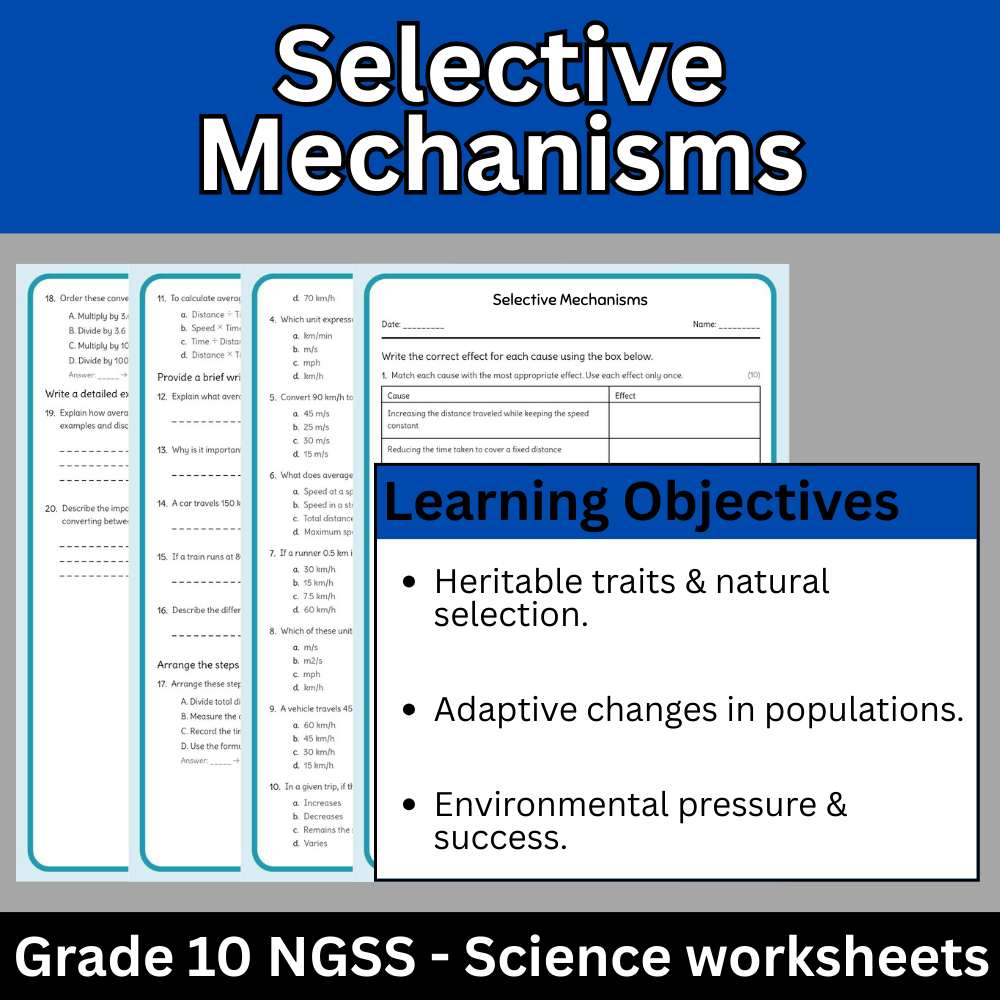
Grade 10 Science | Selective Mechanisms Worksheet (NGSS) – Science PDF
Created byBright Mind ResourcesLearning Objectives
- Understand how variation in heritable traits influences natural selection
- Identify examples illustrating adaptive changes in populations
- Analyze the role of environmental pressures and reproductive success in evolution
Instant download
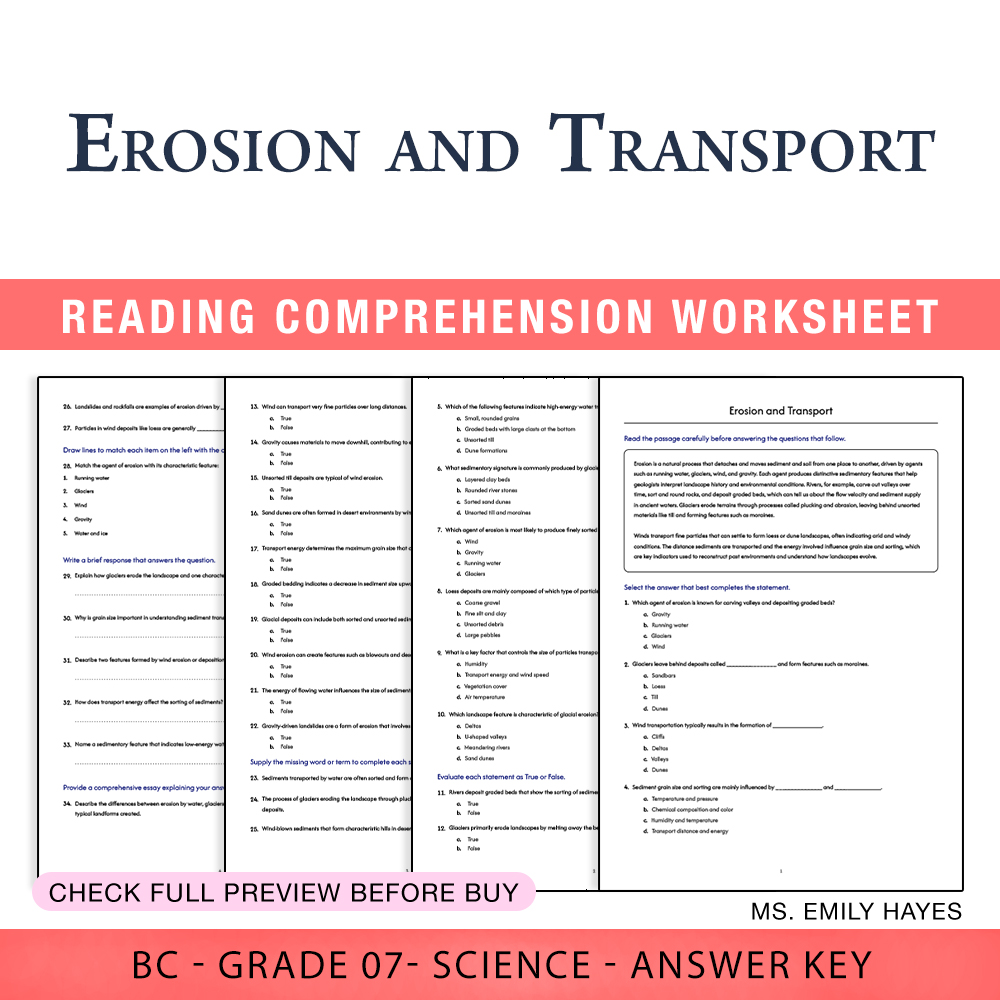
7th Grade Science | Erosion and Transport Worksheet (PDF + Answer Key)
Created byCopper Leaf ClassroomLearning Objectives
- Describe the processes of erosion by water, glaciers, wind, and gravity.
- Identify the distinctive sedimentary signatures produced by different agents of erosion.
- Explain how transport distance and energy influence grain size and sorting.
Also included in: Grade 7 Science | Earth Systems & Geology Unit (PDF+ Answer Keys) +1 more
Instant download

Grade 6 Science – Erosion Pathways Daily Reading Worksheet | Standards-Aligned
Created byBright Mind ResourcesLearning Objectives
- Understand how water causes erosion and shapes Earth's surface.
- Identify different landforms created by erosion and deposition.
- Describe factors that influence the rate of erosion.
Also included in: Earth Systems Grade 6 Science Daily Reading Worksheets Lesson Bundle | General +1 more
Instant download

Grade 11 Allele Segregation Worksheet | California Standards Practice PDF
Created byClear Sky ClassroomLearning Objectives
- Explain how allele segregation during meiosis produces gametes with different alleles
- Predict offspring genotype probabilities from parental genotypes using Punnett outcomes
- Analyze how randomness and large-sample statistics connect to inheritance patterns
Instant download
Grade 6 Science | Physical Properties Worksheet with Short Notes (Printable PDF)
Created byMeadowlark WorksheetsLearning Objectives
- Understand observable and measurable characteristics of matter such as mass, volume, density, conductivity, melting point, and hardness.
- Distinguish between physical changes and chemical changes based on properties and observations.
- Identify physical properties in real-world examples and understand their significance in scientific analysis.
Also included in: Grade 6 Science | Matter, Properties & Change UNIT Worksheet Bundle +1 more
Instant download

Grade 6 Science Change Examples Worksheet with Short Notes | PDF
Created byMeadowlark WorksheetsLearning Objectives
- Understand the difference between physical and chemical changes using concrete examples.
- Identify examples of physical changes that are reversible.
- Recognize signs of chemical changes and understand their properties.
Also included in: Grade 6 Science | Matter, Properties & Change UNIT Worksheet Bundle +1 more
Instant download
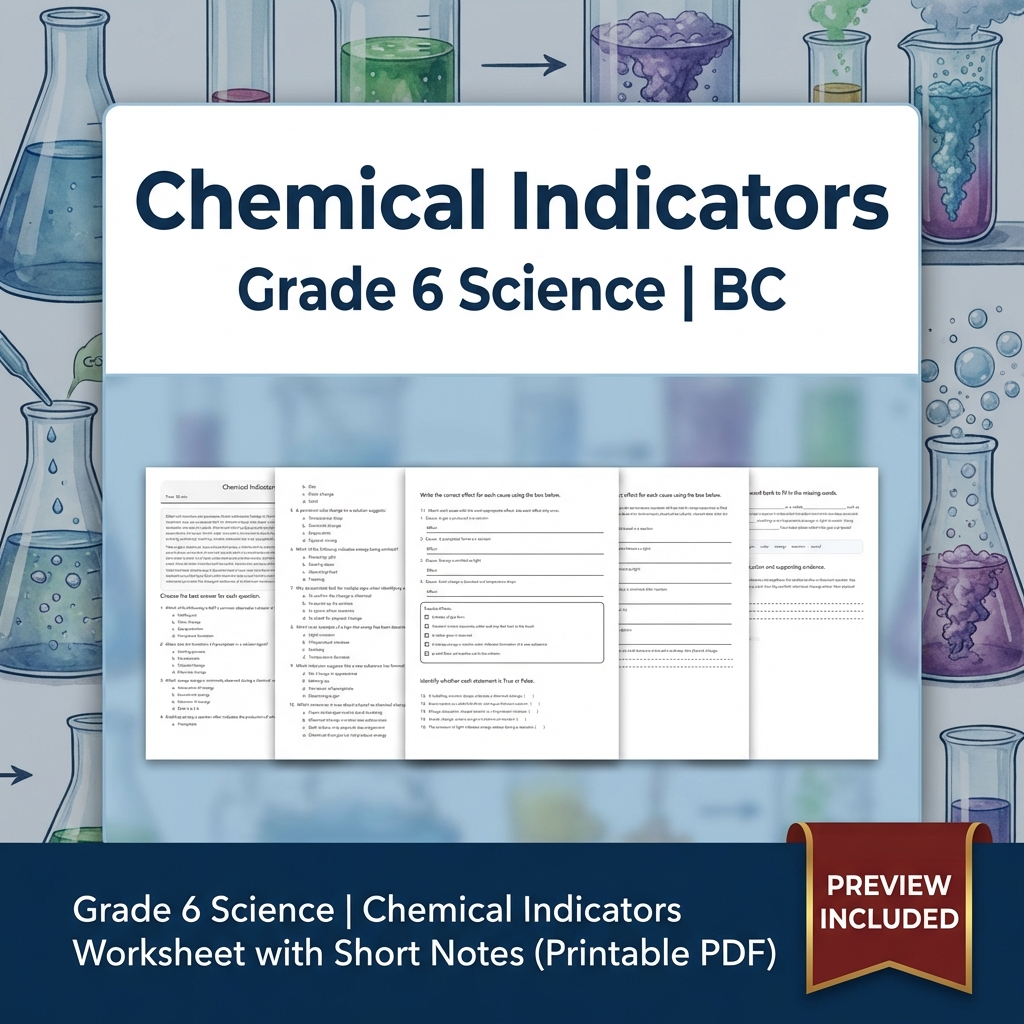
Grade 6 Science | Chemical Indicators Worksheet with Short Notes (Printable PDF)
Created byMeadowlark WorksheetsLearning Objectives
- Identify observable signs that indicate a chemical reaction has occurred.
- Understand various chemical indicators such as gas production, precipitates, and energy changes.
- Explain why multiple indicators provide stronger evidence of chemical change.
Also included in: Grade 6 Science | Matter, Properties & Change UNIT Worksheet Bundle +1 more
Instant download
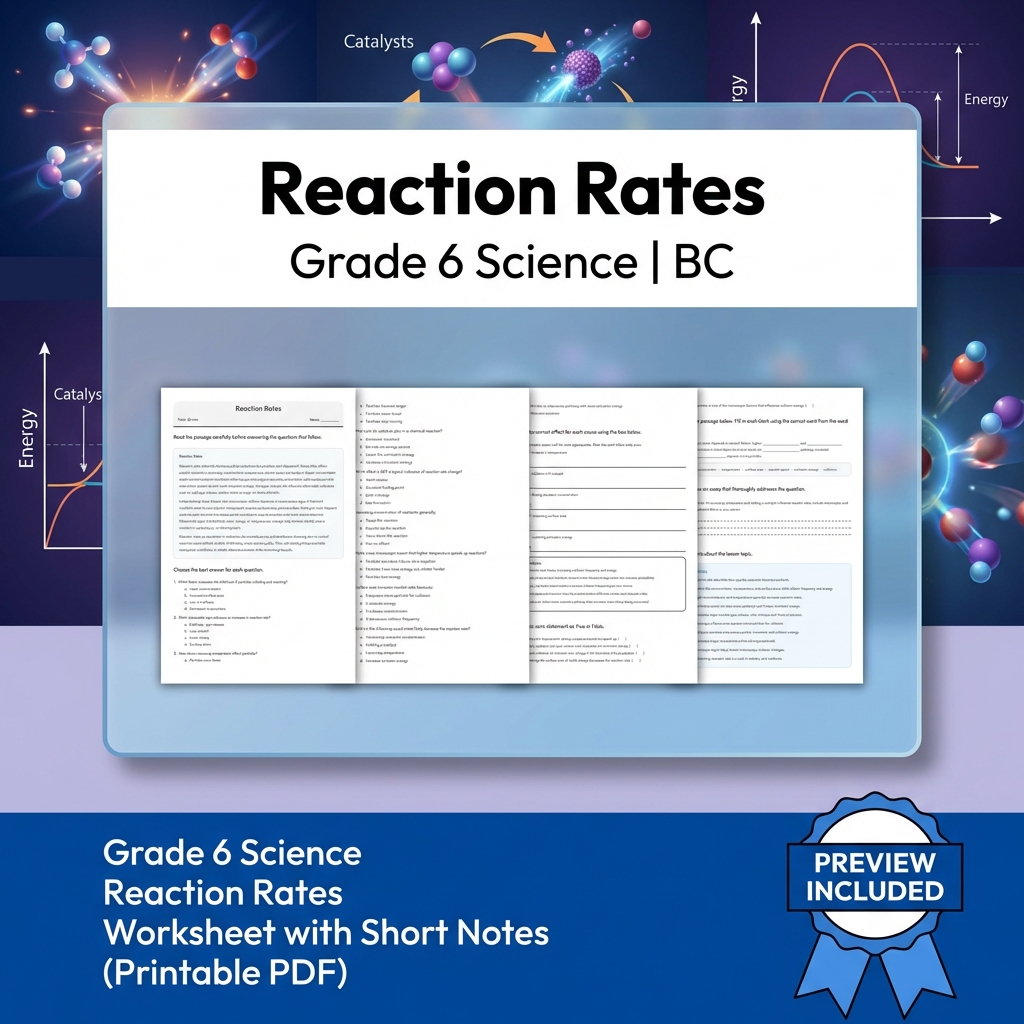
Grade 6 Science Reaction Rates Worksheet with Short Notes (Printable PDF)
Created byMeadowlark WorksheetsLearning Objectives
- Explain how factors like concentration, temperature, surface area, and catalysts influence reaction rates.
- Describe microscopic collision dynamics and relate them to observable macroscopic signs of reactions.
- Identify experimental indicators of reaction rate changes.
Also included in: Grade 6 Science | Matter, Properties & Change UNIT Worksheet Bundle +1 more
Instant download

Grade 6 Science | Diffusion Rates Worksheet with Short Notes (Printable PDF)
Created byMeadowlark WorksheetsLearning Objectives
- Understand how diffusion occurs and the factors that influence its rate.
- Connect microscopic particle motion to observable phenomena like scent spreading.
- Identify variables such as temperature, particle size, and viscosity that affect diffusion speed.
Also included in: Grade 6 Science | Matter, Properties & Change UNIT Worksheet Bundle +1 more
Instant download
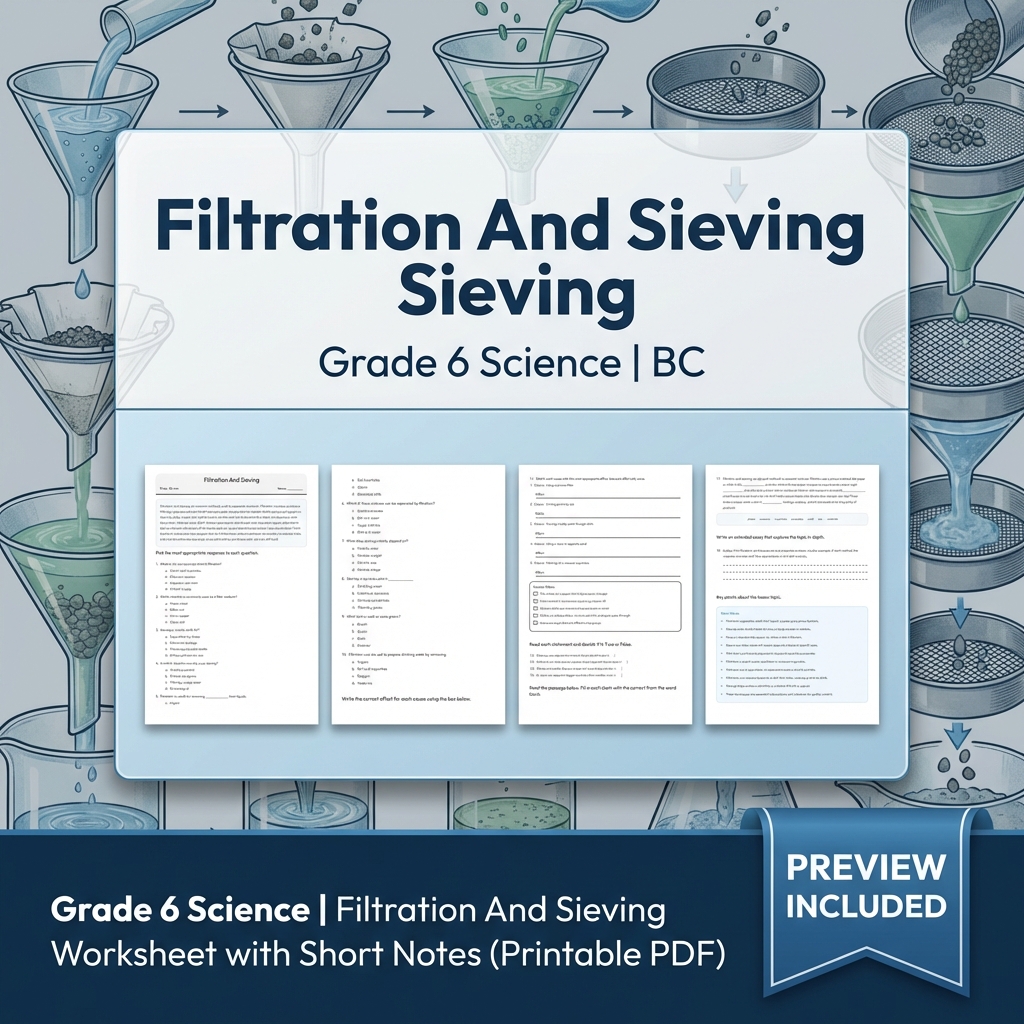
Grade 6 Science | Filtration And Sieving Worksheet with Short Notes (PDF)
Created byMeadowlark WorksheetsLearning Objectives
- Understand the processes of filtration and sieving in separating mixtures.
- Identify different methods used to separate mixtures based on particle size and phase.
- Explain how porous materials help in filtration and sieving.
Also included in: Grade 6 Science | Matter, Properties & Change UNIT Worksheet Bundle +1 more
Instant download
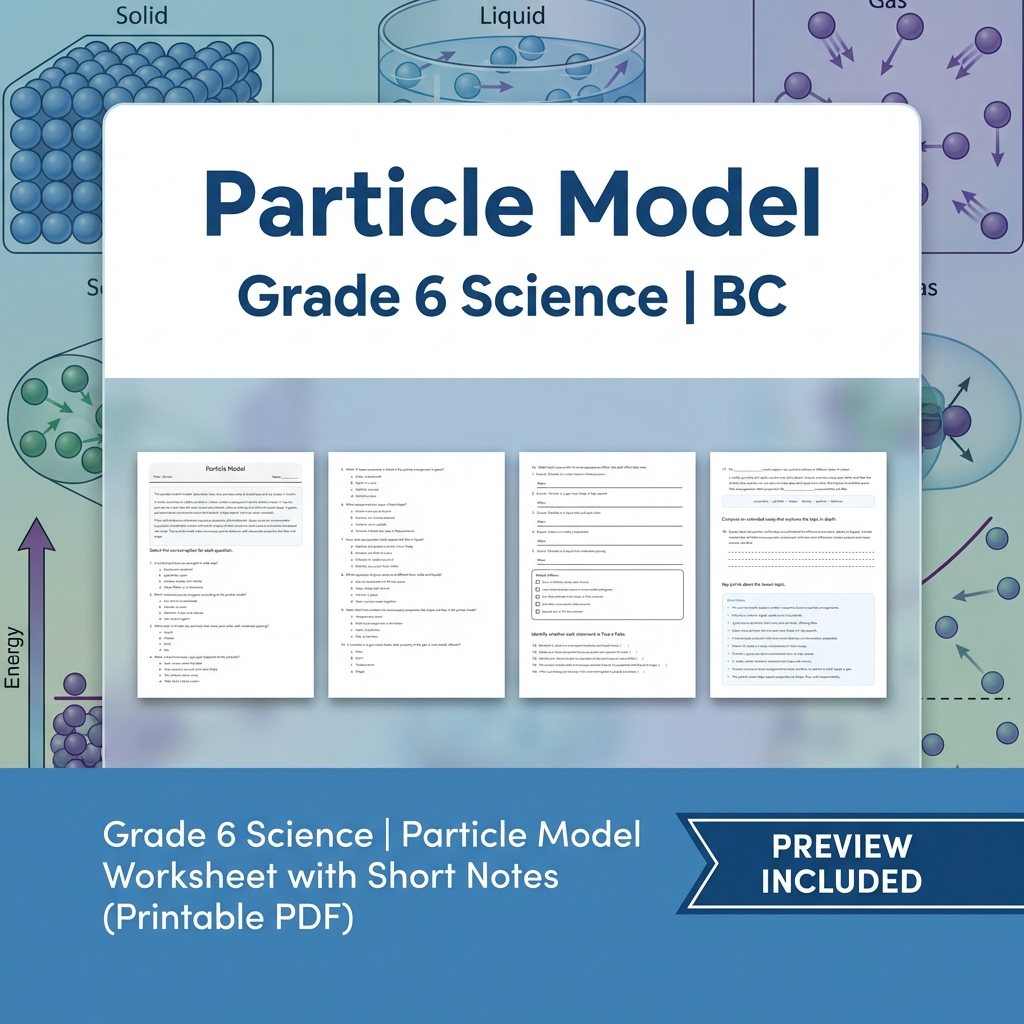
Grade 6 Science | Particle Model Worksheet with Short Notes (Printable PDF)
Created byMeadowlark WorksheetsLearning Objectives
- Understand the basic idea of the particle model and how it explains states of matter.
- Identify differences in particle arrangements in solids, liquids, and gases.
- Describe how microscopic particle behaviour relates to macroscopic properties like shape, volume, and flow.
Also included in: Grade 6 Science | Matter, Properties & Change UNIT Worksheet Bundle +1 more
Instant download
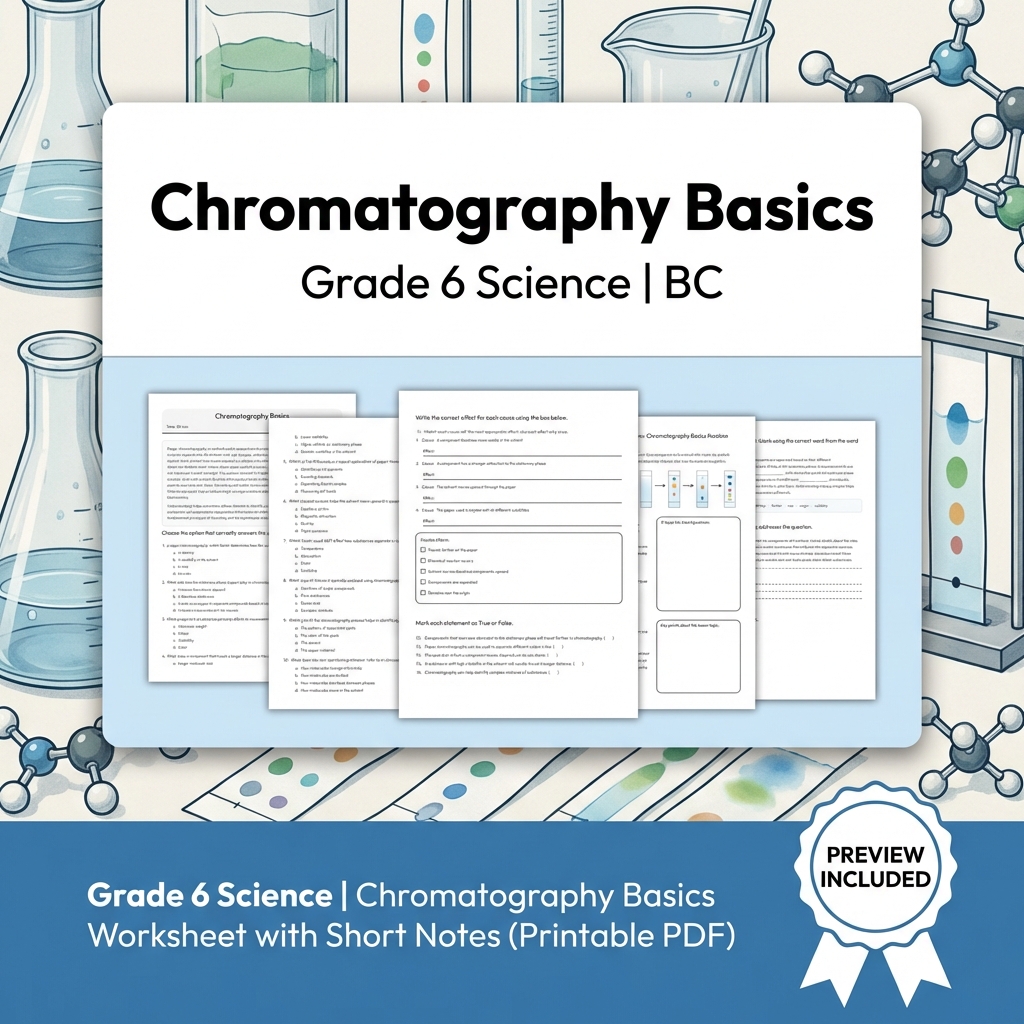
Grade 6 Science | Chromatography Basics Worksheet with Short Notes (PDF)
Created byMeadowlark WorksheetsLearning Objectives
- Understand the principle of paper chromatography and how it separates mixture components.
- Identify the factors influencing the movement of substances in chromatography.
- Interpret chromatograms to analyze mixture compositions.
Also included in: Grade 6 Science | Matter, Properties & Change UNIT Worksheet Bundle +1 more
Instant download
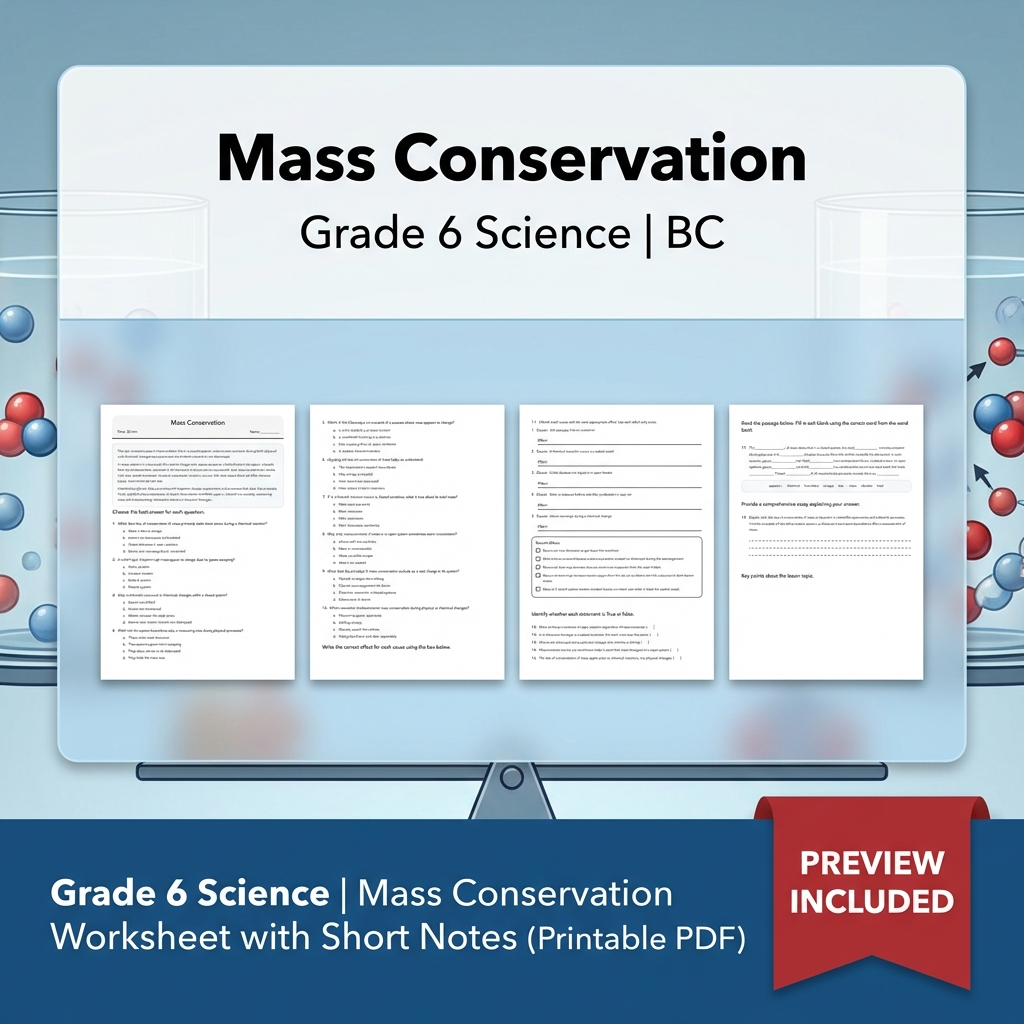
Grade 6 Science | Mass Conservation Worksheet with Short Notes (Printable PDF)
Created byMeadowlark WorksheetsLearning Objectives
- Understand the law of conservation of mass and how it applies to closed and open systems.
- Identify differences between physical and chemical processes in terms of mass.
- Apply principles of mass conservation to real-world experiments and observations.
Also included in: Grade 6 Science | Matter, Properties & Change UNIT Worksheet Bundle +1 more
Instant download

Grade 6 Science | Crystal Structures Worksheet with Short Notes (Printable PDF)
Created byMeadowlark WorksheetsLearning Objectives
- Understand the arrangement of particles in crystalline and amorphous solids.
- Explain how particle bonding and order relate to the properties of solids.
- Compare microscopic structure differences to observable behaviors like melting points and brittleness.
Also included in: Grade 6 Science | Matter, Properties & Change UNIT Worksheet Bundle +1 more
Instant download
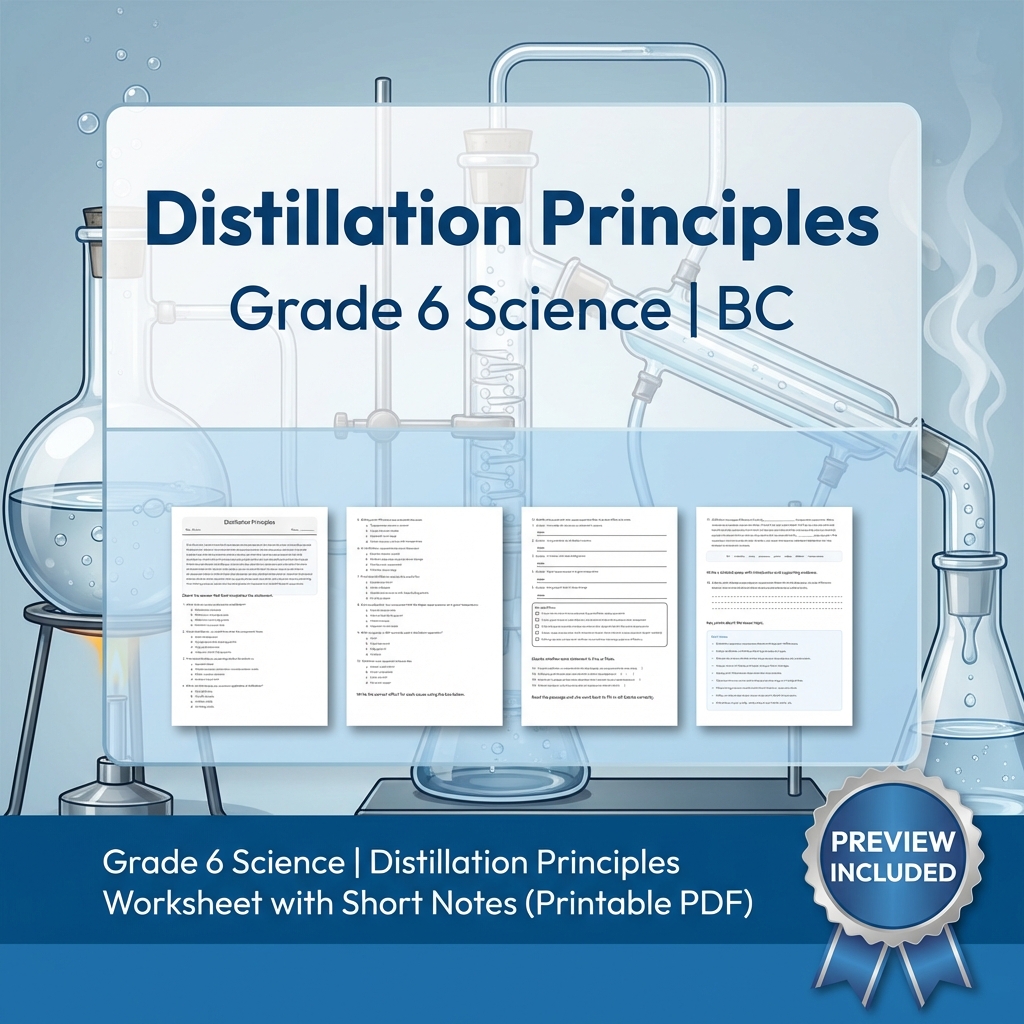
Grade 6 Science | Distillation Principles Worksheet with Short Notes (PDF)
Created byMeadowlark WorksheetsLearning Objectives
- Understand the basic principles of distillation and phase changes
- Differentiate between simple and fractional distillation techniques
- Identify real-world applications of distillation in separating liquids
Also included in: Grade 6 Science | Matter, Properties & Change UNIT Worksheet Bundle +1 more
Instant download
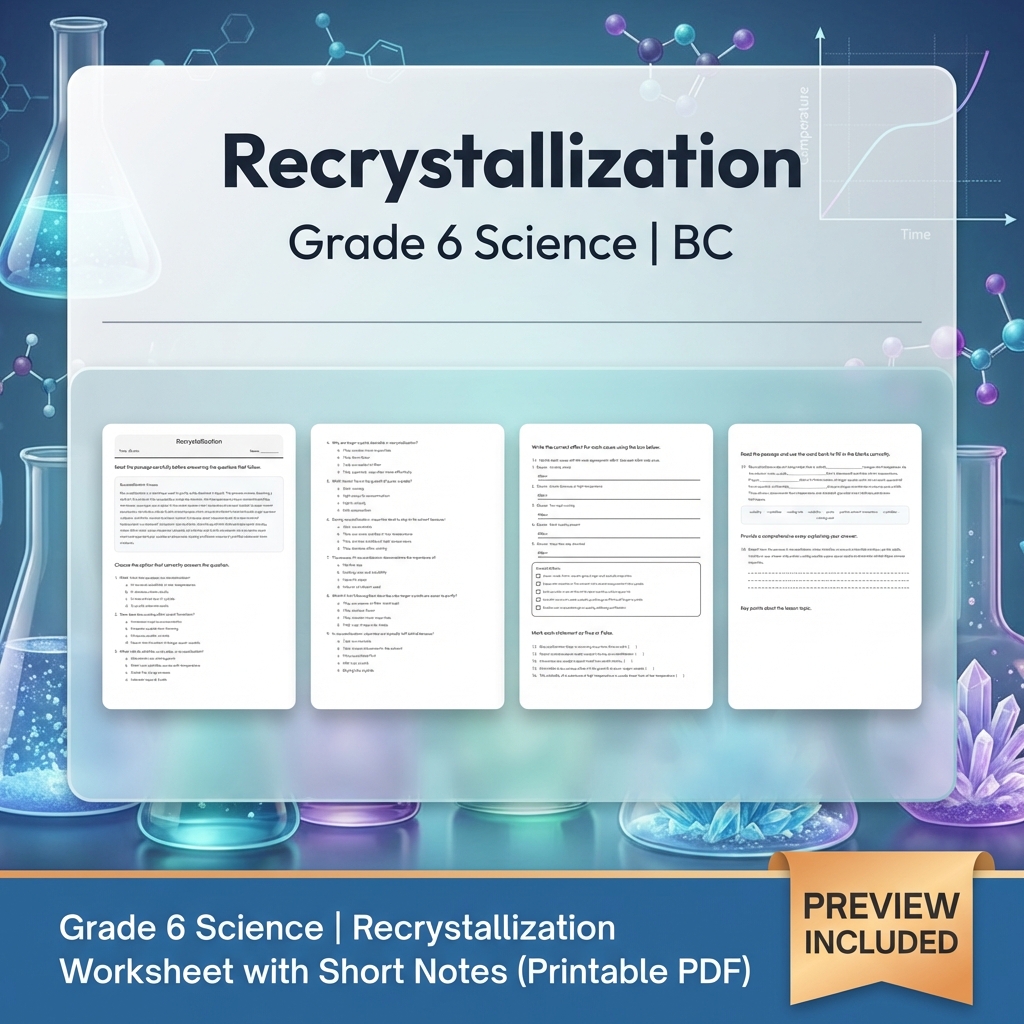
Grade 6 Science | Recrystallization Worksheet with Short Notes (Printable PDF)
Created byMeadowlark WorksheetsLearning Objectives
- Understand the process of recrystallization and its role in purifying solids.
- Explain how temperature changes affect solubility and crystal formation.
- Identify factors that influence the size and purity of crystals during recrystallization.
Also included in: Grade 6 Science | Matter, Properties & Change UNIT Worksheet Bundle +1 more
Instant download
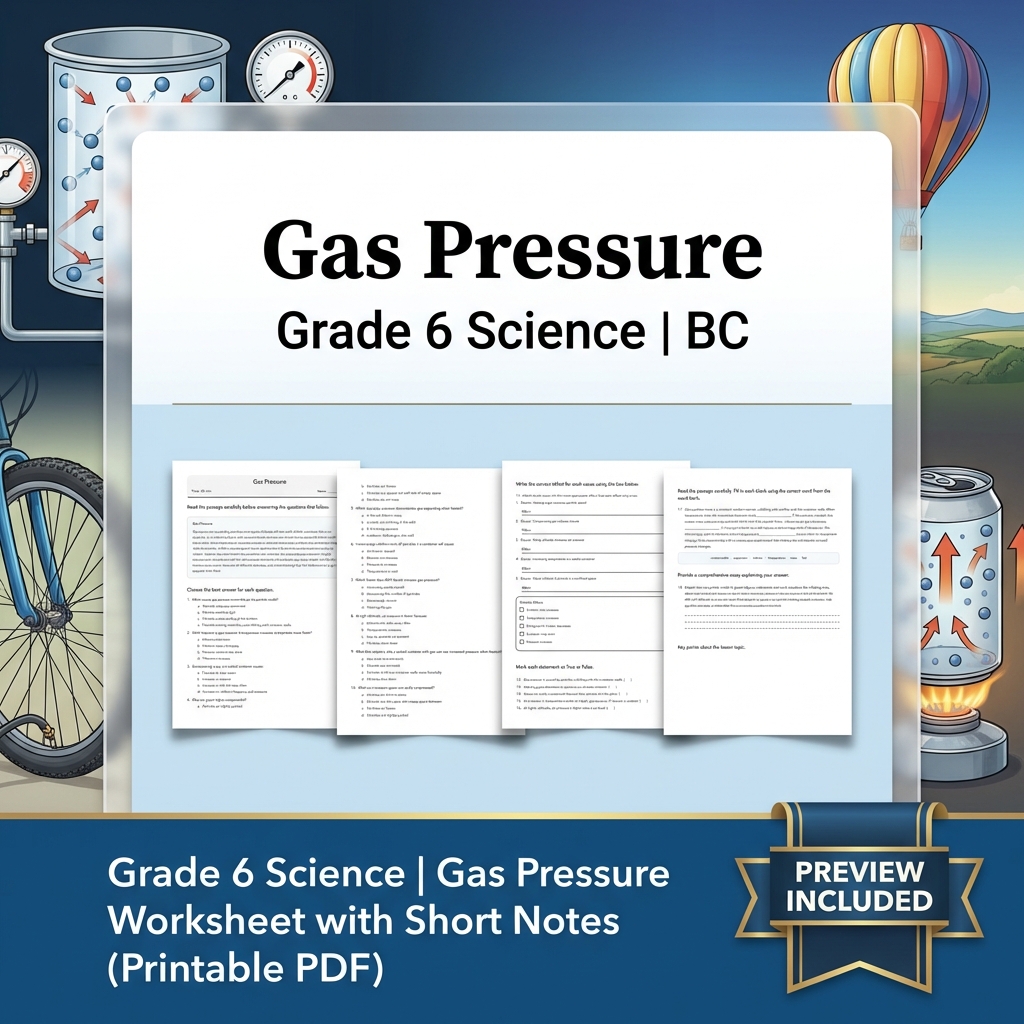
Grade 6 Science | Gas Pressure Worksheet with Short Notes (Printable PDF)
Created byMeadowlark WorksheetsLearning Objectives
- Explain how gas particles exert pressure through collisions with container walls.
- Describe how increasing particle speed or collision frequency affects gas pressure.
- Understand the relationship between temperature, volume, and pressure in gases based on the particle model.
Also included in: Grade 6 Science | Matter, Properties & Change UNIT Worksheet Bundle +1 more
Instant download
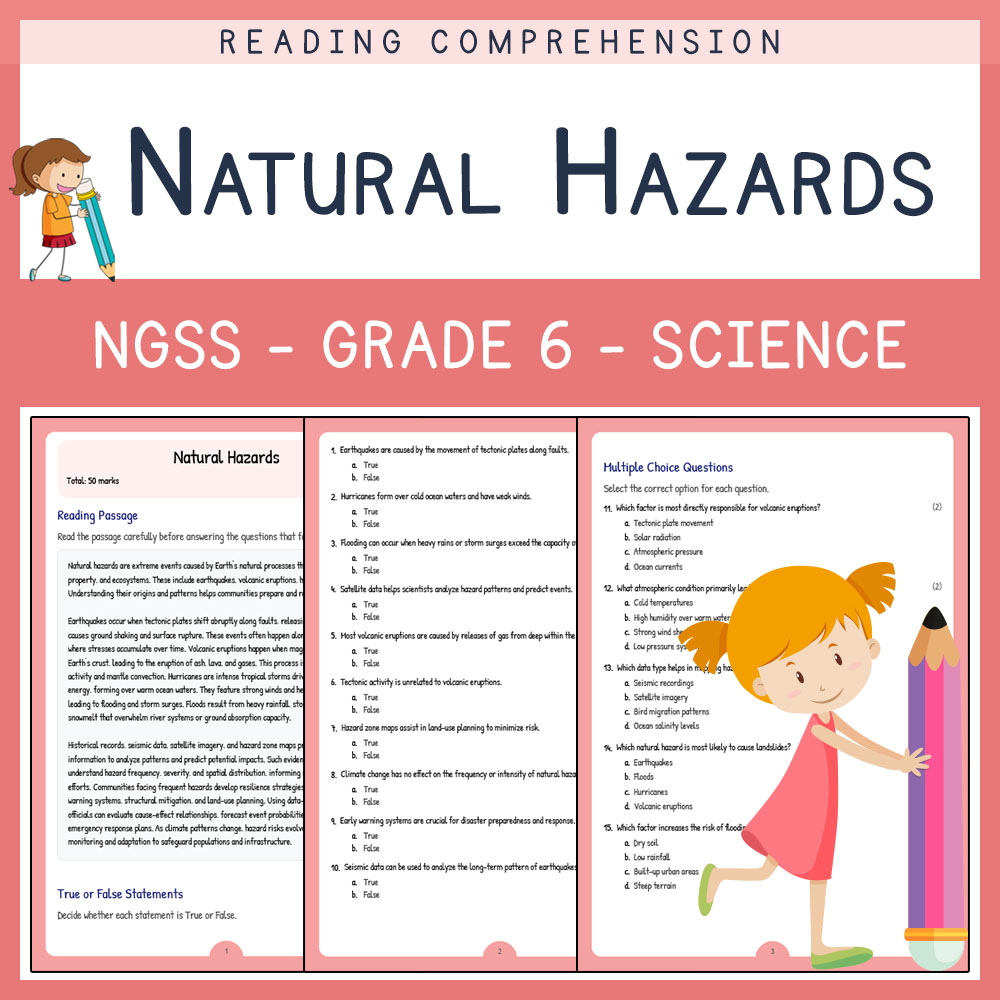
Grade 6 Science | Natural Hazards Worksheet ( Answer Key) | NGSS-Aligned
Created byLumora LearningLearning Objectives
- Explain the causes and effects of various natural hazards such as earthquakes, volcanoes, hurricanes, and floods.
- Identify patterns and relationships among tectonic processes, atmospheric conditions, and hydrological cycles related to hazards.
- Analyze historical data, seismic, and satellite evidence to evaluate hazard risks and impacts on communities.
Instant download
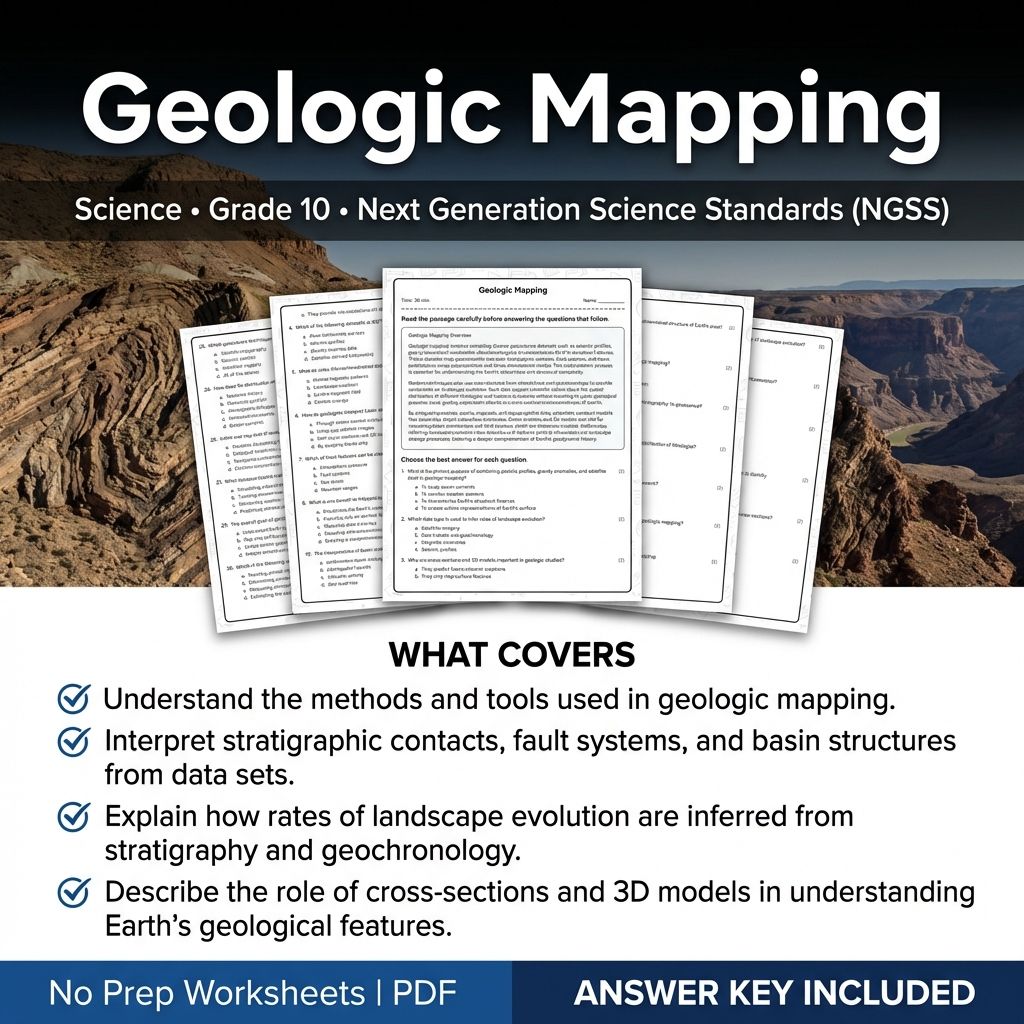
10th Grade Science | Geologic Mapping Worksheet & Answer Key (Printable PDF)
 Created byCoral Reef Learning
Learning Objectives
- Understand the methods and tools used in geologic mapping.
- Interpret stratigraphic contacts, fault systems, and basin structures from data sets.
- Explain how rates of landscape evolution are inferred from stratigraphy and geochronology.
Also included in: Grade 10 Science Unit Bundle – Earth's Surface Atmosphere & Geology Worksheets +1 more
Instant download
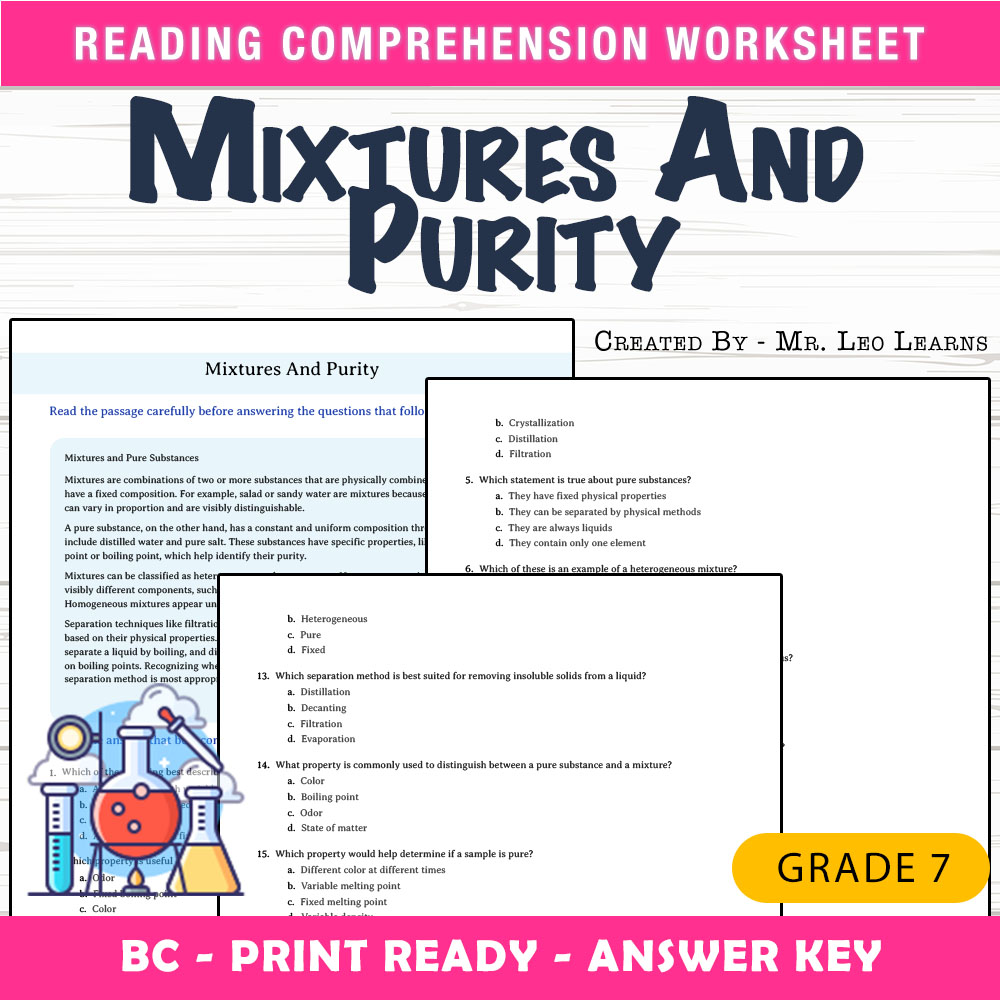
Grade 7 Science — Mixtures & Purity Worksheet MCQ Paper
Created byThe Resource HubLearning Objectives
- Understand the difference between mixtures and pure substances.
- Identify different types of mixtures based on observable traits.
- Learn methods of separation such as filtration, evaporation, and distillation.
Also included in: Grade 7 Science | Matter & Chemical Change Worksheet Bundle – BC Framework +1 more
Instant download
Browse more categories
About Science Worksheets
Find Science worksheets spanning core skills, practice, and review. All 45,429 resources are instant PDF downloads for the classroom or home.
Every worksheet on MyTeachingSheets is created by independent teacher-authors and reviewed before publication. All resources download as printable PDFs for classroom, homework, or at-home practice, and many include answer keys. Preview any worksheet free before buying.