
Science Worksheets
45,429 subject resources
Grade 10 Science | Efficiency Metrics Worksheet | BC Aligned
 Created byLumora Learning
Learning Objectives
- Understand various efficiency metrics used to evaluate energy systems.
- Interpret and compare efficiency indicators like percent efficiency, EROI, COP, and LCOE.
- Analyze the importance of boundaries, time scales, and ancillary impacts in efficiency assessment.
Instant download

Grade 10 Science | Circular Motion Worksheet Elena | AP Aligned
Created byLumora LearningLearning Objectives
- Explain the difference between uniform and non-uniform circular motion.
- Relate angular quantities to linear quantities such as velocity and acceleration.
- Describe the concept of centripetal acceleration and the forces involved.
Instant download

Grade 10 Science | Impulse and Momentum Worksheet | AP Aligned
Created byLumora LearningLearning Objectives
- Explain the relationship between impulse and change in momentum.
- Analyze collision events using conservation of momentum in isolated systems.
- Differentiate between elastic, inelastic, and perfectly inelastic collisions.
Instant download

Grade 12 Science | Resource Impacts Worksheet | BC-Aligned
Created byLumora LearningLearning Objectives
- Analyze how human resource use affects Earth's systems such as soil, water, and air.
- Evaluate environmental trade-offs associated with resource extraction and land modification.
- Identify strategies for sustainable resource management and environmental restoration.
Also included in: Grade 12 Science | Earth Science Custom Bundle | BC Aligned
Instant download

Grade 8 Science | Population Growth Worksheet | BC Aligned
Created byLumora LearningLearning Objectives
- Understand the factors influencing population change, including birth rates, death rates, immigration, and emigration.
- Identify patterns of population growth, stability, and decline.
- Explore how reproductive strategies, age structure, and resource availability affect growth rates.
Instant download

Hybridization Worksheet Elena | BC Science Grade 11 Assessment
Created byLumora LearningLearning Objectives
- Understand the concept of hybridization and how it explains molecular geometries.
- Identify common hybridizations such as sp, sp2, and sp3 and their associated geometries.
- Explain the role of hybrid orbitals in covalent bonding, including sigma and pi bonds.
Also included in: Grade 11 Science | Chemistry Lesson Bundle Worksheet | BC-Aligned
Instant download

Grade 10 Science | Vectors and Components Worksheet | BC Aligned
Created byLumora LearningLearning Objectives
- Understand vector decomposition into perpendicular components.
- Apply trigonometric functions to relate components to magnitude and direction.
- Resolve velocity and acceleration into horizontal and vertical components for motion analysis.
Instant download

Grade 11 Science | Physiological Regulation Worksheet | TEKS-Aligned
Created byLumora LearningLearning Objectives
- Understand the mechanisms involved in physiological regulation of internal variables.
- Identify examples of negative and positive feedback in the body.
- Explain how sensors, control centers, and effectors work together to maintain stability.
Instant download

Grade 12 Science | Energy Forms Worksheet | BC-Aligned
Created byLumora LearningLearning Objectives
- Define and distinguish between common energy forms such as kinetic, potential, and thermal energy.
- Explain how total mechanical energy changes in systems with non-conservative forces.
- Describe energy transfer during motion, collisions, and deformation.
Also included in: Grade 12 Science | Physics Custom Bundle | BC-Aligned Worksheet Set
Instant download

Grade 7 Science | Population Interactions Worksheet | BC Aligned
Created byLumora LearningLearning Objectives
- Understand the different types of interactions between populations such as competition, predation, and mutualism.
- Identify how these interactions influence community composition and population dynamics.
- Explain concepts like resource partitioning and niche separation that allow coexistence of species.
Instant download

Grade 7 Science | Disturbance Effects Worksheet | BC Standards
Created byLumora LearningLearning Objectives
- Understand how disturbances like fire, flood, landslide, and windthrow influence ecosystems.
- Explain how disturbance frequency, intensity, and scale affect biodiversity and community dynamics.
- Identify species adapted to regular disturbance regimes and their resilience mechanisms.
Instant download

Grade 10 Science | Electric Fields Worksheet | BC-Aligned
Created byLumora LearningLearning Objectives
- Understand the concept of electric fields and how they influence charges in space.
- Identify how field lines represent the direction and strength of electric fields.
- Explain the principle of superposition in combining multiple electric fields.
Instant download

Grade 12 Science | Periodic Trends Worksheet | BC-Aligned
Created byLumora LearningLearning Objectives
- Understand how atomic and ionic properties vary across the periodic table.
- Explain the factors driving periodic trends such as atomic radius, ionization energy, and electronegativity.
- Predict element reactivity, ionic sizes, and bonding tendencies based on periodic trends.
Also included in: Grade 12 Science | Chemistry Custom Bundle Worksheets | BC-Aligned
Instant download

Grade 10 Science | Relative Velocity Worksheet | BC Aligned
Created byLumora LearningLearning Objectives
- Explain the concept of relative velocity and how it depends on the observer's frame of reference.
- Determine the relative velocity of objects moving in different directions using vector subtraction.
- Apply classical velocity addition and subtraction rules for objects moving at speeds much less than light.
Instant download

Grade 11 Science | Center Of Mass Worksheet | BC-Aligned
Created byLumora LearningLearning Objectives
- Understand the concept of the center of mass and its significance in physics.
- Apply conservation of momentum principles relative to the center of mass.
- Analyze complex systems using the location of the center of mass to simplify calculations.
Also included in: Grade 11 Science | Physics Custom Bundle | BC-Aligned Worksheet Set
Instant download

Ionic Bonding Worksheet Elena | Standard BC Grade 11 Science
Created byLumora LearningLearning Objectives
- Explain the process of ionic bonding and how it results in the formation of ions.
- Describe the properties and characteristics of ionic compounds, including melting points and conductivity.
- Understand lattice energy and its influence on ionic compound stability and solubility.
Also included in: Grade 11 Science | Chemistry Lesson Bundle Worksheet | BC-Aligned
Instant download

Grade 9 Science | Tidal Forces Worksheet | BC Aligned
Created byLumora LearningLearning Objectives
- Explain the origins of tidal forces resulting from gravitational interactions among the Moon, Sun, and Earth.
- Describe how the relative positions of the Sun and Moon influence spring and neap tides.
- Identify how local coastline geometry, ocean depth, and resonant basins affect tidal amplitudes.
Also included in: Grade 9 Science | Earth Systems Unit Bundle | BC Aligned Worksheets
Instant download

Grade 9 Science | Climate Drivers Worksheet | BC Standards
Created byLumora LearningLearning Objectives
- Understand the key components that influence Earth's climate, including the atmosphere, oceans, ice, land surface, and living organisms.
- Explain how solar energy and internal Earth's heat contribute to climate patterns.
- Identify factors such as aerosols, greenhouse gases, ocean circulation, and land surface properties that cause climate variability.
Also included in: Grade 9 Science | Earth Systems Unit Bundle | BC Aligned Worksheets
Instant download
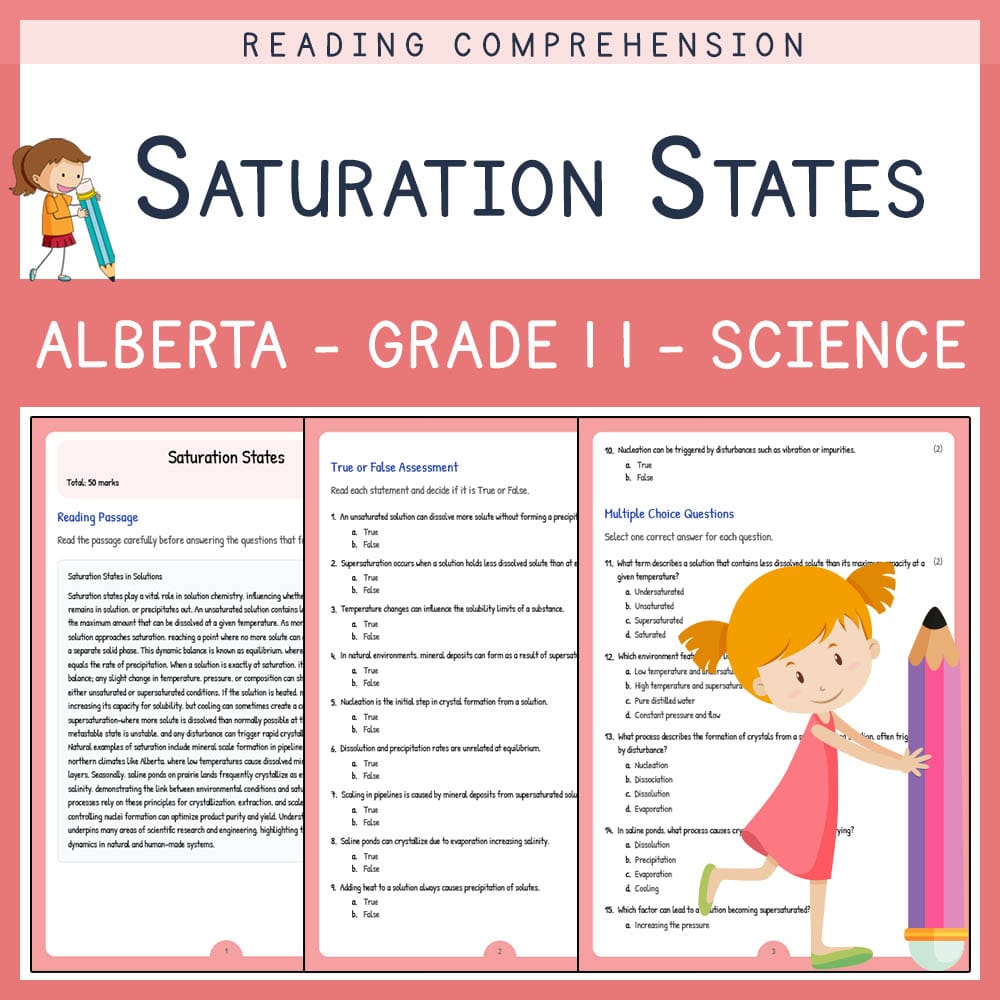
Grade 11 Science | Saturation States Worksheet | Alberta Standards
Created byLumora LearningLearning Objectives
- Understand the concepts of unsaturated, saturated, and supersaturated solutions.
- Explain how dynamic equilibrium relates to solubility and precipitation.
- Identify natural and industrial examples of saturation states and nucleation processes.
Instant download
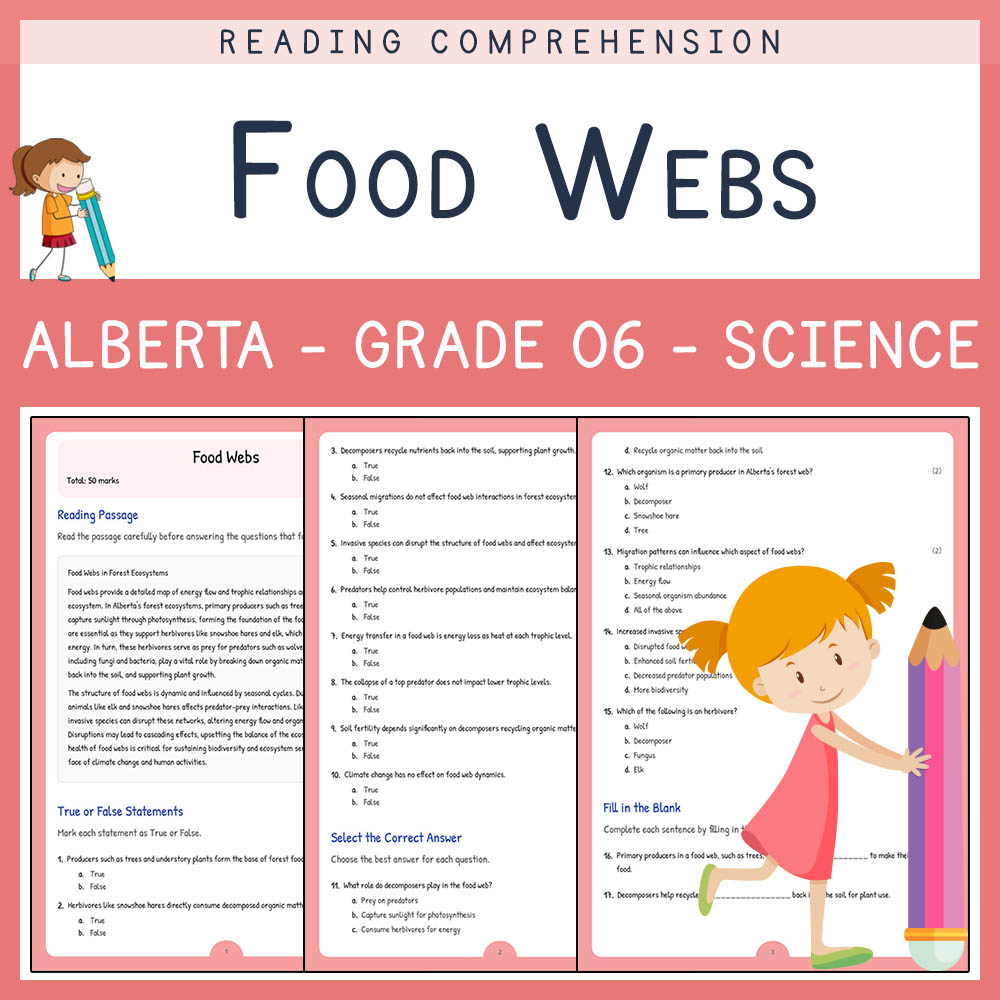
Grade 6 Science Assessment | Food Webs Worksheet Elena | Alberta
Created byLumora LearningLearning Objectives
- Understand the components and structure of food webs in forest ecosystems.
- Identify the roles of producers, consumers, and decomposers within ecological networks.
- Explain how seasonal changes and disruptions affect food web relationships.
Instant download
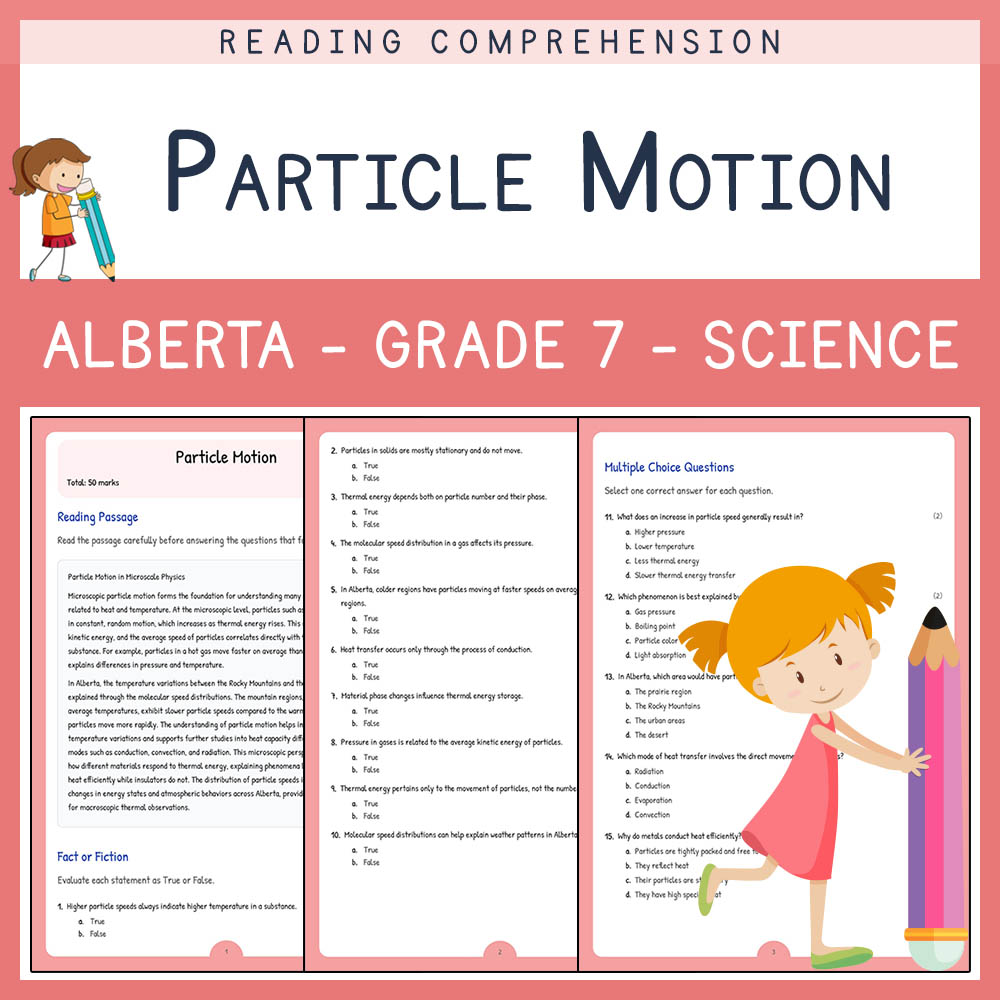
Grade 7 Science | Particle Motion Worksheet | Alberta Standards
Created byLumora LearningLearning Objectives
- Understand microscopic particle motion and its relation to temperature and energy.
- Explain how particle speed distribution influences thermal states and pressure.
- Compare thermal energy among different materials and heat transfer mechanisms.
Instant download
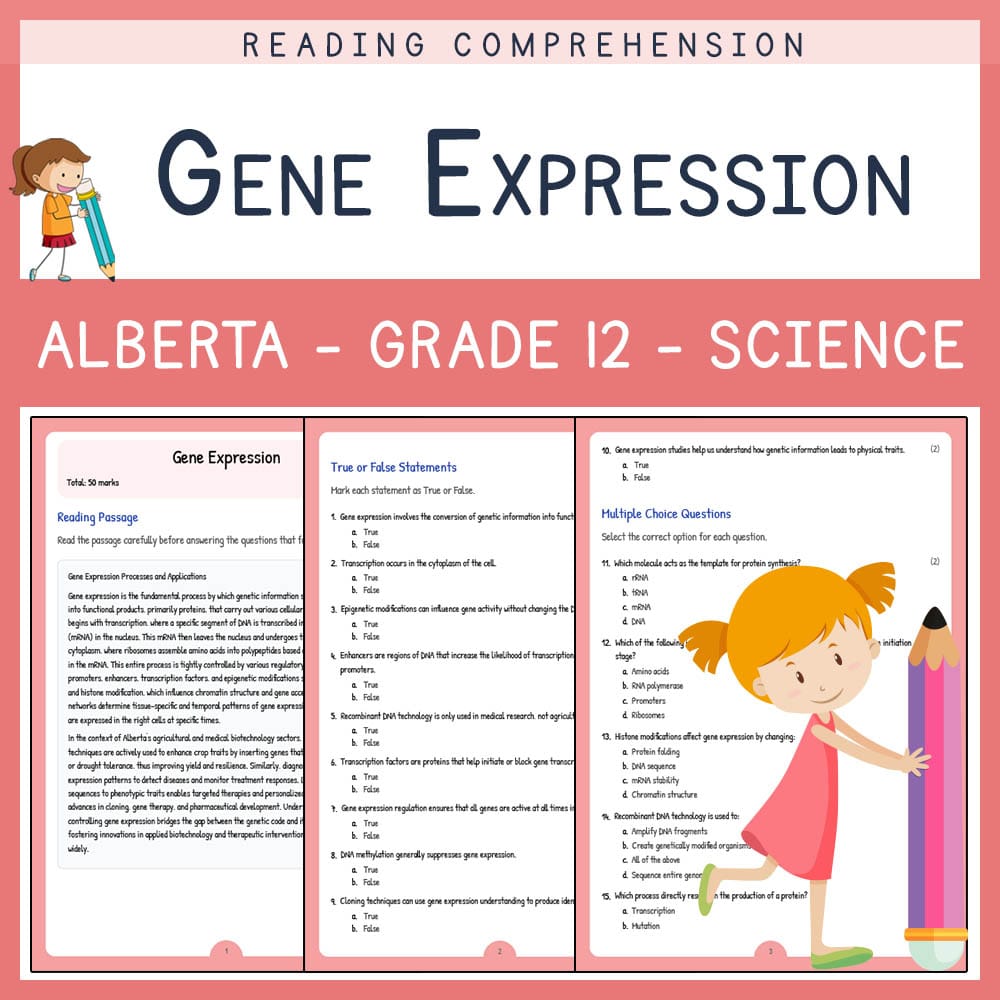
Grade 12 Science | Gene Expression Worksheet Elena | Alberta Standards
Created byLumora LearningLearning Objectives
- Explain the process of gene transcription and translation.
- Identify the roles of promoters, enhancers, and transcription factors in gene regulation.
- Describe how epigenetic modifications influence gene expression patterns.
Also included in: Grade 12 Science | Biology Worksheet Pack Custom Bundle | Alberta
Instant download
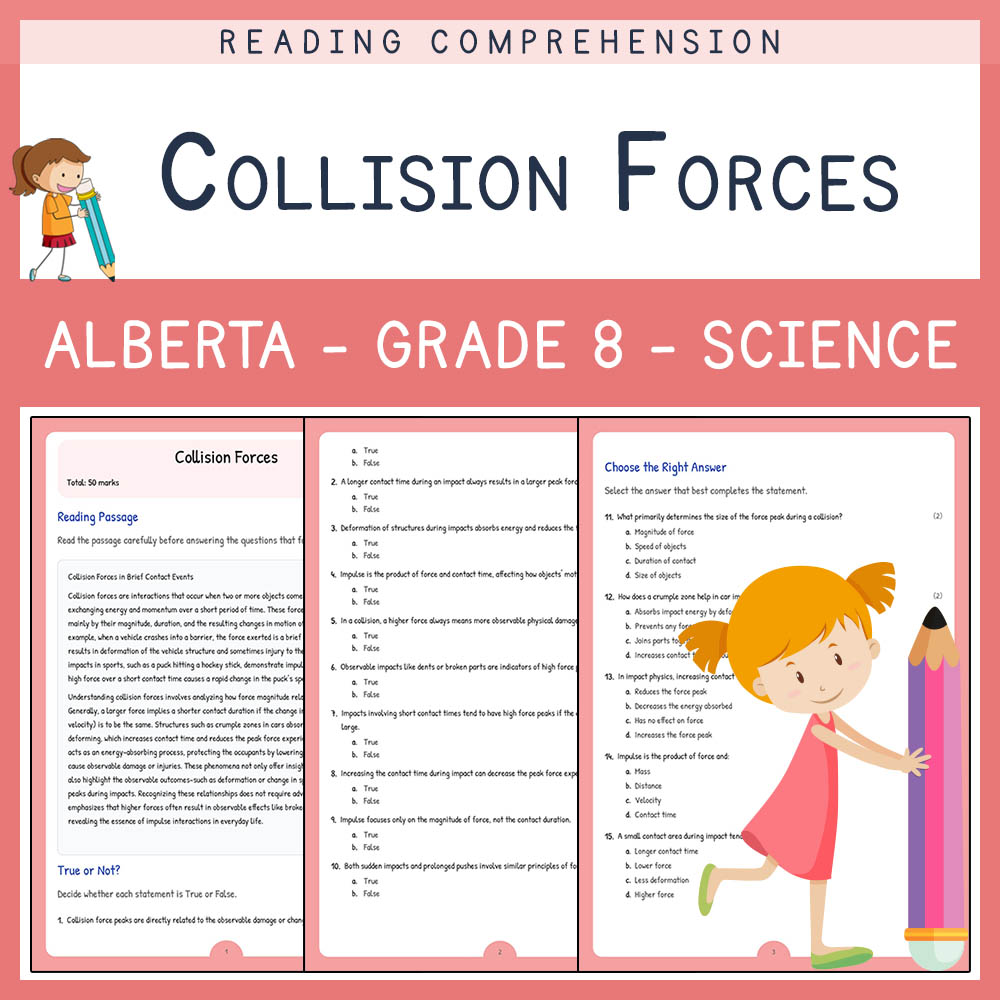
Grade 8 Science | Collision Forces Worksheet Elena | Alberta Standard
Created byLumora LearningLearning Objectives
- Understand how forces exchanged during brief contact events affect the motion of objects.
- Describe the relationship between force magnitude and contact time in collisions.
- Explain how structural deformation absorbs energy during impacts.
Instant download
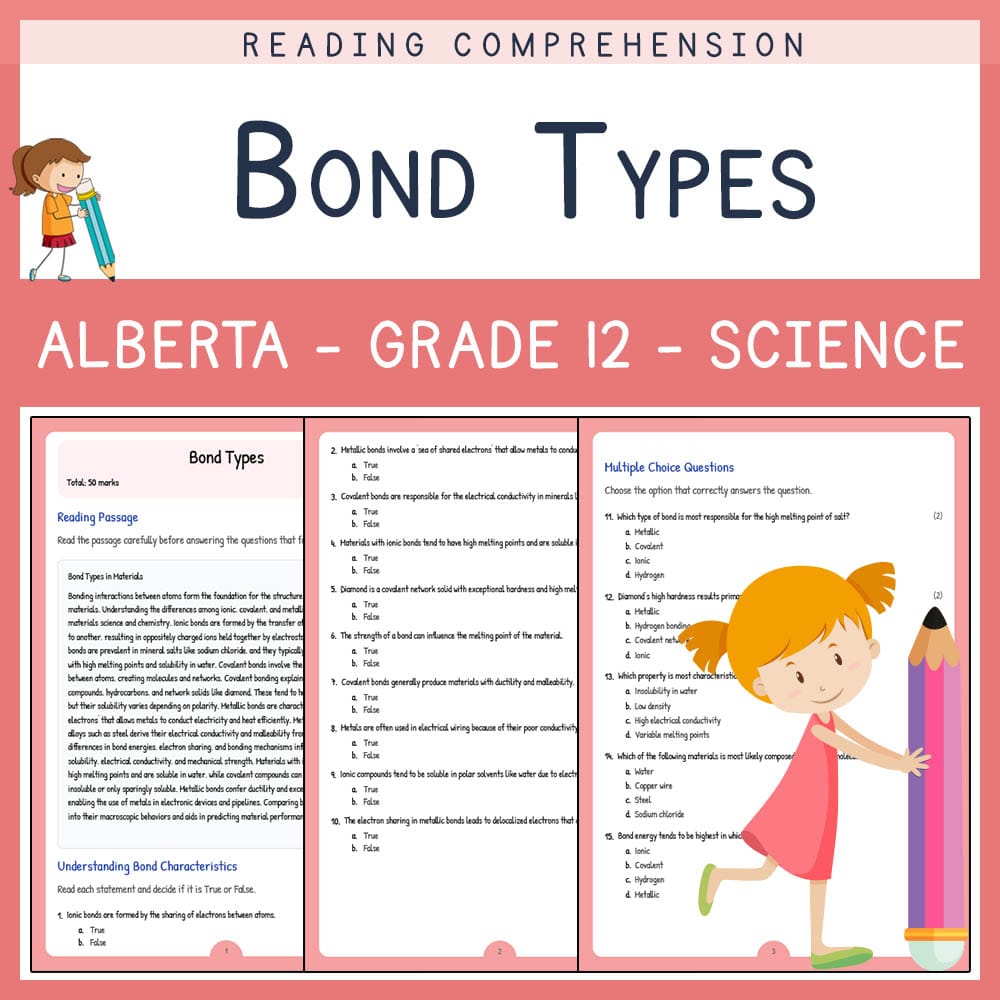
Grade 12 Science | Bond Types Worksheet | Alberta Standards
Created byLumora LearningLearning Objectives
- Classify interactions between atoms into ionic, covalent, and metallic bonds.
- Explain the assembly of compounds and solids based on bond types.
- Compare bond energies, electron sharing, and typical properties of each bond type.
Instant download
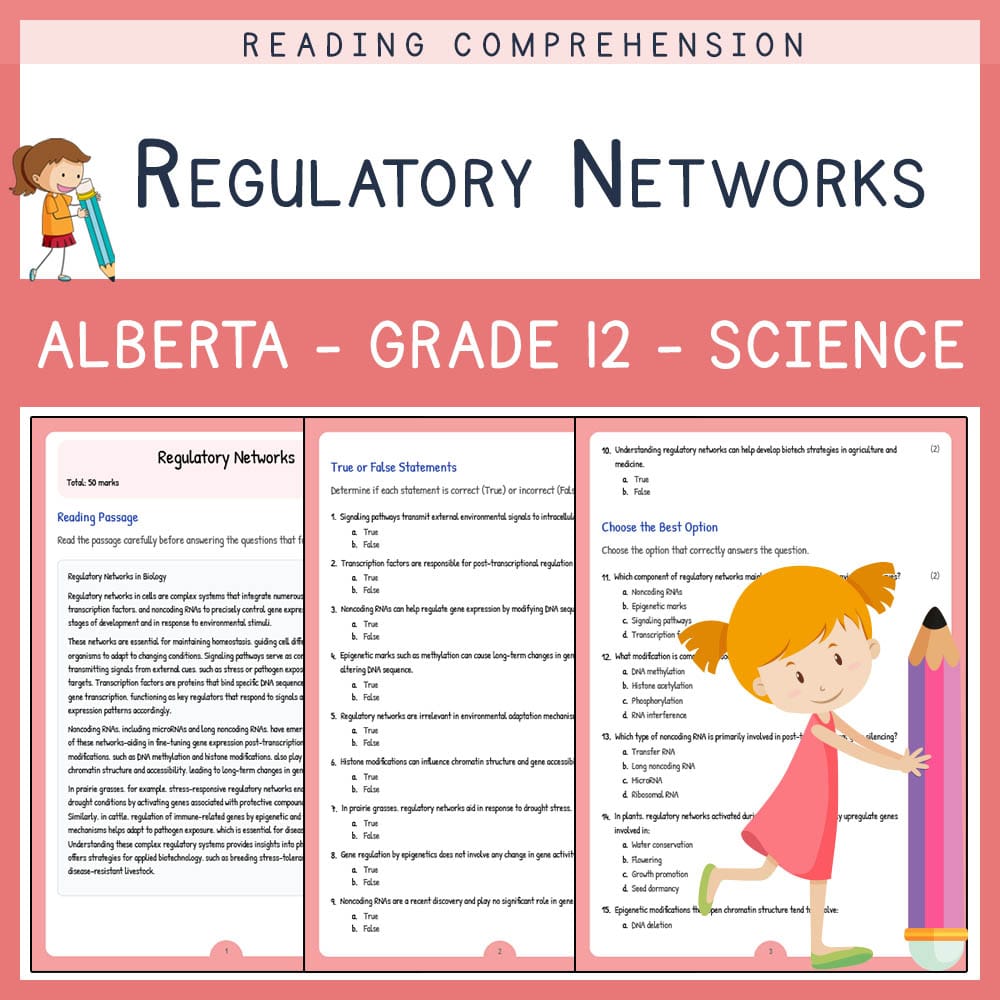
Grade 12 Science | Regulatory Networks Worksheet | Alberta Standards
Created byLumora LearningLearning Objectives
- Understand the components and functions of cellular regulatory networks.
- Explain how signalling pathways, transcription factors, and noncoding RNAs interact to control gene expression.
- Describe the role of epigenetic modifications in gene regulation during development and environmental responses.
Also included in: Grade 12 Science | Biology Worksheet Pack Custom Bundle | Alberta
Instant download
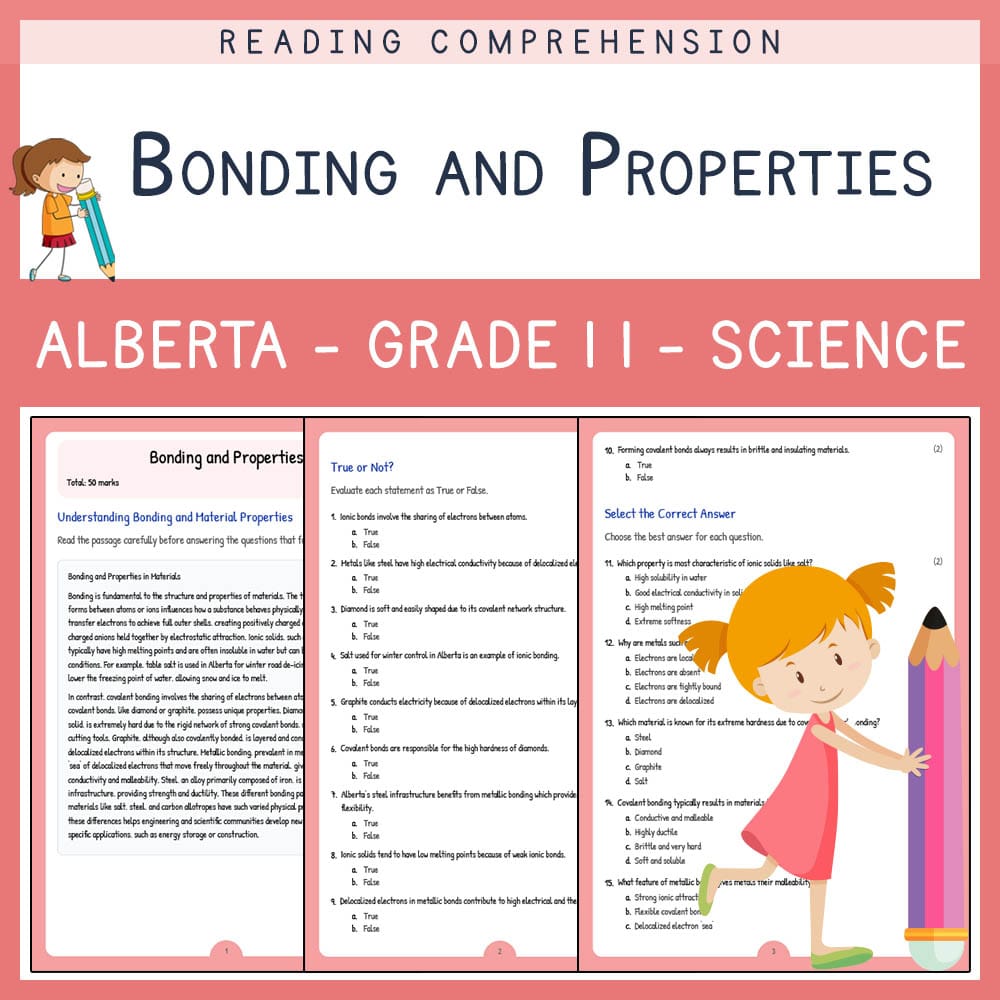
Grade 11 Science | Bonding and Properties Worksheet | Alberta Standards
Created byLumora LearningLearning Objectives
- Describe the different types of bonding—ionic, covalent, and metallic—and how they influence material properties.
- Compare the properties of ionic solids, metals, and covalent networks in terms of hardness, conductivity, melting points, and solubility.
- Analyze real-world Canadian examples such as salt for winter use, steel for infrastructure, and carbon materials in energy contexts.
Also included in: Grade 11 Science | Matter and Chemical Bonding Custom Bundle | Alberta
Instant download
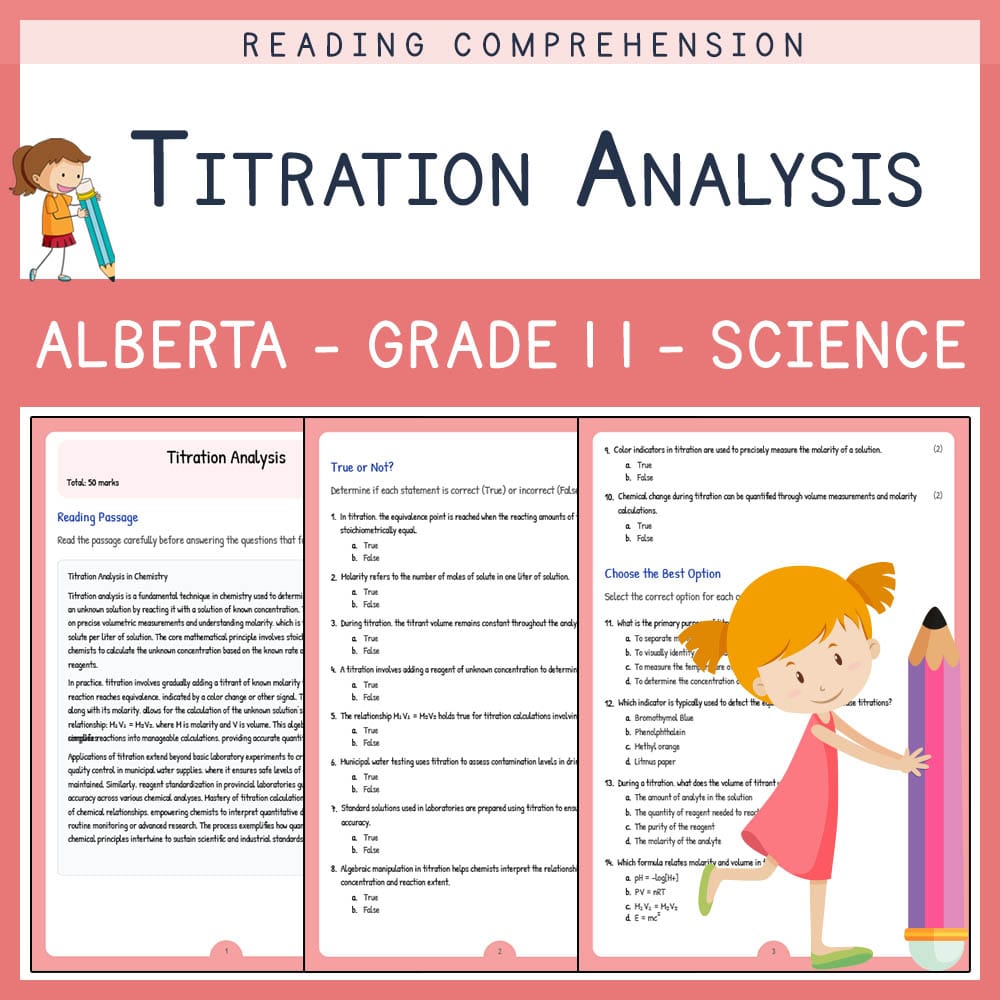
Grade 11 Science | Titration Analysis Worksheet | Alberta Standards
Created byLumora LearningLearning Objectives
- Understand the mathematical basis of titration calculations using molarity and stoichiometry.
- Apply algebraic manipulation to interpret equivalence relationships in titration.
- Explain the applications of titration in quality control for water supplies and laboratory standards.
Instant download
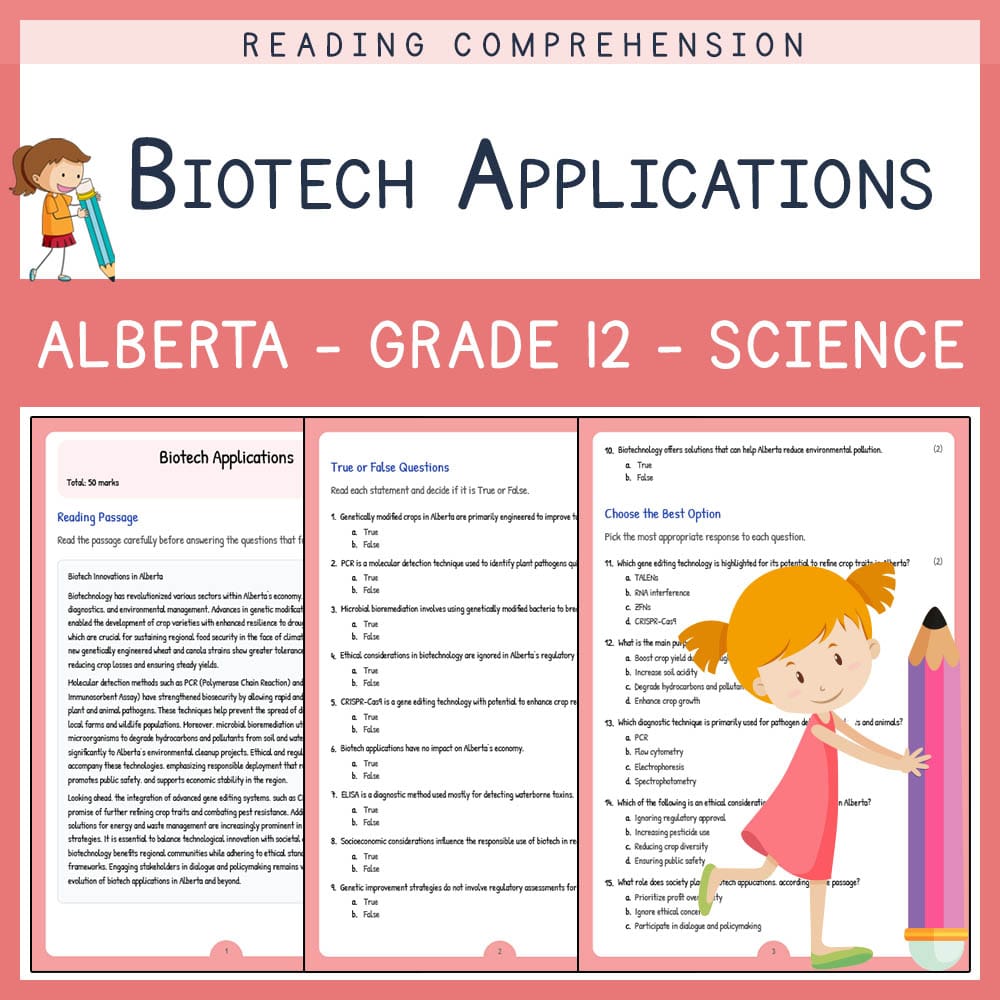
Grade 12 Science | Biotech Applications Worksheet | Alberta Standards
Created byLumora LearningLearning Objectives
- Understand the applications of biotechnology in agriculture, diagnostics, and environmental remediation.
- Analyze genetic strategies used for crop resilience and the ethical considerations involved.
- Identify molecular detection techniques for plant and animal pathogens.
Also included in: Grade 12 Science | Science Custom Bundle | Alberta Standards Worksheets
Instant download
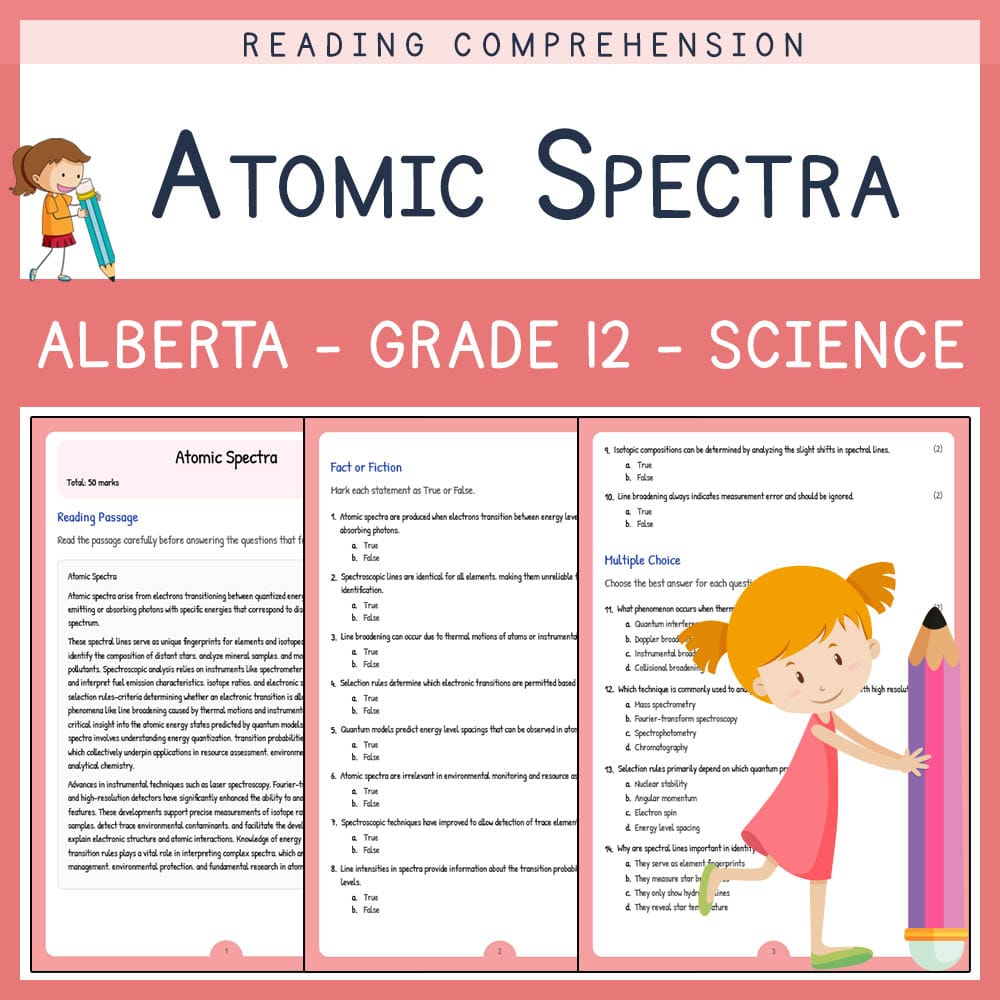
Grade 12 Science | Atomic Spectra Worksheet | Alberta Standards
Created byLumora LearningLearning Objectives
- Understand the process of electronic transitions that produce atomic spectra.
- Identify the importance of spectral patterns in element and isotope identification.
- Explain concepts such as selection rules, line broadening, and energy quantization in spectroscopy.
Instant download

Grade 8 Science | Phase Transitions Worksheet | Alberta Standard
Created byLumora LearningLearning Objectives
- Describe the different types of phase transitions between solid, liquid, and gas.
- Explain how energy exchange and pressure influence phase changes.
- Identify examples of phase transitions in natural and urban environments.
Instant download
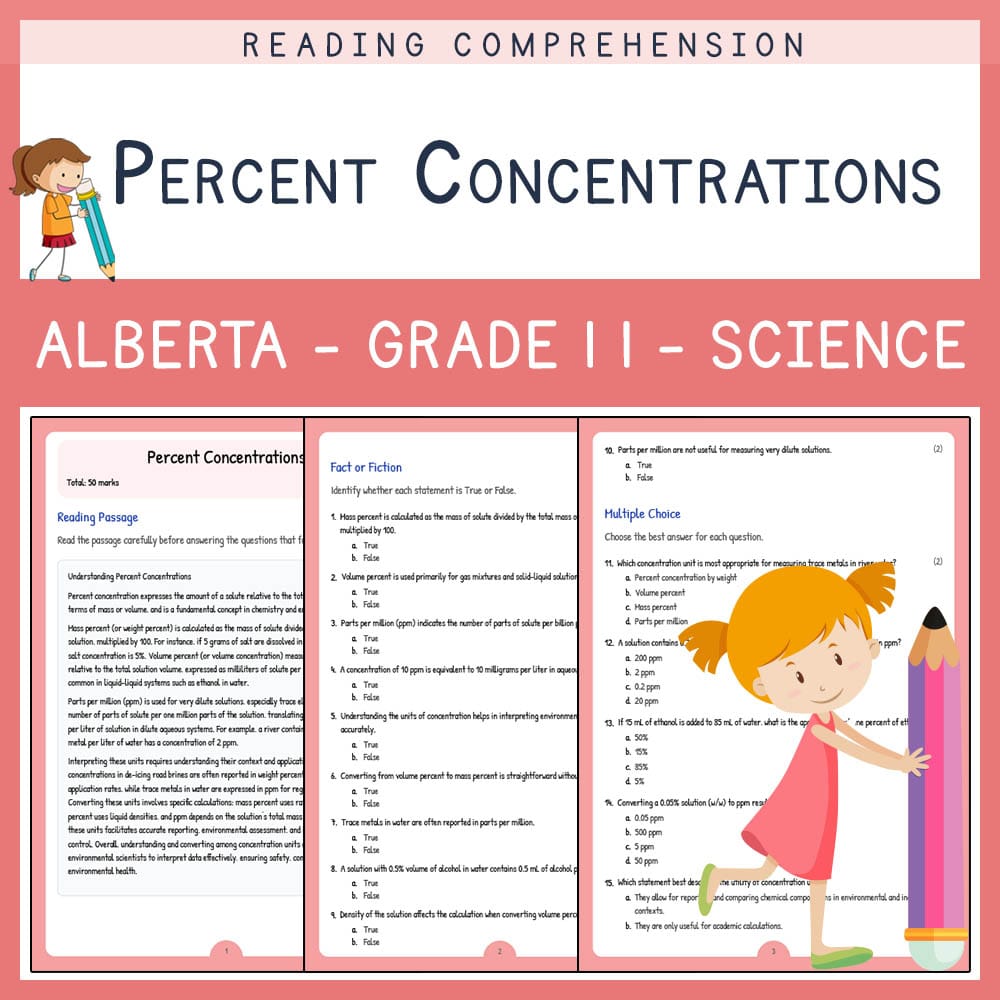
Grade 11 Science | Percent Concentrations Worksheet | Alberta Science
Created byLumora LearningLearning Objectives
- Understand the concept of percent concentration and its different units.
- Learn to convert between mass percent, volume percent, and parts per million.
- Interpret examples of chemical concentrations in environmental and industrial contexts.
Instant download
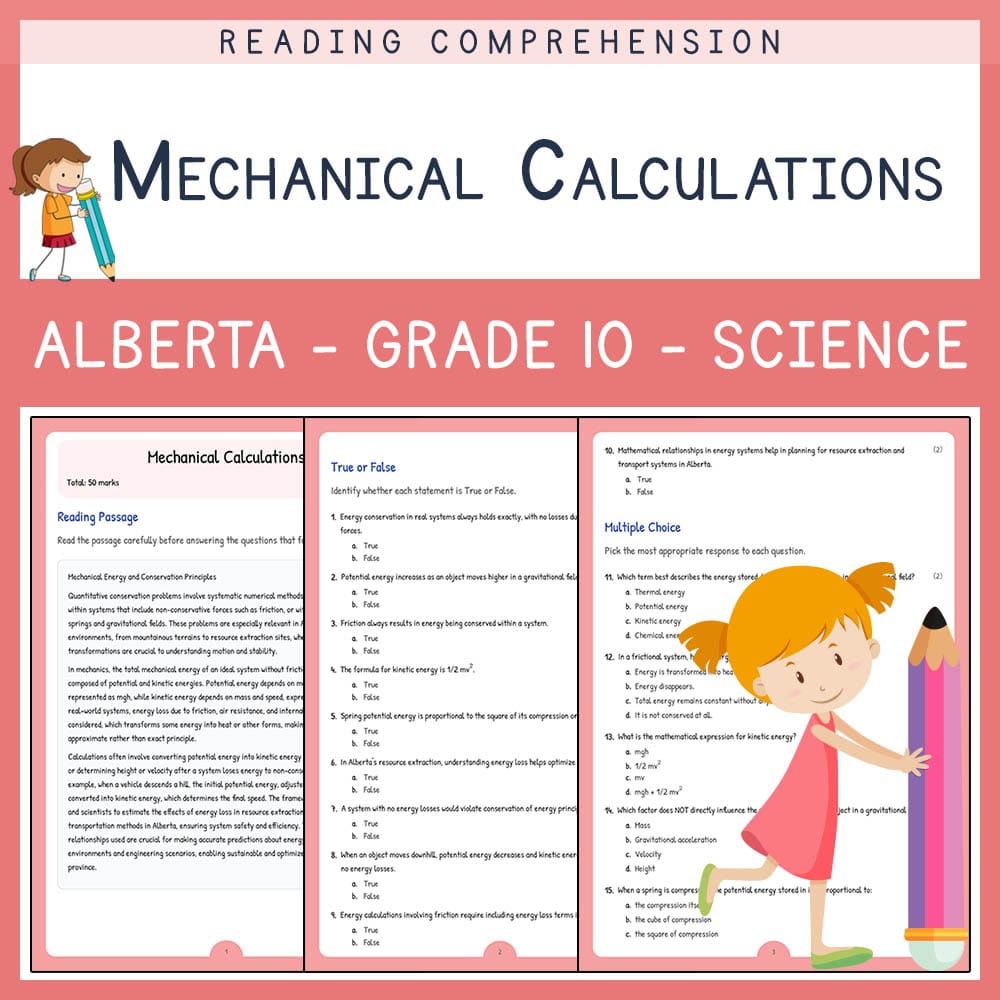
Grade 10 Science | Mechanical Calculations Worksheet | Alberta Standards
Created byLumora LearningLearning Objectives
- Understand the principles of energy conservation in mechanical systems.
- Apply quantitative methods to solve problems involving energy transfer and losses.
- Use mathematical relationships to connect energy, height, speed, and mass in real-world contexts.
Instant download

Grade 5 Science | Resource Sustainability Worksheet (PDF) | NGSS Aligned
Created byLumora LearningLearning Objectives
- Understand how Earth's resources are distributed and formed
- Identify renewable and non-renewable resources
- Learn processes like mineral crystallization and fossil formation
Instant download
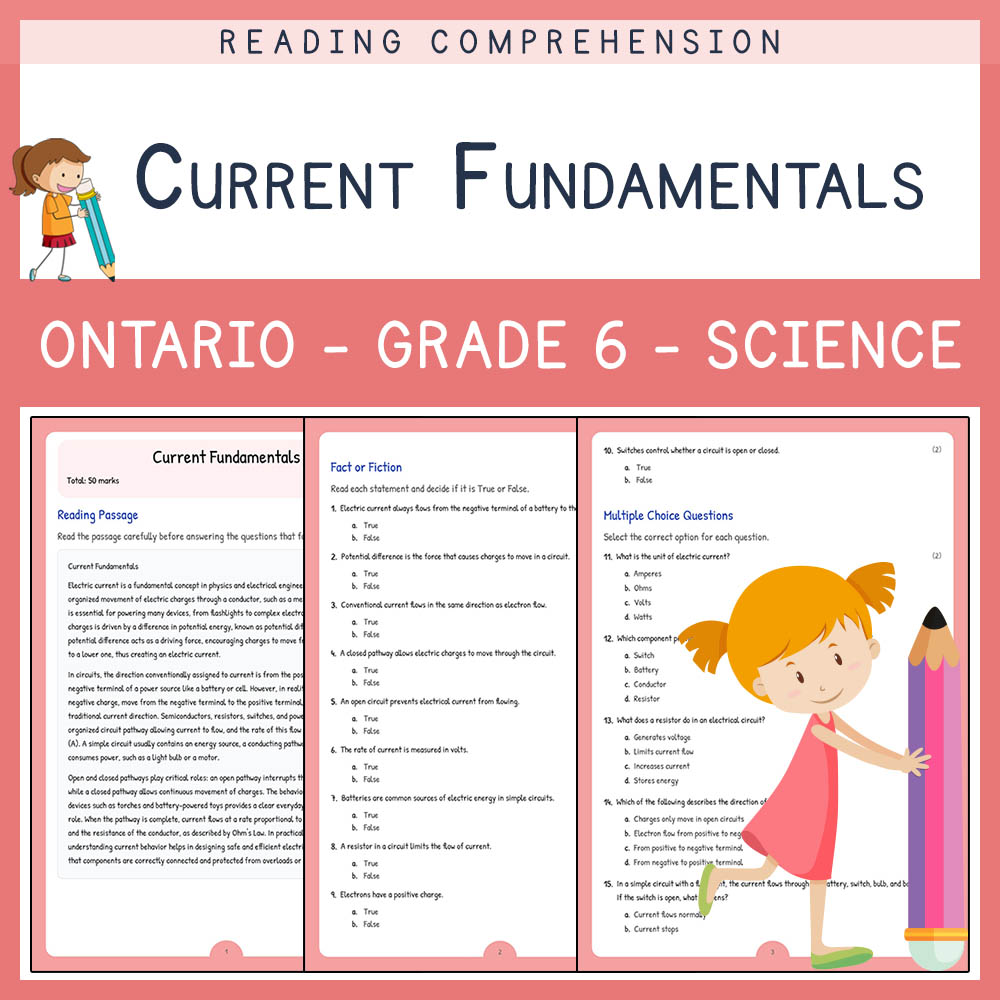
Grade 6 Science | Current Fundamentals Worksheet (Answer Key & Rubric) - Ontario Standard
Created byLumora LearningLearning Objectives
- Describe electric current as an organized movement of charges through a conductor.
- Distinguish between conventional current direction and electron flow.
- Explain potential difference as the driving force behind current.
Also included in: Grade 6 Science | Electricity Unit Custom Bundle | Ontario Framework
Instant download
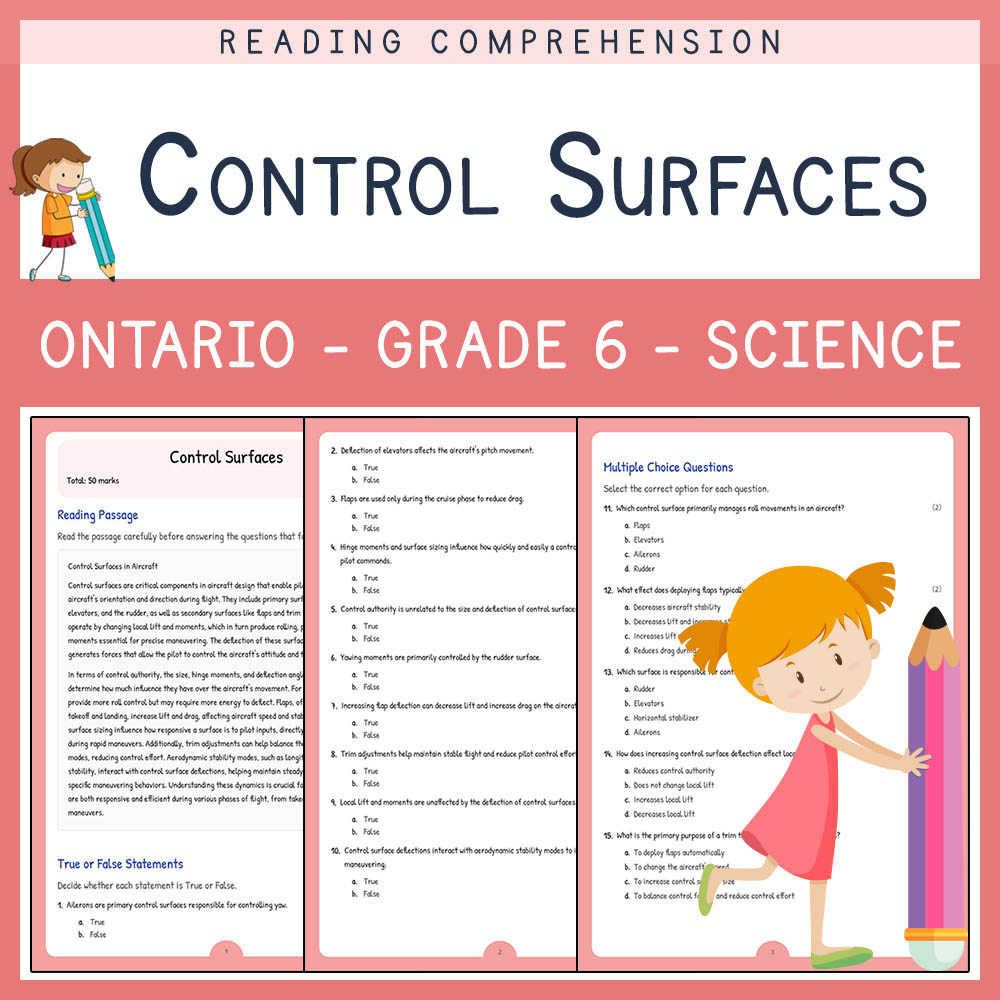
Grade 6 Science | Control Surfaces Worksheet with Answer Key (PDF)
Created byLumora LearningLearning Objectives
- Understand the primary and secondary control surfaces and their roles in aircraft maneuvering.
- Explain how deflections of ailerons, elevators, rudders, and flaps affect roll, pitch, and yaw.
- Describe the concepts of control authority and aerodynamic stability as related to control surfaces.
Also included in: Grade 6 Science | Flight Custom Bundle | Ontario Standards
Instant download
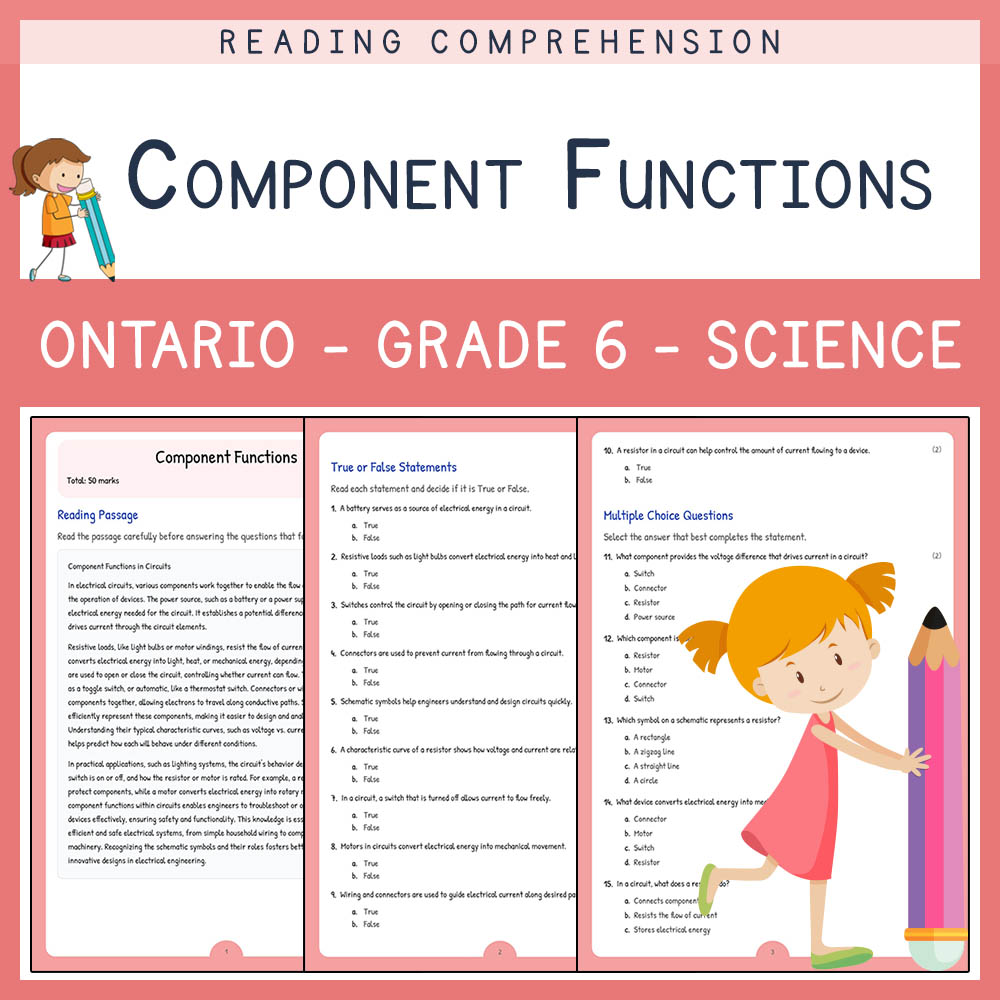
Grade 6 Science | Component Functions Worksheet & Answer Key (PDF)
Created byLumora LearningLearning Objectives
- Identify the roles of common circuit components such as power sources, resistive loads, switches, and connectors.
- Explain how each component influences the behavior of electrical circuits.
- Interpret schematic symbols associated with circuit components.
Also included in: Grade 6 Science | Electricity Unit Custom Bundle | Ontario Framework
Instant download
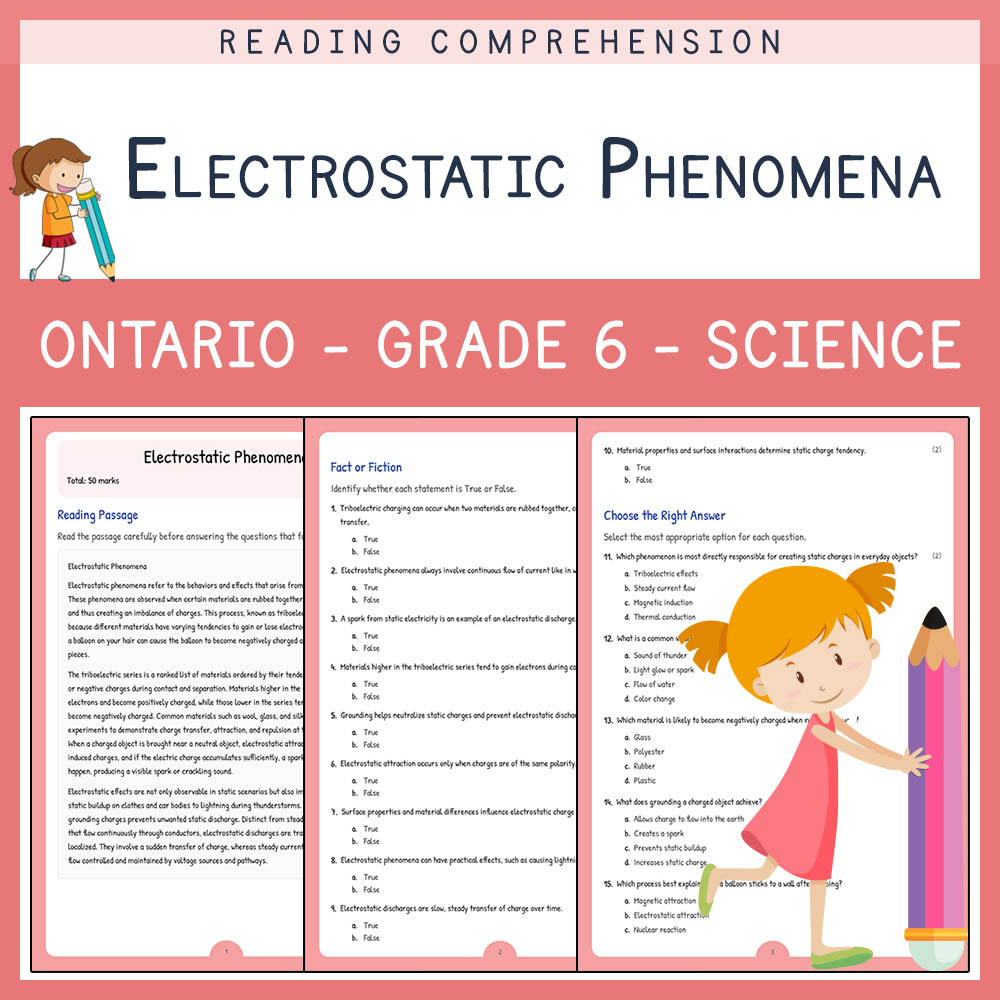
Grade 6 Science | Electrostatic Phenomena Worksheet with Answer Key (PDF)
Created byLumora LearningLearning Objectives
- Understand how charge transfer occurs between materials through triboelectric effects.
- Describe the concept of electrostatic discharge and its common manifestations.
- Identify the materials in the triboelectric series and their tendencies to gain or lose electrons.
Also included in: Grade 6 Science | Electricity Unit Custom Bundle | Ontario Framework
Instant download
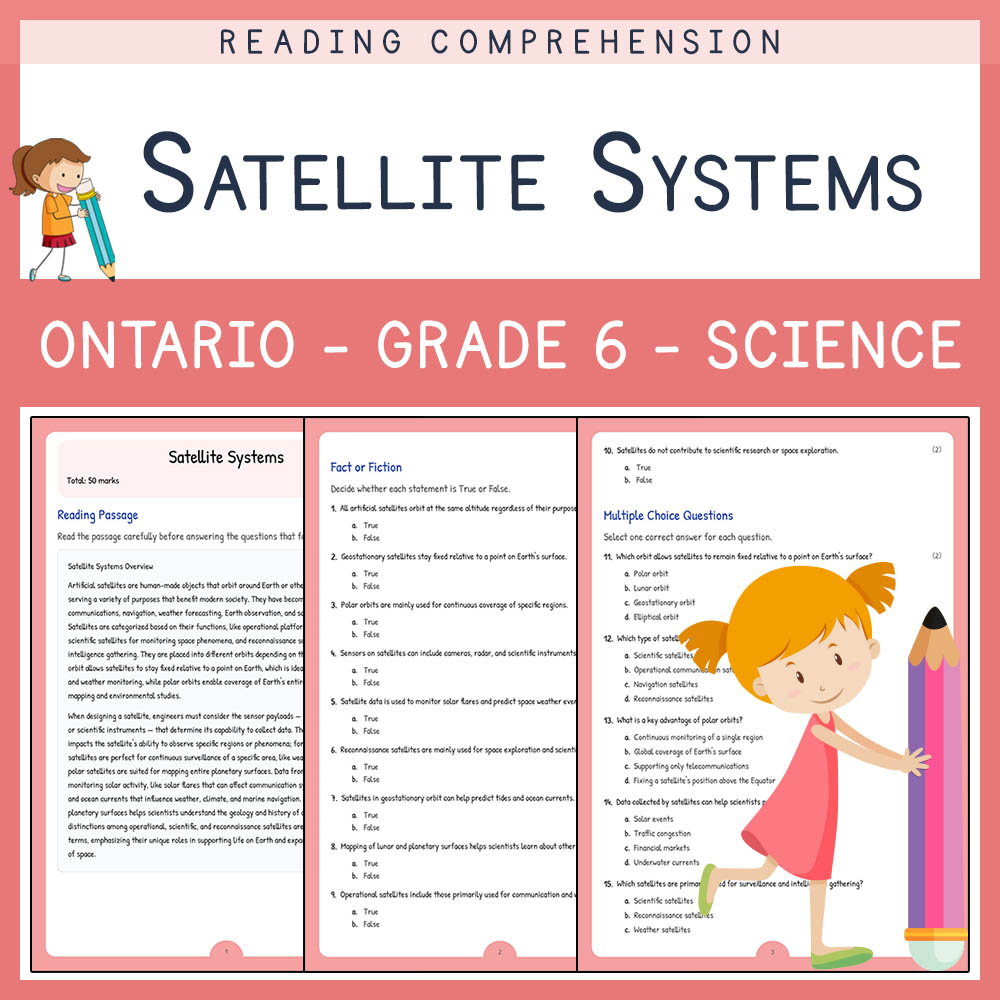
Grade 6 Science | Satellite Systems Worksheet + Answer Key – Ontario Standards
Created byLumora LearningLearning Objectives
- Understand the functions and categories of artificial satellites.
- Describe orbital choices such as geostationary and polar orbits.
- Recognize the roles of satellites in Earth observation, communication, navigation, and scientific monitoring.
Also included in: Grade 6 | Space Science Lesson Bundle Worksheets | Ontario Framework
Instant download
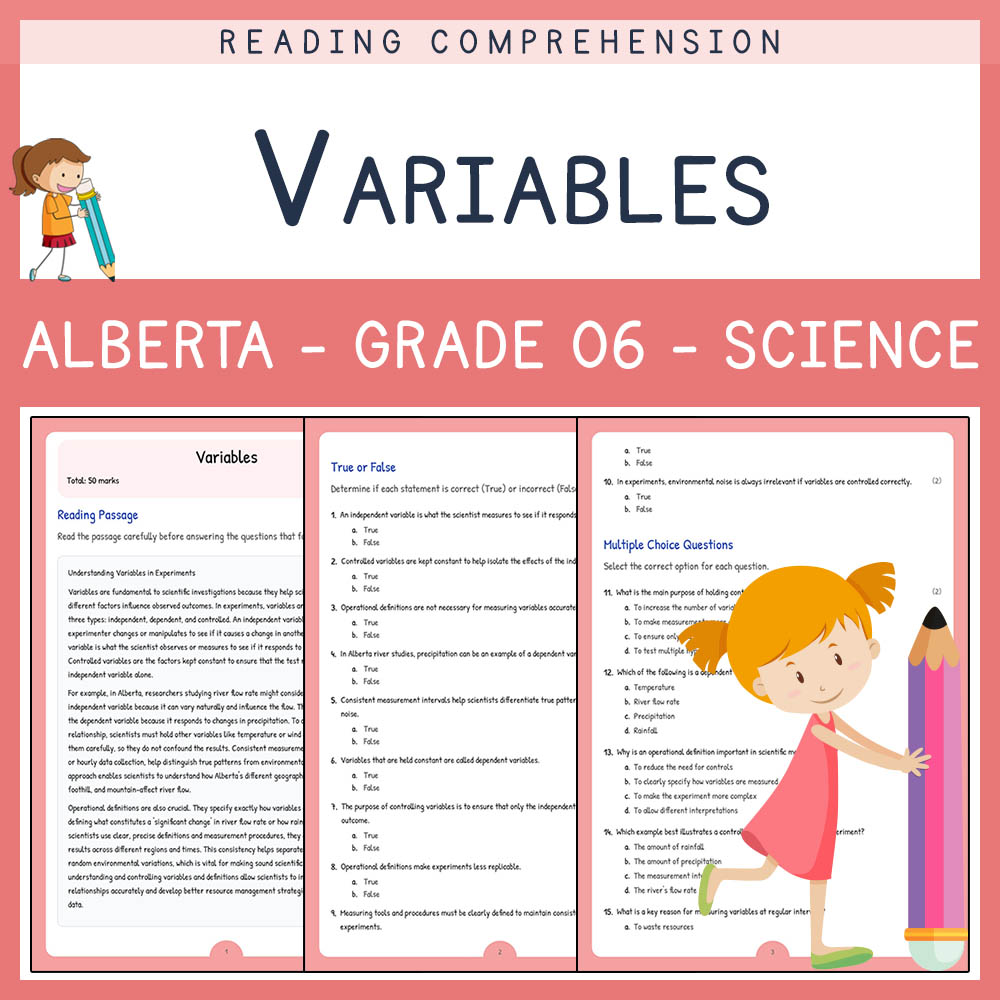
Grade 6 Science | Variables Worksheet Elena | Alberta
Created byLumora LearningLearning Objectives
- Define and distinguish between independent, dependent, and controlled variables.
- Explain the importance of operational definitions and measurement consistency in experiments.
- Apply contextual examples, such as river flow rate, to understand variable relationships.
Also included in: Grade 6 Science | Evidence and Investigation Custom Bundle | Alberta
Instant download
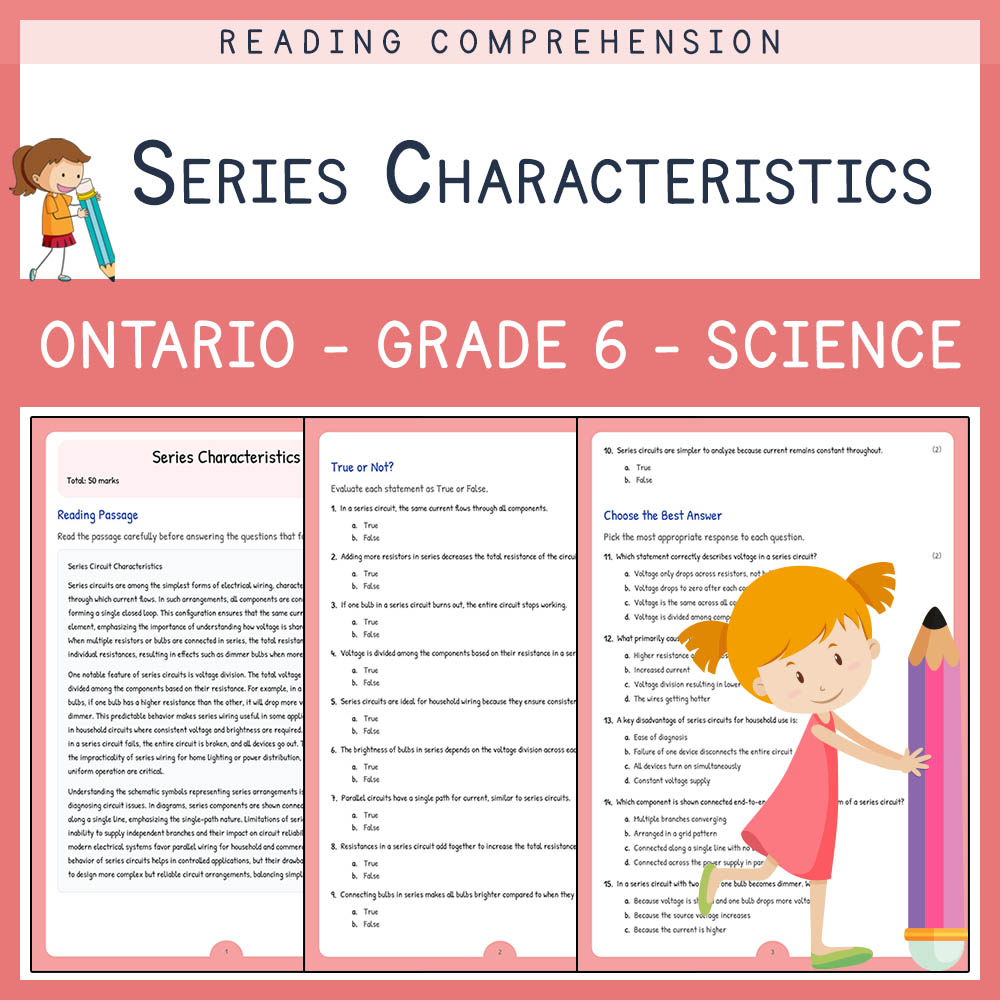
Grade 6 Science | Series Characteristics Worksheet | Electricity & Circuits
Created byLumora LearningLearning Objectives
- Understand the concepts of series circuits, including single-path configuration and current flow.
- Explain how voltage divides among components in a series circuit.
- Describe how resistance affects brightness in incandescent bulbs connected in series.
Also included in: Grade 6 Science | Electricity Unit Custom Bundle | Ontario Framework
Instant download

Grade 5 Science | Plate Movements Worksheet (PDF) | NGSS Aligned
Created byLumora LearningLearning Objectives
- Understand how Earth's lithospheric plates move and interact.
- Identify evidence supporting plate tectonics, such as earthquakes, volcanoes, and ocean trenches.
- Explain different types of plate boundaries and the geological processes they cause.
Instant download
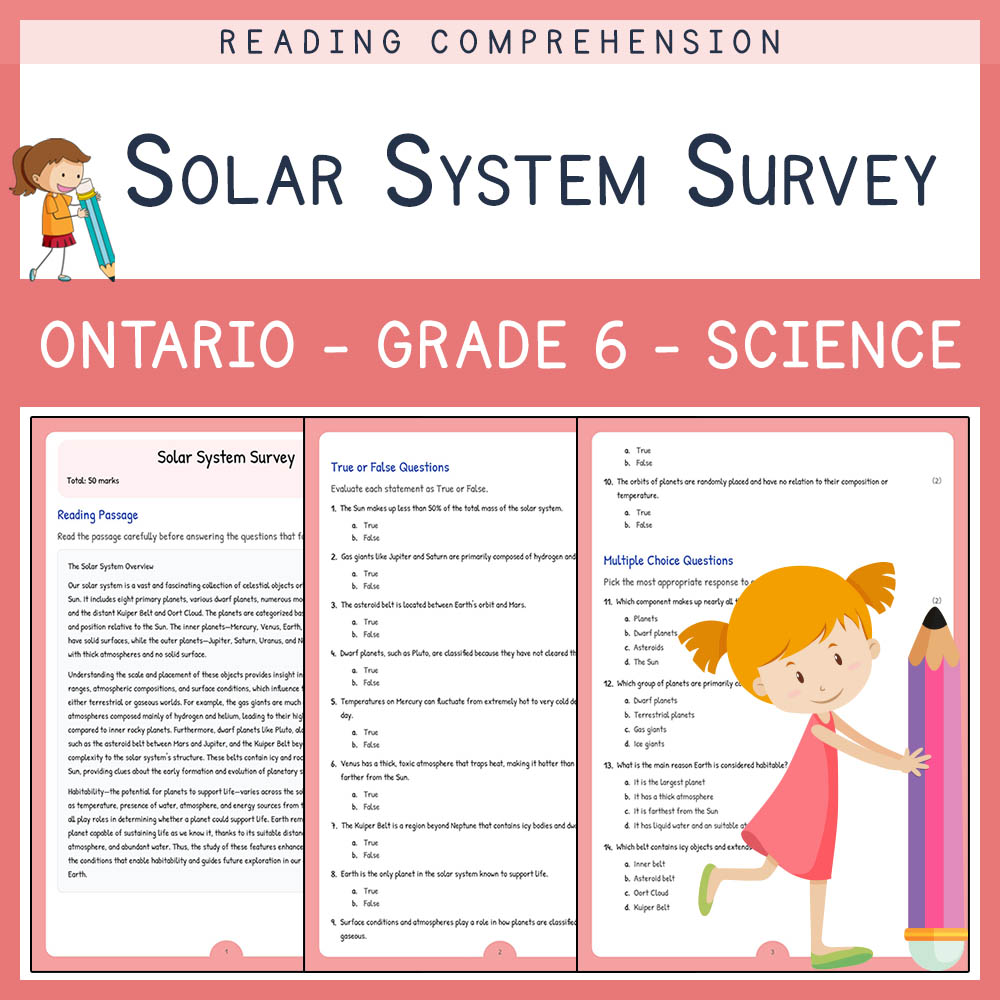
Grade 6 Science | Solar System Survey Worksheet & Answer Key (PDF) | Ontario
Created byLumora LearningLearning Objectives
- Describe the major components of the solar system including planets, dwarf planets, and belts.
- Differentiate between terrestrial planets and gas giants in terms of composition and surface conditions.
- Understand the orbital zones, temperature ranges, and atmospheres that influence planetary classification.
Also included in: Grade 6 | Space Science Lesson Bundle Worksheets | Ontario Framework
Instant download
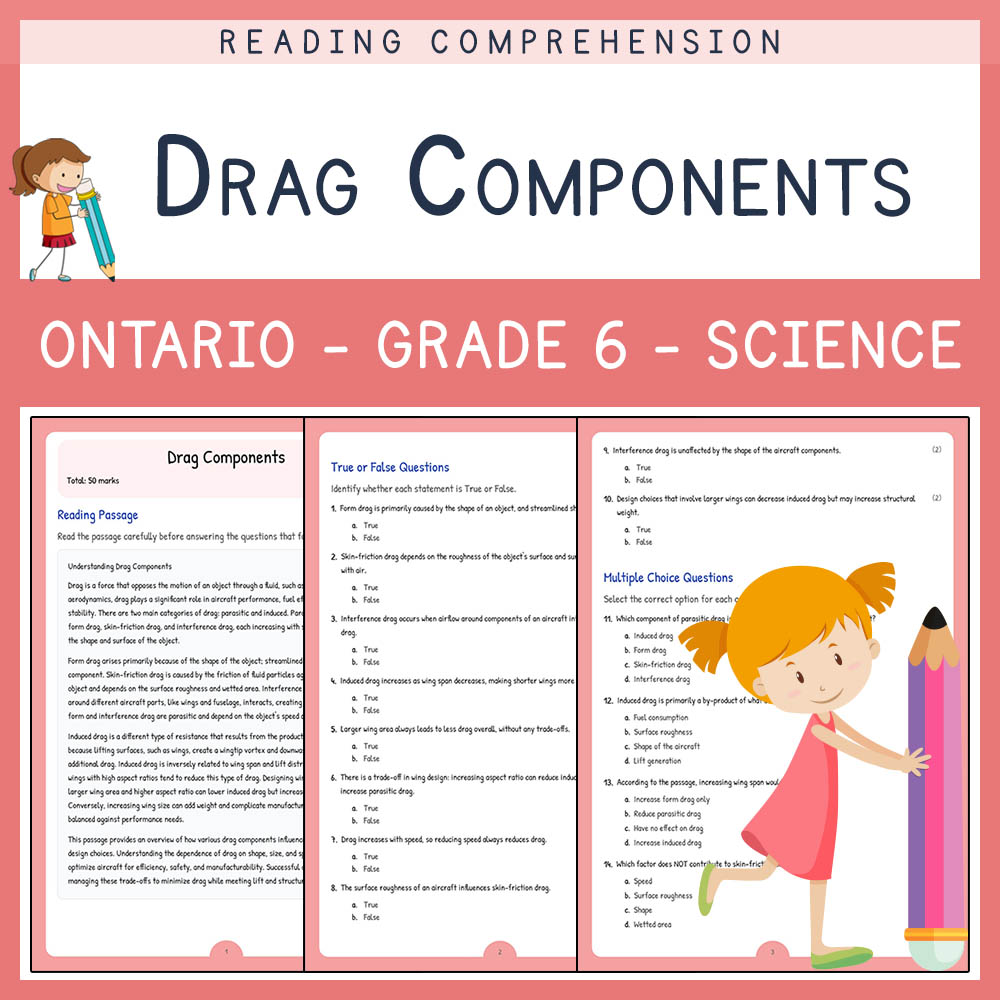
Grade 6 Science | Drag Components Worksheet (PDF + Answer Key)
Created byLumora LearningLearning Objectives
- Understand the different sources of drag in aerodynamics.
- Distinguish between parasitic and induced drag components.
- Explain how shape, speed, and wing design influence drag production.
Also included in: Grade 6 Science | Flight Custom Bundle | Ontario Standards
Instant download
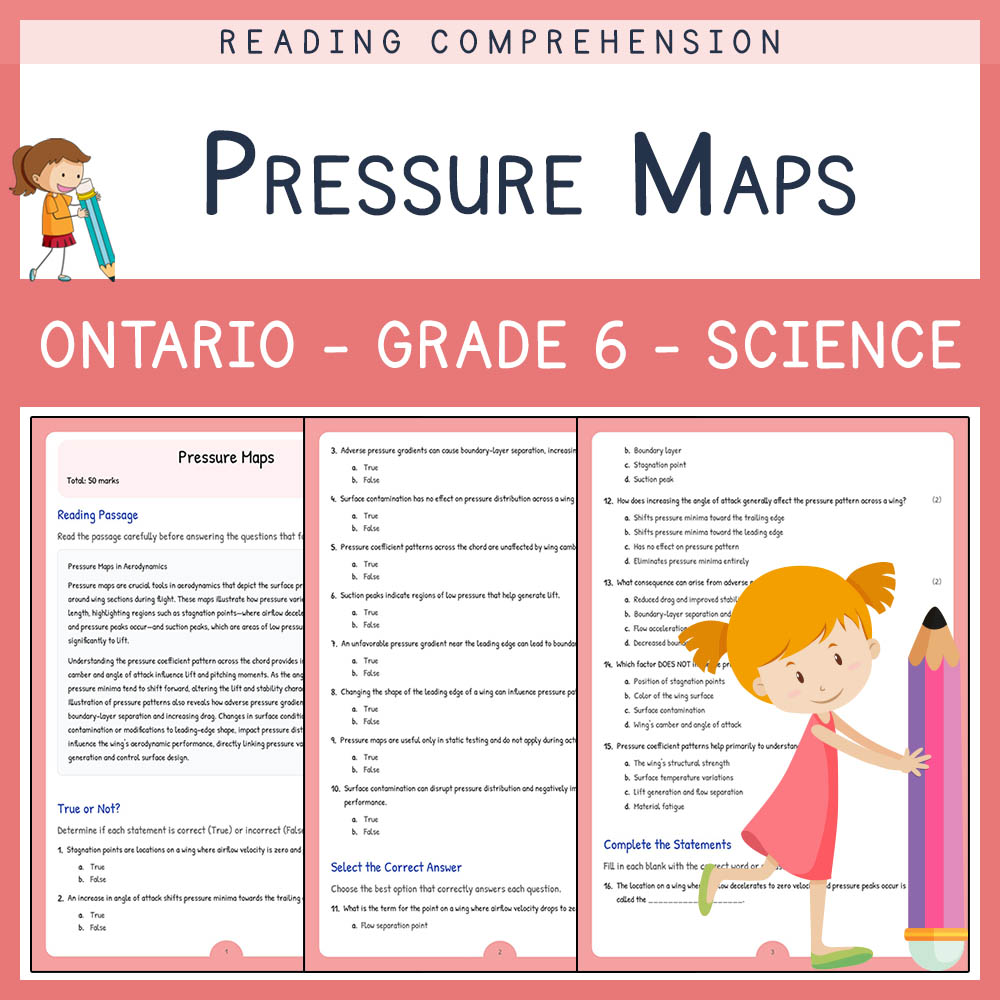
Grade 6 Science | Pressure Maps Worksheet (Answer Key) for Ontario Standards
Created byLumora LearningLearning Objectives
- Explain the concept of surface pressure distribution around wing sections.
- Identify key features such as stagnation points and suction peaks and their significance.
- Describe pressure coefficient patterns across the chord and how they relate to wing shape and angle of attack.
Also included in: Grade 6 Science | Flight Custom Bundle | Ontario Standards
Instant download
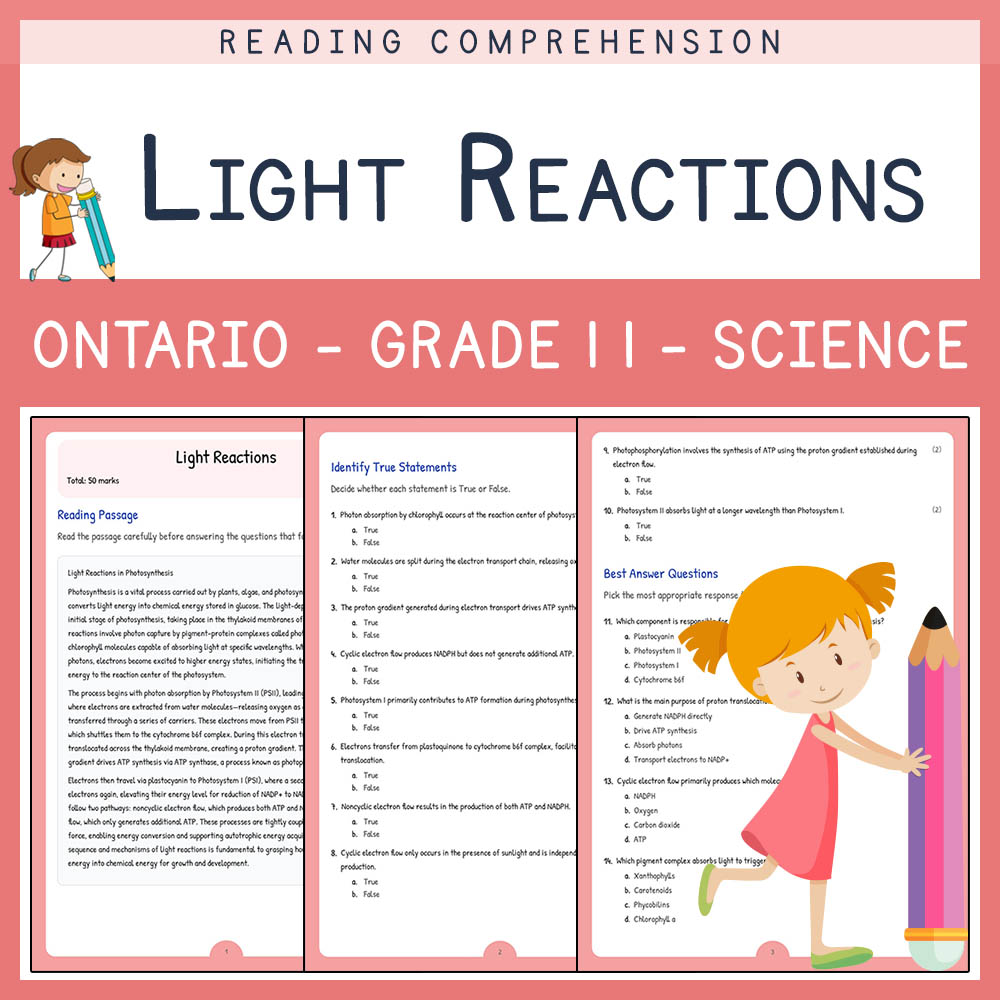
Grade 11 Science Assessment | Light Reactions Worksheet Elena | Ontario
Created byLumora LearningLearning Objectives
- Describe how photon energy is captured and transferred during light reactions.
- Explain the electron transport sequence involving photosystems, plastoquinone, cytochrome b6f, and plastocyanin.
- Identify the processes of proton translocation and photophosphorylation occurring during light reactions.
Instant download

Grade 11 Science | Population Growth Worksheet | TEKS-Aligned
Created byLumora LearningLearning Objectives
- Understand the concepts of exponential and logistic population growth.
- Identify factors that influence population dynamics, including density-dependent and density-independent factors.
- Apply mathematical models to analyze population trends over time.
Instant download

Grade 6 Science | Musculoskeletal System Worksheet | BC Standards
Created byLumora LearningLearning Objectives
- Understand the components and functions of the musculoskeletal system.
- Identify how bones, muscles, and joints work together to support movement.
- Explain the roles of bones as levers and mineral reservoirs.
Instant download
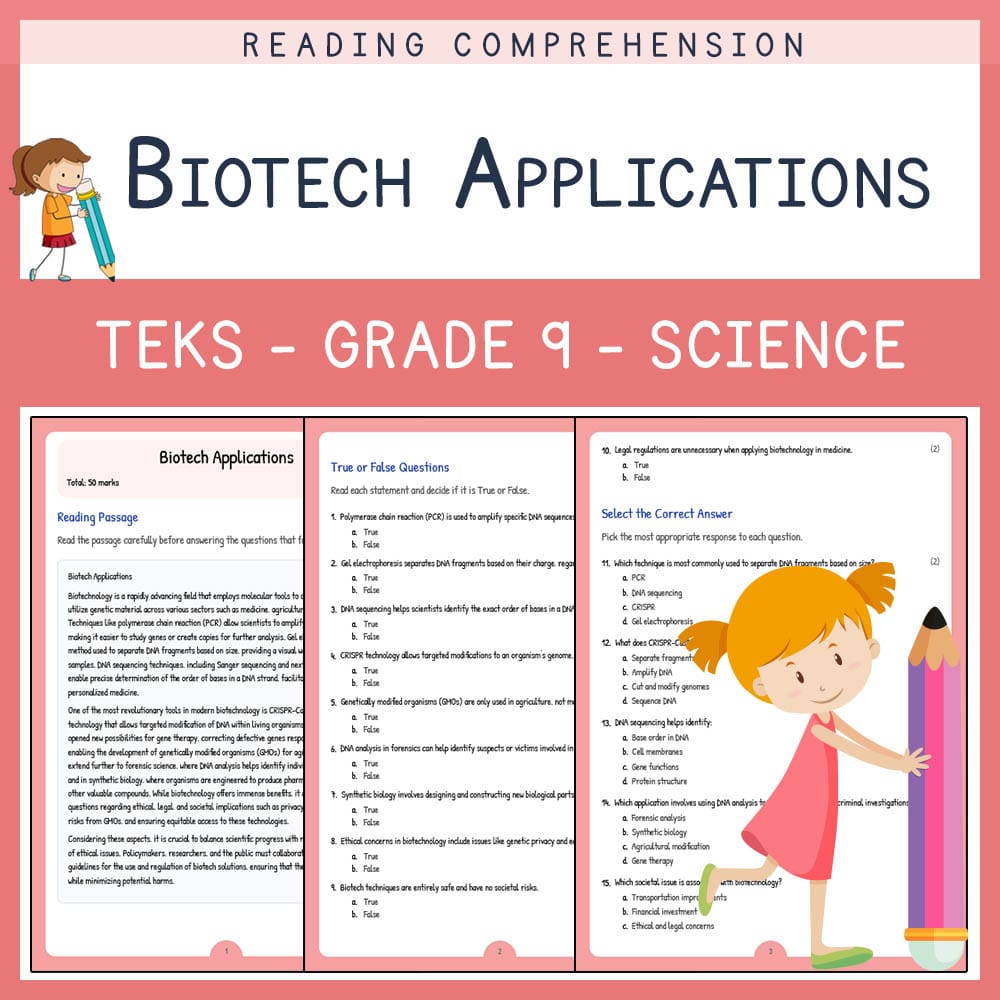
Grade 9 Science | Biotech Applications Worksheet | TEKS Aligned
Created byLumora LearningLearning Objectives
- Explain key molecular techniques used in biotechnology such as PCR, gel electrophoresis, DNA sequencing, and CRISPR genome editing.
- Identify various applications of biotechnology in research, medicine, agriculture, and forensics.
- Discuss ethical, legal, and societal considerations associated with biotechnological advancements.
Also included in: Grade 9 Science | Genetics & Biotechnology Lesson Bundle | TEKS Aligned
Instant download
Browse more categories
About Science Worksheets
Find Science worksheets spanning core skills, practice, and review. All 45,429 resources are instant PDF downloads for the classroom or home.
Every worksheet on MyTeachingSheets is created by independent teacher-authors and reviewed before publication. All resources download as printable PDFs for classroom, homework, or at-home practice, and many include answer keys. Preview any worksheet free before buying.