
Grade 7 Science Worksheets
6,126 worksheets
Innovation History Worksheet | Grade 7 Science Practice
 Created byPrism Point Learning
Learning Objectives
- Explain how inventions become innovations through diffusion and incremental improvements over time.
- Identify factors that enable invention, such as a specific need, available materials, and design choices informed by observation.
- Distinguish innovation from invention by describing cumulative modification across technological lineages.
Also included in: Grade 7 Technology & Engineering Design in Science: Lesson Bundle TEKS
Instant download

Grade 7 Innovation History Science Daily Reading Worksheet | TEKS Activity
 Created byBRIGHT PATH RESOURCES
Learning Objectives
- Identify cause-and-effect relationships in an innovation story.
- Explain how needs, materials, and incremental improvements contribute to innovation.
- Distinguish innovation from invention using a historical example.
Also included in: Engineering Design Grade 7 Science Daily Reading Worksheets Lesson Bundle | TEKS +1 more
Instant download
Grade 7 Science Reading Worksheets | Innovation History TEKS Practice (PDF)
Learning Objectives
- Understand the process of technological innovation and its historical development.
- Identify factors that facilitate invention and innovation across different technological lineages.
- Analyze the causes and diffusion of inventions and innovations over time.
Instant download

Innovation History Worksheet | TEKS Grade 7 Science Practice and Assessment
Learning Objectives
- Differentiate innovation from invention using historical examples and causes of change over time.
- Explain how diffusion and adaptation spread technological ideas across contexts and lead to new versions.
- Describe how empirical observation and design choices work together to produce incremental improvements.
Instant download
Grade 7 Science — History of Innovation Worksheet for Mastery
 Created byThe Resource Hub
Learning Objectives
- Understand the causes and factors that lead to technological inventions and innovations.
- Identify historical examples of inventions and analyze their diffusion and modification over time.
- Distinguish between invention and innovation using real-world examples.
Also included in: Grade 7 Science Unit | Engineering, Technology & Innovation Worksheet Bundle +1 more
Instant download

Population Dynamics Worksheet | Grade 7 Ecology & Ecosystems Activity
Created byPrism Point LearningLearning Objectives
- Explain how births, deaths, immigration, and emigration change population size over time
- Describe limiting factors and how they can slow or speed population growth
- Connect predator-prey relationships to changes (oscillations) in population numbers
Also included in: Grade 7 Evolution, Genetics & Ecosystems Lesson Bundle | Florida NGSSS
Instant download

Science Grade 7 Population Dynamics Worksheet | Standards-Aligned Practice
Learning Objectives
- Explain how population size changes over time due to births, deaths, immigration, and emigration.
- Identify limiting factors that reduce population growth.
- Describe how predator–prey interactions can create oscillations in population numbers.
Also included in: Grade 7 Evolution and Population Dynamics Science Lesson Bundle – Florida NGSSS +1 more
Instant download

Grade 7 Science | Population Dynamics - Daily Reading Comprehension
 Created byCoral Reef Learning
Learning Objectives
- Understand the basic factors influencing population size
- Identify how births, deaths, immigration, and emigration affect populations
- Explore the impact of limiting factors such as resource scarcity and predator-prey relationships
Instant download

Grade 7 Science | Population Dynamics Worksheet | NGSSS Aligned
 Created byLumora Learning
Learning Objectives
- Explain how births, deaths, immigration, and emigration affect population size over time
- Describe limiting factors and carrying capacity in population growth
- Use predator–prey relationships to explain population oscillations
Instant download

Grade 7 Population Dynamics Science Worksheet | Florida NGSSS + Answer Key
 Created byEvergreen Desk Education
Learning Objectives
- Explain how births, deaths, immigration, and emigration change population size over time
- Describe how limiting factors and carrying capacity affect population growth
- Use predator-prey and resource competition ideas to predict patterns in population sizes
Instant download

Grade 7 Population Dynamics Worksheet | NGSS Practice PDF
 Created byClear Sky Classroom
Learning Objectives
- Explain how births, deaths, immigration, and emigration change population size over time.
- Describe limiting factors and how competition for resources affects population growth.
- Use predator–prey relationships and resource availability to interpret changes in population size.
Instant download

Grade 7 Science – Population Dynamics & Ecosystem Changes | Reading Worksheet
 Created byBright Mind Resources
Learning Objectives
- Understand what population dynamics are and the factors influencing them
- Identify different processes that change population size
- Analyze the role of resources and ecosystems in population changes
Also included in: Populations & Traits Grade 7 Science Daily Reading Lesson Bundle | Florida NGSSS +1 more
Instant download

Grade 7 Science Equilibrium Worksheet | NGSS Forces & Balanced Systems
 Created byNorthstar Worksheets
Learning Objectives
- Explain equilibrium as the condition where the net force is zero.
- Differentiate static equilibrium from dynamic equilibrium using acceleration and motion.
- Identify examples of balanced forces, including normal and gravitational forces and tension.
Also included in: Grade 7 Science Forces & Motion Lesson Bundle | NGSS Equilibrium & Collisions +1 more
Instant download

Grade 7 Understanding Equilibrium in Science Worksheet | NGSS Activity
Created byBRIGHT PATH RESOURCESLearning Objectives
- Define equilibrium and identify conditions under which it occurs.
- Differentiate between static and dynamic equilibrium.
- Recognize forces such as normal, gravitational, and tension forces acting on objects.
Also included in: Forces & Motion Grade 7 Science Daily Reading Worksheets Lesson Bundle | NGSS +2 more
Instant download
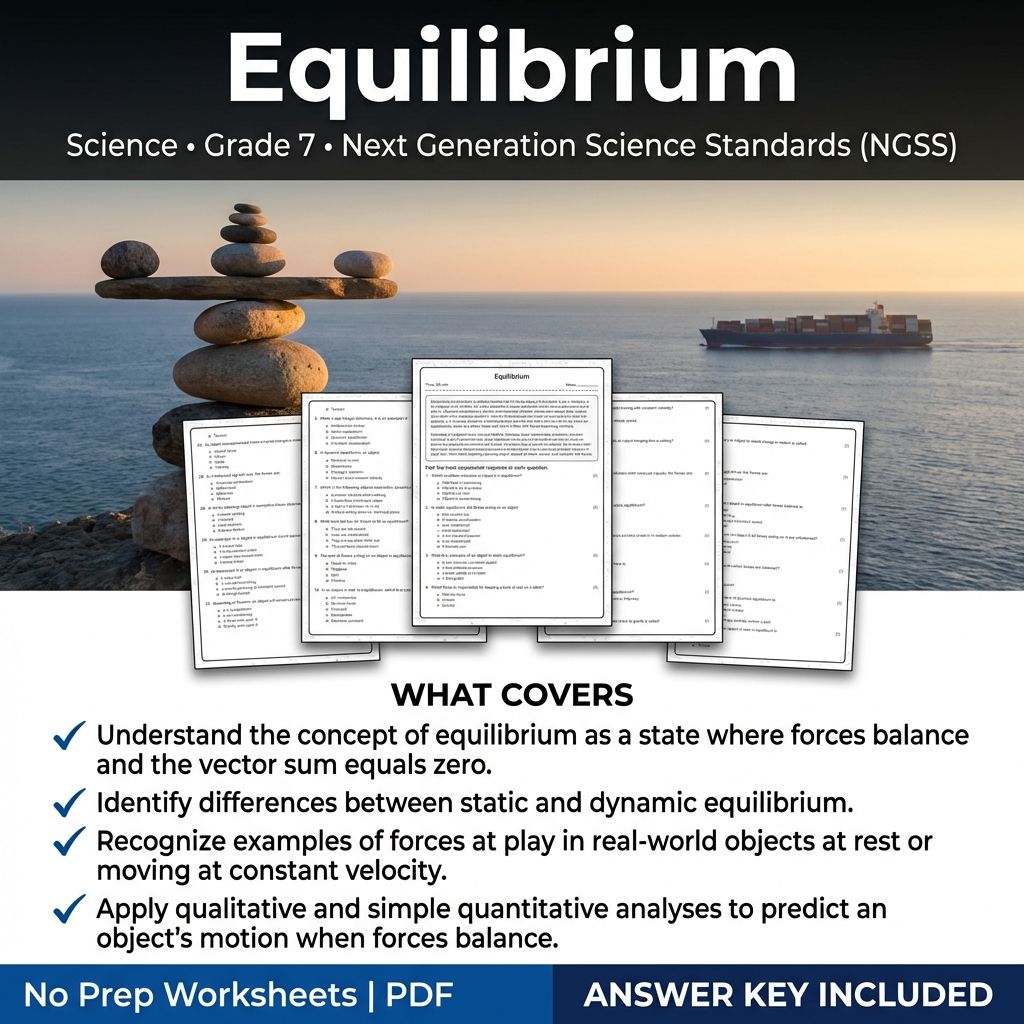
Grade 7 Science Worksheet | Equilibrium Concepts & Practice (PDF + Answer Key)
Created byCoral Reef LearningLearning Objectives
- Understand the concept of equilibrium as a state where forces balance and the vector sum equals zero.
- Identify differences between static and dynamic equilibrium.
- Recognize examples of forces at play in real-world objects at rest or moving at constant velocity.
Instant download
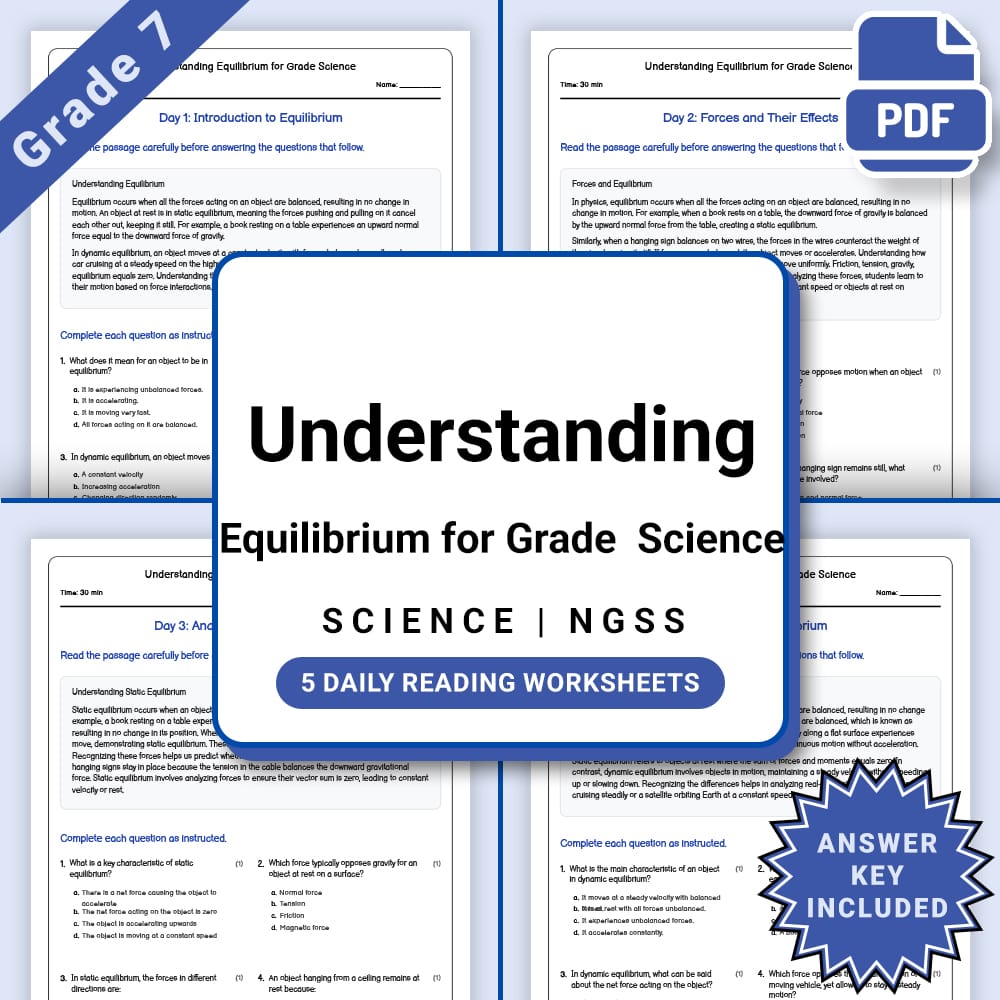
Grade 7 Science – Understanding Equilibrium Worksheet(PDF + Answer Key)
 Created byCopper Leaf Classroom
Learning Objectives
- Define equilibrium and identify its key characteristics.
- Differentiate between static and dynamic equilibrium.
- Recognize forces involved in equilibrium, such as gravity, normal force, and tension.
Instant download

Grade 7 Equilibrium Forces Worksheet | NGSS Science Activity Pack
 Created byAmber Owl Education
Learning Objectives
- Explain equilibrium as the condition where the vector sum of forces equals zero
- Differentiate static equilibrium from dynamic equilibrium using acceleration and velocity
- Analyze forces such as weight, normal force, and tension to predict an object’s motion
Also included in: Grade 7 Science Forces and Motion Lesson Bundle – NGSS Worksheets +1 more
Instant download

Science: Equilibrium of Forces Worksheet | NGSS Grade 7 Science Assessment
 Created bySkylark Worksheets
Learning Objectives
- Explain equilibrium as the condition where the vector sum of forces on an object is zero.
- Distinguish between static equilibrium and dynamic equilibrium using evidence from motion.
- Identify how normal force, gravitational force, and tension can combine to produce net zero acceleration.
Also included in: Grade 7 Forces & Motion Science Lesson Bundle: NGSS Worksheets +1 more
Instant download

Grade 7 Science | Equilibrium in Physics - Daily Reading Comprehension
Created byCoral Reef LearningLearning Objectives
- Define equilibrium as the state where the net force on an object is zero.
- Differentiate between static and dynamic equilibrium.
- Identify forces such as normal, gravitational, and tension in objects at equilibrium.
Instant download

Grade 7 Equilibrium Worksheet | NGSS Practice PDF
Created byClear Sky ClassroomLearning Objectives
- Understand the concept of equilibrium as the balance of forces resulting in constant velocity or rest.
- Identify the differences between static and dynamic equilibrium.
- Apply qualitative and simple quantitative analyses to predict outcomes of objects at rest or moving uniformly.
Also included in: Grade 7 Net Force, Interactions, Collisions Science Lesson Bundle (NGSS) +1 more
Instant download
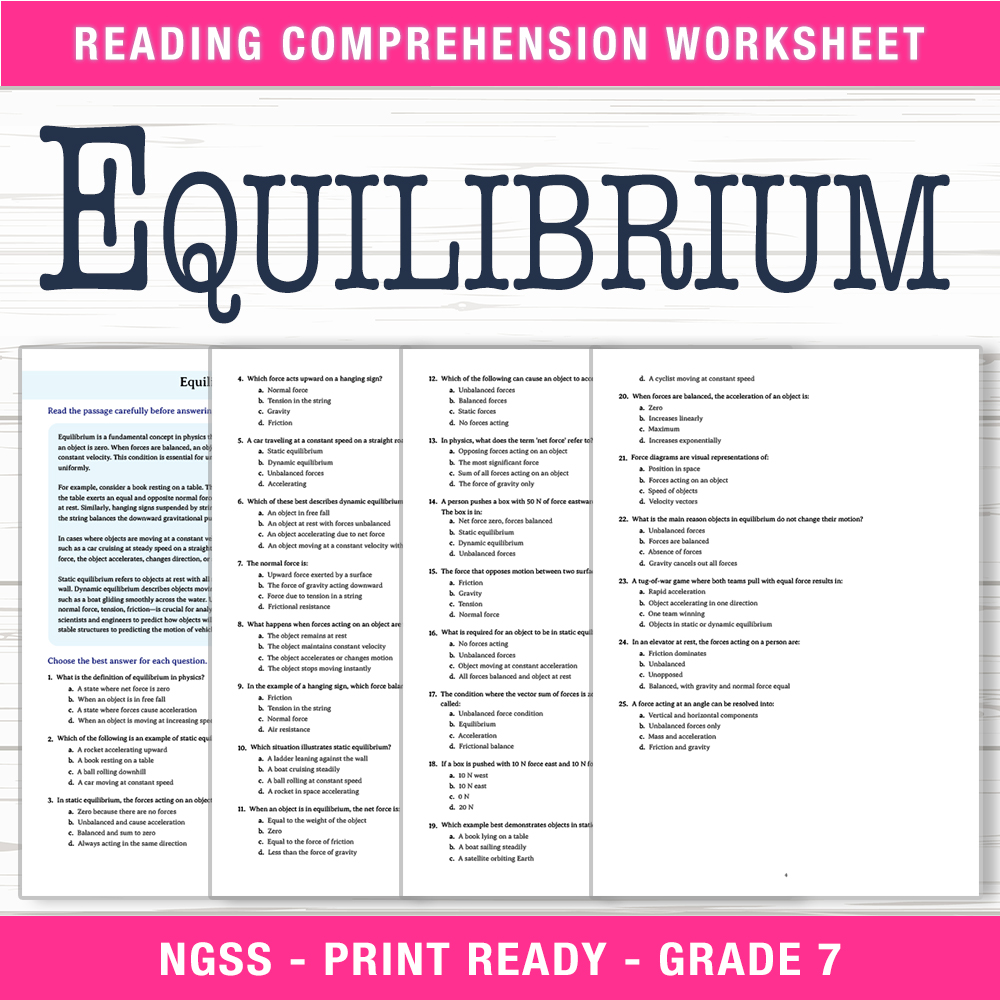
Grade 7 Science – Equilibrium Worksheet (PDF + Answer Key)
 Created byRiverstone Classroom
Learning Objectives
- Describe the concept of equilibrium as the balance of forces acting on an object.
- Differentiate between static and dynamic equilibrium with real-world examples.
- Apply qualitative and simple quantitative analyses to determine if forces are balanced in various situations.
Instant download

Balanced Forces & Equilibrium Worksheets | Grade 7 Science
 Created bythe curious pencil
Learning Objectives
- Explain equilibrium using the vector sum of forces.
- Distinguish static equilibrium from dynamic equilibrium.
- Identify balanced gravity, normal force, and tension.
Also included in: Motion and Stability Grade 7 Science Worksheets | NGSS Forces Bundle +2 more
Instant download
Grade 7 Science – Equilibrium Concept Worksheet (NGSS Aligned) (PDF)
Created byBright Mind ResourcesLearning Objectives
- Understand the concept of equilibrium as the balance of forces acting on an object.
- Differentiate between static and dynamic equilibrium.
- Identify forces involved in equilibrium such as gravity, normal force, tension, and net zero acceleration.
Instant download

Forces and Equilibrium Worksheets: Static & Dynamic Systems Grade 7
 Created byTeachers Club
Learning Objectives
- Describe equilibrium using a vector sum of forces equal to zero
- Differentiate static and dynamic equilibrium using net force
- Relate net force and acceleration to motion outcomes
Also included in: Grade 7 Science Worksheets NGSS Forces and Motion Bundle +2 more
Instant download

Equilibrium Practice Worksheet | Grade 7 Science NGSS Review
Created byPrism Point LearningLearning Objectives
- Explain equilibrium as a condition where the vector sum of forces is zero, resulting in constant velocity or rest
- Differentiate static equilibrium and dynamic equilibrium using examples involving normal and gravitational forces
- Use qualitative reasoning to predict how motion changes when net force and net acceleration are (or are not) zero
Also included in: Grade 7 Forces & Interactions Science Lesson Bundle for NGSS Review
Instant download
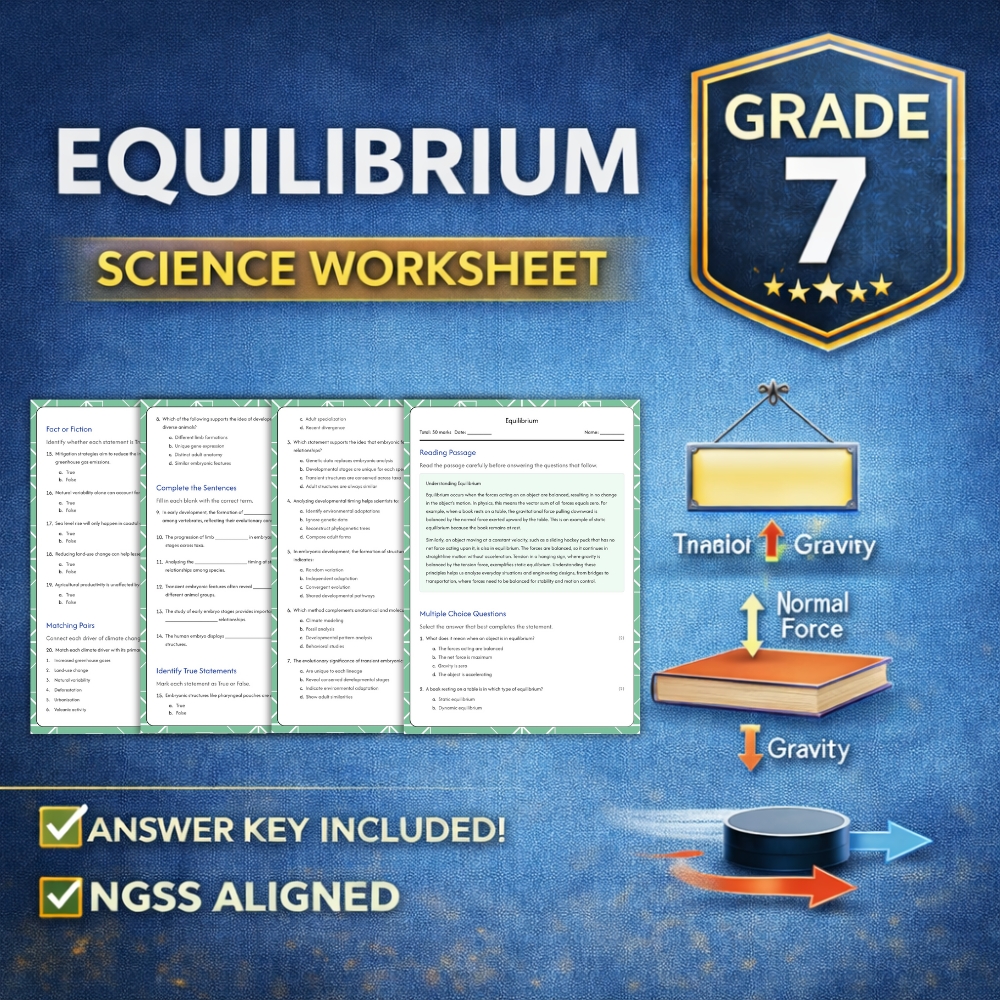
7th Grade Science | Equilibrium Worksheet (NGSS) with Answer Key
 Created byCedar Grove Learning
Learning Objectives
- Describe the concept of equilibrium as a state where forces balance and the vector sum of forces equals zero.
- Differentiate between static and dynamic equilibrium using real-world examples.
- Analyze forces such as normal force, gravitational force, tension, and their roles in maintaining equilibrium.
Instant download
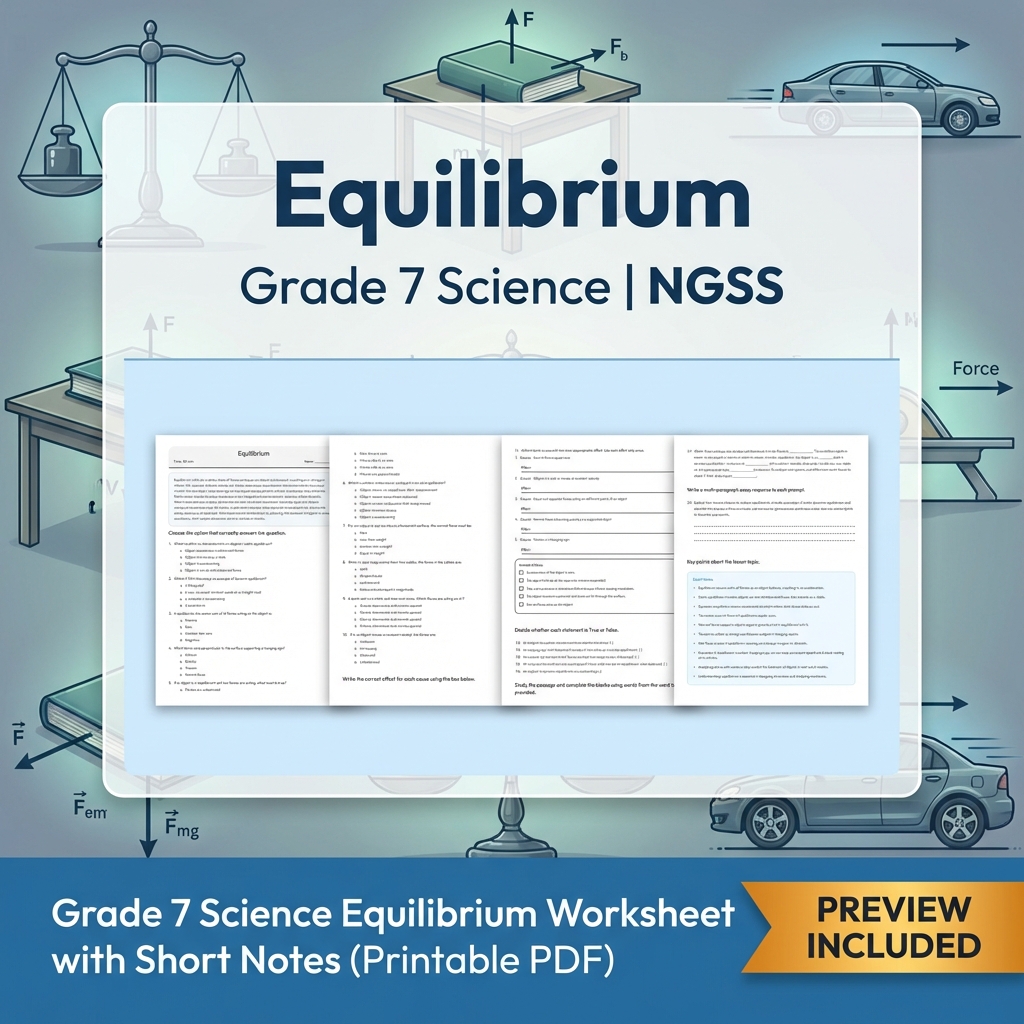
Grade 7 Science Equilibrium Worksheet with Short Notes (Printable PDF)
 Created byMeadowlark Worksheets
Learning Objectives
- Understand the concept of forces in equilibrium and how they balance to produce constant velocity or rest.
- Identify the differences between static and dynamic equilibrium in various scenarios.
- Apply qualitative and simple quantitative analyses to predict outcomes of objects at rest or moving uniformly.
Also included in: Grade 7 Science | Motion and Stability Forces & Interactions NGSS Unit Bundle +1 more
Instant download

Equilibrium Grade 7 Science Worksheet | NGSS-Aligned Assessment & Practice
Learning Objectives
- Understand the concept of equilibrium as the state where forces balance and the vector sum of forces equals zero.
- Differentiate between static and dynamic equilibrium in various physical situations.
- Identify and analyze forces such as normal force, gravitational force, tension, and their role in achieving equilibrium.
Also included in: Grade 7 Forces and Interactions Science Lesson Bundle: NGSS Practice Set +1 more
Instant download
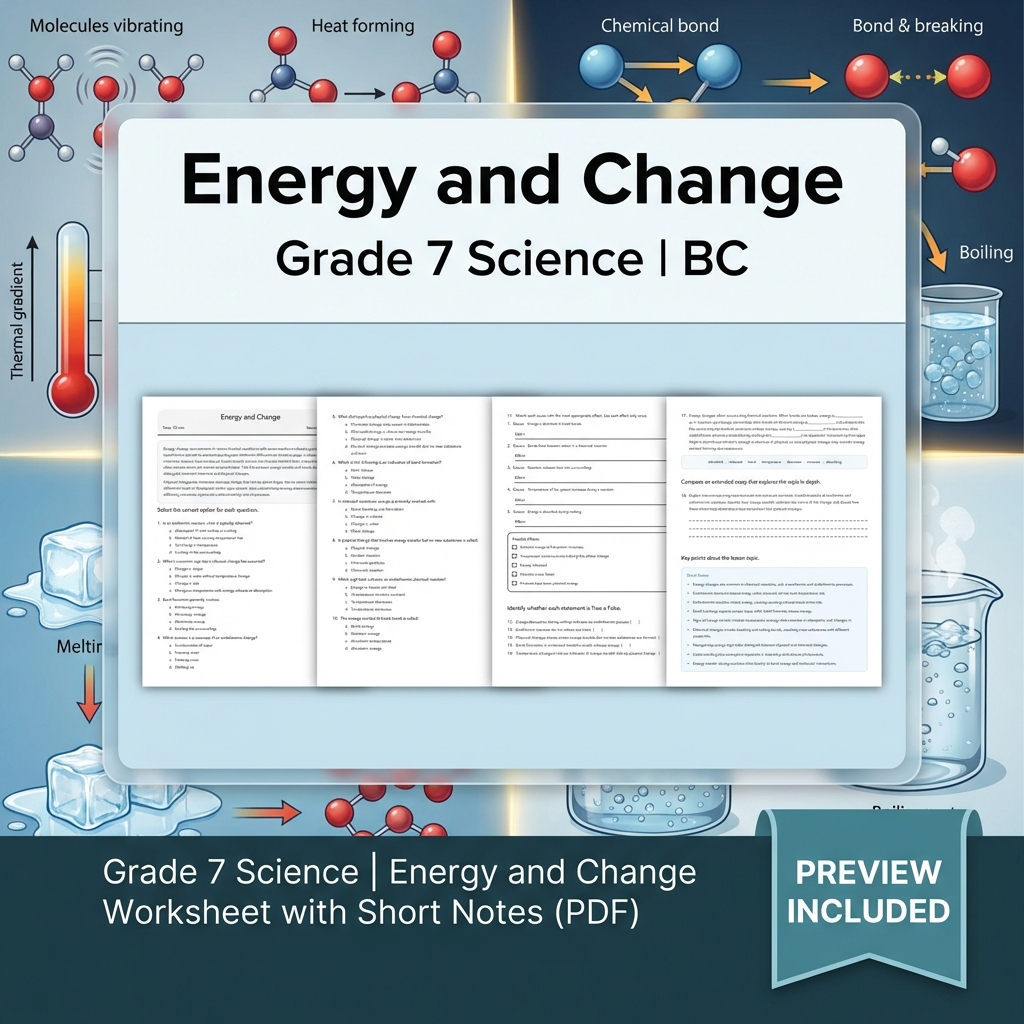
Grade 7 Science | Energy and Change Worksheet with Short Notes (PDF)
Created byMeadowlark WorksheetsLearning Objectives
- Understand how energy changes occur during chemical reactions, including exothermic and endothermic processes.
- Recognize signs of energy transfer in physical and chemical changes.
- Explain the relationship between energy exchange and bond breaking/formation.
Also included in: Grade 7 Science Lesson Bundle | BC Framework on Matter & Reactions Worksheets +1 more
Instant download
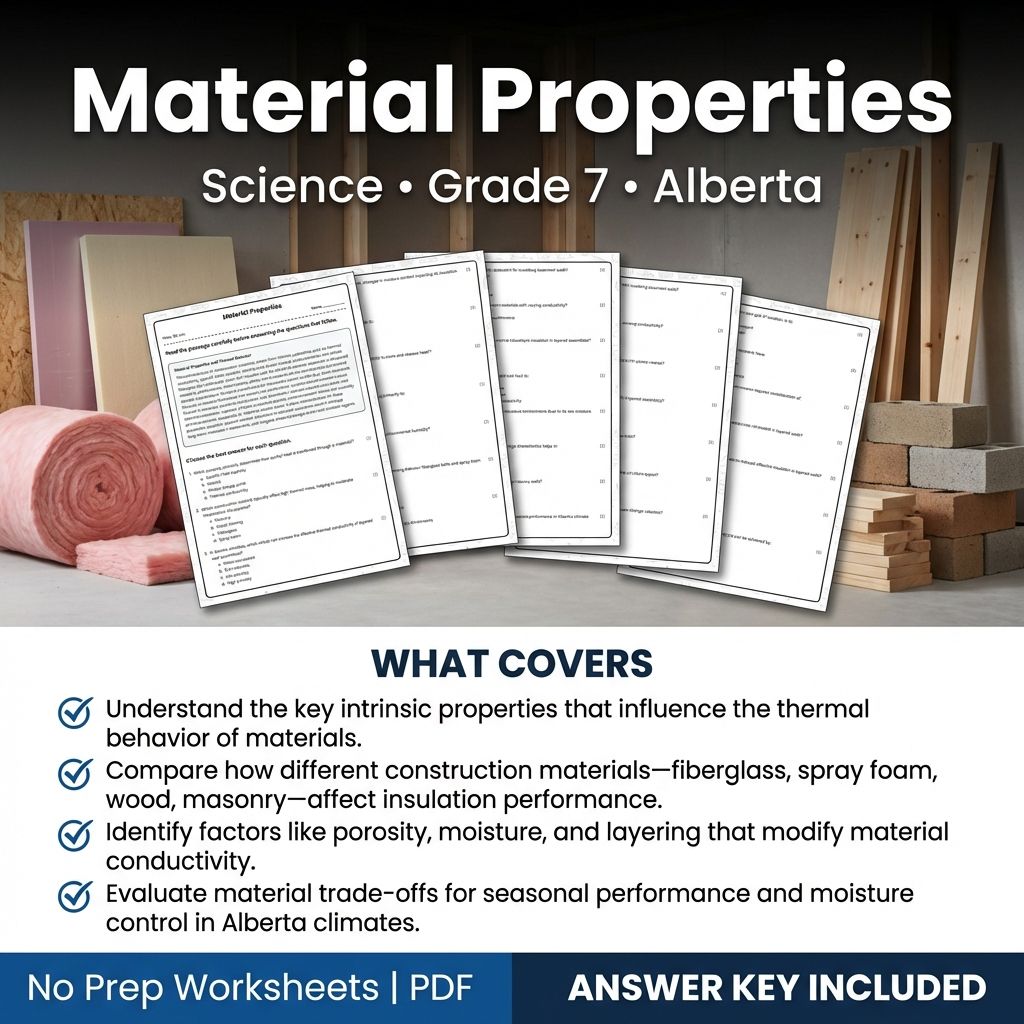
Grade 7 Science Worksheet on Material Properties | Alberta Standard
Created byCoral Reef LearningLearning Objectives
- Understand the key intrinsic properties that influence the thermal behavior of materials.
- Compare how different construction materials—fiberglass, spray foam, wood, masonry—affect insulation performance.
- Identify factors like porosity, moisture, and layering that modify material conductivity.
Instant download
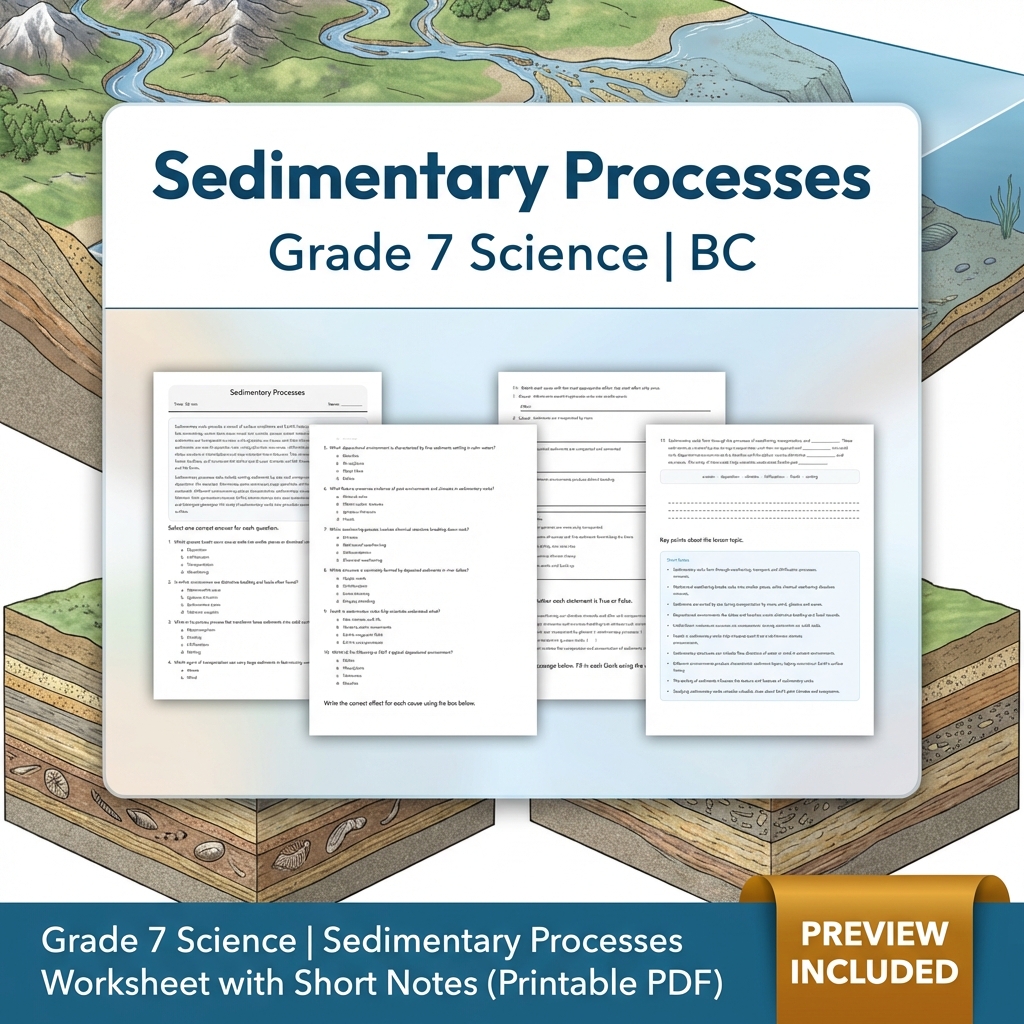
Grade 7 Science | Sedimentary Processes Worksheet with Short Notes (PDF)
Created byMeadowlark WorksheetsLearning Objectives
- Understand the stages involved in the formation of sedimentary rocks.
- Identify different types of weathering and depositional environments.
- Describe how sediments are transported and transformed into rock.
Also included in: Grade 7 Science Lesson Bundle | Earth Processes Worksheets Group +1 more
Instant download
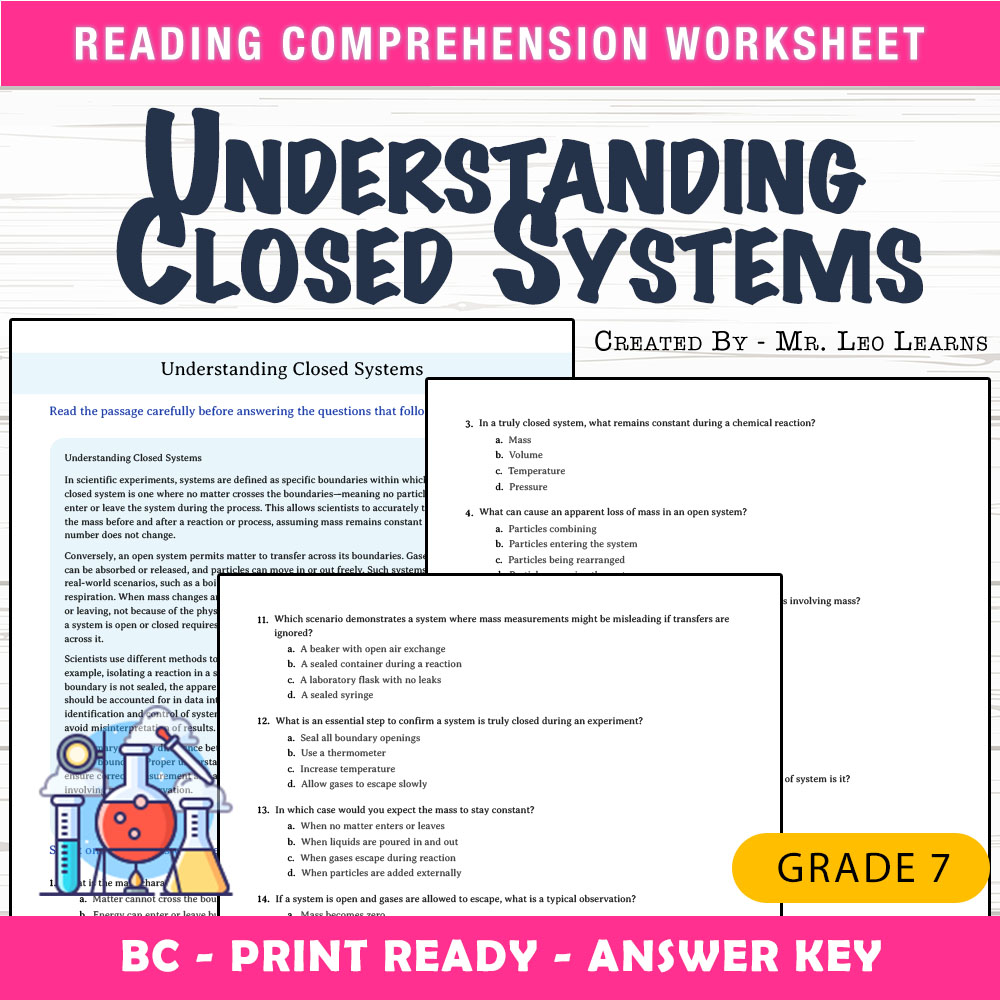
Grade 7 Science — Understanding Closed Systems Worksheet for Mastery
Created byThe Resource HubLearning Objectives
- Explain the difference between closed and open systems in terms of matter transfer.
- Identify the effects of system boundaries on mass conservation.
- Analyze real-world examples of closed and open systems in scientific processes.
Also included in: Grade 7 Science | Matter & Chemical Change Worksheet Bundle – BC Framework +1 more
Instant download
Grade 7 Science – Animal Migration | Daily Reading Worksheet + Answer Key
Learning Objectives
- Understand the main reasons animals migrate
- Identify common migration examples
- Analyze how migration impacts ecosystems and biodiversity
Also included in: Grade 7 Science Lesson Group Bundle | Ecology, Environment & Sustainability +1 more
Instant download

Grade 7 Science – Cited Scientific Reasoning & Data Analysis Reading Worksheet
Created byBright Mind ResourcesLearning Objectives
- Understand how to interpret data and observations to support scientific claims
- Identify specific data points that strengthen or weaken scientific arguments
- Explain how evidence leads to conclusions in scientific reasoning
Also included in: Scientific Models & Evidence Grade 7 Science Reading Lesson Bundle | General +1 more
Instant download

Grade 7 Habitat Fragmentation Worksheet | BC Practice & PDF
Created byClear Sky ClassroomLearning Objectives
- Explain how habitat fragmentation divides ecosystems into isolated patches and how this affects species interactions and populations.
- Describe edge effects and their impacts on microclimate, predation risk, and invasive species.
- Evaluate how connectivity (corridors and gene flow) can reduce extinction risk and support ecosystem resilience.
Instant download
Grade 7 Science | Biotic Interactions Reading Worksheet & Answer Key (PDF)
Learning Objectives
- Understand different types of biotic interactions such as predation, competition, mutualism, commensalism, and parasitism.
- Explain how human actions can disrupt biotic relationships and affect ecosystems.
- Analyze the effects of biotic interactions on community structure and biodiversity.
Instant download

Thermal Basics Worksheet | Grade 7 Science Activities
Created byPrism Point LearningLearning Objectives
- Explain how temperature relates to average kinetic energy and how heat relates to energy transfer.
- Describe how heat moves from warmer to cooler objects through conduction, convection, and radiation.
- Use Alberta winter/practice examples to connect thermal transfer to real-world situations.
Instant download

Calorimetry Basics Worksheet | Grade 7 Science Activities
Created byPrism Point LearningLearning Objectives
- Explain how calorimetry uses temperature change to determine energy transfer.
- Apply the idea of energy conservation to heat gained or lost by substances.
- Use specific heat concepts to compare heating, cooling, melting, and thermal losses.
Instant download
Grade 7 Science – Closed Systems Worksheet (Answer Key) | BC Standards
Created byBright Mind ResourcesLearning Objectives
- Understand the difference between closed and open systems regarding matter transfer.
- Recognize the importance of system boundaries in interpreting mass during reactions.
- Identify examples of closed and open systems in real-world scenarios.
Instant download
Grade 7 Science – Phase Changes Daily Reading Worksheet + Answer Key
Learning Objectives
- Describe the processes of melting and freezing.
- Identify the energy transfer involved in phase changes.
- Explain how temperature and pressure influence phase transitions.
Also included in: Grade 7 Science Lesson Group Bundle | States, Reactions & Properties +1 more
Instant download
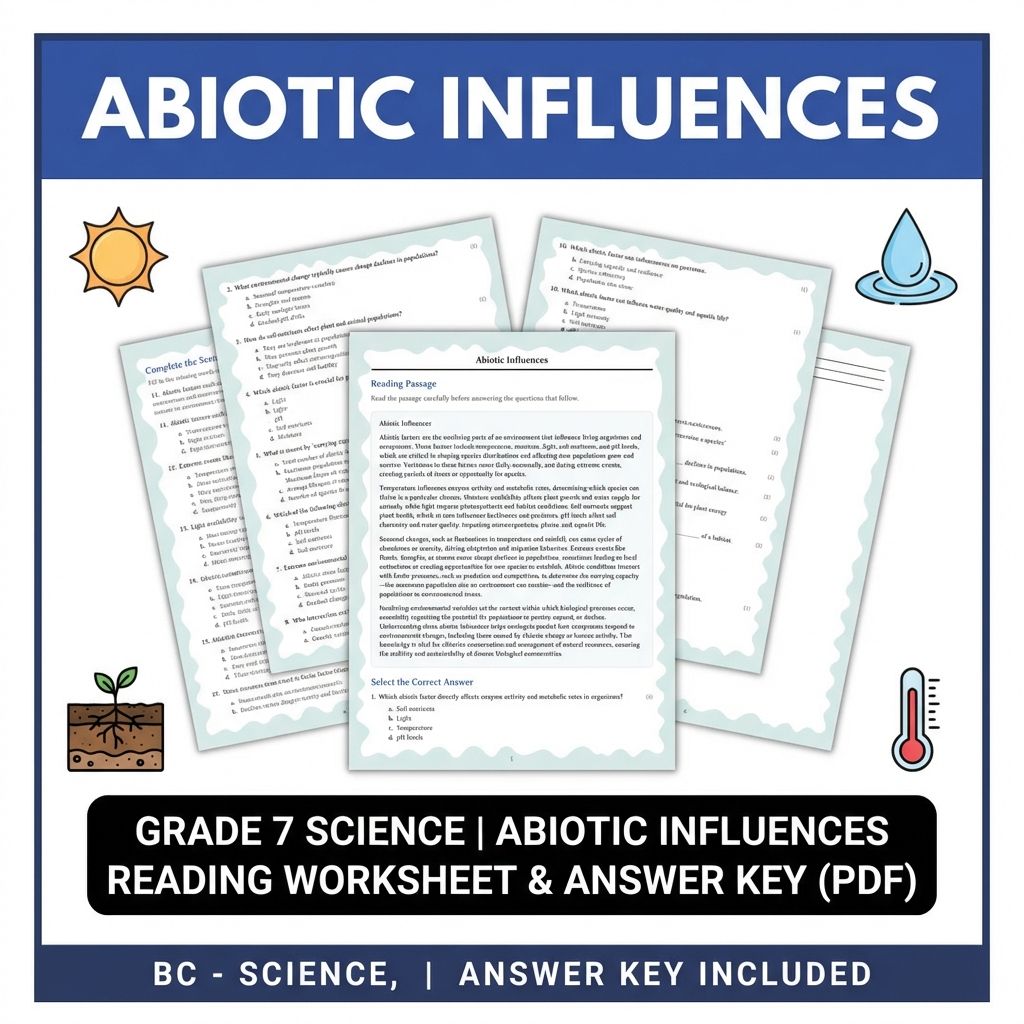
Grade 7 Science | Abiotic Influences Reading Worksheet & Answer Key (PDF)
Learning Objectives
- Understand how abiotic factors such as temperature, moisture, and light affect species distribution.
- Describe the interactions between abiotic conditions and population dynamics.
- Explain how seasonal and extreme environmental changes impact ecosystems.
Instant download

Cited Scientific Reasoning Worksheet | Grade 7 Science Activities
Created byPrism Point LearningLearning Objectives
- Use data and observations to support a scientific claim with specific references.
- Explain why evidence supports a claim using appropriate relationships and units.
- Evaluate alternative explanations by comparing which evidence fits best.
Instant download
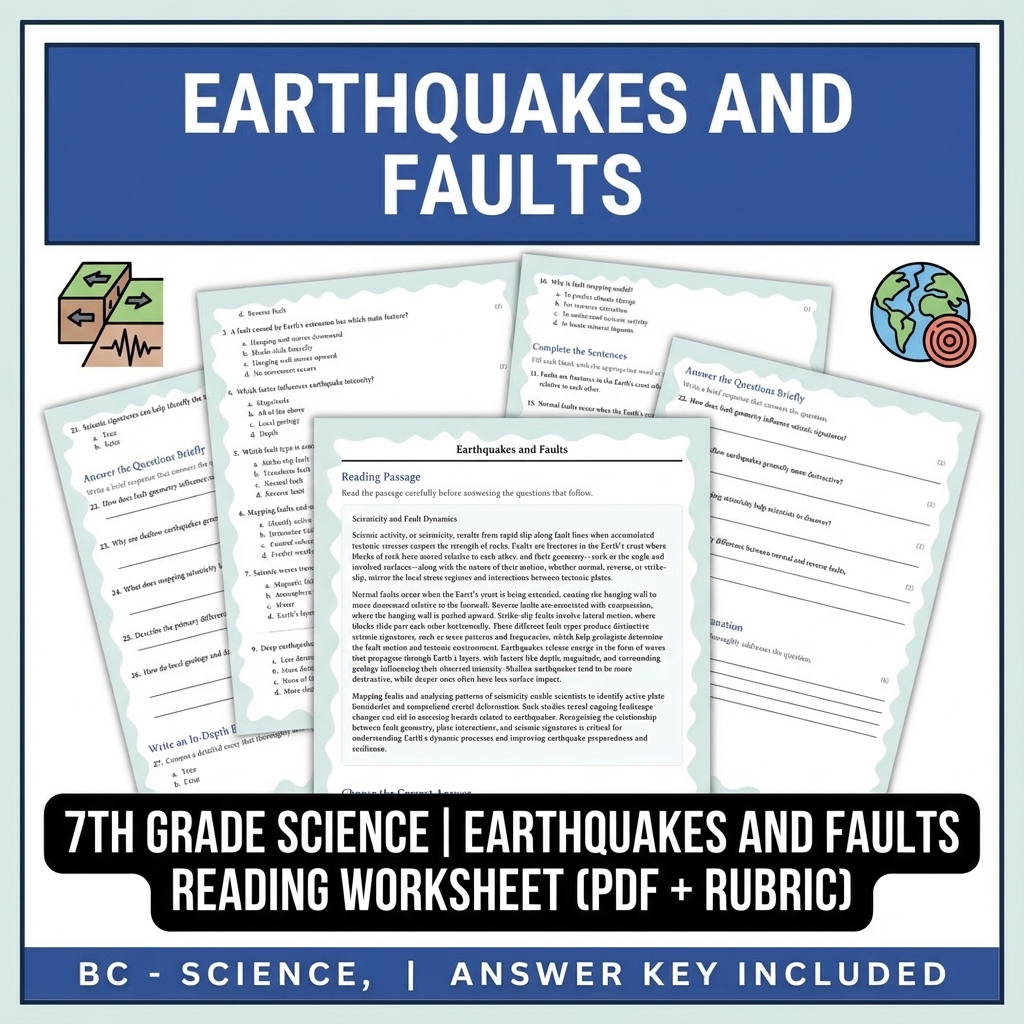
7th Grade Science | Earthquakes and Faults Reading Worksheet (PDF + Rubric)
Learning Objectives
- Understand the causes and types of faults and earthquakes.
- Identify characteristic seismic signatures related to fault motion.
- Explain how fault geometry and local geology influence seismic intensity.
Instant download
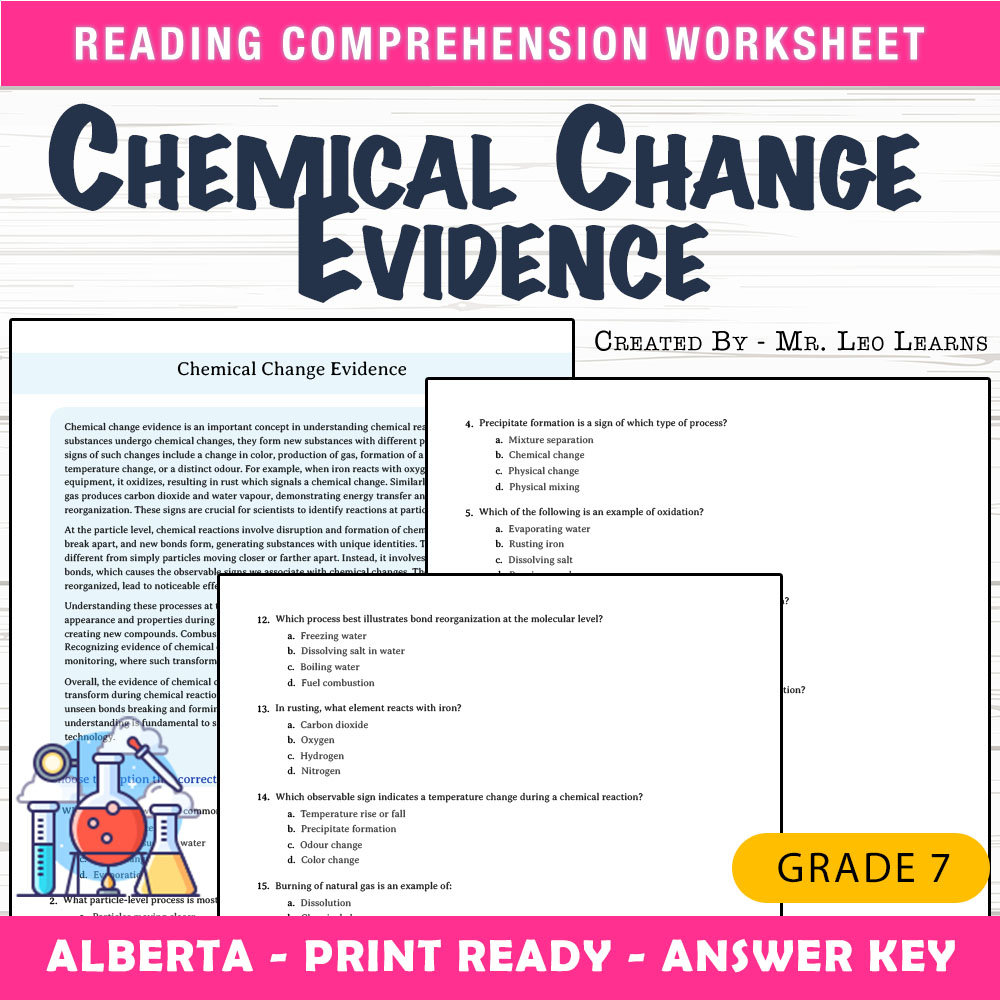
Grade 7 Science — Chemical Change Evidence Worksheet for Mastery
Created byThe Resource HubLearning Objectives
- Identify observable signs of chemical changes such as colour change, gas evolution, and precipitate formation.
- Explain the particle-level interpretation of chemical bonds during chemical reactions.
- Recognize regional examples of chemical change such as oxidation and combustion.
Also included in: Grade 7 Science Alberta Matter and Chemical Change Worksheet Collection +1 more
Instant download

Grade 7 Science | Understanding Phase Changes - Daily Reading Comprehension
Created byCoral Reef LearningLearning Objectives
- Define and identify different phase changes: melting, freezing, vaporization, condensation, sublimation, deposition.
- Understand the role of energy transfer in phase changes.
- Describe how particle arrangement and motion vary during phase changes.
Instant download

Grade 7 Science | Understanding Closed Systems - Daily Reading Comprehension
Created byCoral Reef LearningLearning Objectives
- Define what a closed system is in scientific terms.
- Explain why mass appears to stay constant in a closed system during reactions.
- Distinguish between open and closed systems based on matter transfer.
Instant download

Grade 7 Science | Understanding Sound Perception - Daily Reading Comprehension
Created byCoral Reef LearningLearning Objectives
- Explain how sound waves travel from source to ear
- Identify factors that affect loudness and pitch of sound
- Describe how reflection and absorption influence sound perception
Instant download
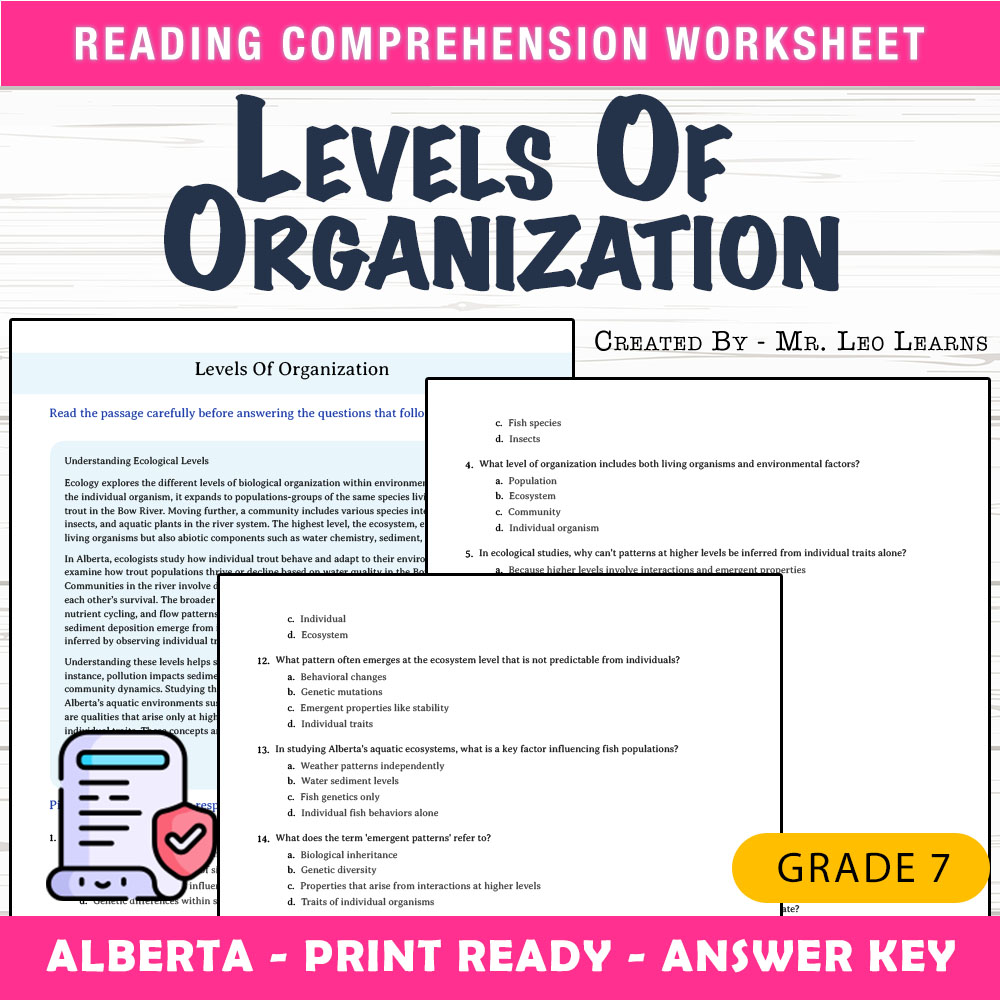
Grade 7 Science — Levels Of Organization Worksheet MCQ Paper
Created byThe Resource HubLearning Objectives
- Understand the different levels of ecological organization from individuals to ecosystems.
- Identify examples of each ecological level using Alberta-specific examples.
- Explain how patterns emerge at higher levels of organization that are not evident in individual traits or behaviors.
Also included in: Grade 7 Science Alberta Ecosystems & Interactions Worksheet Collection +1 more
Instant download
About Grade 7 Science Worksheets
Browse 6,126 printable Grade 7 Science worksheets — ready-to-print PDFs with answer keys where available.
Every worksheet on MyTeachingSheets is created by independent teacher-authors and reviewed before publication. All resources download as printable PDFs for classroom, homework, or at-home practice, and many include answer keys. Preview any worksheet free before buying.