
Science Worksheets
45,429 subject resources
Inheritance Patterns Worksheet | Grade 9 Science Practice
 Created byPrism Point Learning
Learning Objectives
- Explain Mendelian inheritance and predict phenotypic ratios for simple dominant–recessive traits.
- Compare Mendelian and non-Mendelian inheritance patterns (incomplete dominance, codominance, multiple alleles, polygenic traits, sex-linked, imprinting, and mitochondrial transmission).
- Identify how linkage between genes and environmental interactions can change expected inheritance outcomes.
Also included in: Grade 9 Genetics & Biotechnology Lesson Bundle | TeKS Science
Instant download

Health Factors Test Prep Printables | Grade 9 Science
Created byPrism Point LearningLearning Objectives
- Evaluate how lifestyle and environmental factors influence human health at both cellular and system levels.
- Interpret evidence from correlations and propose plausible mechanisms that explain observed health outcomes.
- Explain how sleep, nutrition, physical activity, tobacco exposure, and pollutant inhalation can affect the body through pathways such as oxidative stress, chronic inflammation, and disrupted transport or signaling.
Also included in: Grade 9 Body Systems and Cells Science Ontario Lesson Bundle Test Prep
Instant download

Graphing Motion Worksheet | Grade 7 Science Activities
Created byPrism Point LearningLearning Objectives
- Interpret distance–time and speed–time graphs by relating graph features to motion in real situations.
- Explain how slope and area under a speed–time graph connect to instantaneous and average rates.
- Translate tabulated measurements into graphs and make quantitative conclusions from them.
Instant download

Material Corrosion Worksheet | Grade 8 Science Activities
Created byPrism Point LearningLearning Objectives
- Explain how corrosion involves chemical change and is influenced by environmental factors such as moisture and salts
- Identify evidence of corrosion by describing changes in material properties and new substances formed
- Connect protective strategies (coatings, galvanization, drainage) to how they slow corrosion reactions
Also included in: Grade 8 Matter & Chemical Change Lesson Bundle | Alberta Science
Instant download

Springs And Elasticity Worksheet | Grade 8 Science Practice
Created byPrism Point LearningLearning Objectives
- Explain how elastic forces act when a spring or elastic material is deformed
- Use proportional ideas (force vs. displacement) to describe linear elastic behavior and its limits
- Identify how the restorative direction of elastic forces helps produce overall force balance in mechanical systems
Also included in: Forces, Motion & Energy Lesson Bundle | Grade 8 Science | Alberta
Instant download

Replication Mechanisms Worksheet | Grade 11 Science Practice
Created byPrism Point LearningLearning Objectives
- Explain how origin recognition complexes, helicase, primase, and DNA polymerases coordinate DNA replication with high fidelity.
- Describe roles of Okazaki fragments, DNA ligase, and telomerase in completing DNA replication.
- Distinguish leading vs. lagging strand synthesis and summarize how mismatch repair protects genomic integrity.
Also included in: Genetics & Molecular Biology Lesson Bundle | Grade 11 Science | TEKS
Instant download

pH Fundamentals Worksheet | Grade 11 Science Activities
Created byPrism Point LearningLearning Objectives
- Explain what pH means and how it relates to hydrogen ion concentration and acidity/basicity.
- Use the pH–pOH relationship (at 25°C, pH + pOH = 14) to solve or check chemistry problems.
- Connect pH to real-world effects such as mineral solubility, chemical speciation, and aquatic organism suitability.
Instant download

Electromagnetic Induction Worksheet | Grade 8 Science Activities
Created byPrism Point LearningLearning Objectives
- Explain how changing magnetic flux and relative motion can produce an electromotive force (EMF).
- Describe how an induced current is affected by the rate of change of flux and the number of turns in a coil.
- Connect electromagnetic induction to real systems such as transformers and electrical generators.
Also included in: Grade 8 Science Electricity & Electromagnetism Lesson Bundle | Alberta
Instant download

Planetary Geology Worksheet | Grade 12 Science Practice
Created byPrism Point LearningLearning Objectives
- Compare how impact processes and endogenic activity shape the surfaces of terrestrial planets and icy bodies.
- Explain how internal structure and thermal evolution are inferred from cratering, volcanic, tectonic, and erosion evidence.
- Interpret remote sensing and in situ observations as data used to reconstruct planetary geologic histories.
Also included in: Grade 12 Earth & Space Science Lesson Bundle: TEKS Framework
Instant download

Graph Selection Worksheet | Grade 6 Science Practice
Created byPrism Point LearningLearning Objectives
- Match data types to the most appropriate graph (line, bar, or scatter plot).
- Choose a suitable scale and axis labels to avoid misleading graph impressions.
- Use annotations to highlight important patterns or relationships in data.
Instant download

Titration Curves Worksheet | Grade 11 Science Practice
Created byPrism Point LearningLearning Objectives
- Describe how pH changes as titrant is added during a titration and identify key features of titration curves (initial pH, buffer region, inflection point, equivalence point).
- Compare the shapes of titration curves for strong acid–strong base, weak acid–strong base, and weak base–strong acid systems.
- Use curve features to select appropriate endpoints and interpret titration data in real samples (e.g., natural waters and industrial effluents).
Instant download

Pattern Analysis Worksheet Pack | Grade 6 Science Activities
Created byPrism Point LearningLearning Objectives
- Identify patterns in time-based and space-based data using visual inspection and descriptive statistics.
- Use moving averages and basic seasonal ideas to smooth noise and reveal long-term changes.
- Explain how anomalies can be detected and why environmental drivers may provide plausible explanations.
Instant download

Growth Rings Worksheet | Grade 6 Science Activities
Created byPrism Point LearningLearning Objectives
- Explain how tree growth rings form and what information they can provide about a tree’s age and growth conditions.
- Describe how ring width and ring density can reflect seasonal moisture, temperature, and disturbances such as drought or insect outbreaks.
- Use dendrochronology methods to infer past environmental and climate patterns from growth ring records.
Also included in: Trees and Forests Lesson Bundle | Grade 6 Science | Alberta Framework
Instant download

Evidence Chains Worksheet | CER Reasoning & Scientific Claims AP
Created byPrism Point LearningLearning Objectives
- Explain how evidence chains connect observations, quantitative analysis, and model outputs to explanatory claims
- Evaluate whether evidence is sufficient and consistent across multiple independent measures
- Use graphs and statistical summaries to justify inferences while making assumptions and uncertainties explicit
Instant download

Measurement Fundamentals Worksheet | AP Science Data & Lab Skills
Created byPrism Point LearningLearning Objectives
- Explain how metric units and instrument resolution affect the accuracy of quantitative measurements.
- Describe why calibration and consistent measurement protocols improve reliability and comparability of data.
- Connect measurement uncertainty to evidence, tables, and graphs when making scientific claims.
Instant download

Evidence Communication Worksheet | Grade 6 Science Activities
Created byPrism Point LearningLearning Objectives
- Explain how to turn observations into clear scientific claims supported by evidence.
- Summarize patterns in data using descriptive statistics and appropriate visuals.
- Use science communication conventions, including units and citing data sources.
Instant download

Grade 10 AP Science Circular Motion Worksheet | Physics Practice Pack
Created byPrism Point LearningLearning Objectives
- Explain uniform vs. non-uniform circular motion using angular and linear quantities (ω, f, v, and a).
- Use centripetal acceleration and centripetal force relationships to predict how direction changes create curved paths.
- Distinguish tangential vs. radial components of motion and acceleration in circular movement.
Instant download

Natural Selection Worksheet | Grade 12 Science Activities
Created byPrism Point LearningLearning Objectives
- Explain how environmental pressures change allele frequencies through differential survival and reproduction
- Differentiate patterns of selection (directional, stabilizing, disruptive) and predict their outcomes
- Use examples such as antibiotic resistance to connect natural selection to observable evolutionary change
Also included in: Evolution, Speciation & Genetics Lesson Bundle | Grade 12 Science | BC
Instant download

Light Properties Practice Worksheet | Grade 6 Science BC Review
Created byPrism Point LearningLearning Objectives
- Explain how light can be described using wavelength, frequency, and energy.
- Relate shorter and longer wavelengths to photon energy and typical effects.
- Describe how different materials transmit, absorb, and reflect different colors of light.
Also included in: Energy, Waves & Circuits Lesson Bundle | Grade 6 Science | BC Framework +1 more
Instant download

Momentum Conservation Worksheet | Grade 12 Science Practice
Created byPrism Point LearningLearning Objectives
- Define linear momentum and explain how impulse relates to changes in momentum
- Describe how momentum is conserved in an isolated system and distinguish external forces from internal forces
- Compare elastic and inelastic collisions using momentum conservation and kinetic energy outcomes
Also included in: Waves, Quantum & Electromagnetism Lesson Bundle | Grade 12 Science | BC
Instant download

Mass Conservation Worksheet | Grade 8 Science Activities
Created byPrism Point LearningLearning Objectives
- Explain the conservation of mass for physical and chemical changes in a closed system.
- Use particle and weighing ideas to account for all matter before and after a change.
- Interpret why total mass stays the same when nothing escapes a sealed container.
Also included in: Grade 8 Matter & Chemical Change Lesson Bundle | Alberta Science
Instant download

Population Dynamics Worksheet Practice Test | Grade 11 Science
Created byPrism Point LearningLearning Objectives
- Explain how exponential and logistic growth models differ and identify the role of carrying capacity.
- Interpret demographic parameters (birth rate, death rate, age structure, sex ratio) in population trajectories.
- Describe density-dependent and density-independent factors and predict how they affect population size.
Also included in: Grade 11 Ecology and Sustainability Science Lesson Bundle – Ontario
Instant download

Evaluating Scientific Arguments Worksheet Pack | Grade 12 Science Activities
Created byPrism Point LearningLearning Objectives
- Identify how evidence supports (or fails to support) a scientific claim.
- Evaluate whether uncertainty and limitations are acknowledged in a scientific argument.
- Assess whether controls and comparisons justify the interpretation.
Instant download

Inheritance Patterns Worksheet | Grade 12 Biology Genetics Practice
Created byPrism Point LearningLearning Objectives
- Explain how chromosome segregation during meiosis leads to allele combinations in offspring.
- Use dominance, recessiveness, and Punnett-square reasoning to predict genotype and phenotype outcomes.
- Describe how recombination during sexual reproduction can produce new allele combinations.
Instant download
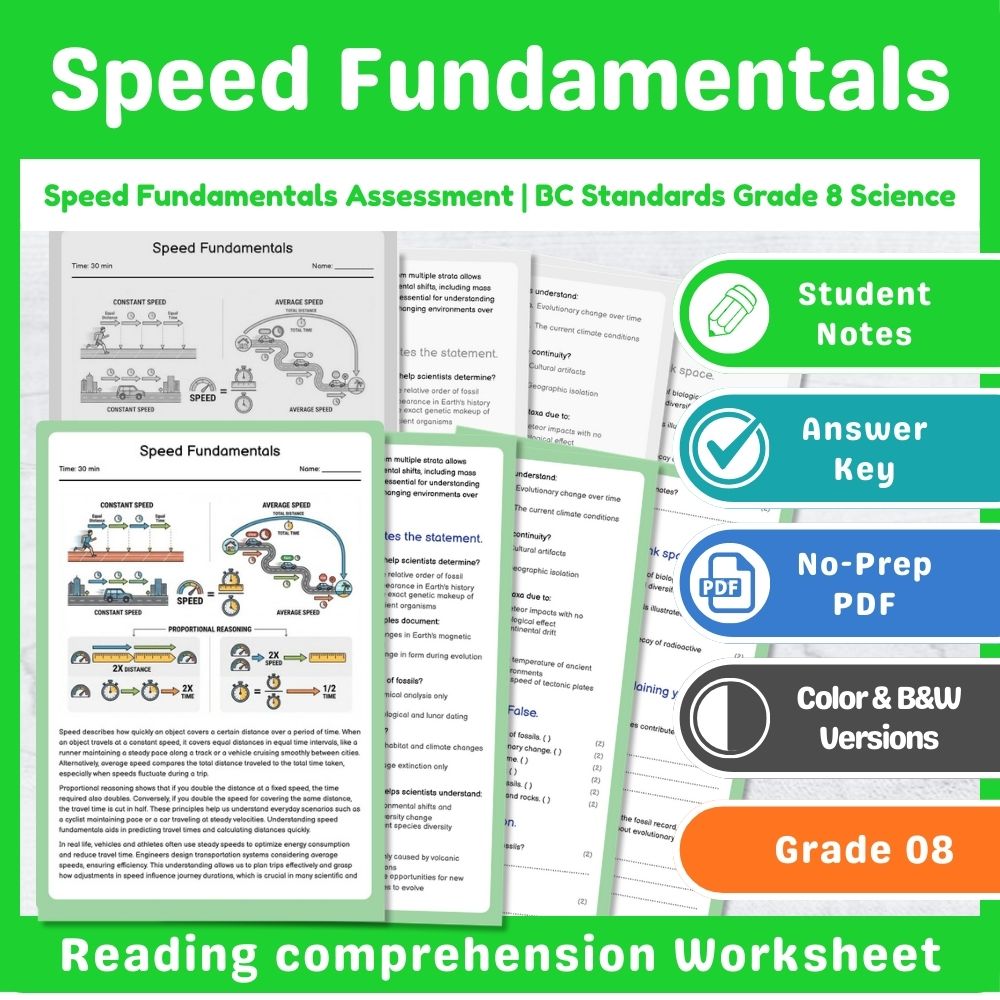
Speed Fundamentals Assessment | BC Standards Grade 8 Science
Created byPrism Point LearningLearning Objectives
- Define speed as the ratio of distance over time.
- Differentiate between constant and average speed.
- Apply proportional reasoning to solve speed, distance, and time problems.
Instant download

Physiological Regulation Assessment for Grade 11 Science TEKS
Created byPrism Point LearningLearning Objectives
- Describe the mechanisms involved in maintaining internal stability in the human body.
- Explain the roles of sensors, control centers, and effectors in physiological regulation.
- Identify examples of negative and positive feedback mechanisms in human physiology.
Also included in: Grade 11 Homeostasis & Human Body Systems Science: Lesson Bundle TEKS
Instant download

Hydrologic Cycle Assessment for Grade 10 Science | Alberta Standards
Created byPrism Point LearningLearning Objectives
- Explain the processes involved in the hydrologic cycle including evaporation, transpiration, condensation, and runoff.
- Describe water movement from mountain snowpack to regional aquifers and rivers.
- Analyze how climate variability and watershed characteristics affect regional water resources.
Also included in: Grade 10 Earth and Space Systems Science Lesson Bundle for Alberta +1 more
Instant download
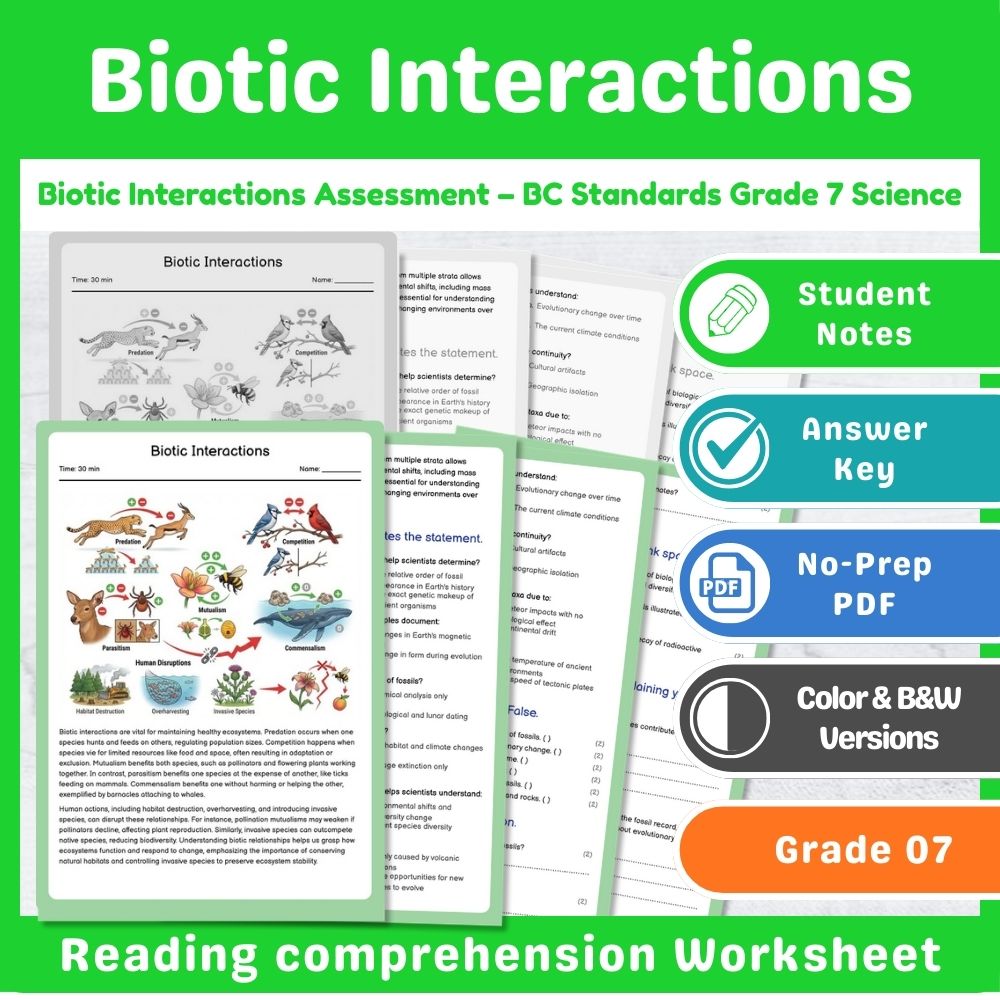
Biotic Interactions Assessment – BC Standards Grade 7 Science
Created byPrism Point LearningLearning Objectives
- Understand the different types of biotic interactions such as predation, competition, mutualism, commensalism, and parasitism.
- Explain how human activities can disrupt biotic relationships and affect ecosystems.
- Describe how changes in one species can influence community structure and biodiversity.
Instant download

Leaf Functions Assessment | Alberta Grade 6 Science Standards
Created byPrism Point LearningLearning Objectives
- Understand key concepts related to Science
- Apply knowledge through practice questions
- Demonstrate comprehension of the material
Also included in: Lesson Grade 6 Science Mini Bundle Trees and Forests Alberta Standards
Instant download

Force Fundamentals Assessment for Grade 9 Science | Alberta Standards
Created byPrism Point LearningLearning Objectives
- Understand the basic concepts of forces, including contact and non-contact forces.
- Identify and describe real-world examples of forces in Alberta settings.
- Apply qualitative reasoning to analyze opposing forces before numerical calculation.
Also included in: Grade 9 Forces and Motion Science Lesson Bundle Alberta Framework +1 more
Instant download

Glycolysis Overview Assessment | TEKS Grade 9 Science Standards
Created byPrism Point LearningLearning Objectives
- Describe the main steps involved in glycolysis.
- Identify key enzymes and intermediates in glycolysis.
- Explain the energy investment and payoff phases of glycolysis.
Instant download

Phase Behaviour Assessment | Alberta Standard Grade 11 Science
Created byPrism Point LearningLearning Objectives
- Understand the concept of phase behaviour and phase diagrams.
- Identify the different phases of matter and their transitions under varying conditions.
- Interpret phase diagrams to determine phase changes at specific temperature and pressure points.
Also included in: Grade 11 Matter and Chemical Bonding Science Lesson Bundle for Alberta +1 more
Instant download
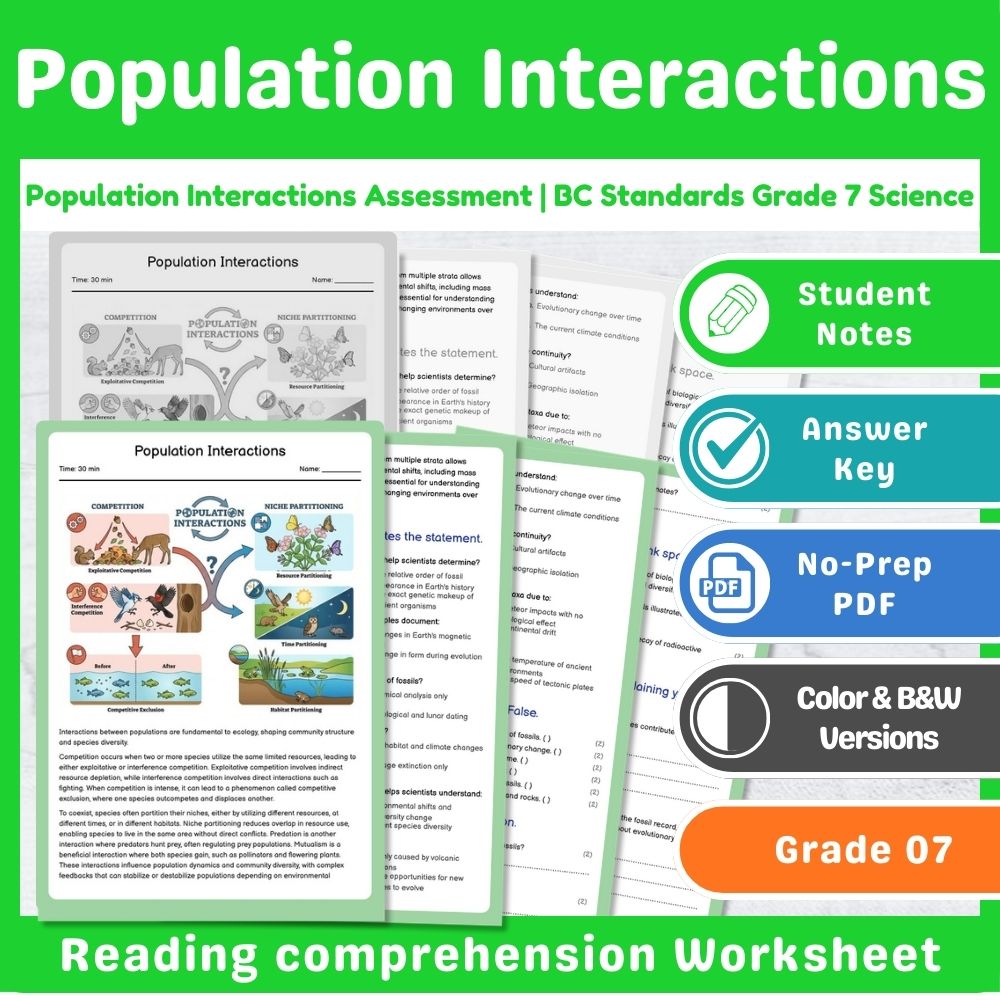
Population Interactions Assessment | BC Standards Grade 7 Science
Created byPrism Point LearningLearning Objectives
- Understand different types of population interactions including competition, predation, and mutualism.
- Identify mechanisms that allow species to coexist despite competition.
- Explain how interactions influence community composition and diversity.
Instant download

Surface Process Evidence Assessment | General Grade 7 Science
Created byPrism Point LearningLearning Objectives
- Understand how Earth's surface is shaped by internal and external processes.
- Identify evidence of surface processes in landform patterns and rock formations.
- Explain how landforms such as deltas and floodplains are formed through external processes.
Also included in: Grade 7 Earth & Space Science Lesson Bundle: General Science Framework
Instant download

Mantle Convection Assessment for Grade 11 Science – Standards-Aligned
Created byPrism Point LearningLearning Objectives
- Understand the process of mantle convection and how it drives plate tectonics.
- Identify geophysical techniques used to observe mantle flow and dynamics.
- Explain the roles of slab pull, ridge push, and mantle plumes in Earth's geological activity.
Also included in: Grade 11 Science Assessment | Plate Tectonics BC Standards Mini Bundle
Instant download

Forces and Motion Assessment Grade 6 | Science Standards-Aligned Test
Created byPrism Point LearningLearning Objectives
- Understand how forces influence the motion of objects.
- Identify examples of balanced and unbalanced forces in everyday situations.
- Explain how different types of forces affect speed and direction.
Also included in: Grade 6 Physical Science Science Lesson Bundle: General Framework
Instant download
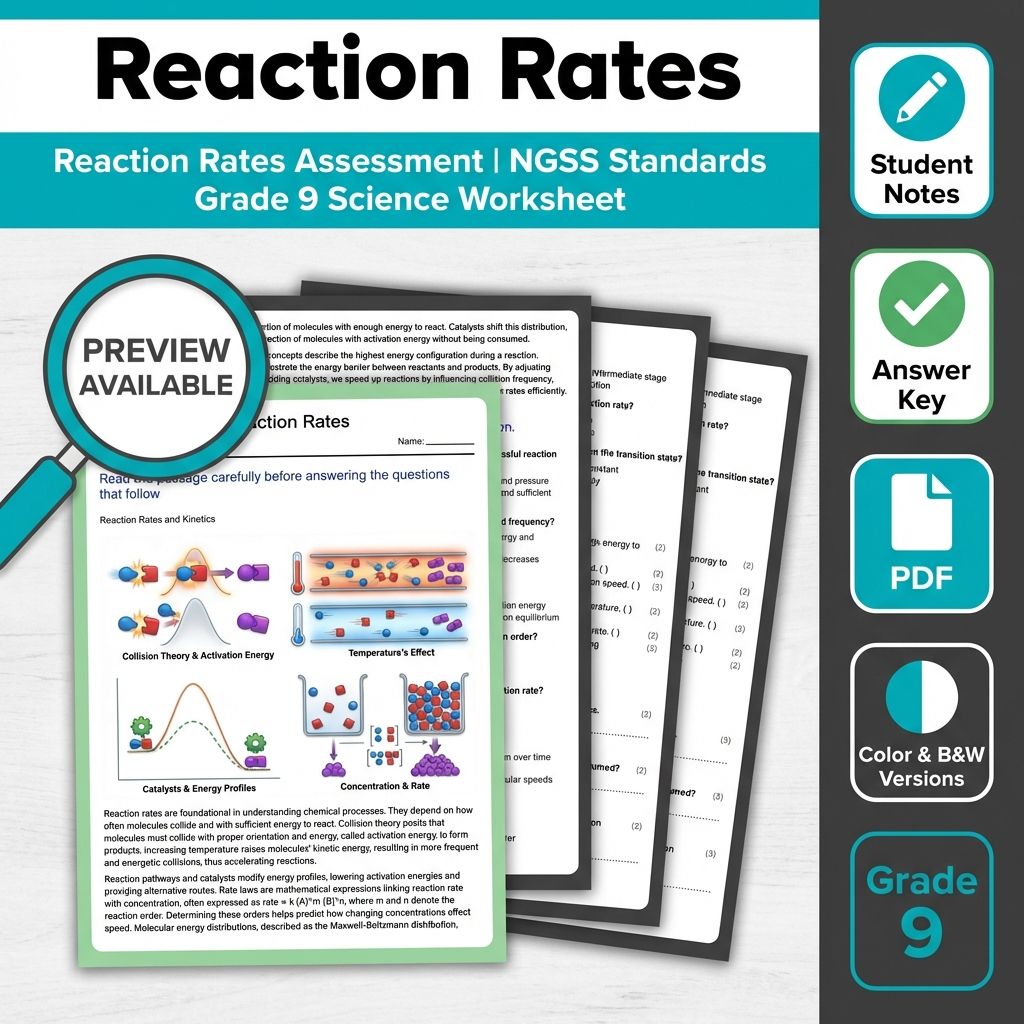
Reaction Rates Assessment | NGSS Standards Grade 9 Science Worksheet
Created byPrism Point LearningLearning Objectives
- Explain how collision frequency, activation energy, and reaction pathways influence reaction rates.
- Describe how temperature, concentration, and catalysts alter energy distributions and affect reaction speeds.
- Interpret rate laws and determine reaction order from experimental data.
Instant download
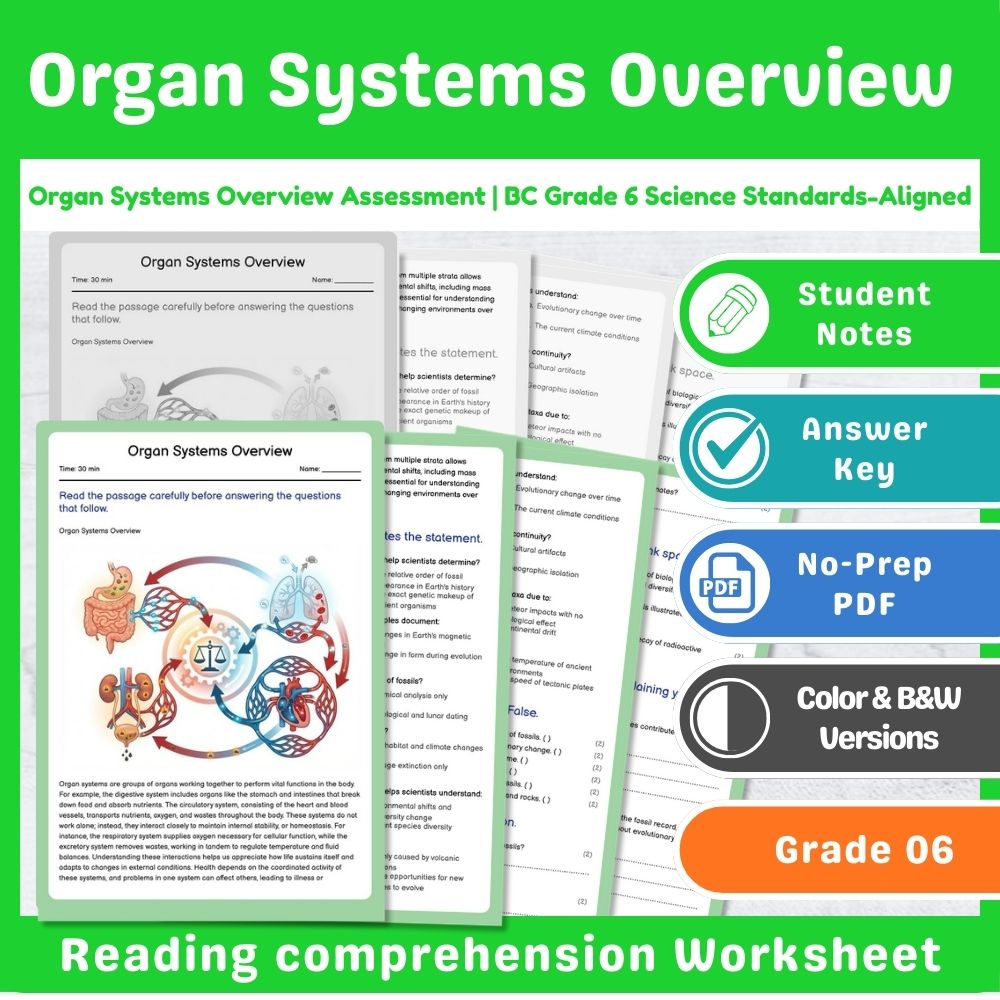
Organ Systems Overview Assessment | BC Grade 6 Science Standards-Aligned
Created byPrism Point LearningLearning Objectives
- Describe the main functions of different organ systems.
- Explain how organ systems interact to maintain homeostasis.
- Identify principal organs involved in various systems.
Instant download

Population Growth Assessment for Grade 11 Science TEKS standards
Created byPrism Point LearningLearning Objectives
- Understand the key factors influencing population dynamics, including birth rates, death rates, immigration, and emigration.
- Differentiate between exponential and logistic growth models and their real-world applications.
- Analyze the impact of density-dependent and density-independent factors on population trajectories.
Instant download

Climate Drivers Over Time Assessment | General Grade 7 Science
Created byPrism Point LearningLearning Objectives
- Understand how natural records and measurements are used to assess past and present climate conditions.
- Identify key climate drivers that influence long-term climate change.
- Explain how factors like greenhouse gases, ocean currents, and volcanic activity affect Earth's energy balance.
Also included in: Grade 7 Earth & Space Science Lesson Bundle: General Science Framework
Instant download
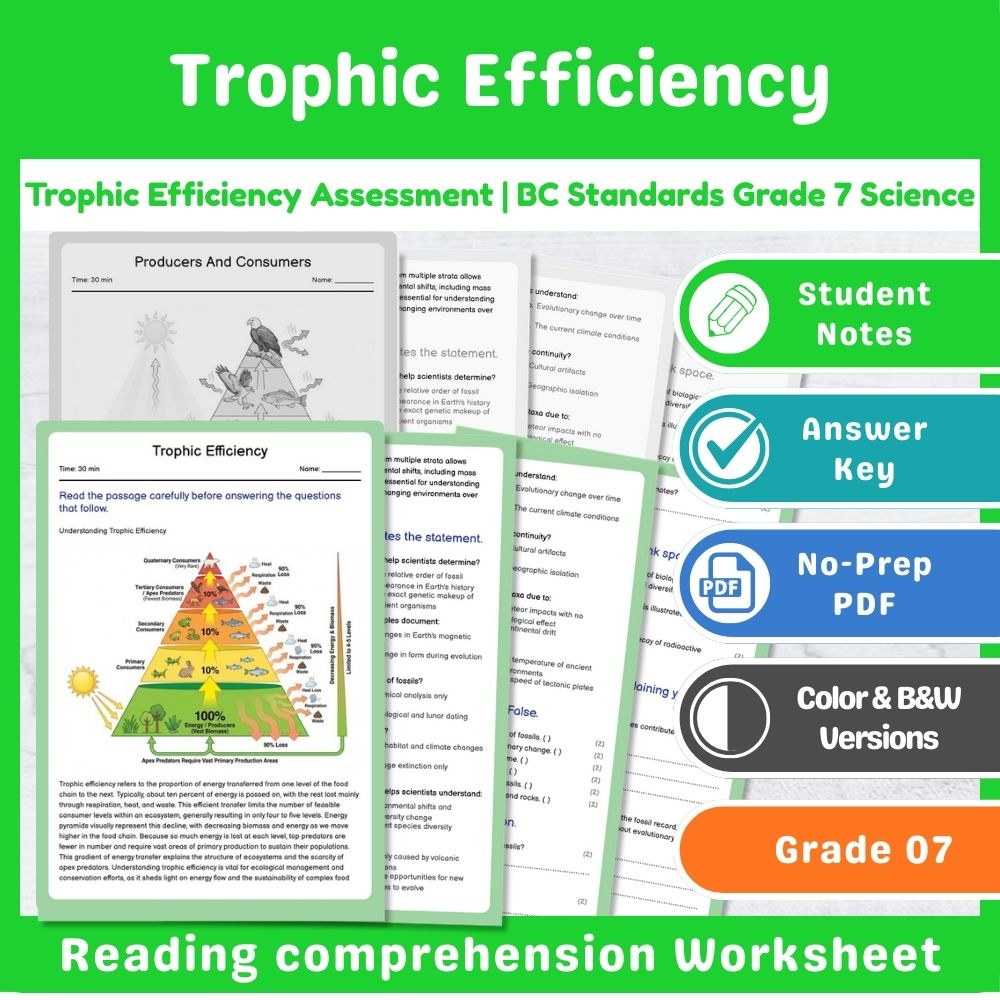
Trophic Efficiency Assessment | BC Standards Grade 7 Science
Created byPrism Point LearningLearning Objectives
- Explain the concept of trophic efficiency and its role in energy transfer within ecosystems.
- Describe how energy pyramids illustrate energy loss at each trophic level.
- Understand the factors limiting the number of trophic levels in ecological communities.
Instant download

Crystal Structures Assessment | BC Grade 6 Science Standards-Aligned
Created byPrism Point LearningLearning Objectives
- Understand the differences between crystalline and amorphous solids based on particle arrangement.
- Identify observable behaviors associated with crystalline and amorphous structures.
- Explain how particle bonding strength influences solid properties.
Instant download

Trade-off Decisions Assessment for Grade 6 Science | Standards-Aligned
Created byPrism Point LearningLearning Objectives
- Understand how design choices involve trade-offs affecting properties like strength, flexibility, and insulation.
- Identify the impact of material choices on weight, cost, and usability in shelter design.
- Analyze how trade-offs relate to user needs and environmental constraints.
Instant download
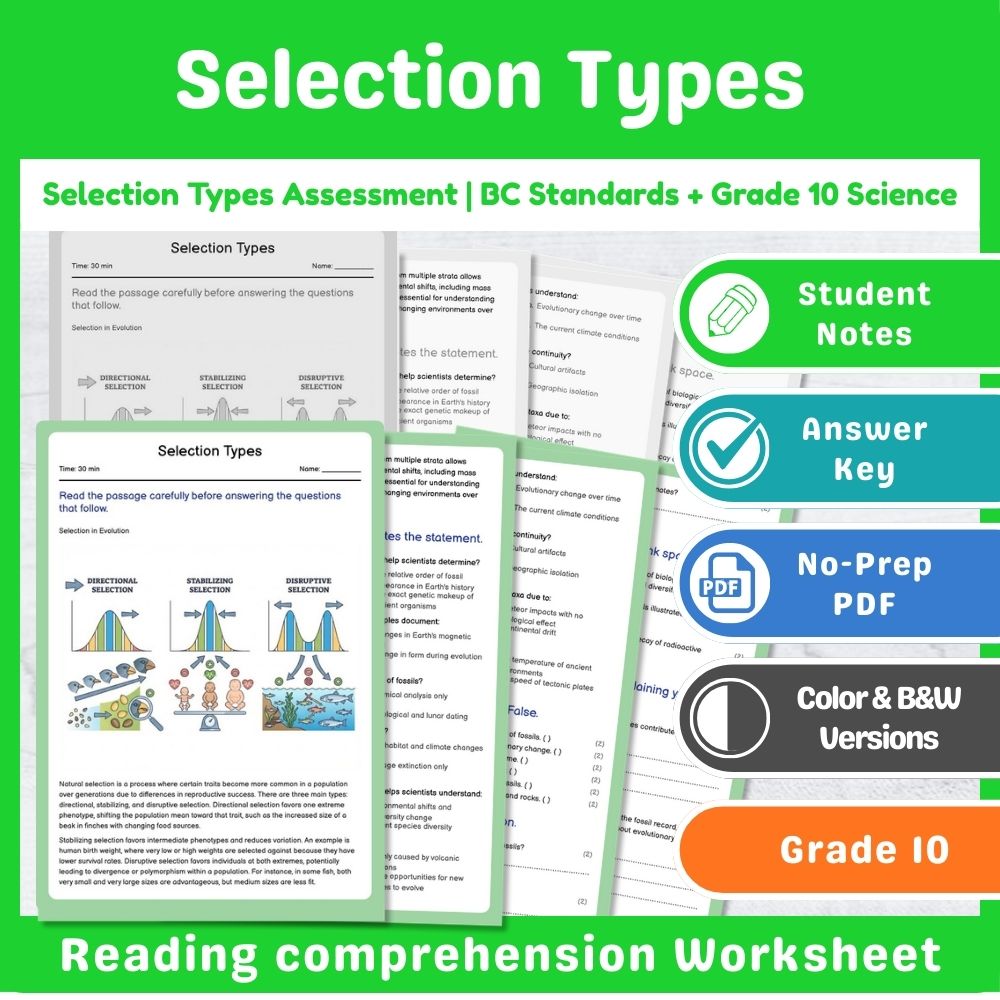
Selection Types Assessment | BC Standards + Grade 10 Science
Created byPrism Point LearningLearning Objectives
- Identify the different modes of natural selection and understand their effects on populations.
- Interpret how directional, stabilizing, and disruptive selection modify trait distributions over time.
- Explain the roles of frequency-dependent and sexual selection in evolution.
Instant download

Thermochemistry Assessment for Grade 11 Science Standards-Aligned
Created byPrism Point LearningLearning Objectives
- Understand the concept of enthalpy and its role in chemical reactions.
- Identify differences between endothermic and exothermic processes.
- Calculate reaction enthalpies using bond energies and standard enthalpies of formation.
Also included in: Grade 11 Science | Thermochemistry Assessment Bundle – Standards-Aligned
Instant download

The Mole Concept Assessment | BC Standards Grade 11 Science
Created byPrism Point LearningLearning Objectives
- Explain the fundamental principles of the mole concept and its relation to Avogadro's number.
- Convert between mass, number of particles, and volume using molar mass and molar relationships.
- Perform calculations involving moles, gases, and mass for quantitative analysis in chemistry.
Also included in: Grade 11 Science | Thermochemistry Assessment Bundle – Standards-Aligned
Instant download
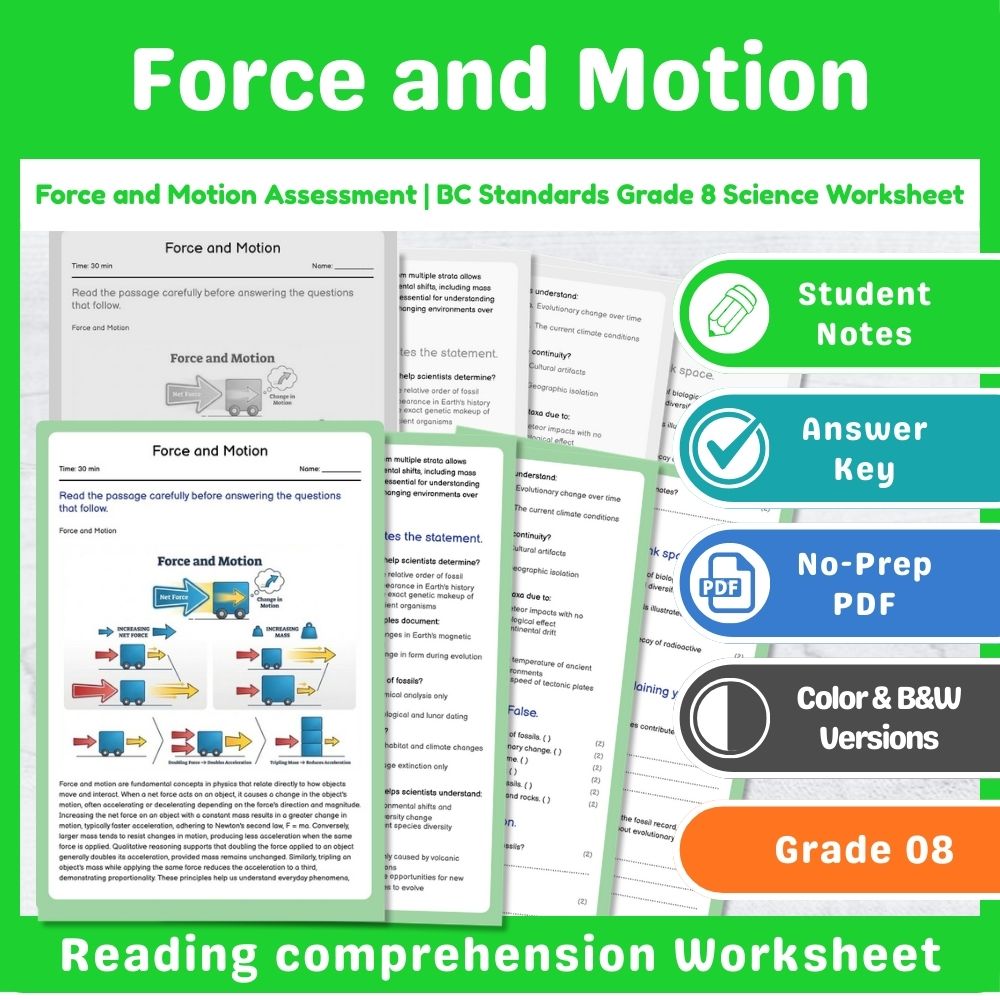
Force and Motion Assessment | BC Standards Grade 8 Science Worksheet
Created byPrism Point LearningLearning Objectives
- Understand the relationship between net force, mass, and acceleration.
- Explain qualitatively how increasing net force affects motion.
- Describe the effect of increased mass on acceleration under the same force.
Instant download
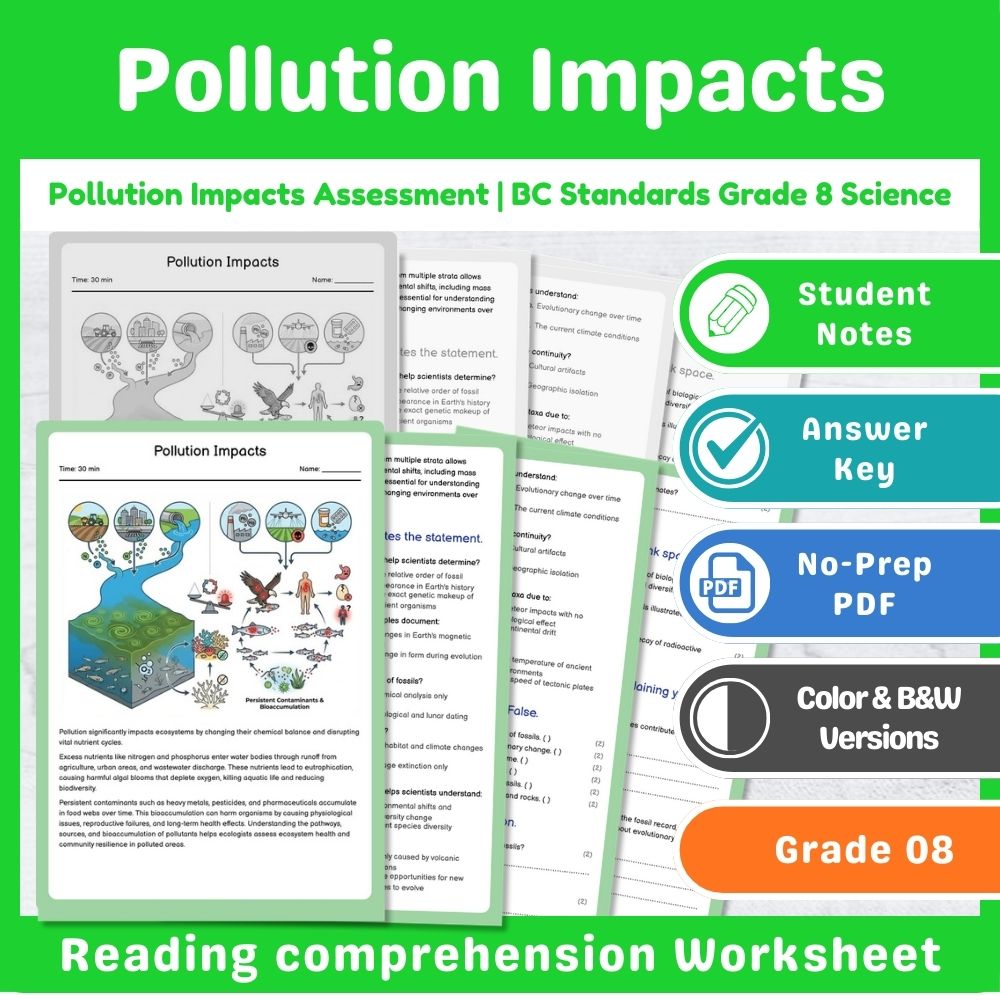
Pollution Impacts Assessment | BC Standards Grade 8 Science
Created byPrism Point LearningLearning Objectives
- Understand how pollution alters ecosystem chemistry and nutrient cycles.
- Identify the effects of excess nutrients and persistent contaminants on water, soil, and organisms.
- Explain the processes of eutrophication, bioaccumulation, and ecological resilience in polluted environments.
Instant download
Browse more categories
About Science Worksheets
Find Science worksheets spanning core skills, practice, and review. All 45,429 resources are instant PDF downloads for the classroom or home.
Every worksheet on MyTeachingSheets is created by independent teacher-authors and reviewed before publication. All resources download as printable PDFs for classroom, homework, or at-home practice, and many include answer keys. Preview any worksheet free before buying.