
Science Worksheets
45,429 subject resources
Species Classification Assessment | Alberta Standard Grade 6 Science
 Created byPrism Point Learning
Learning Objectives
- Understand how to classify organisms into producers, consumers, and decomposers.
- Distinguish between native species and invasive or pest species within ecosystems.
- Recognize Alberta-relevant examples of species and their roles in ecosystems.
Also included in: Lesson Grade 6 Science Mini Bundle Trees and Forests Alberta Standards
Instant download

Energy Basics Assessment | BC Standards Grade 8 Science
Created byPrism Point LearningLearning Objectives
- Understand the forms of mechanical energy, including kinetic and potential energy.
- Explain how energy transfers occur through work and force interactions.
- Describe how friction and air resistance transform mechanical energy into thermal energy.
Instant download

Kinematic Concepts Assessment | Alberta Standards Grade 9 Science
Created byPrism Point LearningLearning Objectives
- Describe how objects move using scalar and vector measures such as speed, velocity, and acceleration.
- Explain the differences between speed, velocity, and acceleration with real-world examples.
- Apply unit conversions and sign conventions to analyze and compare motion in different regional contexts.
Also included in: Grade 9 Forces and Motion Science Lesson Bundle Alberta Framework +1 more
Instant download

Nucleic Acid Structure Assessment for Grade 9 Science | TEKS
Created byPrism Point LearningLearning Objectives
- Describe the chemical structures of DNA and RNA and the role of nucleotides.
- Explain the significance of double helix formation, antiparallel strands, and base pairing in DNA.
- Differentiate between DNA and RNA in terms of structure and function.
Instant download

Dipole Interactions Assessment for Grade 11 Science | Alberta Standards
Created byPrism Point LearningLearning Objectives
- Explain the concept of molecular polarity and its influence on intermolecular forces.
- Analyze how dipole-dipole interactions affect physical properties like boiling point and solubility.
- Describe real-world applications of dipole interactions in refinery processes and atmospheric chemistry.
Also included in: Grade 11 Matter and Chemical Bonding Science Lesson Bundle for Alberta +1 more
Instant download

Pendulum Energy Assessment | BC Standards Grade 8 Science
Created byPrism Point LearningLearning Objectives
- Explain how a pendulum demonstrates energy transformation between potential and kinetic energy.
- Identify factors that influence the period of a pendulum.
- Describe how energy dissipation occurs due to air resistance and friction.
Instant download

Lewis Structures Assessment | Alberta Standard Assessment Grade 11 Science
Created byPrism Point LearningLearning Objectives
- Understand the concept of Lewis electron-dot structures for molecules.
- Identify how to represent shared electrons and bonds.
- Interpret Lewis structures to predict molecular shapes and properties.
Also included in: Grade 11 Matter and Chemical Bonding Science Lesson Bundle for Alberta +1 more
Instant download

Atomic Structure Assessment for Grade 11 Science | Alberta Standards
Created byPrism Point LearningLearning Objectives
- Describe the organization of protons, neutrons, and electrons within atoms.
- Explain how electron arrangements, including shells and valence electrons, influence reactivity and bonding.
- Identify atomic features of Alberta elements used in industry and their macroscopic chemical behaviors.
Also included in: Grade 11 Matter and Chemical Bonding Science Lesson Bundle for Alberta +1 more
Instant download

Solution Stoichiometry Assessment | Alberta Standards Grade 11 Science
Created byPrism Point LearningLearning Objectives
- Understand how to use concentration measures like molarity to determine quantities of reactants and products in aqueous reactions.
- Apply mole relationships and equivalence principles to solve solution-based stoichiometry problems.
- Use mass conservation and volume-mole conversions to predict outcomes of chemical reactions in solution.
Also included in: Grade 11 Chemical Reactions & Stoichiometry Science Lesson Bundle – Alberta +1 more
Instant download

Dynamic Equilibrium Assessment for Grade 10 Science – Alberta Standards
Created byPrism Point LearningLearning Objectives
- Understand the concept of dynamic equilibrium and the factors influencing it.
- Interpret equilibrium constant expressions and predict system shifts due to external changes.
- Apply principles of chemical equilibrium to industrial and environmental contexts.
Also included in: Grade 10 Matter and Chemical Change Science Lesson Bundle: Alberta +1 more
Instant download

Carbon Balance Assessment for Grade 10 Science | Alberta Standards
Created byPrism Point LearningLearning Objectives
- Explain the major carbon pools, flux pathways, and their roles in regional and global climate.
- Identify natural and anthropogenic drivers affecting carbon transfer among atmosphere, vegetation, soil, and ocean.
- Analyze regional examples like boreal forest succession, peatland accumulation, and soil disturbance impacts.
Also included in: Grade 10 Earth and Space Systems Science Lesson Bundle for Alberta +1 more
Instant download

VSEPR and Forces Assessment | Alberta Standards Grade 11 Science
Created byPrism Point LearningLearning Objectives
- Describe the VSEPR model and predict molecular geometries based on electron pair arrangements.
- Explain how molecular shapes influence intermolecular forces such as dipole interactions and hydrogen bonding.
- Relate molecular shape to physical properties like boiling and melting points, with real-world examples.
Also included in: Grade 11 Matter and Chemical Bonding Science Lesson Bundle for Alberta +1 more
Instant download
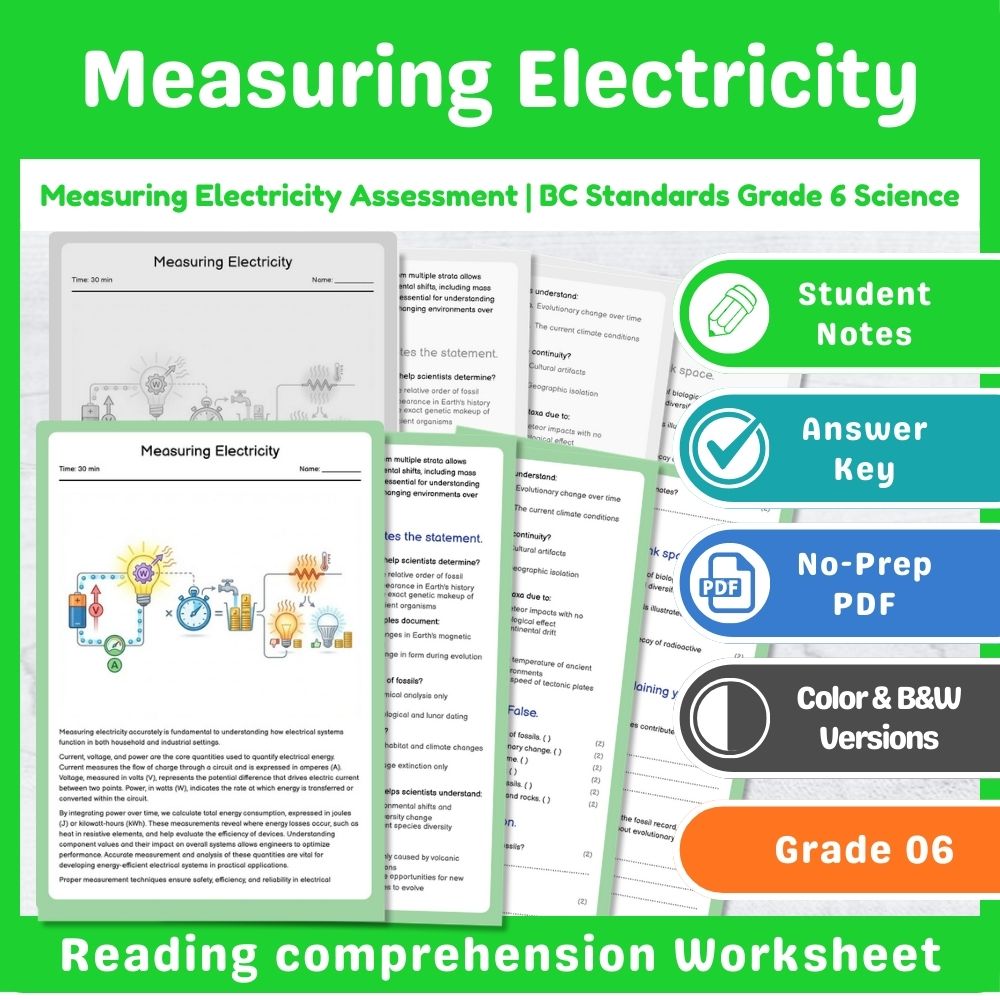
Measuring Electricity Assessment | BC Standards Grade 6 Science
Created byPrism Point LearningLearning Objectives
- Understand key electrical quantities such as current, voltage, and power.
- Identify how measurements of electricity determine energy transfer and system efficiency.
- Learn the relationship between instantaneous electrical quantities and cumulative energy consumption.
Instant download
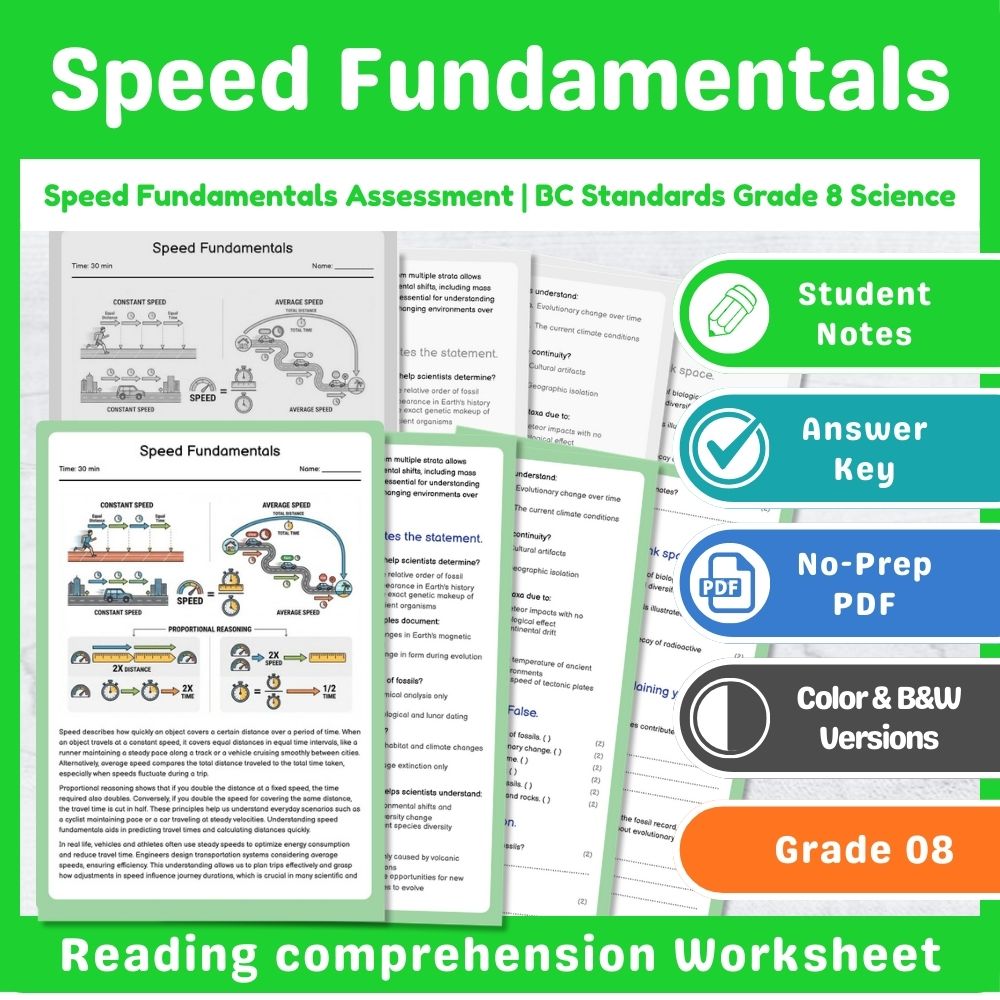
Speed Fundamentals Assessment | BC Standards Grade 8 Science
Created byPrism Point LearningLearning Objectives
- Define speed as the ratio of distance over time.
- Differentiate between constant and average speed.
- Apply proportional reasoning to solve speed, distance, and time problems.
Instant download

Physiological Regulation Assessment for Grade 11 Science TEKS
Created byPrism Point LearningLearning Objectives
- Describe the mechanisms involved in maintaining internal stability in the human body.
- Explain the roles of sensors, control centers, and effectors in physiological regulation.
- Identify examples of negative and positive feedback mechanisms in human physiology.
Also included in: Grade 11 Homeostasis & Human Body Systems Science: Lesson Bundle TEKS
Instant download

Ecosystem Components Assessment | BC Standards Grade 6 Science
Created byPrism Point LearningLearning Objectives
- Identify the key components of an ecosystem, including biotic and abiotic factors.
- Explain how living organisms interact with nonliving elements in their habitat.
- Describe the roles of sunlight, water, soil, and temperature in supporting ecosystems.
Instant download

Atomic Particles Assessment | BC Standards Grade 10 Science
Created byPrism Point LearningLearning Objectives
- Describe the structure of an atom, including protons, neutrons, and electrons.
- Explain how the number of protons determines an element and contributes to atomic mass.
- Identify the arrangement of electrons in shells and how it influences chemical behavior.
Instant download

Protein Synthesis Assessment for Grade 11 Science TEKS Standards
Created byPrism Point LearningLearning Objectives
- Explain the process of transcription and translation in protein synthesis.
- Identify the roles of RNA polymerase, mRNA, tRNA, ribosomes, and amino acids.
- Describe the significance of codon redundancy and wobble in genetic decoding.
Also included in: Grade 11 Molecular Genetics Science Lesson Bundle: TEKS Assessments
Instant download

Physical Properties Assessment | BC Standards Grade 6 Science Worksheet
Created byPrism Point LearningLearning Objectives
- Define and identify various physical properties of matter.
- Differentiate between physical and chemical changes based on properties.
- Observe and measure properties like mass, volume, density, conductivity, melting point, and hardness.
Instant download

Circuit Diagrams Assessment for Grade 6 | BC Standards-Aligned Science
Created byPrism Point LearningLearning Objectives
- Understand the standard symbols used in circuit diagrams for sources, conductors, and loads.
- Identify components such as batteries, resistors, switches, and meters in circuit diagrams.
- Translate physical electrical systems into simplified schematic diagrams.
Instant download

Biogeochemical Cycles Assessment for Grade 11 Science TEKS
Created byPrism Point LearningLearning Objectives
- Understand the key processes involved in the carbon, nitrogen, and phosphorus cycles.
- Identify the roles of different biogeochemical cycles in ecosystems.
- Explain how human activities perturb natural nutrient cycles and their effects.
Instant download
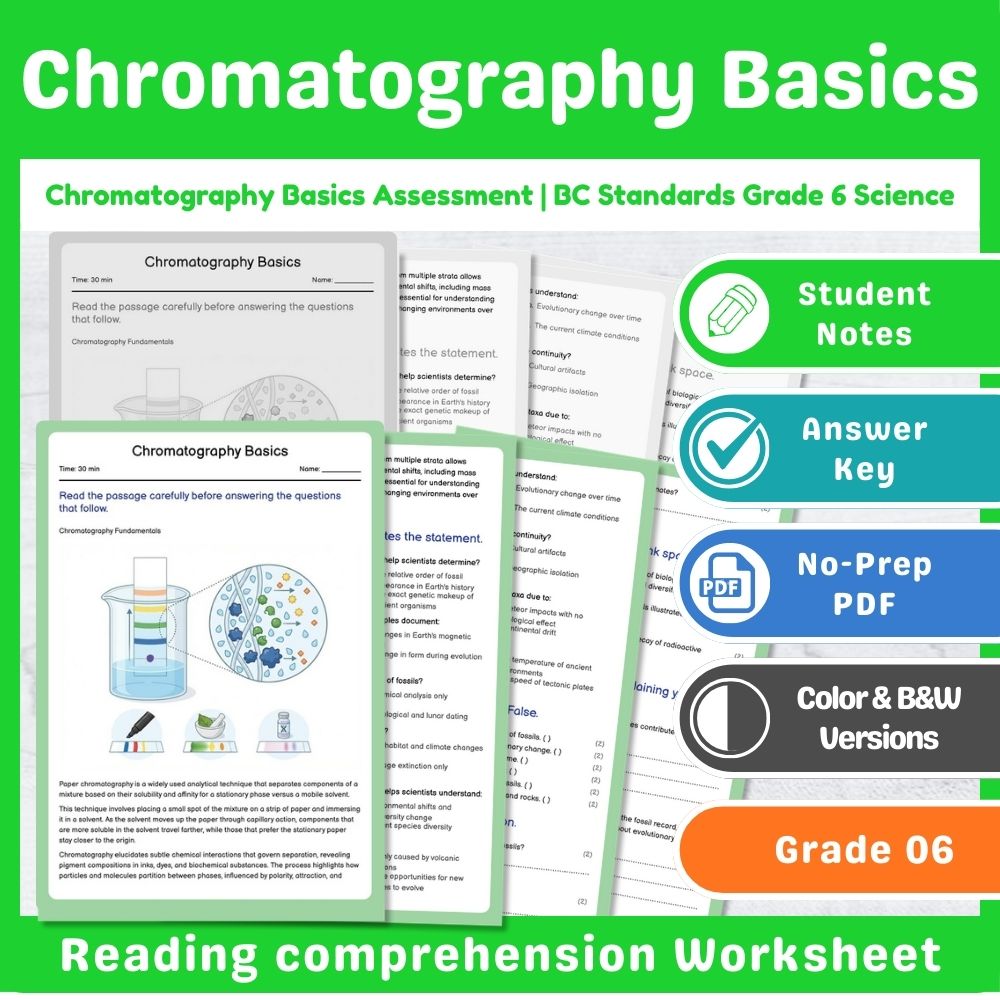
Chromatography Basics Assessment | BC Standards Grade 6 Science
Created byPrism Point LearningLearning Objectives
- Understand the fundamental principles of paper chromatography and how it separates mixture components.
- Identify factors influencing the mobility and separation of substances in chromatography.
- Describe practical applications of chromatography in analyzing complex mixtures such as ink pigments.
Instant download

Evidence Supporting Evolution Assessment | General Grade 10 Science
Created byPrism Point LearningLearning Objectives
- Understand the different types of evidence used to support claims about biological change over time.
- Identify how fossil records, comparative anatomy, molecular data, and biogeography contribute to evolutionary understanding.
- Analyze how multiple lines of evidence reinforce conclusions about evolution despite limitations in individual datasets.
Also included in: Grade 10 Evolution and Genetics Science Lesson Bundle: General Unit
Instant download

Orbital Mechanics Assessment | TEKS Standards Grade 12 Science
Created byPrism Point LearningLearning Objectives
- Understand the principles of gravitational dynamics and Keplerian motion.
- Apply conservation laws to analyze orbital trajectories and resonances.
- Relate orbital parameters such as eccentricity, inclination, and semimajor axis to celestial phenomena.
Instant download

Inheritance Patterns Assessment for Grade 11 Science | Standards-Aligned
Created byPrism Point LearningLearning Objectives
- Explain how observable traits are connected to genetic inheritance patterns across generations.
- Describe the role of Punnett squares in predicting offspring genotypes and phenotypes.
- Differentiate between autosomal and sex-linked inheritance, including dominance and recessiveness.
Also included in: Grade 11 Biological Evidence Science Lesson Bundle | General Framework
Instant download

Inheritance Patterns Assessment for Grade 12 Science | BC Standards
Created byPrism Point LearningLearning Objectives
- Explain various inheritance models such as Mendelian segregation, linkage, Sex linkage, incomplete dominance, and polygenic traits.
- Describe how recombination frequency reveals chromosomal distances and influences trait distribution.
- Interpret pedigrees to infer inheritance modes and estimate carrier status.
Also included in: Grade 12 Science Mini Bundle – Genetics & Evolution Assessment Pack
Instant download

Organ Systems Assessment | TEKS Grade 9 Science Standards
Created byPrism Point LearningLearning Objectives
- Understand the roles of different organ systems in maintaining homeostasis.
- Identify the functions of the circulatory, respiratory, digestive, renal, nervous, and endocrine systems.
- Explain how organ systems communicate and regulate physiological processes.
Also included in: Grade 9 Regulation & Communication Science Assessment Lesson Bundle TEKS
Instant download

Carbon Pathways Assessment | AP Standards for Grade 11 Science
Created byPrism Point LearningLearning Objectives
- Explain how carbon is stored and transferred among air, ocean, terrestrial biosphere, and sediments.
- Utilize flux diagrams and isotopic tracers to distinguish natural from anthropogenic carbon sources.
- Analyze the impact of ocean uptake, soil carbon, and fossil fuel emissions on atmospheric CO2 levels.
Also included in: Lesson Grade 11 Science Assessment Bundle | Earth Systems & Climate
Instant download

Net Force Concept Assessment | BC Standards Grade 9 Science
Created byPrism Point LearningLearning Objectives
- Explain what net force is and how it affects motion.
- Differentiate between balanced and unbalanced forces.
- Resolve forces into components and calculate the net force.
Instant download

System Thinking In Solutions Assessment | General Grade 6 Science
Created byPrism Point LearningLearning Objectives
- Understand the concept of systems thinking and how components interact within a system.
- Identify cause-and-effect relationships in system design and performance.
- Analyze how changes to one part of a system can influence overall behavior.
Instant download

Mass Measurement Assessment for Grade 9 Science | BC Standards
Created byPrism Point LearningLearning Objectives
- Understand how mass measurements reflect the conservation of atoms during chemical reactions.
- Identify factors affecting measured mass, such as gaseous product escape and external influences.
- Explain the importance of defining system boundaries and accounting for all phases in mass analysis.
Instant download

Trophic Modeling Assessment for Grade 8 Science – Alberta Standards
Created byPrism Point LearningLearning Objectives
- Understand the principles of trophic modeling in ecological systems.
- Identify different types of models used to represent energy and matter fluxes.
- Explain how models estimate production, respiration, and decomposition rates.
Also included in: Grade 8 Science Mini Bundle | Interactions and Ecosystems Curriculum
Instant download

Groundwater Systems Assessment for Grade 11 Science | BC Standards
Created byPrism Point LearningLearning Objectives
- Understand the concepts of aquifers, porosity, and permeability in groundwater systems.
- Differentiate between confined and unconfined aquifers and their responses to recharge and pumping.
- Identify factors affecting groundwater flow, quality, and sustainability.
Also included in: Grade 11 Science Assessment | Plate Tectonics BC Standards Mini Bundle
Instant download

Atomic Structure Assessment for Grade 9 Science NGSS Standards
Created byPrism Point LearningLearning Objectives
- Describe the subatomic particles involved in atomic structure including protons, neutrons, and electrons.
- Explain electron configurations and the concept of quantized energy levels.
- Understand how the periodic table arranges elements based on valence electrons and how this influences chemical behavior.
Instant download
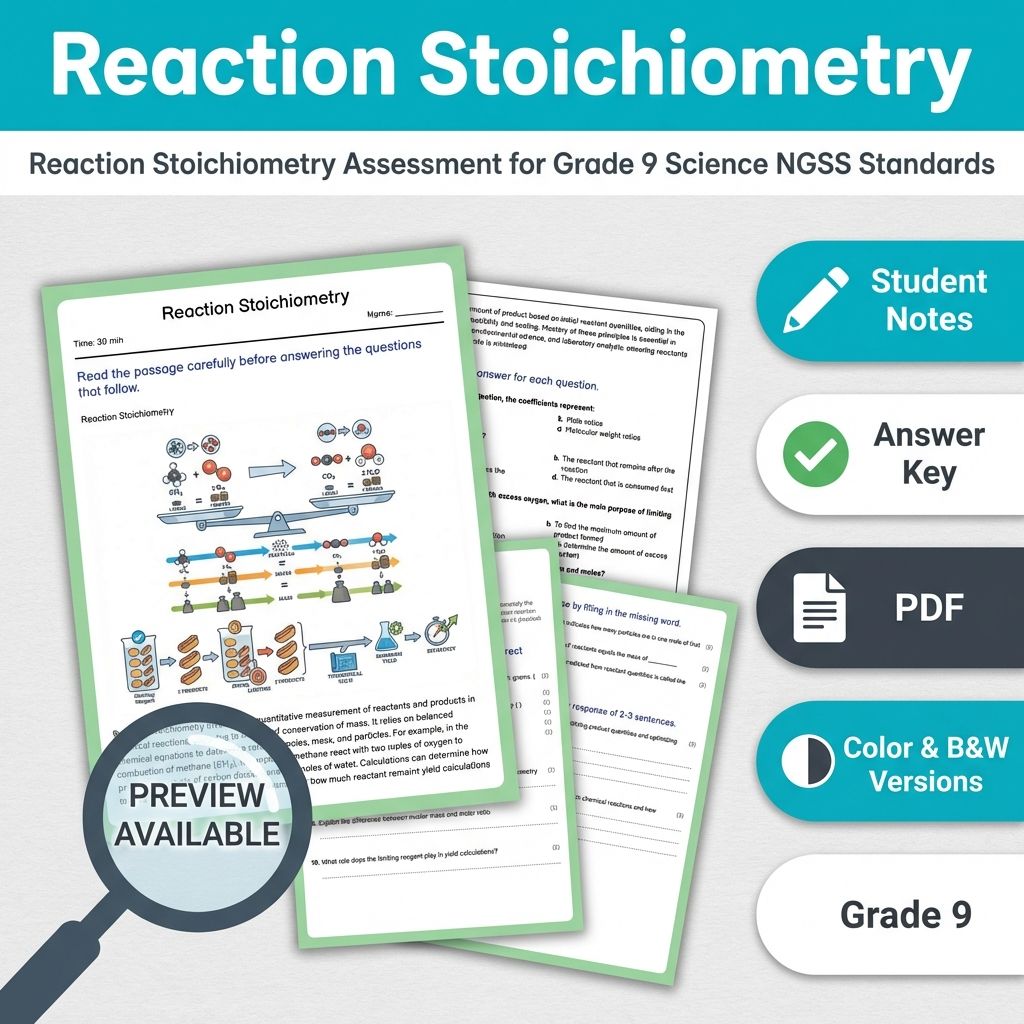
Reaction Stoichiometry Assessment for Grade 9 Science NGSS Standards
Created byPrism Point LearningLearning Objectives
- Understand the principles of mole ratios in balanced chemical equations.
- Apply molar mass conversions to relate mass and moles in reactions.
- Analyze limiting reagents and determine theoretical yields in chemical reactions.
Instant download
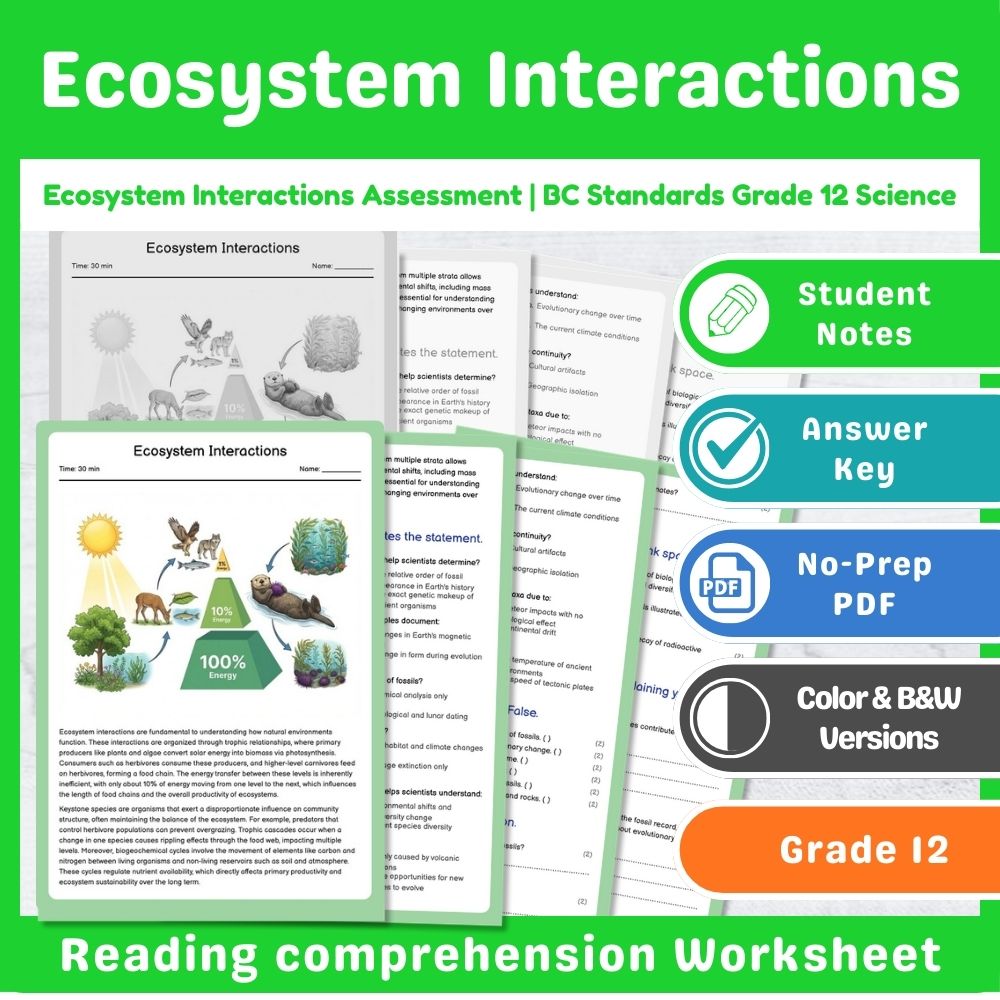
Ecosystem Interactions Assessment | BC Standards Grade 12 Science
Created byPrism Point LearningLearning Objectives
- Explain the flow of energy through trophic levels and its impact on ecosystem productivity.
- Identify key species and their roles within ecological communities, including keystone species.
- Describe trophic cascades and how changes at one level affect others.
Also included in: Grade 12 Science Mini Bundle – Genetics & Evolution Assessment Pack
Instant download
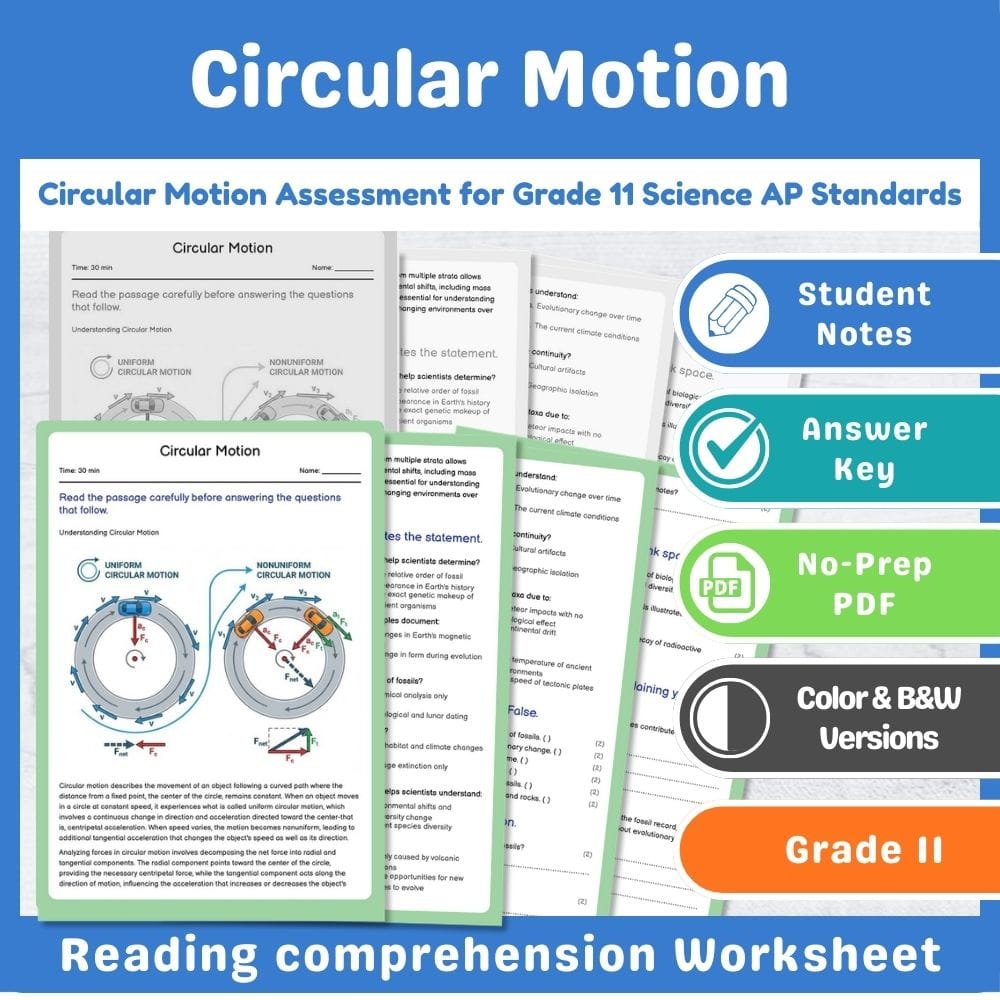
Circular Motion Assessment for Grade 11 Science AP Standards
Created byPrism Point LearningLearning Objectives
- Describe uniform and nonuniform circular motion with emphasis on centripetal and tangential accelerations.
- Model net forces in circular motion by analyzing radial and tangential components.
- Express acceleration vectors in polar coordinates and relate them to the change in velocity direction.
Instant download

Waves and Technology Assessment for Grade 6 Science | BC Standards
Created byPrism Point LearningLearning Objectives
- Explain how sound and light waves transfer energy in technological devices.
- Describe the conversion processes in speakers and microphones.
- Understand how cameras utilize wave properties to produce images.
Instant download

Electron Configuration Assessment | BC Standards Grade 10 Science
Created byPrism Point LearningLearning Objectives
- Describe how electrons occupy energy levels and orbitals around an atomic nucleus.
- Explain the significance of valence electrons in bonding and chemical reactivity.
- Apply principles of quantized energy levels to determine electron distribution in elements.
Instant download

Reaction Energetics Assessment | BC Standards Grade 10 Science
Created byPrism Point LearningLearning Objectives
- Understand the principles of energy changes during chemical reactions.
- Identify differences between exothermic and endothermic reactions.
- Relate bond energies to reaction thermodynamics and feasibility.
Instant download

Ecosystem Matter Cycling Assessment | Standards-Aligned Grade 8 Science
Created byPrism Point LearningLearning Objectives
- Understand how matter cycles through ecosystems involving living and nonliving components.
- Identify processes such as decomposition, gas exchange, and nutrient transformation that return elements to the environment.
- Explain how producers and consumers transfer matter within ecosystems over time.
Also included in: Grade 8 Life Science Science Lesson Bundle – General Framework Resources
Instant download

Light Properties Assessment | BC Standards Grade 6 Science
Created byPrism Point LearningLearning Objectives
- Describe the wave and particle nature of light and their properties such as wavelength, frequency, and energy.
- Explain how visible, ultraviolet, and infrared light differ in wavelength and energy.
- Understand how different materials transmit, absorb, or reflect specific colours based on light properties.
Instant download

Reaction Classification Assessment | BC Standards Grade 10 Science
Created byPrism Point LearningLearning Objectives
- Identify and classify different types of chemical reactions based on reactant and product characteristics.
- Understand the characteristic features and observable evidence of various reaction types.
- Relate reaction classes to the periodic properties of reactants to predict products and energy changes.
Instant download

Decomposers And Nutrients Assessment | BC Standards Grade 6 Science
Created byPrism Point LearningLearning Objectives
- Understand the role of decomposers in nutrient cycling and ecosystem health.
- Identify different types of decomposers including fungi, bacteria, and detritivores.
- Explain how environmental factors affect decomposer efficiency.
Instant download

Trophic Transfers And Efficiency Assessment Grade 9 Science Printable
Created byPrism Point LearningLearning Objectives
- Explain how energy is transferred among organisms in a food chain.
- Describe the concept of energy transfer efficiency and its impact on biomass.
- Interpret evidence like population sizes, biomass trends, and nutrient concentrations to analyze trophic levels.
Also included in: Grade 9 Ecology, Genetics, and Cells Science Lesson Bundle – General
Instant download

Adaptation Overview Assessment – BC Standard Grade 6 Science Worksheet
Created byPrism Point LearningLearning Objectives
- Understand the concept of adaptation and its importance for survival.
- Identify different types of adaptations in animals and plants.
- Analyze real-world examples of adaptations and their functions.
Instant download

Producers And Consumers Assessment | BC Standards Grade 6 Science
Created byPrism Point LearningLearning Objectives
- Understand the roles of producers and consumers in food webs and ecosystems.
- Identify different types of consumers and their feeding habits.
- Explain energy transfer efficiency between trophic levels and its ecological impact.
Instant download
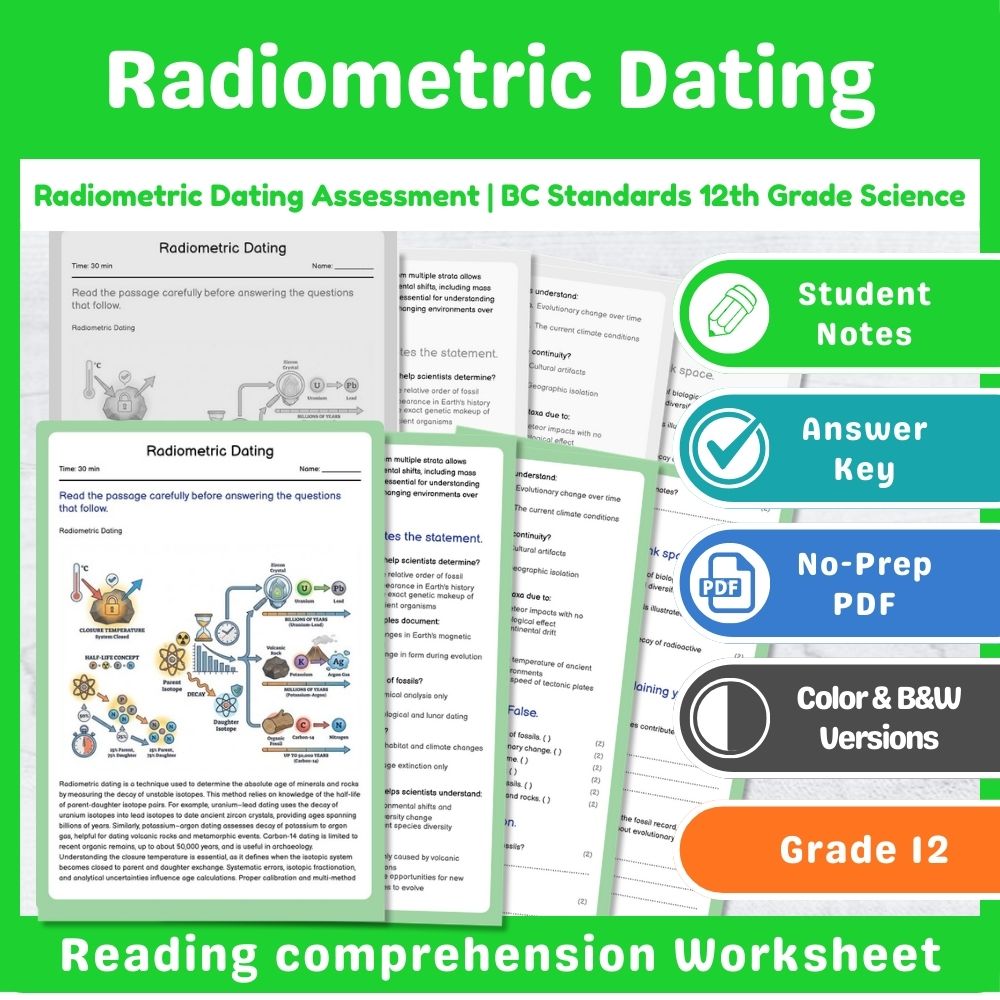
Radiometric Dating Assessment | BC Standards 12th Grade Science
Created byPrism Point LearningLearning Objectives
- Understand the principles of radiometric dating and isotopic decay.
- Identify different radiometric dating methods and their applications.
- Analyze factors affecting the accuracy of radiometric age determinations.
Also included in: Grade 12 Science Mini Bundle – Plate Tectonics & Geoscience Assessment
Instant download
Browse more categories
About Science Worksheets
Find Science worksheets spanning core skills, practice, and review. All 45,429 resources are instant PDF downloads for the classroom or home.
Every worksheet on MyTeachingSheets is created by independent teacher-authors and reviewed before publication. All resources download as printable PDFs for classroom, homework, or at-home practice, and many include answer keys. Preview any worksheet free before buying.