
Grade 6 Science Worksheets
6,100 worksheets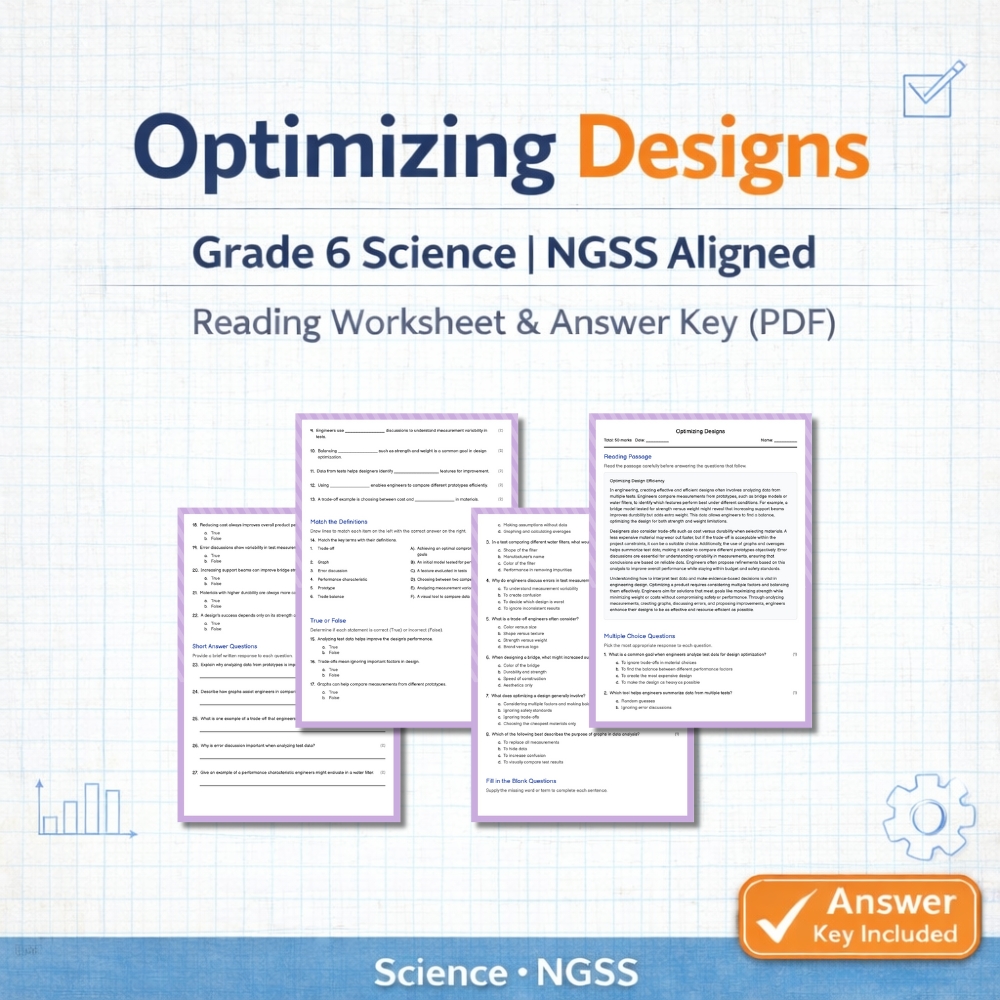
6th Grade Science | Optimizing Designs | Worksheet – NGSS Aligned
 Created byCedar Grove Learning
Learning Objectives
- Analyze data from tests to compare performance of different design options.
- Use graphs, averages, and error discussion to support decisions in design optimization.
- Evaluate trade-offs in design performance criteria such as strength versus weight, cost versus durability.
Also included in: Grade 6 Science Unit Bundle | Engineering Design & Problem Solving Worksheets +1 more
Instant download

Grade 6 Energy Transformations Worksheet | Florida NGSSS Science with Answer Key
 Created byEvergreen Desk Education
Learning Objectives
- Explain how energy can change forms while the total energy in a system remains conserved.
- Identify common energy transformations (potential ↔ kinetic, kinetic → thermal, electrical → light/thermal).
- Use observations of motion, temperature, and brightness to infer where energy went during a transformation.
Instant download
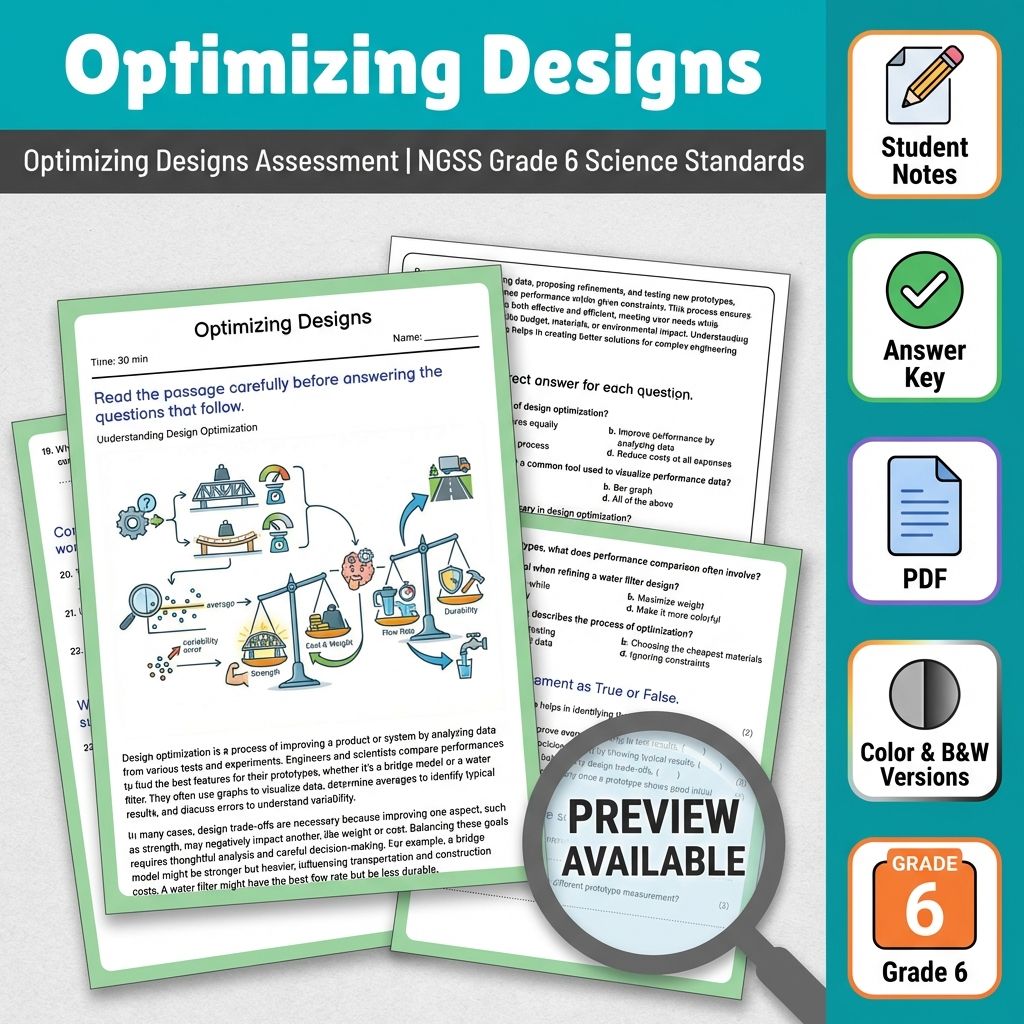
Optimizing Designs Assessment | NGSS Grade 6 Science Standards
 Created byPrism Point Learning
Learning Objectives
- Analyze data from comparative tests to evaluate performance characteristics of different designs.
- Use graphs, averages, and error discussions to support decision-making in design optimization.
- Understand trade-offs involved in balancing competing goals such as strength versus weight, or cost versus durability.
Also included in: Lesson Grade 6 Science | Engineering Design Standards-Aligned Not Specified +1 more
Instant download
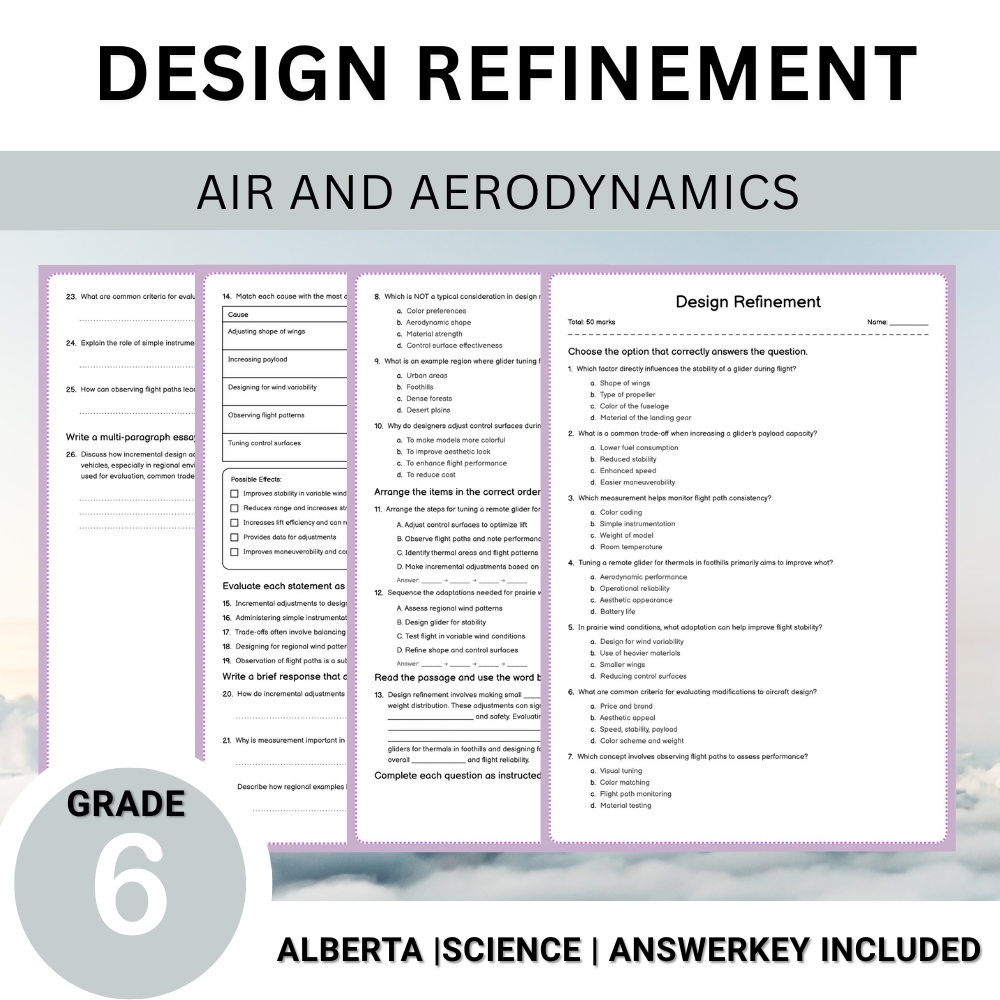
Grade 6 Science | Design Refinement Worksheet – Science (PDF) for Alberta Standards
Learning Objectives
- Understand how incremental adjustments affect aerodynamic performance.
- Identify criteria for evaluating modifications in aircraft design.
- Explain trade-offs between speed, stability, and payload capacity.
Also included in: Grade 6 Science Unit Bundle | Flight, Air Pressure & Aerodynamics Worksheets +1 more
Instant download
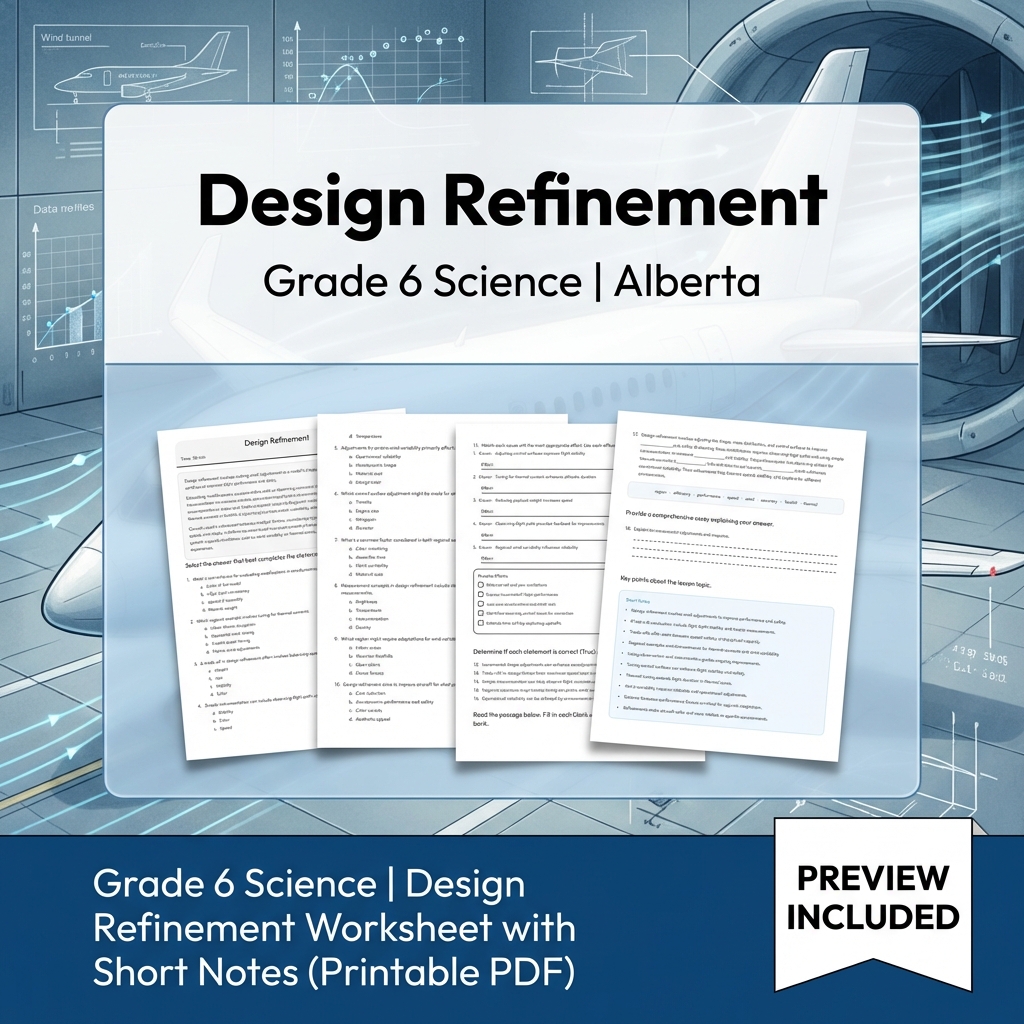
Grade 6 Science | Design Refinement Worksheet with Short Notes (Printable PDF)
 Created byMeadowlark Worksheets
Learning Objectives
- Understand how incremental adjustments affect aerodynamic performance and safety.
- Learn to evaluate modifications based on flight paths and simple instrumentation.
- Identify trade-offs between speed, stability, and payload in design refinement.
Also included in: Grade 6 Science – Air and Aerodynamics UNIT Bundle | Alberta Curriculum Resources +1 more
Instant download

Grade 6 Comparative Flight Worksheet | Alberta Practice & PDF
 Created byClear Sky Classroom
Learning Objectives
- Compare how kites, gliders, and round canopies use lift, drag, and control surfaces to stay in flight.
- Explain how design choices affect glide ratio, lift-to-drag performance, and maneuverability.
- Use quantitative and qualitative evidence to predict likely flight outcomes in Alberta-like conditions.
Also included in: Grade 6 Air and Aerodynamics Science Lesson Bundle (Alberta Framework) +1 more
Instant download

Oceans Regulate Climate Science Worksheet Grade 6 | Florida NGSSS Activity
Created byEvergreen Desk EducationLearning Objectives
- Explain how oceans absorb, store, and release heat to moderate temperature changes.
- Describe how ocean heat affects evaporation, humidity, and atmospheric stability.
- Connect ocean circulation and ocean heat content changes to possible shifts in weather patterns.
Instant download
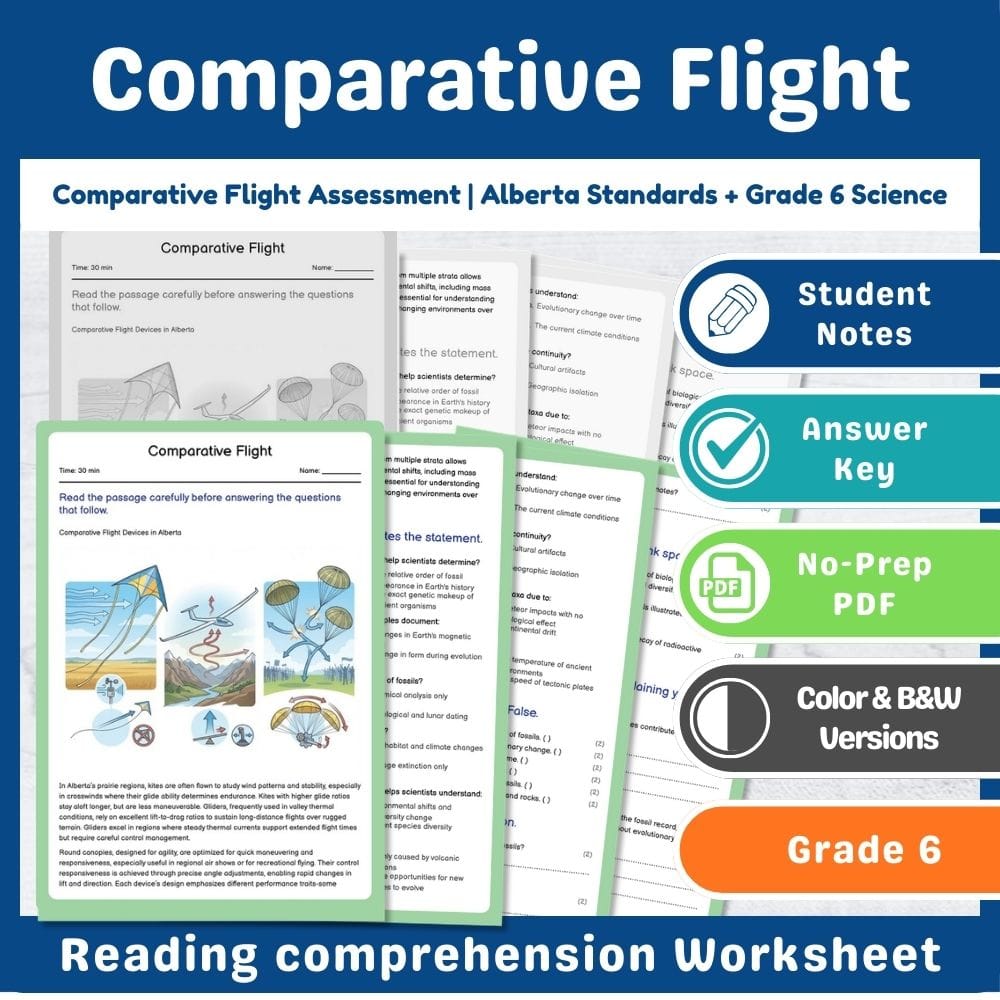
Comparative Flight Assessment | Alberta Standards + Grade 6 Science
Created byPrism Point LearningLearning Objectives
- Analyze the differences in glide ratio, lift-to-drag performance, and control responsiveness among kites, gliders, and round canopies.
- Understand why certain flying device designs favor endurance over maneuverability in regional atmospheric conditions.
- Compare quantitative and qualitative performance parameters of different flying devices in Alberta contexts such as prairie crosswinds and valley thermals.
Also included in: Lesson Grade 6 Science Assessment | Alberta Standards and Topics
Instant download
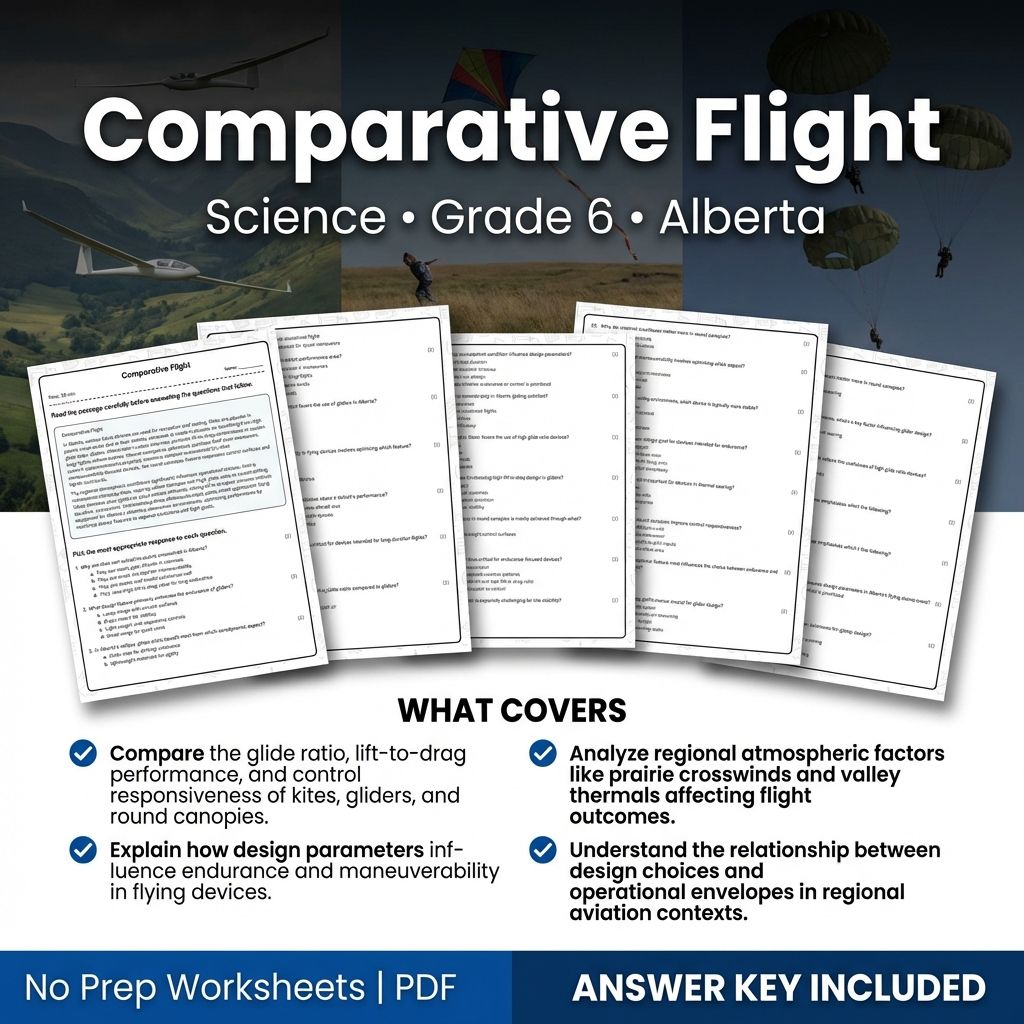
Grade 6 Science Worksheet on Comparative Flight | Alberta Standards
 Created byCoral Reef Learning
Learning Objectives
- Compare the glide ratio, lift-to-drag performance, and control responsiveness of kites, gliders, and round canopies.
- Explain how design parameters influence endurance and maneuverability in flying devices.
- Analyze regional atmospheric factors like prairie crosswinds and valley thermals affecting flight outcomes.
Instant download

Grade 6 Science – Thermal Energy Transfer & Heat Methods | Reading Worksheet
 Created byBright Mind Resources
Learning Objectives
- Understand key concepts related to Science
- Apply knowledge through practice questions
- Demonstrate comprehension of the material
Also included in: Grade 6 Science Energy & Matter Daily Reading Lesson Bundle | Florida NGSSS +1 more
Instant download

Grade 6 Science | Heat and Temperature Worksheet | NGSSS Aligned
 Created byLumora Learning
Learning Objectives
- Explain the difference between heat and temperature using particle motion and energy transfer ideas
- Use temperature differences to predict the direction of heat flow
- Describe how the amount of matter affects how much heat energy an object can store
Instant download

Grade 6 Science – Reactants & Products Reading Worksheet | Standards-Aligned
Created byBright Mind ResourcesLearning Objectives
- Understand the concept of reactants and products in a chemical reaction.
- Identify reactants and products in different diagrams and descriptions.
- Describe how properties of products differ from those of reactants.
Also included in: Grade 6 Matter Science Daily Reading Worksheets Lesson Bundle | CA Standards +1 more
Instant download

Biodiversity Patterns Test Prep Printable | Grade 6 Science
Created byPrism Point LearningLearning Objectives
- Describe how species richness and occurrence patterns can reveal biodiversity trends across space and time
- Explain how comparisons such as island faunas and latitudinal gradients help identify endemism and turnover
- Use ecological and historical factors (like habitat fragmentation and colonization) to interpret why communities differ
Also included in: Grade 6 Evolution and Biodiversity Science lesson bundle | NGSS
Instant download

Grade 6 Mixture Separation Worksheet | NGSS Practice & PDF
Created byClear Sky ClassroomLearning Objectives
- Explain why mixtures can be separated without forming new substances
- Identify physical properties used to separate mixture components (such as density, particle size, boiling point, and solubility)
- Use correct vocabulary to describe common separation methods (filtration, evaporation, distillation, and chromatography)
Instant download
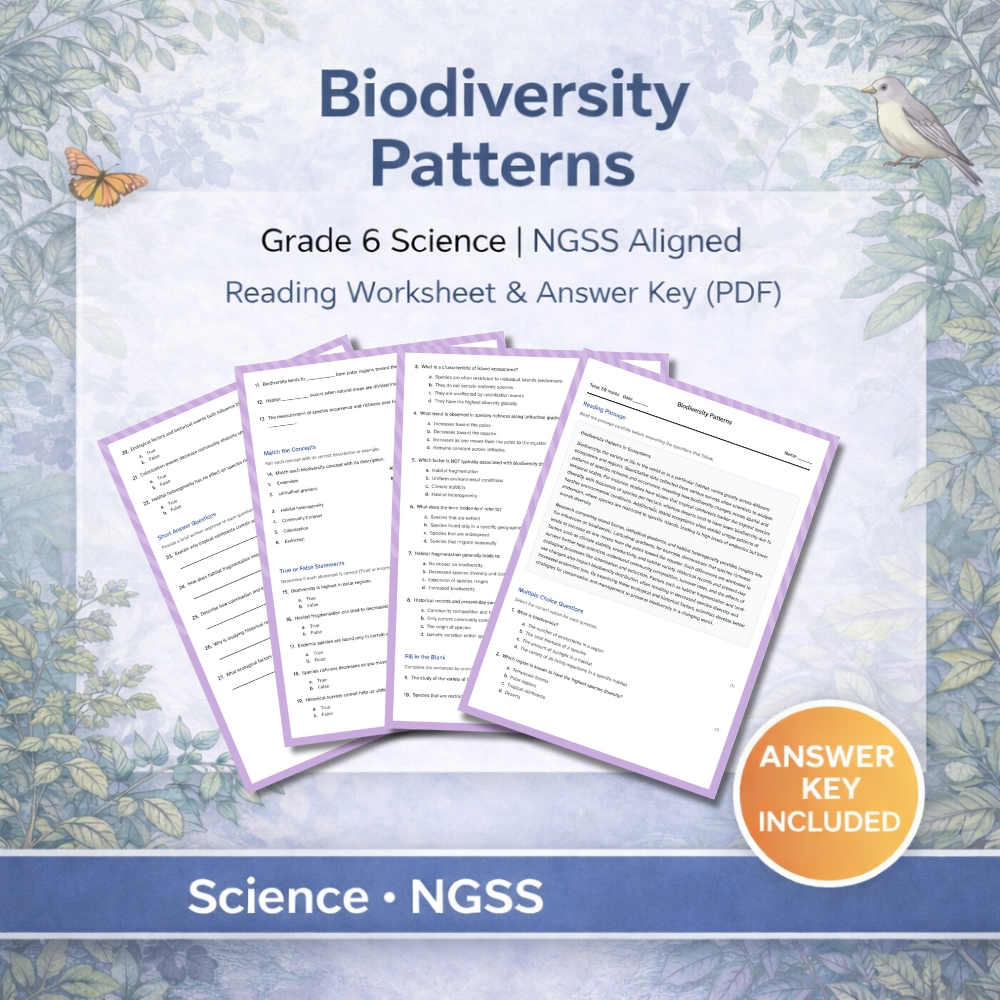
6th Grade Science | Biodiversity Patterns | NGSS Worksheet & Answer Key
Created byCedar Grove LearningLearning Objectives
- Understand how species occurrence and richness reveal biodiversity patterns across different ecosystems.
- Analyze and interpret data related to biodiversity, endemism, and community composition.
- Compare biodiversity variations across islands, latitudinal gradients, and habitats.
Also included in: Grade 6 Science | Ecosystems, Evolution & Biodiversity | NGSS Worksheet Bundle +1 more
Instant download

Comparative Flight Learning Stations | Grade 6 Air and Aerodynamics
 Created byMTS Academic Studio
Learning Objectives
- Compare how different flying devices create lift and drag
- Explain how design features affect flight stability
- Compare design choices that influence maneuverability
Also included in: Grade 6 Air and Aerodynamics Science Stations Bundle | Alberta +2 more
Instant download

Cell Evidence and Biological Organization
 Created bythe curious pencil
Learning Objectives
- Identify cells as the basic units of life using observational evidence.
- Distinguish single-celled organisms from multicellular organisms.
- Explain how cells relate to tissues, organs, and whole organisms.
Also included in: Grade 6 Science Cells & Organisms Worksheets Bundle | NGSS +2 more
Instant download

6th Grade Science – Aerodynamics & Flight Worksheet (Alberta Standards) (PDF)
 Created bySilver Birch Teaching
Learning Objectives
- Compare how kites, gliders, and round canopies behave using lift, drag, and control ideas
- Explain how glide ratio and lift-to-drag performance relate to endurance and distance
- Use Alberta contexts (prairie crosswinds and valley thermals) to predict likely flight outcomes
Also included in: Grade 6 Aerodynamics & Flight Forces Science Lesson Bundle: Alberta +1 more
Instant download

Comparative Flight Worksheet | Alberta Standards Grade 6 Science Practice
Learning Objectives
- Understand the key performance parameters such as glide ratio, lift-to-drag performance, and control responsiveness across different flying devices.
- Compare and contrast the operational envelopes of kites, gliders, and round canopies in regional atmospheric conditions.
- Analyze how design parameters influence endurance versus maneuverability in flight devices.
Instant download

Grade 6 Science | Oceans Regulate Climate Worksheet | NGSSS Aligned
Created byLumora LearningLearning Objectives
- Explain how oceans absorb, store, and release heat more slowly than land.
- Describe how ocean heat content can influence evaporation, humidity, and weather patterns.
- Connect ocean circulation and moisture supply to milder coastal temperatures and early climate signals.
Instant download

Cell Evidence Worksheet | NGSS Grade 6 Cells & Scientific Evidence
 Created byAmber Owl Education
Learning Objectives
- Describe how microscopy and preserved specimens provide evidence that cells are the basic unit of life.
- Distinguish single-celled organisms from multicellular organisms using observable cell features.
- Explain how the organization from cells to tissues, organs, and whole organisms is supported by empirical observations.
Also included in: Cells & Scientific Evidence Lesson Bundle – Grade 6 Science NGSS +1 more
Instant download

Grade 6 Design Refinement Worksheet | Practice & Assessment PDF
Created byClear Sky ClassroomLearning Objectives
- Explain how incremental design changes (shape, mass distribution, and control surfaces) can improve aerodynamic performance and safety.
- Identify criteria and trade-offs involved in refining a design for speed, stability, and payload.
- Describe how consistent observation of flight paths and simple measurements can support design decisions.
Also included in: Grade 6 Air and Aerodynamics Science Lesson Bundle (Alberta Framework) +1 more
Instant download

Cellular Respiration Assessment for Grade 6 Science | California Standards
Created byPrism Point LearningLearning Objectives
- Explain what cellular respiration is and why cells need it
- Describe the role of oxygen and the release of energy during cellular respiration
- Identify how matter changes during respiration and how wastes are produced
Also included in: Grade 6 Energy and Matter Cycles Science Lesson Bundle | California Standards +1 more
Instant download

Air and Aerodynamics Worksheets: Lift, Drag & Flight | Grade 6 Science
 Created bySunny Desk Resources
Learning Objectives
- Compare how kites, gliders, and round canopies differ in glide ratio and lift-to-drag performance
- Explain how design choices affect endurance versus maneuverability in real atmospheric conditions
- Identify how control responsiveness relates to stability and pilot input
Also included in: Air and Aerodynamics Grade 6 Alberta Science Worksheets Bundle +1 more
Instant download

Grade 6 Science | Thermal Energy Transfer Worksheet | NGSSS Aligned
Created byLumora LearningLearning Objectives
- Explain how thermal energy transfers through conduction, convection, and radiation
- Identify which thermal energy transfer mechanism is occurring in everyday scenarios
- Use particle and fluid ideas to justify answers about heat movement
Instant download

Thermal Energy Transfer Worksheet Grade 6 Science | Heat Transfer
Created byPrism Point LearningLearning Objectives
- Explain how thermal energy transfers through conduction, convection, and radiation.
- Identify the medium and movement involved in each thermal energy mechanism.
- Use evidence from everyday examples to determine which transfer mechanism is happening.
Also included in: Grade 6 Energy, Matter & Motion Lesson Bundle | Florida NGSSS
Instant download

Grade 6 Biodiversity Patterns Worksheet | NGSS Practice PDF
Created byClear Sky ClassroomLearning Objectives
- Understand how species occurrence and richness reveal biodiversity patterns across ecosystems.
- Identify different factors influencing biodiversity, such as habitat heterogeneity and colonization.
- Interpret data displays related to species diversity and endemism.
Also included in: Grade 6 Biological Evolution: Unity & Diversity Science lesson bundle NGSS +1 more
Instant download

Biodiversity Richness and Turnover Worksheets | Grade 6 Science
 Created byTeachers Club
Learning Objectives
- Describe how species richness and species occurrence can show biodiversity patterns across space and time
- Compare island faunas, latitudinal gradients, and habitat heterogeneity as examples of biodiversity variation
- Explain how turnover and community composition can be assessed using historical records and present-day surveys
Also included in: Biological Evolution & Unity and Diversity | Grade 6 Science NGSS +2 more
Instant download

Grade 6 Thermal Energy Transfer Worksheet with Answer Key | Florida NGSSS
Created byEvergreen Desk EducationLearning Objectives
- Explain how conduction, convection, and radiation transfer thermal energy
- Identify the role of matter (solids, liquids/gases, or space) in each thermal transfer mechanism
- Use evidence from everyday examples to choose the correct thermal energy transfer process
Instant download

Reactants and Products Worksheet | Standards-Aligned Grade 6 Science Practice
Learning Objectives
- Understand the difference between reactants and products in a chemical reaction.
- Identify properties that change during a chemical reaction and how they indicate a reaction has occurred.
- Interpret particle diagrams showing atoms and molecules before and after reactions.
Also included in: Grade 6 Physical Science Lesson Bundle for Science – California Standards +1 more
Instant download

6th Grade Science | Comparative Flight Reading Worksheets (PDF Answer Key)
Learning Objectives
- Compare the glide ratios, lift-to-drag performance, and control responsiveness of different flying devices.
- Understand how design parameters influence endurance versus maneuverability in kites, gliders, and round canopies.
- Analyze the regional atmospheric factors, such as prairie crosswinds and valley thermals, affecting flight outcomes.
Also included in: Grade 6 Science | Flight Physics & Aerodynamics UNIT Pack (Answer Keys Included) +1 more
Instant download

Grade 6 Reactants and Products Worksheet | Practice & Standards PDF
Created byClear Sky ClassroomLearning Objectives
- Describe reactants and products as the starting materials and the substances formed in a chemical reaction.
- Identify evidence that a chemical reaction occurred by comparing properties of reactants and products.
- Use particle diagrams to explain how atoms are rearranged during a reaction.
Instant download

Grade 6 Science | Reactants & Products - Daily Reading Comprehension
Created byCoral Reef LearningLearning Objectives
- Understand the difference between reactants and products in a chemical reaction.
- Learn how to identify reactants and products from particle diagrams.
- Explain how the properties of substances change after a chemical reaction.
Instant download

Grade 6 Science | Reactants and Products Worksheet | California Standards
Created byLumora LearningLearning Objectives
- Explain the difference between reactants and products in a chemical reaction
- Identify evidence that a chemical reaction occurred using changes in properties
- Use particle diagrams to describe how atoms rearrange from reactants to products
Instant download

Grade 6 Science | Cell Evidence - Daily Reading Comprehension
Created byCoral Reef LearningLearning Objectives
- Understand the basic structure and features of cells through microscopy images.
- Identify different cell types and their specialized structures.
- Distinguish between single-celled and multicellular organisms based on cellular features.
Instant download

Grade 6 Science | Cellular Respiration Worksheet | California Standards
Created byLumora LearningLearning Objectives
- Explain how cellular respiration converts chemical energy in food into energy cells can use
- Describe the role of oxygen and the exchange of gases during cellular respiration
- Identify what happens to matter and energy products produced during respiration
Instant download

Grade 6 Speed and Velocity Worksheet | NGSS Practice PDF
Created byClear Sky ClassroomLearning Objectives
- Distinguish between speed and velocity using direction and units
- Calculate and interpret average speed from distance and time
- Explain how changing speed and changing direction affect motion
Instant download

Thermal Energy Transfer Worksheet | Standards-Aligned Grade 6 Science Practice
Learning Objectives
- Understand the three main mechanisms of thermal energy transfer: conduction, convection, and radiation.
- Identify examples of each energy transfer mechanism in real-world situations.
- Explain how the medium involved affects the process of thermal energy transfer.
Also included in: Grade 6 Matter, Energy, and Forces Science lesson bundle – Florida (NGSSS) +1 more
Instant download

Oceans Regulate Climate Worksheet | Grade 6 Weather & Climate Science
Created byPrism Point LearningLearning Objectives
- Explain how oceans absorb, store, and release energy to reduce temperature extremes.
- Describe how ocean heat affects evaporation, water vapor, humidity, and atmospheric stability.
- Connect ocean circulation and changes in ocean heat content to weather patterns near coastlines.
Also included in: Grade 6 Weather & Climate Science Lesson Bundle | Florida NGSSS
Instant download

Grade 6 Science | Comparative Flight - Daily Reading Comprehension
Created byCoral Reef LearningLearning Objectives
- Understand the differences in design features of kites, gliders, and round canopies.
- Identify how glide ratio, lift-to-drag performance, and control responsiveness affect flight.
- Explain how regional atmospheric conditions influence flying device performance.
Also included in: Air and Aerodynamics Lesson Bundle – Grade 6 Science Alberta Reading Comp. +1 more
Instant download

Grade 6 Moon Relationships Worksheet | Practice NGSS PDF
Created byClear Sky ClassroomLearning Objectives
- Describe the geometric relationships among Earth, Moon, and Sun that produce lunar phases and eclipses.
- Explain the sequence of primary lunar phases and the conditions for solar and lunar eclipses.
- Use observational records to understand periodicity and predictability of Earth–Moon–Sun configurations.
Also included in: Grade 6 Earth's Place in the Universe Science Lesson Bundle: NGSS +1 more
Instant download

Cell Evidence Microscopy Worksheet | NGSS Grade 6 Science Assessment
 Created bySkylark Worksheets
Learning Objectives
- Identify evidence from microscopy and preserved specimens that supports the claim that cells are the basic unit of life.
- Differentiate single-celled organisms from multicellular organisms using observable traits such as size, compartments, and organization.
- Explain how characteristics seen in cells and tissues provide evidence for relationships among cells, tissues, organs, and whole organisms.
Also included in: Grade 6 Cell Systems and Energy Pathways Science Lesson Bundle NGSS +1 more
Instant download

Mixture Separation Worksheet | Standards-Aligned Science Practice Grade 6
Learning Objectives
- Understand that mixtures are combinations of substances that retain their individual properties.
- Identify physical separation methods based on differences like density, particle size, boiling point, and solubility.
- Describe how oil and water separate without chemical reaction.
Also included in: Grade 6 Matter, Energy, and Forces Science lesson bundle – Florida (NGSSS) +1 more
Instant download

Grade 6 Heat and Temperature Worksheet | NGSS Practice PDF
Created byClear Sky ClassroomLearning Objectives
- Distinguish heat from temperature using the idea of energy transfer versus particle motion.
- Explain how heating and cooling depend on temperature differences and energy movement.
- Compare how mass and material affect how much heat energy a system can hold at the same temperature.
Instant download

Design Refinement Worksheet | Standards-Aligned Grade 6 Science Practice
Learning Objectives
- Understand how incremental adjustments to shape, mass distribution, and control surfaces affect aerodynamic performance and safety.
- Identify criteria for evaluating modifications in aeronautical design.
- Analyze trade-offs between speed, stability, and payload in design refinement.
Instant download

Atom Conservation Worksheet Grade 6 Science Matter Conservation Practice
Created byPrism Point LearningLearning Objectives
- Explain how atoms are conserved during chemical reactions using particle diagrams.
- Describe reactants and products as rearrangements of atoms rather than creation or destruction.
- Use particle-level evidence to connect conservation of atoms to observable changes.
Instant download

Grade 6 Understanding the Moon's Phases Worksheet | NGSS Space Science
 Created byBRIGHT PATH RESOURCES
Learning Objectives
- Identify and describe the different lunar phases based on the Moon's relative position to Earth and the Sun.
- Explain how lunar phases are observed from Earth.
- Understand the geometric relationships involved in lunar phases and eclipses.
Also included in: Earth's Place in the Universe Grade 6 Science Worksheets Bundle | ngss +2 more
Instant download

Chemical Evidence Worksheet Grade 6 Science Chemical Change Activities
Created byPrism Point LearningLearning Objectives
- Identify chemical evidence by observing changes such as color change, gas formation, and precipitates.
- Explain why chemical evidence shows a change in composition, not just temporary mixing.
- Use examples like iron rusting and burning paper to connect observations to particle-level changes.
Instant download
About Grade 6 Science Worksheets
Explore Grade 6 Science worksheets for classwork, homework, or review. Our 6,100 printables download instantly as PDFs.
MyTeachingSheets worksheets are made by real teacher-authors and checked before they go live. Download any as a print-ready PDF for lessons, homework, or independent practice — most include answer keys, and previews are always free.